The population of Perry’s Lake, Gadd’s Green, Turner’s Hill and Tippity Green had expanded to from 384 to 412 since 1841. But there was more variation in jobs than in 1841 and more occupations were shown for women. Scholars were also noted, though not many and these are detailed in a later chart.
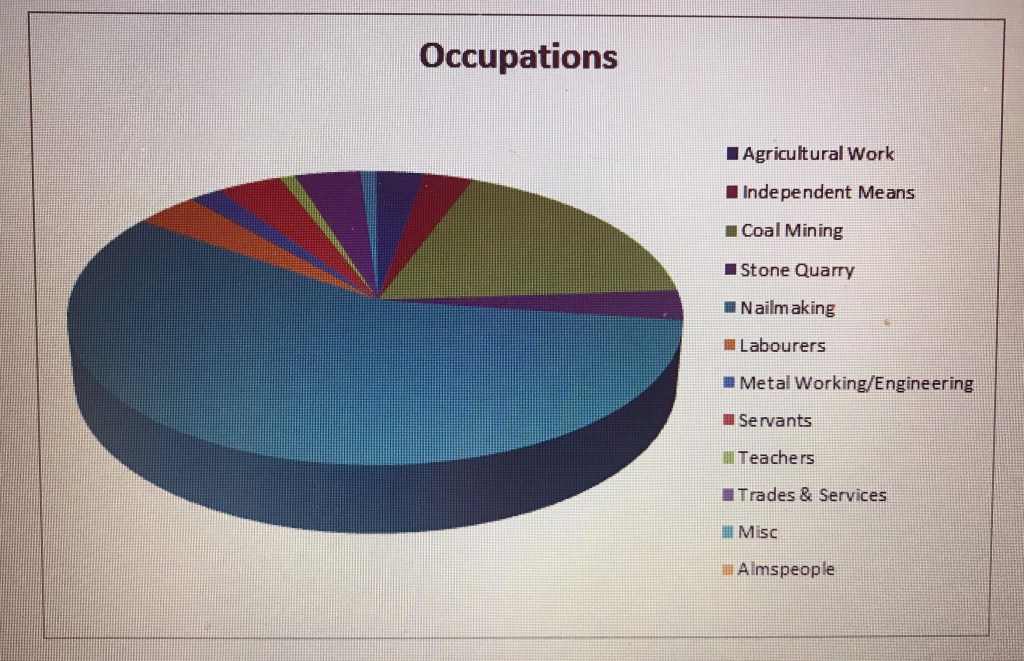
Occupations
Agricultural Labourer 3
Almspeople 2
Annuitants 4
Boat Loader 1
Butcher 1
Coal miners 36
Colliery Clerk 1
Dressmaker 3
Engine worker 1
Engineer 1
Errand boy 1
Farmer 1
Farm Labourer 2
Female Servant 4
Furnace Labourer 1
General Servant 5
Labourer 8
Laundress 1
Man servant 1
Mine agent & Surveyor 1
Nailer 117 57 W, 60M
Nail Master 1
Nail Reckoner 1
Nailer’s Tool Maker 1
National School Teacher 2
Needlewoman 1
Nurse 1
Proprietor of Lands 2
Puddler 1
Retired nailer 1
Stone Cutter 4
Stone labourer 2
Stone miner 1
Turnpike Gate Keeper 1
Victualler and butcher 1
White ash maker 1
So the number of different occupations has changed since 1841, some with only I or two people.
Nail making is still the dominant occupation, with miners the only other numerous group. The numbers of men and women are about equal. In most of this group the enumerator describes people making nails as ‘Nail forgers’, a recognition that they were skilled workers producing wrought iron nails in their forges, though another enumerator still calls them simply ‘nailers’. It is possible that some women and children made nails and simply did not declare it, also that some men made nails when other work was not available (such as agricultural workers in winter) or when they got home from work, so the number of nailmakers may be understated.
Other metal working trades such as a furnace labourer and a puddler are noted so skills were diversifying as new industries expanded or moved into the area.
Stone quarrying is not as big an employer as I had expected although it is possible that some of the labourers worked at the quarry and had not specified that, in addition to those who were listed with a specific stone working skill.
Professionals such as an engineer, a Mine Agent and two teachers (brother and sister) have appeared. The former Census showed John Whitehouse as the Registrar of Births and Deaths but in this Census his wife is shown as a widow so presumably this role passed to someone else.
The ‘nurse’ was a child of 8.
The Bull’s Head in Tippity Green was a public house, dating from 1834, though owned by the Dudley family and Benjamin Bowater is listed as ‘Vittler and Butcher’ in Tippity Green in this census, presumably at the Bull’s Head –and the name may have come from Benjamin’s alternative occupation! Publicans were ‘Licensed Victuallers’ so this fits. Hitchmough’s invaluable guide to Black Country pubs lists Joseph Bowater as Licensee from 1834-1854. There is no Joseph Bowater listed in the hamlets in this census though there is a Joseph Bowater who was landlord of a pub in Cradley Heath so perhaps it was a family occupation. Benjamin Bowater also had another butcher and three servants living in his household so could divide his time between butchery and inn-keeping. According to Hitchmough, The Portway Tavern was licensed premises from about 1850, according to Hitchmough with James Adshead Levett Snr and Jnr and then William Levett holding that licence for the next half century. There is no mention of a tavern in the census or of a licensee. It is possible that the Tavern was already operating informally as a pub at the time of this census, the Levetts who ran it later were based at Brickfield Farm in 1851 though away from home on the census night.
For the chart I have combined the jobs associated with nailing and other occupations into groups.
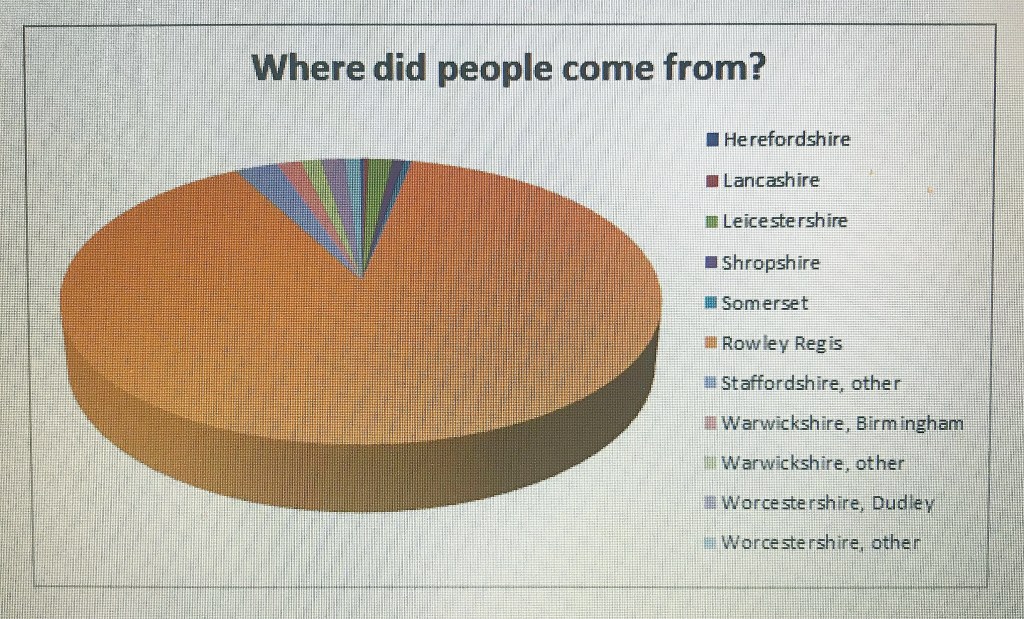
Where did people come from?
Binton, Warwickshire 2
Gloucestershire, St Briavels 1
Herefordshire 1
Lancashire 1
Leicestershire, Mountsorrel 6
Shropshire, Old Park 1
Shropshire, Broseley 1
Shropshire, Stottesdon 1
Somerset, Wellington 2
Staffordshire, Rowley Regis 364
Staffordshire, Sedgley 1
Staffordshire, Tipton 4
Staffordshire, Wednesbury 1
Staffordshire, Wednesfield 1
Staffordshire, West Bromwich 1
Staffordshire, Tettenhall 1
Staffordshire, Tipton 2
Warwickshire, Birmingham 6
Warwickshire, Coventry 1
Warwickshire, Nuneaton 1
Warwickshire, Sambourn 1
Worcestershire, Dudley 6
Worcestershire, Halesowen 2
Worcestershire, Oldbury 1
Worcestershire, Wychbold 1
Again, the great majority are from Rowley itself, with a sprinkling from the surrounding area. Looking at other places, such as Mountsorrel in Leicestershire, I was interested when I looked this up to find that it was renowned for its granite quarry, just like Rowley Regis, so presumably the skills required were transferable. St Briavels in Gloucestershire was in the heart of the Forest of Dean Free Mining area so again there was a common industry.
How old were they?

Men Women
Age
80+ 1 –
75-79 1
70-74 1 5
65-69 1 1
60-64 3 3
55-59 2 3
50-54 9 10
45-49 9 7
40-44 8 9
35-39 12 6
30-34 11 12
25-29 19 20
20-24 27 18
15-19 26 18
As in the 1841 Census, not many lived much past sixty.
Younger people under the age of 15

14 3 5
13 2 3
12 4 5
11 2 4
10 5 7
9 7 6
8 5 4
7 9 5
6 1 5
5 9 3
4 3 7
3 8 9
2 4 5
1 7 7
-1 5 7
74 boys, 82 girls.
Scholars by age

Boys Girls
13 – 1
12 1 1
11 – 1
10 3 1
9 4 1
8 2 1
7 5 2
6 1 –
5 2 1
4 – 3
18 boys out of 74 and 11 girls out of 82 were at school. We do not know how many children were at school in 1841 but this shows that schooling was still far from the norm. Literacy was very much the exception, especially for girls, it seems and from the age of about eight, children were making nails and some were employed outside the home in quarries and mines.
I hope these statistics will be of interest. There will be more for the later censuses, as I transcribe and analyse them. Apologies for the poor quality images – technologically challenged author here, though creating charts is new for me so I am learning!
Hopefully, as more censuses are done we shall be able to see the occupations change over time and I hope to do more detailed work on the families there.
 rowleyregislosthamlets.co.uk