The 1841 Census – Turner’s Hill 3 Redferns but mainly Downings

The next family on the 1841 Census were the Redferns, Joseph Redfern, his wife Ann Maria (nee Priest) and their elder children. This is how the family were shown in that Census:

Christian nameSurnameAgeOccupationWhether born in CountyWhether born in Scotland, Ireland or Foreign Parts
JosephRedfern35LabourerYes 
MariaRedfern40 Yes 
SarahRedfern12 Yes 
ElizaRedfern10 Yes 
JosephRedfern8 Yes 
WilliamRedfern6 Yes 
AnnRedfern4 Yes 
ThomasPriest15 Yes 

Thomas Priest was Joseph’s stepson, the illegitimate son of Ann Maria Priest.

No need for much new research on this family, I did a family study on this family in August and September 2023 which appears in two posts.

There is little new to be added to that information since then so any  interested readers may wish to refresh their memories from those posts:

The Downing Family

Next along the hill were Joseph Downing and his family, Joseph was shown as a farmer. This was their household:

Christian nameSurnameAgeOccupationWhether born in CountyWhether born in Scotland, Ireland or Foreign Parts
JosephDowning55FarmerYes 
Nancy 50 Yes 
Isaac 25 Yes 
SarahWard20Female ServantNo 
HannahHarris30 No 

The Downing Family

There are many Downings in and around the Rowley area, also in Tividale, Sedgley, West Bromwich and Harborne and many of them were owners or tenants of land and therefore more prosperous than most of the average nailers. They intermarried with other families of similar status in the area. Many of them left Wills which, where I have been able to find them, have been the source of a lot of information.

Joseph Downing (1784-1849)

Joseph’s age in the 1841 Census indicates a birth year of about 1786, bearing in mind that in this census adult ages were rounded down to the nearest five years. I had hoped that I would be able to find Joseph in the 1851 Census which would give me a more accurate year but although I found Nancy still on Turner’s Hill with various others, she was now a widow. So now I knew that Joseph had died between 1841 and 1851, into the period of civil registration so easier to find – this should give me an age from the death registration and from the burial if I was able to find that. There were several death registrations of Joseph Downings in the Dudley Registration District between those dates but only one of them was for a Joseph of the right age. Joseph Downing, aged 65, died in the first quarter of 1849 which brings me back to a birth date of about 1784. And this Joseph Downing, aged 65, and – according to the entry in the Burial Register – of Turner’s Hill was buried at St Giles on 2 January 1849. So this is definitely the right Joseph Downing. The Burial entry indicates that he died of a diseased heart.

So now I could look for a baptism of this Joseph. I searched FreeREG for a period from 1780 to 1790 in Rowley Regis and the surrounding area within 7.5 miles. Somewhat to my surprise, there were only two such baptisms – one in 1780 in Himley – a little early if our Joseph’s age was recorded correctly and quite a long way away  – and one in Rowley Regis on 11 January 1784. It seems likely that this second Joseph was our man. This Joseph was the son of Paul and Ann Downing, who had also had a daughter Mary baptised at St Giles in 1782. There were no other baptisms for this couple anywhere that I could find which makes me suspect that the Hannah Downing who died in July 1786 and was buried at St Giles may have been this Ann – Ann and Hannah are sometimes used interchangeably. Or it is possible that she was the Ann Downing who was buried at Halesowen in December 1792. The only other trace that I could find at that point of Paul Downing was a burial at St Giles in November 1823, aged 81 (giving a birth year of about 1742) and giving his abode as Turner’s Hill. So, again, that ties in neatly with this family.

Joseph’s father Paul Downing (1742-1823)

Paul is not a common name in the Downing family nor indeed in Rowley Regis at this time, as far as I can see, but I was able to find a marriage of a Paul Downing on 14 February 1782 to Ann Darby – another name associated with Rowley – by Licence (which indicates a certain level of wealth or social standing). The marriage is listed as having taken place at Rowley Regis cum Clent but I cannot see it in the Rowley Regis Register so presumably it took place at Clent.  And there was a Paul Downing baptised at Harborne on 10 February 1765 who may have been connected in some way, he was the son of John and Martha Downing. The only Paul Downing that I have been able to find in the area in the 1841 Census was a blacksmith living in Hagley Road, Harborne so it does seem that the Downings in that area used Paul as a Christian name, more so than the Rowley Downings. However, I  know from other sources (of which more anon) that this Joseph Downing was the nephew of Isaac Downing of Turner’s Hill.

There was a Paul Downing living on Turner’s Hill from at least about 1782 until 1823. I found a newspaper report that in 1821, John Fox, John Priest, Samuel Perry, Benjamin Perry and Ephraim Rollason of Rowley were convicted at Stafford Assizes for housebreaking at the dwelling-house of Paul Downing in April 1821 and stealing a coat, two sheets and other goods. This does make me think that Paul Downing must have been living in a house of a larger than average size for the village. It would not have taken four men to burgle the average small cottage in the village.

For this crime all four were sentenced to death at Stafford Assizes, which seems a harsh sentence to our modern thinking although I have been able to discover that these death sentneces were commuted and they were all were transported to Australia instead. This was in the period of demobilisation of the army after Waterloo, leading to mass unemployment, poor harvests owing to bad weather, the Peterloo Massacre in 1819 and the introduction of the Corn laws which had a disastrous impact on the poor. Who knows what motivated these four men to break in and steal, though it does not appear that they managed to steal very much and the death sentences seem draconian to us today. I had also noted that Ephraim Rollason appeared in court a couple of times previously charged with stealing so this may not have been a one-off. I cannot help thinking that it would not have made the Downing family very popular amongst the poorer families of the hamlets who lost four of their men.

There was also Isaac Downing on Turner’s Hill at this time, he was buried at St Giles in November 1814, of Turner’s Hill, aged 75, having died of asthma. It seems that Paul and Isaac were brothers. And the maps which appear to have been prepared in connection with the Enclosures in Rowley in the late 1790s or very early 1800s, also show Paul Downing as tenant of land on Turner’s Hill. Looking back, I see that I wrote at some length about the Downings (amongst other families) in my piece about the farms in the Lost Hamlets.

Joseph and Nancy

Joseph Downing married Nancy Whitehouse – again by Licence – at St Giles, on 29 March 1810, the witnesses to this marriage were Mary Downing and William Whitehouse, a really Rowley union, it seems!  A daughter Emma was baptised at Rowley on 17 September 1810, daughter of Joseph and Nancy, followed by Matilda in 1813, Isaac in 1815, Mary Ann in 1818, Lavinia (1821-1824), Amelia in 1823 and another Lavinia – Lavinia Augusta in 1829. In all of these baptisms except the first, Joseph was described as a ‘Beast Leech’.

The ‘beast leech’

A ‘beast leech’ is an old term for a man practiced in healing cattle, which would have included horses and other livestock  – a veterinary or cow doctor. The term is first recorded, according to the Oxford English Dictionary, in 1627 in a dictionary by F Holyoake and that dictionary thinks that it was a term used in English Regional dialect. Certainly there are numerous examples of this term in Yorkshire in the mid 1700s but clearly it was not limited to there. 

In archaic and Old English the word leech meant a physician, healer or surgeon and the term apparently comes from the Old English word lǣce which meant healer. This use had apparently fallen mostly out of use by the 17th century. But, as we can see, the use certainly continued in connection with animals.

And it must have been that there was a need for people experienced and knowledgeable in the treatment of sick animals in most farming communities. Doubtless some horse dealers, grooms, cattle dealers developed their own expertise in dealing with ailments and problems in their own specialisms but the description of Joseph as a beast leech over a period of years suggests that he was recognised as having particular skills in this area and earning his living from his practice and, since his uncle was also a beast leech, this may have been a family occupation.  There is certainly continuing evidence that the Downing family were particularly interested in cattle breeding.  But by 1841 Joseph was described simply as a farmer in the census.

So this was the only Census in which Joseph Downing appeared, and he died, aged 65, on the 27th December 1848 and was buried at St Giles on 2 January 1849. There is much more to say about Joseph Downing, so much that this will be a separate  post about him, soon!

Nancy Downing (nee Whitehouse) 1788-1855

Nancy Whitehouse was born in about 1788-79, which fits with both the age shown in the 1841 and from the age of 62 which she gave in the 1851 Census.  There were four Nancy Whitehouses baptised between 1785 and 1790 in the immediate area of Rowley, two in Wednesbury and one in Kingswinford. But the fourth one was baptised in Rowley Regis on 11 May 1788 which is a close fit, she was the daughter of William and Hannah Whitehouse. As Nancy gives her place of birth in the census as Rowley it seems likely that this is our Nancy.

In 1851, as a widow, Nancy was still living on Turner’s Hill. With her then were her surviving children Isaac (35), Mary (30), Amelia (27), Lavinia (21), along with a Thomas Whitehouse, aged 63, a widower shown as a ‘resident’ (not shown as a relative) and two servants – Joseph Hodgets who was a manservant, aged 20 and Caroline Wasnidge, a general servant aged 35. All of these were born in Rowley Regis except Thomas who was marked born in Staffordshire and Caroline who was born in Birmingham.

As I have often noted previously, those prosperous enough to employ servants often employed people from outside the village.

In 1851, all of the children listed were unmarried. Nancy‘s occupation was listed as an annuitant, as were her three daughters while her son Isaac was shown as a ‘proprietor of lands, etc’, as was Thomas Whitehouse. No mention of farming at all. So this was definitely a well-to-do family on both sides, it seems, owning land and wealthy enough to leave annuities for their unmarried daughters.

Where were the Downing daughters in 1841?

I was curious as to where the four girls, then 20, 17, 15 and 11 were in 1841 as they were not with their parents. The answer was that they, were with Thomas Whitehouse and a Mary Whitehouse, (b.1786, possibly his wife or his sister-in-law)at his home in High Street, West Bromwich. It seems very likely that Thomas was related to them in some way.

This Thomas Whitehouse was a Currier, these were skilled craftsmen, currying was the process of stretching and finishing tanned leather, using techniques of dressing, finishing and colouring to give the leather the desired colour. The leather was then ready to pass on to the finishing trades such as saddlery, bridlery, shoemaking or glovemaking. Walsall was at that time the capital of saddlery in England, plus the making of bridles and harnesses and leather goods, due to the proximity of lime pits used for tanning leather and metal industries supplying metal fittings so Thomas Whitehouse would have had a ready market nearby.

Whilst looking at the Whitehouse family, of whom there were many in this area, I noticed a list published in the Worcester Journal in 1845, of ‘members of the Dudley and West Bromwich Bank” which also showed their occupations and where they lived. There were seven Whitehouses listed among the investors: Richard from Oakham who was a Cattle Dealer (a source for Thomas’s hides, perhaps?); a Joseph and a John, both of Dudley and both canal carriers; a William and a William Frederick of West Bromwich, both Nail Merchants; Thomas of West Bromwich, a currier plus the representatives of a Samuel Whitehouse Deceased, also of West Bromwich and also a currier; and a William of Dudley and West Bromwich who was a Canal Carrier. There were no Downings listed among the Investors, perhaps merchants had more disposable capital than farmers, or perhaps they were more inclined to invest in banks. This is quite a close cluster of Whitehouses, who seemed – at least some of the time  – to be close to each other in location and to be occupied in complimentary businesses. It is quite possible they were all related.

William and Hannah Whitehouse’s family

I looked to see what other children William and Hannah Whitehouse had had baptised at Rowley Regis around the time of Nancy’s birth. The first was Joseph in January 1775 which makes me think that William Whitehouse and Hannah Willetts were the couple who were married at St Philip’s, Birmingham on 14 February 1774. Then followed Samuel in 1777, William in 1780, Thomas in 1785, and Nancy in 1788. However, of these, I have discovered, from the Will of William Whitehouse (abt 1751-1827), Nancy’s father, that his son William died in 1812, sons Samuel and Thomas both died in 1822, leaving only his eldest son Joseph and Nancy herself of his children. So whoever the Thomas Whitehouse shown in the 1841 Census was , he was not Nancy’s brother, though he was very likely related.

So the Thomas and Samuel Whitehouse who were both curriers in West Bromwich must have been brothers from another or at least more distant twig of the Whitehouse family.

But it was when I was looking at these Whitehouse men that I came across a fascinating story of which more in my next post. But what I discovered for certain was that Samuel and Nancy and Thomas Whitehouse –were definitely siblings and that Joseph Downing had married Nancy Whitehouse in 1810 and Samuel Whitehouse had married Mary Downing in 1813 – Joseph’s sister and only sibling. So the families were double in-laws and clearly very closely connected!  

Nancy Downing died in 1855 and was buried at St Giles on 22 August that year, her age given as 67 and her abode as Turner’s Hill. The person making the burial entry noted that the cause of death was General Decay. Thomas Whitehouse, appears to have died in May 1852 in Rowley Regis and was buried in West Bromwich, which had previously been his business base and home for many years.

Isaac Downing (1815-1874)

Isaac was still living on Turner’s Hill in 1851, listed within his mother’s household and described as a “Proprietor of Lands, etc.” His sisters Mary, Amelia and Lavinia were also living there by that time and Thomas Whitehouse.

In 1861 Isaac was still there – although it is clear from the Census that the family were not living at Turner’s Hill Farm, as this is shown separately and occupied by a different family. The Downing abode was a private house. By this time, his mother and Thomas Whitehouse had died and Isaac, by then 42 and unmarried, was shown as the Head of the Household and described as “Principal Occupation: General Superintendence of the cultivation of Land”. Again his three sisters were also living there, all single.

By 1871, Isaac was 55 and shown as a Landowner and Farmer, employing 4 men. His sisters Mary and Lavinia were still with him, all of them unmarried.

Isaac died in 1874, aged 59 and was buried at St Giles on 20 November 1874. He was the last surviving issue of Joseph and Nancy.

Joseph and Nancy’s daughters

From another source, I learned that Mr and Mrs Samuel Whitehouse had been married six or seven years, and had no children of their own. Joseph Downing, who had married Samuel Whitehouse’s sister had four or five children. Samuel Whitehouse had reportedly taken Joseph and Nancy’s eldest daughter Emma from her birth and had adopted her as his own. He had also sent two other of Downing’s children to school, Whitehouse expressing his great satisfaction at what he had done, and saying what good children they were.

Samuel Whitehouse and his brother Thomas both died in 1822 when Emma was about 12 but I suspect that at least one of the girls, if not all, remained with his widow Mary nee Downing. Another Thomas Whitehouse, a bachelor, married a Mary Whitehouse, a widow, by Licence in West Bromwich on 27 September 1827 and I suspect that this is the Thomas and Mary Whitehouse with whom the girls were living in 1841. 

Just to add to the confusion about this family, when this second Thomas died in 1852, in his will he referred to his ‘late brother Samuel’ – don’t you just love it when branches of families use all the same Christian names…?  And in the same Will, the second Thomas left property to a William and Joseph Whitehouse of Rowley, some minor bequests and the residue of his estate to the Downing children, naming Isaac as his nephew. Isaac was Mary’s nephew – but not his but it appears he considered Isaac as such.

Of Joseph and Nancy’s children then, their second daughter Matilda (1813-1837) had died of fever on 24th October 1837, aged 24 and of The Heath, West Bromwich (which was where Samuel and Mary Whitehouse were living at the time of his death and presumably where she continued to live) and was buried at West Bromwich. Emma (1810-1850) had died of Typhus Fever at Great Malvern, unmarried, aged 40 in 1850 and was also buried at West Bromwich. Amelia (1824-1861) died in 1861 and was buried at St Giles  on 22 July. Lavinia Augusta (1829-1873) died on 12 March 1873 of Heart disease and was buried at St Giles on 18 March; her sister Mary Ann (1818-1873) died ten days later on 22 March 1873 of Hepatitis and Fatty degeneration of the heart and was buried at St Giles on 27 March. Isaac was described in their Probate Records as ‘Brother and only Next of Kin’. Isaac died the following year on 15th November, with Angina Pectoris given as the cause of death.  None of the children married.

So, this particular family ended in 1874. What a contrast with some of the other, poorer families in the area who left dozens of grandchildren and great-grandchildren. I have not yet managed to find all of the Wills for this branch of the family and suspect they may be at Stafford Record Office but will continue to try to trace them for the further information they contain.

What sort of social life did the family lead?

I wondered what sort of life Isaac lived, whether the unmarried siblings were reclusive or whether they took part in life in the village.

What was Turner’s Hill House like?

I found an advertisement in the County Advertiser in 1875 which was placed by the Trustees of the Will of this Isaac Downing. This refers principally to the site as a

“Freehold Mineral Property , comprising a desirable Residence and Premises and several closes of very rich Pasture Land adjoining, with an extensive bed of Rowley Rag stone therein, together with the very valuable MINES and MINERALS thereunder ,situate at Turner’s Hill”.

This was being sold at Dudley in One lot and there was some further description of the house itself.

“That very desirable and compact FREEHOLD ESTATE, called TURNER’S HILL, with residence, pleasure grounds, luxuriant Shrubberies, Greenhouses, Vineries, Stables, Coach-Houses, Outbuildings, Entrance Lodge and Premises occupied therewith, and  several closes of very fertile Pasture Land, with the Outbuildings and Cottages adjoining, the whole lying well together and comprising an area of nearly 20 acres.”

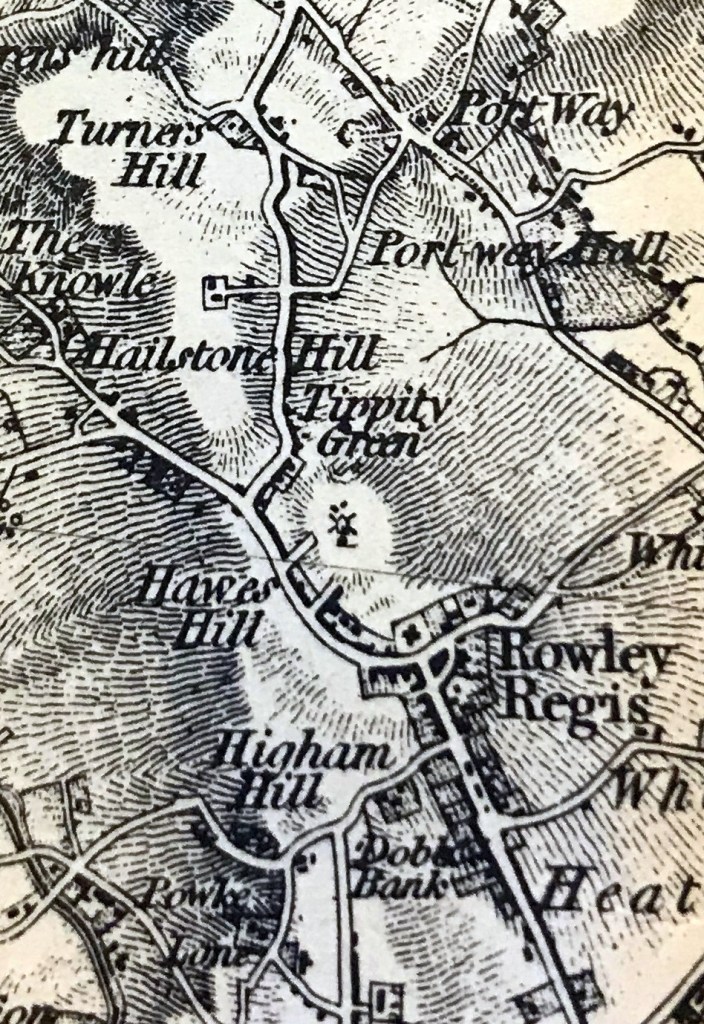
This surprised me, I had not realised how extensive the estate was. I wonder where the Entrance Lodge was? On Turner’s Hill or somewhere off Portway? So I looked on the NLS webpage and found this image of the top of Turner’s Hill which shows Turner’s Hill Farm quite clearly. And I now think that the estate called Cloudlands on this map is Turner’s Hill House – it fits the description above very well, it has shrubberies and gardens, it has outbuildings and cottages, it has an entrance lodge!  
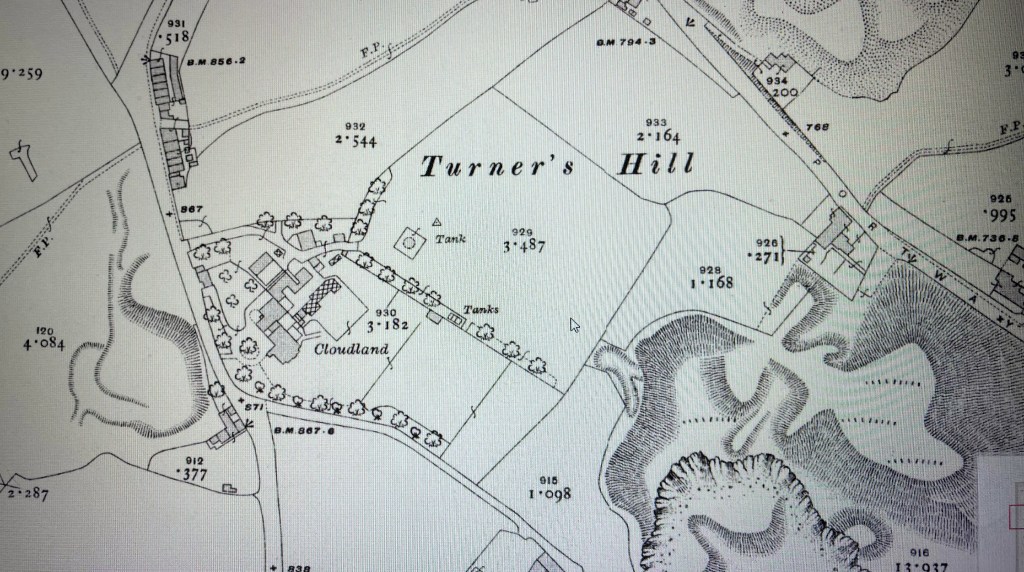
Copyright: National Library of Scotland Creative Commons Re-use.

Another paragraph notes “This property is situated in the very centre of the South Staffordshire Coalfield, and the Earl of Dudley’s new sinkings at Lye Cross are only a few yards from it’s boundary, proving beyond doubt the existence of Thick Coal of the very best quality under the entire Estate.”

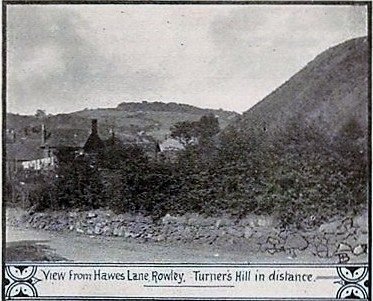
The earlier Isaac Downing probably lived here, too and the previous news snippet shows that he had an estate worth £1,000 a year, so presumably this was that estate. The 1800 Enclosure Map shows Isaac Downing and Paul Downing as tenants in this area. And was this the house that attracted the attention of four burglars?  In another context, in 1822, I noted Joseph Downing was described as a “opulent farmer”. So it appears that the family were quite wealthy.
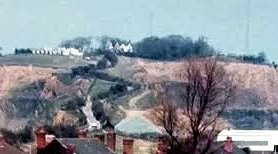
Copyright: Mike Fenton.

Comparing this photograph with the map and the position of the road up between the quarries, I think that the large white house in the middle of the picture is probably Turner’s Hill House, much nearer to the edge of the quarry when this picture was taken than when the map was surveyed in the 1890s.

So the family lived in some luxury and they owned most of the surrounding cottages. I was surprised that there is very little evidence of live-in servants, in the census entries there is usually only one or at most two servants, I would have expected coachmen, grooms or gardeners, with the buildings and gardens listed.

From the description in the advertisement, I now think that all of this little group of cottages was associated with Turner’s Hill House and the farm – and quite possibly most of the people living in the houses worked for the Downings in one way or another. Perhaps Mary Cooper the washerwoman or Hannah Cooper or Phoebe Brinton living a few yards down the lane, actually worked for the Downings? I had wondered why a washerwoman would live so far from the village so that she or her customers would have to carry laundry a long way. But if she worked in a laundry at Turner’s Hill House, that would make more sense. So, in effect, this seems to have been another self-contained enclave in a similar way to Gadd’s Green, but associated – at least in the mid to late 1800s with the Turner’s Hill House estate, and the Downing family. This makes sense in many ways since the hamlet was so physically removed from neighbouring hamlets by a steep hill.

Isaac’s social standing

There is not much to be found about the Downing daughters and their lives. But their brother was easier to track. I noticed that in 1851, Isaac was one of several gentlemen appointed as assignees to hold finds in a bankruptcy case of a local Bank which implies a certain respectability and good standing in the financial community.  In 1855, Isaac was shown as one of the Churchwardens which implies at least some association with St Giles’s, the Parish Church. In 1856 Isaac was listed as holding a General Game Certificate and certainly his father Joseph and his uncle Samuel went shooting regularly. In 1867, Isaac Downing, of Turner’s Hill was elected as a member of the Royal Agricultural Society which indicates a continuing interest in farming then.

In the 1851 and the 1871 censuses the family had visitors staying who were named Crump and it seems that these were the children of the then Vicar William Crump so clearly the family had some social contacts within the village.

The Cattle Connection

You may remember, when I listed Whitehouses in business, earlier in this piece, I mentioned a  Richard Whitehouse from Oakham who was a Cattle Dealer. This must have been very close to the Downing estate and it is more than possible that Richard was related to Nancy, Joseph Downing’s wife.

The Sale of the Shorthorn Cattle Herd

I wonder whether this was a particular Downing interest, as in 1872, shortly before Isaac Downing died, there were numerous reports including one in the Gloucester Journal that he and another man Mr John Harwood of Winterfold, Kidderminster, sold their

“entire herds of shorthorn cattle, consisting of about 65 Head of Bulls, Cows and Heifers, of the Oxford, Waterloo, Wild Eyes, Kirklevington, Lally, Blanche and Surmise Tribes. More than half the Stock are directly descended from animals bred at Kirklevington, and the others largely inherit this highly fashionable blood. The sale includes the magnificent Bull Third Duke of Claro (23729), whose Sire and Dam were both by the celebrated Seventh Duke of York (17754(), and the superb Bull Eighth Duke of Geneva (28390). The young stock are by these excellent Sires, and the Cows and Heifers are served by them. Catalogues, with pedigrees may be had on application to Mr Strafford of Euston Square, London or of Mr Minett, at Winterfold.” Clearly this was no small local sale and generated considerable interest and the animals sold for what were described as “extraordinary prices” .

Another report in that Journal  a little later describes the sale itself. The sale was held

“in one of the large parks connected with the residence of Mr John Harward at Winterfold, situated about three miles from Kidderminster.  There was a large attendance of Shorthorn Breeders from all parts of the country. Among those present were the Lord Fitzhardinge, the Earl of Bective, Colonel Kingscote, MO, the agents of Lord Skelmoersdale, Mr Brogden MP, Colonel Morris (New York), the agent of the Duke of Devonshire, the agent of Sir W Throckmorton, etc.

Luncheon was served, prior to the sale, to which about 500 sat down. Five hundred! That must have been quite a sight to see! This picture shows Winterfold House in 1850 so it was a very grand establishment.
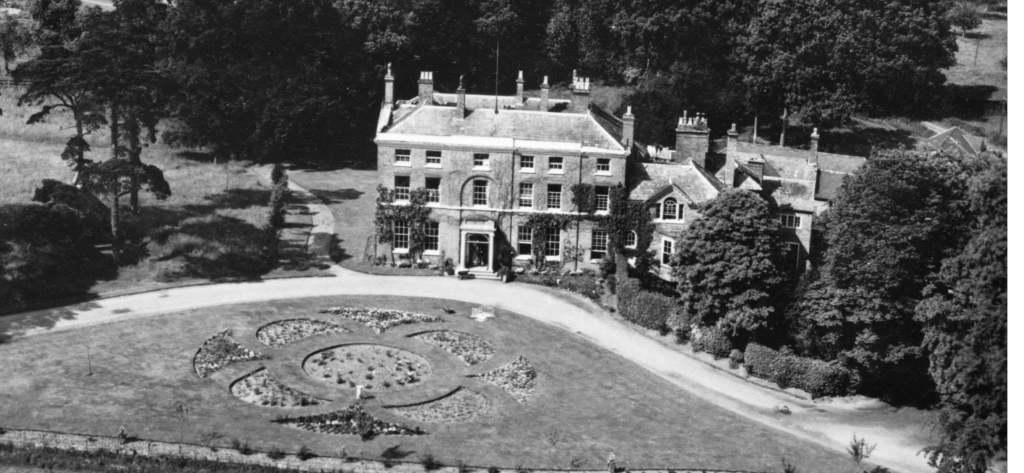
Copyright: Historic England.

At the sale, one animal, named as the Fifth Maid of Oxford, was sold to Mr G Moore of Whitehall, Cumberland for 900 guineas. Lot 26 was sold to a Mr Bowley of Cirencester for £210 guineas and was said to be one of the purest and best bred animals of that tribe in the Kingdom. In the eight-bull department – Lord Fitzhardinge  (Of the Berkeley Castle estate near where I live now) had started the bidding for the Duke of Geneva, at £900 guineas but it was eventually  purchased by Mr Leney of Kent, for the sum of £1,650 guineas,  said to be a “remarkable fine animal, fully developed in every particular, healthy in appearance and well fed.”

The sums raised by the sale were: Cows £15,458; heifers £12,343; and the bulls £3,114. The average price per head was £253/16s. the highest on record.

So if Isaac was closely involved with the breeding of this herd, he was clearly a serious breeder. John Harward was also named as one of the executors of Isaac’s Will so they were at least good friends although I have found no evidence that they were related.

John Harward was a solicitor and apparently a temperance campaigner and preacher. He only outlived Isaac by a few years but I noted that there was another very large sale of Harward’s cattle in 1880 and almost continuous reports of sales of individual beasts after Isaac’s death so clearly Harward had not sold his entire herd at the sale detailed above, perhaps only ones jointly owned with Isaac Downing. I have also learned from the National Archives catalogue that a cache of legal documents relating to the “Downing/Whitehouse/Crump family” was deposited at Stafford Record Office by Harward and Evers, Solicitors of Stourbridge, John’s company, so I am considering whether a visit to Stafford Archives might be worthwhile at some point.

Summary

Generally building the pictures of the lives of this family was slow because they were not very well documented anywhere, as other families often are on Ancestry or Find My Past. Perhaps this is because there were no descendants, so there was less reason for family historians now to document them so fully.

But it appears that Isaac, at least, was not completely reclusive and played a part in society and was, clearly, extremely wealthy in comparison with most residents of the village. It seems rather sad that this wealth and privilege did not prevent all the children of Joseph and Nancy remaining single and dying at relatively early ages and without leaving children to continue their legacy.

One more post to come on the residents of Turner’s Hill in 1841 and another on a particular episode the Downing/Whitehouse families!
The 1841 Census – Turner’s Hill 2 – The Rollasons

The next family listed in the 1841 Census is that of William “Robinson“, it appears or that is how it is transcribed on Ancestry – bear with me. Start with the basics – this is the family group as shown on the page, as transcribed on Ancestry and  on FindMyPast:

Christian nameSurnameAgeOccupationWhether born in CountyWhether born in Scotland, Ireland or Foreign Parts
WilliamRobinson40Coal minerYes 
JaneRobinson35 Yes 
JeremiahRobinson15 Yes 
EdwardRobinson15 Yes 
JamesRobinson13 Yes 
RodahRobinson11 Yes 
MarthaRobinson9 Yes 
RuthRobinson4 Yes 
ElizabethRobinson1 Yes 

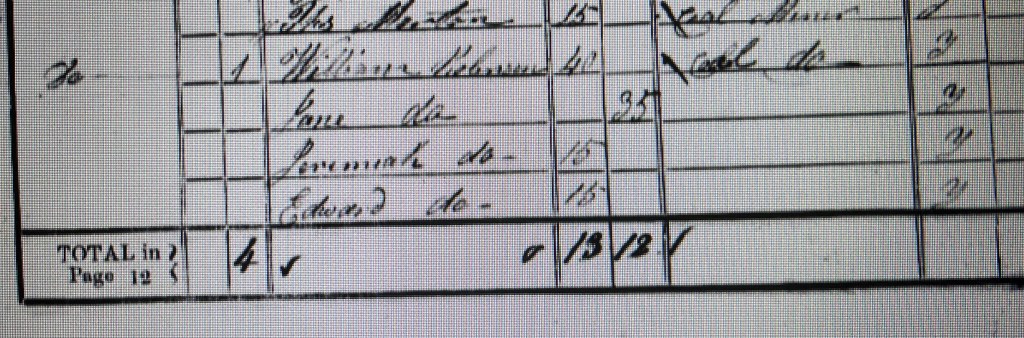
Fairly straightforward then, local family, all born in Staffordshire. But, unusually, there were very few clues about them on Ancestry which is usually quick to offer hints to other records for names I am researching. Although the hints can be spurious, sometimes they can offer useful links. But I did notice, looking on Ancestry at the details of the census entry for William, that someone had suggested that his name was actually Rollason or Rollinson. Ah, yes, now that is definitely a local name that I recognise.

Copyright: The National Archives. HO 107/997/3.

You can see how the name is difficult to read in this small extract from the 1841 Census (the other children are on the next page) and this looks more like Rolinson than Rollason but for someone not familiar with local names, Robinson was a reasonable guess. But from comparisons with other records over several decades of his life, I have settled on using Rollason for him as the name this man was recorded as most!

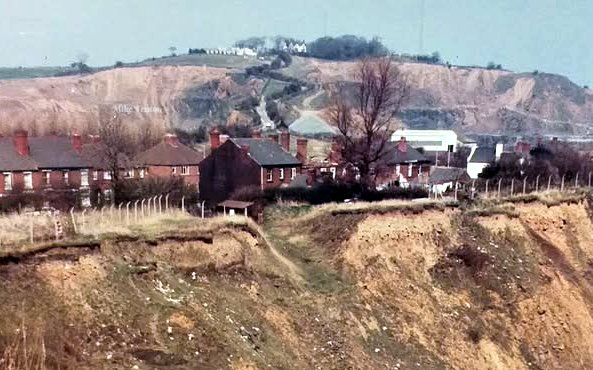
Copyright Mike Fenton.

Taken in the 1970s, this view is looking over Alsop’s Quarry and the houses and farms can be seen at the top of Turner’s Hill, though it is impossible to know whether these were exactly the same houses as in 1841. But it does show how far up the hill they were from the village of Rowley and may be a clue to why the families there often used Dudley, rather than Rowley as their church.

The Robinsons/Rollasons

Out of interest, I checked the Rowley Regis Parish Registers to see how long Rollasons had been in the parish and there was a first clue to potential difficulties to come. Searching the digital copy of the Parish Registers is a good way of finding when people were in the parish, how many there were, whether there were any other place links, how the spelling varied. And the spelling certainly varied for this family, perhaps more than I have come across with any other Rowley family. There were 31 entries for names beginning with Rol in volume 2 of the digital version of the parish Registers, none in Volume 1 – the first was in 1729 when Enoch Rolason married Mary Davis at St Giles. There were 15 entries for Rolasons in this volume with this spelling, another 10 with Roliston, 2 with Rolison, 1 Roleson, 1 Rolinson, 1 Rollison, and 1 Rolloson. And that was just for the period 1685-1772. And these related to several different branches of the family, several of them described as ‘of Dudley’ and one from Oldbury. The next tranch of the Registers – from 1771-1812- has another 96 entries, more than half spelled as Rolinson but again with another six different spellings in various parts of the register.

One of these entries was for the unfortunate Alice, wife of Stephen Rolinson. The Burial entry relates that in September 1802 she “was murdered by a red-hot nailrod being thrust into her side while at work in a nail shop. It penetrated through her stomach and a considerable way into the right lobe of her liver. She died about an hour after. The Coroner’s Inquest sat on the body from 12 o’clock at midday until 6 the next morning when a verdict was returned Wilful Murder. The murderer was acquitted at the following Stafford Assizes.” Poor Alice, what a terrible death but what a long time the jury took to return their verdict – presumably both parties were known to the jurors – oh, to have been able to hear their deliberations! I cannot find any other record of the inquest or the trial so we do not know who the other party was.

The final tranch of the Parish Registers (1813-1849), Volume 4, has 60 entries for names beginning with Rol, 46 spelled Rollason, 7 with Rolinson, 2 with Rolason, 2 with Rolaston, 2 with Rollinson, and 1 with Rollaston. So it appears that expecting any sort of consistency in identifying this name is a forlorn hope. And, for once, I do not appear to have any connection with this 1841 branch of the family, although I do have people with various spellings of this name on my tree there are only a few and they are mostly in the mid-1700s so no short cuts for me there.

The Rolinsons of Dudley

William Rol*son (1801-1862)

So, back to basics. The 1841 Census gives me no information about where William Rollason or Rollinson was born. So I looked for him in the 1851 Census which would give a more detailed place of birth and also confirm relationships within the family. But William, now definitely shown in this census as Rollason, was no longer on Turner’s Hill. By 1851, he was, with his wife Jane and children James, Ruth, Elizabeth and several younger children born after 1841 – Sarah Jane (1842), Rebecca (1844), Phoebe (1846) and Ann Maria (1849), plus his daughter-in-law Sarah and her son Jeremiah (1849)– all living in Constitution Hill, Dudley which is on the Rowley side of Dudley, near Kate’s Hill.

And living next door in 1851 in Dudley was an Edward Rollason, presumably the Edward listed as William’s son in 1841, by now married and with his own wife Mary (Mary Ann, nee Ingley or Hingley) and two children, Rosanna and William. Lodging with Edward was his sister Rhoda with her husband Thomas Williams. So, with all these matching names, it is definitely the same family.  By 1861, William and his family had moved to Bath Street, Dudley and again, Edward was living with his wife and six children two doors away, plus a lodger Henry Hingley who was presumably related to Mary Ann.

So, the 1851 Census tells me that William was born in 1801 in Dudley. In fact, all of his family were shown as having been born in Dudley which makes me suspect that they were living on the Dudley side of Rowley and of Turner’s Hill and counted this as Dudley. Now I was looking, in FreeREG,  for the birth or baptism of a William ROLLASON in about 1801.

But there is no baptism for a William Rollason in this period, anywhere in Dudley or the surrounding area. There are clusters of Rollasons (with varied spellings) in Oldbury, Brierley Hill and Wednesbury, some of the fathers were William but there was no baptism between 1798 and 1805 for a William.

However, when I searched instead for ROLINSON for the same period, up came a whole list of 64 different baptisms, including just two for William, both at Dudley St Thomas, one on 15 March 1801 the son of Joseph and Phebe Rolinson and another on 4 November 1804 for William son of John and Phebe Rolinson. There was very little variation in the spelling of the surname here, the Rolinson family name was clearly familiar and well-established in the Dudley parish. Variations in spellings at this time often arose when different people – clerks, registrars, priests – wrote down what they heard or what they expected to hear.

Hmm, just to try to get some idea of how many Rolinsons there were in the area, and whether there were any particular names in use in any of the families, I looked at baptisms for Rolinsons in Dudley St Thomas, from 1790-1810. There were what appear to be twenty Rolinson couples having their children baptised at Dudley in this period of just twenty years, including Daniel and Mary; Edward with his first wife Hannah Parsons  and second wife Prudence Griffiths;  Enoch and Ann; James and Sarah; at least three, possibly four, different Johns with their wives Leah, Mary, Phebe, Sarah and Lucy; three Josephs with their wives Nancy (possibly the same wife as Ann), Mary and Phebe;  Mark and Phebe; Nehemiah and Mary; Solomon and Ann; Stephen and Phebe; Thomas and Mary; and three Williams with wives Mary, Nancy and Sarah. They really weren’t very adventurous in their naming patterns, were they? But it seems very likely – though I have not researched this any further – that most of these were related to each other, brothers and cousins. This is indicated by the names they gave their children, too which all recur across the couples. All of the names are biblical, as is so typical of much of the Black Country at this period which is probably not surprising as the readings from the bible which they heard in chapel and church were probably the only narrative that they ever heard. I digress…

But the greatest of these was love.. sorry, I mean, the couple I was most interested in were Joseph and Phebe Rolinson . Joseph Rolinson married Phebe Davis (both of Dudley) on 2 Aug 1784 at Dudley St Thomas. They were married by banns and both made their mark so neither was literate enough to sign their names. Their children that I have found baptisms for are Jeremiah (1790), Elizabeth (1792), Mary (1793), Sarah (1796), Joseph (1797), Isaac (1799), William (1901), Benjamin (1802), and Dudley (1804). (Edward and his wife Prudence also named a son Dudley the following year so it recurs. And there was also a Dudley Rolinson baptised at DST in  1754, son of William Rolinson and Catherine (nee Dudley) so it was not completely new to the Rolinson family and was in fact a family surname brought forward.)  So it looks likely that, if this was our William, and that he named one son Jeremiah, after his brother and a daughter after his sister Sarah.

The Rolinsons were not strangers to Rowley Regis. There were 49 Rolinson entries in the Parish Registers between 1772 and 1812, plus another half dozen with variations of Rolinson, rather than Rolason. But none of them appear to relate to the William on Turner’s Hill in 1841.

In fact William is one of the most challenging people I have ever tried to trace.

I shall work on the basis that I have correctly identified the baptism at Dudley of the correct William Rolason/Rollason/Rollinson. 

William Rolinson married Jane Parkes on 23 November 1823 at Kingswinford St Mary, with Kingswinford given as the abode for them both.  The witnesses to the marriage were William Parkes and Thomas Walker.

The GRO entries for their younger children, (born after the start of civil registration in 1837) mostly -that is for Sarah Jane Rolinson(1842), Phoebe Rollason (1846) and Ann Maria Rollason(1849) ) – give a Mother’s Maiden name as Parkes  which fits with the marriage I had found. Rebecca Rolinson, born in 1845, has the Mother’s Maiden name as Vanes – which may be a Transcription error, as it is difficult to see how William could have changed wives in the middle of this period, unless she is the child of a different family – and Elizabeth Rollason, born in 1841 where the Mother’s Maiden name is shown as Smith. I cannot offer any convincing explanations for these differences, especially as William was still living with Jane in 1861 and all censuses in between.

I see also from other records that Rolinson and Rolason seem to be used interchangeably, including by children of the same parents, and also by the same person over their lifetime, just to add to the difficulties.

William and Jane were still in Bath Street in the 1861 Census, still with their son Edward next door. Their children Rebecca and Ann Maria were still living with them, plus their married daughter Sarah, now Garbet.

By the end of the following year, however, they were living in Oxford Streeet, Dudley where Jane died on 2nd November 1862, aged 63 of Bronchitis and Exhaustion, and William died on the following day, 3rd November 1862, aged 62 of Paralysis and Exhaustion. Both deaths were registered by their daughter Rhoda. They were buried together on 9th November at Dudley St Thomas.

William and Jane’s children shown in the 1841 Census:

As the family appear to have moved out of the hamlets by 1847 at the latest I have not gone into great detail about the later lives of their children and have also limited myself to those children who were living on Turner’s Hill in 1841.

Jeremiah Rolinson (1825-1843)

Jeremiah died, aged 18 years and 9 months on 5 May 1843 and was buried at Dudley St Thomas on the 7 May, noted as ‘of Rowley’.

Edward Rollason (1826-1897)

Edward was born on 10 March  1825 and baptised at Dudley St Thomas on 16 December 1838, along with James, Rhoda, Martha and Ruth. The bonus for me of this family group baptism record is that the date of birth of the children was recorded in the baptismal register so that we unusually have accurate dates of birth for these children.

Edward married Mary Ann Ingley (sometimes Hingley) (1829-1895) at Sedgley on 6 September 1847 when he was ‘of full age’ (ie 21 or over) and she was still a minor, both said to be of Dudley. Mary Ann’s father William was a Vice Maker.  The couple lived in the Dudley/Kates Hill areas and had ten children. These were Rosanna (1847-1918), William (1850), Samuel (1852-), James (1855), Reuben (1858), Edward (1860), Isaac (1863), Mary Ann (1865), Elizabeth(1867) and Minnie Martha (1869).

Edward gives his place of birth mostly as Dudley but in later censuses as Oakham which might also have been Turner’s Hill.

Up to the 1881 Census, Edward and his family were living in Constitution Hill and later in Bath Street, Dudley, often near his own parents or siblings. But in 1881, while Mary Ann Rollason, giving her marital status as Married, was living in Tower Street, Dudley with four of their younger children (aged from 12-23), Edward, now aged 60, was recorded living as a Boarder in St John Street, Dudley where he is shown as a coal dealer. He was living in the household of a widow, Mary Ann Hill, aged 41, a nailer and her son John who was a coal miner. And in 1891, when Mary Ann Rollason was living with her son Isaac and his family in Flood Street, Dudley, Edward was still living in the household of Mary Ann Hill, as a lodger, but they had apparently moved to Owen Street, Kates Hill. I say apparently because when you look at it on the map, St John’s Road appears to turn into Owen Street so it may have been the same house as in 1881. By this time Edward was described as a coal haulier and he and Mary Ann Hill were living next door to another coal haulier Charles Dewell so perhaps there was also a coal business here.  These places were only less than a mile from each other but show two separate residences over more than a decade. So it does appear that Edward and Mary Ann had separated between 1871 and 1881.

Mary Ann Rollason, nee Ingley, died in early 1895 and was buried at Dudley St Thomas, on 3 February 1895, aged 66 and with her abode given as Flood Street, Dudley where she had been living with Isaac in 1891.

Edward Rollason died on 7 August 1897, at 65 St John’s Road, Dudley, of pneumonia and his death was registered by his daughter Rosanna, now married and still living in Tower Street, Dudley where her mother had lived in 1881. Rosanna had been present when her father died so presumably there was no estrangement between them, even if her parents had parted. Edward was also buried at Dudley St Thomas on 11 August 1897. Was he buried with his wife, who had been buried there two years before? I don’t know, but it would be interesting to find out!

James Rollason/ Rollinson (1828-1897)

James was born on 9 January 1828 and baptised at Dudley St Thomas on 16 December 1838, with his siblings. He was still with his parental family in the 1851 Census. But he had married, on 4 October 1847 at Tipton St Martin, to Sarah Wheale. They were both minors and neither have an abode shown in the marriage record so presumably were living in the Tipton parish. James was shown as the son of William Rollason, miner (James was also a miner) and Sarah’s father John Wheale was also a miner.

Their son Jeremiah was born in the September quarter of 1848 so is also living with William’s family in 1851. They had a further ten children thereafter, making a total of eleven. These were John (1852), James ((1854), Edward (1858), Job ((1860), Rosanna ((1862), Fanny (1865), Jane (1865), Sarah Ann (1866), Ruth (1868), Cornelius (1873) and Joseph (1876).   James also stayed in the Dudley area for the rest of his life, dying on 24 December 1897 and buried at DST on 2 January 1898. His wife Sarah had died in 1895.

Rhoda Rollason/Rollinson (1829-1909)

Rhoda was born on 19 November 1830 and baptised at Dudley St Thomas on 16 December 1838, with her siblings. She was married at St Andrews Netherton on 15 May 1848 to Thomas Williams, a miner like her father, (although his father was a chainmaker) of Dudley. Both of them give their abode as Dudley so it appears the family had already moved from Turner’s Hill by this time, perhaps her father William had moved to work in a different mine.

In 1851, Rhoda and her husband were lodging with her brother Edward in Constitution Hill, Dudley, as already noted abovewith their 10 month old daughter Elizabeth.

By 1861, Thomas and Rhoda Williams were living at 13 John Street, Dudley with their children Elizabeth (10), John (8), Ann (4) and Emily (1), plus one Boarder John Garbett (23, a coal miner. plus a lodger Frederick Hawkes (19, who was a fishmonger). All three of the children were described as ‘Sunday Scholars’ and this may be another indication that they were Methodist or at least nonconformists, who had more Sunday schools than any of the other denominations.

Rhoda’s younger sister   Sarah Jane (b.1842) had married a William Garbett in 1860 and another sister Rebecca Rollason ( b.1844)  – was to marry this Frederick Hawkes mentioned above in 1862. Rhoda’s niece another Rebecca Rollason, (b. 1872) daughter of Martha and Joseph, was later to marry a John Garbutt (b.1870) in Pontefract in 1890, he was also from Dudley so it seems likely that these Garbetts and Hawkes were all inter-related and remained connected with the Rolason/Rollinson family over a long period.

 In all Thomas and Rhoda had six children, the last two were Rhoda (b.1865) and Rosannah (1867). They were in Dudley in the 1871 Census but then moved to Havercroft in Yorkshire by 1881 where Thomas was shown as a Coal Miner and in the next two censuses they were living in Featherstone, near Pontefract. Thomas died there in 1895 and Rhoda died in Royston, Yorkshire in 1909.

Martha Rollason/Rollinson (1836-1874)

Martha was born on 13 February 1836 and baptised at Dudley St Thomas on 16 December 1838. She was with her family in the 1841 Census. married her first cousin Joseph at Sedgley on 16 February 1852 when her abode was given as Gornal. He was the son of William’s older brother Joseph and Lucy, nee Rose. Joseph was 23 and a miner, Martha was said to be 20 in the marriage details but she was actually 16!  

Martha and Joseph had Benjamin (1854), Obediah (1858), Joseph (1860) all born in Dudley and in 1861, they were living at Waterloo Street, New Dock, Dudley. But in 1871 they were living in Featherstone, a coal mining town near Pontefract, Yorkshire. Their daughter Rebecca was born in 1872 in Harrington, Durham and in 1874, Martha appears to have died giving birth or soon after to William who also died in the same quarter, she was buried at West Herrington, Durham on 7 May 1874.

In the 1881 Census, Joseph was back in Dudley, living at Chapel Street, Dudley with Moses and Rebecca and his widowed sister Caroline who was presumably helping to look after the children. But Caroline re-married in 1884. I have been unable to trace him in the 1891 Census but Rebecca was married in Featherstone in October 1890 to John Garbett and they settled there and had eleven children.  And Moses was also married in Featherstone in 1891 and remained in the North, Yorkshire and Durham area for the rest of his life, so Joseph may well have moved back to the area, too. In 1901 he was  definitely back in Featherstone living with Rebecca and her husband and family. In December 1901, there was a death registration for a Joseph Rollason in Wortley, Yorkshire. This Joseph had died, aged 73, in the County Asylum there and I think that this was this Joseph Rollason as I can find no other trace of him after that time. He had been admitted on the 12 July that year and died on 27 September so he may have been there as a hospital patient, rather than because of mental problems.

Ruth Rollason (1838-1885)

Ruth was born on 15 January 1838, and was baptised at Dudley St Thomas on 16 December that year. She was living with her family in Constitution Hill, Dudley in the 1851 Census.

On  27 Apr 1856 Ruth married at Dudley St James, aged 18. Her husband rejoiced in the name Manassah which is another Old testament name and a great deal easier to track than Rolason/Rollinson. Perhaps it was a relatively unusual name as the biblical Manassah was ‘The Evil King of Judah’, who ruled for 55 years and introduced not only child sacrifices but also sorcery and demonic worship… fortunately, our Manassah did not exhibit any such antisocial tendencies!

Manassah Plant gave his occupation as an Engineer in the Marriage Register, as did his father although at this period this is likely to have meant that they looked after stationary pumping engines,in mines and factories,  rather than the more general engineering we think of today. There is a full scale working replica of the Newcomen atmospheric steam engine at the Black Country Living Museum. Thomas Newcomen invented the first successful engine in 1712, although nothing remains of the original now, it was known to have been put to work in the Black Country in pumping water out of deep coal mines.

In 1861 Manassah and Ruth, with their eldest children Phoebe (b.1858) and James (1860 – aged 5 months), were living in Portway Road and Manassah was shown as an Engine Driver. By 1871, they had moved to Tipton, where they were living at 1 Newels Road, Dudley Port, just four doors away from the Mallin family which I have looked at during my study of the Alsop family. By this time, Phoebe was 13, James 10 and Rebecca (b.1863), Martha (b.1865), Ruth (b.1867), Sarah Jane (b.1869),  and Fanny, aged 1 month had been added to the family. Living next door to them, at 2, Newels Row, were Christopher and Phoebe Plant, Manassah’s parents and on the other side of them at No.3 was Manassah’s sister Phoebe with her husband Charles Bridgwater and their four children. So a tight little family grouping, as we have so often seen in these Black Country families. The 1881 Census finds Ruth and Manassah at 14 Railway Terrace, Tipton with three additional children Manassah (b.1873), Moses (b.1876), and Lilly (b.1878), so a total of 10 children. 

That was the last census in which Ruth appears. She died in 1885 in the West Bromwich Registration area and was buried on 2 June 1885, although the record of this does not indicate where, other than ‘West Midlands’ which is a modern reference because there was no such administrative region in those days.

In 1891, the widowed Manassah was living at 43, Moor Street, West Bromwich and was listed as a ‘Stationery Engine Driver’. With him were Fanny, Manassah Jnr, Moses and Lilian who was now 13. In December 1897 Manassah re-married at Blackheath St Paul’s to a widow, Louisa Woodhouse (nee Barnsley) who had two sons and a daughter from her first marriage. At the time of the marriage, both gave their abode as Halesowen Street, Blackheath. But in 1901, they were all living in Bradley Street, Tipton along with two children of Manassah and Louisa, John (b.1899) and Maud (b. 1900) – Louisa was more than twenty years younger than Manassah and had been 37 when they were married, he had been 58. However in the 1911 Census, Louisa was living in Brades Village with these two youngest children and, although she was described as Married, she was also Head of the household. In this census Manassah was with his widowed son Manassah at 81 Moor Street, West Bromwich and working as an Engine Driver (Stationary) at an Iron Foundry.

And in 1921 Louisa was living at 12 Henry Street, Langley and gave her occupation as a Housekeeper, still with John and Maud living with her.  Manassah, however, was living at 54 Thynne Street, West Bromwich with his daughter Sarah Jane and her husband Edward Aston and their three grown up sons. Manassah’s age was shown in this Census as 94 years and 3 months.

Manassah died in April 1922 and was buried at Heath Lane Cemetery, West Bromwich on 15 April. This  may well be where Ruth was buried, too. Although both the death registration and the burial record (and the 1921 Census) show his age as 93, in fact he was 85 – but there would have been no-one to dispute the matter and the ages of very old people (and he was old, for those times) are often exaggerated, I find. In any case, they are only as accurate as the facts known to whoever was registering the death!

Elizabeth Rollason or Rollinson (1843-1909)

Elizabeth was born in about 1840 in Rowley, almost certainly while the family were living on Turner’s Hill. She was baptised on 2 February 1840 at Dudley St Thomas. Three more sisters followed her, Rebecca in 1844, Phoebe in 1846 and Ann Maria in 1849 but I have not explored these last children in as much detail as they did not appear in the 1841 Census. Elizabeth was with the rest of the family in Constitution Hill, Dudley in the 1851 Census.

Elizabeth was married at All Saints Sedgley on 4 October 1858, when she was 18, to Edward Fisher, who was a Grate Moulder, presumably in an iron foundry. Their first son George Henry was born in early 1860 and a daughter Sarah Jane was born in late 1861. Another daughter Elizabeth followed in the third quarter of 1863 but sadly her father Edward died at about the same time, when he was only 24.

In 1867, Elizabeth married at St John, Kates Hill to William Finch, a miner who was a little younger than her at 22. The 1871 Census finds them living in one of the Courts off Fountain Street, Dudley with the three children of Elizabeth’s first marriage, all listed under the name Finch but with no children of their own.  But by 1881, William Finch had also died, aged 36 and he was buried at Dudley St James in March 1881.

So by the time of the 1881 Census, Elizabeth, now 38 and described as a pipe maker (tobacco, unemployed) was living with her daughters Elizabeth and Sarah Jane in the Minories, Dudley. However, in July 1882, Elizabeth  married for a third time, at Dudley St Thomas, to Joseph Freeman.

In 1891, Elizabeth Freeman, a widow, is living at 54a, Birmingham Street, Dudley with her daughter Elizabeth Fisher, aged 26, William Matthews, a Boarder who was 30 and a chairmaker, Jane Wakefield, aged 17, and Henry Harper aged 14, also both boarders and then George Fisher, aged 8 and Thomas Fisher aged 3. All of these were born in Dudley, and it may have been that Elizabeth was in effect running a boarding house. So where was Joseph Freeman? It seems that this was the Joseph Freeman of Birmingham Street who had died in Dudley, aged 48 in the June quarter of 1888 and was buried at Dudley St Thomas. Poor Elizabeth really didn’t seem to have much luck in choosing husbands for longevity, did she?

But who were the George and Thomas Fisher who were living with her in this census? They are shown as the sons of the Head of the Household which was Elizabeth Freeman. But the clue is in their surname – they were not Elizabeth’s sons, they were both illegitimate and I suspect that they were the sons of her daughter Elizabeth Fisher who was listed just above them in the census. Certainly in the 1901 Census, George is still living with Elizabeth Freeman and is shown as her grandson and Thomas was living with this Elizabeth Fisher, now married, and described as her son and I suspect that George(b.1882) was her son, too as Elizabeth Rollason/Fisher /Finch/Freeman would already have been 42 when this George was born and 48 when Thomas was born, having had no children since 1863 in either of her subsequent marriages. And she already had a son named George Henry Fisher (b.1860) who was Elizabeth Fisher’s older brother. I have been unable to find baptisms for either of these two boys so there is no clue from that quarter. However I have resisted the temptation to buy the birth certificates as I am satisfied that these two boys were the grandsons of Elizabeth Rollason/Fisher /Finch/Freeman.

Elizabeth died in August 1909, aged about 67 and was buried at Dudley St Thomas.

Summary

So there we have the household of William Rollason who were living on Turner’s Hill in 1841.

Although there were undoubtedly other Rollasons/Rollinsons in Rowley and Blackheath, it seems fairly clear to me, from their baptisms and burials, that this branch regarded themselves as a Dudley family and, although they all moved around, rarely staying in one place for very long, for William and Jane and three of these children, those places were mainly in the Dudley area. Martha and Rhoda’s husbands and families ended up moving north to Yorkshire for work and settling there but Edward, James and Elizabeth stayed within a few miles of Dudley and each other. There is little of the deep-rooted attachment to Rowley and the immediate area which characterises so many of the families in the Lost Hamlets. And there appear to have been several instances of marriage breakdowns with couples living separately for many years, at a time when divorce was essentially not possible for people of this class. Again, not something I have observed very much in other family studies but a practical solution for those times.

This has been a challenging family to track because of all the name changes and variations and frequent changes of abode. For once, I have not found a connection to my own family tree and I started out thinking that I would not need a tree, working from paper notes which accumulated rapidly. After a few frustrating days, I gave in and created a separate family tree for this family on Ancestry and this did help to keep them straight. So if anyone has connections to this family, there is a tree on Ancestry with all my research so far.

I did not do a general search on the Rollason name, until I had completed this piece, as I prefer to reach my own conclusions before seeing whether there is anything to confirm or refute them. But a general search produces the AI generated information that there is, apparently, no formal One Name Study for Rollason registered with the Guild of One-Name Studies, although individual genealogical research and regional name collections (such as historical Warwickshire and West Midlands records) frequently track the name. And happily, despite my rant recently about the dangers of AI, all of that fits neatly with my own findings and needs little further explanation. The AI report also notes the variations of the name and also notes that there were a number of Rollason Christenings at the Ruiton Independent chapel at Sedgley in the 18th and 19th centuries, again, all of which tallies with my researches for this piece. So there were no great surprises or additional areas for exploration there. A similar search for Rollinson reveals that this is generally taken to be a variation of the Rollason name which again bears out my own conclusions.

There is a website dedicated to the Stubbs Family but which has a page about Rollasons living in Witton, Birmingham so if any Rollasons are reading this, they may find that of interest. Glancing quickly through it, I could see that these Rollasons appear to be partly in West Bromwich and that one of them married a Mallin – some names keep popping up! https://stubbsfamilyhistory.wordpress.com/2011/01/11/rollason-linneage/

Another interesting finding was that there is a book entitled The Old Non-Parochial registers of Dudley comprising those of the Society of Friends … by a certain Arthur A Rollason. I was pleased to find this book on the Internet Archive and was able to download a copy. I searched it eagerly – there was one Rollason entry found – the author! Hey ho… There is also – according to the Sedgley Manor website – another book by him entitled Dudley Pedigrees but I have been unable to find out any more about this book, nor to trace where it can be seen. Hopefully, it will be at Dudley Archives when I am next able to visit again.

Creating a tree on Ancestry also enabled me to see trees created by other people for individuals in this family which were mostly pretty well in line with my own research. However, this did bring home to me the advantages of having FreeREG with its very full transcriptions, as it meant that I had usually accessed full details of the fathers of couples at their marriages to confirm I was looking at the correct couple. I came across more than one instance in other trees where someone had obviously not seen the full marriage record and had attached the bride or groom to the wrong parents, whereas FreeREG shows the name of the fathers where it has been recorded at the time. So those trees have gone off at a tangent, researching the wrong line for all the earlier generations, which is unfortunate. However, messages about such things are not always appreciated or accepted. Perhaps Ancestry will offer them some hints once it has absorbed the tree I have created.  Thank goodness for FreeREG!

I had not anticipated that this one family would expand to take up a whole piece but it has. I hope to be able to fit in more than one family in future pieces!

Onward in my next piece on the 1841 Census to the family of Joseph Redfern and possibly to Joseph Downing.  Although I also have a short diversion of more general interest in preparation which I hope to slot in soon.

The 1841 Census – Turner’s Hill Part 1

I have succumbed to the temptation to repeat the analysis of local residents in the 1841 Census with the other hamlets, including those of Perry’s Lake, Tippity Green and Turner’s Hill.  As before, some of these will already have been looked at in previous family studies or pub studies and I will not go into great detail on the children here but will try to identify how these families related to each other.

So Turner’s Hill. Was it once owned by someone called Turner? Or does the name come from another source? I do not claim to know the definitive answer to this but I have heard a suggestion that back in the mists of time, the Devil was on Romsley or Clent,  trying to defeat the God Thor who was on this hill, by hurling spears (or some sort of weapons) so this hill became known as Thor’s Hill. Difficult to prove that one way or another…

Another theory I read a few weeks ago was that the hill was named for the painter Turner who was supposed to have painted scenes from it. However, J M W Turner was born in 1775 and there is a parish register entry for the burial at St Giles of “John Woodhouse Snr of Turner’s Hill” in December 1727 so the name was in use at least 50 years before he was born and probably longer. Certainly there are parish register entries for the name Turner in Rowley Regis as early as 1614, so it is entirely possible that the name relates to one of that family. And the earliest entry for the name of the Hill spells the name with an apostrophe, implying that it was possessed by someone.

So, who lived on Turner’s Hill in 1841? The names of families in nearby Finger i’the-Hole are familiar to anyone who follows this blog and many of those surnames also appear in Perry’s Lake and Tippity Green so it will be interesting to see whether there are any unfamiliar names on the Hill.

Copyright: Alan Godfrey Maps.

This map was first surveyed in 1881 and again in 1902 so is considerably later than the 1841 Census. However, it is the only detailed map I have been able to find which shows individual buildings and it does show the separation between Gadds Green, the Hill enclave and the heights of Turner’s Hill, referred to on some maps, including this one, as Cloudland! At this time, the toll road between Halesowen and Dudley went over the hill from Perry’s Lake, the new road down to Portway did not exist so this would have had quite a lot of traffic on it. Some of the houses shown in this map may not have existed in 1841, I believe that Turner’s HIll Farm was occupied by Joseph Downing as he is the only farmer listed on the Hill without the name of the farm.

The route taken by the enumerator notes that he went from “Windmill Farm, through the Tippity Green Toll Bar to Perry’s Lake, thence to Finger Hole and William Bridge’s house, taking the whole of Turnershill, back by Samuel Round and Josiah Parkes houses (more accurately, named farmhouses), back by the Bull’s Head, (so back to Hawes Lane, but not mentioning Tippity Green) to Cock Green”. So, as far as I can work out, he treated ‘Fingerhole’ as one unit, ignored  for the time being the Stone Farm and what he called Freebury Farm and went on to Turner’s Hill where the listings do indeed have William Bridge as the second entry for Turner’s Hill.  The first entry is that of Mary Cooper and two other women.

Having worked his way round the houses on Turner’s Hill, the enumerator then appears to have gone back past Fingerhole to  the two farms partway up the hill to the left of that community on local maps. I think that the ‘Stone Farm’ he mentions must be what was otherwise known as Hailstone Farm – and which was indeed the nearest building to the Hailstone itself so this would be a logical name for it – and that what he called Freebury Farm  was the farm a few yards from Hailstone Farm and which was noted in other records, including a Parish Register entry in 1744, as Freebodies Farm.  But clearly in his mind these two farms were quite separate from Finger i’the-Hole which may reinforce the local perception at this time that this was a self-contained entity.

So, in 1841, the first household listed on Turner’s Hill is this:

Christian NameSurnameAgeOccupationWhether born in CountyWhether born in Scotland, Ireland or Foreign Parts
MaryCooper75Wash for hireNoYes
HannahCooper45 Yes 
PhebyBrinton25 Yes 

Alas, this 1841 census gives us no helpful information as to relationships or occupations for anyone other than the head of the household but it is possible, indeed likely, that this is a family group of some sort. There is a tick in the column for this entry for Mary which appears to indicate that she was born in “Scotland, Ireland or Foreign Parts” but it does not tell us which.  From other entries in this batch of entries however, where this box is ticked, I have developed a theory that the enumerator treated anywhere other than Staffordshire as ‘Foreign Parts’!  

I have had little success in finding out much more about these ladies or their relationships to each other. It appears that Mary Cooper died in February 1851 and was buried at St Giles on 9 February, her abode shown as Turner’s Hill, aged 86, the cause of death shown in the burial register entry as ‘old age’.

Being a washerwoman/wash for hire/laundress was no easy career choice in those days. Washer women had very difficult jobs. They had to haul water for long distances, (especially true at the top of Turner’s Hill, as there were few springs up there, they had to make their own soap, and scrub clothes endlessly on top of maintaining their own households. And for all of their intense labour, wages for washerwomen were low. Washerwomen, while not high-status persons, performed an essential job given the lack of laundry facilities in most smaller houses. 

This 19th century painting of a washerwoman by H. Valkenburg is in the Netherlands Art Collection so unlikely to be set in England but probably still gives some idea of a washerwoman’s working conditions. Although I suspect that – as when in our times when tv cameras go into people’s homes, the background may have been somewhat sanitised, I would have expected there to be rather more laundry around.

Perhaps Mary and Hannah went to the houses of better-off folk to do laundry in their houses, perhaps local farmers or landowners, this way they might have several clients and such more prosperous people might have more room for the laundry work.

Hannah and Pheby also appear in Turner’s Hill in the 1851 Census where Hannah, born in Rowley, is shown as a laundress and Phebe/y, born in Dudley, as a needlewoman. By 1861 the two women had moved to Cock Green, Hannah still working as a laundress and Phebe as a Sempstress. Both were shown as unmarried in both of these latter censuses, Phebe was shown as an inmate or boarder with Hannah.

Since the 1851 and 1861 Censuses both show that Hannah was unmarried and was born in 1794 in Rowley Regis, I looked for a baptism for her at St Giles. There were two possible Hannah Coopers baptised in that period – Hannah, the daughter of Richard and Mary Cooper (no abode shown) on 29 September 1793 and Hannah, daughter of James and Jane Cooper  (also no abode shown) on 22 November 1795. Since Hannah was living with a Mary Cooper in 1841, it seems likely that she was the first of these.

Again, there is only one marriage of a Richard Cooper and a Mary in the area and the right period to be the parents of this Hannah and that took place at Dudley St Thomas on 12 February 1782, when widower Richard Cooper married Mary Brown. Catherine, the wife of Richard Cooper had been buried at St Giles a year earlier in January 1781, so that may well have been the same man. The 1841 Census shows that Mary was not born in Staffordshire but if she was a Dudley girl, that would fit, she would have been born in Worcestershire.  I can find no other trace of this Richard alive, although there was a Richard Cooper, aged 80 who was buried at St Giles in 1794 who may have been the husband.

There is a death of a Hannah Cooper, aged 73 in the Dudley Registration District in the December quarter of 1866 which may well be this Hannah as she does not appear to be in the 1871 Census. And there is a burial of a Hannah Cooper at St John (Kates Hill) on 30th December 1866 which is likely to be the same person. It is possible that residents on Turner’s Hill regarded this newer church (opened in 1840) as serving that community so that our Hannah was buried there.

Pheby Brinton, I thought, might have been Hannah’s daughter but since she was apparently single in later censuses, that would not explain why she had a different surname.  But Pheby is a mystery in all ways.  Censuses indicate that Pheby was born in about 1816 in Dudley but I cannot find a baptism for a Pheby Brinton in a ten  year period from 1810-1820 in Dudley or anywhere within 7.6 miles of Dudley. Neither Ancestry nor FindMyPast can find much about her other than the three censuses that I have already found. There are other Phoebe Brintons in earlier generations in the surrounding area and the Brinton name was not unknown in Blackheath when I was growing up. There were also Brintons in Oldbury and Halesowen. But I can find nothing about Pheby/Phebe after the 1861 Census, not even a death or a marriage.

What a contrast then, this little household presents to their neighbours just down the road in Finger i’the-Hole where everyone was related or connected to each other whereas the three members of this household, who may or may not have been related, appear to have been self-contained and leaving little trace of their lives behind them.

The next  household listed was:

Christian NameSurnameAgeOccupationWhether born in CountyWhether born in Scotland, Ireland or Foreign Parts
WilliamBridge60FarmerYes 
ElizabethBridge50 Yes 
JamesBridge15 Yes 
SarahBridge2 NoYes
MariaHarrould25 Yes 
WilliamBradshaw40 NoYes
      

William Bridge (1780-1845)

William Bridge was not to appear in any later Censuses. He died in 1845, aged 63, of ‘numerous complaints’ according to a note in the Burial Register and he was buried at St Giles on 13th January 1845. So, although we know that he was born in Staffordshire, we do not know whether he was born in Rowley itself.

William, like Edward Alsop, was one of the signatories to the advertisement in 1829, requesting sporting gentlemen from trespassing on their land so presumably he was farming in the Rowley area for some decades.

When I searched FreeREG for a baptism for William Bridge over a ten year period from 1775 and within an eight mile distance from Rowley there was only one result. I believe that this William was the William, son of James and Elizabeth Bridge whose baptism on 5 January 1780 is in the Halesowen Registers which would fit with the age shown in the census and at his burial; William’s third and fourth children were also named Elizabeth and James which is another helpful indicator. Halesowen Parish, at this time, included Oldbury and the priest or clerk did not always keep the records separate so he could have come from that area and the Rowley Registers include references to other members of the Bridge family from Oldbury and also in the parish of Rowley. By 1781 children were being baptised at Rowley to a James and Elizabeth Bridge so it seems possible that William’s parents moved into the Rowley parish at about that time. There were at least four Bridge couples baptising children at Rowley in the early 1800s, likely to have been related in some way but I have not investigated this yet.

William Bridge, a bachelor, had married Elizabeth Siviter, a spinster, on 15 January 1815 at St Giles, both presumably of the parish as no mention is made of any other parish. William and Elizabeth appear to have farmed at Plant’s Green, down in the valley near Old Hill for some years and where they had Joseph (1816), William (1818), Elizabeth (1820), James (1822) – probably the James shown in the census above, and John (1824), all while they were living in Plants Green. By 1841, most of these had presumably moved away to be married or work elsewhere. Plant’s Green was located between Old Hill, Cradley Heath and Saltwells Colliery and is shown on the 1881 OS Map but by the next edition in 1901 it had been built over. Surrounded by iron works, foundries and collieries, Plant’s Green was also a centre for back yard chain and nail making shops and was apparently later deeply tied to the 1910 Cradley Heath Chain Makers’ Strike. However, while William and Elizabeth’s children were born there in the 1810s and 1820s while he was farming, one can imagine that as the area became much more polluted and unsuited to farming as the heavy industries developed around it. Turner’s Hill must have seemed rather different than this area down in the valley.

Elizabeth Bridge (1787-1860)

Elizabeth Bridge, nee Siviter was born in about 1790 from her age in the 1841 census, 1788 is indicated by her age of 63 in the 1851 Census.  This makes it likely that she was the Elizabeth, daughter of Richard and Hannah Siviter who was baptised on 10 June 1787 at St Giles. In April 1789 the same couple had a daughter Hannah, of which more anon. 

By the 1851 Census, Elizabeth, Sarah and Maria Harrold had moved to Old Hill. Elizabeth was shown as a retired farmer. I think that Elizabeth died in 1860 as an Elizabeth Bridge, aged 73, of Old Hill was buried at St Giles on 17 August 1860.

James Bridge (1822-1860)

The James Bridge shown in the 1841 household, whose age was rounded down for this census to 15 was probably the James who was baptised on 4 August 1822 at St Giles. James was still farming on Turner’s Hill in the 1851 Census, apparently on the same farm as his neighbours in that census were still Hannah Cooper and Phoebe Brinton, just as they had been in 1841. By 1851 James was 28 and married. James Bridge and Anne Eliza Hodgetts had married by licence at St Giles, Rowley Regis on 22 May 1849 when he was listed as a farmer of Turner’s Hill and she a spinster of the village. His father was listed as William Bridge, farmer and her father John Hodgetts, also a farmer. The wedding was witnessed by William Whitehouse and Maria Harrold who also appears in the census in 1841. Marrying by Licence involved a fee and was sometimes seen as a status thing so perhaps the farm was prospering. Certainly by 1851 there was a female servant at the farm, Sarah Preston, aged 24 who was a Shropshire girl and an agricultural labourer, the young Reuben Ingram who was 18 in 1851 and born in Sambourne,Warwickshire, he has cropped up in various other family studies.

Was Anne related to Betty Hodgetts who was married to Edward Alsop the farmer at Mill Farm in Hawes Lane? Very possibly. When time permits, I will explore the Hodgetts family more. Alas, James Bridge was not to make old bones, he died in 1860, aged only 37 and was buried at St Giles on 29 Mar 1860, his abode given as Turner’s Hill.

Sarah Bridge (1838-1861)

The Sarah Bridge shown in the census was apparently not born in the County, according to the census here. There is a tick in the column for this entry for Sarah which indicates that she was born in “Scotland, Ireland or Foreign Parts” but my other research indicates that this was not so and all future records refer to her being born in Oldbury which appears, for this enumerator to count as Foreign Parts. There was a baptism of a Sarah Bridge at St Giles on 9 December 1838, which would fit with the age of this child, and her parents were shown in the baptismal register as Joseph and Ann Bridge of Turner’s Hill and that he was a labourer. So perhaps Sarah was William’s granddaughter?

 It seems likely as Joseph, eldest son of William Bridge, Farmer, was married in May 1838 at West Bromwich to Ann Davis, whose father Benjamin Davis was also a farmer. Once more, families marrying into other families with the same occupation, so that the new spouse already knew the ropes of the job. Later Joseph Bridge and his family were living in West Bromwich where he was a corn factor. I had never heard of corn factors until I started researching the Alsop family where Isaac Mallin was also a corn factor – perhaps this was a profession that the sons of farmers went into when they were either not needed or wished to work on the family farm, or perhaps it was simply an ancillary trade to farming and milling or just simply more profitable.

Sarah Bridge was still living with her grandmother Elizabeth Bridge in Old Hill in the 1851 Census, by now aged 12 and a scholar, though now her place of birth was shown as Rowley Regis. In the 1861 Census, taken on 7 April, following the death of her grandmother, she was living in High Street, West Bromwich with her Corn Factor father Joseph and younger brother William, aged 20. However, Sarah died of tuberculosis in September of that year and was buried at Holy Trinity, West Bromwich on 20 September.

Maria Harrold (1815-1885)

Also still in the household with Elizabeth Bridge in 1851 was Maria Harrold, now described as the niece of Elizabeth Bridge and a servant though whether she was a servant to her aunt is not stated. Maria’s place of birth was now given as Oldbury, Worcestershire so perhaps the places of birth for her and Sarah had been transposed in the 1841 Census.

The Harrolds were another family who seemed to live in the Turner’s Hill/Portway/Birchfield Road/Titford area. They first appear in the parish registers for St Giles in about 1769.

Maria’s baptism at St Giles had taken place on 6 August 1815, daughter of Joseph (which has a ? after it in the Transcript so it is  possible that this was John or even James) and Hannah Harrold of Birchfield Lane, so not a great distance from Turner’s Hill and I have noted that Elizabeth Bridge, nee Siviter had a sister Hannah so it is possible that this was Maria’s mother, although I have not been able to find a marriage for either Hannah Siviter or Joseph Harrold.  In 1817 a William, son of Joseph, a farmer and Ann Harrold, of Birchfield Lane was baptised but in March 1818, Joseph Harrold, aged 27 of Birchfield Lane was buried. There were several other burials in the following years of young Harrold children from the Portway area being buried at St Giles, so it seems that there were several branches of the Harrold family living there in the early 1800s. But it appears that Maria’s mother had been widowed at a young age and that may have been why Elizabeth Bridge took in her niece. Or it is possible that Hannah remarried (there was certainly a marriage of a widowed Hannah Harrold in West Bromwich in 1836) and a new husband might not welcome step-children.  Whatever the cause, it seems that Maria lived with her aunt for a number of years.

In 1861, Maria was back on Turner’s Hill, staying with Anne Bridge, the widow of James Bridge who was still farming at Turner’s Hill Farm, with two labourers. Maria was noted as a cousin to Anne. However, after her aunt’s death in 1860, and soon after the census Maria was married. On 15 October 1861, only a few weeks after the death of Sarah Bridge, Maria, aged 46, a spinster, of Rowley, daughter of Joseph Harrold, was married by licence at St Giles to none other than Joseph Bridge, aged 45, a widower and corn factor of West Bromwich, son of William Bridge, a farmer. The witnesses to this marriage were William Woodall and Sarah Whitehouse. So this was Maria’s cousin and father to Sarah Bridge. ( Joseph’s wife Ann Bridge had died in 1858 in West Bromwich where they were living and he was trading as a corn factor.

Not even three months later, sadly, it seems, however, that this short marriage ended. Joseph Bridge died in January 1862, aged 46 and was buried in West Bromwich on 8 January 1862. Joseph died of heart valve disease, gout and asthma. With such ailments, it seems that Joseph cannot have been a well man even at the time of his marriage, perhaps he wished to make provision for Maria in view of her long association with the family.

In 1871 Maria was visiting in Moseley Road, Birmingham, staying with Maria Nichols, aged 84 who had also been born in Rowley Regis. Both women were described as ‘living on income derived from house & Property’.  In 1881, Maria was living as a boarder in New Road, Kings Norton and was described as an annuitant.

Maria died in 1885 and was buried at St Giles on 5 June 1885, aged 69. Her address was given in the Burial entry as Fox Cote, Hagley.

William Bradshaw (1800-?)

William Bradshaw was listed as a Male Servant but was probably what was more usually described as an agricultural labourer. He was apparently born in about 1800 but not in the County of Staffordshire and was no longer  at the farm in the 1851 Census. There is a tick in the column for this entry for William which indicates that she was born in “Scotland, Ireland or Foreign Parts” but That leaves a fairly broad range of possibilities! It seems likely that he was a casual labourer and could have gone anywhere from there. A search of local  parish registers, per FreeREG, does not show any likely marriages or burials in the immediate area up to 1880. There are 62 possible William Bradshaws in the 1851 Census born in about 1800, scattered far and wide across the country without any means of deciding which if any of them was this William Bradshaw so I have not attempted to pursue this any further!

The Hipkiss family

Christian nameSurnameAgeOccupationWhether born in CountyWhether born in Scotland, Ireland or Foreign Parts
JamesHipkiss55NailmakerYes
PhebyHipkiss45Yes
JamesHipkiss10Yes
EzekierHipkiss5Yes
ThomasMorton15Coal MinerYes

The Hipkisses are one of the core families of the Lost Hamlets, families who lived there over many generations and intermarried with the other core families frequently.

James Hipkiss (1781-1851)

It seems very likely that James Hipkiss is the son of Thomas and Esther Hipkiss (nee Whitehall) who was baptised at St Giles on 16 September 1781.

I think that he may have had an earlier marriage to Jane Hackett at Tipton in 1808 and had five children with her. I am still exploring this possibility.

However he married Phebe Moreton on 27 November 1826 at Tipton which ties this family firmly into the Hill family living just down the road. Phoebe (or Pheby as it is spelled here) Moreton was the sister of Ralph Thomas Moreton who had married Elizabeth Hill. The widowed Elizabeth Hill was still living in Finger I’ the Hole in 1841.

James and Phoebe, together with their younger son Hezekiah had moved to Spring Row by 1851 where they were living with Thomas Moreton,  probably the same Thomas Moreton who had been living with them in 1841 and his wife Mary. They are described as his parents-in-law in this census but I think that this is Phoebe’s illegitimate son Thomas Moreton, born in 1822, as –in-laws was also used to describe step-relationships and James was his step-father.  James was described as a Pauper/Nailer and Phoebe as a nailer. My blog pieces on the Hill family, specifically Elizabeth Hill, deal with the Moreton family in some detail.

James died in 1851 and was buried at St Giles on 14 December 1851. The burial entry gives his cause of death as ‘old age’, he was about 70. However, his son James had been killed in a pit accident a few weeks earlier which may have caused or accelerated his decline.

Phoebe Hipkiss nee Moreton (1894-1876)

Phoebe was the daughter of Francis Moreton and Ann Milles who were possibly from the Bromsgrove area and, like several siblings, Phoebe was  baptised at Harborne Parish Church, in her case on 18 May 1794. It is possible that at this time, the parish of Harborne extended almost as far as Whiteheath so the connection to Rowley may not have been as distant as it appears at first sight.

Phoebe had an illegitimate son Thomas Moreton in 1822 in Rowley Regis and married James Hipkiss four years later so it seems unlikely that James was his father. She and James were living with Thomas Moreton and his family in 1851 in Spring Row so had moved down from Turner’s Hill by then.

In 1861, Phoebe was living in Blackheath as a lodger in the household of Thomas Butcher, a labourer, I do not know of any other relationship between them. In 1871, at the grand age of 81, she was living in Causeway, Blackheath and Henry Hadley, her grandson, was living with her, plus a lodger Thomas Willetts. I have no details of a Henry Hadley so cannot tell which of Phoebe’s children he belonged to. I shall continue to research this as it is possible that there were other children of hers that I am not aware of. 

Phoebe died in November 1876 and was buried at St Paul’s, Blackheath, on 5 November 1875, aged 86. Her abode was shown as ‘The Hill’ which seems to have covered the whole area between Blackheath and Quinton and Gorsty Hill so an exact location is unclear. There was another Phoebe Hipkiss, aged 78 and of Perry’s Lake who was buried at St Giles on 20 January 1868 but the 1871 census shows that the Blackheath Phoebe was born in Harborne which is correct for James’s wife so clearly this was not the Phoebe who was buried in 1868. I suspect that this Phoebe may have been a sister of James Hipkiss but this is unclear as I am unable to find any census entries at all for this Phoebe Hipkiss. It is possible that she was married to a Hipkiss.

James Hipkiss (1828-1851)

James was about ten at the time of the 1841 Census and the only baptism of a James Hipkiss in this period was on 6 April 1828, at Dudley St Thomas, when James, the son of James (a nailer) and Phebe Hipkiss of Dixon’s Green was baptised. Although there is a three year difference here, in the 1851 Census James gave his age as 22 which is closer to the correct age.

James married Phoebe Ruston on 25 December 1850, at Dudley St Thomas. They were living with the Ruston family in Club Buildings in the 1851 Census, along with their five month old son Joseph. Another son James was born on 26 November 1851. This was less than a week after the burial of his father James at St Giles, aged 23, after he was killed in a coal pit, as noted in the Burial Register.

Phoebe Hipkiss subsequently remarried, to Philip Whittall in 1858 with whom she had three children Ebenezer( 1859-1864) ,  Sarah Jane (1861-), and Ann Maria (1862-1863) , before Philip died in 1864, aged 37. In 1870, when Phoebe was 42, she married William Taylor, a nailer aged 33, at Dudley St Thomas and she was living with him in the 1871 and 1881 Censuses in Blackheath.  In 1891, Phoebe was living in Long Lane as a boarder with Thomas and Elizabeth Hill, presumably the same couple who had acted as witnesses to her marriage to William Taylor in 1870. Elizabeth Hill was Phoebe’s sister and according to this census Thomas was born in Gadd’s Green so he is certainly one of the Hill tribe.  In 1901, Phoebe was living in Hackett Street, Blackheath, aged 72, as a Boarder with John Blakeway, a widower aged 78. I think that it was this Phoebe Taylor who was buried at St Pauls, Blackheath on 19 January 1905, her age given as 73 which is a couple of years out but such discrepancies are not unusual for people of this age at this time, when there would have been few people alive who actually knew her correct age.

Hezekiah Hipkiss (1836-1888)

(probably Hezekiah, but sometimes recorded as Issachar or Ezekiel any of which may be attributed to whatever name the writer at the time thought they heard!)

Poor Hezekiah, it appears that no-one knew how to spell his name as it appears as Hezekiah, Ezekier, Issachar and several other variations in various records. I have been unable to find a baptism for him and it may well be that the family were non-conformist and their children were baptised in a chapel for which no records have survived. I did check every Hipkiss baptism in the FreeREG database in the area for a period of several years around 1836 in case there was another spelling obscuring the entry and also for any children of James Hipkiss but, alas, still no joy.

In 1851, Hezekiah, now 15, was living in Spring Row, Springfield, with his mother and father in the household of his half-brother Thomas Moreton and his family. Both he and Thomas were coal miners.

On 25 December 1855, Hezekiah (with that spelling) married Mary Ann Willetts, daughter of Thomas Willetts, (a nailer) at Dudley St Thomas. The witnesses to this marriage were Joseph Redfern and Maria Taylor. This seems likely to be the Joseph Redfern living next door but one in 1941 on Turner’s Hill and his future wife, Ann Maria Taylor. At Joseph and Ann’s wedding in June 1856, Hezekiah and Ann Hipkiss returned the favour and acted as witnesses. Hezekiah and Joseph would have grown up together on Turner’s Hill and were obviously good friends. Joseph remained living on Turner’s Hill for the rest of his life, more about him later – Hezekiah moved on.

By 1861, Hezekiah (this time named as Isacher) had moved with Mary to Rowley Village, a few doors from the King’s Arms. In 1871, they were to be found in Causeway, Blackheath, this time as Issachar and he was still working as a miner. In 1881,now listed as Isaac (though the spelling is unclear and has been overwritten), by now 45 and still a coal miner, the couple had moved to 32 Hackett Street, Blackheath.

On 26 February 1888, Isachar Hipkiss, aged 52, of Blackheath, was buried at St Paul’s, Blackheath.  Issachar or Hezekiah and Mary had no children, it seems.

Thomas Moreton (1822-1895)

Thomas was the son of Phoebe Moreton, baptised as the ‘base-born son of Phebe Moreton’  on 24 February 1822, at the Poorhouse – which was somewhere in the Brickfields/Cock Green area. There are no clues who his father was and, since he continued to use the Morton or Moreton name throughout his life, there is no reason to suppose that James Hipkiss, who married Phoebe four years after his birth, was his father, although he grew up in the Hipkiss household and members of the family lived with him later in life. His own Christian name might be a hint, but Phoebe had a brother Thomas and she may have named her son after him. And Thomas is not exactly an unusual name in the village. DNA might provide some clues if any descendants are really keen!

Thomas was a coal miner, and lived on Turner’s Hill at least until 1841, although at the time of his marriage to Mary Ruston at Dudley St Thomas on 17 Apr 1843, his abode was shown as Dudley Wood, as was Mary’s. Thomas and Mary had ten children – Emma (1843-1843), Ann Maria in 1844, Joseph in 1847, John (1848-1849), Mary Ann in 1850, Thomas in 1851, Caroline in 1856, Rebecca in 1857 and Alfred in 1860.

By 1851 Thomas and his family, including his mother, step-father and half-brother Hezekiah were living in Spring Row which was in Springfield. In 1861 they were to be found in Bell End, and in 1871 in Long Lane, Blackheath, Thomas always shown as a coal miner. In 1881, he and Mary were in Newtown Street, Cradley Heath , although they may simply have been staying temporarily with their son Thomas and by now, aged 60, Thomas had taken up rivet making, an occupation also followed by his son.  1891 finds Thomas and Mary lodging in Malt Mill Lane, Blackheath. Thomas died on 5 November 1895, of bronchitis, perhaps a legacy of his many decades working as a coal miner, perhaps simply from the heavily polluted air locally from all the foundries and chimneys. He was buried at St Paul’s, Blackheath on 10 November, his age shown as 74.  His abode was shown as Long Lane, as it was for his widow Mary who died on 12 June 1908 and was buried at St Paul’s on 17 June, aged 86. So, like so many natives of Rowley Regis, Thomas and Mary  lived out their lives within a mile or so of the village and quite possibly never travelled further afield than a couple of  miles.

Conclusion

Although I have only looked at three households on Turner’s Hill so far, I think this is a good point to stop this piece and will begin another piece with the next household – The Robinsons.

Families of the Lost Hamlets –The Alsops 9 – Rhoda

Wilful Trespassers

Life at Windmill Farm and the village of Rowley may not always have been as peaceful as one imagines. In August 1830 a group of Rowley Regis land owners and occupiers had placed an advertisement in Aris’s Birmingham Gazette, addressed to ‘all qualified and unqualified Gentlemen’ and requiring them to refrain from sporting or trespassing on the Lands in their respective occupations, as they would be deemed ‘wilful trespassers’ after the notice. The signatories were Joseph Downing, Joseph Cooks, Josiah Parkes Jnr, Benjamin Woodhouse, William Clift, Joseph Merries, William Bridgwater, Thomas Smart, Mark Pitt, Benjamin Hadley, William Woodhouse, Benjamin Davis, Edward Alsop, Samuel Smith and John Hodgetts. (There is a useful list of major local landowners! )

I do not know what gave rise to this advertisement, as I have noticed similar notices for other areas. After a long period of war which ended in 1815 with the Battle of Waterloo, demobilisation of the army had led to mass unemployment. At the same time the first of the Corn Laws had been passed, helping farmers but with a disastrous impact on the poor. This was followed by dire harvests due to bad weather in 1816, causing widespread hunger in what was described as a ‘Year without a summer’.  This led to a steep rise in the numbers of people who left Britain for good, by the 1830s, in particular those who had been affected by the agricultural depression. So perhaps men were poaching to feed their families.

Or perhaps, now that not so many young men were away with the army, there were more ‘gentlemen’ with the time and inclination to go out hunting and who may not have been particular about trespassing on land belonging to other people. None of the landowners or occupiers listed were gentry so perhaps they had more of a need to assert their rights. And there was no police force to address bad behaviour.

The killing of Richard Hunt

But certainly it appears that of those men, Mary Ann’s father Edward Alsop at least was prepared to defend his property to the death. In December of 1841 and January of 1842, reports appeared in the local papers, of an inquest on a man called Richard Hunt which showed that on 12 December 1841, he had been killed by Edward Alsop of Rowley Regis, a farmer, when he was caught in the act of committing a robbery in an outhouse of the premises. The jury returned a verdict of ‘justifiable homicide’. (This is not a formal verdict now at least in England and Wales, self-defense is now the preferred option). The deceased, it was noted, was about sixty years of age, and “had long been known as a most profligate and notorious thief”.  His accomplice Edward Steward pleaded guilty in court in early January 1842 to a charge of stealing three iron punches and a peck of potatoes, the property of Edward Alsop. He was imprisoned for four calendar months. So clearly Edward Alsop was not a man to cross!

So looking at the story of Rhoda, it begins in much the same way as for her siblings. Rhoda was born on 18 November 1821 at the Windmill Farm and was baptised at St Giles on 18 November 1821. For the next three censuses – 1841, 1851 and 1861 she continued to live at the Windmill Farm, with her family, aged 39 and single in the last one.

But life had not been easy for Rhoda over that period. As I noted earlier, Rhoda’s father Edward Alsop was not one to tolerate offence easily and it appears that Rhoda may have been of a similar mindset. I found a whole series of press reports when Rhoda sued a former swain for breach of promise.

Fortunately for us, the newspapers reported in great details on the circumstances of the case. A report in the Staffordshire Advertiser on 21 July 1855 (subsequently similar accounts appearing in newspapers across the country) explained that Thomas Sergeant had broken a promise to marry her. She stated that there had been an engagement between them for two or three years, tht she was always ready and willing to marry him and that he had married another person.

She was, the report said, a “young lady of some 31 or 32 years of age, the daughter of a farmer of considerable respectability, a gentleman whose ancestors had been tenants of Lord Ward for more than a century, of the Mill Farm, at Rowley Regis. Mr Sergeant was a builder, and a person of considerable landed property, living at North Fields, about four miles from Mr Alsop’s house; and was a person of a suitable age for Rhoda, being some 37 or 38 years old. He met Miss Alsop in the autumn of 1852, and paid great attention to her; was received in her father’s house, introduced to her friends, and acknowledged in every way as her suitor. As he lived at so small a distance from her father’s he used to pay continual visits to her and proposed for her to her father, an old gentleman of about 70 who referred her to Miss Alsop, with whom he had already settled matters. For more than two years this engagement continued, and letters passed between them, the only impediment to their union being the illness of Rhoda’s mother.

Matters went so far that a church was fixed upon for the performance of the ceremony, Mr Sergeant insisting that it should take place at North-field church, where his fathers before him had been married. He also made arrangements for the festivities that should take place on the occasion; the children at the school were to be treated; there was to be a balloon ascent, and other festivities of a rustic character. He also took from her a ring she usually wore, in order to get one of the same size; in fact every preparation was made for the marriage.”

Quotations from various letters from Thomas Sergeant, referring to his affection for her and many of a religious tone, including one which recommended that Rhoda should read Dr.Hook’s Meditations and put her trust in God.

In July 1854 Rhoda’s mother died “and then that which up to that moment had been all tender affection on the part of Mr Sergeant gradually cooled. He was less frequent  in his visits and Miss Alsop was astonished to receive, on the 4th September, the following letter. It had been up to this time ‘My dear Rhoda’ or ‘My dearest Rhoda’ and terms of fond endearment; now the letter came without any heading whatever; it ran thus:

“I assure you I sympathise with you in your troubles, for I have felt the same myself. One above knows how great mine have been the last month, and then, after all anxiety, loss of time and rest, and through that finding my health giving way, to be accused of dishonour and deception and trifling with your feelings, it is certainly very hard. For I must declare, it was never my intention to act dishonourably. Your dear mother’s death caused me to weigh matters over very carefully, and I found that, after all my efforts, I was acting against the will of God. I could no longer stand against the will of Him who sees farther than us sinful creatures, with all our bright hopes of worldly happiness. In all our troubles, we may be sure all things work together for good to them that love him. I would have you to weigh all future affairs now, and I have no doubt you will come to the same conclusion, that I have to appreciate your own home rather than risk your happiness elsewhere. I thank you for all acts of kindness, and shall be happy to reward you, and see you as a friend at any time. Sincerely, T Sergeant”

Oh dear. Poor Rhoda, she was apparently distraught and even sent a cousin to speak to Mr Sergeant and to ask him why he had abandoned her but the only reason he would give was that it was the will of God. He had wept and said that he would never marry anyone else and that if he was to marry at all it should be Miss Alsop. Then he visited her at home and again, wept bitterly and again declaring that it was the will of God, leaving her in ‘a state of despair’.

Mr Alsop, Rhoda’s father, had then written a letter to Mr Sergeant which ran thus:

“In consequence of not seeing you personally for some time, I have taken the liberty of writing to you on a subject, as much as I feel dissatisfied that you have been keeping company with my daughter for about two years, and you do not say what offence any of us have given you, as you stop and slight her. She has fixed her affections on you, and from what you have told her she expected you to be quite a different person and not false. I myself always endeavoured to make you welcome at my house, not expecting that you would treat her in this way. She has not had a day or night’s comfort since, crying and lamenting continually, night and day. She is very ill from your false behaviour, and you have done that you ought not to have done.

I have plenty of living witnesses of your courtship and correspondence and promises of marriage, and so forth, and if you do assign some just reason for your false treatment of conspiracy and delusion against my dear daughter, whom I much adore, my full determination is to enter an action at law of conspiracy and delusion against you, Mr Thomas Sergeant; if you have any defence to make you had better say what you mean to do in this case as you have played the same game with  others, and leave them to bear the rubs without defence.

But it will not be so in this case, for Rhoda Alsop has a very close friend that will see her righted.”

Mr Sergeant responded to the allegation that he had ‘played the same game with  others’ by saying “I truly say it is the second unfortunate affair of the kind with which I have been concerned’. Hmmm, as Lady Bracknell would say, “to lose one fiancé  is unfortunate, to lose two looks like carelessness.” (Oscar Wilde).

More evidence of trifling gifts given to Rhoda by Thomas, commencing with  ‘damsons’ and ‘port pies’ and ending with a ‘book with gilt letters’.  Evidence was also given by her father, her cousin Miss bates and Mr Alsop’s housekeeper, Mrs Farnell.

However, despite his promises about not marrying anyone else, Mr Sergeant had married Ann Ayre, a spinster aged 33, in February 1855. This had prompted the court action.

The case seemed to cause some amusement in court, and it appears that the counsel for the defendant tried to pass this off as a frivolous matter.

In his summing up, the Judge made it fairly clear that he did not approve of this case, saying that an action for breach of promise was not one upon which, as a lawyer, he looked with remarkable favour but it was part of the law of the land and they must deal with it. He also noted that such cases were rarely brought by parties above a certain rank in society; sensitive persons naturally shrank from bringing such an action; but when the action was brought they must bear with it and do justice between the parties. Well, that makes it fairly clear what the Judge thought about the standing of the Alsop family!

However, despite this, the jury took only a few minutes to find for Rhoda and awarded her £50 damages, worth about £7,000 today so not an inconsiderable sum.

Edward Alsop died five years later in 1860 and Rhoda was still at the farm in 1861 with her brother Thomas who had taken over the farm and her eldest sister Sarah. However, following the death of Thomas in 1865, things changed a lot. Sarah, described in the 1871 census as an ‘idiot’ was living with her sister-in-law Eliza in Mincing Lane. So where was Rhoda?

Rhoda had set up in business as a pawnbroker. Had she used her damages? Possibly. She was living in Lichfield Road, Aston and had two unmarried women described as her cousins, Emma Bates, aged 44, also described as a pawnbroker so perhaps they had gone into business together , and Marian O’Donellan, (also described as a cousin, although I cannot work out how she could be a cousin), a pawnbroker’s assistant.

Well ,well! Two years later the same Marian O’Donellan married Rhoda’s nephew Joseph Vaughan, son of Rhoda’s sister Mary Ann. When I was writing about Joseph and Marian in my previous piece, I had not been able to find Marian in the 1871 Census because, I now realise, her surname had been wrongly transcribed and was therefore not turning up in my searches. And comparing dates, I see that Marian’s father Michael was also a pawnbroker at this time – he is listed as such in trade directories in 1868. So perhaps Marian was getting some experience by working for another pawnbroker. Or perhaps the pawnbroking business was a tight knit community.

Although Rhoda describes Emma Bate as a cousin, (and her father did have Bate half-siblings) and the story of Rhoda’s cousin Emma Bate visiting Thomas Sergeant on behalf of Rhoda, was mentioned in the court reports,  I have not been able to find out much more about Emma Bate so far. However, I suspect that it was this Emma Bate who died in 1880 and was buried at Northfield Church.

There is a newspaper report in 1877 that Rhoda Alsop was charged with “taking pledges from a person under 12 years of age” after her assistant Eliza Ann Jones had lent a lad 1s6d, on a pair of boots. The boy, aged 11 years and 2 months, was charged with stealing the boots, valued at 10s, from his employer Mr Oakley  and, on the instructions of his stepmother, had pawned them and destroyed the pawn ticket. Rhoda said that the lad had claimed to be 12 and her assistant confirmed that he had told her on a previous occasion that he was over 12, so Rhoda was discharged with a caution. The stepmother who was charged with receiving stolen goods, claimed that she had not known that the boots were stolen but she was committed to the Winter Assizes for trial. The boy was very fortunate that the magistrates considered that he had been led astray by his stepmother and that his employer was willing to take him back provided that the stepmother kept away from him. As a result, the magistrates did not send him away for five years, as they would otherwise have done, but found him guilty and sentenced him to one day’s imprisonment. He was then allowed to leave with Mrs Oakley with the hope expressed by the magistrate that he would be suitably grateful for this kindness.

Lichfield Road, Aston. Copyright unknown. Date also unclear but possibly early 1900s.

In 1881, Rhoda was still at 36 Lichfield Road, Aston, still a pawnbroker, this time with a new assistant boarding with her, Caroline Kent. Rhoda was also shown as a pawnbroker in trade directories at this address in 1876, 1879 and 1884. But, after that, things changed considerably for her.

In the first quarter of 1886, at last, Rhoda got married! At the age of 59, Rhoda married widower David Round who was also a pawnbroker, in Netherton. He had two sons and four daughters by two previous marriages. Rhoda moved to Netherton where the wider Round family had several businesses, including the pawnbroker’s shop at 14 High Street.  This was where David and Rhoda were living at the time of the census in 1891. They had one pawnbroker’s assistant (Ada Mitchell, aged 21, born in Birmingham) and a servant in the household. Both David and Rhoda were described as pawnbrokers so Rhoda had clearly not retired from the pawnbroking business on her marriage.

David Round died in December 1891, with probate being granted to his son James, leaving a modest estate of £1203 7s 1d. so poor Rhoda only had five years of  marriage.

The census in 1901 shows Rhoda still living in Netherton in St Thomas Street, although she is no longer described as a pawnbroker,  her age being given as 79 when she was living with one boarder, Sarah Gill who was 81.

Rhoda died on 28th January 1903 and was buried at Witton Cemetery, the resting place of her sister Mary Ann, and much of her family.  Probate was granted to her executors Charles Vaughan, iron-caster – her nephew, son of her sister Mary Ann – and Henry Strange, brass caster. I do not know who Henry was or whether he was related to her. But, as ever, it appeared that the Alsop family had remained close through the years.

So Rhoda was the last of the children of Edward Alsop and Betty Hodgetts. Rhoda was clearly an independent woman who set up and ran a business for a number of years, in what must have been a challenging trade and in a busy and poor area of Birmingham.

Pawn Broking

By what is perhaps a curious coincidence, Rhoda ‘s brother Edward Alsop was living next to the Bennett/Collard family who had a draper’s business next to the Alsop boot and shoe business in Blackheath Market Place for some years and the Bennetts had pawnbrokers in their family  too. There is no apparent direct connection but it is interesting that both families were involved in pawnbroking in this period.

But the pawnbroking connection does not end there. When I researched Lucy Bennett, I was interested to note that she had been born in Chipping Sodbury, Gloucestershire (which is about eight miles from where I live now!) and she had arrived in Blackheath by 1871 when she was Lucy Roberts.

 At that time she was 18 and living in High Street, Blackheath with her uncle William Dudley who was – oh, look! – a Pawnbroker but also a draper and a Local Preacher – interesting combination, but I can see that his near neighbour Benjamin Shaw was also listed as a Stationer and Local Preacher in the same census. Another neighbour was a miner and ironmonger and yet another – William Darby – was a Grocer and Maltster. On the following page is a Benjamin Hadley, also a stationer and Methodist Local Preacher while Zachariah Willetts was a Carter and Greengrocer. Multiple occupations seemed to be quite common but clearly being a Local Preacher was a matter of some pride.  

William Dudley had previously had a pawnbroker’s shop in Church Street, Oldbury but moved to High Street, Blackheath after his  marriage to Mary Collard. Lucy, Mary’s niece, was an assistant in the drapery in 1871. Also living with them was William Roberts, Lucy’s brother, also born in Chipping Sodbury and also a Constantine Lovell, aged 23, born, the census says, either in Gloucester or Somerset –he was a first cousin to Lucy, their mothers were Collard sisters and poor Constantine apparently wasn’t even sure where he had been born. He was actually born in Clifton in Bristol, I was able to confirm with today’s searching resources available to me but later in life he gave his place of birth as various parts of Somerset and Gloucestershire.

Several of the Collards and their extended family appeared to combine pawnbroking with their outfitter’s trade.

Lucy’s brother William Roberts, by 1881, was a pawnbroker in Halesowen Road, Netherton and appears to have stayed in Netherton until his death in 1918, but he was buried in Chipping Sodbury, his birthplace. Was it possible that this business was tied in somehow with David Round who married Rhoda Alsop and who was also a pawnbroker in Netherton? Perhaps or perhaps there was sufficient pawnbroking business in the town to support more than one pawnbroker.

Constantine Lovell was also William Dudley’s nephew, also became a pawnbroker and shipping agent in Harborne. But by the time of his son Frederick’s marriage in 1908, both Constantine and Frederick were shown as tailors, so back to the drapery/outfitters/pawnbrokers connection, it seems. Perhaps unredeemed pawned items were sold on in the drapers or outfitter’s shop? But it seems that pawnbroking could be combined with various other trades.

I had never been aware of any pawnbrokers in Blackheath and they were probably no longer around by the time I was growing up there. But only a couple of weeks ago, I was very interested to see a photograph of Blackheath High Street in 1915,  posted on Facebook and there, above the Loan Office, were the three balls which denoted a pawnbroker! Not Rhoda’s shop but definitely in Blackheath so that may at one time have been where William Dudley originally had his shop.

High Street, Blackheath, 1915. Copyright unknown.

Conclusion

So – at considerably greater length than I had originally expected – this concludes the family study for the Alsop family, one time millers of Tippity Green. Like so many local business families, their children took up similar or complementary occupations to their parents and siblings and married into the same sort of families, several of them becoming very prosperous indeed in the fullness of time. But few of them seem to have remained in Rowley Regis and mostly made their lives elsewhere.

The Alsop family was very different from most of the core families who made nails or worked in the quarry or in local foundries and who had lived in the hamlets for so many centuries but it has been interesting to me to explore their ventures through these posts. I hope in particular that these stories will be of interest to Dennis Allsopp and the members of the Allsopp One Name Study.

Families of the Lost Hamlets – The Alsops 5 – Edward

Edward Alsop (1818-1901)

Edward was baptised at St Giles, on 17 Feb 1818, the fourth son of Edward Alsop and Betty (nee Hodgetts). Their abode was shown at that time as ‘Windmill’ and his father’s occupation as miller. On 29 July 1838 FreeREG shows that Edward married Rebecca (often spelled Rebekah) Clift (also known as Parkes) at Christchurch, West Bromwich. Edward was shown as a bachelor and a farmer of Rowley, of full age and Rebecca as a spinster of Rowley, also of full age. Whether Edward was older at baptism than usual I don’t know but with a baptism in 1818, it seems likely that he was only just of full age, which was 21 in those days! Or perhaps he lied… Edward’s father’s occupation was shown as farmer and Samuel Parkes as a Nail Factor.

The man Rebekah names as her father in the marriage entry was Samuel Parkes who was a Nail Factor, business families  marrying into other business families again. There were many members of the Clift family living on the Portway/Oldbury side of Rowley and it appears that Rebekah was baptised as the illegitimate daughter of Sarah Clift of Mincing Lane.  Rebekah gave her own surname as Clift and the name of her father at her marriage as Samuel  Parkes and her mother Sarah appears to have been living with Samuel Parkes in the Club Buildings in 1841 and in Bell End in 1851 when she was shown as his wife but I have not been able to find a marriage between Sarah and Samuel . Rebekah also gave her maiden name as Parkes when the births of her children were registered. Whether Samuel was actually her father is unclear but it appears that she considered him such.

In the 1841 Census, Edward was living at Yew Tree, with Rebecca whose age was shown as 25, so it appears that she was a little older than Edward whose age had been rounded down to 20. Also listed living with them was a daughter Mary (actually registered and baptised as Mary Ann), aged 3 and a son Joseph, aged 6 months. Edward was shown as a Ag Lab. Mary Ann was baptised on 19 October 1838 at St Giles when the abode was given as Windmill and also, apparently, 9 December 1838 when the abode was given as Mincing Lane. This seems very odd. But both entries appear in the parish register, just a few lines apart and there is no other female Alsop born in the area in that period. I suspect, though I cannot be 100% certain, that this may have been a private baptism in October, often performed at home when a baby was in danger of dying. Then, if the baby survived, another ceremony was held a little later to ‘receive the baby into the congregation’ of the church. Joseph was baptised on 14 March 1841 when his parents were living in Yew Tree where Edward was a farmer, confirmed by the 1841 census. And another son Samuel Edward was born in 1844, baptised at St Giles on 14 March 1844, but his mother Rebecca was buried the same day with a note on the burial entry in the register that she had died in childbirth.

Poor Edward’s family life seems to have been badly affected by Rebecca’s death. By the time of the 1851 Census he had  moved to Barr Common, Great Barr where he was farming 39 acres with just one labourer sharing the house with him. His daughter Mary Ann appears to be in service as a house servant, aged 12, at a farm in Handsworth, Birmingham. Joseph is living with his maternal grandmother in Bell End, Rowley and Samuel Edward is living with his paternal  grandparents at the Mill Farm.

In the 1861 Census Edward was still farming at Barr Common but he had re-married in 1859 in Aston, Birmingham to Eliza Paviour , a widow, nee Billingham. With that maiden surname you will probably not be surprised to hear that Eliza, although she had been living in Aston at the time of her marriage to Edward, gives her place of birth as Rowley and there is a baptism at Park Lane Presbyterian chapel in Cradley in 1814 which may relate to her. However, her age in censuses varies in each census and her estimated year of birth from those ages ranges from 1813 to 1820, with three instances of 1817! Edward and Eliza appear not to have had any children.

Also in this census his son Samuel Edward, by now aged 17, was also living with him.

By 1871 Edward and Eliza were still farming at Barr Common but by 1881 Edward was described as a retired farmer and they had moved to Birmingham Road, Great Barr. Eliza died in 1889 and Edward remained in Great Barr in 1891 and 1901, dying in July 1901 and he was buried at St Margaret’s Great Barr on 27 July 1901. His substantial probate in December 1901 showed that he left more than £7,000 which was a substantial sum in those days.

Edward and Rebekah’s children:

Mary Ann (1838-1859)

As already mentioned above, Mary Ann was baptised twice and was apparently in service in Handsworth in 1851. It was not unusual for girls to go into service so young, brutal as we might find it today, and it appears that her two younger brothers were also separated and being cared for by different grandparents at that time. However, I was, at first, unable to find much trace of Mary Ann after that census.

At least one family tree on Ancestry has Mary Ann recorded as marrying a William Ward in Moxley, Staffordshire  in 1864 and subsequently moving to Yorkshire but her father’s name in the FreeREG entry of that marriage record was shown as Henry so definitely not our Mary Ann.

However I did find a death and burial of a Mary Ann Alsop in Great Barr in August 1859. Great Barr was where Mary Ann’s father had moved to following her mother’s death and where he was also buried after his death. This Mary Ann was aged 20 which is the correct age. Bearing in mind that in the 1861 Census Edward’s son Samuel was also living at the farm with his father, it does not seem unlikely that the children, as they grew up, moved to live with their father, especially as Mary Ann could housekeep for him.  I have not been able to find Mary Ann in any later censuses and I think that this is our Mary Ann.

Curiously the Civil Registration Death Index through FreeREG shows two entries for the death of Mary Ann Alsop in Walsall RD in this quarter, with the second entry being inserted below the first and in a different handwriting and with the page number being one different – very odd! But the GRO online search couldn’t find either of them so I couldn’t even order them to satisfy my curiosity! However, I did raise a query with the GRO, and some correction has been made and I have now been able to obtain Mary Ann’s Death Certificate.

Not easy to read but this confirms that this Mary Ann was indeed the daughter of Edward Alsop, farmer and that she died of phthisis (tuberculosis), aged 20 on 12 August 1859 at Great Barr. She had been suffering from  phthisis for three years.  

So two baptisms and two death registrations for this poor girl in her short and hard life.

Joseph 1841-?

Joseph was baptised at St Giles on 14 March 1841, when his parents were living at Yew Tree where Edward was farming. In the 1841 Census his age was given as 6 months and that census was taken on 6 June so presumably he was born sometime in December 1840, though his birth was not registered until the first quarter of 1841. In 1851, aged 9, he was living with his maternal grandmother Sarah Clift/Parkes in Bell End and he was still there in 1861, aged 20 when he was a warehouseman.  His widowed grandmother, by then 65, was listed as a shopkeeper. This is not the first time we have found members of the Alsop family keeping a shop in Bell End, one wonders whether the tenancy was passed around the family as others moved on!

But after that, Joseph disappears. Searching for him has been difficult because he had a first cousin also named Joseph Alsop, also born in 1841, son of his father’s older brother Joseph Alsop and Sarah Eliza Dingley and who at one time also lived in Bell End…. Only by looking at the name of the groom’s father in various marriages was I able to establish that none of the marriages of Joseph Alsop in the surrounding area in following period was this Joseph. He was not with his father and brother in Great Barr in 1871 and I can find no other Joseph born in Rowley Regis in 1840/41 in any of the later censuses, all the entries I can find relate to his cousin. I cannot find a death registration for him in the UK nor a burial any where locally.

It occurs to me that Joseph may have emigrated, perhaps after his maternal grandmother died, as he was living with her in the last two censuses but I have not found any specific records of Sarah’s death or of him emigrating. There is no evidence of him living with his father in later life and his only sister died in 1859, so perhaps new adventures appealed.  Certainly his brother had emigrated to Australia by the mid-1860s, perhaps they went together or one followed the other.

In the meantime, none of the other trees on Ancestry who have this Joseph on them have any information after 1861 either which probably means that there is no more information to find about him, at least at present.

Samuel Edward (1844-1933)

Samuel was baptised at St Giles on 14 March 1844, the same day that his mother was buried. This left his farmer father with three children, including a new born baby, under the age of six. It seems that he got a lot of help from his family, as the two boys were later living with grandparents, Samuel was with his paternal grandparents Edward and Betty Alsop at the Mill Farm, off Tippity Green, while his father had moved to farm in Great Barr.

By 1861 Samuel was living with his father in Great Barr and I found a newspaper report in the Walsall Free Press and General that, in June 1863, “Samuel Edward Alsop, farmer, Great Barr, pleaded guilty to carting night soil through the streets during prohibited hours . It appeared that, on Friday last, the night soil had been brought from West Bromwich, and that the waggon passed along Bridge Street during prohibited hours. Under the circumstances, the defendant was sentenced to pay a fine of 1 shilling and costs.” Which does not seem to be a very severe punishment – one cannot help thinking that if the smells associated with this work were so unpleasant that they could not be transported through the streets when people were out and about (I presume this was the restriction!), and bearing in mind that it was June and possibly quite warm, the magistrates had some sympathy for poor Samuel!

As mentioned above, Samuel’s father had remarried in March 1859, and his sister Mary Ann had died in August 1859 so perhaps Samuel Edward decided that there was not much to keep him at home. Certainly by 1867 he had been in Victoria, Australia long enough to marry his wife Matilda Blazeley. They appear to have settled in Condenand then Camperdown, Victoria and they had at least six children.

I found this obituary for his son Samuel, which gives some of the story of his father’s early life in Australia.  

I was very interested, looking at some of his children on other family trees on Ancestry to see that his son Henry Alsop, born in 1871 in Victoria, was married in Australia and subsequently settled in New Zealand. The reason for my interest? His bride was a Lily Dingley – born in Wolverhampton – another Alsop/Dingley connection and one that showed that the close connectionns between these families had crossed the world, not confined to the Rowley area. And Dennis and Lily were married in the Wesleyan church by a John Adams. And the witnesses at the marriage were Lily’s mother and Grace Rose Adams, presumably related to the Wesleyan Minister. Lily’s parents were Dennis Dingley (born in Titford, Oldbury) and – wait for it… Betsy Alsop (born in Rowley Regis, the daughter of Joseph Alsop and Sarah Eliza Dingley)…  So Henry married his second cousin. What a cluster of very familiar Rowley and Blackheath names – I wonder whether there was a mini-Rowley settlement  there?! It must be challenging to move to the other side of the world, leaving all your loved ones behind – what could be more natural than for people to settle near to others from the same area and who had the same connections back at home?

Samuel Edward returned at least once to England, sailing back in April 1896, apparently, from passenger lists, alone and he returned to Adelaide arriving back in Albany in November of that year.

He died in July 1933 at Camperdown and is buried there.

Conclusion

So of Edward and Rebekah’s three children, the only definite issue was Samuel Edward’s children in Australia. After Edward’s death in 1901, an advertisement appeared in the Walsall Observer on 17 August, giving details of the auction of the contents of Edward’s house in Birmingham Road, at the behest of the executors of Edward’s Will  so it seems likely that there were none of his children in England to take possession.

The Allsopp Genealogy website

In the course of my research on this twig of the Alsop family tree, I found the Allsopp Genealogy website (https://allsoppgenealogy.com/ ), run by Dennis Allsopp in Australia and he is also working on a One Name Study for the Allsopp family. It is an extensive and well documented website and if you have any Alsop connections, you will find it of interest. Dennis has kindly placed a link to this blog on the site as he thinks it may be of interest to some of his members, including this delightful illustration he has created about the Rowley Alsop family.

Whether Dennis has direct links to the Rowley Alsops I do not know but he has noted that Staffordshire was a ‘hotbed for the Allsop name’ and he is continuing to add names to his One Name Study.

I shall continue the story of the Rowley Regis Alsop family in my next piece, with Mary Ann and Rhoda’s stories still to come.

Families of the Lost Hamlets – The Alsops 3 –Sarah, John, Thomas and Mary

This very short piece looks at the next younger children of Edward and Betsey (nee Hodgetts) Alsop , having dealt with their eldest daughter Hannah in my last piece. This piece covers Sarah, John, Thomas andMary. Joseph will be looked at in the next piece, as he has turned out to have quite a lot of information available about him, and the remaining children Edward, Mary Ann and Rhoda will be in the final piece.

This picture (copyright unknown) shows the view to Turners Hill from Hawes Lane which would have been very familiar to the Alsop family, their farm was just over the wall! They must also have had good views of Turner’s Hill, and this was before the hillside quarries really ate into the hillside, and their own quarry also created a very large hole! I am not sure what the enormous heap on the right is, as I am not aware of any mining in this immediate area which would create spoil. Perhaps it was material from their quarry or perhaps it was Alsop’s Hill which appears on the 1902 OSMap. I think that the houses on the left are in Tippity Green and it is possible that by this time, the mill and farm may have disappeared.

Sarah Alsop (1805-1884)

Sarah was born early in 1805 and baptised on the 2 June 1805 at St Giles. In 1841, 1851 and 1861 censuses she was living at Mill Farm, one of several unmarried children of Edward.  In 1871 she had moved to Mincing Lane where she was living with her sister-in-law, Eliza Alsop (widow ofJoseph) . In this census she is described, at the age of 69, as an ‘idiot’ which does not have quite the same meaning  as it might today but implies some sort of mental condition or handicap. However, by 1881 she had moved to 93 Rowley Village where she was living with Jesse Patrick, a tailor and his wife. By now Sarah was 77 but there is no mention in this census of any health issues. Whether Sarah was suffering from dementia we cannot tell nor whether any health issues might have prevented her from marrying but it seems unlikely that she would have lived to such a great age if she had suffered from Downs Syndrome or some such disability. It is possible that she had some degree of learning difficulties and certainly she was looked after with the family until at least 1871. She never married.

Sarah died in Rowley Regis and was interred at St Giles on 27 April 1884, aged 79 and ‘of the village’.

John Alsop (1807 -?)

John Alsop, named presumably for his grandfather John Alsop, was baptised at St Giles on 4 October 1807. And that is the only definite information I can find of him. I cannot find a burial or a marriage for him in Rowley Regis or the surrounding area.  The period of his younger life was before censuses, of course, so there are no clues there. There is a possible baptism for a John Alsop, son of John and Mary Alsop  at Dudley St Thomas in 1839, the father being a baker who could be the right man. But I cannot find that couple in the 1841 Census so that is also inconclusive.  There are three other trees on Ancestry which have John on them but none of them have any further mention. It is tempting to assume that he died in infancy but no subsequent sons were called John, as often happens when an infant dies and a later sibling is given the same name, especially when it is a family name. So John is a mystery!

Thomas Alsop  (1809-1865)

Thomas was baptised at St Giles on 29 October 1809. He was living, unmarried, with his family at the Windmill Farm in 1841, in 1851 when his occupation was given as ‘Farmer’s son’ and in 1861 when, at 51, he was the farmer at Blowershill Farm (otherwise known as Mill Farm or Windmill Farm), farming 35 acres. His father had died in 1860 so Thomas had taken over the farm but there is no reference at any stage to him being involved with the milling trade, unlike two of his brothers. He was still single in 1861 and his unmarried sisters Rhoda and Sarah were also living there. John Wright, a labourer and carter born in Rous Lench , near Evesham, Worcestershire, was also living there. Another instance of labour being brought in from outside the area, even for relatively unskilled work for which one would have thought there would have been suitable local candidates.

Thomas Alsop, of Blower’s Hill, was buried at St Giles on 10 July 1865, aged 54, having outlived his father by only five years. In the next census, his sister Sarah, as related above, had moved to live with her sister-in-law in Mincing Lane which would tie in with this.

Mary Alsop (1811-1813)

Mary was baptised on 24 November 1811 at St Giles and buried there less than two years later on 17 October 1813. The entry in the Burial Register has her abode as the Windmill and the cause of death as a ‘bowel complaint’, a very common cause of death for infants, not only then but for more than a century to come, before water supplies and sewage disposal conditions were improved in the area which helped gradually to reduce the number of infant deaths.

The next brother, Joseph, turns out to have quite a lot of information available so he will probably have a post of his own, hopefully very soon.

Families of the Lost Hamlets – The Alsops

The Alsops only just count as a family of the Lost Hamlets, as they lived at Windmill Farm from about 1764 and were there in the 1841 Census, right on the edge of the Lost Hamlets area where they originally operated the Windmill.  In this first piece I will look at John Alsop and his family and his son Edward. Edward’s children will be the subject of another piece.

Windmill Farm was off Tippity Green and Hawes Lane, the windmill was between the church and Tippity Green, opposite the Bull Public House and where the Windmill is shown on this Ist Edition OS map. The quarry which developed on this land was marked on the 1892 OS Map as Alsop’s Hill Quarry so the family obviously retained control for many years.

Reprint of the 1st Edition Ordnance Survey, Copyright: David & Charles

The Role of the Miller in Society

Where there were farmers growing crops requiring milling and where there were people needing flour, not to mention bakers, Millers were important and necessary in society. Some home grinding was possible with small querns or grinding stones but later two millstones one on top of the other – the bottom one stationary and the upper rotating to grind grain between them to crush the seed, remove the husk and crush the germ inside. The Romans developed this method further by using power to drive the runner stone, at first by horse or donkey but later using water power.

The Domesday Survey records more than five thousand water mills in England, the wind mill was not introduced into England until about 1185.

During the medieval period, there was a customary law known as Mill Soke. The Mill would be built by the Lord of the Manor and his tenants were obliged to bring their corn to be ground there, by the Lord’s Miller and he retained a percentage of the ground flour as his ‘toll’, usually about one fifteenth. Millers were apparently not popular in the communities they served, often accused of taking more than their entitlement (it was noted that the Miller’s pigs were usually the fattest in the village) or adding material, such as alum, to pad out the flour which would, of course, affect the subsequent baking with the flour but would increase the profit for the miller. In 1872 Dr. Hassall, the pioneer investigator into food adulteration and the principal reformer in this vital area of health, demonstrated that half of the bread he examined had considerable quantities of alum. Alum, while not itself poisonous, by inhibiting the digestion could lower the nutritional value of other foods.

The Rowley Windmill was a manorial Mill. It occurs to me that it may have suited the Lord of the Manor to recruit his Miller from outside the community and he would certainly have needed a miller who knew the business and how to operate the  machinery.

By 1750 the tradition of ‘soke’ was disappearing and millers bought grain direct from farmers and sold flour direct to his customers. White bread also became more popular so millers had to install extra equipment, more storage was needed and mills became larger.  Between 1750 and 1850, the population of England tripled to nearly 17 million so more flour was needed.

Copyright: Paul Harrison. This painting shows Heage Mill, in Derbyshire, probably painted in about 1850, this mill is very similar to the remains of the windmill in Rowley Regis, shown in this photograph published by Wilson Jones.

Copyright: Wilson Jones.

By 1850, the traditional windmill or watermill had arrived at a developed state, with many operations becoming automated. The growth of canals and later railways made it possible to distribute flour more easily and quickly. But as new large automated mills with steel rollers rather than stones were built, traditional millers could not compete, particularly in urban areas. In rural areas, some diversified by milling animal feed as well as flour but by the early years of the 20th century, traditional flour milling had all but ceased.

This timeline certainly fits in very well with what we know of the Rowley windmill. In November 1860, an advertisement appeared in the Birmingham Journal, giving details of the Rowley Flour Mill to be let at a low rent, with two dwelling houses and good access to both canal and railway. The Mill was said to consist of “an 18 horse condensing engine, driving three pairs of French stones, with Dressing, Bolting and Smutting machines, Bean Mill, etc all in excellent repair.” So it was using relatively modern technology and money had been spent on equipment. But Edward Alsop had died in August of that year so perhaps no-one in the family had the skills or was prepared to continue traditional milling, especially if they were already well established in other work.

The role of the Millwright in the development of mechanical engineering

I recently read an interesting paper [i]which examined the importance of technical competence in the development of the Industrial Revolution. This suggests that the manufacturing and maintenance of relatively sophisticated devices using high quality materials (such as in mills) required top quality mechanical competence. In the early stages, this competence mattered more than schooling or literacy. The paper focuses on a particular group of craftsmen, millwrights and wheelwrights or simply known as ‘wrights’. These were originally highly skilled carpenters specialising in the planning, construction, improvement and maintenance of mainly water-powered machinery. The paper calls these the engineers of the pre-industrial era. They suggest that the agility and efficiency of the English Apprenticeship system also helped to produce high-skilled mechanics who in turn apprenticed others to pass on their knowledge. The skills developed by these ‘wrights’ later enabled them to be at the forefront of other engineering work, including steam engines – so when mines needed pumps and lifting gear and when factories began to be set up these men were the ones who knew how to install the machinery and the power sources which drove them. Was it a coincidence that many of these factories, especially those in the weaving industries, were known as ‘mills’? And although the Midlands did not have textile mills in the same way as the North-East, they certainly had many other areas of work and factories requiring similar engines and similar skills.

Some of the best-known engineers of the Industrial Revolution originally apprenticed as Millwrights, including James Brindley, the great builder of canals during the early canal era after 1750 and John Rennie the co-inventor of the breast-wheel water mill and who built the first steam driven flour mills. The millwrights were seen as all-round technically competent craftsmen and textile engineering installations categorised their equipment as either ‘millwright’s work’ or ‘clockmaker’s work’.

The report quotes John R Harris, a historian of technology during the Industrial Revolution, as saying “so much knowledge was breathed in by the workman with the sooty atmosphere in which he lived rather then ever consciously learnt”.  Which I think sums up very nicely the versatility and dexterity of many of our Black Country workers, well before literacy was common.  Specific skills were recognised and valued, some men described themselves as nailers or labourers but many others were more specific, many of my male Rose ancestors were rivet makers, others were furnacemen or puddlers, quarrymen were stone cutters or sett makers. I recently saw a remark that competent people in the Black Country made chains, less able made nails but I do not think it was as simple as that. Each village made a particular type of nail – Dudley folk made horse nails – whereas chains tended to be made in the Cradley area but each nailer would learn the skill from their own family so such small differences remained very local. And other skills, such as ramrod making, jew’s harp making, gun making, bladed tool makers were all present locally and usually appear to have been family based skills and very possibly keenly restricted to family!

The authors of this report urge recognition of the ‘crucial role of mechanically trained and highly competent craftsmen in the Industrial Revolution’, which they suggest correlates closely to the distribution of mills and millwrights centuries ago, even as early as the Domesday survey, as the forerunners of the mechanical engineers who enabled much of the Industrial Revolution.

Millers in Rowley Regis

So, milling as a profession required certain skills which were clearly, in the Alsop (and Mallin) families passed through the generations. Although they may not have actually built the mills or the milling machinery, so were not technically ‘millwrights’, millers required quite a high level of engineering skills to operate and maintain their mills, and were not unskilled workers but likely to be in considerable demand by the owners of manorial mills to operate them safely and efficiently. And such owners may have preferred to bring in millers from outside the immediate area whose loyalties would lie with the mill owner, rather than the local populace. From my research, the children of the Alsop family appear considerably more likely to move away from the area and settle elsewhere, than most of the core families I have examined so far in this study.

The Alsop Family

The Alsops were not a family who had been in the parish for very long (at least in contrast to some of the local families who had been there for several centuries) and they were not as prolific as some of the Hamlet families. There are only 28 Alsop entries in the whole of the printed parish registers for Rowley Regis and only 34 results for the parish in FreeREG.

John Alsop (1744-1809)

John Alsop was born in about 1744, calculated from his age at burial which may not have been very accurate, such details are only as accurate as the knowledge of the person giving the information at the time of the death so with older people unlikely to have first hand knowledge. I searched FreeREG for the period 1730-1750 for a baptism in the area around Rowley Regis. There were three John Alsops baptised in the period. The first was baptised on 30 October 1734, the son of John and Mary Alsop. The second was baptised on 7 April 1740, the son of John and Elizabeth Alsop and the third on 9 September 1748, the son of Thomas and Mary Alsop. All three were baptised in Walsall where there are other later Alsop connections. I was very interested to note, whilst I was researching John Alsop, that another John Alsop aged 70 (which tallies with the last baptism above if the age was accurate)was buried in 1818 in Walsall and that his abode was also at ‘Windmill’. Perhaps the Alsop family were Millers and the Rowley John Alsop had moved to Rowley, with his specialist skills, specifically to operate the windmill there. As to which, if any, of these is the John who moved to Rowley, we cannot be sure.

 John first appears in the Rowley Parish Registers in 1764 when his daughter Elizabeth was baptised, the first of five daughters – who were baptised to John and Elizabeth (nee Gough) Alsop. Then followed Hannah in 1766, Rachael in 1768, Lucy (1770-1791) and Mary in 1773. Elizabeth Alsop died in childbirth in 1773, (which I have concluded as Mary was baptised on the same day that Elizabeth was buried).  A child of John Alsop was buried in November 1773 but no name is given but this was probably the motherless Mary . 

John Alsop’s daughters

There is no further clear mention of any of John Alsop’s daughters in the Rowley Registers, other than the burial of Mary in 1773 and Lucy in 1791. There are no marriages for the other daughters in Rowley Regis but I think I have found their marriages elsewhere.

Elizabeth Alsop (1764-1794)

I think that Elizabeth Alsop married widower John Cooper (1761-1797) at Harborne, on 16 July 1782. Cooper’s first wife Mary nee Smith had died in March 1782 and their daughter Sarah (1782-1793) was baptised on the day of Mary’s burial so John re-married very quickly, partly, one would think, to give Sarah a mother. Elizabeth and John Cooper had five children, all baptised in Rowley Regis: these were Joseph (1783), Esther (1785), Elizabeth (1787-1811), Edward (1790-1794) and George (1792). Elizabeth died in 1794 and was buried at St Giles, so when John died in 1797 their surviving children would have been orphans. There are numerous Coopers in the area after that, especially in the Oldbury area but I  have not been able to identify what happened to the children after that, although they may have been taken in by family.

Rachel Alsop (1768-1836)

It seems likely that Rachel Alsop married John Fenton at St Martin’s (in the Bullring) in Birmingham on 7 October 1788 and it appears that this couple went on to live out their lives in Aston, Birmingham where they had at least five children: John (1791), Isaac ((1793), Charles (1800), Sarah (1803) and Henry (1806).  This Rachel died in 1836 and I think John Fenton died in 1843. If this is the correct couple, they were living in Potter Street, Aston which is just behind what is now Aston University and in the 1841 Census John is shown as a Steelworker.

Hannah Alsop (1776-1824)

Hannah married Benjamin Edge, a chain maker of Tuckies in the parish of Broseley, Shropshire in a Quaker ceremony in Worcester in April 1801 when she would have been 35, she was said to be of the City of Worcester. They lived in Coalbrookdale, certainly most of their married lives and at the time of their deaths, Hannah died in 1824 and Benjamin in 1845 and they appear to have had at least one child James Edge (1808-1887) who continued to live there for the rest of his life.

So only one of John Alsop’s daughters stayed in Rowley after her marriage, the other daughters settled in Birmingham and Coalport respectively and it appears that their children stayed in those places.

John Alsop’s second marriage

 After Elizabeth’s death, John Alsop then married Sarah Bate, a widow, at Clent in 1780. Sarah’s husband John Bate had died in 1775, he and Sarah had had three sons and a daughter between 1770 and 1776. Perhaps John, with his several daughters, was keen to have a son to inherit his mill and farm. Edward Alsop was baptised at St Giles on 30 December 1781, the son of John and Sarah Alsop, he appears to have been their only child. 

John Alsop died and was buried at St Giles in 1809, aged 65. Sarah Alsop, of the Windmill, died and was buried in February 1813, aged 76, of Dropsy.

Edward Alsop (1781-1860)

In 1841 John’s only son Edward Alsop, aged 60 with his wife Betty (nee Hodgetts), also 60, were living at the Mill Farm with their children Sarah aged 35, Thomas aged 30, Mary Ann aged 20 and Rhoda aged 15. There was also a Male Servant John Morteby, aged 15 who was not born in the County. Again, perhaps it suited millers to employ family members to keep their knowledge within the family or to bring in servants from outside the local community.

The 1851 Census is helpful, concerning farms and this has Edward Alsop, by then 70,as a farmer of 40 acres, employing 2 labourers. And in 1851 there were two men listed in his household, one a cowman and one a waggoner.  I wonder whether Alsop was already quarrying by that time and required a waggoner to transport stone from the quarry?

Edward Alsop had married Betty Hodgetts of Clent on 7 Jun 1801 at Clent, and his abode was also shown as Clent. It may be that there was a family connection for the Alsops in Clent as his father had also married there but there were also a large number of Alsops in Walsall.

Edward and Betty’s first daughter Hannah was baptised on 11 October 1801 at St Giles, Rowley Regis. Then followed Sarah in 1805, John in 1807, Thomas in 1809, and Mary in 1811, (who was buried aged 1 in 1813), Joseph in 1816, Edward in 1818 – in these latter two baptisms the occupations of the fathers were being shown and in these two Edward Snr’s abode was shown as Windmill and his occupation as a Miller. Next came Mary in 1820 and Rhoda in 1821 and now his occupation was shown as farmer, so perhaps the milling was becoming less important.

Betty Alsop nee Hodgetts, died in July 1854 aged 74 and her abode was given as ‘The Mill’. Her cause of death was noted as ‘old age’. Hodgetts is not an unknown name in the area.  I have not yet researched Betty Hodgetts myself but other researchers who have her on their trees on Ancestry indicate that she was born in Halesowen and that her father was Timothy Hodgetts and her mother Mary Mallen – Mallen is a name which will recur later.

Edward Alsop died six years later, aged 78 in 1860 and was buried at St Giles on 7 September 1860, no cause of death noted. The Mill was being advertised for rent  only a few months later so it was obviously still operational and fully equipped at that point, when milling ceased completely is not known.

The next piece will look at the children of Edward and Betty.


[i] The Wheels of Change: Technology Adoption, Millwrights, and the Persistence in Britain’s Industrialization Joel Mokyr, Assaf Sarid, and Karine van der Beek+ which I was able to download free from academia.edu

Where was Blower’s hill?

Edward Alsop, of Alsop’s Hill and Alsop’s Quarry, died, aged 78 and was buried at St Giles on 7 September 1860, his abode given in the Burial Register as Blower’s Hill. Does anyone know where this was? I didn’t! And no-one in the local Facebook page knew either when I appealed there. But clearly the name was quite unremarkable to local officials who recorded information in parish Registers, compiled Poll Books and drafted Wills. They must have known where Edward was referring to. But I was puzzled, I had seen nothing to indicate that Edward had moved anywhere else, he appeared to have lived all of his life in the Windmill Farm. But I could not find Blower’s hill on any maps or in any online archives.

So I have been exploring down a little local history and genealogical rabbit hole, trying to find out where Blower’s Hill was.

Blower’s hill

The spelling and punctuation vary slightly but usually the Alsop family appear to have spelled Blower’s with an apostrophe – making Blower’s a possessive adjective. And often they did not capitalise Hill, as if it were just a description of part of the landscape, rather than a defined area.

I considered various issues:

What had this area been called before the Alsops arrived?

First of all, although the land there was known later as Alsop’s Quarry or Alsop’s Hill, it must have been called something before the Alsops came along in the mid-1700s. And it would probably have taken a few years/decades/generations of the family living there before it became associated with their name. Even then, although many records and maps show the land they farmed as Alsop’s Hill or Alsop’s quarry, the family appear always to have called it Blower’s hill.

So perhaps the earlier local descriptive name was ‘Blower’s Hill’, either for the windmill, which was apparently a manorial mill, so long established there.

Copyright: Glenys Sykes – my artist’s impression of Blower’s Hill!

Or perhaps the land was known by the name of a previous owner, since mostly the Alsops used a possessive apostrophe in the name and it was very common in this area for places to be named after their owners, such as Gadd’s Green, Darby’s Hill, Perry’s Lake, etc, etc.

So – were there any Blower families locally?

I searched all four volumes of the Rowley Parish Registers (1539-1849)for the name Blower and found just one! In 1573. a Thomas Davies married Agnes Blowere. So at some point there was at least one person called Blower or Blowere known of in the parish even if it was 200 years earlier!  But when I extended the search on FreeREG to surrounding parishes (including 100 additional places within 7.5 miles) I found that , between 1750 and 1850 there were 314 entries of baptisms, marriages and burials in surrounding parishes. There were Blowers in Harborne, Halesowen, Wombourne, many, many in Penn, others in Oldswinford, Brierley Hill, Dudley, Sedgley, and especially latterly, in Bilston and Wolverhampton. Most of those are on an arc to the west of Dudley, between Harborne and Wolverhampton.

I was especially interested to note the marriage of a Susannah Blower to Joseph Hill at Clent in 1769, Rowley was a chapelry of Clent and quite a lot of Rowley people married there. And, of course, there were lots of the Hill family in the Lost Hamlets. And I also noted the marriage of Letticia Perry to John Blower in Sedgley in 1825 – hmmm, Perry’s Lake/Blower’s Hill, are immediately adjacent to each other in Rowley – interesting, perhaps their families had property interests in common!

So although there were very few Blowers in Rowley Regis in later centuries, there were plenty in adjacent areas.

The Electoral Records

Second: Another important clue lay in the Poll Books.  Edward was shown in the 1837 and later Poll Books consistently with a house and land at this address, which was described as Blower’s hill Farm. I found Poll Book entries as early as 1837 – just after electoral reform had been enacted which would have given Edward the right to vote – and all of these identify his only property in Rowley Regis Parish as Blower’s hill farm, which was a house and land occupied, implying it was being farmed.

These voting rights were an important part of political and social reform in 19th century Britain. There are interesting articles with further information here ( https://www.nationalarchives.gov.uk/education/resources/what-caused-the-1832-great-reform-act/ ) and here(https://en.wikipedia.org/wiki/Reform_Act_1832 ), and on numerous other pages. But it was not universal suffrage, the vote given to all men (and certainly no women!). The right to vote was extended to small landowners, tenant farmers, shopkeepers and all householders who paid a yearly rental of £10 or more. So the holding of property had presumably been checked before being recorded in the Poll Books.

What did the family call it?

Thirdly, at least Edward’s generation of the family were calling it ‘Blower’s hill’, rather than Alsop’s Hill or Windmill Hill, over many years.

Answering my own question!

So I have gone through again all of the records I have found for Edward Alsop, looking carefully at the descriptions in those records.

 And, finally, fourthly, looking carefully at the wording of the Probate record for Edward’s Will, shown here, it actually says that he is ‘late of the Mill Farm Blowers-hill in the parish of Rowley Regis.’ And his son Thomas and daughter Rhoda, as executors, are said to be ‘of Blowers-hill aforesaid’.

Copyright: Probate Office.

Which shows, it seems, that Blowers-hill was the name by which the area of land farmed by the Alsops was previously known, and that it and the Mill farm were one and the same place.

Another old Rowley place-name detected and, I believe, placed geographically, at least on my mental map!

Families of the Lost Hamlets, a diversion to the Dingleys, the Ingleys and the Hingleys in the Hill area!

Over the last few weeks, I have been doing some of the basic preparation work for more possible family studies, for the Hipkiss and Whittall families. This is going to be a slow painstaking task, as they were quite prolific and, especially for the Whittalls, the spelling variations make this quite challenging. But I have done a lot of searching through censuses and parish records and made pages and pages of notes. And I am nowhere near ready to write either of them up but I needed a break from the Hipkisses and Whitalls!

So I decided to take a temporary diversion and look at something quite different, to give my brain a rest! I decided to look at the farms in the Hamlets in the 1841 census, starting with Windmill Farm at the junction of Hawes Lane and Tippity Green, the Alsops , millers and farmers, newish (by Rowley standards) to the parish, smallish family, no connections to my tree. Very refreshing.

Copyright: J Wilson Jones.

Ibberty or Tippity Mill, Wilson Jones calls it the Manorial Mill and this is presumably the Mill which the Alsops operated. This photograph appears in his book A history of the Black Country and he appears to have taken the photograph himself. There is no indication of when this was taken but the book was published in about 1950. However, the Mill does not appear on the 1902 OS map so perhaps it was a photograph he acquired from someone else.

Copyright and date unknown but I think this map is part of a copy of the map drawn up before 1800 for the Rowley Regis Enclosures. You can see that John Alsop was renting quite a bit of land here which subsequently became Alsop’s quarry. And in the middle at the bottom is a small oblong which has the name J Alsop , the word Mill and a little diagram of a windmill above the word Mill, although almost obscured by the plot number. So this shows where the Alsops were living, milling and farming. The Mill appeared to have an access road, too which has subsequently disappeared, unless, of course, it later became the site of the Club Buildings? The Alsops had arrived in the parish by 1734, possibly as Millers as there are various Alsops in nearby areas who were also millers.

But, as so often happens, when I got started on the Alsops, they turned out to be quite interesting and worthy of a post of their own to my blog (to follow soon!). And as I started to gather information on the children of Edward Alsop, who was the farmer there in 1841, I found that his second son Joseph had married a Sarah Eliza Dingley and was living in 1841 at the bottom of Rowley Village where he was a shopkeeper.

Straightforward enough so far, and I was interested to see the Dingley name, as I was at school with a Geraldine Dingley, back in the 1960s and I hadn’t come across it in other researches. Because Sarah Eliza had given her full name in the Census, I was able to find her marriage easily on FreeREG, she had married Joseph Alsop at Clent in 1832. And, as I could calculate her birth year from later censuses, I found her baptism on 25th December 1812 at Halesowen. She was the daughter of Ira Dingley (1789-1864) and Elizabeth nee Cooper (1788 -?), the eldest but one, I found, of about ten of their children baptised at Halesowen church. That sounded good, Ira is a relatively unusual name so should be easy to trace. As indeed he was. We will ignore for now that there were at least three more Ira Dingleys to follow in short order, son and grandsons which did complicate sorting them out later. But never mind…

This family all baptised their children at Halesowen, this was before Blackheath St Paul’s was built but they lived in the Hill area of Blackheath, Long Lane, Cocksheds, Gorsty Hill, Malt Mill Lane.

There are clues in these names, I think – Gorsty Hill was probably rough heathland with lots of prickly gorse bushes, the Long Lane really was a long lane leading from Rowley all the way to the King’s Highway at Quinton, there must have been some poultry business at Cocksheds and a brewer’s Malt Mill somewhere in the area – most pubs brewed their own beer but they needed Malt and therefore maltsters.

I was able to find this later Ira’s children William (1810-1842), Sarah Eliza (1812-?), Elisabeth or Betsy (1815-?), Ira (1819-1855), Henry (1822-1885), Paarai (1823-1905), Neri or Nari (1829-?), Edmund (1829-?) and Edward (1830-?).  Imagine what it would have been like in that household? Two people called Ira, one called Paarai and one called Nari? Did you shout for me? Recipe for confusion…

I was particularly interested in Nari or Neri, that really is an unusual name. But I do have two other Neris on my family tree – my great-grandfather and great-great-grandfathers were both Neri or Nari Ingley or Hingley – my aunt knew her grandfather and pronounced his name ‘nar-eye’ but he usually spelled it Neri.

How about that for a coincidence? Neri Hingley/Ingley and Neri Dingley, both living within a mile of each other? They must have known each other, surely?!

Neri Ingley /Hingley

So my 2xg-grandfather Neri Ingley (1824-1901) – the spelling varied between Ingley and Hingley for quite a long time about this period – was baptised in 1824 at St Giles, the son of John Ingley and Mary nee Hackett of Old Hill. This Neri married three times – to Mary Slim (1827-1861), with whom he had eight children, then to widow Ann Aldridge nee Whitehouse ((1823-1869) with whom he had my great-grandfather Neri (1862-1934) and finally to Maria Taylor (1832-1906) with whom he had two more sons. Busy lad.

Just to complicate my family tree, Neri Ingley was my 2xgreat-grandfather through Ann Whitehouse and their son Neri, but his third wife Maria Taylor was also my 2xgreat-grandmother through her first marriage to James Hewitt and their son Joseph. Although the 1861 Census just gives the abode of James and Maria Hewitt simply as Blackheath, they were living next door to William Taylor, who was Maria’s older brother and his wife Phoebe (and his step- daughter Sarah Whittall) and next to them was William Dingley, followed by the Hadley family so it seems very likely from this juxtaposition of families that they were living in this same area around the top of Gorsty Hill as in 1881. And the enumerator, in the description of his route, states that he was starting from the market place in Blackheath and covering both sides of the road towards Halesowen, to the top of Gorsty Hill which confirms this.

Lots more to untangle there – and another Hipkiss!

Neri Dingley

Neri Dingley was born a few years after Neri Ingley, he was baptised at Halesowen in February 1829, the son of Ira Dingley and Elizabeth nee Cooper. I have been unable to find any trace of him after his baptism, he is not listed with the rest of his family in the 1841 Census, he has disappeared. After a lot of checking and head scratching, I have come to the conclusion that Edward Dingley, apparently born about 1830 and Nari may be the same person. Edward appears in the 1841 Census, aged 10, as a son of Ira and Elizabeth but there is no baptism for him, I have checked all the way through the Halesowen Registers. Ira and Elizabeth Dingley had all of their other children baptised, why would they not have Edward baptised? And when Edward marries Matilda Johnson in 1856 he gives his father’s name as Ira Dingley. And he names his second son Nari.  I can’t prove it but I suspect Ira became known as Edward.

Ancestry Hints

Perhaps this dearth of information about Nari/Neri Dingley accounts for some confusion. When I started to research this Neri on Ancestry, I was pleased to see that there were 14 hints for him, as although I always check sources for these hints, they can be useful shortcuts. This number of hints is often a sign of someone who has already been fully researched by others and it is possible to check their sources to satisfy yourself that you are researching the same person.

But when I looked at the hints, they all related to Neri Hingley, not Neri Dingley. I know because most of them referred back to my original research on Neri Hingley which had been faithfully copied by someone else! But it did throw me for a little while. They were definitely not the same person. Surely the two men had no actual family connections? I had not found any in my forty years of family history research.

The Dingley family in Long Lane/Cocksheds Lane

While I was doing the basic research on the family of Sarah Eliza Dingley, which was where I first came across the Dingleys, I found myself looking at her older brother, William Dingley, (1810-1842) and filling in his family. There were a number of Dingleys living in Cocksheds Lane, Gorsty Hill, Malt Mill Lane and Long Lane, over a number of decades, another family who tended to settle near each other. One census record in 1881 caught my eye.

Ira Dingley (1836-1894)

Amongst the children of William Dingley and his wife Rebecca nee Hadley, was another Ira Dingley , Sarah Eliza’s nephew who, in the  1881 Census, was living with his wife Phebe and their daughter Eliza in Malt Mill Lane. They had had seven children between 1854 and 1873, with most of the familiar Dingley names, including yet another Ira (1869). Checking for the marriage of Ira and Phebe, I discovered that they had married in 1858 in Halesowen church and that she was a Hipkiss, the daughter of Thomas Hipkiss, nailer. I just can’t get away from Hipkisses, it seems, they lie in wait for me and leap out when I’m not expecting them.

Copyright: Mark Bryan who posted this picture of Malt Mill lane on Facebook in 2015. He thinks it was taken about 1900 and it appears to feature a Chapel Witness Procession, possibly for Whit Sunday. (I wonder whether the little building on the far right was the Malt Mill?)

And the Whittall family

The Whittalls lie in wait, too, it seems. Because by the time of the 1881 Census, Ira and Phebe were living in Malt Mill Lane, next door to a Joseph Whittall, his wife Ann and their son James, Joseph born in Gorsty Hill, Ann in Old Hill and James in Blackheath. No direct connections obvious there, I thought, though worth some more checking.  

Also living with Joseph  and Ann was a Hannah Taylor who was shown as Joseph’s sister-in-law and her son Joseph Taylor who was 3 years old. Joseph’s place of birth was Cocksheds, so he hadn’t moved far. His mother Hannah gave her place of birth as Chalford, Gloucestershire. That stopped me in my tracks. I already had a Hannah on my tree who was born in Chalford, Gloucestershire – that seemed a strange coincidence – was this the same Hannah? It was indeed. The name had stuck with me because I live only a few miles from Chalford now and know it well.

The Aldridge family

Hannah Aldridge had married Benjamin Taylor in 1872 and she was my great-great-aunt, the daughter of Ann Aldridge (1823-1869) who had been born in Rowley Regis but married a canal boatman David Aldridge from Chalford , Gloucestershire in Dudley in 1846 and had borne him two children, George Aldridge (1848-1908) and Hannah (1850-?) in Chalford before he died in Dudley in 1855, whereupon she had obviously moved back to the Black Country with her two children. In 1841 Ann had been living with her mother Hannah (nee Hodgetts) and step-father James Bird, her mother’s second husband, and she was living with James and Hannah again in Blackheath in 1861 (having been in Chalford with her husband in 1851). Ann’s maiden name was Whitehouse, the daughter of Joseph Whitehouse (1799-1828).

So, if Hannah was the sister-in-law of Joseph Whittall, how exactly was she related to him? Well, Joseph Whittall was the step-father of Benjamin Taylor, Hannah’s husband. Joseph’s wife Ann Whittall in this census had previously been married to Samuel Taylor who had died in 1852. What was this Ann’s maiden name, I wondered? I checked my family tree again. She was Ann Ingley – daughter of John Ingley and Mary nee Hackett. So … Ira Dingley was living next door to Ann nee Ingley who was the sister of Neri Hingley.

But that was not the only link in this complicated family. Ann Whitehouse, mother of Hannah, had married again, after the death of her boatman husband. In April 1862 Ann Alldridge had married – taraaah! – none other than my great-great-grandfather Neri Hingley.  So Hannah Taylor, nee Aldridge was Neri’s step-daughter. Hannah was living with her step-aunt in 1881. I’m not sure how that made Hannah Taylor Joseph Whittall’s sister-in-law as I reckon she was his step-niece in law but she was certainly family of some sort! And Ann Whitehouse/Aldridge/Hingley’s son Neri Hingley (1862-1934) had married Phoebe Hodgetts (1865-1922) and had five daughters including my grandmother Beatrice Hingley.

There are two pages of the 1881 Census for Malt Mill Lane which read like a list from my family tree, this seems to have been another area where, once carefully examined, everyone was related to everyone else. Margaret Thompson, your great-grandparents George Eades and Elizabeth nee Harris were on the previous page, so no doubt these families would have been well known to them.

So, I finally arrived at the conclusion that (a) my attempt to move away, for a while, from researching Hipkisses and Whittalls had not really succeeded (and may never quite succeed) and (b) Neri Dingley and Neri Hingley may not have been related by blood but their families were certainly living very close if not next door to each other in the Gorsty Hill/Cocksheds area over a period of several decades and must have been closely socially intertwined. Neri Dingley may even have been named after Neri Ingley/Hingley, as he was born a few years after him.

I think I’ve worked it all out, made all the links, for now. But I have barely started on the other Dingleys so there may be more links to come!

My brain hurts again…!

Families of the Lost Hamlets – Finger-I’ the Hole, the 1841 Census

Having researched the Hill family of Finger-I’ the Hole (later known as Gadd’s Green) at such length in previous posts to my blog, I have been looking at what to explore next.  As I concluded at the end of the Hill family study, it is now apparent that, by and large, the families in Finger-I’ the Hole especially and in the adjoining areas were so closely connected that any family I now investigate there will almost certainly link back almost immediately – in one way or another – to the Hill family.

So I have gone back to the 1841 Census to see who else was living in Finger-I’ the Hole in 1841 and whether or how they related to one another. The 1841 Census does not show relationships and adult ages are rounded down to the nearest five years (mostly, occasionally a presumably accurate full age is shown) and the origins of each person are limited to whether or not they were born in the County.  So there is a certain amount of guesswork about relationships (which can sometimes be resolved by looking at the next census). I will look at the children shown here in more detail as part of further family studies but am just trying to establish how these mixed households related to each other at this point.

Copyright: The National Archives.

The image above lists the census enumerator’s route which is shown on the first page of each batch of the census. It appears that the enumerator was approaching Finger-I’ the Hole from Tippity Green and he later moved on to Turner’s Hill before returning to The Bull’s Head and Cock Green so presumably the first families  listed lived in the first houses he came to as he climbed from Perry’s Lake. There is no mention of Freebodies Farm in this census so it is possible that some of the people listed under Finger-I’ the Hole were living there although none of the occupations are shown as farmers.

The occupations appear to be shown only for the Head of the Household, even though it is highly likely that older sons, the women and some of the younger children would also have been working or making nails. This is better recorded in later censuses.

In censuses, a double stroke after a group of entries indicates that the entries for that household are complete. A single stroke indicates that a sub-group is living in the same house. At the end of the subgroup a double stroke then shows the start of the next household. I am not totally convinced that these were always correctly recorded, perhaps omitted sometimes from the pages I am looking at as at times it appears that there is yet another group living in the same household but the stroke or double stroke are not shown. But I will work on the basis of what is shown. Where I have been able to find the maiden names of the married women I have added these in brackets, these were not shown in the Census.

My apologies that the correct layout for the table has not copied over from Word so some names are spread over two lines – very irritating!

In 1841 then, living in Finger-I’ the Hole, were:

First Group

The Priests, the Taylors and the Hills

Christian nameSurnameAge Occupation Whether born In County
WilliamPriest45 Nail m[aker] Y
Sarah (nee Smith)Priest45   Y
ElizabethPriest15   Y
Sub-household  1      
JosephTaylor40 Nail m Y
Margaret (nee Bagnall)Taylor40   N
EmmaTaylor12   Y
JosiahTaylor10   Y
ThomasTaylor8   Y
MariahTaylor6   Y
Sub-household  2      
ThomasHill45 Nail m Y
Catharine (nee Taylor)Hill45   Y
ThomasHill15   Y
ElizaHill15   Y
JamesHill12   Y
ElizabethHill9   Y
JosephHill7   Y
JohnHill5   Y
CatharineHill5m   Y

So were there really three families living in one house here? Three adult men, nailmakers, with their families of one, four and 7 children respectively? It seems there were. Or perhaps this was a once larger house sub-divided, as discussed previously in my blog.

Were they related to each other? Yes, certainly in at least some of the cases.

William Priest had married Sarah Smith at Harborne on 3 October 1813. The parish boundary of Harborne at this time covered all of the Hill part of what later became the town of Blackheath and also included much of Whiteheath. So, although this couple had not been living in the Lost Hamlets at the time of their marriage, they were probably close by.

I have not yet identified how or whether William Priest and David Priest, the husband of Ann Hill and living just a few doors away, were related but I have not yet researched the Priest family in detail so that may yet emerge. They do not appear to have been brothers but I have more work to do on David Priest’s family.

Nor have I yet discovered whether Sarah Smith was a Rowley girl but again, that may become known. Sarah’s age, given as rounded down to 45 in the 1841 Census seems to be given ten years later in the 1851 Census as 43 but it is possible that this is not the same Sarah so more research is needed. There were 17 Sarah Smiths baptised in Rowley Regis St Giles alone, between 1790 and 1810 and another 21 at Dudley St Thomas, so it is not going to be a quick process to identify her with any certainty and for these marriages before Civil Registration started in 1837, family details are not given so I do not know who her parents were!

However, looking at the marriage of the next couple listed – Joseph Taylor to Margaret Bagnall, – I was interested to find that this took place at Kingswinford on 19 May 1823. And on the same day, Thomas Hill married Catherine Taylor, also at Kingswinford – a double wedding of the Taylor siblings, presumably. So finding those two families living together now makes more sense.

So there were connections between at least part of this household and their neighbours but more to be investigated.

Second Group

The Hipkisses, the Whitehalls & the Taylors

Christian NameSurnameAge Occupation Whether born In County
JohnHipkiss70 Nail m Y
Ann (previously Nock, Nee?)Hipkiss60   Y
PaulHipkiss20   Y
Sub-household      
SolomonHipkiss30 Nail m Y
Sarah (nee Brookes)Hipkiss30   Y
ThomasHipkiss9   Y
HannahHipkiss7   Y
MariaHipkiss5   Y
AnnHipkiss3   Y
(N/k in this census, actually Solomon Jnr) 5m   Y
       
JohnHipkiss Jnr30 Nail m Y
Priscilla (nee Guest)Hipkiss25   Y
SelenaHipkiss8   N
HenryHipkiss3   N
WilliamHipkiss7m   N
Sub-household  1      
JosephWhitehall59 Nail m Y
Sarah (prev.Taylor, nee Hipkiss)Whitehall69   Y
Sub-household  2      
ElijahWhitehall25 Nail m Y
Ruth(nee Priest)Whitehall25   Y
SarahWhitehall6   Y
TabithaWhitehall4   Y
EmanuelWhitehall2   Y
       
PhilissTaylor35   Y
MaryTaylor12   Y
JosephTaylor9   Y
SamuelTaylor7   Y
WilliamTaylor5   Y

Another interconnecting group –

Looking at John’s history, John Hipkiss Senior, from his age in the 1841 Census and at the time of his death in 1850, was born in about 1770. There were three possible John Hipkisses baptised about this time, two at Dudley St Thomas and one at Harborne. Only one was actually born in 1770, John, son of George and Margaret Hipkiss who was baptised on 25 Feb 1770. Another John, son of Edward and Mary was baptised at Dudley on 29 April 1764, which is a little early. The third John was baptised at Dudley on 5 December 1773, the son of John and Sarah. None of these seem to have died in infancy so it is not really possible to know for sure which was this John. However, none of this John’s numerous children was called Edward, George or Margaret so it is possibly the son of John and Sarah that we are looking at.

A Rowley killing

I noted an intriguing burial entry in the St Giles Register on 18 December 1792 when a William Richards was buried with a note that he had been “killed by Jno. Hipkiss”. Sadly I have been quite unable to find out any more about this event, whether or not there was an inquest or a trial, no mentions in the Press and whether this is the same John Hipkiss.

Military Service

Whilst researching, I also came across an entry in the Royal Hospital Chelsea Records for a Sgt. John Hipkiss who was discharged from the 37th Regiment of Foot in August 1808 suffering from ‘diseased viscera and broken constitution’. I looked up viscera and it apparently refers to the soft internal organs of the body, including the lungs, heart, and the digestive and reproductive systems. Quite a poorly man, then. His age was given as 32 (so born in 1776) and his place of birth as Rowley, Staffs so it is possible that this is the same John. Interestingly there was another Hipkiss from Rowley on the same page of hospital records, a Corporal Joseph Hipkiss who had been discharged in October 1806, following a severe fracture at what looks like Trinidad – although the writing is not good and it may be that this is an obscure medical term I do not recognise. This Joseph was 36 then, so born in 1770. This was during the Napoleonic Wars when Britain was at war with France, which continued until 1815, and 1/6th of all British men served in the army or navy during this period. They may have been brothers or cousins but Rowley was a large parish. There were probably a lot of Rowley men who served in the army during this time.

 John’s marriages and offspring

However, it may have been this John Hipkiss who married an Ann Shaw in Dudley St Thomas in 1794, when he was about 24, the marriage witnessed by Sarah Hipkiss and J Bond. And it may have been this Ann, the wife of a Hipkiss who was buried at St Giles on 26 July 1798. An unnamed child of John Hipkiss  was buried at St Giles on 19 August 1798, less than a month later and it is tempting to think that Ann may have died in childbirth and her baby a few weeks later.  I cannot be sure but it is possible.

Certainly a John Hipkiss, a widower, married a Sarah Day, a spinster at Dudley St Thomas on 15 January 1799, just a few months later.  Joseph Hipkiss, the son of John and Sarah was baptised at St Giles on the 5 January 1800, possibly or possibly not the Joseph Hipkiss buried at St Giles on 20 July 1802. Mary, daughter of John and Sarah Hipkiss was baptised at St Giles on 12 February 1804. On the 14 September 1806, Sarah, wife of John Hipkiss was buried at St Giles and only three weeks later, John, son of John Hipkiss was also buried there. Draw your own conclusions, but sadly I suspect that John had lost another wife and child in childbirth.  And it seems possible that John had at least one living child to care for and would need another wife.

In addition to the birth of Solomon to Ann Nock, there is a baptism on 25 December 1807 of a John Hipkiss, son of Jno. and Ann Hipkiss at St Giles. Where does he fit into the picture? – I really don’t know since Ann Nock and John Hipkiss were not married until 25 November 1811. Perhaps John Snr managed to fit in yet another marriage in between which I have not yet found!  

So I think it is fair to say that John Hipkiss Senior, as he appears in the 1841 Census, had a fairly complicated marital history. But it appears that he had at least one son – Solomon Nock– born before he married Ann Nock and that this Solomon was still living in his house with his own family and who continued to use the name Solomon Hipkiss for the rest of his life. Next door to them was John Hipkiss Jnr, born to John and Ann in 1807. There had also been twin sons James and Daniel born to John and Ann, and baptised on 8 December 1811, just a month after their marriage. I wonder whether the curate had realised that John and Ann were not actually married and put pressure on them to marry before the twins were born? Little Daniel’s burial on 1 January 1818 has a note that he, aged 3 weeks, had been found dead in bed with his mother. His twin James was buried a few months later on 29 April 1812, aged 20 weeks, of a bowel complaint.

Solomon Hipkiss and his family are in the household of John Hipkiss who appears to be the right age to be his father. However, I can find no trace of a baptism for a Solomon Hipkiss anywhere in the area. He is very consistent in the 1841 Census, later censuses and his age given at the time of his death in 1884 that he was born in about 1810 in Rowley Regis and, since he was living with John Hipkiss it seems likely that he was John’s son.

So I looked at children called Solomon who were baptised in Rowley Regis at about that time and there were three.

Solomon Priest was baptised on 26 October 1806, the son of Mark and Rosanna Priest. But this Solomon died in 1808 so that rules him out.

Solomon Trowman was baptised at Rowley on 28 April 1811, the son of Thomas and Mary Trowman. But this Solomon appears to be alive and living in Cradley Heath in 1841 so not our Solomon.

The third Solomon was Solomon Nock who was baptised at Rowley on 24 December 1810, so exactly the right date. He was the ‘base born son’ of Ann Nock. Aha!  And – oh look – I see from FreeREG that John Hipkiss, widower, married Ann Nock, widow at St Giles, Rowley Regis on 25 November 1811, less than a year after Solomon’s birth, their  marriage witnessed by none other than Timothy Hill and also Richard Gaunt who was the Parish Clerk and probably frequently acted as a witness to marriages.  Timothy’s wife Maria had been a Hipkiss until her marriage. Was John Hipkiss related to her? Very probably! So this was presumably the Ann who was living in the household of John Hipkiss in the 1841 Census and it seems likely that Solomon was John’s son, as he subsequently used that name.

Also in the house in 1841 was Paul Hipkiss, who had been baptised at St Giles on 5 September 1819, the son of John and Ann Hipkiss of  Finger-I’ the Hole, John’s occupation given as a labourer. In later censuses Paul is shown as Ann’s son (John’s son too, presumably, but he was deceased by that time).

It seems that the John Hipkiss Junior who appears next in the census is the John who was born in 1807. He died, aged 40 and of Gadd’s Green, in 1847 and was buried at St Giles on 28 December 1847 so from the age and date it seems likely this is the same person. Poor chap was noted as having died, on 23 December 1840, of rheumatism which seems unusual as a cause of death but medical diagnoses were somewhat inexact at that time. His death was registered by John Hipkiss of Gadd’s Green, his father and his death certificate was uncertified so that there is no knowing what a medical practitioner might have put.  His death was followed in 1850 by that of his father, who died of old age, aged 80, also of Gadd’s Green and who was buried on 21 July 1850 so both of these Johns were gone before the next census.

John Hipkiss Jnr was living in 1841 with his wife Priscilla nee Guest. They had married at Dudley St Thomas on 26 March 1832. The witnesses at the marriage were Thomas Allen and Thomas Whitehall, a name which will recur in this family. Their children Selina, aged 8, Henry aged 3 and William, aged 7 months were, unusually for this hamlet, noted as not having been born in Staffordshire. It took a while to find out more about Selina since she was born in 1832, before the start of Civil Registration but I eventually found her baptism at Christchurch West Bromwich where she was baptised as Ann Selina on 31 Jul 1836 with an incomplete note of her birth date as 19 ? 1832, with no month shown.  I found a birth registration for a Henry Hipkiss on 1 July 1838 when the family were at Rood End, near Oldbury  and Henry was also baptised there on 12 Aug 1838. In both baptisms the family were living at Rood End and his father was noted as a collier. The birth of William Hipkis was registered in the Kings Norton Registration District, William was born on 31 October 1840 in Streetly Street, Kings Norton and his father’s occupation was shown as a miner. He was baptised on 22 November 1840 at St Nicolas Kings Norton when his father was still shown as a Coal Miner.

However, by 1841, only a few months after William’s baptism,  the whole family had moved back to Gadd’s Green, possibly because of his illness and so that his family could support them.  

Sub-household:

The Whittalls

Also, apparently living in the household of John Jnr, was Joseph Whitehall, aged 59, as his name  was shown in this census with his family. Elsewhere he is shown as Whittall and there are several other variations of this name in use around the area! There is only one likely marriage for Joseph and his wife Sarah, (aged 69) going by ages of themselves and their children’s ages and that marriage took place at  Dudley St Thomas on 11 April 1813, both Joseph Whittall and Sarah Taylor being widowed. 

Sarah Taylor’s previous husband was Josiah Taylor and they had been married on 13 September 1795 at St Giles. She had eight children with him, from Sarah Taylor in 1796, Mary in 1796, Catherine in 1799, Joseph in 1799, Elizabeth in 1803, Benjamin  in 1803, Phillis in 1805, to Ann in 1806.

Joseph and Sarah remained in Finger-I’ the Hole, or Gadd’s Green as it was subsequently known until their deaths, Joseph died in 1855, aged 75 and Sarah in 1863, aged 93 (according to the Burial Register entry, although I make her age 88), both were buried at St Giles.

More connections:

Hmm, some of those names ring bells. When I look back to the first group, living in the household of William Priest, there are the two Taylor siblings, Catherine and Joseph who had a double wedding in 1823 in Kingswinford. And the ages of those two siblings match, given the five year variance in the 1841, with Sarah’s children.  And it appears that this is who they were. Their re-married mother was living next door to them in Finger-I’ the Hole, in the household of John Hipkiss. And, guess what Sarah’s maiden name turns out to be, when I find the marriage of Sarah and Josiah Taylor? Yes, Sarah was a Hipkiss… And Sarah’s sister was Maria who was married to Timothy Hill, also living in Finger-I’ the Hole, whose family was the subject of my last family study. 

Joseph and Sarah’s son Elijah Whitehall was also living with them in 1841 and he had been baptised at St Giles on 10 November 1813. By 1841 Elijah had married Ruth Priest at Dudley St Thomas on 1 June 1836, a first marriage for both of them, and their three children Sarah aged 6, Tabitha (sometimes known as Sabia or Sabiah), aged 4 and Emanuel aged 2 had been born.  I cannot find baptisms for any of the children at present. The family were great users of biblical names and it is interesting to speculate that they were early Dissenters who had their children baptised by Methodist or Presbyterian ministers. Their use of unusual biblical names implies a good knowledge of the Old Testament.  In later years, Elijah and Ruth had added Paarai (later known as Pharoah) in 1841, Mabel in 1844, Mary in 1846, Charity in 1848, Priscilla in 1851, Abraham in 1854 and Ruth in 1857. Elijah and Ruth remained in Gadd’s Green and Tippity Green for the rest of their lives, Elijah died in 1874 and Ruth in 1883, both were buried at St Giles. I will do some more work on the Whittalls in more detail at some point.

Phillis Taylor: Also with Joseph and Sarah was a Phillis Taylor, born in about 1805 – probably Sarah’s daughter from her first marriage, as the age is correct. Along with four Taylor children – Mary aged 12, Joseph aged 9, Samuel aged 7 and William aged 5. In the 1851 Census, Phillis is still living in Gadd’s Green with Sarah and Joseph Whittall and is described as a widow. It is possible, of course, that Phillis Taylor married a Taylor so did not change her surname but I cannot find a marriage for Phillis anywhere in the area.  I found a baptism on 16 August 1829 for a Mary Ann Taylor at Dudley St Thomas, daughter of Phillis Taylor of Rowley, also a baptism for a Joseph Taylor, also at Dudley St Thomas, on 12 August 1832 when Joseph was described as the son of Samuel and Phillis Taylor of Rowley Regis, Samuel’s occupation given as a nailer.  Phillis continued to live in Gadd’s Green, with various members of the Whittall/Priest/Taylor families but no husband, until her death in 1882.

Curiously I have found a Samuel Taylor, living in Rowley Village in 1861, aged 57 who might be about the right age to be this Samuel . He is a nailer, married to a Mary and has three children – Edward aged 18, Hannah, aged 12 and James aged 9. I was also interested to see that this Samuel was living next door to an Issachar Hipkiss (later known as Hezekiah) who was the son of James Hipkiss and Phebe Moreton – Phebe was the sister of Thomas Moreton who was married to Elizabeth Hill. This may be a coincidence but there do seem to be a lot of links between the Hipkiss/Hill/Taylor families, to say the least.

3rd Group

Christian nameSurnameAge Occupation Whether born in county
WilliamWoodall45 Nail M Y
Elizabeth (nee Whithall)Woodall40   Y
EdwardWoodall15   Y
PhebyWhitehall30 Nail M Y
MaryWhitehall10   Y
SamuelWhitehall7   Y

Goodness, what a small household, only 6 people, but still two families.

To look at the second part of this household first, Pheby Whitall was the daughter of Joseph Whittall/Whitehall, living next door in this census,  by his first wife Mary Worton who had died in 1810 a few months after Pheby’s birth. Mary and Samuel appear to be  Pheby’s illegitimate children, had been baptised at Dudley St Thomas, Mary Ann on 12 September 1830,  and Samuel on 4 May 1834, both described as children of Phebe Whittall of Rowley and both noted as illegitimate. So these three fit easily into the web of family relationships in Finger-I’ the Hole.

Woodall, however, is not a common name in the Lost Hamlets area, although there were Woodalls in the Rowley Parish Registers as early as 1611 and a William Woodall as early as 1626 when Elizabeth, daughter of William Woodall was baptised. In later times, the Woodalls tended to be in the Old Hill/Cradley Heath area or Dudley/Tipton/Sedgley. In fact I find that William is definitely a favourite Woodall name, it recurs constantly through the generations.

The age of 45 in the 1841 census means that William was aged between 40 and 44 so that indicates a birth year of between 1796  and 1801 and he was born in Staffordshire. When I searched FreeREG for the baptism of a William Woodall in this period in Rowley and the surrounding area, there were only two baptisms, one at Dudley St Thomas on 6 March 1796 of William, son of John and Mary Woodall, and the other at Tipton, for William, son of Thomas and Ann Woodall. The latter William appears still to be in Tipton in the 1851 Census so it may well be that the William in Rowley was the son of John and Mary baptised at Dudley St Thomas, remember that residents of Turner’s Hill and often Finger-I’ the Hole/Gadd’s Green frequently used Dudley rather than Rowley church.

The only marriage I found for a William Woodall marrying an Elizabeth was on 23 April 1821 at Dudley St Thomas when he married Elizabeth Wythall, both of Dudley. Wythall is not a common Rowley name either. This stymied me for a while. ( I can be quite dense at times!) Until it dawned on me… Hmm, was this a corruption of Whittall/Whithall? And sure enough, Elizabeth Whithall, the daughter of James and Phebe (nee Downing)Whitehall was baptised on 1796, so a good fit for this Elizabeth. And Elizabeth’s brother Henry Whittall was married to Mary Hill, eldest daughter of Timothy and Maria Hill. So that would account for this couple living in the Hill stronghold – Hill family connection firmly established!

I found a baptism at the Old Hill Primitive Methodist church, dated 9 April 1851 for an Edward Woodall which stated that he was born on 3 August 1823, that is, baptised as an adult, and that he was the son of William (a nailer) and Elizabeth Woodall, his abode given as Old Hill. And sure enough, William and Elizabeth are living in Garratts Lane, Old Hill in the 1851 Census and Edward, now a nailmaker and aged 26, is living at the ‘Back of Garratts Lane’, with his wife Ann and three children, Elizabeth aged 6, Jane, aged 3 and Edward aged 1month.

So, as I suspected at the end of my Hill family study, the Woodall family is also closely linked to the Hill/Whittall tribe! 

The Priest household

Next along the row is the household of David and Ann (nee Hill) Priest which also includes Ann’s brother Joseph Hill and his family: I list them here for completeness but both families were covered in detail in my study of the Hill family.

Christian nameSurnameAge Occupation Whether born in county
DavidPriest35 Labourer Y
Ann (nee Hill)Priest35   Y
TimothyPriest10   Y
WilliamPriest9   Y
MaryPriest7   Y
ElizabethPriest5   Y
Sub-household      
JosephHill20 Coal Miner Y
Betsey (nee Jones)Hill20   Y
JohnHill5   Y
CathrineHill2   Y

The Moreton Household

The final household in Finger-I’ the Hole is that of the widow Elizabeth or Betsey Moreton, nee Hill. Again, this family was covered in detail in the Hill family study so they are included here just for completeness.

Christian nameSurnameAge Occupation Whether born in county
ElizabethMoreton (nee Hill)35 Mail M Y
EmmaMoreton15   Y
MaryMoreton12   Y
ThomasMoreton8   Y
WilliamMoreton5   Y
ElizabethMoreton2   Y
MariaMoreton10   Y
Sub-household      
JohnSimpson20   Y
FannySimpson (nee Hill)20   Y

The sub-household consists of John and Fanny Simpson. John and Fanny were married on 12 Apr 1841 at Dudley St Thomas. John Simpson was a minor, a bachelor and a Miner, with his abode given as Dudley Wood. Frances or Fanny, his wife, was Frances Hill, of full age, also of Dudley Wood. John’s father was Joseph Simpson, a potter and the bride’s father was Thomas Hill, a miner. Interestingly, the witnesses at the marriage were Thomas Hill and Elizabeth Moreton – and here they are, living with Elizabeth on 6th June when the Census was taken. Was this Thomas Hill the same Thomas Hill who is listed in the very first household in Finger-I’ the Hole in this census? Well, it seems not as that Thomas and Catherine were not married until 1823 but there was another Thomas and Catherine Hill pairing who baptised other children, mainly in the Handsworth area at about that time. It is intriguing, though, that Elizabeth Moreton was clearly closely involved. I have not yet been able to link the Thomas Hill in the first group to the rest of the Hill family but will continue to work on this.

Summary

So there we have it, as I suspected at the conclusion of my Hill family study, it transpires that everyone living in the hamlet of Finger-I’ the Hole in 1841 was closely related to the Hill family. It seems extraordinary to me that the entire hamlet was inhabited by one family but it appears that this was the case.

I do not know the logistics of this, how ownerships or tenancies of the various parts of the family passed between members of the family, how it was decided who would live here and who would live just down the road in Perry’s Lake or Hawes Lane. But we already know that there were members of the Hill family living there for hundreds of years…

So, who owned the properties in Finger-I’ the Hole?

The Enclosure Act and Award 1807-08

About 300 acres of common pasture in Rowley in 228 separate holdings were ‘enclosed’ under this Act and various freeholders were mentioned in this. Richard Bate, a farmer bought some additional land adjoining his existing holdings at Tippity Green, Isaac Downing did the same at Turner’s Hill. Richard Gaunt acquired land at Portway Hall. Some of these names recur in later records.

The 1841 Poll Book

On Ancestry, there is a Poll Book for 1841 which gives the names and abodes of those qualified to vote in the Parish of Rowley Regis, the nature of the qualification to vote – ie. the land or property held – and where this property was. Interestingly, there are no Hills listed as voters in the Parish, so presumably they did not own land in the area but there are various other familiar local names.

A William Bennitt owned a freehold house and land in Oakham;

Benjamin Bate held freehold houses in Tippity Green; Ferdinando Smith of the Grange at Halesowen also owned freehold land and premises there. (I have a feeling that Ferdinando Smith may have been connected with the Earl of Dudley but I may be wrong!) I am slightly puzzled that the Earl of Dudley does not appear in this list as I suspect he owned a great deal of property in the area but I cannot find his name or title in the list, perhaps nobility were not permitted to vote in elections for the House of Commons, although no doubt they made their preferences known to their tenants.

Joseph Bowater is listed as the owner of a house and land at the Bull’s Head;

Other owners are listed as holding property  –

 John Bate lived in Garratt’s Lane,  but owned one third of a house and land in Cock Green, the Bate family were in the licensed trade and owned the Cock Inn and Benjamin Bate, mentioned above, also had houses at Perry’s Lake.

Joseph Cookes, of a local farming family, had a house and land in the Knoll (Knowle), and Edward Fletcher of Netherton owned a freehold house and land there.

Charles Cox lived in Hall Street, Dudley but owned a house and land in Oakham, William Cox owned freehold land in Portway. Other voters in Portway included Joseph Green Bourne who lived in Dudley, the Rev. William Lewis who lived in Sedgley, John Mallin who also lived in Portway, John Taylor who lived in Birmingham, Joseph Woodhouse and John Williams who each owned a house and land and also lived on Portway.  

Owners of land on Turner’s Hill included Joseph Downing who also lived there, Jeremiah Detheridge and Edward Foster who both lived on Portway Road, Benjamin Thompson who lived in West Bromwich, William Woodhouse who owned and lived in a house there and William Jewkes who lived in Dudley but let his house on Turner’s Hill to James Hipkiss (who is not listed as living in Finger-I’ the Hole in 1841but is listed as living just up the hill on Turner’s Hill). As might be expected John Levett had a house and land at Brickhouse and James Adshead Levett owned houses at Perry’s Lake.

Two members of the Hipkiss family appear on this Poll Book list: Joseph Hipkiss is listed as owning freehold houses at Springfield, William Hipkiss also owned a house and land at Springfield Colliery.

The Woodhouse family are also well represented: William Woodhouse owned and occupied a house and land at Oakham, Joseph Woodhouse lived in Kidderminster but owned a freehold house and garden at Portway, let to Joseph Lowe. Benjamin and Thomas Woodhouse, publican at the Wheatsheaf and farmer respectively are both listed as owning houses at Lye Cross.

Samuel Whitehouse is listed as occupying a house and land at Lye Cross Farm and John Whitehouse as owning a freehold house at Causeway Green.

There are dozens of entries in the Poll Book relating to other parts of Rowley village and the wider parish but I have concentrated on the owners of land in the immediate area of the Lost Hamlets.

There are only two specific references to Finger-I’ the Hole in the list, Samuel Partridge who lived at Long Lane, Halesowen owned a freehold house and garden there and William Partridge of Oldbury also owned a freehold house and garden, which was let to John Hipkiss. Partridge is a name I associate with the Long Lane/Quinton area (a dear life-long friend of my mother named Partridge lived off the top end of Long Lane until well into the 1980s and many of her family were from Quinton) which is indeed where Samuel Partridge was living. Perhaps their two houses were adjoining and let to various connections of the Hill family.

Or perhaps some properties in the area were under the direct control of the Earl of Dudley who was the Lord of the Manor, and were rented direct from him, which might account for the apparent continuing occupancy over such a long period of time.

But there were no Hills, no Moretons, no Whittall/Whitehalls, appearing in the Poll Lists for the Lost Hamlets area. Two members of the Hipkiss family appear to have owned houses in the Springfield area and there are members of the Priest family listed but they are all based in the Cradley Heath area where the Priests had a strong association with the Presbyterian chapel there. Some of the houses described as Turner’s Hill might also have been around Finger-I’ the Hole. So it is clear that the Hills and their immediate family were tenants of some sort and not land owners, which ties in with their apparently fairly humble status generally. This would have been the case for most ordinary people in those days, home ownership was not a common experience for humble folk.

What next? Further research on-going!

It seems possible that there were also family connections between the Hill and also the Hipkiss, Priest and Taylor families with Cradley Heath, Old Swinford and Kingswinford so there is more digging to be done there. Interestingly, whilst looking at members of the Hill family, I notice that a Thomas Hill was at one stage the curate at Oldswinford  so that may help to explain family connections in that area!  

I am also now working on the Priest and Hipkiss families to work out how or whether they interrelated and I will also be doing more work on the Whitehall/Whitall/Witall/Wytall families so more family studies are in the pipeline.

And I confess to being tempted to do a similar exercise as this for Perry’s Lake/Tippity Green in the 1841 Census and, perhaps, in due course, Turner’s Hill to further track the close contacts between these communities. But it is painstaking work, made even slower these days as I am finding that I must check that people are not duplicated on my own family tree, having arrived there through different connections. Knowing now, as a result of this research, how interrelated the local populace were, the ‘Merge with duplicate’ button on my family tree on Ancestry is coming into use more often! And, having merged duplicated individuals, the same exercise then has to be undertaken for their immediate relatives! I have eleven Edward Coles, ten Thomas Hills, ten Joseph Priests, for example, all with sufficiently different year of birth to make it likely that they are separate individuals but needing to be checked- So updates may take a little time.

Yes, I am a glutton for punishment but I hope that my faithful readers will find something here of interest!