The 1851 Census shows that there was a Turnpike Gate in Tippity Green. The Gate Keeper Hannah Hadley, aged 34, was listed, along with her husband Samuel (35) who was a Nailer’s Tool Maker and their nine children. If the Toll Keeper’s cottage was like most tollhouses that you see, it would have been fairly crowded, though that appeared to have been true of most houses in this area.
I was not previously aware that there was a turnpike road in this area. From the census enumerator’s route, it was at the end of Tippity Green and just before Perry’s Lake.
Copyright David & Charles.
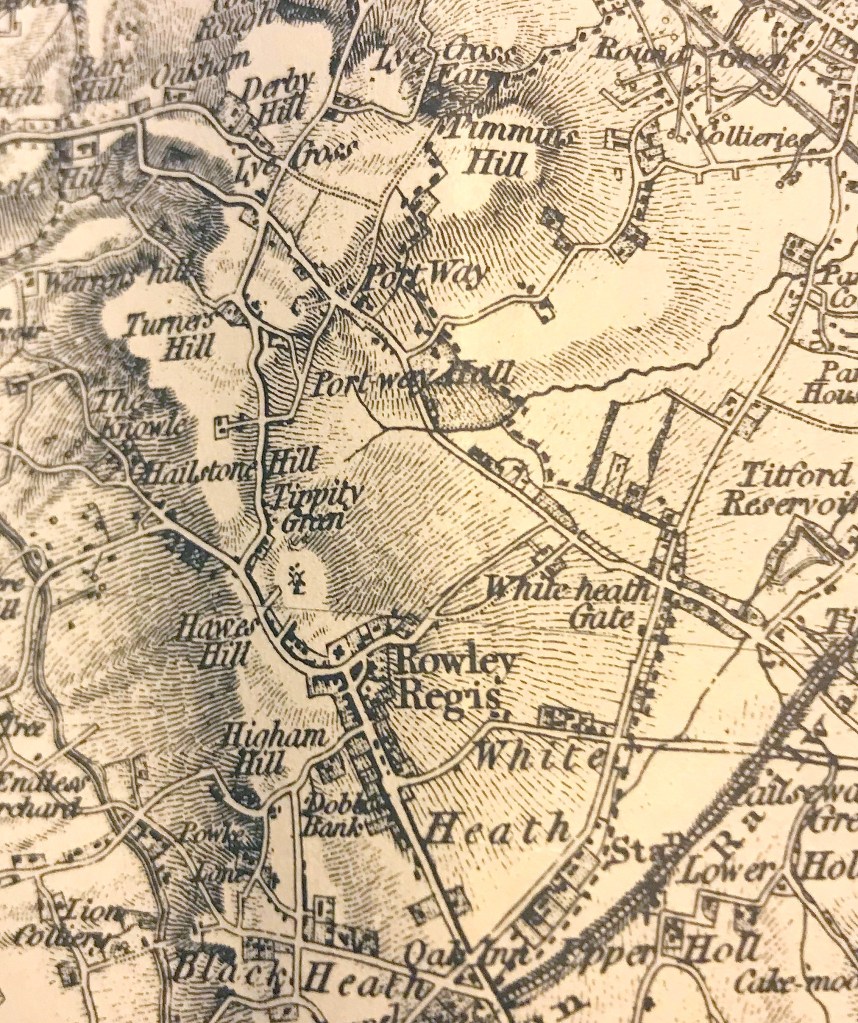
This map is an extract from the OS First Edition, which had been surveyed in the period up to the early 1830s. The road from Tippity Green goes up Turner’s Hill, there is no road straight on to Portway from Perry’s Lake as shown in later maps, so perhaps the very straight wide road from Perry’s Lake to Portway at what became Four Ways was a new Toll Road. In which case there would have been another Toll House, presumably where it joined Portway, with Newbury Lane on the other side of the road leading on to Oldbury. It would have been a very convenient and much flatter improvement to the route, much to the benefit of industrial traffic and at least better off people would have been willing to pay a toll to avoid the hill.
Turnpikes were apparently usually set up to improve existing roads which parishes were struggling to maintain. They were roads administered by Trusts authorised by private Acts of Parliament, on which tolls were charged at gates. They first began in 1663 and gradually increased in numbers so that by 1820 over 1000 turnpike trusts controlled about 22,000 miles of road with 7000 or more gates. Mostly they followed the old roads up hill and down dale. But by the early 1800s, new turnpike roads were being planned along routes whhich had not previously existed. This may have been such a road.
I am now trying to track down more information about this, in the form of the Act of Parliament setting up the Trust or plans and documentation and have sent enquiries to local archives. This may take some little time so this is a teaser and I will keep you informed of any more information I find. Watch this space!
In the meantime, if anyone knows of any information about this turnpike, I would be very pleased to hear from you.
I have been unable to find another Toll House Keeper listed anywhere in the Portway area in the 1851 Census but it is possible that a different enumerator might have recorded only the main occupation of the husband.
It does occur to me that perhaps the new road from Springfield to Dudley might also have been a turnpike road, and, if so, there would have been a gate keeper’s cottage there, too. But that is pure speculation!

Copyright Alan Godfrey Maps
The windmill off Tippity Green, which is documented as being there for centuries, was also still marked on the earlier map, where Windmill Farm was later.
Incidentally, you can also see from this map that the road to Whiteheath from Rowley village goes past the church and then bends round in front of Rowley Hall (I am old enough to remember where Rowley Hall was!) and straight on to Throne Road and past what became known as Ramrod Hall Farm. There was no Hanover Road then. When the quarrying and mining to the North of Rowley Hall expanded it cut off this road so another route must have been found by local people who would still have needed to access the parish church for services, baptisms, marriages and burials.
Copyright Anthony Page
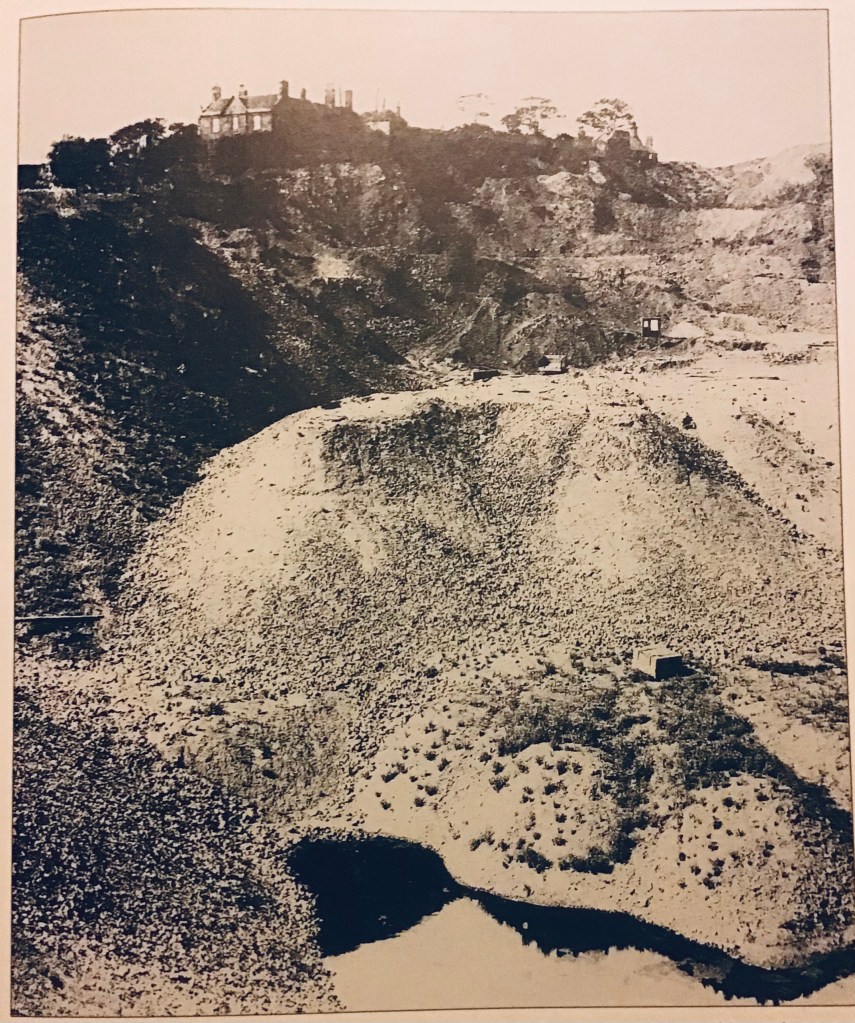
This photograph shows the ‘small quarry’ below Rowley Hall. No chance of walking the old route across this.
This closure must have been inconvenient for people living in the Whiteheath and Mincing Lane area but the quarrying and mining did offer work opportunities. In due course, another road was built from Mincing Lane/Bell End to the Hall to provide a road for vehicles, called, of course, the New Hall Road which is still there, now called Newhall Road.
I recall that, more than a century later when I was a child, people still cut from Bell End up the side of the ‘bonk’, over the now flattened old pit and quarry workings, past the old reservoir to come out at Rowley Hall, on their way to Rowley village and church (or school in Hawes Lane in my case) as the shortest route available. Old habits die hard!
 rowleyregislosthamlets.co.uk
It truly makes my heart hurt, that I can’t see all these old roads, farms and buildings, which my ancestors knew so well.
LikeLike