I have been continuing this week to dip into the very detailed and wideranging reports by the Health Inspector to the Rowley Regis Borough Council. This piece does not relate solely to the area of the Lost Hamlets but this campaign would certainly have included them so I have included it in my blog out of general interest.
Recycling seems to be thought of these days as a fairly modern phenomenon but this extract from the RRUDC Health Inspector’s Report in 1941 shows that it has happened before!
The Ministry of Supply started the “National Salvage Scheme” in December 1939 to save paper, rags, rope and string, household bones, rubber, food waste and all kinds of metal. The Women’s Voluntary Service helped run the campaign to encourage householders to salvage as much material as possible. The point in time of this report was almost halfway through the Second World War and shows how the authorities engaged with the community in promoting recycling for the War Effort.
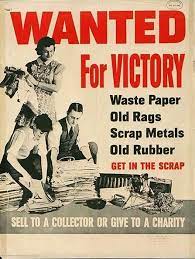
Copyright unknown.
This report is taken from the online report verbatim.
“1941 Report of Health Inspector to Rowley Regis Urban District Council.
WASTE RECOVERY.
This work has expanded during the year according to the demand of National needs.
The premises at Powke Lane have been fully made use of and the ample space and cover provided has been invaluable. An Electric Baling Press for tins, and a larger one for paper (both purchased the previous year) were installed and are rendering excellent service.
In August a County Salvage Drive was inaugurated in which Rowley Regis as a Borough took part, and a two-ton Bedford lorry was obtained and fitted with high sides and painted with suitable advertising matter. The slogan adopted, “ SALVAGE OR SINK,” has caught on very well.
A loud speaker and gramophone were fitted to this vehicle, and after the official send-off by the Mayor and Mayoress, the Chairman of the Health Committee, the Organiser of the W.V.S., and the Leader of the Girl Guides, a tour of the streets and a canvas of every house in the district was made within the allotted fortnight. Excellent results were obtained in material, but financially we were no better off owing to heavy expenses incurred to make the effort a success.
Apart from this, however, the imagination of the Public was stirred and it did help to keep the householders more salvageminded with the resultant continuous even output.
My opinion is that whilst County Drives have played a useful part in educating the people in this war effort, National Appeals result in a far heavier response by those firms who have had the capacity to contribute the weightier ledgers and redundant material which is asked for.
The Women’s Voluntary Service has rendered excellent service and on two occasions every house in the Borough has been canvassed, and handbills delivered. In addition to this, large bills with a gummed front surface have been distributed and stuck inside the windows of the houses. The W.V.S. has been most successful in this form of advertisement as at least one house in every 20 throughout the whole Borough exhibited at least one bill in the house or shop window.
The bills or posters were in large red block type letters with the words “ PLEASE KEEP your Salvage out of the Dustbin,” and “ Put your Scraps in Pig Food Bins and maintain your Eggs and Bacon.” The results were well worth the effort.
In addition to the above, on two separate occasions, every dustbin lid in the Borough had glued on to it a circular paper disc 6 inches in diameter with red letters with the following words “For Ashes Only. Keep your Salvage out,” and “Salvage in the Dustbin is an offence against the War Effort. Are you Guilty? ”
Needless to say, the results were remarkable.
Further to all this, an alternative weekly collection of Refuse and Salvage was inaugurated during the early months and continued throughout the year.
This system of salvage collection is far in advance of the hanging of bags in the street for householders to put the paper in once per week, a method as unsightly as it is disagreeable. A weekly collection from shops, offices and stores is also maintained.
Splendid results have also been obtained from Schools. The method is for children to collect paper and metal and take it to school. It is weighed daily and each child credited with the amount collected. Prizes to the children of each school have been awarded monthly in the form of Saving Stamps, and these have been presented by the Mayoress together with the Chief Sanitary Inspector. The Mayoress (Mrs. Card) has done wonderful work in this connection as up to 10 schools have been visited in one day every month awarding the prizes and instructing the children on salvage procedure.
Much praise is also due to the teachers, most of whom have given every possible help throughout the whole period.
Pen friends have also been made with our local school children in towns in the Yorkshire area.
Prizes of Saving Stamps have been awarded to the children totalling £22 8s. 6d.
Fortnightly visits to the tip and Salvage Disposal Depot have been arranged by the W.V.S. for groups of children from the various schools, and this has formed an interesting feature of our advertising campaign.
The estimated value of Salvage sales are as follows:—[ For those who are not familiar, these sums are shown in pounds, shillings and pence!]
January £51 15 10
February £490 16 1
March £202 1 1
April £217 15 11
May £318 7 6
June £325 0 7
July £251 10 6
August £407 5 3
September £240 0 2
October £305 18 9
November £278 16 11
December £278 19 1
Estimated total sales … £3,368 7 8
The following are the amounts of waste material recovered and returned to industry:—
Tons Cwts Qrs Lbs.
Waste Paper 387 0 2 7
Pig Food 320 6 0 0
Ferrous Metals 202 2 2 18
Non-Ferrous Metals 1 7 0 14
Baled Tins 70 5 0 0
Bones 7 8 3 4
Rags 8 3 2 0
Broken Glass 29 14 3 0
Bottles, Jars, etc. 494 gross, 3 dozen.
Deputations from other Authorities have visited the District and have copied some of our methods.
The number of Communal Pig Food Bins in the district is 825, and these are collected three times per week. The Refuse and Salvage vehicles also collect household scraps from the houses on the weekly visits.”

Copyright details unknown.
We may think we are doing something new but in reality, recycling and re-using materials used to be essential and a way of life to a far greater extent than it is now. It is our modern society which has forgotten about ‘rag and bone men’ who came round the streets with their horse and cart and we have become used to single use plastics and throwaway appliances.
Perhaps we might still have some lessons to learn!
 rowleyregislosthamlets.co.uk