Recently I came across an article in Ariss’s Birmingham Gazette dated 11 April 1825.
Coroner’s Inquest: Rowley Regis
A long examination took place on Saturday at Rowley Regis before Mr H Smith, Coroner, on the body of Jonathan Taylor, a pauper, upwards of 85 years of age. The deceased, who possessed excellent bodily health but whose mental faculties had for some time failed him, was an inmate of the poorhouse, and frequently became so unmanageable that he was obliged to be put under restraint. It was on an occasion of this kind that on Monday afternoon he was confined in a room called the dungeon where there was clean straw for him to lie on, and his victuals were regularly taken to him, and he made a hearty dinner on Tuesday with beef, bread and potatoes; but towards evening he stripped himself naked, and refused to eat his supper.
At five o’clock on Wednesday morning he was heard to cough, and about seven he was found dead, lying on his side with his shirt under his head. Several of the paupers deposed to the kind and humane treatment which the deceased had always received, in common with themselves, from the Governor and Governess of the Workhouse, and it appears that the dungeon was dry and wholesome and had a boarded floor. The Rev. George Barrs, Minister of the parish, stated that he had often made enquiries from the poor as to their treatment and they always expressed themselves perfectly satisfied with it. Mr Kenrick, the surgeon, who opened and examined the body of the deceased, said there were no marks of injury whatever upon it, and that he had never before seen so healthy a subject, considering his extreme age, and that he had no doubt he died a natural death. The jury therefore returned a verdict to that effect.
So what we would now recognise as dementia and mental health problems were a similar problem almost exactly two hundred years ago, and although treatment has mostly moved on a little, even now, in the 21st century, there are periodoc cases one hears of where the treatment of such people has not improved a great deal since then.
I cannot find a baptism locally for a Jonathan Taylor at any time around 1740 or any other record of him but he must have had some local connection to be in the Poorhouse.
The Poorhouse in Rowley was at the Springfield end of the village, just above Tippity Green and the Bull’s Head, on the same side of the road. It is apparently shown on this map which is a copy of the map drawn up in about 1800 in connection with the Enclosure process, above the Bull’s Head, with two buildings and marked ‘Poor’ and ’27’. but considerably before Brickhouse Green. The second building may have been a nailshop which Chitham says was used by the inmates to earn their keep.
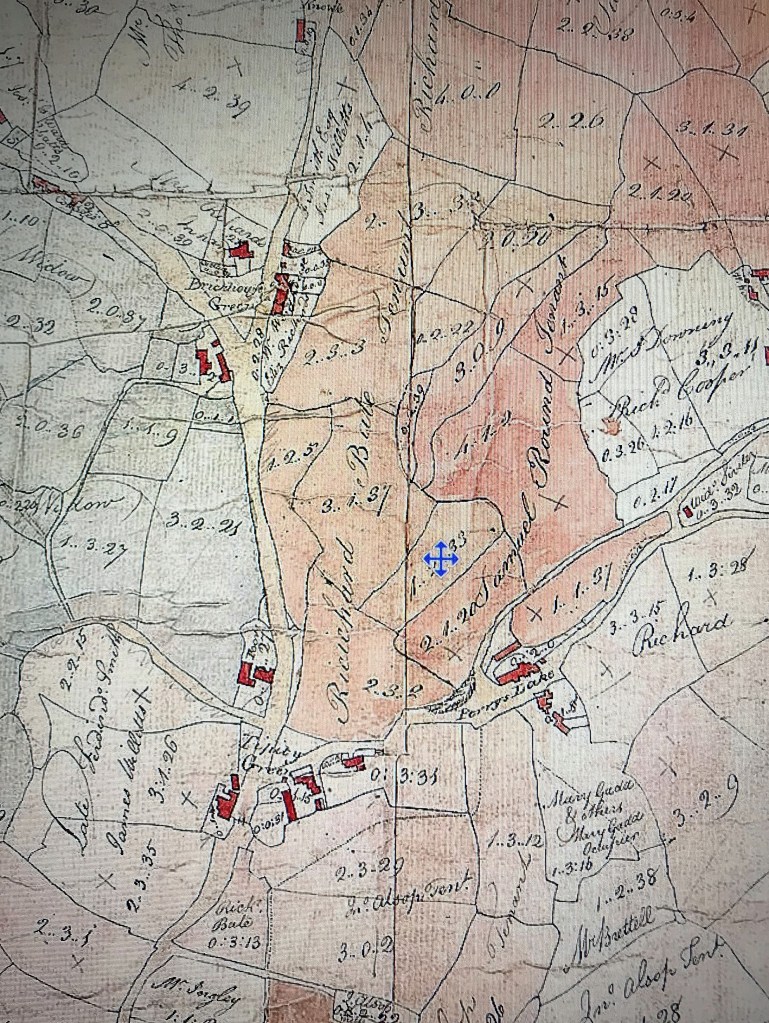
Copyright Glenys Sykes.
Later there seems to have been some alms provision in Tippity Green itself.
Edward Chitham (in his 1972 book The Black Country) says
“The Rowley Poorhouse was situated at Tipperty Green where nowadays the Christadelphian church stands. It was a stone building, limewashed white and contained separate accommodation for men and women. In addition to stone breaking both sexes worked in the adjoining nailshop, which was closed in 1829 to provide space for a small sickbay. In the sickbay the floor was to be laid with bricks and the window looking out on to the garden stopped up, being replaced by another looking onto what is now the Dudley Road. This was to be “above the height of persons” who might look in and see the paupers.”
Perhaps the provision of a sickbay in 1829 was as a result of the death of Jonathan Taylor in 1825.
How were Poorhouses run?
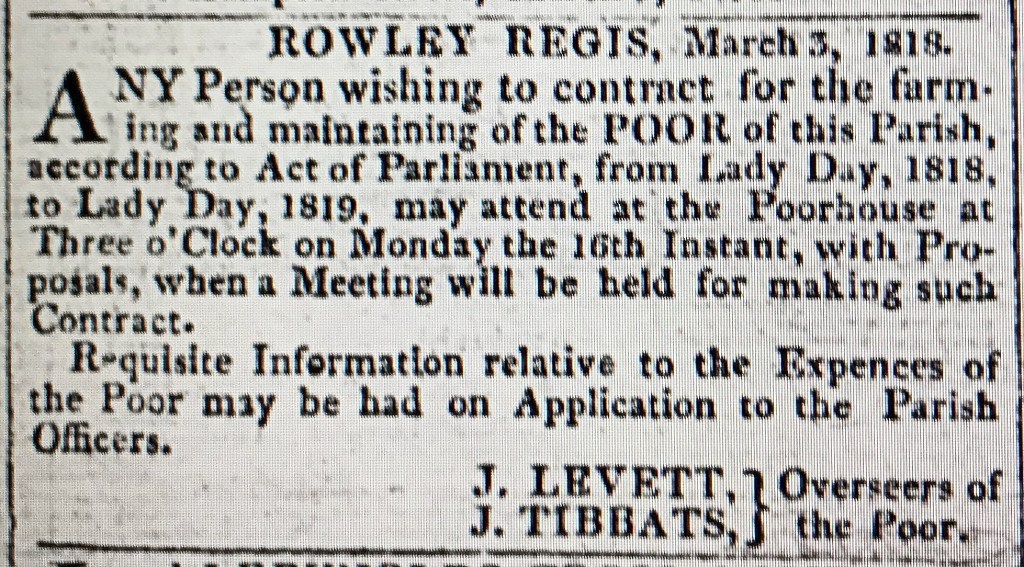
Under legislation arising from the Poor Relief Act of 1601, by the Parish, who appointed Overseers of the Poor (along with Churchwardens and other Parish Officers) from among their number. But those Overseers clearly delegated some of the practical work of running the Poorhouse.
On 3rd March 1818 this advertisement appeared in Ariss’s Birmingham Gazette:
Copyright: Glenys Sykes
Yes, it does say ‘the farming’ of the Poor, a curious term. So it appears that this work was let on an Annual Basis.
What life in the Poorhouse was really like
It is possible that life in the Rowley Poorhouse was not quite as rosy as the picture painted at the inquest above.
These are entries from the Parish Records at about that period:
Rowley Regis Poorhouse 3 January 1820
Resolved that Sarah Challenger be set to break stones at the Poor House under the inspection of J Evans and that she be kept to do that work every day and always do a reasonable quantity of it before every meal is given to her, and that the same course be taken with all other paupers who are capable of work, and that the stones to be broken by the women be first broken into pieces or brought to the place in pieces not exceeding ten or fifteen pounds and be broken by a hammer not exceeding two pounds into pieces not exceeding 3 or 4 ounces.
Rowley Regis Poorhouse 7 May 1820
Ordered that those of the Poor House that are capable of using a hammer with both hands be so put to work, and others with a hammer to be used with one hand only, and that they be not suffered to eat till the appointed quantity be broken by each of them, the stones to be broken down to the size of a hen’s egg.
Bearing in mind that the stone referred to was probably the local notoriously hard Rowley Rag, they certainly earned their keep. And all the local Guardians had supplies of ragstone delivered to their Work and Poorhouses and presumably received an income from the broken stone when it was sold on.
Poor House Rowley Regis 6 July 1821
John Haden was employed to maintain all paupers in the Poor House and he was paid the sum of two shillings and sixpence for each person each week.
One can see why entering the Poorhouse was very much something people dreaded and did their best to avoid. Even for those who needed financial support but could remain outside of the Poorhouse, the authorities would not give any financial assistance, for example, if the applicant owned a dog and they would require the dog to be destroyed before making any payments.
Government Enquiries
The Government was also taking an interest at this time in how these institutions were being managed. A Poor Rates Order was passed in the House of Commons on 20th June 1821,
“That the Churchwardens and Overseers of the Poor of every Parish, Township or other place, in England and Wales, do prepare an Account showing the total amount of the Money levied in the year ending on the 25th March 1821,upon such Parish, Township or other place, maintaining its own Poor; and also, the total amount of Money expended in that year; distinguishing in the said Account the amount of Money paid for any other purpose than the relief of the Poor; and that such Churchwardens and Overseers do, as soon as may be, transmit such Account to the Clerk of the House of Commons, stating, in addition thereto, the number of persons (if any) maintained in any Workhouse or other Poor-house, distinguishing in such Statement the number of children under 14years of age; and also stating whether any Select Vestry has been formed or an Assistant Overseer appointed by Virtue of the Act 59 Geo 3 C.12 and any other observations which may be thought necessary.”
The Report was to be brought back to the House of Commons in six months’ time. At this time, although the first national censuses had been held, the information from them was very limited and not detailed at all so probably this was the only way for the Government to gather this information.
Perhaps as a result of these researches, it appears that the Government was not satisfied that individual parishes were coping well or consistently with their responsibilities for the poor and the wealthier classes considered that they were paying for the poor to be idle. In 1834 ‘An Act for the Amendment and better Administration of the Laws relating to the Poor in England’, known widely as the New Poor Law was passed in Parliament which attempted to impose a system which would be the same all over the country.
Provision was made for Unions of parishes to be set up where several parishes would make provision jointly. Except in special circumstances, poor people could now only get help if they were prepared to leave their homes and go into a workhouse.
Conditions inside the workhouses were deliberately harsh, so that only those who desperately needed help would ask for it. Families were split up and housed in different parts of the workhouse. The poor were made to wear a uniform and the diet was monotonous. There were also strict rules and regulations to follow. Inmates, male and female, young and old were made to work hard, often doing unpleasant jobs such as making nails (although most Rowley folk would have been well used to this) or breaking stones. Children could also find themselves hired out to work in factories or mines.
The National Archives says that “Shortly after the new Poor Law was introduced, a number of scandals hit the headlines. The most famous was Andover Workhouse, where it was reported that half-starved inmates were found eating the rotting flesh from bones. In response to these scandals the government introduced stricter rules for those who ran the workhouses and they also set up a system of regular inspections. However, inmates were still at the mercy of unscrupulous masters and matrons who treated the poor with contempt and abused the rules.”
In 1836 the Parish of Rowley joined the Dudley Union of the Board of Guardians and later a new Workhouse was built at Sedgley where conditions were supposedly very much improved. From that point all of the residents of the Poorhouse in Rowley should have transferred there and certainly there were burials after that date of Rowley people who had died in the Sedgley Workhouse, as this is recorded in the Burials Register in some cases, although some were buried at Sedgley.
The New Workhouse for the Dudley Union
The provision of a new Workhouse for the Union had met with considerable opposition in Rowley, from those who were liable to pay the Poor Rate. In 1849 Mr F W G Barrs attended a meeting of the Guardians of the Dudley Union, (at which he was one of those who represented Rowley) and presented a Memorandum against the erection of a New Workhouse, which he said bore the signatures of ‘a great majority of the resident proprietors, rate-payers, and influential iron and coal masters’. According to the report in the Birmingham Gazette the presentation of this document “gave rise to some derisive observations from Mr Thomas Darby, one of the Rowley Guardians, and which drew from the Chairman the remark that a memorial of such a nature was deserving of the utmost attention and respect, instead of being met with a sneer and made a subject of ridicule.” After some discussions about the potential excessive cost of running a new Workhouse and evidence adduced by the Chairman who had consulted various ‘eminent medical men’ who had given it as their opinion that “in all the Kingdom cannot be found more healthy poor-houses than those now used in the Dudley Union” [which seems quite a remarkable claim] but he left it to the Guardians to act ‘according to the dictates of humanity and their own consciences’.
A proposal was made to the meeting to build a new Workhouse, an amendment was proposed by Mr Barrs “that under the existing depression of every kind of trade, and particularly of the iron trade which is the staple trade of the [Dudley] Union, it is the opinion of this meeting that this is not the time to impose any additional burthen on the already heavily burthened rate-payers.” Eventually, this proposed amendment was withdrawn and the proposal to build a new Workhouse was put to a simple vote. There were seven votes in favour and sixteen against.
This clearly did not put a stop to the proposal entirely as a new Workhouse was built in Sedgley in 1855-56.
The Rowley Poorhouse Building
There is some evidence, however, that the original Poorhouse building in Rowley was no longer in use before the new Workhouse was opened because in August 1849 there was an article in the Birmingham Gazette which related that:
‘At the weekly meeting of the Dudley Board of Guardians on Friday last, it was proposed, and, notwithstanding the strenuous remonstrances of Mr Barrs, one of the Rowley Guardians, ultimately resolved “that the Poorhouse at Rowley Regis be forthwith put in repair and used as a place for the reception of cholera patients for the whole of the Dudley Union.” This Union includes the densely populated parishes of Sedgley, Tipton, Dudley and Rowley.’
Mr Barrs was one of the sons of the late Rev. George Barrs and it seems that he may have inherited the combative style which had made his father so unpopular with his parishioners as the reports of his contributions to meetings of the Dudley Union Board seem to have him vigorously protesting against various proposals. It might be considered that it appears that in doing so he was usually representing the financial interests of rate payers and local businessmen, rather than the welfare of the poorer people who needed poor relief.
However, on this particular topic, one can imagine that the residents of the village around the former poorhouse would not have welcomed the use of the old buildings as a cholera hospital for the whole of this large area, especially as it was recognised to be so contagious so on this occasion Mr Barrs probably was speaking for most local residents. There was a cholera outbreak in the area in 1849 and there were 13 cases in the Rowley Parish, mostly in Old Hill in October and November. It is not known whether this plan was ever carried out or whether alternative arrangements were made. The former Poorhouse would not have appeared to have been very big so it is not clear how many people it would have accommodated nor who would have nursed the patients.
Up until this time, it appears that Overseers had been generally appointed from among local people and were probably not paid, it being perceived as a public service to the community. However, times were changing. By the middle of the 1800s the job of the Overseer or even the Assistants to the Overseer were not confined to the supervision of the Poorhouse or Workhouse itself, it seems. There was an advertisement in July 1849 for the neighbouring Union of Walsall for an Assistant Overseer which read:
Assistant Overseer wanted
The Guardians will, on the 10th August next, appoint some Person to perform the duties of ASSISTANT OVERSEER for the several Parishes in this Union.
Candidates, between the ages of 25 and 55 years, must be thoroughly competent to undertake settlement cases and parish appeals, and value all rateable property to the poor-rate. Salary £50 a year.
So the appointees would have had considerable administrative duties and would have required knowledge of the law to interpret whether people had a right of settlement and so were entitled to poor relief, a responsibility parishes were always keen to repudiate if that responsibility could be passed on to another parish where someone had lived or worked previously.
In the same paper an advertisement by the Parish of Birmingham was seeking to appoint ‘a properly qualified, active and experienced married couple to undertake the offices of Master and Matron of the Workhouse. Joint Salary £150 per annum with Board and Rations.’ They would be required to devote the whole of their time to the duties of their respective offices, and to enforce the observance of the Rules and Regulations of the Poor Law Board, and of the Board of Guardians, with the strictest care. The Master was required to be fully competent to keep the Books required under the Order of Accounts and to give a security of £200 for the faithful performance of his office. So this post did not appear to include the same responsibility for investigating rights of settlement as the Rowley job but it would have been a much larger operation. The report about Jonathan Taylor shows, though that in 1825 there were a Governor and Governess running the Poorhouse on a day to day basis.
The social care profession was slowly being made more professional, although compassion still did not appear to enter into the picture very much.
The Right of Settlement
Priot to the New Poor Law, the Right of Settlement meant that the place where you had this right had to assume responsibility for keeping you if you became poor or ill and unable to support yourself. My 4xg-grandfather Thomas Beet had been born in Nuneaton in 1764 and married there in 1802, having four sons of whom two survived, his wife dying in 1819. My fourth cousin Margaret who is also a descendant of Thomas kindly shared with me her discovery of a Removal Order in Nuneaton in 1820 relating to Thomas and his two sons who were deemed to have no Right of Settlement in Nuneaton and were removed to Rowley Regis. The reason for this is unclear but it is probable that in previous years he had worked in Rowley for some time, possibly for his cousin John Beet at Rowley Hall and this residence overtook his right to be maintained in Nuneaton.
Thomas appears in the 1841 Census in Tippity Green, along with two other elderly residents in the household of Elizabeth Thomson who is said to be of Independent Means. There is no mention of the Poorhouse. In the 1851 Census he was still in Tippity Green, aged 88 and Blind, as was Elizabeth Thompson, now shown as a Widow, and they are both described as Almspeople. So even several years after Rowley had joined the Dudley Union, there were still people described as Almspeople living in Tippity Green (and I have seen a suggestion that there was a Poorhouse in Tippity Green though I cannot find it on any map from the period. ) When Thomas Beet died in 1852 and was buried at St Giles, his abode was still given as The Poorhouse. Almshouses and Poorhouses are not the same thing but it is not clear who gave alms to support local people such as Thomas. I have not heard of any Almshouses as such in Rowley but I am aware that John Beet, the wealthy squire of Rowley Hall, had left the following legacy in his Will which was proved in 1844
“I give and bequeath unto the clergyman of Rowley Church and the occupier of Rowley Hall for the time being the sum of three hundred pounds. And it is my wish and I direct them to nominate and appoint under their hands in writing six proper persons to be trustees jointly with them for the purposes hereinafter mentioned, that is to say: Upon trust to invest the said sum of three hundred pounds upon freehold or governmental security and to crave the interest and proceeds thereof and give and divide the same unto and between such poor persons residing in the parish of Rowley as they or the major part of them shall consider fit and proper objects for relief, part in clothes and part in money.”
So the Vicar and the resident in Rowley Hall (at this time the widow of the late John Beet) appear to have had a sum of money for the assistance of the poor at their disposal and I wonder whether this was how Thomas came to be supported within the village, as an Almsperson. I will do some more research to see whether I can find out what happened to any such Trusts in later years. There is no apparent record of such a charity at the Charity Commission now but it is possible that it may have been consolidated in with other small charities at some point. A record may also have appeared on Charity Boards inside the church. If so, these may well have been destroyed in the church fire. If anyone has any information about this, I would be most interested to hear about it.
There is an interesting article on the workhouses.org website from the Dudley Guardian with a ‘pen and ink sketch’ which waxes lyrical about conditions in the new workhouse in 1866 which makes it sound almost like a delightful rest home. There is also a history and a plan of the new Workhouse on the website.
So this was the Poorhouse and Alms provision which served Rowley village and the Lost Hamlets two hundred or so years ago and illustrates how local people who could no longer support themselves were cared for. At least we know rom that inquest report that the Vicar took an interest in the Poorhouse and that, when someone – even someone who was 85 – died unexpectedly in the Poorhouse there was an inquest held locally and reported on and a real attempt was made to discover whether he had been ill-treated. It also gives us a glimpse of life as a pauper then, for our poor, old or infirm ancestors who could not be cared for by their families.
 rowleyregislosthamlets.co.uk