WWII Farming Survey
In 1941 and over the next two years detailed surveys were carried out by the Government to assess the quantity and quality of farmland available to feed the nation during the War. The original forms , known as MAF (Ministry of Agriculture and Food) 32, can be seen at The National Archives so on a recent visit I arranged to see the file for farms in Rowley Regis and photographed many of them, from which I have extracted the information which follows. With full copyright acknowledgment to The National Archives, I have used different sections of the form relating to one farm – Hailstone Farm – in this article but the same farms were available for each farm and I have extracted details below.
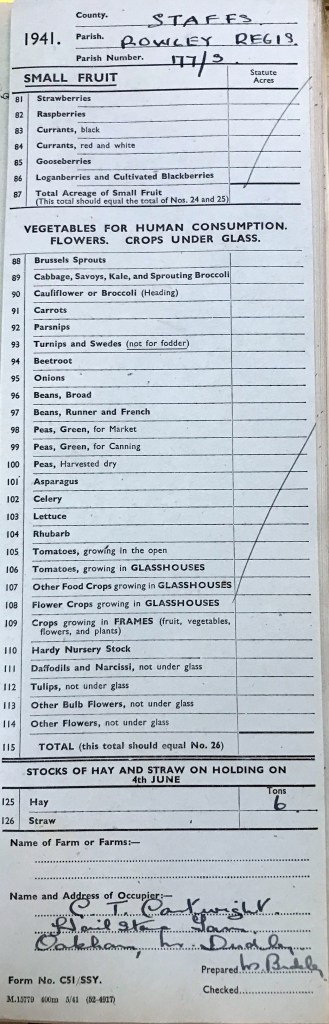
First Section: The first set of forms No.C51/SSY in 1941 listed various crops and how much land was in use for each sort of crop being grown. Under Small Fruit were listed Strawberries, Raspberries,Currants – black, Currants red and wite, Gooseberries, Loganberries and Cultivated Blackberries, with a sub-total for the Total Acreage of Small Fruit.
The next section was for Vegetables for Human Consumption. Flowers. And Crops under Glass. Here the crops listed were Brussels Sprouts, Cabbage (Savoys, Kale and Sprouting Broccoi), Cauliflower or Broccoli (Heading), Carrots, Parsnips, Turnips and Swedes (not for fodder), Beetroot, Onions, Beans – Broad, Beans – runner and French, Peas – green for market, Peas – green for canning, Pease – harvested dry, Asparagus, Celert, Lettuce, Rhubarb, Tomatoes – growing in the open, Tomatoes – growing in Glasshouses, Other Food Cops growing in Glasshouses, Crops growing frames – fruit, vegetables, flowers and plants, Hardy Nursery Stock, Daffodils and Narcissi – not under glass, Tulips –not under glass, Other bulb flowers – not under glass, other flowers – not under glass, with again, an acreage total for each category and a subtotal.
The third section was for Stocks of Hay and Straw on the holding.
This is the completed form for Hailstone Farm.
Copyright The National Archives Document MAF 32/604/177, Extract.
So this was a comprehensive assessment of what was being grown that summer on the farms and small holdings of the country. A remarkable number of these for Rowley were Nil returns – nothing being grown, I was beginning to think that the Rowley farms were remarkably unproductive.
What happened next?
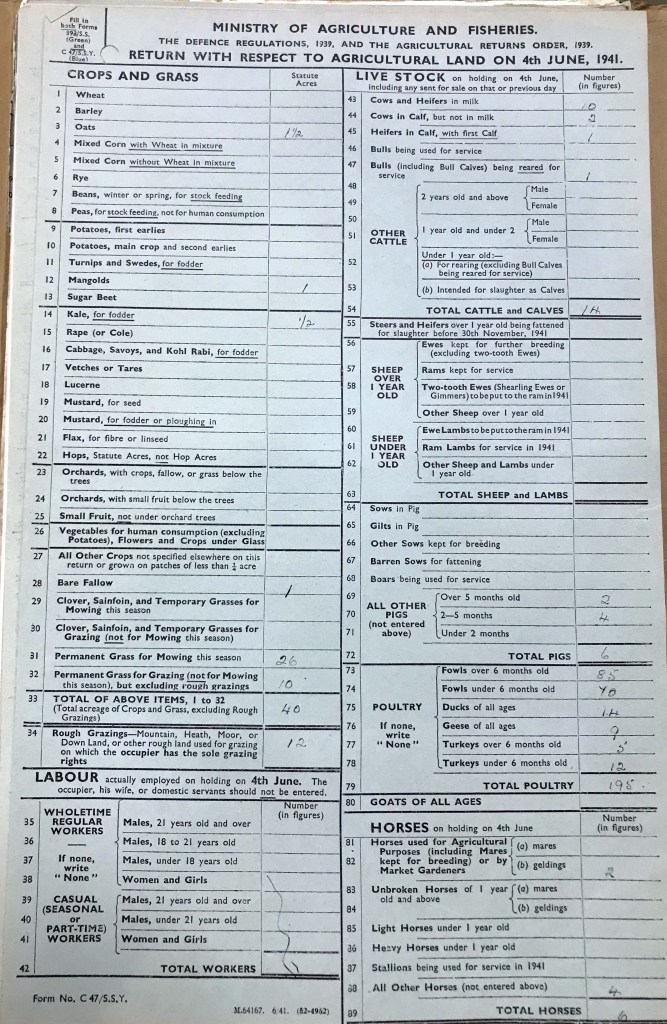
I have to confess that I cannot quite work out how the forms fitted togeether and whether they all went out at one time. But the information is pretty clear. Much more detailed surveys were compiled on Form No. C.47/S S Y which went into the size, condition, usage of the farm, the number of men employed, details of Live Stock broken down into very specific detail.
The first section listed the Statute Acres for growing each of these crops on 4th June – Wheat, Barley, Oats, Mixed corn with wheat in mixture, Mixed corn without wheat in mixture, Rye, Beans – winter or spring, for stock feeding, Peas for stock feeding, not for human consumption. Then the acreage used for vegetables had to be listed – Potatoes – first early, Potatoes – main crop and second earlies, Turnips and Swedes for fodder, Mangolds and Sugar Beet. Kale – for fodder, Rape (or Cole), Cabbage, Savoys and Kohl Rabi for fodder, Vetches or Tares, Lucerne, Mustard – for seed, Mustard for fodder, Flax – for fibre or linseed, Hops – Statute Acres – not Hop Acres, the form says sternly – who knew there was a difference?
Then acreage of Orchards had to be shown – those with crops, fallow or grass below the trees and those with small fruit below the trees had to be shown separately, and Small Fruit not under orchard trees.
Vegetables for human consumption (excluding potatoes) had a line to themselves but included Flowers and Crops under Glass. All other crops followed, including clover, Sainfoin, grass for mowing and got grazing. Then the form details information about the labour employed on the farm (not including the occupier, his wife or domestic servants). Followed by full details of the stock held, right down to the last piglet and hen, with horses required to be listed by their use and their age.
A copy of the form for Hailstone Farm is shown here, it makes interesting reading.
copyright The National Archives Document MAF 32/604/177, Extract.
The next section of the form required details to be given of the Labour employed on the 4th June 1941, including the family of the occupier and whether regular or casual, whole or part time. Then a section on Motive Power on each holding had to be completed, water wheels or turbines – in use or not, whether repairable if not in use, Steam engines, Gas Engines, Oil or Petrol Engines, Electric Motors or others – state kinds, the form says. It’s difficult to think of any other kinds, but there was obviously no excuse for not declaring it if there were any! Edit: A later part entry for one farm lists a horse – which was of course for many the main source of motive power for centuries, those or oxen. Then there was a section requiring information on Tractors held, of various sorts, with information required on the make and model.
Next the form required details of the rent being paid for the holding – if the land was owned by the occupier, the owner was required to give their best estimate of how much the rental value was. And how long the holding had been occupied by the current occupier.
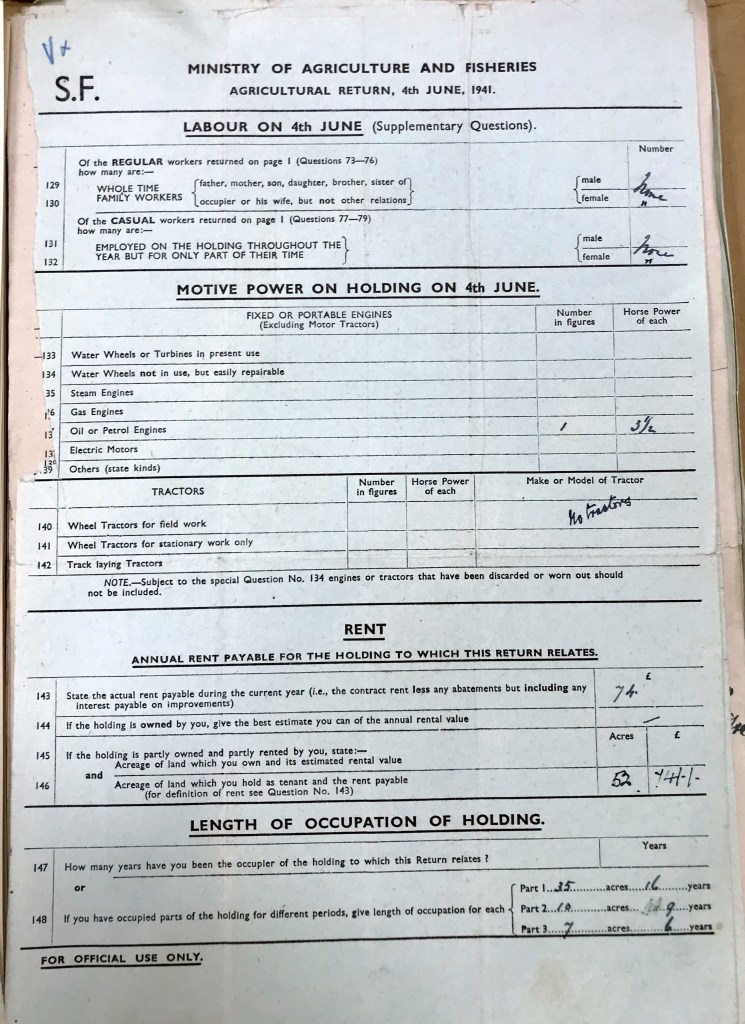
copyright The National Archives Document MAF 32/604/177. Extract
Later Survey
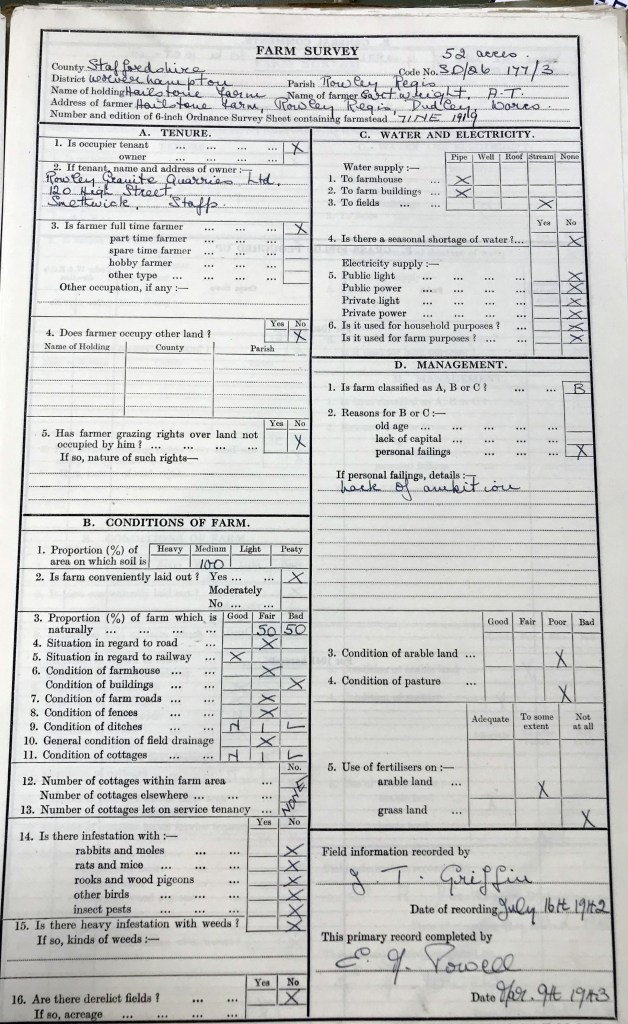
A later Survey gave a detailed picture, not only of the amount of land held but how it related to such things as access to transport, condition of buildings, facilities and an assessment of whether the farm was being farmed efficiently. Again, this is the form relating to Hailstone Farm, part of the same form as previously.
Copyright The National Archives Document MAF 32/604/177. Extract
There were a few copies of each of these forms relating to farms in Rowley. I have grouped the details under each farm and although they are, to some extent, repetitive, I hope they will be of interest.
Hailstone Farm
The name of the Occupier at Hailstone Farm was C or G Cartwright. What was he growing in that first survey? Ah, sadly, none of the crops listed, except that he had 6 tons of hay – just one entry!
At Hailstone Farm on the longer form, there were no additional labourers so all the work must have been done by the occupier Mr Cartwright and his family. He had one 3½ horsepower Oil or Petrol engine and no tractors at all. His rent was £74 per annum. Under the length of tenancy, he stated that he had rented 35 acres for 16 years, 10 acres for 9 years and a further 7 acres for 6 years.
Farm Survey: The survey was carried out on 16 July 1942. The owner of Hailstone Farm, with 52 acres was Rowley Granite Quarries Ltd., which was based in Smethwick High Street. Mr Cartwright was a full time farmer, but occupied no other land and had no grazing rights elsewhere. T he farm was said to be conveniently laid out.
All of the land was classified as medium weight., as opposed to Heavy, Light or Peaty. The condition of the farm was judged to be naturally 50% Fair and 50% Bad, with fair access to roads, good access to railways. The condition of the farmhouse was fair but that of the farm buildings was bad. Farm roads and fences were in fair condition as was the general condition of the field drainage but there were no ditches nor cottages. No problems were noted with infestations of rabbits, rats or rooks, etc nor any heavy infestation with weeds nor derelict fields. Water supply to the farmhouse and buildings was by pipe and to the fields by stream. There was no electrical power supply at all. The condition of the arable land and pasture was judged to be poor and, although fertilisers were used to some extent on arable land, they were not used at all on grassland. The overall verdict on management of the farm? It was graded B (out of a possible A, B or C, it appears). Of the possible reasons for this, it was noted that this was due to personal failings – a lack of ambition! They certainly weren’t pulling any punches, were they?
Turner’s Hill Farm
T E Monk at Turner’s Hill Farm was another nil return on the first form. The later form showed that he had no additional workers and no machinery. He was paying £67 per annum for 27 acres and had rented it for 13 years in 1941.
Farm Survey: Carried out on 31 Aug 1943. Turner’s Hill Farm was also owned by Himley Estates. Mr Monk was described as a ‘spare time’ farmer who was also a Factory Employee., with no other land or grazing rights. The farm was said to be conveniently laid out. The farm conditions showed that the soil was 50% Medium and 50% Light and the proportions of the farm was judged to be naturally 40% Fair and 60% Bad, with good access to roads, and fair access to railways. The condition of the farmhouse and buildings was fair. The farm roads were good and fences were in fair condition as was the general condition of the field drainage although the ditches were noted as Bad. There was one cottage within the farm area. No problems were noted with infestations of rabbits, rats or rooks, etc nor any heavy infestation with weeds, there were no derelict fields. Water supply to the farmhouse and to the farm buildings and fields was by pipe. There was no electrical power supply at all. There was no seasonal shortage of water noted. The condition of the pasture land was good and fertilisers were used adequately on grassland. The overall verdict on management of the farm? It was graded B (out of a possible A, B or C, the reason given for the downgrading was ‘Divided Interests’, presumably relating to Mr Monk’s other employment.
Old Portway Farm
The first form for Old Portway Farm, occupied by Phoebe Cooks, showed just 2 tons of hay.
But the more detailed form showed that Mrs Cooks was growing a total of three acres of Main Crop potatoes, turnips/swedes and mangolds. She had 8½ acres of mowing grass and 15 acres of grazing grass plus 2½ acres of rough grazing – there seems to have been a lot of this in Rowley, perhaps due partly to the effects of quarrying and mining settlement. She had three workers, one male and one female whole time workers and one part-time male. These cared for her 6 cows in milk, her 6 cows in calf but not in milk and 1 bull (used for service). There was one other female cattle aged between one and two years, giving a total of 14 cattle. There were no sheep or pigs but she had 85 fowls over 6 months old, 68 under 6 months and 3 ducks! The remaining live stock consisted of three geldings and one other horse.
On the next page, Mrs Cooks stated that she had one wholetime family worker (male, so not herself) and one part-time casual male worker. She also, like Mr Cartwright at Hailstone Farm, had one 4hp horsepower Oil or Petrol engine and no tractors at all. Her rent was £56/10shillings per annum for 29 acres. Under the length of tenancy, she stated that she had rented the land for 30 years.
Farm Survey: Carried out on 22 May 1942. The owner of Old Portway Farm, with 26½ acres, we can now see, was again Rowley Granite Quarries Ltd., which was based in Smethwick High Street. Mrs Cooks was a full time farmer, but occupied no other land and had no grazing rights elsewhere. The farm was said to be conveniently laid out.
All of the land was classified as medium weight, as opposed to Heavy, Light or Peaty. The condition of the farm was judged to be naturally 100% Fair, with fair access to roads, and good access to railways. The condition of the farmhouse and buildings was fair. There were no farm roads and fences were in fair condition as was the general condition of the field drainage and ditches. There were no cottages. No problems were noted with infestations of rabbits, rats or rooks, etc nor any heavy infestation with weeds, there were 2.5 acres of derelict fields. Water supply to the farmhouse was by pipe and to the farm buildings fields by well. There was no seasonal shortage of water noted. There was no electrical power supply at all. The condition of the arable land was judged to be fair and of the pasture good and, although fertilisers were used adequately on arable land, they were only used to some extent on grassland. The overall verdict on management of the farm? It was graded A (out of a possible A, B or C, it appears).
Lower Portway Farm
Joseph Cooks, at No. 17 – Lower Portway Farm had even less hay – he had nothing entered on his farm on the first form but more detail on the second. He had two acres growing the same crops as Mrs Cooks, plus 5 acres of mowing grass and 10½ acres of grazing grass. He had 3 cows in milk and two in calf with their first calf plus a bull under 1 year old which was being reared for service. No sheep or pigs but 120 fowls over 6 months, 50 fowls under six months and three ducks. He had no horses!
Farm Survey: Carried out on 14 May 1942. The owner of Lower Portway Farm, with 17¼ acres, was Himley Estates Ltd, with an office address in Dudley. Mrs Cooks was a full time farmer, but occupied no other land and had no grazing rights elsewhere. The farm was said to be conveniently laid out.
All of the land was classified as light weight, as opposed to Heavy, Medium or Peaty. The condition of the farm was judged to be naturally 100% Fair, with good access to roads, and fair access to railways. The condition of the farmhouse, farm buildings and farm roads was fair. The fences and ditches were in fair condition and the general condition of the field drainage and ditches was good. There were no cottages. No problems were noted with infestations of rabbits, rats or rooks, etc nor any heavy infestation with weeds, there were no derelict fields. Water supply to the farmhouse and the farm buildings was by pipe and to fields by stream. There was no seasonal shortage of water noted. There was no electrical power supply at all. The condition of the arable and pasture land was good and fertilisers were used to some extent on both arable and grass land. The overall verdict on management of the farm? It was graded A (out of a possible A, B or C).
175 Dudley Road
The Danks brothers were listed on the first form at 175 Dudley road and they had just 1 ton of hay.
The later section shows that they were farming 15½ acres, of which they were the owners. The farmer was described as a part-time Dairyman, with no other land or grazing rights. All of the land was classified as light weight and the farm was said to be conveniently laid out.
Farm Survey: Carried out on 20 Sep 1943. The condition of the farm was judged to be naturally 40% Fair and 60% Bad, with good access to roads and to railways. The condition of the farmhouse and farm buildings was fair. There were no farm roads. The fences and ditches were in fair condition and the general condition of the field drainage and ditches was fair. There were no cottages. No problems were noted with infestations of rabbits, rats or rooks, etc nor any heavy infestation with weeds, there were no derelict fields. Water supply to the farmhouse, the farm buildings and to fields was by pipe. There was no seasonal shortage of water noted. There was electrical power from the public company for light and power, which was used for household but not farm purposes. The condition of the pasture land was good (no arable land)and there was adequate use of fertilisers on the grass land. The overall verdict on management of the farm? It was graded A (out of a possible A, B or C).
‘The Stores’, High Street, Rowley Regis
Samuel Goode was listed at ‘The Stores’, High Street, Rowley Regis and he, too had a zero return on the first form. On the later form he had no crops, no workers and no animals – or at least none of his own, he had a note saying that he had no fowl of his own but let a corner piece of land to someone called Jackson who had about 50 fowl there.
He had no additional labour, no machinery and held 7 acres at a rent of £3/10shillings which he had rented for 7 years, noted in pencil at the bottom of the form as for rough grazing only. I wonder where his land was?
Farm Survey: Carried out on 2 Sep 1943. As might be expected he had a nil return to almost all of the questions on the last section, though his land was classed as 100%light and was not stated to be derelict but the proportion of the farm which was naturally bad was 100%. There were no buildings and the water supply to his field was noted to be by ‘pit’. No power! Fertiliser was used to some extent on what was classed as grass land but the holding still managed to be classed as A, somehow.
Brickhouse Farm
The first return for the Brickhouse Farm was completed by the Borough Surveyor at the Old Hill Offices of the RRUDC and he listed a half acre of onions being grown and half a ton each of Hay and Straw. The later form reported that there were 6 ¼ acres growing oats, 2 acres growing first early potatoes and 15 acres with main crop potatoes, 1 acre growing vegetables for human consumption, 1 acre bare fallow, and 45 acres of mowing grass, plus 17 acres of rough grazing. Contrary to what is stated elsewhere on these forms, he states that there are two full time male workers or 21 and one under 18, and four casual seasonal workers, giving a total of seven. Perhaps these were actually Council employees, rather than specifically employed by the farm. There were no animals on the farm other than one horse, a gelding. But a later part of the form shows that this was apparently the only local farm with a tractor so they did not need to keep many horses.
The next part of the return for Brickhouse Farm shows that it had no men working it and that 57 ½ acres had been rented since April 1939 for a mere £12. Presumably this land was what later became the Brickhouse housing estate. A second return by the same officer still employed no men but boasted a 25hp Fordson tractor. Here 49 acres was owned by the Council with an estimated rent value of £85pa, and a further 38¼ acres rented at £19/2/6. I suppose this could include the land on which the Grammar School was built in the early 1960s. Of this land, 67 acres had been held for only 2 years and 20¼ acres for 5 years. Perhaps the Rowley Regis Council was buying up land as it became available for future uses.
Farm Survey: Carried out on 11 Oct 1943. The owner of Brickhouse Farm, with 70 acres is shown to be Rowley Regis Boro’ Council. The full time farmer was noted as a Bailiff but he occupied no other land and had no grazing rights elsewhere. The farm was said to be conveniently laid out.
All of the land was classified as medium weight, as opposed to Heavy, Light or Peaty. The condition of the farm was judged to be naturally 50% fair and 50% bad, with good access to roads and railways. The condition of the farmhouse and the farm buildings was fair. The farm roads and fences were fair and the general condition of the field drainage and ditches was fair. There were no cottages. No problems were noted with infestations of rabbits, rats or rooks, etc nor any heavy infestation with weeds, there were no derelict fields. Water supply to the farmhouse and the farm buildings was by pipe and to fields by pit. There was no seasonal shortage of water noted. There was no electrical power supply. The condition of the arable land was judged to be fair and of the pasture poor and fertilisers were used adequately on arable land and grassland. The overall verdict on management of the farm? It was graded A.
Throne Farm
W Skidmore at Throne Road had 4 tons of hay on the first form. The next form shows that he had two additional full time workers but no motors of any sort or any tractor. His 33 acres was apparently valued at a rental of £40 and he had occupied it for 20 years.
Mr Skidmore was growing 1 acre of turnips and swedes for fodder and 2 of mangolds with 20 acres of mowing grass and 10 of grazing grass. He had two adult male workers who looked after 17 milking cows and 3 cows in calf. He also had a sow in pig and 5 piglets aged 2-5 months but no fowl of any sort. He had 2 mares and 5 other horses, 7 in total.
Farm Survey: Carried out on 16 Jul 1942. Mr Skidmore was the owner of the farm and that he was a full time farmer, he occupied no other land and had no grazing rights elsewhere. The farm was said to be conveniently laid out. The soil was deemed to be naturally 50% medium and 50% light. The proportion of the farm which was naturally good was 60%and 40% fair, with good access to roads and railways. The condition of the farmhouse was fair and the farm buildings good. The farm roads and fences were fair and the general condition of the field drainage and ditches was good. There were no cottages. No problems were noted with infestations of rabbits, rats or rooks, etc nor any heavy infestation with weeds, there were no derelict fields. Water supply to the farmhouse and the farm buildings was by pipe and to fields by stream. There was no seasonal shortage of water noted. There was electrical power supply used in the farmhouse and for farm purposes. The condition of the arable land was judged to be good and of the pasture fair and fertilisers were used adequately on the arable and grassland. The overall verdict on management of the farm? It was graded A.
Farm Survey: Carried out on 12 Sep 1944. Mr Skidmore also owned land at Whiteheath Farm, 31 acres of this. All of the land was classified as medium weight, as opposed to Heavy, Light or Peaty and the farm was said to be conveniently laid out. The condition of the farm was judged to be naturally 25% fair and 75% bad, with good access to roads and fair access to railways. There was no farmhouse, farm buildings or farm roads and fences were good and the condition of the ditches and the field drainage was fair. There were no cottages. No problems were noted with infestations of rabbits, rats or rooks, etc nor any heavy infestation with weeds, there were no derelict fields. Water supply to the fields was by stream. There was no seasonal shortage of water noted. There was no electrical power supply. There was no arable land and the pasture was rated fair and fertilisers were used adequately on the grassland. The overall verdict on management of the farm? It was graded A.
1 Oakham Farm
David Whitehouse at 1 Oakham Farm had nothing to list on the first form. But the next form shows that he was growing maincrop potatoes, turnips/swedes and mangolds, and there were 16 acres of mowing grass and 20 of grazing grass. Two whole time men over 21 were employed and one 18-21 year old. There were 8 cows in milk, no poultry but three mares, plus one unbroken gelding and one other horse.
The next section shows that he had just one full time male family worker – presumably himself and no engines, although he did add that he had one source of motive power – a horse! He owned 1 acre and had rented a further 44 acres for £54pa for 11 years.
This farm was owned by F W Gould who had an address in Tipton. The farmer was full time and had no access to other land or grazing rights. All of the land was classified as medium weight and the farm was said to be conveniently laid out.
Farm Survey: Carried out on 5 Aug 1942. The condition of the farm was judged to be naturally 65% good and 35% fair, with good access to roads and railways. The condition of the farmhouse the farm buildings was fair as was the condition of the farm roads, fences and the field drainage. There were no ditches or cottages. No problems were noted with infestations of rabbits, rats or rooks, etc nor any heavy infestation with weeds, there were no derelict fields. Water supply to the farmhouse was by pipe and to farm buildings and fields by pits. There was no seasonal shortage of water noted. There was no electrical power supply. The condition of the arable land and pasture land was rated fair and fertilisers were used adequately on the arable land but only to some extent on the grass land. The overall verdict on management of the farm was graded B, with a note that the reason for this was ‘personal failings – lack of Ambition’.
2 Oakham Farm
Bert Whitehouse at 2 Oakham Farm was another farmer with nothing to list on the first form. But the next form shows a name of Joseph Whitehouse – brothers to David, perhaps? – at 2 Oakham Farm which had 13 acres of rough grazing, and one adult man working. There were 10 cows in milk and 50 fowl, plus 21 ducks, with one horse which did not fall into any of the agricultural designations, perhaps a riding horse.
This farm also had one additional full time worker – a daughter. There were no motors or tractors either and the ten acres of land had been rented for 35 years, the rent was £28pa.
Farm Survey: Carried out on 11 Aug 1942. Mr Whitehouse was noted as the owner of the farm and was a full time farmer, though with no access to other land or grazing rights. All of the land was classified as medium weight, as opposed to Heavy, Light or Peaty and the farm was said to be conveniently laid out. The condition of the farm was judged to be naturally 100% fair, with good access to roads and fair access to railways. The condition of the farmhouse and the farm buildings was fair. There were no farm roads and fences were bad and the general condition of the field drainage and ditches was fair. There were no cottages. No problems were noted with infestations of rabbits, rats or rooks, etc nor any heavy infestation with weeds, there were no derelict fields. Water supply to the farmhouse and the farm buildings was by pipe and to fields by pits. There was no seasonal shortage of water noted. There was no electrical power supply. There was no arable land and the pasture was rated fair and fertilisers were used adequately on the grassland. The overall verdict on management of the farm? It was graded B with a note that the holding was farmed by an old widow who ‘lacked management’. This is slightly contradictory because elsewhere on the forms the farmer is described as Bert Whitehouse but perhaps the farm was owned by his mother.
Lamb Cottage, Throne Road, Whiteheath
J Matthews at Lamb Cottage, Throne Road, Whiteheath had nothing to list on the first form. The second form shows that he had no crops but 4 acres of grazing grass and 2 acres of rough grazing. His livestock comprised one sow kept for breeding, 3 piglets aged 2-5 months and 10 under 2 months. There were 25 Fowls over 6 months, 4 ducks, 6 geese, 2 turkeys over 6 months and 8 under 6 months. But no horses.
Details on the next page show that he had rented just 6 acres for one year at £6. And had neither additional workers nor motive power. Of this land, a pencil note adds that 2 acres was rough grazing.
Farm Survey: Carried out on 2 Sep 1943. This farm was owned by Mr Cartwright of Hailstone Farm. The farmer Mr J Matthews was described as a part-time farmer and his other occupation was given as Farm Worker. He had no access to other land or grazing rights.
All of the land was classified as medium weight, and the farm was said to be moderately conveniently laid out. The condition of the farm was judged to be naturally 100% fair, with good access to roads and railways. The condition of the farmhouse and that of the farm buildings was fair. The condition of the farm roads, fences and ditches was fair as was the general condition of the field drainage. There were no cottages. No problems were noted with infestations of rabbits, rats or rooks, etc nor any heavy infestation with weeds, there were no derelict fields. Water supply to the farmhouse and the farm buildings was by pipe and to fields by stream. There was no seasonal shortage of water noted. There was apparently an electrical power supply to the house but not the rest of the farm. The condition of the pasture land was rated fair (no arable land)and fertilisers were used adequately on the grassland. The overall verdict on management of the farm was graded A.
Warrens Hall Farm
At Warrens Hall Farm, the Wooldridge Brothers had nothing to enter on the first form. They were growing 7 acres of oats, 2 of mangolds and 1½ acres of kale for fodder on the next. There was 30 acres of mowing grass and 45 of grazing grass, plus 16½ acres of rough grazing and 69 acres of golf course! For this they had one whole time and one part time seasonal worker – there were 20 cows in milk, and 12 in calf but not in milk. Under Poultry, there were 60 fowls over 6 months old and 40 under, 5 ducks and 4 turkeys over 6 months old, the first turkeys I have seen mentioned in these returns. The horses included 3 geldings and 2 other horses.
The next part of the form shows that there was one whole-time male family worker, plus one male and two female part time workers, with – again – no motive power of any sort. The annual rent for the 171 acres was £110 and it had been rented since 1913, 28 years.
Farm Survey: Carried out on 11 May 1942. Warren’s Hall Farm was owned by the Himley Estates Ltd with an office in Dudley. The farmer was recorded as full time and the farm included access to 69 acres held by Dudley Golf Club. But the farmer had no other grazing rights.
All of the land was classified as medium weight, and the farm was said to be moderately conveniently laid out. The condition of the farm was judged to be naturally 10% good and 90% fair, with fair access to roads and railways. The condition of the farmhouse was good and that of the farm buildings was fair. The condition of the farm roads, fences and ditches was fair as was the general condition of the field drainage. There were no cottages. No problems were noted with infestations of rabbits, rats or rooks, etc nor any heavy infestation with weeds, there were no derelict fields. Water supply to the farmhouse and the farm buildings was by pipe and to fields by stream. There was no seasonal shortage of water noted. There was apparently an electrical power supply to the house and farm. The condition of the arable land was good and the pasture was rated fair and fertilisers were used adequately on them both. The overall verdict on management of the farm? It was graded A.
Who completed the forms?
All of these forms were prepared by independent officials, one recording field information and visits taking place over a period of two years in all and the primary record being completed by another official at a later point. The visiting officials were J Griffin who seems to have visited some sites in July, August , September and October 1942, August, September and October 1943, and September 1944. C A Dickinson visited a couple of farms in May 1942.
The signing off of the primary record seems to have been the responsibility of E M Powell or E M Casstles and happened sometimes months or even more than a year later. The writing of the E M in the signatures is identical so I suspect that it was the same person who was a woman who got married!
Summary
These forms related to the farms which I could identify in the file as in and around the area of the Lost Hamlets. There were a few more forms with vague descriptions of the land they referred to – (land off …Road, etc) – often small areas and usually owned by companies or contractors and not with local family names that I recognised and I have not included these in this piece. Nevertheless I hope that I have covered most of the farms and smallholdings known to local people.
The information gathered was clearly to inform the Government of what capacity for growing food there was and where labour such as the Land Army should be directed, as well as controlling the distribution of food in the form of livestock, chickens, pigs etc so as to safeguard the ration system. And now, thanks to The National Archives, the best part of 100 years later, we can use it to build ourselves a picture of farming life in the hamlets during the Second World War.
It does appear that the farms in this area were, mostly through no fault of the farmers, generally of only fair or poor quality, partly due to historic industrial processes including quarrying and mining which resulted in subsidence and spoil tipping with consequent damage to the farmland above and around the mines and quarries. This was recognised at much earlier times than this war, as Farmer John Levett at Brickhouse Farm was reporting in 1820 that much of his farmland could not be used because of undermining and spoil tipping. Although some of this external damage will have settled and greened over to some extent after the mines closed, it seems likely that even more waste chemicals and other substances were deposited in unrecorded dumping in later years and as local industries diversified and expanded. The damage to the quality of the soil seems likely to have persisted for many years, if indeed it was ever very good. Alas, much of the land on the Rowley Hills had always been ‘rough grazing’ and it seems that farming in Rowley was often a struggle and the farmland did not, could not feed many people, even in the 20th century, other than for dairy purposes.
I hope you have found this an interesting chapter in the story of our local Farms.
 rowleyregislosthamlets.co.uk