This piece arose from my research into the second marriage of John Levett of Brickfield to a widow Alice Ryan, in Edmonton, north of London on 25 Feb 1823. I was puzzled as to how he came to know Alice Ryan well enough to marry her in such a short time after the death of his first wife Elizabeth in June 1822 when Alice lived so far away. John’s children James Adshead would have been seventeen and Katherine nine when their mother died, so perhaps they stayed at Brickhouse or with family in Rowley or perhaps they went to London with their father. It was very common for widowers to remarry very quickly in those days especially if they had small children to be cared for but these children were somewhat older and could probably have been left at home, with James or other family in charge.
So I checked for Alice Ryan’s previous marriage and found that she had been married to Thomas Ryan (1777-1819) on 3 Apr 1800 at Bath Abbey, again by Licence.
Married by Licence
The use of Licences for marrying seems to have been quite common in this little group of families. A Licence cost a considerable sum of money to obtain and although it dispensed with the need for banns to be called on three successive Sundays in the parish church, most common folk used the traditional Banns which were free. Familysearch says that “From quite early times people of social standing who did not wish to attend the parish church to hear their banns called married by license. A marriage by license therefore became a standard symbol of social status.” Other reasons for the use of a licence may have been that the parties differed in religion or did not attend the parish church because they were Nonconformists or Roman Catholics. Or that the parties were of full age but still faced family opposition to their marriage. Was Thomas Ryan a Roman Catholic, as he apparently came from Ireland and his mother and sister were still there? Was Alice a Quaker? I shall try to find whether the Licence still survives which might tell me more.
Alice’s marriage to Thomas Ryan
The witnesses at Alice’s marriage in 1800 in Bath to Thomas Ryan were Joseph Start (who was later named in both Thomas’s and Alice’s Wills as executor or trustee and who was a Woollen draper of Smithfield) and Lydia Gaunt – another Rowley name. But both bride and groom were described as ‘of this parish’.
Thomas Ryan was a haberdasher. A haberdasher at this time was someone who sells sewing notions including cloth, pins and thread or possibly clothing for men. At this period sewing machines had not been invented and many people made their clothes at home so this would have been a good trade to be in. At the time of his death in 1819 Thomas had premises at Number 80 Charlotte Street, on the corner of Goodge Street, in Fitzrovia, London so it seems he was quite a successful businessman, perhaps in 1800 he had been in business in Bath, which in 1801 had a population of 33,000. By the standards of the time, it was a large and important town. There would have been a tempting market for a haberdasher in fashionable Bath although Bath was by then apparently past it’s heyday. However, historians in Bath have very helpfully digitised some historical directories for the period and sadly for my purposes none of these surnames appear in those directories.
Perusing the newspapers of the period, however, I did come across this extract from the Journal des Dames in January 1825.

Copyright unknown.
This gives some indication of what ladies – and gentlemen – of fashion might be looking for, and therefore haberdashers in such fashionable places as Bath might be stocking, although I doubt whether many ‘bonnets called bourrelets’ or ‘velvet great coats, lined with silk and trimmed with fur’ found their way to Rowley Regis!
When Thomas Ryan died on 13 Nov 1819, in his Will, proved on 3rd May 1820, he left all his property by now in Charlotte Street, London to his ‘beloved wife Alice’ with a request that an annuity of £20 per annum be paid to his mother Mary Moore in Dublin and provision was also made for his sister Susanna Byrne, also in Dublin, so it seems likely that Thomas Ryan was born in Ireland. I can find no trace of any children being born to Thomas and Alice and neither of their Wills make any reference to children. Thomas was buried on 21 Nov 1819 at St Giles in the Fields, Holborn, aged 42.
Alice wasn’t having much luck was she? Because at the time of her marriage to Thomas Ryan, she was already a widow – Alice Oakley, although Thomas appears to have been a bachelor.
Who was Alice? Her first marriage
So now it was time to find Alice’s first marriage to someone called Oakley (yes, another name which is familiar in Rowley although I have not yet found any link back to Rowley).
Nicholas Oakley was born in 1760 in Bathampton, Bath and died in January 1798 in Bathampton, aged 38. On 15 Sep 1794 at Walcot St Mary, Bath he had married – wait for it!… Alice Gaunt. There was an advertisement in the Bath Journal for creditors and debtors to his estate to apply to his widow Alice Oakley in April 1798. So were the Gaunt family of such a status that their daughters spent time living in fashionable Regency Bath? Perhaps they were.
But I had found the link – Alice was a Rowley girl, born in Rowley in 1768, the daughter of Richard Gaunt and Lydia Fletcher. Suddenly, things fell into place. Alice was likely to have known John Levett from Rowley, albeit she was a few years his senior. That marriage to a widow in Edmonton links back directly to Rowley Regis.
Alice’s Will
Alice appears in the 1841 Census at Brickhouse Farm with her farmer husband John where she died on 6 November 1843 at Rowley Regis and was buried at St Giles on 11 Nov 1843. The Burial Register entry says that she was aged 75 and died of a diseased heart.
She left a nine page Will which I have transcribed – and a long laborious task it was. But it was worthwhile. Alice left complicated bequests and it appears that she and John Levett had had a Marriage Settlement when they married which was designed to protect much of the property which she had been left by Thomas Ryan, leaving the London properties and a property in Edmonton on the Great North Road in trust to provide the annuity for his mother Mary Moore which had been requested in his Will by Thomas Ryan and also for the benefit of her sister Lydia and specifically her eldest son Thomas and other children who were named in the Will. It seems likely that this was the Lydia who had witnessed Alice’s marriage to Thomas Ryan, although Lydia seems to be very much a Gaunt name, there are numerous Lydia Gaunts in records.
Alice’s sister Lydia Gaunt 1779-1837
This Lydia Gaunt was married to William Legg, a coachmaker of Chandos Street, London on 27 Jan 1805, (five years after Alice’s marriage to Thomas Ryan) at St Margaret’s Church, Westminster, London and both were ‘of this parish’. We know this is the same Lydia as this is detailed in Alice’s Will. So, had Lydia visited her sister who was living with her husband Thomas Ryan in London and met William Legg there? It seems likely.
Most of the people who appear in records in connection with Thomas Ryan were tradesmen of one sort or another and it is quite likely that Thomas Ryan knew William Legg, as Charlotte Street and Chandos Street are just half a mile apart, barely ten minutes walk. They may have attended the same church or used the same pubs. And they would have been serving the same sort of customers. If, as it appears, Ann had no children of her own, what could be more natural than that she should become close to the children of her sister Lydia, living only half a mile away and whom she was leaving behind when she married John Levett and moved back to Rowley Regis? In her Will, Alice made specific and generous bequests to each of Lydia’s children, Thomas, Charles, Arthur and Lydia.
The London Picture Archive has a picture of some premises in Chandos Street, taken in 1910 which shows some ladders and coach wheels leaning against a wall. The caption notes that the rear of the premises was “formerly a coach manufactory” – I wonder whether it belonged to the Legg family? The site specifies that photographs may not be reproduced without specific permission but this is a link to the photograph.
https://www.londonpicturearchive.org.uk/view-item?i=131033
Back to the maps again – Edmonton where Alice Ryan nee Gaunt, was living at the time of her third marriage, was on the Great North Road, eight miles from Shadwell where John Levett was born and where he had strong family connections.
Suddenly it did not seem so strange that the widowed John Levett should have known the widowed Alice, as it seems likely that Rowley families in the area would have known each other and certainly the Levett, Gaunt and Nock families, all business people of one sort or another, would have known each other well in the tiny village of Rowley Regis and were also apparently clustered in the same small area of London.
The Legal connotations
Part of the apparent intention of the marriage settlement referred to in Alice’s Will was to preserve the income from her properties in Charlotte Street and Edmonton, partly to meet her late husband Thomas Ryan’s annuity for his mother but mainly for Alice’s ‘sole and separate use exclusively of the said John Levett’. In her Will Alice later left these valuable Charlotte Street premises to her sister Lydia’s family, although it seems that they may never have got them or possibly any benefit from them during Alice’s lifetime.
And Alice had good reason to try to protect her assets, bearing in mind that the first Married Women’s Property Act was not passed until 1870 and until that point, under the legal doctrine of ‘couverture’, a married couples were deemed to be one legal entity and all the attributes of that person were vested in the man. Married women could not own property, sign contracts or make Wills, though Alice tried to do so. The property of even widowed women passed to their new husbands on re-marriage. Another Married Women’s Property Act was passed in 1882 to close some of the loopholes in the first act.
So anything Alice had inherited from Thomas Ryan would become the property of John Levett, just as, if she had inherited anything from her first husband Nicholas Oakley (although I have not yet found a Will for him and since he died so young, it is possible that he did not make one), that would have become the property of Thomas Ryan on their marriage. I suspect that this is why Alice tried in her Marriage Settlement and subsequently in her Will to put much of her London property in trust for her heirs. With limited success, if any, as we shall see.
The Legg family
William Legg, Alice’s brother-in-law died in 1835, and was buried on 10 Jul 1835 at St Paul’s Covent Garden, which seems to have become the ‘family church’, leaving a handwritten but unwitnessed Will (apparently written in 1818). This left all his estate to his wife Lydia, according to a note on the Chancery copy of the Will, after two people had given evidence that the handwriting was that of William. Lydia Legg was granted authority to administer the estate on 18 January 1836.
But two years later, on 26thJanuary 1838, a second note on the Will states that Lydia had now died, leaving the estate unadministered and permission to administer was granted to Charles Legg, their second son. Lydia had died and was buried on 18 Aug 1837 at St Paul, Covent Garden, the same church as her husband.
So why was Thomas, the eldest son not doing this? Because he too had died and had been buried at the same church on 23 Jul 1837, not a month before Lydia died. Thomas was the son to whom Alice Gaunt had left most of her London property in trust with the request that he pay annuities from it to his brothers and sister. A third note on the Will states that just over a year later, on 5th February 1839, permission to administer was now granted to Arthur Legg, the last son, as Charles had also now died. Charles’ death was registered in the March quarter of 1839 so he must have died during January or at the very end of December 1838 for Arthur to be making this application at the beginning of February.
This is by far the most complicated ‘will’ I have ever seen, because it was not properly drawn up and witnessed and the Legg family seem to have been very unfortunate in this period with both Thomas and Lydia Legg and two of their sons dying within a period of three years. But all the entries in various registers give their location as Chandos Street, where William had long had his coach building business and there is no hint that the family had any connections with Tottenham or Edmonton where Alice Gaunt had left her property in Trust for them, so I suspect that the family never got any benefitafter . Indeed, all but Arthur predeceased Alice, although she made no alteration to her Will after January 1833. The Lesson seems to be ‘Make a proper Will’, folks, it keeps things much simpler!
The remaining surviving Legg children were Lydia (born 1813) who may have married James Howes at St Paul Covent Garden on 15 Jun 1837, again weeks before the deaths of her mother and her older brother Thomas though I am not certain as this lady’s later census records give three different places of birth, none of which is in London! Or it is possible that she also died as there are several possible burials for that name.
Arthur Wellington Legg (born 1816), and the last surviving son, also became a coachmaker . He married Sarah Judith Goward at Westminster St Margaret’s in 1841, and they had one daughter Lydia Alice Legg. Arthur died in 1851 and was buried in St Paul’s, Covent Garden, he was only 35. What a tragic family. So it seems that William’s Legg name died out with this generation as his only daughter had no children.
Lydia Alice Legg (1844-1892) had an interesting life though, she was an actress with the stage name of Lydia Foote and there are numerous photographs of her online in various roles. There is also a short film about her on YouTube:
So on her mother’s side she was connected with a very successful and established theatrical family. She died unmarried and without issue in Thanet in Kent on 30th May 1892, aged 48 – not one of her paternal family made old bones – and she was buried at the Kensal Green Cemetery where her memorial, erected by “a dear friend”, described her as “a good daughter and a true friend”, adding that “her loss was irreparable” – her mother, also described in one census as a “Theatric” had died in 1891 and was also buried in Kensal Green Cemetery. The headstone for Lydia also mentions her mother and on the reverse records the death of “her devoted friend Charlotte Louisa Geater” who had died in 1944, aged 84. There is a touching image of a plaque with a picture of Lydia on the headstone.
So that is the tale of two Gaunt sisters Alice and Lydia and their families. They had numerous other siblings which no doubt I will do some further work on when time permits.
But Alice’s third husband John Levett was much more than a simple farmer in Rowley Regis. He had other strings to his bow. He had certainly had considerable land holdings in the area, in addition to his tenancy of Brickfields Farm. And perhaps the disputes about Overseer of the Poor accounts and the land transactions and sales in 1818 may indicate that he was already in trouble financially.
But you will have to go to the piece on the Levetts to find the rest of this story!
Addendum: I thought I had finished this article yesterday, apart from some tidying up but decided not to post it until the accompanying piece was ready. As I have mentioned in this blog previously, I know very little about London and the churches there and knew nothing about ‘St Paul’s Covent Garden’, the family church of the Legg family.
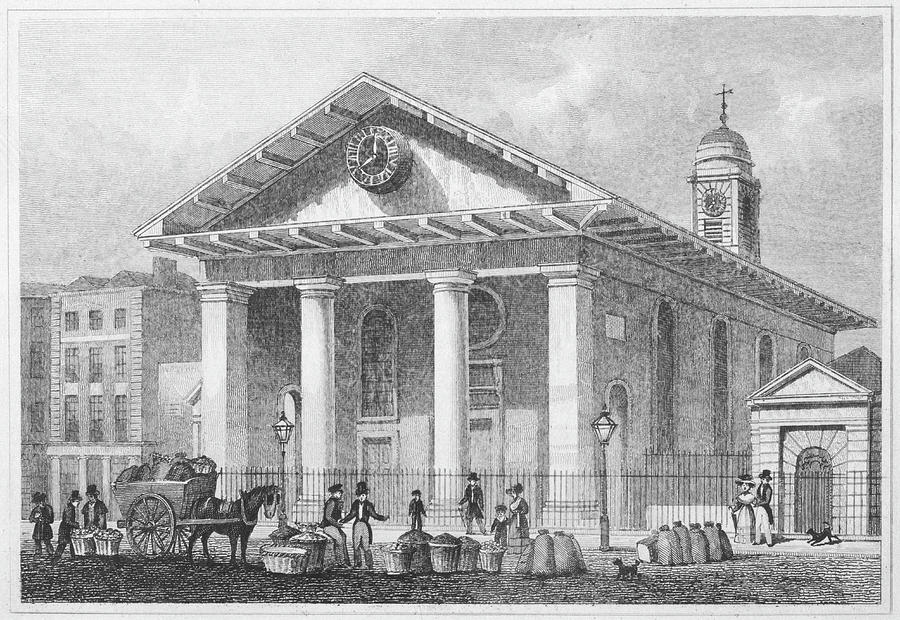
St Paul’s, Covent Garden, copyright unknown.
Imagine my surprise (and delight) just now to log onto Instagram to find that Lucia, the art restorer on The Repair Shop, had just posted a short film about this very church. She says “This is St Paul’s Church on the West side of Covent Garden – London’s West End. It’s the ‘Actors’ Church. [There are plaques to various famous actors shown]. Built by Inigo Jones (1573-1652) in 1631 at a cost of £5k, along with him designing the market square that is Covent Garden. He was also a set designer, loved the theatre. This church has a delightful ‘secret garden’ and lots of famous names. Of course I was only interested in finding the lucky cat that lives here… gone fishin’ ” If you would like to see the little film have a look at Lucia’s Instagram – whichis often packed full of fascinating knowledge on all sorts of subjects – she is luciainlondon123 on Instagram.
 rowleyregislosthamlets.co.uk