Taverns, inns, beerhouses and pubs have been in – indeed central to – our towns and villages for many centuries. The start of Chaucer’s Canterbury Tales, dating from 1387, begins with the pilgrims gathered at the Tabard Inn in Southwark, prior to their setting out on their pilgrimage, and doubtless there would have been many other such houses on busy routes such as existed then.
In smaller settlements some pubs were little more than drinking clubs in an ordinary house, rather than specially built institutions. Many families brewed their own ale for home consumption and many pubs did the same. (Brewed ale was safer than water often because it had been heated in the brewing process.) These successful brewers probably expanded to supply other houses and pubs, especially if it was known as a particularly good brew, big breweries did not exist until relatively recently. Some inns will have started as lodgings for monasteries and religious houses which probably moved seamlessly to independent provision after the Dissolution of the Monasteries and many hostelries, in cities, towns and on major routes will have acted as lodging places for travellers. Others will have developed as places for workmen to get a much needed drink on their way home from dry, dusty or dirty work. The Portway Tavern certainly is on record as having fulfilled this function for the quarry workers from the nearby quarry and some of the other functions from time to time, such as being the venue for inquests.
But formal countrywide legislation to regulate the operation of such places did not reach the statute book until 1753 when the Licensing Act inaugurated the recording of full registers of victuallers, to be kept by the Clerk of the Peace at Quarter Sessions.
In 1830 a Beer Act was passed whereby, upon payment of 2 guineas to the Excise, people could sell Beer, Ale, Porter, Cider and Perry without a formal license from the Licensing Justices and many of the smaller beer houses in the Rowley area fell under this category and were not permitted to sell stronger liquors.
The Licensing Act of 1872 remains in force today and it is illegal to be drunk in charge of a horse, cow or a steam engine. Other modes of transport have been included in later legislation! The Pub History Society tells us that “Under the Act some drinkers became infamous “bona fide travellers”, who could be served outside of normal trading hours. Travelling in good faith meant that you should not be “travelling for the purpose of taking refreshment”, but you could be “one who goes into an inn for refreshment in the course of a journey, whether of business or pleasure”. While people posing as travellers were regularly charged and prosecuted, it was difficult to prosecute licensees who had a handy escape clause in the law. To find the publican guilty, the prosecution had to prove that the licensee did not “honestly believe” that his customer was a bona fide traveller when serving outside of normal opening hours.” [i]
The Portway Tavern

Copyright:Mike Fenton.
The Tavern was, I am told, situated at the foot of Turner’s Hill, facing the road that went up and over the hill and the entrance to the Hailstone Quarry. As can be seen from this photograph, the proximity to the quarrying operations continued to the end. There were several houses around and behind the Tavern, in addition to a Brewhouse and other outbuildings. Some census entries call it the Portway Inn. Some do not even record the name at all.

Copyright: Alan Godfrey Maps.
This map from 1918 shows a ‘P.H.’ at Perry’s Lake, which was obviously the Portway Tavern but I am still not quite sure which building it was in those clusters of cottages. Probably one of the two corner buildings, I suspect and I am inclined to think that it was the building to the right of the new road leading down to Portway. That has several outbuildings and access to a yard which would fit with both the description at the time of the sale and the site described in the prosecution. But someone may put me right on that. It also shows the Rowley Brewery in Tippity Green and how close they were to each other.
Hitchmough records that the Portway Tavern was licensed from some point before 1849, his first names licensee was James Adshead Levett Snr, in whose family occupation it remained until it was sold after Mrs Sarah Perry who was the daughter of James Adshead Levett Junior, gave up the licence in about 1901.
But situated as it was, directly on the route which later became the toll road from Halesowen to Dudley, it seems very likely to me that a beerhouse or hostelry which later became known as the Portway Tavern existed there in some form well before licensing came into force.
The Licensing system was operated by the local magistrates and there was a Licensing Session annually when licences were renewed or not, sometimes, if the applicant had offended against the licensing laws in the meantime in which case he might lose his licence, a serious consideration. There are numerous reports in the contemporary newspapers of these sessions and in each case any offences which had been committed by the Licencee were listed, whether for exceeding licensing hours, permitting drunkenness or gambling or other instances the police reported on. There are also reports in most years that I have seen these reports of the landlords of ‘beer houses’ wanting to upgrade their licence to a full licence so that they could sell wines and spirits in addition to beer but these seemed mostly to be refused and this was obviously carefully controlled.
The Black Country Bugle, in 2003, published an article by Peter Goddard on ‘Tippetty Green and the Tromans Family and Rowley Quarries’, saying:
“Quarrymen were hard workers and hard drinkers. The Portway Tavern was the first port of call after a long shift, due to its closer proximity to the quarries. It had a small bar with a low ceiling, and a little used, long room adjacent.”
And in my blog post entitled ‘Tales of Old Portway’ I noted an article in the Dudley Chronicle in 1926 which said that:-
“The Portway Tavern is described as “the rendezvous of generations of quarrymen”, referring to recent renovations which had done much to modernise the exterior but it was noted that “the interior is pervaded with an old-world atmosphere. On a rack in the smoke room are twenty-two churchwarden pipes, numbered and tobacco stained, the blackest belonging to the oldest and most regular attendant at the pipe club which meets in the tavern on winter evenings.”
The Levett family and the Portway Tavern
In the 1841 Census James Adshead Levett the Elder is living in Perry’s Lake and listed as a Publican, although the pub is not named as such but this was undoubtedly the Portway Tavern. He had, according to the baptismal register at the time of the baptism of his son Richard in 1836, been living at Cock Green as a farmer but by the time of the baptism of his son John in December 1840, the family was living in Perry’s Lake although he was still described as a farmer then, a not unusual case of more than one occupation. In the 1851 Census he was shown as a Colliery Clerk and it was not until the 1861 Census that the Tavern was named and his occupation was shown as a Victualler. As early as 1842, James Adshead Levett Snr was listed in the Poll Books and Electoral Register as eligible to vote because he owned or rented ‘houses at Perry Lake’, so not just one house. Unsurprisingly, in view of this, censuses often show several Levett households living at Perry’s Lake, presumably in these houses, probably around or behind the pub.
Generally when James and Mary Levett were running the Tavern it appears that they kept their house in good order and I can only find one report of an offence in the newspapers. In August 1847 James was charged with permitting gaming with dice in his alehouse. PC Janson told the court that he had found
“two dice on the table and a cup, a man shaking it, and money on the table, for which they were playing. Defendant said there had been a raffle at this house that night, and afterwards the men did play for a few pence, but without his knowledge.”
He was fined 5 shillings and costs. In those days magistrates were local and the courts sat in local towns so people would have been well known to each other. And policemen had local ‘beats’ and would have known their licensees and kept a careful eye on them.
James Levett the Elder died , according to the Probate Record, on 23 Jun 1878, aged 75. His widow Mary retired to Gadd’s Green where two of her granddaughters Ellen (18) and Harriett (9) were staying with her in the 1881 Census. In his Will James had left to his ‘dear wife’ “such part of my household furniture and effects belonging thereto as she shall select for her own use except my clock and bureau which I give and bequeath to my son James”. The remainder of his property was to be sold and the proceeds to be shared equally between his four children. Interestingly, the Will notes that the house in which he lived belonged to his wife as tenant for life. The Will notes that as James the Younger had agreed on his father’s decease “to take it from her as tenant at a rent of twenty-five pounds a year, I direct that in the conversion of my said personal estate into money, my said son James shall be at liberty within a reasonable time after my death or on the happening thereof to exercise the option hereby given to him of taking the stock-in-trade fixtures and effects used by me in my business at my decease at a valuation to be made in the ordinary way in which valuations are made of stock-in-trade fixtures and effects of the like nature.”
It appears that the licence was transferred, perhaps initially to Daisy Levett but later to his son James Adshead Levett the Younger , by then a widower, who was listed as a Licensed Victualler in the 1881 Census at 29 Perry’s Lake, living there with his son William, aged 20, a carpenter, and daughters Daisy aged 23 and listed as a grocer, Kate aged 16 and a Pupil Teacher and Nelly aged 10 and a scholar. It is perhaps not surprising that Daisy should be listed as a grocer as this had been the occupation shown for her father James Adshead Levett Jnr in Perry’s Lake in the two previous censuses, so presumably when he took over the pub, she kept the grocery business going. Looking back at the time of James’s marriage in 1857 he had given his occupation as a grocer on the Tettenhall Road in Wolverhampton and this had been the profession into which he had been apprenticed at the age of 14.
So in addition to the pub, it seems that the Levetts ran a grocer’s shop in Perry’s Lake, very possibly in the same buildings. I have most definitely gained the impression that the Levett family were very flexible about their living and trading arrangements. And it seems the Levetts made sure their children were set up in suitable professions, their son Richard who was a shoemaker (and apparently part-time brewer) also lived in Perry’s Lake, William was a carpenter.
Licencing applications
Oddly, in August 1878, there were various advertisements in the County Express, giving notice of the intention of various people to apply for excise licences to sell various alcoholic beverages in their beerhouses and shops. The advertisement put in by James Adshead Levett was for an excise licence to sell “Sweets by retail, to be drunk and consumed on and off the house and premises thereunto belonging”. This is the only such application I can see, all the others are for licences to sell beer or cider or wine, why would you need an excise licence to sell sweets? Perhaps they were making home brewed soft drinks, as well as beer in their brewery?
I can remember as a child a van that came round selling brewed lemonade, ginger beer and American ice cream soda – strawberry ice cream soda or am I dreaming that? – in large pottery flagons, that was definitely quite fizzy and must have been brewed. I think the drinks were made in Oldbury but certainly very locally. Each week you returned the empty flagons for refilling, it was a rare treat because my father was chronically ill and there wasn’t much money to spare for such luxuries but I remember how delicious they were. And even today Fentimans produce botanically brewed drinks such as lemonade and ginger beer. Or perhaps it was a Printer’s error but I would be interested to hear whether anyone has any other suggestions!
Incidentally in the advertisement Mr Levett states that the house and premises were rated for the relief of the poor and that he was the tenant, the premises being owned by Thomas Auden. So it seems that the Levetts were not the owners after all. Since John Levett had been and appeared to be still bankrupt (See my first article on the Levett family for details) it would perhaps be slightly surprising if his son had the wherewithal to purchase multiple houses at Perry’s Lake in 1841.
Also in the Reports of the County Express of 14 September 1878, there is a report that the Licensing Magistrates approved the transfer of the licence for the Portway Tavern from the executors of the late James Adshead Levett the Elder to Daisy Levett, his granddaughter. But at some point it was obviously transferred again to James Levett the Younger as in the 1881 Census James was was described as the Licensed Victualler and Daisy as a Grocer.
You might think that James would be very careful because he already had a criminal record from an incident much earlier in his life so would not have wanted to be in trouble with the magistrates who obviously ran a tight ship. But alas, James Adshead Levett Jnr found himself in trouble with the police and the licensing authority more than once over the years. In September 1882 it was reported to the Annual Licensing Meeting of the court that he had been convicted of ‘permitting drunkenness on 30th November’, presumably the previous year, when he had been fined £5 plus costs. However, it seems he did not actually lose his license although it, along with several other similarly blacklisted landlords did have the licence suspended for a period.
There were two reports in the West Bromwich Weekly News about this incident, the first on 25th November 1881.
“Thomas Summerfield, Rowley Village, was summoned for being drunk and disorderly on the licensed premises of James Levett, Portway Tavern, Perry’s Lake. Prosecutor said the defendant went to his house on Sunday night, there were about 30 or 50 persons in the house, one of the men having paid for 20 quarts of ale, the defendant left but returned and commenced a disturbance, and knocked a woman down.
Superintendant Woolaston asked for the case to be adjourned, he visited the house on Sunday night in company with Sergeant Cooper and two PCs. There were about 70 persons in the house, and the landlord never interfered. A more disgraceful scene never took place. He was of the opinion that the summons was only taken out for a sham. There would be further evidence adduced. The case was adjourned.”
In the same paper in the edition of 3rd December 1881, this report appears, when James Levett was being charged with permitting drunkenness in his house:-
“PC Birch said at seven o’clock on the night of the 20th ult. He was sent to the defendant’s house in plain clothes, and remained there until 9.30. There was a large number of men and several women in the house, some of whom were drunk. There was a great disturbance, and the language used by the waiter and company was of the most disgraceful nature. Superintendant Wollaston said on Sunday night the 20th ult., he sent the last witness into defendant’s house, he remained outside with PS Cooper and PC Styles. About 8.30 he saw several persons stagger out of the house but they re-entered it almost immediately. About nine o’clock he entered the house, the passage and tap room were completely crammed with persons. There was an old woman, quarrelling with a man called Summerfield, who knocked her down and fell on to the top of her. There was great confusion. There were several men under the influence of drink. There were about 70 people in the house, every room being crowded. A more disorderly house he never saw. He spoke to defendant about it who said he was very sorry.
Cross-examined: Defendant had not been summoned before. PC Cooper corroborated.
Mr Shakespeare said the case arose under unfortunate circumstances. Defendant was away from the house some portion of the time and left someone else in charge. A friend of the defendant’s, from Birmingham, came to the house and left 10s to pay for some beer for the men who caused the disturbance complained of.
Mr Bassano [the Presiding Magistrate] said the Bench considered it a bad case and inflicted a fine of £5 and costs, and endorsed the license. Mr Shakespeare [defending solicitor] appealed to the Bench not to endorse the licence as this was defendant’s first offence. Mr Bassano said they could not alter their decision as they considered it a very bad case.”
One can imagine that if this was a regular occurrence, this might not have gone down well with respectable church going neighbours in this very small and presumably quiet community!
On another occasion Levett was prosecuted for brewing offences, which I have already described in detail in another article.
James Adshead Levett the Youngerdied, aged 63 on 26 Aug 1895, according to the Probate Record which was granted to his daughter Sarah Perry. The cause of death shown on his Death Certificate was Pernicious Anaemia and Exhaustion. His Will allowed Sarah Perry to continue the business of inn-keeping for a period of seven years with the option for a further seven if she wished and for her to have the use of the furniture, stock etc at the pub for this purpose. In fact Sarah died almost exactly seven years later but appears to have given up the pub before then, perhaps because of her poor health and other problems.
The licence, according to Hitchmough, passed then to his son William Levett who held it until 1896, when it passed to Mrs Sarah Perry, which does not quite accord with the intentions in the Will but we do not know whether Sarah was already in poor health. William’s sister. Daisy Levett, his eldest sister, had married Abner Payne in 1885 and she also continued to live in Perry’s Lake until her death in 1902.
Sarah remained the licensee until about 1901 when Hitchmough notes that the licence passed to Thomas William Williams whose family ran the Bull’s Head and had at one time been in some rivalry with the Levett family . However, I do note that Thomas William Williams was listed by Hitchmough as the Licensee of the Bull in Tippity Green from 1892-1900 so he had not moved far. He was also the owner of the Rowley Brewery in Tippity Green so had very local licensing interests.
Sarah died in 1902, as did her sister Daisy – only a few days apart and aged only 42 and 44, followed less than two months later by Sarah’s husband George Perry. But on 20 September 1902 the Portway Tavern had been put up for auction, in accordance with the Will of James Levett the Younger who had left it for Sarah to run the pub for seven years with the possibility of a further term if she so wished. It seems likely that, by this time, she was so ill that she could not continue. The children of Sarah and George Perry were taken in by aunts, uncles and others and left Perry’s Lake.
This was the preliminary advertisemment in the advertisement in the County Advertiser and Herald on the 6th September 1902:
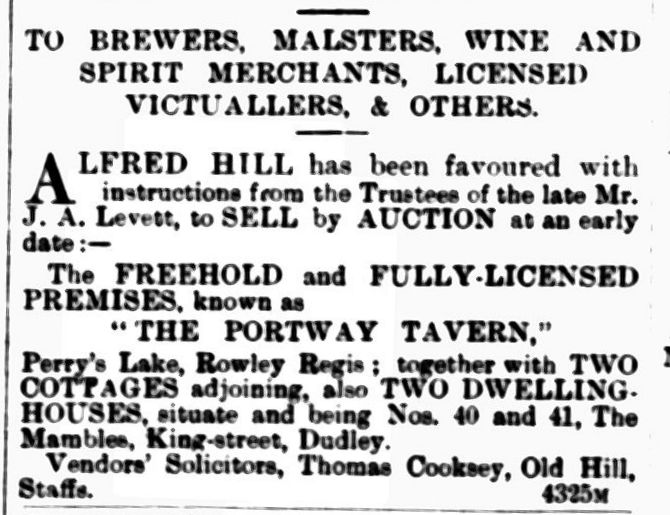
In the full advertisement which appeared on the 20th September 1902 for the sale of the premises this fuller description was given:
“Rowley Regis, Staffs.
Highly Important Sale of a Fully-Licensed Free Public House
Alfred Hill has been favoured with instructions from the Exors. of the late Mr. James A. Levett, to Sell by Auction, on Monday, the 29th day of September, 1902, at the House of Mr. H. B. Darby, the ROYAL OAK INN, Blackheath, at 7-30 in the Evening, sharp.
Lot 1. All that Old-Established Home-Brewing, Fully-Licensed, Freehold, Free, Public House (Corner Property), now in the occupation of Mrs. Sarah Perry, and known as the PORTWAY TAVERN, Perry’s Lake, Rowley Regis, containing Tap Room, Smoke Room, Bar, Club Room, Bedrooms, Pantry, Extensive Cellaring, Brewhouse (with Maltroom over), Stabling (Six-stall), with Loft over, Range of Piggeries, and the usual conveniences, with large Yard and Gateway Entrance, and frontage to two Roads, with Tap Water laid on, and fitted with Gas throughout.
The Auctioneer begs respectfully to call the attention of Investors to these desirable Properties. The Public House offers to Capitalists the rare opportunity of securing a Fully-licensed, entirely Free, Home-brewing House, and an unusually sound Investment”.
Did it sell? I don’t know because I note that in 1911/12 the licensee was George Ward who was the husband of Hannah Levett, the daughter of Richard Levett, the shoemaker, so it seems the Levett family retained an interest in the pub for some time even if it was under another name or perhaps he took it on from Thomas William Williams. George Ward, living at 19 Perrys Lake, had also been one of the Witnesses to James the Younger’s Will.
But altogether three generations of the Levett family had run the Portway Tavern for about seventy years.

Copyright: Eileen Bird who is descended from James AdsheadLevett, shared this family photograph of the Tavern which she says was taken in 1971. I was interested how different it looked when it was painted white.
Over the next sixty or so years, there were nineteen other licensees, according to Hitchmough, most having the pub for only a few years. Because of 100 year privacy rules, it is difficult to find out much about them as individuals, although local people will still have memories of some of the more recent ones and some may even have lived there when their father or other relatives held the licence.
Local memories from Facebook
Below are some of the memories which have been mentioned on the ‘I remember Blackheath and Rowley Regis’ Facebook page over the last few years. Please let me know if you object to your name being mentioned and I will remove your comments but these memories are part of the history of the Lost Hamlets in a way which will never appear in history books!
More people than I can list had their first pints there!
Several people commented that the Tavern was known locally as the ‘blood tub’. David Stokes thought this went back to the early days. His first memories were of living with his great grandfather in the cottages opposite the ‘Tavern’ in the early fifties. He said “What I can remember very well is ‘they’re fighting again’! Hence, ‘the blood tub’…as I understood it? Thankfully, a bygone era!”
Vicki Noott says that she was born in the Tavern in 1955, as her grandfather Albert Harris was the landlord in the 1950s and Maggie Bridgewater said that she also lived there in the 1950s when her parents were the licensees. Two very local surnames there! Peter Wroe’s parents were the landlords from about 1961-1966, he remembered it as a good old fashioned pub. His sister Caroline was also born there.
Joyce Connop remembered that she always used to look at the clock inside through the window to check the time on her way to Doulton Road School, to make sure she wasn’t late for school.
Ann Teague said that she remembered that there was a dirt road down the side of the tavern. The houses there were mostly occupied by Tarmac workers.
Brian Kirkham recalled that there was a row of houses behind the Tavern called Heaven and a bit down from that there was a blacksmiths shoeing horses.
Kenneth Greenhouse remembered all the old penny’s on the ceiling by the darts board.
Marie Devonport – “The road seen in the bottom of the picture was the start of Turners hill, right over the road from the Tarmac entrance. If I remember right my family lived just up the road by the telephone box on the corner.”
William Perry had recently read Wilson Jones’s book on Rowley – “it’s very informative. There is a photo of a manorial windmill that stood on the side of Hawes Hill, also there was a large pool with fish in it somewhere about opposite where the Portway Tavern used to be.”
And indeed Wilson Jones asserts in his book that on a Pre-Inclosure map of Rowley, the main habitations were around Rowley Church from about Rowley Hall to Mincing Lane . But the Manor was at Brickhouse Farm with the Manorial Green at Cock Green and the fishpond on the site of Perry’s Lake. So the original Perrys Lake was a manorial fishpond. He also states that two Manor Mills were also marked on this map, one on the opposite side to Hawes Hill, near Tippity Green and one at Windmill End. The book has a photograph of the Windmill at Tippity Green so it survived for a long time.
Andrew in 2017 said that he lived at the top of Throne Road with his grandparents in the 70’s, he used to be sent to the Portway Tavern with empty Corona bottles to be filled with sherry !
Ant Bromley particularly remembered the really good cider served there.
Marie Smith remembered her brother Eric Oddy having his 21st birthday party there and her mother getting tired – Marie says she was a lady and she never got drunk!
Arthur McWilliams worked in the garage in the quarry opposite the Tavern and recalls that some days they would go over for a pint at lunchtime. He says he will never know how they managed to work the rest of the day!
The end of the Portway Tavern
The Portway Tavern closed in 1984 and was demolished shortly afterwards. This photograph shows it standing in isolation after most of the houses around it had been demolished. St Giles’s Church can be seen on the hill behind it, and some of the houses in Tippity Green to the right.
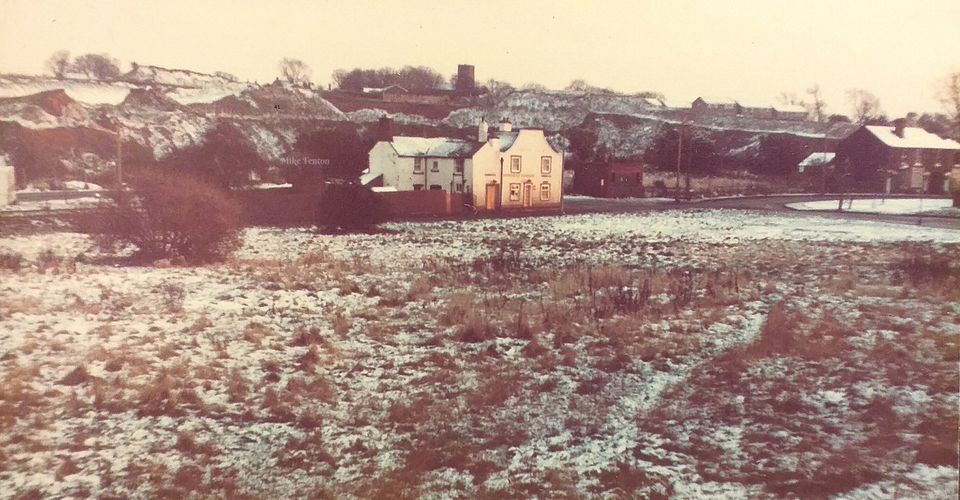
Copyright: Mike Fenton
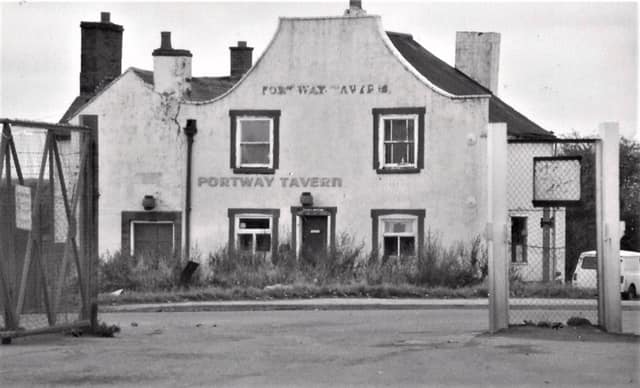
David Duckworth shared this rather sad photograph on Facebook of the Tavern prior to demolition, (copyright of this photograph unknown as it appears in several places).
Standing at the foot of Turners Hill Road, the Portway Tavern had been a central part of the community in the area of the hamlets for probably the best part of two hundred years, from the time when it stood alongside the toll road from Halesowen to Dudley and it had served home brewed ale to many generations of quarrymen working in the nearby quarries. Inquests were sometimes held there and some lively parties, too!
And as so often in these days when so many pubs are closing, something was undoubtedly lost from the heart of the community when it was demolished, and it was the same fate which came to the cottages and communities it once served.
 rowleyregislosthamlets.co.uk
Born in NZ. Married a Rowley Regis lass. Worked in the Turner Hill quarry 1970 to 73. Visited the Portway Tavern several times aweek those days. Tom ……. and his wife were the publicans. Really enjoyed the comradery in all the pubs in Rowley Regis those days. Some great stories told by the older quarry men.
I enjoyed the pub/social life in Rowley Regis that much. That when we returned to Nz we bought a pub. Sold our last one in Victoria Australia in 2012.
THANKS ROWLEY REGIS
Really enjoyed your company
Peter & Pam Benjamin(Pams mum was a Stevens/Dad was a Mathews)
LikeLike