While I was researching my piece on local shops, I came across a very tragic story which revealed that some general stores carried some unexpected wares.
Although this sad tale does not relate to Rowley itself, it took place only a couple of miles away in High Street, Cradley Heath and would no doubt have been well known at the time to local residents. And Anita Hall commented on Facebook on my piece on Ambrose Crowley 1 that she had a particular interest in Billinghams so I have decided to add this to the blog.
Much of the story comes from newspaper reports of the disaster and the inquests which followed. The first thing I came across was a report of an inquest held in April 1887 on two children who were killed in an explosion of gunpowder at the back of an ironmonger’s shop in High Street, Cradley Heath. This had occurred on 7th April 1887. Thomas Lot Billingham and Lily Birch were killed and the coroner deemed the case and the implications so serious that he adjourned the inquest to allow a Home Office Inspector to attend.
A gunpowder magazine is a building designed to store explosive gunpowder in wooden barrels for safety. Gunpowder, until superseded, was a universal explosive used in the military and for civil engineering: both applications required storage magazines. Most magazines were purely functional and tended to be in remote and secure locations.
Overcrowded housing
I was interested recently to read [i] some words of Charles Booth, the creator of the famous London poverty maps, in his analysis for the Royal Statistical Society on the Condition and Occupations of the People of East London and Hackney (1888), he stated how the process of densification of the city, with housing and workshops filling in every last piece of ground makes a mockery of the word “garden”, writing that “… many are the advantages of sufficient open space behind a house, whether it be called garden or yard, for economy, comfort, and even pleasure.”
“One can see what were the original buildings; in many cases they are still standing, and between them, on the large gardens of a past state of things, have been built the small cottage property of to-day. Houses of three rooms, houses of two rooms, houses of one room – houses set back against a wall or back to back, fronting it may be on to a narrow footway, with posts at each end and a gutter down the middle. Small courts contrived to utilise some space in the rear, and approached by archway under the building which fronts the street. Of such sort are the poorest class of houses.”
These observations referred specifically to housing in London but one can see how this also applied in these Black Country areas where industry and population had increased hugely and areas which had once been gardens, orchards and fields had additional housing squeezed in to every space. It happens today, too.
Gunpowder uses
It seems that the main use for gunpowder locally was in industry, quarrying and mining. Apparently this shop was registered to store 200lb (90kg) of gunpowder but it was certainly not in a remote location. It was stored in a brick building, about 5ft (1.5m) square, roofed with tiles, the inside being cased with wood, surrounded by dense housing and only a few feet from Cradley Heath High Street. The floor was composed of bricks covered with wood and one report mentions coconut matting. Police Inspector Walters, the inspector of explosives for the district, had inspected the magazine in the previous February when he found it in good condition and had given Mr Mould, the shopkeeper, advice about having the gunpowder in bags which Mr Mould had promised to see to.

Photograph courtesy of and from the collection of Mike Fenton: This photograph of Cradley Heath High Street is dated 1907 so a few years after the explosion. I note there is a hanging sign for a baker in the centre of the picture but do not know whether this was Mr Birch’s shop. There also appears to be an entry way on the left side which could well lead to the sort of yard where the magazine was situated.
Newspaper reports:
On the 9th April 1887, the Birmingham Daily Post reported that
“A terrible explosion of gunpowder occurred at Cradley Heath, resulting in the death of two children and in serious injuries to two others. The gunpowder was in the detached store which was about fifteen yards (13.7m) from the rear of the Ironmonger’s shop and some six yards (5.5m) from a row of half a dozen small cottages. This report says that several children whilst at play had discovered grains of gunpowder strewn about the yard and began to set fire to them with lighted paper. They gradually approached the door of the store where there was a quantity of scattered grains, which formed a train communicating with other powder inside the storehouse. Unaware of their danger, they ignited the powder, the result being that a tremendous explosion instantly ensued, the whole of the kegs being blown up. The store was completely wrecked, the bricks flying in all directions and falling upon the unfortunate children, most of whom were buried in the debris. Such was the force of the explosion that the windows of the six cottages were blown out, and the buildings more or less damaged, together with the adjoining shop of Mr Birch, Baker and also the establishment of Mr Mould. The explosion was heard at a distance of more than half a mile.
It was found that Lily Birch, about five years old, the daughter of Mr Birch before mentioned, had sustained terrible injuries and she was picked up dead. Another child, Thomas Lot Billingham died on the way to the Guest hospital at Dudley; to which institution were also removed Florence Billingham, aged 8 years and her brother James, six years old, both being seriously injured. Laura Tipton, ten years old, was also hurt but was treated at her home. Shortly after the occurrence Mr T Standish, surgeon, Mr D Denne and another medical gentlemen arrived and rendered prompt aid to the sufferers.
It seems that the powder had been removed to the store by George E Milward, Mr Mould’s assistant, who swept put the place about half-past five o’clock , and it is supposed that either the kegs had leaked or the contents of the store had been swept into the yard with the dust.
Yesterday the condition of the three children who are in the Guest Hospital, Dudley was much the same as on Thursday night when they were admitted. All are burnt about the hands, wrists, face, neck and scalp, Adam being the worst injured of the three. The surgeon at the institution gives but slight hope of his recovery.”
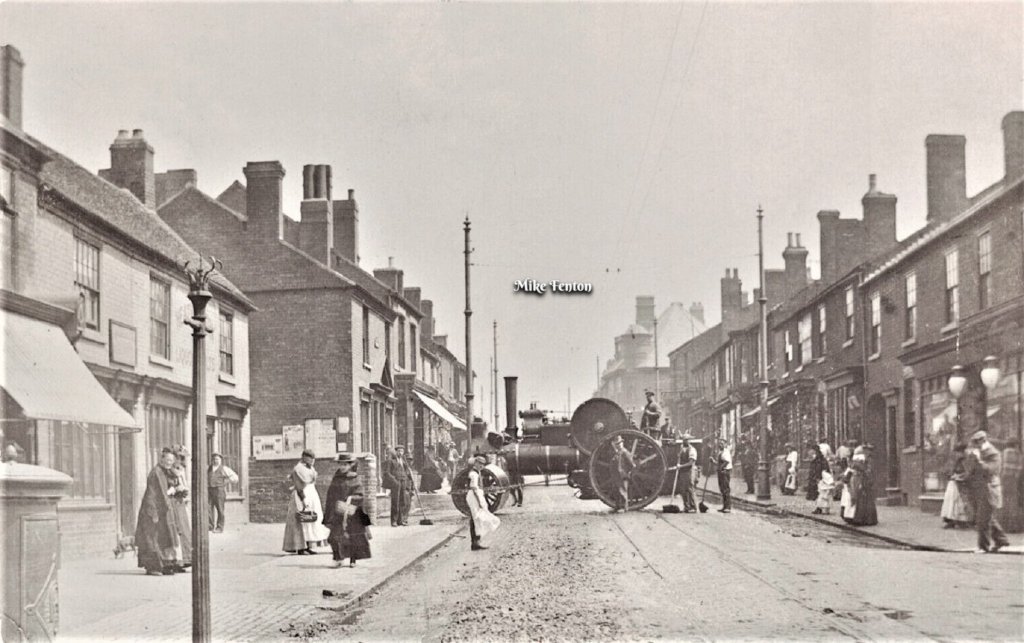
Photograph courtesy of and from the collection of Mike Fenton: Another photograph taken from possibly the same spot as the previous photograph, but in 1902. Many of the people in this photograph were probably living in Cradley Heath at the time of the explosion and would undoubtedly have had vivid memories of it.
Another report in the County Express on the 16th April 1887 gives a lengthy report on the first inquest on the first two children killed in the disaster. This relates:
“George Edward Millward, an apprentice in the employ of Mr Mould told the inquest that it was part of his duties to go into the powder store. The key of the store was kept in the shop and no one excepting his master and himself had access to the store. On Thursday afternoon, he went into the store to receive a consignment of gunpowder which had been brought from the Dudley magazine on a trap [Editor’s note: Traps were small open carts, drawn by a horse]. It consisted of a barrel containing 100lb and four quarters. The carter carried the powder from the trap to the store, and the large barrel was placed in the far corner on the left hand side. About six o’clock the same evening he again visited the store, for the purpose of supplying a man with two pounds of powder. He found the store in exactly the same condition as when he left in the afternoon. He opened the barrel containing the 100lb with a piece of wood and filled a tin can with the powder. In doing so he spilled about a tablespoonful on the floor. He then locked the magazine up and returned to the shop with the powder, and after serving the customer he went back again to the store. He did not label the parcel ‘gunpowder’ and he was not aware that he was required to do so by law. He had never read the Explosives Act and was not provided with a copy. When he went back to the store he took a broom with him and swept up the powder that he had previously spilt and with an iron shovel put it into the large barrel which contained 100lb. He did not know it was dangerous to do so. He knew the powder was used for blasting purposes, but he was not aware that there would be a danger of it exploding whilst being used by miners on account of the grit which was mixed with it. He returned to the shop and in about half an hour afterwards he heard the report of the explosion, and, upon going into the yard, discovered that the store had been blown up. He was quite clear that he did not sweep the powder from the store into the yard and he was not able to form any idea as to how the explosion occurred. He was confident that he did not spill any of the powder out of the can whilst conveying it from the store to the shop.
Mr E Mould, the proprietor, said he ordered the powder from the traveller on the day previous to the accident. In reply to the Coroner he admitted that he had never read the Act of Parliament relating to the storage of gunpowder.
William Felton, miner, residing in Walith’s Building, said he was walking up the yard to his home on the evening in question, when he saw some children playing with powder on the ground. They were gathering it in small heaps and setting fire to it with a lighted paper. He cautioned Adam Billingham and told him that he would have the children injured of he was not careful. The boy, who was about thirteen years of age, disregarded the caution. Shortly afterwards, whilst he was in his own house, he saw Adam Billingham with a lighted paper on the ground about a yard from the magazine. Presently he saw a flash and heard a loud report, and he was knocked down by the force of the explosion.
The witness said that he had lived in that locality for eight years and could testify that Mr Mould had been very careful in the management of the magazine and he had never seen loose powder lying about in the yard. He attributed the accident entirely to the conduct of Billingham in firing the powder close to the magazine.
Police Sergeant Hayward, who came on the scene immediately after the explosion, deposed to finding the children among the debris.
Major Condill (Her Majesty’s Inspector of Explosives) said that he had made an examination of the premises. He did not think that the magazine was a proper place in which to store 200lbs of powder. The utmost that should have been stored in a place so situated was 50lbs.
The Coroner , in summing up, remarked that if Adam Billingham had been older the matter would have assumed a serious aspect as far as he was concerned, as he would have been guilty of manslaughter. There was no doubt that it was through his act that the children lost their lives. He was astonished that a powder magazine should have been allowed to remain in the midst of a thickly populated neighbourhood; and if the store had been a proper distance away from the dwelling houses in all probability the accident would not have occurred.
The jury returned a verdict of Accidental Death and added to it an expression of opinion that the authorities ought to be strongly condemned for allowing such a place to be used as a magazine for storage of gunpowder in such close proximity to inhabited houses.”
A detailed and lengthy report appeared in the Dudley Mercury on 30th April of a further inquest which was held a few days later at Dudley on two more child victims of the explosion who had been injured by the explosion and taken to the Dudley Guest hospital where they had died. Both were Billinghams, Adam aged 14 and James aged 6, the sons of Thomas Billingham, chain maker. Adam had suffered burns to the face, scalp, face and feet, he had died on the 16thof April. James had suffered burns to his face, scalp, neck and hands and he died on the 22 April. So poor Thomas Billingham appears to have lost three sons in this explosion.
From this report it is clear that more investigations had gone on since the previous inquest and that Adam Billingham had spoken about the explosion before he died.
The apprentice George Millward again gave similar evidence (although his name this time was recorded as George Edwin Millward rather than Edward) to that given at the previous inquest. He confirmed that he had spilled a quantity of gunpowder on the floor of the magazine and had returned to sweep it up but stated that he had not given any of it to the children. Some of the children had come to the door while he was sweeping it but he could swear none of them had powder.
The store had been inspected by the Inspector of Explosives (sent by the Home Office), it was built of brick, lined with boards, and the floor covered by coconut matting (all precautions meant to reduce the chances of any sparks being struck by accident) and was said to be nearly airtight. George was quite sure that none of the powder he swept up could have got near the door. Poor lad, imagine what pressure he must have been under, as the one person who had accessed the magazine that day and who had then seen the magazine destroyed and so many children, who must have been known to him, killed and severely injured. The pressure to find the cause and allocate blame puts me in mind of similar accidents today.
Again, William Felton gave evidence, as he had previously. He was a miner and presumably familiar with gunpowder used in the mines and quarries. He repeated that as he passed through the yard shortly before the explosion, he had not seen any powder lying on the ground and he would have seen it if there had been any there.
Corry Keep, the House Surgeon at the Guest Hospital was a new witness. He told the inquest that he had treated the burned children. Adam Billingham had told him that he picked up some powder which he placed in the yard outside the powder magazine. He then went into the house, heated the poker and applied it to the powder, thus causing the explosion. He would give no further information. Up to the morning of the day on which Adam died he declined to give any information whatever but later in the day he told Mr Corry how the explosion was caused. Up to the time of his death he refused to say where he got the powder from. He had told the Government Inspector that he was in the yard but he did not see the explosion caused and knew nothing about it. But before he died he made a statement that he fired some spilt powder. In reply to this witness he said the powder might have been swept out of the magazine but he did not see it swept out. Florrie Billingham said she believed the powder was swept out of the magazine.
There was a detailed interview with Elizabeth Billingham, who was ten years old, who said she was playing in the yard with some other children on the in question, when she and a girl named Laura Tipton found some gunpowder near the door of the magazine. This is the reported exchange between the Coroner and Elizabeth which I reproduce in full as it has so much detail.
C: Can you tell how much powder he had? Two handfuls? (‘he’ presumably referring to Adam.)
E: No, only a little tiny bit.
C: When did he last pick it up?
E: He didn’t pick it up, it was Laura and I.
C: Did you pick some up just before the explosion?
E: Yes.
C: How old is Laura?
E: Ten.
C: What time was it?
E: About twenty minutes to seven.
C: How do you know?
E: When I got to the bottom of the entry it was rather better than a quarter to seven.
C: Did your father or mother tell you to say that?
E: No, Sir.
C: Did you see the boy sweep out the magazine?
E: Yes, with a big broom.
C: Who did you tell about it?
E: My father, when the Inspector came on Saturday. He asked me what I saw.
C: Didn’t anyone else ask you?
E: No.
C: Tell these gentlemen what you saw.
E: I saw him sweep the magazine out.
C: Did you go inside?
E: No, I stood outside with Laura.
C: Did he sweep the powder outside the door?
E: Yes.
C: Did he leave it there?
E: Yes, sir.
C: Was that the powder you picked up?
E: Yes.
C: Did he fasten the door?
E: Yes, he put the barrels in and fastened the door. When I went up the yard he had some little barrels outside with no powder in, and he turned them upside down and knocked the bits out.
C: Had you seen him do this before?
E: No.
C: Did you ask him for some powder?
E: No.
C: Have you ever asked him?
E: No.
C: Did you pick up the powder while he was there?
E: No, we waited until he had gone.
C: Did you hear Mr Felton tell you not to play with the powder?
E: No, I was near the magazine.”
Mr Shakespeare, the solicitor representing Mr Mould, the shop owner, pointed out that it was impossible to simply sweep the powder outside the magazine as the floor level was lower than the yard. He also noted that it was clearly proved at the previous inquest that there was not a particle of powder in the empty barrels. Mr Millward denied that he had turned the empty barrels upside down outside the magazine.
The Coroner told the inquest that he had not sworn the child as he felt she was too young in such a serious matter, she had been called at the request of the father but he had been advised by the South Staffordshire Coroner that the children were too young to give evidence. He understood that another adult witness was in a position to say exactly what Millward did when he swept up the store but she was not now present. The child’s statement suggested that Millward was careless and in such a case he would be deserving of their censure but it was for the jury to say whether they would accept the child’s statement and he was inclined to put it aside altogether, as he thought the child would have told her parents before Saturday if she knew anything about the matter. There was no doubt that Millward had swept up the spilled powder but probably it was suggested to the girl that he swept it outside.
In reply to a juryman it was stated that the proper course would have been to have slippers for use in the magazine but none were provided.
The Jury returned Verdicts of Death from Misadventure on Adam Billingham and Accidental Death on James Billingham.
On the 11th April the Birmingham Daily Post returned to the subject and had some interesting observations to make:
“All that is known at present is that on the day in question, Mr Mould received a consignment of some 200lb of [gun] powder which was stored, according to custom, in a detached shed, situated at the bottom of a yard in the rear of the main premises, and that a quantity of loose powder was subsequently found by the children of the neighbourhood, scattered about the yard. How the powder came there and why it was suffered to remain in such an exposed place are the main questions to which the jury will have to direct their attention.
It was only natural that the children, on discovering the powder, should proceed to ignite it; and as familiarity breeds contempt, that these improvised fireworks should be carried right up to the door of the storehouse where the explosive grains laid thickest. Unfortunately there must have been some loose powder inside as well as outside the shed, for presently the children fired a train which caused the whole of the contents to explode with disastrous consequences.”
“It is difficult to resist the conviction that gross carelessness was at the bottom of this lamentable accident and it will be the duty of the jury to find out who is to blame. It is supposed that the kegs may have leaked, in which case they must have been unfit for the conveyance of gunpowder, and ought not to have been used. But another theory is that the shed had been newly swept out and the sweepings, consisting largely of loose powder, suffered to lie about the yard instead of being removed to a place of safety. But the mischief, it is plain, could not have been caused by the scattered grains in the yard only. There must have been a considerable quantity of loose powder also on the floor of the shed or the train would not have been complete and the kegs could not have been fired. It will be important to ascertain who had the general handling of the powder, and what sort of precautions were adopted with it. Very stringent rules are enacted as to the storage and keeping of gunpowder by licensed retail dealers and the local authorities at Cradley Heath will be able to say how far these were observed in the case here”.
But, so far as I can see, the Jury, although berating the authorities for permitting the storage of such a large quantity of gunpowder in close proximity to dense housing , did not allocate any personal blame to any individual. Possibly the most likely to be censured would have been Adam Billingham who admitted to having heated a poker to light the grains of powder and who, only moments before the explosion, had clearly been warned by William Felton that what he was doing was dangerous to the other children but he paid the ultimate price, dying a few days later along with two of his brothers.
What really happened?
At this distance in time, we shall never know.
The last newspaper report refers to the possibility of the delivery kegs leaking which could account for a ‘trail’ of powder right into the magazine. There was also mention of slippers which should have been but were not provided and of coconut matting on the floor of the shed. Did some of the gunpowder, known to have spilled on the floor when George was measuring some out, get onto the matting and stick to George’s boots, walking a trail out of the door as he swept? Had the store been swept out earlier in the day in readiness for the delivery and the dust deposited in the yard, containing a few grains of powder? Or might those empty barrels have contained a few grains. There is more than a suggestion that the children might have played with gunpowder on other occasions, might have begged grains from George, might be familiar enough with it to look out for it and to enjoy creating their own fireworks – the ultimate ‘playing with fire’.
The miner William Felton also commented at one of the inquests that he had not seen gunpowder in the yard, so it was obviously distinctive and easily recognised, although I doubt many people would recognise it now, just as most modern people are not familiar with open fires, paper or wooden spills, fire irons and pokers, etc.
The Billingham family: On the 7thApril three children of Thomas and Lucy Billingham were fatally injured in the explosion. Thomas Lot, aged 2 had died on the way to hospital and was buried at St Luke’s Reddal Hill on the 12th April, his brother Adam, aged 14 was buried on 21 Apr 1887 and their other brother James, aged 6 was buried on 27 Apr 1887. What a dreadful time for them it must have been.
In the 1881 Census, Thomas Billingham, a chainmaker aged 33, had been living with his wife Lucy at 128 High Street, Cradley Heath, along with children Anne, aged 9, Adam then 8, Eva aged 6, Elizabeth 4, Flora 2 and James aged 4 months. By 1891, they had moved away to Fox Oak Street, Cradley Heath where only Elizabeth, Florrie and a new child Mary Ann aged 3 were with them. In 1889 they had another son who they also named Thomas but, alas, he also died in infancy.
I have been unable to trace a burial or any other information for little Lily Birch who also died at the scene.
No further details have emerged in my research about the apprentice George Millward. A George Millward, born in 1865, died in 1945 in the Rowley Regis Registration District but I do not know whether this was the same man. There was at least one other George Millward in the area and possibly more and it is possible that George left the area.
Finally…
I was astonished when I first read this story that gunpowder was apparently stored and sold in ironmonger’s shops and casually sold to members of the public in small quantities. There are so many questions raised by this whole episode. Who would have wanted to buy gunpowder and for what purpose? Where was it stored after they had bought it? If it was not supplied in tin cans as it apparently should have been, how was it kept safe? Was this the mine operators buying gunpowder? Or small quarrying ventures? One would have expected them to buy their powder direct from the magazine at Dudley but clearly there was a local demand for this in Cradley Heath. And there was sufficient demand for a traveller to be employed going round such shops taking orders for gunpowder and arranging for it to be supplied in open carts. When you think about the number of open fires and forges in the area, that mode of transport alone must have been risky, especially if the trap passed the large blast furnaces in the area. Did every small town ironmonger store and sell gunpowder? Were regulations changed to prohibit the storage of large quantities of gunpowder in built up areas? I do not know the answers to these questions or whether any changes were made to legislation as a result of this incident.
But even when I was a child in the 1950s we children could purchase individual fireworks from our local shops without any restrictions that I can remember, and many of these had screwed or folded paper tops which could be opened to expose the powder inside. I seem to remember that boys seemed to particularly enjoy buying bangers and ‘jumping jacks’ and even throwing them at people or setting them off to make people jump, so perhaps these children did not see their games with grains of gunpowder as being very different. And every now and again, one hears of firework factories exploding with spectacular results, so gunpowder is still dangerous but hopefully not stored close to houses these days. Gradually sales of fireworks have become more and more restricted in terms of age and I believe adults can now only buy prepackaged boxes and I suspect most people these days prefer to attend organised bonfires where they do not have to worry about setting them off.
A sad story but truly the mind boggles…
[i] https://urbanformation.wordpress.com/2024/09/04/space-and-air-are-everywhere-at-a-premium/
 rowleyregislosthamlets.co.uk