Recently, on the ‘I remember Blackheath and Rowley Regis’ Facebook page Ronald Terence Woodhouse drew my attention to a serious fire in a mine at Lye Cross, just over the hill from the Lost Hamlets and probably where some of the miners who lived in the Lost Hamlets worked. I found some basic details fairly quickly for Ronald who had remembered being told about the fire when he was a child but I have since done more research.
The pit concerned was a coal mine at Lye Cross, notLye near Cradley Heath, it was just below Oakham off Portway Hill and was owned by the Earl of Dudley. The colliery became renowned as a ‘state of the art’ pit.
There were many local pits scattered around the area, and their activities later led to many problems with subsidence for houses and buildings built above them, including amongst many other buildings the second Rowley Church, Portway Hall and – a bit out of our district – the now famous and demolished Crooked House pub.
This map, which I found online shows the local pits.

Copyright: mindat.org.
It was surprising to me to realise quite how many pits there were. You can look at this map here https://www.mindat.org/loc-302392.html and if you zoom in, more detail is shown. A green dot with a figure on it shows the number of separate mines or shafts there were on the site or in the immediate area.
An old press article about the History of Mining in the Dudley Herald dated 18 May 1898 gave a lot of information about coal mining in the area. This claimed that originally, it had been thought by local engineers that there was a layer of coal below the basalt which is Rowley Rag but ‘expert geologists who had investigated the subject’ had a contrary theory , due to the geology of the Rowley Hills, that there was no coal underneath the basalt rock. So, according to this expert,
“for many years it was usually believed that either no coal existed beneath the basalt or that whatever coal might have existed had been burnt or otherwise rendered useless by the great heat of the basalt when it flowed from the earth’s interior.”
This, despite the known belief of the colliers of the district that workable coal lay beneath the basalt. Experts, it appears, do not always get things right! The article goes on:
“This important question was not, however, easily disposed of and mining men awaited further developments. One of the most suggestive of these followed the cutting of the Birmingham Canal in 1856: this tunnel passes through the base of the Rowley Hills and no basalt was met with during its construction.”
Trade was said to be in a depressed state at the beginning of 1865,
“though the coal trade improved through the year. There was a colliers’ strike and a lockout of the ironworkers that year. “The lockout took effect in the early part of the year and was indirectly due to a strike of ironworkers in North Staffordshire; in consequence of this strike the ironmasters of South Staffordshire decided to lock their men out as a measure of defence, and to support the masters of North Staffordshire. Towards the end of the year there were about 115 blast furnaces at work in the District.”
In the years 1867-68, the No.25 Tividale Pits were sunk through the hills without passing into any basalt in position. The thick coal was pierced at a depth of about 230 yards and at some distance from the shafts was found to be thrown down for about 100 yards by a great fault. More new shafts were later successfully sunk at Grace Mary and the presence of coal was now confirmed. In the year 1874, the article confirms, the Earl of Dudley’s pits at Lye Cross were completed but unlike those before described, these passed through about 65 yards of basalt which was met at a depth of about 11 yards from the surface. When the lower part of the basalt was reached a large quantity of water poured into the shafts, and this gave considerable trouble. Later parts of the article describe drainage problems in the various mines and the equipment required to try to extract water, mainly rainwater filtering through the rock into the mines. Much is said also about fluctuations in trade in both coal and in the iron industry which was such a big customer for coal for the many furnaces and how these affected the mines. In 1873, apparently, the iron trade began to fall off and later on the coal trade was seriously affected. In March 1874 it was decided to ask the thick coal miners to accept a reduction of 1 shilling and the thin coal miners a reduction of 9pence, owing to trade depression. The men refused to give way, and a strike of about 13,000 colliers was begun and continued for four months. After the strike ended, trade was only moderately good, there being only 80 furnaces in blast in December 1874, whilst 34 were idle.
Also coming into operation about this time was the appointment of a Royal Commission. The article states
“In accordance with the common practice of the Government, when about to take effective steps for remedying evils generally felt by the community, a Royal Commission to inquire into the occurrence of accidents in mines was appointed on February 12th 1879.”
If in doubt, appoint a Royal Commission – some government practices have not changed in f150 years, it seems! This Royal Commission was in response to a series of disastrous colliery explosions in numerous places. As a result of the reports produced by the Commission the operation of the previous Coal Mines Regulation Act 1872 ceased on 31 December 1887 after a period of 15 years, during which time, it had been, directly or indirectly, a great cause of improvement in mining operations, and a new Coal Mines Regulation Act 1887 came into effect on 1st January 1888.
What other records suggest about early coal mining in Rowley
Despite the impression given in this article that there was little or no coalmining until the late 1800s, this is not really borne out by other local records.
In his Will proved in 1844 John Beet, the Squire of Rowley Hall, made numerous references to his coal copyholds and his coal mining interests and how they should be managed for the benefit of his legatees. Later the Rowley Hall mine became a large and active mine for many years, the Bell End pits may also have been his but I have no definite information on this. But clearly local business men were well aware of the potential profits of coal mining in Rowley and did not see this as impossible.
The Burial Registers at St Giles
In the parish registers for Rowley, there is an entry in July 1695 that “Hen. Sheldon of Tivydale, Kill’d in a Coal Pit in Tippon (sic. Presumably Tipton)” had been buried so certainly some form of coal mining was going on in the area at that early date, although there was not then the demand from the ironmasters which would help to drive demand for coal for their blast furnaces.
In November of the same year, William, son of Tho. Willets was also listed as having been killed in a coalpit so it appears that boys as well as men were working in the pits, as the name of the father is not usually given unless the burial is for a child.
In October 1803, the St Giles Burial Register has a description of the death of another child killed in a pit.
“Henry, son of John and Mary Edmands. He was killed in a coal pit near Brierley Hill. His cloathes were caught by a hook, or something of the kind, of the skep, which took him up a considerable way: at length his clothes tore and he held by his hands till being unable to hang any longer, he fell and spoke no more.”
Poor lad, how terrified he must have been.
Another boy, James, son of Joseph and Sarah Darby of Dudley, was killed by a fall of coals in a pit in 1806, a man John Lenton, killed in a coal pit in 1808 and William Thomas was ‘burnt in a coal pit, also in 1808.
Pits were hazardous places above and below ground – Thomas Williams, who was 35 was buried on 29 November 1810 after
“He fell into a coal pit in the dark about 8’o’clock on Saturday evening at Windmill End, It had lain uncovered and unguarded nearly twelve months & was about twenty yards deep in water!!!”
In 1811, William, son of Thomas and Ann Davies, aged 16 was also buried after being killed in a coal pit. Throughout the following years in the early 1800s there are frequent burials of mostly young men and boys killed in coal pits, with 92, for example, between 1813 and 1849.
In the 1841 Census 13 men living in the Lost Hamlets were listed as miners, in 1851 this had increased to 36. So there were certainly men and boys mining coal in the parish well before the period discussed in the article above.
The Lye Cross Colliery
In the Birmingham Gazette on 8th March 1841 an advertisement appeared, addressed to ‘Iron-masters, coal-masters and others’. This gave notice that a One-third share of the Lye Cross Colliery was to be sold by auction in West Bromwich on the 18th March, and stated “ the ‘above-named valuable colliery, together with the Plant in and thereon’ was offered for sale. The advertisement went on
“This property consists of seventy two Acres of Thick Coal in the fast, of undoubted good quality, and of unusual thickness. The sinking of the Shafts and the driving of a Gait Road about 100 yards into the Thick Coal has just been completed, and the latter operation has proved the excellence and superiority of the quality and substance of this important measure.
The Engine is complete and powerful, the shafts within 525 yards of the upper level of the Birmingham Canal and the whole Machinery and Mines (the latter entirely free from water) ready for immediate draught.
The Quarterly Payments, which are light, commenced on the 25th March last, under a lease granted by J E Piercy, Esq., of Worley Hall, from which date thirty nine years have to run.
The present affords an opportunity rarely to be met with for the prosperous investment of a moderate capital, and is therefore especially worthy of attention.”
Further particulars could be obtained from a Solicitor Mr G H Townsend, or Mr B R Smith, Surveyor and Viewer) both of West Bromwich.
Only a few weeks later a further advertisement, couched in identical terms with regard to the mine itself appeared in the same newspaper on 21 June 1841. However, this time, it was not a one-third share being offered but the whole enterprise, to be disposed of by private contract, rather than auction. Again the same Solicitor was listed as able to give further information, along with Mr B R Smith,( in this advertisement described as a Surveyor and Brewer, rather than Viewer!) plus another surveyor, Mr Joseph Cooksey, all of West Bromwich.
Why one third should be offered for sale by auction in March and the whole by private contract is June, I am not clear, it seems rather strange.
Whatever the individual circumstances, however, this makes it clear that there was a full, well equipped and potentially very profitable mine in operation at Lye Cross by mid-1841.
New Colliery Opening
An article in the County Advertiser and Herald dated 20 February 1875 reported
“Coal under Rowley Hills
The new Colliery which has just been opened by the Earl of Dudley, at Lye Cross, furnishes additional testimony of much value as to the coal deposits underlying the basaltic rock which overspreads the Rowley Hills, a section of the Dudley District which, until the last few years, was believed to be wanting in mineral treasure other than that of the famous stone known as the ‘Rowley Rag’. To the enterprise of Mess’rs W North, D North. E T Wright and others in this until recently untested portion of the coalfield the discovery of its great and rich stores of fuel is mostly due, and the success of these pioneers has stimulated enterprise on the part of others. The newly opened Lye Cross pit adds to the previously ascertained mineral wealth of the Earl of Dudley’s estate some 500 acres of best thick coal. The depth of the coal is only 280 yards from the surface but the diameter of the shaft is much above the average, and the plant and machinery, designed and erected under the superintendence of Mr Latham, are among the finest in the District. The time of ascending or descending the shaft is only fifteen seconds. The colliery is now in full operation.”
So, had the previous mine been closed for a time or was this ‘new’ pit a revival of the previous one? Or were there two pits with the same name but in slightly different places?
Experiments with dynamite
Developments in mining and quarrying technology continued during this time. This article in the Worcester Journal dated 2 October 1875 describes experiments in both the stone quarries at Turner’s Hill and in the Lye Cross mine with the use of dynamite to dislodge stone and coal for extraction. Dynamite, as a blasting explosive, had been patented in 1867 by the Swedish physicist Alfred Nobel and it rapidly gained wide-scale use as a more robust alternative to the traditional black powder explosives. The experiments described here were apparently very successful and, what is more, the dynamite reduced loss of coal to slack, made less smoke and was substantially cheaper than earlier methods.
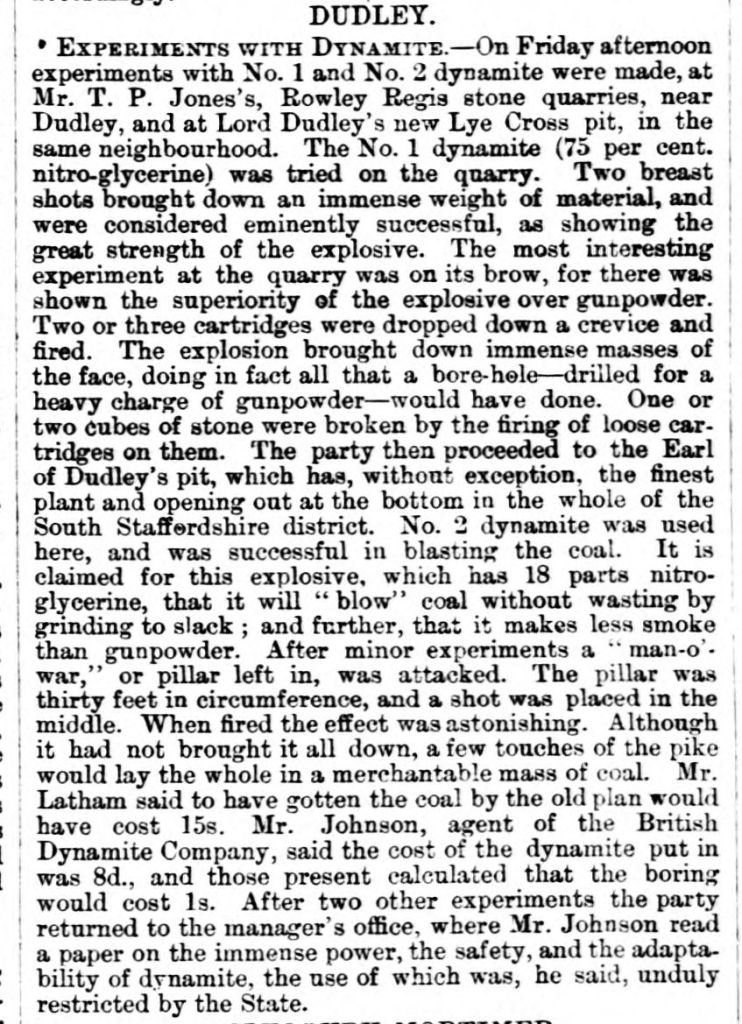
Note that this article described the Lye Cross pit as having “without exception, the finest plant and opening out at the bottom in the whole of the South Staffordshire district”.
In another newspaper article, an obituary for a well known mining engineer a Mr Edward Fisher Smith in 1892, there is also a reference to the special geology of the Rowley Hills. This notes that the area was of special interest to scientific men because the leading geologists of the last generation were emphatic in their declarations that no coal would ever be found beneath the basaltic rocks of which the Rowley Hills were composed. Mr Fisher Smith had experiments made which convinced him that good coal and ironstone would be won under the basalt. He caused the ‘well-known Lye Cross Pits’ to be opened and these were often visited by the late Earl of Dudley and his friends and were regarded as among the best pits in the District, ranking with the Sandwell Park and Hamstead collieries, as well for their scientific mode of working. The present Earl, with distinguished visitors, also apparently often visited this pit at that time.
I also found references to a banquet being held inside the pit by the Earl of Dudley on one occasion in 1875. The most detailed account I have been able to find appeared in the Dudley Chronicle on 3 September 1925, fifty years later and this reads:
“The Lye Cross Banquet
A Worcester contemporary draws attention to the famous banquet which was served in the workings of the Lye Cross pit just 50 years ago. This unique event has been referred to many times in these columns. The pit was visited by a numerous party. Under the courteous guidance of Mr Thomas Latham (a well -known and highly respected Dudley mining engineer) they traversed the extraordinary workings but the novel and interesting feature of this additional celebration of the opening of the colliery was the banquet given in a spacious and commodious dining room which the plodding labour of the miner had hewn out of the solid coal. The repast was on the scale of unusual liberality, wines, viands and fruit, of rare quality being provided. Upon the table there was a profuse display of flowers and ornaments, and the really fine banqueting hall was brilliantly illuminated, the occasional lighting of various coloured fires contributing to form a scene never contemplated by the visitors. The late Earl of Dudley (father of the present Earl) was the host. His lordship was the owner of the colliery which was subsequently visited by distinguished geologists. The pit, in fact, was perhaps the best known of all in the South Staffordshire coalfield. It is not in operation now.”
What an extraordinary occasion that must have been!
Another visit to the Pit was made by members of the Midland Union of Natural History Societies in 1878 to Lye Cross Colliery, and gives some idea of the scale of the pit:
‘Members of the Union and their friends, to the number of nearly 400, made an excursion to Dudley and the neighbourhood, under the auspices of the Dudley and Midland Geological and Scientific Society and Field Club, representatives of which received the party at the Tipton Station of the Great Western Railway, and conducted them in the first instance to the Open Coal Work at Foxyards, where the Ten-yard Coal Seam exposes its point of outcrop on the east side of the obstruding ridges of the Dudley Castle Hill and the Wren’s Nest. Mr, Thomas Latham, the Earl of Dudley’s Mine Agent, gave interesting information as to the mode of getting the coal, and under his direction a fall of coal was displayed.’
‘After Luncheon came the crowning event of the day – the descent by more than 400 persons, including many ladies, of the famous Lye Cross Coal Pit at Rowley, which was superintended by Mr. Latham. This pit is remarkable as the first sunk through the Basalt, or Rowley Rag. Where the pit was commenced the thickness of the basalt was unknown; it proved to be no more than 68 yards, when the rock binds of the coal measures were reached. At 168 yards the Two-foot and Brooch coals were met with, and at 228 yards the Thick coal was cut into. The pit is 258½ yards deep.’ (Anon.,1878).
I have not been able to find any images of this apparently famous pit, other than one which is here. https://images-cdn.bridgemanimages.com/api/1.0/image/600wm.UIG.79727050.7055475/5069618.jpg
Since this is in a commercial photo library I cannot reproduce it here but it is worth you having a look as it gives an idea of the scale of the workings and of the hazards of the working conditions.
The Science Museum also has a Collection of black and white glass negatives of mine workings, chiefly underground, at pits in Staffordshire and Worcestershire taken by H.W. Hughes. ca.1900-1910. This collection totals over 360 negatives. Boxes V and VI (totalling 100 negatives) primarily concern Ramrod Hall Pit and Lye Cross Pit showing a wide range of human and horse activity, machinery and tools. What an interesting collection these would make if they were ever printed.
A few of these images do appear to have been printed and can be seen at the bottom of this page, including photographs from both Lye Cross and Ramrod Hall pits. They give a bleak impression of the working conditions in the mines which were both owned by the Earl of Dudley. https://www.scienceandsociety.co.uk/results.asp?txtkeys1=Mine%20Shafts
Herbert William Hughes, the author, was the colliery manager at the Conygre Pit at Dudley and wrote a book entitled ‘A text-book of coal-mining : for the use of colliery managers and others’ which is extensively illustrated with drawings of all sorts and I note from the index pages that there are seven references to Lye Cross mine in the book. It can be seen and/or downloaded free of charge from the Internet Archive if anyone would like to learn more about mining practices at that time. https://archive.org/details/textbookofcoalmi00hughrich
Mining and other accidents
The Lye Cross pit was not completely trouble free, of course. A report I found in several newspapers, dated August 1900, tells of a collier named David Robinson, aged 60 so presumably an experienced collier, who was crushed when part of the roof where he was working fell on him, even though it was described as ‘well timbered’ and after he had inspected it and considered it safe. By the time he was extracted from under the roof fall, he was dead.
Not all the hazards were inside the pit. In March 1902there are reports of an inquest into the dreadful death of Samuel Hinton, of Oldbury, aged 15 who was buried under a pile of burning ash at the colliery which he was trying to dig out to load onto a cart. (People were apparently allowed to take the ashes produced by the mine gratuitously). His employer was Enoch Richards of Portway Farm. Samuel had already visited the ash tip about fifteen times that week with Joseph Brooks who was also employed at the farm, to collect ash to repair a road. Samuel went on his own this time and his employer stated that he had gone without his knowledge and contrary to his wishes. As Samuel was digging ashes from the bottom of the pile it collapsed onto him, partially burying him. A witness Harriet Green gave evidence that she saw the lad loading ashes at the mound and subsequently saw a cloud of dust and she had shouted that the deceased and horse were buried, although it appears that the horse was not injured but panicked and plunging. Thomas Bishton heard shouts and found the horse plunging and he then saw that the wheel of the cart was on the boy’s leg. The body of the boy was covered in red-hot ashes and terribly burnt, it was very difficult to recover it.
Louisa Hickman of Portway told the inquest that she went to the mound (which was about sixty feet high and sloped to an angle of 45 degrees. However, some of the ashes were still burning and these were about ten feet high) she saw that the boy was partially buried in the ashes but when she attempted to rescue him a second fall occurred which completely buried him. When he was dug out his body was very badly burned.
The Government Inspector of Mines also attended the Inquest and he noted that the burning slope did not look safe, it was dangerous for anyone to get onto it, it was not a safe place to send a youth to.
A verdict of Accidental Death was returned.
Pit ponies
Horses or ponies were commonly used in mines for hauling coal from the coal face to the shafts and the ponies often lived underground for their whole working lives. This description of the underground stables at Lye Cross is taken from Hughes’s book, mentioned above.
Arrangement of Stables.—Pure water and plenty of ventilation are essential. The stables at Lye Cross Pit are shown in Figs. 214 and 215. Each horse has a stall 7ft long by 6ft wide, and a corn manger made with specially shaped bricks, 4ft wide. A water bosh is placed between each two stalls, and a 2in main pipe with down branch pipes that delivers water to each bosh, which has a hole and plug in the bottom to allow of easy emptying.
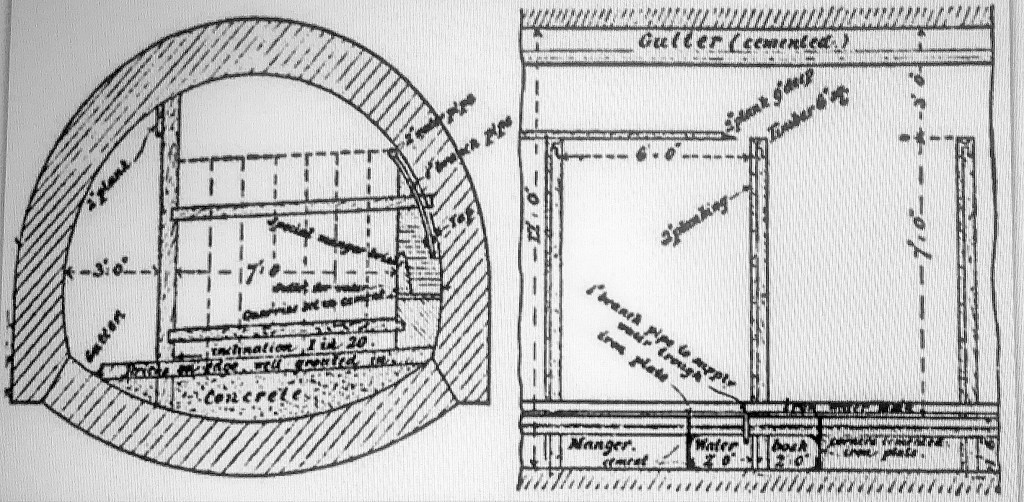
Photograph copyright: Glenys Sykes.
The 1902 Fire
The disasters were not over for 1902. In the early hours of Christmas Day 1902, a great fire broke out at the Lye Cross pit. The miners reported that all had been quiet and secure when they left the mine at 4pm on Christmas Eve but shortly after 9pm that night a watchman who was on duty at the colliery saw smoke coming from what was known as the spare shaft. He and several miners descended one of the other shafts and found that a ‘great fire’ had broken out in the principal roads and was spreading rapidly. These men tried to rescue eleven horses which were in the underground stable there but the flames almost overtook them and they were forced to abandon this work and give the signal to ascend the shaft.
The report notes that they were fortunate to reach the pit bank speedily for immediately afterwards the flames from the fire ascended the spare shaft to a height of at least 20 feet above the pit mouth and began to spread towards the engine house and it was feared that the valuable machinery would be destroyed. The Dudley Fire Brigade was called out but the manual pump was inadequate to cope with such a big fire and a steam fire engine was sent for. In the meantime a gang of men were employed in damming up the air roads leading to the shaft with tons of black sand. When the steamer arrived a large quantity of water from a local pool was pumped into the shaft . One newspaper report describes this, saying that when the water was pumped in to the shaft ‘steam and ashes were shot up as though from a volcano’. But it was not until five o’clock that the flames were extinguished. Fortunately the expensively equipped engine houses were not affected but the horses were lost, poor beasts. Ronald had remembered being told of this event as a child, and had remembered that the ponies had not been rescued. Obviously this aspect had stuck in the folk memory of this event for many years afterwards.
A slightly later report in the Tamworth Herald noted that throughout the whole of Christmas Day and the following day, the workmen were engaged in damming up the mouth of the shaft and the workings were expected to be closed for at least seven or eight weeks. It was fortunate that this occurred at holiday time so that no men were in the workings. About 130 men were thrown out of employment.
A report in the County Advertiser & Herald in August 1904, however, stated that
“there is little probability that the Lye Cross Colliery being re-opened for some months yet, due to the fact that there is a less demand for coal at the present time. About 100 miners who were thrown out of employment at the time of the fire are still out of work.”
This was twenty months after the fire so the mine had been closed for a long time. I suspect that in practice most of the miners would have sought work in other pits, few men would have been able to survive out of work for that length of time before the welfare state existed.
The 1911 Fire
Alas, this was not the last fire at the Lye Cross colliery. A further report in November 1911 described another serious outbreak of fire in the ‘Staffordshire Show Pit’ at Lye Cross which this time led to the closure of the pit and the loss of their jobs for 300 miners. I have not been able to find any trace of the pit re-opening after this.
So that is the story of the Lye Cross Pit, somewhere most of us probably did not even know existed but which almost certainly employed many men from the Lost Hamlets area. Mining has always been a dirty and dangerous business, but it was an important part of the success of the Black Country and must have contributed to the substantially both to the local economy and to the wealth of the mine owners.
 rowleyregislosthamlets.co.uk
