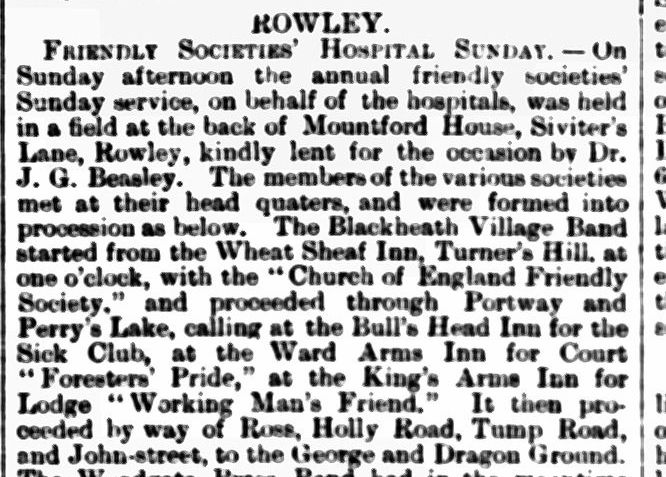
County Advertiser 24/9/1898
I have transcribed this article here:
“On Sunday afternoon the annual friendly societies’ Sunday service, on behalf of the hospitals, was held in a field at the back of Mountford House, Siviters Lane, Rowley, kindly lent for the occasion by Dr. J. G. Beasley. The members of various societies met at their headquarters, and were formed into a procession as below.
The Blackheath Village Band started from the WHEAT SHEAF INN, Turners Hill at one o’clock, with the Church of England Friendly Society, and proceeded through Portway and Perrys Lake, calling at the BULLS HEAD INN for the Sick Club, at the WARD ARMS INN for Court Foresters’ Pride, at the KINGS ARMS INN for Lodge Working Man’s Friend. It then proceeded by way of Ross, Holly Road, Tump Road, and John Street, to the GEORGE AND DRAGON Ground.
The Woodgate Brass Band had in the meantime covered its route from the OLD BUSH INN, Powke Lane, with Court Little Band of Hope, calling at the MALT SHOVEL INN for Lodge Lily of the Valley, the VINE INN for Court Mistletoe Bough, proceeding along Station Road to the RAILWAY INN for Court Britannia’s Pride, thence through Halesowen Street, Tump Road, and Hackett Street, meeting the other Courts at the GEORGE AND DRAGON Ground.
A united procession was then formed, and marched to Siviters Lane, reaching the ground at three o’clock. The proceedings opened with the hymn ‘All people that on earth do dwell,’ after which the Chairman (Mr. E. Pewtress, CC) delivered a short address.
The Rev. C. W. Barnard, MA, Rector of Kings Norton, then addressed the meeting, after which the hymn ‘Lead, kindly light,’ was sung. Addresses were also delivered by the Revs. W. Hall and N. Haigh, of Blackheath.
At the close a collection was taken on behalf of the Dudley Dispensary and Birmingham Eye Hospital. It amounted to £11 9s 5d.”
When I came across this article in the local paper, I was interested that there were so many active friendly societies in the area so I found out a bit more about them. The internet is my friend…!
Friendly societies, in those days before general employment benefits and social security, were mutual aid societies which provided social and financial support to their members when they were affected by illness, unemployment or death, when widows were supported. Originally they were associated with trade guilds but later became independent organisations. They also organised social events such as the one above which must have been quite a colourful sight. I suspect most of the societies would have had their own banners and there was probably some friendly rivalry, too. Like Building Societies – such as our very own Rowley Regis Building Club which built the Club Buildings, these societies mushroomed during the late 18th and 19th century.
Many of our forebears in this area and period would have lived in dread of ending up ‘on the parish’ or, even worse, in the Workhouse, being ill or injured and unable to support their family or having a ‘Pauper’s funeral’. Membership of a Friendly Society offered some hope of avoiding these fates.
There were thousands of different friendly societies, of different sizes and not all of long duration. Smaller and early societies could struggle to calculate their insurance risks fully and to build up sufficient reserves. Events such as epidemics of infectious disease or mass unemployment could lead to the closure of such societies and the loss of members’ contributions which must have caused great dismay.
There were three main types: trade societies, local societies and interest-group societies. Some ‘Orders’ such as the Ancient Order of Foresters, which started in Yorkshire, opened branches in towns and villages across the country which allowed members to move their membership if they moved for work and also enabled risk to be spread, such as if a large employer closed suddenly. These branches were usually known as Lodges but the Foresters called them Courts and there are several Courts mentioned in the list in the article. Some local friendly societies still exist and others moved into more formal life insurance.
To become a member, men (women were not admitted, at least until the late 1800s) had to formally apply, be proposed by an existing member who would propose them and another who would second them. They had to complete declarations about health, including whether any near relatives had died of tuberculosis or if they had had certain other diseases, such as gout, rheumatism, smallpox, etc. The club doctor would also examine candidates and admission depended on his approval, all of this to limit calls on club funds arising from chronic illness. Some societies only admitted members with a weekly wage of at least 22 shillings and many trades were excluded as “any other occupation that the committee may conceive dangerous or injurious to health”. It seems to me that most of the occupations of local residents in Rowley came under this last definition but nevertheless there were clearly enough members to support a number of local societies.
I would hazard a guess that most of the societies listed in the article were, apart from the Church of England Friendly Society, fairly small local organisations. The six main large societies were the Royal Standard, the United Kingdom, the United Patriots, the London Friendly, the Royal Oak and the Hearts of Oak. None of these was mentioned in the description of the march but probably the poor wages of nail makers working from home and the hazardous working conditions in quarries, mines and foundries precluded many local people from membership, even if they could afford the contributions but smaller local societies were perhaps more flexible.
In the late 1800s clubs began to be set up exclusively for women who earned an income independent of their husbands. These clubs paid out on confinement with a child but again strict rules were set out and unmarried mothers were usually excluded.
Legislation
The administration of these friendly societies was regulated through legislation, including the Registration of Friendly Societies Act 1793 and the Friendly Societies Act 1855 which established a Register of such societies. More legislation in 1875 was aimed at protecting the members and ensuring the funds were kept safe. This latter legislation defined the purposes of friendly societies as “the relief or maintenance of the members, their husbands, wives, children, fathers, mothers, brothers or sisters, nephews or nieces or wards, being orphaned, during sickness or other infirmity, whether bodily or mental, in old age (which shall mean any age after 50), or in widowhood, or for the relief of the orphan children of members during minority.”
Each month members paid into the Society, often at a meeting in a pub and in return, payments from the funds were made to ill members and widows. Some societies had initiation and other ceremonies, certificates, passwords and handshakes, – which only paid up members would know – rituals, oaths, parades and feasting, such as the one described in this article, even costumes. Annual feasts were held with processions, banners and dinners, some of which may have got a little over-exuberant. Membership must have brought a real sense of belonging to a community, of brothers, of people who looked out for you. Some societies had funeral processions and graveside duties. To try to protect their funds, many societies had cash boxes with three locks and three keyholders to prevent theft by officials of the society.
And membership, based usually on a subscription basis, provided sickness or injury benefit or contributions to funeral expenses. Some, such as Oddfellows, established in 1810 and still going, had a surgeon at every lodge or branch, who members had access to. Others, like the Rechabites which I have mentioned before, as my mother was a member, were more concerned with alcohol avoidance and ‘wholesome living’. And churches, chapels, businesses and other bodies began to run their own societies. Some societies donated to charities, for hospital beds, convalescent homes and even lifeboats. There were annual conferences, often held at the seaside, giving men the opportunity to take their part in democratic decisions, even before many of them had a vote in ordinary politics. They gave a sense of belonging and community.
However, the introduction of Lloyd George’s National Health Insurance Act in 1911 led initially to a further growth in membership as ‘state members’ were created, as the Act was largely administered through friendly societies and insurance companies. But this meant that the social side became less important and women, in particular, often did not care to go to meetings in pubs, preferring to pay their dues to the “man from the Pru” on his house visits. The loss of thousands of members in WW1 was also damaging for many societies.
By 1945, when the NHS was being set up, the membership of the friendly societies was estimated at 8,500,000, a significant proportion of the population. One estimate is that about 80% of male workers were members. However, the creation of the NHS, grants for funeral costs and changes to National Insurance took many of the functions of the societies away and led to many closures.
Since reading about this, I can remember my father being offered membership of what must have been such a society in the 1950s, perhaps the Order of the Buffalos, but I can remember my parents being somewhat puzzled about what this society was for and why he had been invited to join. And who had put his name forward? He declined in the end, possibly because he suffered chronic ill health and could have ill afforded the membership fees. Perhaps by then, the membership was becoming more of a social commitment and the requirements as to health less stringent as most people received treatment under the NHS.
I found this subject very interesting and enjoyed finding out more about it. I would have loved to see the processions with their bands and banners and no doubt excited children, and local people gathering to watch. Although it is difficult to imagine it now, before the days of radio and television, many people learned to play instruments and to sing to amuse themselves and bands, often sponsored by the big employers, provided companionship and pride and a sense of belonging – they often provided instruments, too and to this day brass bands encourage junior musicians to belong and often have strong family involvement. So I would imagine there could well be numerous local bands who could be called upon to lead processions.
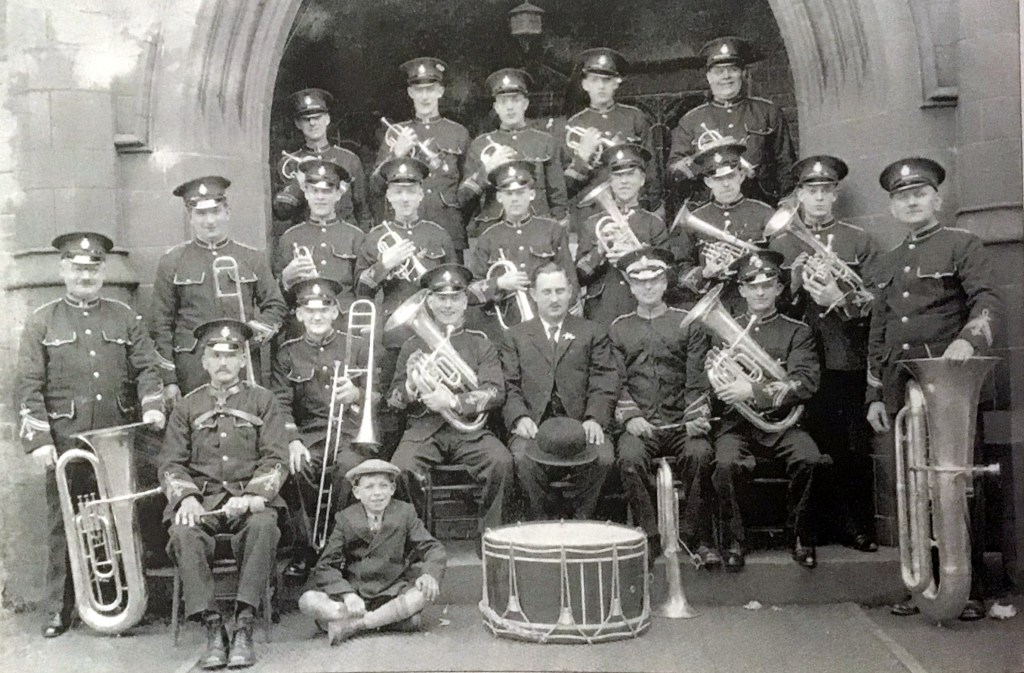
Copyright Anthony Page.
This photograph from Anthony Page’s collection shows the Blackheath Town Band at a somewhat later date, perhaps the 1930s. But their uniforms were probably the same and one or two of the members may even have played for Hospital Sundays!
There were traditional gathering places, too. Apparently the Hackett family who kept the George and Dragon had a field at the back (mentioned in the article above) where fairs and gatherings were held and the frontage of the George and Dragon remained a stopping place for processions until within living memory. I can picture the bands playing and puffing their way up Ross, leading the procession to Siviter’s Lane from the George and Dragon! And although a whole new housing estate was built in the area between the George and Dragon and Birmingham Road in the 1920s and 30s, this spot also was not very far from Britannia Park and the fields which were there before the park was laid out.
The only processions I can remember in the 1950s were the Whit Sunday Processions which were organised by the churches around Blackheath and ended up in Britannia Park, with games and sandwiches and cakes for tea (all in a brown paper bag for each child, if memory serves!) with orange squash or cups of tea for everyone. This spot would, of course, be just below the grounds of Mountford House and may even have been the very same field that was used then – a traditional gathering spot for celebrations!
More reading:
‘Who do you think you are?’ Magazine has an excellent article here:
https://www.whodoyouthinkyouaremagazine.com/feature/friendly-societies
The Wellcome Collection has a most interesting and full account of friendly societies here:
https://wellcomecollection.org/stories/the-friendly-societies-and-healthcare
The HistoryHit has another interesting account here:
Wikipedia even has a list of ‘friendly societies’ still operating today.
https://en.wikipedia.org/wiki/Category:Friendly_societies_of_the_United_Kingdom
 rowleyregislosthamlets.co.uk