I’m a fan of the FAN method of research!

I am a ‘FAN’ fan!

Genealogy or family history research is a very broad interest. It encompasses those who just want to track a direct line, father’s line only and who are not interested in siblings or female lines; those who insist on three separate pieces of written proof before anyone is added to their tree (which can be difficult once you go back a couple of centuries when a single parish register entry may be the only  piece of evidence you can find);  those who are desperate to find that they are related to someone famous. “I am a sixth cousin, 32 times removed from this famous actor/president/Mayflower passenger!” seems to crop  up fairly regularly on some family history online groups. Or related to Royalty… I resist the temptation to say ‘So what? ‘. Although there is a theory that all white Europeans are related to royalty through William the Conqueror, Charlemagne or  Edward III, prolific breeders all, on both sides of the blanket. Edward III has been referred to as ‘the Clapham Junction of English Genealogy’ as ‘all lines go through him’. That probably had more meaning when we had a better railway network…

And then there are those, like me, who research all direct ancestors, their siblings and in-laws and then their sideways connections. So I sometimes find myself diligently searching online for someone’s marriage or death, glance up at their page on my Ancestry tree to check what their relationship is to me to find that I am spending this time on someone who is a “paternal grandfather of wife of 1st cousin 5x removed”. Ah, maybe not spend too much more time on this then. Now, what was I doing before I went down this rabbit hole?   But hey, it’s interesting… and it’s surprising how often familiar names and addresses crop up and you do get a picture of how families interrelated.

There is a research technique in family history called the FAN method – Friends, Associates, Neighbours. By looking at the people around your ancestors, at home, at work, at church or chapel, you build a fuller picture of their lives, are more likely to have an impression of what they were like, you may find neighbours who subsequently marry into your family. Always look a page or two either side of your ancestor on censuses and maybe more in a parish register, you may find other relatives there. And noting the names of the witnesses of a marriage may act as a confirmation that you  have the right one, if a parent or sibling signed.

My husband started researching his family history while he was waiting for me to finish some research in Gloucester Local Studies Library many years ago. He decided to look for his grandmother in the census, as he knew where she had lived in the West End of Gloucester. This was in the days before the internet so you sat in a library or archive or record office, winding through a microfilm page by page, not much indexing. I was using a neighbouring film reader to look at press reports and heard a little “Ha! Got you!” when he found her. ‘That’s you hooked’, I thought. I was right…

He carefully noted down the details and we left to continue our day. It was only some weeks later as he explored more marriage and birth details that he realised that his granny’s maternal grandparents had been living next door – another trip to the library!  So the FAN method can be very useful.

In looking at the families who lived in the Lost Hamlets, I suppose I am doing the ultimate FAN exercise. Preparing detailed family trees however, even for what I think of as the ‘core families’ who lived there over a number of decades, would mean creating at least 14 family trees, possibly more than 20, which is daunting, even for me.

There are things that will help. There is a wonderful online site called  Black Country Connections which was started on the basis that it was very likely that many Rowley and Blackheath folk were related to each other and this is undoubtedly correct. So I can go to that tree and see whether any of the core families are listed (yes, mostly they are!) and have a head start on how they connect, possibly when and where they married and who their children were, all useful stuff.

And I have realised that in the 1841 Census, the Cole family had six households in these hamlets and most of these were already on my personal tree, three brothers and their father, so I have a head start there and have decided for now to start with them and work outwards, as it were, since they often intermarried with members of the other ‘core families’. In the last couple of weeks I’ve spent some time revisiting my original research done many years ago and expanding it in earlier generations, doing more work on siblings to my direct ancestors where I had not previously traced their descendants, too. Very enjoyable, if something of a rat’s nest! And uncovered some fascinating stories about them, so I will be posting some of their stories in due course. Apologies to those who have been waiting for another post, I have been  busy gathering new information.

Copyright Glenys Sykes

This photograph shows my original paper Family Tree, started in about 1980. It’s fair to say that it has expanded a bit since then. My current tree, stored digitally, has over 5000 people on it. Nonetheless, my original research in Smethwick Library and other archives all those years ago has proved very accurate, fortunately, as more and more records became available digitally to check against!

Interesting stories about your Lost Hamlets ancestors would be warmly welcomed!
Poisoned by his wife…

This is not strictly within the Lost Hamlets but concerns a member of the Cole family who was born there – and it’s a fascinating story so I am sharing it with you anyway!

Even after 40 years of research, I still find new facts on my family. Recently I was working on siblings of my 4XG-Grandfather Edward Cole and tracking their descendants, a task infinitely easier than it was when I first worked on Edward himself 40 years ago. With the advent of digitised records and family history programs and online resources, plus, of course, the many subscription services research has utterly transformed. 

Searching through the Cole entries in the St Giles Registers, I came across the Burial Record on 14 March 1832 for my 1st cousin 5xremoved David Cole. The entry says that he was 43 when he died in Mar 1832 and that he was a farmer living in Slack Hillock , off Gorsty Hill. I was picking out Cole burials, spotted the note on his made by the Vicar and was off down a fascinating rabbit hole, irresistible!

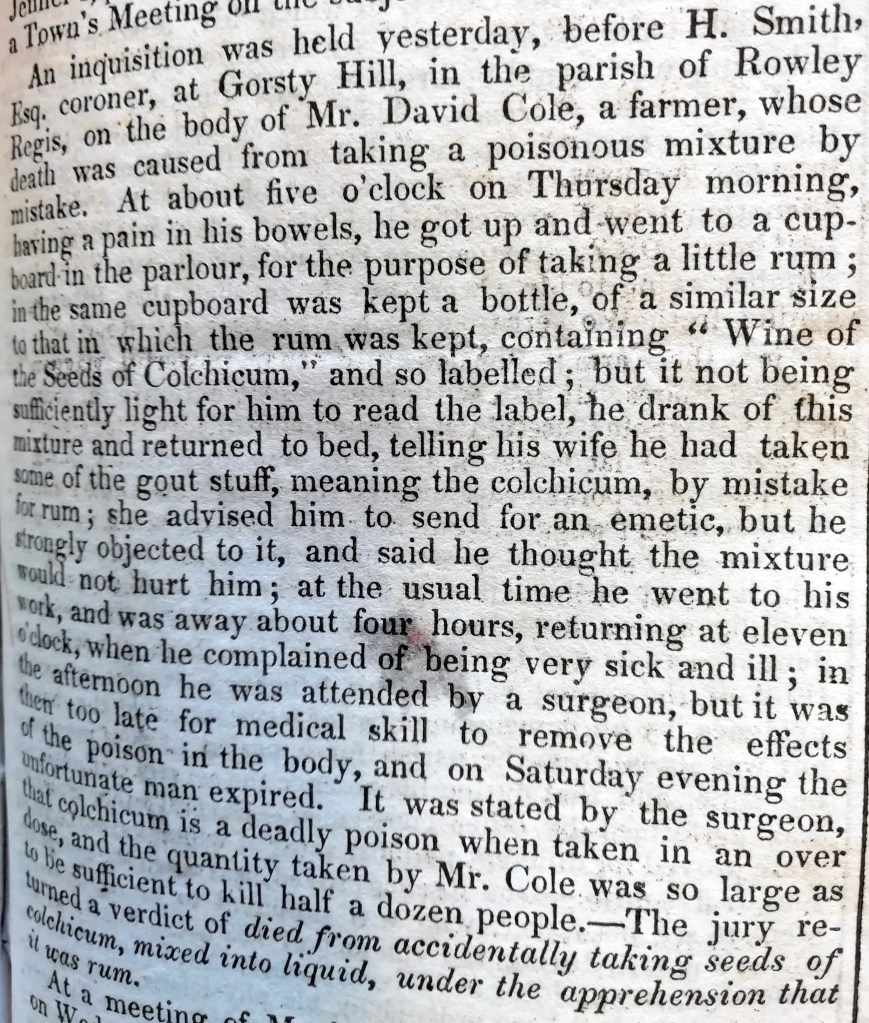
A note in the Register , added by the Vicar, says “Poisoned by drinking a composition which his wife retailed as a specific for the gout”. How about that for a damning story in a few words? I had to know more. I did some sleuthing and found a newspaper report in the Wolverhampton Chronicle dated 14 March 1832.

David Cole had woken at about five o’clock in the morning, with a pain in his bowels and had gone to get a nip of rum to settle his stomach. The ‘specific’ made by his wife, was called ‘seeds of Colchicum’ and was stored in the same cupboard as the rum in a similar bottle. The bottle containing the mixture was labelled “Wine of the Seeds of Colchicum” but it was not sufficiently light for him to read it. When he returned to bed he told his wife he had taken some of the gout mixture and she was concerned and wanted to get a physician to purge him but he strongly objected to this, saying that he did not think the mixture would hurt him. He went off to work as usual but returned four hours later at 11.00am, feeling ill and very sick and took to his bed. He died two days later. The surgeon who had attended him later on the afternoon he was taken ill could do nothing and told the inquest that he had taken ‘enough of the mixture to kill half a dozen people’. The jury returned a verdict that he “died from accidentally taking seeds of colchicum, mixed  into liquid, under the apprehension that  it was rum.”

Copyright Wolverhampton Chronicle.

 He left his wife Charlotte with thirteen children, the youngest David baptised in June 1832, after his father’s death so it seems very likely that Charlotte was heavily pregnant when her husband died.  However, the oldest were old enough to be already working, one as a butcher and others on the farm and she stayed there, listing herself as a farmer for many years after that. I wonder whether she carried on selling her remedies?

But doesn’t this little story actually tell us quite a lot about them? Yes, she was a farmer’s wife but also a herbalist of some knowledge and known as such to local people. I wonder who taught her? Perhaps a family skill? When I looked into it, seeds of Colchicum is still listed by present day herbalists as a treatment for gout but with warnings that it is toxic in large quantities and may cause death. And, to my geat surprise, when I recounted this tale to a genealogist friend who has recently had extensive heart surgery, she responded immediately that “Colchicum is still recommended by the NHS! When I saw my consultant a couple of weeks ago, he recommended colchicine for gout”. So an extract of Colchicum is still used by the NHS today. Charlotte Cole actually knew her stuff, it seems.

Copyright: Glenys Sykes

And there were few remedies for painful gout in those days, if I remember correctly. Presumably she was known to local people for her remedies, hence the Vicar’s somewhat judgmental comment that she sold the remedy. But they didn’t have pharmacies as we know them then, no picking up a remedy at the chemist or pharmacy as we might and probably most people couldn’t afford to consult doctors.

How devastating for Charlotte to have witnessed this tragedy, her husband killed by her own remedy and to have suffered the reproaches of someone like the Vicar and possibly others for something that was not her fault.

A Methodist chapel in Perry’s Lake?!

Once upon a time there was a Methodist Chapel in or between the hamlets of Gadds Green or Perry’s Lake. Who knew? There is no trace of it on any of the maps I can find but it is listed on the censuses, between Perry’s Lake and Gadds Green , in 1861 and 1871.

I first noticed when transcribing the 1871 Census for Perry’s Lake and Gadds Green that between the two hamlets there is a line which says “Primitive Methodist Chapel”. It is not mentioned in the 1881 Census but in the 1861 Census it is there, again listed between Perry’s Lake and Gadds Green both times but this time called Gadds Green Chapel. Not mentioned in the 1851 Census (although Thomas Barnsley, aged 29, living in Perry’s Lake and born in Rowley Regis, gave his occupation as “Methodist Local Preacher and labourer at Stone Quarry”.

However, in an 1844 Preaching Plan for the Dudley Circuit which is on the ‘My Primitive Methodist’ website, Perry’s Lake is among the Chapels listed as having two services each Sunday at 2.30 and 6pm.  Also listed is Rowley  – one service each Sunday at 6pm, though it is not clear where this chapel was, possibly services held in a private house or a rented room or even the open air, as neither Knowle nor Hawes Lane chapels are recorded as having been in operation by this date.

The Preaching Plan is an interesting document, showing the burgeoning vitality of the Methodist church in those days with a list of more than 36 chapels in and around Dudley with a few paid ministers who walked long distances to conduct services and in excess of 80 local preachers in the area, including several women.  And that was only the Primitive Methodists, there were several other types of Methodists, plus Baptists, Congregationalists, Quakers, Unitarians and others all apparently thriving.

The chapel was also noted as ‘Gads Green’ on a list of Chapels, drawn up in 1867, which is again on the My Primitive Methodist website. So it definitely existed between 1844 and 1871. It would be interesting to see the 1887 OS 6″ to the mile map , just to see whether it was still there then but I can’t find this map online or in print anywhere at the moment.

The earliest 6″ OS map I have at present is dated 1904 and I can’t see a chapel marked on there in Perrys Lake or Gadds Green. There is a Chapel Cottage in Gadds Green as late as the 1911 Census but a chapel isn’t mentioned then. So I wonder whether the local Methodists transferred to other chapels, the nearest being Hawes Lane or The Knowle, both less than a mile away and surely less than a mile apart! 

I found online this bit of history about the Knowle Chapel (Eric Bowater giving the information in 2019).

“The first beginning of Knowle Methodist Church met in the small kitchen of a local house,for the sum of 1s 6d.around 1860. As the membership grew it moved into a farm building in Brickhouse Farm a short distance away. Once again the membership grew and so it was decided to build a church of their own. A Church was now to be erected on the present site and was opened in December 1869 called Ebenezer. In 1890 new trouble arose with undermining which affected the chapel. The last meeting held in the chapel was held in 1907.The present church which was built in front of the old one 25th September 1907 and was a United Methodist Church.”

The Knowle site would have been quite close to the hamlets and accessible across the fields so if the earlier chapel closed people might have moved to the Knowle chapel. Reg Parsons, who grew up on Turner’s Hill, told me that he had never heard of a chapel there but that there was also a ‘tin chapel’ at Oakham, opposite the pub there so that may also have provided a spiritual home for some local people when the Perry’s Lake chapel closed.

There was an Ecclesiastical Census on 31st March 1851 (this can be downloaded free of charge from The National Archives) but many small chapels appear to have been omitted and I have been unable to find a chapel I can identify as Perry’s Lake or Gadd’s Green. The entry for St Giles shows figures for attendance which, frankly, I find rather suspect.  An extract is shown here.

Copyright: The National Archives

I find it difficult to imagine 600 people at morning service with 400 children at Sunday School, 1100 people all crammed into St Giles Church for the afternoon service with 400 children at Sunday school (again) and another 100 in the evening in a rented room – such neat round figures, 1000 and 1500 people?! The return for Dudley St Thomas gives figures of 800 and 700 attending services but that for Reddal Hill claims much more modest figures of 149 at church with  223 at Sunday school in the morning with 259 and 223 respectively at later services.

As we have just entered the season of Lent, it is perhaps timely to note that several clergy, in their returns for this census (and clearly anxious that their attendances should not be underestimated by the powers that be for the future), pointed out that the date chosen for the Census was the middle Sunday of Lent.  The note shown below was attached by one local Clergyman. It reads “The reason that attendance at the church appears smaller on the 30th Mar than the average is that the day is Mid-Lent Sunday, commonly called Mothering Sunday. A day much observed in this district by parents having their children and friends around their tables on this day and providing the best in their power for them.”

Copyright: The National Archives

What a picture that conjures in a few words. And a clergyman apparently much in tune with his congregation, however humble.  I can remember my mother telling me as a child that Mothering Sunday was the one day of the year that domestic servants were allowed to go home to visit their mothers, often taking them gifts of food from their employers or spring flowers gathered along the way.

One nearby Anglican clergyman noted bitterly on his return, the ‘scourge of those Dissenters so prevalent in this locality’ and blamed them for his poor attendance figures – showing the hostility of some clergy to their independently minded parishioners. Nonconformists were not popular at that time with the Anglican church, generally seen as rebels and ignorant troublemakers to be corrected and brought back to the Anglican church. A history of Birmingham Road Methodist church in Blackheath recounts that their meeting started in the 1840s in a rented stable in Siviters Lane in Rowley. Dissenters, as they were known, were regarded as the ‘off-scouring of life’, the very scum of the earth’ and, on one occasion when they were unable to pay the rent for the room above the stable, they were not allowed to use the room so sang and prayed in the street outside. A note in the Register for the burial of my 5xgreat-uncle at St Giles in 1794 reads “William Rose, never came to church tho’ often warned and kindly exhorted, died suddenly”. I wonder how kind those exhortations were?  To me, it seems very likely that William Rose was a Dissenter, a Methodist and that was why the Vicar was trying to lure him back.

So the hamlets of Perrys Lake and Gadds Green were fortunate to have a chapel of their own to worship in. Worship in their chosen style was an important part of life for our ancestors then and even small hamlets like Perry’s Lake had chapels – I wonder where it was? Any information would be very welcome.

Might it, just might it, have been behind the cottages in the part of Perry’s Lake which people still remember being called ‘Heaven’?

Some statistics about the people living in the hamlets in 1841

So.. What did they do for a living?

In 1841, the population of Tippity Green, Perry’s Lake, Gadds Green and Turner’s Hill numbered 384.

The occupations listed for them were:

Blacksmith                          1

Butcher                                  1

Coal Miners                        13

Farmers                               5

Female servants               8

Forge filer                           1

Independent means      1

Ironmonger                        1

Jobbing Smith                    1

Labourers                            9

Male Servants                   5

Nail factor                           1

Nail tinner                           1

Nailmakers                         38

Publicans                             1

Registrar of B&D               1

Shoemaker                         1

Stick dresser                      1

Warehouseman                1

Wash for hire                     1

A couple of entries have no occupation shown, this may be because those men were out of work or simply an omission.

Nailmaking was by far the dominant occupation, coal mining was not yet a major employer . Very few occupations were listed for women unless they were widows, despite the fact that most women and many children also made nails at this time. No scholars were listed though that may not mean that no children went to school, there was at least one school in Rowley Regis at this time, it simply may not have been recorded.

Note that the local Registrar of Births and Deaths John Woodhouse was living in Tippity Green, his son William would succeed him in that role in due course.  I have many copy certificates of births and deaths with their signatures.

There appear to have been few shopkeepers at this time, people had to be self-sufficient or buy necessities from further afield, although there may have been some informal grocery shops in front rooms! Many households would have kept chickens and pigs and may have acquired the occasional rabbit for the pot, and presumably grown vegetables if they had gardens.

Where were they from?

Only 46 of the 384 were born outside the County of Staffordshire.

Of these 46 only 10 were born in Scotland, Ireland or Foreign Parts. 5 men and 5 women.  No information is shown in this census about where others came from but more is shown in later censuses.

How old were they?

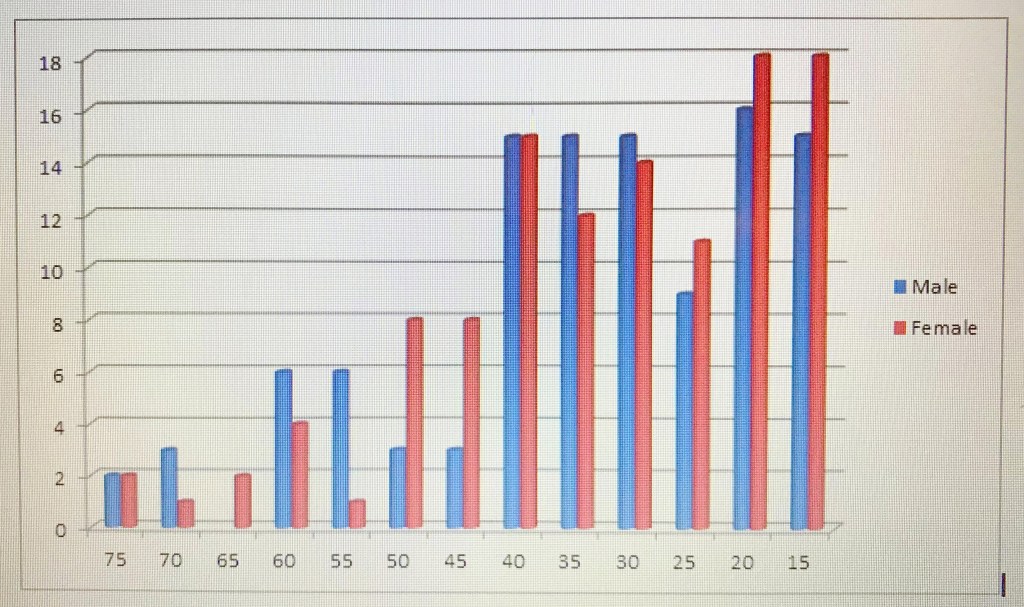
Ages in the 1841 Census were supposed to be rounded down to the nearest five years. So if you were 38, your age was shown as 35. A trap which can mislead family historians who are not aware of this and who are looking for an ancestor of a particular age. And at this time ordinary people were often neither literate nor numerate so ages in this Census should be treated with caution

In this chart the ages are shown along the bottom. As it shows, it appears that living beyond 50 was good going and beyond 60 was a rarity. Two of the four  aged 75 were men living in Tippity Green in the Parish Poorhouse, one of them blind, the first woman was living on Turner’s Hill, the ‘wash for hire’ listed in the occupations and the second woman was living alone in Perry’s Lake.  But with no pensions, most people worked for as long as they lived.

Ages of adults:

Adults’ Ages in the 1841 Census

Younger people

The Census required the ages of those under 15 to be shown by year, perhaps to enable the Government to track child mortality.

Children’s ages in the 1841 Census

Transcribing burial records for Rowley Regis has shown me that great numbers of babies died – of debility, decline, lung and bowel problems – before their first birthdays. These will often not appear at all in Census records if their short lives fell between censuses. And older children succumbed to whooping cough, smallpox, measles, scarlet fever, typhus fever (as did numerous adults) and consumption (Tuberculosis).  Poor nutrition, cramped living conditions and exposure to smoke and air pollution would not have helped.

My apologies for the poor quality of some of these images: I am new to this medium and on a steep learning curve, I hope this will improve as I become more accustomed to it.

So these are the basic statistics for the population of the lost hamlets taken from the 1841 Census. In future posts, I will explore more about the families behind the numbers.

Families in the Lost Hamlets 1841-1881

There are 13 families who were living in the hamlets of Perry’s Lake, Gadd’s Green and Turner’s Hill area for all five censuses which I have so far transcribed. All are familiar Rowley names:

Cole, Cutler, Darby, Foster, Hill, Hipkiss, Levett, Parkes, Redfern, Simpson, Taylor, Whitehall/Whittall and Woodhouse.

A further 9 families had moved in between 1841 and 1851 and were in all four of the 1851-1881 Censuses:

Barnsley, Detheridge, Edwards, Hadley, Harcourt, Ingram, Jones, Knight, Ocroft, Payne and Timmings/Timmins.

Four families were in the 1841-1871 Censuses but had moved on by 1881 – Badley, Downing, Round and Siviter.

When time permits, I will check where these families had moved to.

Certainly there will have been marriages between these families and they were most likely closely interrelated over those years.

This information will be updated as more censuses are transcribed.

Finger i’ the Hole

Another place name in Rowley Regis which has had the same question asked about where it was is ‘Finger-i-the-hole’. Where was it? Why was it called that?

The name first appears in the Parish Registers in December 1727 when ‘Christopher Chambers of ye ffinger-i’-the hole’ was buried and the name crops up in later years with different spellings in various records, including the 1841 Census, when twelve families were living there. Later references to it seem to have reduced it to Fingeryhole.  The local consensus in discussions on the Facebook page was that it was somewhere on Turner’s Hill.

J Wilson-Jones, in his book, The History of the Black Country recounts this story:

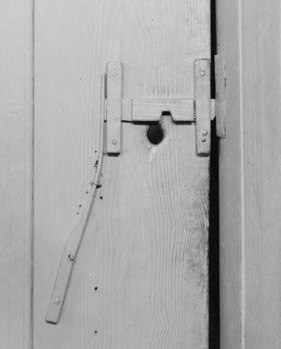
“Upon the Rowley Hills stands an old Cottage known as Finger o’t’Hole. It was so named because old Black Country cottages had a drop latch fixed upon their doors, it could be opened from the outside by putting the finger through a round hole. At this cottage there lived an old lady and one night a robber thought to take advantage of her loneliness. The cottage being in darkness, he placed his finger through the hole but the old lady had been disturbed and was waiting with a poised hatchet. The robber lost his finger and the cottage was named Finger o’t’Hole.”

So that legend obviously goes back a long way.

This appears to be the sort of latch referred to in the story, with a finger hole! (Photograph courtesy of Creative Commons).

When I came to transcribe the 1841 Census, I was not able to find any mention of Gadd’s Green, although Turner’s Hill and Perry’s Lake were easily found. By following the census enumerator’s route, which appears on the first page of each set, I found that Finger-i-the-hole appeared to be in the same geographical position as Gadds Green was in the 1851 and later censuses, after Perry’s Lake and before Turner’s Hill.

Transcribing the 1841 Census showed that the families living in Finger-i-the-hole in 1841 were :

William Priest  (+2)                          45           Nailmaker

Joseph Taylor    (+5)                        40           Nailmaker

Thomas Hill (+8)                                45           Nailmaker

John Hipkiss (+14)                            70           Nailmaker

Joseph Whitehall (+6)                    59           Nailmaker

Philip Taylor (+4)                              35           No occupation shown

William Woodall (+2)                      45           Nailmaker

Pheby Whitehall (+2)                     30           Nailmaker

David Priest (+5)                               35           Labourer

Jos’h Hill (+3)                                     20           Coal miner

Elizabeth Morton (+6)                    35           Nailmaker

John Simpson                                    20           No occupation shown

And every single one of these families appeared in the 1851 Census with the name of their abode given as Gadd’s Green! So – even if the origin of the story of Finger-i-the-hole related to one cottage – from references in the Parish Registers and from the 1841 Census, by the early 1800s the name referred to a whole group of dwellings.

I hope to add the whole of the 1841 and later Censuses for these hamlets in due course so that family members can be seen. The 1841 Census is the least detailed and informative of the censuses, often difficult to read as it was completed in pencil. Also, the ages of adults were supposed to be rounded down to the nearest five years and no relationships were shown. Later censuses were much more informative.

So at last there is an answer to the question, where was Finger-i-the-hole? It became known between 1843 – the last reference to Finger-i-the-hole in the Parish Registers – and 1851 when it appears in the 1851 census – as Gadd’s Green. 

It is probably not a coincidence that the Rev’d George Barrs died in 1840. He had been a vigorous and campaigning Curate in charge of the Rowley Regis Parish  from 1800 until his death and in those forty years must have built up extensive knowledge of local people and places and would have known local names. Perhaps succeeding newcomer curates to the parish found the name Fingeryhole (and the story behind it) fanciful or unacceptable in those very proper Victorian times.

There were certainly Gadds in Perry’s Lake in 1841 and 1851 so it’s possible they were connected and the name came from land they owned there, some further research into deeds may one day give more information.  Interestingly, there were also Gadds, rivet makers, living in Ross, an old street on the other side of the village, in 1841 where later Thomas Gadd founded his rivet making factory. The factory was still there in the 1950s and 60s, and including the original cottages, as I passed this factory on my way to and from the library. I now know that my great-grandfather Absalom Rose worked there.

As I keep saying, folk tended not to move around much!

The ‘Lost Hamlets’ of Rowley Regis

Rowley Regis was once a small ancient village on the top of a very high hill in South Staffordshire, now apparently absorbed seamlessly into the enveloping sprawl of the West Midlands conurbation. It has had several other municipal designations due to local Government re-organisations in the last century but historically, it was in South Staffordshire – that’s what it said on my school exercise books, so I know! The other, less defined, description is that Rowley Regis was in the Black Country, that nebulous area of industry, metal working, mining, quarrying and sheer hard work and where probably most of the population lived in what we would think of now as poverty. 

Although Rowley Regis is an interesting name – yes, at one time, part of it was held by the King, possibly as a hunting area – by the 19th century the village was of no particular note, the main industries in and around the village were quarrying the very hard ‘Rowley Rag’ stone from various quarries on the hill, mining and, above all, in Rowley itself, wrought iron hand nail making which was mostly carried out in small ‘shops’ at the back of houses, and involved whole families, men, women and children from about the age of six. The metal working skills of the local people and the plentiful supplies of the raw materials required meant that, as the Industrial Revolution progressed, hand nail and chain making fell into history and the metal working and myriad engineering skills gave rise to a vast landscape of heavy and polluting industry, canals, mines and brickworks.

I am a Rowley girl. I was born there, grew up and was educated there and lived there until I was eighteen. My parents and grandparents and many of their forebears were born there too and lived out their lives there. My mother told me stories about the area when I was growing up and I started my family history research in about 1980 and have been working on it ever since.

Retired after many years working in local government and now living in the West Country, during the first Covid lockdown I volunteered to transcribe parish registers at home from photographs for FreeREG, for Rowley Regis and Blackheath, the adjacent town which developed just down the road in the mid 19th Century, after the glebe lands belonging to the church were sold. This has included many non-conformist registers, which have never been available online previously.

Very quickly I noticed that many of the family names in those registers were familiar although some of them I had not come across for many years, since I moved away. But I had been at chapel and school with those names! It was also apparent from the Registers and from the various censuses that as well as the village proper, there were a number of hamlets on the edge of the village, some large and some small, and that families tended to stay within these hamlets or nearby. They appear to have been close-knit little communities. Some of my ancestors seemed to stay very firmly in and around the hamlets of Perry’s Lake, Gadds Green, Tipperty Green and Turners Hill, for example, which were very small settlements barely a mile from the village church and within half a mile of each other.  Gradually as houses were built, new roads opened, transport improved  and development spread, addresses were formalised and house numbers began to appear in the parish registers and censuses and some of the old names for the hamlets became less significant.  

There is a very active and informative Facebook page about memories of Rowley Regis and Blackheath, the town. Recently one person asked on the Facebook page where Gadds Green was, because Poppy memorials were being placed near the homes of soldiers who had died in the First World War and one of those had come from Gadds Green. She couldn’t find any trace of it.  I had not realised until then that quarrying had completely obliterated Gadds Green, and much of Perry’s Lake and the houses on Turners Hill – they only existed now on old maps. Other local names do not even appear on maps – there has been some animated discussion on the page about where a place called ‘Finger-i-the-hole’ was and most local people will never have heard of Blackberry Town, which appears in the 1841 census.

Several of the local historians using the page were able to tell the Facebook enquirer where Gadds Green had been. But it seemed a pity to me that these lost hamlets, home to so many of my ancestors, have not only physically disappeared but are now fading from local memory. Through my various researches and transcribing church registers and censuses, I have gathered quite a lot of information about these places, who lived there, who ran the shops and pubs, where people worked and worshipped and who married who.

So I have decided to create a One Place Study about these ‘lost hamlets’. My study will initially concentrate on the hamlets of Perry’s Lake, Gadd’s Green and Turner’s Hill, clustered to the North-West of the village centre, during the period 1840-1921, principally looking initially at censuses, parish registers , maps and what these can tell us about the people who lived there. The people and their lives are my main interest. I suspect that it will expand both geographically and in time period as particular information and resources come to hand. I will be posting to this site with new posts about aspects of life in the hamlets and will add maps and photographs in due course.

And by starting a One Place Study, now registered with the Society for One Place Studies, hopefully information about the people who lived in those ‘lost hamlets’ and in due course, others of the ‘lost hamlets’ can be preserved in a study where other people can also contribute their knowledge to it and where later researchers can find the answer to ‘Where was Gadd’s Green?’.