Finger i’ the Hole

Another place name in Rowley Regis which has had the same question asked about where it was is ‘Finger-i-the-hole’. Where was it? Why was it called that?

The name first appears in the Parish Registers in December 1727 when ‘Christopher Chambers of ye ffinger-i’-the hole’ was buried and the name crops up in later years with different spellings in various records, including the 1841 Census, when twelve families were living there. Later references to it seem to have reduced it to Fingeryhole.  The local consensus in discussions on the Facebook page was that it was somewhere on Turner’s Hill.

J Wilson-Jones, in his book, The History of the Black Country recounts this story:

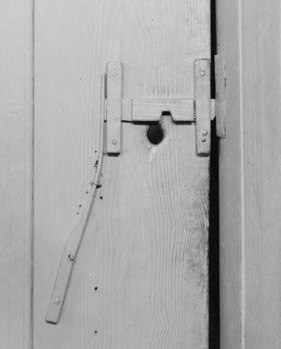
“Upon the Rowley Hills stands an old Cottage known as Finger o’t’Hole. It was so named because old Black Country cottages had a drop latch fixed upon their doors, it could be opened from the outside by putting the finger through a round hole. At this cottage there lived an old lady and one night a robber thought to take advantage of her loneliness. The cottage being in darkness, he placed his finger through the hole but the old lady had been disturbed and was waiting with a poised hatchet. The robber lost his finger and the cottage was named Finger o’t’Hole.”

So that legend obviously goes back a long way.

This appears to be the sort of latch referred to in the story, with a finger hole! (Photograph courtesy of Creative Commons).

When I came to transcribe the 1841 Census, I was not able to find any mention of Gadd’s Green, although Turner’s Hill and Perry’s Lake were easily found. By following the census enumerator’s route, which appears on the first page of each set, I found that Finger-i-the-hole appeared to be in the same geographical position as Gadds Green was in the 1851 and later censuses, after Perry’s Lake and before Turner’s Hill.

Transcribing the 1841 Census showed that the families living in Finger-i-the-hole in 1841 were :

William Priest  (+2)                          45           Nailmaker

Joseph Taylor    (+5)                        40           Nailmaker

Thomas Hill (+8)                                45           Nailmaker

John Hipkiss (+14)                            70           Nailmaker

Joseph Whitehall (+6)                    59           Nailmaker

Philip Taylor (+4)                              35           No occupation shown

William Woodall (+2)                      45           Nailmaker

Pheby Whitehall (+2)                     30           Nailmaker

David Priest (+5)                               35           Labourer

Jos’h Hill (+3)                                     20           Coal miner

Elizabeth Morton (+6)                    35           Nailmaker

John Simpson                                    20           No occupation shown

And every single one of these families appeared in the 1851 Census with the name of their abode given as Gadd’s Green! So – even if the origin of the story of Finger-i-the-hole related to one cottage – from references in the Parish Registers and from the 1841 Census, by the early 1800s the name referred to a whole group of dwellings.

I hope to add the whole of the 1841 and later Censuses for these hamlets in due course so that family members can be seen. The 1841 Census is the least detailed and informative of the censuses, often difficult to read as it was completed in pencil. Also, the ages of adults were supposed to be rounded down to the nearest five years and no relationships were shown. Later censuses were much more informative.

So at last there is an answer to the question, where was Finger-i-the-hole? It became known between 1843 – the last reference to Finger-i-the-hole in the Parish Registers – and 1851 when it appears in the 1851 census – as Gadd’s Green. 

It is probably not a coincidence that the Rev’d George Barrs died in 1840. He had been a vigorous and campaigning Curate in charge of the Rowley Regis Parish  from 1800 until his death and in those forty years must have built up extensive knowledge of local people and places and would have known local names. Perhaps succeeding newcomer curates to the parish found the name Fingeryhole (and the story behind it) fanciful or unacceptable in those very proper Victorian times.

There were certainly Gadds in Perry’s Lake in 1841 and 1851 so it’s possible they were connected and the name came from land they owned there, some further research into deeds may one day give more information.  Interestingly, there were also Gadds, rivet makers, living in Ross, an old street on the other side of the village, in 1841 where later Thomas Gadd founded his rivet making factory. The factory was still there in the 1950s and 60s, and including the original cottages, as I passed this factory on my way to and from the library. I now know that my great-grandfather Absalom Rose worked there.

As I keep saying, folk tended not to move around much!

“Where is Gadd’s Green?”

That was the question posed last autumn on the Facebook page ‘I remember Blackheath and Rowley Regis’. The question was asked by someone who was commemorating local men who had given their lives in WW1 by placing poppy wreaths near where they had lived and she could not find Gadds Green anywhere locally.

I was taken by surprise. Researching my Rowley family, and having an ever expanding collection of older edition maps of the area, I had known for many years that Gadds Green was one of several small hamlets situated on or at the foot of Turner’s Hill, less than a mile from the village proper and the church. But, because I have not lived in Rowley Regis for more than 50 years, I had not realised that Gadds Green simply did not exist now, quarried out of existence, along with most of the houses on Turner’s Hill and Perry’s Lake.  The quarry which had given so many men their employment had ended up taking their homes.

It seems likely to me that many of the place names in this area – Perry’s Lake, Gadd’s Green and Turner’s Hill may be related to families who owned the land or who lived there, especially as they tend in earlier records to have an apostrophe, although this often fell out of use in later years. The surname Perry appears in the Parish Registers as early as 1641, Turner in 1651 and Gadd in 1653 so these families had been in the village for centuries. Further research into Hearth taxes and other Land documents in various archives may cast further light on this theory when I can access records. Transcribing sequences of baptismal registers has also taught me that what people called their places of birth and residence varied from time to time and that what Priests and Ministers called them varied, too. Some place and street names appear to be very old  – Powke Lane is shown on a map dated 1775 and in the St Giles Registers as early as 1723, Gosty Hill in 1729

Some place names appear in use for a short time and then disappear without trace, such as Blackberry Town which I think was somewhere below Springfield.  There was a Treacle Street in the same area in the 1841 but not the 1851 Census. What I knew as Dudley Road, going from Rowley  through Springfield– my birthplace! – to Dudley simply did not exist until the late 1800s, the route from Halesowen to Dudley, according to J Wilson Jones skirted Furnace Hill, past Coombe Mills, the Woodgate, Coombs Wood, Gorsty Hill over the Canal Tunnel and Slecks Hilloock down the present day Station Road, skirting Codsall Coppice to Old Hill. The later main Halesowen Road was an unimportant track weaving its way towards the abbey , leading some to speculate that this was a Pilgrim’s Way. Climbing to the Knoll (Knowle) the road then went via Tipperty Green, Perry’s Lake and then up Turner’s Hill to Oakham, Lye Cross  and Dudley.  The road we now know as the Dudley Road through Springfield was marked on the 1884 First Edition OS map as the “New Rowley Road”. Until that was built, if you wanted to go to Dudley, it was the high road over the Hill!

In the meantime, I have started work on a One Place Study which I am calling Rowley Regis – the Lost Hamlets, as a place to record all that I have learned about these now lost hamlets, to record information from censuses, parish records and family stories.

As part of my One Page Study, I have been transcribing censuses for the hamlets of Perry’s Lake, Gadd’s Green and Turner’s Hill – starting with the 1851, as that has much more information than the 1841. I have transcribed four censuses so far – 1841, 1851, 1861 and 1871 and am working on 1881. It is very interesting to see families intermarry, move short distances and occupations change over the decades,  the latter something also observable in the transcription of parish Baptismal registers which record father’s occupations.

More detailed posts will be coming on the individual censuses and on some of the families living in the area.

The Hamlets of Rowley Regis

Rowley Regis has, it seems, always consisted of not only the ancient parish but also of a number of hamlets, large and small arranged around the village, like satellites. 

The introduction to the transcribed Parish Registers, published by the Staffordshire Parish Registers Society in 1915, and written by the transcriber Miss Henrietta Mary Auden, a Fellow of the Royal Historical Society, or some other knowledgeable authority on local matters offers this commentary:

“The parish in medieval times comprised many isolated houses and hamlets, homes originally of settlers in the forest, and as late as 1842 it was remarkable for the number of old small enclosures. The Manor is not mentioned in Domesday but was apparently a Royal Manor before the Conquest. “

This perhaps laid the pattern of numerous distinct small settlements which persisted until the late 1800s, after which they gradually merged until there was no open space between them. A teacher at the local grammar school in the 1980s commented recently on the local Facebook site that she was amazed, on moving to the area to teach, to find that the local people were very clear about which of these hamlets they lived in, even though, to her as an outsider, there appeared to be no formal or recognizable boundaries that she could identify.

In 1851 William White wrote “The Parish of Rowley Regis forms part of the great Barony of Dudley and contains 7,438 inhabitants and 3,350 acres of land, of which the executors of the late Earl Dudley are lords and owners, and hold Court Leet here in September. The parish comprises the large but indifferently built village of Rowley, seated on the declivity of a lofty hill two and a half miles S.E. of Dudley and about 20 hamlets all of which maintain their poor conjointly, and are occupied chiefly by nailers, chain makers and the miners, forgemen etc  employed in the extensive coal and iron works here. “

Twenty hamlets are listed by White in 1851:

Blackheath, Corngreaves, Cradley Heath, Gosty Hill, Haden Cross, Haden Hill, Hayseech, Knoll, Lye Cross (near Oakham, not to be confused with Lye near Cradley Heath), Oakum (Oakham), Old Hill, Portway, Powke Lane, Reddal Hill, Tipperty Green, Tividale, Turner’s Hill, Windmill End, Whiteheath Gate, Slack Hillock and the other houses in Rowley Village.

In his book A History of the Black Country, published in about 1950, J Wilson Jones, a former Librarian for Blackheath, considers that, at the time of the Enclosure Act of 1799, there were hamlets at:

The Brades (near Oldbury, developed circa 1780 owing to the Iron Works), Tividale (near Dudley, also with a large Iron Works. Developed upon Sheldon Estates.), Oakham (an early settlement as by its name the dwelling in the Oaks), The Knoll (later known as Knowle), Ibberty (Tipperty) Green (a manorial mill), Windmill End (another manorial mill), Old Hill, Reddal Hill, Cradley Heath. Lawrence Lane,  Longtown,  Corngreaves, Hayseech and Gorsty Hill.  He suggests that these hamlets consisted of about twelve or more homesteads plus  groups of from three to six houses or homesteads at Whiteheath Gate, Portway, Turner’s Hill and Perry’s Folly (Perry’s Lake).  There are differences between the lists, but they are largely the same.

Wilson Jones notes that Perry’s Lake was sometimes known as Perry’s Folly which suggests a connection with an individual and an intriguing tale which I will relate if I can find out any more about it. Local people tell me that their families called Perry’s Lake Heaven when they lived here, in the early and mid 20th century, although I have found no formal record of these names.   The reason for these variations is unknown but it is not the only local place to have had several different names over the centuries. 

Some of these hamlets, such as Cradley Heath and Old Hill thrived and expanded into substantial separate communities over time, others faded from history and it is these ‘lost hamlets’ which are the subject of my study, although interesting stories about other parts of Rowley Regis may appear from time to time, if I find these in the course of my research.

I hope you will find my One-Place Study website interesting. This is very much work in progress. With new blogs being added, do check back now and again to see what’s new.

If you have any interesting stories, memories, photographs or postcards which you are willing to share, please do get in touch with me via the Contact Page.

A Plan of the Lost Hamlets

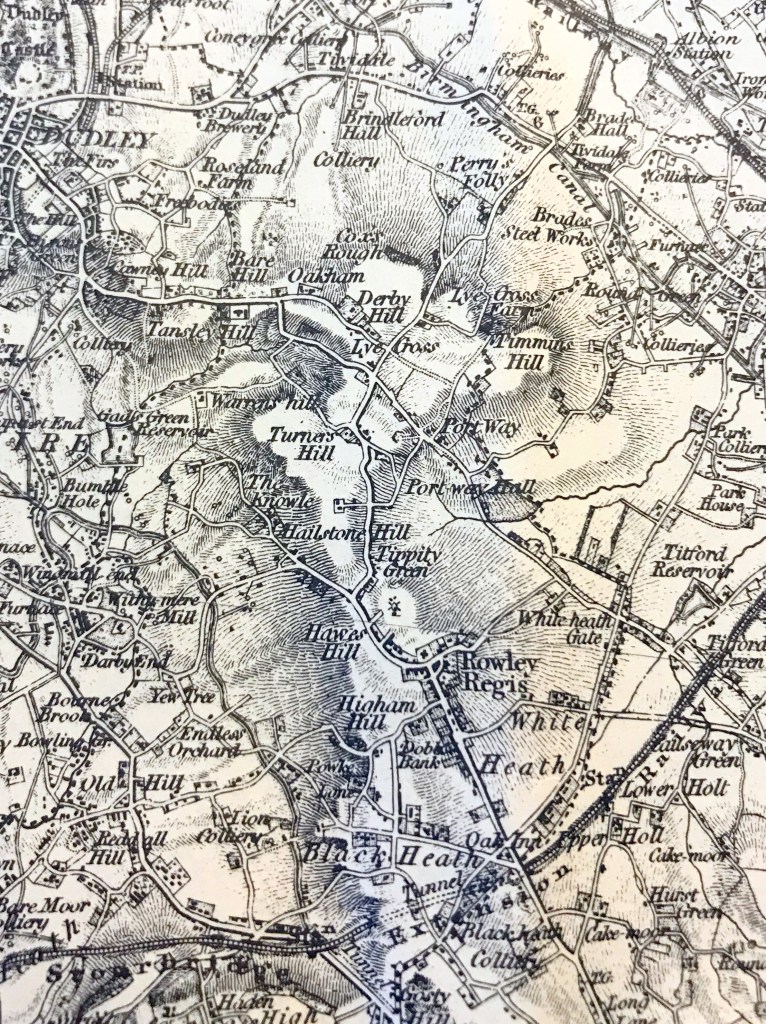
The Lost Hamlets do not appear on modern maps, so here is a plan showing where they were in relation to Rowley Village which is shown at the bottom right corner. Tipperty Green remains as a street name, and some of the buildings still remain, including the Parish church (though the first church, possibly dating to 1284, was replaced in 1840, a building which in turn had to be demolished because of subsidence. The replacement third church was built in 1904 but was destroyed by fire in 1913. The fourth church is still standing.) Most houses and other buildings in the village have gone forever.

The several quarries shown here eventually merged into one large quarry and the road up to Turner’s Hill, still in situ when I lived in the area in the 1950s and 60s, was closed and quarried away, joining up the quarries. I understand that the quarries are now being filled in with landfill so perhaps soon the green hills of Rowley Regis will reappear after so many years of desolation.

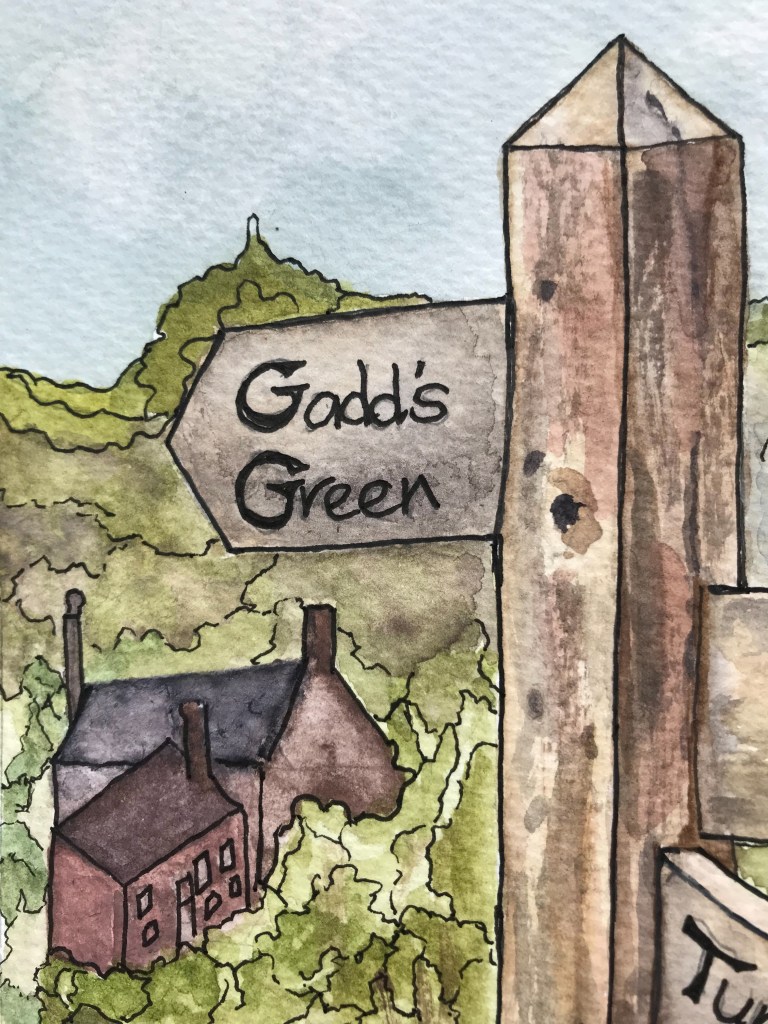
Artist’s impression!

There aren’t many images of the Lost Hamlets of Gadd’s Green, Perry’s Lake and Turner’s Hill, because they mostly disappeared before photography was available, so here is an ‘Artist’s impression’, (though I hesitate to call myself an artist). I will upload some images of the quarries and their impact on the local landscape, as I am able to get permission to use them. But, as you can see, the landscape was grimy, gritty and not particularly pretty, although some local farms survived, up on the top of the hill!

My Primary School was situated down the hill and not far from the main quarry and our school days were punctuated by the bull sounding at regular times for blasting for granite, the Dolerite known as Rowley Rag, very hard and much in demand for road making and shaped stone such as setts and kerbstones.

There were many heaps of pit spoil dotting the landscape which made carefree adventure playgrounds for local children when I was growing up in Rowley in the 1950s, although I had not appreciated then what they were, to us they were just known as ‘The Bonk’ and were derelict land. All covered in new development now.

The ‘Lost Hamlets’ of Rowley Regis

Rowley Regis was once a small ancient village on the top of a very high hill in South Staffordshire, now apparently absorbed seamlessly into the enveloping sprawl of the West Midlands conurbation. It has had several other municipal designations due to local Government re-organisations in the last century but historically, it was in South Staffordshire – that’s what it said on my school exercise books, so I know! The other, less defined, description is that Rowley Regis was in the Black Country, that nebulous area of industry, metal working, mining, quarrying and sheer hard work and where probably most of the population lived in what we would think of now as poverty. 

Although Rowley Regis is an interesting name – yes, at one time, part of it was held by the King, possibly as a hunting area – by the 19th century the village was of no particular note, the main industries in and around the village were quarrying the very hard ‘Rowley Rag’ stone from various quarries on the hill, mining and, above all, in Rowley itself, wrought iron hand nail making which was mostly carried out in small ‘shops’ at the back of houses, and involved whole families, men, women and children from about the age of six. The metal working skills of the local people and the plentiful supplies of the raw materials required meant that, as the Industrial Revolution progressed, hand nail and chain making fell into history and the metal working and myriad engineering skills gave rise to a vast landscape of heavy and polluting industry, canals, mines and brickworks.

I am a Rowley girl. I was born there, grew up and was educated there and lived there until I was eighteen. My parents and grandparents and many of their forebears were born there too and lived out their lives there. My mother told me stories about the area when I was growing up and I started my family history research in about 1980 and have been working on it ever since.

Retired after many years working in local government and now living in the West Country, during the first Covid lockdown I volunteered to transcribe parish registers at home from photographs for FreeREG, for Rowley Regis and Blackheath, the adjacent town which developed just down the road in the mid 19th Century, after the glebe lands belonging to the church were sold. This has included many non-conformist registers, which have never been available online previously.

Very quickly I noticed that many of the family names in those registers were familiar although some of them I had not come across for many years, since I moved away. But I had been at chapel and school with those names! It was also apparent from the Registers and from the various censuses that as well as the village proper, there were a number of hamlets on the edge of the village, some large and some small, and that families tended to stay within these hamlets or nearby. They appear to have been close-knit little communities. Some of my ancestors seemed to stay very firmly in and around the hamlets of Perry’s Lake, Gadds Green, Tipperty Green and Turners Hill, for example, which were very small settlements barely a mile from the village church and within half a mile of each other.  Gradually as houses were built, new roads opened, transport improved  and development spread, addresses were formalised and house numbers began to appear in the parish registers and censuses and some of the old names for the hamlets became less significant.  

There is a very active and informative Facebook page about memories of Rowley Regis and Blackheath, the town. Recently one person asked on the Facebook page where Gadds Green was, because Poppy memorials were being placed near the homes of soldiers who had died in the First World War and one of those had come from Gadds Green. She couldn’t find any trace of it.  I had not realised until then that quarrying had completely obliterated Gadds Green, and much of Perry’s Lake and the houses on Turners Hill – they only existed now on old maps. Other local names do not even appear on maps – there has been some animated discussion on the page about where a place called ‘Finger-i-the-hole’ was and most local people will never have heard of Blackberry Town, which appears in the 1841 census.

Several of the local historians using the page were able to tell the Facebook enquirer where Gadds Green had been. But it seemed a pity to me that these lost hamlets, home to so many of my ancestors, have not only physically disappeared but are now fading from local memory. Through my various researches and transcribing church registers and censuses, I have gathered quite a lot of information about these places, who lived there, who ran the shops and pubs, where people worked and worshipped and who married who.

So I have decided to create a One Place Study about these ‘lost hamlets’. My study will initially concentrate on the hamlets of Perry’s Lake, Gadd’s Green and Turner’s Hill, clustered to the North-West of the village centre, during the period 1840-1921, principally looking initially at censuses, parish registers , maps and what these can tell us about the people who lived there. The people and their lives are my main interest. I suspect that it will expand both geographically and in time period as particular information and resources come to hand. I will be posting to this site with new posts about aspects of life in the hamlets and will add maps and photographs in due course.

And by starting a One Place Study, now registered with the Society for One Place Studies, hopefully information about the people who lived in those ‘lost hamlets’ and in due course, others of the ‘lost hamlets’ can be preserved in a study where other people can also contribute their knowledge to it and where later researchers can find the answer to ‘Where was Gadd’s Green?’.