Families of the Lost Hamlets – the Hill family 3 – the older girls, Mary and Ann

MARY HILL (1801-1882)

Mary Hill was the oldest daughter of Timothy and Maria Hill. She was baptised on 12 January 1804, at St Giles on the same day as her next sister Ann. The Register entry notes that she was 2 years and 6 months old so must have been born in mid 1801. It appears that this branch of the Hills could be a little haphazard about getting their babies baptised!

The next event of note in her life was her marriage on 17 November 1823 to Henry Whittall, which took place at Tipton St Martin church. It was quite a grand building, erected in 1795-1797, so probably quite a contrast with the already dilapidated St Giles.

Henry was a Rowley Regis man, too and was baptised at St Giles on 24 March 1805, the son of James Whitehall and Phebe Downing, both good Rowley surnames. Whitehall and Whittall along with several variations seem to be interchangeable in records at this period. There were several weddings at Tipton involving the Hill family at about this time and Henry Whittall is named in many family weddings of the Hill family as a witness.

The Whittall name, I know, has persisted in the village. There was a Rita Whittall in my year at primary and secondary school so Whittalls were certainly still around in the 1960s and may well still be. This is perhaps not surprising as by my reckoning Henry had many male descendants who remained in the village and immediate area.

Henry and Mary Whittall had nine children: Frederick (1825-1915), Sarah (1825-1893), Eliza (1828-1829), Emma (1831-1896), James (1832-1879), Eliza (1835-1883), Thomas (1837-1903), Mary (1840-1853) and Fanny (1844-1913).  

The family lived in Perry’s Lake in the 1841 Census where Henry was listed as a nailer. Alas, in 1848, Henry died, of dropsy according to a note in the Burial Register, and he was buried at St Giles on 19 November 1848, aged only 48, leaving Mary to raise their children. Mary continued to live in Perry’s Lake until her own death in 1882.

Of their children:

Frederick Whittall (1824-1915)

Frederick was born in late in 1824 or very early in1825, he was baptised on 16 January 1825 at Dudley St Thomas. He married Mary Ann Whitmore in Oldbury in  1846 and they had six children Ann (1848), Henry (1850), Eliza (1853), Joseph (1857, Mary (1863 and William (1866). They lived in Gadd’s Green at first but by had moved to Blackheath by 1861, living in 1871 in the Causeway and then in in Powke Lane for the  next three censuses. Mary Ann died in 1895 and was buried at St Giles. Frederick re-married in 1897at Holy Trinity, Old Hill to widow Sarah Adams, nee Lowe. Sarah had been married three times before Frederick and had several children with each of her previous husbands, though none with Frederick – her family tree is, shall I say, very complicated… Frederick Whittall died in 1915 and was buried at St Giles on 6 April 1915, at the age of 91, his abode given as 46 Oldbury Road..

Sarah Maria Whittall

Sarah was born in 1826, or at least baptised on 26 March 1826 at Dudley St Thomas. She married John Blakeway, on 10 August 1845 when she was just 20, at Christ Church Oldbury, in 1851 they were living in Hawes Lane. They had five children, William (1848), Sarah Ann (1850), James (1857), Henry (1860) and Samuel (1861). John Blakeway was a Boiler Maker or Boiler Smith and this may have been why the family moved to Ross by 1861 and later to High Street Blackheath to be nearer his employment. Sarah died in 1894, John in 1906, both were buried at St Giles.

Eliza Whittall  

Poor little Eliza was baptised on 1 Feb 1829, at Dudley St Thomas. She died of ‘chin cough’ (whooping cough) and was buried at St Giles on 2 August 1829, aged 1.

Emma  Whittall 

Emma was baptised on 12 Sep 1830, at Dudley St Thomas. She married William Jarvis, a widower, on 28 June 1852 , also at Dudley. They had seven children: James (1853), Henry (1854), William (1856-1861), Thomas (1859), Caroline (1861), Mary (or Polly) (1863), and David (1872). The family lived with Emma’s mother in Perry’s Lake in 1861. In 1871 William Jarvis appears to have been living in a lodging house in Dudley. He does not appear again in censuses with his family and must have died between the 1881 and 1891census, as Emma was described as a widow in the latter but I have not been able to identify an exact date for his death. So it seems likely that Emma and William were separated. Emma continued to live in Perry’s Lake until her death in 1896. I have not been able to find burial details for either Emma or William.

James Whittall 1832-1879

James was baptised on 12 August 1832 at Dudley St Thomas. He married Caroline Hill, his first cousin by his mother’s brother Joseph Hill, on 15 May 1865 at Dudley St Thomas. They lived in Siviters Lane where they had two children Eliza Whittall (1870) and John Fred Whittall (1875). Caroline had also had an illegitimate child Joyce before her first marriage in 1857, and a daughter Patience in 1859 by her first husband Joseph While (1833-1861). James Whittall died in 1879, aged 47 and was buried at St Giles. He had not moved beyond Rowley Village. Caroline subsequently married John Payne in 1881when she moved to Hackett Street, Blackheath, and later Powke Lane. 

Eliza Whittall

Eliza was baptised on 29 March 1835 at Dudley St Thomas. She married Abraham Parish at Dudley St Thomas on 13 November 1853 and in 1861 they were still living in Tippity Green. They had seven children George (1855), Alice (1857), Sarah (1859), Charles Thomas (1860), Eliza (1864), Abraham (1866) and Mary Maria (1871). By 1871 the Parishes had moved to Grout Street, West Bromwich where they kept a pub and they remained there until Eliza’s death in 1883, aged 49. She was buried in West Bromwich.

Thomas Whittall (1837-1903)

Thomas was baptised on 24 January 1836 at St Giles. He married Phoebe Cole (also from Perry’s Lake) in 1861 and they had ten children: Kate or Katherine (1862), James (1863), Elizabeth (1866), Mary J (1869), John (1871), Edward (1874), Alice (1877), William (1878), George (1881) and Isaac (1884).  In 1871 they were living in Siviters Lane, until 1891 when they were at 89 Rowley Village. In 1901, their address was shown as 87 The Village, so they may have moved one door along or the houses may have been re-numbered. Or the enumerator may have made a mistake! Phoebe died in 1900 and was buried at St Giles on 10 January 1900, having just seen in the new century. She was 57.  Thomas died in 1903 and was buried at St Giles on 16 December 1903, aged 64, his address still given as 87 Rowley village. Another branch of the family who did not move beyond Rowley village.

Mary Whittall

Mary was baptised on 6 December 1840 at St Giles. In 1841 and in 1851 Censuses she was at home with her family, in 1851 at the age of 10, already listed as a nail maker, no doubt supporting her by then widowed mother. So there would have been six of them nailmaking, a crowded workshop if they were all working together at home. Mary died and was buried on 8 May 1853 at St Giles, aged 13 and Perry’s Lake, according to the Burial Register which added that hers was an ‘Accidental Death’. Curiously her death was registered in the West Bromwich Registration area, not Dudley so she did not die at home. The West Bromwich Registration area covered Oldbury so her death may not have been in West Bromwich itself. I have not been able to find any reports of an Inquest or details of this accident and am resisting the temptation to buy her death certificate!

But if anyone knows what happened to poor Mary, I would love to hear about it!

Fanny Whittall

Fanny was the youngest child of Henry Whittall and Mary Hill. She was baptised on 19 July 1846 at St Giles and would have been only two years old when her father died in 1848. In 1841 and in 1851 Censuses she was at home with her family, in 1851 when she was six, she was the only member of the family who was not listed as nail making but nor was she listed as a scholar so presumably she was not attending school.  By 1861, still living at home in Perry’s Lake, Fanny was listed as a nailer although her older brothers James and Thomas had now become miners, rather than nailers.

On the 25 Dec 1863 Fanny married Henry Thomas Hemmings (later known as Thomas) at Dudley St Thomas. Their first three children Sarah Ann Hemmings (1864), Martha Susannah (1867) and Harry (1870) were born in Rowley Regis but by 1871 the family were living in Bordesley, Birmingham and their next two children Eliza J (1872) and John T (1875) were born there. The family remained in Birmingham, in Deritend and later Aston for the rest of their lives, Fanny dying there in 1913 and Henry Thomas in 1919.

Later years of Mary Whittall, nee Hill

Mary’s age is correctly stated in the censuses in 1841, 1851, and 1861. But in 1871, when her daughter Emma and her family were living with her, Emma was shown as the Head of the household and Mary’s age as 74. So a few years had been added. In 1881, Mary was now listed as the head of the household, although Emma was still living in the house and this time Mary’s age was shown as 84. Which was at least consistent with the previous census.

It seems to me that these small changes merely reflect the fluid living arrangements which seem to have been a theme of the Hill family in the hamlets. In the following year, when Mary was buried at St Giles, the Burial Register lists her age as 88 so she had acquired yet another four years in only one year! But the truth is that in those days people did not generally keep such accurate records of their age and some may not have known their exact age. In fact Mary was 81. But she was one of the several Hill sisters who lived long lives.

So Mary and Henry Whittall gave Timothy and Maria Hill nine grandchildren, the vast majority of whom stayed very close to home, in the hamlets, in Rowley or Blackheath. And of those seven grandchildren who lived to child-bearing age, they in turn gave Timothy and Maria forty two great grandchildren, the majority again staying in the area.

ANN HILL (1804-1890)

Ann Hill was baptised (and probably born) in 1804.

Ann had an illegitimate son John in 1826 and another, Timothy in about 1830. They are the subject of a separate article.

She married David Priest on 30 November 1830 at Old Swinford. At first I had my doubts about whether this was the right Ann Hill but checking the entry on FreeREG I saw that one of the witnesses was her brother-in-law Henry Whittall, popping up again, and by 1841 David and Ann were living in Gadd’s Green, in what appears to have been an extended family group of various Hills and in-laws.

Copyright unknown, old postcard.

David Priest gives his place of birth as Rowley Regis but he is another whose age varies from one record to another. In the 1841 Census, his age was shown as 35 which means that, since adult ages were rounded down in that census to the nearest 5 years, that he could have been anything from 36-39, giving a birth year between 1802 and 1805. In the 1851 Census his age is given as 40 which points to 1811but this is very much the outrider and may have been a recording error. In 1861 his age is shown as 58 which gives a birth year of about 1803. His death registration and burial record in 1869 show his age as 65 which brings us back to 1804.

There is only one baptism for a David Priest in this period that I have been able to find and this was for a David who was baptised at the Park Lane Chapel, Cradley Heath in 1807, the son of Joseph and Elizabeth Priest of Rowley Regis, Elizabeth nee Sidaway. Entries in this nonconformist register include people from Dudley and Kingswinford so it seems that either people travelled to Cradley to worship or the Minister travelled around the area, baptising children when he visited, rather than immediately after their birth, as tended to happen in the Church of England. Another child of Joseph and Elizabeth, Abraham, was baptised in 1814 and recorded in the same register, with, again, the abode of the parents given as Rowley Regis. To add to the confusion, it appears that there was another Joseph and Elizabeth Priest couple in Rowley Regis one or perhaps two generations earlier. And, of course, they all used the same names for their children…

Ann and David Priest had five children listed in censuses: Timothy –see separate article- (1830-1873), William (1832-1907), Mary Maria (1834-1925), Elizabeth (1836-1858), and Ann (1841-1926). As described in a separate article Timothy was Ann’s son but almost certainly not David’s.

David Priest died in 1869 and was buried at St Giles on 28 July 1869, aged 65 and of Gadd’s Green. Ann lived in Gadd’s Green her whole life, until her death in 1890. She was buried on 16 February 1890, the burial register entry says that she was 88 and her abode Gadd’s Green.

Of their children:

William Priest (1832-1907)

William married Mary Bowater (1831-) on 28 November 1864 at Dudley St Thomas, and then moved to Dog Lane (later known as Doulton Road) where they lived with his in-laws. Mary had already had an illegitimate son William in 1855 and a daughter Elizabeth in 1860, father or fathers unknown. William remained living in this road until his death in May 1907, when he was buried at St Giles, aged 75. He and Mary had four children – Sarah Jane (1865), John (1867), Ellen (1869) and Sarah (1872).  

Mary Maria Priest (1834-1925)

Mary who is also been mentioned in the article about John and Timothy Hill, married Reuben Ingram, on 18 December 1853, a marriage witnessed by her half-brother Timothy Hill and Hannah, whose marriage Mary and Reuben had witnessed in the same church just three months earlier. Reuben and Mary had eight children: Elizabeth (1859), Jane (1860), John (1861), Mary (1864), Robert (1867), Reuben (1868), Hannah (1873) and Ann (1875).

In 1861 Reuben and Mary were living with their children Elizabeth and John, with Mary’s parents David and Ann Priest in Gadd’s Green. They were still in Gadd’s Green in 1871, though no longer with Mary’s parents. In 1881 they were in Perry’s Lake, as they were in 1891 and 1901. In 1911 their address is shown as 15 Tippity Green but as the previous address shows in census returns as the first house in Perry’s Lake, it may well have been the same house! That was also the address shown in the Burial Register when Reuben was buried on 30 May 1919, aged 86. Mary Maria outlived Reuben by a few years and was buried at St Giles on 20 November 1925, ‘aged 92, of Tippity Green’ (the Burial Register actually has Perry’s Lake added in brackets so their house was apparently right on the border, I suspect that there was no gap between the two settlements!).

Elizabeth Priest (1836-1858)

Elizabeth was one of the few Hill girls not to live to a great age. She died of Typhus Fever in March 1858, of Gadd’s Green, aged 22 and was buried at St Giles on 7th March.

Ann Priest (1841-1926)

Ann had a daughter Sarah Ann who was baptised on 24th August 1862 and another daughter Phoebe who was baptised on 16th November 1865, at St Giles with their abode given as Gadd’s Green.  Both daughters appear in the 1871 Census, living with Ann and her mother at Gadd’s Green. Also in the house as a lodger is Joseph Leech, a farm labourerwhose place of birth was shown as Cheltenham in Gloucestershire. Ann married Joseph Leech on 15th February 1874 at Dudley St Thomas.

Ann’s illegitimate daughter Sarah Ann Priest married Joseph Westwood Smith in 1885 (witnesses Reuben Ingram and Phoebe Priest, just in case I was wondering whether this was the right Sarah Ann!) and they had five children, living in Perry’s Lake and Tippity Green thereafter, within the Hill stronghold.

Her other illegitimate daughter Phoebe Priest  married Edward Hopewell or or Oakwell or Brooks in 1890 at Reddal Hill. They had four daughters. They lived in Gadds Green, (with Phoebe’s mother Ann and her husband Joseph Leech) and Tippity Green until Phoebe’s death, at the age of 50 in 1916. They lived in Ross and Shepherds Fold. Readers of previous posts may remember that I did a piece on the Hopewells/Oakwells in the early days of this blog. At that time, I did not think that I had any connection with this family – but I was wrong.

After her  marriage, Ann and Joseph Leech had two sons Joseph Richard in 1875 and David in 1878. Sadly they both died and were buried at St Giles on the same day 10th February 1878, aged 3 and 1.

Without buying the death certificates it is not possible to know why these infants died at the same time although there are various possibilities, including childhood illnesses such as measles, diphtheria and whooping cough which frequently proved fatal in those days.

Ann and Joseph Leech’s daughter Ellen was born shortly afterwards in the July/Aug/Sept quarter of 1878. Fortunately she survived infancy but I see that on the 1911 Census there is a note that she had a ‘crippled leg’ which she had had all her life.  Perhaps this was why Ellen never married and she died quite young at the age of 35 and was buried at St Giles on the 13th December 1913, when her abode was given as Tippity Green.

The grandchildren and great-grandchildren tally again

So Ann and David Priest gave Timothy and Maria Hill five grandchildren, the vast majority of whom stayed very close to home, in the hamlets, in Rowley or Blackheath. And of those five grandchildren who lived to child-bearing age, they in turn gave Timothy and Maria twenty-eight great grandchildren, the majority again staying in the area. Making seventy great-grandchildren from these two sisters and more to come! I wonder how they were able to keep track…

The Hill family in the Lost Hamlets – so far!

I think these figures show why tracing and documenting even this one branch of the Hill family is such an undertaking and how very close to the area of the Lost Hamlets most of them stayed – the grandchildren may not have borne the name of Hill if they were descended from the girls but it becomes ever clearer to me as I research that apparently unconnected neighbours and family groups were quite often siblings and cousins, once the web is untangled. Essentially it appears that a majority of the residents of Gadd’s Green in the mid and late 1800s were related in some way to the Hill family! And other descendants clustered in Siviters Lane and Ross in later years, again living next door to cousins or siblings.

I have still to post on Timothy and Maria Hill’s other children Elizabeth, Jane, Joseph and Samuel Hill, all of whom also had children. But these two sisters have provided enough material for one article so the story will be continued in the next instalment, on Ann’s illegitimate sons John and Timothy!

War Time Memories and VE Day celebrations

In the late 1970s, I persuaded my mum to write down her memories of her life. I was so glad she did this as within a few years she developed dementia and lost all of this. These are my mum’s vivid memories of life in Blackheath, during the war and on the celebrations locally when the war ended.

Strictly, this is a little self-indulgent because it is not limited to the lost hamlets area but she mentions the gun emplacement and army camp on Turner’s Hill so I’m sneaking it in. And I think it gives a very personal and vivid account of what life was like then.

The picture of Mum is the one my father carried with him throughout his service as a Sapper (Royal Engineers), slightly dog eared but treasured.

War Time and VE Day Memories by Hilda Hopkins

During the war, each Friday night, I, together with Stella Hancock, Mabel Hooper and Mrs Southall, slept at the local clinic ‘on duty’ in case of air-raids. We were supplied with biscuits and a drink for supper-time and slept on camp beds with blankets. We had our personal Gas Masks which everyone carried around in those days, disguised in boxes with shoulder straps.

We laid out First Aid Equipment in case of air raids, there were de-contamination showers in case of gas attacks. There were air raids most nights and some in daytime. There were casualties and local people were killed, quite a few, but in our clinic area there was nothing like that.

At this time, men at home worked all day and some of them then ‘fire-watched’ or were Air Raid Wardens, all night, as we did, as part of a great rota. Often a policeman or Air Raid Warden would pop in to see if all was well and to see also if our blackout was secure. A cup of tea was always appreciated.  We were each paid 10/- (Ten shillings, 50p in today’s money) for a night’s ‘duty’.

Turner’s Hill, the highest hill for miles around, was a gun battery, and a military camp. The guns from here could be heard for miles. There was a wonderful camaraderie during these times.

There were air raids and very often people had built air raids in their gardens. One evening, I was in the Rex Cinema when the screen notice said there was an air raid, in case anyone wished to leave. Some did but most people stayed. It appeared that incendiary bombs had been dropped, some on the cinema, and quite a few local people were killed, some at Rowley, near to the Grammar School, and one lady in Green Lane.

Copyright: Glenys Sykes, not to be used without my specific permission.

1945

It must have been very late in the evening that the Radio News reported that the War was over – because we were all in bed at home and John’s sister Alice came along to Birmingham Road  and ‘knocked us up’ (a real Black Country expression – used to get workmen up in the early hours). Off I went with Alice to join a procession of ‘Blackheathans’, some with torches and all singing and calling out to each other with joy! We marched to Regis Road and walked up waking people up all the way with happy singing as we went along, the younger folk among us very quickly. It was so sudden – I just couldn’t believe it that the war was really over! The throng was led on and on, walking at will through blacked out streets, using our ‘Ever Ready’ torches as we sang our way and the atmosphere was so full of joy and for some sleepyheads like me a real awakening in every way. We circled the town and woke people up who were still in bed. Everyone was so excited. The joy was intense – we sang, we shouted and walked and walked – it seems like a dream now.

On the Radio news next morning all was happily confirmed and we weren’t alone in our carousing – it happened everywhere, I believe. The day folk had longed for for dreary hard worrying years had come.

VE (Victory in Europe) Day was formally announced on radio and in newspapers to be joyfully celebrated at a later date with great happy crowds, all over our land. Joyce Goreham, Ruth Gallagher and I went off by bus to Birmingham and met there – I never knew quite how because in the city thousands of people, young, old – all wildly  happy – were dancing and singing. I am sure Queen Victoria’s statue smiled at this sight – Victoria Square will never look like this again. We did manage to meet Josie, Kathy’s sister who had previously booked theatre tickets for us. All we had to do was fight our way there through crowded and thronging streets. Through the human mass, singing or just being literally carried along by the excited crowds. Bells rang, crowds shouted and sang for sheer joy. Kathy and Josie had a brother who would now be coming home soon – each one in that massive crowd had someone to come home, sooner or later. This night in a blaze of light in Victoria Square (we hadn’t seen lights like this for years!) was a mighty outpouring of joy and thankfulness after so many years of wondering and waiting – now we knew loved ones would, in time, be coming home.

There was dancing and singing in the city streets, streams of happy people in a great surge of unbridled joy. People climbed lamp-posts to shout and sing, strangers joined hands and danced around in small groups – a very emotional and exciting time I will ever remember.

And the war was over, a new era ahead, a time of homecoming and home making. A new beginning for each person and every nation and Peace in our time, always.

Families of the Lost Hamlets – the Hill family 2 – Benjamin Hill

Timothy and Maria Hill had several children and for many years I have thought that Benjamin was the first of them. Now I am not so sure this is quite correct!

I have not been able to find a baptism for Benjamin Hill. The baptism of his sister Mary Hill took place on 12 January 1804 at St Giles, Rowley Regis when she and her younger sister Ann were baptised. Mary was noted in the entry in the baptisms register to be ‘2years six months old’ which means that she must have been born in the middle of 1801, which would have been almost exactly nine months after Timothy Hill married Maria Hipkiss. Which, in turn, was only three months or so after the death of Ann Priest. So Benjamin must have been born at least nine months before that – in 1800 or before.

At the time of his death in 1844, Benjamin’s age was given as 44 which again takes us back to 1800.  I noted in my first piece on the Hill family that it appeared that Timothy and Ann had no children. But supposing that after all those years without children, Ann – at the age of thirty-five – actually gave birth to a son in 1800, and died in or after childbirth? This was before Civil Registration began in 1837 so sadly I have no way of checking. Could this – with the trauma of her death and the need for Timothy to care for this newly born son- account for why Benjamin was apparently not baptised? And why Timothy re-married so quickly – to provide his son with a mother?  And was it possible that one reason that Benjamin lived a distance from the rest of the Hill family was that he was not Maria’s son and not particularly welcome? Pure speculation but possible.

The first documentary evidence of Benjamin’s existence is in 1821 when he married Ann Williams in Halesowen. One of the witnesses to this marriage was a Timothy Hill, the other was a George G Fiddian. (There are numerous instances of Fiddians acting as witnesses to marriages in Halesowen around this time so he was not likely to be a family member. The presence of Timothy Hill at this marriage is my strongest indication that I have Benjamin in the correct family. But I may be completely wrong, in which case all that follows is completely irrelevant to the Hill family of Gadds Green. But may be of general interest anyway.

In the 1841 Census Benjamin’s occupation is shown as a ‘cole miner’ and his age given as forty. He is living with Ann and their children Joseph, then 18, Timothy, then 15, Mary, then 12 and Benjamin, aged 8. All of these are regular Hill Christian names. Their address was New Street which was in Old Hill. So there were two odd things here. The first is that usually this branch of the Hills stuck pretty close to Turners Hill area, as will be shown by later pieces on Timothy and Maria’s other children. The second unusual thing is that Benjamin was a coal miner whereas most of the Hill family were nailers.

However, I found a newspaper report which may be relevant, (although there were two other Benjamin Hills in the area in 1841, only one other was described as a nailer), so it is possible that this case does not concern this Benjamin Hill at all.

The article appeared in the Worcestershire Chronicle, dated 24 January 1839. This stated, under the Police Reports,

Richard Mountford charged Benjamin Hill, nailer, with embezzling iron he had taken out to work into nails. Hill stated, in his defence, that the plaintiff had induced him to leave another master to work for him, and had shortly afterwards given up business, when he was compelled to dispose of his stock to support his family, and afterwards to go to the workhouse; he was ordered to work in the stock 19 quarters in 19 weeks.”

This report throws up various issues.

Who was Richard Mountford?

Richard Mountford was listed in a report in Aris’s Birmingham Gazette in 1845 as a supporter of the proposed Birmingham, Wolverhampton and Stour Valley Railway, described a Stourbridge businessman merchant, and was living in Coalbournbrook, Ambleside in the 1841 Census, his occupation given as a nail factor which matches the occupation referred to in the court case. But it does imply that he had not given up his nail business as Benjamin Hill had claimed.

There are a few Mountfords in Rowley Regis itself in censuses, though generally not apparently of high status. There was at one time a Mountford House in Siviter’s Lane, for many years the Doctor’s residence and surgery, now the site of a new housing development. Perhaps the Mountfords built the original house?

However, nail factors would have bought nails from all over the area although presumably most workers were accustomed to dealing with particular individuals, (very possibly in family traditions) which would be why Benjamin Hill referred to being induced to leave his previous nail master.

I wonder whether, if this was our Benjamin Hill, Benjamin’s former master refused to deal with him again or whether his family had fallen out with him off as a result of this case. It may be that he simply could not find work as a nailer after this which may be why he became a miner, moving to Old Hill which was nearer the pit at Five Ways, Cradley Heath where he was working. However, when Benjamin’s oldest son Joseph was married at St Giles in April 1845, Joseph gave his father’s occupation as a nailer, so Benjamin, despite his death in a mine, had been a nailer at the time of the court case in 1839, so for most of Joseph’s life and Joseph obviously still thought of him as a nailer. But it is also possible that Benjamin worked as a miner in the daytime and still as a nailer when he got home, this was not uncommon as a way to increase income.

However the move to Old Hill came about, Benjamin stayed in Old Hill after this for the rest of his life and his children also stayed there. Other than Benjamin’s burial at St Giles, which was, in any case, still the parish church for Old Hill at this time, there is no evidence of any later contact between Benjamin and the Hill family in Gadd’s Green.

Richard Mountford might have had a liking for litigation against his workers. I found another report that in 1841 he had indicted a Richard Sutton for feloniously damaging a steam engine’ but this case was dismissed by the Magistrate and a verdict of Not Guilty was recorded.

The Dudley Wood Colliery Disaster

On the 19 October 1844, at the Dudley Wood Colliery, Benjamin Hill, aged 44, was amongst eleven miners killed in an explosion at the mine.

This colliery was situated between Netherton and Darby End, as shown on this map.

Reproduced with the permission of the National Library of Scotland

This map dates from somewhar later than this incident and the mine is marked No.2, so may not be the exact mine, which may perhaps have been on the waste land opposite.

This photograph shows a picture of buildings on Dudley Wood Road, taken in about 1905-7, and showing the buildings affected by subsidence due to coal mining, some of the houses leaning backwards, the whole area must have been terribly undermined.

Copyright Staffordshire PastTrack, Albert Henry Yelland.

A report in the Birmingham Evening Mail on 28th October gives details of the inquest, held at the Five Ways, Cradley Heath, on seven of the miners including Benjamin, the other miners must have lived elsewhere and some were the subject of a separate inquest held at Lye Waste. Other miners killed, according to newspaper reports, were William Brookes(aged 25), Thomas Botfield (aged 30), William Weaver (aged 10), and Joseph Bennett (22), John Evans (27), James Roberts(19) and William Parkes (unable to find any death registration for this name). There had been seventeen miners working in the pit that morning, the other six survived with burns and all but one were thought likely to recover. Both Richard Scriven, aged 64, the mine ‘butty’ and his son Thomas, aged 21 were also killed in the explosion.

The injured men were Thomas Evans (badly injured and not expected to survive), Benjamin Gray, Thomas and Joseph Wright (brothers), Thomas Pearson and Emanuel Hill. Some of the names appear to be incorrect in some reports but I have checked them against death registrations and entered the correct ones here, in case any readers might have family who were affected by this tragedy.

It could indeed have been worse. Also working below ground, some 16 yards below the explosion were several men employed in getting ironstone (this part of the Black Country was known for having all the materials required for iron working – ironstone, coal and clay – in layers, one above the other). When they heard the explosion above, these men instantly got into an empty skip (or basket) which happened to be at the bottom, and ‘were drawn up to light and life; had they remained a short time longer, death would have ensued from the foul air descending to the mine in which they were at work’. It was clearly a powerful explosion. The report adds ‘One skip, which was descending a shaft at the time the explosion occurred, on which was a bottle of beer, was blown into the air an immense height; the bottle was afterwards found more than 200 yards from the pit’s mouth.’

The report notes that the Inquest was conducted by Mr Hinchliffe, one of the Staffordshire Coroners and noted that there was a ‘highly respectable jury’. The pit was referred to as ‘Mess’rs Pargeter and Darby’s coal-pit’. Various witnesses gave evidence, Lemuel Miles (or possibly Emanuel), of Rowley, (a miner who had been working in the pit at the time and who had reportedly checked the pit for gas with Thomas Scriven that morning), and also including the local constable Samuel Garratt, Thomas Frederick the Mine Agent who had inspected the pit for gas that morning, and George Naylor and Thomas Weaver who had assisted with the rescue and recovery of bodies. The agent gave evidence that the proprietors of the pit had spared no expense to have it properly worked and managed, so as to insure the safety of the work people and to prevent accidents.

I was interested to note, from one of the newspaper reports, that the butty Richard Scriven was in the pit at the time of the explosion because the proprietor Mr Darby had requested him to go down to fetch up some lumps of coal, presumably to examine the quality. The explosion occurred immediately Richard Scriven reached the bottom of the shaft. So Joseph Darby, the owner of the pit, was on the premises at the time and, according to one report, immediately called in medical assistance for survivors as they were brought to the surface but he does not appear to have been called as a witness to either of the inquests I have found reports of, which seems a strange omission to me.

The verdict returned at Cradley Heath was “That the unfortunate men were suffocated, scorched and burnt by the accidental explosion of a quantity of sulphuric air or gas in Mess’rs Pargeter and Darby’s coal-pit.” Benjamin’s death certificate stated, under cause of death, ‘Accident: By an explosion of Sulphuric Air or Gas in a Coal Pit: Instant.” The death was registered by the Coroner.

A report in the Worcester Herald on the Lye Inquest noted that the coal-pit ‘belonging to Mr Joseph Darby’ produced thick coal of very excellent quality and the mine has long borne the character of being among the most dangerous in this part of the country’.

The report in the ‘John Bull’ paper has an interesting note I did not see in other reports. It relates “An interesting circumstance, in connexion with this lamentable tragedy is worthy of record. Emanuel [Lemmuel] Miles, a miner employed in the pit, and not given to prayer, was noted on the morning of the accident, before going down, earnestly imploring the Divine protection from accident during the day: his prayers were granted, and though in the pit when so many of his fellows were summoned to their final account, his life was spared, to become, we trust, a wiser and better man.”

Although I can find no further reports of the outcomes of inquests, one newspaper ends their report by stating “The explosion, there can be no doubt, was caused by negligence on the part of someone, in all probability by one of the unfortunate sufferers.” I note from the reports that the explosion happened just as Richard Scriven reached the bottom of the shaft and that he was particularly badly injured, so I wonder whether, since he was only going down to collect a few lumps of coal, he took down a candle, rather than a safety lamp and ignited gas at the bottom of the shaft. There was also mention in one report of an older adjoining mine which had been blocked off with rock and soil but it was thought that this was too well sealed to allow gas to seep through. But presumably gas could leak into the mine passages from fissures in the coal at any time and gather wherever air currents – such as those caused around the shafts by rising or descending baskets – took them.

Benjamin Hill was buried at St Giles, Rowley Regis on 22 October 1844, his abode given as Lawrence’s Lane. He left his wife Ann and four children.

In the 1851 Census Ann, shown as she sometimes was as Hannah, was in Cherry Orchard, Old Hill, still in the same area as she had lived with Benjamin, along with her youngest child Benjamin and her daughter Mary (Ann) who was married to John Pritchard in 1847, and Mary’s two children Ann and Thomas. Plus two lodgers, so a fairly full house!

I have been unable to find any trace of Ann Hill after 1851, either in censuses or in death or burial records, nor in marriages (as she might have re-married). She does not appear to have been with any of her children in later censuses.

Benjamin and Ann’s children all stayed firmly in Cherry Orchard area of Old Hill for decades, with or near their siblings.

Joseph Hill (1823-1903) married Sarah Tibbetts (1828-1902) at St Giles, Rowley Regis in April 1845. They lived for at least twenty years in Cherry Orchard before moving towards Netherton and appear not to have had any children but to have raised Louisa Dalloway, Eliza’s niece, as she is in their household in 1861 and 1871. They were both buried at St Andrew’s church, Netherton.

Timothy Hill (1824-1908) married Eliza Worton (1824-1865) on 14 February 1842 at Old Swinford. They had nine children – Phebe (1844), Emmeline (1845-1847), Sarah Ann (1848-1848), Eliza (1850), Louisa (1851), Timothy (1854), Thomas (1858-1859), Joseph (1860-1862), Anne (or sometimes Hannah, like her grandmother!) (1862). Eliza died in 1865, aged  42 (and worn out, I should think, having nine children!) and was buried on 11 June at St Luke’s, Reddall Hill. On 14 August 1865, just two months later Timothy married Sarah Marsh (nee Pearson), a widow, of Halesowen Road, Reddall Hill and they had two more sons, James (1866) and Isaac (1869). With Sarah’s children Leah (1855) and Edward Marsh (1859) the house must have been pretty crowded. Sarah died in November 1899, aged 71 and was buried at St Luke’s. Timothy died in 1908, aged 78 and was also buried at St Luke’s.

Mary Ann Hill married John Pritchard (who was born in Netherton) on 30 August 1847 at Dudley St Thomas, and they also lived in Cherry Orchard until at least 1891, next door to her parents at first and two doors away from Mary Ann’s brother Benjamin and his family. They had five children: Ann Maria (1848), Thomas (1850-1851), John (1852), Mary Ann (1865) and James (1868).

Despite a lot of searching, I cannot at present find definite Death details for either Mary Ann nor John Pritchard. And neither can any of the numerous other people who have them in their trees on Ancestry. They both appear in the 1901 Census, still together in their home of many years in Cherry Orchard, then aged 74 and 73, respectively. And I cannot find either of them in the 1911 Census. There is a likely looking death and burial at Netherton for a John Pritchard of about the correct age in 1900 but since our John appears in the 1901 Census, this cannot be he. The only other likely death appears to be in 1910 in the Stourbridge Registration District but since that covers parts of Blackheath, where at least one of their children was living, this may be him. I would have to buy death certificates to be sure. That applies also to a possible death for a Mary Ann Pritchard of the correct age who died in the Dudley Registration District in 1913 but I have not found burials for either of these deaths so this remains a mystery at present.

The last child of Benjamin and Ann, another Benjamin, married Mary Steadman at Dudley St Thomas on 16 March 1856, the marriage was witnessed by John and Mary Pritchard, Benjamin’s sister and brother-in-law. In 1861, they were in Garratts Lane but by 1871 they were back with the rest of the family in Cherry Orchard where they stayed for the rest of their lives. They had eight children: Thomas (1857), John (1859), Emiline (usually known as Emily) (1861), Mary Jane (1865), Benjamin (1867), Ellen (1870), Joseph (1872) and Harriet (1875). Benjamin died in August 1913 and Mary in December 1916, both were buried at St Luke’s Church.

All of the four children of Benjamin Hill lived for years in Cherry Orchard, three of them for their whole lives. Cherry Orchard which appears to have been off Wrights Lane, so within sight of Rowley village, was not exactly the rural idyll the name might seem to indicate but was obviously ‘home’ to this branch of the Hill family.

So this is the tale of Benjamin Hill, who I believe to be connected with Timothy Hill of Gadd’s Green and Benjamin’s descendants in Old Hill. A little outside the Lost Hamlets area but within a couple of miles. More pieces will follow on Benjamin’s other siblings shortly.

Families of the Lost Hamlets – the Hill family 1 or ‘The Hills are alive…’

The Hill family were in Rowley Regis for several centuries, (and still are) and can also be found in the surrounding parishes, from Dudley, Halesowen, Cradley, Warley, Halesowen, Tipton, Sedgley and some even further afield in Wolverhampton.

Hill is not an easy name to research in the Parish Registers. The early Registers, with their lack of place names are not too difficult – if you search the first section of the St Giles digital register for Hill, you have to skip over all the Phillips and Phillises, and most of the entries then are for members of the Hill family. But once places of residence start to be regularly recorded there are hundreds of them – Turners Hill, Gosty Hill, Reddall Hill, Old Hill, Darby’s Hill, Kates Hill, Hyams Hill – very frustrating to plough through the later records only to find that the entries contain an abode or place name, rather than a family name which includes Hill!

The Hailstone (Copyright Glenys Sykes) was close to where the Hill family lived and would have been a familiar sight to them, until it was taken down.

The first entry relating to the Hill family in the Rowley Parish Registers was in the  preface written by Henrietta Auden, who was a Fellow of the Royal Historical Society, and who apparently transcribed many other parish registers as well as Rowley Regis. Her father was the Rev. Prebendary Auden. Miss Auden notes that in 1604, in the first parish register, John Hill is noted as ‘owner’. This makes me wonder whether, at the time when surnames began to be formalised, this John had owned land on and lived on Turner’s Hill, as many later generations of Hills did, and he became known simply as John of the Hill, then John de Hill, and then John Hill? As I set out in my piece on Hall houses[1], I think it is likely that the Hill family was wealthy enough at one time to build a Hall house in what later became known as Gadd’s Green and certainly some branches of the Hill family locally were well-to-do even centuries later, as I have discovered from various Hill Wills in the 1700s and 1800s. But that is possibly simplistic thinking on my part.

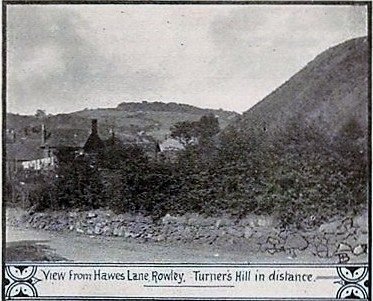
An early postcard image of Turner’s Hill, copyright unknown.

Other early Hill entries in the Parish Registers

Elizabeth, daughter of Thomas Hill was baptised in September 1604 and the John Hill mentioned above was buried in the following March. In 1607 Lucy, daughter of Christopher Hill was baptised at Rowley and in 1612 Elizabeth, daughter of Francis Hill so it appears that there were in the early 1600s  several Hill families – fathers Thomas, Christopher, Silvester, Francis, Richard and William – living in the parish and of an age to be baptising children, perhaps brothers or cousins. And a John Hill of Warley had married Anne, daughter of William Darby which was another family of some standing in the area. 

The Hills had some common but regularly used names such as Thomas, Richard, Joseph and William but it also used several more distinctive names – Silvester, Jerome, Timothy (especially Timothy!), Francis, Daniel   – and Elizabeth, Ann and Rebeckah also recur amongst the women which can be useful in spotting likely connections between branches of the families.

There was an entry for the marriage of Thomas Hill and Ann Cooper at St Giles on  26 June 1687 but there is no indication where either of them came from, nor does there appear to be a baptism for either of them nor a baptism for An, daughter of Pheles (Phyllis is the modern name) who was buried on 29 February 1687/88. After that there are baptisms for John and Ann Hill, a burial for Selvester and for Thomas Hill in 1689, a burial for Elizabeth Hill, widow in 1691, baptisms for William and Hannah Hill and a burial of a Rebeckah Hill, widow in 1694. In 1695 a burial of a son John for Thomas Hill describes Thomas as from Upperside. In 1696.a child Hannah, daughter of John Hill, has a note saying ‘by non-conf.’ so perhaps the family were early dissenters or non-conformists although there  are no consistent indications of this. But certainly there appear to have been several branches of the Hill family in the parish at this time. The Registers at this date do have gaps and missing pages and the entries were by no means detailed so it is not possible to know whether this was one family who had moved into the parish from elsewhere or whether they had been in the parish for some years and earlier records baptisms are lost.

In 1717 an Ambrose Hill of Dudley married Esther Dudley at St Giles, Rowley Regis. In 1723 a Job Hill married Jane Dudley at St Giles so that was two Hill grooms marrying brides named Dudley in six years, so they may well have been related to each other. And my research indicates that there are many later connections between Hill families in Dudley and Rowley Regis.

It is not feasible in this article to describe all the people named Hill in the hamlets and villages over the centuries, there are simply too many of them and some very complicated family trees. There are 123 entries for Hills in the first section of the digital parish register alone, and another 35 in the next section, before place names start to appear which adds to the number. So between the first Hill entry in1604 and 1721 (when place names start to confuse the issue) there are 158 entries in the St Giles Registers for people named Hill.

So I will concentrate on some of those Hills who were in the Lost Hamlets in the 1841 Census, and their families which I will expand in a later article.

Timothy (1763-1831) and Maria Hill nee Hipkiss (1782-1855)

Timothy, that favourite Hill name, was my 4xgreat grandfather. He had been baptised at Dudley St Thomas in 1763 and Maria Hipkiss was a Rowley girl, baptised in 1782. Maria was Timothy’s second wife but he appeared, at first sight to have had no children with Ann Priest, his first wife. Ann was also a Rowley girl and her marriage took place in St Giles, and she appears to have been buried at Dudley in May 1800. I have a little more to say on this in my next piece. Timothy made up for it with Maria, who he married at Halesowen in September 1800 and he had at least seven children, four daughters and three sons with Maria.

Timothy is a particularly commonly used Hill Christian name and can make it difficult to decide which branch of the Hills particular Timothys belonged to.

This Timothy died in 1831 so was not listed in the censuses but Maria appears in the first two – 1841 and 1851, both times living with one of her children, the first time (1841) with her youngest son Samuel when they were living in Blackberry town which appears to have been in Springfield below the Hailstone quarry, and in 1851 she was living in Perry’s Lake with her widowed daughter Mary.

Maria’s family, the Hipkisses, like the Hills, are another of the ‘core families’ of the hamlets who appear in all the censuses there between 1841 and 1881 and later, and although I have not yet transcribed the later censuses I strongly suspect that I will find them in the later censuses, too. Another of those families who lived in these small hamlets for at least three hundred years and possibly much longer, with numerous intermarriages contributing to the complex web of relationships between the core families.

Timothy Hill (1763-1831) was baptised in Dudley, the son of Joseph Hill (1720-?) and Jane Bridgwater, the grandson of Samuel Hill (1684-?) and Martha Wright, and great-grandson of Samuel Hill (1660-?) and Issabill ?(Dates unknown) These earlier Hills had connections in Dudley and possibly, before that, in Oldswinford. But that is a tentative theory at present and there are numerous Hill families in the area so it is possible that is a different family. At some point, when time permits, I will research whether these people appeared in later registers in Oldswinford as that may rule them out. But there are so many Hills in the Dudley and Sedgley area, this might not be possible. But Timothy married two Rowley girls.

Maria was the daughter of John Hipkiss (1744-1818) and Mary Worton (1742-1832). Maria was baptised on 15 September 1782 at St Giles Rowley Regis and her forebears also go back in Rowley Regis for several generations and earlier in Dudley,too.

So this pattern is emerging of close kin living together in Gadds Green and Perrys Lake whose descendants continued to live there or very close by for several generations afterwards.

I have also noticed in the course of my research that often people from the Turner’s Hill/Oakham area used Dudley church, rather than St Giles and it may well be that many of these residents regarded the area on and below Turner’s Hill as separate communities, rather than a hamlet of Rowley Regis, even though most of this area was in Rowley parish.

I shall continue this theme on the Hill family with more posts to follow on the children of Timothy and Maria Hill.

The children of Timothy (1763-1831) and Maria Hill nee Hipkiss (1782-1855) – details of these will be the subject of my next articles.


[1] https://rowleyregislosthamlets.uk/2024/12/01/a-hall-house-at-gadds-green/

Pubs of the Lost Hamlets – The Wheatsheaf, Turners Hill

When, back in February 2023, I posted for the first time on the ‘I Remember Blackheath & Rowley Regis’ Facebook page about my then new One Place Study about the Lost Hamlets, I had some very encouraging responses, one of which was from Ronald Terence Woodhouse who told me that his family had been the original licensees of the Wheatsheaf and that his grandmother had lived in the first cottage going up Turner’s Hill, so right in the centre of the study area. And ever since, I have been meaning to do a piece on the Wheatsheaf. So here it is, at last.

Copyright: Mike Fenton. This shows the pub in about 1928 and the Water Tower on Turners Hill can be seen in the distance. This building was demolished soon after this and a replacement built.

The address shown in Hitchmough’s Guide [i] for the Wheatsheaf is 1, Turner’s Hill, or Darby’s Hill, Lye Cross, Four Lane’s End, Oakham, Rowley Regis. So quite which if those it is, I would not know. Probably all at one time or another. Perhaps part of the reason for this varying address is that these are all descriptions given in the different censuses, Lye Cross from 1841-1861, when the pub was managed by Benjamin Woodhouse from about 1834-1861, then by Joseph Cox from 1861-1892. Joseph Parkes was the Licensee from 1996-1904, Walter Woodall from 1911-1912, then it was managed by Howard Woodhouse in 1916 and then Thomas Woodhouse in 1919-1920. It is quite possible that the other licensees were related to the Woodhouses and Hitchmough does not have a complete list in terms of dates, but I have not looked at those families in detail at this stage.

In the 1871 Census, the pub’s address is shown as Turner’s Hill and in 1881 it is 35 Oakham, in 1901 it was 1, Turner’s Hill – Tavern – as in 1901. So this area seems to have been called various things. As late as 2022 the site was still described as 1 Turners Hill. But certainly there was a pub or tavern there at a very early date which continued until quite recently, only the Bull outlasting it.

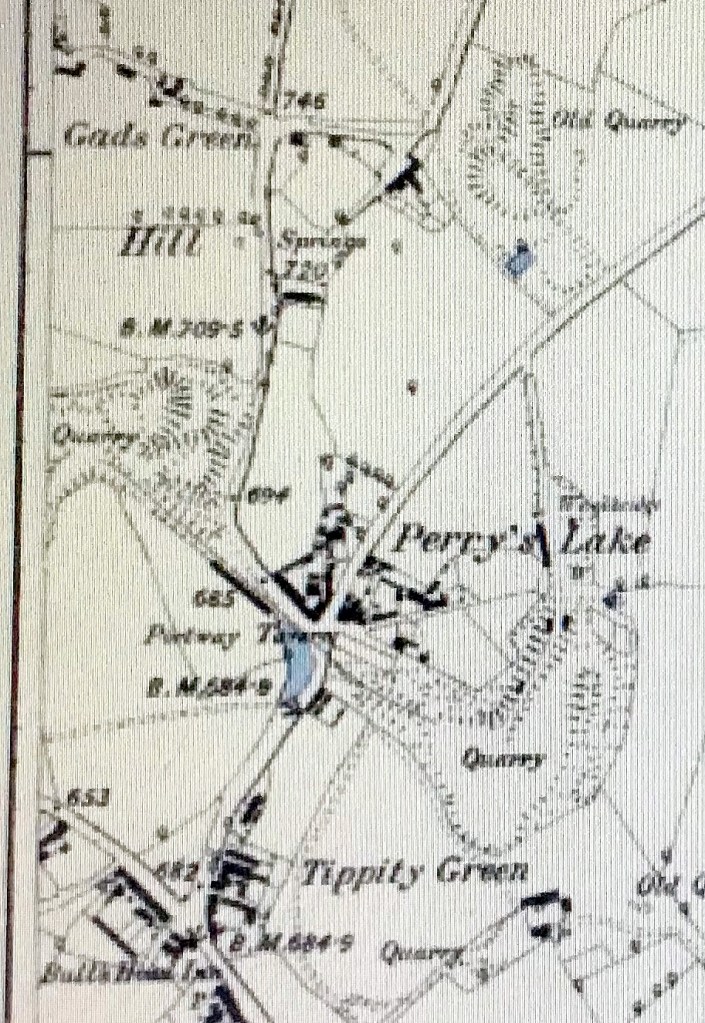
The Wheatsheaf was situated at the junction of Portway Hill and the road which ran from Perry’s Lake up over Turner’s Hill. This area is not strictly part of the Lost Hamlets since it is not physically lost as the other hamlets have been, the area is still there although the pub has now closed. But there was a strong family spread across this area and the Turner’s Hill/Gadd’s Green/Perry’s Lake area with a lot of connections. Families from this area also often used the Dudley churches, rather than Rowley.

Benjamin Woodhouse Licensee 1834-1855)

In August 1826 and 27, August 1829 and again in August 1830 notices appeared in Aris’s Birmingham Gazette warning ‘Gentlemen’ against ‘sporting or trespassing’ on the land of various owners or they would be deemed ‘wilful trespassers. Signatories to this Notice included Benjamin and later Thomas Woodhouse, Benjamin Hadley and Thomas Smart, all names associated with Benjamin. There were similar notices relating to several other places, including Sedgley, Kings Norton and Sutton Coldfield although I do not know what gave rise to these nor whether they had any effect on the hunting /poaching and shooting parties. There was no police force as such in those days and people had to protect their land as best they could,in this instance by working together. However, it does show that at least Joseph Woodhouse was a well established landowner in this area by 1929 and the house may well have  been operating as a beerhouse or pub by then but this is uncertain.

In November 1839, an auction was held at ‘the house of Benjamin Woodhouse at the Wheatsheaf’of a small freehold estate which was situated ‘at Portway’ within two miles of Dudley, by the side of the road leading to Oldbury, Titford and Birmingham, consisting of a Farm House, Barn, Cow-house, small tenement, and four closes of rich Pasture Land, containing about eight acres, ‘in the occupation of Thomas Woodhouse’. The notice emphasised that the property was in the immediate vicinity of numerous collieries and iron works, rendering it a ‘most desirable investment’. This may have been Portway Farm or another farm on that road.

Hitchmough lists the first licensee as Benjamin Woodhouse – from 1834-1861. In the 1841 Census Benjamin was there with his wife Sarah Woodhouse (nee Smart) and an Ann Woodhouse, aged 20, all born in Staffordshire. Benjamin and Sarah appear to have been married at Handsworth in 1812.

The 1841 Census does not give relationships but from what I have been able to research, it does not appear that Ann is the daughter of Benjamin and Sarah, I have only been able to discover one child born to them, Sarah Jane who was baptised at St Giles in 1832, when they had been married for twenty years and Sarah was forty four.

Sarah Woodhouse died in March 1854, aged 66 and Benjamin in early 1855, aged 69, both buried at St Giles. So clearly he cannot have been the licensee until 1861, as Hitchmough suggests. Perhaps the dates of 1861-1892 which Hitchmough suggests for the next licensee reflect the next licence record or possibly census that Hitchmough was able to find, there is sometimes a delay in finding records of licences changing hands.

Benjamin’s Will was made in October 1854, proved in May 1855 in which he describes himself as a publican of Lye Cross, so it seems that this was definitely the right Benjamin Woodhouse. In his Will, Benjamin leaves houses to the two sons of his niece Ann (so perhaps that was who was staying with him in 1841?) but most of his assets were left in a complex Trust for the benefit of his daughter Sarah Jane.  The Trustees were his niece’s husband Enoch Hadley and Charles Cox of Oakham, both described as cattle dealers. Benjamin appears to have been quite well to do, leaving various properties and his Will leaves, amongst other things, his brewing equipment so, like many Victuallers at that time, he obviously made his own beer. But he also listed “furniture, brewing vessels, plate, linen, china, glass, books, prints, wines, liquors, consumable stores, and other household effects” amongst his possessions. Certainly it sounds like a well furnished and decorated house, I have not seen ‘prints’ listed in any other local Wills.

I began this piece fairly sure that I was not related to this family – there was not a Woodhouse to be found on my family tree with 7000 people on it. But then I found that Benjamin’s daughter Sarah Jane Woodhouse married a Major Rose – my mother’s maiden name was Rose. That started little bells ringing in my head as I have lots of Roses from Rowley on my tree. But Major Rose was from Halesowen, so not likely to be connected. It took me about ten minutes to find his father Aaron Rose, also living in Halesowen and a Gun Barrel Manufacturer – still no connection, no gun barrel makers amongst my lot. Then, in the 1851 census I saw that Aaron Rose was born in Rowley. Ah! And his parents were Moses Rose and Mary Stephenton, who were my 5xg-grandparents… okay, I am related, very distantly. Major Rose was my 1st cousin 5xremoved. I am beginning to wonder whether I am actually related to everyone living in the Lost Hamlets then…

Sarah Jane and Major had been married on 15 February 1854 at St Martins in Birmingham, where Sarah Jane was described as ‘of this parish’. This was only a few weeks before her mother died and I am slightly surprised that she was not married in Rowley. And her father’s Will went to great lengths to try to prevent her husband from benefitting  from his estate, leaving most of his assets in Trust for Sarah’s benefit. Perhaps they did not approve of the marriage. Major’s family were involved in gun making and  Benjamin Woodhouse would probably have been aware that Aaron Rose, Major’s father had been declared bankrupt in 1852. None the less, Sarah’s was a long and fruitful marriage, she and Major Rose had at least six children together, rejoicing in the names of Benjamin Woodhouse Rose (1855), Major General Rose, (1859), Sydney Herbert Rose (1861, Baron Rose (1864), Captain Rose (1866) and Sarah Jane Rose. The first two children were born in Rowley Regis (probably at the Wheatsheaf) but the later children were born in Halesowen where the family both farmed in the Frankley/Illey area and Major and his brothers continued to be much involved with gun barrel making.

On 18 April 1855, there is a notice in the Worcestershire Chronicle, stating that the transfer of the Licence for the Wheatsheaf had been sanctioned from Enoch Hadley (who was Executor for the estate of Benjamin Woodhouse) to Major Rose, Benjamin’s son-in-law.

Interestingly Hitchmough has a note that Hoof marks were reported on the roof of the Wheatsheaf in 1855!

And Major and Sarah Jane’s elder two children were born in Rowley in 1855 and 1859 so they may have stayed at the Wheatsheaf until then. In 1857 and 1858 Major Rose also took out Game Licences in Rowley Regis. But by the  1861 Census , Major and Sarah were back in Halesowen, he describing himself as an ‘ironmaster’ and certainly he remained involved with the family gun making business for many  years to come. Also living with them in 1861, apparently as a servant, was Mary Smart, born Rowley Regis, aged 28. As Sarah’s mother was a Smart, I wonder whether she was actually related to Sarah.

The Woodhouses were numerous in Oakham and Lye Cross. There were three Woodhouse families on one page in the 1841 Census. I will do more work for a Woodhouse Family Study when time permits.

The other thing which is becoming clear from my research is that families who kept pubs tended to intermarry – their children were accustomed to the life, knew how things worked, and presumably met the children of other licensees socially. Looking at the marriages of the children of Thomas several of them and their children married into families – the Bate family, the Levett family, the Roses, the Woodhouses who were farmers , maltsters or farmers and especially publicans. Even when men marrying into the family were in other occupations, such as Joseph Cox who was a farmer, and Major Rose who was a gun barrel maker (although his father had been both a maltster and a licensee earlier in his life), these men turned their hands to becoming licensees  when people were required to run the family pub. Keeping the businesses in the family!

Joseph Cox (licensee 1861-1892)

Ah, I thought – a completely different name, nothing to do with the Woodhouses then. It did take me half an hour of checking to discover that Joseph’s wife Sophia was a Woodhouse, the niece of the original Benjamin. So the Woodhouse family were still in control of the Wheatsheaf! I should not be surprised by now at how closely inter-related all the families in this area were.

In the Worcestershire Chronicle on 18th January 1860 there is a notice that a licence transfer had been permitted for the Barley Mow at Rowley from Joseph Cox to William Griffiths, presumably prior to Joseph taking over the Wheatsheaf. Hitchmough lists Joseph Cox as the licensee at the Barley Mow at Tividale from about 1855-1860, his time at the Barley Mow may have been sufficient to give him some experience in the licensed trade before taking over the Wheatsheaf.

In the 1861 Census, Joseph and Sophia were living at the Wheatsheaf with their children John, aged 6, Sarah Jane, aged 3 and Annie E aged 1, plus a house servant Sarah Rupp, aged 17 who was from Dudley.

In the 1871 Census, Joseph and Sophia were living at the Wheatsheaf with their children Eliza Ann, aged 18, John, aged 16 – a solicitor’s Clerk,  Sarah Jane, aged 13, Ann Elizabeth aged 11, plus Mary Sophia, aged 9. (I don’t know where the eldest child Eliza Ann, then 8, was in the 1861 Census, as she is not listed with the rest of the family at the Wheatsheaf and I can’t immediately find her with other relatives in the area.)

There was an inquest held at the Wheatsheaf in October 1878 and details of this appeared in the Birmingham Daily Post on the 18th October:

Birmingham Daily Post 18/10/1878

“Yesterday afternoon Mr. Edwin Hooper, coroner, held an inquest at the WHEAT SHEAF INN, Turners Hill, on the body of Joseph Woodhouse (53), a milkseller, who died under circumstances already reported.

Mrs. Woodhouse said she had been delivering milk with her husband on Monday night, and when in Gipsy Lane, on the road home, she heard a great shouting, and saw a trap loaded with men behind them. Her husband pulled more on one side, but as he did so the horse became frightened, and bolted with them. She lost consciousness, and when she recovered her husband was lying by the road side insensible. She had fallen on her shoulder, and her collar bone was broken. At the time she recovered the men in the trap were driving off faster than ever. A young man helped witness home, and brought her husband. The men were to blame for shouting so loudly and frightening the pony.

Joseph Harvey, of Tividale, said he heard five or six men in a trap driving at full speed, and shouting to Woodhouse as though they wished him to get out of the way. When the pony bolted both were thrown out, and the trap fell over. He called to the men, but they would not stop.

Police-constable Gevin said he had made full enquiries as to the men in the trap, but had not learned who they were. He received no information of the man’s death until late on Tuesday evening.

The Coroner summed up, and asked the jury if they would have an adjournment to give the police more time. There seemed no doubt but that the men would say if brought before the jury that they were simply shouting for the old man to get out of the way. The wife evidently did not seem to think much of the blame to be attached to the men, for she made no complaint, and did not inform the police of the death of her husband for a long time.

The jury then returned a verdict of Accidental Death.”

So this, although not directly related to the Wheatsheaf, was related to the Woodhouse family, one time and perhaps continuing owners of the Wheatsheaf who continued to farm throughout this period in the immediate area of Oakham/Lye Cross.

In the 1881 Census, Joseph and Sophia are still at the Wheatsheaf with son John, now a Clerk at the Colliery, rather than a Solicitor’s Clerk, and daughters Annie and Mary.

In 1891, listed as 1 Turner’s Hill, Joseph is still listed as a licensed victualler and Sophia, Annie and Mary are still living at home and unmarried.

Sophia Cox died in 1894 and Joseph Cox re-married and retired to Smethwick with his new wife where he died in 1903.

Joseph Parkes (licensee 1896-1907)

In 1901, The Licensee is Joseph Parkes, aged 60 and his wife Sarah Jane Parkes.

So far was I know, there is no connection between this couple and the earlier licensees. Parkes is such a common local name that I have not been able to narrow down any more information. So it may be that this was the point at which the family sold the pub to Thomas Williams of the Rowley Brewery. Or it may be, of course, that Joseph Parkes or his wife may have been related to the Woodhouse/Smart/Cox families and I have simply not yet found the link! As Sarah Jane is a name much used by the Woodhouse and Cox families, it was tempting to consider whether Joseph had married into those families but it appears more likely that he was the Joseph Parkes who married Sarah Jane Adams in 1862 in Quinton.

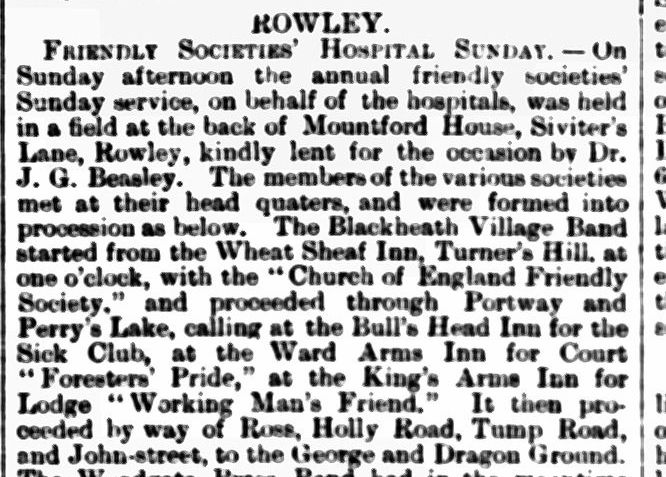
During Joseph’s tenure as licensee, Hitchmough reports an amazing procession, starting at the Wheatsheaf in  1898.

County Advertiser 24/9/1898

“On Sunday afternoon the annual friendly societies’ Sunday service, on behalf of the hospitals, was held in a field at the back of Mountford House, Siviters Lane, Rowley, kindly lent for the occasion by Dr. J. G. Beasley. The members of various societies met at their headquarters, and were formed into a procession as below. The Blackheath Village Band started from the WHEAT SHEAF INN, Turners Hill at one o’clock, with the Church of England Friendly Society, and proceeded through Portway and Perrys Lake, calling at the BULLS HEAD INN for the Sick Club, at the WARD ARMS INN for Court Foresters’ Pride, at the KINGS ARMS INN for Lodge Working Man’s Friend. It then proceeded by way of Ross, Holly Road, Tump Road, and John Street, to the GEORGE AND DRAGON Ground. The Woodgate Brass Band had in the meantime covered its route from the OLD BUSH INN, Powke Lane, with Court Little Band of Hope, calling at the MALT SHOVEL INN for Lodge Lily of the Valley, the VINE INN for Court Mistletoe Bough, proceeding along Station Road to the RAILWAY INN for Court Britannia’s Pride, thence through Halesowen Street, Tump Road, and Hackett Street, meeting the other Courts at the GEORGE AND DRAGON Ground. A united procession was then formed, and marched to Siviters Lane, reaching the ground at three o’clock. The proceedings opened with the hymn ‘All people that on earth do dwell,’ after which the Chairman (Mr. E. Pewtress, CC) delivered a short address.

The Rev. C. W. Barnard, MA, Rector of Kings Norton, then addressed the meeting, after which the hymn ‘Lead, kindly light,’ was sung. Addresses were also delivered by the Revs. W. Hall and N. Haigh, of Blackheath.

At the close a collection was taken on behalf of the Dudley Dispensary and Birmingham Eye Hospital. It amounted to £11 9s 5d.”

What an amazing event that must have been to see, I can imagine the local children dancing happily alongside the procession. It is clear from this that many of the local pubs, including the Wheatsheaf, ran friendly societies to assist people with illness and medical expenses, in those days when there was no health service, no national insurance and when fees had to be paid for a doctor to visit.

Walter Woodall 1907-1912

In 1911 Walter Woodall (35) was listed as ‘brewer [beer], licensed victualler’ and both he and his wife Elizabeth were born in Wednesbury and, again, there is no obvious connection to the previous owners. The elder two of their children Florence (11) and Walter (5) had been born in Tipton but the youngest Harold (1) was born in Rowley.

Walter Woodall appears only to have been there for five years and the only mention of him in the Press is for the transfer of the licence for the Wheatsheaf from him to Thomas Henry Holland in 1912. Which is rather odd because the same report also notes the transfer of the licence of the Barley Mow in City Road, Oakham to the same Thomas Henry Holland! And Hitchmough does list Holland as the licensee at the Barley Mow from 1911 -1916 but does not mention Holland in relation to the Wheatsheaf. Perhaps a reporter error, as Hitchmough lists the new licensee for the Wheatsheaf in 1912 as Howard Woodhouse, succeeded in 1919-1920 by Thomas Woodhouse. Yes, the Woodhouses, after a gap of more than 50 years  (or perhaps 20 if you take into account the Cox family who were also close Woodhouse connections).

Purchase of the Wheatsheaf by Thomas Williams of the Rowley Brewery

Despite all my efforts to associate later licensees with the Woodhouse family, it may well be that in fact the pub was sold in 1896 when the Cox family retired and it is simply coincidence that Woodhouses were back in 1916. Hitchmough notes that the owner of the Wheatsheaf was T B Williams (who had taken over the Bull in about 1875 and who died in 1908) and the Rowley Brewery, followed by Thomas W Williams and Lizzie Bate, before being sold to Ansells in 1946 and subsequently Admiral Taverns.  I had noted in my piece on the Bull [ii] that T Williams, the owner there had expanded his brewing and pub-keeping activities from when he took over as licensee of the Bull and had bought both the Wheatsheaf at Turners Hill and the Grange in Rowley Village. So it appears that although the Woodhouses  were licensees in 1916, they no longer owned the pub.

Thereafter, Hitchmough  listed thesucceeding licensees as :

Howard Woodhouse 1916

Thomas Woodhouse1919-1920

Edward Harrison (1920-1929)

Frank Green (1929)

Frank Jinks (1929-1957)

Walter Raymond Harris (1957 – 1960);

Frederick William Hughes (1960 – [1965]

Frederick Brown (1968 – [ ]

C Swarbrick (1970 – [ ]

Arthur Isherwood (1981 – [ ]

Glenn Whitehouse [1988]

Sara Harvey (2015 – [ ]

Twentieth century genealogical records are much sparser than earlier ones and I have no further information about these licensees although many Rowley people will have memories of more recent ones, as customers at the pub!  The licensees in 1988, Mr & Mrs Whitehouse, complained that when the road over from Perry’s Lake over Turners Hill was closed, they lost a substantial amount of trade from Rowley Regis.

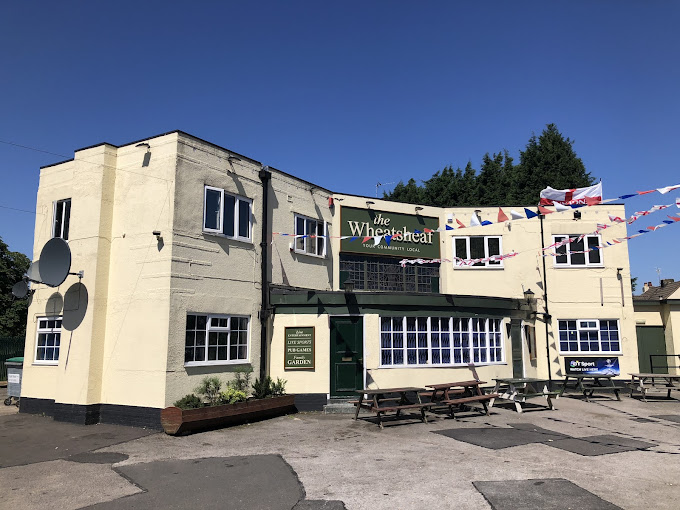
Copyright unknown. Taken in 2018, this shows the replacement pub, looking prosperous and well maintained.

The original pub was demolished in about 1930 and a replacement built behind it.  This closed permanently in 2019, like so many pubs, still described as 1 Turner’s Hill and planning permission was sought in 2022 to redevelop the site with a very modern block of flats. However I note, from the Sandwell Planning website, that the Council Officers considered that this site was an adopted open space within the Strategic Open Space & a Wildlife corridor, no decision notice or withdrawal of the application is listed and there appears to be no further progress on this application since then.

So far as I am aware, the pub building remains boarded up on site at present, another previously well used pub which has now gone.  


[1] https://longpull.co.uk/index.html [1]

[2] https://rowleyregislosthamlets.uk/2023/09/19/pubs-in-the-lost-hamlets-1-the-bulls-head/

A Hall house at Gadds Green?

I have been working recently on another family study for my blog, this time about the Hill family, one of the core families who lived in the hamlets for centuries, mainly at Finger-i’the-hole and Gadd’s Green. As usual, it has proved more complex than I had anticipated and I have got sidetracked into considering where exactly the branch of the family I am looking at lived in the village. Many of them, it appears, lived for centuries in a group of houses in Finger-i’the-hole or Fingeryhole , or Gadd’s Green.

Regular readers may recall that I have posted previously in this blog about the whereabouts in Rowley village of Finger-i’the-hole or Fingeryhole[i].

And, in a separate post [ii] I wrote last year about a newspaper article I had found, in the Dudley Chronicle in 1925, about the delights of what the writer called Portway but which clearly included the wider area of Perry’s Lake and Gadd’s Green. The article referred to the dilapidated cottage in Gadd’s Green as “Finger o’the hole cottage” which the author had visited in 1925, a cottage where the front wall had collapsed in a storm some time before and never been rebuilt.

As a reminder, and for new readers, the name Finger-i’the-hole originates from a very old local story – but which was subject to several variations in later years. A lonely old widow, the story goes, lived alone in a small cottage on Turner’s Hill. A thief or rent collector, depending on which version of the story you look at, knowing that she was unprotected, put his finger into the hole in the door to lift the latch, with a view to robbing her- or perhaps collecting the rent! – only to discover that the feisty widow, hearing his approach, had picked up her axe and  chopped off the offending digit as it was poked through the hole. Though there are no names attached to this tale, there is a locality and I believe that it is likely that some incident of this sort actually happened.

The date of this event is unclear but must have been before 1727, as Christopher Chambers of “Ye ffinger I’the hole” was buried then, according to the Parish Burial Register. And the name of Finger-i’the-hole  for the area persisted until the 1841 Census but had dropped from official use by 1851 when the area , with exactly the same families, was called Gadds Green.

The Chambers family appear, although I have not done any detailed research on them,  to have been well-to-do, they appear in the Parish Registers as living also in 1724 at ‘the Brickhouse’ and  in 1723 and in 1744 as ‘of Freebodies’ so were perhaps brothers as tenant or yeoman farmers. At that time ‘the Brickhouse’ appears to have been at Cock Green, with land extending down towards Powke Lane which later was developed in the 20th century as the Brickhouse  housing estate. Brick was not a commonly used building material at this earlier date and the use of bricks for a whole house was obviously distinctive and worthy of a special name.

Photograph copyright: Glenys Sykes

This is an illustration shown in Wilson Jones’s book of what the barn of the ‘Brickhouse’ farmhouse might have looked like. Note the ragstone wall and what appear to be large chunks of ragstone lying around. I took a photograph recently of the pieces of ragstone still in Tippity Green/Perry’s Lake, at the entrance to the former Hailstone quarry, they have a familiar rugged shape.  

Ragstone blocks at Tippity Green November 2024, photograph taken at the entrance to the former Hailstone Quarry. Copyright Glenys Sykes.

There were lots of the Chambers family in the village throughout the parish registers. An entry in 1723 refers to a Thomas Chambers of Portway and in 1732 an Edward Chambers of Tividale so they did seem to live at this end of Rowley. There was an Edward Chambers at Freebodies Farm in the 1841 Census, albeit described as a farm servant but there were no Chambers that I can find listed in the later censuses in the Lost Hamlets and it appears that they dispersed around a wider area, including Oldbury and Birmingham.

Picturesque Portway

In the newspaper article on Old Portway, which had been written in 1926, I remembered a comment in that article about the cottages at Finger-i’the-hole and this is what it said:

“Our representative visited the now dilapidated cottage where the incident is reputed to have taken place. The cottage is the fourth of a row, and is known in the neighbourhood as “Finger ‘o the hole cottage. “, The article continues “The front of the building was blown out one winter’s night many years ago when the occupant was a Mrs Cox, now of Gornal, and it has never since been repaired. The cottage is said to be over 300 years old and one family – that of Hill, members of which reside in an adjacent cottage – lived there for nearly 200 years.

It is constructed of rough grey sandstone, and originally had two rooms, one up and one down. A stout roughly hewn oak beam, crossing the building from gable to gable, indicates where the first floor once rested, and shows that the height of the living room was under six feet. Occupying one-half of the building is a spacious old-fashioned fire-place, with a large open chimney and contiguous bake ovens.” 

This description of the house known as “Finger ‘o the hole cottage. ” is very interesting.

The cottage is the fourth of a row.” So it could originally have been the end of a much older hall house.

The cottage is said to be over 300 years old” – which takes it back to about 1600 or even earlier.

It is constructed of rough grey sandstone.” Would this have been Rowley Rag? Something substantial to last more than 300 years, unlikely to have been simple wattle and daub.

A stout roughly hewn oak beam, crossing the building from gable to gable, indicates where the first floor once rested and shows that the height of the living room was under six feet.” Was this beam a later addition to divide the hall and add extra accommodation?

 “one-half of the building is a spacious old-fashioned fire-place, with a large open chimney and contiguous bake ovens”.  I can remember when I first read that description, something jarred with me. The original article goes on No fewer than ten men can comfortably stand in the aperture once occupied by the grate and its side seats.”

A humble cottage in a terrace does not have half of the single living space taken up by a fireplace big enough for ten men to stand inside it and nor does it have ‘contiguous bake ovens’, it was unusual for small cottages to have even one oven, certainly not two. There may have been an external bakehouse or oven for a farmhouse or larger dwelling and with large fireplaces in bigger buildings an oven was sometimes built into it. There is an interesting piece with a brief history of baking here – https://www.historyextra.com/period/medieval/a-brief-history-of-baking/

So something is out of the ordinary here. Perhaps there are more clues in the rest of the description of the cottage.

it originally had two rooms, one up and one down.”

Was this a Hall house? Hall houses had one great room which might well have had a great fireplace installed at some stage – I knew that originally such halls had a central hearth and the smoke floated up into the roof. Later fireplaces and chimney  breasts were added. But why the need for such a big one?

But if it was a hall house occupied by a large family or was a busy farmhouse with farmhands to feed, two ovens might well have been provided.

And at a time after the original construction the hall might have been divided into more rooms or cottages and even divided into an upper and lower floor, although if it had been designed to have two floors surely the ground floor would have been higher than six feet when it was first built?

Hall houses

So I began to suspect that this may well have been a very old hall house, perhaps the home of a farming family but that later it was divided and subdivided. And that the Hill family lived there for centuries.

I decided to research a little more about ‘Hall houses’, to see whether my thoughts seemed reasonable. This information is taken from Wikipedia:

“The hall house is a type of vernacular house traditional in many parts of England.

Origins

In Old English, a “hall” is simply a large room enclosed by a roof and walls, and in Anglo-Saxon England simple one-room buildings, with a single hearth in the middle of the floor for cooking and warmth, were the usual residence of a lord of the manor and his retainers. The whole community was used to eating and sleeping in the hall. Over several centuries the hall developed into a building which provided more than one room, giving some privacy to its more important residents.

By about 1400, in lowland Britain, with changes in settlement patterns and agriculture, people were thinking of houses as permanent structures rather than temporary shelter. According to the locality, they built stone or timber-framed houses with wattle and daub or clay infill. The designs were copied by their neighbours and descendants in the tradition of vernacular architecture. [a] They were sturdy and some have survived over five hundred years. Hall houses built after 1570 are rare.”

When considering this house I was slightly concerned that I cannot find any mention in other records of a substantial house at Gadd’s Green, although Wilson Jones in his book[iii] lists all the other significant manors or large houses.

However, David Hay, in his book The Grass Roots of English History[iv], says that although it was once believed that all timber framed houses had been built by the wealthier inhabitants of local societies and that medieval peasant houses were so insubstantial that they could not survive for more than a generation, more recent systematic recording of houses by members of the Vernacular Architecture Group and the new technological advances in dendrochronology,  have overturned these views and it is now known that of the thousands of medieval houses, some of which are still standing in many parts of rural England [though not  in the Lost Hamlets!] belonged to ordinary farming families. Hey states that “The sheer numbers of cruck [timber framed] houses in the Midlands confirms that they must be peasant dwellings, some villages have ten or even twenty such houses.” So it seems quite possible that there would well have been such a house in Gadds Green inhabited by a farming or working family, rather than a more aristocratic one.

Cruck framed houses

Many larger houses at this time were ‘cruck-framed’, that is the central frame, the load bearing members that supported the weight of the roof of the building was made from suitable trees – often oak, which carpenters could split lengthways into two identical ‘blades’ which were set either side of the building and then joined at the top with techniques varying from place to place to support a ridge-piece, the crucks sometimes resting on stone bases to protect them from damp and rot. Half way down the roof, between the ridge-piece and the wall plate other long timbers, known as purlins, were fixed to the outer part of the blades in order to carry the rafters which supported the roofing material, often thatch in earlier times. Because the crucks, and not the walls carried the weight of the roof, the walls could be filled in with whatever material was most easily available to them locally. This could easily be replaced in later centuries without endangering the roof.

The frames were constructed in the carpenter’s workshop or in the wood where the trees were felled before they were assembled at the site according to the sequence of the marks the carpenter had made with his chisel or gouge. Different types of marks can still be seen on timbers in old buildings and it appears that each carpenter had their own marks and systems; some buildings had several hundred pieces of timber and hundreds of joints so carpenters needed a way of sorting these efficiently when they arrived at the construction site. This construction method was a skilled job and not to be undertaken by home builders!

Copyright Wikipedia. This is a cruck house in Worcestershire where the cruck frame can be clearly seen, along with other timbering, in this case infilled with what is probably wattle and daub. In Rowley, with the abundance of local stone, the walls would have been infilled with stone and quite possibly the timbers clad with stone to protect them from the weather so that the cruck frame would not be obvious from the outside.

If the house at Gadd’s Green was constructed in this way, with a cruck frame, this might account for why the front wall of one section could be blown or fall down in a storm but the remainder of the structure remain apparently quite stable for many years afterwards, as mentioned in the article, especially if the inhabitants did not have the skills required to make the repairs.

Peasant Houses

Note: Hey suggests that “peasant” is still a convenient term to describe a small-scale farmer, the type of person who would have been the head of household in most of the surviving timber frames houses.  I have continued his usage so this is not intended as a derogatory term. There is an interesting article on this here: https://archaeology.co.uk/articles/peasant-houses-in-midland-england.htm

Houses were typically arranged around a central hall that was open to the rafters. These halls could be lengthened by the addition of an extra bay or two but their almost standard width was regulated by the roof span. A wood fire in a central hearth originally provided the heating, with most of the smoke escaping through the roof but timber and plaster smokehoods attached to an internal wall were starting to replace central hearths in the wealthier districts. Sometimes later refinements, ceilings, floors, partitions, etc completely conceal this original use and it is only when the smoke darkened timbers are seen in the attic at a much later date that it is realised that the building started life as a hall house.

The lower end of the building may have housed a workshop or a kitchen, dairy or buttery. And a very large fireplace in a cottage at Gadd’s Green may have been a remnant of this earlier use.

“At the other side of the hall, larger peasant houses had a private parlour, sometimes with an upstairs room known as a solar.” Is this what the family memory of the Hills referred to when they talked about the house originally having one room downstairs and one upstairs?

Poor families had to build with whatever materials were to hand, such as clay and wattles for wall panels or earth for mud walls, as in Devon, probably ragstone in Rowley. The many timbered buildings surviving in small towns in Herefordshire, Hey notes as an example, were in well-wooded areas and where woods were managed to produce suitable crops of timber over a long period. And in poor areas, solid houses would not have been readily replaced with more modern structures. So if a substantial house had been built which lasted for centuries at Gadd’s Green, why would the family expend money to replace it? Some of the Hill family later were nail factors or nail ironmongers and relatively well-to-do but others showed no sign of great wealth.

House layouts

In Midland villages, Hey suggests, “each house was separate and protected from unwelcome intrusions. The whole property, including a garden or yard, was surrounded by a fence, hedge or wall, and accessed through a gate leading on to the street and a door with a lock, (finger hole?). Excavations on village sites show that barns, stables, cowsheds and other outbuildings usually stood close together around a yard, kitchens and bakehouses were often detached, to reduce the risk of fire”.

In the view of Hey and other scholars, “the idea of separate living and working spaces would probably not have seemed a meaningful concept to member of a peasant household. There is plenty of documentary evidence for the conversion of bakehouses, carthouses and stables into dwellings for retired peasants”, indeed barn conversions and such continue to this day!

Why and where?

There were many cruck buildings in some parts of the country and none in others for reasons not fully understood. It is possible that the native pendiculate oak trees, whose shape is ideal for cruck construction, predominate in areas such as parts of Yorkshire, Lancashire and Cheshire, along the river Severn in parts of Wales and in other Midland Counties. In eastern England, where cruck framing is conspicuously absent, the less suitable sessile oaks are the major type.

Hey notes that the medieval houses of Midland England are predominantly cruck framed and three bays in length. The chief limitations of cruck framed buildings are in their height and width, because their dimensions were dependent on the size of the blades that could be cut from suitable local trees.

When it became fashionable to insert a ceiling into a hall that had previously been open to the rafters, the space in the upper  storey was very constricted “- or perhaps sometimes the lower storey which might account for the low ceiling mentioned in the 1925 article.

This restriction did not apply to the other main construction method which was where posts and beams were made to create a box like frame and where the roof was supported throughout the frame and the walls. It is possible to find both methods of construction in one house, perhaps with a cruck framed hall having additional wings built with box frames.

These are other things that Wikipedia has to say about hall houses.

“The vast majority of those hall houses which have survived changed significantly over the centuries. In almost all cases the open hearth of the hall house was abandoned during the early modern period and a chimney built which reached from the new hearth to above the roof.

Fireplaces and chimney stacks could be fitted into existing buildings against the passage, or against the side walls or even at the upper end of the hall.

Once the clearance within the hall was no longer needed for smoke from the central hearth, the hall itself would often be divided, with a floor being inserted which connected all the upper rooms.

In smaller hall houses, where heat efficiency and cooking were the prime concern, fireplaces became the principal source of heat earlier.

In the earliest houses combustion of wood was helped by increasing the airflow by placing the logs on iron firedogs. In smaller houses the fire was used for cooking. Andirons provided a rack for spit roasting, and trivets for pots. Later an iron or stone fireback reflected the heat forward and controlled the unwelcome side draughts. Unsurprisingly the hearth migrated to a central wall and became enclosed at the sides.”

So it does seem to me that all of these points, both from Wiki and Hey, tie in with my theory of the house at Gadds Green having been, at one time, one large dwelling, later subdivided into two storeys and into separate cottages.

On the ground

We cannot look at the house or the site now, it has literally been obliterated.

There are no detailed maps before the mid-1800s.

Photograph copyright Glenys Sykes, apologies for the poor quality. Map Copyright: https://maps.nls.uk/

Maps of the area on the NLS website include this OS Map, at six inches to the mile, which was apparently surveyed in 1881-83 and published in 1887. This shows a row of dwellings at Gadd’s Green, with what may have been a yard or fold at the North end.

Incidentally this map also shows a stretch of water at Perry’s Lake which presumably gave this area its name. I have seen suggestions that this may originally been a fish pond for the Manor farm at Cock Green.

Map Copyright: https://maps.nls.uk/

This second map is at 25” to the mile, was originally surveyed in 1881, revised in 1937 and published in 1947. This shows a row of four dwellings and a further one at the rear, plus an additional block of buildings. But the shape of the site including the fold or yard remains. There are also springs marked just along a lane which would have provided the essential water supply for a farmhouse. On both maps, this is the last building in Gadd’s Green before the road continues up Turner’s Hill, and that is where the home of the Hill family always appears in censuses.

There is no sign of water at Perry’s Lake on this later map. Although there is a mysterious building halfway between Perry’s Lake and Gadd’s Green which I suspect may be the Methodist chapel which appears in various records but later disappears. It appears to be a square building with an entrance porch at one corner and a small room at the back, perhaps a vestry or schoolroom.

And farm houses in the area do appear to have survived better than most other buildings in the Rowley area.  They were probably bigger to accommodate some farm workers as well as family and it is also possible that an undercroft or part of the building could also have been used to shelter animals. There may also have been buttery or cheese stores, as well as outbuildings, barns for the storage of crops, stables for horses and vehicles and tools, plus workshops on the site any of which may have been incorporated into the farmhouse in later years. 

A Will I have recently been transcribing relates to a farmer who was related to the Hills and who owned farms in Hagley and Belbroughton. The description of the Hagley Farm reads:  “my Capital Messuage or dwelling house wherein I now reside with the Brewhouse, stable, Coachhouse, cowhouse and other outbuildings, Courtyard ,fold yard, Garden Ground and orchard thereunto adjoining and belonging (comprising all the buildings and the Courtyards Garden rounds Orchard and premises adjoining together on that side of the road.

Which illustrates the number of additional buildings and grounds a substantial farm might have. But even a smaller farm, like the one in Rowley village described in the Will of Ambrose Crowley, had outbuildings of a barn, workshop and yard. Thinking about this, it is clear from even later maps that the Grange site and the Portway Tavern site at Perry’s Lake were arranged in a very similar way and may also have been on an older sites and originally used as a farm.

Old Buildings in Rowley

There has been an interesting discussion this week on the “I remember Blackheath and Rowley Regis” Facebook page, after I asked where the oldest buildings in Rowley were now. The answer appears to be – several pubs, more than one farmhouse, a few well built cottages still survive. It would be fascinating to see the rafters in the roof of some of these houses to see whether any of them were cruck buildings and whether they were once blackened by the smoke from a central hearth!

So the long gone ancestral home of the Hill family in the Lost Hamlets is the rabbit hole I have been exploring for the past few days. Perhaps, – although I shall never know for sure since the house is one of those which disappeared when the quarry expanded – possibly a Hall house, probably a farm house, later four cottages – including the famous Fingeryhole cottage – which I think I have identified on the map. A fascinating – for me, anyway – glimpse of how the local families lived in centuries gone by, and how local legends may have an element of truth and a thread reaching back through the centuries.  


[i] https://rowleyregislosthamlets.uk/2023/02/17/finger-i-the-hole/

[ii] https://rowleyregislosthamlets.uk/2023/10/15/tales-of-old-portway/ 

[iii] J Wilson Jones, The History of the Black Country, ISBN unknown, published c.1950, Cornish Brothers Ltd.

[iv] David Hay, The Grass Roots of English History ISBN: 978-1-4742-8164-5, Bloomsbury Publishing

“The Grass Roots of English History”

This is the title of a book by the renowned historian David Hey, which is subtitled “Local Societies in England before the Industrial Revolution” and I recently noted it from an online comment as recommended reading for those of us with an interest in particular localities, whether in the form of a One Place Study or what I have heard called ‘micro-history’ or more general interest. So I acquired a copy and it has sat on my study table in a pile of other interesting books for a couple of weeks. Until a few days ago when I wanted something to read, out in the garden, sitting in the September sunshine.

Regular readers may remember that recently I commented that in the course of my research for my One Place Study, I had come to the conclusion that many of what I had called the ‘core families’ of the Lost Hamlets in particular but also Rowley village, had been there since time immemorial .

That felt rather a brave thing for me to proclaim, since I am neither academic nor a scholar, but I have come to believe this and certainly the idea seemed to strike a chord with many local people who commented on the ‘I remember Blackheath and Rowley Regis’ Facebook Page who appeared pleased to think that they were so deeply rooted or grounded as one person put it, in this small village.

I had started to observe this pattern when I first started transcribing parish registers for Rowley for FreeREG and realised that many of the names in the 19th century Registers which I was transcribing were names that had also been in the Attendance Registers of my classes at school, both at Rowley Regis Grammar School but especially at Rowley Hall Primary School. I had not seen many of those names, I realised, in the forty years since I had moved away from Rowley so perhaps they were local to the area. This observation was confirmed and reinforced by every subsequent record source I looked at.  

I noticed what I came to think of as ‘local faces’ in old group photographs but which I also recognised from school. And I knew from my own family history research that physical likenesses had passed virtually unchanged over – in my instance – a period of seventy years and at least five generations, from my great-uncle who died without issue at Passchendaele  in 1917 to an uncanny likeness to him which popped up in my son, born seventy years later, five generations apart. The likenesses were there in the men of the intervening generations when I looked properly at their photographs, too but my son not only had the same face but the same stance, the way he held his shoulders and, it appears from other records, similar aptitudes and skills. Other observations, over time, brought the realisation that gaits, stances, voices, aptitudes, skills, and mannerisms also passed unchanged through generations.

All of these elements also indicated to me that many families stayed close to their home ground over centuries. Some, of course, moved elsewhere for work or opportunity (and transmigration patterns between Mountsorrel in Leicestershire, Rowley Regis and the Clee Hills in Shropshire, due to particular granite working skills, have emerged clearly during this study) but most families stayed put, even if individual members moved away, often only for a time. I identified the ‘core families’ who lived in the hamlets over hundreds of years, intermarrying and mostly staying very close to home.

At the Black Country History Conference which I attended at the Black Country Living Museum last year, Simon Briercliffe gave a talk on Irish immigrants in the Black Country. He showed a chart (seen in this photograph, I can obtain the fullchart if anyone would be interested to see it) with the proportions of the population in various local towns and villages who had been born there or elsewhere, based on the places of birth shown in the 1851 census, the first census to show this specific information.

Copyright: Chart – Simon Briercliffe, photograph Glenys Sykes.

Of all the villages Simon had looked at, Rowley Regis had the largest proportion of people who had been born less than ten km away from the village, the smallest number of people born between 10 and 49 km away , even less who had been born more than 50km at all and none from Ireland. As I recall, this raised a little chuckle in the audience as he reviewed the various results with a comment to the effect that Rowley Regis was well known for the people there not moving far!

And when I began to read David Hey’s book, I found myself nodding happily at just about every sentence in the introduction. David Hey, who died, sadly, as the book was in production, I think in about 2016, noted in his introduction that he had been ‘much involved’ in the study of English local and family history at both the professional and amateur level over 50 years and had noted that the local approach, also sometimes called ‘micro-history’, to give it, he says, academic respectability, had helped to transform the understanding of the history of the nation at large.

There are chapters in the book on The people of England, England’s historic towns and cities, Organizing the countryside: Villages, hamlets and farmsteads, Earning a living in the countryside, The greatest buildings in the land, Parish churches and chapels, Timber framed houses, and Population, family life and society.

He notes the importance of considering the administrative framework of a place, and a familiarity with the natural surroundings, the study of farms and field systems, the pattern of highways and lanes, the buildings, the interpretation of place names. But all the while, he says, “we must have at the forefront of our minds the people who inhabited these landscapes, the ordinary English families as well as the high and the mighty.” He welcomed the interest in family history that reinforces the value of the local approach.

This was only the first page of the introduction and yet I was feeling as though he was directly addressing me and my work on the One Place Study!

He goes on to talk about the differing nature of the various local societies throughout England and notes that people used to speak of the neighbourhood with which they were familiar as their ‘country’ , (just as, of course, we refer to our neighbourhood as the Black Country), by which they meant not the whole of England but  the local district that stretched as far as the nearest market towns. He says “The core groups of families that remained rooted in these neighbourhoods were the ones that shaped local culture and passed on their traditions.” He notes that they often bore distinctive surnames which were unique to their area, still evident today.

He notes a tenet of social history that most people in the Stewart and Tudor periods moved from their place of birth at some stage in their lives. Some will have moved but many will have left members of their families behind. He argues that the character of a local community was determined not so much by such comings and goings but by the families that stayed put, even though in time they may be outnumbered by incomers. These formed the core of the community and provided it with a sense of continuity. Networks of families were formed and repeatedly strengthened by intermarriage. He calls these ‘urban dynasties’  and quotes Arnold Bennett, writing in 1902 about families in the Potteries (also in Staffordshire, of course) who said “those families which, by virtue of numbers, variety and personal force seem to permeate a whole district, to be a calculable item of it, an essential part of its identity”. Hey notes that many of these old urban dynasties continued to run matters in their locality over several generations. I have also noted in the course of my research familiar names cropping up in reports of parish offices, of local councils, of those involved in the administration of local affairs, centuries after those names were recorded in the Court Rolls and the Parish Registers for Rowley, so this applied in the Rowley area, too. 

Hey also discusses how the study of surnames has altered in recent years and his belief that each area or ‘country’ had its distinctive collection of surnames which had been formed locally in the Middle Ages. There is also now a school of thought, he says, that very many English family names, including the common ones as well as the rare, should be treated as having a unique history that must be traced back in time and that many would prove to have a single family origin. So each time I have looked at the first entry in the Rowley Registers for a name in my family tree, and wondered whether I could actually trace my line to that person, it seems that yes, I might well be able to and that this would not be too unusual.

In particular Hey notes that where surnames have been mapped from the 1881 census, the great majority of those distinctive surnames – those that appear to have had a single family origin – were still decidedly local in character. He notes that Staffordshire provides many examples of surnames which have remained concentrated in their county of origin. Examples relating to the area of the Potteries are described in the book, and he also discusses those which appear to have derived from small places, and discusses the use of detailed maps in this respect to identify the origins of some names, which may have been as small a place as one farmstead.

Of particular interest to Rowley folk, perhaps, is a paragraph in the introduction about Rayboulds. This name, he says, derived from an old personal name and appears to have had a single family origin in the Black Country. The 903 Rayboulds in the 1881 Census, he notes, included 306 in Dudley and 259 in Stourbridge. I could tell him somewhere else to look too! And that Francis Raball who appears in the Rowley Marriage Register in 1614 is surely one of those very early ones of that name.

And so for all the Darbys, Groves, Wards, Bridgwaters, Hipkisses, Willetts, Whites, Rustons, Whiles, Jeavons, Dankses, Lowes. Hadens, Detheridges, Mucklows, Parsonses, Cartwrights, numerous others –  any of those family names still in the Rowley area and appearing in the mid-1500s in the first few pages of the Rowley Registers, it seems that it is not actually fanciful, to think that you are, very probably, a direct descendant from those original families in Rowley then.

Later in the book, talking about the structure of settlements, Hey says that “Hamlets are found in every English region, even in the heartlands of the Midland open-field villages.  Far from being a somehow inferior type of settlement, as was once assumed, they were often more suited to communal farming than were large villages. Their versatility, adaptability, resilience and tenacity enabled most of them to survive the late medieval economic and demographic depressions, though many suffered and a proportion succumbed. They ensured that England was a country with complex and different rural economies.”

There is a fascinating breadth of knowledge in this book, distilled from a lifetime of study of local and family history by David Hey, about all sorts of details of living in earlier times. Thinking of my piece recently on the Inventory of Ambrose Crowley 1, I was interested to read in this book that livestock were far smaller than now and they produced less milk and meat, while disease was a constant threat. A cow gave 120-150 gallons of milk a year, about one sixth of present day yields. In Yorkshire the average dairy cow produced just 72 pounds of butter and cheese annually. Medieval hay meadows were valued at three or four times the level of surrounding arable lands because they provided the essential winter fodder to keep breeding stock alive over the winter, confirming the reason for the relatively high valuation given in the Inventory for the hay in the barn.

Yet Hey suggests that the inhabitants of England’s medieval towns formed only about 10% of the national population. Prior to the Industrial Revolution, most English towns remained small, they were not yet divorced from the surrounding countryside and their fields and meadows could usually be seen from the market place. This rings true to me because in the small Gloucestershire town where I now live, where expansion and development were crippled for a long period by the collapse of the wool trade, one feature of the landscape is that the surrounding countryside is clearly visible from many of the town streets, including especially long views from the Chipping, originally the Cheaping, the market place.

Hey also considers the position of London, then, as now, not typical of other English towns and with a higher proportion of non-native residents, but he notes also that, at least since the early 1600s and probably well before, London had been connected to smaller cities and market towns in every part of the kingdom by weekly carrying services. A document of 1637 lists the London inns where provincial carriers arrived and departed and their regular schedules. A study he refers to has calculated that about 205 waggons and 165 gangs of packhorses entered and left London every week, carrying a total of about 460 tons of goods each way. By 1715, regular carrying services by road in and out of London had more than doubled since 1637 and coach services to the most provincial centres numbered nearly 1000 a week.

Amongst the goods carried, I reflect, would have been nails from Rowley Regis. Small wonder then that the more ambitious of the families in Rowley, perhaps the young men wanting to expand their horizons, opted to move, at first to larger towns such as Stourbridge where there was a thriving market for nails, possibly transported from there on the river. Nails were heavy, and dense, they could be transported by pack horse or cart but roads were generally poor and travelling slow. Water transport allowed large quantities to be moved more easily, hence the development of canals to places which did not have access to rivers. But I now know of at least three Rowley families whose descendants moved to London to trade as ‘nail ironmongers’ in the city where their wares could be sold on the London markets and also shipped across the world from the London docks where they set up their businesses.  They would doubtless have arranged their own transport, from the Midlands, cutting out the middleman, the carrier and probably improving their security en route. It seems that at least some of our ancestors may have been a lot more mobile than I had always thought.

Also, some young men (not many women), from all parts of the country, came to London to be apprenticed to various trades, as can be identified from Apprenticeship Registers in the archives of the various Livery Companies, as was Ambrose Crowley 3. Hey gives very interesting descriptions about how these apprenticeships were arranged and also how many families in the provinces had one or more members who were in London. Again, this brings my mind back to my ancestor Edward Cole who was married in a Fleet Marriage in London in 1730, then returning to live in Rowley Regis for the rest of his long life. I had already, as a result of earlier research, been wondering whether he and his father had been involved in transporting nails to London, now I am wondering whether there had been an apprenticeship somewhere along the line, too. So now I am going to have to learn more about Apprenticeship Records.

Thoughts

This man is speaking my language.

By learning about this early period I am seeing not only how our ancestors lived then but how this earlier period shaped the times and society that followed.

Most dry days now, I take the book and a large mug of tea out to a sunny spot in the garden and read a few more pages, not rushing, because almost everything he writes is worth understanding and thinking about. If you have found this interesting and fancy a longer read, look out for copies on Amazon or Abebooks or try ordering it through interlibrary loans. For myself, I am enjoying every page and feeling a new confidence that my researches have been leading me in the right direction and that further research is worthwhile.

David Hey was Emeritus Professor of Local and Family History at the University of Sheffield, his roots were in the Hallamshire area of Yorkshire, on which he has published numerous books, he was a hands on family historian, as well as a renowned academic. A review on the book describes it as “a magnificent overview of England’s past, which serves to unite the worlds of landscape history, family history and local history”. Another review notes that it is “highly readable, an excellent interpretative work, up to date, wide-ranging in themes, regions and chronology.”

It is also meticulously referenced and provides details of a range of other books which could tempt me, not to mention Hey’s other publications, some of which I already had.  His books ‘Family names and family history’ and ‘Journeys in Family History’ have already found their way onto my TBR pile this week!  I am now valiantly resisting the temptation to acquire his book “Packmen, Carriers and Packhorse Roads : Trade and Communications in North Derbyshire and South Yorkshire”, as I suspect that many of the trading conditions in metal working in that area may have been similar to those in the Black Country. And ‘Surnames, DNA, and Family History’ by George Redmonds, Turi King, and David Hey – also sings seductively to me – at this rate I am going to need another bookcase…

I have always been an avid reader and had considered myself reasonably well informed about English history, since it has always interested me.  What a joy it is, in my mid-seventies, to have my knowledge and understanding of English history, of ordinary English people, (not just the powerful and wealthy who have always been well documented), and how common folk lived, my perceptions so greatly enhanced and expanded as they are being, in the course of this One Place Study and by such gifted writers as David Hey and Gillian Tindall. My only problem is that there are just not enough reading hours in the day!

Families of the Lost Hamlets – Ambrose Crowley I and Rowley in the 17th Century

The Crowley family were in Rowley Regis for much of the 1600s, later generations moving away to Stourbridge and then London. They were apparently comfortably off, were nailers, later ironmongers and perhaps farmers, Quakers, industrious and clever. And they left Wills! I don’t know for certain whether they lived in the area of the Lost Hamlets but they may have done…

A troubled century

First of all, it is worth considering what life in England generally was like in the 1600s. James 1 of England had come to the throne, following the long reign of Queen Elizabeth 1, in 1603. He was followed by King Charles 1 in 1625.

Rowley Regis was not untouched by national politics, the Gunpowder Plot against King James 1, thwarted in 1605, had led to fleeing plotters Stephen Lyttelton and Robert Winter taking refuge in Rowley Regis, and two local men Christopher White, someone called Holyhead and another man called Smart apparently sheltered them in their houses and legend has it that Holyhead was hanged for doing so. Wilson Jones[i]  states that there is no trace of the fate of Smart and White and it is not known which houses they sheltered in. Edward Chitham in his book on Rowley Regis   also mentions this story and notes that the plotters are said to have hidden in the cellars of what became  Rowley Hall Farm but that building was later replaced on a different footing and no evidence remains of any cellars.

The Pendle Witches were tried in Lancashire in 1612. William Shakespeare died in 1616. Sir Walter Raleigh was executed in 1618. In 1625 Barbary Pirates raided Mounts Bay in Cornwall and took 60 men, women and children into slavery (and in 1645 they took a further 240!). The known world was expanding and the first settlers were sailing off to the Americas, the Mayflower sailed in 1620 with 100 Puritan separatists. Some 20,000 more emigrated to New England in the 1730s, the peak of the Great Migration. (By 1770 the population had reached 92,000), many of them migrating for religious reasons and to avoid persecution.

As a result of many plots against King Charles 1 and unrest in Parliament, a Protestation Oath was introduced in 1641 which required all adult males in England and Wales to declare allegiance to the King, Parliament and the Protestant religion. The names of those who refused was noted.

In 1642 the English Civil War began and continued until 1651. While there was no battle in Rowley itself, Chitham thinks that most Rowley people would have supported Parliament, certainly they would have been well aware of the conflicts as Dudley Castle – only three miles away – was twice besieged, the Lords of Dudley supporting the Royalist cause. The last battle of the Civil War was at Worcester, again, not very far away, so large areas of the country were affected, not just London. Approximately 3.7% of the English population died as a result of the Civil War.

In 1648 Quakerism was founded by George Fox who had strong links in the Midlands. The Quaker website[ii]  notes that “Quakers have always refused to swear oaths, because it implies that there are only certain occasions in which the truth matters. Early Quakers were known for their honesty and straight dealing. This is partly why Quakers were successful in business and banking in the 18th and 19th centuries.” So this set up those of Quaker leanings to be in conflict with those in authority who wanted them to swear oaths of loyalty. As a result many Quakers were persecuted and imprisoned in this period.

Quaker records relating to the Stourbridge meeting show that as in other areas, Friends were subjected to persecution. In 1674, Sarah Reynolds was sent to prison for refusing to contribute to the cost of church repairs and in 1684 Ezekiell and Mary Partridge, Hannah Reynolds, Richard Jones, Edward Ford, Sarah Reynolds and Ambrose Crowley were excommunicated for non-attendance at church. I think this must have been Ambrose Crowley 2, who had given land for a Meeting House in Stourbridge but it is an early indicator of the family’s Quaker involvement.

At about this time a Committee began to investigate the political loyalties of church ministers and increasingly acted against those men who supported the King. Properties were sequestrated from Royalists who continued to fight for the King. There were battles between Royalists and Parliamentarians. In 1649 King Charles I was executed and the Commonwealth set up under Oliver Cromwell which made huge and unpopular changes to how people lived.

In 1660, the Monarchy was restored and Charles II came to the throne. A hearth tax was introduced to support the King and his household. A shilling was to be paid twice yearly for every hearth or stove in domestic buildings. Most Rowley homes had one hearth. Only four houses had more than three hearths and these were “Ye Brickhouse”, “Rowley Hall”, “Brindfield Hall” (at Tividale, the home of the Sheldon family) and “Haden Hall”.

The Great Plague killed more than 60,000 people in London in 1665, and in 1666 there was the Great Fire of London. No doubt news of these events would have filtered through to local people at some point.

 In 1667 a ‘Pole Tax’ was imposed and the list for Rowley Regis, including all children and servants, amounted to 375 names. The total population of Rowley, according to Wilson Jones, excluding servants was 318, including children. The Bishop of Worcester sent out a questionnaire in 1676 to try to gather church statistics and the main question was the number of inhabitants. The number given in response was 420 but Chitham is convinced that this was seriously wrong and that other methods of calculating suggest a figure of nearer 1500.  

The weather was much harsher then, too. In 1683, a Frost Fair was held on the frozen Thames in London, I doubt other areas of the country were much warmer so simply surviving the winter would have required fuel, shelter and food for people and animals.

In 1685 the French King revoked the Edict of Nantes, which started the persecution and killing of Huguenots and thousands fled to England bringing their skills, including – amongst many others – glass making and certainly many settled in glass making areas of the Black Country and possibly elsewhere.

In 1689, under the new monarchs, William3 and Mary 2, the Toleration Act permitted nonconformists to worship, provided they licensed their meeting places.

A window tax was introduced in 1696, to replace the Hearth tax, leading to widespread bricking up of windows.

So, that is a quick summary of events in the 1600s which would have affected local people and families, even in sleepy Rowley Village, and even smaller places like the hamlets. The 1600s were turbulent times of great changes and people must have wondered what was coming next.

The Crowley Family

I have touched on the Crowley family in a previous article about Ambrose Crowley III who became an Alderman of London.

But the first Crowleys appear in the Rowley Regis Registers in the early 1600s. M W Flinn, in his book Men of Iron, when talking about the Crowley family in Rowley and speculating about their prior origins, noted that there were Crowley families in Kings Norton but considered then (in 1961) that there was no evidence to connect the two families. I beg to differ. But then, I have the benefit of computers and access to digitised and computerised records which were not available to earlier researchers.

The first Crowley mentioned in the Rowley Registers is Ambrose  Crowley 1. I call him that because his son and grandson were also Ambrose so I am numbering them for easy differentiation. Ambrose does appear to be a Crowley name, they continue to crop up in various places for centuries afterwards.

So where did Ambrose 1 come from? With the power of FreeREG at my fingertips, I searched for baptisms of surnames beginning with Cro* between 1500 and 1700 (I searched just with Cro*because spellings  of the name varied considerably at that time but they all began with CRO so searching with what is called a ‘wildcard’ brings a list of them all. Crowley became quite settled by the late 1600s but there were Croleys, Croelys, Crolyes, Crolys, all popping up with the recurring family Christian  names, according to whoever completed the Registers in different places and at different times.). I set the centre point of the search as Rowley Regis but included ‘nearby places’ which includes a further 100 places within 7.7 miles. This list appeared in date order and showed that there were indeed Crowley families in the 1500s and early 1600s in Kings Norton (which is, these days, a suburb of Birmingham but which was then a separate village) and, later, also in Harborne which again is now a suburb but was previously a separate village. I then did the same exercise with marriages and burials and all three show the same pattern of a family moving from one settlement to the next. 

Copyright: Glenys Sykes. This 1819 Map by John Cary, (which appears in ‘The Black Country as seen through Antique Maps’) shows how the settlements of Kings Norton, Harborne and Rowley Regis lined up, with Halesowen just to the left of Harborne. Birmingham was still a fairly small place then and these villages were separate places, rather than suburbs.

Three Crowley brothers, (or possibly two brothers and a nephew) baptised in Harborne in the few years either side of 1600 start to appear in the Rowley Registers in the 1630s. And their sister Alice married in Halesowen at the beginning of this period. Had it been just Ambrose, it is conceivable that it was not the same family (although this is the only baptism for an Ambrose Crowley that I could find anywhere at this date so it does narrow the field) but there was also Richard, and later Edward. Other family Christian names from Harborne also recur amongst their offspring over the next generations. Also, none of those names appear in the Harborne registers after they appear in the Rowley Registers so it seems fairly certain that they had moved to Rowley.

So I am fairly confident that Ambrose Crowley 1, along with several brothers, sisters and probably cousins, was born in Harborne and he was baptised there on 16 June 1607. I do dearly wish that I could find out where the parish boundaries at that time were for Harborne, as I have another line on my family tree where a marriage took place at Harborne and they were described as ‘of this parish’ when I know they lived in Oatmeal Row in Cakemore. It does appear that the parish of Harborne extended well towards Quinton which was not a separate parish at that time, did not have a parish church and came under Halesowen parish. So Harborne parish register entries may be for people living much closer to Rowley than appears at first glance at a map. 

On 19 May 1633 Ambrose Crowley 1 married Marie or Mary Grainger or Granger at Rowley Regis. Mary had been born in Rowley, daughter of Henry Grainger and she was baptised in Rowley on 17 Nov 1602, although some early Grainger entries in the Rowley Registers note that the Grangers were from Halesowen.

Initially I thought that Ambrose’s marriage was the first Crowley connection away from Harborne but checking for local marriages, I was interested to note that, three years earlier, on 18 July 1630, a Thomas Granger married Alice Crowley in Halesowen. Was Mary Grainger Thomas’s sister or cousin? It seems very possible. (And later records suggest that the Grangers had links with Illey which is on the Harborne side of Halesowen which would reinforce my observations about the proximity to the Harborne boundary.)

There was certainly some long lasting connection between the Crowleys and the Grangers. When the Inventory was drawn up for Ambrose 1’s Will in 1680, one of the signatories to that was a George Granger and Mary did have a younger brother George. More research needed on the Grangers when time permits. However, this marriage in Halesowen does reinforce the impression of a continuing  drift of members of the Crowley family in a westerly direction.

On 2 Aug 1635 Ambrose 1 and Mary’s first child was baptised at St Giles, he was Ambrose 2. More children followed – Joyes (Joyce in modern English) in 1637, William in 1639 (buried in 1655), John in 1642 (buried in 1643), Margerie in 1644 and – at some point – another daughter Mary. There are gaps in the Rowley Register, some of them quite prolonged so some other baptisms may be missing. A daughter Margaret is named in Ambrose I’s Will, written in 1680, but I have been unable to trace a baptism for her. I wonder whether Marjorie and Margaret were the same person, as spelling of names was so variable then.

I assume all of these children were the children of Mary but names of mothers are not listed in the Registers at this point in time. But Mary was buried in Rowley on 31 Oct 1674, so it seems likely that Ambrose 1 and Mary were together for forty years which must have been a long marriage in those days of short lives.

Ambrose Crowley I, having moved to Rowley, possibly on his marriage to Marie Grainger, stayed there for the rest of his life. I know this because I have read his Will, written in 1680 and he is described in that as ‘of Rowley Regis’. His son Ambrose II moved to Stourbridge at some point, married and settled there and I know that because I have also transcribed his Will, proved in 1720 and that tells me so!

The Will of Ambrose 1, which was proved in 1680, (and of which I obtained a digital copy in less than 24 hours, all kudos to Worcestershire Archives, great value for £10 and saving me a trip to Worcester) is a fascinating document for the picture it gives of the life of this family then.  It is not long, all of it written on one page of parchment, and this is what it said:

“In the Name of God, Amen. The Thirteenth Day of June in the year of our Lord God One Thousand six hundred and eighty, I, Ambrose Crowley, Esquire of Rowley Regis in the County of Stafford, Naylor, being of sound & perfect memory  praised be God do make this my last Will in manner following:

First and principally I commend my soul to God who gave it in hopes of a joyful resurrection at the Last Day. And my body I commit to the earth where it came to be buried at the discretion of Executrix hereinafter named.

And as for my worldly estate whereof it hath pleased Almighty God to give and bestow upon me I dispose hereof as follows:

Item: I give to my daughter Mary Francis twelve pounds in silver and to her eight children twelve pence apiece

And I give to my son Ambrose twelve pounds in silver.  And I give to his wife and eight children six shillings eight pence apiece

And all the rest & residue of my goods and personal estate whatsoever my debts being first paid and my funeral expenses discharged I give and bequeath to my daughter Margaret Crowley whom I make & ordain full and sole executrix of this my Will revoking all former Wills by me heretofore made In witness whereof I have hereunto put my hand and seal today and […] first above Witness.

Signed Ambrose Crowley

Signed, sealed published and endorsed

In the sight and presence of

Jo. Grove

John Hobbes

Paulus Rock”

There are one or two words I have not been able to read but nothing of great significance. Ambrose did not sign his Will. He appears to have signed his initials, as shown on this photograph, the names Ambrose and Crowley on either side of the initials are in the same handwriting as the body of the Will so Ambrose Crowley 1 was not literate although his son Ambrose2 and later generations were.

Copyright: Glenys Sykes.

So, of his children, it appears that only Mary, Ambrose and Margaret survive at this point, or at least that we know they were alive. (It is possible that others were alive but no provision was made for them.  Joyce had married Edward Johnson at Rowley in 1657 and two children were baptised in 1658 but after that there is no trace of them locally. Two other sons had already died without issue.) The bequests are very simple, money to Ambrose and Mary and their respective children, both already well  established with their own households. Everything else goes to Margaret who presumably lived with Ambrose and probably kept house for him.

I find it slightly odd that there is no mention of property, land, real estate in this Will. In Wills I have previously seen any land or houses or real estate are carefully listed and disposed of. The whole process of disposal of land, whether by sale, lease or inheritance was and still is always carefully recorded in writing, verbal contracts for the disposal of land are not valid, unlike other forms of contracts. The wording is detailed, specific, hedged about. If Ambrose had had any land or house to dispose of, we can be pretty sure it would have been listed in his Will. But it wasn’t.

The Inventory, which I will show next, shows that Ambrose 1 was living in a substantial house, not a cottage, perhaps a farmhouse. There is a list of the rooms and there were outbuildings, including a barn and a workshop, plus a yard and, presumably somewhere his cows were kept. So why wasn’t this listed? And where was Margaret, who was at that time apparently unmarried, to keep all the goods and chattels she had been left? Where was she to live?

One possibility which occurs to me is that the house – wherever in Rowley it was – was actually the property of the Granger family. Perhaps they were prepared to continue to allow Margaret to live there? I have been unable to find a Will for Mary but the property rights of married women were very limited so she may not have left one.  Wilson Jones, in his book, notes that there were various large mansion houses including Graingers Hall, near Cradley Heath (the name presumably preserved today in Graingers Lane) so it appears that the Grainger/Granger family were well to do. I do not think that this house was a mansion but it appears to have been more than a cottage, and perhaps operating as a smallholding. But the Crowley name does not appear in any of the various surveys of holders of weapons, hearths or householders that I have seen so they appear not to have been of any great social standing in Rowley although Flinn states that “The Court Rolls of the Manor in the seventeenth century contain many references to the Wheeler, Parkes, Haden, Foley, Darby and Crowley families”.

Flinn,in Men of Iron[iii], also reflects on the nature of the nail making business, where a fairly elaborate system of exchange developed. Raw materials and finished products in small lots moving between small independent producers and many dispersed consumers offered a route for the economic advancement of even the humblest producers, as dealers or middlemen. Many merchants, he says, who came to dominate the iron manufacturing industry of the Midlands came from the ranks of domestic nail makers, a surprising number of them from Rowley. The rise of the Crowley family, from domestic nail making in mid-1600s in Rowley to opulence in London and beyond in three generations illustrates this.

The Inventory attached to the Will

An Inventory is a list of all the possessions of a deceased individual and is drawn up at the time of his or her death by independent people, as part of the Probate process and fixing a value on what was left. This inventory is most interesting in showing what was presumably a typical household of a yeoman family at that time and I note that the signatories to the Inventory are all local Rowley names and at least one of them was probably a family member.

The values, naturally, are shown in pounds, shillings and pence. For those too young to remember, there were twenty shillings to the pound and twelve pence to the shilling. A shilling was also known colloquially as a ‘bob’, hence the ‘ten bob note’ which was half of a pound in value. Pence had nicknames, too – and coins for threepence (thruppence) and sixpence and parts of pence were also in circulation, half-pennies (ha’pennies) and farthings (fourthings, a quarter). I can just remember silver farthings, tiny coins which were often saved for use in the Christmas pudding but copper farthings later superceded the silver ones.

This is my transcription:

A True and Perfect Inventory of all and singular the goods chattels and heredits of Ambrose Crowley late of Rowley Regis in the County of Stafford, Nailer.  Done, taken and apprised the twelfth day of September 1680 by those whose names are subscribed:

Description                                                                                                                                         £              s              d

The wearing Apparel and money in his pocket:                                                                   1              3              4

In the Hall House

Some Chyrurgery Instruments                                                                                                                   2              6

Andiron, fire shovel, Tongs, potgailes, bowls and chafingers                                                       4              0

One greate table board and forms, three chairs, two stooles,

one little falling (folding?)table                                                                                               

                   4              6

One little safe, pailes gawn piggins & other Earthern Ware                                                           3              4

Brasse & Pewter and an Iron Pott                                                                                             1              6              8

Two scissor & Other Trumpery                                                                                                                   2              0

In the Chamber                

One Bedstead, feather bed and all that belongs to it                                                       2              0              0

One old Warming Pan                                                                                                                                   2              0

One hanging presse one old cupboard and chair and other oddments                                    10           0

In the Buttery

A Cheese Press, churn, two barrels, two firkins, five little shelves

 and other odd things                                                                                                                                    8              6

In the Chamber above the Buttery

One joint bedstead and flock bed and all that belongs to it

Linnen in the House                                                                                                                         2              10           0

One old forme one tubb one strike measure and other trumpery                                              

                3              4

In the Chamber Over the Hall

One old Bedstead good bedding and all that belongs to it                                             1              2              6

One Joyne chest one Joyne Box three shelfes and one pair of

yarn blades & other odd trumpery                                                                                                           14           0

In the Kitchen Chamber

One greate wheele, one little wheele two poker odd things                                                           3              4

Cheese in the House                                                                                                                        1              10           0

In the Kitchen

One old Cubbert one paire of cobberts & spit one , one poker, old

skeele & other things                                                                                                                                      5              0

In the Shopp

Double paire of Bellows, one Birkhound hammers shiddies

and other working shoppe tools                                                                                                        1              13           4

Hay in the Barne                                                                                                                               3              2              6

Four ladders and other husbandry implements                                                                                  5              0

Marl in the Yard                                                                                                                3              4

Two cowes and one weanling calfe                                                                                          4              10           0

Two old cow tawes                                                                                                                                         4              0

Some old boots                                                                                                                                                 2              6

Things forgotten & out of sight                                                                                                                 4              0


Sum Total                            24           4              8

Apprized by us:

Charles Colbourne

George Granger

Jo Grove

The National Archives has a currency converter on  their website and shows you what a sum would be worth today and the purchasing power of the amount. This says that the value of the total of £24 pounds, 4 shillings and  8 pence in 1680 would be worth  £2,773.50 in 2017 (presumably when the site was set up) :

In 1680, you could buy one of the following with £24 (pounds), 4s(shillings) & 8d(pence):

Horses: 4

Cows: 5

Wool: 40 stones

Wheat: 12 quarters

Wages: 269 days (skilled tradesman)

So this was not the Will of a rich man but of one who had the necessities of life and the means of working to keep himself and his family. I found it interesting that the most valuable things in the Inventory were the two cows and a calf, and the hay in the barn – the means by which the animals could be kept alive through the winter and ensure production of cheese which also had a substantial value in this list.

With the assistance of the book ‘Words from Wills’[iv], I can disclose that:

In the Hall House

Chyrurgery Instruments were surgical instruments. So Ambrose had some special skills. Possibly these would have included scalpels, clamps, saws but no details are given.

An Andiron was a horizontal iron bar, supported by a short foot at one end, and an upright pillar or support , usually ornamental, at the other. A pair of these were placed at either side of the hearth, to support burning logs. The uprights may also have hooks for pots, etc, to hang above the fire, or may support a spit. Potgailes appear to have been hooks for hanging pots on, (the rootform of gales is also appears in the word gallows, which was also used but for hanging people, rather than pots, today’s slightly bizarre useless information!) And chafingers were dishes for keeping food warm, even today chafing dishes are used in restaurants. Wikipedia says that historically, a chafing dish (from the French chauffer, “to make warm”) is a kind of portable grate raised on a tripod, originally heated with charcoal in a brazier, and used for foods that require gentle cooking, away from the “fierce” heat of direct flames. The chafing dish could be used at table or provided with a cover for keeping food warm. I suspect that chafingers in 17thcentury Rowley were probably rather simpler.

The little ‘safe’ would have been a cupboard, perhaps for meat. Before refrigeration came along, most households had meat safes to protect the meat from flies, etc, (I can just picture my mother’s, before we acquired our first fridge which would have been in the late 1950s I think, with a painted green wooden body with fine metal mesh sides to allow air to circulate, kept in the depths of the pantry or cellar, or the coolest place in the house. Pailes were buckets, of course. A gawn was a gallon or a ladle or pail holding half a gallon, a Piggin was “a small wooden milk pail, with one stave longer than the rest, to serve as a handle”.

These items, all concerned with preparation of food, were located in the main room of the house, according to the Inventory, the Hall, implying that this was a Hall House, a substantial dwelling but where most of the day to day life was in this room. A kitchen is listed, with various cupboards (cubberts), spinning wheels, a spit and a poker but clearly most of the household cooking did not happen there, perhaps it was used more as a pantry and store – a skeele, a wooden tub or bucket for milk was also listed in there and it appears that the production of cheese and perhaps butter was an important part of everyday life. There were also some scissors and ‘trumpery’, or items of little value.

In the Chamber

In addition to the great Hall, there was a chamber perhaps adjoining  it, clearly what we would now think of as the’ Mastersuite’ but without the ensuite! This had the best bedstead and a feather mattress, and ‘all that belongs to it’ perhaps bed hangings or pillows  or bolsters and an old warming pan. Household linen is listed separately and also had a considerable value, two pounds and ten shillings, nearly ten per cent of the value of the entire inventory. So being left a bed with all the bedding was obviously a worthwhile legacy in those days. There was also a ‘hanging presse’, a wardrobe for hanging garments, rather than laying them out in a chest, an old cupboard, a chair and some oddments. Not an overfurnished room.

The next room is the the Buttery where the cheesemaking went on and where the equipment for this was listed.

In the Chamber above the Buttery

Over that was another bedroom with a jointed (wooden) bedstead with a flock mattress, not as luxurious as a feather bed!  The household linen (perhaps made at home)was also listed in this room and also an old form (presumably a bench),  a tubb, one strike measure and other trumpery.  There are two possible definitions of a strike in the book. One is that it was a measure of corn, from a half to four bushels, varying by locality, or a measuring vessel of this capacity. The other is ‘a bundle of hemp or flax’. I lean towards this definition because there is “a great and a small wheel” listed in the house, these were spinning wheels and for spinning flax to make linen. And when Mary Crowley was married in 1657 she was described as a ‘spinstress’, so it would make sense to have a supply of flax or hemp in the house for spinning and linen making which was probably also done by her sister(s).

The next room described as another bedroom, In the Chamber Over the Hall , where there was another old Bedstead with good bedding and all that belongs to it and also a wooden (joyne or jointed) chest , a wooden jointed Box , three shelves and one pair of yarn blades – another indication that spinning was a household activity.

In the Shopp

This was the workshop, the forge, where the nails were made and a pair of bellows is listed. There is also a description of the hammers and tools there but I am unable to provide any translation of what sort of hammers they were!  It looks like Birkhornd but that doesn’t mean anything to me – expert advice on this most welcome if there is anyone out there who knows.

In the yard there was Marl, valued at three shillings and fourpence. Marl  is another word for  clay and is still used in that way now but in the book there is another definition of ‘a type of calcareous clay used as fertiliser’, further confirming that this establishment was more in the nature of a smallholding that a simple house.  I also had to look up what tawes were (two old cow tawes are listed) and it appears that a taw was a whip or lash, so something for herding the cattle.

And even some old boots were mentioned. MW Flinn read this in the Will as some old books but this appears to be the area of the yard and barn which would be an unlikely place to keep books which would have been of some value, and being old does not necessarily make books less valuable. I think books would have been treated with more respect by him and kept in the house. And even old boots would be kept until they literally could not be worn any more, clothing and footwear was expensive.

Conclusion

So there we have a glimpse of how a household in Rowley was furnished in 1680. Some trumpery and little things are listed but mostly the inventory lists very practical goods which enabled the household to earn a living and to grow or buy enough food to see them through each winter.

Where did the Crowleys live in Rowley? I have not been able to work out where exactly this Hall house was, it is unlikely that it was Rowley Hall as hearth tax records show that this was occupied by Thomas Willetts, or Portway Hall occupied by the Russell family at that time. Richard Amphlett was at Warren’s Hall in 1670. Wilson Jones mentions some large houses at Perry’s Folly and Isabela de Botetourt’s house at Isabel  Green, which he says became Ibberty and later still Tippety Green. These were not the only Crowleys in Rowley, there were two other Crowley families baptising children in the mid-1600s and up to the early 1700s so it is possible that these families were also living nearby.

Edit: Since first publishing this, a thought about the possible location of this house has occurred to me. Supposing that the farmstead next to Rowley Church was known then as Granger’s Farm, rather than Grange Farm or the Grange because it belonged to Mary Granger’s family? This building later became a pub, the Grange. It would have been about the right size and maps show that it had the yard and outbuildings described in the Inventory, only in later years did it become a pub. The name might just have lost that final ‘r’ through the years, especially if no-one could remember that it had been owned by the Granger family. It is common in Rowley for farms to be known by the name of their tenant, rather than the formal name shown on the deeds, so it seems possible and this is one of the few substantial houses in the village which is not accounted for by other families. Maybe, just maybe…!

What became of Margaret after Ambrose 1 died?

Probate was issued on 3 October 1680 to Margaret Crowley. On 30 Jan 1680/81 – just four months later – she married William Jones (alias Gadd) at Clent Parish Church. Had she waited until her father died? Did she suddenly become an attractive bride as a result of the Will? Did she need to marry to find a home? Where did they go? I don’t know. I do not know why they were married at Clent instead of Rowley as there were William Gads, father and son, in Rowley in the period and the parish register states that she was ‘of Rowley’ so this does appear to be the correct person. Because I have been unable to find a baptism for Margaret I do not know how old she was at this time but most of her siblings were born in the 1630s and 1640s, as was William Gad Junior, so she may well have been a mature woman. A simple search for baptisms does not appear to show any children born to the pair, although there are baptisms for a William Gad and his wife Mary!  

In the Will of Margaret’s brother Ambrose 2, written in 1716 and proved in 1720, he lists a bequest to Margaret – “Item: I give unto my sister Margaret Gad ten guineas and to her husband Ten Guineas.” So presumably they were both alive then and on good terms with the rest of her family. William Gad alias Jones was buried at St Giles on 12 Jun 1720. I cannot find a burial for Margaret but then I cannot find a burial for her father in 1680 either and I think it is possible that both were buried  in Quaker Burial Grounds, possibly at Stourbridge.

I shall continue to do more research on this Ambrose and his son, Ambrose 2 and may at some stage do a piece on his Will which is much more extensive!

I hope you have found this look at an early Will and Inventory relating to Rowley interesting.


[i] The History of the Black Country, J Wilson Jones, published c.1950 by Cornish Brother Ltd of Birmingham

[ii] https://www.quaker.org.uk/faith/our-values/truth-and-integrity

[iii] Men of Iron, M W Flinn, published by Land of Oak and Iron, ISBN: 978-0-244-43925-5

[iv] Words from Wills and other Probate records by Stuart A Raymond, published by the Federation of Family History Societies (Publications) Ltd, ISBN: 1 86006 1818

Shops and shopping in the Lost Hamlets

When I look into my family history and into life in the Lost Hamlets, I do find the history of the place interesting, especially how the landscape affected industries and work and transmigration for Rowley people, but I am also very interested in what everyday life was like for people then, how they worked, worshipped, moved around, socialised, amused themselves, how they shopped and cooked and celebrated. I want to know the minutiae of their lives – which is probably very boring to most people but which provides a rich vein for research for me!

Of these activities, shopping has changed in the most amazing ways even since since I was a child.

In the 1950s, my mother took a weekly grocery order to George Mason’s shop in High Street, Blackheath (not least because my father worked for George Masons at their Head Office in Birmingham, although I don’t think they got such a thing as a staff discount) and the order was boxed up and delivered by a boy on a bicycle later.

Copyright: Mike Fenton. This was a few years before my time, of course, taken in about 1925. Aren’t the staff all smartly turned out? And the store had their own brand tea, I see, from the poster on the right, 8d a quarter it appears, for those who still know what the weight and price means – old weights and old money!

Sugar was still sold in the 1950s in packets made of thick blue paper then, (this paper was saved by the thrifty and used to cover school books in the days when we had to do this! My granddaughter started secondary school this week and commented on all the books that she was being given which brought back some memories of RRGS for me, though I don’t think they are expected to wrap them these days! But even now there is a type of paper called sugar paper which is used for crafts, thick and slightly rough, just like the paper sugar was bagged in)

And biscuits – custard creams, Nice, pink wafers, rich tea, Bourbons, plain and chocolate digestives – were also sold loose from large aluminium cube shaped tins in grocerrs’ shops, Woolworths and on the market. Mixed broken biscuits were sold at a cheaper price. Mum bought meat for our Sunday roast from Levett’s butchers in Birmingham Road, bacon and other groceries from Mr Darby’s shop, also in Birmingham Road, where the shop always smelled of coffee beans roasting and smoky bacon. I can’t remember us drinking coffee much at home, Typhoo tea was the beverage of choice for the adults although I hated it then, although I seem to remember a bottle of Camp coffee on the shelf in the pantry. It was there for years, probably because it tasted so awful. But later instant coffee became available which in our house was made with hot milk and lots of sugar! Mum always made a cup for my Grandad Hopkins when he visited us on Sunday mornings.

I can’t remember where Mum bought vegetables, perhaps in the local shops or in Blackheath market although my grandad probably gave her some produce sometimes from his garden and allotment. My father brought ham, sausage and bacon from George Mason’s curing house at their Head Office in Digbeth, every Friday and he probably also brought home fruit and veg from the Bull Ring market just up the road. I can certainly remember him bringing home tangerines and pomegranates, usually just before Christmas and him teaching me to prise out the pomegranate seeds with a silver pin, though I have no idea where that method came from. I still think of my dad whenever I get a pomegranate.

Milk, of course, was delivered to the door in glass bottles and bread could also be delivered. Although sometimes, I can remember going up to Bell End to the bakery at the bottom of Newhall Road, where we could knock at a side door and buy freshly baked bread- it smelled delicious and rarely survived the five minute walk home without a corner of crust being torn off and nibbled!

But for oddments and urgent items, we had the local shops –there were several near Uplands Avenue, the little one on the corner of Uplands Avenue and Mincing Lane which had a bell above the door which pinged as you went in, another shop a hundred yards or so up Mincing Lane and two or three more in a row on Bell End just at the junction with Mincing Lane, the biggest of them also run by a Mr Darby, another member of the indefatigable trading family with grocery and other businesses all around the area.

Copyright: Anthony Page. This picture from Anthony’s first book on Rowley is looking along Uplands Avenue from Mincing Lane, with the corner shop on the left here. We lived about half way along here on the right so we were pretty close to this shop, a two minute walk.

These shops were the ones my family mainly used for convenience shopping although there were more shops down on the Oldbury Road, several at the bottom of Uplands Avenue and one at the bottom of Mincing Lane, below the Pear Tree Inn.  From these local shops we would get items we had run out of at home, ham – freshly sliced to order, butter – carved from the tub  of Danish butter and wrapped in greaseproof paper – they were very skilled at carving exactly the amount requested. and as children, we would buy our sweets, chocolate and crisps. And in October the Fireworks would come into stock, displayed in a glass case under the counter and in those days individual fireworks could be bought as pocket money permitted- my brother loved bangers and I liked Roman Candles, Catherine wheels and sparklers! Every one saved their fireworks up at home ready for Bonfire Night and begged for pennies with a guy to buy more. And there were no age restrictions on sales in those days so even as little ones we could buy explosives…

On Saturday mornings we would walk along Bell End and down the Birmingham Road to Blackheath where my dad would take us to the market where we were allowed to choose some sweets from Teddy Gray’s stall. I expect we got other things from the market as well but the sweet stall is a vivid memory. Chocolate covered coconut ice, chewy toffee and coconut teacakes, chunks of rock, herbal tablets and herbal candy, coconut mushrooms, we each had our favourites.

Over the road from the market in Blackheath was Robinsons the cake shop where again we had favourites. I loved the pineapple tarts, chocolate tarts, I seem to remember big puffy choux buns. And they also sold bread – light airy Viennese loaves for special occasions and tiny bridge rolls, as well as sliced ham to go in those rolls, cut in the shop. Hovis was available if you wanted brown bread but wholemeal, rye, seeded and sourdough loaves were unknown in the 1950s.

These excursions to Blackheath usually ended with a visit either to my Grandad Rose in Birmingham Road, next to the Handel Hotel or to my Grandad Hopkins in Park Street, opposite the back entrance to the market. Here we might be allowed to go down the back garden and pick the raspberries which grew along the fence or to accompany Grandad to his allotment further down Park Street, just behind a mission hall.

What would our ancestors have thought of the colossal choices of goods which are now available to us at the touch of a button, delivered to our doors, though not generally by a boy on a pedal bike these days? Instead of the high-ceilinged shops with wooden counters, shelves stacked with familiar tins and packets, the wire pulley system which zinged your cash payment around the store to the cashier upstairs and back; how bewildering would they have found the tens of thousands of items from all over the world? Fresh food available regardless of season – though not necessarily the better for that – displayed in a modern supermarket? What would they have made of people waving small cards over machines or pointing little gadgets in their hands at another gadget to make their payments?

So where did the people living in the Lost Hamlets shop in and access the services they needed in centuries gone by?

There were no supermarkets or chain stores until relatively recently. Chain stores did not start until the second half of the nineteenth century for chain stores and in then only in towns. Small local shops tended to sell all sorts of useful things, besides food. And there would be specialists such as butchers or bakers, perhaps shoemakers, other specialists such as fishmongers or greengrocers were probably uncommon, at least in small villages such as Rowley in early days. Where did people buy their tobacco, their alcohol, their medicines, their tools and needles, thread, yarn, cloth and clothes? Some of these, perhaps, from village stores, beer from the off-licence door at the pub, probably or home brewed by many. Medicines perhaps from the local shop or from some local person known to be knowledgeable about such things, a herbalist in effect. This was touched on in my piece on this blog entitled “Murdered by his wife”. People had to use what was available to them, be it services or goods. There were few doctors, few midwives and dentists, no vets. Yet people with these skills would have been known to local people and sought out when needed. The 1680 Will of Ambrose Crowley of Rowley Regis, Naylor included some ‘Chyrurgery Instruments’ – surgical instruments, perhaps scalpels or similar, but whether these were for use on humans or animals is unknown. Items such as pins, needles, scissors – like nails, these tended to be made in particular areas of the country – needles in Redditch, cutlery and scissors in Sheffield – would have been costly and loss or breakage would present a difficulty until a replacement could be obtained.

Before shops developed, most such occasional needs would have been met from the visits of pedlars who travelled around the country and from weekly markets, with some items sought out at annual ‘fairs’ when traders from afar would work their way round an established and ancient round of such fairs, when not just fairground rides featured but also hiring of labourers and servants and exchanges of goods, including luxuries such as ribbons and fancy goods.

You may hear, even now, occasionally, of ‘market rights’. Towns could not simply start a market because they wanted to, the right to hold a market was a valuable commodity and was organised carefully, often negotiated or sponsored by a benefactor or Lord of the area. There were generally two ways early markets were held, either by the by virtue of a specific royal grant, where there is likely to be a charter recording it, or by prescriptive right, that is, based on immemorial custom, where there may not be any charter to be found. There are also unlikely to be charters for markets and fairs held on the land within the royal demesne.

Market rights were so highly prized by towns because they attracted both shoppers and traders and the market fees went to the owners of those rights. Grants of such rights also usually included the right for the town to hold an annual fair which would have been a much bigger affair and would have been held on a specified Saint’s Day each year. These rights were carefully calculated not to clash with other nearby markets and fairs and indeed to allow regular fair traders to move from one to another on a regular circuit and to this day these ‘fair families’ mourn when places no longer hold their fairs, as I know from my time working for my Town Council. We were approached repeatedly by the family which had historically provided the fair in the town  to reinstate the annual fair, impossible now alas, because of the constraints of narrow roads, development of traditional fair sites for other purposes and the size of modern fairground rides.  To this day, ‘fair people’, families who travel the country between fairs still prize their traditional circuits between towns to coincide with their annual fairs, although most of the trading aspects of the fairs have long since disappeared. And to this day, the trustees of market rights still actively protect and control the markets within their towns, such as Cirencester.

Such markets and fairs had to be within reach of their customers, preferably within a reasonable walking distance because roads were poor or non-existent and it is noticeable, certainly within the countryside area where I live now, that towns tend to be about seven to ten miles apart (so at most a five mile walk or horse ride each way for people living between them, such as farmers wanting to take goods to market) and bigger centres seem, generally, to be about twenty miles apart.

Rowley village was not big enough to support a full market, although both Blackheath and Cradley Heath grew big enough eventually to do so. So where were the market towns which served Rowley?

Dudley was the obvious candidate and nearest market town for centuries. Blackheath did not exist as a town until the middle of the nineteenth century so although it still today has a good market, it did not exist in early times. Birmingham was not then a bustling city. And no doubt Rowley folk would have walked over Turner’s Hill to Dudley for some purposes. But the official market town for Rowley, as revealed by notes in the Parish Register at the time of the Commonwealth (1649-1660) was designated by the Government of the day to be Walsall, much further away then Dudley by several miles and without an obvious connection. But Dudley was in Worcestershire and it seems that Cromwell’s new laws applied within County Districts so Walsall, in Staffordshire, was deemed the local market town, although in practice I have my doubts that many people chose to walk the additional miles to get there, unless forced to do so by the requirement to publish notice of impending marriages. Perhaps there were also shops or facilities at Halesowen or Oldbury or Stourbridge or Kidderminster to attract people. Certainly Stourbridge was apparently a busy trading centre for nails.

But on a day to day basis there were small local shops within and near to the area of the Hamlets, especially in Rowley Village, perhaps Hawes Lane and certainly in Tippity Green and Perry’s Lake. These appear to have sold groceries and perhaps some hardware or clothing items. Perhaps some vegetables, potatoes, onions, carrots, beans etc were grown in people’s gardens, pigs for bacon were commonly kept in back yards, sometimes shared between households and it seems likely that many people kept chickens for eggs but certainly there were numerous butchers’ shops and most butchers slaughtered their own animals on the premises. Those who kept a pig at home might call in a pig butcher to slaughter and joint their pig when the time came but for beef, mutton and lamb, they needed a butcher.

Was bread made locally or did everyone make their own? I know that there was later a bakery in Bell End but there may have been others. Did flour come from the local mill or was this one of the items sold in the small shops?

I recall that in the press reports about the deaths from carbon monoxide poisoning of a family in Cradley Heath in 1873, the bodies were discovered by one of the neighbours who had gone to the house because she wanted to use their oven for baking. So it appears that not every house had such facilities and that it was commonly accepted that neighbours would go into each other’s houses to use them. I have also seen many reports from other areas and sources that it was common for people to take their Christmas goose or joint of meat to the baker on Christmas Eve so that these could be cooked in the bakery ovens. So it seems likely that in earlier times, few small houses would have had ovens and much of the home cooking would have been done over the open fires in houses, limiting the range of dishes possible.

Tea and sugar were comparative luxuries and I suspect that exotic items such as coffee and chocolate were not commonly available in these remoter parts of the area until relatively recent times. Local dairy herds would have supplied milk and perhaps cheese and butter, although many families in earlier times would have used dripping, collected from roasting of meat and bacon, for spreading on bread. Nowadays, if you seek out dripping in supermarkets or butchers, you will find it as beef or goose dripping or lard, according to which animal or bird it comes from but I believe that in earlier times, any dripping would have been collected together and saves carefully for later use, all mixed together and all the tastier for it.

So the whole experience of shopping would have been much more limited than it became in later times, and, of course, because many of the families in the area were poorly paid, every penny of expenditure would have been carefully controlled. Perhaps many poorer folk would have obtained food on ‘tick’ where goods would be taken and then paid for later when the man’s wages were brought home at the end of the week. Provided he did not spend too much of his wages in the pub on the way home. Was this why the Levetts ran a shop as part of their pub business? Different customers, perhaps but from the same families. Many women probably never went to the pub and many men probably never did the shopping!

Another aspect of shops was the Truck or Tommy system. This was a system where employers paid their workers partly in ‘truck or Tommy tokens’ which could only be used in specified ‘truck shops’, usually also controlled by them or their families. This system was doubly unfair in that the employers and/or truck shop owners could set the prices of the goods, usually considerably higher than in independent shops and they also controlled the quality of the goods supplied, frequently substandard or of poor quality, adulterated or even inedible  foodstuffs. Although the ability to make bulk purchases could in theory benefit the customers by offering lower prices, generally, it was the employers who made profits from the system. An Act of Parliament was passed in 1821 to outlaw this system but as late as 1860 it was reported that it still operated in the area around Tipton. I have not seen anything to suggest that any such shops operated in the area of the Lost Hamlets, possibly because there was no one dominant employer in the area as there tended to be around the major iron works.

Chains of shops began to appear in the mid 1800s, nationwide chains such  as Home and Colonial and Liptons had thousands of branches by 1900 but of these chains the only one which survives today is the Co-op. Home and Colonial had, I believe, a branch in Blackheath High Street until as late as the 1950s and there were branches of the Co-op in Blackheath and, at one time, opposite Bell End. W H Smith had begun to appear in the 1840s, mainly originally at railway stations but the local stations were not big enough to merit this facility. Boots the Chemist was another High Street chain which is still on our High Streets – or some of them –  and I am old enough to remember Timothy Whites which was a similar chain but again, the hamlets were not big enough to support these.

More legislation affecting shops followed in later years, in 1892, restricting the hours that young people under the age of eighteen could be required to work to seventy four hours, inclusive of meal times. Shops were also required to provide stools for staff (though whether the staff felt able to use them is another matter!) and the Shops Act, passed in 1911, was a United Kingdom piece of legislation which allowed a weekly half holiday for shop staff. This became known in Britain as “early closing day”. However, provisions of the act of 1892 did not apply to members of the same family living in a house of which the shop formed part, or to members of the employer’s family, or to anyone wholly employed as a domestic servant so, yet again, most of these protections did not apply to the sorts of shops in small villages and hamlets.

So the shops in the Lost Hamlets area were mostly much smaller outfits, often in front rooms of ordinary houses and run by local business people, often by the wives of men  who went out of the house to work.

In the 1841 Census, Elizabeth Lewis, aged 40, was listed in Tippity Green as an Ironmonger.  There was no adult male in the household so perhaps she was a widow, we cannot tell from this census which gives no indication of marital status or relationships. Among so many people who worked with iron, this seems a little contrary but perhaps she sold such items as buckets, pots and pans, small tools and implements, lamps or candle holders – items which could not easily be made in small forges. Joseph Bowater, aged 50 and the landlord at the Bull, was listed as a butcher in Tippity Green, and Edward Richards, aged about 50, was also listed there as a shoemaker. There are no other shop trades mentioned.

By the time of the 1851 Census, Joseph Bowater, again listed in Tippity Green and now 64, was described  as a ‘vittler and butcher’ and was now employing a second butcher who was living with them. Sarah Parkes, also in Tippity Green aged 50 and the wife of a Nailer, was a dressmaker but it not clear that this meant that she had an actual shop. No other shopkeepers were listed.

In the 1861 Census, William Badley, aged 26 and a House Agent was listed living with his father and family but it is difficult to imagine that this involved shop premises as modern estate agents do. In any case, it is likely that he was employed by an estate or owner of houses in the locality, to manage them and collect rents, rather than to sell properties. James Levett, then 29 was listed in Perry’s Lake as a grocer. I have included information about the grocery business run by the Levett family in my articles about that family. Also in Perry’s Lake were two ladies born in Ridgmont, Bedfordshire who were both ‘bonnet sewers’, although again, one cannot imagine there would be sufficient trade for a shop, bonnets may well have been sold from their house.

There is an interesting article on the hat making and straw plaiting industries in Bedfordshire in this period, much of which was a cottage industry in the 1800s, much like nail making in Rowley.[i] However, it seems unlikely that there would have been the logistical set-up for straw plaiting in Rowley  village so perhaps these ladies were making the end product of actual hats for local customers.

Also in the 1861 Census, Benjamin Rock was listed in Tippity Green as a Blacksmith and grocer, immediately next to the Bull Inn. Living very close to them were the Whitehouse family in their private residence which included William Whitehouse, the Registrar of Births and Deaths (his signature well known to many Rowley family historians and his father had performed the same role before him) and his brother Thomas who, aged 19 was listed as a Chemist and Druggist but with no indication of where he practised this profession. Benjamin Bate was listed in Perry’s Lake as a grocer and his house described as a Grocer’s shop; other members of the Bate family kept the Cock Inn in Cock Green and Mary Ann Batehad married into the Levett family so this shop may have been associated with the Levetts .

In the 1871 Census, James Whitehouse, aged 40 is listed as a grocer at Tippity Green but no other shops are mentioned.

In 1881, Daisy Levett is shown as a grocer in Perry’s Lake. Again, this is the only shop  that I have found mentioned.

There would have been more shops just a little way away in Rowley village and probably also in Hawes Lane but I have been concentrating on the area of the Lost Hamlets. Later there were shops at Springfield and Doulton Road and on the Dudley Road.

In 1901, in the Census, my paternal great-grandfather Arthur Hopkins, lived at 3 Tippity Green ‘the fish shop’ and his occupation was shown as a ‘fishmonger’.

Copyright: The National Archives. This is the only reference I have ever found to a wet fish shop in this area and obviously didn’t last long as he was living in Coventry by the time of the next census in 1911!

My mother could remember in the early 1920s, as a small child, being taken to visit elderly ladies in Bell End. In her memoir, she said “I particularly liked Aunt Mary Ingram, mother’s first cousin. She lived in Bell End, where previously the Pits had been until they were worked out. Now it was all fields, with a row of small terraced miners’ cottages. There was a tiny pantry with a front facing window. Aunt Mary made it into a little shop with sweets and chocolate, lucky bags and pop.” [Editor’s note: There was at least one sweet manufacturer in Holly Road in Blackheath but perhaps some sweets, such as toffees, were home made.] “ I suppose she sold groceries too but they wouldn’t have interested me! Oh, yes, I can remember blue paper bags of sugar. Well, of course, as the grown-ups chatted, I was continually asking for pennies and usually got a penny or two for goodies. I loved this tiny windowed shop. Inside was a huge wooden screen or settle padded with cushions – the back was tall and right to the ground and the wooden arms kept one very cosy by the big deep open fire. Hot ashes were falling and glowing cascades as we poked the fire and ‘made it up’ with new coals. Further along the road my mother’s Aunt Liza lived with her grumpy husband Alf. We never stayed too long here. She never had a family but Uncle always retired to his precious garden and greenhouse. He can’t have been too bad because he was kind enough to show me his precious plants and vegetable garden”

Also in the 1920s mum remembered buying vegetables from a greengrocers run by “the Bird family, who traded as greengrocers in Blackheath for many years.” Dick Bird visited my dad’s cobblers shop every day for a gossip or ‘cant’, as did some other men, especially in winter. A good coal fire was a great attraction.” My mother remembered arguments about football – her father and brother were loyal West Bromwich Albion supporters and other customers favoured Aston Villa! This is another aspect of these small shops, the social life which revolved around them, much more than a simple cash transaction.

By the later 19th and most of the 20th century, with a hugely expanded population by comparison with even fifty years earlier, there were dozens of small ‘corner’ shops of varying size, serving small local communities with all sorts of goods. Many of them are remembered with affection by those of us who grew up in that time.  But alas, most of them are gone now, overtaken by changes in shopping and cooking habits, long trading hours, the loss of tobacco sales and post offices, perhaps excessive regulation, business costs, the increased availability of personal transport making it easier to shop somewhere else, especially as more people work a distance from their homes and may pass supermarkets on their way home. Not to mention home delivery services, now offered by all the big supermarkets with the exception of Aldi and Lidl, I believe. Ironically, the nearest equivalent to these corner shops now is probably the small local stores introduced into small towns and neighbourhoods by the big supermarkets- the Tesco Expresses, the Sainsburys Locals, the Morrison’s Daily, the little Waitroses – going back to small convenient local shops which sell a big range of goods and are open for long hours.

These are some of the Facebook Comments over a number of years on the ‘I remember Blackheath and Rowley Regis’ page, about memories of local shops:

There was some discussion about one shop  at Perry’s Lake:

Le Hughes – “I used to live in Regent Road and walk to the local shop every Sunday with my dad and the dog 😊”

Cynthia Cole – “I remember  the shop – Always known as Peggy’s.”

Andy Jakdaw Dawes – “How about the one at the bottom of Turners Hill by the Portway Tavern, it was the only shop open Sunday afternoons where we could get suck from little old lady ran it, if I remember right.”

Carl Fisher – “Yes, I do, we used to go in there when we went to my nan’s

Maggie Smith – “Alison, do you mean the shop at the top of Oakham Road on the corner of Turners Hill? That was also Peggy’s – belonged to the Slim family.

Alison Prosser – Yes Maggie, Aunty Peggys maiden name was Slim.

Maggie Smith  – We must have known each other then. I was good friends with her nieces Ann and Joan Davies and Peggy’s daughter. Also Peggy’s other niece whose parents had the shop in Hilton Road. I think Ann and Joan must have been on Peggy’s side. Their mother, I think, was a Slim. I remember Kathleen, she was younger than me. I spent a lot of my childhood at your Aunty Peggy’s house. I hadn’t seen her for about 50 years and popped into the shop a couple of years ago – I was really surprised that she actually remembered me. We lived in Ashleigh Road, just down from Hadley’s farm. Ann and Joan lived a few houses away. I think it was Peggys brother who was a minister at the mission we attended at the top of Portway Hill.”

Diane Williams asked Who remembers Bob Woodhouse, he owned the tyre yard & the big house behind Peggy’s shop…..

Peter Hackett – I remember it! Used it once!

Marie Devonport saidI walked past Peggy’s old shop today. Went for a walk over to Warrens Hall park. When you walk down the side of the old people’s home, feed the ducks in the pond and then walk down past the riding stables you’re in a different world. You could be anywhere. I love it on a sunny day.”

Paul Scerri remembered“I worked with a bloke on the buses in Wolverhampton, whose mother had the shop before Peggy and George.”

Sue Lynn Babington said “There is still a little paper shop there as I get off the bus there when walking over Turners Hill and pop in for my Kit Kat.”

Joyce Connop – Yes, I can remember that nice to pop in for and ice cream when we’d been for a walk over the golf links.

Doris Crump recalled “There was a green shed across Portway Road, it was a cafe to start with then it was a sweet shop, years ago, sold the best icecream.”

Kath Harris also remembered shops in that area: “I also remember Mrs McKay and Brenda in the sweet shop, Agnes and Ted king Frank the butcher (possibly Tippity Green but not sure)!”

Tony Holland said “ I think Tippity Green started from Portway Tavern to the junction, Bulls Head facing you.  I was born in Portway Road in 1959.

Kelvin Edmunds said there were  two shops in Tippity Green,  just past the Tavern on left was Faulkner’s two sisters who kept that last, the House on the right before the junction, he thought  it was Mrs Tromans.

Keith Fenton commented that he had been told that there was a sweet shop in Tippity Green, he didn’t remember it, did anyone else?

He remembered one of the terraced houses opposite the entrance to golf range used to be a shop.

Sean Comfort agreed that was exactly where it was, opposite his grandparents who lived in the cottages over the road that backed onto the quarry. Jane Davies agreed, she had lived at number 8 Tippity Green from the 70s and her mom only moved from there about 11 years ago. That’s exactly where the shop was.

Janet Harris said “My uncle had the sweet shop in the terraced house about 65 years ago, his name was Albert Haden.”

Mike Fenton noted that in  1939 Albert Haden was living at No. 11 Tippity Green but was listed as a worker in Seamless Steel Tubes. Presumably, the sweet shop came later perhaps he worked at both with his wife Ada?

So many local connections came up!

Jill Tarr said “My auntie Renes full name was Ada Irene.”

Shirley Jordan said “There was 3 shops across Tippity Green, Mrs Haden and then Mrs. Vine took it over and there was Mrs Faulkner’s shop. Over the road a little further along was Mrs Mullets who sold grocery and sweets. Terry Greenhouse believed Mrs Mulletts husband was Reuben if his memory was correct.

Sharon Whitehouse said “Yes I remember it very well, my dad took me in there for sweets, on the way to my nans. I remember it had a red door with a large black knob in the middle of it and all the jars were in the window2.

Peter Wroe had lived in the Portway Tavern as a kid and remembered “going to the shop for sweets, especially flying saucers or rainbow drops, yummy.”

Andrea James also had more reason than most to remember the shop – she noted “Yes there were actually two, one up the steps was owned by two old sisters and it burnt down through faulty electrics. We lived 2 doors away and lost our house in the fire too.

Susan Bowater said her nan had a cafe just below the Port way Tavern on the other side of the road. She remembered going to the sweet shop for yellow kali.  Joyce Connop asked whether that was Ada’s cafe?  She remembered Ada well. She said “On the way to school we used to call and she would sell us cakes left from the day before for a penny and I remember when she moved to a new house in Throne Rd with her daughter .

Brian Kirkham remembered that he used to like the barley twist canes with the chocolate centre. He also recalled that Joe and Johnny slater lived next door, he thought the row of houses was the villa and the pub was the Portway Tavern.

Roger Harris said “I remember the little shop owned by two sisters on the left hand side past the Portway Tavern. It was the only shop open on Sunday afternoon, there was nothing to do on Sundays in the 60s as everywhere else was closed on the afternoon when the newsagents closed at lunchtime .

David Hilton also had family connections with the shop: He said “The sweet shop up the steps was owned by my aunt, Sarah Faulkner. Three of her sisters, Edna, Doris and Mon also worked in the shop.

As a child I lived directly opposite the shop. At quiet times the shop would be locked but regular customers knew that if they stood on the step, one of the sisters would run over the road from where I lived and serve them. It was often my job to “watch the shop”. It was not only a sweet shop but sold most things from food to a few clothes.

I thought the greengrocers was Levers and the other shop was Parkes.”

Gaynor Brockley asked whether anyone remembered the hairdressers, ‘Maureens’ right next to the Bull’s Head in Tippity Green? And she remembered a  greengrocers , she thought his name was Jim Levett .

Those shops in Tippity Green certainly provoked a lot of memories, even today but alas, I have not been able to find any photographs of them or even of Tippity Green. There were also various shops on the Dudley Road , including the Post Office at Springfield and in Doulton Road and later at least one fish and chip shop on Dudley Road which was remembered with appreciation by many people on the Facebook page.

Another memory on Facebook which makes me smile is one from Tracie Evans who said in 2014 “I used to work on the cake stall at Blackheath market, every Saturday we would get the lovely pensioners saying
‘I’ll tek a pound of bosted biscuits and mek sure they ay bosted'” , wonderful, I can just hear them, pure Black Country in word and wit!

Copyright Anthony Page. This is the older of two images in Anthony’s first book of photographs of Rowley, of Bayley’s Post Office at Springfield, which would have been very familiar to residents in the Lost Hamlets, this one is dated about 1920. Not much traffic about, so the many children are quite safe gathering in the road, possibly to gawk at the photographer, although there is one motorcar parked by the Post Office, I wonder who it belonged to?!

And from the mid 1800s onwards an evergrowing range of shops was established in the ‘new town’ of Blackheath which would have drawn many local people to the shops and market there. Hopping on the 140 Bus, probably! And as roads and bus sevices improved, trips to Dudley and even the grand shops in Birmingham would have become possible.

The Tibbetts shop-keeping ladies of Rowley Regis

Copyright: Anthony Page. This picture gives us a glimpse of the interior of  one of those shops in Rowley village, with members of the Tibbetts family.

So I have done my best to consider how and where our ancestors in the Lost Hamlets shopped and what they might have bought there, I hope you have enjoyed this little exploration of shopping in years gone by.


[i] https://www.selvedge.org/blogs/selvedge/the-straw-hat-industry-of-luton

Pubs in the Lost Hamlets  – The Portway Tavern

Taverns, inns, beerhouses and pubs have been in – indeed central to – our towns and villages for many centuries. The start of Chaucer’s Canterbury Tales, dating from 1387, begins with the pilgrims gathered at the Tabard Inn in Southwark, prior to their setting out on their pilgrimage, and doubtless there would have been many other such houses on busy routes such as existed then.

In smaller settlements some pubs were little more than drinking clubs in an ordinary house, rather than specially built institutions. Many families brewed their own ale for home consumption and many pubs did the same. (Brewed ale was safer than water often because it had been heated in the brewing process.) These successful brewers probably expanded to supply other houses and pubs, especially if it was known as a particularly good brew, big breweries did not exist until relatively recently. Some inns will have started as lodgings for monasteries and religious houses which probably moved seamlessly to independent provision after the Dissolution of the Monasteries and many hostelries, in cities, towns and on major routes will have acted as lodging places for travellers. Others will have developed as places for workmen to get a much needed drink on their way home from dry, dusty or dirty work. The Portway Tavern certainly is on record as having fulfilled this function for the quarry workers from the nearby quarry and some of the other functions from time to time, such as being the venue for inquests.

But formal countrywide legislation to regulate the operation of such places did not reach the statute book until 1753 when the Licensing Act inaugurated the recording of full registers of victuallers, to be kept by the Clerk of the Peace at Quarter Sessions.

In 1830 a Beer Act was passed whereby, upon payment of 2 guineas to the Excise, people could sell Beer, Ale, Porter, Cider and Perry without a formal license from the Licensing Justices and many of the smaller beer houses in the Rowley area fell under this category and were not permitted to sell stronger liquors.

The Licensing Act of 1872 remains in force today and it is illegal to be drunk in charge of a horse, cow or a steam engine. Other modes of transport have been included in later legislation! The Pub History Society tells us that “Under the Act some drinkers became infamous “bona fide travellers”, who could be served outside of normal trading hours. Travelling in good faith meant that you should not be “travelling for the purpose of taking refreshment”, but you could be “one who goes into an inn for refreshment in the course of a journey, whether of business or pleasure”.  While people posing as travellers were regularly charged and prosecuted, it was difficult to prosecute licensees who had a handy escape clause in the law. To find the publican guilty, the prosecution had to prove that the licensee did not “honestly believe” that his customer was a bona fide traveller when serving outside of normal opening hours.” [i]

The Portway Tavern

Copyright:Mike Fenton.

The Tavern was, I am told, situated at the foot of Turner’s Hill, facing the road that went up and over the hill and the entrance to the Hailstone Quarry. As can be seen from this photograph, the proximity to the quarrying operations continued to the end. There were several houses around and behind the Tavern, in addition to a Brewhouse and other outbuildings. Some census entries call it the Portway Inn. Some do not even record the name at all.

Copyright: Alan Godfrey Maps.

This map from 1918 shows a ‘P.H.’ at Perry’s Lake, which was obviously the Portway Tavern but I am still not quite sure which building it was in those clusters of cottages. Probably one of the two corner buildings, I suspect and I am inclined to think that it was the building to the right of the new road leading down to Portway. That has several outbuildings and access to a yard which would fit with both the description at the time of the sale and the site described in the prosecution. But someone may put me right on that. It also shows the Rowley Brewery in Tippity Green and how close they were to each other.

Hitchmough records that the Portway Tavern was licensed from some point before 1849, his first names licensee was James Adshead Levett Snr, in whose family occupation it remained until it was sold after Mrs Sarah Perry who was the daughter of James Adshead Levett Junior, gave up the licence in about 1901.

But situated as it was, directly on the route which later became the toll road from Halesowen to Dudley, it seems very likely to me that a beerhouse or hostelry which later became known as the Portway Tavern existed there in some form well before licensing came into force.

The Licensing system was operated by the local magistrates and there was a Licensing Session annually when licences were renewed or not, sometimes, if the applicant had offended against the licensing laws in the meantime in which case he might lose his licence, a serious consideration. There are numerous reports in the contemporary newspapers of these sessions and in each case any offences which had been committed by the Licencee were listed, whether for exceeding licensing hours, permitting drunkenness or gambling or other instances the police reported on. There are also reports in most years that I have seen these reports of the landlords of ‘beer houses’ wanting to upgrade their licence to a full licence so that they could sell wines and spirits in addition to beer but these seemed mostly to be refused and this was obviously carefully controlled.

The Black Country Bugle, in 2003, published an article by Peter Goddard on ‘Tippetty Green and the Tromans Family and Rowley Quarries’, saying:

“Quarrymen were hard workers and hard drinkers. The Portway Tavern was the first port of call after a long shift, due to its closer proximity to the quarries. It had a small bar with a low ceiling, and a little used, long room adjacent.”

And in my blog post entitled ‘Tales of Old Portway’ I noted an article in the Dudley Chronicle in 1926 which said that:-  

“The Portway Tavern is described as “the rendezvous of generations of quarrymen”, referring to recent renovations which had done much to modernise the exterior but it was noted that “the interior is pervaded with an old-world atmosphere. On a rack in the smoke room are twenty-two churchwarden pipes, numbered and tobacco stained, the blackest belonging to the oldest and most regular attendant at the pipe club which meets in the tavern on winter evenings.”

The Levett family and the Portway Tavern

In the 1841 Census James Adshead Levett the Elder  is living in Perry’s Lake and listed as a Publican, although the pub is not named as such but this was undoubtedly the Portway Tavern. He had, according to the baptismal register at the time of the baptism of his son Richard in 1836, been living at Cock Green as a farmer but by the time of the baptism of his son John in December 1840, the family was living in Perry’s Lake although he was still described as a farmer then, a not unusual case of more than one occupation. In the 1851 Census he was shown as a Colliery Clerk and it was not until the 1861 Census that the Tavern was named and his occupation was shown as a Victualler. As early as 1842, James Adshead Levett Snr was listed in the Poll Books and Electoral Register as eligible to vote because he owned or rented ‘houses at Perry Lake’, so not just one house. Unsurprisingly, in view of this, censuses often show several Levett households living at Perry’s Lake, presumably in these houses, probably around or behind the pub.

Generally when James and Mary Levett were running the Tavern it appears that they kept their house in good order and I can only find one report of an offence in the newspapers. In August 1847 James was charged with permitting gaming with dice in his alehouse. PC Janson told the court that he had found

“two dice on the table and a cup, a man shaking it, and money on the table, for which they were  playing. Defendant said there had been a raffle at this house that night, and afterwards the men did play for a few pence, but without his knowledge.”

He was fined 5 shillings and costs. In those days magistrates were local and the courts sat in local towns so people would have been well known to each other. And policemen had local ‘beats’ and would have known their licensees and kept a careful eye on them.

James Levett the Elder died , according to the Probate Record, on 23 Jun 1878, aged 75. His widow Mary retired to Gadd’s Green where two of her granddaughters Ellen (18) and Harriett (9) were staying with her in the 1881 Census. In his Will James had left  to his ‘dear wife’ “such part of my household furniture and effects belonging thereto as she shall select for her own use except my clock and bureau which I give and bequeath to my son James”. The remainder of his property was to be sold and the proceeds to be shared equally between his four children. Interestingly, the Will notes that the house in which he lived belonged to his wife as tenant for life. The Will notes that as James the Younger had agreed on his father’s decease “to take it from her as tenant at a rent of twenty-five pounds a year, I direct that in the conversion of my said personal estate into money, my said son James shall be at liberty within a reasonable time after my death or on the happening thereof to exercise the option hereby given to him of taking the stock-in-trade fixtures and effects used by me in my business at my decease at a valuation to be made in the ordinary way in which valuations are made of stock-in-trade fixtures and effects of the like nature.”

It appears that the licence was transferred, perhaps initially to Daisy Levett but later to his son James  Adshead Levett the Younger , by then a widower, who was listed as a Licensed Victualler in the 1881 Census at 29 Perry’s Lake, living there with his son William, aged 20, a carpenter, and daughters Daisy aged 23 and listed as a grocer, Kate aged 16 and a Pupil Teacher and Nelly aged 10 and a scholar. It is perhaps not surprising that Daisy should be listed as a grocer as this had been the occupation shown for her father James  Adshead Levett Jnr in Perry’s Lake in the two previous censuses, so presumably when he took over the pub, she kept the grocery business going. Looking back at the time of James’s marriage in 1857 he had given his occupation as a grocer on the Tettenhall Road in Wolverhampton and this had been the profession into which he had been apprenticed at the age of 14.

So in addition to the pub, it seems that the Levetts ran a grocer’s shop in Perry’s Lake, very possibly in the same buildings. I have most definitely gained the impression that the Levett family were very flexible about their living and trading arrangements. And it seems the Levetts made sure their children were set up in suitable professions, their son Richard who was a shoemaker (and apparently part-time brewer) also lived in Perry’s Lake, William was a carpenter.

Licencing applications

Oddly, in August 1878, there were various advertisements in the County Express, giving notice of the intention of various people to apply for excise licences to sell various alcoholic beverages in their beerhouses and shops. The advertisement put in by James  Adshead Levett was for an excise licence to sell “Sweets by retail, to be drunk and consumed on and off the house and premises thereunto belonging”. This is the only such application I can see, all the others are for licences to sell beer or cider or wine, why would you need an excise licence to sell sweets? Perhaps they were making home brewed soft drinks, as well as beer in their brewery?

I can remember as a child a van that came round selling brewed lemonade, ginger beer and American ice cream soda – strawberry ice cream  soda or am I dreaming that? –  in large pottery flagons, that was definitely quite fizzy and must  have  been brewed. I think the drinks were made in Oldbury but certainly very locally. Each week you returned the empty flagons for refilling, it was a rare treat because my father was chronically ill and there wasn’t much money to spare for such luxuries but I remember how delicious they were. And even today Fentimans produce botanically brewed drinks such as lemonade and ginger beer. Or perhaps it was a Printer’s error but I would be interested to hear whether anyone has any other suggestions!

Incidentally in the advertisement Mr Levett states that the house and premises were rated for the relief of the poor and that he was the tenant, the premises being owned by Thomas Auden. So it seems that the Levetts were not the owners after all. Since John Levett had been and appeared to be still bankrupt (See my first article on the Levett family for details) it would perhaps be slightly surprising if his son had the wherewithal to purchase multiple houses at Perry’s Lake in 1841.

Also in the Reports of the County Express of 14 September 1878, there is a report that the Licensing Magistrates approved the transfer of the licence for the Portway Tavern from the executors of the late James Adshead Levett the Elder to Daisy Levett, his granddaughter. But at some point it was obviously transferred again to James Levett the Younger as in the 1881 Census James was was described as the Licensed Victualler and Daisy as a Grocer.

You might think that James would be very careful because he already had a criminal record from an incident much earlier in his life so would not have wanted to be in trouble with the magistrates who obviously ran a tight ship. But alas, James Adshead Levett Jnr found himself in trouble with the police and the licensing authority more than once over the years. In September 1882 it was reported to the Annual Licensing Meeting of the court that he had been convicted of ‘permitting drunkenness on 30th November’, presumably the previous year, when he had been fined £5 plus costs. However, it seems he did not actually lose his license although it, along with several other similarly blacklisted landlords did have the licence suspended for a period.

There were two reports in the West Bromwich Weekly News about this incident, the first on 25th November 1881.

Thomas Summerfield, Rowley Village, was summoned for being drunk and disorderly on the licensed premises of James LevettPortway  Tavern, Perry’s Lake. Prosecutor said the defendant went to his house on Sunday night, there were about 30 or 50 persons in the house, one of the men having paid for 20 quarts of ale, the defendant left but returned and commenced a disturbance, and knocked a woman down.

Superintendant Woolaston asked for the case to be adjourned, he visited the house on Sunday night in company with Sergeant Cooper and two PCs. There were about 70 persons in the house, and the landlord never interfered.  A more disgraceful scene never took place. He was of the opinion that the summons was only taken out for a sham. There would be further evidence adduced. The case was adjourned.”

In the same paper in the edition of 3rd December 1881, this report appears, when James Levett was being charged with permitting drunkenness in his house:-

 “PC Birch said at seven o’clock on the night of the 20th ult. He was sent to the defendant’s house in plain clothes, and remained there until 9.30. There was a large number of men and several women in the house, some of whom were drunk. There was a great disturbance, and the language used by the waiter and company was of the most disgraceful nature. Superintendant Wollaston said on Sunday night the 20th ult., he sent the last witness into defendant’s house, he remained outside with PS Cooper and PC Styles. About 8.30 he saw several persons stagger out of the house but they re-entered it almost immediately. About nine o’clock he entered the house, the passage and tap room were completely crammed with persons. There was an old woman, quarrelling with a man called Summerfield, who knocked her down and fell on to the top of her. There was great confusion. There were several men under the influence of drink. There were about 70 people in the house, every room being crowded. A more disorderly house he never saw. He spoke to defendant about it who said he was very sorry.

Cross-examined: Defendant had not been summoned before. PC Cooper corroborated.

Mr Shakespeare said the case arose under unfortunate circumstances. Defendant was away from the house some portion of the time and left someone else in charge. A friend of the defendant’s, from Birmingham, came to the house and left 10s to pay for some beer for the men who caused the disturbance complained of.

Mr Bassano [the Presiding Magistrate] said the Bench considered it a bad case and inflicted a fine of £5 and costs, and endorsed the license. Mr Shakespeare [defending solicitor] appealed to the Bench not to endorse the licence as this was defendant’s first offence. Mr Bassano said they could not alter their decision as they considered it a very bad case.”

One can imagine that if this was a regular occurrence, this might not have gone down well with respectable church going neighbours in this very small and presumably quiet community!

On another occasion Levett was prosecuted for brewing offences, which I have already described in detail in another article.

James Adshead Levett the Youngerdied, aged 63 on 26 Aug 1895, according to the Probate Record which was granted to his daughter Sarah Perry. The cause of death shown on his Death Certificate was Pernicious Anaemia and Exhaustion. His Will allowed Sarah Perry to continue the business of inn-keeping for a period of seven years with the option for a further seven if she wished and for her to have the use of the furniture, stock etc at the pub for this purpose. In fact Sarah died almost exactly seven years later but appears to have given up the pub before then, perhaps because of her poor health and other problems.

The licence, according to Hitchmough, passed then to his son William Levett who held it until 1896, when it passed to Mrs Sarah Perry, which does not quite accord with the intentions in the Will but we do not know whether Sarah was already in poor health. William’s sister. Daisy Levett, his eldest sister, had married Abner Payne in 1885 and she also continued to live in Perry’s Lake until her death in 1902.

Sarah remained the licensee until about 1901 when Hitchmough notes that the licence passed to Thomas William Williams whose family ran the Bull’s Head and had at one time been in some rivalry with the Levett family . However, I do note that Thomas William Williams was listed by Hitchmough as the Licensee of the Bull in Tippity Green from 1892-1900 so he had not moved far. He was also the owner of the Rowley Brewery in Tippity Green so had very local licensing interests.

Sarah died in 1902, as did her sister Daisy – only a few days apart and aged only 42 and 44, followed less than two months later by Sarah’s husband George Perry. But on 20 September  1902 the Portway Tavern had been put up for auction, in accordance with the Will of James Levett  the Younger who had left it for Sarah to run the pub for seven years with the possibility of a further term if she so wished. It seems likely that, by this time, she was so ill that she could not continue. The children of Sarah and George Perry were taken in by aunts, uncles and others and left Perry’s Lake.

This was the preliminary advertisemment in the advertisement in the County Advertiser and Herald on the 6th September 1902:

In the full advertisement which appeared on the 20th September 1902 for the sale of the premises this fuller description was given:

 “Rowley Regis, Staffs.

Highly Important Sale of a Fully-Licensed Free Public House

Alfred Hill has been favoured with instructions from the Exors. of the late Mr. James A. Levett, to Sell by Auction, on Monday, the 29th day of September, 1902, at the House of Mr. H. B. Darby, the ROYAL OAK INN, Blackheath, at 7-30 in the Evening, sharp.

Lot 1. All that Old-Established Home-Brewing, Fully-Licensed, Freehold, Free, Public House (Corner Property), now in the occupation of Mrs. Sarah Perry, and known as the PORTWAY TAVERN, Perry’s Lake, Rowley Regis, containing Tap Room, Smoke Room, Bar, Club Room, Bedrooms, Pantry, Extensive Cellaring, Brewhouse (with Maltroom over), Stabling (Six-stall), with Loft over, Range of Piggeries, and the usual conveniences, with large Yard and Gateway Entrance, and frontage to two Roads, with Tap Water laid on, and fitted with Gas throughout.

The Auctioneer begs respectfully to call the attention of Investors to these desirable Properties. The Public House offers to Capitalists the rare opportunity of securing a Fully-licensed, entirely Free, Home-brewing House, and an unusually sound Investment”.

Did it sell? I don’t know because I note that in 1911/12 the licensee was George Ward who was the husband of Hannah Levett, the daughter of Richard Levett, the shoemaker, so it seems the Levett family retained an interest in the pub for some time even if it was under another name or perhaps he took it on from Thomas William Williams. George Ward, living at 19 Perrys Lake, had also been one of the Witnesses to James  the Younger’s Will.

But altogether three generations of the Levett family had run the Portway Tavern for about seventy years.

Copyright: Eileen Bird who is descended from James AdsheadLevett, shared this family photograph of the Tavern which she says was taken in 1971. I was interested how different it looked when it was painted white.

Over the next sixty or so years, there were nineteen other licensees, according to Hitchmough, most having the pub for only a few years. Because of 100 year privacy rules, it is difficult to find out much about them as individuals, although local people will still have memories of some of the more recent ones and some may even have lived there when their father or other relatives held the licence.

Local memories from Facebook

Below are some of the memories which have been mentioned on the ‘I remember Blackheath and Rowley Regis’ Facebook page over the last few years. Please let me know if you object to your name being mentioned and I will remove your comments but these memories are part of the history of the Lost Hamlets in a way which will never appear in history books!

More people than I can list had their first pints there!

Several people commented that the Tavern was known locally as the ‘blood tub’. David Stokes thought this went back to the early days. His first memories were of living with his great grandfather in the cottages opposite the ‘Tavern’ in the early fifties. He said “What I can remember very well is ‘they’re fighting again’! Hence, ‘the blood tub’…as I understood it? Thankfully, a bygone era!”

Vicki Noott says that she was born in the Tavern in 1955, as her grandfather Albert Harris was the landlord in the 1950s and Maggie Bridgewater said that she also lived there in the 1950s when her parents were the licensees. Two very local surnames there! Peter Wroe’s parents were the landlords from about 1961-1966, he remembered it as a good old fashioned pub. His sister Caroline was also born there.

Joyce Connop remembered that she always used to look at the clock inside through the window to check the time on her way to Doulton Road School, to make sure she wasn’t late for school.

Ann Teague said that she remembered that there was a dirt road down the side of the tavern. The houses there were mostly occupied by Tarmac workers. 

Brian Kirkham recalled that there was a row of houses behind the Tavern called Heaven and a bit down from that there was a blacksmiths shoeing horses.

Kenneth Greenhouse remembered all the old penny’s on the ceiling by the darts board.

Marie Devonport – “The road seen in the bottom of the picture was the start of Turners hill, right over the road from the Tarmac entrance. If I remember right my family lived just up the road by the telephone box on the corner.”

William Perry had recently read Wilson Jones’s book on Rowley – “it’s very informative. There is a photo of a manorial windmill that stood on the side of Hawes Hill, also there was a large pool with fish in it somewhere about opposite where the Portway Tavern used to be.”

And indeed Wilson Jones asserts in his book that on a Pre-Inclosure map of Rowley, the main habitations were around Rowley Church from about Rowley Hall to Mincing Lane . But the Manor was at Brickhouse Farm with the Manorial Green at Cock Green and the fishpond on the site of Perry’s Lake. So the original Perrys Lake was a manorial fishpond. He also states that two Manor Mills were also marked on this map, one on the opposite side to Hawes Hill, near Tippity Green and one at Windmill End.  The book has a photograph of the Windmill at Tippity Green so it survived for a long time.

Andrew in 2017 said that he lived at the top of Throne Road with his grandparents in the 70’s, he used to be sent to the Portway Tavern with empty Corona bottles to be filled with sherry !

Ant Bromley particularly remembered the really good cider served there.

Marie Smith remembered her brother Eric Oddy having his 21st birthday party there and her mother getting tired – Marie says she was a lady and she never got drunk!

Arthur McWilliams worked in the garage in the quarry opposite the Tavern and recalls that some days they would go over for a pint at lunchtime. He says he will never know how they managed to work the rest of the day!

The end of the Portway Tavern

The Portway Tavern closed in 1984 and was demolished shortly afterwards. This photograph shows it standing in isolation after most of the houses around it had been demolished. St Giles’s Church can be seen on the hill behind it, and some of the houses in Tippity Green to the right.

Copyright: Mike Fenton

David Duckworth shared this rather sad photograph on Facebook of the Tavern prior to demolition, (copyright of this photograph unknown as it appears in several places).

Standing at the foot of Turners Hill Road, the Portway Tavern had been a central part of the community in the area of the hamlets for probably the best part of two hundred years, from the time when it stood alongside the toll road from Halesowen to Dudley and it had served home brewed ale to many generations of quarrymen working in the nearby quarries. Inquests were sometimes held there and some lively parties, too!

And as so often in these days when so many pubs are closing, something was undoubtedly lost from the heart of the community when it was demolished, and it was the same fate which came to the cottages and communities it once served.


[i] https://www.pubhistorysociety.co.uk/index