Tales of Old Portway

On the 19th August 1926, nearly 100 years ago, the Dudley Chronicle published an article which it entitled “Picturesque Portway – Interesting Facts about a Little Known Village”. I have not often seen Portway described as a village but no matter. And there seems to be some confusion in the mind of the writer as to where Portway village was, as the Portway Tavern is mentioned as being in the village. And cottages in Gadds Green are also mentioned in the article so Portway seems to be a very broad description covering several of the lost hamlets, rather than the area we know as Portway now. The writer clearly does not regard the area which I think of as the Lost Hamlets as part of Rowley village but rather as an insular self-contained community in itself. But there are indeed some interesting facts mentioned. And I am including it in the study of the Lost Hamlets because parts of the article refer to them.

Portway was introduced in the article as “a small ancient village on the slopes of the Rowley Hills, its associations stretching down into the very roots of our early history”.

The year this was written – 1926 – is significant because this was time of the General Strike, which lasted from 3rd to the 12th May. Much of the impetus for the strike related to the mining industry where the mines were in the ownership of private individuals and where working and safety conditions were poor and wages had been steadily reduced over a period of a seven year period was reduced from £6.00 to a miserly £3.90, an unsustainable figure contributing to severe poverty for a generation of workers and their families. When the mine owners announced their intentions in 1926 to reduce wages further and to increase working hours, they were met with fury by the Miners Federation. “Not a penny off the pay, not a minute on the day” was the response of the miners.  Although the General Strike was only for a few days, the dispute between miners and mine owners lasted in some areas until November of that year.

Copyright: Anthony Page

One of the results of that, and not for the first time, was that people went out digging bits of coal from waste heaps around the mines, as shown on this photograph from Anthony Page’s first book on Blackheath, though he dated this photograph to 1912. But pits were already closing before that, according to Chitham, due to being worked out or because they were flooded, owing to the various owners being unable to agree on a comprehensive drainage scheme. During the 1926 General Strike, no coal was being produced which meant that the mine pumping engines had no coal and water rose in all the mines, sometimes to the top of the shafts. Coal picking on pit mounds became commonplace and Chitham says that miners assembled in hundreds to protest and support the pickers for the pit banks were also being explored by the mine owners, attempting to supply customers – removing waste coal, slack and other material was illegal for the public. But the damage was done to the mines, most of the pits never recovered.

So it was this background which led the article in the Dudley Chronicle to describe Portway as “a miniature Eldorado for coal-pickers since the commencement of the coal strike”. The result of the activities of the coal pickers was that “moss capped pit mounds, derelict these many years, to which Time has brought some appreciable improvement in aspect and old pathways, leading over sites of collieries long forgotten – few wanted to remember them – have been dug up and are now honeycombed with potholes and chasms.” There was a specific example mentioned of a well used path which led from Whiteheath Villa into Throne Road and which was said to be now full of holes, some five feet deep and several yards in circumference, which the writer feared might prove very dangerous on dark nights if they remained unfilled!

Although the writer did not claim that the area was all beautiful – “Portway’s greatest admirer would not call the village beautiful” – he considered that centuries before the area must have been “replete with aesthetic scenery” and must have commanded “one of the most charming panoramas in South Staffordshire”, which he considered had not been destroyed by industry. “There are many more natural altitudes in the county but none of the scenes visible from them is more beautiful today than that part of Worcestershire which, when visibility is good, can be seen from the apex of Portway’s heights, beyond the smoke and dust of the intermediate industrial parts”. A touch of the Hackney Marshes in that observation, methinks.

The situation, the writer continues, was different now in 1926. The many derelict pit mounds, of gigantic proportions, had been beginning to assume a vernal aspect and might have been, in a few years, as verdant as the Rowley Hills themselves, but were now as much of an eyesore as ever they were. “Just when people were beginning to comment upon the phenomenal aptitude of plants and herbage to grow and flourish on derelict land, the all life-giving powers of nature were frustrated by a few weeks of economic distress”. Perhaps not quite how the miners and their families would have seen it!

However, the article goes on to say that Portway would remain attractive because the fascination of the ‘obscure little village’ was attributable to “its old-world atmosphere, its divers associations with the past and old and interesting legends which had been handed down through the generations and will doubtless survive more incredulous generations than our own”.

Here are some of the things the writer found of interest in 1926.

The legend of the Finger i’ the hole cottage

This is a story much discussed on the Facebook page “I remember Blackheath and Rowley Regis” with several variations on a theme. So here is the story which was being told by local people in 1926.

“One of the strangest of the legends is that of the Scotsman, who, when collecting money from the cottages in Gadds Green, Portway, went to a cottage, put his finger in the hole provided to lift the latch, and had it chopped off by the occupant.

Our representative visited the now dilapidated cottage where the incident is reputed to have taken place. The cottage is the fourth of a row, and is known in the neighbourhood as “Finger ‘o the hole cottage. “

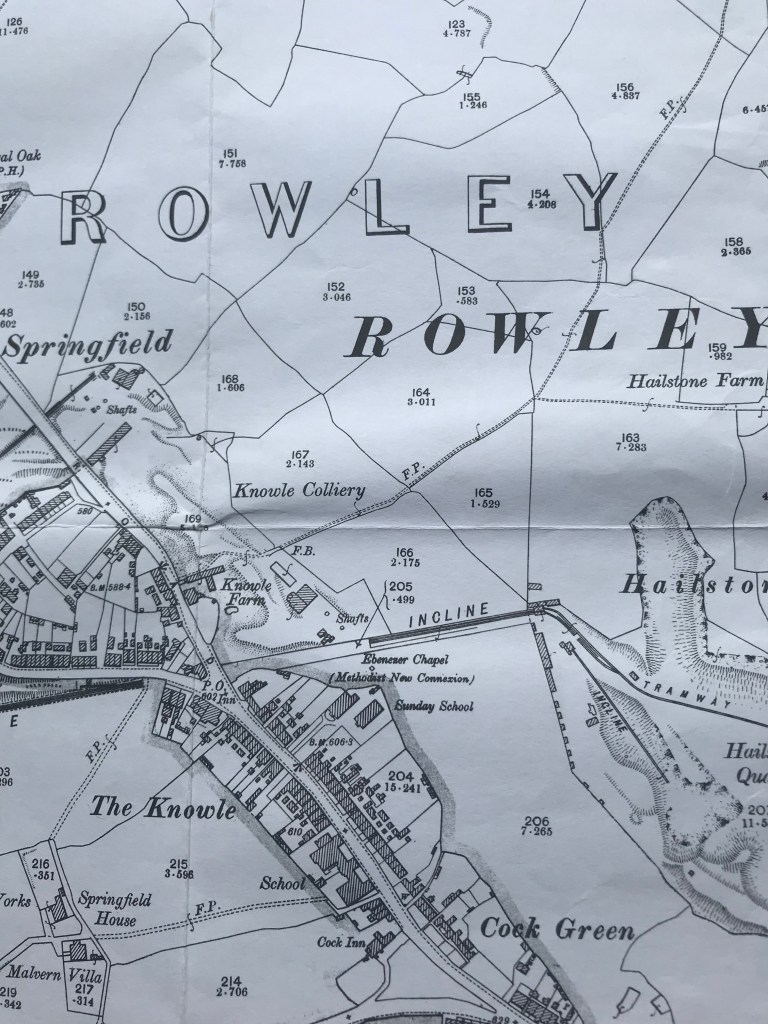
Copyright: Alan Godfrey Maps

Here is the 1902 OS map of Gadd’s Green and there are indeed four cottages in a row – could this be the location of the legendary Finger i’ the Hole Cottage?

The article continues “The front of the building was blown out one winter’s night many years ago when the occupant was a Mrs Cox, now of Gornal, and it has never since been repaired. The cottage is said to be over 300 years old and one family – that of Hill, members of which reside in an adjacent cottage – lived there for nearly 200 years. It is constructed of rough grey sandstone, and originally had two rooms, one up and one down. A stout roughly hewn oak beam, crossing the building from gable to gable, indicates where the first floor once rested, and shows that the height of the living room was under six feet. Occupying one-half of the building is a spacious old-fashioned fire-place, with a large open chimney and contiguous bake ovens. No fewer than ten men can comfortably stand in the aperture once occupied by the grate and its side seats.”

What a picture that paints! The Hill family were certainly in the area of the hamlets, two families of them in Gadd’s Green, then called Finger i’ the hole, in the 1841 Census and in later censuses also in Perry’s Lake.

A Royal Visit

“Another well known legend about the locality” the article goes on “is that concerning King John. It is said that in the early part of his reign the King visited the neighbourhood, and set up his throne in Throne Road. The site is supposedly marked by a group of four old cottages at the bottom of the road, and the story was once printed and sold by an enterprising grocer in the district. Verisimilitude is given to this otherwise almost incredible story by the fact that King John was greatly interested in Worcester, in the adjacent county (where he was buried) and was a frequent visitor to that place. He also frequently hunted in the forests of Kinver and Feckenham, which are not far distant from Portway.

The legend associated with Romsley in Halesowen, is that King John came onto Romsley Hill and, seeing the Premonstratensian monastery [presumably Halesowen Abbey] from that altitude, a circumstance he had wished to avert, walked away in disgust, also tends to give credibility to the Throne Road episode.”

What interests me about this account is that, although I had never heard about the Romsley story, my mother told me that she had been told as a child that Bell End was so called because King John had a Hunting Lodge there where a bell was rung to guide the hunters back after the chase. So that is another story which associates the Rowley area specifically with King John.  I have also wondered how the area which always seemed to be known as ‘The Throne’, long before it became Throne Road, got such a name. So perhaps it just may be true. And I have not seen any convincing account of how the area came to be Rowley Regis, Rowley of the King. Maybe, maybe…

Roman Portway

The article also tells of possible associations of the area with the Romans. The name Portway itself is, the writer claims, indicative of a Roman Road over the heath, or perhaps the old line of British trackway. I have heard it suggested that it may have been one of the ‘white ways’, the roads along which salt was transported around the country. These roads often passed through places with the word white included in their name, presumably because the salt was white. And it may or may not be coincidence that our portway road passes through Whiteheath…

Another Roman connection mentioned in the article relates to the discovery in 1794, when some workmen were demolishing a wall in the locality and discovered an ancient pot or vase which contained a large number of Roman silver coins. The article states these two indications go “conclusively to show that Romans once occupied the neighbourhood, which was in those days of considerable strategical importance, owing to its altitude”.

I must admit, I am not quite as convinced as the writer obviously was but it would be nice to know where those Roman coins went to!

 Portway Houses

A peculiar characteristic of a number of old cottages in Portway was noticeable, apparently, which was that one or perhaps more of the windows in each were  bricked up, undoubtedly by former tenants (or landlords) to evade the window tax. As an alternative to paying tax, the article suggested that “our forebears could live solitary lives in darkened tenements”.

The window tax was in force from 1695 to 1851 and led to many windows or openings being closed up to avoid the tax. a tax of two shillings was set for all homes with up to ten windows, with four more shillings payable by those with up to twenty windows and a further four shillings on top of that by those with more than thirty. The tariffs were varied over time. In 1766 the primary threshold was adjusted to seven windows. Unsurprisingly, the number of homes with exactly seven windows swiftly plummeted by an estimated two thirds. This legislation apparently gave rise to the expression ‘daylight robbery’.

An article online suggests that “the health of the population was significantly affected by the inevitable tax planning manoeuvres of the day. Even by the mid 18th century the medical profession were clear that living without adequate light and ventilation was causing increased typhus, smallpox and cholera and this is borne out by the Public Health Reports  I wrote about recently. The tax, and property owners’ attempts to avoid it, had become a primary cause of death for many of the country’s poor”.

One can, of course, still sometimes see houses where windows have been bricked up for this purpose but generally only in fairly substantial houses though this may only be because the poorer dwellings have long since fallen down or been demolished.

Also on local houses, the writer observed that there were a large number of houses in Throne Road which were of some antiquity.

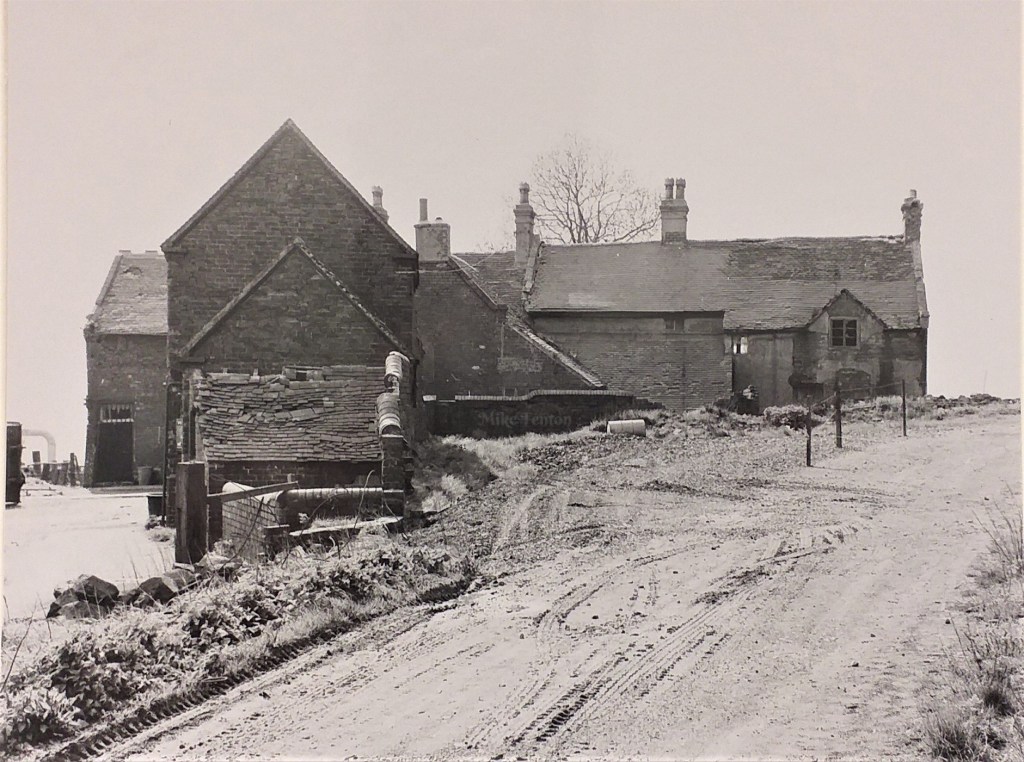
Old Portway Farm, 1960s. Copyright unknown but will be gladly acknowledged on receipt of information.

Several apparently had doors “on the outside of which was quaint partially corroded iron decorative work, the stout weather-beaten panels being held together by wooden pegs. Some of the cottages are partially erected of unpolished grey sandstone; some half- timbered, quaint and diminutive; a few large and of comparatively good architecture, whilst one – Portway Hall, in Throne Road, has a conspicuously fine frontage and is of imposing structure. The date of its erection, according to a plate over the large hall door, is 1672. On the plate is the head of a judge, which suggests that the building might have been the residence of a county judge, sheriff or magistrate.”

Portway Hall. Copyright unknown.

“The writer was permitted to look over the interior of the Portway Hall. The furniture is of considerable antiquity, some being of the seventeenth century. In the dining room, one is first impressed by a massive brightly polished chandelier; next by innumerable old vases decorated with quaint figure work in divers hues, and finally the eye is attracted by large dark oak chairs, which are carved, like the ancient miserere seats in our ancient cathedrals. Halfway up the large wide staircase leading to the first floor, one meets two cavities in the wall, each side a high stained glass window which are now occupied by vases but which were unquestionably made to hold statuettes. The ceilings of most of the rooms are richly scalloped in fine art and in the hall door, the stained glass, which is of another century, is very picturesque.”

Many current members of the Facebook page can remember visiting Portway Hall in the latter part of the 20th century, it is interesting to read an account written in the early 1900s. What a pity that this hall did not survive.

The Portway Tavern

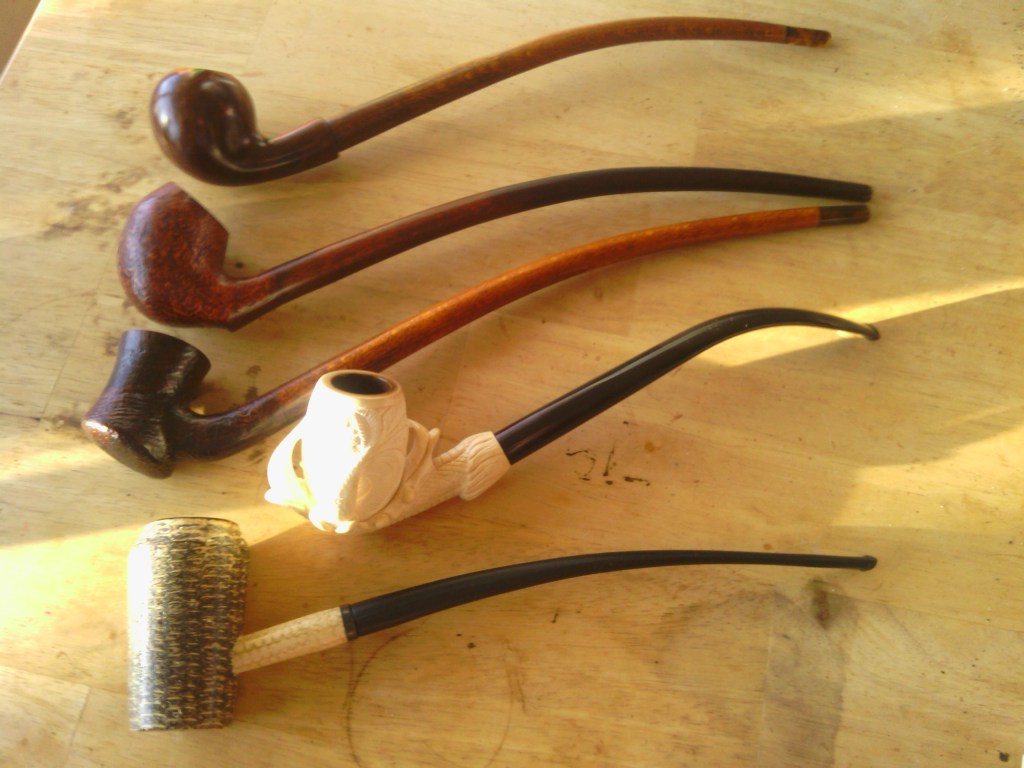
The Portway Tavern is described as “the rendezvous of generations of quarrymen”, referring to recent renovations which had done much to modernise the exterior but it was noted that “the interior is pervaded with an old-world atmosphere. On a rack in the smoke room are twenty-two churchwarden pipes, numbered and tobacco stained, the blackest belonging to the oldest and most regular attendant at the pipe club which meets in the tavern on winter evenings.”

Churchwarden pipes. Copyright Pipes Magazine.

The people of the area

The writer concludes that Portway is secluded and peaceful, its people on the whole an insular contented lot whose families have lived in the same cottages or the same street and worked at the same occupation for generations. He describes how, a stranger, stopping to ask a question, in a moment, is surrounded by a crowd of well-meaning inquisitive folk each contributing to the reply. Once the bona fides of the visitor is established, which he says is not easily wrought, he will be taken into their cottages and treated as one of themselves.

“There is a strangeness of spirit, so different from the traditional English. The men folk work on their doorsteps in the quarry and although they chose to remain secluded, their contribution to the world’s market – the famous Rowley Rag – has brought the urban district fame.

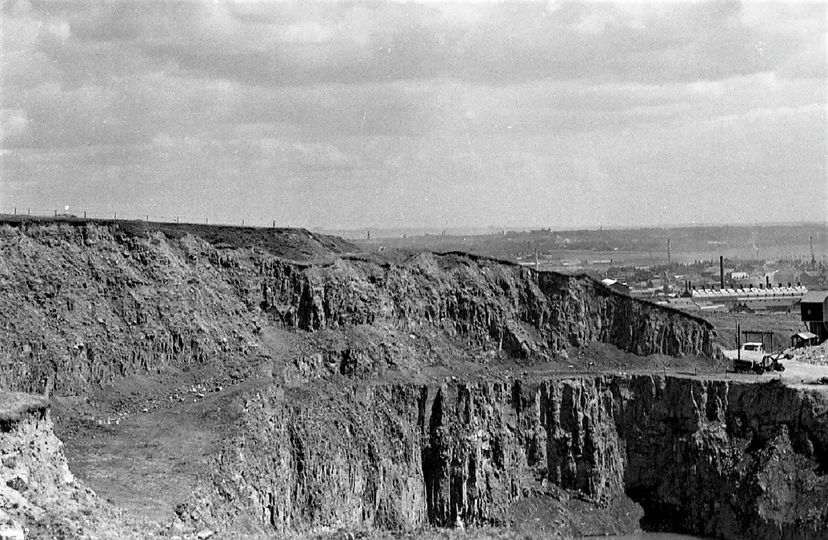
At the conclusion of this fascinating article the writer notes that many people – even in Rowley District would never have seen a quarry from which the Rag is produced. He describes a typical quarry, now derelict, standing near the apex of Portway (in which, remember, he includes Gadds Green and Perry’s Lake). He writes:

“It is a gigantic cavity, half a mile in circumference and of tremendous depth. The steep moss carpeted escarpments, the massive grey and brown sandstone and rock cliffs constitute a very impressive picture. Poised on the very precipice of the quarry is a small ivy clad house, which looks down on the Worcestershire, Warwickshire and Herefordshire Counties. The Malvern, Clent and Warley heights are clearly visible and stretched out, as on an opened Survey Map, are Smethwick, Oldbury, Langley, Frankley and their contiguous townships and villages.”

The Blue Rock Quarry, Copyright Jim Rippin.

“Only with a view such as obtains from this altitude can one realise the multiplicity of two counties industries; the diversity of landscape; the strange mixture of the urban and the rural in Worcestershire; the ugliness of the squat, smoking workers’ cottages in the close proximity, and the extent to which man has despoiled the natural face of the Black Country.”

There is no by-line on this article, we cannot know whose thoughts and observations we are sharing a century later when that landscape has again changed beyond recognition. But it offers, I think, a fascinating glimpse of our hamlets and life in them a century ago. He was not completely correct about insularity, we now know, we have learned about the Rowley men who went off to work in other areas. But I think he may have captured something of the atmosphere of these small communities and the people who lived in them for centuries.

SALVAGE OR SINK!

I have been continuing this week to dip into the very detailed and wideranging reports by the Health Inspector to the Rowley Regis Borough Council. This piece does not relate solely to the area of the Lost Hamlets but this campaign would certainly have included them so I have included it in my blog out of general interest.

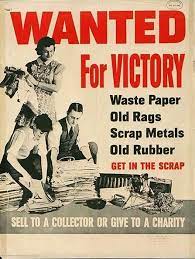
Recycling seems to be thought of these days as a fairly modern phenomenon but this extract from the RRUDC Health Inspector’s Report in 1941 shows that it has happened before!  

The Ministry of Supply started the “National Salvage Scheme” in December 1939 to save paper, rags, rope and string, household bones, rubber, food waste and all kinds of metal. The Women’s Voluntary Service helped run the campaign to encourage householders to salvage as much material as possible. The point in time of this report was almost halfway through the Second World War and shows how the authorities engaged with the community in promoting recycling for the War Effort.

Copyright unknown.

This report is taken from the online report verbatim.

“1941 Report of Health Inspector to Rowley Regis Urban District Council.

WASTE RECOVERY.

This work has expanded during the year according to the demand of National needs.

The premises at Powke Lane have been fully made use of and the ample space and cover provided has been invaluable. An Electric Baling Press for tins, and a larger one for paper (both purchased the previous year) were installed and are rendering excellent service.

In August a County Salvage Drive was inaugurated in which Rowley Regis as a Borough took part, and a two-ton Bedford lorry was obtained and fitted with high sides and painted with suitable advertising matter. The slogan adopted, “ SALVAGE OR SINK,” has caught on very well.

A loud speaker and gramophone were fitted to this vehicle, and after the official send-off by the Mayor and Mayoress, the Chairman of the Health Committee, the Organiser of the W.V.S., and the Leader of the Girl Guides, a tour of the streets and a canvas of every house in the district was made within the allotted fortnight. Excellent results were obtained in material, but financially we were no better off owing to heavy expenses incurred to make the effort a success.

Apart from this, however, the imagination of the Public was stirred and it did help to keep the householders more salvageminded with the resultant continuous even output.

My opinion is that whilst County Drives have played a useful part in educating the people in this war effort, National Appeals result in a far heavier response by those firms who have had the capacity to contribute the weightier ledgers and redundant material which is asked for.

The Women’s Voluntary Service has rendered excellent service and on two occasions every house in the Borough has been canvassed, and handbills delivered. In addition to this, large bills with a gummed front surface have been distributed and stuck inside the windows of the houses. The W.V.S. has been most successful in this form of advertisement as at least one house in every 20 throughout the whole Borough exhibited at least one bill in the house or shop window.

The bills or posters were in large red block type letters with the words “ PLEASE KEEP your Salvage out of the Dustbin,” and “ Put your Scraps in Pig Food Bins and maintain your Eggs and Bacon.” The results were well worth the effort.

In addition to the above, on two separate occasions, every dustbin lid in the Borough had glued on to it a circular paper disc 6 inches in diameter with red letters with the following words “For Ashes Only. Keep your Salvage out,” and “Salvage in the Dustbin is an offence against the War Effort. Are you Guilty? ”

Needless to say, the results were remarkable.

Further to all this, an alternative weekly collection of Refuse and Salvage was inaugurated during the early months and continued throughout the year.

This system of salvage collection is far in advance of the hanging of bags in the street for householders to put the paper in once per week, a method as unsightly as it is disagreeable. A weekly collection from shops, offices and stores is also maintained.

Splendid results have also been obtained from Schools. The method is for children to collect paper and metal and take it to school. It is weighed daily and each child credited with the amount collected. Prizes to the children of each school have been awarded monthly in the form of Saving Stamps, and these have been presented by the Mayoress together with the Chief Sanitary Inspector. The Mayoress (Mrs. Card) has done wonderful work in this connection as up to 10 schools have been visited in one day every month awarding the prizes and instructing the children on salvage procedure.

Much praise is also due to the teachers, most of whom have given every possible help throughout the whole period.

Pen friends have also been made with our local school children in towns in the Yorkshire area.

Prizes of Saving Stamps have been awarded to the children totalling £22 8s. 6d.

Fortnightly visits to the tip and Salvage Disposal Depot have been arranged by the W.V.S. for groups of children from the various schools, and this has formed an interesting feature of our advertising campaign.

The estimated value of Salvage sales are as follows:—[ For those who are not familiar, these sums are shown in pounds, shillings and pence!]

January                                £51 15 10

February                              £490 16 1

March                                   £202 1 1

April                                       £217 15 11

May                                       £318 7 6

June                                      £325 0 7

July                                        £251 10 6

August                                  £407 5 3

September                         £240 0 2

October                               £305 18 9

November                          £278 16 11

December                           £278 19 1

Estimated total sales … £3,368 7 8

The following are the amounts of waste material recovered and returned to industry:—

Tons      Cwts      Qrs         Lbs.

Waste Paper                                                      387         0              2              7

Pig Food                                                               320         6              0              0

Ferrous Metals                                                                 202         2              2              18

Non-Ferrous Metals                                        1             7              0              14

Baled Tins                                                            70           5              0              0

Bones                                                                   7              8              3              4

Rags                                                                       8              3              2              0

Broken Glass                                                      29           14           3              0

Bottles, Jars, etc. 494 gross, 3 dozen.

Deputations from other Authorities have visited the District and have copied some of our methods.

The number of Communal Pig Food Bins in the district is 825, and these are collected three times per week. The Refuse and Salvage vehicles also collect household scraps from the houses on the weekly visits.”

Copyright details unknown.

We may think we are doing something new but in reality, recycling and re-using materials used to be essential and a way of life to a far greater extent than it is now. It is our modern society which has forgotten about ‘rag and bone men’ who came round the streets with their horse and cart and we have become used to single use plastics and throwaway appliances.

Perhaps we might still have some lessons to learn!

Pubs in the Lost Hamlets 1 – The Bull’s Head

There was no shortage of places for folk to have a drink in days gone by, in Rowley and around. Hitchmough’s work on Black Country pubs is an amazing and most interesting read, packed with information and stories. (Hitchmough’s Guide to Black Country pubs – an invaluable source for local historians is at longpull.co.uk ) He lists 29 pubs in and around Rowley, 7 with a Whiteheath address in addition to the ones in the Lost Hamlets. Not all of them will have been operating at the same time and most of them have long since disappeared but in their time, there were a lot of them!

For the purposes of this study, I shall look at the main pubs in the Lost Hamlets in separate posts, as there is too much information for each of them to fit them into one piece

I am starting with the BULLS HEAD which was at 1, Dudley Road, Springfield, (Tippity Green), Rowley Regis. This is the view that most people now would recognise, from Anthony Page’s Second book of Rowley Regis images.

Copyright Anthony Page.

According to Hitchmough, who is the fount of all knowledge on such issues, the owners of the Bull’s Head were Ferdinando Dudley Lea-Smith, Thomas Benjamin Williams and Lizzie Bate of Rowley Regis, Ansells Ltd. (acquired in 1946) and later Sue Whittall and Mark Franks [1997].

It is entirely probable that there was a public house or hostelry of some sort on the site before formal licensing was introduced but the LICENSEES were as follows:

Joseph Bowater [1834] – [1854]

Mrs. Eliza Bowater [1860]

Elizabeth Bowater [1861] – [1865]

William Henry Hingley [1868] – [1870]

William James Hingley [1867] – [1874]

William Williams [1875]

Thomas Benjamin Williams [1875] – [1891]

Thomas William Williams [1892] – [1900]

Howard Woodhouse [ ] – 1909);

Simeon Dunn (1909 – [1912]

Thomas Benjamin Williams [1911]

Gertrude Fletcher (1913 – [ ]

John Hughes [1916] – 1932

Hitchmough has later licensees listed but I have stopped at about 1920 as my study is really looking at this earlier period.

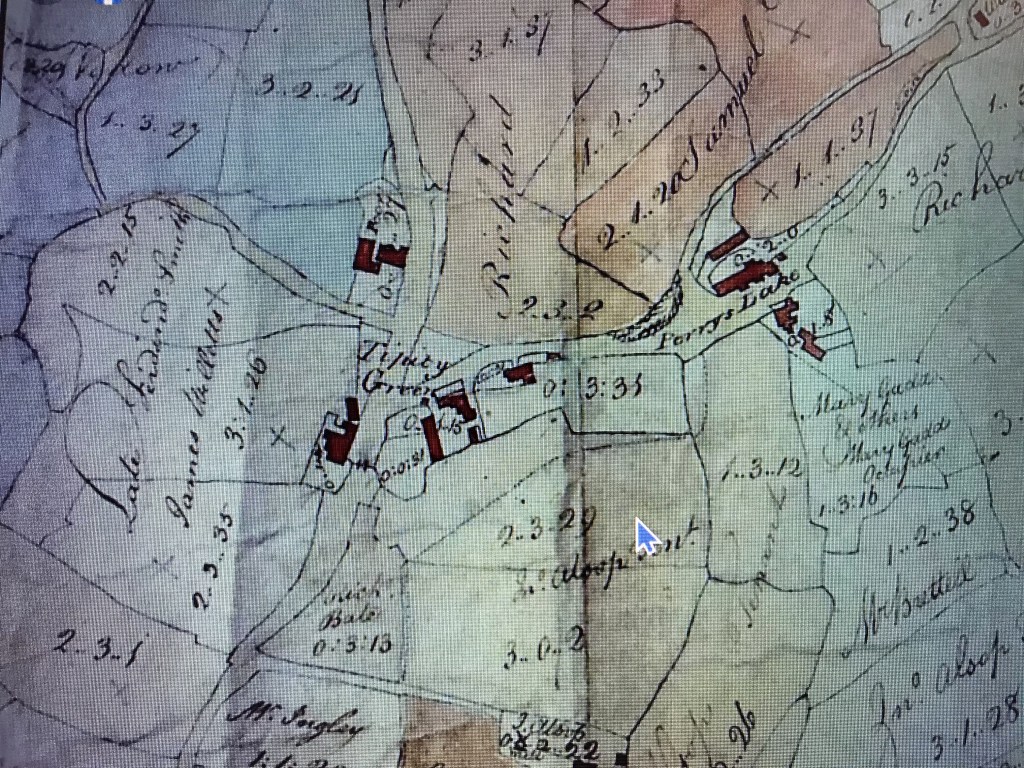
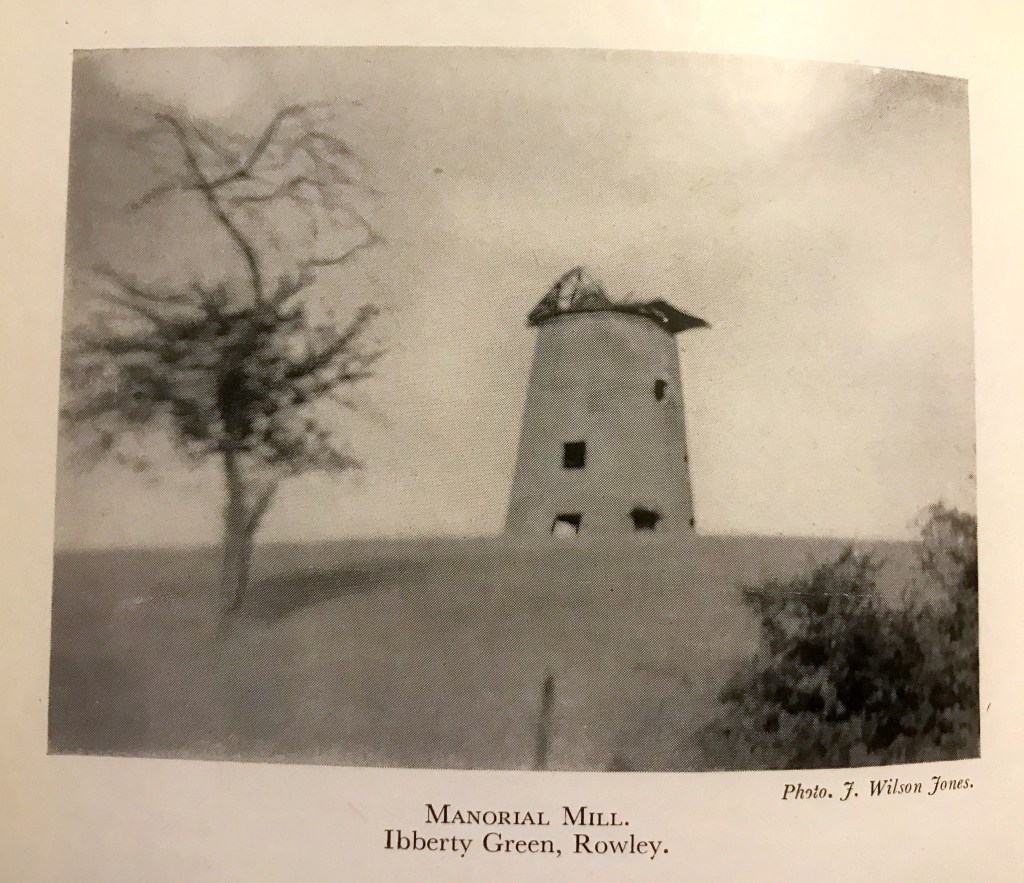
This map is dated about 1803, copyright Bob Adams. It shows a substantial building on the site of the Bull’s Head which was probably a hostelry even then. There is not much other development, the buildings above it are marked Poor and are presumably the Poorhouse which fits with later census routes. The windmill is just visible in the middle at the bottom, the tiny building with sails, in the ownership of J Alsop, according to this map. There is no development to the North side of Tippety Green but the building opposite the Bull’s Head may be the Mill Farm. I suspect that the tiny square there is the Tippity Green Toll House but that is just a guess! Perrys Lake is already quite a substantial area with several buildings shown.

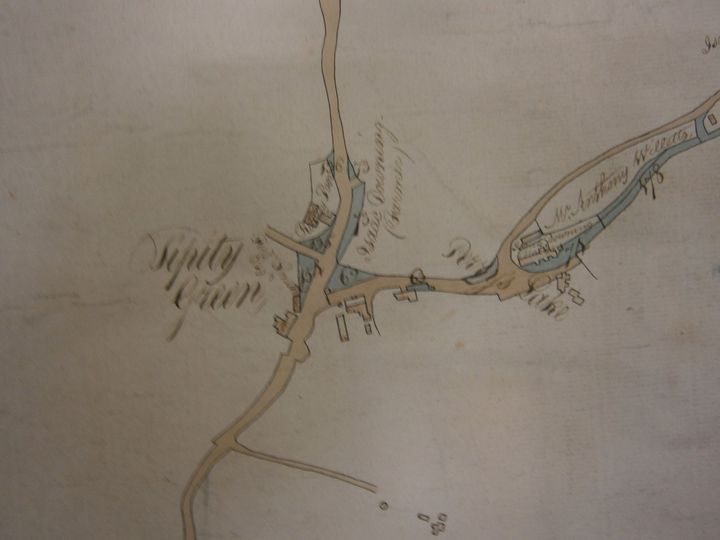
This hand-drawn map looks to date to about the same period and was shown on Facebook by Roger Slater. It too shows the same buildings but possibly also shows the ‘green’ area. Presumably the bar shown across the road to Perry’s Lake is the Toll Gate.

Joseph Bowater, the first licensee listed by Hitchmough, was also a butcher and it was quite common in those days for licensees to have other full time occupations in addition to the pub, including butchers, farmers and boilermakers in this area. In the 1841 Census, Joseph Bowater was listed as living in Tippity Green and his occupation was shown as a butcher. His age was shown as 50 and with him was Elizabeth Bowater, also 50 with no occupation shown, and also William Cooper, a Male Servant, aged 20, and Catherine Hargrove a female servant aged 25. The two men were both born in Staffordshire, the two women were not.

Also living there were three other men, all labourers. Since Joseph had already been the licensee for several years, it appears that he was combining his butchery business with the pub which was probably why the pub was called the Bull’s Head. (In similar vein, the Levett family apparently sold or let land near their butchery business in Birmingham Road, Blackheath for the erection of a pub (first licenced in 1857) and specified that the pub should be called the Shoulder of Mutton which is, as far as I know, still there and still a pub.)

So it appears that as early as 1841 Joseph Bowater was operating also as a lodging house keeper at the pub. A Joseph Johnson Bowater was baptised at St Giles on 13 Jul 1788, the illegitimate son of Ann Bowater, one wonders, as ever whether his middle name is a clue to his father’s identity. And  I was very interested to note from the parish register that sixteen years later in 1804, a child Elenor was baptised, the ‘base-born’ daughter of Daniel Johnson and Elizabeth Bowater , unusual in this register for the father of an illegitimate child to be named – perhaps the Bowaters and the Johnsons were near neighbours!

There were other Bowater families in the area at the time, the first Bowater mentioned in the Parish Registers of St Giles is in 1740.

In 1851 the census gives  clearer picture – Joseph Bowater, 64 still showing as living in the first entry in Tippity Green, is a Vittler (a corruption of Victualler – someone who supplies Victuals – food and drink) and Butcher who was born in Rowley and his wife Elizabeth, 66 who was born in Birmingham. Joseph is also employing a butcher Luke Lashford aged 21 who was also born in Birmingham (also referred to in my post about the Redfern family), two female general servants, born in Halesowen and Tipton respectively , a fourteen year old lad from Dudley described as an Inn Servant and a visitor William Bowater 40, born in Rowley. 

Whereas Tippity Green came in time to be used as the name of the street running from Dudley Road to Perrys Lake, it seems that at this time the names of various small hamlets referred to a group of dwellings and small businesses grouped together, often round an open space or Green rather than a linear row of houses, as shown on the early maps above, hence Tippity Green, Cock Green, Brickhouse Green although quite where one stopped and the next started is not so easy to work out. One thing I have learned is not to get too hung up on precise addresses at this time.

Bowater was clearly keeping the Bulls Head Inn , licensed premises even though the Census does not mention it by name and this is borne out by that little word in the description of one of his employees – Inn servant! And when I looked at the Enumerator’s Route which Ancestry provides at the beginning of each census piece, the enumerator actually mentions the Bulls Head Inn although he doesn’t identify it on the Census sheet itself, how contrary and unhelpful for us later local historians centuries later!

Incidentally, the next entry in the census is for two people described as Almspeople so that gives us a clue that the almshouse was somewhere very close to the Bulls Head. One of those was Thomas Beet, my 4xg-grandfather, then aged 88 and blind.

There is remarkably little information about Joseph Bowater that I can find. There is one baptism in St Giles in 1829 for James, son of Joseph and Mary Bowater of Cock Green, a labourer which is roughly in the same area as the Bull but there were a lot of Bowaters around and there is no real evidence that this is the same Joseph.  By 1841 our Joseph was married to an Elizabeth but no children of that marriage are listed anywhere that I can find. Joseph appears to have died in 1857 and was buried on 23 Jan 1857 at St Giles, aged 70, his abode given as Tippity Green and his cause of death shown in the Burial Register as old age.

Elizabeth or Eliza Bowater then appears to have taken over the licence as she is shown by Hitchmough as the licensee until at least 1865. In the 1861 Census, she is still in Tippity Green, aged 71 and a publican, living with one Elizabeth Bowater, 71, publican and one house servant and one boarder, a stone dresser so the butchery business appears to have ceased or at least not to have a butcher there. There was a grocery shop listed next door in that census, occupied by Benjamin Rock so perhaps he was using part of the premises which had previously been used by the butcher.

Inquests were often held in local pubs and the Bull’s Head was no exception. A report in the Stourbridge Observer on January 1 1865 told of

“An adjourned inquest was held at the BULLS HEAD, Perry’s Lake, on Wednesday last, before E. Hooper, Esq, Coroner, touching the death of Henry Parkes, a collier, 44 years of age, who met with his death through falling down a coal pit on the 21st ultimo. On that day, the deceased and several others who all worked for Mr. Mills of Gornal went to the office to receive their wages. Deceased left the office first, and walked towards the pit to pay his club money. One of the men heard a sound, and immediately missing deceased, some tackle was procured, and a miner named Edwards and another man descended and brought deceased from the bottom of the shaft. He was quite dead. The pit according to witness’s statement, was fenced all round, and was not at work. A man and a boy have both lost their lives previously, by falling down the same pit. After the first inquest, the Coroner and Jury went to view the pit.

At the adjourned inquest, on Wednesday, Mr. Baker, Government Inspector of Mines, was present, and also Mr. Homfray, solicitor, with Mr. Mills, on behalf of the proprietors of the colliery.

Some further evidence was taken of the state of the fencing round the pit, and William Morgan, the banksman of the pit, was called by Mr. Homfray. He stated that the pit was in the same state when the Jury saw it as at the time of the accident.

Mr. Mills was also sworn, and deposed to the same circumstances, and promised that new iron railing should be placed round it.

The Coroner summed up, impressing upon the Jury the fact that there was no evidence as to how the deceased got into the pit. If they were of opinion that the pit was properly fenced of course, would be accidental; but if they thought that the pit was not properly fenced, they would leave the matter in the hands of the Government Inspector.

The Jury retired for ten minutes, and then returned a verdict of Accidental Death, accompanied with the opinion that the pit was not properly fenced at the time.”

Poor Henry Parkes and his family and just before Christmas, too. After publishing this piece I was contacted via Facebook by Luke Adams who was able to give me more information. His wife was related to the Mr Mills referred to above and Luke thinks that the reporter misheard the name of the place, which he gave as Gornal but which Luke thinks was probably Gawne Hill which was the site of a mine and very close to the Bull’s Head. This makes a lot of sense to me, as I had found the Gornal reference odd. Thanks, Luke!

The Bull’s Head also acted as a community venue and several meetings of striking miners and pottery workers were held there at various times, as reported in the local press.

William Hingley took over the licence from at least 1868 so I looked for a death or burial for Elizabeth Bowater at or around that date. But there was no such burial at St Giles anywhere near that date. However, there was a death registered in the Dudley Registration District in the September qtr of 1866 for an Elizabeth Bywater of about the right age. And FreeREG shows that an Elizabeth Bywater was buried in Upper Gornal on August 1866, aged 70 which is exactly the right age for Elizabeth Bowater. Upper Gornal? The abode recorded in the Burial Register  is the clue here, she had been in the Union Workhouse there, just along the road from Upper Gornal and if, as I surmise, she had had no children to look to her welfare, this might well be where she ended up if she became infirm.

I had noticed when looking at the Bowaters in censuses that they rarely employed anyone from the village, always from the surrounding area, perhaps they did not endear themselves to local people.

There is an article on the workhouses.org.uk site from the Dudley Guardian here on the Dudley Workhouse, including an article dated April 1866 so particularly timely for this Elizabeth which gives a ‘pen and ink sketch’ of the new workhouse, well worth reading and fairly positive, considering the general reputation of workhouses at that time.

https://workhouses.org.uk/Dudley/#Post-1834

The Licence for the Bull’s Head was now taken over by William Henry Hingley [1868] – [1870] and then William James Hingley [1867] – [1874]. I do wonder whether these two were actually the same man. Certainly a newspaper report in the Stourbridge Observer on 28 September 1867 has William James.

In the 1871 Census William J Hingley is recorded as being 32 and a licensed victualler, born Rowley Regis. He had married Ann Maria Barnsley in 1862 at Netherton and children Caroline M, born  1864, William H, born 1867 and Mary born 1869 were listed in  the census, all born in Rowley Regis. His father Titus Hingley was also a publican, running the Heath Tavern in Cradley Heath – the licensed trade is another that often ran in families.

Did he keep a good house? I suspect it depended who you asked…

A report in the Stourbridge Observer on 28 September 1867 says:

“At the Petty Sessions, on Wednesday last, before H. G. Firmstone, E. Moore, and F. W. G. Barrs, Esqrs, William James Hingley, landlord of the BULLS HEAD, Tippitty Green, was charged by Superintendent Mills with unlawfully and knowingly permitting drunkenness in his house on the 9th instant.

Police-sergeant Powner said that he visited the defendant’s house after eleven o’clock. He found about forty men in the house, several of whom were quite drunk. Two of the men were playing at dominoes, and four others at cards. About one o’clock in the morning he heard great screaming at the defendant’s house, and some person shouting ‘Murder’. He visited the house again just before two o’clock, and there was fighting going on, the defendant taking no notice.

Defendant admitted that there were a number of persons ‘fresh’, but he did what he could to get them out. Fined 5s and costs.”

So it sounds as though he was popular with some people!

The Police were obviously keeping an eye on the Bull’s Head. A report in the Stourbridge Observer on 21 February 1874 relates:

William James Hingley, landlord of the BULLS HEAD INN, Rowley, was charged with a similar offence [being open during prohibited hours] on the 8th inst.

Police-constable Cooper said he visited defendant’s house on the above date at 5.40pm and found a man and a woman there. The landlady was warming some ale. The man gave the name of Joseph Whitehouse of Dudley. Defendant’s wife said the two people said they were travellers, and she was getting them something to eat and drink, when the officer came in. Joseph Whitehouse also gave evidence. The case was dismissed.”

So he was let off here. Certainly convictions on licensing matters for a licensee were not a trivial matter. At the Annual Licensing Meeting of the Rowley Regis Petty Sessional division, held at Cooksey’s Hotel, Old Hill on 27 August 1870, the County Express reported that the landlord of the Boat Inn, Tividale who had two convictions recorded in the previous year, had his licence taken away altogether, two more had their licenses suspended, and five landlords, including William’s father Tobias in Cradley Heath were ‘cautioned in reference to the future conduct of their houses’. Numerous beer house keepers around the area applied for wine and spirit licences which were all refused except one. Nine men applied for a licence to keep a beerhouse and all but one of these were refused, too. So frequent offences might well lead directly to a loss of livelihood.

But an advertisement in the Dudley Herald on the 7 March 1874 seems to show the whole brewing apparatus  being sold off.

“Unreserved sale ….. at the BULLS HEAD, Tippetty Green near Rowley Regis ….. the whole of the

excellent brewing plant, well seasoned hogshead and half hogshead ale casks, 350 gallon store cask,

2 and a half pockets fine Farnham and Worcester hops, malt, whiskey, stock of old and fresh ale,

crossleg and oblong tables, rail back benches and forms, quantity of chairs, 4-pull beer machine, tap

tables, malt crusher, iron boilers, vats, coolers, fowls, stock of hay etc. together with the neat and

clean household furniture…..”

Whether this sale went ahead we do not know because certainly William James Hingley was still landlord of the Bull’s Head in June of that year when the following report appeared in the Stourbridge Observer

“William James Hingley, landlord of the BULLS HEAD, Tippetty Green, Rowley, was charged by Police-sergeant Walters with selling ale during prohibited hours on the night of the 13th inst, to wit, at 20 minutes to twelve.

Defendant’s wife pleaded not guilty.

Police-constable Jackson said that he visited the defendant’s house at twenty minutes to twelve o’clock. When he heard some persons laughing and talking. Witness pushed the door, but it was fastened. He got over the wall and found several men sitting in the bar, and some women. Cole had a glass of liquors, as also had a man named Joseph Baker. A woman named Priest had a stone bottle full of ale. He went to the front door, and met the woman coming out. Witness told Mrs. Hingley of it. She said the ale was filled before eleven o’clock. Witness saw the bottle filled.

Defendant said it was club night, and there was a dispute over a bondsman, and could not help it.

Sergeant Mills said defendant had been previously convicted; although it had been some time since.

The Bench considered it a bad case, and fined defendant 20s and costs.”

Whether or not these issues led to the Hingleys giving up is not known but Thomas Benjamin Williams took over the licence at latest in 1875 which is very close to that date and the sale.

Thomas Benjamin Williams was born on 6th August 1844, at Glasbury on Wye, Radnorshire. He married Alice Susannah Darby on 8th September 1874 at Rowley Church. He died in 1908.

The Baptisms Register at St. Giles’, Rowley records the baptism on 15th August 1875 of Ella Mary, daughter of Thomas Benjamin, publican of Tippetty (sic) Green and Alice Susannah Williams,

(Thirty-five years later on 29th July 1911 Thomas Raymond (b. 9/7/1911), son of Thomas Benjamin and Jessie Williams, brewer, The Croft, Rowley Regis was also recorded, the next generation!)

So the 1881 Census for the Bull’s Head has Thomas Benjamin Williams (36), licenced victualler, born Glasbury;  Alice S. Williams (39), wife, their children Ella M. Williams (5), Florence Williams (2), daughter and Lizzie Williams (7 months), daughter, all born in Rowley Regis plus Louisa Plant (14) and Hannah Horton (14), both general servants and born Rowley Regis. The Williams family employed people from the village in contrast with the Bowaters.

Sadly Florence died in December 1883 and was buried at St Giles on 10 December, aged 5 and Ella Mary Williams died in December 1888, aged 13 and was buried at St Giles on the 20th December.  So in the 1891 Census there were Thomas Williams (46), licensed victualler, born Glasbury, Radnorshire, Alice S. Williams (39), wife,  Lizzie Williams (10), daughter, scholar, Thomas B. Williams (8), son, scholar, all born Rowley Regis and Ellen Hill (22), a general servant, born Rowley Regis.

Anthony Page had this photograph in his Second Book of Rowley Regis photographs and he dated this to the late 19th Century. The buildings to the right of the house are the brewery. Perhaps the people standing outside are the Williams family.

An article in the Black Country Bugle in January 2003 had the following tale to tell:

‘Tippetty Green – The Tromans Family – And The Rowley Quarries’ by Peter Goddard

“The BULLS HEAD was a little more upmarket thanks largely to the efforts of Thomas Benjamin Williams and his wife ….. Thomas had left the quarries to take the tenancy of the BULLS HEAD and it was here that their children were born – Lizzie and Thomas Benjamin Jnr. The pub prospered much to the reported displeasure of the Levett family who were running the PORTWAY TAVERN …… One night the windows of the BULLS HEAD were mysteriously smashed. The following night, Thomas, always called Master by his wife, was seen leaving his pub with a poker up his sleeve, and setting out over Allsops Hill. The following day it was reported that the windows of the PORTWAY TAVERN had been broken during the hours of darkness! The BULLS HEAD suffered no further damage.

Having worked in the quarries Thomas knew the hardships the local families suffered and during very severe periods he would send a cart to Old Hill Bakery for a load of bread which he distributed free of charge to his customers.

…..The pub continued to improve its trade and Thomas eventually purchased the freehold and began to brew his own beer. The business made rapid progress and Thomas purchased other pubs in the area, including the WHEATSHEAF at Turners Hill and the GRANGE in Rowley Village. They had 14 pubs in all and to meet the demand they built a bigger brewery on land to the rear of “The Turnpike” immediately opposite the BULLS HEAD. Williams’ [This is a useful clue to the whereabouts of the Turnlike!] Fine Rowley Ales continued at the Rowley Brewery until 1st November 1927 when they began to purchase beers from the Holt Brewery of Birmingham. Thomas (Jnr) had taken over the business when his father died in 1908. Ansells Brewery bought out the Holt Brewery and being keen to expand further, made a bid for young Thomas’ business. After protracted negotiations an ‘attractive’ offer was finally made and accepted and the enterprising business of T. W. Williams and their Fine Rowley Ales finally came to an end…..”

Copyright NLS Creative Commons.

https://maps.nls.uk/index.html

This map, the OS 25” to the mile, was surveyed in 1881 and revised in 1914 and it shows the site of the brewery in Tippity Green. It ceased brewing on 1st November 1927.

So although the list of licensees shows other people at different periods between 1900 and 1911, the pub was still in the ownership of the Williams family.

So in the 1901 Census, Thomas and Alice Williams were still at The Bulls Head, Thomas now listed as a brewer rather than just a publican with their children Lizzie, now 20 and Thomas Junior, 18 and one general domestic servant Maria Parsons, aged 19. Next door on Dudley Road was still a grocer’s shop where Hannah Povey (or possibly Dovey) was noted as the shopkeeper. Living with her and her husband Charles Povey (or Dovey), who was a self-employed haulier, were her daughter Isabella, Isabella’s husband Simeon Dunn who was also listed as a brewer and their five children. Simeon Dunn was listed as the licensee from 1909, the year after Thomas Williams’s death, until 1912 when the licence went back to Thomas Junior for a couple of years. So these were obviously closely connected with the family and reinforces  my feeling that the grocery shop was part of or intrinsically connected with the Bull’s Head.

The Parish Register notes on 15th September 1909 the baptism of Wilfred, son of Simeon and Isabella Dunn, brewer, of 1, Dudley Road, the usual address of the Bull’s Head and the 1911 Census has Simeon Dunn (45), brewer, Isabella Dunn (43), wife, married 23 years, James Dunn (22), son, coal haulier,  (perhaps with his grandfather/step-grandfather Charles Povey/Dovey?), William Dunn (19), son, a bricklayer’s apprentice, Amy Dunn (18), daughter, Arthur Dunn (15), son, blacksmith’s striker, Lily Dunn (12), daughter, Florence Dunn (9), daughter, Hilda Dunn (6), daughter, Wilfred Dunn (1), son, all born Rowley Regis. Simeon and Isabella’s descendents are still very much around today.

Norma Postin also confirmed in a comment on this piece about the descendents of Simeon and Isabella Dunn – “I am one of them as they were my gt grandparents . My grandfather was James Dunn. Isabella was the daughter of Hannah and her first husband Samuel Wittall. Isabella later married Charles Dovey. Simeon and Isabella’s daughter Florence married John Noott in 1927 , and lived at Rowley Hall .” Thanks, Norma, the web of connections around the Hamlets is always interesting!

Luke Adams also added some more information on Facebook about Gertrude Fletcher, the landlady in 1913 and who was Luke’s wife’s great-grandmother. She was apparently pretty formidable and well known as the sole proprietor of a series of pubs and cider houses such as The Plough in Halesowen, which was quite unusual for a woman in that time. Coincidentally, she was also the granddaughter of Mr Mills, mentioned in connection with the death of Henry Parkes. And he even supplied a picture of her!

Gertrude Fletcher, Copyright Luke Adams.

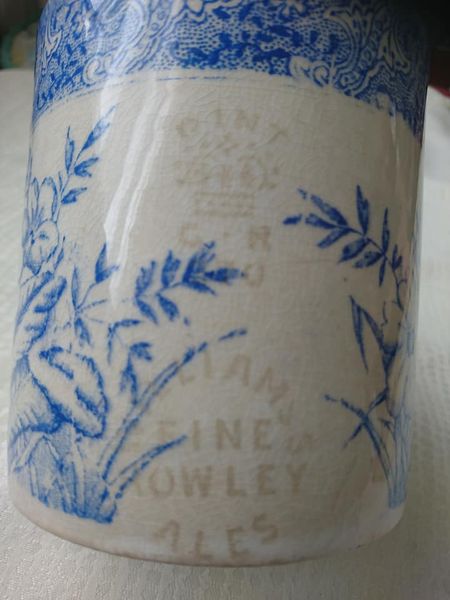
The invaluable ‘I remember Blackheath and Rowley Regis’ Facebook page and community can add some interest to the picture, too. In 2021 Simon Hancox showed a picture of a Williams Fine Rowley Ales blue and white Pint tot, owned by his mother and which was thought to come from the Bull’s Head. Simon’s mother lived at Rowley Hall which he says was owned by the William’s family so their property holdings in Rowley were obviously substantial. A rare and possibly now unique piece of Rowley history, I show it here, if Simon has any objection to this, I will of course remove it.

Copyright Simon Hancox.

As I said in the original piece, I had no doubt that there are many local residents who have memories of this pub, so much a part of the lcoal community over such a long period which has been confirmed on the Facebook page ‘I remember Blackheath and Rowley Regis! Many people had lived there or had friends who lived there or had held family celebrations of various sorts there, many happy memories.

I had asked whether the pub is still open or whether it has suffered the fate of so many pubs now and had closed down. Immediately this piece was published, several people reported on the Facebook page that the Bull’s Head is currently closed and looking sad and run down, there seem to be various rumours about potential future uses though no mention of it reopening as a pub to the regret of many people. Another community asset lost and the long usage of the site as a pub apparently at an end. Many thanks to everyone who added information and answered my question.

The family of Joseph and Ann Maria Redfern, Part 2

Later Redferns after 1851

Following on from my last piece about the older children of this couple, this piece looks at the children born after the 1941 Census.

By 1851, the family was still on Turner’s Hill, Joseph still a labourer but now with his age given as 48 and his place of birth as Rowley Regis as were the whole family. Maria was now 50, Eliza 20, Joseph 18, William 16 both boys working as labourers; Ann at 13 was still a scholar. In the interim between the censuses, Solomon, aged 9, John aged 7 and Samuel aged 5 had all been born. All were described as scholars.

Incidentally, when I looked at later Censuses, I noticed that Joseph’s widow Maria, later described herself as the widow of a Highways Labourer and in 1871, he described himself as a Furnace Labourer, although he and Maria had a boarder who was a Highways Labourer so perhaps he moved from one job to the other. Certainly other Redferns were Furnace Labourers, gruelling hot work for much of the year, I suspect. Their family has grown in ten years.  

In 1851 Eliza is still living at home, now aged 20, Joseph aged 18, William, aged 16 and Ann, aged 13, the two boys were working as labourers and Ann and the younger children were Scholars. But Elizabeth, like her mother, had no occupation shown. Also Solomon, aged 9, John, aged 7 and Samuel aged 5 had come along. The household is almost next to Turner’s Hill Farm so they were pretty high up on the hill.

Henry Redfern

I also noted that there was another Redfern in the later censuses, living with Joseph and Ann Maria and later with his own wife and family. This was Henry Redfern who was born in 1854, the illegitimate son of Eliza Redfern. Henry was baptised at St Giles on 22 Mar 1854 as the son of Eliza Redfern of Turners Hill with no father named and appears to have been raised by his Redfern grandparents as he was with them in the 1861 and 1871 censuses, and after his mother had married Daniel Hughes in 1859 and moved to Dudley.

Family trees on Ancestry state that on his marriage certificate in 1875 (when Henry married his cousin Elizabeth Redfern), his father’s name was given as Luke Lashford. I can find only one reference to this name in the locality and this was in 1851 when a Luke Lashford, born in Birmingham, was living and working as a butcher for Joseph Bowater at the Bulls Head in Tippity Green – the dates fit, so presumably this is Henry’s father.  After this census Luke Lashford disappears without trace. I cannot find a death for him, nor any other record of him later, it does look as though he may have ‘done a runner’! Fortunately, the Redferns were obviously a very supportive family for Eliza.

Henry worked for most of his life in the stone quarries and he and Elizabeth lived on Turners Hill all their lives, it appears from censuses, and had nine children. Their children were Mary A (1874), Henry (1875), Eliza (1878-1878), Joseph (1879), Martha (1882), Louisa (1885), Walter (1889), Sarah Jane (1891) and Ernest (1895) – another nine great-grandchildren for Joseph and Ann Maria.

It seems likely to me that, since Henry worked in the quarry for at least forty years, he may appear on some of the numerous photographs of quarry workers which are in various books and online. Alas, I have no way of identifying him if so but perhaps some members of the Redfern family might recognise a family likeness. Do tell if you can!

Younger children of Joseph and Ann Maria Redfern

Solomon Redfern 1841-1928

Solomon stayed in the hamlets all of his life, working in the quarry. He married Mary Ann Mole of the Club Buildings, Hawes Lane, on 8 Feb 1863 at St Giles when he was 21 and she was 22. They initially lived in Hawes Lane, possibly at the Club Buildings but by 1881 they were back in Perrys Lake where they stayed for the rest of their lives. In the 1901 Census, the address is given as Hailstone Quarry, following on from Perrys Lake in the list so perhaps they were further up the hill, actually within the quarry. Family members may be able to tell me this.

Solomon’s children:

Solomon and Mary Ann had six children that I know of.  These were William (1863-1863), Ann (1864-1948), Alfred (1866-1940), Edward (1868-1871), William (1872-1956) and Samuel (1876-?).

Of those children, the first William died aged 15 weeks, sadly not unusual in those days.

Ann (1864-1948) married Eli Eades at Reddal Hill church on 19 Dec 1891. They had three children, Annie in 1893, William G in 1895 and Jesse in 1901. Eli Eades was a draper and died in 1023. William appears to have followed him into this trade and they may have had a shop in Long Lane, somewhere in the area of Shell Corner. Ann lived on until 1948.

Alfred (1886-1940) stayed in Perrys Lake in Rowley, marrying Kate or Catherine Whithall, also of Perrys Lake on 25 Dec 1887 at St Lukes, Cradley Heath.  He appears to have worked at the quarry for his whole life and they lived at 12 Perrys Lake but had no children. He died in 1940 and Catherine died in 1954.

Edward (1868-1871) had died at the age of three and was buried on 12 Nov 1871 at St Giles, Rowley Regis.

William moved to Threlkeld in Cumberland to work in the quarry there, at some point between 1891 when the census shows that he was still in Perry’s Lake and 1900 when he married Sarah Ann Airey in Threlkeld. They had five children – Ernest in 1901, Edith in 1902, Alfred in 1903, Mildred in 1907 and Annie in 1909. By 1939, William and Sarah had moved to Langcliffe, Craven where William still gave his occupation as a Limestone quarryman. Their son Alfred lived next door but one with his family, he was also a quarryman.  William died in 1956 and Sarah in 1957, they are buried together in Langcliffe, Craven District, North Yorkshire, England.

I could at first find no trace of Solomon’s youngest child Samuel after 1901 when he was still living at home. None of the online family trees had any further information on him either. He did not appear to have died between 1901 and 1939 in the UK, he did not die in the First World War, I could not find him in the 1911 or 1921 Censuses . Did he start using another name? Did he emigrate?

But I think I have now found him. The 1939 Register, (which was not a census but a listing of the whole population taken by the Government just before the Second World War and which was to be the basis of rationing and later used by the NHS, ) is a useful source as it shows dates of birth, addresses, implied family groups, occupations but not places of birth. Many newer entries are redacted, blacked out for 100 years from their date of birth because those people are or are assumed to be still alive, although people who have died can be opened up. But I could search the Register for the whole country for a Samuel Redfern born in 1876. There were six Samuel Redferns in the whole of England and Wales in 1939 who had been born between 1875 and 1877. Of these most were in Derbyshire or Cumberland. But one was in the Cockermouth area, where, as I showed in a previous post, quite a number of Rowley quarry workers had settled, recruited by the quarries there for their sett making skills. Those had included William Redfern, Samuel’s brother who had settled in the Threlkeld area.  

It appears that Samuel had followed his older brother up to Cumberland, he had married in the Cockermouth area in 1908 to Mary Elizabeth Charters and they had two children William Lawrence in 1909 and Mary Frances in 1911. In 1939 Samuel was living in Rakefoot, Embleton, Northumbria with his wife and daughter, his occupation was given as a Roadstone Quarry Worker – the granite connection again! Using this information I was then able to find the family in the 1911 Census in Wythop Mill Nr Cockermouth and in Tile Kiln Cottage, Arlecdon, Cumberland in the 1921 Census, Samuel always working in quarries.

John Redfern 1844-1929

John was living at 26 Rowley Village in 1911, with his two daughters Ann Maria 1871- and Phoebe 1880.  He had married Leah Tromans on 24 December 1865 at Dudley St Thomas and states in the 1911 Census that they had had 8 children of whom only four were still alive in 1911. I can only find the birth registrations for six children between their marriage in 1865 and 1890, the last child I can find was John, born in 1883. The first two children Martha (1866-1866) and Sarah Ann (1868-1868) had both died in their first months and were buried in St Giles. It is possible that there were another two stillbirths which would not be registered but which would still be counted by the family as their children.

Some of the trees on Ancestry have a photograph of a farm called Upper House Farm, Wolferlow in Herefordshire, attached to the information about this John, stating that John farmed there with his son John before returning to Ockbrook, Derby and Stanley, Derbyshire where the family had originated from, a Moravian settlement , where John’s grandfather German Redfern had lived.

This may be possible and may come from family information, since the trees are those of Redferns. However, this may not have been over a prolonged time period as both John and his son John are in the Rowley and Blackheath area for all of the censuses that I have been able to find and all of their children were born in the area.  John the older died in Rowley Regis in 1948. Neither of them appears to have any farming experience from their listed occupations which does not necessarily preclude a period of farming, family members may be able to explain how this came about. There were certainly Redferns farming in Wimborne, Dorset but I have not looked at the Derby Redferns in any detail. His father was given as John Redfern, a labourer and hers as Joseph Stokes, deceased, also a labourer. The witnesses were Joseph Stokes and Jane Hadley.

Leah Redfern died in 1905 and was buried on 17 Aug 1905 at St Giles, aged 58. John Redfern , of 26 Rowley Village, where he had lived with his family for many years, died in 1929, aged 85 and was buried at St Giles on 4 Mar 1929.

John’s children

John and Leah’s known surviving  children were Ann Maria born 1871, Joseph born 1875, Phoebe born 1880 and John born 1882.

Ann Maria 1871-1955, Phoebe 1880-1955

Neither Ann Maria or  Phoebe married and they lived in Rowley Village with their father until his death in 1929, after which they appear to have continued to live together in the same house. Online family trees record that Phoebe died on 9 February 1955 aged 75 and Ann Maria died only a few days later on the 17th, aged 84. Whereas Ann Maria seems to have taken care of domestic life for the family, Phoebe worked, in 1901 as a Nail Bag Maker, in 1911 as a ‘counter of nuts and bolts’ in Rowley, in 1921 as a ‘weigher of nuts and bolts’ at T W Lenches in Ross, and in 1939 as a ‘checker of nuts and bolts’ so it appears likely that she worked at Lenches all her life.

Joseph Redfern 1875-1943

Joseph married Eliza Stokes at St Paul’s Church, Blackheath on 22 Apr 1895. He was 21, a labourer and gave his abode as 74 Halesowen Street while Eliza was also 21 and gave hers as 97 Halesowen Street.  They had at least seven children and in 1911 were living at 91 Rowley Village. He was then working as a Brick Kiln Labourer. Their children were Joseph (1896), Ethel (1899), Doris (1902), May (1905), Leonard (1908) and Lily (1910) and Annie (1912). In 1901, the family were living in Rowley Village and Joseph was working as a labourer at the Cement Works; in 1911 they were at 91 Rowley Village, and Joseph was working as a Brick Kiln Burner; in 1921, still living at 91, Rowley Village, Joseph was working as a Yard Labourer at T W Lenches. The 1939 Register shows Joseph living at 6 Limes Avenue, Blackheath and working as a Works Watchman. With him is his daughter Ethel with her husband Thomas Astley, and Joseph’s youngest daughter Annie.

Although Joseph is noted as a Widower in the 1939 Register, Eliza appears still to be alive and she is listed in the 1939 Register in the Staffordshire Mental Hospital near Stafford, she lived until 1957 by which time she was back in Rowley Regis. There may have been an assumption that Joseph was a widower on the part of the person completing the 1939 Register as Joseph was living alone in Limes Avenue. Joseph died in December 1943 and was buried on 18 Dec 1943 at St Giles, Eliza in 1957.

John Redfern 1882-1948

John married Annie Crumpton in about 1906, in the Stourbridge Registration District. They went on to have at least nine children – Leah – 1906-1906, Percy in 1907, Lily in 1910, Phoebe in 1913, John in 1915, Arthur James in 1919, Harry in 1922, Hilda in 1924 and Stanley in 1928. The family lived in various roads in Blackheath and John was at times a labourer but in 1921, a storekeeper at British Thompson Houston. In 1939, the family were living in Grange Road and John was listed as a general labourer and also as an Air Raid Warden. Annie died in 1947 and John died in 1948.

So all of John and Annie’s  children stayed in the Rowley and Blackheath area for the rest of their lives.

Samuel Redfern

Samuel Redfern 1845-1911

Samuel was the youngest child of Joseph and Ann Maria and by 1861, at 15 years of age he was already a labourer, still living at home with his parents on Turners Hill. In 1871 he was again still living at home and both Samuel and his father were described as Furnace Labourers. In 1891, Samuel appears to have been a patient in the North Lonsdale Hospital, Barrow in Furness where he was described as a ‘Stoker at the Steelworks’. Yet another instance of Rowley men moving up to the North for work, in this case in the steel industry, rather than quarries. But he did, after all, come from a family where many of the men were furnace workers.

After that, records become sparse for Samuel. In 1901 he is still in Barrow in Furness living with his wife Sarah, formerly Hartley and a son named in the census as Henry H Redfern, Samuel’s occupation given as a Steelworks labourer. Samuel and Sarah had been married in Barrow in Furness in 1896. But there is no birth registration for a Henry Redfern in this area in 1882, I suspect that Henry was actually, as so often in those days, put down as Redfern because that was the name of the head of the household and he was actually Henry Hartley, that Sarah was a widow at the time of her marriage to Samuel and Henry was one of three sons of that previous marriage. And there is a Birth Registration for a Henry Hartley in Barrow in Furness in 1882 and a Henry Hartley appears in the 1911 Census in Barrow in Furness, too. So I do not think Henry was Samuel’s son.  

Samuel appears to have died in Barrow in Furness in the early months of 1911. His widow Sarah remarried in 1912.

Redfern Overview

Any errors in this research are all my own, corrections welcome. I have looked at Redfern Trees online and sometimes used those to guide me to additional information (I have said so where I have done this) but generally I have only included information where I can confirm information and sources.

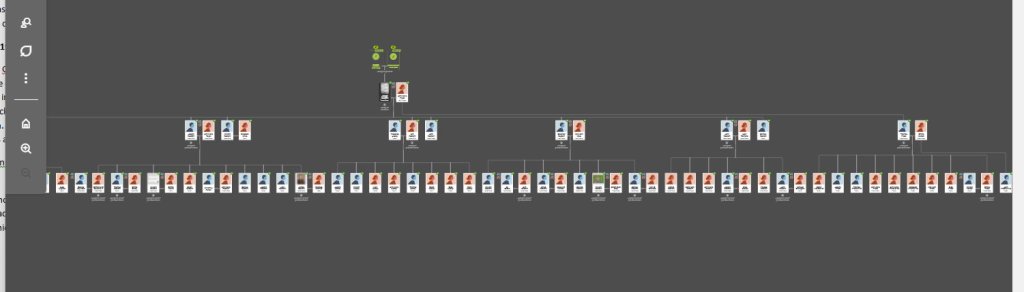
So although I have not gone any further back from Joseph and Ann Maria in that first 1841 census, in two generations they had between them 11 children and at least 54 grandchildren in the Rowley area or within a few miles, shown on this screenshot here (of the Redfern part of my own family tree – Joseph is the paternal grandfather of the husband of my 1st cousin 3x removed, so not exactly closely related!). 

Copyright: Glenys Sykes, all rights reserved.

The screenshot is, I’m afraid, much too small for you to read the details but Joseph and Ann maria are at the top just under those little green symbols. And I couldn’t even get all of the grandchildren on the screen, too many of them, the tree is too wide but it gives an idea of how big their family was! And the majority of them stayed in the Rowley and Blackheath area, although a few went North, no wonder there are still many Redferns in the area today.

There are several Redfern family trees on Ancestry and the Redfern Family website https://redfernsworldwide.com/   and One Name Study which I mentioned in my last article so plenty of opportunities for co-operative researching!

More family studies from the Lost Hamlets coming in due course!

The Redfern Family in the Lost Hamlets 1

The 1841 Census for the Lost Hamlets has one family of RedfernsJoseph Redfern was living on Turners Hill, a labourer, with his age given as 35. His wife Maria (sometimes Ann Maria), nee Priest, has her age as 40. Joseph and Maria appear to have been married at Tipton on 16 Jul 1827. Maria sometimes used Ann Maria and sometimes Maria, in records throughout her life. Their children Sarah aged 12, Eliza aged 10, Joseph aged 8, William, aged 6 and Ann, aged 4 completed the family, all of the children were born in Rowley Regis.

In later censuses, Joseph gave his age as 48 in 1851, giving a birth year of about 1803. I can find no baptism for a Joseph Redfern in the area in that year, so it is possible that he was born elsewhere, though he consistently says in censuses that he was born in Rowley Regis. Another possibility is that he was baptised in a non-conformist chapel. Certainly, the Priest family into which he married had very strong connections with the Presbyterian Chapel in Cradley Heath which was also in the parish of Rowley Regis.

Maria or Ann Maria gives her age in 1851 as 50 which gives her birth year of 1801. The only baptism I can find for this period of a likely Ann Maria is Maria, the daughter of Cornelius and Mary Priest of Bournbrook , Cradley Heath who was baptised at St Giles, Rowley Regis on 4 Oct 1801. But this is by no means certain, there may be another baptism somewhere that I have simply not been able to find.

The fact that Joseph and Maria were married in Tipton perhaps argues that she was not connected to the Cradley Heath Priests but I cannot find another Maria or Ann Maria baptised in the Tipton area either. And since Maria had had a baby out of wedlock, it seems possible that her family sent her to stay with relatives in Rowley to hide the shame for the family (possibly their view, not mine!). And it seems that David Priest , living with his family in Gadds Green in 1841 was born in Cradley Heath and directly related to the Priest families there so they would have been known to each other and were probably related.

At various points Joseph gives his occupation as a labourer or a furnace man or a furnace labourer. This seems to have been a common occupation for the Redferns as at least two of his sons were also furnace labourers. In 1856, at his son Joseph’s marriage his occupation was given as a Blast Furnace man. One census entry notes that he is a furnace labourer in a coal mine (fires were kept burning at the bottom of shafts to pull air through the mines and reduce the build-up of explosive gases) but others were noted as Blast Furnace labourers, a very different job. I am unsure where the nearest blast furnaces were to Turner’s Hill, possibly at Tividale/Tipton where there were extensive iron works and at least three furnaces shown on the 1st Edition OS Map though there were almost certainly others in the area including Brades where a furnace is also shown. If Joseph was working at the iron works in the Tividale/Tipton area, this may account for the marriage at Tipton church.

Ist Edition OS Map, copyright David & Charles, surveyed about 1830. Several furnaces and iron works are shown on this map including ones at Tipton and Dudley Port, also at Brades.

Ann Maria

The name Ann Maria is used frequently in the family from this point on, often, it appears, with the name Maria being used day to day. Almost all Joseph and Ann Maria’s children and many of their grandchildren named one of their daughters Ann Maria so they are liberally scattered around the family tree!

Are they on my family tree?

Yet again, having thought when I started this study that I had no connections with the Redferns, I now find that I have two, so far, as Cornelius Priest was already in my family tree!  I suspect that the more I look in detail at the families in the Lost Hamlets, the more I shall find that my lines are married into them at some point, sometimes several points, perhaps a natural result of them living in such small communities with limited contact with other communities.  So yes, they are on my tree!

Who was Thomas Priest?

Thomas Priest, aged 15 was also living with the Redfern family on Turners Hill. The 1841 Census does not show relationships within households. Thomas was baptised at Dudley St Thomas on 26 Mar 1826, the son of Ann Maria Priest and there is no name shown in the Register for the father so he was probably illegitimate. Joseph and Ann Maria were married in July 1827, fifteen months later so this was certainly not a hasty marriage shortly before or after Thomas’s birth. There are several family trees on Ancestry which suggest that this Thomas was the illegitimate son of Ann Maria and Joseph, born before they were married.

My expert consultant on such issues agreed with me however that, at this time, when parents of an illegitimate child subsequently married, that child usually then became known by the father’s name and is shown in sequence in censuses as the oldest child whereas step children tend to be listed after full children. Since Thomas is shown at the end of the household in 1841, and with the name Priest, not Redfern, and after Joseph and Ann Maria’s other younger children, I suspect that he was not Joseph Redfern’s child but a stepson. It was very common at that time for stepchildren to use their stepfather’s surname or to swap between the two names so the later use of the Redfern name is not conclusive. The only document I can find which lists Thomas as Priest is the 1861 Census when Thomas was living in between his stepfather and stepbrother. I suspect that the enumerator knew that Thomas had grown up in the Redfern household and perhaps thought of him as a Redfern so that the use here is an enumerator error. Certainly all of Thomas’s children were registered as Priest, not Redfern.

At his own marriage to Emma Moreton in 1850, at Dudley St Thomas, Thomas gave the name of his father as Joseph Priest, a Furnaceman, not Joseph Redfern – although he was also a Furnaceman!

There was at least one Joseph Priest in the area who is of about the right age and could have been this man but although there was one family of Priests at Finger i’ the hole in 1841 there is no Joseph listed there and other Priest families appeared to have been in Blackheath and especially in Cradley Heath (which is also where I theorise that Maria’s family were living). It is also possible that the priest asked ‘What is your father’s name and Thomas replied ‘Joseph’ and this was attached to Thomas’s surname of Priest so that gave Joseph Priest. Or Thomas may simply have invented a father’s name, rather than have that space empty, thus showing that he was illegitimate, something that genealogists find is not uncommon with illegitimate children.

A DNA test might prove the final answer to this, perhaps the current members of the Redfern family have done this and established the answer to their satisfaction!

Certainly in later years, Thomas remained in the hamlets, at one stage he and his family were living next door to other members of the Redfern family for several decades.

I shall do a separate post about the Priest family.

Where had the Redferns come from?

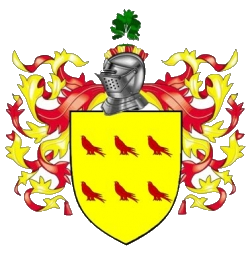
One of the crests associated with the Redfern family, courtesy of Andrew Redfern.

Wikipedia suggests that Redfern is an English surname of French Norman origin. It originally appeared as De Redeven.

The first Redfern mentioned in the St Giles’s Parish Registers is the baptism of Ann, the daughter of William and Sarah Redfern on 9th December 1792, followed by John, their son on 20 May 1798. This John must have died, (although I cannot find a burial for him), as another John was baptised to William and Sarah on 11 Jul 1802.

In 1813,Elizabeth, daughter of William (a farmer) and Sarah Redfern of Piddocks Green, Rowley Regis was baptised on 5th August, in June 1815 Edward, son of William and Sarah of Plants Green, farmer,  was baptised . Plants Green was certainly in the Old Hill/Cradley Heath area but I do not know where Piddocks Green was, it may well have been the same place, place names were sometimes quite flexible.

On 19th January 1817 Henry Smith Redfern, base born son of Mary Redfern of Turner’s Hill was baptised (there may just be a clue as to the identity of his father there, although I haven’t looked any further into that!).

On 15th July 1821, William, son of John and Mary Redfern of Turners Hill, a nailer, was baptised, followed by sister Rebekah on 7 September 1823. On 25 September 1825 Joseph, son of John and Mary, now described as a labourer and of Lye Cross was baptised. On 9 Mar 1828 Mary Ann Redfern of Lye Cross, died, aged 28 of Fever.

On 4 December 1832 Esther Redfern of Mincing Lane, aged 30, died of diabetes.

On 7 Jul 1833 Elizabeth Redfern of Dudley Wood was buried, aged 27, having died of decline.

On 16 Oct 1839, John Redfern of Turners Hill, aged 9 months died of measles.

On 13 February 1848, Harriet, daughter of William (a miner) and Ann Redfern of Portway was baptised.

On 2 December 1849, William Redfern of Turners Hill was buried, aged 81, the cause of death being given as Old age.

So clearly there were Redferns in the area, including Turner’s Hill and Lye Cross as early as 1821.

Both Joseph and Ann Redfern give their place of birth consistently in all censuses as Rowley Regis. And yet, I cannot find baptism for a Joseph Redfern in Rowley or in the surrounding area.

At least some of Joseph and Ann Maria’s children were baptised at Dudley St Thomas, Joseph and Eliza both on 12 Aug 1832, with Joseph’s occupation given as a Furnaceman and their abode as Rowley Regis. William was baptised there on 2 Jul 1837 and Ann Maria was baptised the same day.

Also at St Thomas, John, son of John (another Furnaceman) and Mary Redfern of Portway, was baptised there on 18 Oct 1835.

So it appears that these Redferns moved between St Thomas at Dudley and St Giles at Rowley, which seems to be quite common for families living in this area. And there were Redferns scattered around both Rowley and the wider neighbourhood after about 1790.

To muddy the waters, Solomon (one of Joseph and Ann Maria’s later children, to be covered in a later post) appears to be a Redfern family name. There are Solomon Redferns in Stockport in Cheshire in 1866 and in Meltham near Huddersfield in 1852, though that name is spelled Redfearn.  And in Denton, Lancashire in 1866. Although all of these Solomons were married to a Mary so it is possible that they are all the same person, moving around!

Online trees trace Joseph’s birth to Stanley in Derbyshire, but I have not investigated this possibility any further, since Joseph himself believed that he had been born in Rowley Regis and there were certainly Redferns in the area at that time.

So this is the Redferns in the Lost Hamlets in the 1841 Census. Since this is such a short piece, I will add some details about:

Joseph and Maria’s older children (those listed in the 1841 Census)

Sarah Redfern 1829-1885

The oldest daughter Sarah, who was aged 12 in 1841 was no longer in the household by 1851. In fact she was living at 84 Snow Hill, Birmingham where she was a servant in the household of Josiah Blackwell, who was a grocer. She was described as a House Servant but there were also three other Assistant Grocers living in so there would have been plenty to keep her busy. Snow Hill Station was, of course, the Birmingham Station familiar to those of us who used the train into Birmingham, that trains from Rowley and Blackheath later ran in to on the Great Western line but the station was not built until 1852 so it was not open when Sarah was working there. But a long row of shops remained long afterwards, running down the hill. Rowley Regis and Blackheath Station did not open until 1867! But even without the busy station that Snow Hill became later, there must have been quite a contrast between the rural outlook of Turners Hill and the increasingly busy city of Birmingham.

On 25 Dec 1854 Sarah Redfern was to marry William Damby or Danby, a miner, at Dudley St. Thomas.

Her father Joseph’s occupation then was given as a Furnace labourer and a Joseph Redfern was one of the  witnesses, possibly her brother Joseph who would have been 21 by this time but more likely to have been her father. Sarah and William had ten children, born in Cradley Heath and then The Knowle before William died at The Knowle in January 1873, aged only 41. He was buried in St Giles. By 1881 Sarah had moved to Dudley with the younger four of her children. Among the children of the couple were several with the recurring Redfern names, including Ann Maria (known as Maria) and a Solomon. Sarah died in December 1885, aged 58 and was buried on 20 Dec 1885 at St Giles, with her abode shown as 26 Cinder Bank, Netherton.

So Sarah does not appear in the hamlets after the 1841 Census, although at one later stage she was living at The Knowle, just around the corner from Lost hamlets.

Eliza Redfern – 1831-1909

The next daughter was Eliza, born in about 1831/2, and baptised on 12 August 1831 at Dudley St Thomas was still at home in 1851. On 15 Jun 1859 Eliza married Daniel Hughes at St. James Church Parish, Dudley, and the couple made their home in Dudley, where they had 5 children. Eliza died in September 1909. So Eliza only appears in the hamlets in one more Census, the 1851, before moving to Dudley.

Joseph Redfern 1833-1912

Joseph stayed firmly on Turners Hill, all his life, and married Ann Maria Taylor in 1856, another Ann Maria! Was she related? There were certainly Taylors living on Turners Hill so I shall check this out. Emma Redfern was born in the June qtr of 1854, but Joseph and Ann Maria did not marry until June 1856 so it is not known whether or not Emma was Joseph’s child. However, she was always described as his daughter on census returns and used the name Redfern until her marriage so she may have been. Joseph and Ann Maria went on to have Thomas in 1856, William in 1858, Sarah in 1860, Ann Maria in 1864, Samuel in 1866, Joseph in 1869, John in 1870 and James in 1873.

In 1861 there were three Redfern families living in a row on  Turners Hill, this Joseph, his brother (or half-brother) Thomas Priest/Redfern and his father. By 1871, Joseph was working as a labourer in a ‘potyard’, presumably Doulton’s factory. In his census entry in 1901, Joseph was, at 69, still working as a labourer in the stone quarry. In 1911, still at Turners Hill, he was noted as a pottery labourer but also Old Age Pensioner, a whole lifetime of hard physical labouring of one sort or another.  

He states in 1911 that his marriage had resulted in 9 children of whom only four were still alive. Ann Maria died in 1903, buried on 14 Jul 1903 and Joseph died in 1912. He was buried on 07 May 1912 at St Giles, his abode given as 3, Turners Hill.

William Redfern 1835-1917

William also stayed in the hamlets, living on Turners Hill until his marriage to Elizabeth While in Halesowen in 1871, when he moved to 6 Perry’s Lake where he stayed until his death in January 1917. William and Elizabeth had no children. William was a general labourer all his life, sometimes working at the pottery and his last census entry in 1911 he stated that he was an “Old Age Pensioner, Retired Labourer Moving Pipes”. William was buried at St Giles on 17 Feb 1917. Elizabeth died in 1926 and the entry in the Burial Register at St Giles says that she was ‘late of Perrys Lake’.

Ann Redfern 1838-1919

Ann Maria married Frederick Hadley in the Dudley Registration District in the last quarter of 1857, (although I only know this from GRO Index and have not yet found the marriage).  They lived in Lye Cross for a while before moving to Turners Hill and they had at least eight children: Joseph in 1859, William in 1861, Mary in 1863, Ann Maria in 1865, Thomas in 1868, Sarah in 1871, Eliza in 1877 and Ellen in 1881. They stayed living on Turners Hill, next door to Ann’s older brother Joseph until their last census entry in 1901. Frederick died in 1909 and was buried at St Giles on 31 Jul 1909. Ann died in 1919 and was buried at St Giles on 13 Mar 1919.

Thomas Priest or Redfern 1823-

Thomas was the illegitimate son of Ann Maria or Maria Priest, probably not the son of Joseph Redfern. He married Emma Morton on 10 June 1850 at Dudley St  Thomas. Emma had two children before this marriage, John in 1847 and Sarah in the March quarter of 1850. It is not clear whether these were Thomas’s children although they both subsequently used the Priest surname. Thomas and Emma had at least a further eight children: Joseph in 1854, Thomas in 1857, Ann Maria in 1858 (who died the same year), Ann Maria and Elizabeth (twins) in 1859, Mary in 1862, Eliza in 1865 and Emma in 1867. Emma, wife of Thomas died in 1895 and was buried on 04 Aug 1895 at St Giles.

Thomas Priest died in January 1905 and was buried on 19 Jan 1905 at St Giles, with his abode still given as 2 Turners Hill so he had lived there for nearly 50 years.  

So this is all relating to the Redfern family as they were shown in the 1841 Census. There were more children born to Joseph and Ann Maria later but I will cover them in another post.

The Redfern Family One Name Study

There is a website about the Redfern family which is linked to a Redfern One Name Study and this may be of interest and allow Redfern family members to join forces to compare their information. Andrew Redfern who runs the website and study would welcome contacts with members of the Redfern family wherever they are. Here is the link:

https://redfernsworldwide.com/

The Farms in the Lost Hamlets

As I have mentioned before, although the landscape around Rowley became industrialised and scarred by mining, clay extraction and quarrying, much of Turners Hill remained open countryside and in use for farming, supplying the local population with milk and eggs until well into the 20th century and much of the area on the hill is now being returned to a green condition as quarries are filled in.

There were several farms on the Rowley side of Turners Hill itself, and this post is principally about Freebodies Farm, Hailstone Farm and Turners Hill Farm with a mention of Lamb Farm, nearer to Portway Hall. To local people these farms were often known by the names of the farmers living there at the time but on maps their traditional name are usually shown.  Of the local farms, there were apparently at least four dairy farms in the area in the 1920s and 30s, run by the Monk, Richards, Merris and Skidmore families.

At an early stage there was a Mill or Windmill Farm at Tippity Green although this was not identified in the later censuses, it appears to have been on the site of the former parish windmill and this area was subsequently quarried away.

This photograph of the Ibberty (later Tippity) Manorial Mill appears in J Wilson Jone’s book, The History of the Black Country which was published in about 1950 although the date of the photograph is not known.

In 1841 Edward Alsop aged 60 was listed as a farmer at the Wind Mill Farm in Tippity Green, with his presumed wife and four children, plus a male servant. Next listed on the Census was Elizabeth Lewis, aged 40, an ironmonger, with her family and then Joseph Bowater who was a butcher and subsequent licensee of the Bulls Head so that is the correct area in Tippity Green. Neither the Alsop nor Lewis families are listed in the area by the time of the next census.

There was also a Knowle Farm but this is not quite within the area of the Lost Hamlets and I have not indexed the Census for this area.  

Also, the late Anthony Page has a picture in his first book on Rowley of Warren’s Hall Farm which was over the top of the hill on the Oakham Road, a large white house. It later also had riding stables and later still became a residential Nursing Home before being demolished and replaced by housing. Again, it is not quite within my study area and I have not indexed the census for this area.

Portway Farm, also slightly outside my study area, still exists though no longer in farming use, perhaps the only one of all these farms to have survived as a building to the present day.

The Censuses

The Censuses are not consistent about how the farms were recorded. Sometimes they were not listed by name. Where I have been able to identify the farms I have shown the results under details about each farm. To date I have only transcribed censuses for the Study area up to 1881. Later ones will follow in due course and I hope to upload the transcripts to a website for the Study at some point. 

Not all the censuses include the acreage farmed by each farm but where they do, they vary considerably from one census to the next which does not help with the identification process.

Where on Turners Hill were the farms?

I was very unclear until recently exactly where each of these farms was although I think I have them identified now. No doubt someone will help me out if I have this wrong!

Freebodies Farm and Hailstone Farm were next to each other down a lane on the left off the Turners Hill Road, above the Hailstone quarry with the Hailstone Farmyard being at the end of the track in the area shown on OS maps as Gadds Green. Hailstone Farm occupied the two buildings shown on the left on this photograph and Freebodies the three buildings on the right.

The date of this photograph is not known (copyright also unknown but will be gladly acknowledged if informed) but the two farms are very much on the brink of the quarries so probably 1960s.

Turners Hill Farm was further up the hill, on the right.

Turners Hill Farm, 1969. Copyright: Mike Fenton

Many of the fields were divided not by hedges but by stone walls which is a very common practice in areas where there is a ready supply of stone for use, as in the Cotswolds and in the Yorkshire Dales. There were some hedges, though, because Reg Parsons who grew up at 2 Turners Hill in the late 1930s told me that his mother loved the wild sweet peas which grew in the hedges near there. He remembered Vera Cartwright with the milk cart which delivered daily to Blackheath, Whiteheath, Langley and Rowley Regis, seven days a week. Before the advent of milk bottles, milk in most parts of the country was taken round in churns and cans and the cans were taken into the customer’s house to be dispensed into their own jugs. This was not just in Rowley, my husband can remember, as a boy, helping his uncle with his milk round in Gloucester where the same system was used. He also said that the horse or pony would know the route and stopping places where they would wait patiently for the milk to be dispensed before moving on to the next stop.

Reg Parsons also remembered that there was a field below his home on Turners Hill which was used as an fuel dump in the Second World War, he remembers piles of Jerry Cans on concrete bases and also an anti-aircraft gun (known apparently as Big Bertha) near the Wheatsheaf pub. My mother used to be on fire watch sometimes during the war, with the St John’s Ambulance brigade and  she also remembered the gun there. Sarah notes that one of her grandfather’s fields was requisitioned by the army so this would have been for the fuel storage that Reg remembers and she also tells of family memories that during the war a German bomb landed on one of the fields killing a cow. And during air raids, the ponies pulling the milk carts had to be unharnessed in case they bolted, with all the potential loss of milk and vehicles. Later, in the 1950s, six caravans were put on the site which were lived in by local people.

Many people have mentioned their memories of the Cartwright family who farmed at Hailstone Farm on Turner’s Hill for many decades and who had a riding school, as well as the milk round. Sarah Thomas has written a fascinating book called Hailstone Farm about life on the farms there which she has published privately and, having come across my study online, she has very kindly sent me a copy but with the stipulation that she does not wish to have any of the contents to be put on social media. However, she tells me that she has deposited copies of the book in national and local archives so it would be well worth enquiring, if you are visiting local archives or perhaps Blackheath library, whether they hold a copy. Certainly Dudley Archives lists a copy and Sandwell Archives appear to but do not specify where it is held and it is not reservable through the library system. The book is full of photographs and pictures of documents and family memories and history. I will not be reproducing anything from it but it will inform me about the farms and where they were so that this study has a more accurate record of the farms and their ownership over recent years.

Freebodies Farm, Turner’s Hill

There has been, if not specifically a farm, then an area known as Freebodies on Turners Hill for centuries.

A Survey of English Place Names refers to it as an ‘early-attested site in the Parish of Dudley , a name of the manorial type, deriving from the family of Frebodi  found in Dudley in 1275 and 1327’. Bear in mind that for centuries the main route from Rowley to Dudley ran over Turners Hill so directly through the site where Freebodies Farm later was.  There was, may still be, an area of Dudley called Freebodies in the Kates Hill area of Dudley and the Freebodies Tavern was there until very recently.

The Morgan website has a large amount of well documented and referenced information on local families and the area and notes that a document in the Dudley Archives shows that there was a Deed Poll in about 1550 by a William Chambers Alias Ireland assigning ancient ecclesiastical land of the Priory of St John’s at Halesowen. A number of his descendants for the next 150 years appear in the local records of Rowley Regis and Dudley, using the names ‘Chambers alias Ireland’  These include intermarriages with the Darby family. The name Ireland is sometimes spelled ‘Ierland’ or ‘Yearland’. The same document demonstrates that they owned ex-monastic lands at Rowley called Freebodies, and this reference recurs in a number of later Darby wills. If you have Chambers/Irelands/Darbys or Cartwrights on your family tree it is well worth looking at this site https://www.morganfourman.com/  Sadly I have none of these names in my tree!

A survey by Lord Dudley’s Stewards in 1556 produced a rent roll in which William Ireland’s Freebodys, later called Freebury Farm is recorded, suggesting that it was established before the neighbouring Hailstone Farm.

A Will of John Chambers in 1870, implies that the farm on Turners Hill was originally part of the Freebodies estate. Certainly, John Chamber’s brother William was an executor of his will and was described as a farmer of Rowley Regis.

At other times it was known as Freebury Farm. Spelling was very variable in those days!

Censuses for Freebodies: At Freebodies Farm in 1841 were Josiah Parkes and his family (including Sophia Cole who was mentioned in my earlier article about the Cole families around Turners Hill, and one male and one female servant.

However, there is no mention of Freebodies in the 1861 Census nor any farmer listed in Gadds Green.  However, listed as Farmhouse, Turners Hill and as a farmer of 30 acres is William Smith, aged 54 with his wife Sarah and his Levett granddaughter, plus two servants. Was this Freebodies?

In 1871 there is no mention of Freebodies Farm but two households are listed as ‘adjoining Hailstone Farm’ – John Bradshaw, an agricultural labourer aged 26 with his wife and his 11 month old son plus his brother aged 21 and also an ag lab. The brothers had both been born in Haselor, Warwickshire and his wife in Solihull. Also described as living ‘adjoining Hailstone Farm’ was a blacksmith Henry Russell aged 33 with his wife and daughter. So both of these households were from outside the area. It is possible that the land of the two farms was being worked together and the farmhouse used to house either farm workers or tenants.

The next building listed is Brickhouse Farm which was some distance away in Cock Green on the Dudley Road and which was being farmed by the Levett family with one ag lab and one female servant. There is sometimes no accounting for the routes taken by census enumerators!

Or was there a well established path across the fields between Hailstone and the Dudley Road at Springfield which everyone used? This seems likely as Reg Parsons mentioned to me that his father, on his way home from work, would sometimes get off the bus at Springfield to buy something from the shop there and would then cut up over the  fields to home. This does seem more practical than the residents up on the hill always having to walk down to Perrys Lake, along Tippetty Green and to the Knowle that way. There is certainly a Footpath marked on the 1904 OS Map, here, running from Knowle Farm to Hailstone Farm and also further on up Turners Hill. .

Copyright: Alan Godfrey Maps

Hailstone Farm

A lease in Dudley Archives dated 1796 is for a lease of 21 years to Samuel Round, farmer, of  Hailstone Farm (a messuage called Freeberrys alias Fingerhold – that Finger ‘I the Hole popping up again!) so it seems likely that the farm was established by the late 1700s.

Sarah’s Cartwright grandfather had been born on Hailstone Farm but the family then moved elsewhere, again this makes me think of the information on the Morganfourman site that the Cartwrights were closely linked to this area as far back as the 1500s. He took over first Lamb Farm in 1912 and then Hailstone Farm in 1924 and ran their businesses from there, including the riding school established by Sarah’s mother and the milk round (which had originally been started in the early 1900s when the family were living at Lamb Farm), later taking on the tenancy of Freebodies in addition in 1932, subletting the house to tenants. In addition to the Riding School, there were some Gymkhanas there – much more detail about this and photographs in this article in the Black Country Bugle in 2019. https://www.pressreader.com/uk/black-country-bugle/20191106/281505048027440

Later part of the family moved to another farm at Bewdley and Sarah’s mother and father continued to live at Hailstone until the 1960s when the lease was terminated and the land taken back for quarrying.

There is much more detail in the book about the farms, their construction, plans, photographs, invoices etc from the business in the book, a real very personal record of a Rowley Farm in the 20th century.

Censuses for Hailstone Farm

In 1841, the farmer at Hailstone Farm was Samuel Round who was sixty, with three servants, possibly the Samuel Round mentioned above who was granted a lease in 1796 or possibly his son . I can find no trace of Hailstone Farm or the Round family in 1851.

In 1861, Keturah Round, a married lady of 54 was at Hailstone Farm with several children though no spouse and she is described as the Head of the household though not a widow. She had married Edwin Round in Dudley in the Sep qtr if 1854 and was previously Wheale.

In 1871 Hailstone Farm was occupied by Elizabeth Stickley, a widow with her occupation given as Farmer with her two sons John aged 37 and Thomas aged 27, both described as Farmer’s son, along with Ruth Lees, a servant but possibly also related to Elizabeth Stickley as her maiden name was Lees. In the previous census this family had farmed at Oatmeal Row, Cakemore, next door to some ancestors of mine!

In 1881, there is no mention of Hailstone Farm, and no farmer listed but there are three households listed as Hailstone Hill. Susan Jones, who was 50 and a widow was listed as an annuitant aged 33, born in Middlesex, as were the two young nieces living with her who were scholars. Her femail servant was born in Kingswinford. It is tempting to think that this was Hailstone Farm. One of the other houses was occupied by Joseph Hooper, a Farm labourer, aged 48 and born in Cleverley, Shropshire and his wife Ann aged 54, born Thame, Oxfordshire. The tenants in this area certainly almost all came from outside the area, it seems.   

Turners Hill Farm

Maps show Turners Hill Farm higher up Turners Hill from the other two farms and there is also a reference on some maps to Cloudland though not on recent maps.  There appears to be a large House there, too, Turners Hill House and sometimes the owners of this house were also described as farmers. It is possible, since there is evidence that the Downing family had other land in the area which they let out, that farming was not their principal occupation and that most of the land was farmed from Turners Hill Farm, rather than house.

Censuses for Turners Hill Farm/House

At Turners Hill in 1841 was Joseph Downing with his wife Nancy, son Isaac and two female servants.

By 1851 still on Turners Hill but with no name given for their residence was his widow Nancy Downing with their son Isaac, aged 35 who was a ‘proprietor of lands’ and three unmarried daughters, all described as annuitants, plus a Thomas Whitehouse who was probably Nancy Downing’s brother as her maiden name was Whitehouse. Thomas Whitehouse was a widower, and also a ‘proprietor of lands’ like his nephew.

By 1861 Isaac Downing was still living on Turners Hill, with his three sisters. This time he has given his occupation as “Principal occupation: general superintendence of the cultivation of land. “The Enumerator has added Farmer. But Stephen Parsons on Facebook commented that he remembers that in his time there was a large house on the right of Turners Hill Road which was Turners Hill House, and that Monks Lane ran below it which led to Monks Farm and the quarry. There was also an area in this location called Cloudland on some maps. So were the Downings perhaps  living at Turners Hill House but contracting out the farming? It seems likely. I was interested to see on the Facebook page that Linda George has receipts signed by Isaac Downing in 1855 and 1856 for the letting of a farm at Darby’s Hill to Samuel Cook so the Downing family may have had substantial land holdings around the area.

The Downing siblings, still all unmarried, were still on Turners Hill, in 1871, Isaac, now 55, described as Landowner and Farmer and also on Turners Hill and described as a farmer of 88 acres in 1871 is William Whitehouse, a widower, with his two teenage sons a female servant and a farm labourer. I note that a William Whitehouse had been one of the witnesses of Joseph Downing and Nancy Whitehouse in 1810 so may well have been an uncle or cousin to the Downings.  This census is the last one showing this Isaac Downing, as he died in November 1874 and was buried in St Giles.  

There was also listed in 1871, however, a farmer of 60 acres on Turners Hill, James Bridge aged 28 with his wife Anne, one female servant and one agricultural labourer so this may have been Turners Hill Farm. By 1861 Ann Bridge, now a widow aged  39 was the farmer at Turners Hill Farm, by now farming 40 acres and employing 2 labourers, a cowman and a waggoner.

By 1881, there is the family of Samuel Woodall, an Engineer and Iron Founder listed first under Turners HIll, probably at Turners Hill House. He was 35 and born in Dudley. His wife Mary was born in Birmingham. In addition his two brothers and a sister were also living with them, with three female domestic servants, again all born outside Rowley. I presume this was the house previously occupied by the Downings.

Listed at 5 Turners Hill was William Giles, aged 30 – a farmer of 70 acres employing one additional man. This presumably was Turners Hill Farm. He and his wife were born outside Rowley, though not a great distance, being from Kingswinford and Cakemore respectively.  Their elder two children aged 8 and 6 had been born in Enville, Staffordshire, the two younger aged 4 and 2 in Rowley Regis.  

The Parish Registers

The Chambers family

On 31 October 1544, Margrett, wife of William Chambers was buried, so there were already Chambers in Rowley at this date. In 1558 William Chambers was buried. Between the two dates three Chambers girls – Mary, Margaret and Agnes were all married at St Giles. The records from 1558 to 1566 are noted by the Vicar, Adam Jevenn, as being missing. (I wonder whether he was an early ancestor of the Jeavons families in Rowley and Blackheath?)

In 1575, Jone, as daughter of John Chambers was baptised and in 1602, John, son of Thomas.

On 12 Feb 1603, a child William was baptised, described as the son of Edward Shakespurre and Joane, d. of Christopher Chambers.  Freebodies is not mentioned but certainly Christopher Chambers was associated with Freebodies then .  In January 1641, Edward, son of William Chambers of Freebodies was baptised at St Giles, in 1744 another William Chambers of Freebodies was buried . Christopher Chambers was one of two people appointed in 1650, along with three others to be ‘Collectors for the poore’ which implies a certain social standing in the parish. At times, the Chambers used the name Irelands, too. Sometimes their abode is given as Churchend though it is not clear where this was. Certainly there were 152 Chambers entries in the Parish Register between 1539 and 1684 for baptisms and burials, 1539-1754 for marriages. On occasions Chambers were also churchwardens.

By 1723, with the burial of Elinor Chambers, widow,  her abode was shown as Ffreebodies. Another branch of the Chamber, however was at Brickhouse in 1724. In 1727, Christopher Chambers of ‘ye ffinger i’ the hole’ was buried. Another branch of the Chambers was described in a marriage in 1732 as ‘of Tividale’. So the Chambers seemed to be scattered right around Turners Hill over several centuries.  

The Downing family also had a long term presence on Turners Hill. The first Downing entry in the Registers is in 1644 when Robert, son of John Downing of Warrley was baptised, with  numerous entries after that, the first Isaac Downing (that we know of) being baptised at St Giles in 1672. In 1814 Isaac Downing, of Turners Hill was buried aged 75, having died of Asthma.

Back in 1722, Mary, wife of Isaac Downing ‘de ffox oak’ was buried but he appears to have remarried the following year and had a child Samuell  baptised at St Giles, with an Isaac Downing of Foxoak  being buried in 1727, probably not the same man but possibly related.

On 23rd July 1815, Isaac , son of Joseph and Nancy Downing, was baptised and Joseph’s occupation was given as a ‘Beast Leech’ – someone who treated sick animals. Joseph and Nancy were still on Turners Hill in the 1841 Census. A daughter  Mary Ann was baptised to them in 1818, followed by Lavinia in 1821 and Amelia in 1823. Another Isaac Downing was married to Elizabeth Nutt in 1815 so there were several Isaacs around then. Joseph Downing, originally a ‘beast leech’ and later a farmer died and was buried in St Giles on 2 Jan 1849.

Not all the Downings in the area were so well-to do – Mary Downing, aged 69 of Perry’s Lake was buried in April 1821, having died of cold. In 1823 William Downing, son of Joseph Downing a miner, died in the Poorhouse. In 1828 an Isaac Downing of Perrys Lake died aged 88 of natural decay so presumably there was some connection shown by the use of the name Isaac. There were also Downings in Mincing Lane, in Windmill End and in Portway, all apparently in labouring jobs of various sorts. By the 1840s another branch of Downings were living in Gorsty Hill and another in Waterfall Lane.  

Only the Downings on Turners Hill appear to have been wealthy and one wonders whether perhaps one child might have benefitted from a scholarship to the Old Swinford Hospital and been able subsequently to have gone into a profession which improved his circumstances. I would dearly love to find out a list of Rowley boys who attended that school!

Lamb Farm

Lamb Farm was, according to Roy Slim, in an article in the Black Country Bugle in 2021, a small farm adjacent to the Lion Farm which later gave its name to the Lion Farm Estate, near Whiteheath so slightly out of my main study area but included here as there were connections to Freebodies and Hailstone Farm . Roy says that the Throne Farm, farmed by the Skidmores, was much larger than either of them and I presume that the local roads with royal names were so named because they were on land formerly part of this farm. Throne Road, Throne Crescent, Queens Drive, Hanover Road, Tudor Road, Windsor Road, Stuart Road. And I am interested to see that some of the modern roads there, built where the quack was, also have names with Royal connections, Sandringham Drive, Palace Close, Majestic Way, with the Vikings, Celts, Druids, Goths, Romans and Saxons getting a mention, too!

After the Cartwrights moved to Hailstone Farm in 1924, Lamb Farm was let to various tenants, including Hawleys, Hewitts, Slims, Matthews and Skidmores. Roy Slim has also written about his family’s time there.

Lamb Farm was sold for development in 1945.

Local memories of the farms

On the ‘I remember Blackheath and Rowley Regis’ Facebook page, Raymond Kirkham remembered that he had known the farm halfway up Turners Hill as Cartwright Farm. This would have been Hailstone Farm, as at the time Raymond was growing up, the Cartwrights were working the area of both farms from Hailstone Farm and, although they leased Freebodies too and farmed the land, the house was let to tenants. He noted that the farm further up at the top of the hill was Monk Farm and this must have been Turners Hill Farm. He said that this whole area was his playground when he was growing up and his family got their eggs from the farm.

Ian Davies remembered Hailstone farm well, as he was related to the Cartwright family. Ian’s Geordie grandfather lived with the Cartwrights at Lamb farm, near Portway Hall, when he first moved south in the early 1900s. He remembers that by the 1950s George Cartwright had moved away to a farm near Bewdley and Hailstone Farm had been taken over by their daughter Vera and her husband George Thomas. George taught Ian to ride. The quarries were already threatening to swallow the farm back then. The narrow track from Turners Hill had quarries close on both sides. The farmhouse and top of the land were swallowed up by the Tarmac mega-quarry, The lower area stretching down to Springfield was used for housing.

Ian also remembered Lamb Farm which was on the left going down Throne Road, immediately after Portway Hall. He used to walk past the drive on the way to his grandparents’ house in Newbury Lane. He thinks that St Michael’s School was built on the land and that in the 1800s Portway Hall colliery was on the farm’s land and he thinks this was responsible for the subsidence that ultimately forced Portway Hall to be demolished.

Ian also kindly added a link on the Facebook page about memories of Blackheath and Rowley Regis to an article written by Sarah Thomas in the Black Country Bugle which appeared in Nov 2019, including various photographs.

https://www.pressreader.com/uk/black-country-bugle/20191106/281505048027440

There are obviously several family connections to the Cartwrights still in the area as Margaret Higgs said that George Cartwright was her father’s uncle, her grandmother was George Cartwright’s sister.

 Mark Northall  said that his father Frank Northall had worked at Cartwright’s farm as a lad.

Jill Watkins-Beavon had lived in Gadds Green which was the land opposite Hailstone farm, later her fmily lived in one of the four houses in the quarry.

William Perry remembered in 2018 that his father had told him that when he was young he would walk up Turners Hill to Cartwright’s (Hailstone) farm where they had a lovely horse that he used to stroke.

So this is all the information that I have found to date about the farms in the Lost Hamlets, all disappeared now into the quarry but helping to sustain the local populace in their time, and about the families who farmed them over the centuries. More information would be very welcome and this can be added, corrected or a further post done if sufficient additional information is found.

The distracting delights of background reading

One of the things I have learned as I have been working on this One Place Study, but which I was already somewhat conscious of from my family history researches, is how difficult it is for us, in our relatively pampered modern lives, to really understand what our ancestor’s lives were like. How they coped with the sheer hard toil of their work, whether in mine, quarry or workshop, how they coped with the loss of so many of their wives dying in childbirth, husbands dying in industrial accidents, the high numbers of early deaths from diseases now rare or curable, their children dying young from diseases and conditions which have been overcome by modern medicine. Were they were worried by the changes in their surroundings as industry despoiled what had once been fields and pastures or did they consider the jobs that this brought were a benefit which outweighed this?

Some of this we may never know. We can only wonder.

So in recent times, I have widened my reading to address my lack of knowledge about those times.

A really good blog for Family Historians

I follow an interesting blog on WordPress which I highly recommend, called English Ancestors by Janice Heppingstall. Janice writes excellent and thoughtful (and very informative) pieces on family history and sometimes recommends books which she has found interesting. A few weeks ago she recommended ‘The Butcher, the Baker and the Candlestick Maker’ by Roger Hutchinson which is about how the censuses came to be taken, including a lot of fascinating information, well worth reading. She and I seem to share certain interests, such as what she calls ‘homing in on the little people’ and, like me, some of her ancestors moved from rural areas to industrial ones, including Mill towns, in her case in the North West. Similarly, a book entitled The real Oliver Twist by John Waller and about Robert Blincoe, who was thought to have inspired the character of Oliver Twist. That has also now been added to my pile of books to be read.

Contemporary Fiction as a source of information

At a conference on West Midlands history which I attended a few weeks ago, there was an interesting note from one speaker that we can sometimes learn from the fiction writing of contemporary authors. Francis Brett Young is the obvious writer for the Black Country ( though I confess to not enjoying his writing m7ch) but the other name which was mentioned as giving detailed descriptions of the hardships of many who worked in industry was Charles Dickens.

I have been an avid reader since I was a child but must confess that Dickens has never been top of my list of favourite authors. In fact, when I thought about it, I couldn’t remember reading any of his books apart, perhaps, from Oliver Twist when I was a child. I have seen the many adaptations of his works on television, of course, but again, not for many years so that I could not remember the details of the plots of even Great Expectations. The story of A Christmas Carol is more familiar – dare I admit that that is mainly because it is so deeply imbedded into our culture around Christmas, particularly from the Muppets Christmas Carol which was a family favourite for many years.

But the speaker at the history conference commented that Dickens had used his books to bring attention to the dreadful working conditions of ordinary working people, with some success and had helped to expose the poverty and living conditions of the poor as a result of the Industrial Revolution. He particularly mentioned ‘The Olde Curiosity Shop’ which is next on my reading list.

Different ways to read books!

Now I have a fondness for computer puzzle games. Not the sort of modern flash bang video racing explosive hidden object or match three stuff but actual puzzles, jigsaws, etc. I play a couple of games most days and like to think it helps to keep my brain active. One I have played for many years is called Sherlock and was invented by an American called Everett Kaser, he has many absorbing puzzle games. Recently I noticed that he had a new game called Beckett’s Books. This game takes books which he has transcribed and divides each page into squares (you can vary the numbers of squares) and jumbles them. Your task is then to put the squares back into the right order to give you a readable page before you can move onto the next page. This is done by matching the beginnings and ends of words and phrases – it is quite challenging at times. Kaser has a list of some fifty or so books available including many classics, such as The Secret Garden, the Father Brown Mysteries, several Sherlock Holmes novels, a number of Dickens classics, some of the PGWodehouse books, plus some which clearly reflect his particular interests and some American authors I am not familiar with. As you do the puzzles, of course, you read the book. Really properly slowly read the book – and it’s really enjoyable. The first Dickens book, I tried was Great Expectations. This brought home to me that Dickens really was a cracking writer and that he was very skilled at leaving his readers with a cliff hanger. He originally wrote many of his books for serialisation through daily or weekly publications and I can now fully understand how eagerly his readers would have been waiting for the next instalment. I could hardly wait to start the next page when I finished each one! This threatened to be so time consuming that I had to resort to buying copies of the novels to finish reading.

The Olde Curiosity Shop is, sadly (or perhaps fortunately) not among the books listed at the moment (so I have a pre-loved paperback copy on the way) but another novel called ‘Hard Times’ is among those Everett Kaser has listed and online reviews said that this was a diatribe about the evils of industrialisation, the effects on the air around and the suffering of the poor workers. So I have read (yes, and puzzled) that one. It’s a clever story and has many characters, sympathetic and not, many threads, some amusing and some incredibly sad at times. It is an interesting insight into the politics and prejudices of the time. I was actually moved to tears at one point which is not something that often happens to me. The other thing that is engaging is that it is written entirely without the benefit of hindsight. It reflects in detail how people really lived, worked, travelled, amused themselves at the time without anything but fairly primitive means of communication.

One chapter details an operation to rescue a man who has fallen into a disused mine shaft on the moors above the town – it is no less than riveting, giving so many details about the rescue that I had to wonder whether Dickens had actually watched such an operation.

The Whiteheath Mine Disaster

In December 2022, I posted the piece below on Facebook about a mine disaster at Whiteheath which had resulted in the death of eleven men. Although Whiteheath is slightly outside the Lost Hamlets area, I include the piece below, people living in the hamlets would certainly have known of it at the time and some men from there may well have worked in the mine.

‘The Ramrod Hall Colliery explosion 1856 – some local history which I had never heard of before.

Transcribing burial records last week for St Giles in 1856, I was curious to notice five consecutive entries for burials of young men all on the 15  August 1856, the abode for all given as Whiteheath Gate.  The following day another young  man from Portway was buried, none of these had any cause of death shown which was unusual for this register.

The loss of five young men would have been a grievous loss for such a small community so I did a little research. I wondered whether they had all died in some sort of accident together.

Knowing that the Ramrod Hall Pit was at Whiteheath, I searched the website of the Northern Mine Research Society and found the following information about an explosion there:

RAMROD HALL. Oldbury, Staffordshire. 13th August, 1856.

The colliery was owned by Lord Ward and was at White Heath Gate. The explosion occurred because of bad ventilation. This was partly due to the neglect of the ‘butty’, Thomas Barker who did not discharge the 17th Rule and did not inspect the mine before the men descended. Of the sixteen men and boys who were in the mine at the time of the explosion, eleven were killed.

Those who died were:

Thomas Barker aged 23 years,

R. Cartwright aged 43 years,

John Sheldon aged 36 years,

Thomas Shaw aged 35 years,

Thomas Round aged 34 years,

John Walletts aged 28 years,

William Simpson aged 33 years,

Samuel Willetts aged 26 years,

J. Fulford aged 16 years,

John Bryan aged 13 years,

T. Hampton aged 18 years.

At the inquest it emerged that on the morning of the disaster one group of men descended one of the two shafts. (The mine was quite new and had been closed for a few days because the men were working on the approach roads on the surface.) When the mine reopened, and the first party went down, one of them had a lighted candle which was seen to burn blue, indicating the presence of gas. The candle was sensibly blown out and the miners called up to the banksman that gas was present and to bring down a lantern. By the regulations, a lamp should have been used to test for gas before the men went down. This rule was neglected.

Another skip containing seventeen or eighteen men was lowered and a man named Barker, the butty,  ordered some live coals to be placed in it, saying that there was no sulphur for the lantern. The explosion took place as they were being lowered, blowing the basket and men out of the top of the shaft and causing terrible injuries to them. The accident was put down to the fact that there were two shafts at the mine and water was being drawn off one which forced the foul air up the other shaft.

Newspaper reports tell of hundreds of people rushing to the pithead after the explosion and miners from a neighbouring pit volunteering to go down to rescue injured men still trapped below ground.

Such a sad tale, such a hazardous industry and what a terrible event for the community of Whiteheath, so many widows and children left behind, without any means of support. There are frequent entries in the Burial Registers for men (and boys as young as ten) ‘killed in a pit’,  even though in 1835 a mining investigative committee had been set up to figure out how to cut down on the number of accidents. Whatever they did was not enough to prevent the deaths of at least 610 miners in the Black Country between 1837 and 1842 and many more in later years.

A press report on this explosion states that the inquests were attended by two Inspectors of Mines and a solicitor (representing  Lord Ward who was out of the country) to observe. The Coroner reported that he had gone down the mine the day after the explosion and again a few days later so he was obviously very thorough and such accidents were being properly examined.

Although the reports refer to Thomas Barker (who was buried the day after the other five) the Burial register and his Death Registration give his name as Baker. Thomas Barker/Baker was the ‘butty’ who gave the instruction to carry burning coals into the mine, even though he had been warned that gas was present. Presumably he was buried the following day as local feeling did not want him buried with the other men who died because of his actions. The Mines Inspectors though were clear at the inquests (there were five separate inquests because the men killed lived in different places) that the failure of the mine managers to keep a fire or furnace burning at the foot of one of the shafts to force air circulation through the mine was the reason that gas accumulated while the mine was closed for a few days.  A horse kept underground apparently survived the explosion unhurt and for five days afterwards without any attention, food or water, poor animal!

Within weeks of the inquests, Mine Agents for the area met and agreed tougher new rules on ventilation in mines so perhaps this tragedy helped to prevent others.

The J Fulford listed amongst those who died was listed in the Burial Register as Joseph Fullwood, although his  Death Registration gives his name as Fulford. So if you have a young man who disappears from your family tree in 1866 in this area, this may be what happened to them.

These days we sometimes tend to think H&S is too rigorous but those men could have done with rather more of it.’

That post generated some interesting comments, including some from a former HM Inspector of Factories  who noted that “Nowadays, I think the verdict would not be directed at the fault of one person, ‘the butty’, rather the controlling organisation would be blamed (the employer/directors/management), ie it was a systemic failure. And I’m pretty sure the charge would be ‘corporate manslaughter by gross negligence.’ The dangers were well known, the precautions should have been in place, but weren’t.”

Hard times in Whiteheath?

Copyright unknown but will be gladly acknowledged if made known.

The connection here is that the rescue described by Dickens in Hard Times must have been very similar and vividly relates the incident almost minute by minute.

In the story, the two women who realised that a missing man had fallen down the shaft of a disused mine which had not been fenced off adequately (his hat had fallen off and was lying by the shaft) had to run long distances across the moor in opposite directions to seek help – no mobile phones, no phone boxes. It was a Sunday so people were not at work. Of the men the first woman found, one was lying in a drunken sleep – he was woken and hearing “that a man had fallen into the ‘Old Hell shaft’ he started out to a pool of dirty water, put his head in it and came back sober” – and Dickens recounts that he turned out to be the most useful of the men at the rescue operation. The other men ran off to nearby villages and others from those in turn ran on to other places to spread the word to get more help and equipment, before all heading back to the ‘Old Hell shaft’ where, again, they had to wait for more implements and help to arrive. No cars or lorries or helicopters, no mountain rescue, no first aid kits or painkillers or stretchers, no radios, no roads, the equipment needed had to be assembled and carried manually up to the shaft. Dickens notes that it was more than four hours before enough equipment arrived to start the rescue attempt. Difficulties had arisen in the construction of a means of enabling two men to descend securely before this was rigged with poles and ropes, requisites had been found wanting and messages had to go and return. Some of this would not have applied at Whiteheath, as it was close to other mines and it was a working day but some of the difficulties of the rescue must have been the same.

Eventually, in the story, a surgeon also arrived after messages were sent to the nearest town. By the time the rescue could be attempted, Dickens says perhaps two hundred people had assembled. “There now being enough people present to impede the work” the original rescuers, led by the man who had been drunk, “made a large ring around the Old Hell shaft and appointed men to keep it”. Again, one can well imagine this happening at Whiteheath where a large and anxious crowd had assembled.

When enough equipment had arrived a windlass was set up and a candle was sent down into the shaft to “try the air while three or four rough faces stood crowded close together, attentively watching it: the candle was brought up again, feebly burning “,  – such a vivid picture this conjures – then a bucket was hooked on and two volunteers with lights were lowered into the pit where they found the desperately injured man.

“As the rope went out, tight and strained, and the windlass creaked, there was not a breath among the one or two hundred men and women looking on. The signal was given and the windlass stopped, with abundant rope to spare.”

 Again, Dickens has some striking detail – he mentions that when the two rescuers had first been below for some time with no communication, some in the crowd began to panic that they too had suffered some accident but that

“the surgeon who held the watch declared that not yet five minutes had elapsed and sternly admonished them to keep silence’. Just then the windlass reversed and “practised eyes knew that it did not go as heavily as it would if both workmen had been coming up and that only one was returning.” Yes, those miners would have known that.

“The rope came in tight and strained; and ring after ring was coiled upon the barrel of the windlass, and all eyes were fastened on the pit. The sobered man was brought up and leaped out briskly on the grass. There was a universal cry of “Alive or dead?” and then a deep profound hush.

When he said ‘Alive’ a great shout arose and many eyes had tears in them.”

‘The surgeon who held the watch’ – the watch – presumably not many of the onlookers would have had such a thing and presumably, too in such an operation, one watch has to be used as the timekeeper for that operation.

The story goes on that the fallen man was very badly injured and a hurdle was brought, on which a thick bed of spare clothes was made by the crowd while the surgeon contrived some bandages and slings from shawls and handkerchiefs.

“As these were made they were hung upon an arm of the pitman who had last come up, with instructions how to use them: and as he stood, shown by the light he carried, leaning his powerful loose hand upon one of the poles and sometimes glancing down into the pit and sometimes glancing round upon the people, he was not the least conspicuous figure on the scene. It was dark now and torches were kindled. “

Again, such a clear picture is in my mind of this man. Eventually, he was lowered again into the pit and again, the windlass stopped.

“No man removed his hand from it now. Everyone waited with his grasp set, and his body bent down to the work, ready to reverse and wind in. At length the signal was given, and all the ring leaned forward.

For, now the rope came in, tightened and strained to its utmost as it appeared and the men turned heavily, and the windlass complained. It was scarcely endurable to look at the rope and think of its giving way. But, ring after ring was coiled upon the barrel of the windlass safely, and the connecting chains appeared, and finally the bucket appeared with the two men holding on at the sides – a sight to make the head swim- and tenderly supported between them, slung and tied within, the figure of a poor, crushed, human figure.

A low murmur of pity went round the throng and the women wept aloud, as this form, almost without form, was moved very slowly from its iron deliverance, and laid upon a bed of straw.”

Now, to me, that was the most vivid report I have ever read of such an operation, encompassing not only the details of the mechanics required but the expertise and skills of the rescuers, the feelings of those involved and those watching. I could not help imagining just those responses in the crowd which gathered after the explosion at Whiteheath.

Dickens does not allow the opportunity to pass of making mention of the huge numbers of pit casualties in those times. The victim here says (in a broad accent that I will not attempt to reproduce) that the pit into which he had fallen had cost, in the knowledge of old people still living, hundreds and hundreds of men’s lives, fathers, sons, brothers, dear ones to thousands and thousands and keeping them from want and hunger. The pit he had fallen into had had methane gases which he described as ‘crueller than battle’ which he had read about in public petitions from the men who worked in the pits, in which they prayed and prayed to the lawmakers not to let their work be murder to them but to spare them for the wives and children that they loved as much as gentlefolk loved theirs. When the pit had been in use, it had killed needlessly and even now it killed needlessly.

Powerful stuff!

Hard times was published in 1854, just two years before the Whiteheath Mine disaster, these scenes must surely have been very similar.  The book was not necessarily well thought of at the time. Macaulay attacked Hard Times for its ‘sullen socialism’, but 20th-century critics such as George Bernard Shaw and F.R. Leavis praised this book in the highest terms, for what is both Dickens’ shortest completed novel and also one of his important statements on Victorian society. George Orwell later praised the novel (and Dickens himself) for “generous anger”. The works of Dickens are apparently regarded as having brought about or at least advanced many improvements to working and living conditions of the poor and voiceless which he laid before the mass of his readers.

Dickens was born in Portsmouth and left school to work in a boot-blacking factory when he was twelve because his father was in Debtor’s Prison. After three years he was able to return to school and later became a journalist, editing a weekly journal for twenty years as well as writing 15 novels, five novellas, hundreds of short stories and non-fiction articles.  But it meant that he had first hand experience of working conditions and the lives of poor people. He was an indefatigable letter writer, and campaigned vigorously for children’s rights, for education, and for other social reforms.

Am I leaving you on tenterhooks with Hard Times? What happened next? One more short quote, then:

“They carried him very gently along the fields, and down the lanes and over the wide landscape; Rachael, [his beloved friend] always holding his hand in hers. Very few whispers broke the mournful silence. It was soon a funeral procession. The star had shown him where to find the God of the poor and through humility and sorrow, and forgiveness, he had gone to his Redeemer’s rest.”

Yes, I had tears in my eyes by this time, too.

As a new convert to the works of Dickens, I do recommend you to seek out the book Hard Times and read the whole thing – it is such a good read, such a reminder of how people behave to one another and the living conditions in which many ordinary people lived then.  I shall be interested to see what Dickens has to say in the Old Curiosity Shop and what I can learn from that about the society in which Dickens lived and observed.

So I hope my readers will forgive this little diversion from the detailed posts about the Lost Hamlets and the people who lived in them – more posts on that in progress and to follow very soon.

The Cole families in the Lost Hamlets

Sorting out the early Coles in the Rowley area is a bit like trying to knit with overcooked spaghetti. I think I have them sorted out and suddenly a strand slips and it all unravels.  Repeatedly. It isn’t helped at all that different branches use the same Christian names – Edward, John, Benjamin, William, Sarah, Fanny, ten a penny, they are!  

In the 1841 Census, there are seven Cole households in the hamlets or immediately adjacent. (Bear in mind when looking at these that in the 1841 Census adult ages were rounded down to the nearest five, though children were recorded with their actual ages. Supposedly, because occasionally adult’s actual ages are recorded).

Perry’s Lake

In the 1841 Census, there were a total of fourteen households in Perry’s Lake, of which three were Coles and one a married female Cole sister. It appears from the order in which they were listed that they did not live in a row but were within a very close distance of each other.  This is borne out by maps which show clusters of houses, sometimes appearing to be around a yard or close.

The sons of Edward Cole and his wife Phebe

Edward Cole Jnr, aged 30, was  baptised at St  Giles on 4 June 1811 so he actually was 30, the figure wasn’t rounded down. He was living with his wife Fanny/Frances (nee Smith),who had been baptised 13 Sep 1819 at St Giles, a daughter of William and Elizabeth Smith. Her age in the Census is shown as 20 but she was about 22) they are living in Perry’s Lake, with their two children William, aged 4 (baptised 17 Sep 1837 at St Giles) and Benjamin aged 1 (baptised 8 June 1840).

A few doors away, John Cole, is shown as aged 35. He was baptised on 20 Mar 1803 at St Giles so he was actually 38. He was living with his wife Sarah (nee Willetts), possibly the Sarah Willetts baptised at Dudley St Thomas in 1808 living with their six children. The children are Anne aged 12, baptised 19 Oct 1928 St Giles, Edward aged 10, John aged 8, Hannah aged 5 and Eliza aged 3. None of the children after Anne were baptised at St Giles or any other Anglican church that I can find. It seems very possible that they were Methodists as we know that there was a Methodist Chapel in Perry’s Lake from before 1840, so very possibly there at the time of their births. Although no records have been found for this chapel from this early date, The National Archives have a Non-Parochial Register dating from 1814-1824 showing baptisms for families from Rowley Regis which may have been performed by a visiting Methodist Minister or at Dudley which appears to have been his base.

Again, a few doors away, Benjamin Cole is shown as aged 30. He was baptised on 27 Jul 1806 at St Giles so was almost 35. , with his wife Phebe (nee Smith) and  their three children Eliza aged 8, Joseph aged 4 and Ann, aged 1. (Although Benjamin and Edward both married Smith girls they were not sisters, but may well have been cousins. I still have work to do on that line.)

These three are all nailers and are brothers, the sons of Edward Cole and his wife Phebe, nee Perry.  Edward had died in 1821, so there is no entry in this census for him. Phebe, his widow, remarried in 1839 to Thomas Lane and was living with him in Dudley in 1841, along with her youngest daughter Ann Cole

Edward Snr and Phebe had had seven children in all, four boys and three girls, two of whom had died as children.  In addition to the three sons listed above their daughter Mary, married to Henry Taylor, was also living in Perry’s Lake with their six children.

The family of John and Elenor/Nelly Cole

The Knowle

John (70) and Elenor/Nelly (70) Cole were at the Knowle in the 1841 Census, just round the corner from Tippity Green so not strictly within the Lost Hamlets but included here for completeness and to illustrate how close to one another they all lived.

John and Elenor had had five daughters and five sons, of whom at least three died in infancy, possibly more as I can find no trace of other children at present. 

Their son David was the farmer at Slack Hillock, of whom I have written previously on this blog. It was said at his inquest that David could not read the label on the bottle of mixture which poisoned him because it was the middle of the night and he had not lit a candle. But the important implication of that is that he could read.

Their daughter Maria married George Taylor and lived in Rowley Village. There is a substantial memorial still in the St Giles churchyard to George and Maria and their children. George was variously described as a nail manufacturer (rather than nailer) and later he became the Relieving Officer for the village, later succeeded by his second son John. Of their seven children, only one William married and had children – although he did have eleven! The other children stayed living together in Rowley Village until the ends of their lives. More prosperous family members.

Their youngest daughter Nanny married Joseph Walters of Oldswinford and they lived in Lye, then Slack Hillock where Joseph farmed and kept the Sportsman and Railway pub, (according to Hitchmough) and finally Rowley village again where they both died. Was this the same farm that Nanny’s older brother David had farmed? I do not know but will try to find out. This is another prosperous couple and their sons kept pubs in Rowley Village later.

At their marriage in Harborne, both Nanny and Joseph signed the register and theirs are assured signatures, well practised curves and not awkwardly scribed as is often the case with people who do not write much.  Notice also that the witnesses are Nanny’s sister and brother-in-law George and Maria Taylor, showing that they too had practised signatures.

I wonder how they met? Did Joseph visit Rowley to buy nails through Nanny’s father? There have been previous indications with the Cole family that they may have been involved in shipping nails elsewhere and I think it is possible that they were more than simple nailmakers. Or did Nanny meet him when he rented a farm to her older brother? David died four years after the marriage so he was farming at Sleck Hillock at the time they would have met.

All three of these marriages were apparently to successful people who had known skills and their children often went into business locally. These Cole children were literate.

Freebodies Farm

There is also a single Cole at Freebodies Farm on Turner’s Hill, Sophia Cole, born in 1819. She was the daughter of Joseph Cole who had died of a fever, aged only 24, in Sep 1919 – only three weeks before his daughter’s baptism. Sophia was part of this branch as her father  Joseph was another son of John and Elenor/Nelly Cole. Joseph’s widow Ann (nee Smart) had later married Josiah Parkes in 1825 and Sophia, Joseph’s only child, was living with them at Freebodies Farm in 1841. Although she is marked as a servant, that was not uncommon in such a situation. Sophia went on to marry a John Cole (oh joy!) who was a butcher and they moved to Darby End where they had one son Joseph Thomas in 1851. This branch of the Coles did appear to be mainly on the Lye Cross side of Turner’s Hill.

 The Previous Generation:

John Senior and Edward Cole Senior , the fathers of these families were also brothers,  the sons of William Cole (1734-1784) and Mary Price ((B.1731), it is possible that some of the other Coles may yet link back to them or to William’s parents Edward and Dianah Cole, the ones who married in a Fleet marriage and then returned to Rowley to raise a large family.

The Lye Cross Coles

Up on Turner’s Hill is another Edward Cole, aged 40, also a nailer, son of Edward Cole(70) and Sarah of Lye Cross. He was married to Leah Clift, at Sedgley and it was their daughter Sarah who I wrote about in my blog last week, ‘A wandering Cole’.

At Lye Cross in 1841 are Edward (aged  70) and Sarah Cole, nee Johnson, parents of the Edward above, with their son Henry and two other children.  I have not yet identified Edward Senior’s parents.

At Cock Green , just around the corner from Tippity Green, is another  Benjamin Cole, aged 44, a jobbing smith, with his wife Elizabeth (nee Hadley) and their seven children. I have not yet worked out where this Benjamin fits into the Cole jigsaw!

Summary

The purpose of this article is to give a glimpse of the way that these families tended to remain close to each other and where they were  living in relation to each other and to the Lost Hamlets in 1841. Note, too that almost every name of a spouse listed here is also a well known Rowley family name, naturally enough they married the people around them, adding to the complications of researching our Rowley Roots!

I will update it in future as I show how their families expanded and moved around the area. Because of the constant use of certain common Christian names, it can be difficult to be certain that these relationships are correct but I shall continue to work on this. Still knitting with cold spaghetti here!

Daily life in the hamlets in times gone by

In our generally comfortable living conditions today, it can be quite difficult to imagine the conditions in which our ancestors lived and worked. These are some memories which relate to Rowley and Blackheath, so technically may be considered outside of the area of the Lost Hamlets but I am sure that many of them apply also to the houses and residents there. Some of my own memories of growing up in Long Lane and Uplands Avenue are also included.

What the Vicar thought…

The Reverend George Barrs, who was Curate of St Giles from 1800 to 1840. He did not seem to have a high opinion of his parishioners and he wrote in the 1830s:-

“In 1831 the number of inhabited houses in the parish was 1366, the number of families occupying them 1420 made up of nearly 7500 individuals, an equal number of each sex, within a very few, the males predominating by only 7 or 8. 82 homes were then without inhabitants and only 5 building. Since then the state of trade has considerably improved, many houses have been built or are in progress but few unoccupied.  

Of the above number of families 140 were occupied in agriculture and 909 in manufacture, trade etc. Many however who are ranked as agriculturists are frequently engaged in some branch of trade or manufacture. A very large proportion of the manufacturers are nail makers and nearly all the women and girls; that being the chief pursuit of the operatives in this and surrounding parishes. Here chains of various descriptions and the making of gun barrels especially in time of war, find work for many hands. Here also the manufacture of Jews Harps is carried on and sometimes employs a considerable number of persons.

 A great many of the manufacturers are very poor and their families frequently appear clad in rags, and as if they could obtain but a slender pittance of life’s comforts or even necessities. This however is not to be attributed to their being destitute of the means of procuring these comforts in a degree unknown to other manufacturers but in their want of frugality, domestic economy and good management. Their work is laborious but they can generally earn good wages, which, if discreetly applied would furnish them with a comfortable competence. Unhappily however many, from their very youth contract habits of idleness and prodigality and these are a certain and fruitful source of rags and wretchedness. Since the national pest the “Beer Act” came into operation in 1830 their manners have become more dissolute, their morals more corrupt, their habits more idle and unthrifty and of course neither their personal appearance nor their domestic comforts has much improved.

Such is the degraded and grovelling condition into which many of the nailers are sunk that during the late war when wages were high those who could make a miserable living by earning 2 shillings a day would not earn another 2 pence when they might by no great exertion have earned 2 shillings a day. Of all descriptions of individuals these appear most anxious to observe to the very letter that maxim of holy writ “take no thought for the morrow for the morrow shall take thought for the things of itself” The wretchedness that results from their conduct is indeed an undeniable proof of its criminality and of the enormous evil of such perversions.”

[Note: It is likely that this statistical information is taken from the 1831 Census which is not generally available and did not include as much detail as later censuses. This information relates to the whole ecclesiastical Parish, including Old Hill, Cradley Heath, Whiteheath and Tividale, not just the village of Rowley.]

It is evident that Barr was a man of strong opinions and a striking contempt for his working class parishioners. He had married into the Haden family and apparently lived at Haden Hall, rather than in the village. The resistance he met from local people in his campaign to build a new church may have contributed to his dislike for his parishioners, but surely there must have been a few decent people? Excessive drinking was undoubtedly a general problem in those times, though not limited to the Black Country and certainly the non-conformist churches were strongly against alcohol because of the problems it gave rise to in society. And I suspect that non-conformism, particularly amongst Methodists and Baptists was already strong in the area, perhaps even encouraged by the contempt of clergy such as Barrs.

A visitor’s view of Rowley Regis

Walter White, a traveller from London, visited the Black Country in 1860 and wrote about his observations in his book ‘All round the Wrekin’ . He walked through the village of Rowley Regis and along Hawes Lane and noted the numerous quarries producing ‘Rowley Rag’. He would have seen the breathtaking view over Old Hill from Hawes Lane, a view I later gazed out at from RRGS many a time. Later he went through Tippity Green, Perry’s Lake and over Turner’s Hill to Oakham, right through the Lost Hamlets, a long walk! He also noted, echoing round the village, the click-click and thump-thump of hammers, finding that nearly every cottage had a workshop with a forge in place of a washhouse. In each workshop he and his friend observed the same scene, three or four women hard at work together, sometimes with children helping.

He noted “The fire is in common; and one after another giving a pull at the bellows, each woman heats the end of two slender iron rods, withdraws the first, and by a few hammer strokes, fashions and cuts off the nail, thrusts the end into the fire and takes out the second rod and gets a nail from that in the same way. So the work goes merrily on.”

For the women working thus, it may not have been quite as merry as he found it.

Memories recorded by Wilson Jones

In his book The History of the Black Country (now available as a reprint)  J Wilson Jones recounts that he, born in Walthamstow, had moved as a boy to Rowley Regis in 1921, following the death of his mother. He was often taken by his father to visit elderly relatives on Sundays – one born in 1839, one in 1844, one in 1845 and one in 1847 so their memories went back a long way. How fortunate we are that Wilson Jones listened to and remembered their tales and recorded them for posterity.

He tells that “One old lady had been sold as a bond servant at Halesowen Cross and had received three pence per day wages; another had been employed down the mines, harnessed like a horse and drawing tubs. They had all been nailers and had walked three miles to fetch iron, laboured 109 hours weekly for a penny halfpenny an hour, raised 11 children and saved enough to be owners of three houses. Recreational hours were unknown and children did part time work from seven years of age, school was voluntary and the majority could not read. “

Black Country houses were mostly of a pattern, and I recall that my first family home in Long Lane, my grandfather’s house in Park Street and my great-aunt’s house in Darby Street all exactly fitted this pattern. Built in terraces there was a long entry from the street to the back of the house (because the front doors were never used!)  At the rear there was a scullery or kitchen, in later years sometimes using what had been a nailshop or Brewhouse joined to the house with a bluestone or blue brick yard. There were usually two rooms up and down with a cellar below.  The lavatory was also in the yard at the rear – luxury was having a separate one for each house, often two or three or more houses shared one and people have commented on Facebook, remembering this arrangement in cottages in Tippity Green, Perry’s Lake and Gadds Green.  And a garden where vegetables could be grown and perhaps room for pig and some chickens was a bonus and not always provided.  My grandad Hopkins produced wonderful pickled shallots and grew beautiful flowers, in his garden and allotment. To this day I think of him when I see drumstick primulas which I remember him wearing in his buttonhole, in a tiny silver holder, when he visited us on Sundays.

Later, when nailmaking at home ceased,  many workshops or brewhouses were linked to the house, sometimes with a glass roof and became the scullery or kitchen, often with bathrooms or toilets later added on at the back. My grandfather’s Victorian house in Park Street, Blackheath and our 1930s house in Uplands Avenue still had cast iron ranges in the 1950s with a lovely coal fire and a kettle that could be put on it. The range in Uplands Avenue even had a little oven and I can remember my dad cooking some little lamb chops in there, they tasted wonderful. And toast made in front of the fire, using a wire toasting fork and slices of bread, fresh from the bakery in Bell End, lavished with tub butter from the shop at the top of Mincing Lane, (this was Danish butter, I think, I can remember it was cut from the block in the tub in front of you, according to how much you wanted. The shop owner could judge perfectly how much to carve off, showing long years of experience.) That toast was glorious! Toast made now with mass produced bread and toasted with electric devices doesn’t taste the same at all.

My grandparents had rag rugs on the floor, no fitted carpets in those days – from memory these were made of rags clearly from old suits and any other sturdy fabric available, hooked into pieces of sacking and warmer on the feet than lino or brick floors, though the floor in the entry and in the link from the house to the scullery was made of blue bricks. The range in our house was taken out at some point in the late fifties and replaced with a fireplace with a posh gas fire with a Baxi Bermuda boiler behind it which made the whole house warmer and undoubtedly less dusty. And yes, like many people of my vintage, I can remember ice, exquisite ferny patterns, on the insides of the (unheated) bedroom windows in bad winters, hot water bottles were an essential and when it was really cold my dad used to put his army greatcoat over the bed, it was very heavy.  

When we moved from Long Lane to Uplands Avenue in about 1957 we had an indoor bathroom for the first time – at Long Lane the bath was a tin tub which hung on the wall, filled on bath nights from the copper in the outside washhouse. There were still gas brackets on the wall at Uplands Avenue, (though disused) which had provided the lighting originally, and I remember we had a gas fridge, not something you hear of today with a tiny freezer section which just accommodated a little metal ice-cube tray. Not that we got ice-cubes out of it very often, as the freezer box accumulated frost around itself so that it usually became a block of ice itself. And your fingers stuck to the metal tray if  you tried to extract the cubes. The trick was to hold it under the tap and hope the ice-cubes came out before they completely melted!  If the little gas pilot light on the fridge went out, as it did periodically, my dad had to crawl into the space under the sink with a taper to relight it through the tiny hole at the back with a distinct ‘whoomph. Funny memories!

In most houses, including my home well into the 1960s, the front room or parlour was rarely used. In Victorian times it might have had an aspidistra, hard uncomfortable horsehair stuffed furniture, and a glass display cabinet. Perhaps a harmonium or a piano – my grandad Hopkins loved playing piano and had a white one!  I can remember my great-aunt’s middle sitting room in Darby Street had a dining table with a deep red velour cloth with a fringe I loved playing with as a child, with a lace-edged white cotton table cloth over that. My aunt could remember visiting the same house in Darby Street when she was a child in the 1920s when her grandfather still made nails out in the workshop and she could remember that she was sometimes allowed to work the bellows for the forge for him. Despite being asthmatic, he walked regularly to the bottom of Powke Lane with a little cart to collect iron rod and coke for his forge from the Gas works, and to take his completed nails to be weighed.

On one occasion, Aunt Alice remembered, while ‘helping’ her grandfather, that she had got some ashes on her white pinafore and, realising that her mother would be cross with her, my great grandmother washed, dried and ironed it before she went home. In the days before washing machines, tumble driers and electric irons, this was no mean task and speaks volumes of her kindness. My aunt also remembered that her granny was a wonderful cook and she remembered freshly baked cakes and particularly custard tarts set out to cool on the window sill. Is it coincidence that my father, myself and my son all loved custard tarts? Who knows, perhaps there is such a thing as genetic memory!

Black Country dress remained the same, probably  until the 1920s. Women nailmakers wore black lace-up boots, woollen stockings, long black skirt with a shawl , sometimes a man’s cap. Men wore checked shirts and sturdy leather belts.  The photograph here shows my great grandmother Betsy Rose and my great aunts, taken in the doorway of their shop in Birmingham Road probably in the early 1920s or thereabouts, and her dress fits this description although her daughters are more fashionable! Old photographs from the time of chapel gatherings show that many of the older ladies appeared to be still wearing their ‘Sunday best’ outfits and hats from some decades before. ‘Sunday best’ was definitely a feature of life in those days and even in the 1950s with new outfits for children for the Anniversary each year and I can remember that the men in church always wore smart suits and ties, the ladies dresses or costumes and often hats – no dressing down!

My great-granny Rose with her daughters. Copyright: Glenys Sykes

Weekly routines

Each week in earlier times apparently had routines. Monday was washday and nailmaking , Tuesday brewing and nailmaking, Wednesday and Thursday house cleaning and nailmaking, Friday ess-hole and grate cleaning, knife polishing and nailmaking, Saturday Window cleaning and nailmaking, Sunday   – preparing the Sunday dinner, church, chapel and Sunday school – no work, not even sewing! The days were long, starting at six and often not ending until 10pm. For women, all of this on top of bearing children, caring for and feeding them,  there was little time for rest. Men often worked during the day at outside jobs, in the quarry, mines or farms but also made nails when they got home.

Meals also followed a routine – Sunday, the joint, Monday cold leftover meat, Tuesday broth, Wednesday boney pie, Thursday stew, Friday faggots or tripe. What they would have thought of our supermarkets, online shopping and ready meals I do not know!

But Wilson Jones notes also that, in his words,’ Black Country people had “hearts as big as buckets”, they would laugh with the merry and weep with the sad. Neighbours would share the duties of a sick woman, share their meals, deliver each other’s babies. There was never any knocking at the door, they lifted the latch and walked in. They would draw a pint of home brewed beer for the visitor, be he a vicar or insurance agent. Brewing reached an art that no other district shared. Each home had its ‘secret’ upon how many hops or what kind of malt was to be used. The fermentation had to be produced by no synthetic yeast but from the ‘barm’ passed from one relation to another. The visitor would be handed the glass of beer after it had been inspected for clearness and he had to express his opinion that it was better than ‘so-and-so’s’  – their beer was too muddy, too sweet or too sour’.

Looking back

So – living in tiny overcrowded houses with earthen floors, no running water or sanitation, big families, polluted air, deadly diseases when no cures were available leading to high infant mortality and often early deaths, men working in dangerous jobs in mines and quarries or in the constant heat and grime of factories and the nailshop, children working in nailshops, mines, quarries and factories from the age of seven or so, few shops,  little money, little or no healthcare provision, plenty of hard work – our ancestors had tough lives, and few luxuries but often a strong faith and caring communities.  I am deeply proud to be descended from them.                                                                                                                                                                                                                                                                                                                                                                                                                                                                                                                                                                                                                                                                                                                                                                                                                                                                                                                                                                                                                                                                                                                                                                                                                                                                                                                                                                                                                                                                                                                                                                                                                                                                                                                                                                                                                                                                                                                                                                                                                                                                                                                                                                                                           

Life on the Edge

As I mention in the introduction to this One Place Study, it was the loss to quarrying of whole hamlets in which my ancestors had lived which prompted me to start this study in the hope of recording information about the hamlets and the people who lived there. Quite a few people have mentioned on the Facebook Page ‘I remember Blackheath and Rowley Regis’ their own memories of living on the edge of the quarries on Turner’s Hill.

Peter Hackett was amongst those saddened by the loss of these hamlets. He said in 2014 “You forget that Perrys Lake was almost a little community of its own. Obliterated. Fair enough you have the new houses now. You would have thought that the planners would have kept its original name….”

Marilyn Holder at the same time said “I took a drive over to see the lost community of Perry’s Lake today and found it rather sad that it has disappeared into history like so many parts of the Black Country.”  Marilyn’s  4 x Great-grandad Isaac Bishop lived in one of these cottages and worked as a nail maker in his late 70s – no pension then, work or poor house! Her father-in-law was born in one of the cottages in Perry’s Lake in 1919. She thought that there were 6 terraced cottages, which according to the 1841 census housed around 75 occupants. No bathrooms and one toilet up the back yard served all the houses.

Growing up and family memories on the edge

Cottages at Perry’s Lake, just prior to demolition, early 1960s. Copyright Linda George.

Perry’s Lake was the biggest of the hamlets and in close proximity to the entrance to Rowley Quarry in an area known as “Heaven”. The Portway Tavern was once the haunt of quarry workers after a long shift. For many years the Portway Tavern was owned by the Levett family, up to 1900, who were also butchers in Rowley and Blackheath for many years. It remained open until The Portway Tavern was demolished in 1984.

Many people have commented that Perry’s Lake was known as ‘Heaven’ though this does not appear on any maps that I have seen.

Sue Cole was born in a quarry cottage up on Turners Hill. It was next to a farm. Her mum told her that she had to fetch water from the farm as they didn’t have running water, or electricity, they had Tilley lamps for lighting. And she had to sleep in the wicker washing basket, because her brother was still sleeping in the cot. She also remembers that she used to play on the top of the quarry, and had to go inside when the siren blew when they were going to blast. When she was about six weeks old they moved to one of the houses round the back of the Tavern. Her Dad worked at the Hailstone quarry.

Carol Adney was born in Number 16 in the row of cottages along the top of Turners hill in 1950 and lived there until she was 4yrs old. 

Shirley Jordan recalled that her aunt Mary had lived in the first house round the corner from the Portway Tavern and then there was the road that was called round heaven. She used to play round heaven at the bottom and there were some horses down there. A lady and family called Onions lived round there as well.

David John Reynolds also remembered that Joe Onions had looked after the quarry horses. When David was a child in the 50’s Joe only had one horse to look after, a white one called Dolly. Geoff Skelton  noted that the field is still there where they kept the horses, the golf course fence is where the fence was to stop people  going to the edge of the quarry. Stephen Hall remembered Geoff Onions whom he had worked with at Albright and Wilson and who later kept the Portway Tavern with his wife Joan.

Eileen Hadley remembered that her great-aunt Kate Faulkner lived across Perry’s Lake, and that it used to be known as Heaven. Other residents included families called Bird and Harcourt . Jus Joan had a Great aunt whose name was Redfern, she lived in the first cottage set back from the road about half way down with a small front garden.  George Webb said that his in-laws lived at the back of the Portway Tavern, aka Heaven in old cottages ,they were Harcourts and Reynolds , both worked in the quarry. He also recalled that Syd and Joe Dowell lived opposite the Tavern . Alma Webb also remembered that she visited the cottages by Portway Tavern. George’s wife Mary used to take her to see her sister who lived there. Her husband worked at the quarry and the cottage was on the edge of the quarry.

Jus Joan had a great-uncle Jesse Plant who was killed in the 1st World war who lived at no. 12 Perry’s Lake.

Tony Holland said that he lived in the Portway Tavern from 1959 to about 1962. (It’s surprising how many people lived at the Portway Tavern at various times! I shall write a separate article on the Portway Tavern and the other pubs in the hamlets at some point!) He also knew the area as ‘Heaven’. At the end of Heaven on the left hand side was a field owned by a chap called Joe, presumably Joe Onions. The children played football there and called it Joe’s stadium. Tony said he hung about with kids from Irish families that lived there. He knew that the houses did not have electricity and relied on gas lighting. The cottages were still there in 1962 and there were about half a dozen then.

Stephanie Pullinger says that her great-grandad was a quarryman. As they lived in Tipperty Green she assumes that he worked at the Hailstone quarry but has very little information and would love to find out more. He and his brother, according to family legend, were characters. Apparently one night he brought a donkey home that he found on the way home from the pub. On another occasion he brought an old gypsy woman back much to her great grandmother’s disgust! Stephanie says that every time she thinks about that donkey she imagines its hooves clattering on the cobbles in the entry between the terraced houses.

Hailstone Quarry workers c.1910. Copyright unknown but will be gladly acknowledged on receipt of more information.

Mention of the entries between houses brought back a memory of his teenage years for David Steventon when he was helping the local milkman with deliveries each weekend. Obviously on such days one would collect payment for the week’s milk from the lady of the house. So at the front end of each entryway I would start singing, “Milk ho, milk ho, milk ho, ho, ho!” And sure enough, when he reached the back door the customer would be waiting with purse open to settle the debt.

Reg Parsons was born at Number2 Turner’s Hill in the bungalow his father had built after demolishing some old cottages which had stood on the site. He recalled Slim’s sweet shop which was the nearest shop and his parents’ shop in Doulton Road. He remembered Vera Cartwright with her milk cart. Amongst the local  boys he had played with were those from the Simpson, Parkes, Robinson and Hopkins families who lived nearby. During WWII the field below the bungalow was used as a fuel dump, which consisted of concrete bases with piles of Jerry cans of fuel, securely fenced! There was an anti-aircraft gun nearby, near the Wheatsheaf Inn, something my late mother had also told me about. Reg’s brother Harry was in the Grenadier Guards and his sister Edna was in the Land Army, based in Evesham.

I have recounted elsewhere that Reg went to Britannia Road school and milked the cows at a farm on the way through Rowley, walking to and from school. From what Reg told me about where the bungalow was, I believe this was later replaced by a much bigger house by a local motor dealer Sid Riley who owned the Garage in Dudley Port, Caldene Motors. His niece Maggie Smith tells that he had a swimming pool in the basement of his house, which flooded the rest of the house, when quarry blasting damaged the footings. 

If I am correct, this would have been the view from Reg and later Sid’s home.

View from top of Turner’s Hill. Copyright Catherine Ann.

Joyce Connop remembered that when she used to walk across Tippity Green (73 years ago!) to Doulton school there was nothing on the right hand side, only Ada’s cafe then she would cross over the bottom of Turners Hill. There  was a row of houses, one had a shop in the front room, on the other side there were the grey looking council houses then and Stiffs concrete works, Portway Tavern and a row of terraced houses lay back where the golf range is now. There were a about half a dozen houses just round the corner from Ada’s cafe at the bottom of Turners Hill which were really old, Joyce remembers her mother saying they had earth floors. There were also about half a dozen terraced houses on the corner opposite the Bulls Head.

Joyce loved Ada’s café, Ada used to serve them with penny cakes on our way to school . She was seven, and remembers that it was lonely across there and no pavement then, noting that 7 year olds don’t walk all that way on their own to school now .

Playing on the edge

There were lots of places for children to play and have fun as with so much  of the derelict land in the area, known as the ‘quack’, the ‘bonk’, the marlholes which abounded in the area.

Many children played around the quarries and some could remember falling over the edge.  Pam Veal said that she fell off the top on to the ledge once. 

Peter Greatbatch remembered in about 1965 when he was about 13, that he fell down the Hailstone quarry from top to bottom after climbing down it after a paper jet. He walked away, through the lorry entrance, with a sprained ankle and a cut at the back of his head, neither of these injuries serious! His brother David Greatbatch was there and also his friend Raymond Knowles who said to him after the incident “I thought you had had your chips there”.  Peter says he will never forget it, the luckiest day of his life. Some years later, he added, he had another incident at the other quarry at Turner’s hill in the 70’s when he hit the big rocks put by the side of the quarry at the bottom of the hill. He was trying to broadside his Ford 1600E there in the snow. If those rocks weren’t there he and his three passengers would have ended up in that quarry. He says he would not have walked away from that one.

There was a pool at the Blue Rock quarry where David Wood and JJSmith used to fish, JJSmith commenting that he fell in more than once – the sides were very steep where the perch were and David Wood agreed that the sides were so steep you were lucky if you got out. Joyce Connop recounted that her brother had fallen in there when he was 10 and another lad got a lifesaving award for getting him out.  Roger Harris remembered that he and his mates used to swim there, they used to make rafts out of old wood. One of his mates had a deep gash on his leg after hitting a sharp rock when he fell off an old bit of wood, noting that these were mad days in the 60s before such places were fenced off. There was little mention of Health and Safety in those days.

Sadly, not everyone who fell in got out. There were tragic memories of two brothers who drowned there, within living memory. It was believed that the younger fell in and his older brother jumped in to help him but neither could swim and both were lost, devastating their family and no doubt worrying legion mothers who urged their children not to go near such pools.

Riding on the Edge

Many people remembered riding lessons at Hailstone Farm. Ian Davies recalled that the Cartwrights ran Hailstone Farm which was off to the left on the way up Turners Hill.  They were his relatives; his Geordie grandfather lived with them at Lamb Farm, near Portway Hall, when he first moved south in the early 1900s. By the 1950s George Cartwright had moved away to a farm near Bewdley and Hailstone Farm had been taken over by their daughter Vera and her husband George Thomas. George taught him to ride. The quarries were already threatening to swallow the farm back then. The narrow track from Turners Hill had quarries close on both sides. The farmhouse and top of the land were later swallowed up by the Tarmac mega-quarry.

Hailstone and Freebodies Farms, on the edge! copyright D Morris

Driving on the edge

The road between Perry’s Lake and Oakham, going up Turner’s Hill also had memories for many people. This was later closed and quarried away. There was a sheer drop on either side within a few feet of the road. Many people could remember walking up that road on their way to visit family. Roy Martin could remember when it was still open to two way traffic when he first drove up there. But being narrow with passing places, it was still dodgy so they made it one-way it uphill. But as John Packer remembered, a few people still used it as a short cut, as late as autumn 1968. Michael Bowater recounted that he just managed to escape serious injury walking up there one night on his way back from Brickhouse. A car coming up the hill was going too fast and he just about scrambled up the bank on the left, it was a close call, he noted, it was a good job he was young ,fit and agile. John Packer hoped the car wasn’t his red Hillman Imp!

This photograph shows the three main quarries with the Turner’s Hill Road, climbing between the top two roads. Note also the steep edge of the bottom quarry immediately behind Tippity Green.

Eileen Herbert could remember driving up Turners Hill with her dad to visit her aunt Rose Kite, Eileen lived in Highmoor Road and the siren before blasting was very loud from there. They always knew what time was as they could hear Lenches ” Bull” as well. “Long time ago but I can still hear them in my head!” 

Angela Kirkham also recalled going to visit her gran, auntie and cousins (Tonks and Madley were the names), they used to visit on Sundays and always went over the quarry. She recalls that she spent most of her early childhood playing round the top of the quarry and the banks, sometimes with her brothers throwing bricks at other kids and sometimes at one another ! Angela’s Kirkham grandfather, father and uncles all worked in the quarries, they lived in Dane Terrace and Angela remembered that the blasts used to shake the house. These were presumably the Kirkham brothers Brian and Clifford who commented on the Facebook page that they all worked in the quarry, bringing the rock to the crusher or as a mechanic. Roger Harris also worked with them and said that, although the work was hard and the money wasn’t good, they had some laughs. Which sounds like a lot of life in the area!

Dropping off the edge

Not only people fell into the quarries. Gardens did too and other things! The map shows clearly that the quarries came right up to the edge of gardens in the hamlets.

1st Edition OS Map extract, Copyright David and Charles.

Graham Evan Beese recounted that his grandparents lived at number 50 Tippity Green until the bottom half of the garden fell down the quarry, pigs chickens and shed too. There is no word on the fate of the poor livestock! Graham’s grandparents were quickly moved to Eagle Close on the Brickhouse Farm estate.

Andrea James had a similar experience and recounts “We used to live along Tippity Green and our garden backed right onto the quarry , with only a tiny wire fence that , as children we could easily climb over. Every time they blasted we would lose a little of our garden.

In those days we didn’t have an inside toilet, ours was at the top of the garden and one morning I went to go to the loo …only to find out it had disappeared.  

To add insult to injury I had a further telling off from mom when I woke her up to tell her the toilet had fallen down the quarry.”

Andrea added that, unlike Graham’s grandparents, her family were not rehoused after losing their loo, they used Mrs Faulkner’s loo next door for years!  They stayed there until the row of terraced cottages were destroyed by a fire that started in the sweet shop . Their roof caught fire and Andrea’s father woke them all up to get out … her  mom said “Oh my God ..where’s the dog ? “

Andrea’s dad said “He’s in the car with my fishing rods”. Andrea’s dad clearly had a good grasp of his priorities. They lost everything in the fire (except the dog and the fishing rods, of course) but her mom refused to move into the horrible maisonette she was offered so they lived in the burnt out shell, with help from local people, until they were offered a better house. Tough Black Country folk, these!

And if your garden didn’t fall into the quarry, it was still a risky place to live! Paul Pearson remembered when the air brake failed (or forgot to be put on) on one of the quarry wagons, and it rolled back down the driveway, across Portway road, down the gardens and into two houses. He said that there are still steel girders out in the front of the houses now that the quarry put up after this incident.

Working on the edge

As can be seen from all these memories the quarry loomed large over the village and especially the hamlets. Many local men and boys worked there, quite a few died there or were injured or maimed.  Sarah Preston recounted that her great grandfather died in an accident there before her grandmother was born, he had done an extra shift to get extra money but didn’t live to see his daughter born.

There was regular daily blasting to loosen rock. Apparently when the blasting happened the workers sheltered under metal containers to save coming up away from the area.  Anyone who lived or went to school within hearing distance of the quarries can remember how the day was punctuated by the regular sound of the siren at 10am and 1pm. Certainly I can remember it from my days at Rowley Hall Primary, although I do not remember it from my days at RRGs in Hawes Lane, perhaps the school there was that much lower down and on the other side of the hill. Recollections may vary, others may remember it from there, too.

Maggie Smith also notes that her son in law’s father owned a cafe in Low Town, Oldbury, called the Polar Bear. The cafe had to be pulled down to make way she thought for the magistrates court. It was taken in one piece and used as the cafe at the Hailstone quarry.

Many members of the ‘I remember Blackheath and Rowley Regis’ Facebook page have told of their memories of the sirens and the blasts. The blasting was not always without incident. Alan Homer recalled a rock coming through the roof of Toyes chippy on Dudley Road. Someone else (sorry, I can’t find this entry now!) remembered a rock coming through the roof of a toilet, just after she had finished cleaning it. Fortunately it was unoccupied at the time!

Kelvin Taylor noted that his family lived in Limes Avenue, a mile away below Britannia Park  and could hear the siren and the blast if the wind was blowing in the right direction.

Graham Lamb remembered that his mother used to go mad because they had metal window frames and the blasts used to crack the glass, nearly every week his dad had to put a new pane in somewhere.

I have tried to gather these memories into a more or less coherent form and hope that people will enjoy reading about the life of the ordinary working people who lived in the Lost Hamlets. They had full, active, hard working and hard playing lives and formed strong communities. Though their physical homes have gone, something of their lives is recorded through these memories.  Please feel free to contact me if there are more memories of family here that you would like to add.