Families of the Lost Hamlets – The Nocks

A side helping of Nocks

This piece started out as part of my piece (still in progress!) about the Levett family but has got rather long so that I have decided to post it separately. But the Nock and Levett families were closely linked so keep an eye out for that instalment. And then there will be the Gaunts…

According to the Halesowen Parish Registers, on 6 October 1581, Johane, the daughter of Thomas Nocke, was buried there. This appears to be the only Nocke entry in the Halesowen Registers between 1559 and 1643 but I include it out of interest. There were Nocks in Dudley, too but I am still exploring these, there was certainly a Tobias Nock baptised there in the mid-1700s and a Tobias who was a cordwainer in business there in 1784 so it seems likely there is a connection. I shall continue to investigate this but have concentrated on the Rowley Nocks for the moment and have grouped these together below, although some of the connections are not clear.

The first Nocks to appear in the Rowley parish registers are in 1607 when Olyver Nocke married Jane Murlow. An Oliver Nock was baptised in Sedgley on 11 Mar 1575 and it seems likely that this is the same man and is another indication that there are family connections within the Dudley area. There are no baptisms of children recorded to Olyver and Jane in Rowley so perhaps it was the adult Olyver who was buried on 27  Jan 1612/13.

William and Anne Nocke  Entries 1610-1623

On 18th November 1610 a William Nocke married Anne Grove. The baptism of two daughters to this couple were noted in the register – Elizabeth on 28 March 1610 and Mary on 6 Mar 1611. It was noted in the Register in March of 1613 that William Nock had been one of the Church Wardens for the past year so William was obviously well respected in the village. Where exactly he lived is not clear.  This was followed by the baptism of son John on 15 May 1615, and Richard on 2 Nov 1617 and this is possibly the Richard Nock who was buried at St Giles on  19 April 1647.

On 17 September 1620 William, son of William Nock was baptised. This was followed on 23 Oct 1620 with the burial of a William Nock. Father or child? It seems likely that it was the child baptised in September 1620, as on 3 October 1621 another William, son of William Nock was baptised. Then on 25 September 1623 William Nock was buried – father or child?  There is no clue in the register but there were no further baptisms for children of William Nock so perhaps this time it was the adult  William.

John Nocke, Clark (sic) was buried in Feb 1624. The introduction to the Registers suggests that he may have been Parish Clerk. If so, he was an early example of the literate Nocks. Perhaps William and Thomas whose details I am listing were his sons, we do not know but certainly unless there are substantial gaps in the Registers, there were not  many Nocks about then in Rowley so it seems quite likely. And there were recurring Nock family names, for both boys and girls in these families in the records that follow.

Thomas Nocke  Baptisms 1624-1639

Another family of Nocks appears in the Registers in 1624 when Elizabeth, daughter of Thomas Nock, baptised on 6th November, there is no marriage recorded for Thomas so perhaps he was married elsewhere. This is the second time that the eldest daughter was named Elizabeth, William Nocke had also called his first daughter Elizabeth. If, as I suspect, William and Thomas Nocke were brothers, might their mother’s name have been Elizabeth? 

Then there is a record of the burial of a Thomas Nock in March 1626 and then, thirteen years later, the baptism of Jane, daughter of Thomas Nocke on 26 Jan 1639.

John and Anne Nocke 1641-1655

In 1641, on 10 February, a John Nocke married Anne Hill. This may well have been the John, son of William who was baptised in 1615, as he would have been about 25 in 1641. Hill is also a common name in Rowley and there were many Hills in the very early registers so they were definitely a long term Rowley family. I cannot find a baptism of an Anne Hill in Rowley at this time but there are notes of torn pages, etc so it is possible that a record is lost or that she was baptised elsewhere.

The baptisms of several children of John and Anne then followed. John, on 12 May 1642; William on 31 Dec 1643; Anne on 14 Feb 1646. Then there is a baptism of a Mary Nock on 6 October 1651. Mary was recorded as the daughter of John Nocke and Mary, not Ann.  So were there two John Nockes baptising children at the same time? Or was the name of the mother in the record for Mary an error, substituting the name of the child for the mother? It is impossible to be sure but there were no other baptisms for John and Mary in this period so it seems feasible that it was an error. Two more children were later baptised to John and Anne, so certainly it does not seem that Anne had died and John remarried – an unnamed child of John Nock was baptised on 16 Jul 1654 and Elizabeth on 29 Sep 1655.  After that, no more children were baptised for this couple.

Josiah and Judith Nock  Baptisms 1657-1663

In 1657, during the Commonwealth period, when the recording of life events was much changed, a new family of Nocks appears in the Registers. John, the son of Josiah and Judith Nock was born on 25th December 1657and baptised on 17th January 1657, followed by his brother Josiah, born on 5 June 1660 and baptised on 18th June. Another son Thomas was baptised on 13 Dec 1663 (after the restoration of the monarchy so the Commonwealth requirement to record dates of birth had gone!)

Nock burials in this period include Thomas Nocke who was buried on 5 July 1659 and William Nocke on 25 Dec 1664.

John Nock 1665

The name John Nock reappears in 1665, ten years after the last baptism for a child of John and Anne Nock, when Anne, daughter of John Nocke was buried on 23 January 1665, perhaps the Anne who had been baptised in 1646.

John and Joan Nock 1667-1680

Then on 19 October 1667, William, son of John and Joan Nock was baptised, followed by the baptisms to the same couple of Joseph on 22 September 1672, Thomas on 5 March 1675, and Mary on 7 September 1680. Was this the John who was earlier married to Anne? That would make this John 65 by the time the last child was baptised so I am inclined to think it was not but the next generation.

More Nock burials

Elizabeth Nock, widow, of Hales (Halesowen) Parish was buried at St Giles in July 1684 and Joane, wife of John Nock was buried on 5 September 1684. John Nock was buried on 20 December 1693 and Ann Nock, widow was buried on 22 January 1694.

Following the death of Joane, there is a confusing series of entries.

William and Dorothey Nock  – Baptisms 1687-1706

I have not been able to find a marriage for William Nock to a Dorothey but a Dorothy , daughter of John Williams was baptised at St Giles on 22 Mar 1662 which would make her about the right age to be marrying and having children in these  dates so this  may be her. On 25 Dec 1687 John, son of William and Dorothey Nock was baptised, followed on 21 April 1689 by their daughter Jone. On 8 April 1692 daughter Sarah followed and on 20 May 1694 another son Joseph. On 26 December 1695 Thomas was  baptised and on 4 April 1697 Samuell, then Ann baptised on 26 Dec 1701, Moses on 15 May 1704 and Mary on 14 Jul 1706.

Right in the middle of that sequence there was an entry on 2 Mar 1690 for the baptism of a William, son of John and Dorothey – or should that be William, son of William and Dorothey?  There are no other baptisms to a John and Dorothey at this period. John and William are both Nock family names and it appears that William and Dorothey already had a son John in 1687. It seems very odd that a second Dorothey should appear for this one baptism so I am inclined to think that this is an error and that this child was another child of William and Dorothey, and the date, a year after the baptism of Jone in April 1689 and before Sarah on 8 April 1692, means that he would fit very naturally into the sequence. That’s my theory, anyway! I may be wrong…

Joseph & Ciceley Nock appear just once together in this register when their daughter Sarah was baptised on 6 Oct 1695. Joseph Nock was buried on 23 November 1697, Ciceley Nock, widow was buried on 18 April 1710.

Thomas and Dinah Nock Baptisms 1695-1718

Also in 1695 another family begins baptising children at Rowley. John, son of Thomas and Dinah Nock was baptised on 2 February  1695/6, followed by daughter Ann on 14 May 1699, son Joseph on 4 January 1701/2, Elisabeth on 17 Dec 1705, William on 21 Nov 1708, James on 20 May 1711, Benjamin on 16 Feb 1716 and finally Sarah on 8 Jun 1718.

John & Hannah Nock Marriage and baptisms 1711-1718

On 21 May 1711 John Nock married Hannah Foley. It seems likely that John was the son of William and Dorothey who was baptised in 1687. And perhaps Hannah was the child of Thomas and Hanah Foley who had  been baptised on 10 February 1688 at St Giles.

Their daughter Mary was baptised on 23 March 1712 but buried less than a year later on 21 Feb 1713. Their son William was baptised on 15 May 1715, and daughter Sarah on 27 January  1717/18.

William Nock & Elizabeth Bibb Marriage and baptisms 1714

A couple of years after John’s marriage, William Nock married Elizabeth Bibb on 7 November 1714. Again, it seems likely that William was the son of William and Dorothey, he had been born in 1690, and was the brother of John. Elisabeth may well have been the Elisabeth who was baptised at St Giles on 1 August 1692, the daughter of Benjamin and Elisabeth Bibb

On 19 July 1715, their first child Elisabeth was baptised, followed by Jone on 8 Oct 1716, Benjamin on 8 Dec 1717, William on 15 Nov 1719, Tobias on 8 May 1721 who was buried on 29 Jan 1723/24, Joseph baptised on 28 Sep 1723, Dorothy on 11 Jun 1726, Tobias on 10 Jun 1727 and Phebe on 29 Sep 1731, the last child of the couple listed.

Enough, enough!

I am not going to attempt to list all the Nocks in Rowley (and all the Nocks entries from 1733-1744 are recorded as Knocks  and occasionally as Nocke which adds to the fun!) from here on, as they now become too numerous but I suspect that most of the later Nocks in Rowley parish are part of this family, although many of them fall outside the immediate area of the Lost Hamlets.

The child of William and Elizabeth I am following up from here on is Tobias Nock, baptised in 1728 and his descendants because he appears to have stayed in the village and possibly in Portway and he is the one who is linked to the Levett family which was where this research started. I will continue to research the other Nock children in this family as these Nocks are on my family tree so I will be researching them in more detail at some point.

Tobias Nock the Elder 1728-1791

Tobias Nock (1728-1791) was a Rowley  boy, probably born early in 1728 in Rowley as he was baptised at St Giles on 10 Jun 1728, the son of William and Elizabeth Nock.  He had married Catherine or Kitty Fletcher, apparently in Coventry, in 1750. They had at least seven children – Sarah in 1751, Deborah in 1753, Catherine in 1760, Tobias in 1764, (dying in 1765), another Tobias in 1766, Elizabeth in 1769 and Henry in 1773, all apparently in Rowley Regis. It is not possible now to be sure where Tobias lived but in his Will he left a substantial number of properties in Rowley, Old Hill and Oldbury, as well as his nail ironmonger’s business and specifically left the house in which he was living in Rowley to his wife Catherine. His son Henry also lived in Rowley at this time, probably in Portway House or Hall so it may be that Tobias lived there, too. Tobias’s house was evidently a substantial house so Portway Hall is a possible candidate.

Tobias Nock the elder died on 5 March 1791, presumably  in Rowley but he was buried on the 10th March 1791 in the Friend’s  Burying Ground at Dudley. (Quaker  records are very detailed) Interestingly another daughter of Tobias and Catherine, Elizabeth, born in 1769, died in 1842 and there is a note in The Annual Monitor of Quaker Published Memorials for that year that Elizabeth Nock, aged 74 and living in Dudley had died – and she was described as a Minister, most unusual for those days for a woman, though possibly more common in the Quaker movement. And I have noticed that amongst these Quaker or Presbyterian families, not only are the men literate but many of the women are, too, really quite unusual for those times. And also I have noticed that these men often left property or businesses to their wives, so that women were treated much more equally than elsewhere in society generally then.

The Nock family do not feature very much in the books about the history of Rowley Regis, I can find no mention of them in J Wilson-Jones’s book and only two mentions in Chitham’s book, one of those about a James Nock who kept a pub  in Reddal Hill, rather than Rowley village. Chitham notes that by 1860, amongst the Coalmasters in Rowley Regis were Nock, Wood and Nock in Rowley village so they were still active in business and commerce then. But neither writer mentions  the earlier Nock family so I was quite surprised to discover the extent of their businesses in the area and wealth  by the late 1700s and later.    

And Tobias Nock the Elder was a very wealthy man. In his will, proved in 1792, he left a large number of properties in Rowley, Oldbury and Old Hill to various relatives, plus a cash sum of £200 to his daughter Deborah, (married to John Levett Snr and living in London).  £200 would be worth about £38,000 today. He also left £50 each to his two Adshead granddaughters, worth about £9,500 now.

To his wife Catherine Nock:

“all the house and appurtenances wherein I now dwell and also all those twelve dwelling houses, shops, gardens and appurtenances situate in Rowley Regis aforesaid in the several holdings of Daniel Davis, William Downing, George Taylor, Josiah Winsor, Samuel Perry, Esther Bridgwater, Isaac Parkes, William Collouth, Joseph Windsor, James Carter, Joseph Smith and William Bolton and also all that croft of land called the Sling adjoining in his own possession with all his household goods and furniture to hold the same to his said wife during her natural life”

  • After her death, his household goods and furniture  were to be divided equally between his two daughters Catherine and Elizabeth;
  • After his wife Catherine’s death, all the said buildings and land above mentioned to his son Tobias Nock of London, Ironmonger, his heirs and assigns forever subject to the payment of two hundred pounds to his daughter Deborah Levett.

To sons Tobias and Henry:

  • all his stock in trade, money, outhouse and cart and all implements belonging to his trade. Subject to the payment of all his debts and also subject to the payment of forty pounds apiece to his three daughters Deborah, Catherine and Elizabeth to be paid to them at his decease and his  son Henry shall have one hundred guineas out of his trade [more]than his son Tobias.
  • To sons Tobias and Henry all that the freehold estate in Oldbury in the parish of Halesowen in the County of Salop in the several holdings of Henry Richards, Joseph Darby, Peter ffisher, Thomas See, William Stevens Kilsey, Thomas Danks, and Iseury Holloway to hold the same to their joint use during the natural life of his said wife Catherine Nock and after her decease he gave and devised the same to his son Henry Nock, his heirs and assigns forever subject to the payment of fifty pounds apiece to each of his granddaughters Elizabeth and Harriet Adshead.

To  Catherine Nock:

  • All the freehold estate situate in the parish of Rowley Regis in the County Stafford in the holding of Job Hawkner.

To Elizabeth Nock

  • all those several closes or points of pasture land and also those five dwelling houses shops gardens and appurtenances situate at Old Hill in the parish of Rowley Regis in the County Stafford now in the several holdings of John Westwood, John Johnson, Shelley Garrett, Hannah Garrett and the Widow O’Hara.

Jointly – what appears by my Stock Book to be saved by his hand from the date of his decease he gave equally amongst all his five children”

So, a detailed and extensive estate distributed around his family. Were his tenants nail-makers producing nails for him and his son to sell? It seems likely.

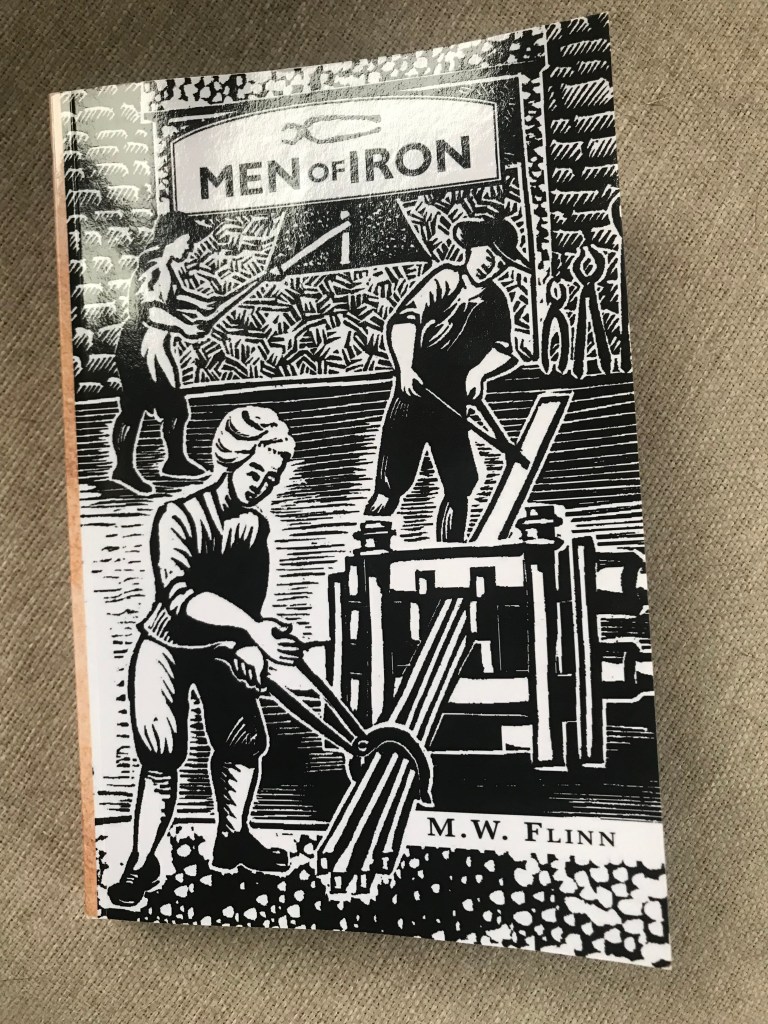
And in 1805 Catherine, daughter of Tobias and Catherine Nock, was married at the Quaker Meeting House in Stourbridge to Thomas Martin. She died on 9th March 1816 and was also buried at the Dudley Quaker Burial ground where her father had also been buried. So the Nock family clearly had a strong connection with the Society of Friends. In fact in his fascinating book ‘Men of Iron’ Michael Flinn states that “the greater part of the iron industry of the day was controlled by closely linked Quaker groups”. So it would not be surprising to find such a link. The Nock family appear to have been amongst the Rowley folk who were more than just nailers but also, like the Crowley family, moved during the late 1700s and onwards into selling and distributing the nails made in the Rowley area in London and possibly elsewhere.

The London connections of the Nock family

All of this is in the period when my 6xg-grandfather Edward Cole married in London in a Fleet marriage. It seems to me increasingly likely that families like the Crowleys and the Nocks employed local men from Rowley to transport the nails from Rowley to their London warehouses or to work for them there, leading to their presence in London at that time. Tobias’s Will leaves his business to his sons, along with “all my stock in trade, money, outhouse and cart and all implements belonging to my trade” so he definitely had a cart as part of his business.

Incidentally, the family of Ambrose Crowley of Stourbridge,  blacksmiths, nail factors and ironmongers, who had originated in Rowley Regis, were also Quakers, albeit some years before this. And their son Sir Ambrose Crowley II, who I mentioned in a previous post, was the ironmonger to the Navy so they were in the same trade, buying nails made in the Black Country and selling them in London. Crowley is known to have had a warehouse in Ratcliffe, Stepney and may have started his business there after he completed his apprenticeship but there is no definitive evidence on this.

Tobias Nock the Younger

Tobias the Elder’s son Tobias Nock the Younger moved from Rowley to London at some point in the late 1700s to set up as a nail monger and is described in his father’s Will dated 1791 as ‘Tobias Nock of London, Ironmonger ‘. Tobias the younger had married Frances Darby in St Giles church in Rowley on 17 Aug 1789 and their daughter Mary was baptised on 17 May 1790 in Shadwell.  Frances Nock nee Darby died in March the following year, presumably back at home, perhaps visiting family, as she was buried in St Giles on 6 Apr 1791.

On 20 Mar 1794 Tobias remarried to Mary Kitson, a widow, at Saint George In The East: Cannon Street Road, Tower Hamlets, and their daughter Katherine was born in Shadwell on 17 February 1795 – we know this because her date of birth was given at her baptism. Alas, Mary died in 1797 and there is a burial at St Paul, Shadwell of a Mary Nocks of  Shadwell High Street on 1 Mar 1797.

Tobias had a son Tobias born on 22 February  1799 in Shadwell. Again we know his date of birth from his baptism. Tobias was followed by Eliza in 1803, Deborah in 1806, William Cane Nock in 1811, Frances in 1814 and Edgar Hynson Nock in 1819.

 On 26 November 1807, Tobias Nock Junior (who was by then described in a Baptismal Register a “Nail Ironmonger” in Shadwell High Street ) had all five of his children baptised at once at St Paul’s Shadwell,  just six days after he had married his third – or possibly fourth – wife in the same church. The mothers of the children are listed against each child and the last three – Tobias in 1799, Eliza in 1803 and Deborah in 1806 – are said to be ‘by his present wife Sarah’. But Tobias had only married Sarah in the previous week so did she bear those children out of wedlock? Or is there yet another marriage to a different Sarah followed by a death and a burial that I have not yet found? Or did the priest misunderstand who their mother was? I do not know but will continue to ferret around this little rabbit hole, watch this space!

Had Tobias followed the Quaker practice of not baptising his infant children but succumbed to pressure from his new wife? It seems quite likely.

Looking at maps

I am not familiar at all with London and have had very little need to consider it up to now in my family researches so, unlike the Rowley area, I generally have not the faintest clue how most areas relate to each other. But I have now found three Rowley families – the Crowleys, the Levetts and the Nocks – with strong connections to the Shadwell/Ratcliffe/Stepney area in the 1700s. So I now have to look at maps to see where people from Rowley lived in London in relation to each other. I had no idea where Shadwell , the home of Tobias Nock Junior was nor Stepney where John Levett (his son-in-law) was born, nor how far apart they were. Google maps tells me that they are less than a mile apart, indeed Shadwell was within the Parish of Stepney. Is that coincidence? M W Flinn in his book ‘Men of Iron’ notes that Thames Street was traditionally the habitat of London Ironmongers’ and the road running through Shadwell and Ratcliffe was a continuation of this road.

Shadwell is in the docklands, on the bank of the river Thames, not far from Tower Bridge. According to Wikipedia, the area’s history and character have been shaped by the maritime trades.  Shadwell’s maritime industries were further developed with roperies, tanneries, breweries, wharves, smiths, and numerous taverns, as well as the chapel of St Paul’s where seventy-five sea captains are buried in the churchyard. The early growth and prosperity of Shadwell in this period has been linked to the road connections into London, which were maintained by wealthy taxpayers from Middlesex, Essex, Kent and Surrey, and presumably used on the way in from the Midlands.

I had hoped to include a map of the area but alas, it was held by the British Library which has been the subject of a disastrous cyber ransom attack which has disabled much of their operation for several months now so I cannot access it now.

There is apparently even today a Shadwell Basin, which is now a fashionable housing area in the Docklands.

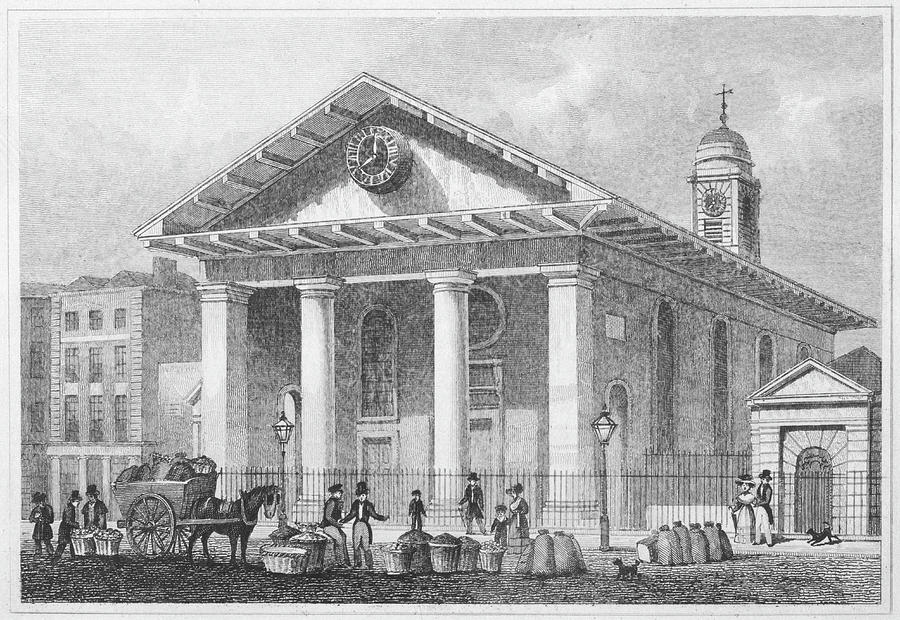
St Dunstan’s church in Stepney, where John Levett and his siblings were baptised is recorded as being founded (or more likely rebuilt) by Dunstan himself in 952, and was the first church in the manor, was also known as “The Church of the High Seas” due to its traditional maritime connections. St Dunstan’s has a long association with the sea, with the parish of Stepney being responsible for registration of British maritime births, marriages and deaths until the 19th century. There is an old rhyme:

“He who sails on the wide sea, is a parishioner of Stepney”

I have noted previously that the maritime trades were very large users of nails, and ironmongery for ship building, etc. So perhaps this was an obvious place for a nail monger to have a business, in the docklands, near to the river.

The old saying ‘Birds of a feather flock together’ has some wisdom in it, what could be more natural than to choose to live near to other folk from your home community when settling in a new place where you knew no-one?

John Levett  was not mentioned in his grandfather Tobias Nock Senior’s Will but his mother Deborah  was. There will be a separate piece on the Levett’s shortly but John Levett was a farmer in Rowley in the first part of the 1800s and the Levetts were among the core families in the lost hamlets. His father was also a John Levett and his mother was Deborah Nock, they had married at St Giles, Rowley Regis on 13 May  1776 when John Levett Snr was a widower of St Dunstans, Stepney, London and a victualler or publican by trade. The marriage was witnessed by her father Tobias Nock (the Younger), just as he would witness his daughter Sarah’s marriage to James Adshead three years later.

Another Great Fire of London

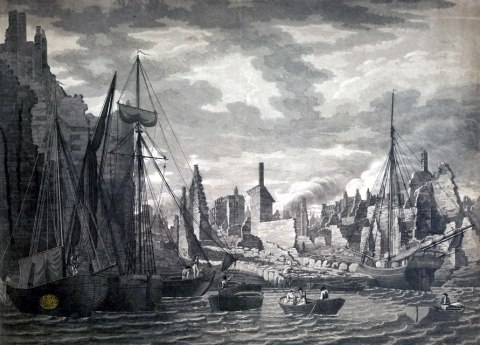
In 1794, many houses in Ratcliffe and Shadwell were destroyed by a fire which “consumed more houses than any one conflagration has done since the Great Fire of London”, and also destroyed many boats, including one laden with around £40,000 of sugar. In fact only one house in Ratcliff survived, so John Levett’s pub must have gone, too. Deborah Levett nee Nock had died in 1794 so I thought for a moment that she might have died in the fire but she had been buried on 15 May 1794 and the fire was on 23rd July.

This is how the fire was described on historic-uk.com

At 3pm on 23rd July, an unattended kettle of pitch boiled over at Clovers Barge Yard, Cock Hill setting it on fire. These flames quickly spread to a nearby barge loaded with saltpetre, a substance used to make gunpowder and matches. The barge exploded violently, scattering burning fragments in all directions. Fires spread to the north and the east, consuming timber yards, rope yards and sugar warehouses.

Narrow streets and a low tide hampered fire fighting, and within a few hours the fire had destroyed 453 houses leaving 1,400 people homeless and displaced. The government erected tents as temporary shelter near St. Dunstan’s Church, whilst the Corporation of London, Lloyds and the East India Company  contributed almost £2,000 to the relief of the homeless.

Copyright: Unknown

I have a lot more material on this fire and the area and would be happy to write more on this if people would be interested.

Tobias Nock the Younger apparently stayed in Shadwell after the fire. He and his only brother Henry had inherited their father’s nail monger’s business in 1792 and appear to have managed it together until 1820 when a notice appeared in Ariss’s Birmingham Gazette stating that the brothers – Tobias of Shadwell High Street, Middlesex and Henry of Rowley Regis , nail ironmongers, had dissolved their partnership on  29 January 1820. But some if not all of Tobias’s descendants appear to have stayed in that area for some decades afterwards.

Meanwhile, back in Rowley… The Midlands Nocks – Henry Nock (1773-1835)

At this time Henry Nock, the only brother of Tobias, was living in Rowley and his address is shown in the records of the Presbyterian Chapel at Oldbury as Portway House.

Henry Nock had married Elizabeth Dixon (1777-1852)in 1793 at St Martins in Birmingham and he had stayed in the Rowley area, his children’s place of birth is shown in Presbyterian records as Portway House and the family appear to have later moved to Oldbury where he died in 1835.

Their children were Henry Dixon Nock, (1794-1870) who later moved to farm in Wigginshill in Warwickshire. Why Wigginshill I don’t know as there isn’t much information online about it, except that it had an early Quaker Meeting House. Perhaps coincidence but those Quakers do keep cropping up. Then came Elizabeth in 1796, Hannah in 1799, Agnes in 1802, Catherine in 1808, Ellen in 1809, Philip in 1812, Fanny in 1814, Edwin in 1818, and Joseph in 1820, all born in Rowley. I have not managed to research all of these but I am working on it!

One later descendant Harry Arthur Nock (1865-1946), son of Edwin above, lived for much of his life, according to census entries, in Delph House, Brierley Hill where he was apparently a Corn Merchant or Factor although intriguingly in just one census in 1891 he gives his occupation as a Civil Engineer and Surveyor as well as Corn Merchant – but only in that one census, in all the others he is a Corn Merchant. However, in 1923 he was well enough off to buy Ellowes Hall in Sedgley which was a substantial house and where his children were still living in the 1939 Register, although he was still at the Delph in 1939, retired and living with his eldest daughter Jessie who was an Elementary School teacherand appears not to have married. Harry died at Ellowes Hall (according to the Probate Grant) in 1946 but the house remained in the ownership of his family until 1963 when it was sold to Staffordshire County Council and demolished.  

The Henrys and the Harrys

There are dozens of Henry/Harry Nocks in the area, often close in age to each other, it was very much a favourite family name. They take some careful sorting out. For example, in 1851 there were two Henry Nocks, one living at 10 Dale End, Birmingham and a grocer and one at 44 Dale End, Birmingham and a Corn Dealer. This caused me some confusion although at present I have only been able to link the second Henry to this branch of the Nocks. Nevertheless the other Henry Nock was born in Tipton/Dudley so it seems likely that they were related in some way.

Tobias was another recurring name, in the Nock family, which may indicate an early connection between branches.

So that is a limited look mostly at the early Nock family, of Rowley Regis and Portway, with their many descendants, who appear mostly to have been in business in the Midlands, Dudley, Birmingham, Coventry, Oldbury, Brierley Hill, Sedgley, Sutton Coldfield, Smethwick – some as corn factors, some as farmers, others in various professions. They were a family of businessmen, dealers, shopkeepers, iron-founders, nail factors, iron-mongers and were mostly well-to-do by Rowley standards. They were literate, they kept a low profile, they left Wills – often leaving their estates to their wives, they appear as executors in the Wills of relatives, they were generally very respectable and very industrious. They appear to have been dissenters for many years and possibly to have Quaker connections.

As I have shown at least one branch moved to London in the late 1700s and it seems very likely that some descendants from that branch remained there. For any readers who have Nock connections, and I know there are many still in the area, I hope you find this interesting and even that this may give you some clues about your family tree – or perhaps you can give me some. Contributions welcome!

When I started looking at this family, I did not think I had any connection and had only one Nock on my family tree, William Henry Nock, known as Harry (of course!) and born in Waterfall Lane, Blackheath and who had married my second cousin Edith in 1959. I remember Harry with great affection, he was a lovely man, what Edith and my mother described as ‘one of nature’s gentlemen’.

Now I have dozens of Nocks in my tree, though most of them are very distantly connected to me.

A most interesting family!

The farms in and around the Lost Hamlets 2

WWII Farming Survey

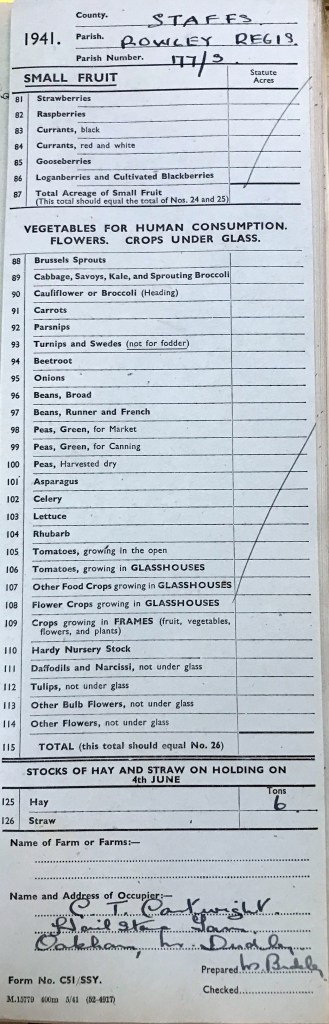
In 1941 and over the next two years detailed surveys were carried out by the Government to assess the quantity and quality of farmland available to feed the nation during the War. The original forms , known as MAF (Ministry of Agriculture and Food) 32, can be seen at The National  Archives so on a recent visit I arranged to see the file for farms in Rowley Regis and photographed many of them, from which I have extracted the information which follows. With full copyright acknowledgment to The National Archives, I have used different sections of the form relating to one farm – Hailstone Farm – in this article but the same farms were available for each farm and I have extracted details below.

First Section: The first set of forms No.C51/SSY in 1941 listed various crops and how much land was in use for each sort of crop being grown. Under Small Fruit were listed Strawberries, Raspberries,Currants – black, Currants red and wite, Gooseberries, Loganberries and Cultivated Blackberries, with a sub-total for the Total Acreage of Small Fruit.

The next section was for Vegetables for Human Consumption. Flowers. And Crops under Glass. Here the crops listed were Brussels Sprouts, Cabbage (Savoys, Kale and Sprouting Broccoi), Cauliflower or Broccoli (Heading), Carrots, Parsnips, Turnips and Swedes (not for fodder), Beetroot, Onions, Beans – Broad, Beans – runner and French, Peas – green for market, Peas – green for canning, Pease – harvested dry, Asparagus, Celert, Lettuce, Rhubarb, Tomatoes – growing in the open, Tomatoes – growing in Glasshouses, Other Food Cops growing in Glasshouses, Crops growing frames – fruit, vegetables, flowers and plants, Hardy Nursery Stock, Daffodils and Narcissi – not under glass, Tulips –not under glass, Other bulb flowers – not under glass, other flowers – not under glass, with again, an acreage total for each category and a subtotal.

The third section was for Stocks of Hay and Straw on the holding.

This is the completed form for Hailstone Farm.

Copyright The National Archives Document MAF 32/604/177, Extract.

So this was a comprehensive assessment of what was being grown that summer on the farms and small holdings of the country. A remarkable number of these for Rowley were Nil returns – nothing being grown, I was beginning to think that the Rowley farms were remarkably unproductive.

What  happened next?

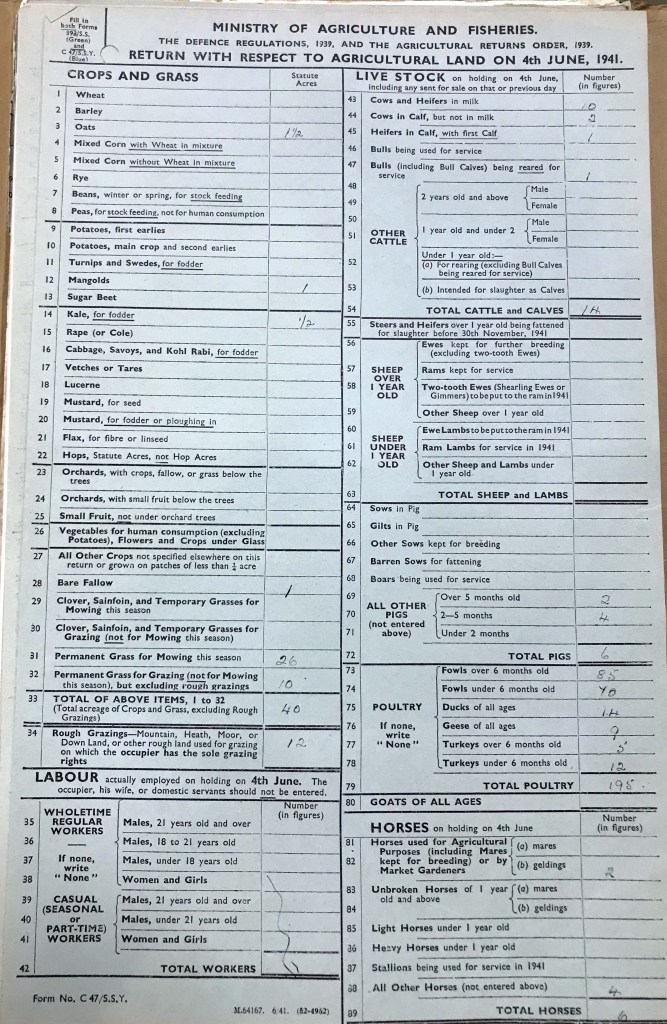
I have to confess that I cannot quite work out how the forms fitted togeether and whether they all went out at one time. But the information is pretty clear. Much more detailed surveys were compiled  on Form No. C.47/S S Y which went into the size, condition, usage of the farm, the number of men employed, details of Live Stock broken down into very specific detail.

The first section listed the Statute Acres for growing each of these crops on 4th June – Wheat, Barley, Oats, Mixed corn with wheat in mixture, Mixed corn without wheat in mixture, Rye, Beans – winter or spring, for stock feeding, Peas for stock feeding, not for human consumption. Then the acreage used for vegetables had to be listed – Potatoes – first early, Potatoes – main crop and second earlies, Turnips and Swedes for fodder, Mangolds and Sugar Beet. Kale – for fodder, Rape (or Cole), Cabbage, Savoys and Kohl Rabi for fodder, Vetches or Tares, Lucerne, Mustard – for seed, Mustard for fodder, Flax – for fibre or linseed, Hops – Statute Acres – not Hop Acres, the form says sternly – who knew there was a difference?

Then acreage of  Orchards had to be shown – those with crops, fallow or grass below the trees and those with small fruit below the trees had to be shown separately, and Small Fruit not under orchard trees.

Vegetables for human consumption (excluding potatoes) had a line to themselves but included Flowers and Crops under Glass. All other crops followed, including clover, Sainfoin, grass for mowing and got grazing. Then the form details information about the labour employed on the farm (not including the occupier, his wife or domestic servants). Followed by full details of the stock held, right down to the last piglet and hen, with horses required to be listed by their use and their age. 

A copy of the  form for Hailstone Farm is shown here, it makes interesting reading.

copyright The National Archives  Document MAF 32/604/177, Extract.

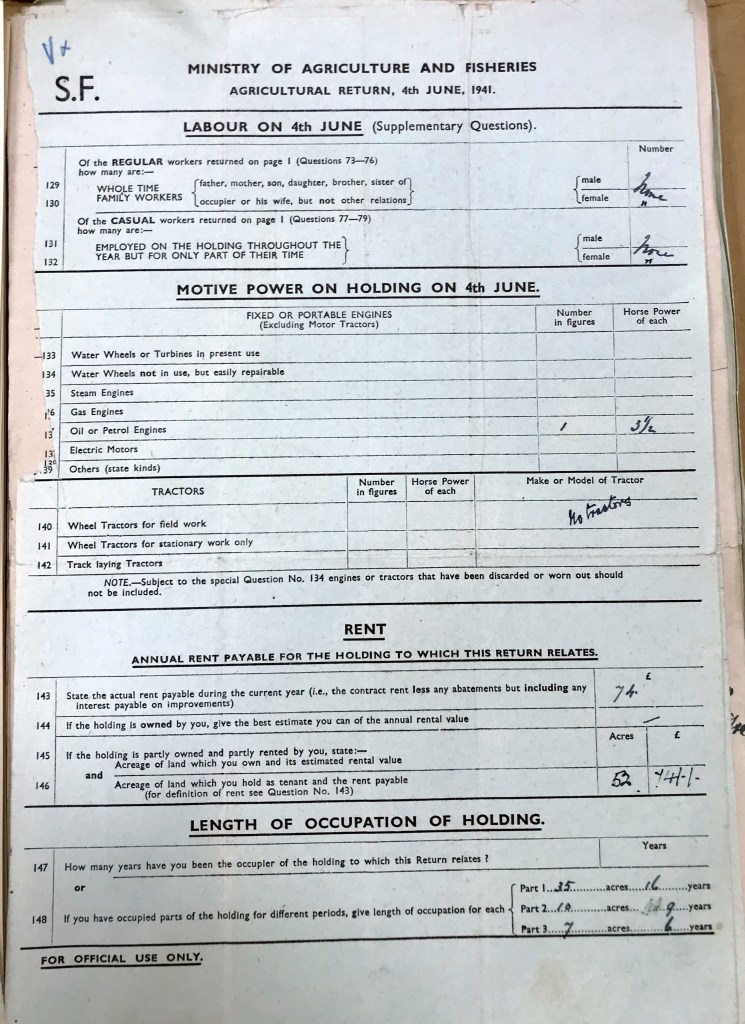
The next section of the form required details to be given of the Labour employed on the 4th June 1941, including the family of the occupier and whether regular or casual, whole or part time. Then a section on Motive Power on each holding had to be completed, water wheels or turbines  – in use or not, whether repairable if not in use, Steam engines, Gas Engines, Oil or Petrol Engines, Electric Motors or others – state kinds, the form says. It’s difficult to think of any other kinds, but there was obviously no excuse for not declaring it if there were any! Edit: A later part entry for one farm lists a horse – which was of course for many the main source of motive power for centuries, those or oxen. Then there was a section requiring information on Tractors held, of various sorts, with information required on the make and model.

Next the form required details of the rent being paid for the holding – if the land was owned by the occupier, the owner was required to give their best estimate of how much the rental value was. And how long the holding had been occupied by the current occupier.

copyright The National Archives  Document MAF 32/604/177. Extract

Later Survey

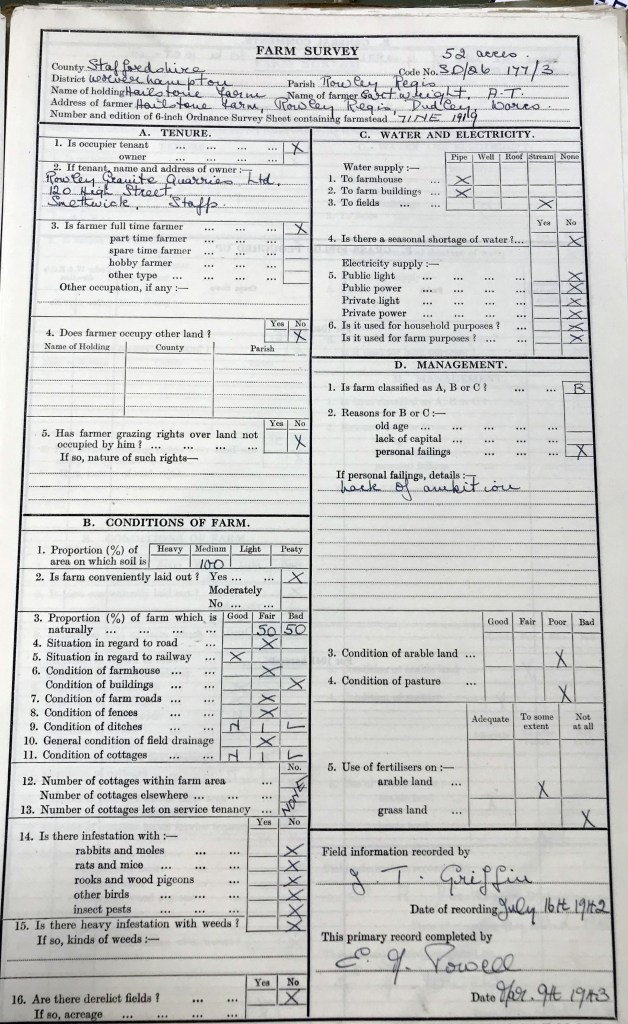
A later  Survey gave a detailed picture, not only of the amount of land held but how it related to such things as access to transport, condition of buildings, facilities and an assessment of whether the farm was being farmed efficiently. Again, this is the form relating to Hailstone Farm, part of the same form as previously.

Copyright The National Archives  Document MAF 32/604/177. Extract

There were a few copies of each of these forms relating to farms in Rowley. I have grouped the details under each farm and although they are, to some extent, repetitive, I hope they will be of interest.

Hailstone Farm

The name of the Occupier at Hailstone Farm was C or G Cartwright. What was he growing in that first survey? Ah, sadly, none of the crops listed, except that he had 6 tons of hay – just one entry!

At Hailstone Farm on the longer form, there were no additional labourers so all the work must have been done by the occupier Mr Cartwright and his family. He had one 3½ horsepower Oil or Petrol engine and no tractors at all.  His rent was £74 per annum. Under the length of tenancy, he stated that he had rented 35 acres for 16 years, 10 acres for 9 years and a further 7 acres for 6 years.

Farm Survey:     The survey was carried out on 16 July 1942.  The owner of Hailstone Farm, with 52 acres was Rowley Granite Quarries Ltd., which was based in Smethwick High Street. Mr Cartwright was a full time farmer, but occupied no other land and had no grazing rights elsewhere. T he farm was said to be conveniently laid out.

All of the land was classified as medium weight., as opposed to Heavy, Light or Peaty. The condition of the farm was judged to be naturally 50% Fair and 50% Bad, with fair access to roads, good access to railways. The condition of the farmhouse was fair but that of the farm buildings was bad. Farm roads and fences were in fair condition as was the general condition of the field drainage but there were no ditches nor cottages. No problems were noted with infestations of rabbits, rats or rooks, etc nor any heavy infestation with weeds nor derelict fields. Water supply to the farmhouse and buildings was by pipe and to the fields by stream. There was no electrical power supply at all. The condition of the arable land and pasture was judged to be poor and, although fertilisers were used to some extent on arable land, they were not used at all on grassland. The overall verdict on management of the farm? It was graded B (out of a possible A, B or C, it appears). Of the possible reasons for this, it was noted that this was due to personal failings – a lack of ambition! They certainly weren’t pulling any punches, were they?

Turner’s Hill Farm

T E Monk at Turner’s Hill Farm was another nil return on the first form. The later form showed that he had no additional workers and no machinery. He was paying £67 per annum for 27 acres and had rented it for 13 years in 1941.

Farm Survey: Carried out on 31 Aug 1943. Turner’s Hill Farm was also owned by Himley Estates. Mr Monk was described as a ‘spare time’ farmer who was also a Factory Employee., with no other land or grazing rights.  The farm was said to be conveniently laid out. The farm conditions showed that the soil was 50% Medium and 50% Light and the proportions of the farm was judged to be naturally 40% Fair and 60% Bad, with good access to roads, and fair access to railways. The condition of the farmhouse and buildings was fair. The farm roads were good and fences were in fair condition as was the general condition of the field drainage although the ditches were noted as Bad. There was one cottage within the farm area. No problems were noted with infestations of rabbits, rats or rooks, etc nor any heavy infestation with weeds, there were no derelict fields. Water supply to the farmhouse and to the farm buildings and fields was by pipe. There was no electrical power supply at all. There was no seasonal shortage of water noted. The condition of the pasture land was good and fertilisers were used adequately on grassland. The overall verdict on management of the farm? It was graded B (out of a possible A, B or C, the reason given for the downgrading was ‘Divided Interests’, presumably relating to Mr Monk’s other employment.

Old Portway Farm

The first form for Old Portway Farm, occupied by Phoebe Cooks, showed just 2 tons of hay.

But the more detailed form showed that Mrs Cooks was growing a total of three acres of Main Crop potatoes, turnips/swedes and mangolds. She had 8½  acres of mowing grass and 15 acres of grazing grass plus 2½  acres of rough grazing – there seems to have been a lot of this in Rowley, perhaps due partly to the effects of quarrying and mining settlement. She had three workers, one male and one female whole time workers and one part-time male. These cared for her 6 cows in milk, her 6 cows in calf but not in milk and 1 bull (used for service). There was one other female cattle aged between one and two years, giving a total of 14 cattle. There were no sheep or pigs but she had 85 fowls over 6 months old, 68 under 6 months and 3 ducks! The remaining live stock consisted of three geldings and one other horse.

On the next page, Mrs Cooks stated that she had one wholetime family worker (male, so not herself) and one part-time casual male worker. She also, like Mr Cartwright at Hailstone Farm, had one 4hp horsepower Oil or Petrol engine and no tractors at all.  Her rent was £56/10shillings per annum for 29 acres. Under the length of tenancy, she stated that she had rented the land for 30 years.

Farm Survey: Carried out on 22 May 1942. The owner of Old Portway Farm, with 26½  acres, we can now see, was again Rowley Granite Quarries Ltd., which was based in Smethwick High Street. Mrs Cooks was a full time farmer, but occupied no other land and had no grazing rights elsewhere.  The farm was said to be conveniently laid out.

All of the land was classified as medium weight, as opposed to Heavy, Light or Peaty. The condition of the farm was judged to be naturally 100% Fair, with fair access to roads, and good access to railways. The condition of the farmhouse and buildings was fair. There were no farm roads and fences were in fair condition as was the general condition of the field drainage and ditches. There were no cottages. No problems were noted with infestations of rabbits, rats or rooks, etc nor any heavy infestation with weeds, there were 2.5 acres of derelict fields. Water supply to the farmhouse was by pipe and to the farm buildings fields by well. There was no seasonal shortage of water noted. There was no electrical power supply at all. The condition of the arable land was judged to be fair and of the pasture good and, although fertilisers were used adequately on arable land, they were only used to some extent on grassland. The overall verdict on management of the farm? It was graded A (out of a possible A, B or C, it appears).

Lower Portway Farm

Joseph Cooks, at No. 17 – Lower Portway Farm had even less hay – he had nothing entered on his farm on the first form but more detail on the second.  He had two acres growing the same crops as Mrs Cooks, plus 5 acres of mowing grass and 10½ acres  of grazing grass. He had 3 cows in milk and two in calf with their first calf plus a bull under 1 year old which was being reared for service. No sheep or pigs but 120 fowls over 6 months, 50 fowls under six months and three ducks. He had no horses!

Farm Survey: Carried out on 14 May 1942. The owner of Lower Portway Farm, with 17¼   acres, was Himley Estates Ltd, with an office address in Dudley. Mrs Cooks was a full time farmer, but occupied no other land and had no grazing rights elsewhere.  The farm was said to be conveniently laid out.

All of the land was classified as light weight, as opposed to Heavy, Medium or Peaty. The condition of the farm was judged to be naturally 100% Fair, with good access to roads, and fair access to railways. The condition of the farmhouse, farm buildings and farm roads was fair. The fences and ditches were in fair condition and the general condition of the field drainage and ditches was good. There were no cottages. No problems were noted with infestations of rabbits, rats or rooks, etc nor any heavy infestation with weeds, there were no derelict fields. Water supply to the farmhouse and the farm buildings was by pipe and to fields by stream. There was no seasonal shortage of water noted. There was no electrical power supply at all. The condition of the arable and pasture land was good and fertilisers were used to some extent on both arable and grass land. The overall verdict on management of the farm? It was graded A (out of a possible A, B or C).

175 Dudley Road

The Danks brothers were listed on the first form at 175 Dudley road and they had just 1 ton of hay.

The later section shows that they were farming 15½ acres, of which they were the owners. The farmer was described as a part-time Dairyman, with no other land or grazing rights. All of the land was classified as light weight and the farm was said to be conveniently laid out.

Farm Survey: Carried out on 20 Sep 1943. The condition of the farm was judged to be naturally 40% Fair and 60% Bad, with good access to roads and to railways. The condition of the farmhouse and farm buildings was fair. There were no farm roads. The fences and ditches were in fair condition and the general condition of the field drainage and ditches was fair. There were no cottages. No problems were noted with infestations of rabbits, rats or rooks, etc nor any heavy infestation with weeds, there were no derelict fields. Water supply to the farmhouse, the farm buildings and to fields was by pipe. There was no seasonal shortage of water noted. There was electrical power from the public company for light and power, which was used for household but not farm purposes. The condition of the pasture land was good (no arable land)and there was adequate use of fertilisers on the grass land. The overall verdict on management of the farm? It was graded A (out of a possible A, B or C).

The Stores’, High Street, Rowley Regis

Samuel Goode was listed at ‘The Stores’, High Street, Rowley Regis and he, too had a zero return on the first form. On the later form he had no crops, no workers and no animals – or at least none of his own, he had a note saying that he had no fowl of his own but let a corner piece of land to someone called Jackson who had about 50 fowl there.

He had no additional labour, no machinery and held 7 acres at a rent of £3/10shillings which he had rented for 7 years,  noted in pencil at the bottom of the form as for rough grazing only. I wonder where his land was?

Farm Survey: Carried out on 2 Sep 1943. As might be expected he had a nil return to almost all of the questions on the last section, though his land was classed as 100%light and was not stated to be derelict but the proportion of the farm which was naturally bad was 100%. There were no buildings and the water supply to his field was noted to be by ‘pit’. No power!  Fertiliser was used to some extent on what was classed as grass land but the holding still managed to be classed as A, somehow.

Brickhouse Farm

The first return for the Brickhouse Farm was completed by the Borough Surveyor at the Old Hill Offices  of the RRUDC and he listed a half acre of onions being grown and half a ton each of Hay and Straw. The later form reported that there were 6 ¼ acres growing oats, 2 acres growing first early potatoes and 15 acres with main crop potatoes, 1 acre growing vegetables for human consumption, 1 acre bare fallow, and 45 acres of mowing grass, plus 17 acres of rough grazing. Contrary to what is stated elsewhere on these forms, he states that there are two full time male workers or 21 and one under 18, and four casual seasonal workers, giving a total of seven. Perhaps these were actually Council employees, rather than specifically employed by the farm. There were no animals on the farm other than one horse, a gelding.  But a later part of the form shows that this was apparently the only local farm with a tractor so they did not need to keep many horses.

The next part of the return for Brickhouse Farm shows that it had no men working it and that 57 ½ acres had been rented since April 1939 for a mere £12. Presumably this land was what later became the Brickhouse housing estate. A second return by the same officer still employed no men but boasted a 25hp Fordson tractor. Here 49 acres was owned by the Council with an estimated rent value of £85pa, and a further 38¼ acres rented at £19/2/6. I suppose this could include the land on which the Grammar School was built in the early 1960s. Of this land, 67 acres had been held for only 2 years and 20¼ acres for 5 years. Perhaps the Rowley Regis Council was buying up land as it became available for future uses.

Farm Survey: Carried out on 11 Oct 1943. The owner of Brickhouse Farm, with 70  acres is shown to be Rowley Regis Boro’ Council. The full time farmer was noted as a Bailiff but he occupied no other land and had no grazing rights elsewhere.  The farm was said to be conveniently laid out.

All of the land was classified as medium weight, as opposed to Heavy, Light or Peaty. The condition of the farm was judged to be naturally 50% fair and 50% bad, with good access to roads and railways. The condition of the farmhouse and the farm buildings was fair. The farm roads and fences were fair and the general condition of the field drainage and ditches was fair. There were no cottages. No problems were noted with infestations of rabbits, rats or rooks, etc nor any heavy infestation with weeds, there were no derelict fields. Water supply to the farmhouse and the farm buildings was by pipe and to fields by pit. There was no seasonal shortage of water noted. There was no electrical power supply. The condition of the arable land was judged to be fair and of the pasture poor and fertilisers were used adequately on arable land and grassland. The overall verdict on management of the farm? It was graded A.

Throne Farm

W Skidmore at Throne Road had 4 tons of hay on the first form.  The next form shows that he had two additional full time workers but no motors of any sort or any tractor. His 33 acres was apparently valued at a rental of £40 and he had occupied it for 20 years.

Mr Skidmore was growing 1 acre of turnips and swedes for fodder and 2 of mangolds with 20 acres of mowing grass and 10 of grazing grass. He had two adult male workers who looked after 17 milking cows and 3 cows in calf. He also had a sow in pig and 5 piglets aged 2-5 months but no fowl of any sort. He had 2 mares and 5 other horses, 7 in total.

Farm Survey: Carried out on 16 Jul 1942. Mr Skidmore was the owner of the farm and that he was a full time farmer, he occupied no other land and had no grazing rights elsewhere.  The farm was said to be conveniently laid out. The soil was deemed to be naturally 50% medium and 50% light. The proportion of the farm which was naturally good was 60%and 40% fair, with good access to roads and railways. The condition of the farmhouse was fair and the farm buildings good. The farm roads and fences were fair and the general condition of the field drainage and ditches was good. There were no cottages. No problems were noted with infestations of rabbits, rats or rooks, etc nor any heavy infestation with weeds, there were no derelict fields. Water supply to the farmhouse and the farm buildings was by pipe and to fields by stream. There was no seasonal shortage of water noted. There was electrical power supply used in the farmhouse and for farm purposes. The condition of the arable land was judged to be good and of the pasture fair and fertilisers were used adequately on the arable and grassland. The overall verdict on management of the farm? It was graded A.

Farm Survey: Carried out on 12 Sep 1944. Mr Skidmore also owned land at Whiteheath Farm, 31 acres of this. All of the land was classified as medium weight, as opposed to Heavy, Light or Peaty and the farm was said to be conveniently laid out. The condition of the farm was judged to be naturally 25% fair and 75% bad, with good access to roads and fair  access to railways. There was no farmhouse, farm buildings or farm roads and fences were good and the condition of the ditches and the field drainage was fair. There were no cottages. No problems were noted with infestations of rabbits, rats or rooks, etc nor any heavy infestation with weeds, there were no derelict fields. Water supply to the fields was by stream. There was no seasonal shortage of water noted. There was no electrical power supply. There was no arable land and the pasture was rated fair and fertilisers were used adequately on the grassland. The overall verdict on management of the farm? It was graded A.

1 Oakham Farm

David Whitehouse at 1 Oakham Farm had nothing to list  on the first form.  But the next form shows that he was growing maincrop potatoes, turnips/swedes and mangolds, and there were 16 acres of mowing grass and 20 of grazing grass. Two whole time men over 21 were employed and one 18-21 year old. There were 8 cows in milk, no poultry but three mares, plus one unbroken gelding and one other horse.

The next section shows that he had just one full time male family worker – presumably himself and no engines, although he did add that he had one source of motive power – a horse! He owned 1 acre and had rented a further 44 acres for £54pa for 11 years.

This farm was owned by F W Gould who had an address in Tipton. The farmer was full time and had no access to other land or grazing rights. All of the land was classified as medium weight and the farm was said to be conveniently laid out.

Farm Survey: Carried out on 5 Aug 1942. The condition of the farm was judged to be naturally 65% good and 35% fair, with good access to roads and railways. The condition of the farmhouse the farm buildings was fair as was the condition of the farm roads, fences and the field drainage. There were no ditches or cottages. No problems were noted with infestations of rabbits, rats or rooks, etc nor any heavy infestation with weeds, there were no derelict fields. Water supply to the farmhouse was by pipe and to farm buildings and fields by pits. There was no seasonal shortage of water noted. There was no electrical power supply. The condition of the arable land and pasture land was rated fair and fertilisers were used adequately on the arable land but only to some extent on the grass land. The overall verdict on management of the farm was graded B, with a note that the reason for this was ‘personal failings – lack of Ambition’.

2 Oakham Farm

Bert Whitehouse at 2 Oakham Farm was another farmer with nothing to list on the first form. But the next form shows a name of Joseph Whitehouse  –  brothers  to David, perhaps? – at 2 Oakham Farm which had 13 acres of rough grazing, and one adult man working. There were 10 cows in milk and 50 fowl, plus 21 ducks, with one horse which did not fall into any of the agricultural designations, perhaps a riding horse.

This farm also had one additional full time worker – a  daughter. There were no motors or tractors either and the ten acres of land had been rented for 35 years, the rent was £28pa.  

Farm Survey: Carried out on 11 Aug 1942. Mr Whitehouse was noted as the owner of the farm and was a full time farmer, though with no access to other land or grazing rights. All of the land was classified as medium weight, as opposed to Heavy, Light or Peaty and the farm was said to be conveniently laid out. The condition of the farm was judged to be naturally 100% fair, with good access to roads and fair  access to railways. The condition of the farmhouse and the farm buildings was fair. There were no farm roads and fences were bad and the general condition of the field drainage and ditches was fair. There were no cottages. No problems were noted with infestations of rabbits, rats or rooks, etc nor any heavy infestation with weeds, there were no derelict fields. Water supply to the farmhouse and the farm buildings was by pipe and to fields by pits. There was no seasonal shortage of water noted. There was no electrical power supply. There was no arable land and the pasture was rated fair and fertilisers were used adequately on the grassland. The overall verdict on management of the farm? It was graded B with a note that the holding was farmed by an old widow who ‘lacked management’. This is slightly contradictory because elsewhere on the forms the farmer is described as Bert Whitehouse but perhaps the farm was owned by his mother.

Lamb Cottage, Throne Road, Whiteheath

J Matthews at Lamb Cottage, Throne Road, Whiteheath had nothing to list on the first form.  The second form shows that he had no crops but 4 acres of grazing grass and 2 acres of rough grazing. His livestock comprised one sow kept for breeding, 3 piglets aged 2-5 months and 10 under 2 months. There were 25 Fowls over 6 months, 4 ducks, 6 geese, 2 turkeys over 6 months and 8 under 6 months. But no horses.

Details on the next page show that he had rented just 6 acres for one year at £6. And had neither additional workers nor motive power. Of this land, a pencil note adds that 2 acres was rough grazing.

Farm Survey: Carried out on 2 Sep 1943. This farm was owned by Mr Cartwright of Hailstone Farm. The farmer Mr J Matthews was described as a part-time farmer and his other occupation was given as Farm Worker.  He had no access to other land or grazing rights.

All of the land was classified as medium weight, and the farm was said to be moderately conveniently laid out. The condition of the farm was judged to be naturally 100% fair, with good access to roads and railways. The condition of the farmhouse and that of the farm buildings was fair. The condition of the farm roads, fences and ditches was fair as was the general condition of the field drainage. There were no cottages. No problems were noted with infestations of rabbits, rats or rooks, etc nor any heavy infestation with weeds, there were no derelict fields. Water supply to the farmhouse and the farm buildings was by pipe and to fields by stream. There was no seasonal shortage of water noted. There was apparently an electrical power supply to the house but not the rest of the farm. The condition of the pasture land was rated fair (no arable land)and fertilisers were used adequately on the grassland. The overall verdict on management of the farm was graded A.

Warrens Hall Farm

At Warrens Hall Farm, the Wooldridge Brothers had nothing to enter on the first form. They were growing 7 acres of oats, 2 of mangolds and 1½ acres of kale for fodder on the next. There was 30 acres of mowing grass and 45 of grazing grass, plus 16½ acres of rough grazing and 69 acres of golf course!  For this they had one whole time and one part time seasonal worker – there were 20 cows in milk, and 12 in calf but not in milk. Under Poultry, there were 60 fowls over 6 months old and 40 under, 5 ducks and 4 turkeys over 6 months old, the first turkeys I have seen mentioned in these returns. The horses included 3 geldings and 2 other horses.

The next part of the form shows that there was one whole-time male family worker, plus one male and two female part time workers, with – again – no motive power of any sort. The annual rent for the 171 acres was £110 and it had been rented since 1913, 28 years.

Farm Survey: Carried out on 11 May 1942. Warren’s Hall Farm was owned by the Himley Estates Ltd with an office in Dudley. The farmer was recorded as full time and the farm included access to 69 acres held by Dudley Golf Club. But the farmer had no other grazing rights.

All of the land was classified as medium weight, and the farm was said to be moderately conveniently laid out. The condition of the farm was judged to be naturally 10% good and 90% fair, with fair access to roads and railways. The condition of the farmhouse was good and that of the farm buildings was fair. The condition of the farm roads, fences and ditches was fair as was the general condition of the field drainage. There were no cottages. No problems were noted with infestations of rabbits, rats or rooks, etc nor any heavy infestation with weeds, there were no derelict fields. Water supply to the farmhouse and the farm buildings was by pipe and to fields by stream. There was no seasonal shortage of water noted. There was apparently an electrical power supply to the  house and farm. The condition of the arable land was good and the pasture was rated fair and fertilisers were used adequately on them both. The overall verdict on management of the farm? It was graded A.

Who  completed the forms?

All of these forms were prepared by independent officials, one recording field information and visits taking place over a period of two years in all and the primary record being completed by another official at a later point. The visiting officials were J Griffin who seems to have visited some sites in July, August ,  September  and October 1942, August, September and October 1943, and September 1944.  C A Dickinson visited a couple of farms in May 1942.

The signing off of the primary record seems to have been the responsibility of E M Powell or E M Casstles and happened sometimes months or even more than a year later. The writing of the E M in the signatures is identical so I suspect that it was the same person who was a woman who got married!

Summary

These forms related to the farms which I could identify in the file as in and around the area of the Lost Hamlets. There were a few more forms with vague descriptions of the land they referred to – (land off …Road, etc) – often small areas and usually owned by companies or contractors and not with local family names that I recognised and I have not included these in this piece. Nevertheless I hope that I have covered most of the farms and smallholdings known to local people.

The information gathered was clearly to inform the Government of what capacity for growing food there was and where labour such as the Land Army should be directed, as well as controlling the distribution of food in the form of livestock, chickens, pigs etc so as to safeguard the ration system. And now, thanks to The National Archives, the best part of 100 years later, we can use it to build ourselves a picture of farming life in the hamlets during the Second World War.

It does appear that the farms in this area were, mostly through no fault of the farmers, generally of only fair or poor quality, partly due to historic industrial processes including quarrying and mining which resulted in subsidence and spoil tipping with consequent damage to the farmland above and around the mines and quarries. This was recognised at much earlier times than this war, as Farmer John Levett at Brickhouse Farm was reporting in 1820 that much of his farmland could not be used because of undermining and spoil tipping. Although some of this external damage  will have settled and greened over to some extent after the mines closed, it seems likely that even more waste chemicals and other substances were deposited in unrecorded dumping in later years and as local industries diversified and expanded. The damage to the quality of the soil seems likely to have persisted for many years, if indeed  it was ever very good. Alas, much of the land on the Rowley Hills had always been ‘rough grazing’ and it seems that farming in Rowley was often a struggle and the farmland did not, could not feed many people, even in the 20th century, other than for dairy purposes.

I hope you have found this an interesting chapter in the story of our local Farms.

A Christmas Post- a little holiday reading with a Yuletide flavour!

Sadly, I have no direct sources from people who lived in the Lost Hamlets for this, but I have pulled together a little from published sources, including Rowley Village and some other places which tell us something of the celebrations in times gone by.

Here are the Christmas memories which J Wilson Jones heard about from his elderly lady relations when he was a boy, so their memories were perhaps of the later part of the 1800s and which he recounted in his History of the Black Country.[i].

“To observe these people at Christmas was an inspiring sight. The table of the poorest was laden with home-cured ham, poultry, plum puddings and delicacies. They gathered around the harmonium or organ and sang the local carols, mainly composed by a Rowley Regis nailmaker Mr Joseph Parkes. The children received few toys, the money of the nailer being spent upon the food and probably new boots. There was, however, that great day of festivity and joy. The scene had changed little from the villain and serf forgetting his hard labour at the Church Fair but in these days  of comparative leisure, we have lost their art of celebration.

The Black Country diet has puzzled many strangers but I cannot agree with the writers who say, “they did themselves well”. I believe many of the delicacies had their foundation in the effort of the yeoman and villain housewife to make a little go a long way. Naturally pork was preferred, not because of an aristocratic taste but everyone kept a pig, from these followed the bacon. Nothing must be wasted and so there came the black pudding, chawl, pork bones, pig’s head and even pig’s tail. Served with pearl barley, leeks or onions, a tasty dish resulted but in districts less accustomed to hardship, how much would have  been thrown away? A turkey or cockerel was never wasted, the giblets, feet and even the cock’s comb seemed to have their uses. All food was dished out in far too liberal helpings, and contained much of the heavy nature as dumplings or suet puddings.”

“Black Country Songs and Carols

The Black Country has a number of songs and carols peculiar to the District and although not heard as frequently now, they were well known in the earlier part of the twentieth Century. One of the carols ‘Brightest and Best’ is sung to a tune called ‘Rowley Regis’ and composed at Blackheath in the 1860s by Joseph Parkes, a nailer. Another Christmas tune he composed was ‘Come again Christmas’ . The new Year is welcomed by a Carol with the quaint refrain:

The Cock sat in the Yew Tree

The Hen came chuckling by,

I wish you a Merry Christmas

And every day a pie.

A pie, a pie, a pie, a peppercorn,

A good fat pig as ever was born

A pie, a pie, a pie, a peppercorn.

This was sung with great enthusiasm around the Rowley district even in 1925.

Another carol contained the words

‘I saw three ships a sailing,

A sailing, a sailing

I saw three ships a sailing,

Upon the bright blue sea.

And those who should be in those three ships,

In those three ships, in those three ships,

But Joseph and his fair lady.’

A song which used to echo around the drawing room on Christmas night, in the form of a round was called Reuben and Rachel. It went as follows:

‘Reuben Reuben I’ve been thinking

What a fine world this would be

If the men were all transported

Far beyond the Northern Sea.’

A song that concerned Rowley was called ‘The poor Nailmaker’ but it seems to have died out about 1840.

                ‘From morn till night

                From early light

                We toil for little pay.

                God help the poor of Rowley

                Throughout each weary day.

                There is a house in Old Hill town

                A garden by its door,

                The keeper keeps you breaking stones

                For ever more.”

A reference, presumably, to the Poorhouse.

Wilson Jones also notes the Postage Rates in 1820. How much did it cost to send a Christmas Card?

Postage Rates, Rowley 1820

15-20 miles                          5d (d is the symbol for one old penny! Twelve pence in a shilling.)

20-30 miles                          6d (sometimes known as a tanner)

230-300 miles                     1 shilling (or a bob, there were twenty shillings in a pound).

He also lists the Poor Allowance in 1871 in Rowley.

( ½ = a halfpenny or ha’penny, ¼ = a farthing, a quarter or fourthing of a penny)

2 loaves of bread                             6 ½d

2oz butter                                           2 ¼d

2oz sugar                                            ½d

4oz bacon                                           2 ¼d

4oz flour                                              ¾d

Potatoes                                              2d

Vegetables                                         ½d

Coal                                                       3d

Fish                                                        4d

Meat                                                     9d

So the cost of sending a letter was an expensive luxury!

Other local memories

Tossie Patrick wrote a wonderful book with her memories of Blackheath, called ‘A pocketful of Memories’.published by the Kates Hill Press. [ii]

She recounts that before Christmas at school, the children would be busy for two or three weeks, making paper chains and Chinese Lanterns and decorating the classroom with them, which looked very festive. The last day of term was the school tea party which she remembered enjoying very much.

Tossie remembered her father getting a small real tree which her mother dressed with tinsel and a few carefully kept glass baubles. Plus sugar pigs and sugar fancies, some rock walking sticks and sometimes a little broken chocolate.  The tree was then hung from a hook in the ceiling and Tossie’s mother would cut the sweets off each day until they were finished. Presents, just as in earlier times mentioned by Wilson Jones, were often new clothes or shoes, and perhaps a few small toys such as a cardboard sweet shop or a toy tea set. Tossie remembered receiving a miniature cooking stove complete with pots and pans – I once got one of those, too!

Tinsel tarnished in those days, I remember, no plastic film then. My mother, too, had a few real glass baubles, perhaps made in one of the local glass works, they were very fragile. There were candle clips which were attached to the branches and real candles – the fire risk must have been terrible! I remember sugar mice and when my children were little I once found a sugar pig in a local sweet shop – I think that the diet police have succeeded in banning these giant lumps of pure sugar these days. But my children had other sweets and they never ate the sugar pig and so it was recycled every year until it became too scruffy and was disposed of! And yesterday my daughter and I were discussing presents and catering and she reported that she had managed to find a sugar mouse for my granddaughter’s stocking, some traditions go on. I don’t suppose my granddaughter will actually eat it either but it’s just one of the things that go in a stocking, along with the orange and nuts and chocolate coins in the toe!

Tossie remembered her Christmas Day tea with great pleasure. Tea included a large tin of Libby’s peaches and a tin of Fussell’s Cream  and a chocolate covered roll and bread and butter. Her Mum had to cut the ends of the chocolate log up and divide them between the children to stop squabbling about the chocolate covered ends.  Like many families, Tossie’s family used the front room at Christmas, very special and they all sat by the fire and listened to Dicken’s ‘A Christmas Carol’ on the wireless.

In the Pocketful of Memories Rowley Book, by Irene M Davies [iii], also published by Kates Hill Press, there is a whole chapter on Christmas in Rowley village, full of lovely memories and well worth reading. She recalled something which I have never come across which was a Christmas Bowl. These could not be bought, they were made at home. Two hoops from a butter barrel (some men were skilful and used three!). These were crossed to form a circle and secured at the crossing point with  string, the hoops were covered with paper strips pasted on and then covered with tissue paper which was trimmed and cut with a fringe and then attached to the bowl with flour and water paste and perhaps hung with sugar fancies as it was hung with pride on Christmas Eve. What pride and joy Irene remembers, money is not always necessary for happiness.

Irene also recalls that many families kept a few fowl in the yard and a pig and a pig would be killed before Christmas, with joints of pork and a cockerel for Christmas dinner, a joint of beef was sometimes bought for the occasion. Most people, she remembers, cooked the meat in front of the fire, using a meat-jack. The meat tin underneath the roasting joint caught the dripping which was much enjoyed at other times! When everything was prepared, it could be left while the family went to chapel before sitting down to their festive meal. Mincemeat for pies and puddings were also made at home with due ceremony. Irene tells of the ingredients for the ‘plum pudding’, made several weeks before Christmas –and containing various ingredients which had to be cleaned and chopped at home. Scraped and shredded carrots (who else thought carrot cake was a modern invention?), peeled and grated apples; currants and sultanas had to be washed and the big juicy raisins had to be stoned and chopped, breadcrumbs made from stale bread. Irene remembers that in those days candied peel came, not in little pots ready chopped, but in the form of half oranges and lemons which also had to be chopped, lumps of sugar had to be prised out of these and these lumps were shared out and sucked, obviously highly prized. Beef suet also had to be chopped along with dates and prunes which had been soaked in hot tea the night before and then stoned. When everything was mixed, with some old ale, everyone in the house would take a turn to stir the mixture and make a wish (which had to be kept secret, of course, or it would not come true) before the puddings were packed into basins and sealed down with greaseproof paper and cloth covers, tied firmly down with string before being cooked in the boiler for several hours the following day.  My mouth is watering as I write, I can almost smell that wonderful steam wafting out. Somehow, picking up even the most superior commercial Christmas pudding from the supermarket seems a great let down in comparison!

Irene is quite right about these larger pieces of candied peel, I was delighted recently to find that one of our two wonderful local farm shops keeps candied peel like this – it is delicious  cut into slices and dipped in melted dark chocolate, my own favourite treat. The French call these Orangettes.  I have even been known to resort to candying my own peel to make these at Christmas!

Copyright: Glenys Sykes

Later in the day, Irene remembered, family would visit, married older brothers and sisters, aunts, uncles, cousins, in-laws and friends. Cups of tea, slices of cake and mince pies, a glass of home-brewed ale would be followed by a good gossip and, later, everyone sitting round the fire singing their favourite carols.

Irene records that her most memorable Christmas was in 1929 when her mother was not feeling well on Boxing Day and she was taken by her father to visit her aunt and uncle. A little later her father slipped out and then came back to tell Irene that she had a new sister, named Hilda. Coincidentally my mother was born on Christmas Day, a few years earlier and she was also called Hilda. Tossie noted that these days everyone just watches television, not nearly such a joyful experience and certainly not as memorable.

What will our children remember about their Christmases with pleasure in fifty or seventy years, as Tossie and Irene did? Tossie and Irene’s books are wonderful reading and I believe they are still available from Kates Hill Press.

Alison Uttley on Christmas

The writer Alison Uttley also writes of how humble houses were decorated for Christmas, in times gone by, in her book Stories for Christmas[iv] which my children enjoyed being read to them when they were small. This is the description of how a ‘kissing bunch’ was made on Christmas Eve, long before Christmas trees were introduced by Prince Albert.

“Now in every farmhouse in that part of England, a Kissing Bunch was made secretly on Christmas Eve to surprise the children on Christmas morning. For hundreds of years, this custom had been kept.

Mr and Mrs Dale planned to make their bunch when the children were fast asleep. So they brought out the best pieces of berried holly, which had been kept apart in the barn, away up the outside steps across the yard. Adam brought the slips of holly indoors, with his lantern swinging, and Mr Dale tied them together in a compact round bunch, arranging them in a double circle of wooden hoops for a frame. The ball was shaped slowly and carefully, with bits tied to the foundation till a beautiful sphere about eighteen inches across was made. It hung from a large hook in the kitchen ceiling.

 [Just like Irene’s Christmas Bowl, perhaps bowl is a corruption of ball? Alison grew up in Derbyshire. Other areas called this the Christmas Bough. Bowl/Bough/Ball – there is a similarity in those names so the name used appears to have been very much a local tradition, used to describe the same thing, made in the same tradition, in different parts of the country. ]

Mrs Dale had been busy with her ribbons and toys, and now she threaded the scarlet and yellow ribbons among the leaves, so that they dropped in streamers. She tied the silver balls, the red and blue glass bells, by strings which were hidden in the greenery. Little bright flags were stuck in the Kissing-bunch here and there, to remind everyone that Christmas was all over the world. Oranges and the brightest red glossy apples from the orchard store, tangerines and gilded walnuts were slung from threads to hang in the bunch as if they grew there.

It was a magical bush of flowers and fruit, of gold and silver. The oranges and apples caught the light of the lanterns and the blazing fire, the holly leaves glittered and the silver and gold bells and balls were like toys from Paradise.

Give me the first kiss, said Farmer Dale and he took his wife in his arms and gave her a smacking kiss under the brilliant Kissing-bunch. “

Copyright: Alison Uttley.

Is that not a lovely description? There is much more of the story in that chapter of Alison’s book.

Some family memories of Christmas

I, too, have memories if Christmas in Rowley and Blackheath in the 1950s. My father was chronically ill and unable to work sometimes and money was very tight. I can remember one year the Minister from our chapel turning up on Christmas Eve with a present each for  my brother and I which he had been asked to deliver anonymously. We might not have had much that year without that kindness. We never knew who had sent them.

We always went to chapel on Christmas Day, of course but it was a fairly low key service and, if I remember correctly, there was not so much as a Christmas tree in church, you know we Methodists liked to keep the chapel simple and relatively unadorned. I can remember being surprised the first time I went to an Anglican church at Christmas and seeing that they had a fully decorated tree in church! Even if there was no tree in chapel though, the favourite carols were always sung fervently, we were good singers at Birmingham Road, a favourite, of course, being Brightest and best of the sons of the Morning, sung to Rowley Regis. I still love that tune.

The first Sunday of December was always the annual performance of the Messiah at Birmingham Road, my childhood introduction to the glories of oratorio, sung in our very own church by our very own (augmented) choir, many of whom had sung in that for many decades and in which I was able to take part in the chorus as I grew up. My mother told me that her mother had such a wonderful alto voice that, one year, when the alto soloist who was booked to perform was taken ill, my granny sang the alto part instead. Sadly she died when I was only three so I don’t remember her but I, too sang alto in choirs for many years which felt like a little link with her.

My mum kept numerous Messiah programmes, this is the one from the year I was born, but I can remember Frank Green the organist from when I was growing up, a faithful servant to the church but somewhat grumpy!

Even though I don’t sing any more,  I still have my battered Messiah score, bought for me by my musical grandad Hopkins who was delighted that his two granddaughters, my cousin Joyce and I enjoyed singing. Grandad certainly enjoyed it, my cousin recently recalled her embarrassment as a child, my grandad’s loud enthusiastic singing in chapel, seated near the front and holding on to some notes long after the rest of the congregation had finished. But he wasn’t embarrassed!

My happiest memories are of Christmas day afternoons when, after lunch, we would walk up from our home in Uplands Avenue to a lovely Edwardian house called Brodawel in Halesowen Street to spend the afternoon with my mother’s cousin Edith and her extended family, her daughters Ann and Christine, Edith’s brother Major Harris and his wife Dot, and a table groaning with a magnificent spread including turkey, ham, cakes, wonderful trifles, including one reserved for the adults with plenty of sherry – and us all good teetotal Methodists, too! I can remember sitting by the glowing coal fire in the front room, cracking nuts and peeling tangerines, and throwing the shells and peel  into the fire. My aunt Edith, as I called her, was the most generous and hospitable hostess and I remember that she nearly always gave me a classic book for Christmas. Heidi, I particularly remember was one and also Little Women and Black Beauty. I loved her dearly, to the end of her days.

Copyright: Glenys Sykes. I am the only person surviving from this photograph taken in the late fifties, at Auntie Edith’s. From left to right, Dot Harris, my mum, my dad, my brother Michael behind, Uncle Harry who was Auntie Edith’s second husband, myself down at the front and someone who I think was cousin Christine’s husband Paul. As you can see, they were very jolly gatherings.

A few years later, our Christmas Day visit changed and we went instead to my mother’s cousin Claude Hadley and his wife Elisabeth in Hurst Green Road. Claude was a wonderful pianist and would play for us on his piano and also play us records of his favourite – and, he said, the greatest ever pianist Horovitz. Elisabeth was German and it was on these occasions that I first tasted this strange but delicious dish called potato salad, a German delicacy which was served with the cold meats and pickles etc. It was lovely, I have to this day never tasted any as good as Elisabeth’s recipe. Claude always seemed to spend his time when we were there trying to get everyone more than a little tiddly, he served very generous tots of spirits to my mum and dad who were not usually great drinkers. Fortunately perhaps, this was before we had a car so we were walking home afterwards, no danger of drinking and driving.

My mum’s hospitality day was always on Boxing Day when our family would gather, my uncle Bill and aunt Dora, Uncle Leslie and Auntie Alice with Joyce, my grandparents in earlier days. My grandad Hopkins always gave my mother a large glass sweet jar full of his home pickled onions or shallots for Christmas, grown on his allotment in Park Street and prepared with his own hand, complete with the pickling spices still in the jar. The best Christmas presents are made with love. This jar usually lasted us for several months and, perhaps it is just nostalgia but again I have never since found any pickles which tasted so good, even when I pickled my own. Perhaps the Blackheath soil gave them a special flavour.

I especially remember Boxing Day 1962 when, after a jolly afternoon in the warmth of the house, we opened the front door for our guests to depart in the late afternoon, and were startled  to find several inches of snow had fallen while we were partying, the start of the terrible winter that year. There was still the odd lump of frozen compacted ice and snow in the gutters of Rowley Village in early April, although even at the beginning it didn’t stop us getting to school and work, life carrying on pretty much as usual. No school closures in those days!

So there we are, a sprinkling of Christmas cheer in Rowley Regis and other places from days gone by, gathered from various sources. So I finish with a description of the food shops in London on Christmas Eve, taken from Dicken’s A Christmas Carol,[v] with a glorious word picture of the bounty on display. I read this a couple of weeks ago, for the first time for many years and much as I love the film versions, especially The Muppets version, Dickens has a wonderful way of drawing word pictures for us. And in this age of the internet, you can download a digital copy free from the Gutenberg Press.[vi]

“The fruiterers were radiant in their glory. There were great, round, pot-bellied baskets of chestnuts, shaped like the waistcoats of jolly old gentlemen, lolling at the doors, and tumbling out into the street in their apoplectic opulence. There were ruddy, brown-faced, broad girthed Spanish Onions, shining in the fatness of their growth like Spanish Friars, and winking from their shelves in wanton slyness at the girls as they went by, and glanced demurely at the hung-up mistletoe. There were pears and apples, clustered high in blooming pyramids; there were bunches of grapes, made, in the shopkeepers’ benevolence to dangle from conspicuous hooks, that people’s mouths might water gratis as they passed; there were piles of filberts, mossy and brown, recalling, in their fragrance, ancient walks among the woods, and pleasant shufflings ankle deep through withered leaves; there were Norfolk Biffins, squat and swarthy, setting off the yellow of the oranges and lemons, and, in the great compactness of their juicy person, urgently entreating and beseeching to be carried home in paper bags and eaten after dinner.”

“The Grocers’! Oh, the Grocers’! Nearly closed, with perhaps two shutters down or one; but through those gaps such glimpses! It was not alone that the scales descending on the counter made a merry sound, or that the twine and roller parted company so briskly, or that the canisters were rattled up and down like juggling tricks; or even that the blended scents of tea and coffee were so grateful to the nose, or even that the raisins were so plentiful and rare, the almonds so extremely white, the sticks of cinnamon so long and straight, the other spices so delicious, the candied fruits so caked and spotted with molten sugar as to make the coldest lookers-on feel faint and subsequently bilious. Nor was it that the figs were moist and pulpy, or that the French plums blushed in modest tartness from their highly decorated boxes, or that everything was good to eat and in its Christmas dress; but the customers were all so hurried and so eager in the hopeful promise of the day, that they tumbled up against each other, crashing their wicker baskets wildly, and left their purchases upon the counter, and came running back to fetch them, and committed hundreds of the like mistakes, in the best humour possible; while the Grocer and his people were so frank and fresh that the polished hearts with which they fastened their aprons behind might have been their own, worn outside for general inspection, and for Christmas daws to peck at if they chose.”

“But soon the steeples called good people all, to church and chapel, and away they came, flocking through the streets in their best clothes, and with their gayest faces. And at the same time, there emerged from scores of bye-streets, lanes and nameless turnings, innumerable people, carrying their dinners to the bakers’ shops.”

“In time the bells ceased, and the bakers were shut up; and yet there was a genial shadowing forth of all these dinners and the progress of their cooking, in the thawed blotch of wet above each baker’s oven where the pavement smoked as if its stones were cooking, too.”

Dickens closes this chapter with this philosophy from the Spirit of Christmas Present, which seems worth pondering on now, all these years after A Christmas Carol was first published  in 1843.

“There are some upon this earth of yours,” returned the Spirit, “who  lay claim to know us, and who do their deeds of passion pride, ill-will, hatred,  envy, bigotry and selfishness in our name who are as strange to us and all our kith and kin, as if they had never lived. Remember that and charge their doings on themselves, not us.”

I wish my readers a very merry Christmas, even if not quite up to the Dickens standard,  and will be back soon with more posts to my blog!


[i] The history of the Black Country by J Wilson Jones, published c.1950 by Cornish Brothers Ltd.

[ii] ‘A pocketful of Memories’.published by the Kates Hill Press, 1998. By  Tossie Patrick. ISBN: 0 95203117 3 6

[iii] A Pocketful of Memories: Rowley, by Irene M Davies, published by The Kates Hill Press in 2005, ISBN 978 1 904552 45 1

[iv] Stories for Christmas by Alison Uttley. My copy published by Puffin Books in 1977. ISBN: 0 14-031349-4

[v] A Christmas Carol in Prose; being a Ghost Story of Christmas by Charles Dickens.

[vi] https://www.gutenberg.org/files/46/46-h/46-h.htm

Men of Iron

In a  previous post, (Daily life in the hamlets in times gone by, May 2023) I have quoted a passage from the memoir of George Barrs, the one time Curate of Rowley Regis , in which he writes with disdain, contempt even, of his Rowley parishioners. He was fairly scathing, too in some of his descriptions of them in the Burial Registers. It appears that this was a mutual dislike as there was at least one unsuccessful attempt to get rid of him by his own churchwardens in the early 1800s but this failed. More on that at a later date, perhaps.

But, as I have transcribed numerous Registers, Anglican and Non-conformist in the last few years  I have noted that, as hand nail-making skills were overtaken by machinery, the ingenious people of the Black Country turned their dextrous hands to other occupations, in metal working especially but in other work, too. And industry continued to thrive in the area.

Even men who worked in physical trades such as quarrying and mining could still work in the nailshops at home. So when I see column after column in church or chapel registers which list occupations as ‘Labourer’ or – in the case of women – no recognition at all that they also worked at nailmaking or in other work, I always find myself wondering how accurate that generalisation was.

It is clear from some registers and from the sheer number of chapels that sprang up in local streets, (more than forty Primitive Methodist meetings in the Dudley area alone by 1840), that many people in the area around Rowley were not the godless alcohol ridden heathens that Barrs seemed to think but were actually independently minded men and women of character and determination who wanted to read the bible for themselves, pray in their own words and to worship in the way they chose in chapels which they had built. In addition to those forty PriitiveMethodist meetings, there were also Wesleyan Methodists, often worshipping in close proximity to the Primitive Methodists plus numerous Baptists and others such as a notable Society of Friends, otherwise known as Quakers. These people chose their own paths to spiritual fulfilment, many of them learning to read along the way.

Many of the chapels which were built were fine buildings which had to be funded locally, and they often involved heavy commitments in time and activities to run them and organise their activities. For at least in the Methodist churches worship was not confined to Sundays, nor to one service on Sundays, two or three was the norm and several services on week nights. Sunday Schools educated adults as well as children. And there were prayer meetings, men’s groups, women’s groups, choirs, bible study groups, too which met in the evenings during the week. Perhaps it was the wholehearted commitment of dissenters to their chapels that annoyed Anglican priests who saw themselves as leaders of their communities by right. The abuse heaped on dissenters in early days was very real and not always confined to words. There was little meeting of minds for many years afterwards.

There was nothing primitive about the organisations of these chapels, there were accounts, trusteeships, preaching rotas, training, printed lists, even before there were paid Ministers. And such Ministers as there were travelled many miles to preach in different places. There were women preachers, too, long before the Established Church ordained women.

Simple descriptions in official records of trades such as labourers or nail or chain makers must conceal the true nature of many of these people. Thinking about my own family, my uncle Bill Rose appears in official records, quite accurately, as a Gas Fitter. And so he was, all of his life. But that was only the day job, he was also for many years a very competent Secretary to our family Methodist church and for many many years, a Trustee of the Church, as was his father, my grandfather who was supposedly just a humble cobbler. And my uncle was also very active in the Worker’s Educational Association in the Birmingham area, promoting not only his own lifelong continuing education but that of others, enriching lives, expanding minds. He was an intelligent, cultured and modest man and highly respected in our chapel, though he never sought this and would have been unwilling to acknowledge it. And I am sure there were many many other such people in our community whose talents and abilities were put to good use but which have faded now from knowledge. Rowley has produced poets and composers as well as nails.

Thomas Gray’s Elegy Written in a Country Churchyard (my mother’s favourite poem) touches on this, the unrealised potential of humble folk.

Full many a gem of purest ray serene,

         The dark unfathom’d caves of ocean bear:

Full many a flow’r is born to blush unseen,

         And waste its sweetness on the desert air.

Far from the madding crowd’s ignoble strife,

         Their sober wishes never learn’d to stray;

Along the cool sequester’d vale of life

         They kept the noiseless tenor of their way.

Perhaps it was simply the independent non-conformist thinking of many ordinary local people that went down badly with the Reverend Barrs. I am convinced that there is a deep thread of non-conformism in my own personality, which surfaces from time to time even today and that this may well have been a defining characteristic of many Black Country people.

Increasingly, in the course of this study, I have had to revise my original view that not many people in Rowley would have stirred from their roots. Increasingly, I have found evidence that there were numerous people who did indeed travel and expand their trades, not only in this country but further afield, too. As regular readers will already know I discovered that one ancestor had married in London and I had wondered whether he was acting as a courier for the nail trade, possibly in connection with the Crowley family who had lived in Rowley before moving to Stourbridge and subsequently London in later generations.

This week I read an article about the Crowley family which mentioned that a book entitled Men of Iron – by M W Flinn, about the early iron industry with particular reference to the Crowley family, had been republished. It was first published in 1962 and Professor Flinn published other books on similar themes before and after this volume. This edition had become rare and expensive. But a copy was loaned by the Winlaton & District History Society to the Land of Oak & Iron Legacy Group and, with the enthusiastic consent of Professor Flinn’s family, the printed text was scanned, transcribed and reset to produce a new edition in 2019. It sounded an interesting book and, thinking that there might be some reference to Rowley Regis , I ordered myself a copy, an early self-Christmas present! It arrived this week and has much detail about the early iron industry and the families involved in it.

Copyright: Land of Oak & Iron 2019.

If you happened to be passing my house late on the evening it arrived, you may have heard a distinct ‘whoop!’ as I read the first few pages as my bedtime reading. This paragraph, on Page 8, is what gave rise to that whoop.

Rowley Regis, in the heart of the Black Country, was a typical nail-making community. It was distinguished in the seventeenth century not only for its concentration on nail-making, but for the number of families living there which produced the leaders of the iron industry in the next century. The Court Rolls of the Manor in the seventeenth century contain many references to the Wheeler, Parkes, Haden, Foley, Darby and Crowley families. Of the men married at Rowley in the years 1656-7, no fewer than forty were classed as nailers, the next largest occupational group being husbandsmen of whom there were four. Rowley Regis specialised at this period in the manufacture of rivets, hobnails and small nails.

Copyright: From Men of Iron – by M W Flinn, published by Land of Oak & Iron 2019.

Whoop, whoop! So there it is, summed up. Not just ignorant unskilled labourers lived in Rowley, or at least not all! There were numerous families of industrious, innovative, inventive, clever, determined men who influenced the future of the iron industry and the whole of the surrounding area and further afield.

Flinn goes on to say a little more about Ambrose Crowley I who lived in the village, although his birthplace is not known. He had married Mary Grainger in the early years of the seventeenth century and settled in the village.

“Like his son and grandson, Ambrose I appeared to have had a numerous family, comprising at least five sons and four daughters. No records of his activities have been traced apart from the fact that he was a nailer. He was described as such in his Will which gives an interesting picture of a combination of light industry with an agricultural smallholding that must have been fairly common amongst the domestic workers in seventeenth-century industry. His property was valued at his death at £24.4s 8d and this included, besides his bellows, hammers and other implements valued at a mere £1.10s.0d, ‘muck in the yard, 3s 4d, cheese in the house £1.10s.0d, a cheese press and some old books; two cowes and one weanling calf, £4 10s 0d.’ Clearly his way of life was far from mean or uncultured, for his house contained six rooms in addition to the workshop and a barn. He died in September 1680 at Rowley Regis.”

Copyright: From Men of Iron – by M W Flinn, published by Land of Oak & Iron 2019.

The best £10 I have spent on a book in a long time! I have a lot more reading to do in this book and in “The Seventeenth Century Foleys: Iron, Wealth and Vision 1580-1716” which I bought at the Black Country Society Local  History Conference in July but have only dipped into. Both books have information about the processes used in the iron industries and how these were refined and improved over time.

So our tiny village of Rowley Regis was not just a sleepy backwater in centuries gone by but home to some amazing people who influenced the whole of the Industrial Revolution. I am prouder than ever to call myself a Rowley girl.

The Poorhouse in Rowley

Recently I came across an article in Ariss’s Birmingham Gazette dated 11 April 1825.

Coroner’s Inquest: Rowley Regis

A long examination took place on Saturday at Rowley Regis before Mr H Smith, Coroner, on the body of Jonathan Taylor, a pauper, upwards of 85 years of age. The deceased, who possessed excellent bodily health but whose mental faculties had for some time failed him, was  an inmate of the poorhouse, and frequently became so unmanageable that he was obliged to be put  under restraint. It was on an occasion of this kind that on Monday afternoon he was confined in a room called the dungeon where there was clean straw for him to lie on, and his victuals were regularly taken to him, and he made a hearty dinner on Tuesday with beef, bread and potatoes; but towards evening he stripped himself naked, and refused to eat his supper.

At five o’clock on Wednesday morning he was heard to cough, and about seven he was found dead, lying on his side with his shirt under his head. Several of the paupers deposed to the kind and humane treatment which the deceased had always received, in common with themselves, from the Governor and Governess of the Workhouse, and it appears that the dungeon was dry and wholesome and had a boarded floor. The Rev. George Barrs, Minister of the parish, stated that he had often made enquiries from the poor as to their treatment and they always expressed themselves perfectly satisfied with it. Mr Kenrick, the surgeon, who opened and examined the body of the deceased, said there were no marks of injury whatever upon it, and that he had never before seen so healthy a subject, considering his extreme age, and that he had no doubt he died a natural death. The jury therefore returned a verdict to that effect.

So what we would now recognise as dementia and mental health problems were a similar problem almost exactly two hundred years ago, and although treatment has mostly moved on a little, even now, in the 21st century, there are periodoc cases one hears of where the treatment of such people has not improved a great deal since then.

I cannot find a baptism locally for a Jonathan Taylor at any time around 1740 or any other record of him but he must have had some local connection to be in the Poorhouse.  

The Poorhouse in Rowley was at the Springfield end of the village, just above Tippity Green and the Bull’s Head, on the same side of the road. It is apparently shown on this map which is a copy of the map drawn up in about 1800 in connection with the Enclosure process, above the Bull’s Head, with two buildings and marked ‘Poor’ and ’27’. but considerably before Brickhouse Green. The second building may have been a nailshop which Chitham says was used by the inmates to earn their keep.

Copyright Glenys Sykes.

Later there seems to have been some alms provision in Tippity Green itself.

Edward Chitham (in his 1972 book The Black Country) says
“The Rowley Poorhouse was situated at Tipperty Green where nowadays the Christadelphian church stands. It was a stone building, limewashed white and contained separate accommodation for men and women. In addition to stone breaking both sexes worked in the adjoining nailshop, which was closed in 1829 to provide space for a small sickbay.  In the sickbay the floor was to be laid with bricks and the window looking out on to the garden stopped up, being replaced by another looking onto what is now the Dudley Road. This was to be “above the height of persons” who might look in and see the paupers.”

Perhaps the provision of a sickbay in 1829 was as a result of the death of Jonathan Taylor in 1825.

How were Poorhouses run?

Under legislation arising from the Poor Relief Act of 1601, by the Parish, who appointed Overseers of the Poor (along with Churchwardens and other Parish Officers) from among their number. But those Overseers clearly delegated some of the practical work of running the Poorhouse.

On 3rd March 1818 this advertisement appeared in Ariss’s Birmingham Gazette:

Copyright: Glenys Sykes

Yes, it does say ‘the farming’ of the Poor, a curious term. So it appears that this work was let on an Annual Basis.

What life in the Poorhouse was really like

It is possible that life in the Rowley Poorhouse was not quite as rosy as the picture painted at the inquest above.

These are entries from the Parish Records at about that period:

Rowley Regis Poorhouse 3 January 1820

Resolved that Sarah Challenger be set to break stones at the Poor House under the inspection of J Evans and that she be kept to do that work every day and always do a reasonable quantity of it before every meal is given to her, and that the same course be taken with all other paupers who are capable of work, and that the stones to be broken by the women be first broken into pieces or brought to the place in pieces not exceeding ten or fifteen pounds and be broken by a hammer not exceeding two pounds into pieces not exceeding 3 or 4 ounces.

Rowley Regis Poorhouse 7 May 1820

Ordered that those of the Poor House that are capable of using a hammer with both hands be so put to work, and others with a hammer to be used with one hand only, and that they be not suffered to eat till the appointed quantity be broken by each of them, the stones to be broken down to the size of a hen’s egg.

Bearing in mind that the stone referred to was probably the local notoriously hard Rowley Rag, they certainly earned their keep. And all the local Guardians had supplies of ragstone delivered to their Work and Poorhouses and presumably received an income from the broken stone when it was sold on.

Poor House Rowley Regis 6 July 1821

John Haden was employed to maintain all paupers in the Poor House and he was paid the sum of two shillings and sixpence for each person each week.

One can see why entering the Poorhouse was very much something people dreaded and did their best to avoid. Even for those who needed financial support but could remain outside of the Poorhouse, the authorities would not give any financial assistance, for example, if the applicant owned a dog and they would require the dog to be destroyed before making any payments.

Government Enquiries

The Government was also taking an interest at this time in how these institutions were being managed. A Poor Rates Order was passed in the House of Commons on 20th June 1821,

“That the Churchwardens and Overseers of the Poor of every Parish, Township or other place, in England and Wales, do prepare an Account showing the total amount of the Money levied in the year ending on the 25th March 1821,upon such Parish, Township or other place, maintaining its own Poor; and also, the total amount of Money expended in that year; distinguishing in the said Account the amount of Money paid for any other purpose than the relief of the Poor; and that such Churchwardens and Overseers do, as soon as may be, transmit such Account to the Clerk of the House of Commons, stating, in addition thereto, the number of persons (if any) maintained in any Workhouse or other Poor-house, distinguishing in such Statement the number of children under 14years of age; and also stating whether any Select Vestry has been formed or an Assistant Overseer appointed by Virtue of the Act 59 Geo 3 C.12 and any other observations which may be thought necessary.”

The Report was to be brought back to the House of Commons in six months’ time. At this time, although the first national censuses had been held, the information from them was very limited and not detailed at all so probably this was the only way for the Government to gather this information.

Perhaps as a result of these researches, it appears that the Government was not satisfied that individual parishes were coping well or consistently with their responsibilities for the poor and the wealthier classes considered that they were paying for the poor to be idle. In 1834 ‘An Act for the Amendment and better Administration of the Laws relating to the Poor in England’, known widely as the New Poor Law was passed in Parliament which attempted to impose a system which would be the same all over the country.

Provision was made for Unions of parishes to be set up where several parishes would make provision jointly. Except in special circumstances, poor people could now only get help if they were prepared to leave their homes and go into a workhouse.

Conditions inside the workhouses were deliberately harsh, so that only those who desperately needed help would ask for it. Families were split up and housed in different parts of the workhouse. The poor were made to wear a uniform and the diet was monotonous. There were also strict rules and regulations to follow. Inmates, male and female, young and old were made to work hard, often doing unpleasant jobs such as making nails (although most Rowley folk would have been well used to this) or breaking stones. Children could also find themselves hired out to work in factories or mines.

The National Archives says that “Shortly after the new Poor Law was introduced, a number of scandals hit the headlines. The most famous was Andover Workhouse, where it was reported that half-starved inmates were found eating the rotting flesh from bones. In response to these scandals the government introduced stricter rules for those who ran the workhouses and they also set up a system of regular inspections. However, inmates were still at the mercy of unscrupulous masters and matrons who treated the poor with contempt and abused the rules.”

In 1836 the Parish of Rowley joined the Dudley Union of the Board of Guardians and later a new Workhouse was built at Sedgley where conditions were supposedly very much improved. From that point all of the residents of the Poorhouse in Rowley should have transferred there and certainly there were burials after that date of Rowley people who had died in the Sedgley Workhouse, as this is recorded in the Burials Register in some cases, although some were buried at Sedgley.

The New Workhouse for the Dudley Union

The provision of a new Workhouse for the Union had met with considerable opposition in Rowley, from those who  were liable to pay the Poor Rate. In 1849 Mr F W G Barrs attended a meeting of the Guardians of the Dudley Union, (at which he was one of those who represented Rowley) and presented a Memorandum against the erection of a New Workhouse, which he said bore the signatures of ‘a great majority of the resident proprietors, rate-payers, and influential iron and coal masters’.  According to the report in the Birmingham Gazette the presentation of this document “gave rise to some derisive observations from Mr Thomas Darby, one of the Rowley Guardians, and which drew from the Chairman the remark that a memorial of such a nature was deserving of the utmost attention and respect, instead of being met with a sneer and made a subject of ridicule.” After some discussions about the potential excessive cost of running a new Workhouse and evidence adduced by the Chairman who had consulted various ‘eminent medical men’ who had given it as their opinion that “in all the Kingdom cannot be found more healthy poor-houses than those now used in the Dudley Union” [which seems quite a remarkable claim] but he left it to the Guardians to act ‘according to the dictates of humanity and their own consciences’.

A proposal was made to the meeting to build a new Workhouse, an amendment was proposed by Mr Barrs “that under the existing depression of every kind of trade, and particularly of the iron trade which is the staple trade of the [Dudley] Union, it is the opinion of this meeting that this is not the time to impose any additional burthen on the already heavily burthened rate-payers.” Eventually, this proposed amendment was withdrawn and the proposal to build a new Workhouse was put to a simple vote. There were seven votes in favour and sixteen against.

This clearly did not put a stop to the proposal entirely as a new Workhouse was built in Sedgley in 1855-56.  

The Rowley Poorhouse Building

There is some evidence, however, that the original Poorhouse building in Rowley was no longer in use before the new Workhouse was opened because in August 1849 there was an article in the Birmingham Gazette which related that:

‘At the weekly meeting of the Dudley Board of Guardians on Friday last, it was proposed, and, notwithstanding the strenuous remonstrances of Mr Barrs, one of the Rowley Guardians, ultimately resolved “that the Poorhouse at Rowley Regis be forthwith put in repair and used as a place for the reception of cholera patients for the whole of the Dudley Union.” This Union includes the densely populated parishes of Sedgley, Tipton, Dudley and Rowley.’

Mr Barrs was one of the sons of the late Rev. George Barrs and it seems that he may have inherited the combative style which had made his father so unpopular with his parishioners as the reports of his contributions to meetings of the Dudley Union Board seem to have him vigorously protesting against various proposals. It might be considered that it appears that in doing so he was usually representing the financial interests of rate payers and local businessmen, rather than the welfare of the poorer people who needed poor relief.

However, on this particular topic, one can imagine that the residents of the village around the former poorhouse would not have welcomed the use of the old buildings as a cholera hospital for the whole of this large area, especially as it was recognised to be so contagious so on this occasion Mr Barrs probably was speaking for most local residents. There was a cholera outbreak in the area in 1849 and there were 13 cases in the Rowley Parish, mostly in Old Hill in October and November. It is not known whether this plan was ever carried out or whether alternative arrangements were made. The former Poorhouse would not have appeared to have been very big so it is not clear how many people it would have accommodated nor who would have nursed the patients.

Up until this time, it appears that Overseers had been generally appointed from among local people and were probably not paid, it being perceived as a public service to the community. However, times were changing. By the middle of the 1800s the job of the Overseer or even the Assistants to the Overseer were not confined to the supervision of the Poorhouse or Workhouse itself, it seems. There was an advertisement in July 1849 for the neighbouring Union of Walsall for an Assistant Overseer which read:

Assistant Overseer wanted

The Guardians will, on the 10th August next, appoint some Person to perform the duties of ASSISTANT OVERSEER for the several Parishes in this Union.

Candidates, between the ages of 25 and 55 years, must be thoroughly competent to undertake settlement cases and parish appeals, and value all rateable property to the poor-rate. Salary £50 a year.

So the appointees would have had considerable administrative duties and would have required knowledge of the law to interpret whether people had a right  of settlement and so were entitled to poor relief, a responsibility parishes were always keen to repudiate if that responsibility could be passed on to another parish where someone had lived or worked previously.

In the same paper an advertisement by the Parish of Birmingham was seeking to appoint ‘a properly qualified, active and experienced married couple to undertake the offices of Master and Matron of the Workhouse. Joint Salary £150 per annum with Board and Rations.’ They would be required to devote the whole of their time to the duties of their respective offices, and to enforce the observance of the Rules and Regulations of the Poor Law Board, and of the Board of Guardians, with the strictest care. The Master was required to be fully competent to keep the Books required under the Order of Accounts and to give a security of £200 for the faithful performance of his office. So this post did not appear to include the same responsibility for investigating rights of settlement as the Rowley job but it would have been a much larger operation. The report about Jonathan Taylor shows, though that in 1825 there were a Governor and Governess running the Poorhouse on a day to day basis.

The social care profession was slowly being made more professional, although compassion still did not appear to enter into the picture very much.

The Right of Settlement

Priot to the New Poor Law, the Right of Settlement meant that the place where you had this right had to assume responsibility for keeping you if you became poor or ill and unable to support yourself. My 4xg-grandfather Thomas Beet had been born in Nuneaton in 1764 and married there in 1802, having four sons of whom two survived, his wife dying in 1819. My fourth cousin Margaret who is also a descendant of Thomas kindly shared with me her discovery of a Removal Order in Nuneaton in 1820 relating to Thomas and his two sons who were deemed to have no Right of Settlement in Nuneaton and were removed to Rowley Regis. The reason for this is unclear but it is probable that in previous years he had worked in Rowley for some time, possibly for his cousin John Beet at Rowley Hall and this residence overtook his right to be maintained in Nuneaton.

Thomas appears in the 1841 Census in Tippity Green, along with two other elderly residents in the household of Elizabeth Thomson who is said to be of Independent Means. There is no mention of the Poorhouse. In the 1851 Census he was still in Tippity Green, aged 88 and Blind, as was Elizabeth Thompson, now shown as a Widow, and they are both described as Almspeople. So even several years after Rowley had joined the Dudley Union, there were still people described as Almspeople living in Tippity Green (and I have seen a suggestion that there was a Poorhouse in Tippity Green though I cannot find it on any map from the period. ) When Thomas Beet died in 1852 and was buried at St Giles, his abode was still given as The Poorhouse. Almshouses and Poorhouses are not the same thing but it is not clear who gave alms to support local people such as Thomas. I have not heard of any Almshouses as such in Rowley but I am aware that John Beet, the wealthy squire of Rowley Hall, had left the following legacy in his Will which was proved in 1844

“I give and bequeath unto the clergyman of Rowley Church and the occupier of Rowley Hall for the time being the sum of three hundred pounds. And it is my wish and I direct them to nominate and appoint under their hands in writing six proper persons to be trustees jointly with them for the purposes hereinafter mentioned, that is to say: Upon trust to invest the said sum of three hundred pounds upon freehold or governmental security and to crave the interest and proceeds thereof and give and divide the same unto and between such poor persons residing in the parish of Rowley as they or the major part of them shall consider fit and proper objects for relief, part in clothes and part in money.”

So the Vicar and the resident in Rowley Hall (at this time the widow of the late John Beet) appear to have had a sum of money for the assistance of the poor at their disposal and I wonder whether this was how Thomas came to be supported within the village, as an Almsperson. I will do some more research to see whether I can find out what happened to any such Trusts in later years. There is no apparent record of such a charity at the Charity Commission now but it is possible that it may have been consolidated in with other small charities at some point. A record may also have appeared on Charity Boards inside the church. If so, these may well have been destroyed in the church fire. If anyone has any information about this, I would be most interested to hear about it.

There is an interesting article on the workhouses.org website from the Dudley Guardian with a ‘pen and ink sketch’ which waxes lyrical about conditions in the new workhouse in 1866 which makes it sound almost like a delightful rest home.  There is also a history and a plan of the new Workhouse on the website.

So this was the Poorhouse and Alms provision which served Rowley village and the Lost Hamlets two hundred or so years ago and illustrates how local people who could no longer support themselves were cared for. At least we know rom that inquest report that the Vicar took an interest in the Poorhouse and that, when someone – even someone who was 85 – died unexpectedly in the Poorhouse there was an inquest held locally and reported on and a real attempt was made to discover whether he had been ill-treated. It also gives us a glimpse of life as a pauper then, for our poor, old or infirm ancestors who could not be cared for by their families.

https://www.workhouses.org.uk/Dudley/

Would you recognise your ancestors?

If we were able to travel back through time to a century or two ago in the Lost Hamlets and Rowley, would those of us with ancestors there be able to pick out members of our family? Or are our genes since then so genetically jumbled that we would not be able to do so?

Recently I went to fascinating talk by Dr Turi King who is the DNA specialist who appears on DNA Family Secrets on BBC1 and who is also the DNA expert at the University of Leicester who helped to exhume and subsequently identified the skeleton of Richard III through DNA. It was a most interesting talk and Dr King also has a website with some interesting videos on it (Link at the end of this article).

During the question and answer session afterwards, there was some discussion – and recognition – that physical appearances pass through DNA. And I put in my two penn’orth that I had observed that other physical characteristics such as gait and mannerisms also passed in that way. She looked rather surprised at this. I gave a couple of instances.

In the small town where I live now I once asked a locally born friend who a particular man coming towards us was, as I often saw him about the town but did not know his name. She thought for a moment and said that she wasn’t sure of his Christian name but he was definitely a P***tt as she could tell by his walk. She was so matter of fact about this that I was interested. Some months later I was standing outside the Co-op in the town and out of the corner of my eye I noticed this same friend approaching me – I knew it was her by her figure and especially because she also had quite a distinctive walk or gait. As she drew near I turned to say hello and found that I was looking at, not my friend, but her aunt – another distinctive family appearance and/or gait!

Dr King was quite interested to hear this though she commented that she had never heard of gait being passed like this – and then remembered that gait most definitely did pass in horses – she gave an instance of a particular breed of horses which had been imported to another country but the descendants of these horses could be identified as belonging to the imported horses by their particular gait. If it can be passed in horses, it seems to me, it can certainly be passed in humans.

At the end of the evening, as we all gathered our coats, a member of the audience came to find me and told me that I was right, gait did pass in families, her brother walked in exactly the same way as her grandmother had. It appears that sometimes genealogists recognise such traits before the science can prove it!

Recently I was discussing this with my cousin and she reminded me of something that happened when we were attending her daughter’s wedding. For various reasons, mostly distance and family commitments, although we had grown up as close friends and family, we had not seen much of each other for some years but my grown-up children and I travelled to Hertfordshire  for this family occasion. It was interesting to see friends and family who we had not seen for some years and yes, likenesses were definitely clear – my cousin’s husband had turned into a replica of his father who I had known throughout my childhood. During the evening reception, my cousin and I stood chatting outside while various people were strolling around taking photographs of the grounds as the sun went down. Suddenly my cousin clutched my arm and pointed to someone – “Is that your R***?” she asked? “I thought it was Uncle John. He stands exactly like Uncle John.” It was my son. My father, his grandfather – her Uncle John – had been dead for many years before he was born and there were and are very few people now alive who knew him or would recognise such a thing as the way he stood.

But I already knew that my son had inherited a strong family likeness from the Hopkins side of my family. A newly acquired photograph of my great-uncle John Thomas Hopkins, killed unmarried and without issue, at Passchendaele in 1917 had shown that he and my son, his great-great-nephew, born seventy years after his death, could have been twins. Intriguingly, from the obituary with the photograph, it appeared that they also had various other traits in common, including artistic ability. Now, thanks to my cousin, I knew that my son had also inherited his gait or stance from that side of the family, too.

So it seems possible that, on our time trip to the Lost Hamlets in earlier times, we might have a clue as to which were our family members by recognising the way they walked or stood, as well as their looks.

Looking at a group photograph of ladies from the Birmingham Road Methodist church Women’s Own some years ago I pointed out one lady to my mother, saying “There is your cousin Edith.” who I knew well.  “No, that’s not Edith,” said my mother “That’s her mother, my Aunt Blanche”.  Likeness passed complete between mother and daughter!

Back in my little country town in Gloucestershire, where I have lived for forty years now, I once took a visitor from New Zealand into our primary school, at his request, as his ancestors had attended that school, and he gave a talk to the children about his life in New Zealand. As we waited to start, and the children were assembled in front of us, he commented to me how many familiar faces there were amongst the children. How could they be familiar to someone born and raised on the other side of the world? He knew the faces from old photographs of family and friends which his family in New Zealand had. I could not dismiss his observation.

And a few years ago, my husband and I travelled up to Ashcroft Nurseries, near Kingswinford (I collected Hellebores then and they are Hellebore specialists). Sitting in their café I looked around at the other customers and commented to my husband how many familiar faces there were. He was startled and looked round him. Who did I know? he asked, thinking I had spotted some old friends from my childhood. No-one, I didn’t actually know anyone individually, but I recognised the shapes of faces, the bone structures, the eyes, the hairlines – they were my tribe.

Whilst researching my family tree, I have often looked at old photographs of Rowley and Blackheath folk in books or online, particularly of groups taken in schools or chapels or sports teams, and have caught glimpses of faces which were familiar. Am I alone in this?

Photographs in some of Anthony Page’s books can also show up strong likenesses. Sometimes I can put a name to a face – Tromans or Baker, before even looking  at the caption, from people I know.

From Anthony Page’s book Old Photographs of Rowley.

From Anthony Page’s book Old Photographs of Rowley.

These photographs are almost certainly of Rowley girls and women. In fact, because they appear to be dated ten or fifteen years apart, some of them may be the same children!

Copyright: Glenys Sykes

I posted this photograph of my class at Rowley Hall Primary School, taken in about 1961, on the Facebook group, some years ago. These were the faces around me in my childhood school years. Here are children named Harper, Spittle, Raybould, Whitehead, Sidaway, Ward, Franks,Whittall, Cole, Russell, Mullett, Tibbetts, Crump and many others if I could only remember them all more than 60 years later! I now know many of these are Rowley family names, although I hadn’t known that at the time.

And, looking at the old group photographs, I see the faces of their descendants, especially of the children in my class , appearing to me among the faces in the old photographs. It gives me a curious sense of belonging since many of my ancestors, too, have been in Rowley since parish records began and possibly since time immemorial.

Rowley quarrymen. Copyright unknown but will be gladly acknowledged if claimed. (If you can positively identify individuals in these photographs, please let me know. That information can then be added to the Lost Hamlets Study.)

Few poor people had cameras in those days and were certainly not of a class to have portraits painted so sometimes these more or less anonymous group photographs will be the only photographs which exist of our poorer ancestors. The men shown in photographs of groups of quarry workers, such as the one above, in all likelihood lived in and around the Lost Hamlets, some of them fathers and sons or brothers or cousins to each other – if we only knew their names. Do you look at them and see familiar faces? Is there a particular ‘walk’ or way of standing that you have noticed in your family?

So please tell me, Rowley and Blackheath people, do you know of family likenesses or family gaits or other characteristics which you have seen in your family? I would be interested to know.

We may never time travel but it is fun to consider what our ancestors looked like.

Useful link: https://turiking.co.uk/

Tales of Old Portway

On the 19th August 1926, nearly 100 years ago, the Dudley Chronicle published an article which it entitled “Picturesque Portway – Interesting Facts about a Little Known Village”. I have not often seen Portway described as a village but no matter. And there seems to be some confusion in the mind of the writer as to where Portway village was, as the Portway Tavern is mentioned as being in the village. And cottages in Gadds Green are also mentioned in the article so Portway seems to be a very broad description covering several of the lost hamlets, rather than the area we know as Portway now. The writer clearly does not regard the area which I think of as the Lost Hamlets as part of Rowley village but rather as an insular self-contained community in itself. But there are indeed some interesting facts mentioned. And I am including it in the study of the Lost Hamlets because parts of the article refer to them.

Portway was introduced in the article as “a small ancient village on the slopes of the Rowley Hills, its associations stretching down into the very roots of our early history”.

The year this was written – 1926 – is significant because this was time of the General Strike, which lasted from 3rd to the 12th May. Much of the impetus for the strike related to the mining industry where the mines were in the ownership of private individuals and where working and safety conditions were poor and wages had been steadily reduced over a period of a seven year period was reduced from £6.00 to a miserly £3.90, an unsustainable figure contributing to severe poverty for a generation of workers and their families. When the mine owners announced their intentions in 1926 to reduce wages further and to increase working hours, they were met with fury by the Miners Federation. “Not a penny off the pay, not a minute on the day” was the response of the miners.  Although the General Strike was only for a few days, the dispute between miners and mine owners lasted in some areas until November of that year.

Copyright: Anthony Page

One of the results of that, and not for the first time, was that people went out digging bits of coal from waste heaps around the mines, as shown on this photograph from Anthony Page’s first book on Blackheath, though he dated this photograph to 1912. But pits were already closing before that, according to Chitham, due to being worked out or because they were flooded, owing to the various owners being unable to agree on a comprehensive drainage scheme. During the 1926 General Strike, no coal was being produced which meant that the mine pumping engines had no coal and water rose in all the mines, sometimes to the top of the shafts. Coal picking on pit mounds became commonplace and Chitham says that miners assembled in hundreds to protest and support the pickers for the pit banks were also being explored by the mine owners, attempting to supply customers – removing waste coal, slack and other material was illegal for the public. But the damage was done to the mines, most of the pits never recovered.

So it was this background which led the article in the Dudley Chronicle to describe Portway as “a miniature Eldorado for coal-pickers since the commencement of the coal strike”. The result of the activities of the coal pickers was that “moss capped pit mounds, derelict these many years, to which Time has brought some appreciable improvement in aspect and old pathways, leading over sites of collieries long forgotten – few wanted to remember them – have been dug up and are now honeycombed with potholes and chasms.” There was a specific example mentioned of a well used path which led from Whiteheath Villa into Throne Road and which was said to be now full of holes, some five feet deep and several yards in circumference, which the writer feared might prove very dangerous on dark nights if they remained unfilled!

Although the writer did not claim that the area was all beautiful – “Portway’s greatest admirer would not call the village beautiful” – he considered that centuries before the area must have been “replete with aesthetic scenery” and must have commanded “one of the most charming panoramas in South Staffordshire”, which he considered had not been destroyed by industry. “There are many more natural altitudes in the county but none of the scenes visible from them is more beautiful today than that part of Worcestershire which, when visibility is good, can be seen from the apex of Portway’s heights, beyond the smoke and dust of the intermediate industrial parts”. A touch of the Hackney Marshes in that observation, methinks.

The situation, the writer continues, was different now in 1926. The many derelict pit mounds, of gigantic proportions, had been beginning to assume a vernal aspect and might have been, in a few years, as verdant as the Rowley Hills themselves, but were now as much of an eyesore as ever they were. “Just when people were beginning to comment upon the phenomenal aptitude of plants and herbage to grow and flourish on derelict land, the all life-giving powers of nature were frustrated by a few weeks of economic distress”. Perhaps not quite how the miners and their families would have seen it!

However, the article goes on to say that Portway would remain attractive because the fascination of the ‘obscure little village’ was attributable to “its old-world atmosphere, its divers associations with the past and old and interesting legends which had been handed down through the generations and will doubtless survive more incredulous generations than our own”.

Here are some of the things the writer found of interest in 1926.

The legend of the Finger i’ the hole cottage

This is a story much discussed on the Facebook page “I remember Blackheath and Rowley Regis” with several variations on a theme. So here is the story which was being told by local people in 1926.

“One of the strangest of the legends is that of the Scotsman, who, when collecting money from the cottages in Gadds Green, Portway, went to a cottage, put his finger in the hole provided to lift the latch, and had it chopped off by the occupant.

Our representative visited the now dilapidated cottage where the incident is reputed to have taken place. The cottage is the fourth of a row, and is known in the neighbourhood as “Finger ‘o the hole cottage. “

Copyright: Alan Godfrey Maps

Here is the 1902 OS map of Gadd’s Green and there are indeed four cottages in a row – could this be the location of the legendary Finger i’ the Hole Cottage?

The article continues “The front of the building was blown out one winter’s night many years ago when the occupant was a Mrs Cox, now of Gornal, and it has never since been repaired. The cottage is said to be over 300 years old and one family – that of Hill, members of which reside in an adjacent cottage – lived there for nearly 200 years. It is constructed of rough grey sandstone, and originally had two rooms, one up and one down. A stout roughly hewn oak beam, crossing the building from gable to gable, indicates where the first floor once rested, and shows that the height of the living room was under six feet. Occupying one-half of the building is a spacious old-fashioned fire-place, with a large open chimney and contiguous bake ovens. No fewer than ten men can comfortably stand in the aperture once occupied by the grate and its side seats.”

What a picture that paints! The Hill family were certainly in the area of the hamlets, two families of them in Gadd’s Green, then called Finger i’ the hole, in the 1841 Census and in later censuses also in Perry’s Lake.

A Royal Visit

“Another well known legend about the locality” the article goes on “is that concerning King John. It is said that in the early part of his reign the King visited the neighbourhood, and set up his throne in Throne Road. The site is supposedly marked by a group of four old cottages at the bottom of the road, and the story was once printed and sold by an enterprising grocer in the district. Verisimilitude is given to this otherwise almost incredible story by the fact that King John was greatly interested in Worcester, in the adjacent county (where he was buried) and was a frequent visitor to that place. He also frequently hunted in the forests of Kinver and Feckenham, which are not far distant from Portway.

The legend associated with Romsley in Halesowen, is that King John came onto Romsley Hill and, seeing the Premonstratensian monastery [presumably Halesowen Abbey] from that altitude, a circumstance he had wished to avert, walked away in disgust, also tends to give credibility to the Throne Road episode.”

What interests me about this account is that, although I had never heard about the Romsley story, my mother told me that she had been told as a child that Bell End was so called because King John had a Hunting Lodge there where a bell was rung to guide the hunters back after the chase. So that is another story which associates the Rowley area specifically with King John.  I have also wondered how the area which always seemed to be known as ‘The Throne’, long before it became Throne Road, got such a name. So perhaps it just may be true. And I have not seen any convincing account of how the area came to be Rowley Regis, Rowley of the King. Maybe, maybe…

Roman Portway

The article also tells of possible associations of the area with the Romans. The name Portway itself is, the writer claims, indicative of a Roman Road over the heath, or perhaps the old line of British trackway. I have heard it suggested that it may have been one of the ‘white ways’, the roads along which salt was transported around the country. These roads often passed through places with the word white included in their name, presumably because the salt was white. And it may or may not be coincidence that our portway road passes through Whiteheath…

Another Roman connection mentioned in the article relates to the discovery in 1794, when some workmen were demolishing a wall in the locality and discovered an ancient pot or vase which contained a large number of Roman silver coins. The article states these two indications go “conclusively to show that Romans once occupied the neighbourhood, which was in those days of considerable strategical importance, owing to its altitude”.

I must admit, I am not quite as convinced as the writer obviously was but it would be nice to know where those Roman coins went to!

 Portway Houses

A peculiar characteristic of a number of old cottages in Portway was noticeable, apparently, which was that one or perhaps more of the windows in each were  bricked up, undoubtedly by former tenants (or landlords) to evade the window tax. As an alternative to paying tax, the article suggested that “our forebears could live solitary lives in darkened tenements”.

The window tax was in force from 1695 to 1851 and led to many windows or openings being closed up to avoid the tax. a tax of two shillings was set for all homes with up to ten windows, with four more shillings payable by those with up to twenty windows and a further four shillings on top of that by those with more than thirty. The tariffs were varied over time. In 1766 the primary threshold was adjusted to seven windows. Unsurprisingly, the number of homes with exactly seven windows swiftly plummeted by an estimated two thirds. This legislation apparently gave rise to the expression ‘daylight robbery’.

An article online suggests that “the health of the population was significantly affected by the inevitable tax planning manoeuvres of the day. Even by the mid 18th century the medical profession were clear that living without adequate light and ventilation was causing increased typhus, smallpox and cholera and this is borne out by the Public Health Reports  I wrote about recently. The tax, and property owners’ attempts to avoid it, had become a primary cause of death for many of the country’s poor”.

One can, of course, still sometimes see houses where windows have been bricked up for this purpose but generally only in fairly substantial houses though this may only be because the poorer dwellings have long since fallen down or been demolished.

Also on local houses, the writer observed that there were a large number of houses in Throne Road which were of some antiquity.

Old Portway Farm, 1960s. Copyright unknown but will be gladly acknowledged on receipt of information.

Several apparently had doors “on the outside of which was quaint partially corroded iron decorative work, the stout weather-beaten panels being held together by wooden pegs. Some of the cottages are partially erected of unpolished grey sandstone; some half- timbered, quaint and diminutive; a few large and of comparatively good architecture, whilst one – Portway Hall, in Throne Road, has a conspicuously fine frontage and is of imposing structure. The date of its erection, according to a plate over the large hall door, is 1672. On the plate is the head of a judge, which suggests that the building might have been the residence of a county judge, sheriff or magistrate.”

Portway Hall. Copyright unknown.

“The writer was permitted to look over the interior of the Portway Hall. The furniture is of considerable antiquity, some being of the seventeenth century. In the dining room, one is first impressed by a massive brightly polished chandelier; next by innumerable old vases decorated with quaint figure work in divers hues, and finally the eye is attracted by large dark oak chairs, which are carved, like the ancient miserere seats in our ancient cathedrals. Halfway up the large wide staircase leading to the first floor, one meets two cavities in the wall, each side a high stained glass window which are now occupied by vases but which were unquestionably made to hold statuettes. The ceilings of most of the rooms are richly scalloped in fine art and in the hall door, the stained glass, which is of another century, is very picturesque.”

Many current members of the Facebook page can remember visiting Portway Hall in the latter part of the 20th century, it is interesting to read an account written in the early 1900s. What a pity that this hall did not survive.

The Portway Tavern

The Portway Tavern is described as “the rendezvous of generations of quarrymen”, referring to recent renovations which had done much to modernise the exterior but it was noted that “the interior is pervaded with an old-world atmosphere. On a rack in the smoke room are twenty-two churchwarden pipes, numbered and tobacco stained, the blackest belonging to the oldest and most regular attendant at the pipe club which meets in the tavern on winter evenings.”

Churchwarden pipes. Copyright Pipes Magazine.

The people of the area

The writer concludes that Portway is secluded and peaceful, its people on the whole an insular contented lot whose families have lived in the same cottages or the same street and worked at the same occupation for generations. He describes how, a stranger, stopping to ask a question, in a moment, is surrounded by a crowd of well-meaning inquisitive folk each contributing to the reply. Once the bona fides of the visitor is established, which he says is not easily wrought, he will be taken into their cottages and treated as one of themselves.

“There is a strangeness of spirit, so different from the traditional English. The men folk work on their doorsteps in the quarry and although they chose to remain secluded, their contribution to the world’s market – the famous Rowley Rag – has brought the urban district fame.

At the conclusion of this fascinating article the writer notes that many people – even in Rowley District would never have seen a quarry from which the Rag is produced. He describes a typical quarry, now derelict, standing near the apex of Portway (in which, remember, he includes Gadds Green and Perry’s Lake). He writes:

“It is a gigantic cavity, half a mile in circumference and of tremendous depth. The steep moss carpeted escarpments, the massive grey and brown sandstone and rock cliffs constitute a very impressive picture. Poised on the very precipice of the quarry is a small ivy clad house, which looks down on the Worcestershire, Warwickshire and Herefordshire Counties. The Malvern, Clent and Warley heights are clearly visible and stretched out, as on an opened Survey Map, are Smethwick, Oldbury, Langley, Frankley and their contiguous townships and villages.”

The Blue Rock Quarry, Copyright Jim Rippin.

“Only with a view such as obtains from this altitude can one realise the multiplicity of two counties industries; the diversity of landscape; the strange mixture of the urban and the rural in Worcestershire; the ugliness of the squat, smoking workers’ cottages in the close proximity, and the extent to which man has despoiled the natural face of the Black Country.”

There is no by-line on this article, we cannot know whose thoughts and observations we are sharing a century later when that landscape has again changed beyond recognition. But it offers, I think, a fascinating glimpse of our hamlets and life in them a century ago. He was not completely correct about insularity, we now know, we have learned about the Rowley men who went off to work in other areas. But I think he may have captured something of the atmosphere of these small communities and the people who lived in them for centuries.

SALVAGE OR SINK!

I have been continuing this week to dip into the very detailed and wideranging reports by the Health Inspector to the Rowley Regis Borough Council. This piece does not relate solely to the area of the Lost Hamlets but this campaign would certainly have included them so I have included it in my blog out of general interest.

Recycling seems to be thought of these days as a fairly modern phenomenon but this extract from the RRUDC Health Inspector’s Report in 1941 shows that it has happened before!  

The Ministry of Supply started the “National Salvage Scheme” in December 1939 to save paper, rags, rope and string, household bones, rubber, food waste and all kinds of metal. The Women’s Voluntary Service helped run the campaign to encourage householders to salvage as much material as possible. The point in time of this report was almost halfway through the Second World War and shows how the authorities engaged with the community in promoting recycling for the War Effort.

Copyright unknown.

This report is taken from the online report verbatim.

“1941 Report of Health Inspector to Rowley Regis Urban District Council.

WASTE RECOVERY.

This work has expanded during the year according to the demand of National needs.

The premises at Powke Lane have been fully made use of and the ample space and cover provided has been invaluable. An Electric Baling Press for tins, and a larger one for paper (both purchased the previous year) were installed and are rendering excellent service.

In August a County Salvage Drive was inaugurated in which Rowley Regis as a Borough took part, and a two-ton Bedford lorry was obtained and fitted with high sides and painted with suitable advertising matter. The slogan adopted, “ SALVAGE OR SINK,” has caught on very well.

A loud speaker and gramophone were fitted to this vehicle, and after the official send-off by the Mayor and Mayoress, the Chairman of the Health Committee, the Organiser of the W.V.S., and the Leader of the Girl Guides, a tour of the streets and a canvas of every house in the district was made within the allotted fortnight. Excellent results were obtained in material, but financially we were no better off owing to heavy expenses incurred to make the effort a success.

Apart from this, however, the imagination of the Public was stirred and it did help to keep the householders more salvageminded with the resultant continuous even output.

My opinion is that whilst County Drives have played a useful part in educating the people in this war effort, National Appeals result in a far heavier response by those firms who have had the capacity to contribute the weightier ledgers and redundant material which is asked for.

The Women’s Voluntary Service has rendered excellent service and on two occasions every house in the Borough has been canvassed, and handbills delivered. In addition to this, large bills with a gummed front surface have been distributed and stuck inside the windows of the houses. The W.V.S. has been most successful in this form of advertisement as at least one house in every 20 throughout the whole Borough exhibited at least one bill in the house or shop window.

The bills or posters were in large red block type letters with the words “ PLEASE KEEP your Salvage out of the Dustbin,” and “ Put your Scraps in Pig Food Bins and maintain your Eggs and Bacon.” The results were well worth the effort.

In addition to the above, on two separate occasions, every dustbin lid in the Borough had glued on to it a circular paper disc 6 inches in diameter with red letters with the following words “For Ashes Only. Keep your Salvage out,” and “Salvage in the Dustbin is an offence against the War Effort. Are you Guilty? ”

Needless to say, the results were remarkable.

Further to all this, an alternative weekly collection of Refuse and Salvage was inaugurated during the early months and continued throughout the year.

This system of salvage collection is far in advance of the hanging of bags in the street for householders to put the paper in once per week, a method as unsightly as it is disagreeable. A weekly collection from shops, offices and stores is also maintained.

Splendid results have also been obtained from Schools. The method is for children to collect paper and metal and take it to school. It is weighed daily and each child credited with the amount collected. Prizes to the children of each school have been awarded monthly in the form of Saving Stamps, and these have been presented by the Mayoress together with the Chief Sanitary Inspector. The Mayoress (Mrs. Card) has done wonderful work in this connection as up to 10 schools have been visited in one day every month awarding the prizes and instructing the children on salvage procedure.

Much praise is also due to the teachers, most of whom have given every possible help throughout the whole period.

Pen friends have also been made with our local school children in towns in the Yorkshire area.

Prizes of Saving Stamps have been awarded to the children totalling £22 8s. 6d.

Fortnightly visits to the tip and Salvage Disposal Depot have been arranged by the W.V.S. for groups of children from the various schools, and this has formed an interesting feature of our advertising campaign.

The estimated value of Salvage sales are as follows:—[ For those who are not familiar, these sums are shown in pounds, shillings and pence!]

January                                £51 15 10

February                              £490 16 1

March                                   £202 1 1

April                                       £217 15 11

May                                       £318 7 6

June                                      £325 0 7

July                                        £251 10 6

August                                  £407 5 3

September                         £240 0 2

October                               £305 18 9

November                          £278 16 11

December                           £278 19 1

Estimated total sales … £3,368 7 8

The following are the amounts of waste material recovered and returned to industry:—

Tons      Cwts      Qrs         Lbs.

Waste Paper                                                      387         0              2              7

Pig Food                                                               320         6              0              0

Ferrous Metals                                                                 202         2              2              18

Non-Ferrous Metals                                        1             7              0              14

Baled Tins                                                            70           5              0              0

Bones                                                                   7              8              3              4

Rags                                                                       8              3              2              0

Broken Glass                                                      29           14           3              0

Bottles, Jars, etc. 494 gross, 3 dozen.

Deputations from other Authorities have visited the District and have copied some of our methods.

The number of Communal Pig Food Bins in the district is 825, and these are collected three times per week. The Refuse and Salvage vehicles also collect household scraps from the houses on the weekly visits.”

Copyright details unknown.

We may think we are doing something new but in reality, recycling and re-using materials used to be essential and a way of life to a far greater extent than it is now. It is our modern society which has forgotten about ‘rag and bone men’ who came round the streets with their horse and cart and we have become used to single use plastics and throwaway appliances.

Perhaps we might still have some lessons to learn!

Health in Rowley Regis and the Hamlets – the Official View in 1895

Anyone who has researched their ancestors back much beyond 1900 knows that general health, life expectancy and particularly child mortality were very much worse than they were later. As Chitham notes in his History of Rowley Regis, cholera epidemics in 1832 and 1849 had made it clear that small parishes had problems coping with such outbreaks and health issues generally. As a result Local Boards of Health were set up and Rowley Regis had one of these, later succeeded by the Rowley Regis Urban District Council in 1871.

The cholera epidemic did not leave Rowley village untouched. Between 16th July and 8th October 1832 there were 71 burials at St Giles with cholera given as the cause of death. Of those 11 were from Rowley Village including 5 members of the Westwood family, 1 from Portway, 1 from Tippity Green, 5 from Bourne Brook and 21 from Windmill End, which was below Rowley, between Springfield and Netherton. Bourn Brook was also in that area. There were also several from Primrose Hill, again very close to Windmill End so the cholera really was rife in that area, though it appears to have been largely avoided by the folk in the hamlets living higher up the hill. The age range of those affected was from 6 months to 78 years, with many adults in middle life, leaving their families without a mother or a father.

In 1849 the published transcribed burial registers stop at the end of 1849 and between 10 Oct 1849 and the end of December that year there were 12 burials of cholera victims but there may be more after that. All of these came from the Old Hill area.

This week online I have found the Annual Report of the Medical Officer of Health to the Rowley Regis Urban District Council , many of which have been digitised with the assistance of the Wellcome Foundation, very possibly from the Foundation Library and which can be read and downloaded free from the Internet Archive.  And they make fascinating reading, giving an official view of many aspects of life in the Rowley Regis area. The earliest report I have been able to find so far is dated March 1894 and the last in 1965 when the Council was abolished.

All photographs here my copyright.

The Medical Officer of Health in 1895 was J G Beasley. The members of the Rowley Local Board were listed in a newspaper report in the County Express on 24 December 1887 so fairly close in date to the first report I can find and they were all local names – Mr W Bassano presided, other members present were Mess’rs Lowe, Priest, Plant, Wood, Robertson and Whitehouse. The Board apparently met monthly. Dr Beasley had clearly been in post for several years by the time of the report I found for 1895 and he knew his area well.

The report is extremely detailed and thorough, much of the information broken down into the Electoral Wards in Rowley Regis, which were Tividale, Rowley Regis, Blackheath, Old Hill and Cradley Heath so it is possible to look at much of the information just for Rowley Regis. Much of what follows, however, relates to the wider area of Rowley, rather than just the hamlets. Nevertheless I hope that you will find it of interest as undoubtedly the issues covered in the report relate to the residents of the Lost Hamlets to some extent. The photograph below shows the list of streets in the Rowley Ward in 1891. The population of the ward then was 5,005, it comprised 1347 acres, had 920 inhabited houses and 29 void houses.

The report also notes the number of births1252 in the District in 1895, there were also 622 deaths in all.

The page also shows the numbers of sicknesses of particular types – Smallpox, Scarlet Fever, Diptheria, Croup, Erysipelas, Enteric Fever, Puerperal Fever and Cholera, whether they related to people under or over five years of age, and the number of deaths resulting, all divided into quarters of the year.  Fortunately in this year, there were no cases of small pox, diphtheria, enteric fever or Cholera.

There are mortality returns – 622 deaths in the year1895, 326 males and 296 female, giving a death rate of 18.7 per 1000 inhabitants. In 1894, the report says, there were 510, and the death rate then was 15.6 per 1000. The report then breaks these down by age – 243 deaths of infants under the age of one year, a rate of 7.3 per 1000 inhabitants, more than twice the rate of any other age group – 103 between one and five years, 22 between five and fifteen years, 19 between fifteen and twenty-five years, 115 between twenty-five and sixty five years and 120 aged over sixty five. None of these latter were more than 3.6 per 1000.

The infant mortality rates were a subject of much concern amongst both Council Health officers and members. The report goes on:

Infant mortality again forces itself very prominently on our notice. Three hundred and forty six deaths under five years of age out of a total of six hundred and twenty two which had been registered. This is a very serious condition of affairs and the solution to the problem of how this waste of infant life is to be prevented does not appear to me to be forthcoming in the near future. In addition to the old conditions mentioned in my previous reports, all of which conditions still exist, a severe epidemic of Scarlet Fever has been prevalent in the District for the last eight months concurrent with which has been an epidemic of Whooping Cough and, during the last quarter and epidemic of measles. “

Smallpox

The report also notes that in the year there were three cases of smallpox, all in the Halesowen Road. In these cases, all the patients had been vaccinated against smallpox and had mild attacks from which they recovered. It is clear from the report that the medical officers made vigorous attempts to trace the origin of the infection and although all three cases were in the same street, he had been unable to find any connection between them. In the report for the previous year, I noted that there had been fourteen cases of smallpox, all treated in isolation at the Tividale Isolation Hospital.

It was noted that several were connected and from the same area of High Street and Hackett Street, Blackheath. The report notes

“All these people, in my opinion, had the disease conveyed to them by our Sub-Inspector who is brother-in-law to the first case admitted this year. I had foreseen the danger for some time and had attempted to minimise it by instructing him not to handle the patients or otherwise unnecessarily expose himself to infection, also to disinfect his own clothing at frequent intervals. This risk will always be attendant on those engaged in disinfecting clothing and infected houses.”

Poor sub-inspector. Fortunately all the patients were well vaccinated, had the disease in a very mild form and made good recoveries. Another cluster of cases in Tividale were thought to have originated with a policeman who regularly patrolled past the isolation hospital where smallpox patients were nursed.

The report noted that the Medical Officer considered that they had been very fortunate in confining the disease to the houses in which it had appeared and he attributed this success in a great measure to the prompt removal of the patients to the hospital and the thorough process of disinfection to which they subjected the houses and their contents.

There had also been one case of suspected cholera in July 1894 in Tividale and again swift and thorough measures were taken. The Medical officer says in a letter sent the same day to the Local Government Board that

“I have ordered the closets at his residence and at the works to be emptied tonight, the contents to be buried after being freely treated with carbolic powder, and the midden holes also to be freely dressed with the same powder. I have supplied disinfectants (sanitas oil emulsion) for all soiled linen to be soaked in and the first thing in the morning, shall have all soiled articles disinfected by our steam disinfector. I have removed all the occupants of the house (including two lodgers) and have left him in the care of his wife and mother.”

How thorough is that? Fortunately the man survived and recovered and laboratory tests on samples subsequently showed that the infection was not cholera. But it might have been…

Scarlet Fever – unknown for my childhood and since until quite recently – 541 cases of this had occurred in 1895, amongst 352 families with 24 deaths resulting. This was 353 more than the previous year. Fortunately most of these had been of a very mild type, hence the ‘small proportion’ of deaths. By the middle of August 1895 the outbreak had become so severe that Dr Beasley had to report it to the Local Government Board. The letter is shown in full in the report. He details his efforts to stop the spread of the disease,

“taking all the means at my disposal’ including confining patients to their homes ‘until desquamation has been completed’  (the peeling of scales of skin due to the disease), preventing children from infected houses attending any school or public assembly, disinfecting by stean disinfector all clothes, bedding etc and disinfecting all infected houses as early as possible after the convalescence or death of the patient. A free distribution of disinfectants and a strict surveillance over all notified cases.” 

He also noted that one person Mary Jane Dunn – had been convicted of exposing a child in public whilst suffering from Scarlet Fever, for which they had been fined twenty shillings and costs. They were certainly very proactive in trying to combat this disease. He notes that almost all the cases were confined to Old Hill and Cradley Heath at the time (August) though it later appeared in Blackheath and Rowley Regis and was also in neighbouring areas and indeed the whole country.

Seven cases of Diptheria had also occurred among five families with one death. Again, unheard of in our modern lives, thanks to vaccinations. The Medical Officer attributed most of these cases to drainage problems and offensive drains.

Six cases of membranous croup had occurred, all isolated cases spread around the district and five of them in under fives, four deaths resulting from these.

There had been twenty one cases of Enteric  (Typhoid) Fever, among seventeen families again scattered around the District though usually attributed to impure drinking water or ‘effluvia’from a night soil tip or pigstys, or contaminated wells or water supplies. He notes that the water supply to these houses had received ‘careful attention’ and other sanitary defects had been rectified.

Measles, although not a notifiable disease,had also proved a considerable problem. Eight deaths had been registered from this cause. There had been a few cases in Old Hill and Cradley Heath in the first quarter and then none until November and December when it became so prevalent that the Endowed School at Reddal Hill and the Infant Department at the Old Hill Board School had been advised by him to close a week prior to the Christmas holidays to try to slow the spread of the disease by person to person infection. A full report had been submitted to the Local Government Board again, once more included in the report, and it was stated that at Reddal Hill School, 120 children out of 610 pupils  and at the Old Hill Board School, 200 out of 417 children were absent on account of some members of the various families being attacked with either measles or scarlet fever. The schools had closed immediately and would not re-open until 6th January.

This photograph shows the Preventive Measures adopted to try to contain the spread of infectious diseases.

As part of this report there is also an ‘Epitome of Sanitary Work for the Past Year’ in the report. Work was being done to provide ‘deep drainage’ throughout the District but this could not be turned into the pipes until the whole work was completed, understandably! 

To improve surface drainage extra men were still employed in attending to the open ditches and water courses in the parish and 5,507 yards of ditches had been cleared out during the year. It has to be said that although parts of Oakham were included in the list of areas where ditches had been cleared out, there is no mention of any of the lost hamlets – perhaps there weren’t any ditches on the quarry side of the hill. Also 1,335 yards of kerbing and channelling had been laid on local roads in the area. It is difficult to imagine so much work being done in such a small area in one year these days.

Night soil removal was done under contract which was said to be ‘far from satisfactory’ – complaints were made of the nuisance arising from some of the tips and of the night soil being tipped in unauthorised places – the more things change the more they stay the same! Early fly tipping, obviously… In the previous April an extra assistant inspector had been appointed to look after the privies and closets in the Upper Division – which would include Rowley – and since then, complaints of delay in having them emptied has been less frequent.

There had been continuing efforts to improve the safety of water supply  in the District – 261 houses had been connected to the South Staffordshire Water Company supply and two wells had been closed in 1895 and the water from fifteen tested and fourteen of those had been condemned as unfit for use. But finally a reference to Turners Hill –

Reference to the water supply to Turners Hill appears in both the 1894 and 1895 Reports.

In 1894:

“The water supply of Turners Hill and District still remains unchanged, although further very special efforts have been made to procure a proper supply from the SSWWCo for this area. It is a matter of deep regret to the Board and to myself that these efforts have been unsuccessful, notwithstanding the engagement by the Board of an eminent Water Engineer, with the hope of effecting the required supply. The Water Works Company have considered several schemes suggested by the said engineer but have not accepted any of them, nor does it seem possible to get the company to lay on their water without the payment of a very considerable sum of money, which it is feared could not be met by a rate on the locality. This particular area is rural in character but is nevertheless within that covered by the Company’s Act of Parliament. It is a great pity that the service reservoir for the parish of Rowley Regis was not constructed on this highest point of the parish so that all parts could have been supplied from it.”

And the 1895 Report has:

“In spite of all efforts on the part of the Council the water supply of Turners Hill district remains unchanged. An effort has been made to get the mains extended either from Perrys lake or Whiteheath to the lower part of Portway and Throne but without success and this part of the parish is practically without any reliable water. Two springs and a number of surface wells are the only sources from which water can be obtained.”

Inspections

In addition to all these other responsibilities Inspections had also been carried out under the Factory and Workshop Act. And 22 dairies and Milkshops had been inspected with 18 formal notices issued and 17 nuisances abated as a result. 219 Cowsheds and 131 slaughter houses, 92 canal boats and 67 pigsties had been inspected. Dwellings, houses and schools had been the subject of 281 inspections for ‘foul conditions’, resulting in 133 notices and 130 improvements, 31 buildings had been found to have structural defects , 14 to be overcrowded  and 17 unfit for habitation. Of these latter notices had been issued in 15 cases and the nuisances abated. There had also been 1098 lots of infected bedding stoved or destroyed, 458 houses disinfected and 1 school and 330 houses had been limewashed. The Department had purchased a ‘Disinfector’ apparatus which was judged to be a great requisition and was performing its work ‘in a most satisfactory manner’, and public prejudice against it was said to be gradually wearing away.

Conclusions

I was struck by the diligent efforts shown in this report to prevent disease and to identify the origins, the work to improve housing, sanitation, drains etc, to make life better for local people. Taxes, it has been said, are paid with resignation, rates are paid in anger and it is certainly true that, in my experience as a local government officer, many people find it hard to identify the services which their rates pay for. But I don’t think that this can have been said then. There appears to have been quite a small team making a very strong effort to improve people’s lives and to assist those afflicted by infectious diseases and to remove the causes where these could be traced back to environmental issues.

I am also sure that it is not insignificant that the people sitting on this board were local people, they lived here, they worked or had their businesses here, they met the local inhabitants at their churches and chapels, in the shops, as their neighbours – they knew them. These were not ‘jobsworths’ doing this for the sake of looking good, of being a committee member, this committee also had a vigorous committed professional staff who, frankly, appear to have been working their socks off to improve the living conditions of local people, and many of them appear to have stayed in their posts for many years. So they knew their area intimately. I have the impression that they achieved an enormous amount given the limitations of scientific knowledge then.

I wonder, has local government been greatly improved by combining authorities into bigger and bigger councils so that your representatives will certainly not have the local knowledge and commitment that these people did?

These reports show a very detailed picture of the public health concerns of local councils at this time and by looking at later reports it is possible to see great changes and to appreciate why some courses of action were taken in slum clearance and demolishing houses in later years. I will look at a couple of later reports in a later post, some of the changes are very striking.  

To read some of the reports for yourself, go to the Internet Archive at archive.org and search for “Rowley Regis” and specify ‘texts’. You can also limit it by dates so I searched from 1850 – 1970, lots of interesting results and many of these reports.

Pubs in the Lost Hamlets 1 – The Bull’s Head

There was no shortage of places for folk to have a drink in days gone by, in Rowley and around. Hitchmough’s work on Black Country pubs is an amazing and most interesting read, packed with information and stories. (Hitchmough’s Guide to Black Country pubs – an invaluable source for local historians is at longpull.co.uk ) He lists 29 pubs in and around Rowley, 7 with a Whiteheath address in addition to the ones in the Lost Hamlets. Not all of them will have been operating at the same time and most of them have long since disappeared but in their time, there were a lot of them!

For the purposes of this study, I shall look at the main pubs in the Lost Hamlets in separate posts, as there is too much information for each of them to fit them into one piece

I am starting with the BULLS HEAD which was at 1, Dudley Road, Springfield, (Tippity Green), Rowley Regis. This is the view that most people now would recognise, from Anthony Page’s Second book of Rowley Regis images.

Copyright Anthony Page.

According to Hitchmough, who is the fount of all knowledge on such issues, the owners of the Bull’s Head were Ferdinando Dudley Lea-Smith, Thomas Benjamin Williams and Lizzie Bate of Rowley Regis, Ansells Ltd. (acquired in 1946) and later Sue Whittall and Mark Franks [1997].

It is entirely probable that there was a public house or hostelry of some sort on the site before formal licensing was introduced but the LICENSEES were as follows:

Joseph Bowater [1834] – [1854]

Mrs. Eliza Bowater [1860]

Elizabeth Bowater [1861] – [1865]

William Henry Hingley [1868] – [1870]

William James Hingley [1867] – [1874]

William Williams [1875]

Thomas Benjamin Williams [1875] – [1891]

Thomas William Williams [1892] – [1900]

Howard Woodhouse [ ] – 1909);

Simeon Dunn (1909 – [1912]

Thomas Benjamin Williams [1911]

Gertrude Fletcher (1913 – [ ]

John Hughes [1916] – 1932

Hitchmough has later licensees listed but I have stopped at about 1920 as my study is really looking at this earlier period.

This map is dated about 1803, copyright Bob Adams. It shows a substantial building on the site of the Bull’s Head which was probably a hostelry even then. There is not much other development, the buildings above it are marked Poor and are presumably the Poorhouse which fits with later census routes. The windmill is just visible in the middle at the bottom, the tiny building with sails, in the ownership of J Alsop, according to this map. There is no development to the North side of Tippety Green but the building opposite the Bull’s Head may be the Mill Farm. I suspect that the tiny square there is the Tippity Green Toll House but that is just a guess! Perrys Lake is already quite a substantial area with several buildings shown.

This hand-drawn map looks to date to about the same period and was shown on Facebook by Roger Slater. It too shows the same buildings but possibly also shows the ‘green’ area. Presumably the bar shown across the road to Perry’s Lake is the Toll Gate.

Joseph Bowater, the first licensee listed by Hitchmough, was also a butcher and it was quite common in those days for licensees to have other full time occupations in addition to the pub, including butchers, farmers and boilermakers in this area. In the 1841 Census, Joseph Bowater was listed as living in Tippity Green and his occupation was shown as a butcher. His age was shown as 50 and with him was Elizabeth Bowater, also 50 with no occupation shown, and also William Cooper, a Male Servant, aged 20, and Catherine Hargrove a female servant aged 25. The two men were both born in Staffordshire, the two women were not.

Also living there were three other men, all labourers. Since Joseph had already been the licensee for several years, it appears that he was combining his butchery business with the pub which was probably why the pub was called the Bull’s Head. (In similar vein, the Levett family apparently sold or let land near their butchery business in Birmingham Road, Blackheath for the erection of a pub (first licenced in 1857) and specified that the pub should be called the Shoulder of Mutton which is, as far as I know, still there and still a pub.)

So it appears that as early as 1841 Joseph Bowater was operating also as a lodging house keeper at the pub. A Joseph Johnson Bowater was baptised at St Giles on 13 Jul 1788, the illegitimate son of Ann Bowater, one wonders, as ever whether his middle name is a clue to his father’s identity. And  I was very interested to note from the parish register that sixteen years later in 1804, a child Elenor was baptised, the ‘base-born’ daughter of Daniel Johnson and Elizabeth Bowater , unusual in this register for the father of an illegitimate child to be named – perhaps the Bowaters and the Johnsons were near neighbours!

There were other Bowater families in the area at the time, the first Bowater mentioned in the Parish Registers of St Giles is in 1740.

In 1851 the census gives  clearer picture – Joseph Bowater, 64 still showing as living in the first entry in Tippity Green, is a Vittler (a corruption of Victualler – someone who supplies Victuals – food and drink) and Butcher who was born in Rowley and his wife Elizabeth, 66 who was born in Birmingham. Joseph is also employing a butcher Luke Lashford aged 21 who was also born in Birmingham (also referred to in my post about the Redfern family), two female general servants, born in Halesowen and Tipton respectively , a fourteen year old lad from Dudley described as an Inn Servant and a visitor William Bowater 40, born in Rowley. 

Whereas Tippity Green came in time to be used as the name of the street running from Dudley Road to Perrys Lake, it seems that at this time the names of various small hamlets referred to a group of dwellings and small businesses grouped together, often round an open space or Green rather than a linear row of houses, as shown on the early maps above, hence Tippity Green, Cock Green, Brickhouse Green although quite where one stopped and the next started is not so easy to work out. One thing I have learned is not to get too hung up on precise addresses at this time.

Bowater was clearly keeping the Bulls Head Inn , licensed premises even though the Census does not mention it by name and this is borne out by that little word in the description of one of his employees – Inn servant! And when I looked at the Enumerator’s Route which Ancestry provides at the beginning of each census piece, the enumerator actually mentions the Bulls Head Inn although he doesn’t identify it on the Census sheet itself, how contrary and unhelpful for us later local historians centuries later!

Incidentally, the next entry in the census is for two people described as Almspeople so that gives us a clue that the almshouse was somewhere very close to the Bulls Head. One of those was Thomas Beet, my 4xg-grandfather, then aged 88 and blind.

There is remarkably little information about Joseph Bowater that I can find. There is one baptism in St Giles in 1829 for James, son of Joseph and Mary Bowater of Cock Green, a labourer which is roughly in the same area as the Bull but there were a lot of Bowaters around and there is no real evidence that this is the same Joseph.  By 1841 our Joseph was married to an Elizabeth but no children of that marriage are listed anywhere that I can find. Joseph appears to have died in 1857 and was buried on 23 Jan 1857 at St Giles, aged 70, his abode given as Tippity Green and his cause of death shown in the Burial Register as old age.

Elizabeth or Eliza Bowater then appears to have taken over the licence as she is shown by Hitchmough as the licensee until at least 1865. In the 1861 Census, she is still in Tippity Green, aged 71 and a publican, living with one Elizabeth Bowater, 71, publican and one house servant and one boarder, a stone dresser so the butchery business appears to have ceased or at least not to have a butcher there. There was a grocery shop listed next door in that census, occupied by Benjamin Rock so perhaps he was using part of the premises which had previously been used by the butcher.

Inquests were often held in local pubs and the Bull’s Head was no exception. A report in the Stourbridge Observer on January 1 1865 told of

“An adjourned inquest was held at the BULLS HEAD, Perry’s Lake, on Wednesday last, before E. Hooper, Esq, Coroner, touching the death of Henry Parkes, a collier, 44 years of age, who met with his death through falling down a coal pit on the 21st ultimo. On that day, the deceased and several others who all worked for Mr. Mills of Gornal went to the office to receive their wages. Deceased left the office first, and walked towards the pit to pay his club money. One of the men heard a sound, and immediately missing deceased, some tackle was procured, and a miner named Edwards and another man descended and brought deceased from the bottom of the shaft. He was quite dead. The pit according to witness’s statement, was fenced all round, and was not at work. A man and a boy have both lost their lives previously, by falling down the same pit. After the first inquest, the Coroner and Jury went to view the pit.

At the adjourned inquest, on Wednesday, Mr. Baker, Government Inspector of Mines, was present, and also Mr. Homfray, solicitor, with Mr. Mills, on behalf of the proprietors of the colliery.

Some further evidence was taken of the state of the fencing round the pit, and William Morgan, the banksman of the pit, was called by Mr. Homfray. He stated that the pit was in the same state when the Jury saw it as at the time of the accident.

Mr. Mills was also sworn, and deposed to the same circumstances, and promised that new iron railing should be placed round it.

The Coroner summed up, impressing upon the Jury the fact that there was no evidence as to how the deceased got into the pit. If they were of opinion that the pit was properly fenced of course, would be accidental; but if they thought that the pit was not properly fenced, they would leave the matter in the hands of the Government Inspector.

The Jury retired for ten minutes, and then returned a verdict of Accidental Death, accompanied with the opinion that the pit was not properly fenced at the time.”

Poor Henry Parkes and his family and just before Christmas, too. After publishing this piece I was contacted via Facebook by Luke Adams who was able to give me more information. His wife was related to the Mr Mills referred to above and Luke thinks that the reporter misheard the name of the place, which he gave as Gornal but which Luke thinks was probably Gawne Hill which was the site of a mine and very close to the Bull’s Head. This makes a lot of sense to me, as I had found the Gornal reference odd. Thanks, Luke!

The Bull’s Head also acted as a community venue and several meetings of striking miners and pottery workers were held there at various times, as reported in the local press.

William Hingley took over the licence from at least 1868 so I looked for a death or burial for Elizabeth Bowater at or around that date. But there was no such burial at St Giles anywhere near that date. However, there was a death registered in the Dudley Registration District in the September qtr of 1866 for an Elizabeth Bywater of about the right age. And FreeREG shows that an Elizabeth Bywater was buried in Upper Gornal on August 1866, aged 70 which is exactly the right age for Elizabeth Bowater. Upper Gornal? The abode recorded in the Burial Register  is the clue here, she had been in the Union Workhouse there, just along the road from Upper Gornal and if, as I surmise, she had had no children to look to her welfare, this might well be where she ended up if she became infirm.

I had noticed when looking at the Bowaters in censuses that they rarely employed anyone from the village, always from the surrounding area, perhaps they did not endear themselves to local people.

There is an article on the workhouses.org.uk site from the Dudley Guardian here on the Dudley Workhouse, including an article dated April 1866 so particularly timely for this Elizabeth which gives a ‘pen and ink sketch’ of the new workhouse, well worth reading and fairly positive, considering the general reputation of workhouses at that time.

https://workhouses.org.uk/Dudley/#Post-1834

The Licence for the Bull’s Head was now taken over by William Henry Hingley [1868] – [1870] and then William James Hingley [1867] – [1874]. I do wonder whether these two were actually the same man. Certainly a newspaper report in the Stourbridge Observer on 28 September 1867 has William James.

In the 1871 Census William J Hingley is recorded as being 32 and a licensed victualler, born Rowley Regis. He had married Ann Maria Barnsley in 1862 at Netherton and children Caroline M, born  1864, William H, born 1867 and Mary born 1869 were listed in  the census, all born in Rowley Regis. His father Titus Hingley was also a publican, running the Heath Tavern in Cradley Heath – the licensed trade is another that often ran in families.

Did he keep a good house? I suspect it depended who you asked…

A report in the Stourbridge Observer on 28 September 1867 says:

“At the Petty Sessions, on Wednesday last, before H. G. Firmstone, E. Moore, and F. W. G. Barrs, Esqrs, William James Hingley, landlord of the BULLS HEAD, Tippitty Green, was charged by Superintendent Mills with unlawfully and knowingly permitting drunkenness in his house on the 9th instant.

Police-sergeant Powner said that he visited the defendant’s house after eleven o’clock. He found about forty men in the house, several of whom were quite drunk. Two of the men were playing at dominoes, and four others at cards. About one o’clock in the morning he heard great screaming at the defendant’s house, and some person shouting ‘Murder’. He visited the house again just before two o’clock, and there was fighting going on, the defendant taking no notice.

Defendant admitted that there were a number of persons ‘fresh’, but he did what he could to get them out. Fined 5s and costs.”

So it sounds as though he was popular with some people!

The Police were obviously keeping an eye on the Bull’s Head. A report in the Stourbridge Observer on 21 February 1874 relates:

William James Hingley, landlord of the BULLS HEAD INN, Rowley, was charged with a similar offence [being open during prohibited hours] on the 8th inst.

Police-constable Cooper said he visited defendant’s house on the above date at 5.40pm and found a man and a woman there. The landlady was warming some ale. The man gave the name of Joseph Whitehouse of Dudley. Defendant’s wife said the two people said they were travellers, and she was getting them something to eat and drink, when the officer came in. Joseph Whitehouse also gave evidence. The case was dismissed.”

So he was let off here. Certainly convictions on licensing matters for a licensee were not a trivial matter. At the Annual Licensing Meeting of the Rowley Regis Petty Sessional division, held at Cooksey’s Hotel, Old Hill on 27 August 1870, the County Express reported that the landlord of the Boat Inn, Tividale who had two convictions recorded in the previous year, had his licence taken away altogether, two more had their licenses suspended, and five landlords, including William’s father Tobias in Cradley Heath were ‘cautioned in reference to the future conduct of their houses’. Numerous beer house keepers around the area applied for wine and spirit licences which were all refused except one. Nine men applied for a licence to keep a beerhouse and all but one of these were refused, too. So frequent offences might well lead directly to a loss of livelihood.

But an advertisement in the Dudley Herald on the 7 March 1874 seems to show the whole brewing apparatus  being sold off.

“Unreserved sale ….. at the BULLS HEAD, Tippetty Green near Rowley Regis ….. the whole of the

excellent brewing plant, well seasoned hogshead and half hogshead ale casks, 350 gallon store cask,

2 and a half pockets fine Farnham and Worcester hops, malt, whiskey, stock of old and fresh ale,

crossleg and oblong tables, rail back benches and forms, quantity of chairs, 4-pull beer machine, tap

tables, malt crusher, iron boilers, vats, coolers, fowls, stock of hay etc. together with the neat and

clean household furniture…..”

Whether this sale went ahead we do not know because certainly William James Hingley was still landlord of the Bull’s Head in June of that year when the following report appeared in the Stourbridge Observer

“William James Hingley, landlord of the BULLS HEAD, Tippetty Green, Rowley, was charged by Police-sergeant Walters with selling ale during prohibited hours on the night of the 13th inst, to wit, at 20 minutes to twelve.

Defendant’s wife pleaded not guilty.

Police-constable Jackson said that he visited the defendant’s house at twenty minutes to twelve o’clock. When he heard some persons laughing and talking. Witness pushed the door, but it was fastened. He got over the wall and found several men sitting in the bar, and some women. Cole had a glass of liquors, as also had a man named Joseph Baker. A woman named Priest had a stone bottle full of ale. He went to the front door, and met the woman coming out. Witness told Mrs. Hingley of it. She said the ale was filled before eleven o’clock. Witness saw the bottle filled.

Defendant said it was club night, and there was a dispute over a bondsman, and could not help it.

Sergeant Mills said defendant had been previously convicted; although it had been some time since.

The Bench considered it a bad case, and fined defendant 20s and costs.”

Whether or not these issues led to the Hingleys giving up is not known but Thomas Benjamin Williams took over the licence at latest in 1875 which is very close to that date and the sale.

Thomas Benjamin Williams was born on 6th August 1844, at Glasbury on Wye, Radnorshire. He married Alice Susannah Darby on 8th September 1874 at Rowley Church. He died in 1908.

The Baptisms Register at St. Giles’, Rowley records the baptism on 15th August 1875 of Ella Mary, daughter of Thomas Benjamin, publican of Tippetty (sic) Green and Alice Susannah Williams,

(Thirty-five years later on 29th July 1911 Thomas Raymond (b. 9/7/1911), son of Thomas Benjamin and Jessie Williams, brewer, The Croft, Rowley Regis was also recorded, the next generation!)

So the 1881 Census for the Bull’s Head has Thomas Benjamin Williams (36), licenced victualler, born Glasbury;  Alice S. Williams (39), wife, their children Ella M. Williams (5), Florence Williams (2), daughter and Lizzie Williams (7 months), daughter, all born in Rowley Regis plus Louisa Plant (14) and Hannah Horton (14), both general servants and born Rowley Regis. The Williams family employed people from the village in contrast with the Bowaters.

Sadly Florence died in December 1883 and was buried at St Giles on 10 December, aged 5 and Ella Mary Williams died in December 1888, aged 13 and was buried at St Giles on the 20th December.  So in the 1891 Census there were Thomas Williams (46), licensed victualler, born Glasbury, Radnorshire, Alice S. Williams (39), wife,  Lizzie Williams (10), daughter, scholar, Thomas B. Williams (8), son, scholar, all born Rowley Regis and Ellen Hill (22), a general servant, born Rowley Regis.

Anthony Page had this photograph in his Second Book of Rowley Regis photographs and he dated this to the late 19th Century. The buildings to the right of the house are the brewery. Perhaps the people standing outside are the Williams family.

An article in the Black Country Bugle in January 2003 had the following tale to tell:

‘Tippetty Green – The Tromans Family – And The Rowley Quarries’ by Peter Goddard

“The BULLS HEAD was a little more upmarket thanks largely to the efforts of Thomas Benjamin Williams and his wife ….. Thomas had left the quarries to take the tenancy of the BULLS HEAD and it was here that their children were born – Lizzie and Thomas Benjamin Jnr. The pub prospered much to the reported displeasure of the Levett family who were running the PORTWAY TAVERN …… One night the windows of the BULLS HEAD were mysteriously smashed. The following night, Thomas, always called Master by his wife, was seen leaving his pub with a poker up his sleeve, and setting out over Allsops Hill. The following day it was reported that the windows of the PORTWAY TAVERN had been broken during the hours of darkness! The BULLS HEAD suffered no further damage.

Having worked in the quarries Thomas knew the hardships the local families suffered and during very severe periods he would send a cart to Old Hill Bakery for a load of bread which he distributed free of charge to his customers.

…..The pub continued to improve its trade and Thomas eventually purchased the freehold and began to brew his own beer. The business made rapid progress and Thomas purchased other pubs in the area, including the WHEATSHEAF at Turners Hill and the GRANGE in Rowley Village. They had 14 pubs in all and to meet the demand they built a bigger brewery on land to the rear of “The Turnpike” immediately opposite the BULLS HEAD. Williams’ [This is a useful clue to the whereabouts of the Turnlike!] Fine Rowley Ales continued at the Rowley Brewery until 1st November 1927 when they began to purchase beers from the Holt Brewery of Birmingham. Thomas (Jnr) had taken over the business when his father died in 1908. Ansells Brewery bought out the Holt Brewery and being keen to expand further, made a bid for young Thomas’ business. After protracted negotiations an ‘attractive’ offer was finally made and accepted and the enterprising business of T. W. Williams and their Fine Rowley Ales finally came to an end…..”

Copyright NLS Creative Commons.

https://maps.nls.uk/index.html

This map, the OS 25” to the mile, was surveyed in 1881 and revised in 1914 and it shows the site of the brewery in Tippity Green. It ceased brewing on 1st November 1927.

So although the list of licensees shows other people at different periods between 1900 and 1911, the pub was still in the ownership of the Williams family.

So in the 1901 Census, Thomas and Alice Williams were still at The Bulls Head, Thomas now listed as a brewer rather than just a publican with their children Lizzie, now 20 and Thomas Junior, 18 and one general domestic servant Maria Parsons, aged 19. Next door on Dudley Road was still a grocer’s shop where Hannah Povey (or possibly Dovey) was noted as the shopkeeper. Living with her and her husband Charles Povey (or Dovey), who was a self-employed haulier, were her daughter Isabella, Isabella’s husband Simeon Dunn who was also listed as a brewer and their five children. Simeon Dunn was listed as the licensee from 1909, the year after Thomas Williams’s death, until 1912 when the licence went back to Thomas Junior for a couple of years. So these were obviously closely connected with the family and reinforces  my feeling that the grocery shop was part of or intrinsically connected with the Bull’s Head.

The Parish Register notes on 15th September 1909 the baptism of Wilfred, son of Simeon and Isabella Dunn, brewer, of 1, Dudley Road, the usual address of the Bull’s Head and the 1911 Census has Simeon Dunn (45), brewer, Isabella Dunn (43), wife, married 23 years, James Dunn (22), son, coal haulier,  (perhaps with his grandfather/step-grandfather Charles Povey/Dovey?), William Dunn (19), son, a bricklayer’s apprentice, Amy Dunn (18), daughter, Arthur Dunn (15), son, blacksmith’s striker, Lily Dunn (12), daughter, Florence Dunn (9), daughter, Hilda Dunn (6), daughter, Wilfred Dunn (1), son, all born Rowley Regis. Simeon and Isabella’s descendents are still very much around today.

Norma Postin also confirmed in a comment on this piece about the descendents of Simeon and Isabella Dunn – “I am one of them as they were my gt grandparents . My grandfather was James Dunn. Isabella was the daughter of Hannah and her first husband Samuel Wittall. Isabella later married Charles Dovey. Simeon and Isabella’s daughter Florence married John Noott in 1927 , and lived at Rowley Hall .” Thanks, Norma, the web of connections around the Hamlets is always interesting!

Luke Adams also added some more information on Facebook about Gertrude Fletcher, the landlady in 1913 and who was Luke’s wife’s great-grandmother. She was apparently pretty formidable and well known as the sole proprietor of a series of pubs and cider houses such as The Plough in Halesowen, which was quite unusual for a woman in that time. Coincidentally, she was also the granddaughter of Mr Mills, mentioned in connection with the death of Henry Parkes. And he even supplied a picture of her!

Gertrude Fletcher, Copyright Luke Adams.

The invaluable ‘I remember Blackheath and Rowley Regis’ Facebook page and community can add some interest to the picture, too. In 2021 Simon Hancox showed a picture of a Williams Fine Rowley Ales blue and white Pint tot, owned by his mother and which was thought to come from the Bull’s Head. Simon’s mother lived at Rowley Hall which he says was owned by the William’s family so their property holdings in Rowley were obviously substantial. A rare and possibly now unique piece of Rowley history, I show it here, if Simon has any objection to this, I will of course remove it.

Copyright Simon Hancox.

As I said in the original piece, I had no doubt that there are many local residents who have memories of this pub, so much a part of the lcoal community over such a long period which has been confirmed on the Facebook page ‘I remember Blackheath and Rowley Regis! Many people had lived there or had friends who lived there or had held family celebrations of various sorts there, many happy memories.

I had asked whether the pub is still open or whether it has suffered the fate of so many pubs now and had closed down. Immediately this piece was published, several people reported on the Facebook page that the Bull’s Head is currently closed and looking sad and run down, there seem to be various rumours about potential future uses though no mention of it reopening as a pub to the regret of many people. Another community asset lost and the long usage of the site as a pub apparently at an end. Many thanks to everyone who added information and answered my question.