People in the Lost Hamlets both arrived and left, this is looking at why and where they came from or went to, and especially how this was affected by their work and skills.
Joseph, the third son of Edward Alsop and Betty (nee Hodgetts), was baptised at St Giles on 14 January 1816, so may have been born late in 1815.
Joseph married Sarah Eliza Dingley on 4 December 1836 at Clent. In the 1841 Census they were, from the description of the enumerator’s route, living at the bottom of Rowley village, very near to Lillypot Row, with their 3 year old son Edward and also Nahan (Nathan?) Dingley, aged 14, presumably a relative of Sarah. Joseph was a shop keeper.
In the 1851 Census, Joseph and his family are shown as living in Blackheath. But then, so is everyone else in nine pages! Trying to work out whether these were actually the same place, I looked at the route described by the enumerator. The enumerator’s route, however, is slightly – but only slightly – more informative when trying to work out exactly where they were living and then only if you know where other named individuals were also living, as routes are often defined by reference to the occupants or sometimes the builders or owners of particular houses. I do not have that knowledge! So:-
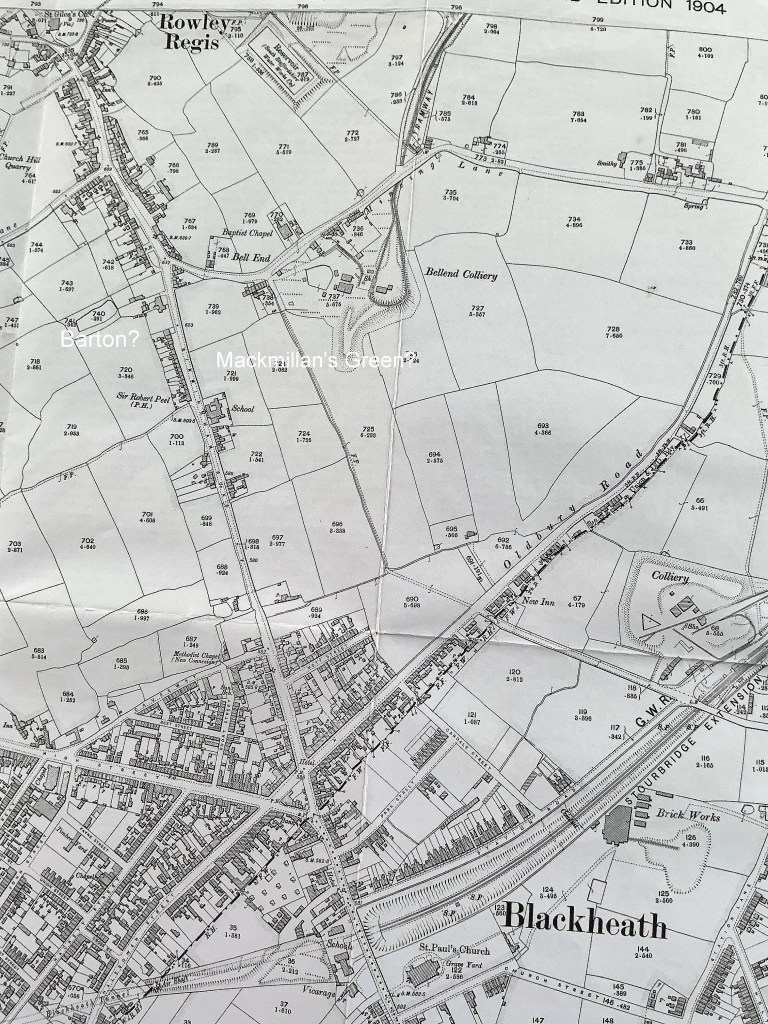
“All that Part of the Parish of Rowley Regis called Blakeheath [a common spelling variation then and later in the document the writer consistently spells the name as Bleakheath] , commencing at two houses lately built by James Preece [no help at all!], taking both sides of the road up to the Endowed School, then Lillypot Row, Barton [at this period Barton seems to have referred to an area around what is now the Britannia Inn. The historical meaning of barton refers to a barley farm and I am interested to note this as I know from other studies that at least one farmer of this land was also a publican on the site and perhaps grew barley for use in brewing his beer] and up to the Partridge’s on that side only, then along Siviters Lane, taking New Ross and Shepherd’s Fold including the Yew Tree Lane and Hyams Hill House, and Scotwell Cottage, thence to Benjamin Adshead [again, no help, except that I was interested to see that there were Adsheads living in this area as I had previously only come across this surname in connection with the Levett family] taking that side of the village to the National School.”
The Enumerator’s route for the adjoining part of the 1851 Census reads :
“All that Part of the Parish of Rowley Regis called Mincing Lane, taking Bell End, MackMillans’s Green, the North side of the village including 2 houses at Whiteheath Well, Spring Row, the Parsonage, Hawes Lane, Club Buildings, the Mill Farm House and Tippity Green, ending at Joseph Parkes.”
From various descriptions, Mackmillan’s Green appears to have been below Bell End, perhaps opposite to what is now the entrance to Britannia Park.
Copyright: Alan Godfrey Maps. Surveyed 1883, revised 1902.
So it appears that the line of what was or is now called Birmingham Road was the boundary between these two Enumerator’s sections and that Joseph and his family were living somewhere at the bottom of the village, between Lillypot Row and Siviter’s Lane, on the side where Britannia Park is and possibly where the Tesco is now and possibly in the same place as in 1841. But this time, Edward was described as a farmer of 7 acres, so not a big farm.
Joseph and Sarah had six children: Edward (1838-1908) who is looked at in the rest of this piece; Joseph (1841-), Eliza (1844-); William (1845-1846); Elizabeth (1847-) and Rhoda Ann (1849).
Rhoda is quite an unusual name but appears several times in the Alsop family, both in Rowley Regis and as far afield as Shropshire, Gloucestershire, Derbyshire, Cambridgeshire and London in the 1700s and early 1800s. Presumably this Rhoda was named after Joseph’s youngest sister Rhoda (1821-1903)of whom more anon.
In this piece I will deal with their eldest son Edward who had an extensive and busy family. The others will follow soon! I hope…
Joseph and Sarah’s children:
EdwardAlsop (1838-1908) married Sarah Whitehouse at St Edmund’s Dudley on 25 December 1858. Sarah’s family lived in Portway. It was not unusual to have weddings on Christmas Day in those days, as this was the one day that workers were on holiday and would not lose pay. Perhaps also it was a day that families often got together to celebrate so that a separate celebratory gathering was not necessary.
In the 1861Census, when this Edward was living in Rowley Village with Sarah and their eldest son Joseph, aged 3, he was a cordwainer or shoemaker, a trade which he passed on to others in his family and in which he appears to have built up a successful business in the Blackheath area.
Edward and Sarah had six children, all blessed with the usual Alsop names, leading to some confusion at times. I apologise in advance if I confuse you, too! These were : Joseph (1859-1932), Eliza (1863-1939), Mary (or Polly) (1865-1938), Alfred (1871-1900), Alice (1875-1887) and Annie (1879-1954).
Joseph Alsop (1859-1932)
Their eldest son Joseph, like his father and brother, became a boot and shoe maker, he had a shop for many years in Oldbury but moved back to his father’s business in Blackheath after his father’s death. It does appear, looking at the locations of the family in various censuses and wills that they kept a connection to a shop in this immediate area for many years. Other records refer to 4 Long Lane and others to Market Place, Blackheath. And as seen before, the boys in the family appear to have been placed in businesses of their own, even if in the same trade, but carefully situated far enough apart not to compete with each other.
Joseph married Annie (Susannah) Grosvenor at Quinton in 1880, they had three sons. The eldest Edward (1881-1946) was in Barnsley Hall Mental Hospital in the 1921 Census and apparently remained there, dying there in 1946.
I can remember when I was growing up in Rowley in the 1950s there was an absolute horror of people being ‘taken to Barnsley Hall’ and I know from other people I have researched that quite often people who were admitted to mental hospitals, including some who were admitted after shell shock in WW1 military service, never came out. Whether Edward was admitted for these reasons we cannot know but it is possible that he remained there for most of his adult life.
Joseph and Annie’s other sons were Alfred (1886-1973) who married Elsie Oakley in 1909 and was a Master Shoe Maker, staying in the Blackheath area for the rest of his life. Alfred and Elsie appear not to have had any children.
And Horace (1892-1945). In the 1911 Census Horace, then 19, is recorded proudly as ‘Student – Arts Degree’. This is the first time I have come across a member of this family graduating, which Horace clearly did as he became a secondary school teacher and later an Inspector of Schools. He married Hilda Lusty in 1917 and was a schoolmaster in Norwich by 1921, where he stayed for the rest of his life.
Joseph died in 1932 and his Probate Record describes him as ‘of Long Lane, Blackheath, I have been unable to find a record of his burial and Susannah died in 1933.
Eliza Alsop (1863-1939)
Edward and Sarah’s daughter Eliza married James Stafford (1864-1940) who was a Boot and Shoe Maker in 1886 (although he later became a publican and also, at some point a shopkeeper); they lived in Mott Street, Blackheath in 1891, just around the corner from Eliza’s parents, later at the Quinton end of Long Lane in 1901 and later still in Riddins Street, Old Hill (which was apparently somewhere in the Brickfields area) in 1911 and 1921.
And Hitchmough confirms that James Henry Stafford was indeed the licensee of the Riddins Tavern from about 1905 – 1930. What fascinated me about the entry in Hitchmough was the name of the previous licensee – John E French [1899] – [1901]. Hang on, we already know about a John French who was a licensee, the son-in-law of Hannah Alsop, Eliza’s aunt. And although he was dead long before this, he did have a son John E French. Was it possible that Eliza and her husband took over the pub from her cousin?
Well, no, apparently not! The John Edgar French (1881-1973) on the Alsop family tree was born in Belbroughton in 1881 and was a farmer whereas the publican John E French was, according to various censuses, born in 1866 in Cradley Heath. And our original John French (1832-1886) was the son of George French, and was born, as was his father, in Wardington, Oxfordshire. The Cradley John E French was the son of Andrew and Ann French who were both from County Mayo, Ireland. Just a strange coincidence, it seems! But it is tempting to wonder what connections there might have been further back…
James and Eliza had two daughters Elsie (1889) and Lily May (1893) and one son James Leonard (1898). Eliza died in January 1939, her death being registered in the Rowley Regis Registration District so she had not moved far from her Rowley roots, James died in 1940.
Mary (or Polly) (1865-1938)
Mary [usually known as Polly] Edward & Sarah’s next daughter, married Alfred Adams (1865-1943) in 1889, he was a Solicitor’s Clerk. In the 1921 Census, which asks for the name of employers, Alfred says that he was employed by T Cooksey and Co., Solicitors, of Old Hill. They stayed in the Blackheath/Cakemore area for the rest of their lives.
Polly’s husband Alfred Adams is related to me as a distant cousin, through my maternal line, and I will be doing a separate piece about the Alsop premises in Blackheath and how they relate to my Rose/Adams/Parsons family.
Alfred and Polly had four sons, Eli Percy (1890-1891), Alfred Theodore (1894-1960), Bertram Leslie (1897-1992) and Harold Cyril (1902-1974). Of these, Eli died in infancy, Alfred and Cyril appear to have stayed in the Halesowen/Cakemore area and Bertram, who was a Civil Servant lived in various places including Nottingham, Doncaster and London, but died in Bournemouth. Alfred does not appear to have married though both his brothers did. He was noted in the 1939 Register as living with his retired father and his occupation , very unusually for a man in those times, was shown as ‘unpaid domestic duties. Since he died in Powick Mental Hospital in 1960, it is possible that he suffered from some disabling condition.
This Alfred was a second grandson of Edward & Sarah’s who appeared to have long term residence in a mental hospital. It seems very sad that this should have happened and that it appears to have been relatively common to have people confined in these hospitals for such long period but there appear to have been relatively few effective treatments at that time, conditions such as PTSD were not defined (although shell shock was) and it was many years before a campaign was undertaken to move people who were capable of being released into the community.
Polly died in the second quarter of 1938, aged 73 and Alfred Adams in 1943, aged 78.
Alfred Alsop (1871-1900), was born in 1871, in Rowley Road, Blackheath (which was another name for Birmingham Road at that point), and was less than one month old at the date of the 1871 Census (which took place on 2 April 1871). In 1881 the family were stillat Birmingham Road, living next door to the Shoulder of Mutton, a property with which they appear to have retained a connection well into the 1900s. More of that in my next piece. Alfred was then a scholar. In 1891 he was still at home with the family (who had moved from Birmingham Road to 122 Halesowen Street), now aged 20 and a journeyman bootmaker, following the family trade. He married Flora Jones, who was a dressmaker, on 20 March 1895 at St Paul’s Blackheath, Flora being a Quinton girl. Alfred’s sister Polly (Mary) and her husband Alfred were the witnesses at the wedding. Alfred and Flora had two sons Arthur William Alfred (1895-1979) and Harry Leslie (1897-1954). Sadly, Alfred died on 18 July 1900, aged 29 and was buried at St Paul’s on the 20th. His widow re-married in 1908 to James Adderley and Flora, by this time a widow again, died in Hove, Sussex in 1845. Her son Harry was living in Hove in 1939, working as a Motor Mechanic and died in Hove in 1954. His older brother Arthur died in Eastbourne, Sussex in 1979, a period of fifty years between those deaths so presumably they had all moved to Sussex at some point. So this was another branch of the family who moved a long way from Rowley Regis.
Alice (1875-1887)
Alice was born at Birmingham Road, next to the Shoulder of Mutton and was listed as a scholar, aged 6 in 1881. Alas, this was the only census in which Alice appears as she died in 1887 and was buried at St Paul’s, Blackheath on 1 September 1887, aged 12.
Annie (1879-1954)
Annie was also born at Birmingham Road, and was there in 1881. In 1891 she was with the family in 122 Halesowen Street when she was a scholar. As the youngest child she was still at home in 1901, at Halesowen Street, with her parents and their grandson Arthur, son of Alfred, mentioned above.
Where exactly did the Alsops live?
I was still trying to sort out the exact location of these addresses in my own mind, as more and more family addresses seemed to link back to this immediate area. So I looked in more detail at the censuses for this area. In the 1891 Census, the list goes:
123 High Street: George Darby, Grocer and his family.
Next house:
122 Halesowen Street: Edward Alsop, Boot & Shoe Manufacturer and family.
Then:
123 Halesowen Street: Henry Bennett, General Outfitter and his family.
And then:
124 Halesowen Street: The Shoulder of Mutton, Thomas Miller Gun Wadding Manufacturer and Licensed Victualler – interesting combination!
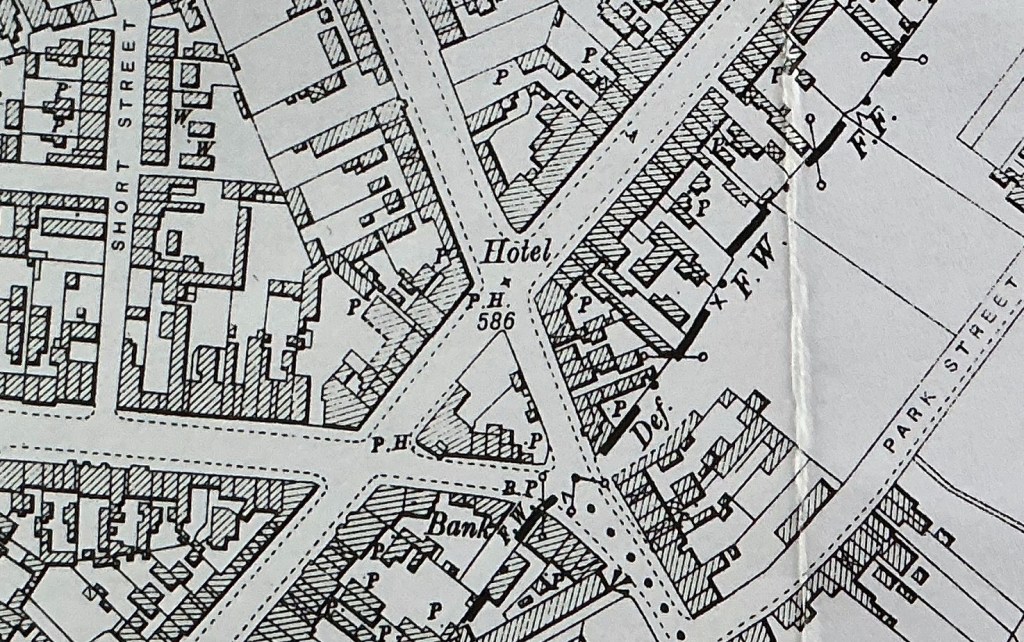
It appears, from carefully reading the extensive information in Hitchmough about the Royal Oak Inn (which was later demolished to make way for the roundabout in the Market Place) that George Darby was born in The Royal Oak as his father owned it and that the Darby family owned extensive properties in this area and, again, all the family were involved in different businesses and pubs.
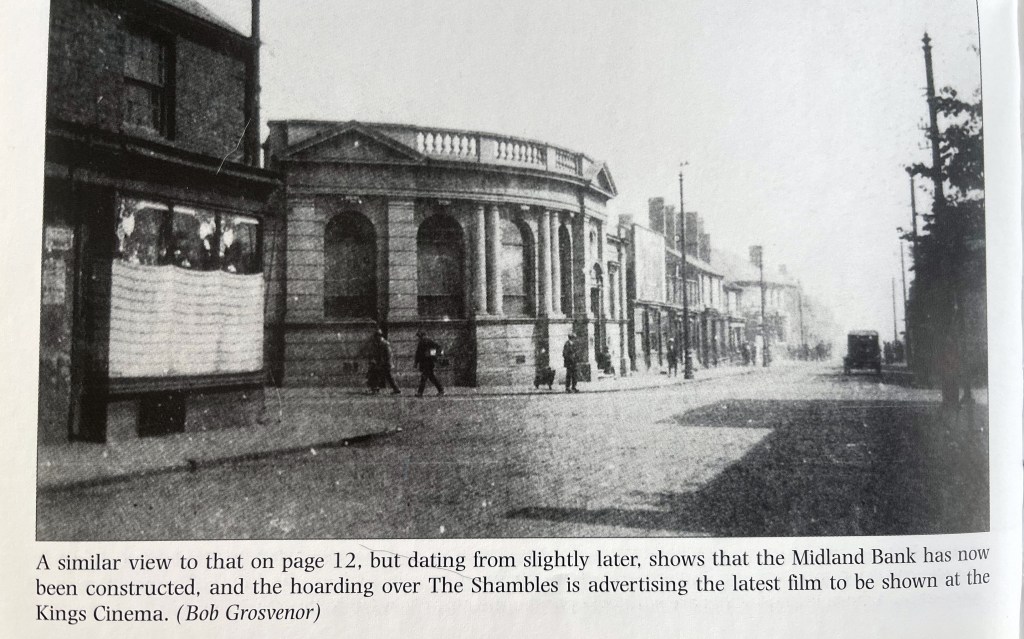
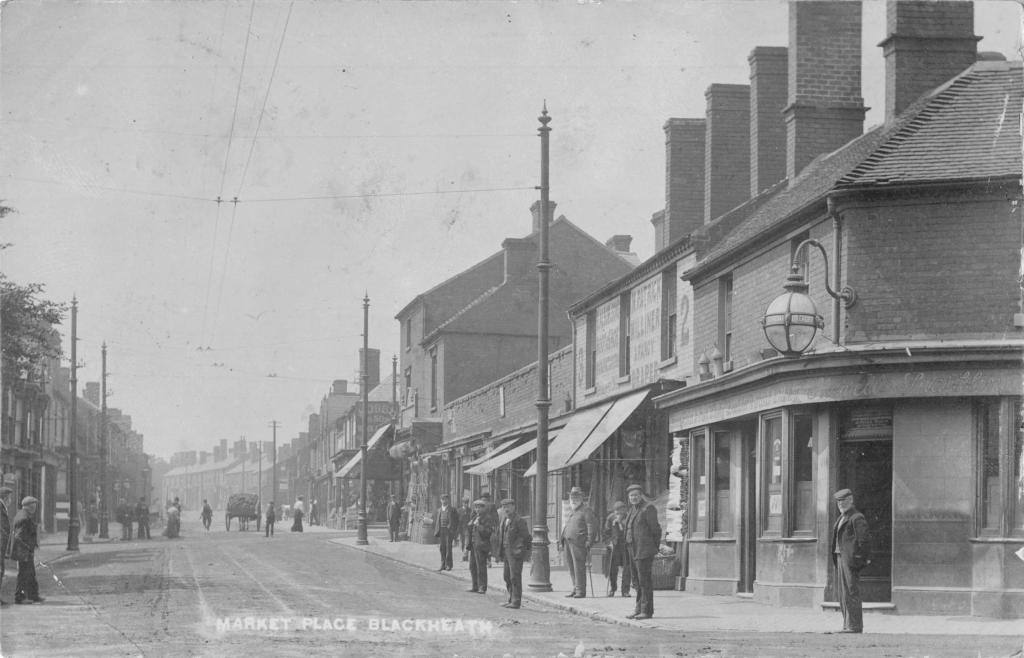
So I think that the households listed above ran across the west side of the market place, where the Midland Bank and Burtons were later so that the Alsops were in the middle of that row of shops. And it seems quite possible that this is the same place sometimes known as 3 Market Place, where Edward Alsop died in 1903. The Royal Oak was sometimes described as in Halesowen Street and sometimes in High Street so it can be quite confusing!
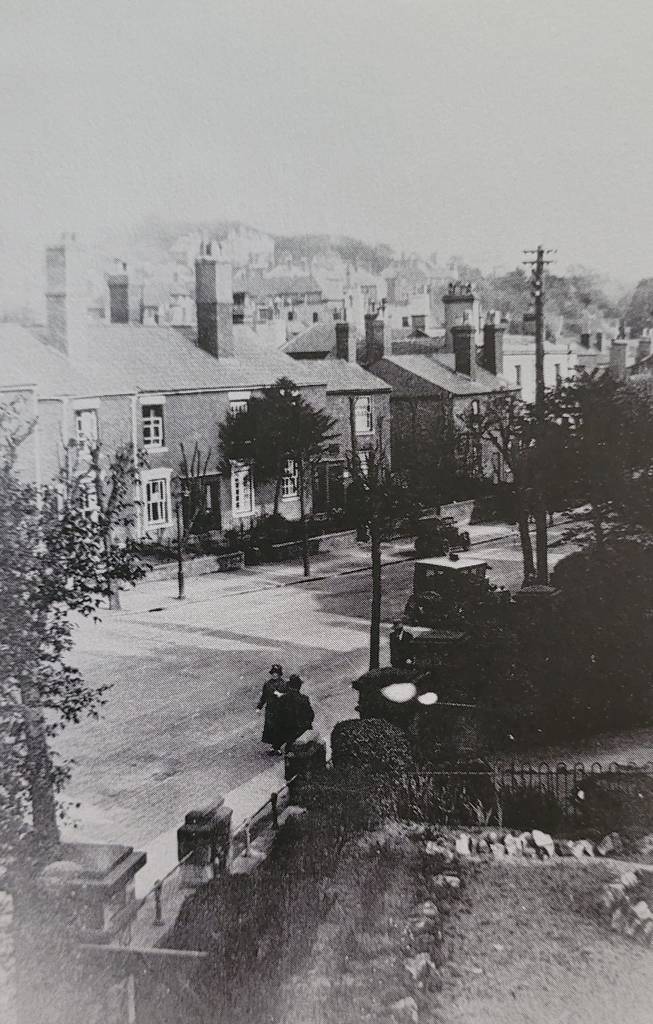
I have found this photograph in Anthony Page’s Second Book of Blackheath Photographs which shows this area (albeit slightly later) and refers to the Shambles which ran from the back of some of the shops in Birmingham Road and the Shoulder of Mutton (which had been built on land originally owned by the butcher who had asked for the pub to be named after one of his products!) into Market Place and High Street. And I think that the Alsop’s shop and home in this photograph was between the advertising hoarding and the Shoulder of Mutton. The Royal Oak faced them, on the far right of this photograph, with a van parked outside. The Darby family hired various means of transport from the pub so this may well have been one of their vehicles.
The day after publishing this, and by pure coincidence, I was amazed to see a postcard photograph of this very area from the other direction which Phil Sims posted on Facebook. The pub on the right is the Shoulder of Mutton. And Phil has very kindly allowed me to add it here. When the scan is enlarged, the names can be read on the shops which place the photograph about 1905, I think.
Copyright: Phil Sims
Back to Annie
Annie married William Leonard Butler in 1907, and they continued to live in Halesowen Street. They had one daughter Vera May Alsop Butler in 1908. Although Vera later moved to Mucklow Hill with her husband Reginald Hiscock, Annie stayed in Blackheath. In 1939 she was living at 3 Halesowen Street (which as so often may have been the same house previously numbered 122 which appeared from the census return to be immediately adjacent to or on the Market Place). William Leonard Butler died in 1949 and Annie in 1954, they are buried together in Quinton Cemetery. Annie’s Probate entry still refers to her as ‘of The Market Place, Halesowen Street, Blackheath so there was an Alsop connection to that address as late as 1954. Does anyone remember Alsop’s Shoe shops? I don’t, I’m afraid but it must have been before my time, nor have I found any advertisements for the shop or business .
Summary
So this was the family of Edward Alsop, (eldest son of farmer Joseph Alsop), and Edward’s wife Sarah Whitehouse. Edward’s family started and expanded the boot and shoe making of the Alsops.
As usual, the Alsops were in trade, always willing, it appears, to diversify into new areas of trading and to ensure that their children also had business opportunities and training or education to take later generations into the professions. A far cry from the millers/farmers only a few decades earlier, but clearly the business acumen and drive of the Alsops was fully present in this branch of the family.
Their six children had given Edward and Sarah the fairly modest (for that time) total of thirteen grandchildren.
In my next piece I will look at the other younger children of Joseph and Sarah.
Of Edward’s children, I will look in this piece at Hannah, the eldest daughter and her family, many of whom were – at least initially – involved in milling and associated trades. The other children will be the subject of later posts.
Hannah Alsop (1801-1870)
Hannah was baptised at St Giles on 11 October 1801. On 21 June 1824 she married Isaac Mallin at Clent and they moved to Dudley Port where Isaac ran a grocer’s shop and also worked as a Corn Factor for the rest of his life. At the time of the marriage they were both described as ‘of Rowley Regis’.
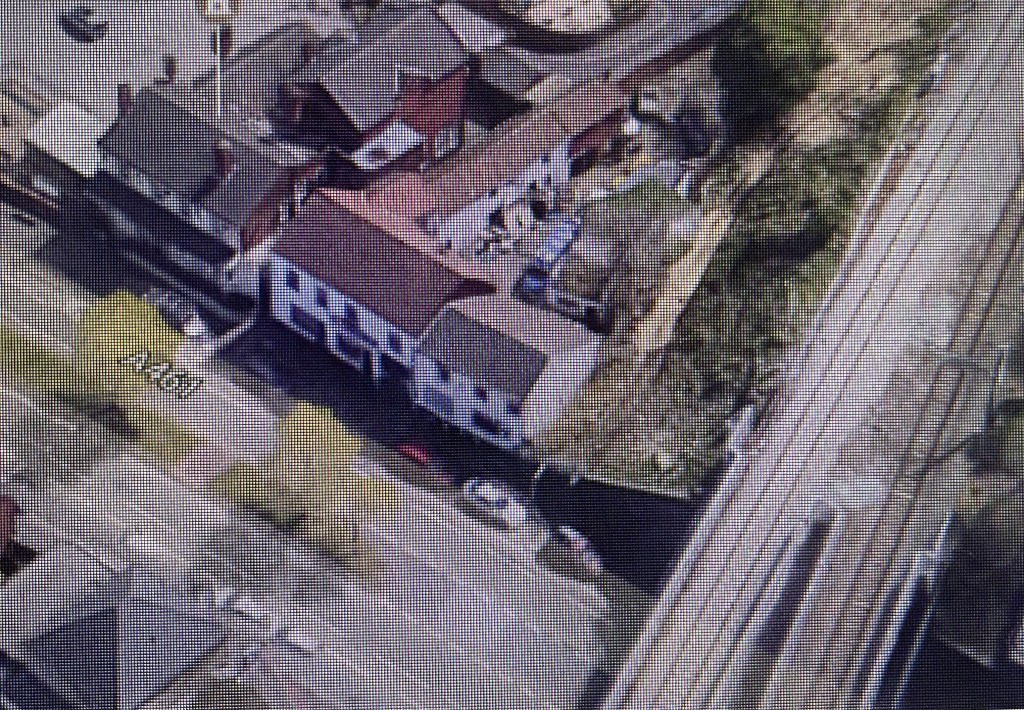
Apologies for the poor quality of this picture. This image, uploaded by D Bickley (to whom copyright presumably belongs) is believed to show the grocer and corn factor’s premises at 8 Dudley Port, home of Isaac and Hannah Mallin. The middle building with the red roof is the premises in question and this also shows numerous outbuildings at the rear where presumably Isaac stored the corn and other materials he dealt with.
The Mallin family
Isaac Mallin, son of William Mallin and Ann nee Woodhouse, was born in 1800 at Portway where several Mallin families were farming in the 1841 Census.
The Mallin/Mallen family had many connections on the Oldbury/Portway/Tividale side of Rowley, and in the Brades area. They first appear in the Rowley Parish Registers in 1718 when Elizabeth, daughter of William Mallin was baptised at St Giles and recur frequently after that, using the names Abraham, William and Isaac repeatedly in all branches of the family which adds considerably to the task of sorting out who was who! They were business people, like the Alsops, mainly farmers, with at least three Mallin families listed separately in Portway in the 1841 Census but they also worked in associated trades and generally married into families in associated trades. Isaac and at least one of his sons became grocers and Corn Factors who would have many dealings with Millers. Others became Millers or worked in jobs associated with milling in some way.
I was also interested to note that Hannah’s maternal grandparents were Mallins, so she may have been related to her husband although I have not pursued further research on this line yet. It appears from baptismal records that Hannah’s maternal grandparents lived in Cakemore, so came under the parish of Halesowen, which at this time included Oldbury and certainly there were numerous Mallins still in this area in the 1800s so again there is this association with the Cakemore/Brades area.
The Mallin family – or at least some them – were, by the standards of most local families I have studied so far, well-to-do. A report of the death in 1838 of Mr Abraham Mallin of Tividale, aged 81, notes that he was formerly of Brades Hall and a report of a burglary in 1871 at the home of another Abraham Mallin of Oldbury lists some of the items stole on Christmas Day 1870. These included “six silver teaspoons, two silver table spoons and a pair of silver sugar tongs; two old Guineas; three gold dress rings; a silver pin; two pairs of gold ear-rings; a gold locket and a brooch.” This implies a level of living standards and prosperity quite outside the experience of most ordinary Hamlet folk, I suspect!
Isaac and Hannah had nine children – John (1824-1880), Ann Eliza (1831-1904), Joseph (1833-1912), Elizabeth Emma (1833-1897), Isaac (1835-1852), Abraham (1836-1902), Edward James (1838-1922), Hannah Alsop (1841-1918) and Mary Jane (1844-1910). The ties with Rowley Regis and the Mill remained close. The first seven children were baptised at Rowley, the last two at Tipton. Several of the boys learned milling skills, presumably from their grandfather so must have worked with him at the windmill.
Hannah died in 1870, aged 68 and was buried at St Giles, Rowley. Isaac died in 1885, aged 84, of Dudley Port and was also buried at St Giles, on 24 March 1885. His Will was proved in June of that year and his son Joseph and two of his sons in law were executors. His estate seems relatively modest, after his long business life – £286. 6s. 8d – but perhaps he had distributed some of his assets before he died.
Isaac and Hannah (nee Alsop) Mallin’s children
John Mallin (1824-1880)
John was baptised at Rowley Regis on 21 November 1824, the family abode was shown as ‘Windmill’ and he later gave his place of birth as Rowley Regis, later children of the couple gave their place of birth as Dudley Port or Tipton. In the 1841 Census John was listed at Portway, living with his paternal grandparents William and Ann Mallin, his occupation was shown as Male Servant. Also listed is an Elizabeth Mallin, aged 18, who I suspect was the Elizabeth Mallin, illegitimate daughter of Rebekah Mallin of Portway who had been baptised on 25 December 1822 so another grandchild. So he was effectively an agricultural labourer for his grandfather, not an uncommon situation in those days which gave occupation and training, though possibly not much pay!
In the 1851 Census John was living at Dudley Road, Tividale as Head of his household and was a provision dealer. His sisters Elizabeth Emma aged 23 and Ann Eliza aged 20 plus his brother Edward James aged 11 were also living with him. His younger siblings were still in Dudley Port with their parents and it seems reasonable to assume that his sisters kept house for him and probably helped in the business. This seems to be a recurring pattern in the family, there are several instances of groups of the children living together away from the family home but working in businesses which may well have been satellites of the main business in Dudley Port.
John married Rebecca Wright , by Licence, at Dudley St Thomas on 19 October 1854. Rebecca’s father was a wine merchant in Dudley so this is another example of business families inter-marrying with other business families. Their son Isaac Henry Mallin was born in the September quarter of 1855 although he was not baptised until 26 December 1858 at Dudley St Thomas. Rebecca Mallin died in the September quarter of 1856, the death notice for her which appeared in the Worcestershire Chronicle describes her as “the beloved wife of John Mallin and the only daughter of Mr H Wright of Dudley”. So Henry’s baptism is well after this date but he is still described in the baptism record as the son of John and Rebecca Mallin, of Dudley Port with no mention of her being deceased. John’s occupation was given in the baptism record as a Miller.
In late 1855/early 1856 a John Mallin, presumably this John Mallin, as Miller of Rowley Regis, was declared bankrupt. There is just one newspaper notice that I can find which names Joseph Mallin of Rowley Regis, a Miller as bankrupt, on exactly the same date as John, but no mention of John in that notice. Had they been partners in business I would have expected both of their names to appear. But this is the only one of numerous notices appearing in the press about this bankruptcy to name Joseph, all of the others only name John. Also, by 1861 Joseph was employed by the New Union Mill in Ladywood Birmingham, as Company Secretary, a position he held for several decades. I do not think that the company could have employed a bankrupt in this position of trust, so I am inclined to think that this one notice was an error.
There was also one Press advertisement in November 1860 for the Rowley Flour Mill to be let at a low rent. It included outbuildings and two dwelling houses. This states that ‘the Mill consists of 18-horse condensing engine, driving three pairs of French Stones, with Dressing, Bolting and Smutting machines, Bean Mill, etc all in excellent repair’. So it sounds as though someone had invested money in equipment, perhaps this debt had led to the bankruptcy. Enquiries were directed to Isaac Mallin, Corn Factor at Dudley or Joseph Mallin at the New Union Mill, Birmingham. This was just a couple of months after the death of Edward Alsop who had perhaps continued milling until his death and it may already have been known that John would not be returning from the USA.
It appears that John Mallin moved soon after his bankruptcy to the USA, as he appears in a Street Directory in Chicago in 1867 as a Miller and in the 1870 Census in Chicago, as a Miller. Trees on Ancestry also suggest that a John Mallin in New York in the 1860 census was also him but that John Mallin gave his place of birth as Canada so would not seem to be the same person. Living with him in Chicago in 1870 is a lady who appears to be his wife Mary and four children, Louisa aged 21, Andrew, aged 16, Jane aged 14 and Ada aged 12 who were presumably Mary’s children from a previous marriage as John was in England at the time of their births, although they appear to have adopted his surname. It is unclear when John died.
John’s son Isaac Henry remained in England for a period. He was living with his Mallin grandfather and two of his aunts at Dudley Port in 1871 but he then also moved to the USA. A Voter registration form dated 1892, shows him living in Mill Avenue, having been in the Precinct for one year, the County for 12 years and the state for 16 years. Isaac became a naturalised citizen and later married and remained in the USA until his death in Chicago in 1921.
I have found John’s parents Isaac and Hannah Mallin in every census during their lives apart from 1861 when I cannot find either of them anywhere. They were at 8 Dudley Port at the shop in censuses before and after that but in 1861 their son Edward James was there with his two younger sisters, with Hannah described as a grocer. They do not appear to be with any of their other children so far as I can see or anywhere else in the country. Then in the next census they are back in Dudley Port so they had not retired. I wonder whether they had gone to visit their eldest son John the USA. I don’t suppose I shall never know! I cannot find them on any passenger lists but those are not exhaustive so it seems possible that they had gone to visit their eldest son.
So it appears that John and his descendants settled in the USA and they appear not to have returned to the UK.
Ann Eliza Mallin (1831-1904)
Ann Eliza was born in about 1831 in Dudley Port. I have not found her baptism. She was living in Dudley Port with her parents in 1841 and in Tividale with her brother John in 1851. By 1861 she was living with her brother Joseph at the Union Flour Mill in Ladywood, Birmingham where he was the Company Secretary for many years. After Joseph’s marriage Annie Eliza moved back to Dudley Port and was living with her father in the 1871 and 1881 Censuses. By 1891 she was back in Aston, housekeeping for her brother Joseph again, he was a widower by this time but had his seven children living with him, ranging in age from 24 to 10. By 1901, Joseph, by now aged 68, had taken up a new occupation of Cycle Fitter and Annie was still living with him in Bolton Road, Aston, sharing housekeeping duties with her niece Lucy.
Annie died on 5 March 1904 at 18 Dawson Street, Small Heath, Birmingham, still living with her brother Joseph and was buried at Yardley Cemetery. She had never married but appears to have spent her whole life housekeeping for members of her family.
JosephMallin (1832-1912)
Joseph was born in 1832 and baptised at Rowley Regis on 23 September 1832, his parent’s abode given as Dudley Port and his father’s occupation as a grocer. In 1841 he was with his parents and siblings at the grocer’s shop in Dudley Port, aged 8. In 1851, he was living at Wombourne with the miller there and his occupation was also given as a Miller, so clearly more than one of the Mallin boys had learned the family trade from their grandfather Alsop. By 1861, Joseph was living in a company house in Ladywood, Birmingham where he was Company Secretary and Clerk to the Union Flour Mill. His sister Annie Eliza was also with him, as mentioned above, keeping house for him and they had one female servant, aged 15.
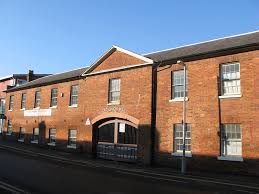
The New Union Mill, Birmingham where Joseph worked as Company Secretary for many years. Copyright unknown.
On 14 April 1865, Joseph married Mary Ann Morgan at St Barnabas church, Edgbaston, she was a Birmingham girl, born in Great Barr. They had eight children: Lucy Beatrice Rose (1867), Francis Joseph Edward (1868), Arthur William (1871), Charles Isaac (1872), Walter Herbert (1873), Albert Howard (1874), Charlotte Florence (1879-1879) and Harriet Lilian (1880). Mary Ann died in 1883, aged 41 and was buried at Witton Cemetery, Birmingham. That left him with several young children under ten so it is perhaps not surprising that his sister Annie Eliza moved back to keep house for him, apparently staying for the remainder of her life. Joseph never re-married.
By 1891, at the age of 58, Joseph was living in Stratford Place. Aston, with Annie and all of his surviving children and was described as ‘living on his own means’. All the children aged 16 or more were working, Lucy as a barmaid, Francis as a Warehouseman, Arthur, Charles, Walter and Albert as Clerks and the youngest two – Frederick and Harriet were still scholars.
In 1901, Joseph and Annie were at 120 Bolton Road, Small Heath, Birmingham, and six of the children were still at home, aged from 34 down to 20. Joseph had perhaps seen a business opportunity and had become a Cycle Fitter. Perhaps rotating things still appealed to him, mill wheels, bicycle wheels…
These were not very large houses but some of the houses in Bolton Road were three storeys so this may have been one of those.
In 1911, Joseph, now 77 and a pensioner, was living at 18 Dawson Street, Aston, with his son Frederick who was still unmarried and worked as a traveller in hardware. His sister Annie had also been living there with him until her death in 1904.
Joseph died in March 1912 and, like his sister, was buried at Yardley Cemetery. Most of Joseph’s working life had been involved with mills but that link seems to have been broken after him and none of his offspring seem to have gone into the mill business.
Joseph’s children appear to have remained settled in Birmingham, where they were all born, and not come back to the Tividale/Dudley Port/Rowley Regis area.
Elizabeth Emma Mallin (1833-1897)
Elizabeth Emma was baptised on 27 April 1828 at St Giles, Rowley Regis. Her parents were said to be of Dudley Port and Isaac’s occupation was given as a Huckster, which means someone who sells or offers goods, sometimes with implications of inferior goods or questionable sales techniques.
Elizabeth is not living in Dudley Port with her family in the 1841Census so must have been visiting elsewhere, possibly with family. Elizabeth’s sister Hannah was born in the first quarter of 1841 so it is possible that a member of the family took Elizabeth to stay with them, to help their mother.
Searching the 1841 census for Elizabeth, I found an Elizabeth Mallin, living in Church Vale in West Bromwich but she was shown aged eleven and there were twenty three children of various ages at this address, almost all of whom were described as pupils, although there was only one adult who might be in charge who was described as a governess, plus a couple of servants. The enumerator’s route described Church Vale and the Parsonage but there was no mention of the Parsonage in the listed people nor a clergyman of any sort. Living with the Governess Mary Hartland, (who was only 25) the Head of the Household Timothy Hartland appeared to be a bricklayer with the same surname and a baby aged one, also with that surname, followed by the children aged from 3-17. It seems very strange. So, if this was a somewhat chaotic establishment, I suppose the age might be wrong. But I then noted that in the 1851 Census, Elizabeth’s sisters Hannah and Mary Jane were also shown as boarders at this same address so it obviously was a boarding school and it seems that this was the correct Elizabeth Mallin. So it appears that the Mallin family were sufficiently prosperous to send their daughters to boarding school.
In 1851 Elizabeth Emma aged 23 was living at Dudley Road, Tividale with her oldest brother John who was then a provision dealer. Her sister Ann Eliza aged 20 plus her brother Edward James aged 11 were also living there.
On 5 June 1855Emma Elizabeth married Jabez Baker, a Land Surveyor, at St Giles. They had four children: Joseph Edward was born in 1859 in Wolverhampton; Walter Jabez in 1862 in West Bromwich; Elizabeth Emma in 1866 also in in West Bromwich and Agnes Louise in 1869 in Lenton, Nottinghamshire.
In 1861Elizabeth and Jabez were living at Railway Street, West Bromwich with their son Joseph Edward and also Mary Baker, Jabez’s widowed mother and a servant girl. Jabez was shown as a Land & Mine Agent.
By 1871, the family, now including all four children (but not Jabez’s mother) were living in Lenton Sands in Nottinghamshire where Jabez was employed as an Engineer. Their neighbours here included an Estate Agent, an Insurance Superintendent, a Photographer, a Police Constable and a shop keeper – and several lace makers, so it seems to have been a reasonably comfortable area. In 1881, the whole family were at 233 Derby Road, Lenton and Jabez’s occupation is shown as a Mining Engineer. By 1891, the family had moved to Loughborough Road, West Bridgford , Jabez still a mining engineer with their two daughters in the household, daughter Elizabeth Emma under her married name of Beardsley and Agnes Louise, still unmarried.
Jabez Baker, died on 18 Jun 1897, aged 70 and Elizabeth Emma nee Mallin died two months later in August 1897 and was buried on the 14 August 1897 in Nottingham. All four of their children remained settled in the Nottingham area for the rest of their lives.
Isaac Mallin (1835-1852)
Isaac was born in Dudley Port and baptised at Rowley Regis on 20 April 1834. In 1841 and in 1851 he was living at home with his family in Dudley Port. He died on Typhus Fever, aged 18 on 4 February 1852 and was buried at St Giles, Rowley Regis on 10 February 1852.
Abraham Mallin (1836-1902)
Abraham was born in Tipton (almost certainly in Dudley Port) and was baptised at St Giles, Rowley Regis on 17 July 1836. In 1841 and 1851 he was living at home with his family at 8 Dudley Port. No occupation is shown for him in 1851 but he was 15, a working age for boys in those days, so was probably working in the family business in some way.
On 3 April 1861 Abraham married Ann Hargrave Blewitt, daughter of Joseph Blewitt, Butcher (another Mallin marriage into another business family) and just four days later on 7th April the 1861 Census shows the happy couple living in their own household in Dudley Port with Abraham’s occupation shown as a Corn Factor, (an occupation which his father also followed in conjunction with his grocery business). Again, note the connection to the Milling trade, corn had to be milled, this was the family area of expertise.
Abraham and Ann had six children: Mary Louisa (1862); Isaac (1864); Jessie Blewitt (1868); Samuel (1870); Ada Sarah (1873) and Emma Gertrude (1876).
By 1871, the family were living at 37 Halesowen Street, Oldbury where Abraham was still following his trade of Corn Factor. He was two doors away from the ‘Hope and Anchor’ pub and next to the Canal side which may have been the means by which much of the corn was moved around. But perhaps he had business problems as by 1881 the family was living in Danks Street, Tipton and Abraham was listed as a labourer.
In 1891, the family had moved again – back to 8 Dudley Port, Isaac and Hannah’s home where Abraham was once more working as a corn factor, his father having died in 1885. The 1901 Census has the family still in Dudley Port, apparently now at 123 Dudley Port, rather than Number 8, where the family business had been for decades, but Abraham was still a Corn Factor so the number may just have changed.
Abraham died in February 1902, aged 65 and was buried on 7 February 1902 at Tipton Cemetery. It appears that their daughter Jessie and her husband then took over the business as Ann was living with them there at 123 Dudley Port, in 1911. She died in 1919 and was buried on 19 March 1919, like Abraham, at Tipton Cemetery.
Abraham and Ann’s children mostly stayed in the Dudley/Walsall area and lived no further away than Birmingham so closer than many of their cousins. None of them, however, returned to Rowley Regis.
Edward James Mallin(1838-1922)
Edward was born in 1838 in Tipton and was baptised on 3 July 1838 at Rowley Regis. In 1841, he was with his family in Dudley Port; in 1851 he and his two sisters Elizabeth and Ann Eliza were living with his oldest brother John in Tividale; in 1861 he was listed as a machinist in Dudley Road, Tividale with his younger sisters Hannah, listed as a grocer, and Mary Jane. Perhaps this was the same shop that his brother John had been living in in 1851, a second family grocery, in addition to the one in Dudley Port, to serve the growing community of Tividale.
On 28 March 1865 Edward married Sarah Whitehouse at Harborne. His occupation was shown as a Licensed Victualler and his father as Isaac Mallin, Corn Factor. Sarah’s father, also an Isaac, was also a publican, at the Cottage of Content in Harborne. Alas, Sarah died in September 1866, and was buried at Holy Trinity, Smethwick, aged 26 of Canal Bank, Harborne/Smethwick which appears to be where her father’s pub was also situated. Canal Bank was also where Edward’s brother Abraham was living at about this time so perhaps this was how Edward and Sarah met or perhaps they lived with Abraham, as we know that it was very much the Mallin family practice for siblings to live together.
On 4th December 1866 at Edgbaston Parish church, Edward married widow Ann Ralph (nee Butler), Joseph Mallin was one of the witnesses. The 1871 Census shows Edward (although he is, for some reason, shown as Edward Isaac in this census) as a Licensed Victualler at the Britannia Inn Tipton, where Annie and her two children Lizzy Ralph (Eliza Ann 1862) and SusannaRalph (1864) were living with them. Edward was licensee from 1868-1873. Annie and Edward had six children: Georgina Gertrude Ann (1867), Edward James (1869), Edith May (1871), John Henry Butler (1873), Albert Victor (1876-1889) and Walter William (1879).
Edward was a publican for much of his life, around Tipton, Willenhall and Dudley, although he was declared bankrupt in 1873 when he was the landlord of the Saracen’s Head which was in Stone Street, Dudley. Nevertheless, he continued to hold a license in later years and was licensee of the Three Crowns Inn, Willenhall from 1891-1904. Edward’s son, Albert Victor Mallin b 1877, died there in 1889.
In 1881 he and Annie were living in Cobden Street, Walsall and he was working as a Goods Guard.
The 1891 Census shows Edward is living at the Saracen’s Head with his wife, Ann (previously Ralph, nee Butler), children, Eliza (Lizzie Ralph), Edward James (b1869), May (Edith May b. 1871), John (John Henry Butler Mallin b. 1873) & Walter William Mallin b 1879). In 1896, his wife Annie died there. In the first quarter of 1897, while still living at the Three Crowns, Edward married widow Louisa Jane Flude (nee Lloyd b. 1849) but she died in 1899, aged 48, also while living at the Three Crowns Inn.
Hitchmough tells us that Edward James Mallin was the Licensee at the Gough Arms from about 1908- 1911.
In the 1911 Census Edward James Mallin (b1838) was living there with wife number four, Rose Hannah Mallin (formerly Griffiths, nee Booth, b. 1843) who he had married in 1902. Also living there was his son, John Henry ButlerMallin (b. 1873).
In 1921, Edward and Rose were living at 33 Fisher Street with John. Edward, at 85, was finally described as retired! Rose Hannah died in the first quarter of 1922 and, after his long and eventful life, Edward died a few months later in the third quarter of 1922, though I have not been able to find their burials.
Of Edward and Ann Butler’s six children, Georgina and Albert died in childhood.
Edward James (1869-1949) stayed in the Willenhall area, marrying Fanny Hoggins there and having six children. He worked as a gas lamp lighter and later a gas stoker and died in 1949 in Bilston.
Edith May (1871-1957) married William Allen in July 1891 and had four children with him before his death in 1898 (he thus misses appearing with Edith in either the 1891 or the 1901 censuses so I have limited information on him or his occupation), she then married Harley Chamberlain in November 1898 in Wednesfield with whom she had another son, also named Harley. Harley Chamberlain Snr died in 1937 and in October 1942 Edith appears to have married for the final time, to William T Mason in Wolverhampton. It appears that, like her father, Edith worked in the licensed and hotel trade much of her life and in 1921 she was Manageress of the Angel Hotel in Queen Street, Wolverhampton and in 1939 she was managing an off-licence in Bushbury Lane, Wolverhampton. In the 1921 Census Edith described herself as a widow, whereas in fact Harley Chamberlain was alive and living in Smethwick then, working as a Stable Man at Guest Keen and Nettlefolds; he described himself as married but perhaps they were separated. Harley died in 1937 in West Bromwich. Edith died in October 1957 in the Wolverhampton area, aged 86.
John Henry Butler Mallin (1873-1946)
John never married and lived most of his life with his father and then his brother Edward James. In 1891 he is listed as a ‘plater’, in 1901 as a mechanical engineer, in 1911 as a fitter and turner, in 1921 as a tool maker. In the 1939 Register he is noted as a ‘heavy worker’. John stayed in Willenhall and Bilston for his whole life. He died in 1946 and his Will named his niece Alice Maud Withington as his executor (along with Gordon James Smart, solicitor’s managing clerk.).
Walter William Mallin (1878-1909)
Walter William did not marry either and also lived with his father until his death in 1909, aged 31. Like his brother John, in 1891 he is listed as a ‘plater’, and in 1901 as a mechanical engineer. Walter was buried at the Bentley Cemetery, Willenhall on 11Jun 1909, his address given as High Street, Portobello, Willenhall and his age as 31.
So this branch of the Mallin family, although starting out in Tipton, mostly ended up in the Willenhall/Wolverhampton area and had no apparent further association with Rowley Regis.
Hannah Alsop Mallin(1841-1918)
Hannah was baptised on 21 January 1841 at St Martin’s Church, Tipton. She was, apparently, baptised again at St Giles, Rowley Regis two years later on 23 April 1842. This is unusual! But I have checked birth and death registrations for that time and it is not the case that the baby Hannah who was baptised at Tipton died and a later baby given the same name. Hannah Alsop Mallin really was baptised twice in different churches.
In the 1841 Census, Hannah, aged 4 months, was living at home in Dudley Port with her parents. In 1851, she, with her younger sister Mary Jane, was at the same Church Vale School which her older sister Elizabeth had been at in 1841. In 1861, Hannah was living in Dudley Road, Tividale with her brother Edward and sister Mary Jane. Hannah was shown as a grocer.
On 21 June 1864 Hannah married Frederick Duesbury, a Clerk, at St Giles, Rowley Regis. Frederick’s family were quite middle class, his father was listed, amongst other occupations, as an appraiser, an auctioneer, and a solicitor’s managing clerk. Other members of the Duesbury family were in the medical profession and Frederick also appears to have had various occupations.
Frederick and Hannah had eight children: Frederick William Ambrose (1865-1907), Arthur Edward (1867), Alexander Clifford (1869), William Herbert (1872), Ada Alice Jane (1875), Georgina Louisa (1877), Alfred Ernest (1879) and Harry Roland (1882).
In 1871 the family were living at St John’s Road, Kates Hill when Frederick was listed as a Varnish Manufacturer (the factory was apparently the Faraday Works at Monmore Green, Wolverhampton). By 1881 the family had moved to Cromwell House, Hill Road, Kates Hill where the family were still living in 1911, the last time Hannah appears in a census. Also living with them was Catherine, sister of Frederick Duesberry and Frederick had specified in his Will that a home should be provided for his sister or an annuity paid to her.
This 1928 image shows Dixons Green and Kates Hill which clearly had some superior dwellings! Copyright unknown but will be acknowledged on receipt of information.
Frederick died in September 1905, leaving a gross sum of £14,000, equivalent to over a million pounds today. Hannah died in September 1918, aged 77.
Of Frederick and Hannah’s children:
Their eldest son Frederick committed suicide in 1907, with reports at the inquest of financial and other problems, leaving a widow Mary Amelia nee Butler with two small children.
Arthur, who continued to run the varnish factory, married Myra Jordan in 1901 in Dudley and had one son John Frederick in 1904, Arthur died in 1934, having remained in the Dudley/Willenhall/Wolverhampton area all his life.
Alexander married Catherine Williams in 1902 and they had two children. He died in 1952 in the Walsall Registration District.
William disappears without trace from records after the 1891 Census when he was living at home, aged 19 and described as a Woollen Draper’s assistant. I can find no trace of him after that, no death registered, no census entries, no marriage. It is possible that he emigrated. There is a H W Duesbury listed on a ship from Australia in 1943 by which time he would have been 71 but that man was described as belonging to the Australian navy so unlikely to be our man, although possibly a descendant.
Ada Jane and Georgina both remained unmarried and appear to have shared a house in Stourbridge Road, Dudley after the death of their parents. Ada died in 1951 and Georgina in 1962.
Alfred was also a director of the family varnish manufacturing company, he married Florence Eley Dando in 1905 in Dudley and they had two sons. They continued to live in the Dudley area, Florence dying in 1934. It appears that Alfred may have re-married in 1935 but this is not certain and I am unable to find Alfred in the 1939 Register. However, he died in Dudley in 1949 so may have been out of the country in 1939.
Harry Rowland was working in the Varnish business in 1911. In 1920 he married Hilda Vincent in Sunderland, County Durham. In 1921 he was living in Sunderland and describing himself as a Master Confectioner. Harry and Hilda, a music teacher, had one son. Hilda’s full name was Hilda Whitehouse Vincent and I was interested to see the Whitehouse name which is also so common in Rowley Regis. Hilda was born in County Durham but her mother Hannah Whitehouse was born in West Bromwich! Hilda’s father was an organ builder so perhaps he built some organs in the flourishing non-conformist chapels in the Black Country and met Hannah there, perhaps it was he also who taught Hilda to play music so that she later became a music teacher.
Harry died in 1967, Hilda had died in 1959, both in Sunderland.
So Frederick and Hannah remained living close to Rowley Regis in the Kates Hill area of Dudley and their children and grandchildren mostly remained in the Dudley/Wolverhampton/Walsall area. They were perhaps the most prosperous of Isaac and Hannah’s children.
Mary Jane Mallin (1843-1910)
Mary Jane was born in the third quarter of 1843 in Dudley Port and baptised at Tipton on 5 August that year. In 1851 she was at the Church Vale School in West Bromwich with her older sister Hannah and in 1861 she and Hannah were living with their older brother Edward in Dudley Road, Tividale. In 1871, aged 27, she was at 8 Dudley Port, her father’s shop, with her widowed father, sister Annie and nephew Isaac Henry. Isaac Snr was still described as a Corn Factor whereas Mary Jane and her sister Annie were shown as having no occupation, so perhaps they were not working in their father’s business or perhaps, as in so many cases I have come across, the occupations of women were not considered worth recording.
On 23 June 1875, aged 31, Mary Jane married widower John French, aged 45, variously described as a farmer of Sandy Fields, Sedgley or a Licensed Victualler, whose first wife Eliza nee Butler had died in September 1874. Eliza was the sister of Annie Butler who had married Edward Mallin in 1866. John French had been the Licensee of the Earl Dudley’s Court House Inn, Gospel End, Bull Ring, Sedgley from 1860-1871, according to Hitchmough.
In the 1871 Census, when John and Sarah French were living at the Court House Inn, Susannah Ralph, Annie’s daughter by her first marriage and Georgina and Edward Mallin, children of Edward and Annie Mallin were visiting the Frenches, listed as nieces and nephew. This confused me as Mary Jane and John French did not marry until 1875 but when I looked further into the relationships I realised that Eliza and Annie Butler were sisters. There was also another niece visiting, Mary Berry, aged 16 who was the daughter of John French’s sister Sarah. So it seems John French was quite hospitable to members of the family.
An article in the Wolverhampton Chronicle in September 1861 relates, with reference to:
“Applications For New Licenses…..
Mr. John French, of the COURT HOUSE, Sedgley, was opposed in his application for a renewal of his license by Mr. Homer, on the grounds that a large organ or musical box had been introduced into the house, which played secular music on week-days and sacred music on Sundays. There was no other complaint against the house, and the license was therefore renewed.” So it seems that he kept quite a lively house there.
John and Mary Jane’s daughter Augusta was born in Sedgley in 1877 and John French was later the licensee of the Talbot Hotel at Belbroughton where their next two children were born: William Henry in 1879 and John Edgar in 1881.
John French died in February 1886, aged 56, at Belbroughton. His Will, which had been written on 5 July 1879, just a couple of weeks before the birth of his first son William on the 21st, (his daughter Augusta had been born in 1877) and was proved in May 1886, probate granted to his executor Frederick Duesbury, Mary’s brother-in-law, the other named executor Benjamin Smith having renounced the probate and execution of the Will. It is not a complicated Will but is not very helpful as it refers to his wife, unnamed and just his wife, not his beloved or dear wife as the majority of Wills seemed to in those days. Provision is also made for his children but again these are neither named nor numbered, perhaps wisely as he and Mary did have another two sons after William, John in 1881 and Frederick in 1883. A solicitor’s note is attached to the Will stating that John French was formerly of Sandy Fields Sedgley but late of Belbroughton, Licensed Victualler.
Of these children Augusta MaryFrench (1877-1910) died in 1910 in Wolverhampton, aged 32 and unmarried.
William Henry French(1879-1949) was with his family in Belbroughton in 1881 but I was at first surprised to see that in 1891, aged 11, he was in the Orphan Asylum in Penn Road, Wolverhampton, while his widowed mother (living on her own means) was living in St Phillips Terrace, Penn nearby, with her other children. A little delving revealed that the Wolverhampton Orphanage had been founded in 1850 by a local lock manufacturer to provide a home for children left orphaned by a serious outbreak of cholera. It had later expanded and provided an education for the boys there and was located in handsome buildings, so may well have provided William with a good education. William went on to become a Director and Company Secretary to a local company ; he married Ellen Haydon in Aston in 1911 and they had two children. They lived in the Penn area of Wolverhampton, William died in Bilston in 1949, and Ellen in 1965.
John Edgar French(1881-1973)
John Edgar became the farmer of the family, following his father into the trade, although it appears that he moved farms several times and certainly John French’s Will had directed that the rents and profits from his real estate should be paid to his wife for the life or for the duration of her widowhood and on her death or remarriage that income should be used to maintain his children. Then that when his youngest child reached the age of twenty one, the real estate should be sold and the funds split equally between his children. So there did not appear to be a family farm for John to take over.
In 1901, John was living in Penn Road, Wolverhampton with his mother and siblings when all three brothers were working as Clerks for a hollowware manufacturer . Both his sister and mother died in 1910 and in 1911 John was a farmer at Manor Farm, Shareshill, Wolverhampton where his two brothers were also living with him, William a Despatch Clerk for the Holloware company and Frederic a Manufacturer’s Clerk at a Safe and lock Works. John was noted as an employer but the number of employees is not noted. By 1921 John had married Minnie Sortwell and his brother Frederick was still single and living with them at Old Fallings Lane, Bushbury. Although Minnie was born and grew up in Essex, they were married in 1920 in Hampshire. I found a newspaper article about Minnie stating that she had passed her third year nursing examinations at Wolverhampton General Hospital so perhaps they had met during her time there. In the 1939 Register John was farming at Seisdon in Staffordshire and Minnie was described as ‘incapacitated’ . He and Minnie do not appear to have had any children. I cannot find a definite death record for Minnie French but a woman of her age died in 1962 in Birmingham. If she had died in hospital, rather than at home in Wolverhampton, this might well be her. This Minnie was buried in Erdington so perhaps not, as John French died in 1973 in Penn, Wolverhampton, his home area. But it is also possible that they were separated.
Frederic CecilFrench
Frederick’s birth was registered in 1883 with that spelling but in many later records, including his baptism at Clent in November 1883, his name appears as Frederic. The variation persisted throughout his life. His marriage and his death were registered as Frederick, his Will and Probate record him as Frederic. It seems likely to me that in his own and family circles he was Frederic but in cases where officials were keeping records, they may have assumed the more common spelling.
Following his father’s death in 1886 when Frederic was only three, his mother appears to have moved to the Penn area of Wolverhampton. It is possible that Frederic also went to the school at the nearby Asylum as certainly William had. All three brothers had become Clerks by 1901 so presumably had a reasonable standard of literacy. By 1921 Frederic was the Managing Director and Secretary of a Company of Lock Manufacturers.
In 1924 Frederic, by then 41, married Adelaide Cecila Jaffa who was 38, in Egremont, in Cumberland and they settled in Penn Road and then at 8 Merridale Lane, Wolverhampton where they were still living in 1939. It appears that they did not have any children.
At some later point Frederic and Adelaide moved North as they both died in West Kirby, Cheshire where Adelaide had been born and perhaps where she had family. She died in 1970 and Frederic in 1972.
So yet again, most of these descendants of Mary Jane settled away from Rowley Regis, mostly in the Wolverhampton area.
Summary:
So these were the descendants of Hannah Alsop, eldest daughter of Edward Alsop and Betty Hodgetts. She had been born in the Mill Farm at Rowley Regis in 1801, and her husband Isaac Mallin came from a business family that had many links with milling. They had nine children and seven of those had children, giving Hannah and Isaac at least forty-eight grandchildren.
Hannah kept her associations with Rowley Regis, although she lived at Dudley Port after her marriage and she was baptised and buried at St Giles. Her older children were also baptised there and there are indications that at least the older boys may have learned milling skills from their grandfather Alsop. Later children tended to base themselves around Dudley.
As noted previously these children and their own children tended to marry into families like themselves, business people, traders, publicans, shopkeepers, merchants. Some were clearly comfortably off, some became quite prosperous, few of them appeared to end up in the relative poverty of many residents of the Lost Hamlets.
But many of these descendants ended up away from Rowley Regis and the Lost Hamlets, living in an arc ranging from Kates Hill and Dudley, round to Walsall and Wolverhampton.
My next pieces will move on to Edward Alsop’s other children and we shall see whether they remained in Rowley or moved further afield.
The Alsops only just count as a family of the Lost Hamlets, as they lived at Windmill Farm from about 1764 and were there in the 1841 Census, right on the edge of the Lost Hamlets area where they originally operated the Windmill. In this first piece I will look at John Alsop and his family and his son Edward. Edward’s children will be the subject of another piece.
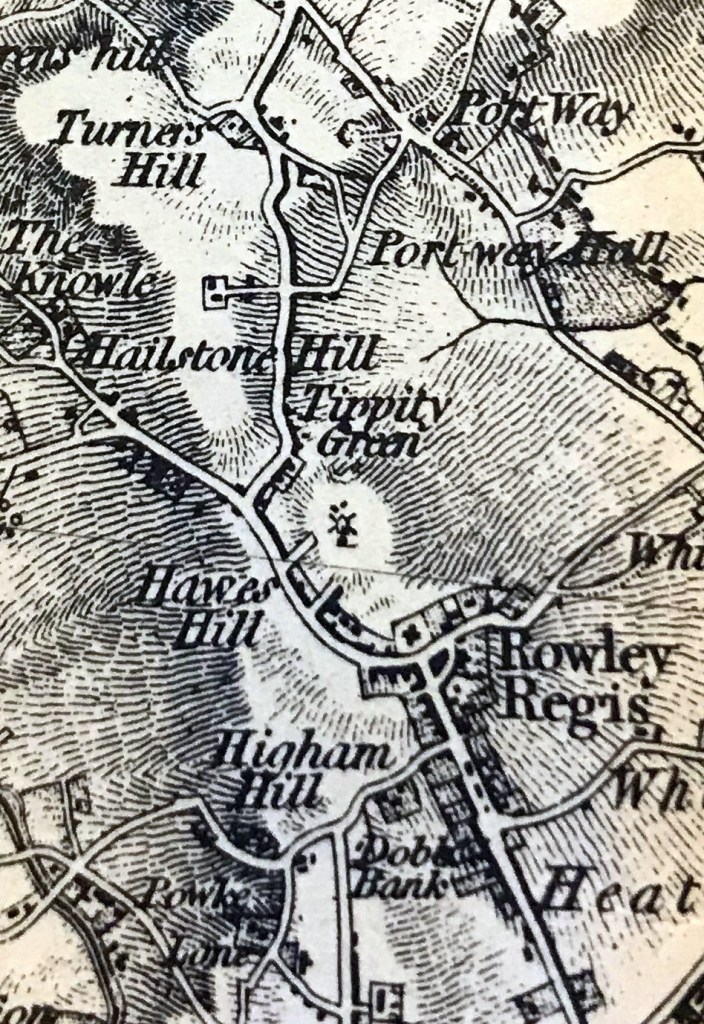
Windmill Farm was off Tippity Green and Hawes Lane, the windmill was between the church and Tippity Green, opposite the Bull Public House and where the Windmill is shown on this Ist Edition OS map. The quarry which developed on this land was marked on the 1892 OS Map as Alsop’s Hill Quarry so the family obviously retained control for many years.
Reprint of the 1st Edition Ordnance Survey, Copyright: David & Charles
The Role of the Miller in Society
Where there were farmers growing crops requiring milling and where there were people needing flour, not to mention bakers, Millers were important and necessary in society. Some home grinding was possible with small querns or grinding stones but later two millstones one on top of the other – the bottom one stationary and the upper rotating to grind grain between them to crush the seed, remove the husk and crush the germ inside. The Romans developed this method further by using power to drive the runner stone, at first by horse or donkey but later using water power.
The Domesday Survey records more than five thousand water mills in England, the wind mill was not introduced into England until about 1185.
During the medieval period, there was a customary law known as Mill Soke. The Mill would be built by the Lord of the Manor and his tenants were obliged to bring their corn to be ground there, by the Lord’s Miller and he retained a percentage of the ground flour as his ‘toll’, usually about one fifteenth. Millers were apparently not popular in the communities they served, often accused of taking more than their entitlement (it was noted that the Miller’s pigs were usually the fattest in the village) or adding material, such as alum, to pad out the flour which would, of course, affect the subsequent baking with the flour but would increase the profit for the miller. In 1872 Dr. Hassall, the pioneer investigator into food adulteration and the principal reformer in this vital area of health, demonstrated that half of the bread he examined had considerable quantities of alum. Alum, while not itself poisonous, by inhibiting the digestion could lower the nutritional value of other foods.
The Rowley Windmill was a manorial Mill. It occurs to me that it may have suited the Lord of the Manor to recruit his Miller from outside the community and he would certainly have needed a miller who knew the business and how to operate the machinery.
By 1750 the tradition of ‘soke’ was disappearing and millers bought grain direct from farmers and sold flour direct to his customers. White bread also became more popular so millers had to install extra equipment, more storage was needed and mills became larger. Between 1750 and 1850, the population of England tripled to nearly 17 million so more flour was needed.
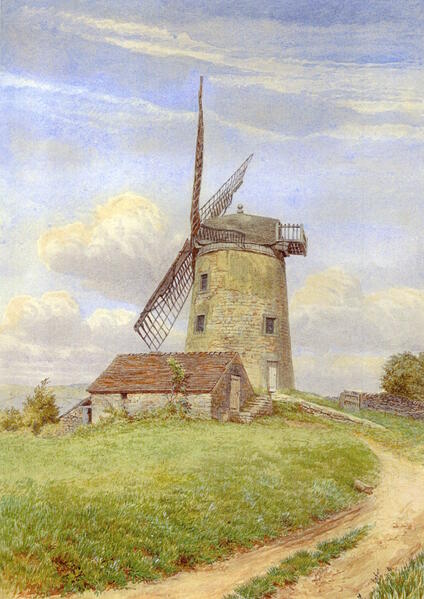
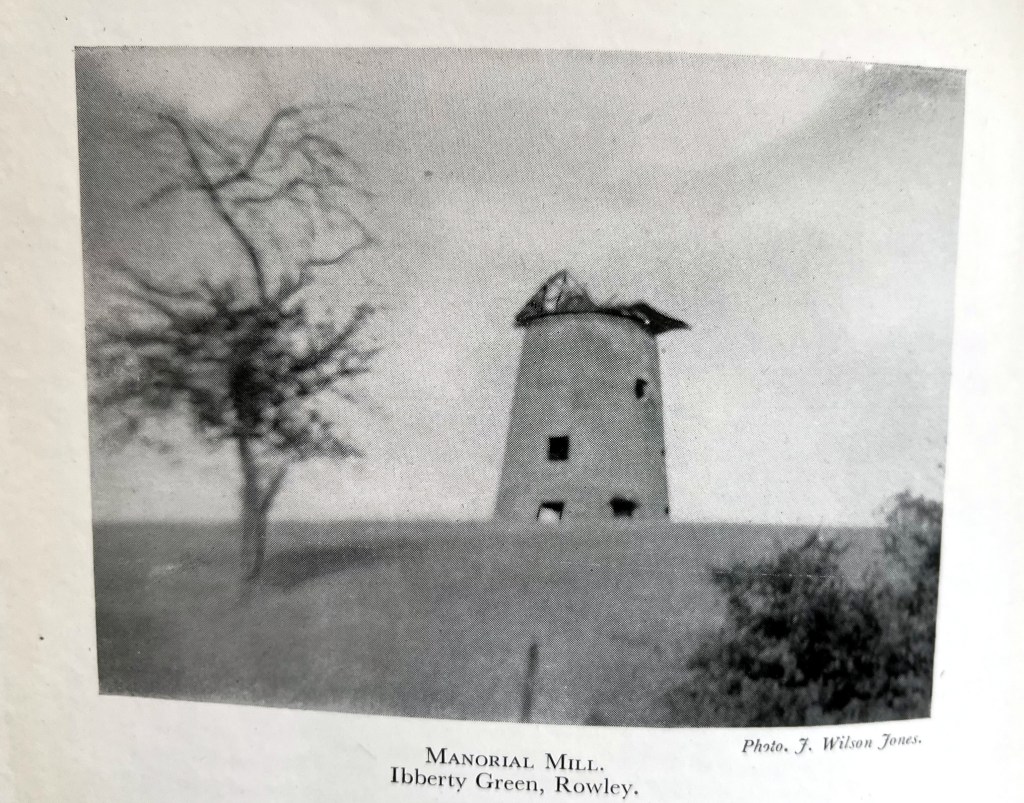
Copyright: Paul Harrison. This painting shows Heage Mill, in Derbyshire, probably painted in about 1850, this mill is very similar to the remains of the windmill in Rowley Regis, shown in this photograph published by Wilson Jones.
Copyright: Wilson Jones.
By 1850, the traditional windmill or watermill had arrived at a developed state, with many operations becoming automated. The growth of canals and later railways made it possible to distribute flour more easily and quickly. But as new large automated mills with steel rollers rather than stones were built, traditional millers could not compete, particularly in urban areas. In rural areas, some diversified by milling animal feed as well as flour but by the early years of the 20th century, traditional flour milling had all but ceased.
This timeline certainly fits in very well with what we know of the Rowley windmill. In November 1860, an advertisement appeared in the Birmingham Journal, giving details of the Rowley Flour Mill to be let at a low rent, with two dwelling houses and good access to both canal and railway. The Mill was said to consist of “an 18 horse condensing engine, driving three pairs of French stones, with Dressing, Bolting and Smutting machines, Bean Mill, etc all in excellent repair.” So it was using relatively modern technology and money had been spent on equipment. But Edward Alsop had died in August of that year so perhaps no-one in the family had the skills or was prepared to continue traditional milling, especially if they were already well established in other work.
The role of the Millwright in the development of mechanical engineering
I recently read an interesting paper [i]which examined the importance of technical competence in the development of the Industrial Revolution. This suggests that the manufacturing and maintenance of relatively sophisticated devices using high quality materials (such as in mills) required top quality mechanical competence. In the early stages, this competence mattered more than schooling or literacy. The paper focuses on a particular group of craftsmen, millwrights and wheelwrights or simply known as ‘wrights’. These were originally highly skilled carpenters specialising in the planning, construction, improvement and maintenance of mainly water-powered machinery. The paper calls these the engineers of the pre-industrial era. They suggest that the agility and efficiency of the English Apprenticeship system also helped to produce high-skilled mechanics who in turn apprenticed others to pass on their knowledge. The skills developed by these ‘wrights’ later enabled them to be at the forefront of other engineering work, including steam engines – so when mines needed pumps and lifting gear and when factories began to be set up these men were the ones who knew how to install the machinery and the power sources which drove them. Was it a coincidence that many of these factories, especially those in the weaving industries, were known as ‘mills’? And although the Midlands did not have textile mills in the same way as the North-East, they certainly had many other areas of work and factories requiring similar engines and similar skills.
Some of the best-known engineers of the Industrial Revolution originally apprenticed as Millwrights, including James Brindley, the great builder of canals during the early canal era after 1750 and John Rennie the co-inventor of the breast-wheel water mill and who built the first steam driven flour mills. The millwrights were seen as all-round technically competent craftsmen and textile engineering installations categorised their equipment as either ‘millwright’s work’ or ‘clockmaker’s work’.
The report quotes John R Harris, a historian of technology during the Industrial Revolution, as saying “so much knowledge was breathed in by the workman with the sooty atmosphere in which he lived rather then ever consciously learnt”. Which I think sums up very nicely the versatility and dexterity of many of our Black Country workers, well before literacy was common. Specific skills were recognised and valued, some men described themselves as nailers or labourers but many others were more specific, many of my male Rose ancestors were rivet makers, others were furnacemen or puddlers, quarrymen were stone cutters or sett makers. I recently saw a remark that competent people in the Black Country made chains, less able made nails but I do not think it was as simple as that. Each village made a particular type of nail – Dudley folk made horse nails – whereas chains tended to be made in the Cradley area but each nailer would learn the skill from their own family so such small differences remained very local. And other skills, such as ramrod making, jew’s harp making, gun making, bladed tool makers were all present locally and usually appear to have been family based skills and very possibly keenly restricted to family!
The authors of this report urge recognition of the ‘crucial role of mechanically trained and highly competent craftsmen in the Industrial Revolution’, which they suggest correlates closely to the distribution of mills and millwrights centuries ago, even as early as the Domesday survey, as the forerunners of the mechanical engineers who enabled much of the Industrial Revolution.
Millers in Rowley Regis
So, milling as a profession required certain skills which were clearly, in the Alsop (and Mallin) families passed through the generations. Although they may not have actually built the mills or the milling machinery, so were not technically ‘millwrights’, millers required quite a high level of engineering skills to operate and maintain their mills, and were not unskilled workers but likely to be in considerable demand by the owners of manorial mills to operate them safely and efficiently. And such owners may have preferred to bring in millers from outside the immediate area whose loyalties would lie with the mill owner, rather than the local populace. From my research, the children of the Alsop family appear considerably more likely to move away from the area and settle elsewhere, than most of the core families I have examined so far in this study.
The Alsop Family
The Alsops were not a family who had been in the parish for very long (at least in contrast to some of the local families who had been there for several centuries) and they were not as prolific as some of the Hamlet families. There are only 28 Alsop entries in the whole of the printed parish registers for Rowley Regis and only 34 results for the parish in FreeREG.
John Alsop (1744-1809)
John Alsop was born in about 1744, calculated from his age at burial which may not have been very accurate, such details are only as accurate as the knowledge of the person giving the information at the time of the death so with older people unlikely to have first hand knowledge. I searched FreeREG for the period 1730-1750 for a baptism in the area around Rowley Regis. There were three John Alsops baptised in the period. The first was baptised on 30 October 1734, the son of John and Mary Alsop. The second was baptised on 7 April 1740, the son of John and Elizabeth Alsop and the third on 9 September 1748, the son of Thomas and Mary Alsop. All three were baptised in Walsall where there are other later Alsop connections. I was very interested to note, whilst I was researching John Alsop, that another John Alsop aged 70 (which tallies with the last baptism above if the age was accurate)was buried in 1818 in Walsall and that his abode was also at ‘Windmill’. Perhaps the Alsop family were Millers and the Rowley John Alsop had moved to Rowley, with his specialist skills, specifically to operate the windmill there. As to which, if any, of these is the John who moved to Rowley, we cannot be sure.
John first appears in the Rowley Parish Registers in 1764 when his daughter Elizabeth was baptised, the first of five daughters – who were baptised to John and Elizabeth (nee Gough) Alsop. Then followed Hannah in 1766, Rachael in 1768, Lucy (1770-1791) and Mary in 1773. Elizabeth Alsop died in childbirth in 1773, (which I have concluded as Mary was baptised on the same day that Elizabeth was buried). A child of John Alsop was buried in November 1773 but no name is given but this was probably the motherless Mary .
John Alsop’s daughters
There is no further clear mention of any of John Alsop’s daughters in the Rowley Registers, other than the burial of Mary in 1773 and Lucy in 1791. There are no marriages for the other daughters in Rowley Regis but I think I have found their marriages elsewhere.
Elizabeth Alsop (1764-1794)
I think that Elizabeth Alsop married widower John Cooper (1761-1797) at Harborne, on 16 July 1782. Cooper’s first wife Mary nee Smith had died in March 1782 and their daughter Sarah (1782-1793) was baptised on the day of Mary’s burial so John re-married very quickly, partly, one would think, to give Sarah a mother. Elizabeth and John Cooper had five children, all baptised in Rowley Regis: these were Joseph (1783), Esther (1785), Elizabeth (1787-1811), Edward (1790-1794) and George (1792). Elizabeth died in 1794 and was buried at St Giles, so when John died in 1797 their surviving children would have been orphans. There are numerous Coopers in the area after that, especially in the Oldbury area but I have not been able to identify what happened to the children after that, although they may have been taken in by family.
Rachel Alsop (1768-1836)
It seems likely that Rachel Alsop married John Fenton at St Martin’s (in the Bullring) in Birmingham on 7 October 1788 and it appears that this couple went on to live out their lives in Aston, Birmingham where they had at least five children: John (1791), Isaac ((1793), Charles (1800), Sarah (1803) and Henry (1806). This Rachel died in 1836 and I think JohnFenton died in 1843. If this is the correct couple, they were living in Potter Street, Aston which is just behind what is now Aston University and in the 1841 Census John is shown as a Steelworker.
Hannah Alsop (1776-1824)
Hannah married Benjamin Edge, a chain maker of Tuckies in the parish of Broseley, Shropshire in a Quaker ceremony in Worcester in April 1801 when she would have been 35, she was said to be of the City of Worcester. They lived in Coalbrookdale, certainly most of their married lives and at the time of their deaths, Hannah died in 1824 and Benjamin in 1845 and they appear to have had at least one child James Edge (1808-1887) who continued to live there for the rest of his life.
So only one of John Alsop’s daughters stayed in Rowley after her marriage, the other daughters settled in Birmingham and Coalport respectively and it appears that their children stayed in those places.
John Alsop’s second marriage
After Elizabeth’s death, John Alsop then married Sarah Bate, a widow, at Clent in 1780. Sarah’s husband John Bate had died in 1775, he and Sarah had had three sons and a daughter between 1770 and 1776. Perhaps John, with his several daughters, was keen to have a son to inherit his mill and farm. Edward Alsop was baptised at St Giles on 30 December 1781, the son of John and Sarah Alsop, he appears to have been their only child.
John Alsop died and was buried at St Giles in 1809, aged 65. Sarah Alsop, of the Windmill, died and was buried in February 1813, aged 76, of Dropsy.
Edward Alsop (1781-1860)
In 1841 John’s only son Edward Alsop, aged 60 with his wife Betty (nee Hodgetts), also 60, were living at the Mill Farm with their children Sarah aged 35, Thomas aged 30, Mary Ann aged 20 and Rhoda aged 15. There was also a Male Servant John Morteby, aged 15 who was not born in the County. Again, perhaps it suited millers to employ family members to keep their knowledge within the family or to bring in servants from outside the local community.
The 1851 Census is helpful, concerning farms and this has Edward Alsop, by then 70,as a farmer of 40 acres, employing 2 labourers. And in 1851 there were two men listed in his household, one a cowman and one a waggoner. I wonder whether Alsop was already quarrying by that time and required a waggoner to transport stone from the quarry?
EdwardAlsop had married Betty Hodgetts of Clent on 7 Jun 1801 at Clent, and his abode was also shown as Clent. It may be that there was a family connection for the Alsops in Clent as his father had also married there but there were also a large number of Alsops in Walsall.
Edward and Betty’s first daughter Hannah was baptised on 11 October 1801 at St Giles, Rowley Regis. Then followed Sarah in 1805, John in 1807, Thomas in 1809, and Mary in 1811, (who was buried aged 1 in 1813), Joseph in 1816, Edward in 1818 – in these latter two baptisms the occupations of the fathers were being shown and in these two Edward Snr’s abode was shown as Windmill and his occupation as a Miller. Next came Mary in 1820 and Rhoda in 1821 and now his occupation was shown as farmer, so perhaps the milling was becoming less important.
Betty Alsop nee Hodgetts, died in July 1854 aged 74 and her abode was given as ‘The Mill’. Her cause of death was noted as ‘old age’. Hodgetts is not an unknown name in the area. I have not yet researched Betty Hodgetts myself but other researchers who have her on their trees on Ancestry indicate that she was born in Halesowen and that her father was Timothy Hodgetts and her mother Mary Mallen – Mallen is a name which will recur later.
Edward Alsop died six years later, aged 78 in 1860 and was buried at St Giles on 7 September 1860, no cause of death noted. The Mill was being advertised for rent only a few months later so it was obviously still operational and fully equipped at that point, when milling ceased completely is not known.
The next piece will look at the children of Edward and Betty.
[i] The Wheels of Change: Technology Adoption, Millwrights, and the Persistence in Britain’s Industrialization Joel Mokyr, Assaf Sarid, and Karine van der Beek+ which I was able to download free from academia.edu
Timothy and Maria Hill had several children and for many years I have thought that Benjamin was the first of them. Now I am not so sure this is quite correct!
I have not been able to find a baptism for Benjamin Hill. The baptism of his sister Mary Hill took place on 12 January 1804 at St Giles, Rowley Regis when she and her younger sister Ann were baptised. Mary was noted in the entry in the baptisms register to be ‘2years six months old’ which means that she must have been born in the middle of 1801, which would have been almost exactly nine months after Timothy Hill married Maria Hipkiss. Which, in turn, was only three months or so after the death of Ann Priest. So Benjamin must have been born at least nine months before that – in 1800 or before.
At the time of his death in 1844, Benjamin’s age was given as 44 which again takes us back to 1800. I noted in my first piece on the Hill family that it appeared that Timothy and Ann had no children. But supposing that after all those years without children, Ann – at the age of thirty-five – actually gave birth to a son in 1800, and died in or after childbirth? This was before Civil Registration began in 1837 so sadly I have no way of checking. Could this – with the trauma of her death and the need for Timothy to care for this newly born son- account for why Benjamin was apparently not baptised? And why Timothy re-married so quickly – to provide his son with a mother? And was it possible that one reason that Benjamin lived a distance from the rest of the Hill family was that he was not Maria’s son and not particularly welcome? Pure speculation but possible.
The first documentary evidence of Benjamin’s existence is in 1821 when he married Ann Williams in Halesowen. One of the witnesses to this marriage was a Timothy Hill, the other was a George G Fiddian. (There are numerous instances of Fiddians acting as witnesses to marriages in Halesowen around this time so he was not likely to be a family member. The presence of Timothy Hill at this marriage is my strongest indication that I have Benjamin in the correct family. But I may be completely wrong, in which case all that follows is completely irrelevant to the Hill family of Gadds Green. But may be of general interest anyway.
In the 1841 CensusBenjamin’s occupation is shown as a ‘cole miner’ and his age given as forty. He is living with Ann and their children Joseph, then 18, Timothy, then 15, Mary, then 12 and Benjamin, aged 8. All of these are regular Hill Christian names. Their address was New Street which was in Old Hill. So there were two odd things here. The first is that usually this branch of the Hills stuck pretty close to Turners Hill area, as will be shown by later pieces on Timothy and Maria’s other children. The second unusual thing is that Benjamin was a coal miner whereas most of the Hill family were nailers.
However, I found a newspaper report which may be relevant, (although there were two other Benjamin Hills in the area in 1841, only one other was described as a nailer), so it is possible that this case does not concern this Benjamin Hill at all.
The article appeared in the Worcestershire Chronicle, dated 24 January 1839. This stated, under the Police Reports,
“Richard Mountford charged Benjamin Hill, nailer, with embezzling iron he had taken out to work into nails. Hill stated, in his defence, that the plaintiff had induced him to leave another master to work for him, and had shortly afterwards given up business, when he was compelled to dispose of his stock to support his family, and afterwards to go to the workhouse; he was ordered to work in the stock 19 quarters in 19 weeks.”
This report throws up various issues.
Who was Richard Mountford?
Richard Mountford was listed in a report in Aris’s Birmingham Gazette in 1845 as a supporter of the proposed Birmingham, Wolverhampton and Stour Valley Railway, described a Stourbridge businessman merchant, and was living in Coalbournbrook, Ambleside in the 1841 Census, his occupation given as a nail factor which matches the occupation referred to in the court case. But it does imply that he had not given up his nail business as Benjamin Hill had claimed.
There are a few Mountfords in Rowley Regis itself in censuses, though generally not apparently of high status. There was at one time a Mountford House in Siviter’s Lane, for many years the Doctor’s residence and surgery, now the site of a new housing development. Perhaps the Mountfords built the original house?
However, nail factors would have bought nails from all over the area although presumably most workers were accustomed to dealing with particular individuals, (very possibly in family traditions) which would be why Benjamin Hill referred to being induced to leave his previous nail master.
I wonder whether, if this was our Benjamin Hill, Benjamin’s former master refused to deal with him again or whether his family had fallen out with him off as a result of this case. It may be that he simply could not find work as a nailer after this which may be why he became a miner, moving to Old Hill which was nearer the pit at Five Ways, Cradley Heath where he was working. However, when Benjamin’s oldest son Joseph was married at St Giles in April 1845, Joseph gave his father’s occupation as a nailer, so Benjamin, despite his death in a mine, had been a nailer at the time of the court case in 1839, so for most of Joseph’s life and Joseph obviously still thought of him as a nailer. But it is also possible that Benjamin worked as a miner in the daytime and still as a nailer when he got home, this was not uncommon as a way to increase income.
However the move to Old Hill came about, Benjamin stayed in Old Hill after this for the rest of his life and his children also stayed there. Other than Benjamin’s burial at St Giles, which was, in any case, still the parish church for Old Hill at this time, there is no evidence of any later contact between Benjamin and the Hill family in Gadd’s Green.
Richard Mountford might have had a liking for litigation against his workers. I found another report that in 1841 he had indicted a Richard Sutton for feloniously damaging a steam engine’ but this case was dismissed by the Magistrate and a verdict of Not Guilty was recorded.
The Dudley Wood Colliery Disaster
On the 19 October 1844, at the Dudley Wood Colliery, Benjamin Hill, aged 44, was amongst eleven miners killed in an explosion at the mine.
This colliery was situated between Netherton and Darby End, as shown on this map.
Reproduced with the permission of the National Library of Scotland
This map dates from somewhar later than this incident and the mine is marked No.2, so may not be the exact mine, which may perhaps have been on the waste land opposite.
This photograph shows a picture of buildings on Dudley Wood Road, taken in about 1905-7, and showing the buildings affected by subsidence due to coal mining, some of the houses leaning backwards, the whole area must have been terribly undermined.
Copyright Staffordshire PastTrack, Albert Henry Yelland.
A report in the Birmingham Evening Mail on 28th October gives details of the inquest, held at the Five Ways, Cradley Heath, on seven of the miners including Benjamin, the other miners must have lived elsewhere and some were the subject of a separate inquest held at Lye Waste. Other miners killed, according to newspaper reports, were William Brookes(aged 25), Thomas Botfield (aged 30), William Weaver (aged 10), and Joseph Bennett (22), John Evans (27), James Roberts(19) and William Parkes (unable to find any death registration for this name). There had been seventeen miners working in the pit that morning, the other six survived with burns and all but one were thought likely to recover. Both Richard Scriven, aged 64, the mine ‘butty’ and his son Thomas, aged 21 were also killed in the explosion.
The injured men were Thomas Evans (badly injured and not expected to survive), Benjamin Gray, Thomas and Joseph Wright (brothers), Thomas Pearson and Emanuel Hill. Some of the names appear to be incorrect in some reports but I have checked them against death registrations and entered the correct ones here, in case any readers might have family who were affected by this tragedy.
It could indeed have been worse. Also working below ground, some 16 yards below the explosion were several men employed in getting ironstone (this part of the Black Country was known for having all the materials required for iron working – ironstone, coal and clay – in layers, one above the other). When they heard the explosion above, these men instantly got into an empty skip (or basket) which happened to be at the bottom, and ‘were drawn up to light and life; had they remained a short time longer, death would have ensued from the foul air descending to the mine in which they were at work’. It was clearly a powerful explosion. The report adds ‘One skip, which was descending a shaft at the time the explosion occurred, on which was a bottle of beer, was blown into the air an immense height; the bottle was afterwards found more than 200 yards from the pit’s mouth.’
The report notes that the Inquest was conducted by Mr Hinchliffe, one of the Staffordshire Coroners and noted that there was a ‘highly respectable jury’. The pit was referred to as ‘Mess’rs Pargeter and Darby’s coal-pit’. Various witnesses gave evidence, Lemuel Miles (or possibly Emanuel), of Rowley, (a miner who had been working in the pit at the time and who had reportedly checked the pit for gas with Thomas Scriven that morning), and also including the local constable Samuel Garratt, Thomas Frederick the Mine Agent who had inspected the pit for gas that morning, and George Naylor and Thomas Weaver who had assisted with the rescue and recovery of bodies. The agent gave evidence that the proprietors of the pit had spared no expense to have it properly worked and managed, so as to insure the safety of the work people and to prevent accidents.
I was interested to note, from one of the newspaper reports, that the butty Richard Scriven was in the pit at the time of the explosion because the proprietor Mr Darby had requested him to go down to fetch up some lumps of coal, presumably to examine the quality. The explosion occurred immediately Richard Scriven reached the bottom of the shaft. So Joseph Darby, the owner of the pit, was on the premises at the time and, according to one report, immediately called in medical assistance for survivors as they were brought to the surface but he does not appear to have been called as a witness to either of the inquests I have found reports of, which seems a strange omission to me.
The verdict returned at Cradley Heath was “That the unfortunate men were suffocated, scorched and burnt by the accidental explosion of a quantity of sulphuric air or gas in Mess’rs Pargeter and Darby’s coal-pit.” Benjamin’s death certificate stated, under cause of death, ‘Accident: By an explosion of Sulphuric Air or Gas in a Coal Pit: Instant.” The death was registered by the Coroner.
A report in the Worcester Herald on the Lye Inquest noted that the coal-pit ‘belonging to Mr Joseph Darby’ produced thick coal of very excellent quality and the mine has long borne the character of being among the most dangerous in this part of the country’.
The report in the ‘John Bull’ paper has an interesting note I did not see in other reports. It relates “An interesting circumstance, in connexion with this lamentable tragedy is worthy of record. Emanuel [Lemmuel] Miles, a miner employed in the pit, and not given to prayer, was noted on the morning of the accident, before going down, earnestly imploring the Divine protection from accident during the day: his prayers were granted, and though in the pit when so many of his fellows were summoned to their final account, his life was spared, to become, we trust, a wiser and better man.”
Although I can find no further reports of the outcomes of inquests, one newspaper ends their report by stating “The explosion, there can be no doubt, was caused by negligence on the part of someone, in all probability by one of the unfortunate sufferers.” I note from the reports that the explosion happened just as Richard Scriven reached the bottom of the shaft and that he was particularly badly injured, so I wonder whether, since he was only going down to collect a few lumps of coal, he took down a candle, rather than a safety lamp and ignited gas at the bottom of the shaft. There was also mention in one report of an older adjoining mine which had been blocked off with rock and soil but it was thought that this was too well sealed to allow gas to seep through. But presumably gas could leak into the mine passages from fissures in the coal at any time and gather wherever air currents – such as those caused around the shafts by rising or descending baskets – took them.
Benjamin Hill was buried at St Giles, Rowley Regis on 22 October 1844, his abode given as Lawrence’s Lane. He left his wife Ann and four children.
In the 1851 Census Ann, shown as she sometimes was as Hannah, was in Cherry Orchard, Old Hill, still in the same area as she had lived with Benjamin, along with her youngest child Benjamin and her daughter Mary (Ann) who was married to John Pritchard in 1847, and Mary’s two children Ann and Thomas. Plus two lodgers, so a fairly full house!
I have been unable to find any trace of Ann Hill after 1851, either in censuses or in death or burial records, nor in marriages (as she might have re-married). She does not appear to have been with any of her children in later censuses.
Benjamin and Ann’s children all stayed firmly in Cherry Orchard area of Old Hill for decades, with or near their siblings.
Joseph Hill (1823-1903) married Sarah Tibbetts (1828-1902) at St Giles, Rowley Regis in April 1845. They lived for at least twenty years in Cherry Orchard before moving towards Netherton and appear not to have had any children but to have raised Louisa Dalloway, Eliza’s niece, as she is in their household in 1861 and 1871. They were both buried at St Andrew’s church, Netherton.
Timothy Hill (1824-1908) married Eliza Worton (1824-1865) on 14 February 1842 at Old Swinford. They had nine children – Phebe (1844), Emmeline (1845-1847), Sarah Ann (1848-1848), Eliza (1850), Louisa (1851), Timothy (1854), Thomas (1858-1859), Joseph (1860-1862), Anne (or sometimes Hannah, like her grandmother!) (1862). Eliza died in 1865, aged 42 (and worn out, I should think, having nine children!) and was buried on 11 June at St Luke’s, Reddall Hill. On 14 August 1865, just two months later Timothy married Sarah Marsh (nee Pearson), a widow, of Halesowen Road, Reddall Hill and they had two more sons, James (1866) and Isaac (1869). With Sarah’s children Leah (1855) and Edward Marsh (1859) the house must have been pretty crowded. Sarah died in November 1899, aged 71 and was buried at St Luke’s. Timothy died in 1908, aged 78 and was also buried at St Luke’s.
Mary Ann Hill married John Pritchard (who was born in Netherton) on 30 August 1847 at Dudley St Thomas, and they also lived in Cherry Orchard until at least 1891, next door to her parents at first and two doors away from Mary Ann’s brother Benjamin and his family. They had five children: Ann Maria (1848), Thomas (1850-1851), John (1852), Mary Ann (1865) and James (1868).
Despite a lot of searching, I cannot at present find definite Death details for either Mary Ann nor John Pritchard. And neither can any of the numerous other people who have them in their trees on Ancestry. They both appear in the 1901 Census, still together in their home of many years in Cherry Orchard, then aged 74 and 73, respectively. And I cannot find either of them in the 1911 Census. There is a likely looking death and burial at Netherton for a John Pritchard of about the correct age in 1900 but since our John appears in the 1901 Census, this cannot be he. The only other likely death appears to be in 1910 in the Stourbridge Registration District but since that covers parts of Blackheath, where at least one of their children was living, this may be him. I would have to buy death certificates to be sure. That applies also to a possible death for a Mary Ann Pritchard of the correct age who died in the Dudley Registration District in 1913 but I have not found burials for either of these deaths so this remains a mystery at present.
The last child of Benjamin and Ann, another Benjamin, married Mary Steadman at Dudley St Thomas on 16 March 1856, the marriage was witnessed by John and Mary Pritchard, Benjamin’s sister and brother-in-law. In 1861, they were in Garratts Lane but by 1871 they were back with the rest of the family in Cherry Orchard where they stayed for the rest of their lives. They had eight children: Thomas (1857), John (1859), Emiline (usually known as Emily) (1861), Mary Jane (1865), Benjamin (1867), Ellen (1870), Joseph (1872) and Harriet (1875). Benjamin died in August 1913 and Mary in December 1916, both were buried at St Luke’s Church.
All of the four children of Benjamin Hill lived for years in Cherry Orchard, three of them for their whole lives. Cherry Orchard which appears to have been off Wrights Lane, so within sight of Rowley village, was not exactly the rural idyll the name might seem to indicate but was obviously ‘home’ to this branch of the Hill family.
So this is the tale of Benjamin Hill, who I believe to be connected with Timothy Hill of Gadd’s Green and Benjamin’s descendants in Old Hill. A little outside the Lost Hamlets area but within a couple of miles. More pieces will follow on Benjamin’s other siblings shortly.
When, back in February 2023, I posted for the first time on the ‘I Remember Blackheath & Rowley Regis’ Facebook page about my then new One Place Study about the Lost Hamlets, I had some very encouraging responses, one of which was from Ronald Terence Woodhouse who told me that his family had been the original licensees of the Wheatsheaf and that his grandmother had lived in the first cottage going up Turner’s Hill, so right in the centre of the study area. And ever since, I have been meaning to do a piece on the Wheatsheaf. So here it is, at last.
Copyright: Mike Fenton. This shows the pub in about 1928 and the Water Tower on Turners Hill can be seen in the distance. This building was demolished soon after this and a replacement built.
The address shown in Hitchmough’s Guide [i] for the Wheatsheaf is 1, Turner’s Hill, or Darby’s Hill, Lye Cross, Four Lane’s End, Oakham, Rowley Regis. So quite which if those it is, I would not know. Probably all at one time or another. Perhaps part of the reason for this varying address is that these are all descriptions given in the different censuses, Lye Cross from 1841-1861, when the pub was managed by Benjamin Woodhouse from about 1834-1861, then by Joseph Cox from 1861-1892. Joseph Parkes was the Licensee from 1996-1904, Walter Woodall from 1911-1912, then it was managed by Howard Woodhouse in 1916 and then Thomas Woodhouse in 1919-1920. It is quite possible that the other licensees were related to the Woodhouses and Hitchmough does not have a complete list in terms of dates, but I have not looked at those families in detail at this stage.
In the 1871 Census, the pub’s address is shown as Turner’s Hill and in 1881 it is 35 Oakham, in 1901 it was 1, Turner’s Hill – Tavern – as in 1901. So this area seems to have been called various things. As late as 2022 the site was still described as 1 Turners Hill. But certainly there was a pub or tavern there at a very early date which continued until quite recently, only the Bull outlasting it.
The Wheatsheaf was situated at the junction of Portway Hill and the road which ran from Perry’s Lake up over Turner’s Hill. This area is not strictly part of the Lost Hamlets since it is not physically lost as the other hamlets have been, the area is still there although the pub has now closed. But there was a strong family spread across this area and the Turner’s Hill/Gadd’s Green/Perry’s Lake area with a lot of connections. Families from this area also often used the Dudley churches, rather than Rowley.
Benjamin Woodhouse Licensee 1834-1855)
In August 1826 and 27, August 1829 and again in August 1830 notices appeared in Aris’s Birmingham Gazette warning ‘Gentlemen’ against ‘sporting or trespassing’ on the land of various owners or they would be deemed ‘wilful trespassers. Signatories to this Notice included Benjamin and later Thomas Woodhouse, Benjamin Hadley and Thomas Smart, all names associated with Benjamin. There were similar notices relating to several other places, including Sedgley, Kings Norton and Sutton Coldfield although I do not know what gave rise to these nor whether they had any effect on the hunting /poaching and shooting parties. There was no police force as such in those days and people had to protect their land as best they could,in this instance by working together. However, it does show that at least Joseph Woodhouse was a well established landowner in this area by 1929 and the house may well have been operating as a beerhouse or pub by then but this is uncertain.
In November 1839, an auction was held at ‘the house of Benjamin Woodhouse at the Wheatsheaf’of a small freehold estate which was situated ‘at Portway’ within two miles of Dudley, by the side of the road leading to Oldbury, Titford and Birmingham, consisting of a Farm House, Barn, Cow-house, small tenement, and four closes of rich Pasture Land, containing about eight acres, ‘in the occupation of Thomas Woodhouse’. The notice emphasised that the property was in the immediate vicinity of numerous collieries and iron works, rendering it a ‘most desirable investment’. This may have been Portway Farm or another farm on that road.
Hitchmough lists the first licensee as Benjamin Woodhouse – from 1834-1861. In the 1841 Census Benjamin was there with his wife Sarah Woodhouse (nee Smart) and an Ann Woodhouse, aged 20, all born in Staffordshire. Benjamin and Sarah appear to have been married at Handsworth in 1812.
The 1841 Census does not give relationships but from what I have been able to research, it does not appear that Ann is the daughter of Benjamin and Sarah, I have only been able to discover one child born to them, Sarah Jane who was baptised at St Giles in 1832, when they had been married for twenty years and Sarah was forty four.
Sarah Woodhouse died in March 1854, aged 66 and Benjamin in early 1855, aged 69, both buried at St Giles. So clearly he cannot have been the licensee until 1861, as Hitchmough suggests. Perhaps the dates of 1861-1892 which Hitchmough suggests for the next licensee reflect the next licence record or possibly census that Hitchmough was able to find, there is sometimes a delay in finding records of licences changing hands.
Benjamin’s Will was made in October 1854, proved in May 1855 in which he describes himself as a publican of Lye Cross, so it seems that this was definitely the right Benjamin Woodhouse. In his Will, Benjamin leaves houses to the two sons of his niece Ann (so perhaps that was who was staying with him in 1841?) but most of his assets were left in a complex Trust for the benefit of his daughter Sarah Jane. The Trustees were his niece’s husband Enoch Hadley and Charles Cox of Oakham, both described as cattle dealers. Benjamin appears to have been quite well to do, leaving various properties and his Will leaves, amongst other things, his brewing equipment so, like many Victuallers at that time, he obviously made his own beer. But he also listed “furniture, brewing vessels, plate, linen, china, glass, books, prints, wines, liquors, consumable stores, and other household effects” amongst his possessions. Certainly it sounds like a well furnished and decorated house, I have not seen ‘prints’ listed in any other local Wills.
I began this piece fairly sure that I was not related to this family – there was not a Woodhouse to be found on my family tree with 7000 people on it. But then I found that Benjamin’s daughter Sarah Jane Woodhouse married a Major Rose – my mother’s maiden name was Rose. That started little bells ringing in my head as I have lots of Roses from Rowley on my tree. But Major Rose was from Halesowen, so not likely to be connected. It took me about ten minutes to find his father Aaron Rose, also living in Halesowen and a Gun Barrel Manufacturer – still no connection, no gun barrel makers amongst my lot. Then, in the 1851 census I saw that Aaron Rose was born in Rowley. Ah! And his parents were Moses Rose and Mary Stephenton, who were my 5xg-grandparents… okay, I am related, very distantly. Major Rose was my 1st cousin 5xremoved. I am beginning to wonder whether I am actually related to everyone living in the Lost Hamlets then…
Sarah Jane and Major had been married on 15 February 1854 at St Martins in Birmingham, where Sarah Jane was described as ‘of this parish’. This was only a few weeks before her mother died and I am slightly surprised that she was not married in Rowley. And her father’s Will went to great lengths to try to prevent her husband from benefitting from his estate, leaving most of his assets in Trust for Sarah’s benefit. Perhaps they did not approve of the marriage. Major’s family were involved in gun making and Benjamin Woodhouse would probably have been aware that Aaron Rose, Major’s father had been declared bankrupt in 1852. None the less, Sarah’s was a long and fruitful marriage, she and Major Rose had at least six children together, rejoicing in the names of Benjamin Woodhouse Rose (1855), Major General Rose, (1859), Sydney Herbert Rose (1861, Baron Rose (1864), Captain Rose (1866) and Sarah Jane Rose. The first two children were born in Rowley Regis (probably at the Wheatsheaf) but the later children were born in Halesowen where the family both farmed in the Frankley/Illey area and Major and his brothers continued to be much involved with gun barrel making.
On 18 April 1855, there is a notice in the Worcestershire Chronicle, stating that the transfer of the Licence for the Wheatsheaf had been sanctioned from Enoch Hadley (who was Executor for the estate of Benjamin Woodhouse) to Major Rose, Benjamin’s son-in-law.
Interestingly Hitchmough has a note that Hoof marks were reported on the roof of the Wheatsheaf in 1855!
And Major and Sarah Jane’s elder two children were born in Rowley in 1855 and 1859 so they may have stayed at the Wheatsheaf until then. In 1857 and 1858 Major Rose also took out Game Licences in Rowley Regis. But by the 1861 Census , Major and Sarah were back in Halesowen, he describing himself as an ‘ironmaster’ and certainly he remained involved with the family gun making business for many years to come. Also living with them in 1861, apparently as a servant, was Mary Smart, born Rowley Regis, aged 28. As Sarah’s mother was a Smart, I wonder whether she was actually related to Sarah.
The Woodhouses were numerous in Oakham and Lye Cross. There were three Woodhouse families on one page in the 1841 Census. I will do more work for a Woodhouse Family Study when time permits.
The other thing which is becoming clear from my research is that families who kept pubs tended to intermarry – their children were accustomed to the life, knew how things worked, and presumably met the children of other licensees socially. Looking at the marriages of the children of Thomas several of them and their children married into families – the Bate family, the Levett family, the Roses, the Woodhouses who were farmers , maltsters or farmers and especially publicans. Even when men marrying into the family were in other occupations, such as Joseph Cox who was a farmer, and Major Rose who was a gun barrel maker (although his father had been both a maltster and a licensee earlier in his life), these men turned their hands to becoming licensees when people were required to run the family pub. Keeping the businesses in the family!
Joseph Cox (licensee 1861-1892)
Ah, I thought – a completely different name, nothing to do with the Woodhouses then. It did take me half an hour of checking to discover that Joseph’s wife Sophia was a Woodhouse, the niece of the original Benjamin. So the Woodhouse family were still in control of the Wheatsheaf! I should not be surprised by now at how closely inter-related all the families in this area were.
In the Worcestershire Chronicle on 18th January 1860 there is a notice that a licence transfer had been permitted for the Barley Mow at Rowley from Joseph Cox to William Griffiths, presumably prior to Joseph taking over the Wheatsheaf. Hitchmough lists Joseph Cox as the licensee at the Barley Mow at Tividale from about 1855-1860, his time at the Barley Mow may have been sufficient to give him some experience in the licensed trade before taking over the Wheatsheaf.
In the 1861 Census, Joseph and Sophia were living at the Wheatsheaf with their children John, aged 6, Sarah Jane, aged 3 and Annie E aged 1, plus a house servant Sarah Rupp, aged 17 who was from Dudley.
In the 1871 Census, Joseph and Sophia were living at the Wheatsheaf with their children Eliza Ann, aged 18, John, aged 16 – a solicitor’s Clerk, Sarah Jane, aged 13, Ann Elizabeth aged 11, plus Mary Sophia, aged 9. (I don’t know where the eldest child Eliza Ann, then 8, was in the 1861 Census, as she is not listed with the rest of the family at the Wheatsheaf and I can’t immediately find her with other relatives in the area.)
There was an inquest held at the Wheatsheaf in October 1878 and details of this appeared in the Birmingham Daily Post on the 18th October:
Birmingham Daily Post 18/10/1878
“Yesterday afternoon Mr. Edwin Hooper, coroner, held an inquest at the WHEAT SHEAF INN, Turners Hill, on the body of Joseph Woodhouse (53), a milkseller, who died under circumstances already reported.
Mrs. Woodhouse said she had been delivering milk with her husband on Monday night, and when in Gipsy Lane, on the road home, she heard a great shouting, and saw a trap loaded with men behind them. Her husband pulled more on one side, but as he did so the horse became frightened, and bolted with them. She lost consciousness, and when she recovered her husband was lying by the road side insensible. She had fallen on her shoulder, and her collar bone was broken. At the time she recovered the men in the trap were driving off faster than ever. A young man helped witness home, and brought her husband. The men were to blame for shouting so loudly and frightening the pony.
Joseph Harvey, of Tividale, said he heard five or six men in a trap driving at full speed, and shouting to Woodhouse as though they wished him to get out of the way. When the pony bolted both were thrown out, and the trap fell over. He called to the men, but they would not stop.
Police-constable Gevin said he had made full enquiries as to the men in the trap, but had not learned who they were. He received no information of the man’s death until late on Tuesday evening.
The Coroner summed up, and asked the jury if they would have an adjournment to give the police more time. There seemed no doubt but that the men would say if brought before the jury that they were simply shouting for the old man to get out of the way. The wife evidently did not seem to think much of the blame to be attached to the men, for she made no complaint, and did not inform the police of the death of her husband for a long time.
The jury then returned a verdict of Accidental Death.”
So this, although not directly related to the Wheatsheaf, was related to the Woodhouse family, one time and perhaps continuing owners of the Wheatsheaf who continued to farm throughout this period in the immediate area of Oakham/Lye Cross.
In the 1881 Census, Joseph and Sophia are still at the Wheatsheaf with son John, now a Clerk at the Colliery, rather than a Solicitor’s Clerk, and daughters Annie and Mary.
In 1891, listed as 1 Turner’s Hill, Joseph is still listed as a licensed victualler and Sophia, Annie and Mary are still living at home and unmarried.
Sophia Cox died in 1894 and Joseph Cox re-married and retired to Smethwick with his new wife where he died in 1903.
Joseph Parkes (licensee 1896-1907)
In 1901, The Licensee is Joseph Parkes, aged 60 and his wife Sarah Jane Parkes.
So far was I know, there is no connection between this couple and the earlier licensees. Parkes is such a common local name that I have not been able to narrow down any more information. So it may be that this was the point at which the family sold the pub to Thomas Williams of the Rowley Brewery. Or it may be, of course, that Joseph Parkes or his wife may have been related to the Woodhouse/Smart/Cox families and I have simply not yet found the link! As Sarah Jane is a name much used by the Woodhouse and Cox families, it was tempting to consider whether Joseph had married into those families but it appears more likely that he was the Joseph Parkes who married Sarah Jane Adams in 1862 in Quinton.
During Joseph’s tenure as licensee, Hitchmough reports an amazing procession, starting at the Wheatsheaf in 1898.
“County Advertiser 24/9/1898
“On Sunday afternoon the annual friendly societies’ Sunday service, on behalf of the hospitals, was held in a field at the back of Mountford House, Siviters Lane, Rowley, kindly lent for the occasion by Dr. J. G. Beasley. The members of various societies met at their headquarters, and were formed into a procession as below. The Blackheath Village Band started from the WHEAT SHEAF INN, Turners Hill at one o’clock, with the Church of England Friendly Society, and proceeded through Portway and Perrys Lake, calling at the BULLS HEAD INN for the Sick Club, at the WARD ARMS INN for Court Foresters’ Pride, at the KINGS ARMS INN for Lodge Working Man’s Friend. It then proceeded by way of Ross, Holly Road, Tump Road, and John Street, to the GEORGE AND DRAGON Ground. The Woodgate Brass Band had in the meantime covered its route from the OLD BUSH INN, Powke Lane, with Court Little Band of Hope, calling at the MALT SHOVEL INN for Lodge Lily of the Valley, the VINE INN for Court Mistletoe Bough, proceeding along Station Road to the RAILWAY INN for Court Britannia’s Pride, thence through Halesowen Street, Tump Road, and Hackett Street, meeting the other Courts at the GEORGE AND DRAGON Ground. A united procession was then formed, and marched to Siviters Lane, reaching the ground at three o’clock. The proceedings opened with the hymn ‘All people that on earth do dwell,’ after which the Chairman (Mr. E. Pewtress, CC) delivered a short address.
The Rev. C. W. Barnard, MA, Rector of Kings Norton, then addressed the meeting, after which the hymn ‘Lead, kindly light,’ was sung. Addresses were also delivered by the Revs. W. Hall and N. Haigh, of Blackheath.
At the close a collection was taken on behalf of the Dudley Dispensary and Birmingham Eye Hospital. It amounted to £11 9s 5d.”
What an amazing event that must have been to see, I can imagine the local children dancing happily alongside the procession. It is clear from this that many of the local pubs, including the Wheatsheaf, ran friendly societies to assist people with illness and medical expenses, in those days when there was no health service, no national insurance and when fees had to be paid for a doctor to visit.
Walter Woodall 1907-1912
In 1911 Walter Woodall (35) was listed as ‘brewer [beer], licensed victualler’ and both he and his wife Elizabeth were born in Wednesbury and, again, there is no obvious connection to the previous owners. The elder two of their children Florence (11) and Walter (5) had been born in Tipton but the youngest Harold (1) was born in Rowley.
Walter Woodall appears only to have been there for five years and the only mention of him in the Press is for the transfer of the licence for the Wheatsheaf from him to Thomas Henry Holland in 1912. Which is rather odd because the same report also notes the transfer of the licence of the Barley Mow in City Road, Oakham to the same Thomas Henry Holland! And Hitchmough does list Holland as the licensee at the Barley Mow from 1911 -1916 but does not mention Holland in relation to the Wheatsheaf. Perhaps a reporter error, as Hitchmough lists the new licensee for the Wheatsheaf in 1912 as Howard Woodhouse, succeeded in 1919-1920 by Thomas Woodhouse. Yes, the Woodhouses, after a gap of more than 50 years (or perhaps 20 if you take into account the Cox family who were also close Woodhouse connections).
Purchase of the Wheatsheaf by Thomas Williams of the Rowley Brewery
Despite all my efforts to associate later licensees with the Woodhouse family, it may well be that in fact the pub was sold in 1896 when the Cox family retired and it is simply coincidence that Woodhouses were back in 1916. Hitchmough notes that the owner of the Wheatsheaf was T B Williams (who had taken over the Bull in about 1875 and who died in 1908) and the Rowley Brewery, followed by Thomas W Williams and Lizzie Bate, before being sold to Ansells in 1946 and subsequently Admiral Taverns. I had noted in my piece on the Bull [ii] that T Williams, the owner there had expanded his brewing and pub-keeping activities from when he took over as licensee of the Bull and had bought both the Wheatsheaf at Turners Hill and the Grange in Rowley Village. So it appears that although the Woodhouses were licensees in 1916, they no longer owned the pub.
Thereafter, Hitchmough listed thesucceeding licensees as :
Howard Woodhouse 1916
Thomas Woodhouse1919-1920
Edward Harrison (1920-1929)
Frank Green (1929)
Frank Jinks (1929-1957)
Walter Raymond Harris (1957 – 1960);
Frederick William Hughes (1960 – [1965]
Frederick Brown (1968 – [ ]
C Swarbrick (1970 – [ ]
Arthur Isherwood (1981 – [ ]
Glenn Whitehouse [1988]
Sara Harvey (2015 – [ ]
Twentieth century genealogical records are much sparser than earlier ones and I have no further information about these licensees although many Rowley people will have memories of more recent ones, as customers at the pub! The licensees in 1988, Mr & Mrs Whitehouse, complained that when the road over from Perry’s Lake over Turners Hill was closed, they lost a substantial amount of trade from Rowley Regis.
Copyright unknown. Taken in 2018, this shows the replacement pub, looking prosperous and well maintained.
The original pub was demolished in about 1930 and a replacement built behind it. This closed permanently in 2019, like so many pubs, still described as 1 Turner’s Hill and planning permission was sought in 2022 to redevelop the site with a very modern block of flats. However I note, from the Sandwell Planning website, that the Council Officers considered that this site was an adopted open space within the Strategic Open Space & a Wildlife corridor, no decision notice or withdrawal of the application is listed and there appears to be no further progress on this application since then.
So far as I am aware, the pub building remains boarded up on site at present, another previously well used pub which has now gone.
Faithful readers who ploughed through my piece about Hall Houses last week may recall that I had quite a lot to say about timber framed houses and the skills and production methods used in their construction.
The fire at the Cathedral, in April 2019, caused extensive damage to some parts of the cathedral but the windows and bell towers, relics and art survived the fire. But the spire fell, through the roof. The things which were extensively damaged were parts of the structure, some many centuries old, that most people probably didn’t notice when they visited. But, as the Telegraph noted, “as la forêt – the latticework of timber over the nave that had supported the roof for eight centuries – had been engulfed in flames and would need rebuilding.”
In the immediate aftermath, work began on finding craftsmen with the necessary skills to re-create the timbering exactly as it was and using the same techniques as 800 years ago, and also to find the timber required. That was the task of the French equivalent of the Forestry Commission who worked with the carpenters to identify the trees required for the work. Eleven principal trusses were needed and forty five secondary trusses, each 1.4m wide and 10m high. The task of carrying out the work was given to a group specialising in heritage projects – Charpentiers sans Frontières (Carpenters without Borders) – which brings together experts to work on historical construction sites.
English carpenter Mike Dennis is one of the small number of carpenters in the world with the skill and knowledge to undertake such work. And he was already living in France. Much of the work, according to him, had to develop from such plans and dimensions as they had available to them. The architect Remi Fromont had done a study of the roof in 2014 and his knowledge was vital. But to recreate the roof in every detail, as they were determined to do, meant drawing on many other resources, including trawling the internet for photographs visitors had taken, which might enable the carpenters to see details and angles of the trusses and tie-beams, including the carpenters’ assembly marks, to which I referred in my previous article.
Tree felling began in December of 2022 and the carpenters would go into the forests with a team from the commission to identify suitable trees for their purposes. They also had a team of blacksmiths who made tools, 13th century style axes, and gouges for them to recreate the marks on the timbers. The work was organised in much the same way as in a medieval workshop, Dennis says, the timber would arrive at the workshop, the carpenters would work on the trusses which would then be piled up ready to be sent to Paris as soon as the masons had prepared the walls. He describes the structure as “a flat pack on a massive scale”. All of the hewing and carpentry work was done by hand, with the carpenters working out the best and quickest ways to create what was needed with hand tools, just as the carpenters would have done originally. The only modern tool used was a circular saw to cut the joints.
The pictures from the restored cathedral look absolutely wonderful but you will not see la forêt – that is hidden above the ceiling but it is there, doing the job of holding up the roof, thanks to the wonderful skills of carpenters like Mike.
Mike Dennis is on Instagram and this is his page there – there are some amazing images of cruck timbers in various old buildings as well as his own work. https://www.instagram.com/mike_dennis_craft/?hl=en
Since completing this work, Mike has apparently been involved in a project to recreate the ship on which William the Conqueror sailed to England.
It was lovely to read about this work on Notre Dame and to realise that it was the same skills, on a smaller level which created timber framed houses in our past and in our neighbourhoods, and especially good to know, as the daughter of a traditionally apprenticed and trained carpenter, that there are still dedicated craftsmen keeping these skills alive today.
Recently, on the ‘I remember Blackheath and Rowley Regis’ Facebook page Ronald Terence Woodhouse drew my attention to a serious fire in a mine at Lye Cross, just over the hill from the Lost Hamlets and probably where some of the miners who lived in the Lost Hamlets worked. I found some basic details fairly quickly for Ronald who had remembered being told about the fire when he was a child but I have since done more research.
The pit concerned was a coal mine at Lye Cross, notLye near Cradley Heath, it was just below Oakham off Portway Hill and was owned by the Earl of Dudley. The colliery became renowned as a ‘state of the art’ pit.
There were many local pits scattered around the area, and their activities later led to many problems with subsidence for houses and buildings built above them, including amongst many other buildings the second Rowley Church, Portway Hall and – a bit out of our district – the now famous and demolished Crooked House pub.
This map, which I found online shows the local pits.
Copyright: mindat.org.
It was surprising to me to realise quite how many pits there were. You can look at this map here https://www.mindat.org/loc-302392.html and if you zoom in, more detail is shown. A green dot with a figure on it shows the number of separate mines or shafts there were on the site or in the immediate area.
An old press article about the History of Mining in the Dudley Herald dated 18 May 1898 gave a lot of information about coal mining in the area. This claimed that originally, it had been thought by local engineers that there was a layer of coal below the basalt which is Rowley Rag but ‘expert geologists who had investigated the subject’ had a contrary theory , due to the geology of the Rowley Hills, that there was no coal underneath the basalt rock. So, according to this expert,
“for many years it was usually believed that either no coal existed beneath the basalt or that whatever coal might have existed had been burnt or otherwise rendered useless by the great heat of the basalt when it flowed from the earth’s interior.”
This, despite the known belief of the colliers of the district that workable coal lay beneath the basalt. Experts, it appears, do not always get things right! The article goes on:
“This important question was not, however, easily disposed of and mining men awaited further developments. One of the most suggestive of these followed the cutting of the Birmingham Canal in 1856: this tunnel passes through the base of the Rowley Hills and no basalt was met with during its construction.”
Trade was said to be in a depressed state at the beginning of 1865,
“though the coal trade improved through the year. There was a colliers’ strike and a lockout of the ironworkers that year. “The lockout took effect in the early part of the year and was indirectly due to a strike of ironworkers in North Staffordshire; in consequence of this strike the ironmasters of South Staffordshire decided to lock their men out as a measure of defence, and to support the masters of North Staffordshire. Towards the end of the year there were about 115 blast furnaces at work in the District.”
In the years 1867-68, the No.25 Tividale Pits were sunk through the hills without passing into any basalt in position. The thick coal was pierced at a depth of about 230 yards and at some distance from the shafts was found to be thrown down for about 100 yards by a great fault. More new shafts were later successfully sunk at Grace Mary and the presence of coal was now confirmed. In the year 1874, the article confirms, the Earl of Dudley’s pits at Lye Cross were completed but unlike those before described, these passed through about 65 yards of basalt which was met at a depth of about 11 yards from the surface. When the lower part of the basalt was reached a large quantity of water poured into the shafts, and this gave considerable trouble. Later parts of the article describe drainage problems in the various mines and the equipment required to try to extract water, mainly rainwater filtering through the rock into the mines. Much is said also about fluctuations in trade in both coal and in the iron industry which was such a big customer for coal for the many furnaces and how these affected the mines. In 1873, apparently, the iron trade began to fall off and later on the coal trade was seriously affected. In March 1874 it was decided to ask the thick coal miners to accept a reduction of 1 shilling and the thin coal miners a reduction of 9pence, owing to trade depression. The men refused to give way, and a strike of about 13,000 colliers was begun and continued for four months. After the strike ended, trade was only moderately good, there being only 80 furnaces in blast in December 1874, whilst 34 were idle.
Also coming into operation about this time was the appointment of a Royal Commission. The article states
“In accordance with the common practice of the Government, when about to take effective steps for remedying evils generally felt by the community, a Royal Commission to inquire into the occurrence of accidents in mines was appointed on February 12th 1879.”
If in doubt, appoint a Royal Commission – some government practices have not changed in f150 years, it seems! This Royal Commission was in response to a series of disastrous colliery explosions in numerous places. As a result of the reports produced by the Commission the operation of the previous Coal Mines Regulation Act 1872 ceased on 31 December 1887 after a period of 15 years, during which time, it had been, directly or indirectly, a great cause of improvement in mining operations, and a new Coal Mines Regulation Act 1887 came into effect on 1st January 1888.
What other records suggestabout early coal mining in Rowley
Despite the impression given in this article that there was little or no coalmining until the late 1800s, this is not really borne out by other local records.
In his Will proved in 1844 John Beet, the Squire of Rowley Hall, made numerous references to his coal copyholds and his coal mining interests and how they should be managed for the benefit of his legatees. Later the Rowley Hall mine became a large and active mine for many years, the Bell End pits may also have been his but I have no definite information on this. But clearly local business men were well aware of the potential profits of coal mining in Rowley and did not see this as impossible.
The Burial Registers at St Giles
In the parish registers for Rowley, there is an entry in July 1695 that “Hen. Sheldon of Tivydale, Kill’d in a Coal Pit in Tippon (sic. Presumably Tipton)” had been buried so certainly some form of coal mining was going on in the area at that early date, although there was not then the demand from the ironmasters which would help to drive demand for coal for their blast furnaces.
In November of the same year, William, son of Tho. Willets was also listed as having been killed in a coalpit so it appears that boys as well as men were working in the pits, as the name of the father is not usually given unless the burial is for a child.
In October 1803, the St Giles Burial Register has a description of the death of another child killed in a pit.
“Henry, son of John and Mary Edmands. He was killed in a coal pit near Brierley Hill. His cloathes were caught by a hook, or something of the kind, of the skep, which took him up a considerable way: at length his clothes tore and he held by his hands till being unable to hang any longer, he fell and spoke no more.”
Poor lad, how terrified he must have been.
Another boy, James, son of Joseph and Sarah Darby of Dudley, was killed by a fall of coals in a pit in 1806, a man John Lenton, killed in a coal pit in 1808 and William Thomas was ‘burnt in a coal pit, also in 1808.
Pits were hazardous places above and below ground – Thomas Williams, who was 35 was buried on 29 November 1810 after
“He fell into a coal pit in the dark about 8’o’clock on Saturday evening at Windmill End, It had lain uncovered and unguarded nearly twelve months & was about twenty yards deep in water!!!”
In 1811, William, son of Thomas and Ann Davies, aged 16 was also buried after being killed in a coal pit. Throughout the following years in the early 1800s there are frequent burials of mostly young men and boys killed in coal pits, with 92, for example, between 1813 and 1849.
In the 1841 Census 13 men living in the Lost Hamlets were listed as miners, in 1851 this had increased to 36. So there were certainly men and boys mining coal in the parish well before the period discussed in the article above.
The Lye Cross Colliery
In the Birmingham Gazette on 8th March 1841 an advertisement appeared, addressed to ‘Iron-masters, coal-masters and others’. This gave notice that a One-third share of the Lye Cross Colliery was to be sold by auction in West Bromwich on the 18th March, and stated “ the ‘above-named valuable colliery, together with the Plant in and thereon’ was offered for sale. The advertisement went on
“This property consists of seventy two Acres of Thick Coal in the fast, of undoubted good quality, and of unusual thickness. The sinking of the Shafts and the driving of a Gait Road about 100 yards into the Thick Coal has just been completed, and the latter operation has proved the excellence and superiority of the quality and substance of this important measure.
The Engine is complete and powerful, the shafts within 525 yards of the upper level of the Birmingham Canal and the whole Machinery and Mines (the latter entirely free from water) ready for immediate draught.
The Quarterly Payments, which are light, commenced on the 25th March last, under a lease granted by J E Piercy, Esq., of Worley Hall, from which date thirty nine years have to run.
The present affords an opportunity rarely to be met with for the prosperous investment of a moderate capital, and is therefore especially worthy of attention.”
Further particulars could be obtained from a Solicitor Mr G H Townsend, or Mr B R Smith, Surveyor and Viewer) both of West Bromwich.
Only a few weeks later a further advertisement, couched in identical terms with regard to the mine itself appeared in the same newspaper on 21 June 1841. However, this time, it was not a one-third share being offered but the whole enterprise, to be disposed of by private contract, rather than auction. Again the same Solicitor was listed as able to give further information, along with Mr B R Smith,( in this advertisement described as a Surveyor and Brewer, rather than Viewer!) plus another surveyor, Mr Joseph Cooksey, all of West Bromwich.
Why one third should be offered for sale by auction in March and the whole by private contract is June, I am not clear, it seems rather strange.
Whatever the individual circumstances, however, this makes it clear that there was a full, well equipped and potentially very profitable mine in operation at Lye Cross by mid-1841.
New Colliery Opening
An article in the County Advertiser and Herald dated 20 February 1875 reported
“Coal under Rowley Hills
The new Colliery which has just been opened by the Earl of Dudley, at Lye Cross, furnishes additional testimony of much value as to the coal deposits underlying the basaltic rock which overspreads the Rowley Hills, a section of the Dudley District which, until the last few years, was believed to be wanting in mineral treasure other than that of the famous stone known as the ‘Rowley Rag’. To the enterprise of Mess’rs W North, D North. E T Wright and others in this until recently untested portion of the coalfield the discovery of its great and rich stores of fuel is mostly due, and the success of these pioneers has stimulated enterprise on the part of others. The newly opened Lye Cross pit adds to the previously ascertained mineral wealth of the Earl of Dudley’s estate some 500 acres of best thick coal. The depth of the coal is only 280 yards from the surface but the diameter of the shaft is much above the average, and the plant and machinery, designed and erected under the superintendence of Mr Latham, are among the finest in the District. The time of ascending or descending the shaft is only fifteen seconds. The colliery is now in full operation.”
So, had the previous mine been closed for a time or was this ‘new’ pit a revival of the previous one? Or were there two pits with the same name but in slightly different places?
Experiments with dynamite
Developments in mining and quarrying technology continued during this time. This article in the Worcester Journal dated 2 October 1875 describes experiments in both the stone quarries at Turner’s Hill and in the Lye Cross mine with the use of dynamite to dislodge stone and coal for extraction. Dynamite, as a blasting explosive, had been patented in 1867 by the Swedish physicist Alfred Nobel and it rapidly gained wide-scale use as a more robust alternative to the traditional black powder explosives. The experiments described here were apparently very successful and, what is more, the dynamite reduced loss of coal to slack, made less smoke and was substantially cheaper than earlier methods.
Note that this article described the Lye Cross pit as having “without exception, the finest plant and opening out at the bottom in the whole of the South Staffordshire district”.
In another newspaper article, an obituary for a well known mining engineer a Mr Edward Fisher Smith in 1892, there is also a reference to the special geology of the Rowley Hills. This notes that the area was of special interest to scientific men because the leading geologists of the last generation were emphatic in their declarations that no coal would ever be found beneath the basaltic rocks of which the Rowley Hills were composed. Mr Fisher Smith had experiments made which convinced him that good coal and ironstone would be won under the basalt. He caused the ‘well-known Lye Cross Pits’ to be opened and these were often visited by the late Earl of Dudley and his friends and were regarded as among the best pits in the District, ranking with the Sandwell Park and Hamstead collieries, as well for their scientific mode of working. The present Earl, with distinguished visitors, also apparently often visited this pit at that time.
I also found references to a banquet being held inside the pit by the Earl of Dudley on one occasion in 1875. The most detailed account I have been able to find appeared in the Dudley Chronicle on 3 September 1925, fifty years later and this reads:
“The Lye Cross Banquet
A Worcester contemporary draws attention to the famous banquet which was served in the workings of the Lye Cross pit just 50 years ago. This unique event has been referred to many times in these columns. The pit was visited by a numerous party. Under the courteous guidance of Mr Thomas Latham (a well -known and highly respected Dudley mining engineer) they traversed the extraordinary workings but the novel and interesting feature of this additional celebration of the opening of the colliery was the banquet given in a spacious and commodious dining room which the plodding labour of the miner had hewn out of the solid coal. The repast was on the scale of unusual liberality, wines, viands and fruit, of rare quality being provided. Upon the table there was a profuse display of flowers and ornaments, and the really fine banqueting hall was brilliantly illuminated, the occasional lighting of various coloured fires contributing to form a scene never contemplated by the visitors. The late Earl of Dudley (father of the present Earl) was the host. His lordship was the owner of the colliery which was subsequently visited by distinguished geologists. The pit, in fact, was perhaps the best known of all in the South Staffordshire coalfield. It is not in operation now.”
What an extraordinary occasion that must have been!
Another visit to the Pit was made by members of the Midland Union of Natural History Societies in 1878 to Lye Cross Colliery, and gives some idea of the scale of the pit:
‘Members of the Union and their friends, to the number of nearly 400, made an excursion to Dudley and the neighbourhood, under the auspices of the Dudley and Midland Geological and Scientific Society and Field Club, representatives of which received the party at the Tipton Station of the Great Western Railway, and conducted them in the first instance to the Open Coal Work at Foxyards, where the Ten-yard Coal Seam exposes its point of outcrop on the east side of the obstruding ridges of the Dudley Castle Hill and the Wren’s Nest. Mr, Thomas Latham, the Earl of Dudley’s Mine Agent, gave interesting information as to the mode of getting the coal, and under his direction a fall of coal was displayed.’
‘After Luncheon came the crowning event of the day – the descent by more than 400 persons, including many ladies, of the famous Lye Cross Coal Pit at Rowley, which was superintended by Mr. Latham. This pit is remarkable as the first sunk through the Basalt, or Rowley Rag. Where the pit was commenced the thickness of the basalt was unknown; it proved to be no more than 68 yards, when the rock binds of the coal measures were reached. At 168 yards the Two-foot and Brooch coals were met with, and at 228 yards the Thick coal was cut into. The pit is 258½ yards deep.’ (Anon.,1878).
Since this is in a commercial photo library I cannot reproduce it here but it is worth you having a look as it gives an idea of the scale of the workings and of the hazards of the working conditions.
The Science Museum also has a Collection of black and white glass negatives of mine workings, chiefly underground, at pits in Staffordshire and Worcestershire taken by H.W. Hughes. ca.1900-1910. This collection totals over 360 negatives. Boxes V and VI (totalling 100 negatives) primarily concern Ramrod Hall Pit and Lye Cross Pit showing a wide range of human and horse activity, machinery and tools. What an interesting collection these would make if they were ever printed.
A few of these images do appear to have been printed and can be seen at the bottom of this page, including photographs from both Lye Cross and Ramrod Hall pits. They give a bleak impression of the working conditions in the mines which were both owned by the Earl of Dudley. https://www.scienceandsociety.co.uk/results.asp?txtkeys1=Mine%20Shafts
Herbert William Hughes, the author, was the colliery manager at the Conygre Pit at Dudley and wrote a book entitled ‘A text-book of coal-mining : for the use of colliery managers and others’ which is extensively illustrated with drawings of all sorts and I note from the index pages that there are seven references to Lye Cross mine in the book. It can be seen and/or downloaded free of charge from the Internet Archive if anyone would like to learn more about mining practices at that time. https://archive.org/details/textbookofcoalmi00hughrich
Mining and other accidents
The Lye Cross pit was not completely trouble free, of course. A report I found in several newspapers, dated August 1900, tells of a collier named David Robinson, aged 60 so presumably an experienced collier, who was crushed when part of the roof where he was working fell on him, even though it was described as ‘well timbered’ and after he had inspected it and considered it safe. By the time he was extracted from under the roof fall, he was dead.
Not all the hazards were inside the pit. In March 1902there are reports of an inquest into the dreadful death of Samuel Hinton, of Oldbury, aged 15 who was buried under a pile of burning ash at the colliery which he was trying to dig out to load onto a cart. (People were apparently allowed to take the ashes produced by the mine gratuitously). His employer was Enoch Richards of Portway Farm. Samuel had already visited the ash tip about fifteen times that week with Joseph Brooks who was also employed at the farm, to collect ash to repair a road. Samuel went on his own this time and his employer stated that he had gone without his knowledge and contrary to his wishes. As Samuel was digging ashes from the bottom of the pile it collapsed onto him, partially burying him. A witness Harriet Green gave evidence that she saw the lad loading ashes at the mound and subsequently saw a cloud of dust and she had shouted that the deceased and horse were buried, although it appears that the horse was not injured but panicked and plunging. Thomas Bishton heard shouts and found the horse plunging and he then saw that the wheel of the cart was on the boy’s leg. The body of the boy was covered in red-hot ashes and terribly burnt, it was very difficult to recover it.
Louisa Hickman of Portway told the inquest that she went to the mound (which was about sixty feet high and sloped to an angle of 45 degrees. However, some of the ashes were still burning and these were about ten feet high) she saw that the boy was partially buried in the ashes but when she attempted to rescue him a second fall occurred which completely buried him. When he was dug out his body was very badly burned.
The Government Inspector of Mines also attended the Inquest and he noted that the burning slope did not look safe, it was dangerous for anyone to get onto it, it was not a safe place to send a youth to.
A verdict of Accidental Death was returned.
Pit ponies
Horses or ponies were commonly used in mines for hauling coal from the coal face to the shafts and the ponies often lived underground for their whole working lives. This description of the underground stables at Lye Cross is taken from Hughes’s book, mentioned above.
Arrangement of Stables.—Pure water and plenty of ventilation are essential. The stables at Lye Cross Pit are shown in Figs. 214 and 215. Each horse has a stall 7ft long by 6ft wide, and a corn manger made with specially shaped bricks, 4ft wide. A water bosh is placed between each two stalls, and a 2in main pipe with down branch pipes that delivers water to each bosh, which has a hole and plug in the bottom to allow of easy emptying.
Photograph copyright: Glenys Sykes.
The 1902 Fire
The disasters were not over for 1902. In the early hours of Christmas Day 1902, a great fire broke out at the Lye Cross pit. The miners reported that all had been quiet and secure when they left the mine at 4pm on Christmas Eve but shortly after 9pm that night a watchman who was on duty at the colliery saw smoke coming from what was known as the spare shaft. He and several miners descended one of the other shafts and found that a ‘great fire’ had broken out in the principal roads and was spreading rapidly. These men tried to rescue eleven horses which were in the underground stable there but the flames almost overtook them and they were forced to abandon this work and give the signal to ascend the shaft.
The report notes that they were fortunate to reach the pit bank speedily for immediately afterwards the flames from the fire ascended the spare shaft to a height of at least 20 feet above the pit mouth and began to spread towards the engine house and it was feared that the valuable machinery would be destroyed. The Dudley Fire Brigade was called out but the manual pump was inadequate to cope with such a big fire and a steam fire engine was sent for. In the meantime a gang of men were employed in damming up the air roads leading to the shaft with tons of black sand. When the steamer arrived a large quantity of water from a local pool was pumped into the shaft . One newspaper report describes this, saying that when the water was pumped in to the shaft ‘steam and ashes were shot up as though from a volcano’. But it was not until five o’clock that the flames were extinguished. Fortunately the expensively equipped engine houses were not affected but the horses were lost, poor beasts. Ronald had remembered being told of this event as a child, and had remembered that the ponies had not been rescued. Obviously this aspect had stuck in the folk memory of this event for many years afterwards.
A slightly later report in the Tamworth Herald noted that throughout the whole of Christmas Day and the following day, the workmen were engaged in damming up the mouth of the shaft and the workings were expected to be closed for at least seven or eight weeks. It was fortunate that this occurred at holiday time so that no men were in the workings. About 130 men were thrown out of employment.
A report in the County Advertiser & Herald in August 1904, however, stated that
“there is little probability that the Lye Cross Colliery being re-opened for some months yet, due to the fact that there is a less demand for coal at the present time. About 100 miners who were thrown out of employment at the time of the fire are still out of work.”
This was twenty months after the fire so the mine had been closed for a long time. I suspect that in practice most of the miners would have sought work in other pits, few men would have been able to survive out of work for that length of time before the welfare state existed.
The 1911 Fire
Alas, this was not the last fire at the Lye Cross colliery. A further report in November 1911 described another serious outbreak of fire in the ‘Staffordshire Show Pit’ at Lye Cross which this time led to the closure of the pit and the loss of their jobs for 300 miners. I have not been able to find any trace of the pit re-opening after this.
So that is the story of the Lye Cross Pit, somewhere most of us probably did not even know existed but which almost certainly employed many men from the Lost Hamlets area. Mining has always been a dirty and dangerous business, but it was an important part of the success of the Black Country and must have contributed to the substantially both to the local economy and to the wealth of the mine owners.
This is the title of a book by the renowned historian David Hey, which is subtitled “Local Societies in England before the Industrial Revolution” and I recently noted it from an online comment as recommended reading for those of us with an interest in particular localities, whether in the form of a One Place Study or what I have heard called ‘micro-history’ or more general interest. So I acquired a copy and it has sat on my study table in a pile of other interesting books for a couple of weeks. Until a few days ago when I wanted something to read, out in the garden, sitting in the September sunshine.
Regular readers may remember that recently I commented that in the course of my research for my One Place Study, I had come to the conclusion that many of what I had called the ‘core families’ of the Lost Hamlets in particular but also Rowley village, had been there since time immemorial .
That felt rather a brave thing for me to proclaim, since I am neither academic nor a scholar, but I have come to believe this and certainly the idea seemed to strike a chord with many local people who commented on the ‘I remember Blackheath and Rowley Regis’ Facebook Page who appeared pleased to think that they were so deeply rooted or grounded as one person put it, in this small village.
I had started to observe this pattern when I first started transcribing parish registers for Rowley for FreeREG and realised that many of the names in the 19th century Registers which I was transcribing were names that had also been in the Attendance Registers of my classes at school, both at Rowley Regis Grammar School but especially at Rowley Hall Primary School. I had not seen many of those names, I realised, in the forty years since I had moved away from Rowley so perhaps they were local to the area. This observation was confirmed and reinforced by every subsequent record source I looked at.
I noticed what I came to think of as ‘local faces’ in old group photographs but which I also recognised from school. And I knew from my own family history research that physical likenesses had passed virtually unchanged over – in my instance – a period of seventy years and at least five generations, from my great-uncle who died without issue at Passchendaele in 1917 to an uncanny likeness to him which popped up in my son, born seventy years later, five generations apart. The likenesses were there in the men of the intervening generations when I looked properly at their photographs, too but my son not only had the same face but the same stance, the way he held his shoulders and, it appears from other records, similar aptitudes and skills. Other observations, over time, brought the realisation that gaits, stances, voices, aptitudes, skills, and mannerisms also passed unchanged through generations.
All of these elements also indicated to me that many families stayed close to their home ground over centuries. Some, of course, moved elsewhere for work or opportunity (and transmigration patterns between Mountsorrel in Leicestershire, Rowley Regis and the Clee Hills in Shropshire, due to particular granite working skills, have emerged clearly during this study) but most families stayed put, even if individual members moved away, often only for a time. I identified the ‘core families’ who lived in the hamlets over hundreds of years, intermarrying and mostly staying very close to home.
At the Black Country History Conference which I attended at the Black Country Living Museum last year, Simon Briercliffe gave a talk on Irish immigrants in the Black Country. He showed a chart (seen in this photograph, I can obtain the fullchart if anyone would be interested to see it) with the proportions of the population in various local towns and villages who had been born there or elsewhere, based on the places of birth shown in the 1851 census, the first census to show this specific information.
Copyright: Chart – Simon Briercliffe, photograph Glenys Sykes.
Of all the villages Simon had looked at, Rowley Regis had the largest proportion of people who had been born less than ten km away from the village, the smallest number of people born between 10 and 49 km away , even less who had been born more than 50km at all and none from Ireland. As I recall, this raised a little chuckle in the audience as he reviewed the various results with a comment to the effect that Rowley Regis was well known for the people there not moving far!
And when I began to read David Hey’s book, I found myself nodding happily at just about every sentence in the introduction. David Hey, who died, sadly, as the book was in production, I think in about 2016, noted in his introduction that he had been ‘much involved’ in the study of English local and family history at both the professional and amateur level over 50 years and had noted that the local approach, also sometimes called ‘micro-history’, to give it, he says, academic respectability, had helped to transform the understanding of the history of the nation at large.
There are chapters in the book on The people of England, England’s historic towns and cities, Organizing the countryside: Villages, hamlets and farmsteads, Earning a living in the countryside, The greatest buildings in the land, Parish churches and chapels, Timber framed houses, and Population, family life and society.
He notes the importance of considering the administrative framework of a place, and a familiarity with the natural surroundings, the study of farms and field systems, the pattern of highways and lanes, the buildings, the interpretation of place names. But all the while, he says, “we must have at the forefront of our minds the people who inhabited these landscapes, the ordinary English families as well as the high and the mighty.” He welcomed the interest in family history that reinforces the value of the local approach.
This was only the first page of the introduction and yet I was feeling as though he was directly addressing me and my work on the One Place Study!
He goes on to talk about the differing nature of the various local societies throughout England and notes that people used to speak of the neighbourhood with which they were familiar as their ‘country’ , (just as, of course, we refer to our neighbourhood as the Black Country), by which they meant not the whole of England but the local district that stretched as far as the nearest market towns. He says “The core groups of families that remained rooted in these neighbourhoods were the ones that shaped local culture and passed on their traditions.” He notes that they often bore distinctive surnames which were unique to their area, still evident today.
He notes a tenet of social history that most people in the Stewart and Tudor periods moved from their place of birth at some stage in their lives. Some will have moved but many will have left members of their families behind. He argues that the character of a local community was determined not so much by such comings and goings but by the families that stayed put, even though in time they may be outnumbered by incomers. These formed the core of the community and provided it with a sense of continuity. Networks of families were formed and repeatedly strengthened by intermarriage. He calls these ‘urban dynasties’ and quotes Arnold Bennett, writing in 1902 about families in the Potteries (also in Staffordshire, of course) who said “those families which, by virtue of numbers, variety and personal force seem to permeate a whole district, to be a calculable item of it, an essential part of its identity”. Hey notes that many of these old urban dynasties continued to run matters in their locality over several generations. I have also noted in the course of my research familiar names cropping up in reports of parish offices, of local councils, of those involved in the administration of local affairs, centuries after those names were recorded in the Court Rolls and the Parish Registers for Rowley, so this applied in the Rowley area, too.
Hey also discusses how the study of surnames has altered in recent years and his belief that each area or ‘country’ had its distinctive collection of surnames which had been formed locally in the Middle Ages. There is also now a school of thought, he says, that very many English family names, including the common ones as well as the rare, should be treated as having a unique history that must be traced back in time and that many would prove to have a single family origin. So each time I have looked at the first entry in the Rowley Registers for a name in my family tree, and wondered whether I could actually trace my line to that person, it seems that yes, I might well be able to and that this would not be too unusual.
In particular Hey notes that where surnames have been mapped from the 1881 census, the great majority of those distinctive surnames – those that appear to have had a single family origin – were still decidedly local in character. He notes that Staffordshire provides many examples of surnames which have remained concentrated in their county of origin. Examples relating to the area of the Potteries are described in the book, and he also discusses those which appear to have derived from small places, and discusses the use of detailed maps in this respect to identify the origins of some names, which may have been as small a place as one farmstead.
Of particular interest to Rowley folk, perhaps, is a paragraph in the introduction about Rayboulds. This name, he says, derived from an old personal name and appears to have had a single family origin in the Black Country. The 903 Rayboulds in the 1881 Census, he notes, included 306 in Dudley and 259 in Stourbridge. I could tell him somewhere else to look too! And that Francis Raball who appears in the Rowley Marriage Register in 1614 is surely one of those very early ones of that name.
And so for all the Darbys, Groves, Wards, Bridgwaters, Hipkisses, Willetts, Whites, Rustons, Whiles, Jeavons, Dankses, Lowes. Hadens, Detheridges, Mucklows, Parsonses, Cartwrights, numerous others – any of those family names still in the Rowley area and appearing in the mid-1500s in the first few pages of the Rowley Registers, it seems that it is not actually fanciful, to think that you are, very probably, a direct descendant from those original families in Rowley then.
Later in the book, talking about the structure of settlements, Hey says that “Hamlets are found in every English region, even in the heartlands of the Midland open-field villages. Far from being a somehow inferior type of settlement, as was once assumed, they were often more suited to communal farming than were large villages. Their versatility, adaptability, resilience and tenacity enabled most of them to survive the late medieval economic and demographic depressions, though many suffered and a proportion succumbed. They ensured that England was a country with complex and different rural economies.”
There is a fascinating breadth of knowledge in this book, distilled from a lifetime of study of local and family history by David Hey, about all sorts of details of living in earlier times. Thinking of my piece recently on the Inventory of Ambrose Crowley 1, I was interested to read in this book that livestock were far smaller than now and they produced less milk and meat, while disease was a constant threat. A cow gave 120-150 gallons of milk a year, about one sixth of present day yields. In Yorkshire the average dairy cow produced just 72 pounds of butter and cheese annually. Medieval hay meadows were valued at three or four times the level of surrounding arable lands because they provided the essential winter fodder to keep breeding stock alive over the winter, confirming the reason for the relatively high valuation given in the Inventory for the hay in the barn.
Yet Hey suggests that the inhabitants of England’s medieval towns formed only about 10% of the national population. Prior to the Industrial Revolution, most English towns remained small, they were not yet divorced from the surrounding countryside and their fields and meadows could usually be seen from the market place. This rings true to me because in the small Gloucestershire town where I now live, where expansion and development were crippled for a long period by the collapse of the wool trade, one feature of the landscape is that the surrounding countryside is clearly visible from many of the town streets, including especially long views from the Chipping, originally the Cheaping, the market place.
Hey also considers the position of London, then, as now, not typical of other English towns and with a higher proportion of non-native residents, but he notes also that, at least since the early 1600s and probably well before, London had been connected to smaller cities and market towns in every part of the kingdom by weekly carrying services. A document of 1637 lists the London inns where provincial carriers arrived and departed and their regular schedules. A study he refers to has calculated that about 205 waggons and 165 gangs of packhorses entered and left London every week, carrying a total of about 460 tons of goods each way. By 1715, regular carrying services by road in and out of London had more than doubled since 1637 and coach services to the most provincial centres numbered nearly 1000 a week.
Amongst the goods carried, I reflect, would have been nails from Rowley Regis. Small wonder then that the more ambitious of the families in Rowley, perhaps the young men wanting to expand their horizons, opted to move, at first to larger towns such as Stourbridge where there was a thriving market for nails, possibly transported from there on the river. Nails were heavy, and dense, they could be transported by pack horse or cart but roads were generally poor and travelling slow. Water transport allowed large quantities to be moved more easily, hence the development of canals to places which did not have access to rivers. But I now know of at least three Rowley families whose descendants moved to London to trade as ‘nail ironmongers’ in the city where their wares could be sold on the London markets and also shipped across the world from the London docks where they set up their businesses. They would doubtless have arranged their own transport, from the Midlands, cutting out the middleman, the carrier and probably improving their security en route. It seems that at least some of our ancestors may have been a lot more mobile than I had always thought.
Also, some young men (not many women), from all parts of the country, came to London to be apprenticed to various trades, as can be identified from Apprenticeship Registers in the archives of the various Livery Companies, as was Ambrose Crowley 3. Hey gives very interesting descriptions about how these apprenticeships were arranged and also how many families in the provinces had one or more members who were in London. Again, this brings my mind back to my ancestor Edward Cole who was married in a Fleet Marriage in London in 1730, then returning to live in Rowley Regis for the rest of his long life. I had already, as a result of earlier research, been wondering whether he and his father had been involved in transporting nails to London, now I am wondering whether there had been an apprenticeship somewhere along the line, too. So now I am going to have to learn more about Apprenticeship Records.
Thoughts
This man is speaking my language.
By learning about this early period I am seeing not only how our ancestors lived then but how this earlier period shaped the times and society that followed.
Most dry days now, I take the book and a large mug of tea out to a sunny spot in the garden and read a few more pages, not rushing, because almost everything he writes is worth understanding and thinking about. If you have found this interesting and fancy a longer read, look out for copies on Amazon or Abebooks or try ordering it through interlibrary loans. For myself, I am enjoying every page and feeling a new confidence that my researches have been leading me in the right direction and that further research is worthwhile.
David Hey was Emeritus Professor of Local and Family History at the University of Sheffield, his roots were in the Hallamshire area of Yorkshire, on which he has published numerous books, he was a hands on family historian, as well as a renowned academic. A review on the book describes it as “a magnificent overview of England’s past, which serves to unite the worlds of landscape history, family history and local history”. Another review notes that it is “highly readable, an excellent interpretative work, up to date, wide-ranging in themes, regions and chronology.”
It is also meticulously referenced and provides details of a range of other books which could tempt me, not to mention Hey’s other publications, some of which I already had. His books ‘Family names and family history’ and ‘Journeys in Family History’ have already found their way onto my TBR pile this week! I am now valiantly resisting the temptation to acquire his book “Packmen, Carriers and Packhorse Roads : Trade and Communications in North Derbyshire and South Yorkshire”, as I suspect that many of the trading conditions in metal working in that area may have been similar to those in the Black Country. And ‘Surnames, DNA, and Family History’ by George Redmonds, Turi King, and David Hey – also sings seductively to me – at this rate I am going to need another bookcase…
I have always been an avid reader and had considered myself reasonably well informed about English history, since it has always interested me. What a joy it is, in my mid-seventies, to have my knowledge and understanding of English history, of ordinary English people, (not just the powerful and wealthy who have always been well documented), and how common folk lived, my perceptions so greatly enhanced and expanded as they are being, in the course of this One Place Study and by such gifted writers as David Hey and Gillian Tindall. My only problem is that there are just not enough reading hours in the day!
Over the last few weeks, I have done quite a lot of work on the Levett family in Rowley Regis. After the terrible year for that family of 1902 I suspected that most of the remaining Levetts had moved away from the village. Having a quick look at the 1911 Census for Rowley to confirm my theory, I was surprised to see a John Levett aged 67 living in Springfield because he did not appear to be part of the other Levett family in any of the earlier work I had done. On searching further, I found him in Rowley and Blackheath right back to 1871, originally working as a butcher and later at the quarry. I knew that there were later generations of Levetts who were butchers in Rowley and Blackheath who did not appear to come from the branch of the family which I had been working on – was this where they came from?
This John Levett appears in his first census under this name in Rowley in 1871 and he was consistent in records thereafter over a 50 year period about his age and place of birth which showed that he was born in Rowley Regis in 1847. So who were his parents? Where was he in 1851 and 1861? He did not appear under this name in the censuses for those years.
I looked in various records for a birth or baptism of a John Levett in Rowley Regis in 1847, + or -1 year. No birth registration or baptism. Odd. Checked surrounding parishes – still no John Levett. Odder. After mulling this over for a while, it occurred to me that perhaps his birth and baptism had not appeared because he was illegitimate and his birth might have been registered in his mother’s name?
The illegitimate Johns baptised in Rowley Regis in 1847
So I checked the Baptismal Register for St Giles for 1847, looking for a child named John, illegitimate, and baptised in that year. There were only two.
John Hobbiss
One was born to Rosannah Hobbiss at Slack Hillock on 28th February 1847 and was baptised at St Giles on 9 May 1847, according to his Birth Certificate. Although the mother’s name is given in the Baptismal Register as Louisa, I cannot find any trace of a Louisa Hobbis before or after this date and I suspect that either this is a clerical error or she lied about her name! But a John Hobbis of the right age appears in the 1851 and the 1861 Censuses, apparently the son of Rosannah Smitten, nee Hobbis, in both censuses living in Old Hill. But after that John Hobbiss is nowhere to be found. Rosannah Hobbis married Thomas Smitten at Dudley St Edmund on 25 Oct 1847 and in 1851, when they were living in Old Hill, John is described as Rosannah’s son so it appears that he was not Thomas’s as their other child Emily is specifically noted as his child. Rosannah was born in Bromsgrove so was not a Rowley or Old Hill girl. In 1861, the family were living in Cherry Orchard, Old Hill and John is again shown under the name of John Hobis, by then 14 and a coal miner. In 1871 Rosannah, by now widowed, was living in Elbow Street, Old Hill with her children by Thomas Smitten but John is no longer living with her. I have not been able to find any trace of him under that name after that date.
So this boy had associations with Slack Hillock and Halesowen Street, where the mystery John Levett was later living in 1871 and where his bride Ellen Smith lived, was only a few hundred yards away. However it is more difficult to see whether John Levett of Rowley, the farmer, had any direct connections with this area that would bring him into contact with Rosannah Hobbiss but that cannot be ruled out either.
John Moreton
The second illegitimate John was born to Emma Moreton, (who just happens to be my 2xgreat-aunt) on 16th March 1847 at Finger-i-the-Hole and was baptised at St Giles a few weeks later on 13th June 1847. Emma, who grew up in Perry’s Lake, married Thomas Priest (or Redfern) a couple of years later in 1850 and they had ten children together. But in the 1851 Census her four year old son John is living with them in Gadds Green under the name Priest and also in 1861, by then aged 14 and listed by the name Redfern – but that was because his stepfather Thomas Priest also used both names in different censuses, either that or it was an enumerator error, as the family was living literally between two households of Redferns – see my article on the Redferns for more on that! At that time John was a furnace labourer, a common occupation for the Redfern men. But after that John Moreton – or Priest or Redfern – depending on which name he was using at the time – is nowhere to be found on the area.
So both of these illegitimate Johns seem to disappear after the 1861 Census when they would have been 14 and going out to work – no help there, then!
However, a John Moreton, aged 22, was married at St Giles on 21 Aug 1870 to Eliza Caddick. He gave his abode as Turner’s Hill, (where the Priests/Redferns lived), and did not enter any name for his father. And the witnesses to this marriage were Solomon and Mary Ann Redfern, Solomon was only a few years older than John and was a half-brother to Thomas Priest or Redfern. He actually lived for some years next door to John so would certainly have been known to and associated with this John.
Had this John reverted to his original name for his marriage? I think he had.
John and his wife were living in Church Row, Rowley in 1871 with their 10 month old son Samuel and this John gives his place of birth as Rowley Regis. There was only one John Moreton born in Rowley in that period, so it seems likely that this is the same John Moreton who was baptised in 1847. By 1881 the family had moved to Barrow-in-Furness in Lancashire and John was working in the iron works there. Again, this fits with his previous occupation as a furnace labourer when he was in Rowley.
Barrow-in-Furness Migration from Rowley
Incidentally, on this page of twenty six people in Parker Street, Barrow-in-Furness, there are no less than twenty two people who give their place of birth in the Black Country – Rowley Regis, Cradley, Brierley Hill, Tipton – on this page and those around it there are Mortons, Whitehouses, Gaunts, Willetts,Siveters, Priests, Ingrams, Westwoods, Billinghams, and Taylors, all familiar local Rowley names. It looks as though there was a considerable migration amongst the iron workers from the Black Country iron works to the Barrow area.
This Moreton/Morton family (The spelling changes at this time) remained there afterwards and it appears that John Moreton died there some time between the 1901 and 1911 censuses when Eliza Morton is shown as a widow in the latter. If this is the John Moreton who was baptised in 1847, he is not our man.
Back to the mystery man –John Levett the Butcher
At this new John Levett’s marriage in St Giles in 1867, aged 21 and a butcher, of Blackheath, he gave his father’s name as John Levett, farmer. The information given in such records is only as accurate as the priest or Clerk is told so the use of this name is not necessarily true. But his use thereafter of the Levett surname does seem to indicate that he believed that he was a Levett. Perhaps he knew who his father was and decided to name his father and use his surname when he got married and thereafter.
As to the identity of this John’s father, there is only one John Levett in Rowley Regis in the 1841 and 1851Censuses, and that was John Levett of Brickhouse Farm, father of James Adshead Levett. Did the recently widowed John Levett find solace with a local girl in 1846? Perhaps he did. Was he the father of this John Levett? He would have been nearly seventy by 1847 so not impossible but perhaps unusual.
Or might James Adshead Levett, living in Perry’s Lake, and aged 42, and previously described in records as a farmer, be responsible? It appears from the variations in the descriptions of James’s occupations that the pub-keeping was only one of various occupations and as late as 1851 he was described as a colliery clerk. It may well have been that he also assisted his father with running the Brickhouse Farm.
Of the two possible illegitimate Johns baptised in Rowley, I tend towards thinking that the John Levett in Rowley is more likely to be the son of Rosannah Hobbiss. He was later living in Halesowen Street, Blackheath at the time of his marriage, just up the hill from Slack Hillock and it does seem likely that the other John reverted to his original name of Moreton and moved away from the area.
I can find no Bastardy Orders to help. Perhaps a DNA test would throw up some links or perhaps descendants of this couple actually know the story but otherwise this has to remain pure speculation.
John and Ellen Levett
This John Levett married Ellen Smith on 14 Oct 1868 at St Giles, Rowley Regis. He was 21 and a butcher of Blackheath. She was 19 and also of Blackheath, so presumably her father had given his consent to the marriage. The groom gave his father’s name and occupation as John Levett, farmer. Her father was Sydney Smith, a Manufacturer. The witnesses were Job and Sarah Siviter but these people were the Grave Digger and Church Cleaner for St Giles so this may have been the only connection, they may have acted as witnesses on a regular basis.
John was marrying into a respectable family, perhaps he felt under pressure to be able to name his father in the marriage record. Later in life their sons and daughters went into service with wealthy families and ran businesses so they must all have been presentable and capable.
Ellen Smith was the eldest daughter of Sydney Smith of Halesowen Street , Blackheath who was a Rivet Manufacturer, employing five men in 1871. From the description in the census then it appears that they were living towards the Gorsty Hill end of Halesowen Street, perhaps somewhere near the junction with New John Street.
After their marriage, the couple were living in Halesowen Street in 1871, in Garratts Lane, Old Hill in 1881 and by 1891 had moved to 2 Dudley Road, Springfield where he was described as a Labourer, (also in 1901 when he and his two remaining sons at home were stone breakers) whereas previously he had always been shown as a butcher. 2 Dudley Road was next to the Bull Inn and there is some evidence that this had been a shop, possibly a butcher’s shop previously. By this time John and Ellen Levett had had five sons and three daughters. They remained in Springfield until their deaths, both attaining grand old ages for that period. John Levett died in 1926 aged 81 and Ellen in 1929 aged 80, both are buried in St Giles Churchyard.
Their children were:
Harry (1870-1886), who died aged 15 and was buried at St Giles on 9 May 1886, his address was shown in the Burial Register as Tippity Green so their Dudley Road home appears to have been very close to the Bull Inn.
Their eldest daughter Alice (1872-1915) had in 1891 been living in as a servant in the household of Mr T Danks, Boiler manufacturer, at 77 Dudley Road, along with her sister Amy. In 1895 Alice married Samuel Dowell at Reddal Hill and they moved to St Johns-in-the-Vale, in Cumbria, where they were living in 1901, where Samuel was working in the stone quarry. (Regular readers may remember that many Rowley sett workers moved to St John’s-in-the-Vale in this period, this has been referred to in other pieces on this blog.) Alice’s brother Frank was also living with them, also working at the quarry. However, their stay in Cumbria does not appear to have lasted long as both of Alice and Samuel’s children were born in Rowley, Winifred in 1903 and Donald in 1907. In 1911 they were living in New Buildings, Tippity Green. Alice died in 1915, aged 42 and was buried at St Giles.
Frederick (1873-1932) This little Levett stayed at home! Frederick became a butcher, in 1901 and 1911 he was listed as a butcher in Rowley Village. In 1894 Fred, then a quarryman, married Elizabeth Payne at Holy Trinity, Old Hill, and they had six children, two daughters and four sons, one of the latter died in infancy. By 1921 Fred had a butcher’s shop at 35 Penncricket Lane and his son Harry (by then 24) had his own butcher’s shop at 48 Birmingham Road, Blackheath. It was this shop that I remember although by then it must have been run by Fred’s grandson or great-grandson.
Frederick and Elizabeth had four sons and two daughters, Harry (1896-1958),John (1899), Ellen (1902), George Frederick (1903-04), Alfred(1908) and Amy (1909). Harry continued to run the butcher’s shop in Birmingham Road and it was still run by Levetts up to the 1960s.
Copyright – Steve Pearce
This photograph, posted on Facebook by Steve Pearce in 2014, shows Levett’s butcher’s shop in Birmingham Road, alongside the never to be completed car park construction. The abattoir was originally behind the shop, I understand and the family sold the land on which the Shoulder of Mutton was built, the name of the pub specified as a nod to the butchery business! There are many comments on Facebook from people who remember David Levett and his son still running the business and how well respected, obliging and friendly they were, as I remember myself.
Amy (1875-1952) also went into service and after leaving Mr Dank’s household, she moved to Stoke Prior where in the 1901 Census she was a nurse to the children of Mr Victor Drury, a boot manufacturer. Her sister Lizzy was Cook in the same household. However, soon after the Census Amy married William Henry Edwards (a Rowley boy) on 27 Jun 1901. And they married in St Johns-in-the-Vale, in Cumbria (popping up again!). This family stayed in Cumbria, however, their children Frederick and Ellen were born there and they later moved to Cockermouth where they died, William in 1940 and Amy in 1952.
Frank, (1877-1938) who had been living with his sister Alice in the 1901 Census, also stayed in Cumbria. On 8 Apr 1901 he married Annie Adelaide Hindmoor Benbow at St Johns-in-the-Vale, Cumbria and they had three sons Sydney (1903), James (1904) and John (1908) He and his family moved to the USA in 1913, probably to join Annie’s brother JamesBenbow, and Frank is still listed as a sett cutter at this time. However, Annie died in Massachusetts in 1917 and Frank returned to Cumbria with his two younger sons James (1904) and John (1908) (their eldest son Sydney (1902) staying in the USA for the remainder of his life) in 1919. They were living with his sister Amy and brother-in-law William Edwards in Threlkeld in the 1921 Census. Frank died in 1938, his death registered in the Carlisle area so it is possible that he continued to live in Threlkeld or perhaps died in the Infirmary in Carlisle which is the main hospital for the area.
Lizzie (1880-1956) or Lizzy (the spelling varies throughout her life!) also remained in Springfield, Rowley for many years, listed as late as 1940 in trade directories as a shop keeper at 7, Dudley Road, where she lived with her parents until their deaths. Whether she kept the shop open is unknown but she died at 7 Dudley Road in 1956, the last of her generation, and it appears likely that she is the Elizabeth Levett who was buried at St Giles then. She had been Lizzie all her life and her birth was registered as Lizzie but formality overtook her at the end! Records show that Probate was issued to her nephews Harry and John Levett, both butchers!
Peter (1883-1944)
Peter’s is a sad story. He was unmarried and shown as a stone quarry worker in 1911, living in Dudley Road with his parents. He served in WW1 with the Worcestershire Regiment but was discharged ‘insane’ in 1919 and in the 1921 Census was shown as a patient at Barnsley Hall Mental Hospital. He was still there in the 1939 Register, shown as an ex- soldier, which probably implies that he had been there ever since. He died at Barnsley Hall in 1944.
Ernest Levett (1877-1919)
Ernest, the youngest of the children of John and Ellen Levett, was born in 1877. In 1911 he was working as a labourer at the stone quarry. He married Beatrice Taylor at St Giles on 25 Oct 1908 and they had five daughters and one son, including twin daughters Nellie and Amy born on 28 Oct 1919. He died and was buried at St Giles on 6 Dec 1919, when they were barely a month old. No mention is made of his cause of death and he may have died of Spanish flu which killed many people then. Beatrice, at the age of only 26,was left with six children aged twelve down to a few weeks old. Ernest having returned from the war, unlike many men, this must have seemed very hard to Beatrice. In the 1921 Census, Beatrice was still at 2 Tippity Green, the address given on Ernest’s enlistment papers but by 1939 she had moved with all her children except Elsie to Queens Drive, Whiteheath. It appears that Elsie died in 1927, aged 11. The other children – Lizzie (1909), Herbert (1911), Annie (1913), Elsie (1916), Nellie and Amy (twins – 1919) mostly appear to have married fairly locally, although this is entering the period when tracking people becomes more difficult because of data protection.
Summary – the other Levett family!
This John Levett was not mentioned in any of the Levett Wills I have looked at and it is not known whether the other branch of Levetts in Rowley acknowledged them. The names John and his wife used for their children are not the same names, generally, that recur frequently in the other Levett family, although the names from the Smith family, Ellen’s family – Sydney, do recur. Like the other Levetts, however, this John Levett was a hard working man, first as a butcher and later in the quarry. He left eight children and at least twenty grandchildren. No doubt there are many more descendants in later generations. Two of his sons and one of his daughters followed him into business, running shops in Springfield and the village and later in Blackheath so perhaps he had inherited at least the Levett capacity for business.
And although the family moved around the area in later years, John and Ellen and their daughter Lizzie Levett, with their shop and home lived at 7 Dudley Road right up to Lizzie’s death in 1956.
Copyright: Mike Fenton
This photograph, courtesy of Mike Fenton, shows Dudley Road in 1969, only a few years after Lizzie died and there are two shops on the left. Comments on this picture on Facebook say that the first of these was a butcher’s shop, and the second was known as Mary’s shop. I suspect that this shop was Lizzie’s shop before Mary!
The end of this part of the story of their lives has Lizzie ending up living for decades within yards of, if not actually on the site of Brickhouse Farm where the original John Levett, very possibly her grandfather or great grandfather, had lived when he moved to Rowley one hundred and fifty years earlier.
As I have commented before in this study, Rowley family roots go deep but it seems they also go in circles!
Taverns, inns, beerhouses and pubs have been in – indeed central to – our towns and villages for many centuries. The start of Chaucer’s Canterbury Tales, dating from 1387, begins with the pilgrims gathered at the Tabard Inn in Southwark, prior to their setting out on their pilgrimage, and doubtless there would have been many other such houses on busy routes such as existed then.
In smaller settlements some pubs were little more than drinking clubs in an ordinary house, rather than specially built institutions. Many families brewed their own ale for home consumption and many pubs did the same. (Brewed ale was safer than water often because it had been heated in the brewing process.) These successful brewers probably expanded to supply other houses and pubs, especially if it was known as a particularly good brew, big breweries did not exist until relatively recently. Some inns will have started as lodgings for monasteries and religious houses which probably moved seamlessly to independent provision after the Dissolution of the Monasteries and many hostelries, in cities, towns and on major routes will have acted as lodging places for travellers. Others will have developed as places for workmen to get a much needed drink on their way home from dry, dusty or dirty work. The Portway Tavern certainly is on record as having fulfilled this function for the quarry workers from the nearby quarry and some of the other functions from time to time, such as being the venue for inquests.
But formal countrywide legislation to regulate the operation of such places did not reach the statute book until 1753 when the Licensing Act inaugurated the recording of full registers of victuallers, to be kept by the Clerk of the Peace at Quarter Sessions.
In 1830 a Beer Act was passed whereby, upon payment of 2 guineas to the Excise, people could sell Beer, Ale, Porter, Cider and Perry without a formal license from the Licensing Justices and many of the smaller beer houses in the Rowley area fell under this category and were not permitted to sell stronger liquors.
The Licensing Act of 1872 remains in force today and it is illegal to be drunk in charge of a horse, cow or a steam engine. Other modes of transport have been included in later legislation! The Pub History Society tells us that “Under the Act some drinkers became infamous “bona fide travellers”, who could be served outside of normal trading hours. Travelling in good faith meant that you should not be “travelling for the purpose of taking refreshment”, but you could be “one who goes into an inn for refreshment in the course of a journey, whether of business or pleasure”. While people posing as travellers were regularly charged and prosecuted, it was difficult to prosecute licensees who had a handy escape clause in the law. To find the publican guilty, the prosecution had to prove that the licensee did not “honestly believe” that his customer was a bona fide traveller when serving outside of normal opening hours.” [i]
The Portway Tavern
Copyright:Mike Fenton.
The Tavern was, I am told, situated at the foot of Turner’s Hill, facing the road that went up and over the hill and the entrance to the Hailstone Quarry. As can be seen from this photograph, the proximity to the quarrying operations continued to the end. There were several houses around and behind the Tavern, in addition to a Brewhouse and other outbuildings. Some census entries call it the Portway Inn. Some do not even record the name at all.
Copyright: Alan Godfrey Maps.
This map from 1918 shows a ‘P.H.’ at Perry’s Lake, which was obviously the Portway Tavern but I am still not quite sure which building it was in those clusters of cottages. Probably one of the two corner buildings, I suspect and I am inclined to think that it was the building to the right of the new road leading down to Portway. That has several outbuildings and access to a yard which would fit with both the description at the time of the sale and the site described in the prosecution. But someone may put me right on that. It also shows the Rowley Brewery in Tippity Green and how close they were to each other.
Hitchmough records that the Portway Tavern was licensed from some point before 1849, his first names licensee was James Adshead Levett Snr, in whose family occupation it remained until it was sold after Mrs Sarah Perry who was the daughter of James Adshead Levett Junior, gave up the licence in about 1901.
But situated as it was, directly on the route which later became the toll road from Halesowen to Dudley, it seems very likely to me that a beerhouse or hostelry which later became known as the Portway Tavern existed there in some form well before licensing came into force.
The Licensing system was operated by the local magistrates and there was a Licensing Session annually when licences were renewed or not, sometimes, if the applicant had offended against the licensing laws in the meantime in which case he might lose his licence, a serious consideration. There are numerous reports in the contemporary newspapers of these sessions and in each case any offences which had been committed by the Licencee were listed, whether for exceeding licensing hours, permitting drunkenness or gambling or other instances the police reported on. There are also reports in most years that I have seen these reports of the landlords of ‘beer houses’ wanting to upgrade their licence to a full licence so that they could sell wines and spirits in addition to beer but these seemed mostly to be refused and this was obviously carefully controlled.
The Black Country Bugle, in 2003, published an article by Peter Goddard on ‘Tippetty Green and the Tromans Family and Rowley Quarries’, saying:
“Quarrymen were hard workers and hard drinkers. The Portway Tavern was the first port of call after a long shift, due to its closer proximity to the quarries. It had a small bar with a low ceiling, and a little used, long room adjacent.”
And in my blog post entitled ‘Tales of Old Portway’ I noted an article in the Dudley Chronicle in 1926 which said that:-
“The Portway Tavern is described as “the rendezvous of generations of quarrymen”, referring to recent renovations which had done much to modernise the exterior but it was noted that “the interior is pervaded with an old-world atmosphere. On a rack in the smoke room are twenty-two churchwarden pipes, numbered and tobacco stained, the blackest belonging to the oldest and most regular attendant at the pipe club which meets in the tavern on winter evenings.”
The Levett family and the Portway Tavern
In the 1841 Census James Adshead Levett the Elder is living in Perry’s Lake and listed as a Publican, although the pub is not named as such but this was undoubtedly the Portway Tavern. He had, according to the baptismal register at the time of the baptism of his son Richard in 1836, been living at Cock Green as a farmer but by the time of the baptism of his son John in December 1840, the family was living in Perry’s Lake although he was still described as a farmer then, a not unusual case of more than one occupation. In the 1851 Census he was shown as a Colliery Clerk and it was not until the 1861 Census that the Tavern was named and his occupation was shown as a Victualler. As early as 1842, James Adshead Levett Snr was listed in the Poll Books and Electoral Register as eligible to vote because he owned or rented ‘houses at Perry Lake’, so not just one house. Unsurprisingly, in view of this, censuses often show several Levett households living at Perry’s Lake, presumably in these houses, probably around or behind the pub.
Generally when James and Mary Levett were running the Tavern it appears that they kept their house in good order and I can only find one report of an offence in the newspapers. In August 1847 James was charged with permitting gaming with dice in his alehouse. PC Janson told the court that he had found
“two dice on the table and a cup, a man shaking it, and money on the table, for which they were playing. Defendant said there had been a raffle at this house that night, and afterwards the men did play for a few pence, but without his knowledge.”
He was fined 5 shillings and costs. In those days magistrates were local and the courts sat in local towns so people would have been well known to each other. And policemen had local ‘beats’ and would have known their licensees and kept a careful eye on them.
James Levett the Elder died , according to the Probate Record, on 23 Jun 1878, aged 75. His widow Mary retired to Gadd’s Green where two of her granddaughters Ellen (18) and Harriett (9) were staying with her in the 1881 Census. In his Will James had left to his ‘dear wife’ “such part of my household furniture and effects belonging thereto as she shall select for her own use except my clock and bureau which I give and bequeath to my son James”. The remainder of his property was to be sold and the proceeds to be shared equally between his four children. Interestingly, the Will notes that the house in which he lived belonged to his wife as tenant for life. The Will notes that as James the Younger had agreed on his father’s decease “to take it from her as tenant at a rent of twenty-five pounds a year, I direct that in the conversion of my said personal estate into money, my said son James shall be at liberty within a reasonable time after my death or on the happening thereof to exercise the option hereby given to him of taking the stock-in-trade fixtures and effects used by me in my business at my decease at a valuation to be made in the ordinary way in which valuations are made of stock-in-trade fixtures and effects of the like nature.”
It appears that the licence was transferred, perhaps initially to Daisy Levett but later to his son James Adshead Levett the Younger , by then a widower, who was listed as a Licensed Victualler in the 1881 Census at 29 Perry’s Lake, living there with his son William, aged 20, a carpenter, and daughters Daisy aged 23 and listed as a grocer, Kate aged 16 and a Pupil Teacher and Nelly aged 10 and a scholar. It is perhaps not surprising that Daisy should be listed as a grocer as this had been the occupation shown for her father James Adshead Levett Jnr in Perry’s Lake in the two previous censuses, so presumably when he took over the pub, she kept the grocery business going. Looking back at the time of James’s marriage in 1857 he had given his occupation as a grocer on the Tettenhall Road in Wolverhampton and this had been the profession into which he had been apprenticed at the age of 14.
So in addition to the pub, it seems that the Levetts ran a grocer’s shop in Perry’s Lake, very possibly in the same buildings. I have most definitely gained the impression that the Levett family were very flexible about their living and trading arrangements. And it seems the Levetts made sure their children were set up in suitable professions, their son Richard who was a shoemaker (and apparently part-time brewer) also lived in Perry’s Lake, William was a carpenter.
Licencing applications
Oddly, in August 1878, there were various advertisements in the County Express, giving notice of the intention of various people to apply for excise licences to sell various alcoholic beverages in their beerhouses and shops. The advertisement put in by James Adshead Levett was for an excise licence to sell “Sweets by retail, to be drunk and consumed on and off the house and premises thereunto belonging”. This is the only such application I can see, all the others are for licences to sell beer or cider or wine, why would you need an excise licence to sell sweets? Perhaps they were making home brewed soft drinks, as well as beer in their brewery?
I can remember as a child a van that came round selling brewed lemonade, ginger beer and American ice cream soda – strawberry ice cream soda or am I dreaming that? – in large pottery flagons, that was definitely quite fizzy and must have been brewed. I think the drinks were made in Oldbury but certainly very locally. Each week you returned the empty flagons for refilling, it was a rare treat because my father was chronically ill and there wasn’t much money to spare for such luxuries but I remember how delicious they were. And even today Fentimans produce botanically brewed drinks such as lemonade and ginger beer. Or perhaps it was a Printer’s error but I would be interested to hear whether anyone has any other suggestions!
Incidentally in the advertisement Mr Levett states that the house and premises were rated for the relief of the poor and that he was the tenant, the premises being owned by Thomas Auden. So it seems that the Levetts were not the owners after all. Since John Levett had been and appeared to be still bankrupt (See my first article on the Levett family for details) it would perhaps be slightly surprising if his son had the wherewithal to purchase multiple houses at Perry’s Lake in 1841.
Also in the Reports of the County Express of 14 September 1878, there is a report that the Licensing Magistrates approved the transfer of the licence for the Portway Tavern from the executors of the late James Adshead Levett the Elder to Daisy Levett, his granddaughter. But at some point it was obviously transferred again to James Levett the Younger as in the 1881 Census James was was described as the Licensed Victualler and Daisy as a Grocer.
You might think that James would be very careful because he already had a criminal record from an incident much earlier in his life so would not have wanted to be in trouble with the magistrates who obviously ran a tight ship. But alas, James Adshead Levett Jnr found himself in trouble with the police and the licensing authority more than once over the years. In September 1882 it was reported to the Annual Licensing Meeting of the court that he had been convicted of ‘permitting drunkenness on 30th November’, presumably the previous year, when he had been fined £5 plus costs. However, it seems he did not actually lose his license although it, along with several other similarly blacklisted landlords did have the licence suspended for a period.
There were two reports in the West Bromwich Weekly News about this incident, the first on 25th November 1881.
“Thomas Summerfield, Rowley Village, was summoned for being drunk and disorderly on the licensed premises of James Levett, Portway Tavern, Perry’s Lake. Prosecutor said the defendant went to his house on Sunday night, there were about 30 or 50 persons in the house, one of the men having paid for 20 quarts of ale, the defendant left but returned and commenced a disturbance, and knocked a woman down.
Superintendant Woolaston asked for the case to be adjourned, he visited the house on Sunday night in company with Sergeant Cooper and two PCs. There were about 70 persons in the house, and the landlord never interfered. A more disgraceful scene never took place. He was of the opinion that the summons was only taken out for a sham. There would be further evidence adduced. The case was adjourned.”
In the same paper in the edition of 3rd December 1881, this report appears, when James Levett was being charged with permitting drunkenness in his house:-
“PC Birch said at seven o’clock on the night of the 20th ult. He was sent to the defendant’s house in plain clothes, and remained there until 9.30. There was a large number of men and several women in the house, some of whom were drunk. There was a great disturbance, and the language used by the waiter and company was of the most disgraceful nature. Superintendant Wollaston said on Sunday night the 20th ult., he sent the last witness into defendant’s house, he remained outside with PS Cooper and PC Styles. About 8.30 he saw several persons stagger out of the house but they re-entered it almost immediately. About nine o’clock he entered the house, the passage and tap room were completely crammed with persons. There was an old woman, quarrelling with a man called Summerfield, who knocked her down and fell on to the top of her. There was great confusion. There were several men under the influence of drink. There were about 70 people in the house, every room being crowded. A more disorderly house he never saw. He spoke to defendant about it who said he was very sorry.
Cross-examined: Defendant had not been summoned before. PC Cooper corroborated.
Mr Shakespeare said the case arose under unfortunate circumstances. Defendant was away from the house some portion of the time and left someone else in charge. A friend of the defendant’s, from Birmingham, came to the house and left 10s to pay for some beer for the men who caused the disturbance complained of.
Mr Bassano [the Presiding Magistrate] said the Bench considered it a bad case and inflicted a fine of £5 and costs, and endorsed the license. Mr Shakespeare [defending solicitor] appealed to the Bench not to endorse the licence as this was defendant’s first offence. Mr Bassano said they could not alter their decision as they considered it a very bad case.”
One can imagine that if this was a regular occurrence, this might not have gone down well with respectable church going neighbours in this very small and presumably quiet community!
On another occasion Levett was prosecuted for brewing offences, which I have already described in detail in another article.
James Adshead Levett the Youngerdied, aged 63 on 26 Aug 1895, according to the Probate Record which was granted to his daughter Sarah Perry. The cause of death shown on his Death Certificate was Pernicious Anaemia and Exhaustion. His Will allowed Sarah Perry to continue the business of inn-keeping for a period of seven years with the option for a further seven if she wished and for her to have the use of the furniture, stock etc at the pub for this purpose. In fact Sarah died almost exactly seven years later but appears to have given up the pub before then, perhaps because of her poor health and other problems.
The licence, according to Hitchmough, passed then to his son William Levett who held it until 1896, when it passed to Mrs Sarah Perry, which does not quite accord with the intentions in the Will but we do not know whether Sarah was already in poor health. William’s sister. Daisy Levett, his eldest sister, had married Abner Payne in 1885 and she also continued to live in Perry’s Lake until her death in 1902.
Sarah remained the licensee until about 1901 when Hitchmough notes that the licence passed to Thomas William Williams whose family ran the Bull’s Head and had at one time been in some rivalry with the Levett family . However, I do note that Thomas William Williams was listed by Hitchmough as the Licensee of the Bull in Tippity Green from 1892-1900 so he had not moved far. He was also the owner of the Rowley Brewery in Tippity Green so had very local licensing interests.
Sarah died in 1902, as did her sister Daisy – only a few days apart and aged only 42 and 44, followed less than two months later by Sarah’s husband George Perry. But on 20 September 1902 the Portway Tavern had been put up for auction, in accordance with the Will of James Levett the Younger who had left it for Sarah to run the pub for seven years with the possibility of a further term if she so wished. It seems likely that, by this time, she was so ill that she could not continue. The children of Sarah and George Perry were taken in by aunts, uncles and others and left Perry’s Lake.
This was the preliminary advertisemment in the advertisement in the County Advertiser and Herald on the 6th September 1902:
In the full advertisement which appeared on the 20th September 1902 for the sale of the premises this fuller description was given:
“Rowley Regis, Staffs.
Highly Important Sale of a Fully-Licensed Free Public House
Alfred Hill has been favoured with instructions from the Exors. of the late Mr. James A. Levett, to Sell by Auction, on Monday, the 29th day of September, 1902, at the House of Mr. H. B. Darby, the ROYAL OAK INN, Blackheath, at 7-30 in the Evening, sharp.
Lot 1. All that Old-Established Home-Brewing, Fully-Licensed, Freehold, Free, Public House (Corner Property), now in the occupation of Mrs. Sarah Perry, and known as the PORTWAY TAVERN, Perry’s Lake, Rowley Regis, containing Tap Room, Smoke Room, Bar, Club Room, Bedrooms, Pantry, Extensive Cellaring, Brewhouse (with Maltroom over), Stabling (Six-stall), with Loft over, Range of Piggeries, and the usual conveniences, with large Yard and Gateway Entrance, and frontage to two Roads, with Tap Water laid on, and fitted with Gas throughout.
The Auctioneer begs respectfully to call the attention of Investors to these desirable Properties. The Public House offers to Capitalists the rare opportunity of securing a Fully-licensed, entirely Free, Home-brewing House, and an unusually sound Investment”.
Did it sell? I don’t know because I note that in 1911/12 the licensee was George Ward who was the husband of Hannah Levett, the daughter of Richard Levett, the shoemaker, so it seems the Levett family retained an interest in the pub for some time even if it was under another name or perhaps he took it on from Thomas William Williams. George Ward, living at 19 Perrys Lake, had also been one of the Witnesses to James the Younger’s Will.
But altogether three generations of the Levett family had run the Portway Tavern for about seventy years.
Copyright: Eileen Bird who is descended from James AdsheadLevett, shared this family photograph of the Tavern which she says was taken in 1971. I was interested how different it looked when it was painted white.
Over the next sixty or so years, there were nineteen other licensees, according to Hitchmough, most having the pub for only a few years. Because of 100 year privacy rules, it is difficult to find out much about them as individuals, although local people will still have memories of some of the more recent ones and some may even have lived there when their father or other relatives held the licence.
Local memoriesfrom Facebook
Below are some of the memories which have been mentioned on the ‘I remember Blackheath and Rowley Regis’ Facebook page over the last few years. Please let me know if you object to your name being mentioned and I will remove your comments but these memories are part of the history of the Lost Hamlets in a way which will never appear in history books!
More people than I can list had their first pints there!
Several people commented that the Tavern was known locally as the ‘blood tub’. David Stokes thought this went back to the early days. His first memories were of living with his great grandfather in the cottages opposite the ‘Tavern’ in the early fifties. He said “What I can remember very well is ‘they’re fighting again’! Hence, ‘the blood tub’…as I understood it? Thankfully, a bygone era!”
Vicki Noott says that she was born in the Tavern in 1955, as her grandfather Albert Harris was the landlord in the 1950s and Maggie Bridgewater said that she also lived there in the 1950s when her parents were the licensees. Two very local surnames there! Peter Wroe’s parents were the landlords from about 1961-1966, he remembered it as a good old fashioned pub. His sister Caroline was also born there.
Joyce Connop remembered that she always used to look at the clock inside through the window to check the time on her way to Doulton Road School, to make sure she wasn’t late for school.
Ann Teague said that she remembered that there was a dirt road down the side of the tavern. The houses there were mostly occupied by Tarmac workers.
Brian Kirkham recalled that there was a row of houses behind the Tavern called Heaven and a bit down from that there was a blacksmiths shoeing horses.
Kenneth Greenhouse remembered all the old penny’s on the ceiling by the darts board.
Marie Devonport – “The road seen in the bottom of the picture was the start of Turners hill, right over the road from the Tarmac entrance. If I remember right my family lived just up the road by the telephone box on the corner.”
William Perry had recently read Wilson Jones’s book on Rowley – “it’s very informative. There is a photo of a manorial windmill that stood on the side of Hawes Hill, also there was a large pool with fish in it somewhere about opposite where the Portway Tavern used to be.”
And indeed Wilson Jones asserts in his book that on a Pre-Inclosure map of Rowley, the main habitations were around Rowley Church from about Rowley Hall to Mincing Lane . But the Manor was at Brickhouse Farm with the Manorial Green at Cock Green and the fishpond on the site of Perry’s Lake. So the original Perrys Lake was a manorial fishpond. He also states that two Manor Mills were also marked on this map, one on the opposite side to Hawes Hill, near Tippity Green and one at Windmill End. The book has a photograph of the Windmill at Tippity Green so it survived for a long time.
Andrew in 2017 said that he lived at the top of Throne Road with his grandparents in the 70’s, he used to be sent to the Portway Tavern with empty Corona bottles to be filled with sherry !
Ant Bromley particularly remembered the really good cider served there.
Marie Smith remembered her brother Eric Oddy having his 21st birthday party there and her mother getting tired – Marie says she was a lady and she never got drunk!
Arthur McWilliams worked in the garage in the quarry opposite the Tavern and recalls that some days they would go over for a pint at lunchtime. He says he will never know how they managed to work the rest of the day!
The end of the Portway Tavern
The Portway Tavern closed in 1984 and was demolished shortly afterwards. This photograph shows it standing in isolation after most of the houses around it had been demolished. St Giles’s Church can be seen on the hill behind it, and some of the houses in Tippity Green to the right.
Copyright: Mike Fenton
David Duckworth shared this rather sad photograph on Facebook of the Tavern prior to demolition, (copyright of this photograph unknown as it appears in several places).
Standing at the foot of Turners Hill Road, the Portway Tavern had been a central part of the community in the area of the hamlets for probably the best part of two hundred years, from the time when it stood alongside the toll road from Halesowen to Dudley and it had served home brewed ale to many generations of quarrymen working in the nearby quarries. Inquests were sometimes held there and some lively parties, too!
And as so often in these days when so many pubs are closing, something was undoubtedly lost from the heart of the community when it was demolished, and it was the same fate which came to the cottages and communities it once served.