The Granite Connections 1 – The Mountsorrel and Shropshire Connections

I have noted from Census entries for the Lost Hamlets over several decades that while most residents were from the village or the hamlets themselves, some people came from other areas. If a place recurs several times when I am transcribing, I look the place up to see whether I can work out the link and I often find that these places had granite quarries, just like Rowley.  Researching around this theme, I have found so much information that I am splitting the results into three posts.

To illustrate this migratory pattern, I have concentrated initially on looking at one family, the Hopewell  brothers who came to Rowley from Mountsorrel in Leicestershire, fifty miles away, in about 1841. There were numerous other migrant workers but I picked this family because there were three brothers to work on. I do not appear to be related to them, at least so far!

In the 1851 Census Thomas Hopewell (aged 30) and his brother Charles (24) were living in Tippity Green, probably lodging at the Bull’s Head. They both gave their occupation as Stone Cutter and both were born in Mountsorrel, Leicestershire. Thomas had already been living in Tippity Green in the 1841 Census, but the 1851 Census is the first which actually shows the place of birth, usually County and place. The 1841 Census does not show relationships within a household and just says whether someone was born in the County or not. In Rowley’s case, this means that someone could be born as close as Dudley, parts of Whiteheath or Gorsty Hill, Oldbury or Halesowen and still tick No so this is not a good indication of how far people had moved.

Thomas Hopewell had married Mary Trowman on 18 Sep 1843 at St Giles Church. His occupation then was given as a Stocktaker, perhaps at the quarry but there is no way of knowing for sure.  Mary gave her abode at the time of the marriage as Club Buildings and she was the daughter of Benjamin Trowman, a Jews Harp Maker. Thomas signed the Register so he was literate, as presumably he would need to be as a Stocktaker but Mary made her mark as most people in Rowley did at the time.

The marriage registers tell us that the father of the brothers was Septimus Hopewell and his occupation was given as a ‘Frame work slitter’ who does not appear ever to have moved from Leicestershire.  That would have been a very unfamiliar occupation in Rowley, and I think he was actually a frame work knitter. The framework knitting trade was common in Leicestershire and Nottinghamshire, making stockings but, like nailmaking, work at home which was very badly paid which is perhaps why Thomas and his brothers sought other employment. I have put a link at the end of this article to an interesting website about the conditions of Framework knitters.

There was at least one other Hopewell brother in the area, George Hopewell who married Mary Ann Masfield/Masefield in Rowley in 1842. George was also living in Tippity Green at the time of the marriage and was also a stone cutter. He died aged 47 in 1862, leaving his widow with his stepson. They do not appear to have had any other children.

Charles Hopewell, the youngest brother I have found in Rowley,  married Elizabeth Lowe in St Giles in 1852 but died aged only 32 in 1860 leaving his widow with five young children. Lowe is another Rowley name which will recur in this family tree. The children from Charles’s marriage appear to have stayed in the Rowley/Blackheath area although their mother had at least two more children and then remarried in 1870 to John Brooks, living almost next door to the Gadds in Ross. The Hopewell name in this part of the family appears to have been spelled as Oakwell in various records for some time, a hazard to the illiterate (and to the family history researcher)!  If you say Hopewell and drop the ‘h’ you can hear how that might happen. Later some of the children used the name Hopewell and some Oakwell and some swapped between the two…

Both George and Charles Hopewell were buried at St Giles.

In 1861 Thomas and Mary were living in Hawes Lane, Rowley with five children:  Annie, born 1844, Sarah, born 1847, George born 1850, Elizabeth born 1853 and Septimus born 1860, all in Rowley Regis. He was now described as a Stone Cutter.

Living next door to them were Joseph Lowe and his sons including Samuel, then aged 20 and Joseph, aged 18, both of whom feature later in the Hopewell family story. Thomas and Mary’s eldest daughter Annie married Samuel Lowe in Dudley in May 1861 and they stayed in Rowley for some years after her parents moved to Shropshire although her later children were also born in Shropshire.

Mountsorrel in Leicestershire, where the brothers came from, is described even today as ‘The village renowned for its granite quarry, the largest in Europe…  and the local area is built on granite. Organised quarrying of the granite in Mountsorrel Quarry began in the late eighteenth century, and the quarrying trade had around 500 employees by 1870.’ So there was certainly expertise in granite quarrying there.

Clee Hills, Shropshire:

There were apparently numerous granite quarries around the Clee Hills in Shropshire at this time, most of which are long closed now. Interestingly, there were a few Hopewells living in the area in the 1841 and 1851 censuses but I have not been able to link them to the brothers.

This map shows the locations of Mountsorrel in Leicestershire, Bedworth in Warwickshire, Rowley Regis and Cainham in Shropshire, all places which had a notable interchange of workers and their families.

Copyright Google maps.

By 1871 Thomas, Mary and three of their children were living in Cainham (now Caynham), Shropshire, thirty three miles from Rowley.

Most people in earlier censuses in Cainham were involved in agriculture but by 1871 there were many stone cutters, most of them incomers.  There is no mention of a quarry at Cainham in current information online about the village but in the 1871 Census there was a Quarry House and ‘The Stone Inn’ in Cainham, which are pretty good clues that there was a quarry operating then.  Quarry House was occupied by  a Quarry Man, his two lodgers were from Leicestershire – one from Mountsorrel and one from Sileby which is a nearby village, both stone cutters.

Next to the Stone Inn were the ‘New Buildings’, eight or nine houses, presumably built specially to accommodate incoming quarry workers,  as  six of these were occupied by stone cutters or sett makers, mostly born in  the Mountsorrel area  of Leicestershire, one from Bedworth in Warwickshire  plus a Clerk of Works who almost certainly also worked at the quarry. Amongst these were a sprinkling of wives and children from other granite producing areas, including several who gave their place of birth as Rowley Regis.

A few doors along the street from the New Buildings Thomas and Mary had living with them their sons  George aged 20, Septimus aged 11 and Benjamin aged 7. All the children were born in Rowley, plus two boarders.  Joseph Bissell, a familiar Rowley family name, aged 20, listed as from Staffordshire (but in all likelihood the Joseph Bissell who was baptised at St Giles on 26 Sep 1849, the son of Joseph and Mary Ann Bissell of Hawes Lane). Another lodger in their household was a Thomas Baum, born in Leicestershire, the Baum name recurs later in the Hopewell family history, too. Thomas Hopewell, his two older sons, George aged 20 and Septimus aged 11, and their two lodgers were all described as ‘stone cutters’. 

Next door was Thomas Rudkin, also born in Leicestershire and also a stone cutter, with his wife Jane and his daughter Sarah who were both born in Rowley Regis, three further children born in Cainham and his brother-in-law Thomas Parkes and mother-in-law Mary Parkes, both born in Rowley Regis.  Samuel Sharpe, aged 22, a few houses away was also a stone cutter, he was born in Mountsorrel, his wife in Cainham. A real mixture in Cainham of Mountsorrel , Cainham and Rowley Regis origins.

By the time of the 1881 Census, Thomas and Mary, both now 60 , were still living in Shropshire but had moved three miles along the road to Hope Baggott. Their son Benjamin, now 16, was still at home and their son George, with his wife Hannah and children Mary, aged 8, Joseph aged 6 and Anne, aged 2 were living next door. All of the men were stone cutters.

Interestingly, although George had been with Thomas and Mary in Cainham in 1871, his wife Hannah and two older children were all born in Rowley Regis, clearly in the interim George had gone home to Rowley to get married and stayed there for long enough to have two children before they all m oved to Shropshire. His bride Hannah Bissell, daughter of Joseph Bissell, lived in Tippity Green, so still in the Tippity Green area. It took me some time to find the record of their wedding in 1872, as the bridegroom’s name was recorded as Oakwell!  Was Hannah the sister of the Joseph Bissell who was lodging with the Hopewells in Cainham a year earlier? Yes, she was. What you might call close family links!

By 1891 Mary Hopewell was living in Clee Hill, Shropshire, a widow, although I have been completely unable to find a record of the death or burial of Thomas Hopewell in this period. Mary had two lodgers aged 20, Albert Varnham (her grandson by daughter Elizabeth) and James Masefield, both stone breakers.  The Masfield/Masefield/Macefield name has occurred in this family before, too – Mary’s brother-in-law George Hopewell was married to Mary Ann/Maria Masfield in 1842 so it is possible that there is a family connection here too. 

In 1901 Mary was still living independently in Cainham, still with two (different) lodgers, one of whom was born in Rowley Regis, sadly I cannot read his name but he was, as you might expect, a stone cutter.

Mary Hopewell, nee Trowman, died in March 1907, aged 88 and was buried at St Paul’s, Knowbury.

I have created a family tree for the Hopewells on Ancestry; if anyone has connections and would like to see it do let me know and I will give you a link. At present the tree is private.

I have not yet been able to trace all the Hopewell descendants although I know that Septimus Hopewell moved to Pistyll, near  Pwllheli, where he was working as a sett maker in 1881 and lodging with Daniel Baum and his family, (in 1871 a Thomas Baum had been lodging with his parents). Septimus appears to have been with his brother Benjamin in the Bradford area by 1901, both working as sett dressers. He returned to Cainham later and was living with his sister Elizabeth and her family there in 1911. He had then returned to Rowley Regis by 1921, still single, when he was living at 1 Tippity Green, as a lodger and working as a quarryman, full circle for this Hopewell! He appears to have died in the Dudley Registration District in 1930.

There are some connections with the Bradford area where some of the family worked as sett dressers at one point but I have not done a great deal of research on that. Again, the granite dressing skills, this time used in road making, are the connecting factor.

Several of the Varnham family, children of Elizabeth Hopewell, later moved to the Alnwick area of Northumberland, where most of them were sett makers! Follow the granite…

A moving pattern

So there is a pattern in the mid-1800s of stone cutters moving from Leicestershire, in particular the Mountsorrel area, to Rowley Regis, marrying local girls and having children there and then moving on to other quarrying areas.  The family patterns felt rather like ribbons intermingling on a maypole at times when I was trying to sort them out. Suddenly a familiar name would pop up again!

 It was obviously very common, even for families with several children , to accommodate and living in what were probably quite small cottages, for young single men to be taken in as lodgers, though it appears that in the case of the Hopewells they were often related or in close friendship groups.

Stone cutters were clearly not simply labourers, there are other entries in the censuses for labourers, both general and agricultural but stone cutters and sett makers, wherever their origins, are listed by their skill.

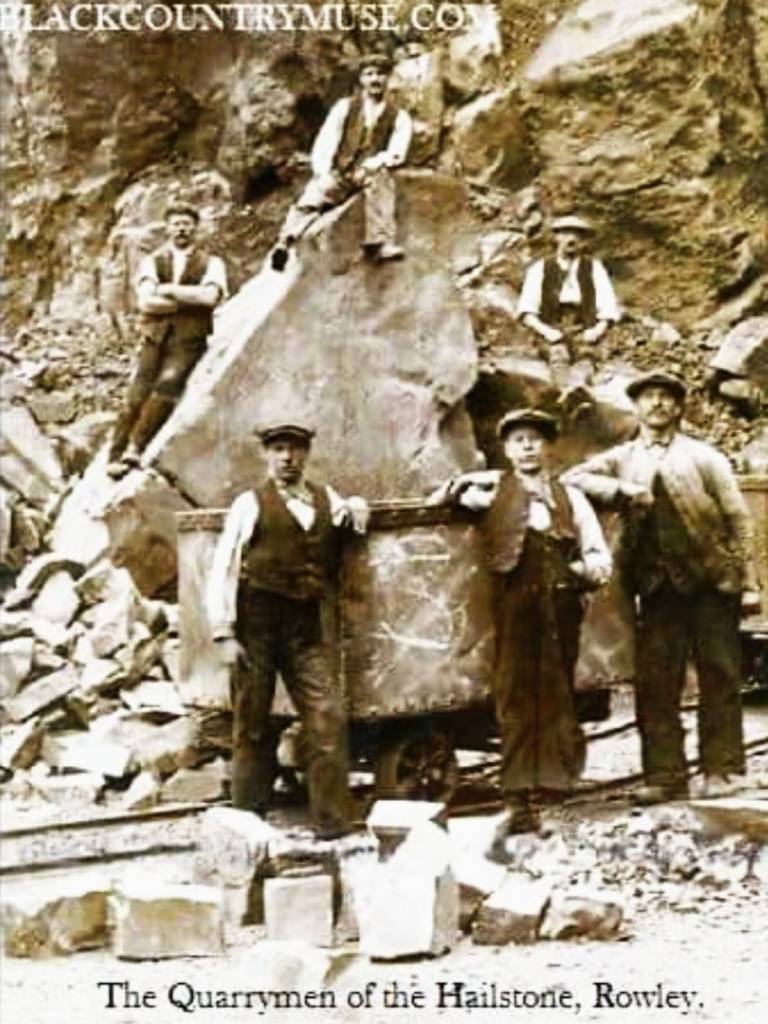
This photograph (brought to my attention by Ronald Terence Woodhouse) shows workers in the Hailstone Quarry and shows the size of some of the rocks they were working with. Imagine the effort needed to manually reduce that very hard rock down to small evenly shaped setts. Hard and dangerous work. It is also used on the front over of Anthony Page’s book on Rowley in Old Photographs and he notes that it was from the Ken Rock Collection: the photograph itself refers to BlackCountryMuse.com. Whichever owns the copyright, due acknowledgment is made!
Whether these movements of workers happened because the quarries sent recruiters to particular areas which had the skills they needed is not clear or whether word was spread by the men themselves that work was available or a combination of both. Some of these skilled workers settled in their new areas and many moved on again to another granite quarrying location where their skills would have been at a premium. If you have ancestors in Rowley who you know came from Leicestershire, or who subsequently moved to Shropshire, this may well account for it!

I will do another post about the Nuneaton/Bedworth connections to Rowley.  

And there was another migration wave, a little later on in the century , which I will write about in another piece – The Threlkeld Connection, to follow soon!

Other resources:
The Tippity Green Turnpike

The 1851 Census shows that there was a Turnpike Gate in Tippity Green. The Gate Keeper Hannah Hadley, aged 34, was listed, along with her husband Samuel (35) who was a Nailer’s Tool Maker and their nine children. If the Toll Keeper’s cottage was like most tollhouses that you see, it would have been fairly crowded, though that appeared to have been true of most houses in this area.

I was not previously aware that there was a turnpike road in this area. From the census enumerator’s route, it was at the end of Tippity Green and just before Perry’s Lake.

Copyright David & Charles.

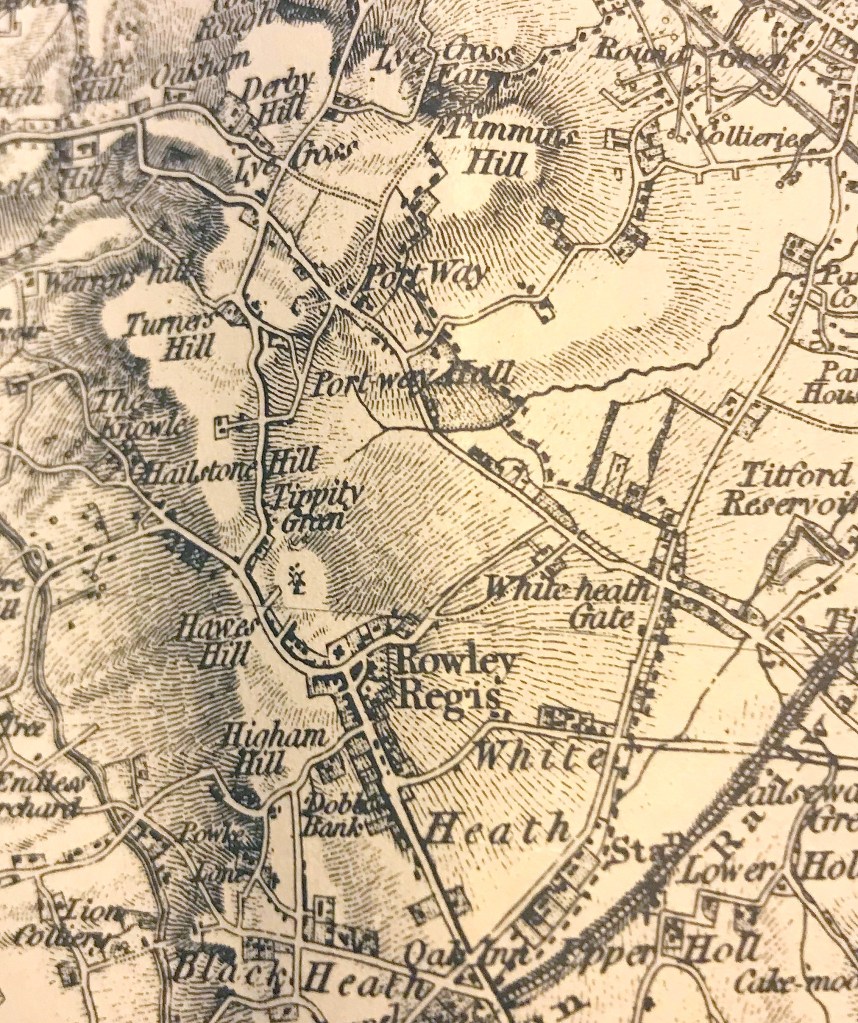
This map is an extract from the OS First Edition, which had been surveyed in the period up to the early 1830s. The road from Tippity Green goes up Turner’s Hill, there is no road straight on to Portway from Perry’s Lake as shown in later maps, so perhaps the very straight wide road from Perry’s Lake to Portway at what became Four Ways was a new Toll Road. In which case there would have been another Toll House, presumably where it joined Portway, with Newbury Lane on the other side of the road leading on to Oldbury. It would have been a very convenient and much flatter improvement to the route, much to the benefit of industrial traffic and at least better off people would have been willing to pay a toll to avoid the hill.

Turnpikes were apparently usually set up to improve existing roads which parishes were struggling to maintain. They were roads administered by Trusts authorised by private Acts of Parliament, on which tolls were charged at gates. They first began in 1663 and gradually increased in numbers so that by 1820 over 1000 turnpike trusts controlled about 22,000 miles of road with 7000 or more gates. Mostly they followed the old roads up hill and down dale. But by the early 1800s, new turnpike roads were being planned along routes whhich had not previously existed. This may have been such a road.

I am now trying to track down more information about this, in the form of the Act of Parliament setting up the Trust or plans and documentation and have sent enquiries to local archives. This may take some little time so this is a teaser and I will keep you informed of any more information I find. Watch this space!

In the meantime, if anyone knows of any information about this turnpike, I would be very pleased to hear from you.

I have been unable to find another Toll House Keeper listed anywhere in the Portway area in the 1851 Census but it is possible that a different enumerator might have recorded only the main occupation of the husband.

It does occur to me that perhaps the new road from Springfield to Dudley might also have been a turnpike road, and, if so, there would have been a gate keeper’s cottage there, too. But that is pure speculation!


Copyright Alan Godfrey Maps

The windmill off Tippity Green, which is documented as being there for centuries, was also still marked on the earlier map, where Windmill Farm was later.

Incidentally, you can also see from this map that the road to Whiteheath from Rowley village goes past the church and then bends round in front of Rowley Hall (I am old enough to remember where Rowley Hall was!) and straight on to Throne Road and past what became known as Ramrod Hall Farm. There was no Hanover Road then. When the quarrying and mining to the North of Rowley Hall expanded it cut off this road so another route must have been found by local people who would still have needed to access the parish church for services, baptisms, marriages and burials.

Copyright Anthony Page

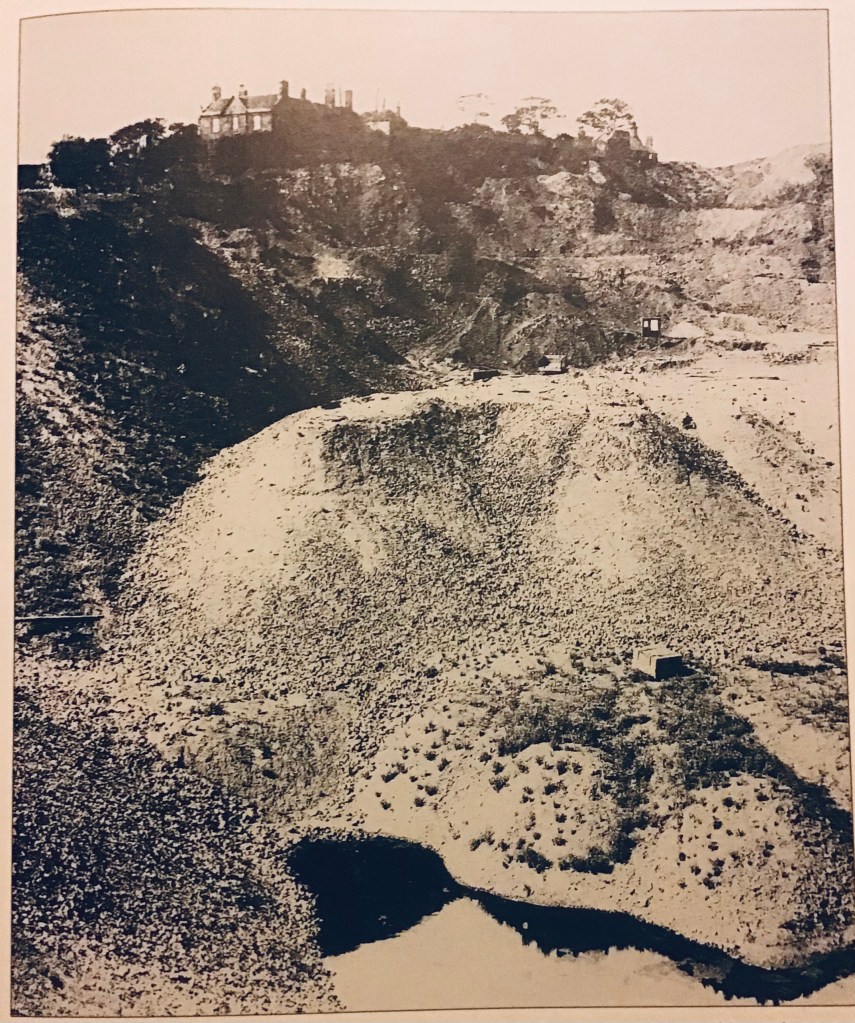
This photograph shows the ‘small quarry’ below Rowley Hall. No chance of walking the old route across this.

This closure must have been inconvenient for people living in the Whiteheath and Mincing Lane area but the quarrying and mining did offer work opportunities. In due course, another road was built from Mincing Lane/Bell End to the Hall to provide a road for vehicles, called, of course, the New Hall Road which is still there, now called Newhall Road.

I recall that, more than a century later when I was a child, people still cut from Bell End up the side of the ‘bonk’, over the now flattened old pit and quarry workings, past the old reservoir to come out at Rowley Hall, on their way to Rowley village and church (or school in Hawes Lane in my case) as the shortest route available. Old habits die hard!

Nails from Rowley Regis

My mother told me that each village and community in the Black Country had a speciality. Some made nails, some chains, locks, jews’ harps,  gun barrels. Certainly in the Cradley area, some gave their occupation in the parish registers as ‘oddworkers’ who apparently made latches and hinges. Such clever dexterous people! But within that, many villages had their own speciality in the type of nails they made.  Dudley made horse nails apparently, Rowley specialised in small nails, and I know that some of my ancestors, particularly the Roses, made rivets, a trade which was later moved into industrial premises, such as Gadd’s in Ross.

Why were nails needed?

Nails were used in many ways in years gone by, in building and timber work, in shoemaking (think hob-nailed boots!), in ship building, in horse shoeing, in wheel making,  in furniture making. Sometimes they were used partly as decoration and partly as strengthening or fortification, some medieval doors and chests still exist which are studded with nails, often domed or squared ones, which have survived several hundred years.  It is not a new industry, the Romans used iron nails which probably looked very similar to the ones our ancestors used. But while most blacksmiths could and did make nails when needed, especially if they were distant from the traditional nail making areas, the quantities produced in the Rowley and Black Country area were far in excess of local needs. So where did they go? They must have been sold elsewhere. More on that in a later article!

How long had nail-making been happening in Rowley?

Trades and professions do not generally appear in the parish registers until the 1600s although in 1554, one John Lowe was noted as a ‘Naylor’.  During the Commonwealth period, when Cromwell’s Laws required much more information on marriages to be kept, the records show a clear picture of nailmaking as the principal local industry. Between March 1656 and March 1657, for example, there were 25 weddings recorded in the Rowley Registers, of which 19 of the bridegrooms and 5 of the brides’ fathers were nailers. By 1841, it was still the main occupation listed in the Census that year. The numbers dropped, census by census after that, and after the mechanised production of nails began, the trade became uneconomic, causing a drop in the prices paid for hand wrought nails resulting in poverty and near starvation for nailer families and many were forced or tempted into other jobs, though many remained in metal working industries. Women and children probably carried on nail making while their menfolk worked in mines , quarries and factories and men may well have joined in when they came home from work. 

And some men continued as nailers well into the 20th century. My aunt, born in 1917, could remember visiting her Hingley grandparents in their Darby Street home in Blackheath where her grandfather Neri Hingley continued to make nails in his backyard nailshop, well into the 1920s, collecting bundles of rod, taking his nails to be weighed each week  and collecting coke for his forge in a trolley from the gas works in Powke Lane. Considering that my aunt said he was asthmatic, it must have been hard going. Cobblers apparently continued to prefer hand made nails for shoemaking which may have been what my great-grandfather was producing.

Hugh Bodey, in the Shire Book on nail making thinks that by the 15th century, there were specialist nailmakers in the West Midlands. In the 16th century, demand increased  as wooden floors were laid in houses which previously would have had earthen floors and as upper floors were inserted in previously open halls. The establishment and expansion of the navy in Tudor times and the growth of trade with demand for new trading ships also increased demand for nails. The production process was simplified and speeded up by the development of slitting mills from 1628 onwards which cut hammered and later rolled iron into rods which could be produced in various thicknesses and sizes, according to the size of nail to be produced. The abundant presence of coal and iron in the Midlands gave the area a great advantage, though of course it also led directly to the desecration of much of the landscape.  

The industry was mostly controlled by nailmasters, often the owners of the slitting mills, others were merchants of the finished nails. Later, in the nineteenth century, foggers took more part in the industry but these were notorious for giving out shortweight iron and weighing the returned nails on rigged scales. Little allowance was made for wastage and payment was often by the Tommy shops, in tokens which could be used only in shops owned by the fogger where awful quality food and short measure were common. Tommy shops were later abolished by Parliament. The nailers were little more than slaves and a report was made to parliament on the working and living conditions in 1843.

The report to Parliament describes the typical nailshop:

“The best forges are little brick shops of about 15 feet by 12 feet in which seven or eight individuals constantly work together, with no ventilation except the door and two slits, a loop-hole in the wall ; but the majority of these workplaces are very much smaller, filthily dirty, and, on looking in upon one of them when the fire is not lighted, presents the appearance of a dilapidated coalhole or little black den.

In the dirty den there are commonly at work a man and his wife and daughter…  Sometimes the wife carries on the forge with the aid of her children. The filthiness of the ground, the half-ragged, half-naked, unwashed persons at work, and the hot smoke, ashes, water and clouds of dust, are really dreadful.”

Parliament did nothing to improve conditions, the problem was more complex than anything covered by factory regulation before then.  These then were the conditions many of our ancestors worked in during the 19th century and for increasingly poor returns.

How many types of nails were there?

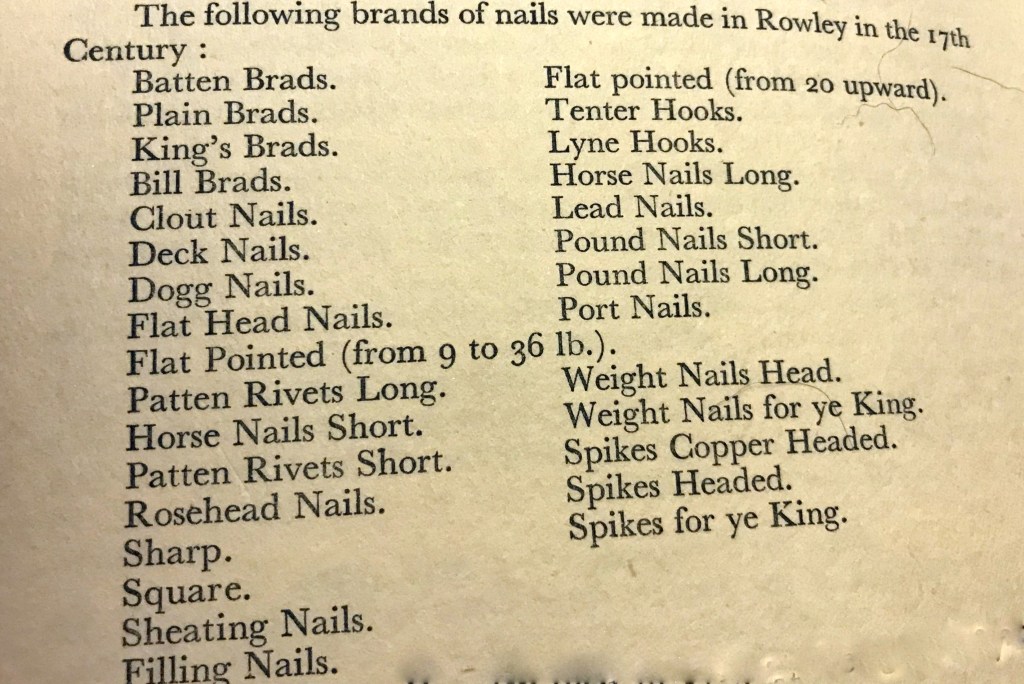
 J Wilson Jones shows the following types of nails which he says were listed by a London ironmonger as made in Rowley in the late 1600s, including nails he supplied to the Royal Navy, hence the reference to ‘for ye King’.  (I will do a separate post soon about this man as he has Rowley connections.). The sheer variety of nails being made is astonishing, although this man also had manufacturing premise in the North-East so some of them may have been made there.  

Taken from my original copy of J Wilson Jone’s book, details below.

Brief Lives

So, for all of us who have nail-making ancestors in Rowley, there is a glimpse of the conditions in which many worked.  It is small wonder that so many died young.  John Cobden wrote a book, published in 1854 titled “The White Slaves of England” in which he described the working conditions in such trades and in dressmaking , the Workhouse system and also in the cotton mills of Northern England which is listed below, written in somewhat dire language and not cheerful reading!

Britain may have abolished slavery in Great Britain and fought to abolish it elsewhere but much of the profits of the wealthy manufacturing classes in the Industrial Revolution came from the hard physical work and the deprived conditions in which tens of thousands of the poorest workers existed.                                                                                                                                                                                                                                             

Further reading:

Nailmaking by Hugh Bodey, Shire Books. ISBN: 978-0-85263-60-0

The History of the Black Country by J Wilson Jones, originally published in about 1950, recently republished by Royston Slim, Janus Books.

The White Slaves of England by John Cobden – Digital download – free.

https://archive.org/details/whiteslavesofeng00cobduoft

There is an interesting article on the West Midlands Nail Trade here: https://historywm.com/file/historywm/the-west-mids-nail-trade-article-guy-sjogren-final-80502.pdf

Some statistics about the people living in the hamlets in 1841

So.. What did they do for a living?

In 1841, the population of Tippity Green, Perry’s Lake, Gadds Green and Turner’s Hill numbered 384.

The occupations listed for them were:

Blacksmith                          1

Butcher                                  1

Coal Miners                        13

Farmers                               5

Female servants               8

Forge filer                           1

Independent means      1

Ironmonger                        1

Jobbing Smith                    1

Labourers                            9

Male Servants                   5

Nail factor                           1

Nail tinner                           1

Nailmakers                         38

Publicans                             1

Registrar of B&D               1

Shoemaker                         1

Stick dresser                      1

Warehouseman                1

Wash for hire                     1

A couple of entries have no occupation shown, this may be because those men were out of work or simply an omission.

Nailmaking was by far the dominant occupation, coal mining was not yet a major employer . Very few occupations were listed for women unless they were widows, despite the fact that most women and many children also made nails at this time. No scholars were listed though that may not mean that no children went to school, there was at least one school in Rowley Regis at this time, it simply may not have been recorded.

Note that the local Registrar of Births and Deaths John Woodhouse was living in Tippity Green, his son William would succeed him in that role in due course.  I have many copy certificates of births and deaths with their signatures.

There appear to have been few shopkeepers at this time, people had to be self-sufficient or buy necessities from further afield, although there may have been some informal grocery shops in front rooms! Many households would have kept chickens and pigs and may have acquired the occasional rabbit for the pot, and presumably grown vegetables if they had gardens.

Where were they from?

Only 46 of the 384 were born outside the County of Staffordshire.

Of these 46 only 10 were born in Scotland, Ireland or Foreign Parts. 5 men and 5 women.  No information is shown in this census about where others came from but more is shown in later censuses.

How old were they?

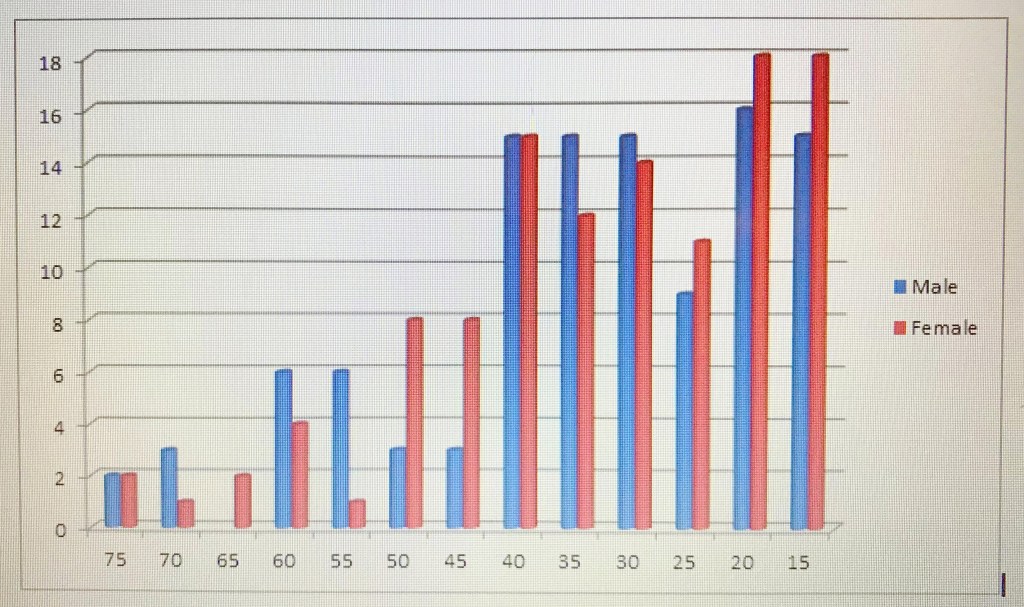
Ages in the 1841 Census were supposed to be rounded down to the nearest five years. So if you were 38, your age was shown as 35. A trap which can mislead family historians who are not aware of this and who are looking for an ancestor of a particular age. And at this time ordinary people were often neither literate nor numerate so ages in this Census should be treated with caution

In this chart the ages are shown along the bottom. As it shows, it appears that living beyond 50 was good going and beyond 60 was a rarity. Two of the four  aged 75 were men living in Tippity Green in the Parish Poorhouse, one of them blind, the first woman was living on Turner’s Hill, the ‘wash for hire’ listed in the occupations and the second woman was living alone in Perry’s Lake.  But with no pensions, most people worked for as long as they lived.

Ages of adults:

Adults’ Ages in the 1841 Census

Younger people

The Census required the ages of those under 15 to be shown by year, perhaps to enable the Government to track child mortality.

Children’s ages in the 1841 Census

Transcribing burial records for Rowley Regis has shown me that great numbers of babies died – of debility, decline, lung and bowel problems – before their first birthdays. These will often not appear at all in Census records if their short lives fell between censuses. And older children succumbed to whooping cough, smallpox, measles, scarlet fever, typhus fever (as did numerous adults) and consumption (Tuberculosis).  Poor nutrition, cramped living conditions and exposure to smoke and air pollution would not have helped.

My apologies for the poor quality of some of these images: I am new to this medium and on a steep learning curve, I hope this will improve as I become more accustomed to it.

So these are the basic statistics for the population of the lost hamlets taken from the 1841 Census. In future posts, I will explore more about the families behind the numbers.

Families in the Lost Hamlets 1841-1881

There are 13 families who were living in the hamlets of Perry’s Lake, Gadd’s Green and Turner’s Hill area for all five censuses which I have so far transcribed. All are familiar Rowley names:

Cole, Cutler, Darby, Foster, Hill, Hipkiss, Levett, Parkes, Redfern, Simpson, Taylor, Whitehall/Whittall and Woodhouse.

A further 9 families had moved in between 1841 and 1851 and were in all four of the 1851-1881 Censuses:

Barnsley, Detheridge, Edwards, Hadley, Harcourt, Ingram, Jones, Knight, Ocroft, Payne and Timmings/Timmins.

Four families were in the 1841-1871 Censuses but had moved on by 1881 – Badley, Downing, Round and Siviter.

When time permits, I will check where these families had moved to.

Certainly there will have been marriages between these families and they were most likely closely interrelated over those years.

This information will be updated as more censuses are transcribed.