An unexpected bonus map!

Old maps are always interesting to me. And they can be very informative about how a place has developed. I have shown extracts from the First Edition OS map previously on this blog and also from the Godfrey reproductions of the Second Edition. Alan Godfrey is well attuned to the value of being able to compare maps over periods and often publishes groups of maps in an area and then the next edition so that development can be clearly seen and usually has offers giving a discount for buying two maps of the same area together. His maps are very good value at £3.50 and the service is brilliant, maps usually posted out on the day of ordering. He is especially good at industrial areas.  

I also have a book of Antique Maps of the Black Country which has maps dating back to 1579 but most are not very detailed. Just a very interesting book to browse through.

There are other maps I would dearly like to see but have not yet been able to find. It would be very interesting to see any plans associated with the sale of the Glebe lands on which Blackheath was subsequently built. I have occasionally seen what I suspect may be extracts from it but have never located the whole plan.

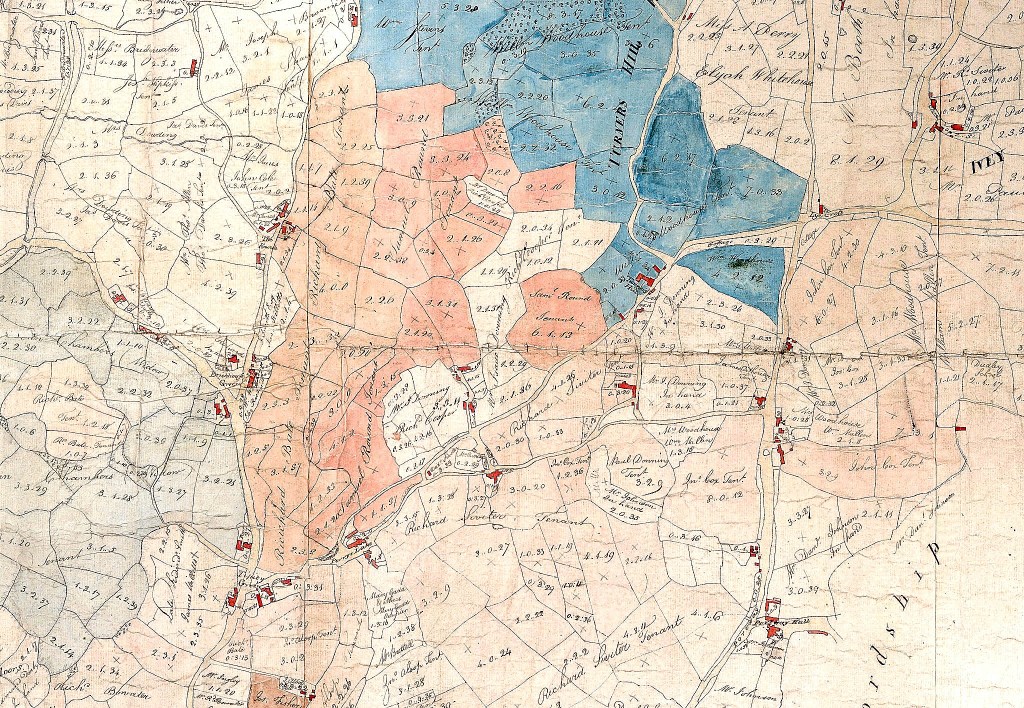
Much of the area surrounding Rowley was heath or waste land originally and, as in many areas of the country, in the late 1800s, the landowners who owned much of the land decided to seek an Enclosure Order to enclose most of it within hedges and walls, the hope generally being that this would encourage better farming outcomes. The Enclosure Bill went forward in 1799, resulting in an Act and Award in 1807-8. The effect was to parcel out about 300 acres of common pasture in 228 separate holdings and to commute some ancient manorial duties and rights. Although common people who relied on keeping their pigs, chickens and cattle on common land were probably less enthusiastic. 

Edward Chitham, my one-time Latin teacher and the originator of my interest in local history, wrote in detail in his book  ‘Rowley Regis A History’ , noting that the documents associated with this showed the names of local families. It is worth trying to read this scholarly book, with many illustrations – second hand copies appear to be rare but libraries may be able to obtain it on inter-library loan.

The two Lords of the Manor were William Viscount Dudley and Ward (Rowley Regis) and Granville Leveson Gower, Marquis of Stafford (Rowley Somery). The Vicar of Clent (of which Rowley Regis was at the time still a chapelry) was compensated for the loss of tithes by 11 acres of additional glebe land at Cradley Heath and 39 acres at Blackheath, the latter sold later to fund the building of a new church, leading to the development of the ‘new town’ of Blackheath.

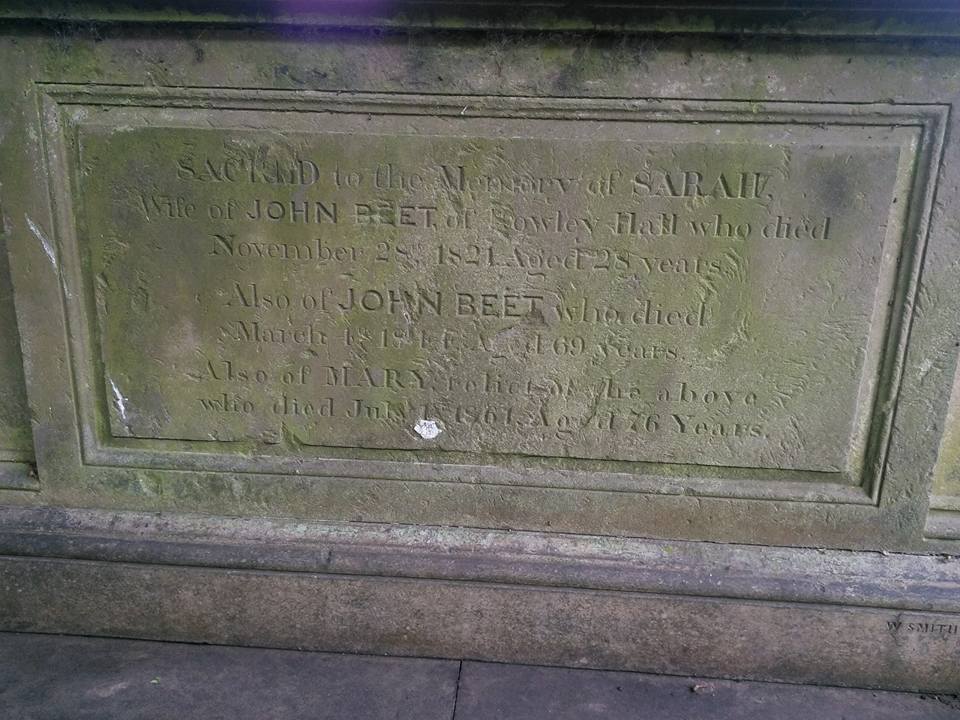
Existing landholders could also buy land adjoining their own property and John Beet, butcher, of Rowley Hall bought land at Whiteheath; Richard Bate, farmer bought land at Tippity Green; Isaac Downing, nailer, bought  land at Turner’s Hill; Richard Gaunt land at Portway Hall; Stephen Rollinson, butcher, and Thomas Sidaway both bought land at Reddal Hill. Chitham notes that, of all the purchasers of land and those allotted it, only one – James Purser, lived at a distance, in London. All the rest were resident in the locality, many actually in Rowley parish.

Some papers relating to the Enclosure Act are at The National Archives at Kew and on my next visit I will examine those. Other copies may be in County or other archives but some documents arise from deposits of family papers from solicitors and these tend to be more scattered.  Driving any distance is a problem for me at the moment, due to a knee problem so I have not been optimistic about being able to see such documents and plans any time soon.

So I was delighted when Kevin James posted a photograph of part of a map of Rowley Village, dating from 1804, on the ‘oldbury and blackcountry history’ Facebook page recently. And very obligingly, at my request, he then added a photograph of the area of the Lost Hamlets on the same map and also the Inscription and the key to the colours used on the map, also kindly giving me permission to include them in this study. 

Copyright Kevin James

So this is a copy of the map which was used in the Enclosure process and reproduced, it appears fifty years later by the same artist. What a treasure! So many familiar Rowley names, some of whom were still in possession when the censuses began forty years later.

Copyright Kevin James

Copyright Kevin James

Out of interest, this is the other map Kevin posted, of Rowley Village.

Copyright Kevin James

I hope you find this map as interesting as I do. I shall continue to try to see the Enclosure Act but this glimpse of the area is very pleasing.

Useful further reading:

Copyright: Glenys Sykes

‘The Black Country as seen through antique maps’ by Eric Richardson, published by the Black Country Society. ISBN: 0 904015 60 2

‘Rowley Regis – a History’ by Edward Chitham. Published by Phillimore in 2006. ISBN: 1-86077-418-0

‘The Oxford Companion to Family and Local History’ edited by David Hey. Published by Oxford University Press in 2010. ISBN number 9 780199 532971 – an immensely useful book, used copies available for less than £5!

The Tippity Green Turnpike

The 1851 Census shows that there was a Turnpike Gate in Tippity Green. The Gate Keeper Hannah Hadley, aged 34, was listed, along with her husband Samuel (35) who was a Nailer’s Tool Maker and their nine children. If the Toll Keeper’s cottage was like most tollhouses that you see, it would have been fairly crowded, though that appeared to have been true of most houses in this area.

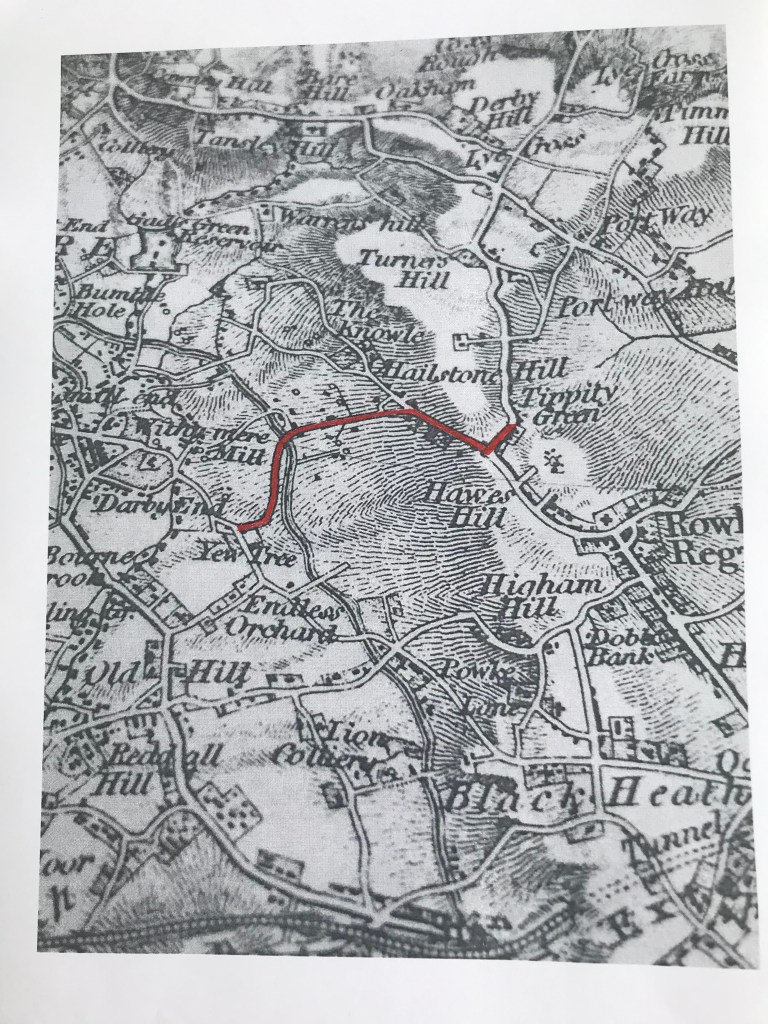
I was not previously aware that there was a turnpike road in this area. From the census enumerator’s route, it was at the end of Tippity Green and just before Perry’s Lake.

Copyright David & Charles.

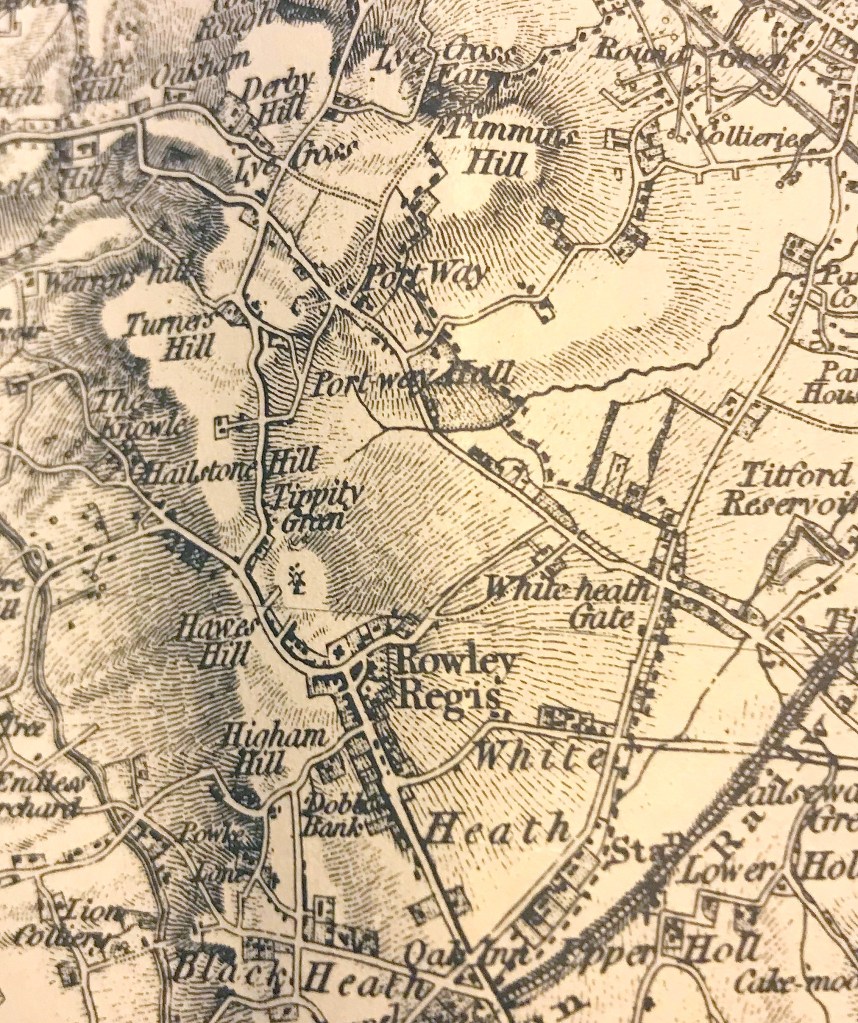
This map is an extract from the OS First Edition, which had been surveyed in the period up to the early 1830s. The road from Tippity Green goes up Turner’s Hill, there is no road straight on to Portway from Perry’s Lake as shown in later maps, so perhaps the very straight wide road from Perry’s Lake to Portway at what became Four Ways was a new Toll Road. In which case there would have been another Toll House, presumably where it joined Portway, with Newbury Lane on the other side of the road leading on to Oldbury. It would have been a very convenient and much flatter improvement to the route, much to the benefit of industrial traffic and at least better off people would have been willing to pay a toll to avoid the hill.

Turnpikes were apparently usually set up to improve existing roads which parishes were struggling to maintain. They were roads administered by Trusts authorised by private Acts of Parliament, on which tolls were charged at gates. They first began in 1663 and gradually increased in numbers so that by 1820 over 1000 turnpike trusts controlled about 22,000 miles of road with 7000 or more gates. Mostly they followed the old roads up hill and down dale. But by the early 1800s, new turnpike roads were being planned along routes whhich had not previously existed. This may have been such a road.

I am now trying to track down more information about this, in the form of the Act of Parliament setting up the Trust or plans and documentation and have sent enquiries to local archives. This may take some little time so this is a teaser and I will keep you informed of any more information I find. Watch this space!

In the meantime, if anyone knows of any information about this turnpike, I would be very pleased to hear from you.

I have been unable to find another Toll House Keeper listed anywhere in the Portway area in the 1851 Census but it is possible that a different enumerator might have recorded only the main occupation of the husband.

It does occur to me that perhaps the new road from Springfield to Dudley might also have been a turnpike road, and, if so, there would have been a gate keeper’s cottage there, too. But that is pure speculation!


Copyright Alan Godfrey Maps

The windmill off Tippity Green, which is documented as being there for centuries, was also still marked on the earlier map, where Windmill Farm was later.

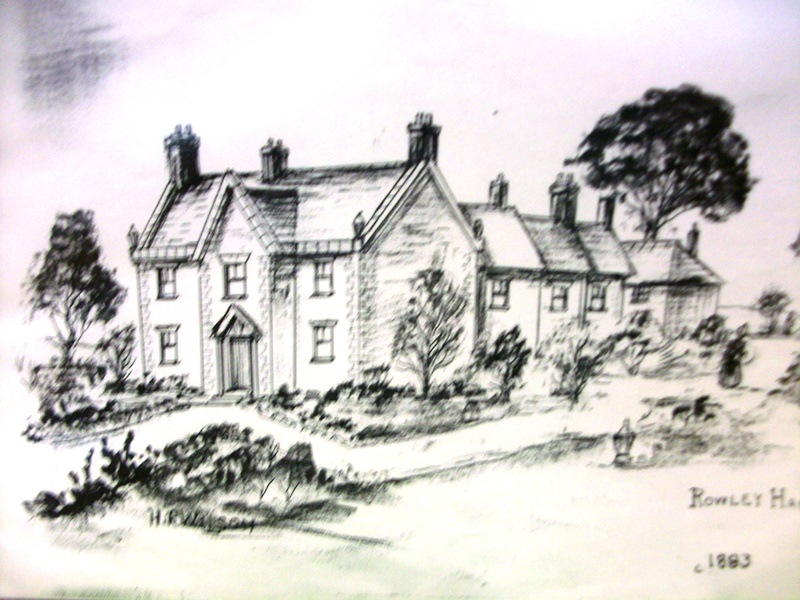
Incidentally, you can also see from this map that the road to Whiteheath from Rowley village goes past the church and then bends round in front of Rowley Hall (I am old enough to remember where Rowley Hall was!) and straight on to Throne Road and past what became known as Ramrod Hall Farm. There was no Hanover Road then. When the quarrying and mining to the North of Rowley Hall expanded it cut off this road so another route must have been found by local people who would still have needed to access the parish church for services, baptisms, marriages and burials.

Copyright Anthony Page

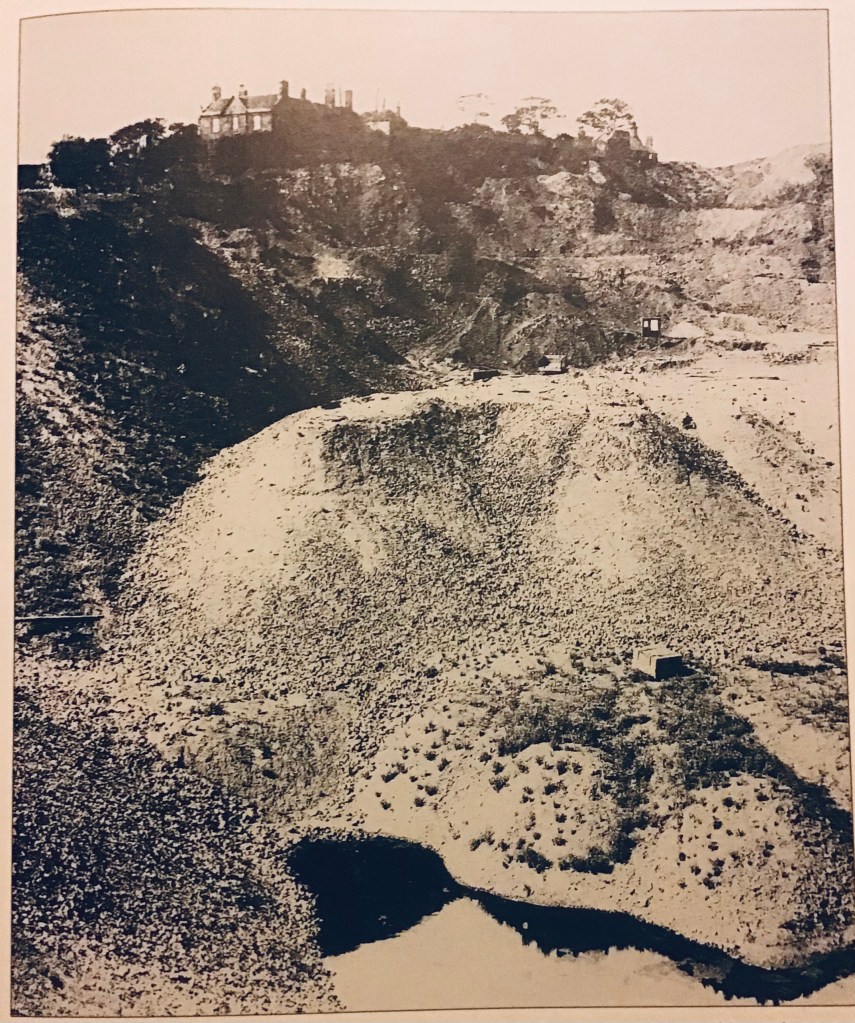
This photograph shows the ‘small quarry’ below Rowley Hall. No chance of walking the old route across this.

This closure must have been inconvenient for people living in the Whiteheath and Mincing Lane area but the quarrying and mining did offer work opportunities. In due course, another road was built from Mincing Lane/Bell End to the Hall to provide a road for vehicles, called, of course, the New Hall Road which is still there, now called Newhall Road.

I recall that, more than a century later when I was a child, people still cut from Bell End up the side of the ‘bonk’, over the now flattened old pit and quarry workings, past the old reservoir to come out at Rowley Hall, on their way to Rowley village and church (or school in Hawes Lane in my case) as the shortest route available. Old habits die hard!

The 1851 Census – some statistics

The population of Perry’s Lake, Gadd’s Green, Turner’s Hill and Tippity Green had expanded to from 384 to 412 since 1841. But there was more variation in jobs than in 1841 and more occupations were shown for women. Scholars were also noted, though not many and these are detailed in a later chart.

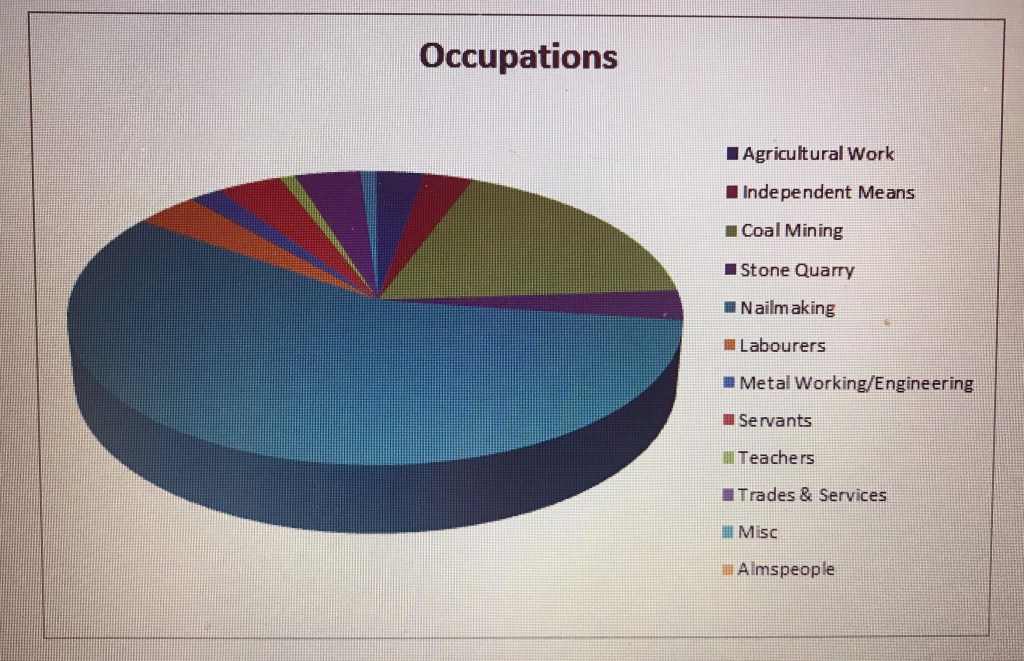
Occupations

Agricultural Labourer                      3

Almspeople                                        2

Annuitants                                          4             

Boat Loader                                        1

Butcher                                                1

Coal miners                                        36

Colliery Clerk                                      1

Dressmaker                                        3

Engine worker                                   1

Engineer                                              1

Errand boy                                          1

Farmer                                                 1

Farm Labourer                                  2

Female Servant                               4

Furnace Labourer                            1

General  Servant                              5

Labourer                                              8

Laundress                                           1

Man servant                                      1

Mine agent & Surveyor                 1

Nailer                                                    117         57 W, 60M

Nail Master                                         1

Nail Reckoner                                    1

Nailer’s Tool Maker                         1

National School Teacher               2

Needlewoman                                  1

Nurse                                                    1

Proprietor of Lands                         2

Puddler                                                 1

Retired nailer                                     1

Stone Cutter                                      4

Stone labourer                                  2

Stone miner                                       1

Turnpike Gate Keeper                   1

Victualler and butcher                   1

White ash maker                              1

So the number of different occupations has changed since 1841, some with only I or two people.

Nail making is still the dominant occupation, with miners the only other numerous group. The numbers of men and women are about equal. In most of this group the enumerator describes people making nails as ‘Nail forgers’, a recognition that they were skilled workers producing wrought iron nails in their forges, though another enumerator still calls them simply  ‘nailers’. It is possible that some women and children made nails and simply did not declare it, also that some men made nails when other work was not available (such as agricultural workers in winter) or when they got home from work, so the number of nailmakers may be understated.

Other metal working trades such as a furnace labourer and a puddler are noted so skills were diversifying as new industries expanded or moved into the area.

Stone quarrying is not as big an employer as I had expected although it is possible that some of the labourers worked at the quarry and had not specified that, in addition to those who were listed with a specific stone working skill.

Professionals such as an engineer, a Mine Agent and two teachers (brother and sister) have appeared.    The former Census showed John Whitehouse as the Registrar of Births and Deaths but in this Census his wife is shown as a widow so presumably this role passed to someone else. 

The ‘nurse’ was a child of 8.

The Bull’s Head in Tippity Green was a public house, dating from 1834, though owned by the Dudley family and Benjamin Bowater is listed as ‘Vittler and Butcher’  in Tippity Green in this census, presumably at the Bull’s Head –and the name may have come from Benjamin’s alternative occupation!  Publicans were ‘Licensed Victuallers’ so this fits. Hitchmough’s invaluable guide to Black Country pubs lists Joseph Bowater as Licensee from 1834-1854. There is no Joseph Bowater listed in the hamlets in this census though there is a Joseph Bowater who  was landlord of a pub in Cradley Heath so perhaps it was a family occupation. Benjamin Bowater also had another butcher and three servants living in his household so could divide his time between butchery and inn-keeping. According to Hitchmough, The Portway Tavern was licensed premises from about 1850, according to Hitchmough with James Adshead Levett  Snr and Jnr  and then William Levett holding that licence for the next  half century. There is no mention of a tavern in the census or of a licensee. It is possible that the Tavern was already operating informally as a pub at the time of this census, the Levetts who ran it later were based at Brickfield Farm in 1851 though away from home on the census night.

For the chart I have combined the jobs associated with nailing and other occupations into groups.

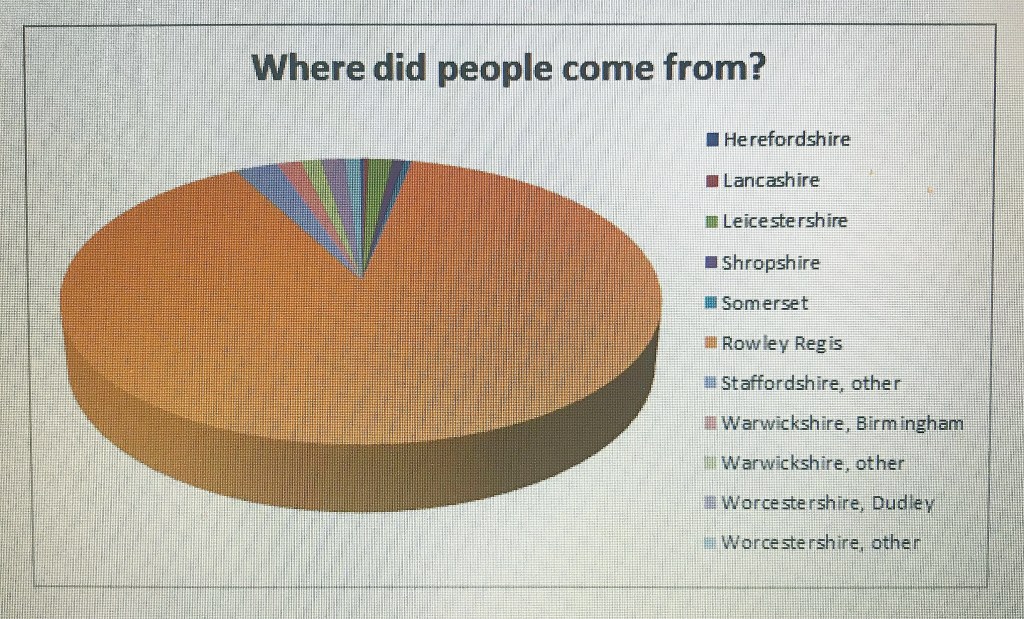
Where did people come from?

Binton, Warwickshire                                     2

Gloucestershire, St Briavels                         1

Herefordshire                                                   1

Lancashire                                                           1

Leicestershire, Mountsorrel                        6

Shropshire, Old Park                                       1

Shropshire, Broseley                                      1

Shropshire, Stottesdon                                 1

Somerset, Wellington                                    2

Staffordshire, Rowley Regis                        364

Staffordshire, Sedgley                                   1

Staffordshire, Tipton                                      4

Staffordshire, Wednesbury                         1

Staffordshire, Wednesfield                         1

Staffordshire, West Bromwich                   1

Staffordshire, Tettenhall                              1             

Staffordshire,  Tipton                                     2

Warwickshire, Birmingham                          6

Warwickshire, Coventry                                  1

Warwickshire, Nuneaton                              1

Warwickshire,   Sambourn                           1

Worcestershire, Dudley                                 6

Worcestershire, Halesowen                        2

Worcestershire, Oldbury                              1

Worcestershire,               Wychbold            1

Again, the great majority are from Rowley itself, with a sprinkling from the surrounding area. Looking at other places, such as Mountsorrel in Leicestershire, I was interested when I looked this up to find that it was renowned for  its granite quarry, just like Rowley Regis, so presumably the skills required were transferable. St Briavels in Gloucestershire was in the heart of the Forest of Dean Free Mining area so again there was a common industry.

How old were they?

Men                      Women               

Age

80+                         1                              –

75-79                                                     1

70-74                     1                              5

65-69                     1                              1

60-64                     3                              3

55-59                     2                              3

50-54                     9                              10

45-49                     9                              7

40-44                     8                              9

35-39                     12                           6

30-34                     11                           12

25-29                     19                           20

20-24                     27                           18

15-19                     26                           18

As in the 1841 Census, not many lived much past sixty.

Younger people under the age of 15

14                           3                              5

13                           2                              3

12                           4                              5

11                           2                              4

10                           5                              7

9                              7                              6

8                              5                              4

7                              9                              5

6                              1                              5

5                              9                              3

4                              3                              7

3                              8                              9

2                              4                              5

1                              7                              7

-1                            5                              7

74 boys,  82 girls.

Scholars by age

Boys                      Girls

13           –                              1

12           1                              1

11           –                              1

10           3                              1

9              4                              1

8              2                              1

7              5                              2

6              1                              –

5              2                              1

4              –                              3

18 boys out of 74 and 11 girls out of 82 were at school. We do not know how many children were at school in 1841 but this shows that schooling was still far from the norm. Literacy was very much the exception, especially for girls, it seems and from the age of about eight, children were making nails and some were employed outside the home in quarries and mines.

I hope these statistics will be of interest. There will be more for the later censuses, as I transcribe and analyse them. Apologies for the poor quality images – technologically challenged author here, though creating charts is new for me so I am learning!

Hopefully, as more censuses are done we shall be able to see the occupations change over time and I hope to do more detailed work on the families there.

I’m a fan of the FAN method of research!

I am a ‘FAN’ fan!

Genealogy or family history research is a very broad interest. It encompasses those who just want to track a direct line, father’s line only and who are not interested in siblings or female lines; those who insist on three separate pieces of written proof before anyone is added to their tree (which can be difficult once you go back a couple of centuries when a single parish register entry may be the only  piece of evidence you can find);  those who are desperate to find that they are related to someone famous. “I am a sixth cousin, 32 times removed from this famous actor/president/Mayflower passenger!” seems to crop  up fairly regularly on some family history online groups. Or related to Royalty… I resist the temptation to say ‘So what? ‘. Although there is a theory that all white Europeans are related to royalty through William the Conqueror, Charlemagne or  Edward III, prolific breeders all, on both sides of the blanket. Edward III has been referred to as ‘the Clapham Junction of English Genealogy’ as ‘all lines go through him’. That probably had more meaning when we had a better railway network…

And then there are those, like me, who research all direct ancestors, their siblings and in-laws and then their sideways connections. So I sometimes find myself diligently searching online for someone’s marriage or death, glance up at their page on my Ancestry tree to check what their relationship is to me to find that I am spending this time on someone who is a “paternal grandfather of wife of 1st cousin 5x removed”. Ah, maybe not spend too much more time on this then. Now, what was I doing before I went down this rabbit hole?   But hey, it’s interesting… and it’s surprising how often familiar names and addresses crop up and you do get a picture of how families interrelated.

There is a research technique in family history called the FAN method – Friends, Associates, Neighbours. By looking at the people around your ancestors, at home, at work, at church or chapel, you build a fuller picture of their lives, are more likely to have an impression of what they were like, you may find neighbours who subsequently marry into your family. Always look a page or two either side of your ancestor on censuses and maybe more in a parish register, you may find other relatives there. And noting the names of the witnesses of a marriage may act as a confirmation that you  have the right one, if a parent or sibling signed.

My husband started researching his family history while he was waiting for me to finish some research in Gloucester Local Studies Library many years ago. He decided to look for his grandmother in the census, as he knew where she had lived in the West End of Gloucester. This was in the days before the internet so you sat in a library or archive or record office, winding through a microfilm page by page, not much indexing. I was using a neighbouring film reader to look at press reports and heard a little “Ha! Got you!” when he found her. ‘That’s you hooked’, I thought. I was right…

He carefully noted down the details and we left to continue our day. It was only some weeks later as he explored more marriage and birth details that he realised that his granny’s maternal grandparents had been living next door – another trip to the library!  So the FAN method can be very useful.

In looking at the families who lived in the Lost Hamlets, I suppose I am doing the ultimate FAN exercise. Preparing detailed family trees however, even for what I think of as the ‘core families’ who lived there over a number of decades, would mean creating at least 14 family trees, possibly more than 20, which is daunting, even for me.

There are things that will help. There is a wonderful online site called  Black Country Connections which was started on the basis that it was very likely that many Rowley and Blackheath folk were related to each other and this is undoubtedly correct. So I can go to that tree and see whether any of the core families are listed (yes, mostly they are!) and have a head start on how they connect, possibly when and where they married and who their children were, all useful stuff.

And I have realised that in the 1841 Census, the Cole family had six households in these hamlets and most of these were already on my personal tree, three brothers and their father, so I have a head start there and have decided for now to start with them and work outwards, as it were, since they often intermarried with members of the other ‘core families’. In the last couple of weeks I’ve spent some time revisiting my original research done many years ago and expanding it in earlier generations, doing more work on siblings to my direct ancestors where I had not previously traced their descendants, too. Very enjoyable, if something of a rat’s nest! And uncovered some fascinating stories about them, so I will be posting some of their stories in due course. Apologies to those who have been waiting for another post, I have been  busy gathering new information.

Copyright Glenys Sykes

This photograph shows my original paper Family Tree, started in about 1980. It’s fair to say that it has expanded a bit since then. My current tree, stored digitally, has over 5000 people on it. Nonetheless, my original research in Smethwick Library and other archives all those years ago has proved very accurate, fortunately, as more and more records became available digitally to check against!

Interesting stories about your Lost Hamlets ancestors would be warmly welcomed!

Nails from Rowley Regis

My mother told me that each village and community in the Black Country had a speciality. Some made nails, some chains, locks, jews’ harps,  gun barrels. Certainly in the Cradley area, some gave their occupation in the parish registers as ‘oddworkers’ who apparently made latches and hinges. Such clever dexterous people! But within that, many villages had their own speciality in the type of nails they made.  Dudley made horse nails apparently, Rowley specialised in small nails, and I know that some of my ancestors, particularly the Roses, made rivets, a trade which was later moved into industrial premises, such as Gadd’s in Ross.

Why were nails needed?

Nails were used in many ways in years gone by, in building and timber work, in shoemaking (think hob-nailed boots!), in ship building, in horse shoeing, in wheel making,  in furniture making. Sometimes they were used partly as decoration and partly as strengthening or fortification, some medieval doors and chests still exist which are studded with nails, often domed or squared ones, which have survived several hundred years.  It is not a new industry, the Romans used iron nails which probably looked very similar to the ones our ancestors used. But while most blacksmiths could and did make nails when needed, especially if they were distant from the traditional nail making areas, the quantities produced in the Rowley and Black Country area were far in excess of local needs. So where did they go? They must have been sold elsewhere. More on that in a later article!

How long had nail-making been happening in Rowley?

Trades and professions do not generally appear in the parish registers until the 1600s although in 1554, one John Lowe was noted as a ‘Naylor’.  During the Commonwealth period, when Cromwell’s Laws required much more information on marriages to be kept, the records show a clear picture of nailmaking as the principal local industry. Between March 1656 and March 1657, for example, there were 25 weddings recorded in the Rowley Registers, of which 19 of the bridegrooms and 5 of the brides’ fathers were nailers. By 1841, it was still the main occupation listed in the Census that year. The numbers dropped, census by census after that, and after the mechanised production of nails began, the trade became uneconomic, causing a drop in the prices paid for hand wrought nails resulting in poverty and near starvation for nailer families and many were forced or tempted into other jobs, though many remained in metal working industries. Women and children probably carried on nail making while their menfolk worked in mines , quarries and factories and men may well have joined in when they came home from work. 

And some men continued as nailers well into the 20th century. My aunt, born in 1917, could remember visiting her Hingley grandparents in their Darby Street home in Blackheath where her grandfather Neri Hingley continued to make nails in his backyard nailshop, well into the 1920s, collecting bundles of rod, taking his nails to be weighed each week  and collecting coke for his forge in a trolley from the gas works in Powke Lane. Considering that my aunt said he was asthmatic, it must have been hard going. Cobblers apparently continued to prefer hand made nails for shoemaking which may have been what my great-grandfather was producing.

Hugh Bodey, in the Shire Book on nail making thinks that by the 15th century, there were specialist nailmakers in the West Midlands. In the 16th century, demand increased  as wooden floors were laid in houses which previously would have had earthen floors and as upper floors were inserted in previously open halls. The establishment and expansion of the navy in Tudor times and the growth of trade with demand for new trading ships also increased demand for nails. The production process was simplified and speeded up by the development of slitting mills from 1628 onwards which cut hammered and later rolled iron into rods which could be produced in various thicknesses and sizes, according to the size of nail to be produced. The abundant presence of coal and iron in the Midlands gave the area a great advantage, though of course it also led directly to the desecration of much of the landscape.  

The industry was mostly controlled by nailmasters, often the owners of the slitting mills, others were merchants of the finished nails. Later, in the nineteenth century, foggers took more part in the industry but these were notorious for giving out shortweight iron and weighing the returned nails on rigged scales. Little allowance was made for wastage and payment was often by the Tommy shops, in tokens which could be used only in shops owned by the fogger where awful quality food and short measure were common. Tommy shops were later abolished by Parliament. The nailers were little more than slaves and a report was made to parliament on the working and living conditions in 1843.

The report to Parliament describes the typical nailshop:

“The best forges are little brick shops of about 15 feet by 12 feet in which seven or eight individuals constantly work together, with no ventilation except the door and two slits, a loop-hole in the wall ; but the majority of these workplaces are very much smaller, filthily dirty, and, on looking in upon one of them when the fire is not lighted, presents the appearance of a dilapidated coalhole or little black den.

In the dirty den there are commonly at work a man and his wife and daughter…  Sometimes the wife carries on the forge with the aid of her children. The filthiness of the ground, the half-ragged, half-naked, unwashed persons at work, and the hot smoke, ashes, water and clouds of dust, are really dreadful.”

Parliament did nothing to improve conditions, the problem was more complex than anything covered by factory regulation before then.  These then were the conditions many of our ancestors worked in during the 19th century and for increasingly poor returns.

How many types of nails were there?

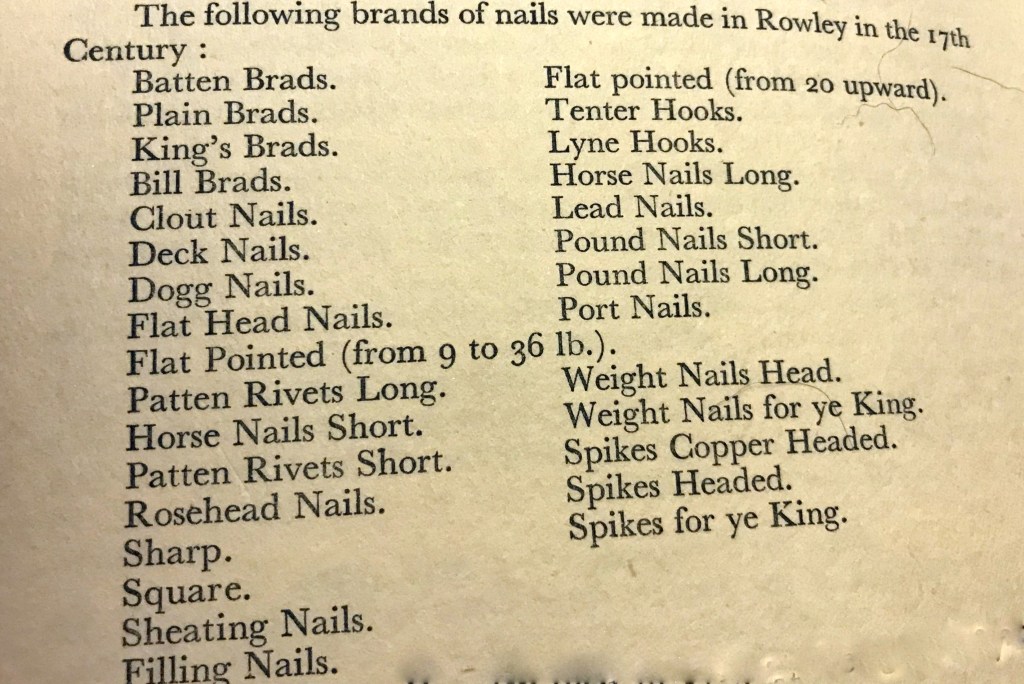
 J Wilson Jones shows the following types of nails which he says were listed by a London ironmonger as made in Rowley in the late 1600s, including nails he supplied to the Royal Navy, hence the reference to ‘for ye King’.  (I will do a separate post soon about this man as he has Rowley connections.). The sheer variety of nails being made is astonishing, although this man also had manufacturing premise in the North-East so some of them may have been made there.  

Taken from my original copy of J Wilson Jone’s book, details below.

Brief Lives

So, for all of us who have nail-making ancestors in Rowley, there is a glimpse of the conditions in which many worked.  It is small wonder that so many died young.  John Cobden wrote a book, published in 1854 titled “The White Slaves of England” in which he described the working conditions in such trades and in dressmaking , the Workhouse system and also in the cotton mills of Northern England which is listed below, written in somewhat dire language and not cheerful reading!

Britain may have abolished slavery in Great Britain and fought to abolish it elsewhere but much of the profits of the wealthy manufacturing classes in the Industrial Revolution came from the hard physical work and the deprived conditions in which tens of thousands of the poorest workers existed.                                                                                                                                                                                                                                             

Further reading:

Nailmaking by Hugh Bodey, Shire Books. ISBN: 978-0-85263-60-0

The History of the Black Country by J Wilson Jones, originally published in about 1950, recently republished by Royston Slim, Janus Books.

The White Slaves of England by John Cobden – Digital download – free.

https://archive.org/details/whiteslavesofeng00cobduoft

There is an interesting article on the West Midlands Nail Trade here: https://historywm.com/file/historywm/the-west-mids-nail-trade-article-guy-sjogren-final-80502.pdf

Poisoned by his wife…

This is not strictly within the Lost Hamlets but concerns a member of the Cole family who was born there – and it’s a fascinating story so I am sharing it with you anyway!

Even after 40 years of research, I still find new facts on my family. Recently I was working on siblings of my 4XG-Grandfather Edward Cole and tracking their descendants, a task infinitely easier than it was when I first worked on Edward himself 40 years ago. With the advent of digitised records and family history programs and online resources, plus, of course, the many subscription services research has utterly transformed. 

Searching through the Cole entries in the St Giles Registers, I came across the Burial Record on 14 March 1832 for my 1st cousin 5xremoved David Cole. The entry says that he was 43 when he died in Mar 1832 and that he was a farmer living in Slack Hillock , off Gorsty Hill. I was picking out Cole burials, spotted the note on his made by the Vicar and was off down a fascinating rabbit hole, irresistible!

A note in the Register , added by the Vicar, says “Poisoned by drinking a composition which his wife retailed as a specific for the gout”. How about that for a damning story in a few words? I had to know more. I did some sleuthing and found a newspaper report in the Wolverhampton Chronicle dated 14 March 1832.

David Cole had woken at about five o’clock in the morning, with a pain in his bowels and had gone to get a nip of rum to settle his stomach. The ‘specific’ made by his wife, was called ‘seeds of Colchicum’ and was stored in the same cupboard as the rum in a similar bottle. The bottle containing the mixture was labelled “Wine of the Seeds of Colchicum” but it was not sufficiently light for him to read it. When he returned to bed he told his wife he had taken some of the gout mixture and she was concerned and wanted to get a physician to purge him but he strongly objected to this, saying that he did not think the mixture would hurt him. He went off to work as usual but returned four hours later at 11.00am, feeling ill and very sick and took to his bed. He died two days later. The surgeon who had attended him later on the afternoon he was taken ill could do nothing and told the inquest that he had taken ‘enough of the mixture to kill half a dozen people’. The jury returned a verdict that he “died from accidentally taking seeds of colchicum, mixed  into liquid, under the apprehension that  it was rum.”

Copyright Wolverhampton Chronicle.

 He left his wife Charlotte with thirteen children, the youngest David baptised in June 1832, after his father’s death so it seems very likely that Charlotte was heavily pregnant when her husband died.  However, the oldest were old enough to be already working, one as a butcher and others on the farm and she stayed there, listing herself as a farmer for many years after that. I wonder whether she carried on selling her remedies?

But doesn’t this little story actually tell us quite a lot about them? Yes, she was a farmer’s wife but also a herbalist of some knowledge and known as such to local people. I wonder who taught her? Perhaps a family skill? When I looked into it, seeds of Colchicum is still listed by present day herbalists as a treatment for gout but with warnings that it is toxic in large quantities and may cause death. And, to my geat surprise, when I recounted this tale to a genealogist friend who has recently had extensive heart surgery, she responded immediately that “Colchicum is still recommended by the NHS! When I saw my consultant a couple of weeks ago, he recommended colchicine for gout”. So an extract of Colchicum is still used by the NHS today. Charlotte Cole actually knew her stuff, it seems.

Copyright: Glenys Sykes

And there were few remedies for painful gout in those days, if I remember correctly. Presumably she was known to local people for her remedies, hence the Vicar’s somewhat judgmental comment that she sold the remedy. But they didn’t have pharmacies as we know them then, no picking up a remedy at the chemist or pharmacy as we might and probably most people couldn’t afford to consult doctors.

How devastating for Charlotte to have witnessed this tragedy, her husband killed by her own remedy and to have suffered the reproaches of someone like the Vicar and possibly others for something that was not her fault.

A Methodist chapel in Perry’s Lake?!

Once upon a time there was a Methodist Chapel in or between the hamlets of Gadds Green or Perry’s Lake. Who knew? There is no trace of it on any of the maps I can find but it is listed on the censuses, between Perry’s Lake and Gadds Green , in 1861 and 1871.

I first noticed when transcribing the 1871 Census for Perry’s Lake and Gadds Green that between the two hamlets there is a line which says “Primitive Methodist Chapel”. It is not mentioned in the 1881 Census but in the 1861 Census it is there, again listed between Perry’s Lake and Gadds Green both times but this time called Gadds Green Chapel. Not mentioned in the 1851 Census (although Thomas Barnsley, aged 29, living in Perry’s Lake and born in Rowley Regis, gave his occupation as “Methodist Local Preacher and labourer at Stone Quarry”.

However, in an 1844 Preaching Plan for the Dudley Circuit which is on the ‘My Primitive Methodist’ website, Perry’s Lake is among the Chapels listed as having two services each Sunday at 2.30 and 6pm.  Also listed is Rowley  – one service each Sunday at 6pm, though it is not clear where this chapel was, possibly services held in a private house or a rented room or even the open air, as neither Knowle nor Hawes Lane chapels are recorded as having been in operation by this date.

The Preaching Plan is an interesting document, showing the burgeoning vitality of the Methodist church in those days with a list of more than 36 chapels in and around Dudley with a few paid ministers who walked long distances to conduct services and in excess of 80 local preachers in the area, including several women.  And that was only the Primitive Methodists, there were several other types of Methodists, plus Baptists, Congregationalists, Quakers, Unitarians and others all apparently thriving.

The chapel was also noted as ‘Gads Green’ on a list of Chapels, drawn up in 1867, which is again on the My Primitive Methodist website. So it definitely existed between 1844 and 1871. It would be interesting to see the 1887 OS 6″ to the mile map , just to see whether it was still there then but I can’t find this map online or in print anywhere at the moment.

The earliest 6″ OS map I have at present is dated 1904 and I can’t see a chapel marked on there in Perrys Lake or Gadds Green. There is a Chapel Cottage in Gadds Green as late as the 1911 Census but a chapel isn’t mentioned then. So I wonder whether the local Methodists transferred to other chapels, the nearest being Hawes Lane or The Knowle, both less than a mile away and surely less than a mile apart! 

I found online this bit of history about the Knowle Chapel (Eric Bowater giving the information in 2019).

“The first beginning of Knowle Methodist Church met in the small kitchen of a local house,for the sum of 1s 6d.around 1860. As the membership grew it moved into a farm building in Brickhouse Farm a short distance away. Once again the membership grew and so it was decided to build a church of their own. A Church was now to be erected on the present site and was opened in December 1869 called Ebenezer. In 1890 new trouble arose with undermining which affected the chapel. The last meeting held in the chapel was held in 1907.The present church which was built in front of the old one 25th September 1907 and was a United Methodist Church.”

The Knowle site would have been quite close to the hamlets and accessible across the fields so if the earlier chapel closed people might have moved to the Knowle chapel. Reg Parsons, who grew up on Turner’s Hill, told me that he had never heard of a chapel there but that there was also a ‘tin chapel’ at Oakham, opposite the pub there so that may also have provided a spiritual home for some local people when the Perry’s Lake chapel closed.

There was an Ecclesiastical Census on 31st March 1851 (this can be downloaded free of charge from The National Archives) but many small chapels appear to have been omitted and I have been unable to find a chapel I can identify as Perry’s Lake or Gadd’s Green. The entry for St Giles shows figures for attendance which, frankly, I find rather suspect.  An extract is shown here.

Copyright: The National Archives

I find it difficult to imagine 600 people at morning service with 400 children at Sunday School, 1100 people all crammed into St Giles Church for the afternoon service with 400 children at Sunday school (again) and another 100 in the evening in a rented room – such neat round figures, 1000 and 1500 people?! The return for Dudley St Thomas gives figures of 800 and 700 attending services but that for Reddal Hill claims much more modest figures of 149 at church with  223 at Sunday school in the morning with 259 and 223 respectively at later services.

As we have just entered the season of Lent, it is perhaps timely to note that several clergy, in their returns for this census (and clearly anxious that their attendances should not be underestimated by the powers that be for the future), pointed out that the date chosen for the Census was the middle Sunday of Lent.  The note shown below was attached by one local Clergyman. It reads “The reason that attendance at the church appears smaller on the 30th Mar than the average is that the day is Mid-Lent Sunday, commonly called Mothering Sunday. A day much observed in this district by parents having their children and friends around their tables on this day and providing the best in their power for them.”

Copyright: The National Archives

What a picture that conjures in a few words. And a clergyman apparently much in tune with his congregation, however humble.  I can remember my mother telling me as a child that Mothering Sunday was the one day of the year that domestic servants were allowed to go home to visit their mothers, often taking them gifts of food from their employers or spring flowers gathered along the way.

One nearby Anglican clergyman noted bitterly on his return, the ‘scourge of those Dissenters so prevalent in this locality’ and blamed them for his poor attendance figures – showing the hostility of some clergy to their independently minded parishioners. Nonconformists were not popular at that time with the Anglican church, generally seen as rebels and ignorant troublemakers to be corrected and brought back to the Anglican church. A history of Birmingham Road Methodist church in Blackheath recounts that their meeting started in the 1840s in a rented stable in Siviters Lane in Rowley. Dissenters, as they were known, were regarded as the ‘off-scouring of life’, the very scum of the earth’ and, on one occasion when they were unable to pay the rent for the room above the stable, they were not allowed to use the room so sang and prayed in the street outside. A note in the Register for the burial of my 5xgreat-uncle at St Giles in 1794 reads “William Rose, never came to church tho’ often warned and kindly exhorted, died suddenly”. I wonder how kind those exhortations were?  To me, it seems very likely that William Rose was a Dissenter, a Methodist and that was why the Vicar was trying to lure him back.

So the hamlets of Perrys Lake and Gadds Green were fortunate to have a chapel of their own to worship in. Worship in their chosen style was an important part of life for our ancestors then and even small hamlets like Perry’s Lake had chapels – I wonder where it was? Any information would be very welcome.

Might it, just might it, have been behind the cottages in the part of Perry’s Lake which people still remember being called ‘Heaven’?

Rowley Regis was not always a ‘blasted landscape’.  

This may seem obvious but to those of us who grew up there in the mid 20th Century, seeing across the landscape almost always through an industrial haze, it was easy to forget that the hills and heaths had once been rural and agricultural landscapes and that my mother could remember, as late as the 1920s, walking over fields from Oldbury Road in Blackheath  to Bell End in Rowley, seeing haystacks, picking wild flowers, paddling in the stream  and watching the farmers at work.

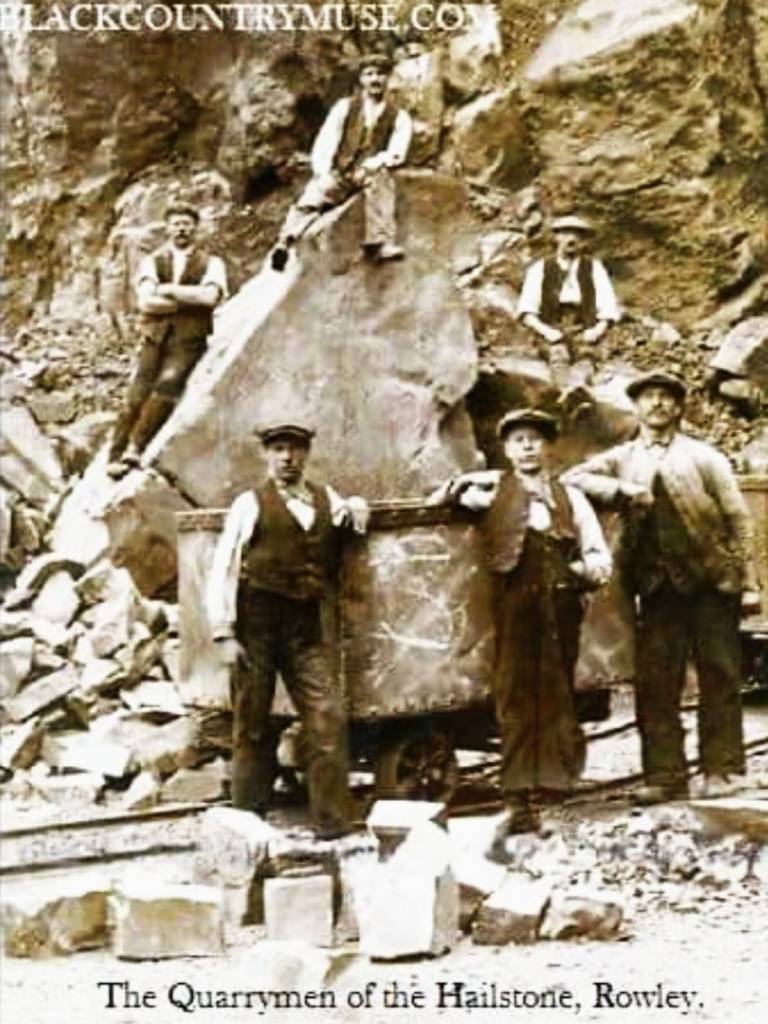
My childhood walk to primary school at Rowley Hall was across the ‘Bonk’, one of the many huge spoil heaps from mines and quarries and in later years, unofficially, even less child friendly substances from chemical works. It was stony, gritty, pink or grey in places, green and shrubby in others with steep slopes for sliding down on tin trays, unfathomed pools and, my brother and his friend swore, a tunnel which they had explored and which led down to Whiteheath. He was right, it turned out, though I never found it, it would have been part of the tramway from Rowley Hall quarry and mine to Titford Basin. A similar tramway ran from the Hailstone quarry under the road at the Knowle down to the Dudley Canal, using gravity to move the heavy coal and stone to the waterways which would transport it further afield.   The bonk was not somewhere many parents nowadays would allow their children to play unsupervised, but to us, the many children who used it as a giant playground, it was simply a natural part of our surroundings. It was only when I was an adult that it dawned on me that we had been playing on a waste heap!

But there were several farms and farmers in or near the lost hamlets on the 1841 census and some of these were still there in the 1940s; perhaps someone will tell me one or two are still there.

They were, like other places, called by different names at different times. Sometimes Freebodies Farm, Hailstone Farm, Brick House Farm, Gadds Green Farm, Turner’s Hill Farm, Windmill Farm, Portway Hall Farm – different records used different names, perhaps depending on the source of the information. At other times they would have been known by the names of whoever was farming there. Even in the 1950s and 60s, once  you had left Springfield on the way to Dudley, there were green spaces either side of the road, though there may once have been quarries and mines there. Not smooth green meadows but greenish.

Reg Parsons, who was born and grew up on Turner’s Hill told me that his mother and father, who had a shop in Doulton Road, were walking on Turmer’s Hill one day and his mother saw some wild sweet peas growing in the hedge. What a lovely place this would be to live, she said. So when a piece of land with three condemned cottages became available there, they bought it, Reg’s father demolished the cottages and built a new house, No 2, Turner’s Hill and they moved to it. That was later sold to a local businessman who wanted to live looking over the golf course before that, too was demolished. What a view some of these houses must have had and how lovely to think that wild sweet peas grew in the hedges.

Reg recounts that his father worked in Dudley and, when he needed items from the shop at Springfield, he would get off the bus there, get his shopping and then cut across to walk up over the fields and home.  Reg also recounted that, when he was at Britannia Road School (a fair walk in itself) he would call in at a farm off Hawes Lane to milk two of their cows. On the way home he would call in and milk the cows again, having his evening meal with the farmer and then walking home. As Reg said, he was working longer days than when he started his first real job. But his family – and other families in the area were mostly self-sufficient, keeping chickens and a pig, growing vegetables and getting milk from the local farm.  

The map from which the extract below is taken, the First Edition of the Ordnance Survey, shows the Turner’s Hill area. This One Inch to the Statute Mile map was derived from two topographical surveys, the first completed between 1814 and 1817 by members of the Royal Military Surveyors and Draftsmen and probably assisted by local surveyors hired for the task. Numerous revisions for the rapidly changing Black Country were completed by 1831-1832, shortly before the first printing in 1834. Copies of the original surveys are preserved in the British Museum. Sheet 62, from which this small extract is taken, was engraved on four separate sheets of copper by the engravers’ workshop at the Tower of London where the first copies were also printed. The names of surveyors, engravers and printers are all recorded. This fascinating information is printed on the David and Charles Reprint edition, along with a great deal more detailed information. My recently acquired copy cost me the grand sum of less than £10, including postage so if, like me, you love old maps, it is worth seeking one out.

Information on the maps tells us that “The engravers’ workshop at the Tower was under the direction of Benjamin Baker. He employed six or seven assistants, each of whom was responsible for a particular aspect of the map – hills, water, woods, lettering and so on.” The Rowley Hills would have provided plenty of work for the one responsible for hachuring the hills!

Copyright David & Charles, Newton Abbot, Devon.

The map shows that most of the area of the Rowley Hills was still undeveloped then, although clusters of houses and some quarries are shown, the steel works at the Brades is shown and the railways are already marked.

The map shown below is an extract from the very useful Alan Godfrey Reprint of the 1904 OS 6″ to the mile, sixty years or so after the 1st Edition where you can see much more detail of the quarries around the hamlets. The hatching shows that many of the houses backed on to sheer drops into the quarries and many would end up being consumed by the quarrying operations. The Prospect Quarry was the site of a windmill at one time and there was still a Windmill Farm in Tippity Green appearing in records long after the mill had gone.

Copyright: Alan Godfrey Maps

So while we may have gone to Quinton in my childhood to see the bluebells or to Clent to ‘the real countryside’, there were some green spaces of sorts all around us and around our ancestors, despite the prevalence of quarrys, factories and pits. Interestingly, the old quarries are apparently now being filled in and greened over so perhaps the hills will become a green and pleasant land again after all these years. Though one suspects that the push for new housing may take priority…

Some statistics about the people living in the hamlets in 1841

So.. What did they do for a living?

In 1841, the population of Tippity Green, Perry’s Lake, Gadds Green and Turner’s Hill numbered 384.

The occupations listed for them were:

Blacksmith                          1

Butcher                                  1

Coal Miners                        13

Farmers                               5

Female servants               8

Forge filer                           1

Independent means      1

Ironmonger                        1

Jobbing Smith                    1

Labourers                            9

Male Servants                   5

Nail factor                           1

Nail tinner                           1

Nailmakers                         38

Publicans                             1

Registrar of B&D               1

Shoemaker                         1

Stick dresser                      1

Warehouseman                1

Wash for hire                     1

A couple of entries have no occupation shown, this may be because those men were out of work or simply an omission.

Nailmaking was by far the dominant occupation, coal mining was not yet a major employer . Very few occupations were listed for women unless they were widows, despite the fact that most women and many children also made nails at this time. No scholars were listed though that may not mean that no children went to school, there was at least one school in Rowley Regis at this time, it simply may not have been recorded.

Note that the local Registrar of Births and Deaths John Woodhouse was living in Tippity Green, his son William would succeed him in that role in due course.  I have many copy certificates of births and deaths with their signatures.

There appear to have been few shopkeepers at this time, people had to be self-sufficient or buy necessities from further afield, although there may have been some informal grocery shops in front rooms! Many households would have kept chickens and pigs and may have acquired the occasional rabbit for the pot, and presumably grown vegetables if they had gardens.

Where were they from?

Only 46 of the 384 were born outside the County of Staffordshire.

Of these 46 only 10 were born in Scotland, Ireland or Foreign Parts. 5 men and 5 women.  No information is shown in this census about where others came from but more is shown in later censuses.

How old were they?

Ages in the 1841 Census were supposed to be rounded down to the nearest five years. So if you were 38, your age was shown as 35. A trap which can mislead family historians who are not aware of this and who are looking for an ancestor of a particular age. And at this time ordinary people were often neither literate nor numerate so ages in this Census should be treated with caution

In this chart the ages are shown along the bottom. As it shows, it appears that living beyond 50 was good going and beyond 60 was a rarity. Two of the four  aged 75 were men living in Tippity Green in the Parish Poorhouse, one of them blind, the first woman was living on Turner’s Hill, the ‘wash for hire’ listed in the occupations and the second woman was living alone in Perry’s Lake.  But with no pensions, most people worked for as long as they lived.

Ages of adults:

Adults’ Ages in the 1841 Census

Younger people

The Census required the ages of those under 15 to be shown by year, perhaps to enable the Government to track child mortality.

Children’s ages in the 1841 Census

Transcribing burial records for Rowley Regis has shown me that great numbers of babies died – of debility, decline, lung and bowel problems – before their first birthdays. These will often not appear at all in Census records if their short lives fell between censuses. And older children succumbed to whooping cough, smallpox, measles, scarlet fever, typhus fever (as did numerous adults) and consumption (Tuberculosis).  Poor nutrition, cramped living conditions and exposure to smoke and air pollution would not have helped.

My apologies for the poor quality of some of these images: I am new to this medium and on a steep learning curve, I hope this will improve as I become more accustomed to it.

So these are the basic statistics for the population of the lost hamlets taken from the 1841 Census. In future posts, I will explore more about the families behind the numbers.

Families in the Lost Hamlets 1841-1881

There are 13 families who were living in the hamlets of Perry’s Lake, Gadd’s Green and Turner’s Hill area for all five censuses which I have so far transcribed. All are familiar Rowley names:

Cole, Cutler, Darby, Foster, Hill, Hipkiss, Levett, Parkes, Redfern, Simpson, Taylor, Whitehall/Whittall and Woodhouse.

A further 9 families had moved in between 1841 and 1851 and were in all four of the 1851-1881 Censuses:

Barnsley, Detheridge, Edwards, Hadley, Harcourt, Ingram, Jones, Knight, Ocroft, Payne and Timmings/Timmins.

Four families were in the 1841-1871 Censuses but had moved on by 1881 – Badley, Downing, Round and Siviter.

When time permits, I will check where these families had moved to.

Certainly there will have been marriages between these families and they were most likely closely interrelated over those years.

This information will be updated as more censuses are transcribed.