I have been working recently on another family study for my blog, this time about the Hill family, one of the core families who lived in the hamlets for centuries, mainly at Finger-i’the-hole and Gadd’s Green. As usual, it has proved more complex than I had anticipated and I have got sidetracked into considering where exactly the branch of the family I am looking at lived in the village. Many of them, it appears, lived for centuries in a group of houses in Finger-i’the-hole or Fingeryhole , or Gadd’s Green.
Regular readers may recall that I have posted previously in this blog about the whereabouts in Rowley village of Finger-i’the-hole or Fingeryhole[i].
And, in a separate post [ii] I wrote last year about a newspaper article I had found, in the Dudley Chronicle in 1925, about the delights of what the writer called Portway but which clearly included the wider area of Perry’s Lake and Gadd’s Green. The article referred to the dilapidated cottage in Gadd’s Green as “Finger o’the hole cottage” which the author had visited in 1925, a cottage where the front wall had collapsed in a storm some time before and never been rebuilt.
As a reminder, and for new readers, the name Finger-i’the-hole originates from a very old local story – but which was subject to several variations in later years. A lonely old widow, the story goes, lived alone in a small cottage on Turner’s Hill. A thief or rent collector, depending on which version of the story you look at, knowing that she was unprotected, put his finger into the hole in the door to lift the latch, with a view to robbing her- or perhaps collecting the rent! – only to discover that the feisty widow, hearing his approach, had picked up her axe and chopped off the offending digit as it was poked through the hole. Though there are no names attached to this tale, there is a locality and I believe that it is likely that some incident of this sort actually happened.
The date of this event is unclear but must have been before 1727, as Christopher Chambers of “Ye ffinger I’the hole” was buried then, according to the Parish Burial Register. And the name of Finger-i’the-hole for the area persisted until the 1841 Census but had dropped from official use by 1851 when the area , with exactly the same families, was called Gadds Green.
The Chambers family appear, although I have not done any detailed research on them, to have been well-to-do, they appear in the Parish Registers as living also in 1724 at ‘the Brickhouse’ and in 1723 and in 1744 as ‘of Freebodies’ so were perhaps brothers as tenant or yeoman farmers. At that time ‘the Brickhouse’ appears to have been at Cock Green, with land extending down towards Powke Lane which later was developed in the 20th century as the Brickhouse housing estate. Brick was not a commonly used building material at this earlier date and the use of bricks for a whole house was obviously distinctive and worthy of a special name.

Photograph copyright: Glenys Sykes
This is an illustration shown in Wilson Jones’s book of what the barn of the ‘Brickhouse’ farmhouse might have looked like. Note the ragstone wall and what appear to be large chunks of ragstone lying around. I took a photograph recently of the pieces of ragstone still in Tippity Green/Perry’s Lake, at the entrance to the former Hailstone quarry, they have a familiar rugged shape.

Ragstone blocks at Tippity Green November 2024, photograph taken at the entrance to the former Hailstone Quarry. Copyright Glenys Sykes.
There were lots of the Chambers family in the village throughout the parish registers. An entry in 1723 refers to a Thomas Chambers of Portway and in 1732 an Edward Chambers of Tividale so they did seem to live at this end of Rowley. There was an Edward Chambers at Freebodies Farm in the 1841 Census, albeit described as a farm servant but there were no Chambers that I can find listed in the later censuses in the Lost Hamlets and it appears that they dispersed around a wider area, including Oldbury and Birmingham.
Picturesque Portway
In the newspaper article on Old Portway, which had been written in 1926, I remembered a comment in that article about the cottages at Finger-i’the-hole and this is what it said:
“Our representative visited the now dilapidated cottage where the incident is reputed to have taken place. The cottage is the fourth of a row, and is known in the neighbourhood as “Finger ‘o the hole cottage. “, The article continues “The front of the building was blown out one winter’s night many years ago when the occupant was a Mrs Cox, now of Gornal, and it has never since been repaired. The cottage is said to be over 300 years old and one family – that of Hill, members of which reside in an adjacent cottage – lived there for nearly 200 years.
It is constructed of rough grey sandstone, and originally had two rooms, one up and one down. A stout roughly hewn oak beam, crossing the building from gable to gable, indicates where the first floor once rested, and shows that the height of the living room was under six feet. Occupying one-half of the building is a spacious old-fashioned fire-place, with a large open chimney and contiguous bake ovens.”
This description of the house known as “Finger ‘o the hole cottage. ” is very interesting.
“The cottage is the fourth of a row.” So it could originally have been the end of a much older hall house.
“The cottage is said to be over 300 years old” – which takes it back to about 1600 or even earlier.
“It is constructed of rough grey sandstone.” Would this have been Rowley Rag? Something substantial to last more than 300 years, unlikely to have been simple wattle and daub.
“A stout roughly hewn oak beam, crossing the building from gable to gable, indicates where the first floor once rested and shows that the height of the living room was under six feet.” Was this beam a later addition to divide the hall and add extra accommodation?
“one-half of the building is a spacious old-fashioned fire-place, with a large open chimney and contiguous bake ovens”. I can remember when I first read that description, something jarred with me. The original article goes on “No fewer than ten men can comfortably stand in the aperture once occupied by the grate and its side seats.”
A humble cottage in a terrace does not have half of the single living space taken up by a fireplace big enough for ten men to stand inside it and nor does it have ‘contiguous bake ovens’, it was unusual for small cottages to have even one oven, certainly not two. There may have been an external bakehouse or oven for a farmhouse or larger dwelling and with large fireplaces in bigger buildings an oven was sometimes built into it. There is an interesting piece with a brief history of baking here – https://www.historyextra.com/period/medieval/a-brief-history-of-baking/
So something is out of the ordinary here. Perhaps there are more clues in the rest of the description of the cottage.
“it originally had two rooms, one up and one down.”
Was this a Hall house? Hall houses had one great room which might well have had a great fireplace installed at some stage – I knew that originally such halls had a central hearth and the smoke floated up into the roof. Later fireplaces and chimney breasts were added. But why the need for such a big one?
But if it was a hall house occupied by a large family or was a busy farmhouse with farmhands to feed, two ovens might well have been provided.
And at a time after the original construction the hall might have been divided into more rooms or cottages and even divided into an upper and lower floor, although if it had been designed to have two floors surely the ground floor would have been higher than six feet when it was first built?
Hall houses
So I began to suspect that this may well have been a very old hall house, perhaps the home of a farming family but that later it was divided and subdivided. And that the Hill family lived there for centuries.
I decided to research a little more about ‘Hall houses’, to see whether my thoughts seemed reasonable. This information is taken from Wikipedia:
“The hall house is a type of vernacular house traditional in many parts of England.
Origins
In Old English, a “hall” is simply a large room enclosed by a roof and walls, and in Anglo-Saxon England simple one-room buildings, with a single hearth in the middle of the floor for cooking and warmth, were the usual residence of a lord of the manor and his retainers. The whole community was used to eating and sleeping in the hall. Over several centuries the hall developed into a building which provided more than one room, giving some privacy to its more important residents.
By about 1400, in lowland Britain, with changes in settlement patterns and agriculture, people were thinking of houses as permanent structures rather than temporary shelter. According to the locality, they built stone or timber-framed houses with wattle and daub or clay infill. The designs were copied by their neighbours and descendants in the tradition of vernacular architecture. [a] They were sturdy and some have survived over five hundred years. Hall houses built after 1570 are rare.”
When considering this house I was slightly concerned that I cannot find any mention in other records of a substantial house at Gadd’s Green, although Wilson Jones in his book[iii] lists all the other significant manors or large houses.
However, David Hay, in his book The Grass Roots of English History[iv], says that although it was once believed that all timber framed houses had been built by the wealthier inhabitants of local societies and that medieval peasant houses were so insubstantial that they could not survive for more than a generation, more recent systematic recording of houses by members of the Vernacular Architecture Group and the new technological advances in dendrochronology, have overturned these views and it is now known that of the thousands of medieval houses, some of which are still standing in many parts of rural England [though not in the Lost Hamlets!] belonged to ordinary farming families. Hey states that “The sheer numbers of cruck [timber framed] houses in the Midlands confirms that they must be peasant dwellings, some villages have ten or even twenty such houses.” So it seems quite possible that there would well have been such a house in Gadds Green inhabited by a farming or working family, rather than a more aristocratic one.
Cruck framed houses
Many larger houses at this time were ‘cruck-framed’, that is the central frame, the load bearing members that supported the weight of the roof of the building was made from suitable trees – often oak, which carpenters could split lengthways into two identical ‘blades’ which were set either side of the building and then joined at the top with techniques varying from place to place to support a ridge-piece, the crucks sometimes resting on stone bases to protect them from damp and rot. Half way down the roof, between the ridge-piece and the wall plate other long timbers, known as purlins, were fixed to the outer part of the blades in order to carry the rafters which supported the roofing material, often thatch in earlier times. Because the crucks, and not the walls carried the weight of the roof, the walls could be filled in with whatever material was most easily available to them locally. This could easily be replaced in later centuries without endangering the roof.
The frames were constructed in the carpenter’s workshop or in the wood where the trees were felled before they were assembled at the site according to the sequence of the marks the carpenter had made with his chisel or gouge. Different types of marks can still be seen on timbers in old buildings and it appears that each carpenter had their own marks and systems; some buildings had several hundred pieces of timber and hundreds of joints so carpenters needed a way of sorting these efficiently when they arrived at the construction site. This construction method was a skilled job and not to be undertaken by home builders!

Copyright Wikipedia. This is a cruck house in Worcestershire where the cruck frame can be clearly seen, along with other timbering, in this case infilled with what is probably wattle and daub. In Rowley, with the abundance of local stone, the walls would have been infilled with stone and quite possibly the timbers clad with stone to protect them from the weather so that the cruck frame would not be obvious from the outside.
If the house at Gadd’s Green was constructed in this way, with a cruck frame, this might account for why the front wall of one section could be blown or fall down in a storm but the remainder of the structure remain apparently quite stable for many years afterwards, as mentioned in the article, especially if the inhabitants did not have the skills required to make the repairs.
Peasant Houses
Note: Hey suggests that “peasant” is still a convenient term to describe a small-scale farmer, the type of person who would have been the head of household in most of the surviving timber frames houses. I have continued his usage so this is not intended as a derogatory term. There is an interesting article on this here: https://archaeology.co.uk/articles/peasant-houses-in-midland-england.htm
Houses were typically arranged around a central hall that was open to the rafters. These halls could be lengthened by the addition of an extra bay or two but their almost standard width was regulated by the roof span. A wood fire in a central hearth originally provided the heating, with most of the smoke escaping through the roof but timber and plaster smokehoods attached to an internal wall were starting to replace central hearths in the wealthier districts. Sometimes later refinements, ceilings, floors, partitions, etc completely conceal this original use and it is only when the smoke darkened timbers are seen in the attic at a much later date that it is realised that the building started life as a hall house.
The lower end of the building may have housed a workshop or a kitchen, dairy or buttery. And a very large fireplace in a cottage at Gadd’s Green may have been a remnant of this earlier use.
“At the other side of the hall, larger peasant houses had a private parlour, sometimes with an upstairs room known as a solar.” Is this what the family memory of the Hills referred to when they talked about the house originally having one room downstairs and one upstairs?
Poor families had to build with whatever materials were to hand, such as clay and wattles for wall panels or earth for mud walls, as in Devon, probably ragstone in Rowley. The many timbered buildings surviving in small towns in Herefordshire, Hey notes as an example, were in well-wooded areas and where woods were managed to produce suitable crops of timber over a long period. And in poor areas, solid houses would not have been readily replaced with more modern structures. So if a substantial house had been built which lasted for centuries at Gadd’s Green, why would the family expend money to replace it? Some of the Hill family later were nail factors or nail ironmongers and relatively well-to-do but others showed no sign of great wealth.
House layouts
In Midland villages, Hey suggests, “each house was separate and protected from unwelcome intrusions. The whole property, including a garden or yard, was surrounded by a fence, hedge or wall, and accessed through a gate leading on to the street and a door with a lock, (finger hole?). Excavations on village sites show that barns, stables, cowsheds and other outbuildings usually stood close together around a yard, kitchens and bakehouses were often detached, to reduce the risk of fire”.
In the view of Hey and other scholars, “the idea of separate living and working spaces would probably not have seemed a meaningful concept to member of a peasant household. There is plenty of documentary evidence for the conversion of bakehouses, carthouses and stables into dwellings for retired peasants”, indeed barn conversions and such continue to this day!
Why and where?
There were many cruck buildings in some parts of the country and none in others for reasons not fully understood. It is possible that the native pendiculate oak trees, whose shape is ideal for cruck construction, predominate in areas such as parts of Yorkshire, Lancashire and Cheshire, along the river Severn in parts of Wales and in other Midland Counties. In eastern England, where cruck framing is conspicuously absent, the less suitable sessile oaks are the major type.
Hey notes that the medieval houses of Midland England are predominantly cruck framed and three bays in length. The chief limitations of cruck framed buildings are in their height and width, because their dimensions were dependent on the size of the blades that could be cut from suitable local trees.
“When it became fashionable to insert a ceiling into a hall that had previously been open to the rafters, the space in the upper storey was very constricted “- or perhaps sometimes the lower storey which might account for the low ceiling mentioned in the 1925 article.
This restriction did not apply to the other main construction method which was where posts and beams were made to create a box like frame and where the roof was supported throughout the frame and the walls. It is possible to find both methods of construction in one house, perhaps with a cruck framed hall having additional wings built with box frames.
These are other things that Wikipedia has to say about hall houses.
“The vast majority of those hall houses which have survived changed significantly over the centuries. In almost all cases the open hearth of the hall house was abandoned during the early modern period and a chimney built which reached from the new hearth to above the roof.
Fireplaces and chimney stacks could be fitted into existing buildings against the passage, or against the side walls or even at the upper end of the hall.
Once the clearance within the hall was no longer needed for smoke from the central hearth, the hall itself would often be divided, with a floor being inserted which connected all the upper rooms.
In smaller hall houses, where heat efficiency and cooking were the prime concern, fireplaces became the principal source of heat earlier.
In the earliest houses combustion of wood was helped by increasing the airflow by placing the logs on iron firedogs. In smaller houses the fire was used for cooking. Andirons provided a rack for spit roasting, and trivets for pots. Later an iron or stone fireback reflected the heat forward and controlled the unwelcome side draughts. Unsurprisingly the hearth migrated to a central wall and became enclosed at the sides.”
So it does seem to me that all of these points, both from Wiki and Hey, tie in with my theory of the house at Gadds Green having been, at one time, one large dwelling, later subdivided into two storeys and into separate cottages.
On the ground
We cannot look at the house or the site now, it has literally been obliterated.
There are no detailed maps before the mid-1800s.
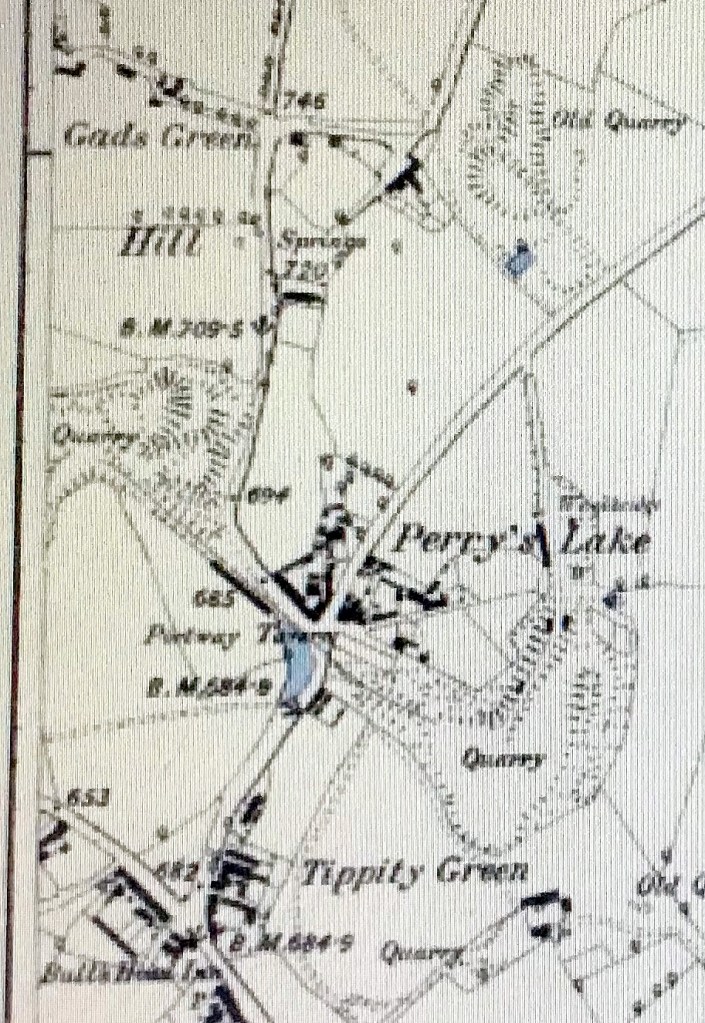
Photograph copyright Glenys Sykes, apologies for the poor quality. Map Copyright: https://maps.nls.uk/
Maps of the area on the NLS website include this OS Map, at six inches to the mile, which was apparently surveyed in 1881-83 and published in 1887. This shows a row of dwellings at Gadd’s Green, with what may have been a yard or fold at the North end.
Incidentally this map also shows a stretch of water at Perry’s Lake which presumably gave this area its name. I have seen suggestions that this may originally been a fish pond for the Manor farm at Cock Green.
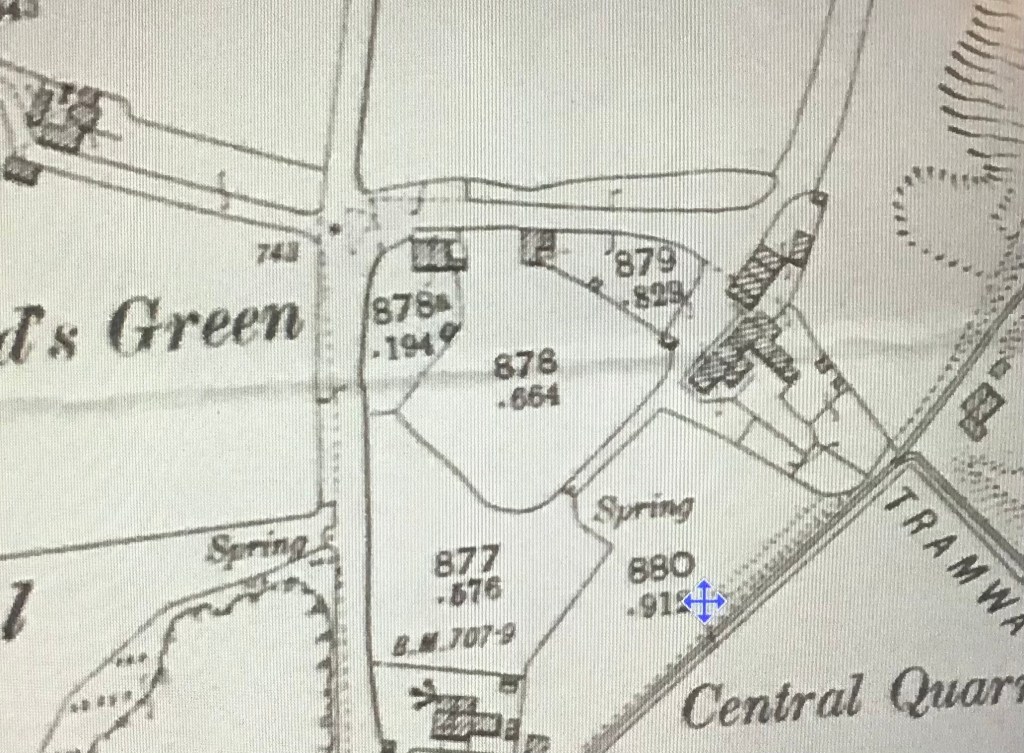
Map Copyright: https://maps.nls.uk/
This second map is at 25” to the mile, was originally surveyed in 1881, revised in 1937 and published in 1947. This shows a row of four dwellings and a further one at the rear, plus an additional block of buildings. But the shape of the site including the fold or yard remains. There are also springs marked just along a lane which would have provided the essential water supply for a farmhouse. On both maps, this is the last building in Gadd’s Green before the road continues up Turner’s Hill, and that is where the home of the Hill family always appears in censuses.
There is no sign of water at Perry’s Lake on this later map. Although there is a mysterious building halfway between Perry’s Lake and Gadd’s Green which I suspect may be the Methodist chapel which appears in various records but later disappears. It appears to be a square building with an entrance porch at one corner and a small room at the back, perhaps a vestry or schoolroom.
And farm houses in the area do appear to have survived better than most other buildings in the Rowley area. They were probably bigger to accommodate some farm workers as well as family and it is also possible that an undercroft or part of the building could also have been used to shelter animals. There may also have been buttery or cheese stores, as well as outbuildings, barns for the storage of crops, stables for horses and vehicles and tools, plus workshops on the site any of which may have been incorporated into the farmhouse in later years.
A Will I have recently been transcribing relates to a farmer who was related to the Hills and who owned farms in Hagley and Belbroughton. The description of the Hagley Farm reads: “my Capital Messuage or dwelling house wherein I now reside with the Brewhouse, stable, Coachhouse, cowhouse and other outbuildings, Courtyard ,fold yard, Garden Ground and orchard thereunto adjoining and belonging (comprising all the buildings and the Courtyards Garden rounds Orchard and premises adjoining together on that side of the road.
Which illustrates the number of additional buildings and grounds a substantial farm might have. But even a smaller farm, like the one in Rowley village described in the Will of Ambrose Crowley, had outbuildings of a barn, workshop and yard. Thinking about this, it is clear from even later maps that the Grange site and the Portway Tavern site at Perry’s Lake were arranged in a very similar way and may also have been on an older sites and originally used as a farm.
Old Buildings in Rowley
There has been an interesting discussion this week on the “I remember Blackheath and Rowley Regis” Facebook page, after I asked where the oldest buildings in Rowley were now. The answer appears to be – several pubs, more than one farmhouse, a few well built cottages still survive. It would be fascinating to see the rafters in the roof of some of these houses to see whether any of them were cruck buildings and whether they were once blackened by the smoke from a central hearth!
So the long gone ancestral home of the Hill family in the Lost Hamlets is the rabbit hole I have been exploring for the past few days. Perhaps, – although I shall never know for sure since the house is one of those which disappeared when the quarry expanded – possibly a Hall house, probably a farm house, later four cottages – including the famous Fingeryhole cottage – which I think I have identified on the map. A fascinating – for me, anyway – glimpse of how the local families lived in centuries gone by, and how local legends may have an element of truth and a thread reaching back through the centuries.
[i] https://rowleyregislosthamlets.uk/2023/02/17/finger-i-the-hole/
[ii] https://rowleyregislosthamlets.uk/2023/10/15/tales-of-old-portway/
[iii] J Wilson Jones, The History of the Black Country, ISBN unknown, published c.1950, Cornish Brothers Ltd.
[iv] David Hay, The Grass Roots of English History ISBN: 978-1-4742-8164-5, Bloomsbury Publishing
 rowleyregislosthamlets.co.uk