Sadly, I have no direct sources from people who lived in the Lost Hamlets for this, but I have pulled together a little from published sources, including Rowley Village and some other places which tell us something of the celebrations in times gone by.
Here are the Christmas memories which J Wilson Jones heard about from his elderly lady relations when he was a boy, so their memories were perhaps of the later part of the 1800s and which he recounted in his History of the Black Country.[i].
“To observe these people at Christmas was an inspiring sight. The table of the poorest was laden with home-cured ham, poultry, plum puddings and delicacies. They gathered around the harmonium or organ and sang the local carols, mainly composed by a Rowley Regis nailmaker Mr Joseph Parkes. The children received few toys, the money of the nailer being spent upon the food and probably new boots. There was, however, that great day of festivity and joy. The scene had changed little from the villain and serf forgetting his hard labour at the Church Fair but in these days of comparative leisure, we have lost their art of celebration.
The Black Country diet has puzzled many strangers but I cannot agree with the writers who say, “they did themselves well”. I believe many of the delicacies had their foundation in the effort of the yeoman and villain housewife to make a little go a long way. Naturally pork was preferred, not because of an aristocratic taste but everyone kept a pig, from these followed the bacon. Nothing must be wasted and so there came the black pudding, chawl, pork bones, pig’s head and even pig’s tail. Served with pearl barley, leeks or onions, a tasty dish resulted but in districts less accustomed to hardship, how much would have been thrown away? A turkey or cockerel was never wasted, the giblets, feet and even the cock’s comb seemed to have their uses. All food was dished out in far too liberal helpings, and contained much of the heavy nature as dumplings or suet puddings.”
“Black Country Songs and Carols
The Black Country has a number of songs and carols peculiar to the District and although not heard as frequently now, they were well known in the earlier part of the twentieth Century. One of the carols ‘Brightest and Best’ is sung to a tune called ‘Rowley Regis’ and composed at Blackheath in the 1860s by Joseph Parkes, a nailer. Another Christmas tune he composed was ‘Come again Christmas’ . The new Year is welcomed by a Carol with the quaint refrain:
The Cock sat in the Yew Tree
The Hen came chuckling by,
I wish you a Merry Christmas
And every day a pie.
A pie, a pie, a pie, a peppercorn,
A good fat pig as ever was born
A pie, a pie, a pie, a peppercorn.
This was sung with great enthusiasm around the Rowley district even in 1925.
Another carol contained the words
‘I saw three ships a sailing,
A sailing, a sailing
I saw three ships a sailing,
Upon the bright blue sea.
And those who should be in those three ships,
In those three ships, in those three ships,
But Joseph and his fair lady.’
A song which used to echo around the drawing room on Christmas night, in the form of a round was called Reuben and Rachel. It went as follows:
‘Reuben Reuben I’ve been thinking
What a fine world this would be
If the men were all transported
Far beyond the Northern Sea.’
A song that concerned Rowley was called ‘The poor Nailmaker’ but it seems to have died out about 1840.
‘From morn till night
From early light
We toil for little pay.
God help the poor of Rowley
Throughout each weary day.
There is a house in Old Hill town
A garden by its door,
The keeper keeps you breaking stones
For ever more.”
A reference, presumably, to the Poorhouse.
Wilson Jones also notes the Postage Rates in 1820. How much did it cost to send a Christmas Card?
Postage Rates, Rowley 1820
15-20 miles 5d (d is the symbol for one old penny! Twelve pence in a shilling.)
20-30 miles 6d (sometimes known as a tanner)
230-300 miles 1 shilling (or a bob, there were twenty shillings in a pound).
He also lists the Poor Allowance in 1871 in Rowley.
( ½ = a halfpenny or ha’penny, ¼ = a farthing, a quarter or fourthing of a penny)
2 loaves of bread 6 ½d
2oz butter 2 ¼d
2oz sugar ½d
4oz bacon 2 ¼d
4oz flour ¾d
Potatoes 2d
Vegetables ½d
Coal 3d
Fish 4d
Meat 9d
So the cost of sending a letter was an expensive luxury!
Other local memories
Tossie Patrick wrote a wonderful book with her memories of Blackheath, called ‘A pocketful of Memories’.published by the Kates Hill Press. [ii]
She recounts that before Christmas at school, the children would be busy for two or three weeks, making paper chains and Chinese Lanterns and decorating the classroom with them, which looked very festive. The last day of term was the school tea party which she remembered enjoying very much.
Tossie remembered her father getting a small real tree which her mother dressed with tinsel and a few carefully kept glass baubles. Plus sugar pigs and sugar fancies, some rock walking sticks and sometimes a little broken chocolate. The tree was then hung from a hook in the ceiling and Tossie’s mother would cut the sweets off each day until they were finished. Presents, just as in earlier times mentioned by Wilson Jones, were often new clothes or shoes, and perhaps a few small toys such as a cardboard sweet shop or a toy tea set. Tossie remembered receiving a miniature cooking stove complete with pots and pans – I once got one of those, too!
Tinsel tarnished in those days, I remember, no plastic film then. My mother, too, had a few real glass baubles, perhaps made in one of the local glass works, they were very fragile. There were candle clips which were attached to the branches and real candles – the fire risk must have been terrible! I remember sugar mice and when my children were little I once found a sugar pig in a local sweet shop – I think that the diet police have succeeded in banning these giant lumps of pure sugar these days. But my children had other sweets and they never ate the sugar pig and so it was recycled every year until it became too scruffy and was disposed of! And yesterday my daughter and I were discussing presents and catering and she reported that she had managed to find a sugar mouse for my granddaughter’s stocking, some traditions go on. I don’t suppose my granddaughter will actually eat it either but it’s just one of the things that go in a stocking, along with the orange and nuts and chocolate coins in the toe!
Tossie remembered her Christmas Day tea with great pleasure. Tea included a large tin of Libby’s peaches and a tin of Fussell’s Cream and a chocolate covered roll and bread and butter. Her Mum had to cut the ends of the chocolate log up and divide them between the children to stop squabbling about the chocolate covered ends. Like many families, Tossie’s family used the front room at Christmas, very special and they all sat by the fire and listened to Dicken’s ‘A Christmas Carol’ on the wireless.
In the Pocketful of Memories Rowley Book, by Irene M Davies [iii], also published by Kates Hill Press, there is a whole chapter on Christmas in Rowley village, full of lovely memories and well worth reading. She recalled something which I have never come across which was a Christmas Bowl. These could not be bought, they were made at home. Two hoops from a butter barrel (some men were skilful and used three!). These were crossed to form a circle and secured at the crossing point with string, the hoops were covered with paper strips pasted on and then covered with tissue paper which was trimmed and cut with a fringe and then attached to the bowl with flour and water paste and perhaps hung with sugar fancies as it was hung with pride on Christmas Eve. What pride and joy Irene remembers, money is not always necessary for happiness.
Irene also recalls that many families kept a few fowl in the yard and a pig and a pig would be killed before Christmas, with joints of pork and a cockerel for Christmas dinner, a joint of beef was sometimes bought for the occasion. Most people, she remembers, cooked the meat in front of the fire, using a meat-jack. The meat tin underneath the roasting joint caught the dripping which was much enjoyed at other times! When everything was prepared, it could be left while the family went to chapel before sitting down to their festive meal. Mincemeat for pies and puddings were also made at home with due ceremony. Irene tells of the ingredients for the ‘plum pudding’, made several weeks before Christmas –and containing various ingredients which had to be cleaned and chopped at home. Scraped and shredded carrots (who else thought carrot cake was a modern invention?), peeled and grated apples; currants and sultanas had to be washed and the big juicy raisins had to be stoned and chopped, breadcrumbs made from stale bread. Irene remembers that in those days candied peel came, not in little pots ready chopped, but in the form of half oranges and lemons which also had to be chopped, lumps of sugar had to be prised out of these and these lumps were shared out and sucked, obviously highly prized. Beef suet also had to be chopped along with dates and prunes which had been soaked in hot tea the night before and then stoned. When everything was mixed, with some old ale, everyone in the house would take a turn to stir the mixture and make a wish (which had to be kept secret, of course, or it would not come true) before the puddings were packed into basins and sealed down with greaseproof paper and cloth covers, tied firmly down with string before being cooked in the boiler for several hours the following day. My mouth is watering as I write, I can almost smell that wonderful steam wafting out. Somehow, picking up even the most superior commercial Christmas pudding from the supermarket seems a great let down in comparison!
Irene is quite right about these larger pieces of candied peel, I was delighted recently to find that one of our two wonderful local farm shops keeps candied peel like this – it is delicious cut into slices and dipped in melted dark chocolate, my own favourite treat. The French call these Orangettes. I have even been known to resort to candying my own peel to make these at Christmas!

Copyright: Glenys Sykes
Later in the day, Irene remembered, family would visit, married older brothers and sisters, aunts, uncles, cousins, in-laws and friends. Cups of tea, slices of cake and mince pies, a glass of home-brewed ale would be followed by a good gossip and, later, everyone sitting round the fire singing their favourite carols.
Irene records that her most memorable Christmas was in 1929 when her mother was not feeling well on Boxing Day and she was taken by her father to visit her aunt and uncle. A little later her father slipped out and then came back to tell Irene that she had a new sister, named Hilda. Coincidentally my mother was born on Christmas Day, a few years earlier and she was also called Hilda. Tossie noted that these days everyone just watches television, not nearly such a joyful experience and certainly not as memorable.
What will our children remember about their Christmases with pleasure in fifty or seventy years, as Tossie and Irene did? Tossie and Irene’s books are wonderful reading and I believe they are still available from Kates Hill Press.
Alison Uttley on Christmas
The writer Alison Uttley also writes of how humble houses were decorated for Christmas, in times gone by, in her book Stories for Christmas[iv] which my children enjoyed being read to them when they were small. This is the description of how a ‘kissing bunch’ was made on Christmas Eve, long before Christmas trees were introduced by Prince Albert.
“Now in every farmhouse in that part of England, a Kissing Bunch was made secretly on Christmas Eve to surprise the children on Christmas morning. For hundreds of years, this custom had been kept.
Mr and Mrs Dale planned to make their bunch when the children were fast asleep. So they brought out the best pieces of berried holly, which had been kept apart in the barn, away up the outside steps across the yard. Adam brought the slips of holly indoors, with his lantern swinging, and Mr Dale tied them together in a compact round bunch, arranging them in a double circle of wooden hoops for a frame. The ball was shaped slowly and carefully, with bits tied to the foundation till a beautiful sphere about eighteen inches across was made. It hung from a large hook in the kitchen ceiling.
[Just like Irene’s Christmas Bowl, perhaps bowl is a corruption of ball? Alison grew up in Derbyshire. Other areas called this the Christmas Bough. Bowl/Bough/Ball – there is a similarity in those names so the name used appears to have been very much a local tradition, used to describe the same thing, made in the same tradition, in different parts of the country. ]
Mrs Dale had been busy with her ribbons and toys, and now she threaded the scarlet and yellow ribbons among the leaves, so that they dropped in streamers. She tied the silver balls, the red and blue glass bells, by strings which were hidden in the greenery. Little bright flags were stuck in the Kissing-bunch here and there, to remind everyone that Christmas was all over the world. Oranges and the brightest red glossy apples from the orchard store, tangerines and gilded walnuts were slung from threads to hang in the bunch as if they grew there.
It was a magical bush of flowers and fruit, of gold and silver. The oranges and apples caught the light of the lanterns and the blazing fire, the holly leaves glittered and the silver and gold bells and balls were like toys from Paradise.
Give me the first kiss, said Farmer Dale and he took his wife in his arms and gave her a smacking kiss under the brilliant Kissing-bunch. “
Copyright: Alison Uttley.
Is that not a lovely description? There is much more of the story in that chapter of Alison’s book.
Some family memories of Christmas
I, too, have memories if Christmas in Rowley and Blackheath in the 1950s. My father was chronically ill and unable to work sometimes and money was very tight. I can remember one year the Minister from our chapel turning up on Christmas Eve with a present each for my brother and I which he had been asked to deliver anonymously. We might not have had much that year without that kindness. We never knew who had sent them.
We always went to chapel on Christmas Day, of course but it was a fairly low key service and, if I remember correctly, there was not so much as a Christmas tree in church, you know we Methodists liked to keep the chapel simple and relatively unadorned. I can remember being surprised the first time I went to an Anglican church at Christmas and seeing that they had a fully decorated tree in church! Even if there was no tree in chapel though, the favourite carols were always sung fervently, we were good singers at Birmingham Road, a favourite, of course, being Brightest and best of the sons of the Morning, sung to Rowley Regis. I still love that tune.
The first Sunday of December was always the annual performance of the Messiah at Birmingham Road, my childhood introduction to the glories of oratorio, sung in our very own church by our very own (augmented) choir, many of whom had sung in that for many decades and in which I was able to take part in the chorus as I grew up. My mother told me that her mother had such a wonderful alto voice that, one year, when the alto soloist who was booked to perform was taken ill, my granny sang the alto part instead. Sadly she died when I was only three so I don’t remember her but I, too sang alto in choirs for many years which felt like a little link with her.
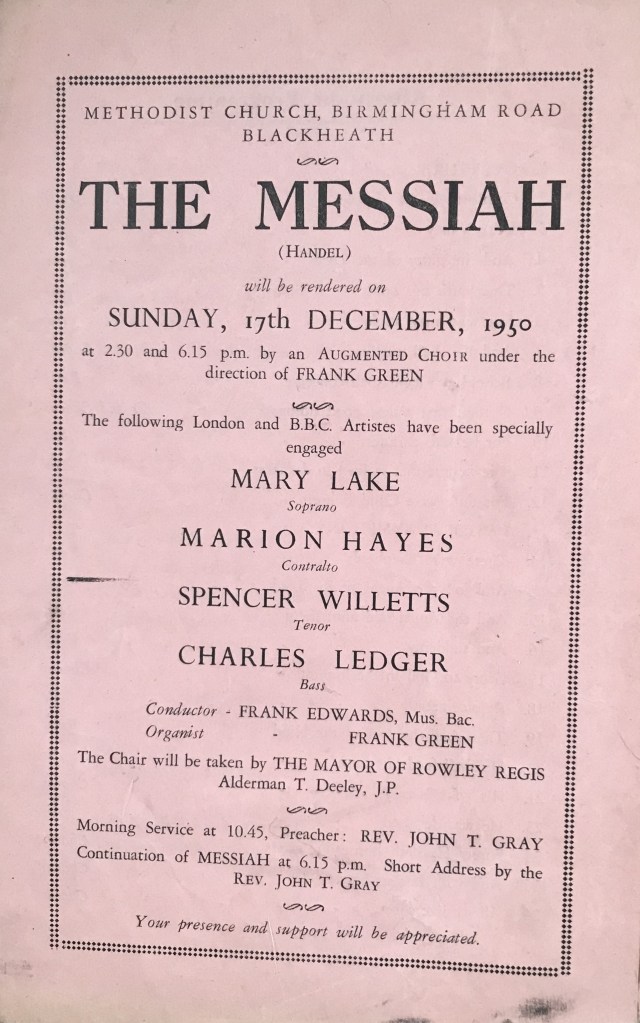
My mum kept numerous Messiah programmes, this is the one from the year I was born, but I can remember Frank Green the organist from when I was growing up, a faithful servant to the church but somewhat grumpy!
Even though I don’t sing any more, I still have my battered Messiah score, bought for me by my musical grandad Hopkins who was delighted that his two granddaughters, my cousin Joyce and I enjoyed singing. Grandad certainly enjoyed it, my cousin recently recalled her embarrassment as a child, my grandad’s loud enthusiastic singing in chapel, seated near the front and holding on to some notes long after the rest of the congregation had finished. But he wasn’t embarrassed!
My happiest memories are of Christmas day afternoons when, after lunch, we would walk up from our home in Uplands Avenue to a lovely Edwardian house called Brodawel in Halesowen Street to spend the afternoon with my mother’s cousin Edith and her extended family, her daughters Ann and Christine, Edith’s brother Major Harris and his wife Dot, and a table groaning with a magnificent spread including turkey, ham, cakes, wonderful trifles, including one reserved for the adults with plenty of sherry – and us all good teetotal Methodists, too! I can remember sitting by the glowing coal fire in the front room, cracking nuts and peeling tangerines, and throwing the shells and peel into the fire. My aunt Edith, as I called her, was the most generous and hospitable hostess and I remember that she nearly always gave me a classic book for Christmas. Heidi, I particularly remember was one and also Little Women and Black Beauty. I loved her dearly, to the end of her days.

Copyright: Glenys Sykes. I am the only person surviving from this photograph taken in the late fifties, at Auntie Edith’s. From left to right, Dot Harris, my mum, my dad, my brother Michael behind, Uncle Harry who was Auntie Edith’s second husband, myself down at the front and someone who I think was cousin Christine’s husband Paul. As you can see, they were very jolly gatherings.
A few years later, our Christmas Day visit changed and we went instead to my mother’s cousin Claude Hadley and his wife Elisabeth in Hurst Green Road. Claude was a wonderful pianist and would play for us on his piano and also play us records of his favourite – and, he said, the greatest ever pianist Horovitz. Elisabeth was German and it was on these occasions that I first tasted this strange but delicious dish called potato salad, a German delicacy which was served with the cold meats and pickles etc. It was lovely, I have to this day never tasted any as good as Elisabeth’s recipe. Claude always seemed to spend his time when we were there trying to get everyone more than a little tiddly, he served very generous tots of spirits to my mum and dad who were not usually great drinkers. Fortunately perhaps, this was before we had a car so we were walking home afterwards, no danger of drinking and driving.
My mum’s hospitality day was always on Boxing Day when our family would gather, my uncle Bill and aunt Dora, Uncle Leslie and Auntie Alice with Joyce, my grandparents in earlier days. My grandad Hopkins always gave my mother a large glass sweet jar full of his home pickled onions or shallots for Christmas, grown on his allotment in Park Street and prepared with his own hand, complete with the pickling spices still in the jar. The best Christmas presents are made with love. This jar usually lasted us for several months and, perhaps it is just nostalgia but again I have never since found any pickles which tasted so good, even when I pickled my own. Perhaps the Blackheath soil gave them a special flavour.
I especially remember Boxing Day 1962 when, after a jolly afternoon in the warmth of the house, we opened the front door for our guests to depart in the late afternoon, and were startled to find several inches of snow had fallen while we were partying, the start of the terrible winter that year. There was still the odd lump of frozen compacted ice and snow in the gutters of Rowley Village in early April, although even at the beginning it didn’t stop us getting to school and work, life carrying on pretty much as usual. No school closures in those days!
So there we are, a sprinkling of Christmas cheer in Rowley Regis and other places from days gone by, gathered from various sources. So I finish with a description of the food shops in London on Christmas Eve, taken from Dicken’s A Christmas Carol,[v] with a glorious word picture of the bounty on display. I read this a couple of weeks ago, for the first time for many years and much as I love the film versions, especially The Muppets version, Dickens has a wonderful way of drawing word pictures for us. And in this age of the internet, you can download a digital copy free from the Gutenberg Press.[vi]
“The fruiterers were radiant in their glory. There were great, round, pot-bellied baskets of chestnuts, shaped like the waistcoats of jolly old gentlemen, lolling at the doors, and tumbling out into the street in their apoplectic opulence. There were ruddy, brown-faced, broad girthed Spanish Onions, shining in the fatness of their growth like Spanish Friars, and winking from their shelves in wanton slyness at the girls as they went by, and glanced demurely at the hung-up mistletoe. There were pears and apples, clustered high in blooming pyramids; there were bunches of grapes, made, in the shopkeepers’ benevolence to dangle from conspicuous hooks, that people’s mouths might water gratis as they passed; there were piles of filberts, mossy and brown, recalling, in their fragrance, ancient walks among the woods, and pleasant shufflings ankle deep through withered leaves; there were Norfolk Biffins, squat and swarthy, setting off the yellow of the oranges and lemons, and, in the great compactness of their juicy person, urgently entreating and beseeching to be carried home in paper bags and eaten after dinner.”
“The Grocers’! Oh, the Grocers’! Nearly closed, with perhaps two shutters down or one; but through those gaps such glimpses! It was not alone that the scales descending on the counter made a merry sound, or that the twine and roller parted company so briskly, or that the canisters were rattled up and down like juggling tricks; or even that the blended scents of tea and coffee were so grateful to the nose, or even that the raisins were so plentiful and rare, the almonds so extremely white, the sticks of cinnamon so long and straight, the other spices so delicious, the candied fruits so caked and spotted with molten sugar as to make the coldest lookers-on feel faint and subsequently bilious. Nor was it that the figs were moist and pulpy, or that the French plums blushed in modest tartness from their highly decorated boxes, or that everything was good to eat and in its Christmas dress; but the customers were all so hurried and so eager in the hopeful promise of the day, that they tumbled up against each other, crashing their wicker baskets wildly, and left their purchases upon the counter, and came running back to fetch them, and committed hundreds of the like mistakes, in the best humour possible; while the Grocer and his people were so frank and fresh that the polished hearts with which they fastened their aprons behind might have been their own, worn outside for general inspection, and for Christmas daws to peck at if they chose.”
“But soon the steeples called good people all, to church and chapel, and away they came, flocking through the streets in their best clothes, and with their gayest faces. And at the same time, there emerged from scores of bye-streets, lanes and nameless turnings, innumerable people, carrying their dinners to the bakers’ shops.”
“In time the bells ceased, and the bakers were shut up; and yet there was a genial shadowing forth of all these dinners and the progress of their cooking, in the thawed blotch of wet above each baker’s oven where the pavement smoked as if its stones were cooking, too.”
Dickens closes this chapter with this philosophy from the Spirit of Christmas Present, which seems worth pondering on now, all these years after A Christmas Carol was first published in 1843.
“There are some upon this earth of yours,” returned the Spirit, “who lay claim to know us, and who do their deeds of passion pride, ill-will, hatred, envy, bigotry and selfishness in our name who are as strange to us and all our kith and kin, as if they had never lived. Remember that and charge their doings on themselves, not us.”
I wish my readers a very merry Christmas, even if not quite up to the Dickens standard, and will be back soon with more posts to my blog!
[i] The history of the Black Country by J Wilson Jones, published c.1950 by Cornish Brothers Ltd.
[ii] ‘A pocketful of Memories’.published by the Kates Hill Press, 1998. By Tossie Patrick. ISBN: 0 95203117 3 6
[iii] A Pocketful of Memories: Rowley, by Irene M Davies, published by The Kates Hill Press in 2005, ISBN 978 1 904552 45 1
[iv] Stories for Christmas by Alison Uttley. My copy published by Puffin Books in 1977. ISBN: 0 14-031349-4
[v] A Christmas Carol in Prose; being a Ghost Story of Christmas by Charles Dickens.
 rowleyregislosthamlets.co.uk