This is an extended account of the lives of Matilda Ennis, her husband William Hackett and her children. I outlined this briefly in my piece on Jane Hill’s children but this gives a longer explanation of my researches into this matter. A full transcription of the newspaper article appears below, the article appeared verbatim in at least two newspapers I have found, so probaably in others, too.
“SUSPICIOUS DEATH OF A CHILD
An inquest was held on Friday last, at the Shoulder of Mutton, before Mr E Hooper, Coroner, on the body of Emma Hackett, aged 6 months.
Henry Duncalfe, surgeon, West Bromwich, deposed to having received the Coroner’s precept to make a post-mortem examination; that he had found the body in a very emaciated state, but every organ of the body healthy. The stomach contained half a teaspoonful of liquid, but there was no trace of poison. There was no doubt in his mind that deceased had died from want of nutrition, and it was clear that she could not have had any food for nearly two days before death; but if she had been purged, it was possible that if she had food within two days all traces of it would have disappeared.
Jane Hoddy swore that she lodged with Miss Matilda Hackett, the mother of deceased who was living apart from her husband. She had known deceased for six weeks, and she had been very delicate. Mr Phillips, who had been attending her, pronounced her to be in a decline, so she had heard Mrs Hackett to say. Mrs Hackett went from home on Monday morning week and never returned till the following Wednesday night. Witness attended the deceased. She took a quantity of bread and milk. Up to Friday she had not been purged. She was taken much worse on Saturday and no doctor was sent for. Deceased died on Sunday morning.
Matilda Hackett identified the body as being that of her daughter Emma and proved her death. She at first denied that any woman had been in her house on the Sunday before deceased died, but on the Coroner pressing the question, she said there had been some women there.
Sarah Edwards swore that on Wednesday last she heard that Mrs Hackett had gone from home, and her child Emma was dead. She also heard they would let no person see it. She went to the house and found two women there. They said Matilda had gone to Dudley. They said Emma was in bed. She went upstairs and on removing the bedclothes she found the child lying in its own filth, and must have been in that state a long time. She had not been purged. One of the women said she had taken more care of the deceased than the mother would have done if she had been at home, for she had given her her own breast which the mother would not have done.
Thomas Bevington, Police Constable, deposed that on Monday he had received information that Hackett’s child had been poisoned, whereupon he went to Mr Philips [apparently a local doctor] and told him what he had heard. He said reports must not be attended to, but he did not give a certificate. The case caused much talk in the neighbourhood and an inquest was much desired. Consequently he reported the whole of the facts to the Coroner. On Sunday, before the death, there had been several prostitutes in the house.
The Coroner, in addressing the jury, stated that all the evidence had been laid before them that could be obtained , and upon that evidence their duty would be to find a verdict; but at the same time he must caution them against placing too much reliance on the mother’s evidence, considering the unsatisfactory manner in which she had tendered it.
The foreman said the Jury returned a verdict that the deceased had died from exhaustion, produced through want of sufficient nourishment; and they were of opinion that the n-mother’s conduct had been most inhuman, but that the evidence, in their opinion, was not quite sufficient to warrant them in committing her for manslaughter.
Matilda Hackett was called in, and severely admonished by the Coroner, who informed her that in as much as the deceased was the fourth child she had lost under similar circumstances, he considered it his duty to cause a strict watch to be kept upon her movements, at the same time informing her that she had very narrowly escaped a verdict of manslaughter. In his opinion, she had been guilty of very disgraceful conduct.”
This sad tale was a newspaper report which I found while I was researching the Hill family, and working on William, son of John and Jane Hackett (nee Hill). William Hackett had married a Matilda Ennis at Dudley St Thomas in April 1856, so his wife was Matilda Hackett. Could this be her?
The 1861 Census showed that there were three Matilda Hacketts living in the Rowley/Blackheath area at this time – but one was too old to be the mother of the child. Another was the wife of Thomas Hackett, she had been Matilda Willetts and they were living in Hyam’s Hill in 1861 with their five month old son and next door to her parents. The other Matilda was married to my William Hackett and in 1861 they were living in Blackheath with a son George who was 7 (her illegitimate son born in 1854, so some time before the couple married) a daughter Elizabeth, born in 1857 and a son John who was 1 month old. Was this the same Matilda?
I checked the 1871 Census for Matilda Hacketts to see whether these Matilda Hacketts were still in the area. I found the first Matilda mentioned above still with her husband Thomas, now in Halesowen Road with the son who had been five months old in 1861, now 11 plus three more children born in the interim. So it did not seem to be her.
What of the other Matilda Hackett with her husband William? They were not in Blackheath in 1871 and I could not find either Matilda or William Hackett of the right age nearby.
I checked what children the couple had had. I checked for birth registrations and found the birth of George Henry Ennis in the first quarter of 1854, with no MMN so probably illegitimate. This was confirmed when I found his baptism in Dudley on 3 September 1854, which listed his mother, of Queen’s Close, Dudley but no father. This also recorded his date of birth which was 17 January 1854. So he was the eldest child listed with the family on the 1861 census.
Then there was Elizabeth, born in 1857, John who had been born and died in 1858, John who had been born and died in 1861 and Eliza, born in 1862. Then there was an Emma born in 1864. Oh dear. This was sounding familiar.
Back to basics then.
Matilda, I discovered had been born in Dudley in 1835, the child of quite a big and apparently respectable Dudley family. Her father Benjamin had died in 1835, the year she was born but she had five older brothers of whom only two survived infancy and an older sister. Her uncle Joseph Ennis was a stone miner but later the gate keeper at Dudley Castle for many years.
A general search for Matilda found another marriage. Matilda appeared to have remarried in Smethwick in 1868, describing herself as a widow. But I couldn’t find a death registration for William Hackett between 1861 when he was listed in the Census and 1868 when Matilda re-married. I checked FreeREG for burials, too but couldn’t find a burial either for a William Hackett of the right age. But it was not unheard in this era, because of the expense and difficulty – and stigma – of divorce for ordinary people, for separated couples to ‘marry’ again, possibly in an area where they were not known and to pretend that they were widowed. Matilda seemed to have married Thomas Lane, a carter, at Smethwick, as Matilda Hackett and with her correct father’s name. The happy couple had a son Thomas Charles Jabez Lane in the third quarter of 1869.
But I now knew that I was looking for Matilda Lane, not Hackett in the 1871 census. But I could not find a Matilda Lane in the 1871 Census either , so where was she?
I searched the 1871 Census for the children.
I found an Elizabeth Hackett of the right age and born in Rowley Regis, living as a servant in Oldbury Road, Smethwick and the family for whom she worked, although a name I did not know, had two younger children of 7 and 6 who had been born in Rowley Regis so the family had obviously lived there at some recent point. The husband was a Railway Contractor so perhaps he had been involved with the building of the railway there – I see that the station at Blackheath had opened in 1867 so the dates for that are exactly right. So this may well be William’s daughter. And by this time, I later discovered, Matilda was also living in Smethwick…
Then I looked for George, under the surnames of both Ennis and Hackett. Nothing for George Ennis but there was a George Hacket living in Halford Street, Smethwick – the same address given as the abode of Thomas Lane, father and son in their various register entries. George was with his mother Matilda Jones, and his sister Eliza H, aged 7 and an Albert Hacket, aged 4 who had been born in Spon Lane, Smethwick and, although he had been given the surname Hackett there was no Mother’s Maiden Name, so this implied that he was illegitimate. George and Eliza appeared to be the right children. But Matilda, who was 35, was shown as being married to John Jones, aged 26, a puddler and he was noted as the father-in-law (step-father) of the children George, Eliza H(?) and Albert Hacket. Was this Eliza the Eliza Jane born in 1862? The age in this census suggests she was born in 1864 but I cannot find such a birth registration so it may be her. Or did that earlier Eliza die – or was there another baby?
And where did John Jones come from?
I then discovered that Matilda’s new husband Thomas Lane had died, aged 29 in July 1869 and was buried in Smethwick. His abode was given as Halford Street, Smethwick.
And the baby Thomas Charles Jabez Lane also died, in the third quarter of 1870, aged 11 months and his burial entry shows the same address. Oh my, another infant death and another dead husband.
Thomas Lane had only died in July 1869 – and little Thomas only in 1870, surely she had not married again so quickly? Well, yes, she had.
Matilda Lane had married John Jones at St Stephen’s, Birmingham on the 5th April 1870, just nine months after Thomas Lane died and while the baby was still alive. In 1881 the family were still at Halford Street with another son Reuben, aged 7, son of Matilda and John Jones. Albert Hacket was also still there, aged 15.
But in 1891, although John Jones and Reuben were in Smethwick, John Jones’s wife was named Louisa and her age was twenty five years younger than Matilda. Matilda had died in 1886.
So Matilda‘s life story was that she:-
Had one child in 1854 – George Henry Ennis who survived into adulthood.
Married William Hackett in 1856 and had five children, Elizabeth 1857, John 1858-1858, John 1861-1861, Eliza Jane 1862-?, and Emma 1864-1864. At least four of her children died in very early infancy, of diarrhoea or (implied) neglect and she was separated from William by the time of Emma’s death in 1864. Reprimanded by the Coroner who was going to have a watch kept on her. There is the implication that she was – at the least – sharing a house with prostitutes and that the deaths due to neglect of her children was well known to local people who were disturbed by this.
Had a son Alfred Hackett in 1867, father unknown, born in Smethwick, who survived into adulthood.
Married Thomas Lane in 1868, he died in 1869. Thomas Lane, at least, did not die due to Matilda’s negligence. His death certificate says that he was crushed by a wagon upsetting on him – what terrible luck, after only 15 months of marriage. , their child also Thomas died aged 11 months in 1870, of diarrhoea.
Married John Jones on 5 April 1870, had a child Reuben in 1874, was still with John Jones in 1881.
Matilda died in Derby on 19 August 1886, aged 51, of Diabetes which she had suffered from for 9 years. Buried in Derby.
John Jones
It appears that John Jones had moved to Derby at some point between 1881 and 1885, where he must have worked as an iron puddler. After Matilda’s death, he married Louisa Hinton in Derby in the last quarter of 1886. They had two sons and were still living in Litchurch, Derby in 1891. Sadly both of those babies died within weeks of birth so Matilda was not the only mother whose children did not survive those early months. However, by the time of the 1901 Census the couple were back in Smethwick and in 1911, they were living in Dawley in Shropshire where John was working as a Roadman for the County Council. John had been born in Wellington, Shropshire so he had returned to his roots. Curiously, although they had married in Derbyshire, Louisa and her family came from Dudley and they had lived in Dudley until at least 1871: the link is in their occupations again – Louisa’s father had been a furnaceman, John was a puddler. I have lost track of the couple after 1911, too many John Jones around!
Matilda’s surviving children
Those children who survived infancy become difficult to trace after this.
George Ennis or Hackett does not appear to be in Derbyshire with his mother and step father and I cannot find any definite record of him after 1871.
I think I have found Eliza in service in Handsworth in 1881 so she did not move to Derby with her mother and step-father. This census entry states specifically that she was born in Blackheath, rather than Rowley Regis. She may well have married after that but I have not yet found her thereafter.
Alfred Edward Hackett must have moved to Derbyshire with his mother and John Jones as he married there in 1888, two years after his mother’s death. He had one daughter Edith Ellen in 1890 and appears to have remained in Derbyshire for the rest of his life, dying in 1922.
Reuben Jones was in Derby with his father in 1891 and may well have remained there as there is a record of a Reuben Jones of the right age being buried in Derby in 1944. However, his date of birth in the 1939 Register does not fit with the birth registration for Matilda’s son so this is unclear.
Matilda as a mother
If Emma was William Hackett’s child, he and Matilda were together – at least part of the time – until no later than 1864. But if the hints of prostitution are correct, Emma may not have been his child. Whoever her father was, however, it seems clear that Matilda did not find motherhood easy and was inclined to neglect her children. She did not even register all their deaths herself, after the first, shown below. The death of the second child called John was registered by a neighbour, the death of Emma by the Coroner.
Copyright:GRO
The first infant John died aged 4 months from ‘lientery’ as shown on the partial death certificate above– a form of diarrhoea where food passes undigested through the body which had been of three moths duration. Why would a four month old baby be given food, almost from birth? Would he not be breast fed? Apparently, though, it was common for babies to be fed ‘pap’, a mixture of bread and milk, especially in orphanages where there were no wet nurses available.
The second John died aged 6 months, also of diarrhoea, this death was registered by his half-brother George Hackett, by then 16. This was in 1861 – why was the death not registered by Matilda or by William? Had they already separated by then? Was Matilda in denial or unwilling to register the death? Just as she apparently left the dead body of six month old Emma in her bed and left the town for several days.
The death of little Thomas Lane, aged 11 months in 1870 (who also died of diarrhoea after only six hours of illness) was registered by a neighbour Adeline Smith who had been ‘present at the death’. Curiously this neighbour and her husband had also witnessed the Lane’s marriage. And yet, I cannot find any trace of a woman of this name (or her husband) in the 1871 census, only a few months later, anywhere in the area.
The report in the account of the inquest mentions a comment by one of the women in the house where little Emma’s body was found had said that this woman ‘had given her her own breast which the mother would not have done” could perhaps imply that Matilda may have had an aversion to breastfeeding which could account for a lot if this had been a problem with all her babies and would account for them being fed on unsuitable food at an early age. Not every woman finds motherhood easy or natural.
Given what we also know about sanitation and water supply in Blackheath, it is not perhaps surprising that some babies died of such things but there does appear to be an unfortunate pattern in these deaths. Or perhaps Matilda was just in denial or unlucky.
What happened to William?
Another mystery. William Hackett, coming from a prolific family where children – legitimate or not- were cherished and cared for within the family group, must have found his situation after this death and inquest, appalling and shameful although no reference or reproach was apparently made to him by the Coroner, nor does he appear to have given evidence to the inquest which may be telling in itself, as it may imply that William was out of the picture by this point.
I have looked at every local burial and every death in the country of a William Hackett between 1861 and 1867 when Matilda re-married and ruled them all out on age or other grounds so I cannot find any evidence that he died. There was a William Hackett living in Cradley Heath in later censuses who was about the right age but I also found the same family in Cradley Heath in the 1861 and 1871 census so this was not our man.
And yet it seems strange for him to abandon children? Would someone from his family not have taken him in in his distress? Had all the children he knew to be his died? Did he change his name and move away, or emigrate and start a new life? Did he kill himself somewhere he was not known and was buried unknown? A brick wall I shall no doubt return to and look at again from time to time. But, of all the Hill descendants I have looked at, in all my years of family history research, this is undoubtedly the saddest story I have found.
JaneHill was baptised at Dudley St Thomas on 2 July 1809, daughter of Timothy and Maria Hill. She married John Hackett , also at Dudley St Thomas on 29 December 1828. The witnesses were Henry and Mary Whitehall but we know them as Whittall – Jane’s eldest sister and her husband. The name was fairly flexible at this time and as most people were illiterate they could not know whether the clerk or priest had spelled their name in a different way from the priest in their local church. And I have noted that Henry Whittall was a witness at most of the family weddings.
I have not been able to find out much about John Hackett. He was a collier and he was literate enough to sign the Register at his marriage. He was born in Staffordshire, we know from the 1841 Census, the only one he appears in. From the age given at his death he was born in about 1808 but how accurate that was we cannot know. I cannot find a baptism for him but then, neither can Ancestry, FreeREG, FamilySearch or FindMyPast nor anyone else researching this John Hackett on Ancestry. But it seems likely that he was fairly local and there were certainly Hacketts in Rowley Regis at this time.
Jane and John Hackett had nine children in the fourteen years they were married – Rebecca (1829), John (1831), William (1833), Thomas (1837), Jane (1839), Sarah (1840), Joseph (1843) , Alice and Leah, (both 1844, Alice in the first quarter, Leah in the last quarter.).
In the 1841 Census John and Jane are living in Perry’s Lake, with their first seven children Rebecca, aged 12, John, aged 10, William aged 8, Thomas aged 4, Jane, aged 2 and Sarah, aged 1. Thanks to a Death Certificate uploaded to Ancestry by another researcher, (Thank you, Nigel Croft) I know that John was killed in a fall of coal in a pit at Rowley Regis on 27 April 1844, his death registered by the Coroner so there was clearly an inquest, although I have not been able to find any press reports of it. John was buried at St Giles on the 30th April 1844, leaving Jane with eight children to care for and another on the way.
By 1851 Jane was back in the Hill enclave at Gadd’s Green, living in the household of her younger brother Joseph Hill, his wife and two daughters. With her are Thomas aged 14, Jane aged 12, Sarah 10, Joseph 8, Alice 7 and Leah 6. So the three eldest children were living elsewhere – Rebecca was married and her brother John was visiting her, William – by then about 18 – was, I think, lodging in Perry’s Lake, with the Griffiths family, he was working as a coal miner.
On one side of Joseph’s household were living David and AnnPriest, with their six children, on the other side a Thomas and Catherine Hill with their five youngest children (not in this direct line of Hills – as far as I know, so far…!) and beyond them Elijah and Ruth Whittall and their eight children. More connections in the Hill dynasty, to be discovered in due course, I am sure.
The 1861 Census finds Jane living in Rowley Village as a lodger in the household of John Taylor, 35, a nailer and only a couple of doors from the Ward Arms so probably in Hawes Lane. With her are Joseph, Alice, Leah and another child Ann who was 7.
Yet again, they are surrounded by familiar names. On one side is Jane’s son Thomas Hackett with his wife Jane and one year old son John, lodging with him is William Stokes with his wife Sarah nee Hackett, Jane’s daughter and their son John, aged 3 months. Next along the road is Elizabeth Hopewell with her family. Elizabeth was a widow but we have come across the family before and Elizabeth’s later born son Edward Hopewell (or Brooks or Oakwell which were names he used at various times) who, a few years later , was to marry Jane’s great-niece Phoebe Priest, the granddaughter of David and Ann Priest. And next along, with his family is Henry Taylor who may well be related to John Taylor– yet to be determined. The Taylors are another family who are not just a genealogical rabbit hole, they are a whole genealogical warren! But the pattern is the same. Even as the family spread out from their base at Gadd’s Green, they go only a short distance and even then, live surrounded by family connections.
By 1871, Jane Hackett had become Jane Taylor – yes, another Hill daughter marrying a Taylor… On the 9 July 1865 Jane, aged 56, married John Taylor – or Bridgwater, it says in the marriage record, aged 40, no details given of the groom’s father. The witnesses at the marriage are Jane’s son Thomas Hackett and his wife Jane. Presumably the John Taylor she had been lodging with in 1861. I have Bridgwaters in my family tree but let’s not go there. At least, not at this moment… but I see that Timothy Hill’s mother was a Bridgwater, too. As usual, the more I look at local families the more the Lost Hamlets web continues to expand. By now they were shown as living in Club Buildings and were there also in 1881.
Although John used the name Bridgwater at this marriage, thereafter they used Taylor in all records, including his death and burial. Other researchers on Ancestry show Bridgwater as his birth name which is quite possible, if his mother subsequently married a Taylor and he then used his step-father’s name, this was not uncommon. But I have been unable to find a baptism in the correct period for this John under either name.
Jane and John Hackett’s children
Rebecca 1829-1910
Rebecca was born in 1829 and was baptised at Dudley St Thomas on 16 August 1829. Her father’s occupation was shown as a Collier and his abode as Oldbury, although this might have included areas around Whiteheath. Certainly by 1841 the family were living in Perry’s Lake.
Rebecca married Samuel Barnsley on 24 May 1847 at St Giles, when she was living in Perry’s Lake and he in Spring Row. He was a stone quarry man, as was his father, also Samuel. Samuel had been baptised at Dudley St Thomas on 8 April 1827, the abode for his parents, Samuel and Charlotte Barnsley was shown as Oakham.
Their first daughter Priscilla was born in 1847, followed by nine more children – Sarah (1849), Samuel (1851), Mary Ann (1853), Rebecca (1853), John (1858), Mary J (1860), Lavinia (1862), Annie (1867) and Thomas (1869).
Samuel died and was buried at St Giles on 14 June 1893, aged 66 and of Church Row. Rebecca lived in Rowley for her whole life. She died in 1910 and was buried at St Giles, on 26 July 1910, aged 81, of 39, Hawes Lane.
John Hackett 1831-1909
John was baptised on 24 April 1831 at Dudley St Thomas and in 1841 he was living with his parents and siblings in Perry’s Lake. By 1851 he is shown as a visitor with his sister Rebecca and Samuel Barnsley in Perry’s Lake, aged 20.
On 20 June 1853, at Dudley St Thomas, John married Priscilla Groves, the marriage witnessed by his cousins Eliza Whittall and Joseph Hill. His occupation was shown as a miner. In 1861 they were living in Peartree Street, Old Hill with their daughters Catherine – sometimes Caroline, Ann and Louisa. Their neighbours? Well, I notice that on that one page of the census, with twenty five people listed, there are families named Priest (two families), Groves, Barnsley, and another family of Hacketts. On the previous page are Priests, Willetts, Halls. I think we can assume they were surrounded by kith and kin! A fourth daughter Martha came along in 1862 and a fifth, with the unusual name of Viannah or Vihannah in 1865. Martha and Vihannah were to marry Saunders brothers at a later time.
In 1871, the family are still in Reddall Hill, plus Alice Hackett, who is John’s sister. Although there is a child William, born in 1869, apparently listed as the child of John and Priscilla in this Census, it is my opinion that William is in fact the son of Alice Hackett, John’s sister who is staying with them as she is shown as the head of the sub-household and his name appears as her son below hers in the list. His birth was registered without a Mother’s Maiden Name which indicates that he was illegitimate. In any case, by this time Priscilla was about 50 so the child is unlikely to be hers. In this entry John is listed as Thomas, a coal miner but the remainder of the family is correct, so this must be an error, unless John had become John Thomas – not noted anywhere else.
By 1881, John and Priscilla had moved to Bowling Green, near Netherton – foreign parts, more than two miles from Rowley! Here John was shown as a nail maker but his two daughters Louisa and Martha are chain makers and Vian as a nail maker. In 1891, John and Priscilla were living in Brook Lane, ReddallHill where John had apparently taken employment as a labourer in a Timber Yard. They were shown as lodgers but were living with Alfred and Martha Saunders, Martha being their daughter. Alfred is shown as Arthur in this census but is Alfred in all other records so this appears to be an error, he was also a chain maker, in those few miles from Rowley village, chain making was much in evidence in this area, nail making not appearing on this sheet of the census return.
Priscilla died in 1892 and was buried at St Lukes on 4 August 1892, aged 60 according to the Burial Register which is also the age shown on the death registration. But this is another instance of varying ages in different records. I cannot find any record of baptism for her. But in the 1841 Census she was shown as 15, so could have been up to 19, giving an approximate year of about 1826. In 1851, still living at home with her parents in Plants Green, she was 27, again computing to 1824. In 1861 she was 28(!), in 1871 51(1822), in 1881 61(1820), in 1891she was 69 (1822). So, somewhere between 1822 and 1824 is my best guess which would have made her much nearer to 70 than 60 at the time of her death. But she was several years older than her husband so perhaps she was coy about her age and possibly even her children did not know her true age.
John Hackett in the 1901 Census was with his sister Alice Fellows at 61 Enville Street, Stourbridge, a retired Miner and aged 70. He died in 1909 and was buried at St Luke’s Cradley Heath on 25 March 1909, aged 76 and his abode given as 24 Petford Street.
William Hackett (1833-?)
William was baptised on 15 September 1833 at Dudley St Thomas and is living with his family in Perry’s Lake, in the 1841 Census. In 1851, when his mother was a widow and had moved back to live with her brother, he was lodging with the Griffith family in Perrys Lake and working as a coal miner.
On 21 April 1856 William, son of John Hackett, miner, deceased, had married Matilda Ennis, daughter of Benjamin Ennis, at Dudley St Thomas and in 1861 they were living in Blackheath, with George (7), Elizabeth (4), and John, (1 month).
Elizabeth had been baptised at St Giles on 11 October 1857, I cannot find a baptism for John.
George Henry Ennis, son of Matilda Ennis, according to the record of his baptism at Dudley on 3 September 1854, had been born on 17th January 1853 so William was probably not his father, although it appears that George used the name Hackett thereafter.
It appears from a newspaper article I found that several of Matilda’s children died in early infancy, at least one of them of neglect and it also appears that by 1864 Matilda and William were separated. Matilda goes on to marry twice more before the 1871 Census, and in 1881 she was living with her third husband in Smethwick. That husband remarried in Derby in the last quarter of 1886 and I found that Matilda had died there, of diabetes, aged 51. I may do a separate piece about Matilda as her life was so complicated.
William is also elusive after this point. I cannot find William after 1861, but nor can I find a death for him. The situation with Matilda must have been deeply humiliating and the loss of several children with possible implications of neglect must have been utterly heart-breaking for him, coming as he did from a family where children, whatever their birth circumstances, seem to have been cherished and welcomed.
Perhaps William moved away, perhaps he emigrated, perhaps he simply chose to disappear – it is impossible to know but it is a sad story.
Thomas Hackett (1836-1919)
Thomas was baptised at Rowley Regis on 28 August 1836 and in 1841 he was in Perry’s Lake with his family. In 1851 they were in Gadd’s Green.
On 29 August 1859, Thomas married Sarah Jane Whittall, daughter of Samuel and Mary Whittall (nee Hipkiss) of Portway and in 1861 they and their one year old son John were living in Hawes Lane, (possibly Club Buildings although the census does not specify this), part of that little group of Hacketts, Taylors and Hopewells we have already noted in connection with Thomas’s mother Jane.
By the time of the 1871Census Thomas and Sarah Jane had joined other relatives in Barrow-in-Furness where they were living, along with other Black Country furnacemen, amongst a whole community who these pages of the census show were mainly drawn from Staffordshire and Worcestershire – later censuses show that Thomas was working at the Bessemer Steel Works who obviously recruited workers from the many blast furnaces in the Black Country.
Some statistics
In his book The Little Book of the Black Country[i]Michael Pearson gives some interesting numbers of industry in the Black Country.
In 1800 there were 160 collieries, producing 500,000 tons per annum.
By 1868, there were 540 collieries, producing 10,206,000 tons per annum.
In 1796 there were 14 blast furnaces, by 1806 there were 42.
By 1868, there were 167 and iron production ran at 855,000 tons of finished product from 2,100 puddling furnaces.
20,000 people were employed in the Black Country Iron Trade which had doubled in 68 years. So there was plenty of experience for Barrow-in-Furness to call on.
By 1860, within five miles of Dudley, there were:
44 pits
181 blast furnaces
118 iron works
79 rolling mills
1,500 puddling furnaces.
No wonder the Black Country was black!
But although these numbers obviously declined and the heavy industry now disappeared I can remember looking out from the Grammar School on Hawes Lane in the winter and seeing the glow of numerous furnaces even in the early 1960s. Today the closure of some of the last remaining blast furnaces in the country has just been narrowly averted – what a change. So many skills, so much experience gone – which can probably never be recovered. Let’s hope we don’t suddenly need to have a steel industry again.
Steel Working in Barrow-in-Furness
The Morecombe Bay Partnership say the following about the Iron Works there:
“In 1859 Schneider, Hannay and Company established the iron works in Hindpool, marking the beginning of what would be the largest iron and steel works in the world. Twelve blast furnaces were built in the 1860s producing 5000 to 5550 tones of iron each week. In 1866 18 Bessemer convertors started making steel from the iron smelted at the iron works. By 1903 7000 tons of steel was produced a week. A large amount of the steel was used to make rails for railways all over the world. From 1962 no new steel was made, instead scrap was melted to produce steel. The steel works became part of British Steel in 1964 and the works closed in 1983. All that is left is the slag banks which have now been landscaped and opened from walkers.”[ii]
By 1871 Thomas and Sarah Jane had had four children – John (1860-), Mary Jane (1867- born in Rowley), Alice (1869 – born in Barrow), and Eliza (1870). They went on to have Ellen (1873), Thomas (1875), Sarah (1876), Louise (1878), Rose (1880), and Frederick (1882), ten in all. And boarding with them in the same house in 1871 were Sarah Jane’s brother Reuben Whithall (24), plus Benjamin Tibbetts (22), Samuel Ellis (18) (from a distant part of the country called Wednesbury so not a familiar name!), and one other Rowley man whose name I cannot read, also 18. And one 11 year old servant girl. Imagine the washing and cooking required to look after three children under five and those five men working in hot filthy conditions.
Thomas and Sarah stayed in Barrow-in-Furness for the rest of their lives, Sarah appears to have died between the 1891 census when she was still in Barrow, listed as a grocer at 2 Lincoln Street, with her family and 1901 when Thomas is listed with a different wife.
This article in the Barrow Herald, dated 14 September 1895, seems to indicate that Sarah was still alive and well and still in Barrow in 1895 but in Newbarns, not Lincoln Street. I cannot find a death registration or a burial for a Sarah Hackett of the right age in the years between 1891 and 1901. Had Thomas and Sarah separated?
Copyright BNLibrary.
Thomas appears to have married again, to Alice Standbridge in Coventry in 1897. Alice’s initials appear differently in different records so it has not been possible to find her before the marriage to Thomas.
Thomas died in Barrow in January 1919, a few years after Alice. I cannot trace a burial for Sarah Jane but Thomas and Alice were buried in the same grave so what happened to Sarah is something of a mystery.
Jane Hackett (1839-1907)
Jane was baptised on 14 April 1939 at St Giles, Rowley Regis. She was at home with her family in 1841 and 1851. In 1861, there is a Jane Hackett, aged 23 and born in Rowley, living as a lodger in Cherry Orchard, Old Hill, with William Chapman and his family. Also lodging with the Chapmans is a miner named Thomas Bagley, aged 24 born in Dudley. I have no real evidence that this is the correct Jane but she is the only single Jane Hackett of the correct age in the area. Jane did not die or marry between 1851 and 1861, and I cannot find her living with any of her family so it is probable that this is her.
In 1861 Jane had a daughter Ann, followed by George in 1864, Maria in 1867, William in 1869, Sarah in 1874, and Jane in 1876. During the whole of this time Jane Hackett was apparently a ‘lodger’ in the household of Thomas Bagley, the one who had also been lodging in the same house as Jane in 1861. The births of all of these children were registered as illegitimate. Jane is shown as Hackett and ‘boarder’ in 1871 and Bagley in later censuses and the children were shown as the children of Thomas Bagley but listed as Hackett. Until 1881 when Jane is shown as the wife of Thomas Bagley and all the children are shown as his children and listed as Bagley, the name most of them appeared to have used. So it seems extremely likely that Thomas Bagley was the father of them all.
In 1880 a last child was born but this one, Thomas, was registered as Bagley with a MMN of Hackett and was always known as Bagley. This might be taken to imply that Thomas Bagley and Jane Hackett had married by this time. However, I cannot find a marriage for Jane Hackett and Thomas Bagley at any time anywhere in the GRO records.
In 1901 Jane can be found in Harborne, listed as Jane Bagley, widow, visiting her married daughter Maria.
Jane died and her death was registered as that of Jane Bagley aged 69, of Elbow Street, Old Hill and she was buried as Jane Bagley in St Giles on 15 May 1907. One can, of course, in law, call oneself any name one likes, providing we do not do so to deceive and it appears that for nearly forty years Jane was to all intents and purposes, the wife of Thomas Bagley. There is no obvious reason why they did not marry, although it seems likely that Thomas was himself illegitimate so perhaps he saw no need. Or perhaps he had a previous wife living, although he described himself in censuses as unmarried and I cannot find such a marriage. We shall never know.
Sarah Hackett (1840-1865)
Sarah was baptised at St Giles, Rowley Regis on 8 Jun 1840.
On 19 September 1859 Sarah married William Stokes at Halesowen and in the 1861 Census she and William and their son John, aged 3 months are living with Sarah’s brother ThomasHackett in Hawes Lane, next to Sarah’s mother Jane. In 1864 they had a daughter Ann but Sarah died on 30 August 1865, of Typhoid Fever, having been ill for three weeks. She was buried at St Giles aged 26, on 3 September 1865.
It is possible that John was the baby John Stokes of the Village, aged 11 weeks who was buried at St Giles on 9 May 1861 .There were three John Stokes born in the first quarter of the Dudley RD but this is the only baby of that name buried in 1861 in the area around Rowley which does seem a bit of a coincidence. I cannot find John with his father after that date. Nor can I find William Stokes with Ann in the next census, nor in fact William himself with any certainty. So the whole family seems to have disappeared, sadly. It is possible that they moved to a distant area but I cannot find them, if they did.
Joseph Hackett (1841-1925)
Joseph was a dream to research, he was where I expected him to be, when I expected him to be, no mysteries, no disappearances, such a pleasure!
Joseph was baptised on 20 November 1842 at St Giles. Born a few months too late for the 1841 Census, he was living with his mother in the 1851 and 1861 censuses. On 16 July 1865 Joseph married Sarah Ann Perry at St Giles, Rowley Regis. Sarah’s family lived in Rowley village, with their eleven children, next to the Ring of Bells pub which was opposite the parish church (as you might guess from the name of the pub!).
Sarah had an illegitimate daughter Sarah Jane in 1864 and she lived thereafter as their daughter and was listed as Hackett in censuses. However, when Sarah Jane married in 1895, she used the name Perry, not Hackett and gave no details of her father so it seems that Joseph was not her father.
Joseph and Sarah lived on Dudley Road, Cock Green for the rest of their lives and Joseph worked as a coal miner all of his life. In 1911, aged 68, he was still working as a miner/loader (underground) although by 1921 – when he was 79 and six months, he was finally described in the census as retired. The ‘old age pension’ had been introduced on 1 January 1909 with a non-contributory pension of 5 shillings (25p) per week to individuals aged 70 or over, a significant step in providing financial security for the elderly.
They had fourteen children, according to the 1911 Census, although I can only find birth registrations for thirteen, including Sarah Jane. Of these two had died so twelve survived. If a child was born dead that birth would not have been registered but no doubt the couple would have counted such a child as one of their own which may account for the different number. So, there came Hannah in 1866, Phebe in 1867, Thomas in 1868, Joseph in 1870, Polly in 1872, Harriet in 1875, John in 1877 who died in 1878, Benjamin in 1879, Selina in 1882, Jim in 1885 and Clara in 1889.
Sarah died in 1924, and was buried at St Giles on 26 August, aged 80. They had been married for 59 years. Joseph followed barely six months later and was buried at St Giles on 18 April 1925, aged 83 and of Dudley Road where they had lived all their married life.
Another fourteen grandchildren for John and Jane Hackett, most of whom appear to have stayed in the Rowley area.
Alice Hackett (1843-1924)
Alice was baptised on 16 July 1843 at St Giles, Rowley Regis. In 1851 and 1861 she was living with her mother, in Gadd’s Green and then Hawes Lane. In 1869, it appears that Alice had a son William, as he is listed after her in Reddall Hill, where she was lodging with her older brother John and his family. I think that this is the William Hacket, aged 2, of the village who was buried at St Giles on 14 Jun 1872 as I cannot find this William after that date and he is certainly not living with his mother at any later points of record.
On 14 October 1872, Alice married Noah Fellows who was a maltster and in 1881 they were living with her mother and Jane’s new husband John Taylor in Hawes Lane, together with their children John Thomas (1873), Ruth (1875), Noah (1877) and Alice (1879). Another son Joseph was born in 1882 and William in 1885.
Noah Fellows, you think – well, that’s a distinctive name, should be easy to track him. Except that there were three Noah Fellows born, one in the September quarter of 1846 in the Dudley RD, one in the following quarter in the Stourbridge RD and one in Shifnal in Shropshire in June 1848. I’m sure they are all closely related and in the same family at some point but fortunately in censuses, the two I am interested in each usually say where they were born – in Cradley or in West Bromwich. Alice married the Noah who was born in Cradley and at a later stage they moved back to Cradley, and then to Wolleston.
Noah died in 1914. Alice died in January 1924, in Stourbridge. Their children seem to have settled slightly further afield than most of the Hill decendants, settling either in the Stourbridge area, where Noah’s family were from, or in Birmingham.
Leah Hackett (1844-1864)
Leah was baptised on 26 January 1845 at St Giles. In 1851 she was living with her mother in Gadd’s Green in her uncle Joseph’s household. In 1861 she was again, aged 16, with her mother in Hawes Lane where her mother was lodging with John Taylor.
In the last quarter of 1862, Leah married Titus Hadley somewhere in the Dudley RD. Unfortunately I cannot find any details of where this marriage took place or exactly when. Both of these parties have unusual names and both appear to be the only ones born in the relevant period so it would look easy to trace them. It ain’t necessarily so…
I was able to find two men named Titus Hadley, in the 1861 Census, one born in 1842, and the other in 1845. One of these, Thomas Titus Hadley, was living with his parents and family in Shepherd’s Fold in Blackheath. The other, born in Causeway Green, off Penncrickett Lane, was living in Club Buildings with his grandmother Martha Westwood, aunt Phoebe Westwood and sister Martha Hadley. This seems the likely candidate to me, given the, by now, frequently evidenced tendency of local people in this area to marry their neighbours. Leah was just along the road in Hawes Lane at this time.
Which of these is the Titus Hadley referred to in this press cutting, I am not sure.
Copyright: BNLibrary
It coincides almost exactly with the Rowley Titus’s later marriage to Emma after Leah’s death, the paternity hearing being reported in September 1865 and Titus married Emma in October 1865 which may or may not be relevant. Or this may have been the other Titus Hadley.
It seems likely that Titus and LeahHadley were the parents of Samuel Hadley, whose birth was registered in the first quarter of 1864 and who was buried on 21 July 1864 at St Giles, aged 6 months and of Club Buildings.
Leah died and was buried on 4 April 1864, aged 21 (according to the Burial Register entry although her death registration has her age as 19 – let’s say she was about 20… ), three months before baby Samuel.
There were actually three male children born to Hadley/Hackett parents in just three years – John in 1862, Samuel in early 1864 and William in the last quarter of 1864. (Another child, Edward was born to this combination in 1866 when Leah had been dead for two years. So there must have been another Hadley/Hackett marriage in the village. I will probably find it at some point.) So William cannot have been their child but John possibly could. I cannot tell unless I buy the birth certificates, a temptation I am currently resisting. However, I cannot find baptisms for John or Samuel, nor a burial for John so these are unknowns at present. Later Hadleys were certainly active Methodists so it is possible that babies were baptised in the Methodist tradition, for which records are patchy at this period.
After Leah’s death, Titus re-married to Emma Whithall in October 1865 at Halesowen, (who was on the same page in the 1861 census, living with her father William in Club Buildings.) They had four sons, Joseph, Titus, Alfred and Jason and lived in Birmingham Road and Station Road, Blackheath until Titus’s death. He was buried on 6 May 1922 in St Giles, aged 81.
So these were the nine children of John and Jane Hackett, nee Hill.
Ann Hackett 1854-1923
And then there was Ann Hackett, the daughter apparently born to the widowed Jane Hackett on 7 February 1854 in Rowley village, father unknown. Oddly, this Ann seems to have been baptised as the daughter of Jane Hackett of the village, but not until 2 Mar 1868, when she would have been fourteen. In 1861 and in 1871, Ann is living with her mother and step-father.
I do wonder whether Ann was actually the daughter of Jane Hackett’s daughter Jane. Jane Hackett, nee Hill would have been 45 in 1854, her daughter Jane would have been 15 so either would be possible. There is no way of telling from the birth certificate , it merely says Jane Hackett as the mother. However, in the censuses, Jane Hackett Senior describes Ann as her daughter and I have left her as that in the family tree. It was not unusual for parents to raise a grandchild, particularly one born illegitimately to a young girl so it does seem possible to me. The only thing which gives me pause is that Jane named her own first-born daughter of her marriage, in 1861, Ann. Although that was also the name of her husband’s mother so he could have decided that.
In 1873, Ann Hackett married Benjamin Tibbetts in the Ulverston Registration District, presumably the same Benjamin Tibbetts who had been lodging with Ann’s half brother (or uncle!) Thomas in Barrow-in-Furness in the 1871 Census and presumably they married in Barrow.
Elizabeth was the first child born to Benjamin and Ann, she was born in 1874 in Barrow-in-Furness. But by 1876, when their second daughter Annie was born they were back in Rowley Regis, living in Hawes Lane in the 1881 Census. The Tibbetts family lived in Hawes Lane until by 1901 they were at 70 Rowley Village. Later children were William Benjamin (1882), Jane (1883-1890), Mary (1886), JohnThomas (1888), Harry (1890), George Frederick (1894) and Lucy (1902).
In the 1911 Census, which asks how many children were born alive in the present marriage and whether they were still alive, Ann says that there were thirteen children, of whom 7 were alive. I can only find birth registrations for nine, however but spelling errors in one or other of the surnames might have prevented me from finding the others.
In 1821, Ann was still living in 7 Hawes Lane and was recorded as a “Midwife Certificated”, so apparently still working at 68 years and 4 months. No doubt she would have been a familiar figure in the local community. By 1821 Annie was lised as a widow and there is a death registration for a Benjamin Tibbetts in the last quarter of 1915 which is for someone of the correct age; however, I cannot find a burial for him. He had worked as a labourer at the quarry for the whole of his working life in Rowley, perhaps he is one of those anonymous faces we see in old photographs of quarry workers.
Annie died on 4 Nov 1923 and was buried at St Giles on the 8th November, aged 70.
Finally…
John Taylor, or Bridgwater, second husband of Jane,died in 1882 aged 55 and was buried at St Giles on 25th April.
Jane Taylor, previously Hackett, nee Hill of Club Buildings, survived him by four years and died in 1886, aged 77 and was buried at St Giles on 21 July 1886.
Jane Taylor, nee Hill, had at least 9, probably 10 children and they in turn added at least 69 great-grandchildren to Timothy and Maria Hill’s dynasty.
Only two more of Timothy and Maria’s children to come in the next instalment, with possibly another diversion en route!
[i] The Little Book of the Black Country by Michael Pearson, The History Press. ISBN 978 0 7524 8783 0
Here is the next instalment about the Hill family, about Elizabeth, the next daughter of Timothy Hill and Maria Hipkiss. It was going to be about Elizabeth and her sister Jane but was too long and complicated before I had even finished Elizabeth so Jane will be in the next instalment.
ELIZABETH HILL (1806-1892)
Elizabeth was the first member of the Hill family that I researched when I started my family history journey in 1980. She is my great-great-great-grandmother. And, because she lived in Gadd’s Green she was perhaps the start of my interest in that place and therefore planted the seed which grew into this One Place Study all these years later. So I have a fondness for Elizabeth.
Elizabeth was born, probably in 1806 or thereabouts and was baptised on 16th March 1806 at St Giles, the daughter of Timothy and Maria Hill. There were no details in the Register at this period of abodes or occupations.
On 26 December 1825, at Tipton church Elizabeth married Thomas Moreton (thought, by me at least, to be Ralph Thomas Moreton, born in Harborne – see my previous article on this[i]). The witnesses were Henry Whittall, her brother-in-law, who had married her older sister Mary in the same church two years before. The second witness was Thomas Shorthouse.
Many marriages at this time took place on Christmas and Feast days as they were the only days working men got holiday. The 25th December 1825 was a Sunday so presumably men got the Monday off instead.
I do not know why several weddings of Rowley people took place at Tipton at this time, there may be family connections in this case.
Another Moreton wedding at Tipton
And in November 1826, another wedding took place in this church which was of Phebe Moreton, (sister to Ralph Thomas Moreton) who married James Hipkiss. Another Hipkiss connection! The witnesses at this wedding were Thomas Moreton (brother of the bride and my 3xgreat-grandfather) and another familiar name – Thomas Shorthouse, presumably the same Thomas Shorthouse who had witnessed Elizabeth’s wedding a year earlier! Thomas Shorthouse does not appear on my family tree. Yet!
James and Phebe Hipkiss then settled – where else? In Finger I’ the Hole, later known as Gadd’s Green, just a couple of doors away from David and Ann Priest, and Phebe’s brother and sister-in-law Thomas andElizabeth Moreton and their family.
Phebe Moreton, (also born in Harborne parish to Francis and Ann Moreton, like Ralph Thomas) had given birth at the Poorhouse in Rowley in 1822 to a ‘base-born’, an illegitimate son Thomas, according to the record of his baptism on 24 February in 1822. So Phebe had been in the Rowley area for several years. And Harborne was not as far away as it sounds – the parish of Harborne stretched right out to parts of Whiteheath so the family might have been there. This Thomas was living with Phebe and James on Turner’s Hill in 1841 so he had evidently not been cast off when his mother married.
Back to Elizabeth:
Elizabeth and Thomas Moreton had several children. The first, Emma, was baptised on 15 October 1826 at Dudley St Thomas, the daughter of ‘Thomas and Betsey Morton of Dixon’s Green, labourer’. Dixon’s Green is just past Oakham on the way to Dudley, so very close to home. Their next daughter Mary Ann was also baptised at St Thomas on 16 August 1829 but this time the parents were shown as Thomas and Elizabeth Moreton of Rowley. After that came Maria (1831) and Ralph Thomas (1832) and William, my great-great-grandfather who was baptised on 2 April 1837 . William was a posthumous baby, his father Ralph Thomas had died and was buried on 2 October 1836 at St Giles, aged 36 and of dropsy, according to the burial register. So Elizabeth was left with five children to bring up.
However Elizabeth went on to have three more children in the years after Thomas’s death – Elizabeth in 1839, Eve in 1842 and Edward in 1844. No clues exist in records as to the identity of their father but family legend has it that all three were the children of George Smith, of Oakham (just up the hill) who was the famous (or infamous) hangman. The other legend about him is that he sold, as grisly souvenirs, pieces from ropes he had used to hang people, allegedly giving rise to the phrase ‘money for old rope’.
Elizabeth continued to live in Gadd’s Green until 1871 when she is found living in Siviters Lane with her daughter Mary Ann, Mary Ann’s husband Joseph Taylor and their five children. But by 1881, she was back in Gadd’s Green, living with her daughter Eve and her husband Joshua Taylor and nine of their fourteen children. Elizabeth was also living with Eve and her family in Gadd’s Green in 1891.
Of Thomas and Elizabeth’s children:
Emma Moreton (1826-1895)
Emma was baptised on 15 October 1826 at Dudley St Thomas. Her parents may have been living in Dixon’s Green at this time. She had an illegitimate son JohnMoreton,( sometimes later known as Priest or Redfern – it’s confusing!) John was baptised on 13 June 1847 at St Giles. There is no indication who his father was.
Emma married Thomas Priest,( sometimes known by his step-father’s name of Redfern, just to add to the complications), on 10 June 1850 at Dudley St Thomas. Thomas was the illegitimate son of Ann Maria Priest, he was born in Rowley in 1826 and was living with his mother and stepfather on Turner’s Hill in 1841, listed as Thomas Priest. In the 1851 Census, Emma and Thomas were living in Gadd’s Green with Emma’s son John Moreton, now aged 4 and shown as Priest, their eldest child Sarah, then aged 1, in the household of Ann Hipkiss, aged 73 and Paul Hipkiss aged 32, although I have not yet worked out whether there is a connection with the other Hipkisses in this family group. It seems quite possible if I can just untangle it!
By 1861Thomas and Emma had moved to Turner’s Hill where they lived between Thomas’s Redfern step-father Joseph Redfern and his half-brother – also Joseph Redfern. In this census Thomas Priest is listed as Thomas Redfern but as his family of Emma, John and their other children are living with them, it is clear that this is the correct family. I suspect that, living in a family group, the Enumerator Richard Bate who was local, perhaps knew that Thomas had grown up in the Redfern family, probably thought of Thomas as a Redfern and listed him accordingly! Or he may just have made an error in transcribing his notes.
Thomas and Emma Priest had nine children together: Sarah’s birth was registered in the first quarter of 1850, so just before Thomas and Emma married and she was registered as Moreton so she was illegitimate. It is quite possible though that Thomas was her father and she appears as Sarah Priest in 1851, 1861 and 1871Censuses. However, I have not been able to trace Sarah after that 1871 Census, neither death, censuses nor marriage as either Priest or Moreton so she will have to remain a mystery for the moment.
Thomas and Emma Priest’s other children were Joseph (1854), Thomas (1857), Ann Maria (1858-1858), Elizabeth (1859), Ann Maria (1859), Mary Ann (1862), Eliza 1864) and Emma (1867-1944).
Mary Ann Moreton (1829-1886)
Mary Ann, Thomas and Elizabeth’s second daughter, was baptised on 16 August 1829 at Dudley St Thomas.
This is getting to be a familiar start to these pieces – it appears that Mary Ann’s daughters Hannah (1853) and Sarah (1856) were illegitimate, born several years before Mary Ann married in 1859. Certainly the birth registrations for both girls showed no name for the father and were both registered under the name Moreton, although later they appear to have used the surname Taylor, their stepfather’s name. I cannot find a baptism for Hannah or Sarah. Although the family were living next door to the Methodist chapel between Perry’s Lake and Gadd’s Green at this time so it is quite possible that they were baptised there. Records for that chapel have never been traced.
I also noted the birth of an illegitimate Eliza Moreton in the second quarter of 1852 in the Dudley Registration area and her death in the last quarter of that year. I could not find a baptism for this child, but I found her burial at St Giles, aged 8 months, of Gadd’s Green. So I did not know who the mother of this child was. I was tempted to send for a digital copy of the birth certificate, as this would tell me. But frustratingly, the GRO Website told me that technical reasons, a digital copy was not available so I would have to send for a more expensive paper or .pdf copy. Then I thought of buying a digital copy of the Death Registration as with luck, this would fill in the gaps. And it did. Eliza was the daughter of Mary Ann, the first of her children. She had died at only 8 months of a ‘bowel complaint’ with no medical attendant involved. Poor baby.
There was also a baptism on 10 July 1859 at St Giles, for an Emma Moreton, daughter of Mary Ann Moreton of Gadd’s Green. It was one of two Emma Moreton’s born that year, both with no father shown so perhaps two of the Moreton sisters had daughters called Emma that year. Since this child does not appear with Mary Ann or in the area in the 1861 Census or thereafter, I suspect that she may be the Emma Moreton whose Death Registration was in the last quarter of 1860, aged 1. This Emma Moreton was buried at St Giles, on 11 November 1860, aged 1 year and 5/6, that is 1 year and ten months which would put her birth in something like September 1858, which fits with the second illegitimate Emma Moreton registered that year in the last quarter of the year. I have not yet discovered who the other illegitimate Emma Moreton was!
It seems that it was quite usual for the Moreton girls to have one or two (or more!) illegitimate children before they got married, whereas their mother had three after she was widowed! With Mary Ann, however, she had four which may all have been the children of one relationship or may suggest a certain promiscuity, or even that Mary Ann was following the ‘oldest profession’ before she married. I hope I do not offend any other Hill family historians with that observation but the family patterns do seem to indicate a fairly relaxed attitude towards extra-marital encounters and the outcomes!
Mary Ann Moreton then married Joseph Taylor, at Dudley St Thomas on 18 December 1859. Thomas was a Boilermaker and gave his abode as Dudley. The witnesses at the marriage were Eve Moreton, the bride’s half sister and Joshua Taylor. In fact it was a double wedding because Eve Moreton married Joshua Taylor the same day and Mary Ann and Joseph were the witnesses to their wedding! From their respective father’s names Joshua and Joseph were not brothers but may well have been related in some way. Research continues on that.
In 1861Joseph and Mary were living in Gadd’s Green and all the surviving children were shown as their children and listed under Taylor but by 1871 they had moved to Siviters Lane where Mary Ann’s mother lived with them for a time, I also found the family there in 1881 although by that time ElizabethMoreton had returned to Gadd’s Green to live with daughter Eve.
In all, Joseph and Mary family consisted of six children, five daughters and one son (only the latter four of these were apparently Joseph’s). These were Hannah (1853), Sarah (1856), Ann Maria (1864), John (1866), Elizabeth (1868),and Mary Ann (1869). (Hannah later married a Job Taylor, too – the mind boggles, I have not done any work on that generation yet!)
Mary Ann Taylor, nee Moreton died in 1886 and was buried at St Giles on 8 November 1886, aged 57 and ‘of Rowley village’. Joseph Taylor died in 1901 and was buried at St Giles on 7 November 1901, aged 70.
Maria Moreton (1831-?)
In the course of my researches into infant births in the Hill family, I found a baptism at St Giles for a Sarah Moreton on 26 Jun 1854, an illegitimate baby and her baptism gives her mother’s name as Maria Moreton of Gadd’s Green, who was Mary Ann’s next sister. Unfortunately I can find no trace of Maria after that census. It is possible that she married but if so, I cannot find the Civil Registration entry for it. Nor can I find a death. Perhaps Maria went into service elsewhere, although I have not found her in any censuses, I suppose it is possible that she emigrated, although the family seemed to stick very close to Rowley. Nor can I find any trace of Sarah after her baptism, no census entry in the next census in 1861, no death entry, just another brick wall. Watch this space!
Various trees on Ancestry appear to confuse Mary Ann Moreton and Maria but they are definitely separate people, both appear on the 1841 and 1851 Censuses and were each baptised on different dates.
Ralph Thomas Moreton (1832-1894)
Thomas Moreton was born to [Ralph] Thomas and Elizabeth Moreton in 1832, this is the approximate year which computes from six censuses and his death registration.He was not baptised, however, until 2 April 1837 when he was baptised at Dudley St Thomas at the same time as his younger brother William. By this time his father was dead, having died in October 1836. In most records he was recorded as Thomas Moreton but not all, at baptism he was baptised as Ralph Thomas, his death was registered as Ralph Thomas and he named his son Ralph Thomas, it seems to have been a family name!
Thomas was at home in Gadd’s Green with his mother and siblings in the 1841 and 1851 Censuses. On 6 September 1857 Thomas married Mary Ann Siviter at Dudley St Thomas.
Mary AnnSiviter was a minor, according to the record and no details were given of her father in the marriage record so she was presumably illegitimate.
Mary Ann’s year of birth has been a puzzle to work out. In all of her records Mary Ann gave her place of birth as Rowley Regis. But her age varies between censuses. In 1841, she was five months old, giving a birth year of 1841which is, let’s face it, most likely to be accurate, it is difficult to make a mistake of several years at that point! And in 1851, she was ten, then in 1861, 1871, and 1881 her age gives a year of about 1835 – but in those years she was shown as being the same age as her husband Thomas so this may have been an error or whoever was completing the form genuinely believed they were the same age. In 1891, the birth year is about 1841, in 1901, she was noted as 57, giving 1834 again and in 1911, it is back to 1841. But in 1911, she is listed as an Old Age Pensioner and to claim that she would have had to prove her date of birth. So it seems likely that this is the correct year. And there is an illegitimate Mary Siviter born in the last quarter of 1840 which would tally with the 1840/1 date. And this would make her seventeen at the time of her marriage so she was indeed a minor.
And I did find a baptism for a Mary Ann Siviter, born to Judith Siviter. This baptism was at St Giles on 12 November 1843 and Judith Siviter was the only parent listed. In 1841 Judith Siviter was living in Treacle Street which was in Springfield, with three children Elizabeth, aged 5, Samuel, aged 3 and Mary Ann. Judith was also from a Rowley family. So Mary Ann grew up close to the Moretons, who were living just up the hill in Gadd’s Green.
[Ralph] Thomas and Mary Ann Morton (at about this point the name began to be spelled without the ‘e’) lived in Cock Green, later described as Dudley Road, Springfield and had eight children. These were: Emma (1853), John (1855), Eliza (1860), Joseph (1864), Ralph Thomas (1866-1923), Sarah Ann (1869), William (1871) and Samuel (1877).
Ralph Thomas Morton’s death was registered under that name in the first quarter of 1894 and he was buried at St Giles on 28 March 1894, aged 58 and of 102 Dudley Road. His widow Mary AnnMorton died in February 1913 and was buried at St Giles on 18 February 1913.
William Moreton 1837-1899
William Moreton was my great-great-grandfather on my dad’s side. He was baptised on the 2 April 1837 at Dudley St Thomas. William’s father had been buried in October the previous year so he never knew his father. But his family continued to live in the Hill enclave in Gadd’s Green!
In 1841 and in 1851 the Moreton family, with the widowed Elizabeth as the Head of the household, were in Gadd’s Green, in 1841 with a couple living with them as lodgers. In 1851 Frederick Whittall, Elizabeth’s nephew and his wife and two young children were living with them. It must have been quite crowded with twelve living there. William was 15 in 1851 and working as a coal miner.
On the 4 April 1858 William married Elizabeth Beet at St Giles and their first daughter Mary Jane (also known as Polly) was born in August 1858. William and Mary eventually had thirteen children: Mary Jane (Polly) (1858), Emma (1861), Ralph Thomas (1863-1863), Elizabeth (1864-1865), Ann Maria (1866-1866), Alice – my great-grandmother – 1868-1902, Joseph (1871-1871), Sarah (1872-1872), William (1873-1928), Hannah (1876-1953), Ann Eliza (1878), Minnie (1881-1956, and Edward (1885).
Elizabeth Beet was born in 1839, the daughter of Joseph and Mary Ann Beet (nee Parkes). The Beet family were originally from the Nuneaton area but had been settled in Rowley Regis since the early 1800s. They were distantly related to John Beet, the ‘Squire’ who had also been born near Nuneaton and who lived at Rowley Hall until his death in 1844. Whether it is coincidence that Elizabeth’s father at one time lived in Spring Row which was apparently ‘retainer’s cottages’ for Rowley Hall or that they later lived in Beet Street, I do not know. Certainly John Beet’s widow was described in 1851 Census as the ‘owner of Land and houses’ so it is possible that she developed the land off the Causeway that became Beet Street, and allowed Joseph to rent a house there. Or it might simply have been that the street was named for a local family as so many were in Blackheath – Darby Street, Hackett Street, etc. My distant cousin (through the Beet family) Margaret Thompson will no doubt have more information on this than me! Our great-grandmothers were sisters.
In 1861, William, Elizabeth and Mary Jane and Emma were lodging in Rowley village. By 1871, they had moved to the fast expanding new town of Blackheath and were living in the Causeway, although this may have been what later came to be known as Beet Street, which was off the Causeway, as this was where they lived later. In 1881 and 1891 they were living at 14 Beet Street.
Health – Drainage and water supplies in the area
You may note from the lists of children that several of William and Elizabeth’s children died in infancy in the 1860s and 1870s. I do not know the specific reasons for the individual deaths but am reminded of a Report which I found in The National Archives a couple of years ago. This Report, entitled “Dr Ballard’s Report to the Local Government Board on the Sanitary Condition of the Registration Sub-District of Rowley Regis” and was dated April 1875. This Report was commissioned as part of the Government’s efforts to prevent Cholera outbreaks. Fortunately it is a typed copy of the report, rather than manuscript. Most of the correspondence in this file is manuscript so I’m not sure how this came to be typewritten but very grateful it is!
I will at some point do an article on the whole report because it gives a detailed account of how our ancestors in Rowley Regis were living but one paragraph had stuck in my mind. It is discussing the contamination of water sources in various places but singles out Causeway and Beet Street in Blackheath.
It reads:
“In one well in this village [Blackheath] where the surface of the water stood at a level of 8-10 feet from the surface of the earth, I was told that there was scarcely any water to be had in the summer time. It was situated in ‘The Causeway’, in an undrained, unpaved yard abounding in surface nuisances [Nuisances in this context has a specific meaning relating to sources of contamination], with a large accumulation of sewage water in one corner, and a row of leaking overfull privies at one side of it. In Beet Street, the pump well for the supply of a row of cottages is situated in a narrow passage between the cottages and a row of nail-shops. Slops and sewage were stagnant in an imperfect channel close to the pump, and the inhabitants told me that the water could not be drunk on account of its sickly and bad flavour and that they got water where they could. Not far from this place in High Street, I found in a yard a well about 40 feet deep to the surface of the water but water was trickling in from the surface soil through the brickwork at a depth of about 6 feet. The quality of this water thus polluting the well may be estimated from the fact that a few yards off from the well there were a privy ashpit full of excrement, an enormous heap of filth, and accumulations of sewage water, besides other surface nuisances.”
This Report was written by an experienced medical professional who had carried out inspections all over the country and prepared many such reports. The language may read more like a sensationalist report in a newspaper but I found it sobering to realise the terrible conditions our ancestors lived in and surprising, quite honestly, that so many survived at all. It is not a criticism of the inhabitants who were clearly doing what they could to obtain potable water and in another section Dr Ballard notes “Many of the cottages in the District are clean and decent, and if it were not for want of proper drainage and of good water supply, and for the abominable privy nuisances and filth about them, would be wholesome residences enough.”
So perhaps the high rate of child deaths should be viewed in the light of these findings. The yards the children, often barefoot I imagine, (and adults) had to walk through and play in were a constant threat to their health, it seems and there would have been little clean water for washing. It was to be more than twenty years after this report before any substantial improvements to drainage and water supply in the area were made and then only at the continuous strong urging of the Government officials. Cholera, enteric fever and similar diseases continued to be a problem in the worst areas during that time, the great frustration of the officers of the Government Health Ministry is apparent in the correspondence in the files at Kew between them and local officials.
Willliam died and was buried at St Giles on 18 March 1899, aged 63 and of Blackheath. In 1901Elizabeth was living at 28 Hackett Street, a widow and the head of the household, with her sons William and Edward and her married daughter Minnie and Minnie’s husband Richard Woodward and their son Aaron. Elizabeth died in 1909 but I have not been able to find a burial for her.
Elizabeth’s other children
Now we come to Elizabeth’s other children Elizabeth (1839), Eve (1842-1912) and Edward (1844). As previously noted, I have been told that the father of all three of these children was George Smith, the Dudley hangman, who lived at Oakham. I have no proof of this but family stories often have more than a grain of truth.
Elizabeth 1839- ?
Elizabeth appears with her mother in the 1841 and 1851 Censuses at Gadd’s Green, aged 2 and 12 respectively.After that things are less clear. I suspect that it is this Elizabeth who married Frederick Parsons in 1860 at Dudley St Thomas, where no details are shown for the father of the bride.
In 1861, this couple are living in Blackheath where Frederick is shown as being born in Chadwich, Lancashire. However, in the 1841 and 1851and several later Censuses, there is a Frederick Parsons of the correct age who was born (and living in the first two censuses mentioned) in Chadwich, Bromsgrove, Worcestershire! Which is just a few miles away and seems a lot more likely than Lancashire.
I am fairly confident that this is the right couple as, in 1861, they have a lodger who is Pheby Moreton, Elizabeth’s aunt, previously living on Turner’s Hill. But by 1871 Pheby is living in the Causeway, as the head of her own household.
But of Frederick and Elizabeth Parsons, I can find no trace after that. I can find no children born to the pair, nor a death registration for a Frederick of the right age.
In the 1871 and 1881 Censuses, there is a Frederick Parsons of the right age, born in Bromsgrove, living with a William Parsons and his wife in Aston, Birmingham. But he is described as unmarried. Could the marriage have failed and Frederick moved away? Or had Elizabeth died? In 1882 this Frederick Parsons married Harriet Haynes in Aston and they continued to live in Erdington with their several children until I last found them in 1911. By 1921 Harriet was a widow but I have not been able to identify a likely death registration for Frederick. There is a death of a Frederick Parsons in the Aston Registration District in the first quarter of 1910 which is for a man of the right age but since our Frederick was alive in the 1911 Census and indeed completed and signed the Census form, it cannot be him. Another unresolved life.
So what happened to Elizabeth Parsons, nee Moreton? I cannot find any trace of her after 1861. She does not appear to have died or remarried and I cannot find her under either name in any of the later censuses. But, unless they obtained a divorce, how was Frederick able to re-marry? Perhaps, as people often did in those days, they split up, pretended to be unmarried or widowed and went through a form of marriage with someone else. Or Elizabeth may have been living with someone else, recorded under his name, there is no way of checking that. But she does not appear to be with any of her close family in later censuses so must remain a puzzle.
Eve Morton 1842-1912
Eve was baptised, the daughter of Elizabeth Moreton, on 16 March 1845 at St Giles. A note on the entry in the Baptisms Register says that she was aged 3 years but I cannot find any trace of her birth being registered in or around 1842. She was baptised on the same day as her future husband JoshuaTaylor, I noticed when I looked at the register, who was six years old then, she was three! Their first meeting?
The rest of her life, however, is much better documented.
Eve Moreton married Joshua Taylor at Dudley St Thomas on 18 December 1859 when she would have been 17. The witnesses at the marriage were Mary Ann Moreton , Eve’s half sister and Joseph Taylor. In fact it was a double wedding because the two couples married the same day and were the witnesses to each other’s weddings! From their respective father’s names Joshua and Joseph were not brothers.
Eve and Joshua had twelve children, according to the 1911 Census (which asks how many children have been born alive to their marriage): Fanny or Frances (1860), Elizabeth (1861), Mary (Polly) (1862), Ann Selina (1864), George (1866), Elizabeth (1869), Emma (1870), Samuel (1873), Sarah Ann (1875), Eleanor or Ellen or Nelly (1879), Anne (1883), and Harry (1884). This last child is shown in the 1891 and 1901 censuses as the child of Eve and Joshua but his birth registration and baptism show that he is the son of Fanny, their eldest daughter. This leaves only eleven children that I have found birth registrations for. There are Birth and Death Registrations for a John Taylor in 1865 who may be the twelfth, although I cannot find a burial to confirm this.
The 1901 Census shows a Henry Taylor (aged 17), Mabel Taylor (7) and Ivan Taylor (1) all as children of Joshua and Eve. In fact, as noted above Henry is the son of Fanny, and was baptised as such on 16 April 1884 so he was their grandson. Ivan, whose birth was registered in 1899, again as an illegitimate Taylor birth, was baptised as Ivan Gould Taylor on 4 June 1899, the son of Nellie Taylor of Gadd’s Green so he was also a grandson.
Mabel Taylor proved difficult to allocate to one of the daughters, although her birth was registered in April 1894 again as an illegitimate Taylor birth, I could find no baptism for her to give me a clue, although I found quite a lot of other information. Mabel married Charles Knight (of Perry’s Lake, of course!) on 13 June 1915 at St Giles. He was killed in a mine explosion and buried at St Giles on the 27 October 1915, only four months later, his abode given as Perry’s Lake. There are numerous reports of the accident and a couple of reports of the funeral, one of which notes that Mabel was supported by her mother but the mother is just about the only person in the report who is not named! Mabel probably needed that support because she was heavily pregnant, giving birth to their daughter Edith Eva Knight on 19th November 1915, only a couple of weeks later. Mabel re-married on 28 April 1919 at St Giles, to – ah, another Ingram connection! – Ernest Reuben Ingram of Tippity Green. All very close to home as usual. At the time of the marriage, Mabel’s abode was shown as the Portway Tavern, Perry’s Lake. They had a son Jack in 1920.
So who was Mabel’s mother? I had to buy the birth certificate to get the answer. Mabel’s mother was Emma Taylor, Eve and Joshua’s daughter, so again she was a grandchild, not a daughter as shown in the census.
Copyright: GRO. Do not reproduce!
But it does appear that Eve and Joshua were very happy to help raise their grandchildren and it is possible that some of them believed Eve and Joshua to be their parents.
Eve Taylor, nee Moreton, died and was buried at St Giles on 20 June1912, her address given as Gadd’s Green where she had been born and where she lived her entire life. Joshua Taylor had died the previous year and was also buried at St Giles, on 26 Sep 1911, aged 71.
Edward Moreton1845-1909
The last lap of what has been a complicated research project and the last of Elizabeth Moreton, nee Hill’s children.
Edward was baptised on 16 March 1845 at St Giles, the son of Elizabeth Moreton, father unknown but possibly George Smith.
Edward married Mary Ann Nock in the last quarter of 1867, at Dudley St Thomas. Mary Ann’s son George had been born in the Dudley Registration District, in the first quarter of 1867, so it was not clear whether Edward was his father. Nevertheless George is shown in the 1871 Census, in the Causeway, Blackheath, listed as George Morton, living with Edward and Mary Ann and their daughter Elizabeth, then 7 months old. They had also had a son Joseph in 1869 who had died in the same year.
Mary Ann Moreton died in the second quarter of 1872, aged 28. I have not been able to find a burial for her but it seems quite likely that she was buried at St Paul’s, Blackheath and those records have not yet been added to FreeREG. Baby Elizabeth Moreton also died in the third quarter of 1872, leaving only George of their children.
Edward re-married on 16 August 1874 at Halesowen, to Sarah Stokes. Sarah had been born in Cradley where she and Edward later lived but her parents Benjamin Stokes and Mary Bridgwater were both born in Rowley Regis.
I think this is the same Edward, he was aged 30, a miner and a widower which all seem to fit. In the 1881 Census this Edward was shown as born in Rowley which also fits. With Edward and Sarah in Overend, Cradley were Sarah’s son Arthur Stokes, aged 9 and Thomas (3) and Harry Morton (9 months).
Not listed is George. Nor can I find any trace of George Moreton or Morton after the 1871 Census. I cannot find a death, a burial, marriage, a census entry, he has disappeared. Perhaps he was taken in by a relative, an aunt or grandparent and appears in censuses under their name, but as I am not sure which of the several Mary Ann Nocks was his mother, I am unable to look into this at the moment.
At least, that is what I wrote then, anyway. But, as you know, I enjoy a challenge…
Where was George?
I thought that perhaps George had been taken in by family after his mother’s death in 1872 and that I might find him with family in the 1881 Census. And it has become clear that this extended family is usually very ready to take in any number of grandchildren!
But which family? I had checked all the likely Moreton parents, grandparents and siblings, no sign of George there. Hmm, perhaps his mother’s Nock family? Since I knew Mary Ann’s approximate year of birth was 1845, (from the 1871 Census and her age at death) I looked for the baptism of a Mary Ann Nock in Rowley in 1845 and there was, on 16 March 1845, a baptism of a Mary Ann, daughter of Hannah Nock of Yew Tree. This tallied with a birth registration in the last quarter of 1844 for an illegitimate Mary Ann in Dudley Registration District. So this seemed a reasonable possibility to look at first.
Now I already had some Nocks in my tree so I rootled around those and found that there was one branch which was in Yew Tree Lane. And, curiously this family – William Nock, a nailer of Yew Tree and his wife Mary had had three daughters baptised in one ceremony on 1 July 1845, with their ages shown in the Register entries. All were adults or at least teenagers, Eliza (13), Martha (17) and Susannah (24). This was just a couple of months after Mary Ann had been baptised. Another family, Titus and Phoebe Newton, a farmer of Blackheath, also baptised six adult children the same day and three other teenagers were also baptised. How odd. But no Hannah listed there with the other baptisms.
So I checked the 1841 Census for William’s family, and there was Hannah listed, aged 15 and with her younger sisters Martha and Eliza. The 1841 Census, remember, rounds ages down to the next five years so Hannah could have been up to 19. Were Susannah and Hannah the same person? I have sometimes seen Rosanna spelled Roshannah in local registers, might this name have been the same, a pet name, abbreviated?
So I decided to investigate Susannah a little more. She married Joseph Portman on 5 December 1847 in Christ Church, Oldbury and I was able to find them in 1851 in New Ross, Blackheath with their son William James, in 1861 in Shepherd’s Fold (very possibly the same place as 1851 with a new name and both of them yards away from Yew Tree Lane and Susannah’s family), with daughters Elizabeth, Susanna, Parthenia and Ellen, in 1871 in Halesowen Street, Blackheath with the same girls plus Samuel, and in 1881 now living in Coombes Wood Cottages, Gorsty Hill, with Ellen, Samuel, and – oh, look – her grandson George Nock, aged 14 and a labourer at the Tube Works! Bingo! So perhaps George was not Edward’s son, and his grandmother took him in when his mother died.
However George had survived to marry Mary Ann Oliver in 1896 at St Giles and they had six children, eventually moving to the Quinton area. George was a socket maker at the Tube Works, in the 1911 census he names this as the Anchor Tube Works but the enumerator has crossed the name out and added ‘Iron and Steel’. So perhaps not Coombs Wood, although he may have worked there earlier when he was living in Coombs Wood Cottages. I have been unable to trace any of the family after the 1911 census and wonder whether they emigrated as there is a George Nock, mechanic, on a ship sailing to Canada in April 1914. But it was satisfying to track George down to his maternal family and expand that Nock twig on the family tree.
Back to Edward and Sarah Morton who lived most of their married life in Overend, Cradley and went on to have more children, nine in all. These were Thomas Henry (1878), Harry (1880), Mary Elizabeth (1882), Leah (1885), Harriet Lily (1886), Katie Ann Eliza (1888), James Edward (1890), Howard (1892) and Francis William (1896). In the 1911 Census Sarah, by now a widow, states that she had eleven children in this marriage, of which one had died but I have been unable to find any other birth registrations. She may have included her son Arthur in her total. The family continued to live in Cradley until at least 1911.
There is a death registration for Edward Morton of a similar age in 1909 in the Stourbridge Registration District which I think is this Edward but I have not been able to find a burial for him. Sarah died in 1927, aged 75 but, again, I have not found a burial record for her.
ELIZABETH MORETON, nee HILL died in February 1892, fifty six years after her husband and was buried at St Giles on 14 February, aged 87 ‘of Gadd’s Green’. She had had 8 children and at least 71 grandchildren, most of them staying in the lost hamlets, or in Rowley village and Blackheath.
You really could not be much more a part of the Lost Hamlets than this family.
The next instalment is about Jane Hill, the next sister.
Ann Priest nee Hill appears to have had an illegitimate son John who was baptised on 22 October 1826 at Dudley St Thomas, described in the Register as the ‘son of Ann Hill of Rowley’.
In the 1841 Census John was living with John and Jane Hackett in Perry’s Lake. John and Jane Hackett already had six children at that time so again, the house must have been fairly crowded and one wonders why they also took in a lodger. The answer quickly becomes apparent when I realised that Jane was Ann Hill’s sister, married to John Hackett in 1828. More of Jane elsewhere. But John was still very much in the care of the Hill family.
The next event I can find for JohnHill (who is my first cousin 4x removed, through Timothy Hill) is his marriage to Fanny Cole, also of Perry’s Lake, (who is also my first cousin 4x removed but through Edward Cole) on 19 October 1851 at Dudley St Thomas. They had five children: Thomas (1852), Phoebe (1856), Edward (1859), Joseph (1861-1864) and John (1866). John and Fanny remained in Perry’s Lake for the rest of their married lives, Fanny only moving a little way away after John’s death.
John Hill died on 4 January 1896 and was buried at St Giles on the 8th January, aged 70, of Perry’s Lake. Probate was granted to his wife Fanny in February 1896 in the sum of £50.
Fanny later moved to Hailstone Terrace, Tippity Green and was living there in the 1901 Census, (where she was wrongly recorded as Frances, she had actually been baptised as Fanny) with her daughter Phoebe Ann and Phoebe’s second husband Alfred Brewer. Incidentally this was next door to none other than Reuben Ingram, who with his wife Mary Maria, Timothy Hill’s half-sister, had witnessed the marriage of John’s brother or half-brother Timothy all those years before.
Fanny Hill, nee Cole died in 1908 and was buried on the 11th April at St Giles, aged 80 and her abode given as Tippity Green – she had never lived more than half a mile from her roots in the Lost Hamlets.
TIMOTHY PRIEST OR HILL 1830-
Timothy was something of a mystery to me for a long time. Timothy is listed in the household of Ann and DavidPriest in the 1841 Census. The 1841 does not give relationships but he is the first of the children listed as aged 10 (and children are shown with their actual ages in the 1841, not rounded up or down). As Ann and David were married in November 1830, it would be reasonable to assume that he was their eldest son.
[There is another Timothy Priest, son of Benjamin and Sophia Priest of Old Hill who was born in the same period in 1828 and many of the references I have found in my research relate to him so are not listed here. A marriage in Dudley in 1851 to Susannah Penn was for Benjamin’s son and a death of a Timothy in 1852 (suggested by another tree on Ancestry as being this Timothy) was for a child aged less than a year, so not our Timothy again.]
I could not find my Timothy Priest anywhere in the 1851 Census when he would have been about 20. But there was no death or burial recorded for any other Timothy Priest in the whole country between 1841 when he was present with his presumed family in Gadd’s Green and 1851 when he is not.
But there was someone called Timothy living with David and Ann Priest in the 1851 Census at Gadd’s Green who was aged 22 and a coal miner but his name is shown as Timothy Hill and he is listed at the end of the family list along with John Hill who was 24. As related earlier, John was the illegitimate son of Ann Hill, and I have puzzled during previous researches about where this Timothy Hill fitted in to the Hill family tree as I could find no baptism for him in the area.
Now I wondered whether Timothy was also an illegitimate son of Ann? David Priest and Ann Hill were married in November 1830 and Timothy was said to be 10 in the 1841 Census so born in about 1830 or 1831. So it is quite possible that he was born in 1830 before that marriage, was shown as Priest in the 1841 Census and reverted to the name of Hill later. This was before Civil Registration began so there are no clues to be found there. I cannot find a baptism under either name nor trace that Timothy to any other family.
But to all intents and purposes Timothy Priest, having appeared in the 1841 Census, disappears without trace after that date.
Interestingly, I then found a marriage on FreeREG for a Timothy Hill on 11 September 1853 at Dudley St Thomas, when he married Hannah Slater of Dudley, he was of full age (21 or over). There is no information entered in the Register for the father of this Timothy which implies that he was illegitimate. He was a miner and his abode was given as Dudley which fitted with the missing Timothy. (Remember that parts of Turner’s Hill and Oakham came under Dudley parish and many members of the Hill family used Dudley St Thomas for baptisms and marriages). One of the witnesses to this marriage was Reuben Ingram and the second was Mary Priest. And where was Reuben Ingram (born in about 1833 so pretty much a contemporary of Timothy Hill) living in the 1851Census? Why, on Turner’s Hill, just a few hundred yards from the Priest family. Was the Mary Priest the Mary Maria Priest who was the daughter of David Priest and Ann Hill, so a half sister to Timothy Hill/Priest? It seems likely to me. I later discovered that Mary Maria Priest married Reuben Ingram just three months later on 18th December 1853 at Dudley St Thomas when the witnesses were apparently Timothy Hill and Hannah Slater (which is slightly odd as she was Hannah Hill by then but it takes brides a while to get used to their new names!) so the ties are strong.
The presence of these two, both of Gadd’s Green and Turner’s Hill as witnesses to this marriage made me consider that Timothy Hill and Timothy Priest might be one and the same person.
At the time of their daughter Eliza’s baptism at St Giles on 26 November 1854, Timothy and Hannah Hill were shown as living in Tippity Green, so very much in Hill home territory. By 1861, Timothy was living in Peartree Street, Old Hill, (another address which recurs in my research on this family) with Hannah and their children Eliza (1854), David (1856), John (1858) and Elizabeth (1860). Again, interesting names, especially David which may have been a nod to Timothy’s stepfather. Many of the men living in Peartree Street in that census were miners, either in coal or in stone mining so they may have moved to be near the mine where Timothy was working. In the 1871 Census, the family had moved to Halesowen Road, Old Hill with the same children and also an Elizabeth and a Stephen Slater, all born Rowley Regis, these latter two were the mother and brother of Hannah.
In 1873 there was a death registered for a Timothy Hill of the right age and a burial at St Luke’s, Reddal Hill which gave his abode as Old Hill. Hmm, could this be him? I could not find my Timothy Hill in any other records after this date.
So I splashed out and bought the digital image (£3.00!) of this Timothy’s death certificate to see whether there were any clues there. And oh, yes, there were clues, worth every penny, whoop, whoop! The place of death was Old Hill, the date of death the 19th February 1873 and the occupation of this Timothy as Colliery labourer, all of which fitted my existing information. The cause of death was ‘chronic bronchitis’, poor Timothy who had been a miner all his working life.
Copyright: GRO.
But the real bonus of this certificate for me was when I reached the information about who registered the death. I saw that the death was registered not by his wife Hannah as I expected but by Ann Priest of Gadds Green, Rowley Regis. The very person I had suspected was his mother! Perhaps she had helped to nurse Timothy in his chronic illness. So far as I am concerned this is the clincher which confirms my theory – which documents the definite connection between Timothy Hill in Old Hill and Ann Priest nee Hill in Gadd’s Green.
So these were John and Timothy Hill, illegitimate sons of Ann Hill with no clue as to their fathers. But remaining very much part of the family of Timothy and Maria Hill, it seems and adding another nine Hill great-grandchildren to the tally in Perry’s Lake and Old Hill.
Mary Hill was the oldest daughter of Timothy and Maria Hill. She was baptised on 12 January 1804, at St Giles on the same day as her next sister Ann. The Register entry notes that she was 2 years and 6 months old so must have been born in mid 1801. It appears that this branch of the Hills could be a little haphazard about getting their babies baptised!
The next event of note in her life was her marriage on 17 November 1823 to Henry Whittall, which took place at Tipton St Martin church. It was quite a grand building, erected in 1795-1797, so probably quite a contrast with the already dilapidated St Giles.
Henry was a Rowley Regis man, too and was baptised at St Giles on 24 March 1805, the son of James Whitehall and Phebe Downing, both good Rowley surnames. Whitehall and Whittall along with several variations seem to be interchangeable in records at this period. There were several weddings at Tipton involving the Hill family at about this time and HenryWhittall is named in many family weddings of the Hill family as a witness.
The Whittall name, I know, has persisted in the village. There was a Rita Whittall in my year at primary and secondary school so Whittalls were certainly still around in the 1960s and may well still be. This is perhaps not surprising as by my reckoning Henry had many male descendants who remained in the village and immediate area.
Henry and Mary Whittall had nine children: Frederick (1825-1915), Sarah (1825-1893), Eliza (1828-1829), Emma (1831-1896), James (1832-1879), Eliza (1835-1883), Thomas (1837-1903), Mary (1840-1853) and Fanny (1844-1913).
The family lived in Perry’s Lake in the 1841 Census where Henry was listed as a nailer. Alas, in 1848, Henry died, of dropsy according to a note in the Burial Register, and he was buried at St Giles on 19 November 1848, aged only 48, leaving Mary to raise their children. Mary continued to live in Perry’s Lake until her own death in 1882.
Of their children:
Frederick Whittall (1824-1915)
Frederick was born in late in 1824 or very early in1825, he was baptised on 16 January 1825 at Dudley St Thomas. He married Mary Ann Whitmore in Oldbury in 1846 and they had six children Ann (1848), Henry (1850), Eliza (1853), Joseph (1857, Mary (1863 and William (1866). They lived in Gadd’s Green at first but by had moved to Blackheath by 1861, living in 1871 in the Causeway and then in in Powke Lane for the next three censuses. Mary Ann died in 1895 and was buried at St Giles. Frederick re-married in 1897at Holy Trinity, Old Hill to widow Sarah Adams, nee Lowe. Sarah had been married three times before Frederick and had several children with each of her previous husbands, though none with Frederick – her family tree is, shall I say, very complicated… Frederick Whittall died in 1915 and was buried at St Giles on 6 April 1915, at the age of 91, his abode given as 46 Oldbury Road..
Sarah Maria Whittall
Sarah was born in 1826, or at least baptised on 26 March 1826 at Dudley St Thomas. She married John Blakeway, on 10 August1845 when she was just 20, at Christ Church Oldbury, in 1851 they were living in Hawes Lane. They had five children, William (1848), Sarah Ann (1850), James (1857), Henry (1860) and Samuel (1861). John Blakeway was a Boiler Maker or Boiler Smith and this may have been why the family moved to Ross by 1861 and later to High Street Blackheath to be nearer his employment. Sarah died in 1894, John in 1906, both were buried at St Giles.
Eliza Whittall
Poor little Eliza was baptised on 1 Feb 1829, at Dudley St Thomas. She died of ‘chin cough’ (whooping cough) and was buried at St Giles on 2 August 1829, aged 1.
EmmaWhittall
Emma was baptised on 12 Sep 1830, at Dudley St Thomas. She married William Jarvis, a widower, on 28 June 1852 , also at Dudley. They had seven children: James (1853), Henry (1854), William (1856-1861), Thomas (1859), Caroline (1861), Mary (or Polly) (1863), and David (1872). The family lived with Emma’s mother in Perry’s Lake in 1861. In 1871 William Jarvis appears to have been living in a lodging house in Dudley. He does not appear again in censuses with his family and must have died between the 1881 and 1891census, as Emma was described as a widow in the latter but I have not been able to identify an exact date for his death. So it seems likely that Emma and William were separated. Emma continued to live in Perry’s Lake until her death in 1896. I have not been able to find burial details for either Emma or William.
James Whittall 1832-1879
James was baptised on 12 August 1832 at Dudley St Thomas. He married Caroline Hill, his first cousin by his mother’s brother Joseph Hill, on 15 May 1865 at Dudley St Thomas. They lived in Siviters Lane where they had two children ElizaWhittall (1870) and John Fred Whittall (1875). Caroline had also had an illegitimate child Joyce before her first marriage in 1857, and a daughter Patience in 1859 by her first husband Joseph While (1833-1861). JamesWhittall died in 1879, aged 47 and was buried at St Giles. He had not moved beyond Rowley Village. Caroline subsequently married John Payne in 1881when she moved to Hackett Street, Blackheath, and later Powke Lane.
Eliza Whittall
Eliza was baptised on 29 March 1835 at Dudley St Thomas. She married Abraham Parish at Dudley St Thomas on 13 November 1853 and in 1861 they were still living in Tippity Green. They had seven children George (1855), Alice (1857), Sarah (1859), CharlesThomas (1860), Eliza (1864), Abraham (1866) and Mary Maria (1871). By 1871 the Parishes had moved to Grout Street, West Bromwich where they kept a pub and they remained there until Eliza’s death in 1883, aged 49. She was buried in West Bromwich.
Thomas Whittall (1837-1903)
Thomas was baptised on 24 January 1836 at St Giles. He married Phoebe Cole (also from Perry’s Lake) in 1861 and they had ten children: Kate or Katherine (1862), James (1863), Elizabeth (1866), Mary J (1869), John (1871), Edward (1874), Alice (1877), William (1878), George (1881) and Isaac (1884). In 1871 they were living in Siviters Lane, until 1891 when they were at 89 Rowley Village. In 1901, their address was shown as 87 The Village, so they may have moved one door along or the houses may have been re-numbered. Or the enumerator may have made a mistake! Phoebe died in 1900 and was buried at St Giles on 10 January 1900, having just seen in the new century. She was 57. Thomas died in 1903 and was buried at St Giles on 16 December 1903, aged 64, his address still given as 87 Rowley village. Another branch of the family who did not move beyond Rowley village.
Mary Whittall
Mary was baptised on 6 December 1840 at St Giles. In 1841 and in 1851 Censuses she was at home with her family, in 1851 at the age of 10, already listed as a nail maker, no doubt supporting her by then widowed mother. So there would have been six of them nailmaking, a crowded workshop if they were all working together at home. Mary died and was buried on 8 May 1853 at St Giles, aged 13 and Perry’s Lake, according to the Burial Register which added that hers was an ‘Accidental Death’. Curiously her death was registered in the West Bromwich Registration area, not Dudley so she did not die at home. The West Bromwich Registration area covered Oldbury so her death may not have been in West Bromwich itself. I have not been able to find any reports of an Inquest or details of this accident and am resisting the temptation to buy her death certificate!
But if anyone knows what happened to poor Mary, I would love to hear about it!
Fanny Whittall
Fanny was the youngest child of Henry Whittall and Mary Hill. She was baptised on 19 July 1846 at St Giles and would have been only two years old when her father died in 1848. In 1841 and in 1851 Censuses she was at home with her family, in 1851 when she was six, she was the only member of the family who was not listed as nail making but nor was she listed as a scholar so presumably she was not attending school. By 1861, still living at home in Perry’s Lake, Fanny was listed as a nailer although her older brothers James and Thomas had now become miners, rather than nailers.
On the 25 Dec 1863 Fanny married Henry Thomas Hemmings (later known as Thomas) at Dudley St Thomas. Their first three children Sarah Ann Hemmings (1864), Martha Susannah (1867) and Harry (1870) were born in Rowley Regis but by 1871 the family were living in Bordesley, Birmingham and their next two children Eliza J (1872) and John T (1875) were born there. The family remained in Birmingham, in Deritend and later Aston for the rest of their lives, Fanny dying there in 1913 and Henry Thomas in 1919.
Later years of Mary Whittall, nee Hill
Mary’s age is correctly stated in the censuses in 1841, 1851, and 1861. But in 1871, when her daughter Emma and her family were living with her, Emma was shown as the Head of the household and Mary’s age as 74. So a few years had been added. In 1881, Mary was now listed as the head of the household, although Emma was still living in the house and this time Mary’s age was shown as 84. Which was at least consistent with the previous census.
It seems to me that these small changes merely reflect the fluid living arrangements which seem to have been a theme of the Hill family in the hamlets. In the following year, when Mary was buried at StGiles, the Burial Register lists her age as 88 so she had acquired yet another four years in only one year! But the truth is that in those days people did not generally keep such accurate records of their age and some may not have known their exact age. In fact Mary was 81. But she was one of the several Hill sisters who lived long lives.
So Mary and Henry Whittall gave Timothy and Maria Hill nine grandchildren, the vast majority of whom stayed very close to home, in the hamlets, in Rowley or Blackheath. And of those seven grandchildren who lived to child-bearing age, they in turn gave Timothy and Maria forty two great grandchildren, the majority again staying in the area.
ANN HILL (1804-1890)
Ann Hill was baptised (and probably born) in 1804.
Ann had an illegitimate son John in 1826 and another, Timothy in about 1830. They are the subject of a separate article.
She married David Priest on 30 November 1830 at Old Swinford. At first I had my doubts about whether this was the right Ann Hill but checking the entry on FreeREG I saw that one of the witnesses was her brother-in-law Henry Whittall, popping up again, and by 1841 David and Ann were living in Gadd’s Green, in what appears to have been an extended family group of various Hills and in-laws.
Copyright unknown, old postcard.
David Priest gives his place of birth as Rowley Regis but he is another whose age varies from one record to another. In the 1841 Census, his age was shown as 35 which means that, since adult ages were rounded down in that census to the nearest 5 years, that he could have been anything from 36-39, giving a birth year between 1802 and 1805. In the 1851 Census his age is given as 40 which points to 1811but this is very much the outrider and may have been a recording error. In 1861 his age is shown as 58 which gives a birth year of about 1803. His death registration and burial record in 1869 show his age as 65 which brings us back to 1804.
There is only one baptism for a David Priest in this period that I have been able to find and this was for a David who was baptised at the Park Lane Chapel, Cradley Heath in 1807, the son of Joseph and Elizabeth Priest of Rowley Regis, Elizabeth nee Sidaway. Entries in this nonconformist register include people from Dudley and Kingswinford so it seems that either people travelled to Cradley to worship or the Minister travelled around the area, baptising children when he visited, rather than immediately after their birth, as tended to happen in the Church of England. Another child of Joseph and Elizabeth, Abraham, was baptised in 1814 and recorded in the same register, with, again, the abode of the parents given as Rowley Regis. To add to the confusion, it appears that there was another Joseph and Elizabeth Priest couple in Rowley Regis one or perhaps two generations earlier. And, of course, they all used the same names for their children…
Ann and DavidPriest had five children listed in censuses: Timothy –see separate article- (1830-1873), William (1832-1907), Mary Maria (1834-1925), Elizabeth (1836-1858), and Ann (1841-1926). As described in a separate article Timothy was Ann’s son but almost certainly not David’s.
DavidPriest died in 1869 and was buried at St Giles on 28 July 1869, aged 65 and of Gadd’s Green. Ann lived in Gadd’s Green her whole life, until her death in 1890. She was buried on 16 February 1890, the burial register entry says that she was 88 and her abode Gadd’s Green.
Of their children:
William Priest(1832-1907)
William married Mary Bowater (1831-) on 28 November 1864 at Dudley St Thomas, and then moved to Dog Lane (later known as Doulton Road) where they lived with his in-laws. Mary had already had an illegitimate son William in 1855 and a daughter Elizabeth in 1860, father or fathers unknown. William remained living in this road until his death in May 1907, when he was buried at St Giles, aged 75. He and Mary had four children – Sarah Jane (1865), John (1867), Ellen (1869) and Sarah (1872).
Mary Maria Priest (1834-1925)
Mary who is also been mentioned in the article about John and Timothy Hill, married Reuben Ingram, on 18 December 1853, a marriage witnessed by her half-brother Timothy Hill and Hannah, whose marriage Mary and Reuben had witnessed in the same church just three months earlier. Reuben and Mary had eight children: Elizabeth (1859), Jane (1860), John (1861), Mary (1864), Robert (1867), Reuben (1868), Hannah (1873) and Ann (1875).
In 1861 Reuben and Mary were living with their children Elizabeth and John, with Mary’s parents David and Ann Priest in Gadd’s Green. They were still in Gadd’s Green in 1871, though no longer with Mary’s parents. In 1881 they were in Perry’s Lake, as they were in 1891 and 1901. In 1911 their address is shown as 15 Tippity Green but as the previous address shows in census returns as the first house in Perry’s Lake, it may well have been the same house! That was also the address shown in the Burial Register when Reuben was buried on 30 May 1919, aged 86. Mary Maria outlived Reuben by a few years and was buried at St Giles on 20 November 1925, ‘aged 92, of Tippity Green’ (the Burial Register actually has Perry’s Lake added in brackets so their house was apparently right on the border, I suspect that there was no gap between the two settlements!).
Elizabeth Priest(1836-1858)
Elizabeth was one of the few Hill girls not to live to a great age. She died of Typhus Fever in March 1858, of Gadd’s Green, aged 22 and was buried at St Giles on 7th March.
Ann Priest (1841-1926)
Ann had a daughter Sarah Ann who was baptised on 24th August 1862 and another daughter Phoebe who was baptised on 16th November 1865, at St Giles with their abode given as Gadd’s Green. Both daughters appear in the 1871 Census, living with Ann and her mother at Gadd’s Green. Also in the house as a lodger is Joseph Leech, a farm labourerwhose place of birth was shown as Cheltenham in Gloucestershire. Ann married Joseph Leech on 15th February 1874 at Dudley St Thomas.
Ann’s illegitimate daughter Sarah Ann Priest married Joseph Westwood Smith in 1885 (witnesses Reuben Ingram and Phoebe Priest, just in case I was wondering whether this was the right Sarah Ann!) and they had five children, living in Perry’s Lake and Tippity Green thereafter, within the Hill stronghold.
Her other illegitimate daughter Phoebe Priest married Edward Hopewell or or Oakwell or Brooks in 1890 at Reddal Hill. They had four daughters. They lived in Gadds Green, (with Phoebe’s mother Ann and her husband Joseph Leech) and Tippity Green until Phoebe’s death, at the age of 50 in 1916. They lived in Ross and Shepherds Fold. Readers of previous posts may remember that I did a piece on the Hopewells/Oakwells in the early days of this blog. At that time, I did not think that I had any connection with this family – but I was wrong.
After her marriage, Ann and Joseph Leech had two sons Joseph Richard in 1875 and David in 1878. Sadly they both died and were buried at St Giles on the same day 10th February 1878, aged 3 and 1.
Without buying the death certificates it is not possible to know why these infants died at the same time although there are various possibilities, including childhood illnesses such as measles, diphtheria and whooping cough which frequently proved fatal in those days.
Ann and Joseph Leech’s daughter Ellen was born shortly afterwards in the July/Aug/Sept quarter of 1878. Fortunately she survived infancy but I see that on the 1911 Census there is a note that she had a ‘crippled leg’ which she had had all her life. Perhaps this was why Ellen never married and she died quite young at the age of 35 and was buried at St Giles on the 13th December 1913, when her abode was given as Tippity Green.
The grandchildren and great-grandchildren tally again
So Ann and DavidPriest gave Timothy and Maria Hill five grandchildren, the vast majority of whom stayed very close to home, in the hamlets, in Rowley or Blackheath. And of those five grandchildren who lived to child-bearing age, they in turn gave Timothy and Maria twenty-eight great grandchildren, the majority again staying in the area. Making seventy great-grandchildren from these two sisters and more to come! I wonder how they were able to keep track…
The Hill family in the Lost Hamlets – so far!
I think these figures show why tracing and documenting even this one branch of the Hill family is such an undertaking and how very close to the area of the Lost Hamlets most of them stayed – the grandchildren may not have borne the name of Hill if they were descended from the girls but it becomes ever clearer to me as I research that apparently unconnected neighbours and family groups were quite often siblings and cousins, once the web is untangled. Essentially it appears that a majority of the residents of Gadd’s Green in the mid and late 1800s were related in some way to the Hill family! And other descendants clustered in Siviters Lane and Ross in later years, again living next door to cousins or siblings.
I have still to post on Timothy and Maria Hill’s other children Elizabeth, Jane, Joseph and Samuel Hill, all of whom also had children. But these two sisters have provided enough material for one article so the story will be continued in the next instalment, on Ann’s illegitimate sons John and Timothy!
There are many people who really do not understand why I love family history so much, why I spend so much time working on my One Place Study, what it is that keeps my interest. And, generally, those people have no interest at all in the subject. Fair enough, they have interests of their own which would undoubtedly bore me rigid!
But I recently came across this article by Marc McDermott which articulated very clearly what this research means to me. I will quote a few bits but the whole piece is worth reading.
Marc thinks that genealogy changes the way we see ourselves in the ‘grand tapestry of time’. I think he is right, that has happened to me, especially since I have been studying the Lost Hamlets in detail.
He talks about the feelings you get when you first see the handwriting and signatures of your ancestors on documents. “Because suddenly, this isn’t just data. This is a human being, moving a pen across paper, having no idea that their great-great-grandchild would be studying their handwriting centuries later.”
“That document you’re staring at? They touched it. Their hands were there. Their hopes were fresh. Their future – your past – was unwritten.”
He thinks of these documents as more than just documents, but as windows, portals, time machines transporting us to their lives all those years ago. The places they lived in, the paths and streets they walked, the churches where they married, many still standing, still holding services, still “echoing with centuries of prayer”, including those of our ancestors.
He describes how we find ourselves learning about the local history of where our ancestors lived, wanting to know what was happening in their day, what challenges they faced, why people arrived or left the village or even the country. And he has found that one effect of this is that time seems to diminish, that through studying maps, old photographs, the very landscape, we walk through their footsteps across time.
Then he talks about DNA, how we inherit their genetic code, the shape of your nose, the colour of your eyes, the way we laugh or walk – parts of them live in us. This is certainly true in my family, I realised only a few years ago that my brother and I had exactly the same laugh; a picture of my granddaughter at eight, bears a striking resemblance to a picture of me at the same age. I can trace the distinctive wavy hair at my forehead through several generations of Hopkinses. My hairdressers have learned that they have to work round it, it will not be straightened! Marc suggests that we inherit work ethics, talents, interests from our ancestors without realising it. “Whispers in your DNA”, he calls it, finding pieces of ourselves scattered through time.
Two hundred years, he points out, is just three or four lifetimes. “Your great-grandmother held your grandmother. Your grandmother held your mother. Your mother held you.” We are three embraces from history, three sets of arms link us directly to people who lived through events we read about in history books.
Of course, those ancestors never knew we would exist. They never knew that their decisions would “ripple through time to shape our existence”. They could not know that all these years later someone carrying their DNA would be learning about them. Someone marrying in 1875 would have had no idea that they would be creating a lineage leading to us. But we genealogists now are the people who get to join the dots, to see how their stories led to us. So we are living the culmination of “hundreds of lives, hundreds of choices, hundreds of moments of courage and resilience”. What a thought!
Marc points out that if any link in these genetic chains had been broken, we – as an individual – would not exist today, we would not be the same mixture of genes which produced us as people. Each of us comes, he avers, “from an unbroken line of survivors. Warriors. People who survived wars, plagues, famines, revolutions, who watched their world change and adapted”. We are each of us “the culmination of countless victories over death, disease, poverty and despair”.
We family historians are, he says, time travellers, story tellers, keepers of a flame which would otherwise go out. We find out old stories, rediscover forgotten names, draw back lives from the mists of time where no one remembered them. We can reclaim pieces of our heritage.
He goes on to suggest that in the future our descendants will do the same about us, google our neighbourhoods, walk our streets on Google maps, look at our signatures and photographs and feel that same sense of connection that we feel as we research. We are, he says, the link, the bridge between past and future, between what was and what will be. Genealogy, he says, is about “understanding your place in the grand sweep of time.”
He finishes by saying
“Remember: They lived their lives never knowing about you.
But you live yours knowing about them.
And that makes all the difference.
Own it. Honour it. Keep it alive.
Because you’re not just discovering your ancestors. You’re discovering yourself.”
I loved this article, I recognised many of the things he talks about, share many of his observations but he also made me look at some things in a new way, perhaps it will do the same for you!
In the late 1970s, I persuaded my mum to write down her memories of her life. I was so glad she did this as within a few years she developed dementia and lost all of this. These are my mum’s vivid memories of life in Blackheath, during the war and on the celebrations locally when the war ended.
Strictly, this is a little self-indulgent because it is not limited to the lost hamlets area but she mentions the gun emplacement and army camp on Turner’s Hill so I’m sneaking it in. And I think it gives a very personal and vivid account of what life was like then.
The picture of Mum is the one my father carried with him throughout his service as a Sapper (Royal Engineers), slightly dog eared but treasured.
War Time and VE Day Memories by Hilda Hopkins
During the war, each Friday night, I, together with Stella Hancock, Mabel Hooper and Mrs Southall, slept at the local clinic ‘on duty’ in case of air-raids. We were supplied with biscuits and a drink for supper-time and slept on camp beds with blankets. We had our personal Gas Masks which everyone carried around in those days, disguised in boxes with shoulder straps.
We laid out First Aid Equipment in case of air raids, there were de-contamination showers in case of gas attacks. There were air raids most nights and some in daytime. There were casualties and local people were killed, quite a few, but in our clinic area there was nothing like that.
At this time, men at home worked all day and some of them then ‘fire-watched’ or were Air Raid Wardens, all night, as we did, as part of a great rota. Often a policeman or Air Raid Warden would pop in to see if all was well and to see also if our blackout was secure. A cup of tea was always appreciated. We were each paid 10/- (Ten shillings, 50p in today’s money) for a night’s ‘duty’.
Turner’s Hill, the highest hill for miles around, was a gun battery, and a military camp. The guns from here could be heard for miles. There was a wonderful camaraderie during these times.
There were air raids and very often people had built air raids in their gardens. One evening, I was in the Rex Cinema when the screen notice said there was an air raid, in case anyone wished to leave. Some did but most people stayed. It appeared that incendiary bombs had been dropped, some on the cinema, and quite a few local people were killed, some at Rowley, near to the Grammar School, and one lady in Green Lane.
Copyright: Glenys Sykes, not to be used without my specific permission.
1945
It must have been very late in the evening that the Radio News reported that the War was over – because we were all in bed at home and John’s sister Alice came along to Birmingham Road and ‘knocked us up’ (a real Black Country expression – used to get workmen up in the early hours). Off I went with Alice to join a procession of ‘Blackheathans’, some with torches and all singing and calling out to each other with joy! We marched to Regis Road and walked up waking people up all the way with happy singing as we went along, the younger folk among us very quickly. It was so sudden – I just couldn’t believe it that the war was really over! The throng was led on and on, walking at will through blacked out streets, using our ‘Ever Ready’ torches as we sang our way and the atmosphere was so full of joy and for some sleepyheads like me a real awakening in every way. We circled the town and woke people up who were still in bed. Everyone was so excited. The joy was intense – we sang, we shouted and walked and walked – it seems like a dream now.
On the Radio news next morning all was happily confirmed and we weren’t alone in our carousing – it happened everywhere, I believe. The day folk had longed for for dreary hard worrying years had come.
VE (Victory in Europe) Day was formally announced on radio and in newspapers to be joyfully celebrated at a later date with great happy crowds, all over our land. Joyce Goreham, Ruth Gallagher and I went off by bus to Birmingham and met there – I never knew quite how because in the city thousands of people, young, old – all wildly happy – were dancing and singing. I am sure Queen Victoria’s statue smiled at this sight – Victoria Square will never look like this again. We did manage to meet Josie, Kathy’s sister who had previously booked theatre tickets for us. All we had to do was fight our way there through crowded and thronging streets. Through the human mass, singing or just being literally carried along by the excited crowds. Bells rang, crowds shouted and sang for sheer joy. Kathy and Josie had a brother who would now be coming home soon – each one in that massive crowd had someone to come home, sooner or later. This night in a blaze of light in Victoria Square (we hadn’t seen lights like this for years!) was a mighty outpouring of joy and thankfulness after so many years of wondering and waiting – now we knew loved ones would, in time, be coming home.
There was dancing and singing in the city streets, streams of happy people in a great surge of unbridled joy. People climbed lamp-posts to shout and sing, strangers joined hands and danced around in small groups – a very emotional and exciting time I will ever remember.
And the war was over, a new era ahead, a time of homecoming and home making. A new beginning for each person and every nation and Peace in our time, always.
Timothy and Maria Hill had several children and for many years I have thought that Benjamin was the first of them. Now I am not so sure this is quite correct!
I have not been able to find a baptism for Benjamin Hill. The baptism of his sister Mary Hill took place on 12 January 1804 at St Giles, Rowley Regis when she and her younger sister Ann were baptised. Mary was noted in the entry in the baptisms register to be ‘2years six months old’ which means that she must have been born in the middle of 1801, which would have been almost exactly nine months after Timothy Hill married Maria Hipkiss. Which, in turn, was only three months or so after the death of Ann Priest. So Benjamin must have been born at least nine months before that – in 1800 or before.
At the time of his death in 1844, Benjamin’s age was given as 44 which again takes us back to 1800. I noted in my first piece on the Hill family that it appeared that Timothy and Ann had no children. But supposing that after all those years without children, Ann – at the age of thirty-five – actually gave birth to a son in 1800, and died in or after childbirth? This was before Civil Registration began in 1837 so sadly I have no way of checking. Could this – with the trauma of her death and the need for Timothy to care for this newly born son- account for why Benjamin was apparently not baptised? And why Timothy re-married so quickly – to provide his son with a mother? And was it possible that one reason that Benjamin lived a distance from the rest of the Hill family was that he was not Maria’s son and not particularly welcome? Pure speculation but possible.
The first documentary evidence of Benjamin’s existence is in 1821 when he married Ann Williams in Halesowen. One of the witnesses to this marriage was a Timothy Hill, the other was a George G Fiddian. (There are numerous instances of Fiddians acting as witnesses to marriages in Halesowen around this time so he was not likely to be a family member. The presence of Timothy Hill at this marriage is my strongest indication that I have Benjamin in the correct family. But I may be completely wrong, in which case all that follows is completely irrelevant to the Hill family of Gadds Green. But may be of general interest anyway.
In the 1841 CensusBenjamin’s occupation is shown as a ‘cole miner’ and his age given as forty. He is living with Ann and their children Joseph, then 18, Timothy, then 15, Mary, then 12 and Benjamin, aged 8. All of these are regular Hill Christian names. Their address was New Street which was in Old Hill. So there were two odd things here. The first is that usually this branch of the Hills stuck pretty close to Turners Hill area, as will be shown by later pieces on Timothy and Maria’s other children. The second unusual thing is that Benjamin was a coal miner whereas most of the Hill family were nailers.
However, I found a newspaper report which may be relevant, (although there were two other Benjamin Hills in the area in 1841, only one other was described as a nailer), so it is possible that this case does not concern this Benjamin Hill at all.
The article appeared in the Worcestershire Chronicle, dated 24 January 1839. This stated, under the Police Reports,
“Richard Mountford charged Benjamin Hill, nailer, with embezzling iron he had taken out to work into nails. Hill stated, in his defence, that the plaintiff had induced him to leave another master to work for him, and had shortly afterwards given up business, when he was compelled to dispose of his stock to support his family, and afterwards to go to the workhouse; he was ordered to work in the stock 19 quarters in 19 weeks.”
This report throws up various issues.
Who was Richard Mountford?
Richard Mountford was listed in a report in Aris’s Birmingham Gazette in 1845 as a supporter of the proposed Birmingham, Wolverhampton and Stour Valley Railway, described a Stourbridge businessman merchant, and was living in Coalbournbrook, Ambleside in the 1841 Census, his occupation given as a nail factor which matches the occupation referred to in the court case. But it does imply that he had not given up his nail business as Benjamin Hill had claimed.
There are a few Mountfords in Rowley Regis itself in censuses, though generally not apparently of high status. There was at one time a Mountford House in Siviter’s Lane, for many years the Doctor’s residence and surgery, now the site of a new housing development. Perhaps the Mountfords built the original house?
However, nail factors would have bought nails from all over the area although presumably most workers were accustomed to dealing with particular individuals, (very possibly in family traditions) which would be why Benjamin Hill referred to being induced to leave his previous nail master.
I wonder whether, if this was our Benjamin Hill, Benjamin’s former master refused to deal with him again or whether his family had fallen out with him off as a result of this case. It may be that he simply could not find work as a nailer after this which may be why he became a miner, moving to Old Hill which was nearer the pit at Five Ways, Cradley Heath where he was working. However, when Benjamin’s oldest son Joseph was married at St Giles in April 1845, Joseph gave his father’s occupation as a nailer, so Benjamin, despite his death in a mine, had been a nailer at the time of the court case in 1839, so for most of Joseph’s life and Joseph obviously still thought of him as a nailer. But it is also possible that Benjamin worked as a miner in the daytime and still as a nailer when he got home, this was not uncommon as a way to increase income.
However the move to Old Hill came about, Benjamin stayed in Old Hill after this for the rest of his life and his children also stayed there. Other than Benjamin’s burial at St Giles, which was, in any case, still the parish church for Old Hill at this time, there is no evidence of any later contact between Benjamin and the Hill family in Gadd’s Green.
Richard Mountford might have had a liking for litigation against his workers. I found another report that in 1841 he had indicted a Richard Sutton for feloniously damaging a steam engine’ but this case was dismissed by the Magistrate and a verdict of Not Guilty was recorded.
The Dudley Wood Colliery Disaster
On the 19 October 1844, at the Dudley Wood Colliery, Benjamin Hill, aged 44, was amongst eleven miners killed in an explosion at the mine.
This colliery was situated between Netherton and Darby End, as shown on this map.
Reproduced with the permission of the National Library of Scotland
This map dates from somewhar later than this incident and the mine is marked No.2, so may not be the exact mine, which may perhaps have been on the waste land opposite.
This photograph shows a picture of buildings on Dudley Wood Road, taken in about 1905-7, and showing the buildings affected by subsidence due to coal mining, some of the houses leaning backwards, the whole area must have been terribly undermined.
Copyright Staffordshire PastTrack, Albert Henry Yelland.
A report in the Birmingham Evening Mail on 28th October gives details of the inquest, held at the Five Ways, Cradley Heath, on seven of the miners including Benjamin, the other miners must have lived elsewhere and some were the subject of a separate inquest held at Lye Waste. Other miners killed, according to newspaper reports, were William Brookes(aged 25), Thomas Botfield (aged 30), William Weaver (aged 10), and Joseph Bennett (22), John Evans (27), James Roberts(19) and William Parkes (unable to find any death registration for this name). There had been seventeen miners working in the pit that morning, the other six survived with burns and all but one were thought likely to recover. Both Richard Scriven, aged 64, the mine ‘butty’ and his son Thomas, aged 21 were also killed in the explosion.
The injured men were Thomas Evans (badly injured and not expected to survive), Benjamin Gray, Thomas and Joseph Wright (brothers), Thomas Pearson and Emanuel Hill. Some of the names appear to be incorrect in some reports but I have checked them against death registrations and entered the correct ones here, in case any readers might have family who were affected by this tragedy.
It could indeed have been worse. Also working below ground, some 16 yards below the explosion were several men employed in getting ironstone (this part of the Black Country was known for having all the materials required for iron working – ironstone, coal and clay – in layers, one above the other). When they heard the explosion above, these men instantly got into an empty skip (or basket) which happened to be at the bottom, and ‘were drawn up to light and life; had they remained a short time longer, death would have ensued from the foul air descending to the mine in which they were at work’. It was clearly a powerful explosion. The report adds ‘One skip, which was descending a shaft at the time the explosion occurred, on which was a bottle of beer, was blown into the air an immense height; the bottle was afterwards found more than 200 yards from the pit’s mouth.’
The report notes that the Inquest was conducted by Mr Hinchliffe, one of the Staffordshire Coroners and noted that there was a ‘highly respectable jury’. The pit was referred to as ‘Mess’rs Pargeter and Darby’s coal-pit’. Various witnesses gave evidence, Lemuel Miles (or possibly Emanuel), of Rowley, (a miner who had been working in the pit at the time and who had reportedly checked the pit for gas with Thomas Scriven that morning), and also including the local constable Samuel Garratt, Thomas Frederick the Mine Agent who had inspected the pit for gas that morning, and George Naylor and Thomas Weaver who had assisted with the rescue and recovery of bodies. The agent gave evidence that the proprietors of the pit had spared no expense to have it properly worked and managed, so as to insure the safety of the work people and to prevent accidents.
I was interested to note, from one of the newspaper reports, that the butty Richard Scriven was in the pit at the time of the explosion because the proprietor Mr Darby had requested him to go down to fetch up some lumps of coal, presumably to examine the quality. The explosion occurred immediately Richard Scriven reached the bottom of the shaft. So Joseph Darby, the owner of the pit, was on the premises at the time and, according to one report, immediately called in medical assistance for survivors as they were brought to the surface but he does not appear to have been called as a witness to either of the inquests I have found reports of, which seems a strange omission to me.
The verdict returned at Cradley Heath was “That the unfortunate men were suffocated, scorched and burnt by the accidental explosion of a quantity of sulphuric air or gas in Mess’rs Pargeter and Darby’s coal-pit.” Benjamin’s death certificate stated, under cause of death, ‘Accident: By an explosion of Sulphuric Air or Gas in a Coal Pit: Instant.” The death was registered by the Coroner.
A report in the Worcester Herald on the Lye Inquest noted that the coal-pit ‘belonging to Mr Joseph Darby’ produced thick coal of very excellent quality and the mine has long borne the character of being among the most dangerous in this part of the country’.
The report in the ‘John Bull’ paper has an interesting note I did not see in other reports. It relates “An interesting circumstance, in connexion with this lamentable tragedy is worthy of record. Emanuel [Lemmuel] Miles, a miner employed in the pit, and not given to prayer, was noted on the morning of the accident, before going down, earnestly imploring the Divine protection from accident during the day: his prayers were granted, and though in the pit when so many of his fellows were summoned to their final account, his life was spared, to become, we trust, a wiser and better man.”
Although I can find no further reports of the outcomes of inquests, one newspaper ends their report by stating “The explosion, there can be no doubt, was caused by negligence on the part of someone, in all probability by one of the unfortunate sufferers.” I note from the reports that the explosion happened just as Richard Scriven reached the bottom of the shaft and that he was particularly badly injured, so I wonder whether, since he was only going down to collect a few lumps of coal, he took down a candle, rather than a safety lamp and ignited gas at the bottom of the shaft. There was also mention in one report of an older adjoining mine which had been blocked off with rock and soil but it was thought that this was too well sealed to allow gas to seep through. But presumably gas could leak into the mine passages from fissures in the coal at any time and gather wherever air currents – such as those caused around the shafts by rising or descending baskets – took them.
Benjamin Hill was buried at St Giles, Rowley Regis on 22 October 1844, his abode given as Lawrence’s Lane. He left his wife Ann and four children.
In the 1851 Census Ann, shown as she sometimes was as Hannah, was in Cherry Orchard, Old Hill, still in the same area as she had lived with Benjamin, along with her youngest child Benjamin and her daughter Mary (Ann) who was married to John Pritchard in 1847, and Mary’s two children Ann and Thomas. Plus two lodgers, so a fairly full house!
I have been unable to find any trace of Ann Hill after 1851, either in censuses or in death or burial records, nor in marriages (as she might have re-married). She does not appear to have been with any of her children in later censuses.
Benjamin and Ann’s children all stayed firmly in Cherry Orchard area of Old Hill for decades, with or near their siblings.
Joseph Hill (1823-1903) married Sarah Tibbetts (1828-1902) at St Giles, Rowley Regis in April 1845. They lived for at least twenty years in Cherry Orchard before moving towards Netherton and appear not to have had any children but to have raised Louisa Dalloway, Eliza’s niece, as she is in their household in 1861 and 1871. They were both buried at St Andrew’s church, Netherton.
Timothy Hill (1824-1908) married Eliza Worton (1824-1865) on 14 February 1842 at Old Swinford. They had nine children – Phebe (1844), Emmeline (1845-1847), Sarah Ann (1848-1848), Eliza (1850), Louisa (1851), Timothy (1854), Thomas (1858-1859), Joseph (1860-1862), Anne (or sometimes Hannah, like her grandmother!) (1862). Eliza died in 1865, aged 42 (and worn out, I should think, having nine children!) and was buried on 11 June at St Luke’s, Reddall Hill. On 14 August 1865, just two months later Timothy married Sarah Marsh (nee Pearson), a widow, of Halesowen Road, Reddall Hill and they had two more sons, James (1866) and Isaac (1869). With Sarah’s children Leah (1855) and Edward Marsh (1859) the house must have been pretty crowded. Sarah died in November 1899, aged 71 and was buried at St Luke’s. Timothy died in 1908, aged 78 and was also buried at St Luke’s.
Mary Ann Hill married John Pritchard (who was born in Netherton) on 30 August 1847 at Dudley St Thomas, and they also lived in Cherry Orchard until at least 1891, next door to her parents at first and two doors away from Mary Ann’s brother Benjamin and his family. They had five children: Ann Maria (1848), Thomas (1850-1851), John (1852), Mary Ann (1865) and James (1868).
Despite a lot of searching, I cannot at present find definite Death details for either Mary Ann nor John Pritchard. And neither can any of the numerous other people who have them in their trees on Ancestry. They both appear in the 1901 Census, still together in their home of many years in Cherry Orchard, then aged 74 and 73, respectively. And I cannot find either of them in the 1911 Census. There is a likely looking death and burial at Netherton for a John Pritchard of about the correct age in 1900 but since our John appears in the 1901 Census, this cannot be he. The only other likely death appears to be in 1910 in the Stourbridge Registration District but since that covers parts of Blackheath, where at least one of their children was living, this may be him. I would have to buy death certificates to be sure. That applies also to a possible death for a Mary Ann Pritchard of the correct age who died in the Dudley Registration District in 1913 but I have not found burials for either of these deaths so this remains a mystery at present.
The last child of Benjamin and Ann, another Benjamin, married Mary Steadman at Dudley St Thomas on 16 March 1856, the marriage was witnessed by John and Mary Pritchard, Benjamin’s sister and brother-in-law. In 1861, they were in Garratts Lane but by 1871 they were back with the rest of the family in Cherry Orchard where they stayed for the rest of their lives. They had eight children: Thomas (1857), John (1859), Emiline (usually known as Emily) (1861), Mary Jane (1865), Benjamin (1867), Ellen (1870), Joseph (1872) and Harriet (1875). Benjamin died in August 1913 and Mary in December 1916, both were buried at St Luke’s Church.
All of the four children of Benjamin Hill lived for years in Cherry Orchard, three of them for their whole lives. Cherry Orchard which appears to have been off Wrights Lane, so within sight of Rowley village, was not exactly the rural idyll the name might seem to indicate but was obviously ‘home’ to this branch of the Hill family.
So this is the tale of Benjamin Hill, who I believe to be connected with Timothy Hill of Gadd’s Green and Benjamin’s descendants in Old Hill. A little outside the Lost Hamlets area but within a couple of miles. More pieces will follow on Benjamin’s other siblings shortly.
The Hill family were in Rowley Regis for several centuries, (and still are) and can also be found in the surrounding parishes, from Dudley, Halesowen, Cradley, Warley, Halesowen, Tipton, Sedgley and some even further afield in Wolverhampton.
Hill is not an easy name to research in the Parish Registers. The early Registers, with their lack of place names are not too difficult – if you search the first section of the St Giles digital register for Hill, you have to skip over all the Phillips and Phillises, and most of the entries then are for members of the Hill family. But once places of residence start to be regularly recorded there are hundreds of them – Turners Hill, Gosty Hill, Reddall Hill, Old Hill, Darby’s Hill, Kates Hill, Hyams Hill – very frustrating to plough through the later records only to find that the entries contain an abode or place name, rather than a family name which includes Hill!
The Hailstone (Copyright Glenys Sykes) was close to where the Hill family lived and would have been a familiar sight to them, until it was taken down.
The first entry relating to the Hill family in the Rowley Parish Registers was in the preface written by Henrietta Auden, who was a Fellow of the Royal Historical Society, and who apparently transcribed many other parish registers as well as Rowley Regis. Her father was the Rev. Prebendary Auden. Miss Auden notes that in 1604, in the first parish register, John Hill is noted as ‘owner’. This makes me wonder whether, at the time when surnames began to be formalised, this John had owned land on and lived on Turner’s Hill, as many later generations of Hills did, and he became known simply as John of the Hill, then John de Hill, and then John Hill? As I set out in my piece on Hall houses[1], I think it is likely that the Hill family was wealthy enough at one time to build a Hall house in what later became known as Gadd’s Green and certainly some branches of the Hill family locally were well-to-do even centuries later, as I have discovered from various Hill Wills in the 1700s and 1800s. But that is possibly simplistic thinking on my part.
An early postcard image of Turner’s Hill, copyright unknown.
Other early Hill entries in the Parish Registers
Elizabeth, daughter of Thomas Hill was baptised in September 1604 and the John Hill mentioned above was buried in the following March. In 1607 Lucy, daughter of Christopher Hill was baptised at Rowley and in 1612 Elizabeth, daughter of Francis Hill so it appears that there were in the early 1600s several Hill families – fathers Thomas, Christopher, Silvester, Francis, Richard and William – living in the parish and of an age to be baptising children, perhaps brothers or cousins. And a John Hill of Warley had married Anne, daughter of William Darby which was another family of some standing in the area.
The Hills had some common but regularly used names such as Thomas, Richard, Joseph and William but it also used several more distinctive names – Silvester, Jerome, Timothy (especially Timothy!), Francis, Daniel – and Elizabeth, Ann and Rebeckah also recur amongst the women which can be useful in spotting likely connections between branches of the families.
There was an entry for the marriage of Thomas Hill and Ann Cooper at St Giles on 26 June 1687 but there is no indication where either of them came from, nor does there appear to be a baptism for either of them nor a baptism for An, daughter of Pheles (Phyllis is the modern name) who was buried on 29 February 1687/88. After that there are baptisms for John and Ann Hill, a burial for Selvester and for Thomas Hill in 1689, a burial for Elizabeth Hill, widow in 1691, baptisms for William and Hannah Hill and a burial of a Rebeckah Hill, widow in 1694. In 1695 a burial of a son John for Thomas Hill describes Thomas as from Upperside. In 1696.a child Hannah, daughter of John Hill, has a note saying ‘by non-conf.’ so perhaps the family were early dissenters or non-conformists although there are no consistent indications of this. But certainly there appear to have been several branches of the Hill family in the parish at this time. The Registers at this date do have gaps and missing pages and the entries were by no means detailed so it is not possible to know whether this was one family who had moved into the parish from elsewhere or whether they had been in the parish for some years and earlier records baptisms are lost.
In 1717 an Ambrose Hill of Dudley married Esther Dudley at St Giles, Rowley Regis. In 1723 a Job Hill married Jane Dudley at St Giles so that was two Hill grooms marrying brides named Dudley in six years, so they may well have been related to each other. And my research indicates that there are many later connections between Hill families in Dudley and Rowley Regis.
It is not feasible in this article to describe all the people named Hill in the hamlets and villages over the centuries, there are simply too many of them and some very complicated family trees. There are 123 entries for Hills in the first section of the digital parish register alone, and another 35 in the next section, before place names start to appear which adds to the number. So between the first Hill entry in1604 and 1721 (when place names start to confuse the issue) there are 158 entries in the St Giles Registers for people named Hill.
So I will concentrate on some of those Hills who were in the Lost Hamlets in the 1841 Census, and their families which I will expand in a later article.
Timothy (1763-1831) and Maria Hill nee Hipkiss (1782-1855)
Timothy, that favourite Hill name, was my 4xgreat grandfather. He had been baptised at Dudley St Thomas in 1763 and Maria Hipkiss was a Rowley girl, baptised in 1782. Maria was Timothy’s second wife but he appeared, at first sight to have had no children with Ann Priest, his first wife. Ann was also a Rowley girl and her marriage took place in St Giles, and she appears to have been buried at Dudley in May 1800. I have a little more to say on this in my next piece. Timothy made up for it with Maria, who he married at Halesowen in September 1800 and he had at least seven children, four daughters and three sons with Maria.
Timothy is a particularly commonly used Hill Christian name and can make it difficult to decide which branch of the Hills particular Timothys belonged to.
This Timothy died in 1831 so was not listed in the censuses but Maria appears in the first two – 1841 and 1851, both times living with one of her children, the first time (1841) with her youngest son Samuel when they were living in Blackberry town which appears to have been in Springfield below the Hailstone quarry, and in 1851 she was living in Perry’s Lake with her widowed daughter Mary.
Maria’s family, the Hipkisses, like the Hills, are another of the ‘core families’ of the hamlets who appear in all the censuses there between 1841 and 1881 and later, and although I have not yet transcribed the later censuses I strongly suspect that I will find them in the later censuses, too. Another of those families who lived in these small hamlets for at least three hundred years and possibly much longer, with numerous intermarriages contributing to the complex web of relationships between the core families.
TimothyHill (1763-1831) was baptised in Dudley, the son of Joseph Hill (1720-?) and Jane Bridgwater, the grandson of Samuel Hill (1684-?) and Martha Wright, and great-grandson of Samuel Hill (1660-?) and Issabill ?(Dates unknown) These earlier Hills had connections in Dudley and possibly, before that, in Oldswinford. But that is a tentative theory at present and there are numerous Hill families in the area so it is possible that is a different family. At some point, when time permits, I will research whether these people appeared in later registers in Oldswinford as that may rule them out. But there are so many Hills in the Dudley and Sedgley area, this might not be possible. But Timothy married two Rowley girls.
Maria was the daughter of John Hipkiss (1744-1818) and Mary Worton (1742-1832). Maria was baptised on 15 September 1782 at St Giles Rowley Regis and her forebears also go back in Rowley Regis for several generations and earlier in Dudley,too.
So this pattern is emerging of close kin living together in Gadds Green and Perrys Lake whose descendants continued to live there or very close by for several generations afterwards.
I have also noticed in the course of my research that often people from the Turner’s Hill/Oakham area used Dudley church, rather than St Giles and it may well be that many of these residents regarded the area on and below Turner’s Hill as separate communities, rather than a hamlet of Rowley Regis, even though most of this area was in Rowley parish.
I shall continue this theme on the Hill family with more posts to follow on the children of Timothy and Maria Hill.
The children of Timothy (1763-1831) and Maria Hill nee Hipkiss (1782-1855) – details of these will be the subject of my next articles.
I have been working recently on another family study for my blog, this time about the Hill family, one of the core families who lived in the hamlets for centuries, mainly at Finger-i’the-hole and Gadd’s Green. As usual, it has proved more complex than I had anticipated and I have got sidetracked into considering where exactly the branch of the family I am looking at lived in the village. Many of them, it appears, lived for centuries in a group of houses in Finger-i’the-hole or Fingeryhole , or Gadd’s Green.
Regular readers may recall that I have posted previously in this blog about the whereabouts in Rowley village of Finger-i’the-hole or Fingeryhole[i].
And, in a separate post [ii] I wrote last year about a newspaper article I had found, in the Dudley Chronicle in 1925, about the delights of what the writer called Portway but which clearly included the wider area of Perry’s Lake and Gadd’s Green. The article referred to the dilapidated cottage in Gadd’s Green as “Finger o’the hole cottage” which the author had visited in 1925, a cottage where the front wall had collapsed in a storm some time before and never been rebuilt.
As a reminder, and for new readers, the name Finger-i’the-hole originates from a very old local story – but which was subject to several variations in later years. A lonely old widow, the story goes, lived alone in a small cottage on Turner’s Hill. A thief or rent collector, depending on which version of the story you look at, knowing that she was unprotected, put his finger into the hole in the door to lift the latch, with a view to robbing her- or perhaps collecting the rent! – only to discover that the feisty widow, hearing his approach, had picked up her axe and chopped off the offending digit as it was poked through the hole. Though there are no names attached to this tale, there is a locality and I believe that it is likely that some incident of this sort actually happened.
The date of this event is unclear but must have been before 1727, as Christopher Chambers of “Ye ffinger I’the hole” was buried then, according to the Parish Burial Register. And the name of Finger-i’the-hole for the area persisted until the 1841 Census but had dropped from official use by 1851 when the area , with exactly the same families, was called Gadds Green.
The Chambers family appear, although I have not done any detailed research on them, to have been well-to-do, they appear in the Parish Registers as living also in 1724 at ‘the Brickhouse’ and in 1723 and in 1744 as ‘of Freebodies’ so were perhaps brothers as tenant or yeoman farmers. At that time ‘the Brickhouse’ appears to have been at Cock Green, with land extending down towards Powke Lane which later was developed in the 20th century as the Brickhouse housing estate. Brick was not a commonly used building material at this earlier date and the use of bricks for a whole house was obviously distinctive and worthy of a special name.
Photograph copyright: Glenys Sykes
This is an illustration shown in Wilson Jones’s book of what the barn of the ‘Brickhouse’ farmhouse might have looked like. Note the ragstone wall and what appear to be large chunks of ragstone lying around. I took a photograph recently of the pieces of ragstone still in Tippity Green/Perry’s Lake, at the entrance to the former Hailstone quarry, they have a familiar rugged shape.
Ragstone blocks at Tippity Green November 2024, photograph taken at the entrance to the former Hailstone Quarry. Copyright Glenys Sykes.
There were lots of the Chambers family in the village throughout the parish registers. An entry in 1723 refers to a Thomas Chambers of Portway and in 1732 an Edward Chambers of Tividale so they did seem to live at this end of Rowley. There was an Edward Chambers at Freebodies Farm in the 1841 Census, albeit described as a farm servant but there were no Chambers that I can find listed in the later censuses in the Lost Hamlets and it appears that they dispersed around a wider area, including Oldbury and Birmingham.
Picturesque Portway
In the newspaper article on Old Portway, which had been written in 1926, I remembered a comment in that article about the cottages at Finger-i’the-hole and this is what it said:
“Our representative visited the now dilapidated cottage where the incident is reputed to have taken place. The cottage is the fourth of a row, and is known in the neighbourhood as “Finger ‘o the hole cottage. “, The article continues “The front of the building was blown out one winter’s night many years ago when the occupant was a Mrs Cox, now of Gornal, and it has never since been repaired. The cottage is said to be over 300 years old and one family – that of Hill, members of which reside in an adjacent cottage – lived there for nearly 200 years.
It is constructed of rough grey sandstone, and originally had two rooms, one up and one down. A stout roughly hewn oak beam, crossing the building from gable to gable, indicates where the first floor once rested, and shows that the height of the living room was under six feet. Occupying one-half of the building is a spacious old-fashioned fire-place, with a large open chimney and contiguous bake ovens.”
This description of the house known as “Finger ‘o the hole cottage. ” is very interesting.
“The cottage is the fourth of a row.” So it could originally have been the end of a much older hall house.
“The cottage is said to be over 300 years old” – which takes it back to about 1600 or even earlier.
“It is constructed of rough grey sandstone.” Would this have been Rowley Rag? Something substantial to last more than 300 years, unlikely to have been simple wattle and daub.
“A stout roughly hewn oak beam, crossing the building from gable to gable, indicates where the first floor once rested and shows that the height of the living room was under six feet.” Was this beam a later addition to divide the hall and add extra accommodation?
“one-half of the building is a spacious old-fashioned fire-place, with a large open chimney and contiguous bake ovens”. I can remember when I first read that description, something jarred with me. The original article goes on “No fewer than ten men can comfortably stand in the aperture once occupied by the grate and its side seats.”
A humble cottage in a terrace does not have half of the single living space taken up by a fireplace big enough for ten men to stand inside it and nor does it have ‘contiguous bake ovens’, it was unusual for small cottages to have even one oven, certainly not two. There may have been an external bakehouse or oven for a farmhouse or larger dwelling and with large fireplaces in bigger buildings an oven was sometimes built into it. There is an interesting piece with a brief history of baking here – https://www.historyextra.com/period/medieval/a-brief-history-of-baking/
So something is out of the ordinary here. Perhaps there are more clues in the rest of the description of the cottage.
“it originally had two rooms, one up and one down.”
Was this a Hall house? Hall houses had one great room which might well have had a great fireplace installed at some stage – I knew that originally such halls had a central hearth and the smoke floated up into the roof. Later fireplaces and chimney breasts were added. But why the need for such a big one?
But if it was a hall house occupied by a large family or was a busy farmhouse with farmhands to feed, two ovens might well have been provided.
And at a time after the original construction the hall might have been divided into more rooms or cottages and even divided into an upper and lower floor, although if it had been designed to have two floors surely the ground floor would have been higher than six feet when it was first built?
Hall houses
So I began to suspect that this may well have been a very old hall house, perhaps the home of a farming family but that later it was divided and subdivided. And that the Hill family lived there for centuries.
I decided to research a little more about ‘Hall houses’, to see whether my thoughts seemed reasonable. This information is taken from Wikipedia:
“The hall house is a type of vernacular house traditional in many parts of England.
Origins
In Old English, a “hall” is simply a large room enclosed by a roof and walls, and in Anglo-Saxon England simple one-room buildings, with a single hearth in the middle of the floor for cooking and warmth, were the usual residence of a lord of the manor and his retainers. The whole community was used to eating and sleeping in the hall. Over several centuries the hall developed into a building which provided more than one room, giving some privacy to its more important residents.
By about 1400, in lowland Britain, with changes in settlement patterns and agriculture, people were thinking of houses as permanent structures rather than temporary shelter. According to the locality, they built stone or timber-framed houses with wattle and daub or clay infill. The designs were copied by their neighbours and descendants in the tradition of vernacular architecture. [a] They were sturdy and some have survived over five hundred years. Hall houses built after 1570 are rare.”
When considering this house I was slightly concerned that I cannot find any mention in other records of a substantial house at Gadd’s Green, although Wilson Jones in his book[iii] lists all the other significant manors or large houses.
However, David Hay, in his book The Grass Roots of English History[iv], says that although it was once believed that all timber framed houses had been built by the wealthier inhabitants of local societies and that medieval peasant houses were so insubstantial that they could not survive for more than a generation, more recent systematic recording of houses by members of the Vernacular Architecture Group and the new technological advances in dendrochronology, have overturned these views and it is now known that of the thousands of medieval houses, some of which are still standing in many parts of rural England [though not in the Lost Hamlets!] belonged to ordinary farming families. Hey states that “The sheer numbers of cruck [timber framed] houses in the Midlands confirms that they must be peasant dwellings, some villages have ten or even twenty such houses.” So it seems quite possible that there would well have been such a house in Gadds Green inhabited by a farming or working family, rather than a more aristocratic one.
Cruck framed houses
Many larger houses at this time were ‘cruck-framed’, that is the central frame, the load bearing members that supported the weight of the roof of the building was made from suitable trees – often oak, which carpenters could split lengthways into two identical ‘blades’ which were set either side of the building and then joined at the top with techniques varying from place to place to support a ridge-piece, the crucks sometimes resting on stone bases to protect them from damp and rot. Half way down the roof, between the ridge-piece and the wall plate other long timbers, known as purlins, were fixed to the outer part of the blades in order to carry the rafters which supported the roofing material, often thatch in earlier times. Because the crucks, and not the walls carried the weight of the roof, the walls could be filled in with whatever material was most easily available to them locally. This could easily be replaced in later centuries without endangering the roof.
The frames were constructed in the carpenter’s workshop or in the wood where the trees were felled before they were assembled at the site according to the sequence of the marks the carpenter had made with his chisel or gouge. Different types of marks can still be seen on timbers in old buildings and it appears that each carpenter had their own marks and systems; some buildings had several hundred pieces of timber and hundreds of joints so carpenters needed a way of sorting these efficiently when they arrived at the construction site. This construction method was a skilled job and not to be undertaken by home builders!
Copyright Wikipedia. This is a cruck house in Worcestershire where the cruck frame can be clearly seen, along with other timbering, in this case infilled with what is probably wattle and daub. In Rowley, with the abundance of local stone, the walls would have been infilled with stone and quite possibly the timbers clad with stone to protect them from the weather so that the cruck frame would not be obvious from the outside.
If the house at Gadd’s Green was constructed in this way, with a cruck frame, this might account for why the front wall of one section could be blown or fall down in a storm but the remainder of the structure remain apparently quite stable for many years afterwards, as mentioned in the article, especially if the inhabitants did not have the skills required to make the repairs.
Peasant Houses
Note: Hey suggests that “peasant” is still a convenient term to describe a small-scale farmer, the type of person who would have been the head of household in most of the surviving timber frames houses. I have continued his usage so this is not intended as a derogatory term. There is an interesting article on this here: https://archaeology.co.uk/articles/peasant-houses-in-midland-england.htm
Houses were typically arranged around a central hall that was open to the rafters. These halls could be lengthened by the addition of an extra bay or two but their almost standard width was regulated by the roof span. A wood fire in a central hearth originally provided the heating, with most of the smoke escaping through the roof but timber and plaster smokehoods attached to an internal wall were starting to replace central hearths in the wealthier districts. Sometimes later refinements, ceilings, floors, partitions, etc completely conceal this original use and it is only when the smoke darkened timbers are seen in the attic at a much later date that it is realised that the building started life as a hall house.
The lower end of the building may have housed a workshop or a kitchen, dairy or buttery. And a very large fireplace in a cottage at Gadd’s Green may have been a remnant of this earlier use.
“At the other side of the hall, larger peasant houses had a private parlour, sometimes with an upstairs room known as a solar.” Is this what the family memory of the Hills referred to when they talked about the house originally having one room downstairs and one upstairs?
Poor families had to build with whatever materials were to hand, such as clay and wattles for wall panels or earth for mud walls, as in Devon, probably ragstone in Rowley. The many timbered buildings surviving in small towns in Herefordshire, Hey notes as an example, were in well-wooded areas and where woods were managed to produce suitable crops of timber over a long period. And in poor areas, solid houses would not have been readily replaced with more modern structures. So if a substantial house had been built which lasted for centuries at Gadd’s Green, why would the family expend money to replace it? Some of the Hill family later were nail factors or nail ironmongers and relatively well-to-do but others showed no sign of great wealth.
House layouts
In Midland villages, Hey suggests, “each house was separate and protected from unwelcome intrusions. The whole property, including a garden or yard, was surrounded by a fence, hedge or wall, and accessed through a gate leading on to the street and a door with a lock, (finger hole?). Excavations on village sites show that barns, stables, cowsheds and other outbuildings usually stood close together around a yard, kitchens and bakehouses were often detached, to reduce the risk of fire”.
In the view of Hey and other scholars, “the idea of separate living and working spaces would probably not have seemed a meaningful concept to member of a peasant household. There is plenty of documentary evidence for the conversion of bakehouses, carthouses and stables into dwellings for retired peasants”, indeed barn conversions and such continue to this day!
Why and where?
There were many cruck buildings in some parts of the country and none in others for reasons not fully understood. It is possible that the native pendiculate oak trees, whose shape is ideal for cruck construction, predominate in areas such as parts of Yorkshire, Lancashire and Cheshire, along the river Severn in parts of Wales and in other Midland Counties. In eastern England, where cruck framing is conspicuously absent, the less suitable sessile oaks are the major type.
Hey notes that the medieval houses of Midland England are predominantly cruck framed and three bays in length. The chief limitations of cruck framed buildings are in their height and width, because their dimensions were dependent on the size of the blades that could be cut from suitable local trees.
“When it became fashionable to insert a ceiling into a hall that had previously been open to the rafters, the space in the upper storey was very constricted “- or perhaps sometimes the lower storey which might account for the low ceiling mentioned in the 1925 article.
This restriction did not apply to the other main construction method which was where posts and beams were made to create a box like frame and where the roof was supported throughout the frame and the walls. It is possible to find both methods of construction in one house, perhaps with a cruck framed hall having additional wings built with box frames.
These are other things that Wikipedia has to say about hall houses.
“The vast majority of those hall houses which have survived changed significantly over the centuries. In almost all cases the open hearth of the hall house was abandoned during the early modern period and a chimney built which reached from the new hearth to above the roof.
Fireplaces and chimney stacks could be fitted into existing buildings against the passage, or against the side walls or even at the upper end of the hall.
Once the clearance within the hall was no longer needed for smoke from the central hearth, the hall itself would often be divided, with a floor being inserted which connected all the upper rooms.
In smaller hall houses, where heat efficiency and cooking were the prime concern, fireplaces became the principal source of heat earlier.
In the earliest houses combustion of wood was helped by increasing the airflow by placing the logs on iron firedogs. In smaller houses the fire was used for cooking. Andirons provided a rack for spit roasting, and trivets for pots. Later an iron or stone fireback reflected the heat forward and controlled the unwelcome side draughts. Unsurprisingly the hearth migrated to a central wall and became enclosed at the sides.”
So it does seem to me that all of these points, both from Wiki and Hey, tie in with my theory of the house at Gadds Green having been, at one time, one large dwelling, later subdivided into two storeys and into separate cottages.
On the ground
We cannot look at the house or the site now, it has literally been obliterated.
There are no detailed maps before the mid-1800s.
Photograph copyright Glenys Sykes, apologies for the poor quality. Map Copyright: https://maps.nls.uk/
Maps of the area on the NLS website include this OS Map, at six inches to the mile, which was apparently surveyed in 1881-83 and published in 1887. This shows a row of dwellings at Gadd’s Green, with what may have been a yard or fold at the North end.
Incidentally this map also shows a stretch of water at Perry’s Lake which presumably gave this area its name. I have seen suggestions that this may originally been a fish pond for the Manor farm at Cock Green.
This second map is at 25” to the mile, was originally surveyed in 1881, revised in 1937 and published in 1947. This shows a row of four dwellings and a further one at the rear, plus an additional block of buildings. But the shape of the site including the fold or yard remains. There are also springs marked just along a lane which would have provided the essential water supply for a farmhouse. On both maps, this is the last building in Gadd’s Green before the road continues up Turner’s Hill, and that is where the home of the Hill family always appears in censuses.
There is no sign of water at Perry’s Lake on this later map. Although there is a mysterious building halfway between Perry’s Lake and Gadd’s Green which I suspect may be the Methodist chapel which appears in various records but later disappears. It appears to be a square building with an entrance porch at one corner and a small room at the back, perhaps a vestry or schoolroom.
And farm houses in the area do appear to have survived better than most other buildings in the Rowley area. They were probably bigger to accommodate some farm workers as well as family and it is also possible that an undercroft or part of the building could also have been used to shelter animals. There may also have been buttery or cheese stores, as well as outbuildings, barns for the storage of crops, stables for horses and vehicles and tools, plus workshops on the site any of which may have been incorporated into the farmhouse in later years.
A Will I have recently been transcribing relates to a farmer who was related to the Hills and who owned farms in Hagley and Belbroughton. The description of the Hagley Farm reads: “my Capital Messuage or dwelling house wherein I now reside with the Brewhouse, stable, Coachhouse, cowhouse and other outbuildings, Courtyard ,fold yard, Garden Ground and orchard thereunto adjoining and belonging (comprising all the buildings and the Courtyards Garden rounds Orchard and premises adjoining together on that side of the road.
Which illustrates the number of additional buildings and grounds a substantial farm might have. But even a smaller farm, like the one in Rowley village described in the Will of Ambrose Crowley, had outbuildings of a barn, workshop and yard. Thinking about this, it is clear from even later maps that the Grange site and the Portway Tavern site at Perry’s Lake were arranged in a very similar way and may also have been on an older sites and originally used as a farm.
Old Buildings in Rowley
There has been an interesting discussion this week on the “I remember Blackheath and Rowley Regis” Facebook page, after I asked where the oldest buildings in Rowley were now. The answer appears to be – several pubs, more than one farmhouse, a few well built cottages still survive. It would be fascinating to see the rafters in the roof of some of these houses to see whether any of them were cruck buildings and whether they were once blackened by the smoke from a central hearth!
So the long gone ancestral home of the Hill family in the Lost Hamlets is the rabbit hole I have been exploring for the past few days. Perhaps, – although I shall never know for sure since the house is one of those which disappeared when the quarry expanded – possibly a Hall house, probably a farm house, later four cottages – including the famous Fingeryhole cottage – which I think I have identified on the map. A fascinating – for me, anyway – glimpse of how the local families lived in centuries gone by, and how local legends may have an element of truth and a thread reaching back through the centuries.



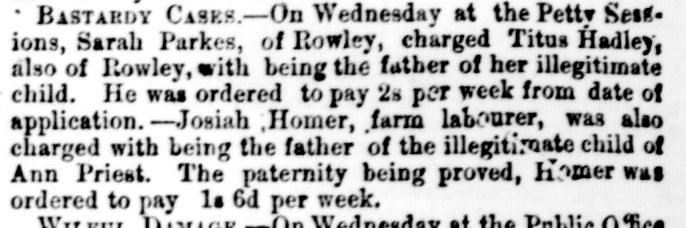





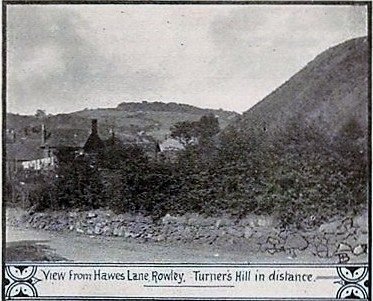


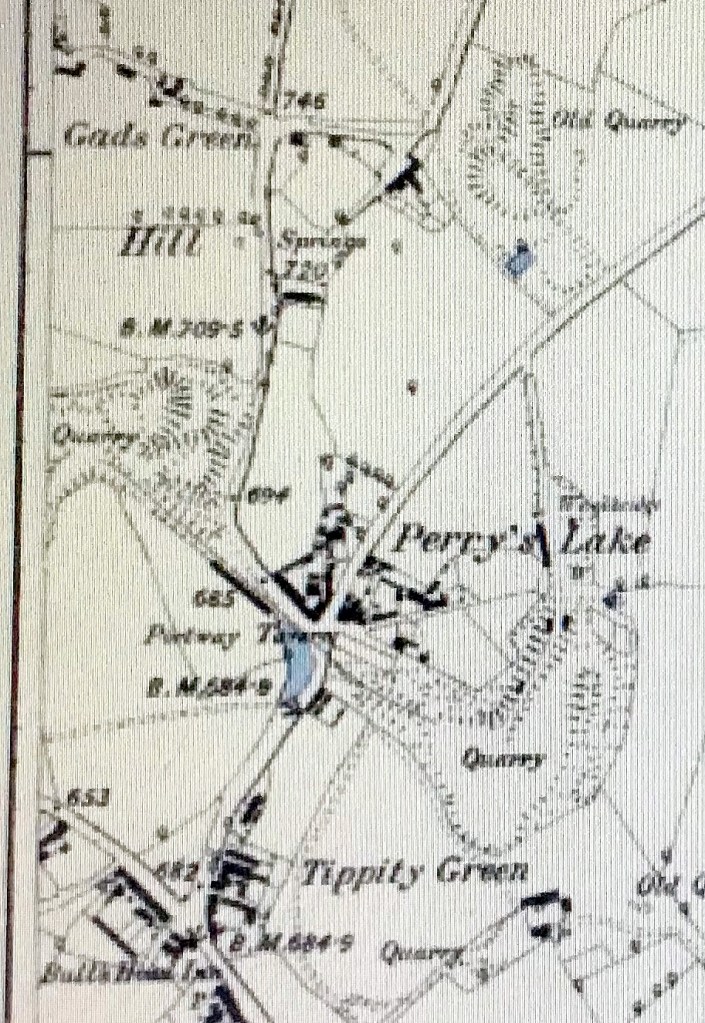
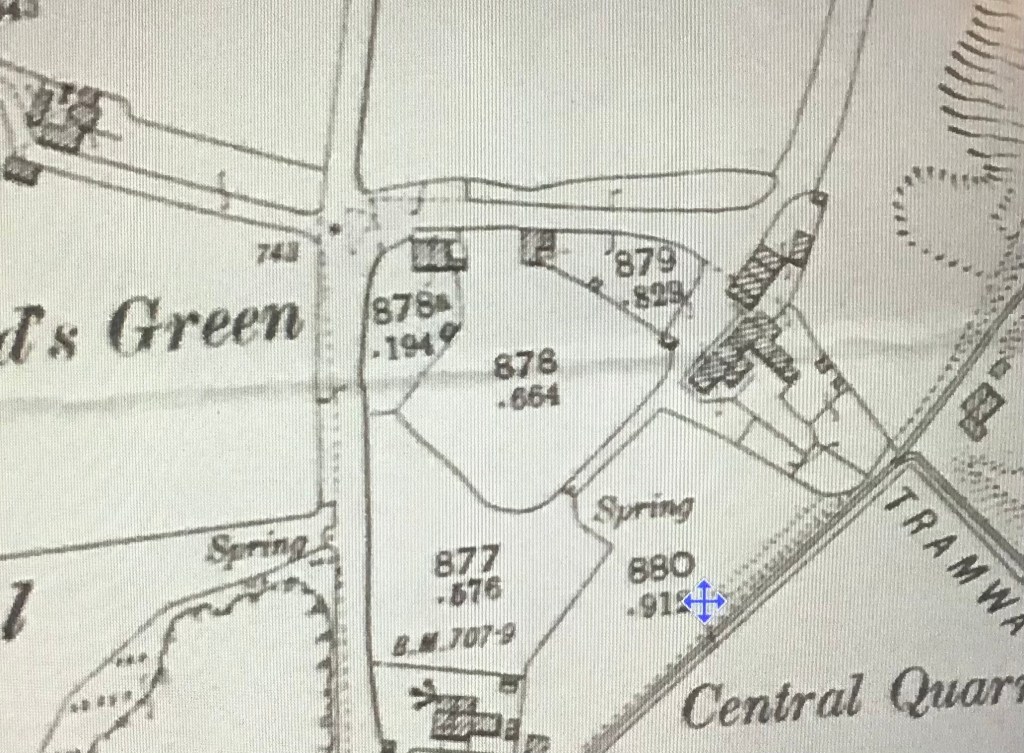
 rowleyregislosthamlets.co.uk