A side helping of Nocks
This piece started out as part of my piece (still in progress!) about the Levett family but has got rather long so that I have decided to post it separately. But the Nock and Levett families were closely linked so keep an eye out for that instalment. And then there will be the Gaunts…
According to the Halesowen Parish Registers, on 6 October 1581, Johane, the daughter of Thomas Nocke, was buried there. This appears to be the only Nocke entry in the Halesowen Registers between 1559 and 1643 but I include it out of interest. There were Nocks in Dudley, too but I am still exploring these, there was certainly a Tobias Nock baptised there in the mid-1700s and a Tobias who was a cordwainer in business there in 1784 so it seems likely there is a connection. I shall continue to investigate this but have concentrated on the Rowley Nocks for the moment and have grouped these together below, although some of the connections are not clear.
The first Nocks to appear in the Rowley parish registers are in 1607 when Olyver Nocke married Jane Murlow. An Oliver Nock was baptised in Sedgley on 11 Mar 1575 and it seems likely that this is the same man and is another indication that there are family connections within the Dudley area. There are no baptisms of children recorded to Olyver and Jane in Rowley so perhaps it was the adult Olyver who was buried on 27 Jan 1612/13.
William and Anne Nocke Entries 1610-1623
On 18th November 1610 a William Nocke married Anne Grove. The baptism of two daughters to this couple were noted in the register – Elizabeth on 28 March 1610 and Mary on 6 Mar 1611. It was noted in the Register in March of 1613 that William Nock had been one of the Church Wardens for the past year so William was obviously well respected in the village. Where exactly he lived is not clear. This was followed by the baptism of son John on 15 May 1615, and Richard on 2 Nov 1617 and this is possibly the Richard Nock who was buried at St Giles on 19 April 1647.
On 17 September 1620 William, son of William Nock was baptised. This was followed on 23 Oct 1620 with the burial of a William Nock. Father or child? It seems likely that it was the child baptised in September 1620, as on 3 October 1621 another William, son of William Nock was baptised. Then on 25 September 1623 William Nock was buried – father or child? There is no clue in the register but there were no further baptisms for children of William Nock so perhaps this time it was the adult William.
John Nocke, Clark (sic) was buried in Feb 1624. The introduction to the Registers suggests that he may have been Parish Clerk. If so, he was an early example of the literate Nocks. Perhaps William and Thomas whose details I am listing were his sons, we do not know but certainly unless there are substantial gaps in the Registers, there were not many Nocks about then in Rowley so it seems quite likely. And there were recurring Nock family names, for both boys and girls in these families in the records that follow.
Thomas Nocke Baptisms 1624-1639
Another family of Nocks appears in the Registers in 1624 when Elizabeth, daughter of Thomas Nock, baptised on 6th November, there is no marriage recorded for Thomas so perhaps he was married elsewhere. This is the second time that the eldest daughter was named Elizabeth, William Nocke had also called his first daughter Elizabeth. If, as I suspect, William and Thomas Nocke were brothers, might their mother’s name have been Elizabeth?
Then there is a record of the burial of a Thomas Nock in March 1626 and then, thirteen years later, the baptism of Jane, daughter of Thomas Nocke on 26 Jan 1639.
John and Anne Nocke 1641-1655
In 1641, on 10 February, a John Nocke married Anne Hill. This may well have been the John, son of William who was baptised in 1615, as he would have been about 25 in 1641. Hill is also a common name in Rowley and there were many Hills in the very early registers so they were definitely a long term Rowley family. I cannot find a baptism of an Anne Hill in Rowley at this time but there are notes of torn pages, etc so it is possible that a record is lost or that she was baptised elsewhere.
The baptisms of several children of John and Anne then followed. John, on 12 May 1642; William on 31 Dec 1643; Anne on 14 Feb 1646. Then there is a baptism of a Mary Nock on 6 October 1651. Mary was recorded as the daughter of John Nocke and Mary, not Ann. So were there two John Nockes baptising children at the same time? Or was the name of the mother in the record for Mary an error, substituting the name of the child for the mother? It is impossible to be sure but there were no other baptisms for John and Mary in this period so it seems feasible that it was an error. Two more children were later baptised to John and Anne, so certainly it does not seem that Anne had died and John remarried – an unnamed child of John Nock was baptised on 16 Jul 1654 and Elizabeth on 29 Sep 1655. After that, no more children were baptised for this couple.
Josiah and Judith Nock Baptisms 1657-1663
In 1657, during the Commonwealth period, when the recording of life events was much changed, a new family of Nocks appears in the Registers. John, the son of Josiah and Judith Nock was born on 25th December 1657and baptised on 17th January 1657, followed by his brother Josiah, born on 5 June 1660 and baptised on 18th June. Another son Thomas was baptised on 13 Dec 1663 (after the restoration of the monarchy so the Commonwealth requirement to record dates of birth had gone!)
Nock burials in this period include Thomas Nocke who was buried on 5 July 1659 and William Nocke on 25 Dec 1664.
John Nock 1665
The name John Nock reappears in 1665, ten years after the last baptism for a child of John and Anne Nock, when Anne, daughter of John Nocke was buried on 23 January 1665, perhaps the Anne who had been baptised in 1646.
John and Joan Nock 1667-1680
Then on 19 October 1667, William, son of John and Joan Nock was baptised, followed by the baptisms to the same couple of Joseph on 22 September 1672, Thomas on 5 March 1675, and Mary on 7 September 1680. Was this the John who was earlier married to Anne? That would make this John 65 by the time the last child was baptised so I am inclined to think it was not but the next generation.
More Nock burials
Elizabeth Nock, widow, of Hales (Halesowen) Parish was buried at St Giles in July 1684 and Joane, wife of John Nock was buried on 5 September 1684. John Nock was buried on 20 December 1693 and Ann Nock, widow was buried on 22 January 1694.
Following the death of Joane, there is a confusing series of entries.
William and Dorothey Nock – Baptisms 1687-1706
I have not been able to find a marriage for William Nock to a Dorothey but a Dorothy , daughter of John Williams was baptised at St Giles on 22 Mar 1662 which would make her about the right age to be marrying and having children in these dates so this may be her. On 25 Dec 1687 John, son of William and Dorothey Nock was baptised, followed on 21 April 1689 by their daughter Jone. On 8 April 1692 daughter Sarah followed and on 20 May 1694 another son Joseph. On 26 December 1695 Thomas was baptised and on 4 April 1697 Samuell, then Ann baptised on 26 Dec 1701, Moses on 15 May 1704 and Mary on 14 Jul 1706.
Right in the middle of that sequence there was an entry on 2 Mar 1690 for the baptism of a William, son of John and Dorothey – or should that be William, son of William and Dorothey? There are no other baptisms to a John and Dorothey at this period. John and William are both Nock family names and it appears that William and Dorothey already had a son John in 1687. It seems very odd that a second Dorothey should appear for this one baptism so I am inclined to think that this is an error and that this child was another child of William and Dorothey, and the date, a year after the baptism of Jone in April 1689 and before Sarah on 8 April 1692, means that he would fit very naturally into the sequence. That’s my theory, anyway! I may be wrong…
Joseph & Ciceley Nock appear just once together in this register when their daughter Sarah was baptised on 6 Oct 1695. Joseph Nock was buried on 23 November 1697, Ciceley Nock, widow was buried on 18 April 1710.
Thomas and Dinah Nock Baptisms 1695-1718
Also in 1695 another family begins baptising children at Rowley. John, son of Thomas and Dinah Nock was baptised on 2 February 1695/6, followed by daughter Ann on 14 May 1699, son Joseph on 4 January 1701/2, Elisabeth on 17 Dec 1705, William on 21 Nov 1708, James on 20 May 1711, Benjamin on 16 Feb 1716 and finally Sarah on 8 Jun 1718.
John & Hannah Nock Marriage and baptisms 1711-1718
On 21 May 1711 John Nock married Hannah Foley. It seems likely that John was the son of William and Dorothey who was baptised in 1687. And perhaps Hannah was the child of Thomas and Hanah Foley who had been baptised on 10 February 1688 at St Giles.
Their daughter Mary was baptised on 23 March 1712 but buried less than a year later on 21 Feb 1713. Their son William was baptised on 15 May 1715, and daughter Sarah on 27 January 1717/18.
William Nock & Elizabeth Bibb Marriage and baptisms 1714
A couple of years after John’s marriage, William Nock married Elizabeth Bibb on 7 November 1714. Again, it seems likely that William was the son of William and Dorothey, he had been born in 1690, and was the brother of John. Elisabeth may well have been the Elisabeth who was baptised at St Giles on 1 August 1692, the daughter of Benjamin and Elisabeth Bibb.
On 19 July 1715, their first child Elisabeth was baptised, followed by Jone on 8 Oct 1716, Benjamin on 8 Dec 1717, William on 15 Nov 1719, Tobias on 8 May 1721 who was buried on 29 Jan 1723/24, Joseph baptised on 28 Sep 1723, Dorothy on 11 Jun 1726, Tobias on 10 Jun 1727 and Phebe on 29 Sep 1731, the last child of the couple listed.
Enough, enough!
I am not going to attempt to list all the Nocks in Rowley (and all the Nocks entries from 1733-1744 are recorded as Knocks and occasionally as Nocke which adds to the fun!) from here on, as they now become too numerous but I suspect that most of the later Nocks in Rowley parish are part of this family, although many of them fall outside the immediate area of the Lost Hamlets.
The child of William and Elizabeth I am following up from here on is Tobias Nock, baptised in 1728 and his descendants because he appears to have stayed in the village and possibly in Portway and he is the one who is linked to the Levett family which was where this research started. I will continue to research the other Nock children in this family as these Nocks are on my family tree so I will be researching them in more detail at some point.
Tobias Nock the Elder 1728-1791
Tobias Nock (1728-1791) was a Rowley boy, probably born early in 1728 in Rowley as he was baptised at St Giles on 10 Jun 1728, the son of William and Elizabeth Nock. He had married Catherine or Kitty Fletcher, apparently in Coventry, in 1750. They had at least seven children – Sarah in 1751, Deborah in 1753, Catherine in 1760, Tobias in 1764, (dying in 1765), another Tobias in 1766, Elizabeth in 1769 and Henry in 1773, all apparently in Rowley Regis. It is not possible now to be sure where Tobias lived but in his Will he left a substantial number of properties in Rowley, Old Hill and Oldbury, as well as his nail ironmonger’s business and specifically left the house in which he was living in Rowley to his wife Catherine. His son Henry also lived in Rowley at this time, probably in Portway House or Hall so it may be that Tobias lived there, too. Tobias’s house was evidently a substantial house so Portway Hall is a possible candidate.
Tobias Nock the elder died on 5 March 1791, presumably in Rowley but he was buried on the 10th March 1791 in the Friend’s Burying Ground at Dudley. (Quaker records are very detailed) Interestingly another daughter of Tobias and Catherine, Elizabeth, born in 1769, died in 1842 and there is a note in The Annual Monitor of Quaker Published Memorials for that year that Elizabeth Nock, aged 74 and living in Dudley had died – and she was described as a Minister, most unusual for those days for a woman, though possibly more common in the Quaker movement. And I have noticed that amongst these Quaker or Presbyterian families, not only are the men literate but many of the women are, too, really quite unusual for those times. And also I have noticed that these men often left property or businesses to their wives, so that women were treated much more equally than elsewhere in society generally then.
The Nock family do not feature very much in the books about the history of Rowley Regis, I can find no mention of them in J Wilson-Jones’s book and only two mentions in Chitham’s book, one of those about a James Nock who kept a pub in Reddal Hill, rather than Rowley village. Chitham notes that by 1860, amongst the Coalmasters in Rowley Regis were Nock, Wood and Nock in Rowley village so they were still active in business and commerce then. But neither writer mentions the earlier Nock family so I was quite surprised to discover the extent of their businesses in the area and wealth by the late 1700s and later.
And Tobias Nock the Elder was a very wealthy man. In his will, proved in 1792, he left a large number of properties in Rowley, Oldbury and Old Hill to various relatives, plus a cash sum of £200 to his daughter Deborah, (married to John Levett Snr and living in London). £200 would be worth about £38,000 today. He also left £50 each to his two Adshead granddaughters, worth about £9,500 now.
To his wife Catherine Nock:
“all the house and appurtenances wherein I now dwell and also all those twelve dwelling houses, shops, gardens and appurtenances situate in Rowley Regis aforesaid in the several holdings of Daniel Davis, William Downing, George Taylor, Josiah Winsor, Samuel Perry, Esther Bridgwater, Isaac Parkes, William Collouth, Joseph Windsor, James Carter, Joseph Smith and William Bolton and also all that croft of land called the Sling adjoining in his own possession with all his household goods and furniture to hold the same to his said wife during her natural life”
- After her death, his household goods and furniture were to be divided equally between his two daughters Catherine and Elizabeth;
- After his wife Catherine’s death, all the said buildings and land above mentioned to his son Tobias Nock of London, Ironmonger, his heirs and assigns forever subject to the payment of two hundred pounds to his daughter Deborah Levett.
To sons Tobias and Henry:
- all his stock in trade, money, outhouse and cart and all implements belonging to his trade. Subject to the payment of all his debts and also subject to the payment of forty pounds apiece to his three daughters Deborah, Catherine and Elizabeth to be paid to them at his decease and his son Henry shall have one hundred guineas out of his trade [more]than his son Tobias.
- To sons Tobias and Henry all that the freehold estate in Oldbury in the parish of Halesowen in the County of Salop in the several holdings of Henry Richards, Joseph Darby, Peter ffisher, Thomas See, William Stevens Kilsey, Thomas Danks, and Iseury Holloway to hold the same to their joint use during the natural life of his said wife Catherine Nock and after her decease he gave and devised the same to his son Henry Nock, his heirs and assigns forever subject to the payment of fifty pounds apiece to each of his granddaughters Elizabeth and Harriet Adshead.
To Catherine Nock:
- All the freehold estate situate in the parish of Rowley Regis in the County Stafford in the holding of Job Hawkner.
To Elizabeth Nock
- all those several closes or points of pasture land and also those five dwelling houses shops gardens and appurtenances situate at Old Hill in the parish of Rowley Regis in the County Stafford now in the several holdings of John Westwood, John Johnson, Shelley Garrett, Hannah Garrett and the Widow O’Hara.
Jointly – what appears by my Stock Book to be saved by his hand from the date of his decease he gave equally amongst all his five children”
So, a detailed and extensive estate distributed around his family. Were his tenants nail-makers producing nails for him and his son to sell? It seems likely.
And in 1805 Catherine, daughter of Tobias and Catherine Nock, was married at the Quaker Meeting House in Stourbridge to Thomas Martin. She died on 9th March 1816 and was also buried at the Dudley Quaker Burial ground where her father had also been buried. So the Nock family clearly had a strong connection with the Society of Friends. In fact in his fascinating book ‘Men of Iron’ Michael Flinn states that “the greater part of the iron industry of the day was controlled by closely linked Quaker groups”. So it would not be surprising to find such a link. The Nock family appear to have been amongst the Rowley folk who were more than just nailers but also, like the Crowley family, moved during the late 1700s and onwards into selling and distributing the nails made in the Rowley area in London and possibly elsewhere.
The London connections of the Nock family
All of this is in the period when my 6xg-grandfather Edward Cole married in London in a Fleet marriage. It seems to me increasingly likely that families like the Crowleys and the Nocks employed local men from Rowley to transport the nails from Rowley to their London warehouses or to work for them there, leading to their presence in London at that time. Tobias’s Will leaves his business to his sons, along with “all my stock in trade, money, outhouse and cart and all implements belonging to my trade” so he definitely had a cart as part of his business.
Incidentally, the family of Ambrose Crowley of Stourbridge, blacksmiths, nail factors and ironmongers, who had originated in Rowley Regis, were also Quakers, albeit some years before this. And their son Sir Ambrose Crowley II, who I mentioned in a previous post, was the ironmonger to the Navy so they were in the same trade, buying nails made in the Black Country and selling them in London. Crowley is known to have had a warehouse in Ratcliffe, Stepney and may have started his business there after he completed his apprenticeship but there is no definitive evidence on this.
Tobias Nock the Younger
Tobias the Elder’s son Tobias Nock the Younger moved from Rowley to London at some point in the late 1700s to set up as a nail monger and is described in his father’s Will dated 1791 as ‘Tobias Nock of London, Ironmonger ‘. Tobias the younger had married Frances Darby in St Giles church in Rowley on 17 Aug 1789 and their daughter Mary was baptised on 17 May 1790 in Shadwell. Frances Nock nee Darby died in March the following year, presumably back at home, perhaps visiting family, as she was buried in St Giles on 6 Apr 1791.
On 20 Mar 1794 Tobias remarried to Mary Kitson, a widow, at Saint George In The East: Cannon Street Road, Tower Hamlets, and their daughter Katherine was born in Shadwell on 17 February 1795 – we know this because her date of birth was given at her baptism. Alas, Mary died in 1797 and there is a burial at St Paul, Shadwell of a Mary Nocks of Shadwell High Street on 1 Mar 1797.
Tobias had a son Tobias born on 22 February 1799 in Shadwell. Again we know his date of birth from his baptism. Tobias was followed by Eliza in 1803, Deborah in 1806, William Cane Nock in 1811, Frances in 1814 and Edgar Hynson Nock in 1819.
On 26 November 1807, Tobias Nock Junior (who was by then described in a Baptismal Register a “Nail Ironmonger” in Shadwell High Street ) had all five of his children baptised at once at St Paul’s Shadwell, just six days after he had married his third – or possibly fourth – wife in the same church. The mothers of the children are listed against each child and the last three – Tobias in 1799, Eliza in 1803 and Deborah in 1806 – are said to be ‘by his present wife Sarah’. But Tobias had only married Sarah in the previous week so did she bear those children out of wedlock? Or is there yet another marriage to a different Sarah followed by a death and a burial that I have not yet found? Or did the priest misunderstand who their mother was? I do not know but will continue to ferret around this little rabbit hole, watch this space!
Had Tobias followed the Quaker practice of not baptising his infant children but succumbed to pressure from his new wife? It seems quite likely.
Looking at maps
I am not familiar at all with London and have had very little need to consider it up to now in my family researches so, unlike the Rowley area, I generally have not the faintest clue how most areas relate to each other. But I have now found three Rowley families – the Crowleys, the Levetts and the Nocks – with strong connections to the Shadwell/Ratcliffe/Stepney area in the 1700s. So I now have to look at maps to see where people from Rowley lived in London in relation to each other. I had no idea where Shadwell , the home of Tobias Nock Junior was nor Stepney where John Levett (his son-in-law) was born, nor how far apart they were. Google maps tells me that they are less than a mile apart, indeed Shadwell was within the Parish of Stepney. Is that coincidence? M W Flinn in his book ‘Men of Iron’ notes that Thames Street was traditionally the habitat of London Ironmongers’ and the road running through Shadwell and Ratcliffe was a continuation of this road.
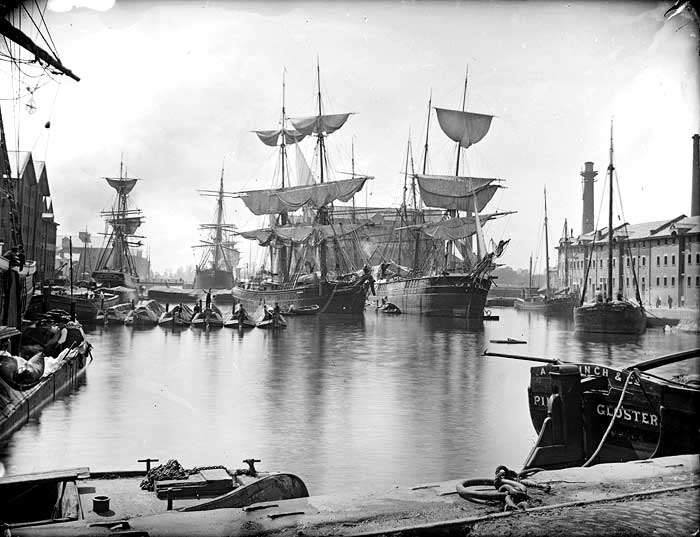
Shadwell is in the docklands, on the bank of the river Thames, not far from Tower Bridge. According to Wikipedia, the area’s history and character have been shaped by the maritime trades. Shadwell’s maritime industries were further developed with roperies, tanneries, breweries, wharves, smiths, and numerous taverns, as well as the chapel of St Paul’s where seventy-five sea captains are buried in the churchyard. The early growth and prosperity of Shadwell in this period has been linked to the road connections into London, which were maintained by wealthy taxpayers from Middlesex, Essex, Kent and Surrey, and presumably used on the way in from the Midlands.
I had hoped to include a map of the area but alas, it was held by the British Library which has been the subject of a disastrous cyber ransom attack which has disabled much of their operation for several months now so I cannot access it now.
There is apparently even today a Shadwell Basin, which is now a fashionable housing area in the Docklands.
St Dunstan’s church in Stepney, where John Levett and his siblings were baptised is recorded as being founded (or more likely rebuilt) by Dunstan himself in 952, and was the first church in the manor, was also known as “The Church of the High Seas” due to its traditional maritime connections. St Dunstan’s has a long association with the sea, with the parish of Stepney being responsible for registration of British maritime births, marriages and deaths until the 19th century. There is an old rhyme:
“He who sails on the wide sea, is a parishioner of Stepney”
I have noted previously that the maritime trades were very large users of nails, and ironmongery for ship building, etc. So perhaps this was an obvious place for a nail monger to have a business, in the docklands, near to the river.
The old saying ‘Birds of a feather flock together’ has some wisdom in it, what could be more natural than to choose to live near to other folk from your home community when settling in a new place where you knew no-one?
John Levett was not mentioned in his grandfather Tobias Nock Senior’s Will but his mother Deborah was. There will be a separate piece on the Levett’s shortly but John Levett was a farmer in Rowley in the first part of the 1800s and the Levetts were among the core families in the lost hamlets. His father was also a John Levett and his mother was Deborah Nock, they had married at St Giles, Rowley Regis on 13 May 1776 when John Levett Snr was a widower of St Dunstans, Stepney, London and a victualler or publican by trade. The marriage was witnessed by her father Tobias Nock (the Younger), just as he would witness his daughter Sarah’s marriage to James Adshead three years later.
Another Great Fire of London
In 1794, many houses in Ratcliffe and Shadwell were destroyed by a fire which “consumed more houses than any one conflagration has done since the Great Fire of London”, and also destroyed many boats, including one laden with around £40,000 of sugar. In fact only one house in Ratcliff survived, so John Levett’s pub must have gone, too. Deborah Levett nee Nock had died in 1794 so I thought for a moment that she might have died in the fire but she had been buried on 15 May 1794 and the fire was on 23rd July.
This is how the fire was described on historic-uk.com
At 3pm on 23rd July, an unattended kettle of pitch boiled over at Clovers Barge Yard, Cock Hill setting it on fire. These flames quickly spread to a nearby barge loaded with saltpetre, a substance used to make gunpowder and matches. The barge exploded violently, scattering burning fragments in all directions. Fires spread to the north and the east, consuming timber yards, rope yards and sugar warehouses.
Narrow streets and a low tide hampered fire fighting, and within a few hours the fire had destroyed 453 houses leaving 1,400 people homeless and displaced. The government erected tents as temporary shelter near St. Dunstan’s Church, whilst the Corporation of London, Lloyds and the East India Company contributed almost £2,000 to the relief of the homeless.
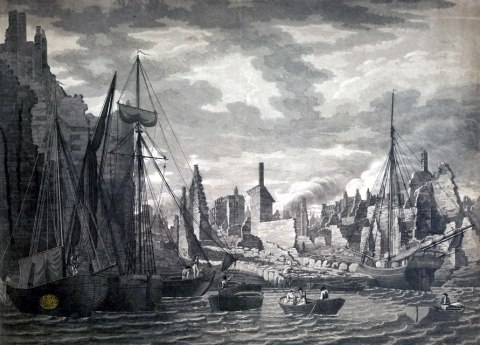
Copyright: Unknown
I have a lot more material on this fire and the area and would be happy to write more on this if people would be interested.
Tobias Nock the Younger apparently stayed in Shadwell after the fire. He and his only brother Henry had inherited their father’s nail monger’s business in 1792 and appear to have managed it together until 1820 when a notice appeared in Ariss’s Birmingham Gazette stating that the brothers – Tobias of Shadwell High Street, Middlesex and Henry of Rowley Regis , nail ironmongers, had dissolved their partnership on 29 January 1820. But some if not all of Tobias’s descendants appear to have stayed in that area for some decades afterwards.
Meanwhile, back in Rowley… The Midlands Nocks – Henry Nock (1773-1835)
At this time Henry Nock, the only brother of Tobias, was living in Rowley and his address is shown in the records of the Presbyterian Chapel at Oldbury as Portway House.
Henry Nock had married Elizabeth Dixon (1777-1852)in 1793 at St Martins in Birmingham and he had stayed in the Rowley area, his children’s place of birth is shown in Presbyterian records as Portway House and the family appear to have later moved to Oldbury where he died in 1835.
Their children were Henry Dixon Nock, (1794-1870) who later moved to farm in Wigginshill in Warwickshire. Why Wigginshill I don’t know as there isn’t much information online about it, except that it had an early Quaker Meeting House. Perhaps coincidence but those Quakers do keep cropping up. Then came Elizabeth in 1796, Hannah in 1799, Agnes in 1802, Catherine in 1808, Ellen in 1809, Philip in 1812, Fanny in 1814, Edwin in 1818, and Joseph in 1820, all born in Rowley. I have not managed to research all of these but I am working on it!
One later descendant Harry Arthur Nock (1865-1946), son of Edwin above, lived for much of his life, according to census entries, in Delph House, Brierley Hill where he was apparently a Corn Merchant or Factor although intriguingly in just one census in 1891 he gives his occupation as a Civil Engineer and Surveyor as well as Corn Merchant – but only in that one census, in all the others he is a Corn Merchant. However, in 1923 he was well enough off to buy Ellowes Hall in Sedgley which was a substantial house and where his children were still living in the 1939 Register, although he was still at the Delph in 1939, retired and living with his eldest daughter Jessie who was an Elementary School teacherand appears not to have married. Harry died at Ellowes Hall (according to the Probate Grant) in 1946 but the house remained in the ownership of his family until 1963 when it was sold to Staffordshire County Council and demolished.
The Henrys and the Harrys
There are dozens of Henry/Harry Nocks in the area, often close in age to each other, it was very much a favourite family name. They take some careful sorting out. For example, in 1851 there were two Henry Nocks, one living at 10 Dale End, Birmingham and a grocer and one at 44 Dale End, Birmingham and a Corn Dealer. This caused me some confusion although at present I have only been able to link the second Henry to this branch of the Nocks. Nevertheless the other Henry Nock was born in Tipton/Dudley so it seems likely that they were related in some way.
Tobias was another recurring name, in the Nock family, which may indicate an early connection between branches.
So that is a limited look mostly at the early Nock family, of Rowley Regis and Portway, with their many descendants, who appear mostly to have been in business in the Midlands, Dudley, Birmingham, Coventry, Oldbury, Brierley Hill, Sedgley, Sutton Coldfield, Smethwick – some as corn factors, some as farmers, others in various professions. They were a family of businessmen, dealers, shopkeepers, iron-founders, nail factors, iron-mongers and were mostly well-to-do by Rowley standards. They were literate, they kept a low profile, they left Wills – often leaving their estates to their wives, they appear as executors in the Wills of relatives, they were generally very respectable and very industrious. They appear to have been dissenters for many years and possibly to have Quaker connections.
As I have shown at least one branch moved to London in the late 1700s and it seems very likely that some descendants from that branch remained there. For any readers who have Nock connections, and I know there are many still in the area, I hope you find this interesting and even that this may give you some clues about your family tree – or perhaps you can give me some. Contributions welcome!
When I started looking at this family, I did not think I had any connection and had only one Nock on my family tree, William Henry Nock, known as Harry (of course!) and born in Waterfall Lane, Blackheath and who had married my second cousin Edith in 1959. I remember Harry with great affection, he was a lovely man, what Edith and my mother described as ‘one of nature’s gentlemen’.
Now I have dozens of Nocks in my tree, though most of them are very distantly connected to me.
A most interesting family!









 rowleyregislosthamlets.co.uk