Poisoned by his wife…

This is not strictly within the Lost Hamlets but concerns a member of the Cole family who was born there – and it’s a fascinating story so I am sharing it with you anyway!

Even after 40 years of research, I still find new facts on my family. Recently I was working on siblings of my 4XG-Grandfather Edward Cole and tracking their descendants, a task infinitely easier than it was when I first worked on Edward himself 40 years ago. With the advent of digitised records and family history programs and online resources, plus, of course, the many subscription services research has utterly transformed. 

Searching through the Cole entries in the St Giles Registers, I came across the Burial Record on 14 March 1832 for my 1st cousin 5xremoved David Cole. The entry says that he was 43 when he died in Mar 1832 and that he was a farmer living in Slack Hillock , off Gorsty Hill. I was picking out Cole burials, spotted the note on his made by the Vicar and was off down a fascinating rabbit hole, irresistible!

A note in the Register , added by the Vicar, says “Poisoned by drinking a composition which his wife retailed as a specific for the gout”. How about that for a damning story in a few words? I had to know more. I did some sleuthing and found a newspaper report in the Wolverhampton Chronicle dated 14 March 1832.

David Cole had woken at about five o’clock in the morning, with a pain in his bowels and had gone to get a nip of rum to settle his stomach. The ‘specific’ made by his wife, was called ‘seeds of Colchicum’ and was stored in the same cupboard as the rum in a similar bottle. The bottle containing the mixture was labelled “Wine of the Seeds of Colchicum” but it was not sufficiently light for him to read it. When he returned to bed he told his wife he had taken some of the gout mixture and she was concerned and wanted to get a physician to purge him but he strongly objected to this, saying that he did not think the mixture would hurt him. He went off to work as usual but returned four hours later at 11.00am, feeling ill and very sick and took to his bed. He died two days later. The surgeon who had attended him later on the afternoon he was taken ill could do nothing and told the inquest that he had taken ‘enough of the mixture to kill half a dozen people’. The jury returned a verdict that he “died from accidentally taking seeds of colchicum, mixed  into liquid, under the apprehension that  it was rum.”
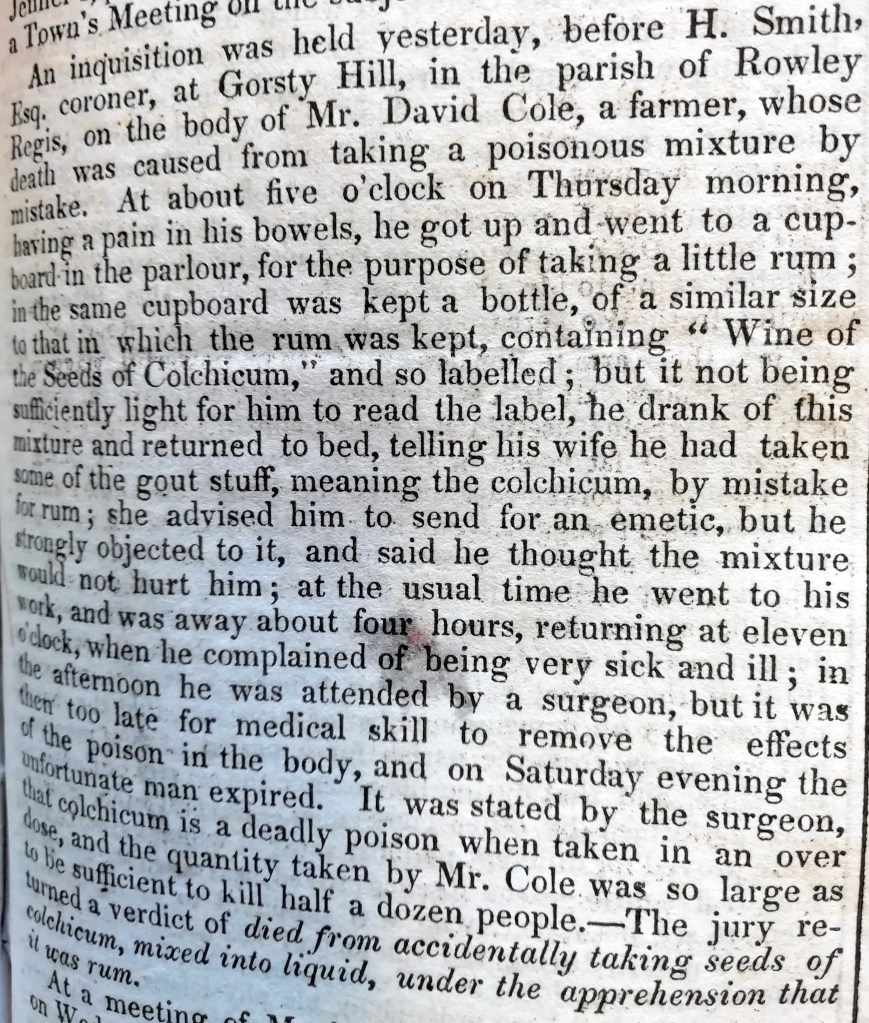
Copyright Wolverhampton Chronicle.

 He left his wife Charlotte with thirteen children, the youngest David baptised in June 1832, after his father’s death so it seems very likely that Charlotte was heavily pregnant when her husband died.  However, the oldest were old enough to be already working, one as a butcher and others on the farm and she stayed there, listing herself as a farmer for many years after that. I wonder whether she carried on selling her remedies?

But doesn’t this little story actually tell us quite a lot about them? Yes, she was a farmer’s wife but also a herbalist of some knowledge and known as such to local people. I wonder who taught her? Perhaps a family skill? When I looked into it, seeds of Colchicum is still listed by present day herbalists as a treatment for gout but with warnings that it is toxic in large quantities and may cause death. And, to my geat surprise, when I recounted this tale to a genealogist friend who has recently had extensive heart surgery, she responded immediately that “Colchicum is still recommended by the NHS! When I saw my consultant a couple of weeks ago, he recommended colchicine for gout”. So an extract of Colchicum is still used by the NHS today. Charlotte Cole actually knew her stuff, it seems.
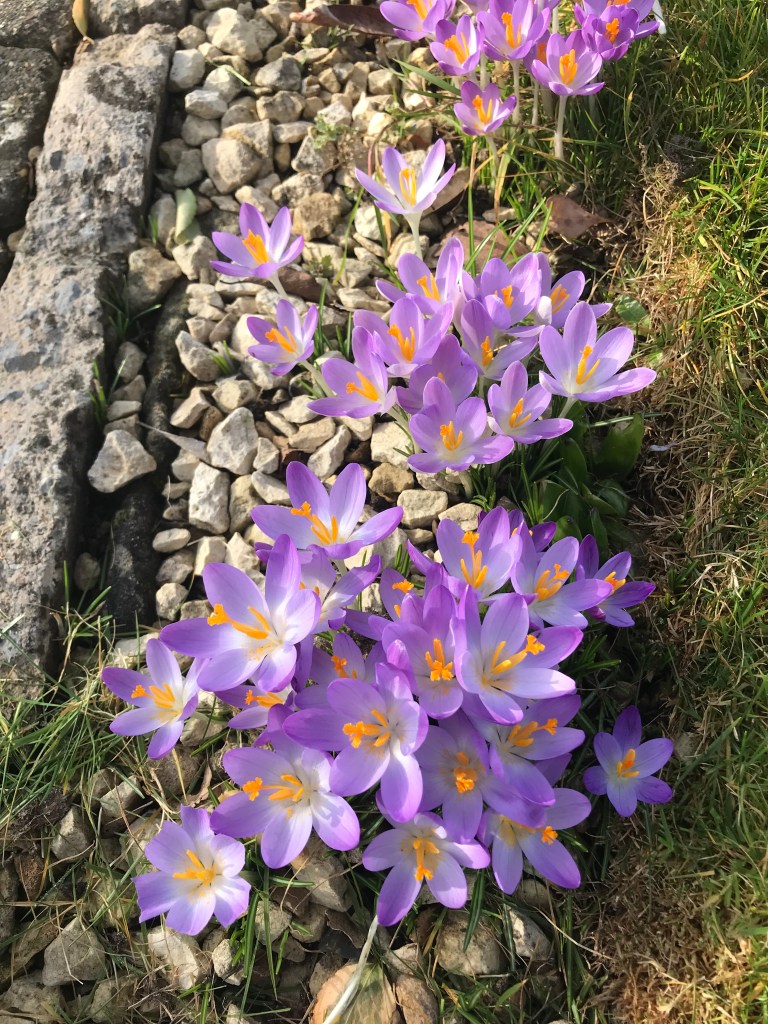
Copyright: Glenys Sykes

And there were few remedies for painful gout in those days, if I remember correctly. Presumably she was known to local people for her remedies, hence the Vicar’s somewhat judgmental comment that she sold the remedy. But they didn’t have pharmacies as we know them then, no picking up a remedy at the chemist or pharmacy as we might and probably most people couldn’t afford to consult doctors.

How devastating for Charlotte to have witnessed this tragedy, her husband killed by her own remedy and to have suffered the reproaches of someone like the Vicar and possibly others for something that was not her fault.

Families in the Lost Hamlets 1841-1881

There are 13 families who were living in the hamlets of Perry’s Lake, Gadd’s Green and Turner’s Hill area for all five censuses which I have so far transcribed. All are familiar Rowley names:

Cole, Cutler, Darby, Foster, Hill, Hipkiss, Levett, Parkes, Redfern, Simpson, Taylor, Whitehall/Whittall and Woodhouse.

A further 9 families had moved in between 1841 and 1851 and were in all four of the 1851-1881 Censuses:

Barnsley, Detheridge, Edwards, Hadley, Harcourt, Ingram, Jones, Knight, Ocroft, Payne and Timmings/Timmins.

Four families were in the 1841-1871 Censuses but had moved on by 1881 – Badley, Downing, Round and Siviter.

When time permits, I will check where these families had moved to.

Certainly there will have been marriages between these families and they were most likely closely interrelated over those years.

This information will be updated as more censuses are transcribed.

The ‘Lost Hamlets’ of Rowley Regis

Rowley Regis was once a small ancient village on the top of a very high hill in South Staffordshire, now apparently absorbed seamlessly into the enveloping sprawl of the West Midlands conurbation. It has had several other municipal designations due to local Government re-organisations in the last century but historically, it was in South Staffordshire – that’s what it said on my school exercise books, so I know! The other, less defined, description is that Rowley Regis was in the Black Country, that nebulous area of industry, metal working, mining, quarrying and sheer hard work and where probably most of the population lived in what we would think of now as poverty. 

Although Rowley Regis is an interesting name – yes, at one time, part of it was held by the King, possibly as a hunting area – by the 19th century the village was of no particular note, the main industries in and around the village were quarrying the very hard ‘Rowley Rag’ stone from various quarries on the hill, mining and, above all, in Rowley itself, wrought iron hand nail making which was mostly carried out in small ‘shops’ at the back of houses, and involved whole families, men, women and children from about the age of six. The metal working skills of the local people and the plentiful supplies of the raw materials required meant that, as the Industrial Revolution progressed, hand nail and chain making fell into history and the metal working and myriad engineering skills gave rise to a vast landscape of heavy and polluting industry, canals, mines and brickworks.

I am a Rowley girl. I was born there, grew up and was educated there and lived there until I was eighteen. My parents and grandparents and many of their forebears were born there too and lived out their lives there. My mother told me stories about the area when I was growing up and I started my family history research in about 1980 and have been working on it ever since.

Retired after many years working in local government and now living in the West Country, during the first Covid lockdown I volunteered to transcribe parish registers at home from photographs for FreeREG, for Rowley Regis and Blackheath, the adjacent town which developed just down the road in the mid 19th Century, after the glebe lands belonging to the church were sold. This has included many non-conformist registers, which have never been available online previously.

Very quickly I noticed that many of the family names in those registers were familiar although some of them I had not come across for many years, since I moved away. But I had been at chapel and school with those names! It was also apparent from the Registers and from the various censuses that as well as the village proper, there were a number of hamlets on the edge of the village, some large and some small, and that families tended to stay within these hamlets or nearby. They appear to have been close-knit little communities. Some of my ancestors seemed to stay very firmly in and around the hamlets of Perry’s Lake, Gadds Green, Tipperty Green and Turners Hill, for example, which were very small settlements barely a mile from the village church and within half a mile of each other.  Gradually as houses were built, new roads opened, transport improved  and development spread, addresses were formalised and house numbers began to appear in the parish registers and censuses and some of the old names for the hamlets became less significant.  

There is a very active and informative Facebook page about memories of Rowley Regis and Blackheath, the town. Recently one person asked on the Facebook page where Gadds Green was, because Poppy memorials were being placed near the homes of soldiers who had died in the First World War and one of those had come from Gadds Green. She couldn’t find any trace of it.  I had not realised until then that quarrying had completely obliterated Gadds Green, and much of Perry’s Lake and the houses on Turners Hill – they only existed now on old maps. Other local names do not even appear on maps – there has been some animated discussion on the page about where a place called ‘Finger-i-the-hole’ was and most local people will never have heard of Blackberry Town, which appears in the 1841 census.

Several of the local historians using the page were able to tell the Facebook enquirer where Gadds Green had been. But it seemed a pity to me that these lost hamlets, home to so many of my ancestors, have not only physically disappeared but are now fading from local memory. Through my various researches and transcribing church registers and censuses, I have gathered quite a lot of information about these places, who lived there, who ran the shops and pubs, where people worked and worshipped and who married who.

So I have decided to create a One Place Study about these ‘lost hamlets’. My study will initially concentrate on the hamlets of Perry’s Lake, Gadd’s Green and Turner’s Hill, clustered to the North-West of the village centre, during the period 1840-1921, principally looking initially at censuses, parish registers , maps and what these can tell us about the people who lived there. The people and their lives are my main interest. I suspect that it will expand both geographically and in time period as particular information and resources come to hand. I will be posting to this site with new posts about aspects of life in the hamlets and will add maps and photographs in due course.

And by starting a One Place Study, now registered with the Society for One Place Studies, hopefully information about the people who lived in those ‘lost hamlets’ and in due course, others of the ‘lost hamlets’ can be preserved in a study where other people can also contribute their knowledge to it and where later researchers can find the answer to ‘Where was Gadd’s Green?’.