Families of the Lost Hamlets – Finger-I’ the Hole, the 1841 Census

Having researched the Hill family of Finger-I’ the Hole (later known as Gadd’s Green) at such length in previous posts to my blog, I have been looking at what to explore next.  As I concluded at the end of the Hill family study, it is now apparent that, by and large, the families in Finger-I’ the Hole especially and in the adjoining areas were so closely connected that any family I now investigate there will almost certainly link back almost immediately – in one way or another – to the Hill family.

So I have gone back to the 1841 Census to see who else was living in Finger-I’ the Hole in 1841 and whether or how they related to one another. The 1841 Census does not show relationships and adult ages are rounded down to the nearest five years (mostly, occasionally a presumably accurate full age is shown) and the origins of each person are limited to whether or not they were born in the County.  So there is a certain amount of guesswork about relationships (which can sometimes be resolved by looking at the next census). I will look at the children shown here in more detail as part of further family studies but am just trying to establish how these mixed households related to each other at this point.

Copyright: The National Archives.

This was the census enumerator’s route which is shown on the first page of each batch of the census. It appears that the enumerator was approaching Finger-I’ the Hole from Tippity Green and he later moves on to Turner’s Hill before returning to The Bull’s Head and Cock Green so presumably the first families  listed lived in the first houses he came to as he climbed from Perry’s Lake. There is no mention of Freebodies Farm in this census so it is possible that some of the people listed under Finger-I’ the Hole were living there although none of the occupations are shown as farmers.

The occupations appear to be shown only for the Head of the Household, even though it is highly likely that older sons, the women and some of the younger children would also have been working or making nails. This is better recorded in later censuses.

In censuses, a double stroke after a group of entries indicates that the entries for that household are complete. A single stroke indicates that a sub-group is living in the same house. At the end of the subgroup a double stroke then shows the start of the next household. I am not totally convinced that these were always correctly recorded, perhaps omitted sometimes from the pages I am looking at as at times it appears that there is yet another group living in the same household but the stroke or double stroke are not shown. But I will work on the basis of what is shown. Where I have been able to find the maiden names of the married women I have added these in brackets, these were not shown in the Census.

My apologies that the correct layout for the table has not copied over from Word so some names are spread over two lines – very irritating!

In 1841 then, living in Finger-I’ the Hole, were:

First Group

The Priests, the Taylors and the Hills

Christian nameSurnameAge Occupation Whether born In County
WilliamPriest45 Nail m[aker] Y
Sarah (nee Smith)Priest45   Y
ElizabethPriest15   Y
Sub-household  1      
JosephTaylor40 Nail m Y
Margaret (nee Bagnall)Taylor40   N
EmmaTaylor12   Y
JosiahTaylor10   Y
ThomasTaylor8   Y
MariahTaylor6   Y
Sub-household  2      
ThomasHill45 Nail m Y
Catharine (nee Taylor)Hill45   Y
ThomasHill15   Y
ElizaHill15   Y
JamesHill12   Y
ElizabethHill9   Y
JosephHill7   Y
JohnHill5   Y
CatharineHill5m   Y

So were there really three families living in one house here? Three adult men, nailmakers, with their families of one, four and 7 children respectively? It seems there were. Or perhaps this was a once larger house sub-divided, as discussed previously in my blog.

Were they related to each other? Yes, certainly in at least some of the cases.

William Priest had married Sarah Smith at Harborne on 3 October 1813. The parish boundary of Harborne at this time covered all of the Hill part of what later became the town of Blackheath and also included much of Whiteheath. So, although this couple had not been living in the Lost Hamlets at the time of their marriage, they were probably close by.

I have not yet identified how or whether William Priest and David Priest, the husband of Ann Hill and living just a few doors away, were related but I have not yet researched the Priest family in detail so that may yet emerge. They do not appear to have been brothers but I have more work to do on David Priest’s family.

Nor have I yet discovered whether Sarah Smith was a Rowley girl but again, that may become known. Sarah’s age, given as rounded down to 45 in the 1841 Census seems to be given ten years later in the 1851 Census as 43 but it is possible that this is not the same Sarah so more research is needed. There were 17 Sarah Smiths baptised in Rowley Regis St Giles alone, between 1790 and 1810 and another 21 at Dudley St Thomas, so it is not going to be a quick process to identify her with any certainty and for these marriages before Civil Registration started in 1837, family details are not given so I do not know who her parents were!

However, looking at the marriage of the next couple listed – Joseph Taylor to Margaret Bagnall, – I was interested to find that this took place at Kingswinford on 19 May 1823. And on the same day, Thomas Hill married Catherine Taylor, also at Kingswinford – a double wedding of the Taylor siblings, presumably. So finding those two families living together now makes more sense.

So there were connections between at least part of this household and their neighbours but more to be investigated.

Second Group

The Hipkisses, the Whitehalls & the Taylors

Christian NameSurnameAge Occupation Whether born In County
JohnHipkiss70 Nail m Y
Ann (previously Nock, Nee?)Hipkiss60   Y
PaulHipkiss20   Y
Sub-household      
SolomonHipkiss30 Nail m Y
Sarah (nee Brookes)Hipkiss30   Y
ThomasHipkiss9   Y
HannahHipkiss7   Y
MariaHipkiss5   Y
AnnHipkiss3   Y
(N/k in this census, actually Solomon Jnr) 5m   Y
       
JohnHipkiss Jnr30 Nail m Y
Priscilla (nee Guest)Hipkiss25   Y
SelenaHipkiss8   N
HenryHipkiss3   N
WilliamHipkiss7m   N
Sub-household  1      
JosephWhitehall59 Nail m Y
Sarah (prev.Taylor, nee Hipkiss)Whitehall69   Y
Sub-household  2      
ElijahWhitehall25 Nail m Y
Ruth(nee Priest)Whitehall25   Y
SarahWhitehall6   Y
TabithaWhitehall4   Y
EmanuelWhitehall2   Y
       
PhilissTaylor35   Y
MaryTaylor12   Y
JosephTaylor9   Y
SamuelTaylor7   Y
WilliamTaylor5   Y

Another interconnecting group –

Looking at John’s history, John Hipkiss Senior, from his age in the 1841 Census and at the time of his death in 1850, was born in about 1770. There were three possible John Hipkisses baptised about this time, two at Dudley St Thomas and one at Harborne. Only one was actually born in 1770, John, son of George and Margaret Hipkiss who was baptised on 25 Feb 1770. Another John, son of Edward and Mary was baptised at Dudley on 29 April 1764, which is a little early. The third John was baptised at Dudley on 5 December 1773, the son of John and Sarah. None of these seem to have died in infancy so it is not really possible to know for sure which was this John. However, none of this John’s numerous children was called Edward, George or Margaret so it is possibly the son of John and Sarah that we are looking at.

A Rowley killing

I noted an intriguing burial entry in the St Giles Register on 18 December 1792 when a William Richards was buried with a note that he had been “killed by Jno. Hipkiss”. Sadly I have been quite unable to find out any more about this event, whether or not there was an inquest or a trial, no mentions in the Press and whether this is the same John Hipkiss.

Military Service

Whilst researching, I also came across an entry in the Royal Hospital Chelsea Records for a Sgt. John Hipkiss who was discharged from the 37th Regiment of Foot in August 1808 suffering from ‘diseased viscera and broken constitution’. I looked up viscera and it apparently refers to the soft internal organs of the body, including the lungs, heart, and the digestive and reproductive systems. Quite a poorly man, then. His age was given as 32 (so born in 1776) and his place of birth as Rowley, Staffs so it is possible that this is the same John. Interestingly there was another Hipkiss from Rowley on the same page of hospital records, a Corporal Joseph Hipkiss who had been discharged in October 1806, following a severe fracture at what looks like Trinidad – although the writing is not good and it may be that this is an obscure medical term I do not recognise. This Joseph was 36 then, so born in 1770. This was during the Napoleonic Wars when Britain was at war with France, which continued until 1815, and 1/6th of all British men served in the army or navy during this period. They may have been brothers or cousins but Rowley was a large parish. There were probably a lot of Rowley men who served in the army during this time.

 John’s marriages and offspring

However, it may have been this John Hipkiss who married an Ann Shaw in Dudley St Thomas in 1794, when he was about 24, the marriage witnessed by Sarah Hipkiss and J Bond. And it may have been this Ann, the wife of a Hipkiss who was buried at St Giles on 26 July 1798. An unnamed child of John Hipkiss  was buried at St Giles on 19 August 1798, less than a month later and it is tempting to think that Ann may have died in childbirth and her baby a few weeks later.  I cannot be sure but it is possible.

Certainly a John Hipkiss, a widower, married a Sarah Day, a spinster at Dudley St Thomas on 15 January 1799, just a few months later.  Joseph Hipkiss, the son of John and Sarah was baptised at St Giles on the 5 January 1800, possibly or possibly not the Joseph Hipkiss buried at St Giles on 20 July 1802. Mary, daughter of John and Sarah Hipkiss was baptised at St Giles on 12 February 1804. On the 14 September 1806, Sarah, wife of John Hipkiss was buried at St Giles and only three weeks later, John, son of John Hipkiss was also buried there. Draw your own conclusions, but sadly I suspect that John had lost another wife and child in childbirth.  And it seems possible that John had at least one living child to care for and would need another wife.

In addition to the birth of Solomon to Ann Nock, there is a baptism on 25 December 1807 of a John Hipkiss, son of Jno. and Ann Hipkiss at St Giles. Where does he fit into the picture? – I really don’t know since Ann Nock and John Hipkiss were not married until 25 November 1811. Perhaps John Snr managed to fit in yet another marriage in between which I have not yet found!  

So I think it is fair to say that John Hipkiss Senior, as he appears in the 1841 Census, had a fairly complicated marital history. But it appears that he had at least one son – Solomon Nock– born before he married Ann Nock and that this Solomon was still living in his house with his own family and who continued to use the name Solomon Hipkiss for the rest of his life. Next door to them was John Hipkiss Jnr, born to John and Ann in 1807. There had also been twin sons James and Daniel born to John and Ann, and baptised on 8 December 1811, just a month after their marriage. I wonder whether the curate had realised that John and Ann were not actually married and put pressure on them to marry before the twins were born? Little Daniel’s burial on 1 January 1818 has a note that he, aged 3 weeks, had been found dead in bed with his mother. His twin James was buried a few months later on 29 April 1812, aged 20 weeks, of a bowel complaint.

Solomon Hipkiss and his family are in the household of John Hipkiss who appears to be the right age to be his father. However, I can find no trace of baptism for a Solomon Hipkiss anywhere in the area. He is very consistent in the 1841 Census, later censuses and his age given at the time of his death in 1884 that he was born in about 1810 in Rowley Regis and, since he was living with John Hipkiss it seems likely that he was John’s son.

So I looked at children called Solomon who were baptised in Rowley Regis at about that time and there were three.

Solomon Priest was baptised on 26 October 1806, the son of Mark and Rosanna Priest. But this Solomon died in 1808 so that rules him out.

Solomon Trowman was baptised at Rowley on 28 April 1811, the son of Thomas and Mary Trowman. But this Solomon appears to be alive and living in Cradley Heath in 1841 so not our Solomon.

The third Solomon was Solomon Nock who was baptised at Rowley on 24 December 1810, so exactly the right date. He was the ‘base born son’ of Ann Nock. Aha!  And – oh look – I see from FreeREG that John Hipkiss, widower, married Ann Nock, widow at St Giles, Rowley Regis on 25 November 1811, less than a year after Solomon’s birth, their  marriage witnessed by none other than Timothy Hill and also Richard Gaunt who was the Parish Clerk and probably frequently acted as a witness to marriages.  Timothy’s wife Maria had been a Hipkiss until her marriage. Was John Hipkiss related to her? Very probably! So this was presumably the Ann who was living in the household of John Hipkiss in the 1841 Census and it seems likely that Solomon was John’s son, as he subsequently used that name.

Also in the house in 1841 was Paul Hipkiss, who had been baptised at St Giles on 5 September 1819, the son of John and Ann Hipkiss of  Finger-I’ the Hole, John’s occupation given as a labourer. In later censuses Paul is shown as Ann’s son (John’s son, too presumably but he was deceased by that time).

It seems that the John Hipkiss Junior who appears next in the census is the John who was born in 1807. He died, aged 40 and of Gadd’s Green, in 1847 and was buried at St Giles on 28 December 1847 so from the age and date it seems likely this is the same person. Poor chap was noted as having died, on 23 December 1840, of rheumatism which seems unusual as a cause of death but medical diagnoses were somewhat inexact at that time. His death was registered by John Hipkiss of Gadd’s Green, his father and his death certificate was uncertified so that there is no knowing what a medical practitioner might have put.  His death was followed in 1850 by that of his father, who died of old age, aged 80, also of Gadd’s Green and who was buried on 21 July 1850 so both of these Johns were gone before the next census.

John Hipkiss Jnr was living with his wife Priscilla nee Guest. They had married at Dudley St Thomas on 26 March 1832. The witnesses at the marriage were Thomas Allen and Thomas Whitehall, a name which will recur in this family. Their children Selina, aged 8, Henry aged 3 and William, aged 7 months were, unusually for this hamlet, noted as not having been born in Staffordshire. It took a while to find out more about Selina since she was born in 1832, before the start of Civil Registration but I eventually found her baptism at Christchurch West Bromwich where she was baptised as Ann Selina on 31 Jul 1836 with an incomplete note of her birth date as 19 ? 1832, with no month shown.  I found a birth registration for a Henry Hipkiss on 1 July 1838 when the family were at Rood End, near Oldbury  and Henry was also baptised there on 12 Aug 1838. In both baptisms the family were living at Rood End and his father was noted as a collier. The birth of William Hipkis was registered in the Kings Norton Registration District, William was born on 31 October 1840 in Streetly Street, Kings Norton and his father’s occupation was shown as a miner. He was baptised on 22 November 1840 at St Nicolas Kings Norton when his father was still shown as a Coal Miner.

However, by 1841, only a few months after William’s baptism,  the whole family had moved back to Gadd’s Green, possibly because of his illness and so that his family could support them.  

Sub-household:

The Whittalls

Also, apparently living in the household of John Jnr, was Joseph Whitehall, aged 59, as his name  was shown in this census with his family. Elsewhere he is shown as Whittall and there are several other variations of this name in use around the area! There is only one likely marriage for Joseph and his wife Sarah, (aged 69) going by ages of themselves and their children’s ages and that marriage took place at  Dudley St Thomas on 11 April 1813, both Joseph Whittall and Sarah Taylor being widowed. 

Sarah Taylor’s previous husband was Josiah Taylor and they had been married on 13 September 1795 at St Giles. She had eight children with him, from Sarah Taylor in 1796, Mary in 1796, Catherine in 1799, Joseph in 1799, Elizabeth in 1803, Benjamin  in 1803, Phillis in 1805, to Ann in 1806.

Joseph and Sarah remained in Finger-I’ the Hole, or Gadd’s Green as it was subsequently known until their deaths, Joseph died in 1855, aged 75 and Sarah in 1863, aged 93 (according to the Burial Register entry, although I make her age 88), both were buried at St Giles.

More connections:

Hmm, some of those names ring bells. When I look back to the first group, living in the household of William Priest, there are the two Taylor siblings, Catherine and Joseph who had a double wedding in 1823 in Kingswinford. And the ages of those two siblings match, given the five year variance in the 1841, with Sarah’s children.  And it appears that this is who they were. Their re-married mother was living next door to them in Finger-I’ the Hole, in the household of John Hipkiss. And, guess what Sarah’s maiden name turns out to be, when I find the marriage of Sarah and Josiah Taylor? Yes, Sarah was a Hipkiss… And Sarah’s sister was Maria who was married to Timothy Hill, also living in Finger-I’ the Hole, whose family was the subject of my last family study. 

Joseph and Sarah’s son Elijah Whitehall was also living with them in 1841 and he had been baptised at St Giles on 10 November 1813. By 1841 Elijah had married Ruth Priest at Dudley St Thomas on 1 June 1836, a first marriage for both of them, and their three children Sarah aged 6, Tabitha (sometimes known as Sabia or Sabiah), aged 4 and Emanuel aged 2 had been born.  I cannot find baptisms for any of the children at present. The family were great users of biblical names and it is interesting to speculate that they were early Dissenters who had their children baptised by Methodist or Presbyterian ministers. Their use of unusual biblical names implies a good knowledge of the Old Testament.  In later years, Elijah and Ruth had added Paarai (later known as Pharoah) in 1841, Mabel in 1844, Mary in 1846, Charity in 1848, Priscilla in 1851, Abraham in 1854 and Ruth in 1857. Elijah and Ruth remained in Gadd’s Green and Tippity Green for the rest of their lives, Elijah died in 1874 and Ruth in 1883, both were buried at St Giles. I will do some more work on the Whittalls in more detail at some point.

Phillis Taylor: Also with Joseph and Sarah was a Phillis Taylor, born in about 1805 – probably Sarah’s daughter from her first marriage, as the age is correct. Along with four Taylor children – Mary aged 12, Joseph aged 9, Samuel aged 7 and William aged 5. In the 1851 Census, Phillis is still living in Gadd’s Green with Sarah and Joseph Whittall and is described as a widow. It is possible, of course, that Phillis Taylor married a Taylor so did not change her surname but I cannot find a marriage for Phillis anywhere in the area.  I found a baptism on 16 August 1829 for a Mary Ann Taylor at Dudley St Thomas, daughter of Phillis Taylor of Rowley, also a baptism for a Joseph Taylor, also at Dudley St Thomas, on 12 August 1832 when Joseph was described as the son of Samuel and Phillis Taylor of Rowley Regis, Samuel’s occupation given as a nailer.  Phillis continued to live in Gadd’s Green, with various members of the Whittall/Priest/Taylor families but no husband, until her death in 1882.

Curiously I have found a Samuel Taylor, living in Rowley Village in 1861, aged 57 who might be about the right age to be this Samuel . He is a nailer, married to a Mary and has three children – Edward aged 18, Hannah, aged 12 and James aged 9. I was also interested to see that this Samuel was living next door to an Issachar Hipkiss (later known as Hezekiah) who was the son of James Hipkiss and Phebe MoretonPhebe was the sister of Thomas Moreton who was married to Elizabeth Hill. This may be a coincidence but there do seem to be a lot of links between the Hipkiss/Hill/Taylor families, to say the least.

3rd Group

Christian nameSurnameAge Occupation Whether born in county
WilliamWoodall45 Nail M Y
Elizabeth (nee Whithall)Woodall40   Y
EdwardWoodall15   Y
PhebyWhitehall30 Nail M Y
MaryWhitehall10   Y
SamuelWhitehall7   Y

Goodness, what a small household, only 6 people, but still two families.

To look at the second part of this household first, Pheby Whitall was the daughter of Joseph Whittall/Whitehall, living next door in this census,  by his first wife Mary Worton who had died in 1810 a few months after Pheby’s birth. Mary and Samuel appear to be  Pheby’s illegitimate children, had been baptised at Dudley St Thomas, Mary Ann on 12 September 1830,  and Samuel on 4 May 1834, both described as children of Phebe Whittall of Rowley and both noted as illegitimate. So these three fit easily into the web of family relationships in Finger-I’ the Hole.

Woodall, however, is not a common name in the Lost Hamlets area, although there were Woodalls in the Rowley Parish Registers as early as 1611 and a William Woodall as early as 1626 when Elizabeth, daughter of William Woodall was baptised. In later times, the Woodalls tended to be in the Old Hill/Cradley Heath area or Dudley/Tipton/Sedgley. In fact I find that William is definitely a favourite Woodall name, it recurs constantly through the generations.

The age of 45 in the 1841 census means that William was aged between 40 and 44 so that indicates a birth year of between 1796  and 1801 and he was born in Staffordshire. When I searched FreeREG for the baptism of a William Woodall in this period in Rowley and the surrounding area, there were only two baptisms, one at Dudley St Thomas on 6 March 1796 of William, son of John and Mary Woodall, and the other at Tipton, for William, son of Thomas and Ann Woodall. The latter William appears still to be in Tipton in the 1851 Census so it may well be that the William in Rowley was the son of John and Mary baptised at Dudley St Thomas, remember that residents of Turner’s Hill and often Finger-I’ the Hole/Gadd’s Green frequently used Dudley rather than Rowley church.

The only marriage I found for a William Woodall marrying an Elizabeth was on 23 April 1821 at Dudley St Thomas when he married Elizabeth Wythall, both of Dudley. Wythall is not a common Rowley name either. This stymied me for a while. ( I can be quite dense at times!) Until it dawned on me… Hmm, was this a corruption of Whittall/Whithall? And sure enough, Elizabeth Whithall, the daughter of James and Phebe (nee Downing)Whitehall was baptised on 1796, so a good fit for this Elizabeth. And Elizabeth’s brother Henry Whittall was married to Mary Hill, eldest daughter of Timothy and Maria Hill. So that would account for this couple living in the Hill stronghold – Hill family connection firmly established!

I found a baptism at the Old Hill Primitive Methodist church, dated 9 April 1851 for an Edward Woodall which stated that he was born on 3 August 1823, that is, baptised as an adult, and that he was the son of William (a nailer) and Elizabeth Woodall, his abode given as Old Hill. And sure enough, William and Elizabeth are living in Garratts Lane, Old Hill in the 1851 Census and Edward, now a nailmaker and aged 26, is living at the ‘Back of Garratts Lane’, with his wife Ann and three children, Elizabeth aged 6, Jane, aged 3 and Edward aged 1month.

So, as I suspected at the end of my Hill family study, the Woodall family is also closely linked to the Hill/Whittall tribe

The Priest household

Next along the row is the household of David and Ann (nee Hill) Priest which also includes Ann’s brother Joseph Hill and his family: I list them here for completeness but both families were covered in detail in my study of the Hill family.

Christian nameSurnameAge Occupation Whether born in county
DavidPriest35 Labourer Y
Ann (nee Hill)Priest35   Y
TimothyPriest10   Y
WilliamPriest9   Y
MaryPriest7   Y
ElizabethPriest5   Y
Sub-household      
JosephHill20 Coal Miner Y
Betsey (nee Jones)Hill20   Y
JohnHill5   Y
CathrineHill2   Y

The Moreton Household

The final household in Finger-I’ the Hole is that of the widow Elizabeth or Betsey Moreton, nee Hill. Again, this family was covered in detail in the Hill family study so they are included here just for completeness.

Christian nameSurnameAge Occupation Whether born in county
ElizabethMoreton (nee Hill)35 Mail M Y
EmmaMoreton15   Y
MaryMoreton12   Y
ThomasMoreton8   Y
WilliamMoreton5   Y
ElizabethMoreton2   Y
MariaMoreton10   Y
Sub-household      
JohnSimpson20   Y
FannySimpson (nee Hill)20   Y

The sub-household consists of John and Fanny Simpson. John and Fanny were married on 12 Apr 1841 at Dudley St Thomas. John Simpson was a minor, a bachelor and a Miner, with his abode given as Dudley Wood. Frances or Fanny, his wife, was Frances Hill, of full age, also of Dudley Wood. John’s father was Joseph Simpson, a potter and the bride’s father was Thomas Hill, a miner. Interestingly, the witnesses at the marriage were Thomas Hill and Elizabeth Moreton – and here they are, living with Elizabeth on 6th June when the Census was taken. Was this Thomas Hill the same Thomas Hill who is listed in the very first household in Finger-I’ the Hole in this census? Well, it seems not as that Thomas and Catherine were not married until 1823 but there was another Thomas and Catherine Hill pairing who baptised other children, mainly in the Handsworth area at about that time. It is intriguing, though, that Elizabeth Moreton was clearly closely involved. I have not yet been able to link the Thomas Hill in the first group to the rest of the Hill family but will continue to work on this.

Summary

So there we have it, as I suspected at the conclusion of my Hill family study, it transpires that everyone living in the hamlet of Finger-I’ the Hole in 1841 was closely related to the Hill family. It seems extraordinary to me that the entire hamlet was inhabited by one family but it appears that this was the case.

I do not know the logistics of this, how ownerships or tenancies of the various parts of the family passed between members of the family, how it was decided who would live here and who would live just down the road in Perry’s Lake or Hawes Lane. But we already know that there were members of the Hill family living there for hundreds of years…

So, who owned the properties in Finger-I’ the Hole?

The Enclosure Act and Award 1807-08

About 300 acres of common pasture in Rowley in 228 separate holdings were ‘enclosed’ under this Act and various freeholders were mentioned in this. Richard Bate, a farmer bought some additional land adjoining his existing holdings at Tippity Green, Isaac Downing did the same at Turner’s Hill. Richard Gaunt acquired land at Portway Hall. Some of these names recur in later records.

The 1841 Poll Book

On Ancestry, there is a Poll Book for 1841 which gives the names and abodes of those qualified to vote in the Parish of Rowley Regis, the nature of the qualification to vote – ie. the land or property held – and where this property was. Interestingly, there are no Hills listed as voters in the Parish, so presumably they did not own land in the area but there are various other familiar local names.

A William Bennitt owned a freehold house and land in Oakham;

Benjamin Bate held freehold houses in Tippity Green; Ferdinando Smith of the Grange at Halesowen also owned freehold land and premises there. (I have a feeling that Ferdinando Smith may have been connected with the Earl of Dudley but I may be wrong!) I am slightly puzzled that the Earl of Dudley does not appear in this list as I suspect he owned a great deal of property in the area but I cannot find his name or title in the list, perhaps nobility were not permitted to vote in elections for the House of Commons, although no doubt they made their preferences known to their tenants.

Joseph Bowater is listed as the owner of a house and land at the Bull’s Head;

Other owners are listed as holding property  –

 John Bate lived in Garratt’s Lane,  but owned one third of a house and land in Cock Green, the Bate family were in the licensed trade and owned the Cock Inn and Benjamin Bate, mentioned above, also had houses at Perry’s Lake.

Joseph Cookes, of a local farming family, had a house and land in the Knoll (Knowle), and Edward Fletcher of Netherton owned a freehold house and land there.

Charles Cox lived in Hall Street, Dudley but owned a house and land in Oakham, William Cox owned freehold land in Portway. Other voters in Portway included Joseph Green Bourne who lived in Dudley, the Rev. William Lewis who lived in Sedgley, John Mallin who also lived in Portway, John Taylor who lived in Birmingham, Joseph Woodhouse and John Williams who each owned a house and land and also lived on Portway.  

Owners of land on Turner’s Hill included Joseph Downing who also lived there, Jeremiah Detheridge and Edward Foster who both lived on Portway Road, Benjamin Thompson who lived in West Bromwich, William Woodhouse who owned and lived in a house there and William Jewkes who lived in Dudley but let his house on Turner’s Hill to James Hipkiss (who is not listed as living in Finger-I’ the Hole in 1841but is listed as living just up the hill on Turner’s Hill). As might be expected John Levett had a house and land at Brickhouse and James Adshead Levett owned houses at Perry’s Lake.

Two members of the Hipkiss family appear on this Poll Book list: Joseph Hipkiss is listed as owning freehold houses at Springfield, William Hipkiss also owned a house and land at Springfield Colliery.

The Woodhouse family are also well represented: William Woodhouse owned and occupied a house and land at Oakham, Joseph Woodhouse lived in Kidderminster but owned a freehold house and garden at Portway, let to Joseph Lowe. Benjamin and Thomas Woodhouse, publican at the Wheatsheaf and farmer respectively are both listed as owning houses at Lye Cross.

Samuel Whitehouse is listed as occupying a house and land at Lye Cross Farm and John Whitehouse as owning a freehold house at Causeway Green.

There are dozens of entries in the Poll Book relating to other parts of Rowley village and the wider parish but I have concentrated on the owners of land in the immediate area of the Lost Hamlets.

There are only two specific references to Finger-I’ the Hole in the list, Samuel Partridge who lived at Long Lane, Halesowen owned a freehold house and garden there and William Partridge of Oldbury also owned a freehold house and garden, which was let to John Hipkiss. Partridge is a name I associate with the Long Lane/Quinton area (a dear life-long friend of my mother named Partridge lived off the top end of Long Lane until well into the 1980s and many of her family were from Quinton) which is indeed where Samuel Partridge was living. Perhaps their two houses were adjoining and let to various connections of the Hill family.

Or perhaps some properties in the area were under the direct control of the Earl of Dudley who was the Lord of the Manor, and were rented direct from him, which might account for the apparent continuing occupancy over such a long period of time.

But there were no Hills, no Moretons, no Whittall/Whitehalls, appearing in the Poll Lists for the Lost Hamlets area. Two members of the Hipkiss family appear to have owned houses in the Springfield area and there are members of the Priest family listed but they are all based in the Cradley Heath area where the Priests had a strong association with the Presbyterian chapel there. Some of the houses described as Turner’s Hill might also have been around Finger-I’ the Hole. So it is clear that the Hills and their immediate family were tenants of some sort and not land owners, which ties in with their apparently fairly humble status generally. This would have been the case for most ordinary people in those days, home ownership was not a common experience for humble folk.

What next? Further research on-going!

It seems possible that there were also family connections between the Hill and also the Hipkiss, Priest and Taylor families with Cradley Heath, Old Swinford and Kingswinford so there is more digging to be done there. Interestingly, whilst looking at members of the Hill family, I notice that a Thomas Hill was at one stage the curate at Oldswinford  so that may help to explain family connections in that area!  

I am also now working on the Priest and Hipkiss families to work out how or whether they interrelated and I will also be doing more work on the Whitehall/Whitall/Witall/Wytall families so more family studies are in the pipeline.

And I confess to being tempted to do a similar exercise as this for Perry’s Lake/Tippity Green in the 1841 Census and, perhaps, in due course, Turner’s Hill to further track the close contacts between these communities. But it is painstaking work, made even slower these days as I am finding that I must check that people are not duplicated on my own family tree, having arrived there through different connections. Knowing now, as a result of this research, how interrelated the local populace were, the ‘Merge with duplicate’ button on my family tree on Ancestry is coming into use more often! And, having merged duplicated individuals, the same exercise then has to be undertaken for their immediate relatives! I have eleven Edward Coles, ten Thomas Hills, ten Joseph Priests, for example, all with sufficiently different year of birth to make it likely that they are separate individuals but needing to be checked- So updates may take a little time.

Yes, I am a glutton for punishment but I hope that my faithful readers will find something here of interest!

Tales of Old Portway

On the 19th August 1926, nearly 100 years ago, the Dudley Chronicle published an article which it entitled “Picturesque Portway – Interesting Facts about a Little Known Village”. I have not often seen Portway described as a village but no matter. And there seems to be some confusion in the mind of the writer as to where Portway village was, as the Portway Tavern is mentioned as being in the village. And cottages in Gadds Green are also mentioned in the article so Portway seems to be a very broad description covering several of the lost hamlets, rather than the area we know as Portway now. The writer clearly does not regard the area which I think of as the Lost Hamlets as part of Rowley village but rather as an insular self-contained community in itself. But there are indeed some interesting facts mentioned. And I am including it in the study of the Lost Hamlets because parts of the article refer to them.

Portway was introduced in the article as “a small ancient village on the slopes of the Rowley Hills, its associations stretching down into the very roots of our early history”.

The year this was written – 1926 – is significant because this was time of the General Strike, which lasted from 3rd to the 12th May. Much of the impetus for the strike related to the mining industry where the mines were in the ownership of private individuals and where working and safety conditions were poor and wages had been steadily reduced over a period of a seven year period was reduced from £6.00 to a miserly £3.90, an unsustainable figure contributing to severe poverty for a generation of workers and their families. When the mine owners announced their intentions in 1926 to reduce wages further and to increase working hours, they were met with fury by the Miners Federation. “Not a penny off the pay, not a minute on the day” was the response of the miners.  Although the General Strike was only for a few days, the dispute between miners and mine owners lasted in some areas until November of that year.

Copyright: Anthony Page

One of the results of that, and not for the first time, was that people went out digging bits of coal from waste heaps around the mines, as shown on this photograph from Anthony Page’s first book on Blackheath, though he dated this photograph to 1912. But pits were already closing before that, according to Chitham, due to being worked out or because they were flooded, owing to the various owners being unable to agree on a comprehensive drainage scheme. During the 1926 General Strike, no coal was being produced which meant that the mine pumping engines had no coal and water rose in all the mines, sometimes to the top of the shafts. Coal picking on pit mounds became commonplace and Chitham says that miners assembled in hundreds to protest and support the pickers for the pit banks were also being explored by the mine owners, attempting to supply customers – removing waste coal, slack and other material was illegal for the public. But the damage was done to the mines, most of the pits never recovered.

So it was this background which led the article in the Dudley Chronicle to describe Portway as “a miniature Eldorado for coal-pickers since the commencement of the coal strike”. The result of the activities of the coal pickers was that “moss capped pit mounds, derelict these many years, to which Time has brought some appreciable improvement in aspect and old pathways, leading over sites of collieries long forgotten – few wanted to remember them – have been dug up and are now honeycombed with potholes and chasms.” There was a specific example mentioned of a well used path which led from Whiteheath Villa into Throne Road and which was said to be now full of holes, some five feet deep and several yards in circumference, which the writer feared might prove very dangerous on dark nights if they remained unfilled!

Although the writer did not claim that the area was all beautiful – “Portway’s greatest admirer would not call the village beautiful” – he considered that centuries before the area must have been “replete with aesthetic scenery” and must have commanded “one of the most charming panoramas in South Staffordshire”, which he considered had not been destroyed by industry. “There are many more natural altitudes in the county but none of the scenes visible from them is more beautiful today than that part of Worcestershire which, when visibility is good, can be seen from the apex of Portway’s heights, beyond the smoke and dust of the intermediate industrial parts”. A touch of the Hackney Marshes in that observation, methinks.

The situation, the writer continues, was different now in 1926. The many derelict pit mounds, of gigantic proportions, had been beginning to assume a vernal aspect and might have been, in a few years, as verdant as the Rowley Hills themselves, but were now as much of an eyesore as ever they were. “Just when people were beginning to comment upon the phenomenal aptitude of plants and herbage to grow and flourish on derelict land, the all life-giving powers of nature were frustrated by a few weeks of economic distress”. Perhaps not quite how the miners and their families would have seen it!

However, the article goes on to say that Portway would remain attractive because the fascination of the ‘obscure little village’ was attributable to “its old-world atmosphere, its divers associations with the past and old and interesting legends which had been handed down through the generations and will doubtless survive more incredulous generations than our own”.

Here are some of the things the writer found of interest in 1926.

The legend of the Finger i’ the hole cottage

This is a story much discussed on the Facebook page “I remember Blackheath and Rowley Regis” with several variations on a theme. So here is the story which was being told by local people in 1926.

“One of the strangest of the legends is that of the Scotsman, who, when collecting money from the cottages in Gadds Green, Portway, went to a cottage, put his finger in the hole provided to lift the latch, and had it chopped off by the occupant.

Our representative visited the now dilapidated cottage where the incident is reputed to have taken place. The cottage is the fourth of a row, and is known in the neighbourhood as “Finger ‘o the hole cottage. “

Copyright: Alan Godfrey Maps

Here is the 1902 OS map of Gadd’s Green and there are indeed four cottages in a row – could this be the location of the legendary Finger i’ the Hole Cottage?

The article continues “The front of the building was blown out one winter’s night many years ago when the occupant was a Mrs Cox, now of Gornal, and it has never since been repaired. The cottage is said to be over 300 years old and one family – that of Hill, members of which reside in an adjacent cottage – lived there for nearly 200 years. It is constructed of rough grey sandstone, and originally had two rooms, one up and one down. A stout roughly hewn oak beam, crossing the building from gable to gable, indicates where the first floor once rested, and shows that the height of the living room was under six feet. Occupying one-half of the building is a spacious old-fashioned fire-place, with a large open chimney and contiguous bake ovens. No fewer than ten men can comfortably stand in the aperture once occupied by the grate and its side seats.”

What a picture that paints! The Hill family were certainly in the area of the hamlets, two families of them in Gadd’s Green, then called Finger i’ the hole, in the 1841 Census and in later censuses also in Perry’s Lake.

A Royal Visit

“Another well known legend about the locality” the article goes on “is that concerning King John. It is said that in the early part of his reign the King visited the neighbourhood, and set up his throne in Throne Road. The site is supposedly marked by a group of four old cottages at the bottom of the road, and the story was once printed and sold by an enterprising grocer in the district. Verisimilitude is given to this otherwise almost incredible story by the fact that King John was greatly interested in Worcester, in the adjacent county (where he was buried) and was a frequent visitor to that place. He also frequently hunted in the forests of Kinver and Feckenham, which are not far distant from Portway.

The legend associated with Romsley in Halesowen, is that King John came onto Romsley Hill and, seeing the Premonstratensian monastery [presumably Halesowen Abbey] from that altitude, a circumstance he had wished to avert, walked away in disgust, also tends to give credibility to the Throne Road episode.”

What interests me about this account is that, although I had never heard about the Romsley story, my mother told me that she had been told as a child that Bell End was so called because King John had a Hunting Lodge there where a bell was rung to guide the hunters back after the chase. So that is another story which associates the Rowley area specifically with King John.  I have also wondered how the area which always seemed to be known as ‘The Throne’, long before it became Throne Road, got such a name. So perhaps it just may be true. And I have not seen any convincing account of how the area came to be Rowley Regis, Rowley of the King. Maybe, maybe…

Roman Portway

The article also tells of possible associations of the area with the Romans. The name Portway itself is, the writer claims, indicative of a Roman Road over the heath, or perhaps the old line of British trackway. I have heard it suggested that it may have been one of the ‘white ways’, the roads along which salt was transported around the country. These roads often passed through places with the word white included in their name, presumably because the salt was white. And it may or may not be coincidence that our portway road passes through Whiteheath…

Another Roman connection mentioned in the article relates to the discovery in 1794, when some workmen were demolishing a wall in the locality and discovered an ancient pot or vase which contained a large number of Roman silver coins. The article states these two indications go “conclusively to show that Romans once occupied the neighbourhood, which was in those days of considerable strategical importance, owing to its altitude”.

I must admit, I am not quite as convinced as the writer obviously was but it would be nice to know where those Roman coins went to!

 Portway Houses

A peculiar characteristic of a number of old cottages in Portway was noticeable, apparently, which was that one or perhaps more of the windows in each were  bricked up, undoubtedly by former tenants (or landlords) to evade the window tax. As an alternative to paying tax, the article suggested that “our forebears could live solitary lives in darkened tenements”.

The window tax was in force from 1695 to 1851 and led to many windows or openings being closed up to avoid the tax. a tax of two shillings was set for all homes with up to ten windows, with four more shillings payable by those with up to twenty windows and a further four shillings on top of that by those with more than thirty. The tariffs were varied over time. In 1766 the primary threshold was adjusted to seven windows. Unsurprisingly, the number of homes with exactly seven windows swiftly plummeted by an estimated two thirds. This legislation apparently gave rise to the expression ‘daylight robbery’.

An article online suggests that “the health of the population was significantly affected by the inevitable tax planning manoeuvres of the day. Even by the mid 18th century the medical profession were clear that living without adequate light and ventilation was causing increased typhus, smallpox and cholera and this is borne out by the Public Health Reports  I wrote about recently. The tax, and property owners’ attempts to avoid it, had become a primary cause of death for many of the country’s poor”.

One can, of course, still sometimes see houses where windows have been bricked up for this purpose but generally only in fairly substantial houses though this may only be because the poorer dwellings have long since fallen down or been demolished.

Also on local houses, the writer observed that there were a large number of houses in Throne Road which were of some antiquity.

Old Portway Farm, 1960s. Copyright unknown but will be gladly acknowledged on receipt of information.

Several apparently had doors “on the outside of which was quaint partially corroded iron decorative work, the stout weather-beaten panels being held together by wooden pegs. Some of the cottages are partially erected of unpolished grey sandstone; some half- timbered, quaint and diminutive; a few large and of comparatively good architecture, whilst one – Portway Hall, in Throne Road, has a conspicuously fine frontage and is of imposing structure. The date of its erection, according to a plate over the large hall door, is 1672. On the plate is the head of a judge, which suggests that the building might have been the residence of a county judge, sheriff or magistrate.”

Portway Hall. Copyright unknown.

“The writer was permitted to look over the interior of the Portway Hall. The furniture is of considerable antiquity, some being of the seventeenth century. In the dining room, one is first impressed by a massive brightly polished chandelier; next by innumerable old vases decorated with quaint figure work in divers hues, and finally the eye is attracted by large dark oak chairs, which are carved, like the ancient miserere seats in our ancient cathedrals. Halfway up the large wide staircase leading to the first floor, one meets two cavities in the wall, each side a high stained glass window which are now occupied by vases but which were unquestionably made to hold statuettes. The ceilings of most of the rooms are richly scalloped in fine art and in the hall door, the stained glass, which is of another century, is very picturesque.”

Many current members of the Facebook page can remember visiting Portway Hall in the latter part of the 20th century, it is interesting to read an account written in the early 1900s. What a pity that this hall did not survive.

The Portway Tavern

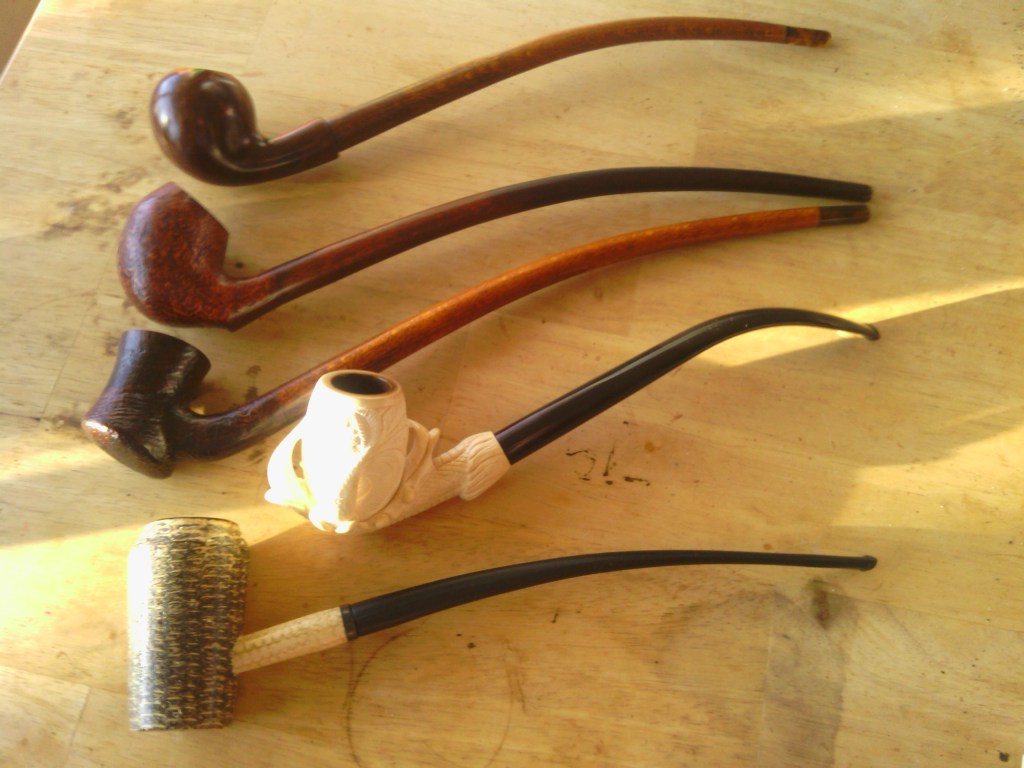
The Portway Tavern is described as “the rendezvous of generations of quarrymen”, referring to recent renovations which had done much to modernise the exterior but it was noted that “the interior is pervaded with an old-world atmosphere. On a rack in the smoke room are twenty-two churchwarden pipes, numbered and tobacco stained, the blackest belonging to the oldest and most regular attendant at the pipe club which meets in the tavern on winter evenings.”

Churchwarden pipes. Copyright Pipes Magazine.

The people of the area

The writer concludes that Portway is secluded and peaceful, its people on the whole an insular contented lot whose families have lived in the same cottages or the same street and worked at the same occupation for generations. He describes how, a stranger, stopping to ask a question, in a moment, is surrounded by a crowd of well-meaning inquisitive folk each contributing to the reply. Once the bona fides of the visitor is established, which he says is not easily wrought, he will be taken into their cottages and treated as one of themselves.

“There is a strangeness of spirit, so different from the traditional English. The men folk work on their doorsteps in the quarry and although they chose to remain secluded, their contribution to the world’s market – the famous Rowley Rag – has brought the urban district fame.

At the conclusion of this fascinating article the writer notes that many people – even in Rowley District would never have seen a quarry from which the Rag is produced. He describes a typical quarry, now derelict, standing near the apex of Portway (in which, remember, he includes Gadds Green and Perry’s Lake). He writes:

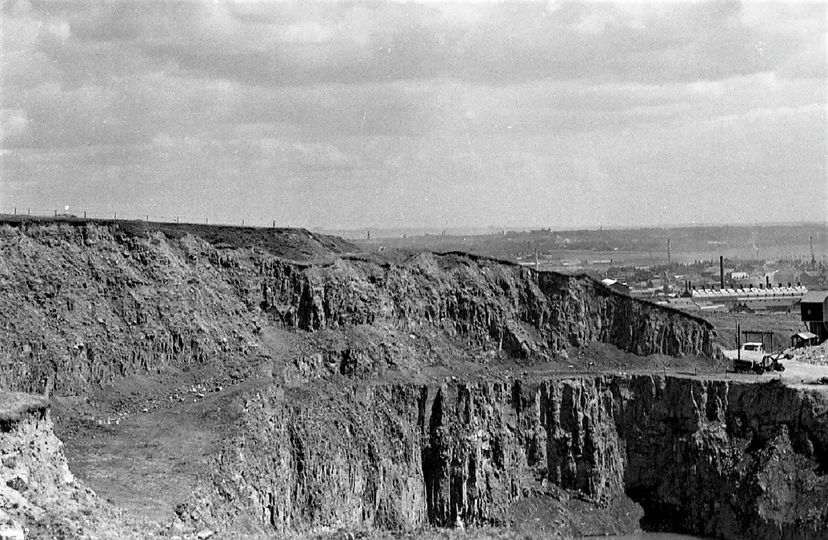
“It is a gigantic cavity, half a mile in circumference and of tremendous depth. The steep moss carpeted escarpments, the massive grey and brown sandstone and rock cliffs constitute a very impressive picture. Poised on the very precipice of the quarry is a small ivy clad house, which looks down on the Worcestershire, Warwickshire and Herefordshire Counties. The Malvern, Clent and Warley heights are clearly visible and stretched out, as on an opened Survey Map, are Smethwick, Oldbury, Langley, Frankley and their contiguous townships and villages.”

The Blue Rock Quarry, Copyright Jim Rippin.

“Only with a view such as obtains from this altitude can one realise the multiplicity of two counties industries; the diversity of landscape; the strange mixture of the urban and the rural in Worcestershire; the ugliness of the squat, smoking workers’ cottages in the close proximity, and the extent to which man has despoiled the natural face of the Black Country.”

There is no by-line on this article, we cannot know whose thoughts and observations we are sharing a century later when that landscape has again changed beyond recognition. But it offers, I think, a fascinating glimpse of our hamlets and life in them a century ago. He was not completely correct about insularity, we now know, we have learned about the Rowley men who went off to work in other areas. But I think he may have captured something of the atmosphere of these small communities and the people who lived in them for centuries.

The Redfern Family in the Lost Hamlets 1

The 1841 Census for the Lost Hamlets has one family of RedfernsJoseph Redfern was living on Turners Hill, a labourer, with his age given as 35. His wife Maria (sometimes Ann Maria), nee Priest, has her age as 40. Joseph and Maria appear to have been married at Tipton on 16 Jul 1827. Maria sometimes used Ann Maria and sometimes Maria, in records throughout her life. Their children Sarah aged 12, Eliza aged 10, Joseph aged 8, William, aged 6 and Ann, aged 4 completed the family, all of the children were born in Rowley Regis.

In later censuses, Joseph gave his age as 48 in 1851, giving a birth year of about 1803. I can find no baptism for a Joseph Redfern in the area in that year, so it is possible that he was born elsewhere, though he consistently says in censuses that he was born in Rowley Regis. Another possibility is that he was baptised in a non-conformist chapel. Certainly, the Priest family into which he married had very strong connections with the Presbyterian Chapel in Cradley Heath which was also in the parish of Rowley Regis.

Maria or Ann Maria gives her age in 1851 as 50 which gives her birth year of 1801. The only baptism I can find for this period of a likely Ann Maria is Maria, the daughter of Cornelius and Mary Priest of Bournbrook , Cradley Heath who was baptised at St Giles, Rowley Regis on 4 Oct 1801. But this is by no means certain, there may be another baptism somewhere that I have simply not been able to find.

The fact that Joseph and Maria were married in Tipton perhaps argues that she was not connected to the Cradley Heath Priests but I cannot find another Maria or Ann Maria baptised in the Tipton area either. And since Maria had had a baby out of wedlock, it seems possible that her family sent her to stay with relatives in Rowley to hide the shame for the family (possibly their view, not mine!). And it seems that David Priest , living with his family in Gadds Green in 1841 was born in Cradley Heath and directly related to the Priest families there so they would have been known to each other and were probably related.

At various points Joseph gives his occupation as a labourer or a furnace man or a furnace labourer. This seems to have been a common occupation for the Redferns as at least two of his sons were also furnace labourers. In 1856, at his son Joseph’s marriage his occupation was given as a Blast Furnace man. One census entry notes that he is a furnace labourer in a coal mine (fires were kept burning at the bottom of shafts to pull air through the mines and reduce the build-up of explosive gases) but others were noted as Blast Furnace labourers, a very different job. I am unsure where the nearest blast furnaces were to Turner’s Hill, possibly at Tividale/Tipton where there were extensive iron works and at least three furnaces shown on the 1st Edition OS Map though there were almost certainly others in the area including Brades where a furnace is also shown. If Joseph was working at the iron works in the Tividale/Tipton area, this may account for the marriage at Tipton church.

Ist Edition OS Map, copyright David & Charles, surveyed about 1830. Several furnaces and iron works are shown on this map including ones at Tipton and Dudley Port, also at Brades.

Ann Maria

The name Ann Maria is used frequently in the family from this point on, often, it appears, with the name Maria being used day to day. Almost all Joseph and Ann Maria’s children and many of their grandchildren named one of their daughters Ann Maria so they are liberally scattered around the family tree!

Are they on my family tree?

Yet again, having thought when I started this study that I had no connections with the Redferns, I now find that I have two, so far, as Cornelius Priest was already in my family tree!  I suspect that the more I look in detail at the families in the Lost Hamlets, the more I shall find that my lines are married into them at some point, sometimes several points, perhaps a natural result of them living in such small communities with limited contact with other communities.  So yes, they are on my tree!

Who was Thomas Priest?

Thomas Priest, aged 15 was also living with the Redfern family on Turners Hill. The 1841 Census does not show relationships within households. Thomas was baptised at Dudley St Thomas on 26 Mar 1826, the son of Ann Maria Priest and there is no name shown in the Register for the father so he was probably illegitimate. Joseph and Ann Maria were married in July 1827, fifteen months later so this was certainly not a hasty marriage shortly before or after Thomas’s birth. There are several family trees on Ancestry which suggest that this Thomas was the illegitimate son of Ann Maria and Joseph, born before they were married.

My expert consultant on such issues agreed with me however that, at this time, when parents of an illegitimate child subsequently married, that child usually then became known by the father’s name and is shown in sequence in censuses as the oldest child whereas step children tend to be listed after full children. Since Thomas is shown at the end of the household in 1841, and with the name Priest, not Redfern, and after Joseph and Ann Maria’s other younger children, I suspect that he was not Joseph Redfern’s child but a stepson. It was very common at that time for stepchildren to use their stepfather’s surname or to swap between the two names so the later use of the Redfern name is not conclusive. The only document I can find which lists Thomas as Priest is the 1861 Census when Thomas was living in between his stepfather and stepbrother. I suspect that the enumerator knew that Thomas had grown up in the Redfern household and perhaps thought of him as a Redfern so that the use here is an enumerator error. Certainly all of Thomas’s children were registered as Priest, not Redfern.

At his own marriage to Emma Moreton in 1850, at Dudley St Thomas, Thomas gave the name of his father as Joseph Priest, a Furnaceman, not Joseph Redfern – although he was also a Furnaceman!

There was at least one Joseph Priest in the area who is of about the right age and could have been this man but although there was one family of Priests at Finger i’ the hole in 1841 there is no Joseph listed there and other Priest families appeared to have been in Blackheath and especially in Cradley Heath (which is also where I theorise that Maria’s family were living). It is also possible that the priest asked ‘What is your father’s name and Thomas replied ‘Joseph’ and this was attached to Thomas’s surname of Priest so that gave Joseph Priest. Or Thomas may simply have invented a father’s name, rather than have that space empty, thus showing that he was illegitimate, something that genealogists find is not uncommon with illegitimate children.

A DNA test might prove the final answer to this, perhaps the current members of the Redfern family have done this and established the answer to their satisfaction!

Certainly in later years, Thomas remained in the hamlets, at one stage he and his family were living next door to other members of the Redfern family for several decades.

I shall do a separate post about the Priest family.

Where had the Redferns come from?

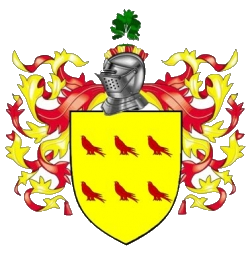
One of the crests associated with the Redfern family, courtesy of Andrew Redfern.

Wikipedia suggests that Redfern is an English surname of French Norman origin. It originally appeared as De Redeven.

The first Redfern mentioned in the St Giles’s Parish Registers is the baptism of Ann, the daughter of William and Sarah Redfern on 9th December 1792, followed by John, their son on 20 May 1798. This John must have died, (although I cannot find a burial for him), as another John was baptised to William and Sarah on 11 Jul 1802.

In 1813,Elizabeth, daughter of William (a farmer) and Sarah Redfern of Piddocks Green, Rowley Regis was baptised on 5th August, in June 1815 Edward, son of William and Sarah of Plants Green, farmer,  was baptised . Plants Green was certainly in the Old Hill/Cradley Heath area but I do not know where Piddocks Green was, it may well have been the same place, place names were sometimes quite flexible.

On 19th January 1817 Henry Smith Redfern, base born son of Mary Redfern of Turner’s Hill was baptised (there may just be a clue as to the identity of his father there, although I haven’t looked any further into that!).

On 15th July 1821, William, son of John and Mary Redfern of Turners Hill, a nailer, was baptised, followed by sister Rebekah on 7 September 1823. On 25 September 1825 Joseph, son of John and Mary, now described as a labourer and of Lye Cross was baptised. On 9 Mar 1828 Mary Ann Redfern of Lye Cross, died, aged 28 of Fever.

On 4 December 1832 Esther Redfern of Mincing Lane, aged 30, died of diabetes.

On 7 Jul 1833 Elizabeth Redfern of Dudley Wood was buried, aged 27, having died of decline.

On 16 Oct 1839, John Redfern of Turners Hill, aged 9 months died of measles.

On 13 February 1848, Harriet, daughter of William (a miner) and Ann Redfern of Portway was baptised.

On 2 December 1849, William Redfern of Turners Hill was buried, aged 81, the cause of death being given as Old age.

So clearly there were Redferns in the area, including Turner’s Hill and Lye Cross as early as 1821.

Both Joseph and Ann Redfern give their place of birth consistently in all censuses as Rowley Regis. And yet, I cannot find baptism for a Joseph Redfern in Rowley or in the surrounding area.

At least some of Joseph and Ann Maria’s children were baptised at Dudley St Thomas, Joseph and Eliza both on 12 Aug 1832, with Joseph’s occupation given as a Furnaceman and their abode as Rowley Regis. William was baptised there on 2 Jul 1837 and Ann Maria was baptised the same day.

Also at St Thomas, John, son of John (another Furnaceman) and Mary Redfern of Portway, was baptised there on 18 Oct 1835.

So it appears that these Redferns moved between St Thomas at Dudley and St Giles at Rowley, which seems to be quite common for families living in this area. And there were Redferns scattered around both Rowley and the wider neighbourhood after about 1790.

To muddy the waters, Solomon (one of Joseph and Ann Maria’s later children, to be covered in a later post) appears to be a Redfern family name. There are Solomon Redferns in Stockport in Cheshire in 1866 and in Meltham near Huddersfield in 1852, though that name is spelled Redfearn.  And in Denton, Lancashire in 1866. Although all of these Solomons were married to a Mary so it is possible that they are all the same person, moving around!

Online trees trace Joseph’s birth to Stanley in Derbyshire, but I have not investigated this possibility any further, since Joseph himself believed that he had been born in Rowley Regis and there were certainly Redferns in the area at that time.

So this is the Redferns in the Lost Hamlets in the 1841 Census. Since this is such a short piece, I will add some details about:

Joseph and Maria’s older children (those listed in the 1841 Census)

Sarah Redfern 1829-1885

The oldest daughter Sarah, who was aged 12 in 1841 was no longer in the household by 1851. In fact she was living at 84 Snow Hill, Birmingham where she was a servant in the household of Josiah Blackwell, who was a grocer. She was described as a House Servant but there were also three other Assistant Grocers living in so there would have been plenty to keep her busy. Snow Hill Station was, of course, the Birmingham Station familiar to those of us who used the train into Birmingham, that trains from Rowley and Blackheath later ran in to on the Great Western line but the station was not built until 1852 so it was not open when Sarah was working there. But a long row of shops remained long afterwards, running down the hill. Rowley Regis and Blackheath Station did not open until 1867! But even without the busy station that Snow Hill became later, there must have been quite a contrast between the rural outlook of Turners Hill and the increasingly busy city of Birmingham.

On 25 Dec 1854 Sarah Redfern was to marry William Damby or Danby, a miner, at Dudley St. Thomas.

Her father Joseph’s occupation then was given as a Furnace labourer and a Joseph Redfern was one of the  witnesses, possibly her brother Joseph who would have been 21 by this time but more likely to have been her father. Sarah and William had ten children, born in Cradley Heath and then The Knowle before William died at The Knowle in January 1873, aged only 41. He was buried in St Giles. By 1881 Sarah had moved to Dudley with the younger four of her children. Among the children of the couple were several with the recurring Redfern names, including Ann Maria (known as Maria) and a Solomon. Sarah died in December 1885, aged 58 and was buried on 20 Dec 1885 at St Giles, with her abode shown as 26 Cinder Bank, Netherton.

So Sarah does not appear in the hamlets after the 1841 Census, although at one later stage she was living at The Knowle, just around the corner from Lost hamlets.

Eliza Redfern – 1831-1909

The next daughter was Eliza, born in about 1831/2, and baptised on 12 August 1831 at Dudley St Thomas was still at home in 1851. On 15 Jun 1859 Eliza married Daniel Hughes at St. James Church Parish, Dudley, and the couple made their home in Dudley, where they had 5 children. Eliza died in September 1909. So Eliza only appears in the hamlets in one more Census, the 1851, before moving to Dudley.

Joseph Redfern 1833-1912

Joseph stayed firmly on Turners Hill, all his life, and married Ann Maria Taylor in 1856, another Ann Maria! Was she related? There were certainly Taylors living on Turners Hill so I shall check this out. Emma Redfern was born in the June qtr of 1854, but Joseph and Ann Maria did not marry until June 1856 so it is not known whether or not Emma was Joseph’s child. However, she was always described as his daughter on census returns and used the name Redfern until her marriage so she may have been. Joseph and Ann Maria went on to have Thomas in 1856, William in 1858, Sarah in 1860, Ann Maria in 1864, Samuel in 1866, Joseph in 1869, John in 1870 and James in 1873.

In 1861 there were three Redfern families living in a row on  Turners Hill, this Joseph, his brother (or half-brother) Thomas Priest/Redfern and his father. By 1871, Joseph was working as a labourer in a ‘potyard’, presumably Doulton’s factory. In his census entry in 1901, Joseph was, at 69, still working as a labourer in the stone quarry. In 1911, still at Turners Hill, he was noted as a pottery labourer but also Old Age Pensioner, a whole lifetime of hard physical labouring of one sort or another.  

He states in 1911 that his marriage had resulted in 9 children of whom only four were still alive. Ann Maria died in 1903, buried on 14 Jul 1903 and Joseph died in 1912. He was buried on 07 May 1912 at St Giles, his abode given as 3, Turners Hill.

William Redfern 1835-1917

William also stayed in the hamlets, living on Turners Hill until his marriage to Elizabeth While in Halesowen in 1871, when he moved to 6 Perry’s Lake where he stayed until his death in January 1917. William and Elizabeth had no children. William was a general labourer all his life, sometimes working at the pottery and his last census entry in 1911 he stated that he was an “Old Age Pensioner, Retired Labourer Moving Pipes”. William was buried at St Giles on 17 Feb 1917. Elizabeth died in 1926 and the entry in the Burial Register at St Giles says that she was ‘late of Perrys Lake’.

Ann Redfern 1838-1919

Ann Maria married Frederick Hadley in the Dudley Registration District in the last quarter of 1857, (although I only know this from GRO Index and have not yet found the marriage).  They lived in Lye Cross for a while before moving to Turners Hill and they had at least eight children: Joseph in 1859, William in 1861, Mary in 1863, Ann Maria in 1865, Thomas in 1868, Sarah in 1871, Eliza in 1877 and Ellen in 1881. They stayed living on Turners Hill, next door to Ann’s older brother Joseph until their last census entry in 1901. Frederick died in 1909 and was buried at St Giles on 31 Jul 1909. Ann died in 1919 and was buried at St Giles on 13 Mar 1919.

Thomas Priest or Redfern 1823-

Thomas was the illegitimate son of Ann Maria or Maria Priest, probably not the son of Joseph Redfern. He married Emma Morton on 10 June 1850 at Dudley St  Thomas. Emma had two children before this marriage, John in 1847 and Sarah in the March quarter of 1850. It is not clear whether these were Thomas’s children although they both subsequently used the Priest surname. Thomas and Emma had at least a further eight children: Joseph in 1854, Thomas in 1857, Ann Maria in 1858 (who died the same year), Ann Maria and Elizabeth (twins) in 1859, Mary in 1862, Eliza in 1865 and Emma in 1867. Emma, wife of Thomas died in 1895 and was buried on 04 Aug 1895 at St Giles.

Thomas Priest died in January 1905 and was buried on 19 Jan 1905 at St Giles, with his abode still given as 2 Turners Hill so he had lived there for nearly 50 years.  

So this is all relating to the Redfern family as they were shown in the 1841 Census. There were more children born to Joseph and Ann Maria later but I will cover them in another post.

The Redfern Family One Name Study

There is a website about the Redfern family which is linked to a Redfern One Name Study and this may be of interest and allow Redfern family members to join forces to compare their information. Andrew Redfern who runs the website and study would welcome contacts with members of the Redfern family wherever they are. Here is the link:

https://redfernsworldwide.com/

Finger i’ the Hole

Another place name in Rowley Regis which has had the same question asked about where it was is ‘Finger-i-the-hole’. Where was it? Why was it called that?

The name first appears in the Parish Registers in December 1727 when ‘Christopher Chambers of ye ffinger-i’-the hole’ was buried and the name crops up in later years with different spellings in various records, including the 1841 Census, when twelve families were living there. Later references to it seem to have reduced it to Fingeryhole.  The local consensus in discussions on the Facebook page was that it was somewhere on Turner’s Hill.

J Wilson-Jones, in his book, The History of the Black Country recounts this story:

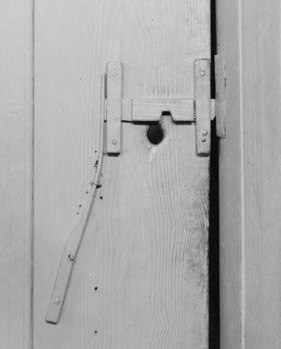
“Upon the Rowley Hills stands an old Cottage known as Finger o’t’Hole. It was so named because old Black Country cottages had a drop latch fixed upon their doors, it could be opened from the outside by putting the finger through a round hole. At this cottage there lived an old lady and one night a robber thought to take advantage of her loneliness. The cottage being in darkness, he placed his finger through the hole but the old lady had been disturbed and was waiting with a poised hatchet. The robber lost his finger and the cottage was named Finger o’t’Hole.”

So that legend obviously goes back a long way.

This appears to be the sort of latch referred to in the story, with a finger hole! (Photograph courtesy of Creative Commons).

When I came to transcribe the 1841 Census, I was not able to find any mention of Gadd’s Green, although Turner’s Hill and Perry’s Lake were easily found. By following the census enumerator’s route, which appears on the first page of each set, I found that Finger-i-the-hole appeared to be in the same geographical position as Gadds Green was in the 1851 and later censuses, after Perry’s Lake and before Turner’s Hill.

Transcribing the 1841 Census showed that the families living in Finger-i-the-hole in 1841 were :

William Priest  (+2)                          45           Nailmaker

Joseph Taylor    (+5)                        40           Nailmaker

Thomas Hill (+8)                                45           Nailmaker

John Hipkiss (+14)                            70           Nailmaker

Joseph Whitehall (+6)                    59           Nailmaker

Philip Taylor (+4)                              35           No occupation shown

William Woodall (+2)                      45           Nailmaker

Pheby Whitehall (+2)                     30           Nailmaker

David Priest (+5)                               35           Labourer

Jos’h Hill (+3)                                     20           Coal miner

Elizabeth Morton (+6)                    35           Nailmaker

John Simpson                                    20           No occupation shown

And every single one of these families appeared in the 1851 Census with the name of their abode given as Gadd’s Green! So – even if the origin of the story of Finger-i-the-hole related to one cottage – from references in the Parish Registers and from the 1841 Census, by the early 1800s the name referred to a whole group of dwellings.

I hope to add the whole of the 1841 and later Censuses for these hamlets in due course so that family members can be seen. The 1841 Census is the least detailed and informative of the censuses, often difficult to read as it was completed in pencil. Also, the ages of adults were supposed to be rounded down to the nearest five years and no relationships were shown. Later censuses were much more informative.

So at last there is an answer to the question, where was Finger-i-the-hole? It became known between 1843 – the last reference to Finger-i-the-hole in the Parish Registers – and 1851 when it appears in the 1851 census – as Gadd’s Green. 

It is probably not a coincidence that the Rev’d George Barrs died in 1840. He had been a vigorous and campaigning Curate in charge of the Rowley Regis Parish  from 1800 until his death and in those forty years must have built up extensive knowledge of local people and places and would have known local names. Perhaps succeeding newcomer curates to the parish found the name Fingeryhole (and the story behind it) fanciful or unacceptable in those very proper Victorian times.

There were certainly Gadds in Perry’s Lake in 1841 and 1851 so it’s possible they were connected and the name came from land they owned there, some further research into deeds may one day give more information.  Interestingly, there were also Gadds, rivet makers, living in Ross, an old street on the other side of the village, in 1841 where later Thomas Gadd founded his rivet making factory. The factory was still there in the 1950s and 60s, and including the original cottages, as I passed this factory on my way to and from the library. I now know that my great-grandfather Absalom Rose worked there.

As I keep saying, folk tended not to move around much!