Finger i’ the Hole

Another place name in Rowley Regis which has had the same question asked about where it was is ‘Finger-i-the-hole’. Where was it? Why was it called that?

The name first appears in the Parish Registers in December 1727 when ‘Christopher Chambers of ye ffinger-i’-the hole’ was buried and the name crops up in later years with different spellings in various records, including the 1841 Census, when twelve families were living there. Later references to it seem to have reduced it to Fingeryhole.  The local consensus in discussions on the Facebook page was that it was somewhere on Turner’s Hill.

J Wilson-Jones, in his book, The History of the Black Country recounts this story:

“Upon the Rowley Hills stands an old Cottage known as Finger o’t’Hole. It was so named because old Black Country cottages had a drop latch fixed upon their doors, it could be opened from the outside by putting the finger through a round hole. At this cottage there lived an old lady and one night a robber thought to take advantage of her loneliness. The cottage being in darkness, he placed his finger through the hole but the old lady had been disturbed and was waiting with a poised hatchet. The robber lost his finger and the cottage was named Finger o’t’Hole.”

So that legend obviously goes back a long way.
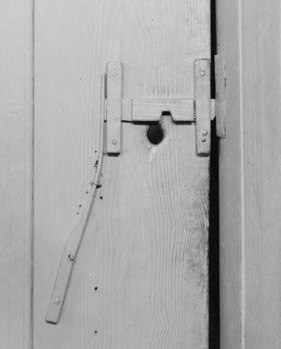
This appears to be the sort of latch referred to in the story, with a finger hole! (Photograph courtesy of Creative Commons).

When I came to transcribe the 1841 Census, I was not able to find any mention of Gadd’s Green, although Turner’s Hill and Perry’s Lake were easily found. By following the census enumerator’s route, which appears on the first page of each set, I found that Finger-i-the-hole appeared to be in the same geographical position as Gadds Green was in the 1851 and later censuses, after Perry’s Lake and before Turner’s Hill.

Transcribing the 1841 Census showed that the families living in Finger-i-the-hole in 1841 were :

William Priest  (+2)                          45           Nailmaker

Joseph Taylor    (+5)                        40           Nailmaker

Thomas Hill (+8)                                45           Nailmaker

John Hipkiss (+14)                            70           Nailmaker

Joseph Whitehall (+6)                    59           Nailmaker

Philip Taylor (+4)                              35           No occupation shown

William Woodall (+2)                      45           Nailmaker

Pheby Whitehall (+2)                     30           Nailmaker

David Priest (+5)                               35           Labourer

Jos’h Hill (+3)                                     20           Coal miner

Elizabeth Morton (+6)                    35           Nailmaker

John Simpson                                    20           No occupation shown

And every single one of these families appeared in the 1851 Census with the name of their abode given as Gadd’s Green! So – even if the origin of the story of Finger-i-the-hole related to one cottage – from references in the Parish Registers and from the 1841 Census, by the early 1800s the name referred to a whole group of dwellings.

I hope to add the whole of the 1841 and later Censuses for these hamlets in due course so that family members can be seen. The 1841 Census is the least detailed and informative of the censuses, often difficult to read as it was completed in pencil. Also, the ages of adults were supposed to be rounded down to the nearest five years and no relationships were shown. Later censuses were much more informative.

So at last there is an answer to the question, where was Finger-i-the-hole? It became known between 1843 – the last reference to Finger-i-the-hole in the Parish Registers – and 1851 when it appears in the 1851 census – as Gadd’s Green. 

It is probably not a coincidence that the Rev’d George Barrs died in 1840. He had been a vigorous and campaigning Curate in charge of the Rowley Regis Parish  from 1800 until his death and in those forty years must have built up extensive knowledge of local people and places and would have known local names. Perhaps succeeding newcomer curates to the parish found the name Fingeryhole (and the story behind it) fanciful or unacceptable in those very proper Victorian times.

There were certainly Gadds in Perry’s Lake in 1841 and 1851 so it’s possible they were connected and the name came from land they owned there, some further research into deeds may one day give more information.  Interestingly, there were also Gadds, rivet makers, living in Ross, an old street on the other side of the village, in 1841 where later Thomas Gadd founded his rivet making factory. The factory was still there in the 1950s and 60s, and including the original cottages, as I passed this factory on my way to and from the library. I now know that my great-grandfather Absalom Rose worked there.

As I keep saying, folk tended not to move around much!

The Hamlets of Rowley Regis

Rowley Regis has, it seems, always consisted of not only the ancient parish but also of a number of hamlets, large and small arranged around the village, like satellites. 

The introduction to the transcribed Parish Registers, published by the Staffordshire Parish Registers Society in 1915, and written by the transcriber Miss Henrietta Mary Auden, a Fellow of the Royal Historical Society, or some other knowledgeable authority on local matters offers this commentary:

“The parish in medieval times comprised many isolated houses and hamlets, homes originally of settlers in the forest, and as late as 1842 it was remarkable for the number of old small enclosures. The Manor is not mentioned in Domesday but was apparently a Royal Manor before the Conquest. “

This perhaps laid the pattern of numerous distinct small settlements which persisted until the late 1800s, after which they gradually merged until there was no open space between them. A teacher at the local grammar school in the 1980s commented recently on the local Facebook site that she was amazed, on moving to the area to teach, to find that the local people were very clear about which of these hamlets they lived in, even though, to her as an outsider, there appeared to be no formal or recognizable boundaries that she could identify.

In 1851 William White wrote “The Parish of Rowley Regis forms part of the great Barony of Dudley and contains 7,438 inhabitants and 3,350 acres of land, of which the executors of the late Earl Dudley are lords and owners, and hold Court Leet here in September. The parish comprises the large but indifferently built village of Rowley, seated on the declivity of a lofty hill two and a half miles S.E. of Dudley and about 20 hamlets all of which maintain their poor conjointly, and are occupied chiefly by nailers, chain makers and the miners, forgemen etc  employed in the extensive coal and iron works here. “

Twenty hamlets are listed by White in 1851:

Blackheath, Corngreaves, Cradley Heath, Gosty Hill, Haden Cross, Haden Hill, Hayseech, Knoll, Lye Cross (near Oakham, not to be confused with Lye near Cradley Heath), Oakum (Oakham), Old Hill, Portway, Powke Lane, Reddal Hill, Tipperty Green, Tividale, Turner’s Hill, Windmill End, Whiteheath Gate, Slack Hillock and the other houses in Rowley Village.

In his book A History of the Black Country, published in about 1950, J Wilson Jones, a former Librarian for Blackheath, considers that, at the time of the Enclosure Act of 1799, there were hamlets at:

The Brades (near Oldbury, developed circa 1780 owing to the Iron Works), Tividale (near Dudley, also with a large Iron Works. Developed upon Sheldon Estates.), Oakham (an early settlement as by its name the dwelling in the Oaks), The Knoll (later known as Knowle), Ibberty (Tipperty) Green (a manorial mill), Windmill End (another manorial mill), Old Hill, Reddal Hill, Cradley Heath. Lawrence Lane,  Longtown,  Corngreaves, Hayseech and Gorsty Hill.  He suggests that these hamlets consisted of about twelve or more homesteads plus  groups of from three to six houses or homesteads at Whiteheath Gate, Portway, Turner’s Hill and Perry’s Folly (Perry’s Lake).  There are differences between the lists, but they are largely the same.

Wilson Jones notes that Perry’s Lake was sometimes known as Perry’s Folly which suggests a connection with an individual and an intriguing tale which I will relate if I can find out any more about it. Local people tell me that their families called Perry’s Lake Heaven when they lived here, in the early and mid 20th century, although I have found no formal record of these names.   The reason for these variations is unknown but it is not the only local place to have had several different names over the centuries. 

Some of these hamlets, such as Cradley Heath and Old Hill thrived and expanded into substantial separate communities over time, others faded from history and it is these ‘lost hamlets’ which are the subject of my study, although interesting stories about other parts of Rowley Regis may appear from time to time, if I find these in the course of my research.

I hope you will find my One-Place Study website interesting. This is very much work in progress. With new blogs being added, do check back now and again to see what’s new.

If you have any interesting stories, memories, photographs or postcards which you are willing to share, please do get in touch with me via the Contact Page.