My maiden name was Hopkins and I was very fortunate to have a head start when I started our family tree, as my father’s only sibling, my aunt Alice, gave me several family documents of great interest, including some original, battered and creased original birth and marriage certificates for my Hopkins family, as well as a little oral history. At that time, I had no idea that my Hopkins line originated outside the area. One of those documents, my paternal great-grandfather Arthur Hopkins’s birth certificate, showed that he was born in Perry’s Lake in 1867, the eldest child of Edward and Elizabeth Cole. This enabled me to look for the family in the 1871 census, thus starting considerable progress on building my family tree.
I have to confess that, despite being born in Springfield and going to school for several years only a few hundred yards away, I had never heard of Perry’s Lake until I started doing my family history!
Edward Hopkins – or was he Edwin?
My g-g-grandfather Hopkins, Arthur’s father, I saw from that 1871 Census, was not a Rowley man. Although he was living in Perry’s Lake in 1871 he gave his place of birth as Gloucestershire and his first name was shown as Edward. That was a surprise to me, there had never been any hint in the family that there were any links to Gloucestershire. That was, I later realised, partly because there were no living close family there by then, or perhaps no family he wanted to stay in touch with. He stayed in the Rowley/Oldbury area for the rest of his life and many of his children did, too.
So next I looked for the marriage, shortly before Arthur’s birth, of Edward Hopkins and his wife Elizabeth, (whose name I knew from both the 1871 Census and from Arthur’s baptism) because he was their eldest child and in those days babies tended to come along quite quickly after marriage. Sure enough, I found a marriage for Edward Hopkins and Elizabeth Cole at Dudley St Thomas on 25 December 1866. I’m not sure why they were married at Dudley, rather than Rowley unless it was something to do with the fact that their first son Arthur , my great-grandfather, was born on 17 March 1867, so Elizabeth was six months pregnant at the time of the marriage. So Arthur came along very quickly! The marriage was witnessed by William and Elizabeth Cole, presumably the William who was Elizabeth’s eldest brother and his wife Elizabeth nee Davies. The other interesting thing for me about the marriage entry was that Edward was a widower.
So I next went back to the 1861 Census to see whether Edward had been in Perry’s Lake then.
And there he was, aged 21, already in Perry’s Lake and living with Benjamin Cole as his son-in-law with Edward’s wife Ann. Yes, Ann, not Elizabeth. Further investigation showed that Edward Hopkins and Ann Cole had been married on 1 April 1861 at St Giles, Rowley Regis. (you begin to see why there are quite so many Coles in my family tree, don’t you?) They had married at St Giles just one week before the Census was taken on 7 April, how lucky for me was that! Edward gave the name of his father as James Hopkins and his occupation as a cabinet maker. I was absolutely thrilled to see this, my father John Hopkins was also very proud of being a cabinet maker and I was delighted to discover that this was an inherited skill. I have subsequently discovered that there is a long line of carpenters in the Hopkins family, going back to at least 1800, although sadly my own father had died some years before so never knew this. I was very surprised to be told only a couple of years ago by someone who knew him that my grandad Hopkins was also a ‘chippy’, a carpenter although he worked at various jobs and as an ‘odd job man’, I had never realised he was also a carpenter. When I told my brother about this, he told me that, although generally he hated school, the woodwork teacher at Britannia Road School had said that he was the best woodworker he had ever taught. My brother went into the motor industry as so many local people did but the carpentry gene was obviously still going strong in the 1960s.
Edward and Ann had a son James in the June quarter of that year, presumably named after his paternal grandfather, another prompt arrival of that first baby! Alas Ann Hopkins died in March 1864 and little James in September 1864. Both were buried at St Giles.
And in 1866 Edward Hopkins married Ann’s first cousin Elizabeth Cole, daughter of Edward and Frances (or Fanny) Cole. Edward and Elizabeth Hopkins had ten children, nine of whom survived into adulthood – Arthur in 1867, John in 1869 (also died in 1869), Harriet in 1870, Fanny in 1872, William Benjamin in 1874, Edward , sometimes known as Edwin in 1876, Joseph in 1877, Samuel in 1879, James in 1882 and Lucy in 1884. The family later moved from Perry’s Lake to Portway and later to Taylors Lane and by 1911 Edward, (by now a widower after Elizabeth died in 1907) was living in Canal Street Oldbury, with his daughter and son-in-law Enoch and Fanny Pooler. In 1921 he had moved to live with his son Samuel in Albert Street, Oldbury. Dying in 1922, Edward was buried in the Rood End Cemetery on 8 Mar 1922.
Sometimes, in the Census Edward/Edwin just gave his name as Ed. I think that is significant, because if that is what he called himself, it seems likely that various officials assumed that he was the more popular Edward, rather than Edwin.
Father deceased – or not? A trap for the unwary!
One of the advantages of seeing images of full marriage registers or full transcriptions is that, after 1837, when the Civil Registration of Births, Marriages and Deaths began, there was usually some chance of finding the names and occupations of the fathers of both bride and groom. This did not always happen, as if one of them was illegitimate, this was left blank. Similarly, it was usually indicated if the father was dead. But this was not infallible.
In my case, Edward had given his father’s name as James Hopkins and that he was, in the first entry, a cabinet maker and, in the second marriage, only five years later, he was marked as a carpenter and deceased. This led to a brick wall of many years standing as I assumed from this that James Hopkins had died in the intervening period between the marriages. I searched for a long time for James Hopkins, thinking that he was alive in 1861 but could find no definite trace of him after 1841. More on this shortly.
Where did Edward come from?
Edward gave his place of birth in subsequent censuses more specifically as Tewkesbury, Gloucestershire. He was consistent about his age, indicating that he was born in about 1839. So I looked for an Edward Hopkins born about then in Tewkesbury, in both the 1841 Census and in the Tewkesbury Parish Registers. I couldn’t find him. Nor could I find him anywhere in Staffordshire or Gloucestershire in the 1851 Census. But in the 1841 Census I did find an Edwin Hopkins, born in Tewkesbury in 1839, born to parents James Hopkins, a carpenter of Barton Street, Tewkesbury and his wife Harriett(nee Evans). James and Harriett had been married in Tewkesbury in 1827.
By the time of the 1841 Census, James Hopkins was a widower (Harriet had died in May 1841 of Tuberculosis, just a couple of weeks before the 1841 Census) living in Potters Alley, off Barton Street, Tewkesbury with his children William, aged 10, Harriet, aged 8, James aged 6 (James’s twin John had died in infancy) and Edwin aged 1. If you compare that list of names with the names of Edwin/Edward’s children in Rowley, there is a striking overlap. Edwin’s birth Certificate describes his place of birth as ‘Corner of Potter’s Alley, Tewkesbury’ so I have been able to stand in front of the house and see exactly where they lived, it is still there.

Copyright: Glenys Sykes. You can see the entrance to Potter’s Alley at the left hand side of the house, still with very ancient paving which James and Harriett had probably walked on which gave me a thrill as I walked down the alley. Walking in my ancestor’s footsteps! The house on the left of that is an altogether grander place and I think it is unlikely that it would have been occupied by a carpenter, even if he was a cabinet maker! So I think this is where Edwin/Edward was born.
By the time of the 1851 Census, the only one of the family left in Tewkesbury was Harriet , by then 18 years old who was in service and living in Church Street, which is a continuation of Barton Street. Harriet was to remain in service in Tewkesbury until her death in 1912, having married the coachman of the household Joseph Wakefield, and they had two daughters Alice and Lucy (yes, those names also recur in the Rowley Hopkinses!).
So where were her brothers in 1851?
I could not find William, the eldest in the local area in the 1851 Census but he was twenty by this time and could be (and was) somewhere miles away.
William’s story (or a small part of it!)
Just to add to my fun, I later made contact with one of his descendants and discovered that he had changed his name to William Daniels and joined the merchant navy in Gloucester in 1843, later moving to Scholing in Hampshire – it’s a long story…. He also had numerous children, including a James and an Edwin, a Harriett and an Alice, all Hopkins family names. But although I discovered that many years later he made contact again with his sister Harriet in Tewkesbury, he was said by my contact never to have found his brothers James and Edwin, both by then in the Black Country, they were the lost brothers he named his sons for.
The same contact told me family lore that William, the oldest brother, had told his family – that he had changed his name and left Gloucester because of some undesirable issue with the Hopkins family that he was ashamed of, and my research has since provided clues about what that might have been. He had also said that his mother Harriet had been genteel, educated and a teacher, that her family had been related to William Shakespeare and that the family names Lucy and Alice came from that connection.
This sounded far fetched to me when I first heard it in about 1990 but I have to say that several of the elements of that story have since proved to be correct and certainly, those names continued to be used in the Black Country Hopkinses, both brothers.
However I thought that the Shakespeare connection sounded just too unlikely. After all, my Hopkins family had lived in Tewkesbury, not Stratford-on-Avon. Until one day, I casually googled ‘Shakespeare and Tewkesbury’ and discovered that there were indeed Shakespeares in Tewkesbury (buried in the very early Baptist chapel off Church Street) and they were indeed connected to William Shakespeare’s family, though obviously not of direct descent. One day, I shall do some more research on that! For the moment, Harriet and her family are another brick wall of long standing.
The younger Hopkins brothers
Of James and Harriet’s other sons in 1851, I found a possible James Hopkins, now aged 16, born in Tewkesbury and living in Northgate Street, Gloucester as a ‘visitor’ with a confectioner named Richard Davis. Although I am pretty sure this is my man, I have never been able to find out why he was there or any connection between James and his host.
And I found a possible Edwin Hopkins, aged 11, apparently born in Gloucester and a scholar, in the Gloucester Union Workhouse. This was a real puzzle. If this was my Edwin why was he in the Workhouse? And why was his place of birth given as Gloucester because if it was my Edwin he should have been in the Tewkesbury Workhouse, that was how the Poor Law worked, each area responsible for their own poor. In fact, that would have been why his place of birth was given incorrectly, if the truth had been known he would have been shipped off to Tewkesbury. So presumably, someone lied because they didn’t want that to happen. I discovered later that James’s mother Catherine had lived in Gloucester, dying in 1850 so I believe that Edward and possibly James had been raised by her, or perhaps by her oldest daughter for some years before Edwin went into the Workhouse, possibly when Catherine died. Some of James’s family in Gloucester were – to say the least – less than honest so a lie about where a child was born, would probably not have been a problem for them, especially if they were trying to get rid of an unwelcome child.
So that was two boys from the Hopkins family in Gloucester in 1851 and the eldest had joined the navy in Gloucester. They had obviously moved to Gloucester from Tewkesbury at some point and this suggested family links with Gloucester city.
The missing James Hopkins Senior
Despite diligent research, over some years, I could not find any trace of their father James anywhere in 1851, nor in any subsequent census. Eventually, I abandoned the idea that James was still alive when Edward married in 1861 because it was possible that the Vicar had simply not asked the questionwhether he was stil alive. I began to look carefully at all the GRO Death Registrations I could find for a James Hopkins, born in 1805, dying after the 1841 Census and before the 1851 Census, concentrating specifically on the Gloucestershire deaths simply because it seemed most likely that he had stayed close to home. There were nine in that period, ranging from Chepstow to Bristol, to Monmouth and Evesham. There were none in Tewkesbury and just one in Gloucester (or Gloster as it was called then,) in December 1842. Just one! It called to me….
By this time in my research, I was living and working in Gloucester (sometimes the genealogical gods smile on us!) so I decided to pay a visit to the Register Office in Spa Road, explain my quest and ask them to check the details in the Register to see whether there were any matching details. This meant I did not have to pay for the certificate upfront. The Registrar could not have been more helpful. He went and looked at the Register and came back to tell me that this James Hopkins had died in the Gloucester Infirmary, in Lower Southgate Street, overlooking the Docks, barely a quarter of a mile from the Register Office, in October 1842, aged 38, of dropsy – perhaps heart failure. Though the Registrar warned me that several deaths at the hospital had been registered on the same day by the same person, possibly a reasonably capable and mobile orderly, perhaps with what we would now recognise as learning difficulties, and the same cause of death had been given for all the deaths – dropsy. He thought it unlikely in his professional opinion that they had all died of the same thing so I should treat this with caution. And it does seem possible to me that James had also died of Tuberculosis, like his wife only a year or so earlier.
And this James Hopkins had been a carpenter– Bingo! I was convinced this was my man. This was why I could not find him later, this was probably why his children were in Gloucester. Edwin was still only three years old then, I reasoned that James must have come back to Gloucester, perhaps to family there, with his younger children, after his wife’s death or perhaps when he became too ill to work or look after them. He was buried at the church of St Mary de Crypt, a few hundred yards further along the road from the hospital. I later discovered that James’s family were living at Littleworth, Gloucester just round the corner from the Register Office and on the Bristol Road, not far from the Hospital. They were all in the area around the docks.
By now I had realised that Edwin/Edward must have had some substantial contact while he was growing up with someone else in his family. How else would he have known the correct names of his parents and the detailed occupation of his father – a cabinet maker, no less? Someone was proud of that and must have told him, it is unlikely that the Workhouse would have had such detailed information on his background, or passed it on to him. He had been orphaned by the time he was three, he could not have remembered this by himself.
It was to be several more years before I was able to find the evidence that confirmed my theories – but it was very satisfying when I did! But that’s another story… Do you want to know? It’s (to me anyway) a very interesting and complex story but it doesn’t really relate directly to Rowley Regis so I won’t go into more detail here but I will happily do another post on that jigsaw if anyone would find it interesting.
The Waterways connection
So up until he left Gloucestershire between sometime 1851 and 1861 my g-g-grandfather was Edwin and after that he was (mostly) Edward. He named one of his sons Edwin though I have found that this son also seemed to use Edwin sometimes and Edward at others, perhaps a practice he got from his father.
The Great Mystery
But how did Edwin/Edward get from the Workhouse in Gloucester to the tiny rural and surely not widely known hamlet of Perry’s Lake and be married to a local girl in the ten years between censuses? He wasn’t a skilled granite worker so it wasn’t that. He worked most of his life, after settling in Rowley, as a miner then in 1901 as a labourer in the brickyard, in 1911 as a stoker at a laundry and only in 1921, at the age of 83 was he shown as having no occupation.
It took me a long time to arrive at a possible explanation and even now I cannot prove it but it seems very likely that he came up on the River Severn from Gloucester Docks, not far from the Workhouse, and the canals up to the Midlands.
What made me think that?
I am always interested in (some might say nosy about) other people’s family trees and, having got my husband hooked on his own family history, I knew that several generations of his ancestors in Gloucester had been boatmen on the canals and the River Severn. He is indeed a proud ‘Gloster boy’ himself, born and bred in the West End of Gloucester, adjacent to the busy docks. So when I saw a book in our local library entitled ‘Working Life on the Severn and Canal, Reminiscenses of Working Boatmen’ compiled from interviews with former boatmen by that meticulous Gloucester historian Hugh Conway Jones, I knew the book would be of interest to my husband.

Photograph copyright: Glenys Sykes – we rapidly acquired our own copy!
As I stood in the library that day, leafing casually through it to see whether any of my husband’s ‘family names’ were mentioned, another name leapt off a page at me – a mention of ‘a quarry on Rowley Beacon’! The section was relating the memories of boatmen on what goods were transported back down to Gloucester once their inbound loads had been unloaded.
The paragraph reads :-
“During the summer months, instead of bringing coal [back to Gloucester and the West Country] some of the boats brought stone for the County Council to put on the roads. We fetched it from a quarry on Rowley Beacon – you went through the Bar Lock, out to Smethwick and then took a branch to the left, Titford Canal. The stone came down on a railway operated by a cable so that the loaded trucks took the empty ones back up. As each truck came alongside, they dropped the side down and let the stone fall into the boat. When you had twelve tons in the aft-end, you shifted the boat to load 8 tons into the middle, and then you shifted her again to load 7 tons into the fore-end. The stone was discharged on the river bank just above the Haw bridge [between Tewkesbury and Gloucester]. It was put into wheel-barrows and taken ashore across planks, although if the water level was high, the boat could sometimes get in close enough for the stone to be just thrown out on to the bank. From the Haw Bridge it was taken by horse and cart to various road-side sites to be broken up by gangs of men with hammers.”

This photograph, from Anthony Page’s book on Rowley is captioned that the boats were loading coal. But might they have been loading stone? It seems possible.

Another photograph, also from Anthony Page’s book on Rowley, shows the trucks used to move coal, and, it appears, stone down to the canal at Titford.
First of all, this book and this account fascinated me – it tied together so many things I already knew about the quarry in Rowley and the stone that was produced, and the truck systems. And it made me better understand the multiple handling and the sheer physical hard work required to shift the stone out of the boat and then to reduce the stone to the right size. Imagine pushing a wheelbarrow loaded with stone over a gang plank?! I’m sure they were skilled at it but it must have bounced and been exhausting and quite perilous.
Secondly, the whole book is really interesting and worth reading. The recounting of the personal memories reveals the formidable skills and hard working lives of these men who had to find their way up and down the river and through the canal network, summer and winter, in flood conditions and dry, so much knowledge and experience generally unrecognised and now lost, but for the memories recounted in this book.
And thirdly – another ‘Bingo’ moment. Had Edward been working on the canals, was that how he had arrived at Rowley? I stood in that library exultant, suddenly a beam of light shone onto the great mystery which had been in my mind all those years – I think that the waterways were the connection that brought Edwin to Rowley Regis. But I doubt I will ever prove it…
To bolster my theory, the book also has this quotation from one of the boatmen about Gloucester Docks and the people who lived on the boats.
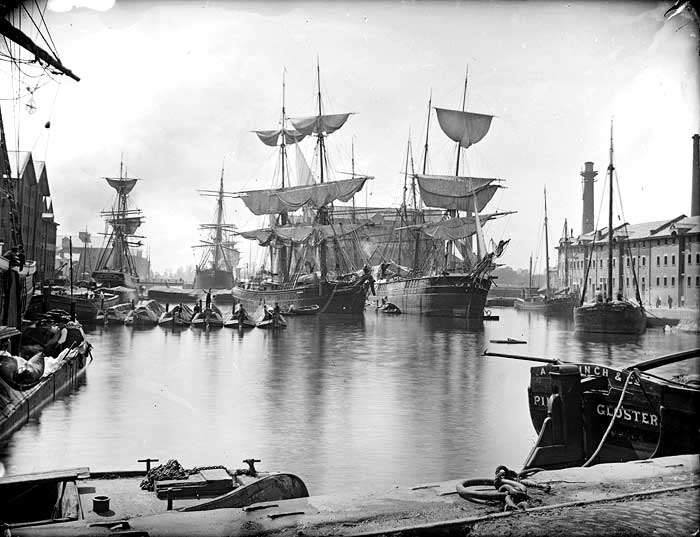
Copyright: Tony Walker. Gloucester Docks, c. 1880.
“You normally only lived on board when you were away on a trip as most crews had their own homes in Gloucester. [This was certainly true of my husband’s ancestors]
In the early days, there were sometimes young boys without homes hanging around who went with any skipper who needed a crew. They had to learn to do what they were told and keep the boat clean, and then they were never long without a trip. If a boatman’s wife had to stay at home for a bit, one of the boys would go in her place. Also there were some unmarried skippers who didn’t have a regular crew. A few were a bit barbaric and knocked the boys about or half-starved them but others were more considerate. One boy managed to work with two skippers for quite a long time – when he came back with one, if he was lucky, the other would be loaded and tied up by the lock ready to set off the next morning. Now and again, the one at Gloucester found his turn came up before the boy was back. So then he sent a postcard to the Worcester Office, saying he was coming up on the tug and the boy stayed with the lock keeper at Worcester until he arrived.”
What sad lives these young boys had, with no settled home and whatever work and food they could find.
But you can just imagine on those summer evenings, when they were tied up at Rowley, ready for the journey back the next day, the local girls might venture out for a stroll along the ‘cut’ and might just happen to get chatting with the boys who worked on the boats, so much more interesting than the Rowley lads they had known all their lives!
If this was how Edward/Edwin found his way to Rowley, and he thought there was regular work to be found there as a miner, no wonder he settled in this simple village.
And, we realised, my husband and I, it is conceivably just possible – though again I will never know – that my husband’s boatmen ancestors might have brought my g-g-grandfather on one of their boats up the River Severn and the canals to Titford. Wouldn’t that be neat?
I later discovered that Edward’s older brother James had also come from Gloucester up to Birmingham, perhaps by the same route and had married in Birmingham (also describing his father James as a cabinet maker!) and had later settled in West Bromwich. There is a suggestion that he too joined the navy as his older brother William did, though that is still uncertain. And the two brothers were definitely in touch with each other, in a later Census I found Edward/Edwin’s daughter Harriet staying with her uncle James in Oldbury as a visitor. Perhaps Edward/Edwin had managed to stay in touch, perhaps he had even come to the Midlands to be near his brother. So he was not completely alone in the world.
But imagine, for this long orphaned boy, no doubt ejected from the Gloucester Workhouse at about fourteen, if not earlier, and apparently with no other family around able or willing to take him in, what a relief it must have been to marry into and settle in the close knit community of Perry’s Lake and the large Cole clan, a real home at last, founding the dynasty of the Hopkinses in Perry’s Lake and Rowley!
 rowleyregislosthamlets.co.uk