In a previous post, (Daily life in the hamlets in times gone by, May 2023) I have quoted a passage from the memoir of George Barrs, the one time Curate of Rowley Regis , in which he writes with disdain, contempt even, of his Rowley parishioners. He was fairly scathing, too in some of his descriptions of them in the Burial Registers. It appears that this was a mutual dislike as there was at least one unsuccessful attempt to get rid of him by his own churchwardens in the early 1800s but this failed. More on that at a later date, perhaps.
But, as I have transcribed numerous Registers, Anglican and Non-conformist in the last few years I have noted that, as hand nail-making skills were overtaken by machinery, the ingenious people of the Black Country turned their dextrous hands to other occupations, in metal working especially but in other work, too. And industry continued to thrive in the area.
Even men who worked in physical trades such as quarrying and mining could still work in the nailshops at home. So when I see column after column in church or chapel registers which list occupations as ‘Labourer’ or – in the case of women – no recognition at all that they also worked at nailmaking or in other work, I always find myself wondering how accurate that generalisation was.
It is clear from some registers and from the sheer number of chapels that sprang up in local streets, (more than forty Primitive Methodist meetings in the Dudley area alone by 1840), that many people in the area around Rowley were not the godless alcohol ridden heathens that Barrs seemed to think but were actually independently minded men and women of character and determination who wanted to read the bible for themselves, pray in their own words and to worship in the way they chose in chapels which they had built. In addition to those forty PriitiveMethodist meetings, there were also Wesleyan Methodists, often worshipping in close proximity to the Primitive Methodists plus numerous Baptists and others such as a notable Society of Friends, otherwise known as Quakers. These people chose their own paths to spiritual fulfilment, many of them learning to read along the way.
Many of the chapels which were built were fine buildings which had to be funded locally, and they often involved heavy commitments in time and activities to run them and organise their activities. For at least in the Methodist churches worship was not confined to Sundays, nor to one service on Sundays, two or three was the norm and several services on week nights. Sunday Schools educated adults as well as children. And there were prayer meetings, men’s groups, women’s groups, choirs, bible study groups, too which met in the evenings during the week. Perhaps it was the wholehearted commitment of dissenters to their chapels that annoyed Anglican priests who saw themselves as leaders of their communities by right. The abuse heaped on dissenters in early days was very real and not always confined to words. There was little meeting of minds for many years afterwards.
There was nothing primitive about the organisations of these chapels, there were accounts, trusteeships, preaching rotas, training, printed lists, even before there were paid Ministers. And such Ministers as there were travelled many miles to preach in different places. There were women preachers, too, long before the Established Church ordained women.
Simple descriptions in official records of trades such as labourers or nail or chain makers must conceal the true nature of many of these people. Thinking about my own family, my uncle Bill Rose appears in official records, quite accurately, as a Gas Fitter. And so he was, all of his life. But that was only the day job, he was also for many years a very competent Secretary to our family Methodist church and for many many years, a Trustee of the Church, as was his father, my grandfather who was supposedly just a humble cobbler. And my uncle was also very active in the Worker’s Educational Association in the Birmingham area, promoting not only his own lifelong continuing education but that of others, enriching lives, expanding minds. He was an intelligent, cultured and modest man and highly respected in our chapel, though he never sought this and would have been unwilling to acknowledge it. And I am sure there were many many other such people in our community whose talents and abilities were put to good use but which have faded now from knowledge. Rowley has produced poets and composers as well as nails.
Thomas Gray’s Elegy Written in a Country Churchyard (my mother’s favourite poem) touches on this, the unrealised potential of humble folk.
Full many a gem of purest ray serene,
The dark unfathom’d caves of ocean bear:
Full many a flow’r is born to blush unseen,
And waste its sweetness on the desert air.
Far from the madding crowd’s ignoble strife,
Their sober wishes never learn’d to stray;
Along the cool sequester’d vale of life
They kept the noiseless tenor of their way.
Perhaps it was simply the independent non-conformist thinking of many ordinary local people that went down badly with the Reverend Barrs. I am convinced that there is a deep thread of non-conformism in my own personality, which surfaces from time to time even today and that this may well have been a defining characteristic of many Black Country people.
Increasingly, in the course of this study, I have had to revise my original view that not many people in Rowley would have stirred from their roots. Increasingly, I have found evidence that there were numerous people who did indeed travel and expand their trades, not only in this country but further afield, too. As regular readers will already know I discovered that one ancestor had married in London and I had wondered whether he was acting as a courier for the nail trade, possibly in connection with the Crowley family who had lived in Rowley before moving to Stourbridge and subsequently London in later generations.
This week I read an article about the Crowley family which mentioned that a book entitled Men of Iron – by M W Flinn, about the early iron industry with particular reference to the Crowley family, had been republished. It was first published in 1962 and Professor Flinn published other books on similar themes before and after this volume. This edition had become rare and expensive. But a copy was loaned by the Winlaton & District History Society to the Land of Oak & Iron Legacy Group and, with the enthusiastic consent of Professor Flinn’s family, the printed text was scanned, transcribed and reset to produce a new edition in 2019. It sounded an interesting book and, thinking that there might be some reference to Rowley Regis , I ordered myself a copy, an early self-Christmas present! It arrived this week and has much detail about the early iron industry and the families involved in it.
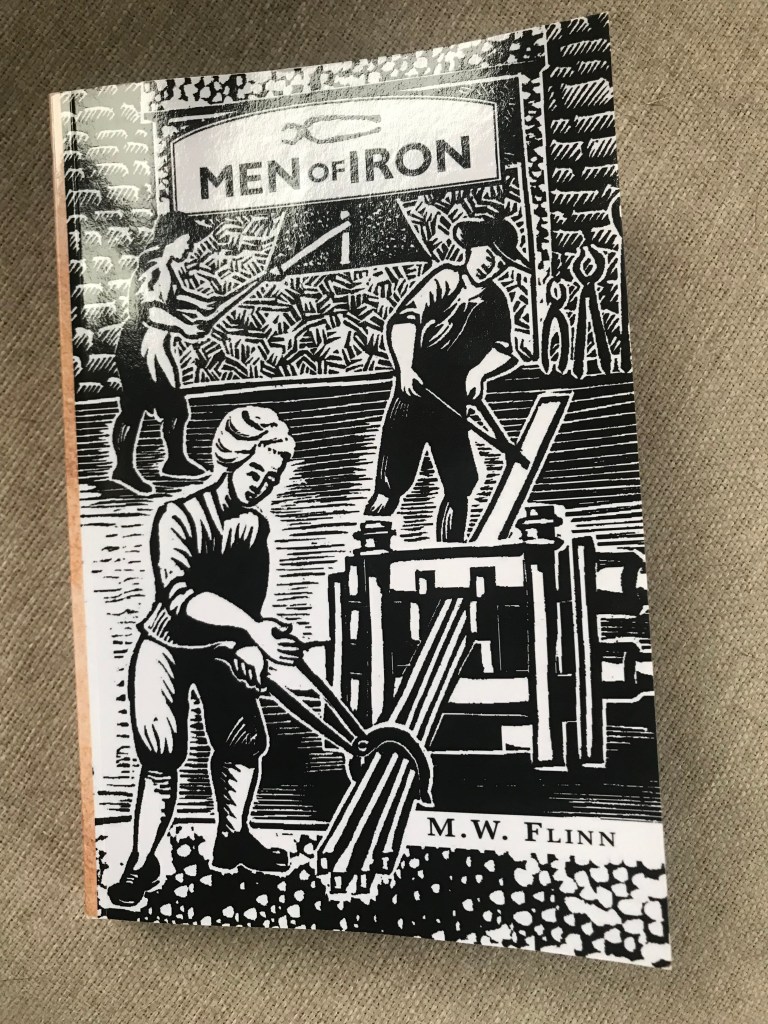
Copyright: Land of Oak & Iron 2019.
If you happened to be passing my house late on the evening it arrived, you may have heard a distinct ‘whoop!’ as I read the first few pages as my bedtime reading. This paragraph, on Page 8, is what gave rise to that whoop.
“Rowley Regis, in the heart of the Black Country, was a typical nail-making community. It was distinguished in the seventeenth century not only for its concentration on nail-making, but for the number of families living there which produced the leaders of the iron industry in the next century. The Court Rolls of the Manor in the seventeenth century contain many references to the Wheeler, Parkes, Haden, Foley, Darby and Crowley families. Of the men married at Rowley in the years 1656-7, no fewer than forty were classed as nailers, the next largest occupational group being husbandsmen of whom there were four. Rowley Regis specialised at this period in the manufacture of rivets, hobnails and small nails.“
Copyright: From Men of Iron – by M W Flinn, published by Land of Oak & Iron 2019.
Whoop, whoop! So there it is, summed up. Not just ignorant unskilled labourers lived in Rowley, or at least not all! There were numerous families of industrious, innovative, inventive, clever, determined men who influenced the future of the iron industry and the whole of the surrounding area and further afield.
Flinn goes on to say a little more about Ambrose Crowley I who lived in the village, although his birthplace is not known. He had married Mary Grainger in the early years of the seventeenth century and settled in the village.
“Like his son and grandson, Ambrose I appeared to have had a numerous family, comprising at least five sons and four daughters. No records of his activities have been traced apart from the fact that he was a nailer. He was described as such in his Will which gives an interesting picture of a combination of light industry with an agricultural smallholding that must have been fairly common amongst the domestic workers in seventeenth-century industry. His property was valued at his death at £24.4s 8d and this included, besides his bellows, hammers and other implements valued at a mere £1.10s.0d, ‘muck in the yard, 3s 4d, cheese in the house £1.10s.0d, a cheese press and some old books; two cowes and one weanling calf, £4 10s 0d.’ Clearly his way of life was far from mean or uncultured, for his house contained six rooms in addition to the workshop and a barn. He died in September 1680 at Rowley Regis.”
Copyright: From Men of Iron – by M W Flinn, published by Land of Oak & Iron 2019.
The best £10 I have spent on a book in a long time! I have a lot more reading to do in this book and in “The Seventeenth Century Foleys: Iron, Wealth and Vision 1580-1716” which I bought at the Black Country Society Local History Conference in July but have only dipped into. Both books have information about the processes used in the iron industries and how these were refined and improved over time.
So our tiny village of Rowley Regis was not just a sleepy backwater in centuries gone by but home to some amazing people who influenced the whole of the Industrial Revolution. I am prouder than ever to call myself a Rowley girl.
 rowleyregislosthamlets.co.uk