In all, Timothy Hill (1763-1831) and Maria Hill nee Hipkiss (1782-1855) had seven children between 1800 and 1823, including Benjamin who may or may not have been the son of Timothy’s first wife Ann Priest or of Maria, his second wife. I have been aware of the number of children they had almost since I started my family history research but until now I had not realised how closely they all remained in their community.
Perhaps unusually for that period, it seems that all seven survived into adulthood and childbearing age. Although it is possible that there were other children that I have not found who lived only short periods or were stillborn.
Timothy was about 68 when he died. Two of the Hill sons died relatively young – Benjamin aged 44 in a colliery explosion and Joseph aged 49. Joseph was also a miner but the burial record contains no clues about his death. Samuel lived the longest of all the children, to the ripe old age of 90, very unusual for those days.
And the four girls also all lived long lives, most of them staying within the close neighbourhood of the Lost Hamlets. Maria, their mother, had lived to be 73. Mary Hill was 81, Ann and her sister Elizabeth (Betsey) were both 86 and Jane was 77 when they died. These were unusually long lives for those times, these girls must have inherited some strong genes!
Perhaps living up on the hill above the main settlements meant that they had space to grow some of their food, fresh air, free mostly of much pollution and similarly their water supplies from local springs were probably purer than water in wells lower in the valleys. Whereas many of the men were in quite hazardous occupations, their lungs subjected to constant exposure to coal dust, furnace fumes and quarry dust, with no safety equipment which may have impacted their health, not to mention the hazards of explosions in mines and quarries. But the women and children nail makers would also have worked in the dusty polluted air inside poorly ventilated nailshops.
Grandchildren
So how many grandchildren and great-grandchildren did Timothy and Maria leave?
Child No of children No. of grandchildren
Benjamin 4 27
Mary 9 53
Ann 6 28
Elizabeth 8 64
Jane 10 68
Joseph 5 27
Samuel 4 3
Total: 46 270
So, from their seven children, Timothy and Maria had about 46 grandchildren and the extraordinary total of about 270 great-grandchildren, 213 of these through their daughters so not bearing the Hill surname. Many of these stayed in the immediate area of the Lost Hamlets. So, I think it is fair to say that the Lost Hamlets were well populated with this family and their close connections.
I say about 46 and 270 grandchildren and because there are a couple of instances of people marrying their cousins so Timothy and Maria would be their grandparents twice over and there are also some children whose exact parentage is unclear. There may also have been some children who died in infancy who I have no information about. And a few people simply could not be traced after a certain point and they may have had more children wherever they were.
The Hill children married mostly local people, usually very local. Surnames of spouses in that generation include Whittall, Priest, Moreton, Taylor/Bridgwater, Hackett, Williams, Jones, Bate and Smith.
In the 1841 Census there are twelve households listed under Gadd’s Green or Finger-i-the-Hole, as it was known then, but I can only see one family listed there which is not named either Hill or one of the first four of these names – he was William Woodall. And even then, I suspect I will tie him into the Hill family at some point as he has a Pheby Hipkiss living in his household. So it appears to me that this hamlet was essentially a Hill family enclave. There were certainly Hills in Rowley as early as 1604, as mentioned in the Parish Register and it is likely that they were in the Lost Hamlets area then.
Timothy and Maria’s grandchildren married spouses called Tibbetts, Pearson, Worton, Pritchard, Steadman, Lowe, Whitmore, Blakeway, Jarvis, Parish, Cole, Hemmings, Bowater, Ingram, Leech, Homer, Slater, Priest, Redfern, Siviter, Beet, Parsons, Stokes, Nock, While, Payne, Westwood, Cox, Perry, Raybould, Pockett, Allen, Barnsley, Groves, Ennis, Fellows, Hadley, almost all of these familiar Rowley names.
The next generation linked with Bastable, Gazey, Horton, Harvey – and I have barely looked at that generation, there will be more names.
And yet there are other Rowley names which do not appear – no Parkes, Darbys, Rustons, Levetts, who were all farmers or business people. It appears generally that the Hill family married into families like themselves, nailers, labourers, miners, foundrymen, quarrymen – not many rags to riches stories but plenty of hard working people.
Family life for this part of the Hill tribe essentially centred – literally for centuries – around Gadd’s Green, on the Hill above Perrys Lake and Tippety Green which also provided homes for many of the overspill, which then edged along into Hawes Lane and Siviters Lane.
As I related in a previous post (Tales of Old Portway – https://rowleyregislosthamlets.uk/2023/10/15/tales-of-old-portway/) in a newspaper report about Portway, the reporter noted that “The cottage is said to be over 300 years old and one family – that of Hill, members of which reside in an adjacent cottage – lived there for nearly 200 years.” That 300 year old cottage was built then in about 1600, which ties in neatly with the first mention of John Hill in 1604.
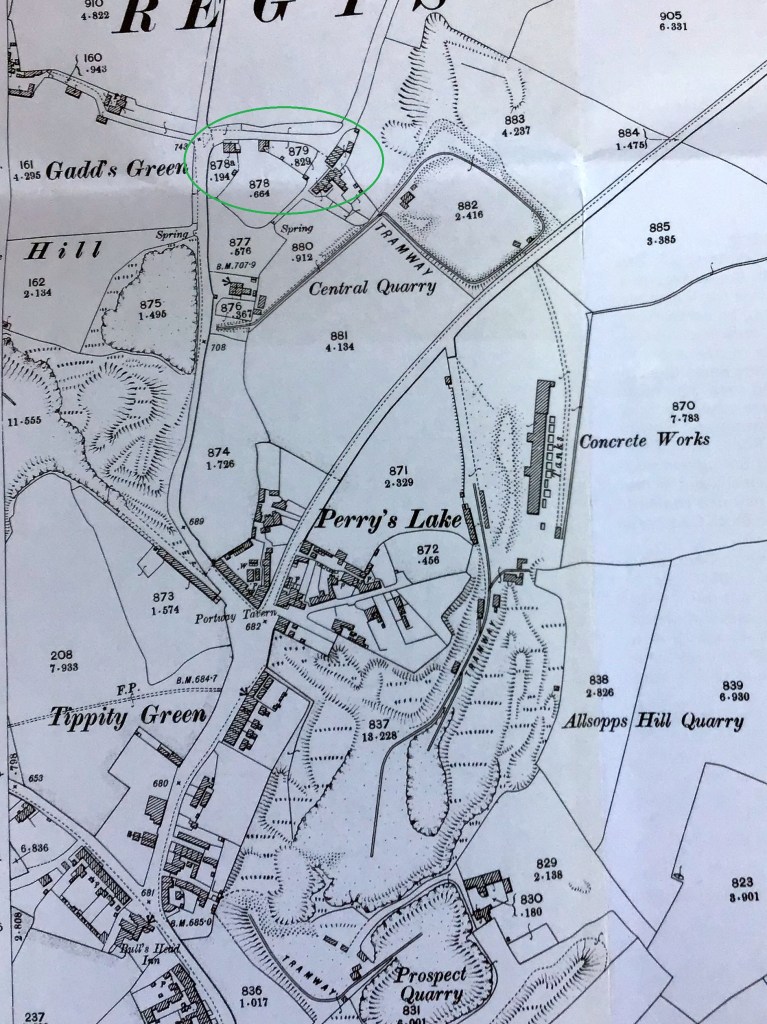
Copyright: Alan Godfrey Maps:
This map shows Gadds Green in 1902 and there are only perhaps twelve cottages shown, none of them of any great size but as I set out in a previous post, (A Hall House at Gadd’s Green?) I think that the group of buildings shown on the right of the green circle on this map was where the Hill’s, in all their nomenclatures, lived and that it is likely that their house started as a hall house and was later sub-divided.
And when these descendants moved away they often stayed in close proximity to other members of the family, little colonies of Hills. And there were other Hill families in the area, these articles relate only to Timothy and Maria’s descendants.
Overcrowding
And the crowded conditions in which many of them lived and on which I have commented several times in these posts, were recognised by officialdom. In his 1875 report on living and sanitary conditions in Rowley Regis, Dr Edward Ballard (who prepared similar reports for many surrounding areas for the government) noted specifically:-
“Overcrowding of cottages, although, of course, not universal, nor perhaps very general, must, from my observation in this matter, be pretty common in many parts. Some of the worst cases I chanced to fall upon during my inspection were at a group of cottages at Gadd’s Green; in Mrs Siviter’s cottage at Hawes Lane, Rowley, and in one of the old cottages opposite the gas-works at Old Hill. In some of the instances of overcrowding which came under my observation, lodgers were taken in; in others the occupants belonged to the same family, but were grown-up sons and daughters of the tenant of the cottage with (in the worst case of all) a number of illegitimate children of two of the girls.”
I remember reading that paragraph for the first time, sitting in The National Archives in October 2023 and mentally noting the specific reference to Gadd’s Green. But it was only re-reading this section of the report last week that the penny dropped and, having done those detailed reports on each of the Hill children, I knew exactly which family Dr Ballard was referring to!
Improvements to Housing
The general overcrowding in the parish and the poor conditions of many cottages was to lead in the 20th century to a huge programme of house building which led to the local council setting out big new estates around Britannia Road, below Britannia Park and below Rowley village in the Throne estates. Houses in poor condition were regularly inspected, condemned and either improved or demolished and the tenants were offered new houses.
The detailed inspections which were undertaken, to meet the obligations increasingly imposed on local councils by various housing legislation, can be seen free online in the Annual Health Reports which were made by the Medical Officer and Sanitary Inspectors to the Rowley Regis Council. Some of these are available at The National Archives and others can be downloaded from the Wellcome Foundation. If you search online for Wellcome Foundation and then search their site for Rowley Regis Health reports there are three pages listing reports, and you can download any of them to read later. They date from the early 1890s to the 1960s and make very interesting reading, dealing with all aspects of health, births and deaths, housing, sanitation, water supply and refuse disposal, many reports listing all the staff by name. And there were remarkably few staff with a lot of duties, especially in the earlier years! I have not found the reports for every year but enough to be able to observe the changes that came over the area.
What a contrast it must have been to move from a poorly maintained damp possibly subsiding two up two down cottage with no damp courses, earthern floors, poor water supply and little or no sanitation, into a newly built house with generously sized accommodation and front and large back gardens, a three or four bedroom house with a separate kitchen and bathroom, all on spaciously laid out and designed estates, not just long straight rows of cottages as had sprung up in Blackheath in the mid-late 1800s, all within easy walking access of Blackheath town, shops, churches and chapels, schools and all the facilities they needed. And very often with familiar faces living nearby as the worst areas were cleared.
Conclusion – Kith and Kin in the Lost Hamlets
I hope that my readers have found this long and detailed account of one family in the Lost Hamlets interesting and that it may have been helpful to anyone with Hill ancestors. I am seriously considering combining all these articles into an e-book to keep all the information together.
It seems likely to me that, for centuries, these small communities in these hamlets were very insular and did not really regard themselves as part even of Rowley village proper, until the growth of Blackheath, better housing and opportunities in industry enticed later generations away from the hill.
This family study has, for me, illustrated very clearly the intrinsic web of kith and kinship which existed in the area of the Lost Hamlets and the extent to which people in the Hamlets married the boy or girl next door. (Originally, “kith” meant one’s native land or country, then broadened to include friends and neighbours, kin meant immediate and wider family.)
I follow the blog of another One Placer who is working on a OPS of a village where his ancestors lived. Over the past couple of posts he has been describing how he now has one large tree which covers most of the people which he refers to as a ‘forest’, rather than a tree. I think there is something in that analogy but in my case I do not think the Lost Hamlets or even the Hill family amount to a forest. So I looked up other words for a group of trees and I decided that the word to describe the kinship in the Lost Hamlets is a ‘spinney’ which is apparently defined as “A thicket or small wood, often on higher ground”, a thicket by the way is “a dense, tangled mass of shrubs and small trees” which seems very appropriate. So my Lost Hamlets families are all part of the Lost Hamlets Spinney!
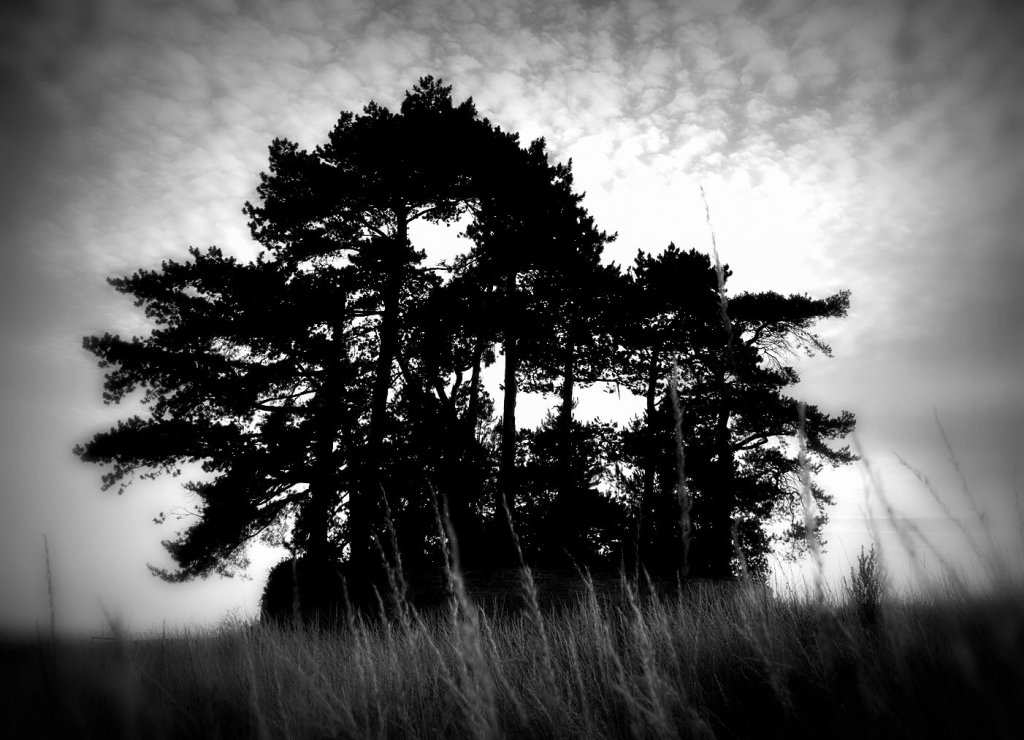
A ‘spinney’ on a hill! Copyright Mark Schofield and Glenys Sykes
It is now apparent that as I research for more family studies in this area that I will keep finding they were also kith and kin and will link back to this research and the work I have done on other families, more trees and shrubs within the Spinney! And I observe that such webs of kinship were the norm in many small places and in small places within larger places. Tribes might be another description, although that can have sinister connotations these days. But tribes looked after their own and protected them. This, albeit a long time later, is my tribe.
How astonished these people would be, I suspect, to stand in Tippity Green today and see that almost all of the places in which they, their ancestors and many of their descendants lived their lives have completely disappeared. More astonished still, perhaps, to know how much information about them we are able to put together two hundred years later, how could they have imagined such interest in them and their lives?
But these small hamlets and the people who lived in them will not be forgotten, at least by me!
 rowleyregislosthamlets.co.uk