Families of the Lost Hamlets -Yet Another John Levett

John Levett b.1847 Rowley Regis

Over the last few weeks, I have done quite a lot of work on the Levett family in Rowley Regis. After the terrible year for that family of 1902 I suspected that most of the remaining Levetts had moved away from the village. Having a quick look at the 1911 Census for Rowley to confirm my theory, I was surprised to see a John Levett aged 67 living in Springfield because he did not appear to be part of the other Levett family in any of the earlier work I had done. On searching further, I found him in Rowley and Blackheath right back to 1871, originally working as a butcher and later at the quarry. I knew that there were later generations of Levetts who were butchers in Rowley and Blackheath who did not appear to come from the branch of the family which I had been working on – was this where they came from?

This John Levett appears in his first census under this name in Rowley in 1871 and he was consistent in records thereafter over a 50 year period about his age and place of birth which showed that he was born in Rowley Regis in 1847. So who were his parents? Where was he in 1851 and 1861? He did not appear under this name in the censuses for those years.

I looked in various records for a birth or baptism of a John Levett in Rowley Regis in 1847, + or -1 year. No birth registration or baptism. Odd. Checked surrounding parishes – still no John Levett. Odder.  After mulling this over for a while, it occurred to me that perhaps his birth and baptism had not appeared because he was illegitimate and his birth might have been registered in his mother’s name?

The illegitimate Johns baptised in Rowley Regis in 1847

So I checked the Baptismal Register for St Giles for 1847, looking for a child named John, illegitimate, and baptised in that year. There were only two.

John Hobbiss

One was born to Rosannah Hobbiss at Slack Hillock on 28th February 1847 and was baptised at St Giles on 9 May 1847, according to his Birth Certificate. Although the mother’s name is given in the Baptismal Register as Louisa, I cannot find any trace of a Louisa Hobbis before or after this date and I suspect that either this is a clerical error or she lied about her name! But a John Hobbis of the right age appears in the 1851 and the 1861 Censuses, apparently the son of Rosannah Smitten, nee Hobbis, in both censuses living in Old Hill. But after that John Hobbiss is nowhere to be found. Rosannah Hobbis married Thomas Smitten at Dudley St Edmund on 25 Oct 1847 and in 1851, when they were living in Old Hill, John is described as Rosannah’s son so it appears that he was not Thomas’s as their other child Emily is specifically noted as his child. Rosannah was born in Bromsgrove so was not a Rowley or Old Hill girl. In 1861, the family were living in Cherry Orchard, Old Hill and John is again shown  under the name of John Hobis, by then 14 and a coal miner. In 1871 Rosannah, by now widowed, was living in Elbow Street, Old Hill with her children by Thomas Smitten but John is no longer living with her.  I have not been able to find any trace of him under that name after that date.

So this boy had associations with Slack Hillock and Halesowen Street, where the mystery John Levett was later living in 1871 and where his bride Ellen Smith lived, was only a few hundred yards away. However it is more difficult to see whether John Levett of Rowley, the farmer, had any direct connections with this area that would bring him into contact with Rosannah Hobbiss but that cannot be ruled out either.

John Moreton

The second illegitimate John was born to Emma Moreton, (who just happens to be my 2xgreat-aunt) on 16th March 1847 at Finger-i-the-Hole and was baptised at St Giles a few weeks later on 13th June 1847.  Emma, who grew up in Perry’s Lake, married Thomas Priest (or Redfern) a couple of years later in 1850 and they had ten children together. But in the 1851 Census her four year old son John is living with them in Gadds Green under the name Priest and also in 1861, by then aged 14 and listed by the name Redfern – but that was because his stepfather Thomas Priest also used both names in different censuses, either that or it was an enumerator error, as the family was living literally between two households of Redferns – see my article  on the Redferns for more on that! At that time John was a furnace labourer, a common occupation for the Redfern men. But after that John Moreton – or Priest or Redfern – depending on which name he was using at the time – is nowhere to be found on the area.  

So both of these illegitimate Johns seem to disappear after the 1861 Census when they would have been 14 and going out to work – no help there, then!

However, a John Moreton, aged 22, was married at St Giles on 21 Aug 1870 to Eliza Caddick. He gave his abode as Turner’s Hill, (where the Priests/Redferns lived), and did not enter any name for his father. And the witnesses to this marriage were Solomon and Mary Ann Redfern, Solomon was only a few years older than John and was a half-brother to Thomas Priest or Redfern. He actually lived for some years next door to John so would certainly have been known to and associated with this John.

Had this John reverted to his original name for his marriage? I think he had.

John and his wife were living in Church Row, Rowley in 1871 with their 10 month old son Samuel and this John gives his place of birth as Rowley Regis. There was only one John Moreton born in Rowley in that period, so it seems likely that this is the same John Moreton who was baptised in 1847. By 1881 the family had moved to Barrow-in-Furness in Lancashire and John was working in the iron works there. Again, this fits with his previous occupation as a furnace labourer when he was in Rowley.

Barrow-in-Furness Migration from Rowley

Incidentally, on this page of twenty six people in Parker Street, Barrow-in-Furness, there are no less than twenty two people who give their place of birth in the Black Country – Rowley Regis, Cradley, Brierley Hill, Tipton – on this page and those around it there are Mortons, Whitehouses, Gaunts, Willetts,Siveters, Priests, Ingrams, Westwoods, Billinghams, and Taylors, all familiar local Rowley names. It looks as though there was a considerable migration amongst the iron workers from the Black Country iron works to the Barrow area.  

This Moreton/Morton family (The spelling changes at this time) remained there afterwards and it appears that John Moreton died there some time between the 1901 and 1911 censuses when Eliza Morton is shown as a widow in the latter. If this is the John Moreton who was baptised in 1847, he is not our man.

Back to the mystery man – John Levett the Butcher

At this new John Levett’s marriage in St Giles in 1867, aged 21 and a butcher, of Blackheath, he gave his father’s name as John Levett, farmer.  The information given in such records is only as accurate as the priest or Clerk is told so the use of this name is not necessarily true. But his use thereafter of the Levett surname does seem to indicate that he believed that he was a Levett.  Perhaps he knew who his father was and decided to name his father and use his surname when he got married and thereafter.

As to the identity of this John’s father, there is only one John Levett in Rowley Regis in the 1841 and 1851 Censuses, and that was John Levett of Brickhouse Farm, father of James Adshead Levett. Did the recently widowed John Levett find solace with a local girl in 1846? Perhaps he did. Was he the father of this John Levett? He would have been nearly seventy by 1847 so not impossible but perhaps unusual.

Or might James Adshead Levett, living in Perry’s Lake, and aged 42, and previously described in records as a farmer, be responsible? It appears from the variations in the descriptions of James’s occupations that the pub-keeping was only one of various occupations and as late as 1851 he was described as a colliery clerk. It may well have been that he also assisted his father with running the Brickhouse Farm.

Of the two possible illegitimate Johns baptised in Rowley, I tend towards thinking that the John Levett in Rowley is more likely to be the son of Rosannah Hobbiss.  He was later living in Halesowen Street, Blackheath at the time of his marriage, just up the hill from Slack Hillock and it does seem likely that the other John reverted to his original name of Moreton and moved away from the area.   

I can find no Bastardy Orders to help. Perhaps a DNA test would throw up some links or perhaps descendants of this couple actually know the story but otherwise this has to remain pure speculation.

John and Ellen Levett

This John Levett married Ellen Smith on 14 Oct 1868 at St Giles, Rowley Regis. He was 21 and a butcher of Blackheath. She was 19 and also of Blackheath, so presumably her father had given his consent to the marriage. The groom gave his father’s name and occupation as John Levett, farmer. Her father was Sydney Smith, a Manufacturer. The witnesses were Job and Sarah Siviter but these people were the Grave Digger and Church Cleaner for St Giles so this may have been the only connection, they may have acted as witnesses on a regular basis.

John was marrying into a respectable family, perhaps he felt under pressure to be able to name his father in the marriage record. Later in life their sons and daughters went into service with wealthy families and ran businesses so they must all have been presentable and capable.

Ellen Smith was the eldest daughter of Sydney Smith of Halesowen Street , Blackheath who was a Rivet Manufacturer, employing five men in 1871. From the description in the census then it appears that they were living towards the Gorsty Hill end of Halesowen Street, perhaps somewhere near the junction with New John Street.

After their marriage, the couple were living in Halesowen Street in 1871, in Garratts Lane, Old Hill in 1881 and by 1891 had moved to 2 Dudley Road, Springfield where he was described as a Labourer, (also in 1901 when he and his two  remaining sons at home were stone breakers)  whereas previously he had always been shown as a butcher.  2 Dudley Road was next to the Bull Inn and there is some evidence that this had been a shop, possibly a butcher’s shop previously. By this time John and Ellen Levett had had five sons and three daughters. They remained in Springfield until their deaths, both attaining grand old ages for that period. John Levett died in 1926 aged 81 and Ellen in 1929 aged 80, both are buried in St Giles Churchyard.

Their children were:

Harry (1870-1886), who died aged 15 and was buried at St Giles on 9 May 1886, his address was shown in the Burial Register as Tippity Green so their Dudley Road home appears to have been very close to the Bull Inn.

Their eldest daughter Alice (1872-1915) had in 1891 been living in as a servant in the household of Mr T Danks, Boiler manufacturer, at 77 Dudley Road, along with her sister Amy. In 1895 Alice married Samuel Dowell at Reddal Hill and they moved to St Johns-in-the-Vale, in Cumbria, where they were living in 1901, where Samuel was working in the stone quarry. (Regular readers may remember that many Rowley sett workers moved to St John’s-in-the-Vale in this period, this has been referred to in other pieces on this blog.)  Alice’s brother Frank was also living with them, also working at the quarry. However, their stay in Cumbria does not appear to have lasted long as both of Alice and Samuel’s children were born in Rowley, Winifred in 1903 and Donald in 1907. In 1911 they were living in New Buildings, Tippity Green. Alice died in 1915, aged 42 and was buried at St Giles.

Frederick (1873-1932) This little Levett stayed at home! Frederick became a butcher, in 1901 and 1911 he was listed as a butcher in Rowley Village. In 1894 Fred, then a quarryman, married Elizabeth Payne at Holy Trinity, Old Hill, and they had six children, two daughters and four sons, one of the latter died in infancy. By 1921 Fred had a butcher’s shop at 35 Penncricket Lane and his son Harry (by then 24) had his own butcher’s shop at 48 Birmingham Road, Blackheath. It was this shop that I remember although by then it must have been run by Fred’s grandson or great-grandson.

Frederick and Elizabeth had four sons and two daughters, Harry (1896-1958),John (1899), Ellen (1902), George Frederick (1903-04), Alfred(1908) and Amy (1909). Harry continued to run the butcher’s shop in Birmingham Road and it was still run by Levetts up to the 1960s.
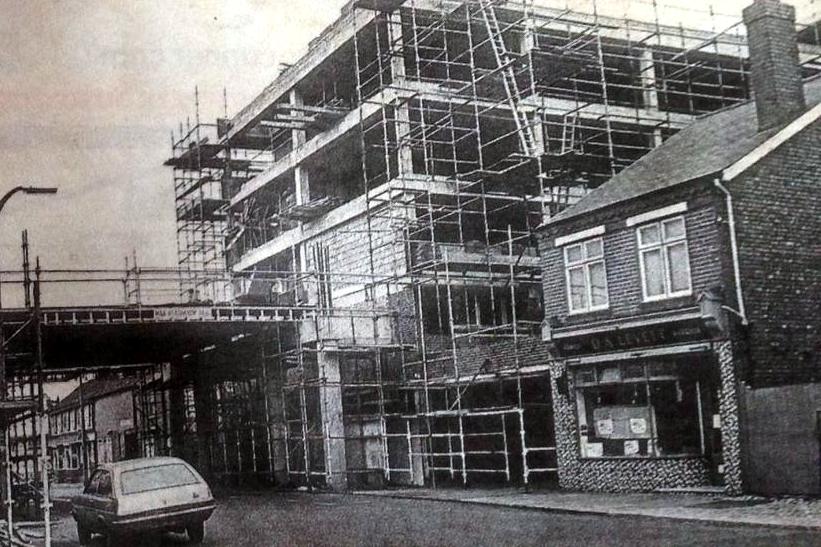
Copyright – Steve Pearce

This photograph, posted on Facebook by Steve Pearce in 2014, shows Levett’s butcher’s shop in Birmingham Road, alongside the never to be completed car park construction. The abattoir was originally behind the shop, I understand and the family sold the land on which the Shoulder of Mutton was built, the name of the pub specified as a nod to the butchery business! There are many comments on Facebook from people who remember David Levett and his son still running the business and how well respected, obliging and friendly they were, as I remember myself.

Amy (1875-1952) also went into service and after leaving Mr Dank’s household, she moved to Stoke Prior where in the 1901 Census she was a nurse to the children of Mr Victor Drury, a boot manufacturer. Her sister Lizzy was Cook in the same household. However, soon after the Census Amy married William Henry Edwards (a Rowley boy) on 27 Jun 1901. And they married in St Johns-in-the-Vale, in Cumbria (popping up again!). This family stayed in Cumbria, however, their children Frederick and Ellen were born there and they later moved to Cockermouth where they died, William in 1940 and Amy in 1952.

Frank, (1877-1938) who had been living with his sister Alice in the 1901 Census, also stayed in Cumbria. On 8 Apr 1901 he married Annie Adelaide Hindmoor Benbow at St Johns-in-the-Vale, Cumbria and they had three sons Sydney (1903), James (1904) and John (1908) He and his family moved to the USA in 1913, probably to join Annie’s brother James Benbow, and Frank is still listed as a sett cutter at this time. However, Annie died in Massachusetts in 1917 and Frank returned to Cumbria with his two younger sons James (1904) and John (1908) (their eldest son Sydney (1902) staying in the USA for the remainder of his life) in 1919. They were living with his sister Amy and brother-in-law William Edwards in Threlkeld in the 1921 Census. Frank died in 1938, his death registered in the Carlisle area so it is possible that he continued to live in Threlkeld or perhaps died in the Infirmary in Carlisle which is the main hospital for the area.

Lizzie (1880-1956) or Lizzy (the spelling varies throughout her life!) also remained in Springfield, Rowley for many years, listed as late as 1940 in trade directories as a shop keeper at 7, Dudley Road, where she lived with her parents until their deaths. Whether she kept the shop open is unknown but she died at 7 Dudley Road in 1956, the last of her generation, and it appears likely that she is the Elizabeth Levett who was buried at St Giles then. She had been Lizzie all her life and her birth was registered as Lizzie but formality overtook her at the end! Records show that Probate was issued to her nephews Harry and John Levett, both butchers!

Peter (1883-1944)

Peter’s is a sad story. He was unmarried and shown as a stone quarry worker in 1911, living in Dudley Road with his parents. He served in WW1 with the Worcestershire Regiment but was discharged ‘insane’ in 1919 and in the 1921 Census was shown as a patient at Barnsley Hall Mental Hospital. He was still there in the 1939 Register, shown as an ex- soldier, which probably implies that he had been there ever since. He died at Barnsley Hall in 1944.

Ernest Levett (1877-1919)

Ernest, the youngest of the children of John and Ellen Levett, was born in 1877. In 1911 he was working as a labourer at the stone quarry. He married Beatrice Taylor at St Giles on 25 Oct 1908 and they had five daughters and one son, including twin daughters Nellie and Amy born on 28 Oct 1919. He died and was buried at St Giles on 6 Dec 1919, when they were barely a month old. No mention is made of his cause of death and he may have died of Spanish flu which killed many people then. Beatrice, at the age of only 26,was left with six children aged twelve down to a few weeks old. Ernest having returned from the war, unlike many men, this must have seemed very hard to Beatrice. In the 1921 Census, Beatrice was still at 2 Tippity Green, the address given on Ernest’s enlistment papers but by 1939 she had moved with all her children except Elsie to Queens Drive, Whiteheath. It appears that Elsie died in 1927, aged 11. The other children – Lizzie (1909), Herbert (1911), Annie (1913), Elsie (1916), Nellie and Amy (twins – 1919) mostly appear to have married fairly locally, although this is entering the period when tracking people becomes more difficult because of data protection.

Summary – the other Levett family!

This John Levett was not mentioned in any of the Levett Wills I have looked at and it is not known whether the other branch of Levetts in Rowley acknowledged them. The names John and his wife used for their children are not the same names, generally, that recur frequently in the other Levett family, although the names from the Smith family, Ellen’s family – Sydney, do recur. Like the other Levetts, however, this John Levett was a hard working man, first as a butcher and later in the quarry. He left eight children and at least twenty grandchildren. No doubt there are many more descendants in later generations. Two of his sons and one of his daughters followed him into business, running shops in Springfield and the village and later in Blackheath so perhaps he had inherited at least the Levett  capacity for business.

And although the family moved around the area in later years, John and Ellen and their daughter Lizzie Levett, with their shop and home lived at 7 Dudley Road right up to Lizzie’s death in 1956.

Copyright: Mike Fenton

This photograph, courtesy of Mike Fenton, shows Dudley Road in 1969, only a few years after Lizzie died and there are two shops on the left. Comments on this picture on Facebook say that the first of these was a butcher’s shop, and the second was known as Mary’s shop. I suspect that this shop was Lizzie’s shop before Mary!

The end of this part of the story of their lives has Lizzie ending up living for decades within yards of, if not actually on the site of Brickhouse Farm where the original John Levett, very possibly her grandfather or great grandfather, had lived when he moved to Rowley one hundred and fifty years earlier.

As I have commented before in this study, Rowley family roots go deep but it seems they also go in circles!

Pubs in the Lost Hamlets  – The Portway Tavern

Taverns, inns, beerhouses and pubs have been in – indeed central to – our towns and villages for many centuries. The start of Chaucer’s Canterbury Tales, dating from 1387, begins with the pilgrims gathered at the Tabard Inn in Southwark, prior to their setting out on their pilgrimage, and doubtless there would have been many other such houses on busy routes such as existed then.

In smaller settlements some pubs were little more than drinking clubs in an ordinary house, rather than specially built institutions. Many families brewed their own ale for home consumption and many pubs did the same. (Brewed ale was safer than water often because it had been heated in the brewing process.) These successful brewers probably expanded to supply other houses and pubs, especially if it was known as a particularly good brew, big breweries did not exist until relatively recently. Some inns will have started as lodgings for monasteries and religious houses which probably moved seamlessly to independent provision after the Dissolution of the Monasteries and many hostelries, in cities, towns and on major routes will have acted as lodging places for travellers. Others will have developed as places for workmen to get a much needed drink on their way home from dry, dusty or dirty work. The Portway Tavern certainly is on record as having fulfilled this function for the quarry workers from the nearby quarry and some of the other functions from time to time, such as being the venue for inquests.

But formal countrywide legislation to regulate the operation of such places did not reach the statute book until 1753 when the Licensing Act inaugurated the recording of full registers of victuallers, to be kept by the Clerk of the Peace at Quarter Sessions.

In 1830 a Beer Act was passed whereby, upon payment of 2 guineas to the Excise, people could sell Beer, Ale, Porter, Cider and Perry without a formal license from the Licensing Justices and many of the smaller beer houses in the Rowley area fell under this category and were not permitted to sell stronger liquors.

The Licensing Act of 1872 remains in force today and it is illegal to be drunk in charge of a horse, cow or a steam engine. Other modes of transport have been included in later legislation! The Pub History Society tells us that “Under the Act some drinkers became infamous “bona fide travellers”, who could be served outside of normal trading hours. Travelling in good faith meant that you should not be “travelling for the purpose of taking refreshment”, but you could be “one who goes into an inn for refreshment in the course of a journey, whether of business or pleasure”.  While people posing as travellers were regularly charged and prosecuted, it was difficult to prosecute licensees who had a handy escape clause in the law. To find the publican guilty, the prosecution had to prove that the licensee did not “honestly believe” that his customer was a bona fide traveller when serving outside of normal opening hours.” [i]

The Portway Tavern

Copyright:Mike Fenton.

The Tavern was, I am told, situated at the foot of Turner’s Hill, facing the road that went up and over the hill and the entrance to the Hailstone Quarry. As can be seen from this photograph, the proximity to the quarrying operations continued to the end. There were several houses around and behind the Tavern, in addition to a Brewhouse and other outbuildings. Some census entries call it the Portway Inn. Some do not even record the name at all.

Copyright: Alan Godfrey Maps.

This map from 1918 shows a ‘P.H.’ at Perry’s Lake, which was obviously the Portway Tavern but I am still not quite sure which building it was in those clusters of cottages. Probably one of the two corner buildings, I suspect and I am inclined to think that it was the building to the right of the new road leading down to Portway. That has several outbuildings and access to a yard which would fit with both the description at the time of the sale and the site described in the prosecution. But someone may put me right on that. It also shows the Rowley Brewery in Tippity Green and how close they were to each other.

Hitchmough records that the Portway Tavern was licensed from some point before 1849, his first names licensee was James Adshead Levett Snr, in whose family occupation it remained until it was sold after Mrs Sarah Perry who was the daughter of James Adshead Levett Junior, gave up the licence in about 1901.

But situated as it was, directly on the route which later became the toll road from Halesowen to Dudley, it seems very likely to me that a beerhouse or hostelry which later became known as the Portway Tavern existed there in some form well before licensing came into force.

The Licensing system was operated by the local magistrates and there was a Licensing Session annually when licences were renewed or not, sometimes, if the applicant had offended against the licensing laws in the meantime in which case he might lose his licence, a serious consideration. There are numerous reports in the contemporary newspapers of these sessions and in each case any offences which had been committed by the Licencee were listed, whether for exceeding licensing hours, permitting drunkenness or gambling or other instances the police reported on. There are also reports in most years that I have seen these reports of the landlords of ‘beer houses’ wanting to upgrade their licence to a full licence so that they could sell wines and spirits in addition to beer but these seemed mostly to be refused and this was obviously carefully controlled.

The Black Country Bugle, in 2003, published an article by Peter Goddard on ‘Tippetty Green and the Tromans Family and Rowley Quarries’, saying:

“Quarrymen were hard workers and hard drinkers. The Portway Tavern was the first port of call after a long shift, due to its closer proximity to the quarries. It had a small bar with a low ceiling, and a little used, long room adjacent.”

And in my blog post entitled ‘Tales of Old Portway’ I noted an article in the Dudley Chronicle in 1926 which said that:-  

“The Portway Tavern is described as “the rendezvous of generations of quarrymen”, referring to recent renovations which had done much to modernise the exterior but it was noted that “the interior is pervaded with an old-world atmosphere. On a rack in the smoke room are twenty-two churchwarden pipes, numbered and tobacco stained, the blackest belonging to the oldest and most regular attendant at the pipe club which meets in the tavern on winter evenings.”

The Levett family and the Portway Tavern

In the 1841 Census James Adshead Levett the Elder  is living in Perry’s Lake and listed as a Publican, although the pub is not named as such but this was undoubtedly the Portway Tavern. He had, according to the baptismal register at the time of the baptism of his son Richard in 1836, been living at Cock Green as a farmer but by the time of the baptism of his son John in December 1840, the family was living in Perry’s Lake although he was still described as a farmer then, a not unusual case of more than one occupation. In the 1851 Census he was shown as a Colliery Clerk and it was not until the 1861 Census that the Tavern was named and his occupation was shown as a Victualler. As early as 1842, James Adshead Levett Snr was listed in the Poll Books and Electoral Register as eligible to vote because he owned or rented ‘houses at Perry Lake’, so not just one house. Unsurprisingly, in view of this, censuses often show several Levett households living at Perry’s Lake, presumably in these houses, probably around or behind the pub.

Generally when James and Mary Levett were running the Tavern it appears that they kept their house in good order and I can only find one report of an offence in the newspapers. In August 1847 James was charged with permitting gaming with dice in his alehouse. PC Janson told the court that he had found

“two dice on the table and a cup, a man shaking it, and money on the table, for which they were  playing. Defendant said there had been a raffle at this house that night, and afterwards the men did play for a few pence, but without his knowledge.”

He was fined 5 shillings and costs. In those days magistrates were local and the courts sat in local towns so people would have been well known to each other. And policemen had local ‘beats’ and would have known their licensees and kept a careful eye on them.

James Levett the Elder died , according to the Probate Record, on 23 Jun 1878, aged 75. His widow Mary retired to Gadd’s Green where two of her granddaughters Ellen (18) and Harriett (9) were staying with her in the 1881 Census. In his Will James had left  to his ‘dear wife’ “such part of my household furniture and effects belonging thereto as she shall select for her own use except my clock and bureau which I give and bequeath to my son James”. The remainder of his property was to be sold and the proceeds to be shared equally between his four children. Interestingly, the Will notes that the house in which he lived belonged to his wife as tenant for life. The Will notes that as James the Younger had agreed on his father’s decease “to take it from her as tenant at a rent of twenty-five pounds a year, I direct that in the conversion of my said personal estate into money, my said son James shall be at liberty within a reasonable time after my death or on the happening thereof to exercise the option hereby given to him of taking the stock-in-trade fixtures and effects used by me in my business at my decease at a valuation to be made in the ordinary way in which valuations are made of stock-in-trade fixtures and effects of the like nature.”

It appears that the licence was transferred, perhaps initially to Daisy Levett but later to his son James  Adshead Levett the Younger , by then a widower, who was listed as a Licensed Victualler in the 1881 Census at 29 Perry’s Lake, living there with his son William, aged 20, a carpenter, and daughters Daisy aged 23 and listed as a grocer, Kate aged 16 and a Pupil Teacher and Nelly aged 10 and a scholar. It is perhaps not surprising that Daisy should be listed as a grocer as this had been the occupation shown for her father James  Adshead Levett Jnr in Perry’s Lake in the two previous censuses, so presumably when he took over the pub, she kept the grocery business going. Looking back at the time of James’s marriage in 1857 he had given his occupation as a grocer on the Tettenhall Road in Wolverhampton and this had been the profession into which he had been apprenticed at the age of 14.

So in addition to the pub, it seems that the Levetts ran a grocer’s shop in Perry’s Lake, very possibly in the same buildings. I have most definitely gained the impression that the Levett family were very flexible about their living and trading arrangements. And it seems the Levetts made sure their children were set up in suitable professions, their son Richard who was a shoemaker (and apparently part-time brewer) also lived in Perry’s Lake, William was a carpenter.

Licencing applications

Oddly, in August 1878, there were various advertisements in the County Express, giving notice of the intention of various people to apply for excise licences to sell various alcoholic beverages in their beerhouses and shops. The advertisement put in by James  Adshead Levett was for an excise licence to sell “Sweets by retail, to be drunk and consumed on and off the house and premises thereunto belonging”. This is the only such application I can see, all the others are for licences to sell beer or cider or wine, why would you need an excise licence to sell sweets? Perhaps they were making home brewed soft drinks, as well as beer in their brewery?

I can remember as a child a van that came round selling brewed lemonade, ginger beer and American ice cream soda – strawberry ice cream  soda or am I dreaming that? –  in large pottery flagons, that was definitely quite fizzy and must  have  been brewed. I think the drinks were made in Oldbury but certainly very locally. Each week you returned the empty flagons for refilling, it was a rare treat because my father was chronically ill and there wasn’t much money to spare for such luxuries but I remember how delicious they were. And even today Fentimans produce botanically brewed drinks such as lemonade and ginger beer. Or perhaps it was a Printer’s error but I would be interested to hear whether anyone has any other suggestions!

Incidentally in the advertisement Mr Levett states that the house and premises were rated for the relief of the poor and that he was the tenant, the premises being owned by Thomas Auden. So it seems that the Levetts were not the owners after all. Since John Levett had been and appeared to be still bankrupt (See my first article on the Levett family for details) it would perhaps be slightly surprising if his son had the wherewithal to purchase multiple houses at Perry’s Lake in 1841.

Also in the Reports of the County Express of 14 September 1878, there is a report that the Licensing Magistrates approved the transfer of the licence for the Portway Tavern from the executors of the late James Adshead Levett the Elder to Daisy Levett, his granddaughter. But at some point it was obviously transferred again to James Levett the Younger as in the 1881 Census James was was described as the Licensed Victualler and Daisy as a Grocer.

You might think that James would be very careful because he already had a criminal record from an incident much earlier in his life so would not have wanted to be in trouble with the magistrates who obviously ran a tight ship. But alas, James Adshead Levett Jnr found himself in trouble with the police and the licensing authority more than once over the years. In September 1882 it was reported to the Annual Licensing Meeting of the court that he had been convicted of ‘permitting drunkenness on 30th November’, presumably the previous year, when he had been fined £5 plus costs. However, it seems he did not actually lose his license although it, along with several other similarly blacklisted landlords did have the licence suspended for a period.

There were two reports in the West Bromwich Weekly News about this incident, the first on 25th November 1881.

Thomas Summerfield, Rowley Village, was summoned for being drunk and disorderly on the licensed premises of James LevettPortway  Tavern, Perry’s Lake. Prosecutor said the defendant went to his house on Sunday night, there were about 30 or 50 persons in the house, one of the men having paid for 20 quarts of ale, the defendant left but returned and commenced a disturbance, and knocked a woman down.

Superintendant Woolaston asked for the case to be adjourned, he visited the house on Sunday night in company with Sergeant Cooper and two PCs. There were about 70 persons in the house, and the landlord never interfered.  A more disgraceful scene never took place. He was of the opinion that the summons was only taken out for a sham. There would be further evidence adduced. The case was adjourned.”

In the same paper in the edition of 3rd December 1881, this report appears, when James Levett was being charged with permitting drunkenness in his house:-

 “PC Birch said at seven o’clock on the night of the 20th ult. He was sent to the defendant’s house in plain clothes, and remained there until 9.30. There was a large number of men and several women in the house, some of whom were drunk. There was a great disturbance, and the language used by the waiter and company was of the most disgraceful nature. Superintendant Wollaston said on Sunday night the 20th ult., he sent the last witness into defendant’s house, he remained outside with PS Cooper and PC Styles. About 8.30 he saw several persons stagger out of the house but they re-entered it almost immediately. About nine o’clock he entered the house, the passage and tap room were completely crammed with persons. There was an old woman, quarrelling with a man called Summerfield, who knocked her down and fell on to the top of her. There was great confusion. There were several men under the influence of drink. There were about 70 people in the house, every room being crowded. A more disorderly house he never saw. He spoke to defendant about it who said he was very sorry.

Cross-examined: Defendant had not been summoned before. PC Cooper corroborated.

Mr Shakespeare said the case arose under unfortunate circumstances. Defendant was away from the house some portion of the time and left someone else in charge. A friend of the defendant’s, from Birmingham, came to the house and left 10s to pay for some beer for the men who caused the disturbance complained of.

Mr Bassano [the Presiding Magistrate] said the Bench considered it a bad case and inflicted a fine of £5 and costs, and endorsed the license. Mr Shakespeare [defending solicitor] appealed to the Bench not to endorse the licence as this was defendant’s first offence. Mr Bassano said they could not alter their decision as they considered it a very bad case.”

One can imagine that if this was a regular occurrence, this might not have gone down well with respectable church going neighbours in this very small and presumably quiet community!

On another occasion Levett was prosecuted for brewing offences, which I have already described in detail in another article.

James Adshead Levett the Youngerdied, aged 63 on 26 Aug 1895, according to the Probate Record which was granted to his daughter Sarah Perry. The cause of death shown on his Death Certificate was Pernicious Anaemia and Exhaustion. His Will allowed Sarah Perry to continue the business of inn-keeping for a period of seven years with the option for a further seven if she wished and for her to have the use of the furniture, stock etc at the pub for this purpose. In fact Sarah died almost exactly seven years later but appears to have given up the pub before then, perhaps because of her poor health and other problems.

The licence, according to Hitchmough, passed then to his son William Levett who held it until 1896, when it passed to Mrs Sarah Perry, which does not quite accord with the intentions in the Will but we do not know whether Sarah was already in poor health. William’s sister. Daisy Levett, his eldest sister, had married Abner Payne in 1885 and she also continued to live in Perry’s Lake until her death in 1902.

Sarah remained the licensee until about 1901 when Hitchmough notes that the licence passed to Thomas William Williams whose family ran the Bull’s Head and had at one time been in some rivalry with the Levett family . However, I do note that Thomas William Williams was listed by Hitchmough as the Licensee of the Bull in Tippity Green from 1892-1900 so he had not moved far. He was also the owner of the Rowley Brewery in Tippity Green so had very local licensing interests.

Sarah died in 1902, as did her sister Daisy – only a few days apart and aged only 42 and 44, followed less than two months later by Sarah’s husband George Perry. But on 20 September  1902 the Portway Tavern had been put up for auction, in accordance with the Will of James Levett  the Younger who had left it for Sarah to run the pub for seven years with the possibility of a further term if she so wished. It seems likely that, by this time, she was so ill that she could not continue. The children of Sarah and George Perry were taken in by aunts, uncles and others and left Perry’s Lake.

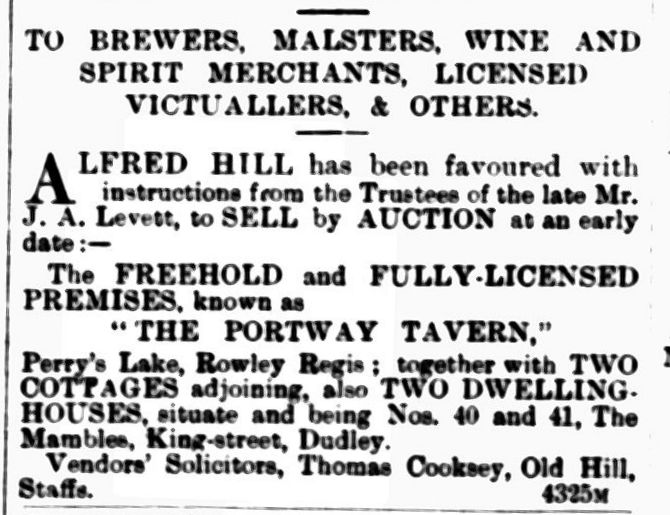
This was the preliminary advertisemment in the advertisement in the County Advertiser and Herald on the 6th September 1902:

In the full advertisement which appeared on the 20th September 1902 for the sale of the premises this fuller description was given:

 “Rowley Regis, Staffs.

Highly Important Sale of a Fully-Licensed Free Public House

Alfred Hill has been favoured with instructions from the Exors. of the late Mr. James A. Levett, to Sell by Auction, on Monday, the 29th day of September, 1902, at the House of Mr. H. B. Darby, the ROYAL OAK INN, Blackheath, at 7-30 in the Evening, sharp.

Lot 1. All that Old-Established Home-Brewing, Fully-Licensed, Freehold, Free, Public House (Corner Property), now in the occupation of Mrs. Sarah Perry, and known as the PORTWAY TAVERN, Perry’s Lake, Rowley Regis, containing Tap Room, Smoke Room, Bar, Club Room, Bedrooms, Pantry, Extensive Cellaring, Brewhouse (with Maltroom over), Stabling (Six-stall), with Loft over, Range of Piggeries, and the usual conveniences, with large Yard and Gateway Entrance, and frontage to two Roads, with Tap Water laid on, and fitted with Gas throughout.

The Auctioneer begs respectfully to call the attention of Investors to these desirable Properties. The Public House offers to Capitalists the rare opportunity of securing a Fully-licensed, entirely Free, Home-brewing House, and an unusually sound Investment”.

Did it sell? I don’t know because I note that in 1911/12 the licensee was George Ward who was the husband of Hannah Levett, the daughter of Richard Levett, the shoemaker, so it seems the Levett family retained an interest in the pub for some time even if it was under another name or perhaps he took it on from Thomas William Williams. George Ward, living at 19 Perrys Lake, had also been one of the Witnesses to James  the Younger’s Will.

But altogether three generations of the Levett family had run the Portway Tavern for about seventy years.

Copyright: Eileen Bird who is descended from James AdsheadLevett, shared this family photograph of the Tavern which she says was taken in 1971. I was interested how different it looked when it was painted white.

Over the next sixty or so years, there were nineteen other licensees, according to Hitchmough, most having the pub for only a few years. Because of 100 year privacy rules, it is difficult to find out much about them as individuals, although local people will still have memories of some of the more recent ones and some may even have lived there when their father or other relatives held the licence.

Local memories from Facebook

Below are some of the memories which have been mentioned on the ‘I remember Blackheath and Rowley Regis’ Facebook page over the last few years. Please let me know if you object to your name being mentioned and I will remove your comments but these memories are part of the history of the Lost Hamlets in a way which will never appear in history books!

More people than I can list had their first pints there!

Several people commented that the Tavern was known locally as the ‘blood tub’. David Stokes thought this went back to the early days. His first memories were of living with his great grandfather in the cottages opposite the ‘Tavern’ in the early fifties. He said “What I can remember very well is ‘they’re fighting again’! Hence, ‘the blood tub’…as I understood it? Thankfully, a bygone era!”

Vicki Noott says that she was born in the Tavern in 1955, as her grandfather Albert Harris was the landlord in the 1950s and Maggie Bridgewater said that she also lived there in the 1950s when her parents were the licensees. Two very local surnames there! Peter Wroe’s parents were the landlords from about 1961-1966, he remembered it as a good old fashioned pub. His sister Caroline was also born there.

Joyce Connop remembered that she always used to look at the clock inside through the window to check the time on her way to Doulton Road School, to make sure she wasn’t late for school.

Ann Teague said that she remembered that there was a dirt road down the side of the tavern. The houses there were mostly occupied by Tarmac workers. 

Brian Kirkham recalled that there was a row of houses behind the Tavern called Heaven and a bit down from that there was a blacksmiths shoeing horses.

Kenneth Greenhouse remembered all the old penny’s on the ceiling by the darts board.

Marie Devonport – “The road seen in the bottom of the picture was the start of Turners hill, right over the road from the Tarmac entrance. If I remember right my family lived just up the road by the telephone box on the corner.”

William Perry had recently read Wilson Jones’s book on Rowley – “it’s very informative. There is a photo of a manorial windmill that stood on the side of Hawes Hill, also there was a large pool with fish in it somewhere about opposite where the Portway Tavern used to be.”

And indeed Wilson Jones asserts in his book that on a Pre-Inclosure map of Rowley, the main habitations were around Rowley Church from about Rowley Hall to Mincing Lane . But the Manor was at Brickhouse Farm with the Manorial Green at Cock Green and the fishpond on the site of Perry’s Lake. So the original Perrys Lake was a manorial fishpond. He also states that two Manor Mills were also marked on this map, one on the opposite side to Hawes Hill, near Tippity Green and one at Windmill End.  The book has a photograph of the Windmill at Tippity Green so it survived for a long time.

Andrew in 2017 said that he lived at the top of Throne Road with his grandparents in the 70’s, he used to be sent to the Portway Tavern with empty Corona bottles to be filled with sherry !

Ant Bromley particularly remembered the really good cider served there.

Marie Smith remembered her brother Eric Oddy having his 21st birthday party there and her mother getting tired – Marie says she was a lady and she never got drunk!

Arthur McWilliams worked in the garage in the quarry opposite the Tavern and recalls that some days they would go over for a pint at lunchtime. He says he will never know how they managed to work the rest of the day!

The end of the Portway Tavern

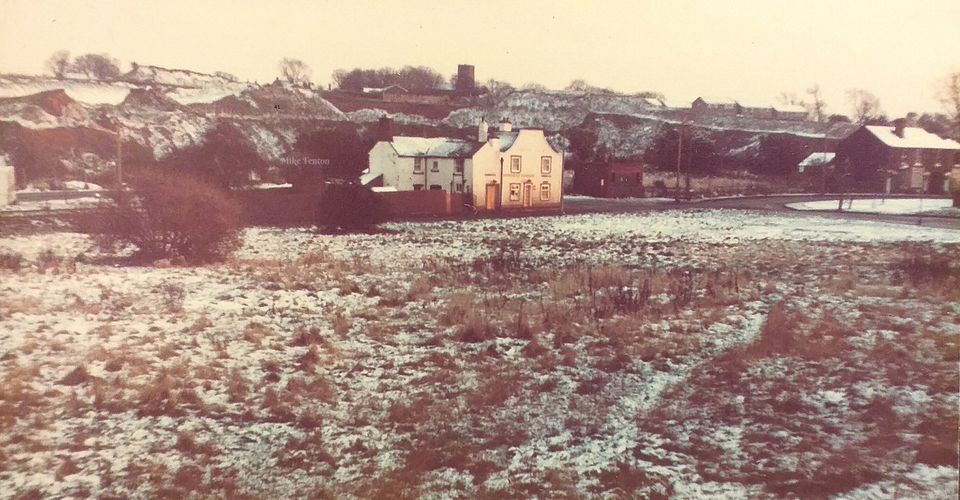
The Portway Tavern closed in 1984 and was demolished shortly afterwards. This photograph shows it standing in isolation after most of the houses around it had been demolished. St Giles’s Church can be seen on the hill behind it, and some of the houses in Tippity Green to the right.

Copyright: Mike Fenton

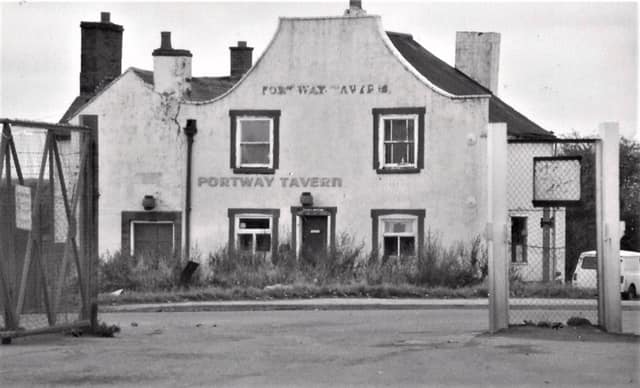
David Duckworth shared this rather sad photograph on Facebook of the Tavern prior to demolition, (copyright of this photograph unknown as it appears in several places).

Standing at the foot of Turners Hill Road, the Portway Tavern had been a central part of the community in the area of the hamlets for probably the best part of two hundred years, from the time when it stood alongside the toll road from Halesowen to Dudley and it had served home brewed ale to many generations of quarrymen working in the nearby quarries. Inquests were sometimes held there and some lively parties, too!

And as so often in these days when so many pubs are closing, something was undoubtedly lost from the heart of the community when it was demolished, and it was the same fate which came to the cottages and communities it once served.


[i] https://www.pubhistorysociety.co.uk/index

Families of the Lost Hamlets: The Levett family 2 – James Adshead Levett (1805-1878), and his descendants

My previous article was about John Levett and his connections. James Adshead Levett was the son of John Levett and Elizabeth Adshead. He was baptised at St Giles, Rowley Regis on 6 Jul 1805, followed by his sister Catherine Levett who was baptised at Halesowen Parish Church on 30 Jul 1813. James’s mother Elizabeth had died in 1822 and his father remarried in London in 1823.

I have limited myself in this piece mostly to those descendants who stayed in the immediate area of Rowley. There are many others who lived in surrounding towns and villages as well as much further afield but I have stuck for now with those who continued to be associated with the area of the Lost Hamlets. These lived consistently in Perry’s Lake and Gadd’s Green, Brickfields and Tippity Green.

Incidentally, I was very interested, in looking at various Levett Wills to see that at least some of them regarded Perry’s Lake as a separate place and not part of Rowley Regis, so that they gave their address as Perry’s Lake, near Dudley. All of the Lost Hamlets were, of course, within the parish of Rowley Regis but clearly at least these residents did not see it as simply part of the village.

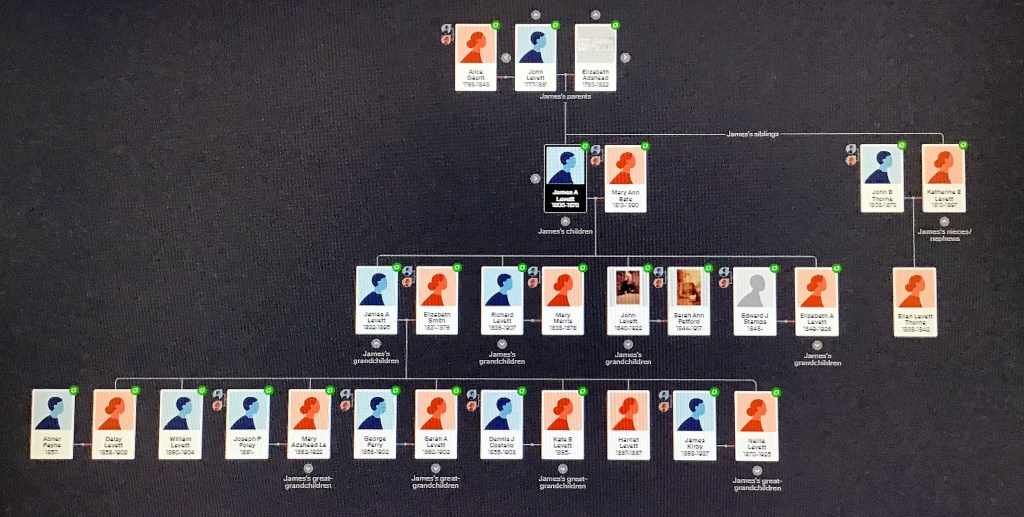
Copyright Glenys Sykes. I apologise for these somewhat fuzzy images, I am exploring ways of producing better ones!

Catherine Elizabeth Levett and the Thorne family

John and Elizabeth’s only daughter Catherine or Kate Levett married John Brooke Thorne, a widower and a Mercantile Clerk of Bradford Street, Birmingham at St Giles on 4 Oct 1837 and they later lived in Aston in Birmingham. They appear to have had only one child, Ellen Levett Thorne who was born in Aston in July 1838 but died aged 3 years and 8 months in 1842. In 1841 Ellen is not in their household, she appears to be with a Sarah Thorne, who was aged 23, living in Handsworth, along with two Finney children who were possibly related to William Finney who married Hannah  Gaunt in 1833, although I have not been able to confirm any connection.  Why Ellen was with Sarah Thorne is unclear and I have been unable to confirm any relationship between Sarah Thorne and John Brooke Thorne but it seems a considerable coincidence that the child should be entrusted to Sarah Thorne unless they were related.

At a later stage, on a family tree on Ancestry, there is a photograph of a beautifully bound Family Bible which has embossed on the front of it that it was presented to John Levett (1840-1922) and Sarah Petford (1844-1917) on their wedding day, 18th March 1867, by ‘their aunt Sarah Thorne’. This John Levett was the son of James Adshead Levett the Elder and his only blood aunt was Catherine Levett who was married to John B Thorne. Was Catherine/Kate known as Sarah – I have not seen this suggested anywhere else although she was frequently referred to as Kate and all official documentation shows her as Catherine or Katherine or Kate. Or was this the unknown Sarah Thorne who was caring for John and Kate Thorne’s daughter in 1841? Sarah Thorne is very elusive in the censuses, does not appear to be in the Midlands over a period of forty years and this remains a mystery – unless there is a member of the Levett family who can tell me? I would love to know!

In later censuses John and Kate Thorne had Catherine’s nephew John Levett (the one who was later presented with that bible)staying with them in Birmingham in 1851, in 1861 a niece Lissie Levett aged 11 and born in Rowley, and in 1871, a niece Janet Pearson aged 10 and said to be born in Penkridge. However, I cannot work out who this child could be, as Catherine had only one brother and he did not have a daughter called Janet. However there is a birth registration in 1860 in Penkridge for an Esther Jane Pearson, and the Mother’s maiden name is shown as Thorne, so presumably Mary was the sister of John Brooke Thorne.

John Brooke Thorne died in 1873 and was buried in Key Hill Cemetery in Birmingham.

By 1881, the widowed Catherine had moved to Sutton Coldfield where in 1881 her unmarried niece Esther Pearson, aged 20 and also born in Penkridge, was living with her, together with a Mary Pearson, aged 46, who was married and a visitor, born in Stafford. Was Esther the Janet who had been staying in 1871? It appears that Esther was indeed Janet or rather Jane, because an Esther Jane Pearson was born in Penkridge in 1860 and her Mother’s Maiden name was Thorne so it appears that this was a niece of Catherine’s husband, rather than Catherine herself. Was Mary her mother? It seems likely. However, tantalising as this rabbit hole is, it is not directly connected with the Lost Hamlets area and I will resist exploring it further! For now, anyway…

Catherine Elizabeth Thorne’s death was registered in the first quarter of 1893 in the Dudley Registration District, although I have been unable to find her burial. Perhaps in her final years she came back to the family with whom she had clearly remained in close contact through the years of her widowhood. From the number of nieces staying with her in various censuses, it would be good to think that for much of her life ‘going to stay with Aunt Kate’ was a pleasing prospect.  Catherine’s Death Certificate shows that she died of ‘senectus’ – old age, and that she died at 28 Tump Road, Blackheath (later Beeches Road) and her death was registered by Mrs Ann Barker, who had been present at the death. Who Ann Barker was and why Kate was there, I have no idea but her only brother and her nephew were both dead and several of his children were to die shortly afterwards so may already have been unable to take Kate in. It is possible that Kate was buried at St Paul’s churchyard, the burial records for there have not yet been transcribed for FreeREG. She was not buried at Key Hill Cemetery with her husband, according to their records.

James Adshead Levett the Elder 1805-1878

James was married to Mary Ann Bate on 21 Feb 1832 at Wolverhampton St Peter, the witnesses being H Adshead, possibly Harriet Adhead, his aunt and James Adshead who may have been his grandfather. The Adsheads appear to have been a Wolverhampton family. Perhaps James had been staying  with his Adshead relations. The first child of James and Mary Ann- also James Adshead Levett  (who I shall refer to as JAL the Younger from hereon) – was baptised at Dudley St Thomas on 27 May 1832, shown in the Baptism Register as James, son of James Adshead and Mary Ann Levett of Rowley. James’s occupation was given as Farmer, perhaps at Brickfield Farm which was still in the ownership of his father.  Two more sons Richard in 1836 and John in 1840 followed. A daughter Elizabeth, again probably named for her Adshead great-grandmother, was born in 1849.

The Bate family – publicans and Victuallers in Cock Green

Mary Ann Bate gives her place of birth in later censuses as Rowley Regis and her ages in those censuses consistently compute to give her a birth year of about 1813. But there is no baptism at St Giles for a Mary Ann Bate in that period. There is a baptism in 1814 for a John, son of Richard and Hannah Bate of Cock Green where the father’s occupation is shown as Victualler so in the licensed trade and he was apparently her brother.

However, there was a baptism at Dudley St Thomas on 8th Aug 1813 for a Mary Ann Bate, daughter of the same couple, Richard and Hannah Bate of Rowley, said to be a labourer so this appears to be the correct Mary Ann, and this was during is the period when extensive repairs were being carried out at St Giles which may account for the Dudley baptism.

Checking out my theory that Mary Ann’s Bate family were in the Licensed trade, I looked without success in the 1851 Census for Richard Bate and then for Hannah Bate and found her, by then a widow, listed at Cock Green, next door to Brickhouse Farm, aged 64 and a Victualler. This later became known as the Cock Inn and it certainly reinforces the idea that John and Mary Ann grew up as neighbours. I was then able to find that Richard Bate of Cock Green was buried at St Giles on 26 March 1832, aged 41, said in the Burial Register to have died of Dropsy.

Hannah Bate had also been at Cock Green in 1841, also a publican then and living apparently in the same household as her son Benjamin Bate, aged 37 and his family, although he had no occupation shown. Perhaps his mother was the licensee but he also worked in the pub.

Hitchmough shows that three members of the Bate family owned the Cock Inn between 1814 and 1873, with John Bate, mentioned above, the last of these.  In 1818, a daughter Sarah had been baptised at St Giles to Richard and Hannah Bate of Cock Green but this time Richard’s occupation was given as a farmer, another instance of double occupations for victuallers. Multi-generation pub-keeping seems to have been quite common in Rowley!

There are numerous entries in the St Giles Registers for the Bate family and many of them are in the Cock Green area which was adjacent to Brickhouse so James and this Mary Ann would have known each other from childhood as neighbours. Why they were married in Wolverhampton is another matter, (although there is a marriage of a Richard Bate in Wolverhampton in 1808 so perhaps the Bate family had connections there, like the Adsheads). Or it may simply have been that Mary Ann was at least six months pregnant at the time of the marriage on 21 Feb 1832, as James Adshead the Younger  was baptised on 27 May 1832 at Dudley, again, not in the parish so perhaps an attempt to keep a low profile on this. Or simply that James was in busisness there or perhaps that one or other of their families did not approve of the marriage, we cannot tell.

The 1841 Census shows James Adshead Levett and his family in Perry’s Lake where his occupation is shown as ‘Publican’. Richard at that time was 5 years old and John just 8 months old. Little James would have been nine and was not shown in the household, because he was with his grandfather John Levett at Brickhouse Farm. So by that time James had already moved from Brickhouse Farm to Perry’s Lake and become a publican, presumably at The Portway Tavern although it was not named as such in the census. We can narrow the date of that move down even more. At Richard’s baptism on29 May 1836, the abode is given as Cock Green and his father’s occupation as a Farmer but by the time John was baptised on 6 Dec 1840 his father’s address was shown as Perry’s Lake, although he was still shown as a farmer. So James and Mary Ann must have moved from Cock Green, in all likelihood from Brickhouse Farm, although possibly from Mary Ann’s family residence at Cock Green, to Perry’s Lake at some point between 1836 and 1840.

According to Hitchmough’s Guide to Black Country pubs, James Adshead Levett the Elder was the Licensee at the Portway Tavern from at least 1841 until 1887 and his son James Adshead Levett the Younger from 1887-1895, followed by William Levett from 1892-1896, some overlap there.  Interestingly, Hitchmough lists the owner of the pub as Thomas B Williams and Lizzie Bate and also states that it was acquired by Ansells on 15th June 1846 which seems a very early date, especially as Ansells itself was not founded until 1858, so I suspect that Ansells acquired it in 1946, not 1846. The name Bate is also of interest here as Mary Ann, the wife of James was a Bate so perhaps her family bought the pub.

But James appears to have had more interests than the Portway Tavern in Perry’s Lake, he was listed in the Poll Books and Electoral Registers as the ratepayer of Freehold houses there between at least 1841 and 1878, though there may be other Poll Books which have not yet been digitised.

In August 1847, the Worcestershire Chronicle reported that James Levett of Rowley Regis was summonsed before the Magistrates as P.C.Janson had charged him with

“permitting gaming with dice in his house, an ale house on the 7th August. On the table were two dice and a cup, a man shaking it and money on the table for which they were playing.  Defendant said that there had been a raffle at his house that night and afterwards the men did play for a few pence, but without his knowledge. – Fined 5 shillings and costs. “

In the 1851 Census, James and Mary Ann  were at Perry’s Lake, though there is still no mention of the Portway Tavern and James’s occupation is shown as Colliery Clerk. It was quite common for publicans to have other jobs and if, as I suspect, Mary Ann was the daughter of a publican, it is quite likely that she would have been very involved in the management of the pub. Their children, shown as Richard aged 15 and Elizabeth aged 1 were at home but John was not.

In the 1861 Census, James is shown for the first time at the Portway Tavern and as a Victualler, along with Mary Ann, and their unmarried son Richard, now 26 and a shoe maker.

In the 1871 Census, James and Mary Ann are again shown at the Portway Tavern, and he is shown as a Licensed Victualler.

Perhaps there was a little rivalry between the Bull’s Head and the Portway Tavern – Hitchmough relates an account that after Thomas Williams had taken over the licence of the Bull’s Head in 1875,

“The pub prospered much to the reported displeasure of the Levett family who were running the PORTWAY TAVERN …… One night the windows of the BULLS HEAD were mysteriously smashed. The following night, Thomas, always called Master by his wife, was seen leaving his pub with a poker up his sleeve, and setting out over Allsops Hill. The following day it was reported that the windows of the PORTWAY TAVERN had been broken during the hours of darkness! The BULLS HEAD suffered no further damage.”

James Adshead Levett the Elder died , according to the Probate Record, on 23 Jun 1878, aged 75. Mary Ann had moved to Gadd’s Green by the time of the 1881 Census, described as a Retired Licensed Victualler, where her granddaughters Ellen Levett, aged 18 and Harriet Levett aged 9 were living with her. Mary Ann died 15 Jan 1890, according to her Probate Record, aged 76, her burial record states that she died in Perry’s Lake, she was buried on 20 Jan 1890 at St Giles.

The children of James and Mary Ann

Copyright Glenys Sykes.

Of the children of James the Elder and Mary Ann, James Adshead Levett the Younger and Richard stayed in the Perry’s Lake area for the rest of their lives. I shall deal with James in more detail later as he is the one I have most information about but this is what became of the other children of James Adshead Levett the Elder and Mary Ann:

Richard (1838-1907) and his family

Richard, the Boot and Shoe maker, married Mary Merris in 1863 at Dudley St Thomas and they had five daughters – Ellen in 1863, Hannah in 1864, Elizabeth or Lizzie in 1867, Harriet in 1872 and Mary Ann in 1875. Mary Merris died in 1878 and Richard never remarried.

Of these girls, I have been unable to find any trace of Ellen after 1881, no marriage or death.

Hannah married George Ward and they stayed in Rowley Regis, living in Perry’s Lake. They had two children Amy Ward in 1887 and William Ward in 1893. Alas Hannah also died aged 41 in 1906 and she was buried in St Giles on 26 Jun 1906.

Elizabeth (or Lizzie) had gone into service and was in Manningham, Yorkshire for the 1891 Census. I think it was this Lizzie Levett who died in the Sheffield area, possibly in the North Bierlow Workhouse and was buried on 9 Jun 1899 at the City Road Cemetery, Sheffield, Yorkshire, aged 31.

Harriet married John Rudkin and I have already uploaded a whole article on the Rudkin family. Harriet’s children were all born in Rowley, the last in 1909 but she then moved to Cannock in 1911 and later to Meriden and then possibly Nuneaton as that was where she died in 1956.

Mary Ann Levett married Charles Jones in 1897 at Reddall Hill and they lived in Ross in Rowley and later Oldbury. I have been unable to trace the couple after 1921 when they were living in Church Street, Oldbury with their five children and looking for Charles or Mary Jones is a difficult exercise!

So it appears that Hannah was the only one of Richard’s daughters to stay in Rowley and she had died by 1906.

John Levett (1840-1922) and his family

John Levett, the third son, married Sarah Ann Petford at St Giles in 1867 and they moved to live in Harts Hill, Dudley where they had ten children. These were Kate Elizabeth (1867), Fred (1870), Florence Mary (1872), Kezia Beatrice (1873), Daisy (1874), Harry Brooke (1875-1875), Janet (1877), William A (1879), Major (1881) and May (1887). Sarah died in 1917 in Dudley and John died in September 1922 in Halifax, Yorkshire where he was living with his daughter Daisy. So this branch of the Levett family had moved completely out of the Lost Hamlets area.

Elizabeth Levett and her family

Elizabeth Levett married Edward J Stamps in 1871 in Handsworth, Birmingham and they had one daughter Violet Stamps (1873) and three sons Edward Levett Stamps (1875), Thomas Bernard Stamps (1876) and Ernest Cecil Stamps (1877). The family lived in Sutton Coldfield until 1911 but by 1921 the widowed Elizabeth was living with her son Edward in Carshalton, Surrey where Elizabeth died in 1925. Another branch of the Levett family which had moved completely out of the Lost Hamlets area.

James Adshead Levett the Younger (1832-1895) and his family

In those days, it was quite common for boys to be apprenticed at about the age of fourteen, which was usually a seven year commitment. And James was apprenticed to Mr Gill of Bilston, a Provision Dealer, at the age of fourteen, which would have been in about 1846. Following my research on the Old Swinford Hospital School, and their apprenticing practices, it does occur to me that James may have attended the school but I have not been able to check their records, so the apprenticeship may simply have been arranged by his family. He apparently left before his apprenticeship was completed, with Mr Gill’s concurrence and went into the employ of Mess’rs Hallam and Spikes who may have been in Birmingham. Mr Gill had apparently always found James to be ‘a faithful, honest and industrious servant’ whilst in his employ. His new employers also found him steady and faithful until in 1850 he seems to have had a momentary aberration.

A spell ‘inside’!

In October 1850 James Adshead Levett the Younger was convicted at Birmingham of stealing five shillings and sixpence from his employer and sentenced to 12 months in Birmingham Boro’ Gaol, or possibly the Moor Street lock-up. (A new Gaol had been built in 1849 so if this was where James was held it was very new. Or he may have been held in the Birmingham Lock up in Moor Street, it is not clear.) James was now 19 but his former employers, both Mr Gill and Mess’rs Hallam and Spikes evidently did not think of him as an habitual criminal as Mr Gill expressed willingness to take him back into his employ. Mess’rs Hallam and Spikes were said to regard the taking of the money as ‘an act of peculation’, rather than a determined theft.’ and bore witness to his general honesty. Peculation is the act of illegally taking or using money, especially public money, that you are responsible for managing.

How do I know all this? Because in The National Archives is a letter to the Home Secretary [i] Sir George Grey, dated 10 December 1850, from the Mayor of Dudley Thomas Fereday, urging that James’s sentence should be commuted. This letter emphasised the good standing of James’s family in the local community, that the signatories had known them for many years and that they had always ‘maintained the highest character for honesty and integrity’.

Copyright: The National Archives – Reference HO 18/294

The letter goes on that James’s mother had been  ‘greatly depressed in spirits ever since his committal and her health which has been gradually declining, is now in a precarious state’.

The letter therefore asked the Home Secretary to consider remitting or commuting James’s sentence. The number and identity of signatories to this letter is impressive. The signatories were:- Thomas Fereday, Mayor of Dudley; William Crump, Incumbent of Rowley Regis; Samuel Nicklin, Churchwarden of Rowley Regis; Thomas Sidaway, Churchwarden of St Luke’s Church at Reddal Hill; William F Peart, Curate of Rowley Regis; Samuel Gill, Provision Dealer of Bilston, the former Master of J A Levett; Francis Northall of Rowley Regis; Charles Hallam, Tea Dealer, Birmingham.

Also appended to this request was a statement that “We the undersigned are desirous of certifying that the parents and family of James Adshead Levett whom we have known many years, have always borne a high character for honesty and integrity.” This statement had been signed by Isaac Budge, and Councillor Cartwright, both Magistrates for the County of Worcester and Stafford.

What an impressive list of supporters for the family had put together this letter. Did it work? It seems unlikely. There is a note on the outside of the paper that James would have immediate employment if he was released and that an answer was sent on the 4th January 1851 but a scribbled note appears to say Nil and certainly James was still in prison at the time of the census in 1851. What a terrible time this must have been for the family. I found it touching that so many people of position and standing in the community tried to intervene to get James’s sentence reduced. And, it seems, James’s mother Mary Ann survived and lived on until 1890.

James Adshead Levett the Younger obviously served his time and rebuilt his life over the next few years. He married Elizabeth Smith by Banns on 26 Nov 1857 at St Mark’s Wolverhampton (Wolverhampton keeps cropping up, doesn’t it?) at which time he was a grocer in Tettenhall Road and their daughter Daisy, the first of ten children, was born in Rowley in 1858, with their abode given in the baptismal register at St Giles as Perry’s Lake and James’s occupation shown as Grocer, the trade he had been apprenticed to originally. A son William followed in 1860, twins Sarah and Mary in in 1863, Kate in 1865, Harriet in 1867, Nellie in 1870, Alice in 1872, Fred in 1873 and Amy in 1875.

In 1861 James Adshead Levett the Younger and Elizabeth, with William, are in Perry’s Lake, in a grocer’s shop, although Daisy is with her maternal grandparents William and Sarah Smith on Freebodies Farm on Turner’s Hill.

Another Bankruptcy? But in the Birmingham Journal of 12 May 1866 there was a Notice that there had been a First Meeting in re Bankruptcy for James Adshead Levett the Younger of Deritend, which is in Birmingham, a labourer, formerly of Rowley Regis, with debts of £204 6s and assets of £202. 5s 2½d, when an assignee was appointed. How strange that Bankruptcy should have been involved for a difference of a couple of pounds. 

Did he move to Birmingham for a time in between the two censuses? Did his grocery shop run into trouble? Twins Sarah and Mary were baptised at St Giles on 9 November 1862, Kate Elizabeth on 30 Apr 1865, and James’s occupation in all of these was given as grocer. So if there was a bankruptcy, it appears to have been resolved very quickly because I have not been able to find any other formal Notices which are usually involved in the process. Other bankruptcies I have seen in this research have generated numerous advertisements and meetings but this one does not appear to have had this happen. Had it not been for the reference to the full name and James being formerly of Rowley Regis I would have thought that this was a case of mistaken identity. Or perhaps family realised what was happening and helped James out of his difficulty.

In 1871, the family are still in Perry’s Lake although James is now described as a Labourer. Elizabeth Levett, nee Smith, died in 1876, aged only 45 and was buried at St Giles.

Taking over the Portway Tavern

After his father’s death in Jun 1878, James Adshead Levett the Younger applied early in September 1878 for a new Licence for the premises in Perry’s Lake, apparently successfully. I cannot think this would have happened if James was still bankrupt.

In 1881, James was listed as a Licensed Victualler in Perry’s Lake, and his daughter Daisy, by then 23, was a grocer. Other children William, aged 21, a carpenter, Kate, aged 16 a pupil teacher and Nellie, aged 10, a scholar were also living with him. Twins Sarah and Mary, aged 18, were also listed in Perry’s Lake though not apparently in the same house but their occupations were described as ‘Licensed Victualler’s daughters with a note on the census ‘see note on Portway Tavern. Sadly the note is not visible but it appears that the flexible living arrangements of the Levett family in Perry’s Lake was well established. The twins were each married soon after that census.

In 1891, James was still at the Portway Tavern with his son William, and his niece Harriet. But in August 1895 he died and was buried at St Giles on the 30th August.

What happened to James and Elizabeth’s children?

Daisy Levett was married in 1885 to Abner Payne but they do not appear to have had any children before her early death on 24 Oct 1902 at the age of 44. Daisy was buried on 31 Oct 1902 at St Giles.

William Levett stayed in the area and died on 5th June 1904, his abode at the time of his burial on 8th  Jun 1904 was shown in the Burial Register entry as Gadds Green. He did not marry, so far as I have been able to discover and in his Will, his married sisters Catherine and Elizabeth were his executors. He was also 44 at the time of his death.

Mary Adshead Levett was married to Joseph Foley on 6 Sep 1881 at Halesowen and lived in Powke Lane and later Garratts Lane, before moving to West Bromwich, never returning to live in Rowley village. Though Mary and her daughter Sarah both later ran sweet shops in West Bromwich and Oldbury so they carried on the trading traditions of the Levett  family. Mary and Joseph had five children of whom two died in infancy. The eldest son John James Adshead Foley died in 1902, aged only 19. 1902 , indeed the first decade of the 1900s, were terrible years for the Levett family. Mary’s remaining son Albert Edward married in 1915 but did not have had any children, so far as I can find and appears to have been divorced as his wife re-married in 1931. In the 1939 Register Alfred was living with his sister Sarah in Station Road, Oldbury, and was described as a retired Motor Engineer (incapacitated), whereas she was still described as a shopkeeper (Sweets and Tobacco).   I have not been able to identify a death or burial for Arthur.

Mary Foley, nee Levett was living with her daughter Sarah in High Street, West Bromwich in the 1921 Census, both were widows and Mary died in West Bromwich in 1922, aged 59. I suspect that she and Joseph may have separated before 1901, and there is no evidence of them being together after 1891. Evidence suggests that Joseph ‘married’ his barmaid Amy Read, twenty years his junior, in 1901 (according to the number of years married shown in the 1911 Census) although I have not found any evidence of such a marriage or of a divorce. It is not impossible that a divorce did happen, although Mary Foley was still describing herself as married in the 1911 Census!

Sarah Adshead Levett,  Mary’s twin, was married in 1882 at Netherton to George Perry, (whose brothers Samuel and Daniel kept the Why Not Inn in Reddall Hill, another pub-keeping family) and Sarah and George lived at Gadds Green and subsequently took over the Portway Tavern, although George seems also to have kept up his other occupation as an iron or scrap dealer. Sarah and George had five children, Ada, born 1888, Mabel born 1891, James, born 1892, Alfred born 1894 and Miriam born 1896.

Sadly Sarah Adshead Perry, nee Levett died on 28th October 1902, aged 40, only four days after her oldest sister Daisy who was 44 when she died.  Their funerals were held three days apart. And only weeks later on 31 December 1902 Sarah’s husband George Perry also died, aged 47, so that their children were orphaned.

Alcoholism seems to be an occupational hazard for publicans and all three adults who died in late 1902 died of alcoholism and related causes. There is also some evidence of epilepsy in the family, as epilepsy was given as one of the causes of death for Daisy and some years earlier, during the trial of James Levett for brewing offences, it was mentioned in evidence that one of Sarah’s children had suffered a fit on the evening of the alleged offence.

Of Sarah and George Perry’s children, the two older girls of the Perry family were living with their aunt Mary in Smethwick in 1911, both working as shop assistants in a draper’s shop. Ada went to New York, USA in 1912, marrying there and dying in Pennsylvania in 1964. I have been unable to trace her sister Mabel in this country after the 1911 Census but note with interest that a Mabel Perry of the correct age travelled to New York in 1914 and I wonder whether she went to join her sister there.

The two boys went to their father’s brothers at the Why Not Inn in Reddall Hill. James Perry became a mechanic and subsequently emigrated to Canada where he married and had two children, dying in Ontario in 1965. Alfred stayed in Reddall Hill, where he married and had one son, he had taken over the management of the Why Not Inn by 1921, that common family trade but died – yet another premature Levett death, at the age of 38 in 1933.

Little Miriam, the youngest at only five when her mother died, appears to have been adopted by the Pearson family who kept the Haden Cross Inn at Haden Hill. I believe that she married George Yarranton in 1927 and had two sons, dying in the Sandwell area in 1980.

Nellie Levett, the youngest of the children of James Adshead Levett the Younger married James Kirby in 1890 and they had ten children. They continued to live in the area, in Gadds Green and in Perry’s Lake. In 1921 the family were living at 7 Tippity Green, with nine of the children and two grandchildren.

The Kirby children were William James (1891-1941), Elizabeth (b.1892), Frederick (b.1894), Mary known as Polly) b.1895, Sarah Helen (1897-1906), John (b.1898), Miriam (b.1900), Mabel (b.1902), Samuel (b.1904), Ada (b.906), Lily (b.1908), Nellie (b.1911) and Beatrice May (b.1913). In 1939, for the Register commissioned for identification and rationing purposes, many of these brothers and sisters were living at 6 Windsor Road, with the oldest William as Head of the Household, their mother Nellie having died in 1925 and father James Kirby in 1937. At the time of James Kirby’s burial the abode is given as Hailstone House, Tippity Green so this part of the family had stayed in the immediate area. Nellie gave her children so many Levett Christian names there, familiar from her siblings and her wider family! Many of the Levett girls gave their children the names Levett and Adshead as second names, which can help a lot with tracing them in the records.

Born, as most of Nellie’s children were, on the cusp of the 20th century, it is not always possible to trace their whereabouts properly, as records tend to be closed for privacy reasons for 100 years but it appears from those who I have been able to track, that many or most of this family stayed in or close to Rowley, often in the immediate area of Perrys Lake, Gadds Green and Tippity Green, true Lost Hamlets people.

The descendants of John Levett in the Lost Hamlets

So there we have the Levett family – from the arrival in Rowley of John Levett, from Stepney, London, grandson of the Nock family, in about 1800, through his children, grandchildren and great-grandchildren – they lived in the Lost Hamlets area for almost exactly a century, although their Nock ancestors had been there much longer – also spreading around the wider area and further afield. They ran pubs, shops and businesses, brewed ale, suffered bankruptcies, prosecutions and even prison and conducted bitter disputes with the Curate in that time. They married members of other families in the licensed trade numerous times. And the other familiar names of the Lost Hamlets families appear frequently on their family tree.

But by 1911 the last of this branch of the Levett name in the village had died, many of them after relatively short lives, and the family had suffered some grievous losses. At the end of that time, although there were descendants from the female line still living in the village, there were no Levetts who could trace their descent directly from the original John Levett.

Or were there?

Where did Levett’s Butchers , who I remember from Blackheath and mentioned right at the start of the first article, fit into this? I had not found any connection between this family and those Levetts. And when I double checked for Levetts in the village in the 1911 Census, I was surprised to see that there was still a John Levett with his family  in Springfield in 1911 and his son Fred in the village, John keeping a shop in Springfield and Fred a butchers shop in Rowley village.

But that’s another story… and a third instalment to come about the Levetts!


[i] The National Archives Reference HO 18/294

Families of the Lost Hamlets – The Rudkin family

Rudkin is not a common name in Rowley Regis and I only came across it while I was researching the Levett family. Yes, another rabbit hole for me to explore!

Harriet Levett (1872-1956) was the third of the four daughters of Richard Levett, he the second son of James Adshead Levett the Elder and brother to James Adshead Levett the Younger. Richard, born in 1836, was married to Mary Merris and they lived in Perry’s Lake, where Richard was a Boot and Shoe Maker and he also helped his brother out with brewing, as mentioned in my recent article about a court case.

Harriet’s mother died when Harriet was only six and subsequently she was staying with her grandmother Mary Levett in Gadd’s Green at the time of the 1881 Census, while her father and other sisters were living in Hawes Lane, and in 1891 she was in Perry’s Lake with her uncle James Adshead Levett and his son William, (also mentioned in the court case), although her father was by then immediately next door with his youngest daughter Mary Ann, aged 16 and a visitor Ann M Parkes, also 16, a dressmaker, so perhaps a friend of Mary Ann. 

On 13 May 1894 Harriet Levett married John Rudkin at Holy Trinity, Old Hill, when he was 26 and she was 22.

John Rudkin, born in 1868, was not a Rowley native, but he was living at 17 Tippity Green in 1881 and at 24 Perry’s Lake in 1891, lodging with Edward Payne, along with his brother William so he had  been living very close to Harriet for most of their lives, the boy next door, as it were. I say that John was not a Rowley native but his younger brother William was, born in Rowley Regis in 1875. They were two of the sons of William Rudkin. So I looked for John in the 1871 Census and found him living with his family William and Jane Rudkin in Cainham, near Ludlow in Shropshire. Now, where have we come across Cainham before? Ah, yes, when I was looking at migration patterns among the quarry workers in an earlier article when I found that quite a few sett makers had moved from Mountsorrel in Leicestershire to Rowley Regis to work, had married in Rowley and then moved on to Cainham in Shropshire. And sure enough, when I looked at this family, the pattern fitted again.

Copyright unknown, this photograph of the Clee Hills quarries in Shropshire shows that the quarrying area is not dissimilar to Rowley but without the surrounding heavy industry!

William Rudkin the Elder, John Rudkin’s father, was born in 1835 in Groby, Leicestershire. In 1851 he was living in Mountsorrel, Leicestershire where his father (also William) was a Quarry man and William himself was a Frame Work Knitter, another repeating detail as a Leicestershire occupation.In 1861, William was in Rowley Regis. The ten years between the two censuses were eventful for the Rudkin family.

The 1871 Census shows John Rudkin, with his father William, a Stone Cutter, who was living in Cainham with his wife Mary Jane (nee Parkes, I would later find). Jane, aged 25, had been born in Rowley Regis and their oldest child Sarah J, aged 14 was also born in Rowley Regis , while son Thomas aged 5 was born in Cainham, John aged 3 apparently born in Ludlow, and Elizabeth A, aged 1 also born in Cainham. And living with them were Thomas Parkes, his brother-in-law, aged 15, a labourer and his widowed mother-in-law Mary Parkes, both of them born in Rowley Regis. A classic Mountsorrel/Rowley/Cainham pattern!

And because I always try to find the birth registration in the GRO registers for my records, I was able to confirm that the mother’s maiden name of all the younger children was indeed Parkes.  So that all tied together nicely. Except…

Looking at the family in 1871, I noticed that the oldest child Sarah J was 14, born in 1857, but Jane Rudkin was only 25. It seemed very unlikely that she had had a baby at 11. Technically possible perhaps but unlikely. Sarah J must have been born to someone else. So I looked for Sarah’s birth registration – and there was no birth registration for a Sarah Jane Rudkin in the right period. There was, however, a registration of a Sarah Jane Parkes in the first quarter of 1856, with no Mother’s Maiden Name recorded which is usually an indication of illegitimacy. And then I found a baptism on 27 July 1856 at St Giles, Rowley Regis for Sarah Jane Parkes, the illegitimate daughter of Ann Parkes. Not Mary Jane, who was only eleven at this time. So, another puzzle – who was Ann Parkes?

Some more digging around showed that Ann Parkes was born in 1833 in Rowley Regis, the daughter of Joseph Parkes of Tippity Green. Ann Parkes and William Rudkin had been married on 26 Oct 1857 at Dudley St. Thomas, and their son Charles (1858-1861) was born in the last quarter of 1858, followed by Mary (1861-1862) and twins Ann and Maria in 1863, all in Rowley Regis. Now I was able to find William, Ann and Charles in Tippity Green in the 1861 Census. It appears that William accepted Sarah Jane into his household as she was shown as Rudkin in all subsequent censuses. Alas, Ann died, in childbirth or soon after the twins were born, as she was buried on 21 Jul 1863 at St Giles, Rowley Regis, aged 28 and of Perry’s Lake, shortly after the birth of the twins. Baby Ann died in October and was buried on 25 Oct 1863, followed a few months later by her twin Maria who was buried on 20 Jan 1864.

So poor William Rudkin had lost his wife and all four of his children in the space of six years. It is possible that Sarah Jane was also his child but equally possible that she was not as William and Ann did not marry until Sarah Jane was at least fifteen months old.

William, a working quarryman, must have had a lot of help for those new-born twins to survive even a few months. He was living close to his in-laws and no doubt they and other neighbours would have helped to look after the children. So perhaps it is not surprising that on 19 Oct 1863, (just three month’s after Ann’s death)  William Rudkin married again, at Dudley Saint Thomas, this time to Mary Jane, usually known as Jane, Parkes. Who appears to have been Ann’s sister!

Perhaps William felt Rowley was not a good place for him or perhaps better money was  on offer as they must have moved to Shropshire soon afterwards. William and Jane went on to have four children in Cainham – Edward Thomas (1866-1923), John (1868-1949) who married Harriet Levett and Edith Ann, (1870-1942). As the dates show, these three children all survived into adulthood unlike most of their earlier half siblings. Another son George Henry was baptised on 13 Oct 1872 at Knowbury. But by the time of the 1881 census, everything had changed again.

By 1881, Mary Parkes, now 68, was back in Tippity Green, living with her daughter Elizabeth Parkes, aged 28, the three Rudkin grandchildren, a granddaughter Annie Parkes, aged 6 and another Rudkin grandson named William who was aged 5 and born in Rowley. (Also a lodger William Foley, a miner aged 43). When you think how small the cottages in that area were, it must have been quite crowded.

Where were William Rudkin and Jane? William had died in Shropshire in 1872, just a couple of months after the baptism of their new son George Henry and William was buried on 10 Dec 1872 at St Paul’s church, Knowbury. I do not know what he died of and can find no other records about him but he was only 37 so possibly an industrial accident or perhaps a disease. And Jane? She had obviously moved back to Rowley with her mother and the children by 1874 because George Henry died and was buried at St Giles on 15 Feb 1874, aged 1. And she had had another child William in Rowley Regis in 1875. There is no way of knowing who was little William’s father but it could not have been William Rudkin, her late husband since he had died in 1872.

Jane herself was not in that 1881 Census entry because she, too, had died and had been buried at St Giles on 21 Apr 1878, aged 31.

So poor Mary Parkes, herself elderly, was now responsible for her four Rudkin grandchildren, although by 1881 both Thomas and John were working at the quarry.  

What became of the Rudkin children?

I have not been able to trace Sarah Jane Parkes or Rudkin after the 1871 census, there are no definite sightings of her under the name Rudkin and there are so many Sarah Parkes that it is not possible to be sure which if any of them is her.  She could have married, gone into service, died under either name – it remains a mystery.

Edward Thomas Rudkin joined the army at some point shortly after this, and when he married Kate Cook in Buriton, Southampton in 1887 he was a Corporal. Presumably travelling with the army, they had two daughters in India, one of whom died there. When they returned to England, they lived in Army Cottages in Kempsey, Worcestershire, presumably based at the Barracks there and later moved to Saltley in Birmingham where Edward was working as a Commissionaire at the Motor Works in 1911. By 1923, they had returned to the Portsmouth area where Edward died in 1923 and Kate in 1936. Their surviving daughter Edith married George Henry Day in Portsmouth in 1915 and she was still living there until she died on 27 May 1941, listed among civilian war deaths there so possibly killed in bombing raids on Portsmouth. She and George Day appear to have had three sons, the first born in Leicester. I wonder whether she had gone back to her Rudkin family there?  Pure speculation, of course!

Edith Ann Rudkin went into service and in 1891 she was living at 6 Siviters Lane, Rowley as a domestic servant to Dr Beasley. In 1901 she was still described as a domestic servant but was visiting a friend in Dudley. In 1908 she married a widower Charles Upton in Aston, Birmingham  and in the 1911 Census they were living in Hednesford, Cannock  with his two daughters from a previous marriage and Edith May, their own daughter born in 1910. Sadly little Edith May died in 1915. Edith Ann was a widow according to the 1921 Census and she died in Cannock in 1942, aged 72.

John Rudkin, my starting point for this family mini-study, had married Harriett Levett in 1894 at Holy Trinity, Old Hill and they had four children. In 1901 they were still living in Perry’s Lake with their son Lawrence (1895-1951) who was six. John was working as a hewer in a coal mine.

By 1911, they had left Rowley and were living in Rugeley Road, Hednesford, Cannock – yes, the same place as John’s sister Edith, nineteen miles from Rowley, according to Google maps. Whether Edith moved to be near John or vice versa, I don’t know but they were living less than a mile apart. By this time John and Harriett also had Edith (1904-1979), Mary (1907-1927) and William Thomas (1909 – ?). John was still working as a miner or Stallman at the pit face and now his son Lawrence, aged 16, was also working in the pit as a driver (underground).

In 1921, John and Harriett had moved again and were living in Kingsbury, near Meriden, the other side of Birmingham. All their children were still at home and again both John and Lawrence were working as miners at the Kingsbury Colliery.

Most of the children stayed in the Meriden area from then on, although it is possible that the youngest William Thomas settled elsewhere as he joined the Navy in 1927 and his service details note him as having been traced for his pension in 1949, though I cannot find any other definite information for him.

John and Harriet appear only to have had two grandchildren, one of them Betty, (the illegitimate daughter of Lawrence) who was born in Tamworth in 1926 and emigrated to the USA with her American husband in 1947, perhaps a War Bride. The only photograph I have been able to find of the Rudkin family in this country is of a young Lawrence in what looks like WWI army uniform, which was uploaded to Ancestry and was marked on the back as ‘Betty’s father’. Her application for naturalisation in the USA gives Rudkin as another name so it appears that this was an acknowledged connection.  So the Rudkin genes stretch over the Atlantic, it seems.

Lawrence Rudkin as a young soldier, possibly in WW1. Copyright unknown.

John’s daughter – another Edith – had married William C Monk in Sutton Coldfield in 1941 and had one son Peter in 1942 so he was their only grandson.

The Rudkins in Rowley

So none of the Rudkin family stayed in Rowley Regis, mostly they and their descendants ended up in Warwickshire or further afield and the name will be unknown to most Rowley folk.  

So why have I written in such detail about a family who had such a brief encounter with the village?

I have recently been reading some books by Gillian Tindall who is known, according to reviews,   as a superb ‘micro-historian’.  She is someone who writes about small communities, individual people, a village, a single house – in great detail. Her writing is fascinating and I learn from her writing constantly. The first book of hers which I read was ‘The house by the Thames’ and it is all about a single very old house which survives even now, between the Globe theatre and the Tate Modern on the Embankment in London. It is most interesting and I have learned much about the history of the area and the people who lived there. (I now have three other books by Gillian Tindall waiting to be read!) But it was in the first pages of this book that I read about the philosophy which drives her research and this sang to my heart. She wrote in the first chapter:

“the vast majority of men and women in every time do not leave behind them either renown or testimony. These people walked our streets, prayed in our churches, drank in our inns or in those that bear the same names, built and lived in the houses where we have our being today, opened our front doors, looked out of our windows, called to each other down our staircases. They were moved by essentially the same passions and griefs that we are, the same bedrock hopes and fears, they saw the sun set over Westminster as we do. Yet almost all of them have passed away from human memory and are still passing away, generation after generation –.”

“Witness to the living, busy complex beings that many of these vanished ones were tends to be limited to fleeting references on pages of reference books that are seldom opened. At the most, there may be a handwritten note or a bill, perhaps a Will, a decorative trade-card, a few lines in a local newspaper or a report from a long obsolete committee, possibly an inscription on a tomb. There may perhaps be a relevant page or two in an account of something quite other, or a general social description which seems to fit the specific case.

Scant evidence, you may say, of lives as vivid and as important to the bearers as our own are to us today. But by putting these scraps together, sometimes, with luck, something more coherent is achieved. Pieces of lost lives are genuinely recovered. Extinct causes clamour for attention. Forgotten social groups coalesce again. Here and there a few individual figures detach themselves from the dark and silence to which time has consigned them. They walk slowly towards us. Eventually we may even see their faces.”[i]

‘Neither renown nor testimony’

In Rowley Regis today, of course, there are very few old buildings and our ancestors did not live in our particular houses, look out of our windows or call down our stairs. But the landscape they gazed on has not changed so much and indeed with much of the polluting heavy industry gone or cleaned up, the local scene is perhaps now closer in appearance to the pre-industrial landscape our earlier ancestors would have known. They, too would have gazed across the valley to the Clent hills and been able to spot distant church steeples and the ruins of Dudley Castle, still visible today.

While I was researching Harriet Levett and her marriage to John Rudkin, I had realised that John had grown up in Tippity Green and Perry’s Lake, in the heart of the Lost Hamlets, and that his father had been married to not one but two Rowley girls, the older of whom had borne him four children in Rowley. The children had all died as infants, buried, like Ann herself, in Rowley Regis at St Giles and only one of her children Sarah J had grown to adulthood. Sadly this would not have been an unusual situation with babies in those days. Then I realised that, looking at other Rudkin family trees on Ancestry, that they only listed William Rudkin’s marriage to the second Parkes daughter Mary Jane. Poor Ann Parkes and her infant children had been lost in the mists of time.

I hope that my One Place Study is helping to make the history of the lost hamlets, with the complex web I keep finding of family relationships and intermarriages,  more coherent , as Gillian Tindall suggests is possible. And I hope, in particular, that this piece has helped to preserve the memory of this family, and especially of Ann Parkes, (1835-1863), daughter of Joseph and Mary Parkes of Tippity Green. This ordinary and short-lived Rowley girl, has previously been lost in that ‘dark and silence’ to which Gillian Tindall refers, and, although we may not see Ann’s face, I hope that she has at least ‘walked slowly a little way towards us’. 


[i] Copyright Gillian Tindall – The House on the Thames, published by Pimlico 2007. ISBN: 9781844130948

A double charge against Licensed Victuallers at The Portway Tavern

The Portway Tavern 1889 -– Concealment of Wort – a Midnight Brew – Heavy Penalty

I came across this story while I was researching material on the Portway Tavern but am posting it separately as it is fairly detailed and lengthy. There will be a more general post on the Portway Tavern soon.

In 1889, James Adshead Levett Jnr and another man Joseph Pensotti of Cross Guns Street, Kate’s Hill faced a more serious charge of concealment of Wort.

A quick diversion – An Italian in Dudley?

The name Pensotti sent me off down a rabbit hole because I wondered how he came to be charged with this offence and whether he was Italian.  Mr Pensotti was not a Rowley man, in the 1891 Census he was listed at the Cross Guns Street address in Kates Hill but listed as a Post messenger. That was his occupation in a couple of earlier censuses too which showed that he had been born in Dudley but in 1851 he was a publican in Dudley and prior to that I found an entry for him in a trade directory when he was listed in Dudley as a “Barometer, Thermometer etc Manufacturer”, along with three other men, all of whom had Italian names – Charles CasseraCarlo Cetti, Andrew Comoli and Joseph Pensotti!

Intriguing. I wondered whether the ‘etc ‘ they were making included hydrometers which are using for checking the alcohol content of liquids? (almost certainly yes, is the answer!) Every brewery would be required to have these, I would have thought, as part of their tools of the trade. Perhaps his specialist knowledge led to him being involved in the brewing trade with James Levett.  

A little more research informed me that many makers of barometers in this period had originated in Italy and moved to London initially and gradually spread around the country, and it seems likely that these men were all of Italian descent although they may well have been born here. Another little glimpse of unexpected things in the Black Country! There is a most interesting website about Italian makers of fine instruments, many from the Como area of Italy[i]. Since the decorative cases for the barometers would have been made of wood, it is interesting to reflect that the fine woodworking skills required for this would not have been so very different from those famous Italian makers of violins, Stradivarius, Guarneri and Amato who were also from Northern Italy within a few miles of Milan. The barometer pictured here was not made locally and is a Torricelli barometer from the mid-1800s but illustrative of the sorts of instruments made by Italian craftsmen.

Torricelli barometer, copyright unknown but will be acknowledged on further information being provided.

It turned out from evidence given at the trial that Mr Pensotti took no active part in the business and both men were executors of the late James Adshead Levett. Who had died in 1878, more than ten years earlier! Evidence was given that the entry in the book was made jointly which was why they were both prosecuted. Quite why this was still happening so long after James’s death is another mystery but I will investigate further.

Back to the Wort

What is Wort, I hear you ask? Well, I had to look it up too. Wort is basically a liquid made from grain intended to be turned into beer by yeast.  Mostly water—about 80% to 90% for most types of beer—wort is mixed with extracts from the grain. This is what goes into the brewer’s mash tun, which is a large vessel where the brewer combines barley or other grains with hot water, initiating the process called mashing. Mashing is like a hot bath for crushed malted grains (usually barley). Immersing the barley in hot water releases enzymes that break apart the barley’s starches into simple sugars. This sugary substance is the unfermented wort.

The charge against Levett and Pensotti was that “they, being brewers, did, on the 31st March, use certain malt, to wit, 8 bushels, the brewing of beer, without making or having made an entry in the book duly delivered to and kept by them, as such brewers for such  purpose, as by the statute in that case made and provided, as was required to be made. “  They were also charged with concealing six gallons of wort, on the 1st May, so as to prevent certain officers of the Inland Revenue from taking an account of the said worts.

Tax evasion is nothing new, it appears. But I had not previously  realised how strictly the brewing business was regulated by the authorities. But it appears that every single brewing had to be accounted for and recorded in this book.

The defendants pleaded guilty to the second charge which was therefore not gone into entirely, the reporter notes, although there was the information given below.

The  entry for the two men in what was presumably the start of the brewing book, the court was told, stated that they intended to carry on the business of brewers for sale and which rooms within the premises were marked on a plan as those in which the brewing would be carried on. Other parts of the premises were not so marked but when an Officer (it is not clear whether this was a police officer or an excise officer) visited the premises on 1st May he found ‘practically six gallons of wort’ in the fowl house, which was not part of the approved area. Two brewings had apparently taken place during that day, one in the  morning and one was in the course of being collected. These worts ‘for no apparent reason’ were in the fowl house and was not brought to charge with the other wort. When spoken to about it, Levett had said that the wort was part of the first wort and had been put there to cool. The officers thought this was a very funny place to put it! The officers alleged that while they were making their survey, a son of Levett’s was heard to remark “they had got it now”, though they did not at the time understand what this referred to.

As for the other charge relating to malt concealment, it seems that brewers should make an entry in the brewing book twenty four hours before it was to be used. There was such an entry on the 29th March, which made the officer think that there would be two brewings on the first April.

The Witnesses for the Prosecution

The Policeman’s Story

Police Constable Himan gave evidence that he knew both of the defendants, as James Levett ‘carried on the business of the public’  which was part of his division. He remembered something in connection with the 30th March. He went to the defendant’s house that night from something he had heard about 12.15. He waited a few minutes outside the doors and at length saw them open. There were lights and lots of steam especially from the direction of the Brewhouse. Noticing the lights, he thought there was a police offence being committed. He therefore kept quiet and watched, and ultimately saw the defendant Levett come to the doors and look down the road, and afterwards heard him remark “It’s all right, Will,now.” Then his son William came and shut the doors. After that they appeared to be busy in the Brewhouse.

There being a space between the gates when shut the officer inserted a stick and lifted the bar which was placed across inside, and went into the Yard. He there saw the defendant Levett, standing by the door of the Brewhouse. He commented to Levett that he seemed busy and Levett responded that “We’re only brewing”. The Brewhouse door was open and he could see inside. He saw the son William and Levett’s brother Richard standing by the mash tub. One was emptying malt into it and he believed Richard was pouring in the malt while William was stirring it. He could see the steam rising from the tub. He told the court there was no doubt in his mind as to what they were doing, they were mashing malt up, he felt confident.

He noted that there were two females in the house at the time. He had first observed the brewing at about a quarter past twelve and from the time he first observed it to the time he went into the Brewhouse would be about twenty-five minutes. He was on the premises about twenty minutes to one. He saw Mr Levett, his son and his brother but did not see Mr Pensotti there and had never seen him in the house. He also noted that he had frequently seen lights and signs of persons being busy on Saturday nights but since this night he had not.

The Excise Man

The Excise Officer was John Stanislaus O’Dea, a good Black Country name if ever there was one! In fact I understand that it was common practice in those times for Excise Men to be drawn from outside the area so that they had no personal loyalties to distract them from their duties.

Mr O’Dea told the court that the defendant’s house was in his division. He delivered the Brewing Book and had surveyed the premises and made entries in the book. There was an entry in the book on the 30th March to brew on the 1st April. He visited the premises on the Monday and took the produce of the morning’s brewing. His survey book showed the temperature as regular. He was on the premises at nine o’clock in the evening and the brewing was then in operation and the produce of that brewing was collected next morning.

On being cross-examined, he had said that he personally knew nothing about the alleged brewing on the Saturday night or Sunday morning. The first intimation he had from the policeman was on about the 15th April. He was asked whether he had sought out the policeman or whether the policeman had sought him out, to which he replied that he had met the policeman on the road and he had mentioned it to him. When he had gone to the premises, on the Monday evening, he found the produce was all regular and also the brewing which had taken place in the morning.

He had had considerable experience as an officer, and it would all depend on the circumstances as to the time it would take to remove the traces of brewing. They brewed nine bushels of malt which should produce 162 gallons of beer. There were worts in the vessels, the results of the brew, at one o’clock. The defendants had about eight barrels but he could not tell how many barrels were used for ale. Wort could be fermented at the temperature of the atmosphere. The fowl house was about 9ft by 6ft. On the Monday he went into the cellar; no barrels were gone. There were plenty of barrels in the yard of the defendants had chosen to use them.

The prosecution then asked further questions and he said that the brewing premises were close to the house and that Levett’s brother and mother lived near.

The evidence for the defence

The Levetts had a solicitor to defend them, a wise decision, I think.  As lawyers in our courts do now, his first argument was that his clients had voluntarily pleaded guilty to the first charge of concealing the worts although he suggested that technically the question would have been raised as to whether it was or was not a concealment which had taken place, but over and above what the vessels would contain were these six gallons of worts which were put into the casks. Seeing the officer come onto the premises, the brewer, instead of letting them remain, foolishly, and, so far as the prosecution held, criminally, took the vessels into the fowl house. That was more a technical offence than a wilful intention to defraud the authorities of their proper due. No one could see why they wanted to conceal the worts as the duty on them only amounted to something like 1 shilling and 3 pence, knowing they were liable to such a heavy penalty.

The real point at issue with the other charge, however, was that it was alleged that on Saturday night or Sunday morning his clients used eight bushels of malt wort without entering it in the book. It was established beyond doubt that it was entered in the book that a brewing was to take place and that fact was in favour of the defendant. What became, he asked, of the 160 gallons which the prosecution alleged the defendants had brewed?

It would have been better if there had been any evidence to corroborate the police officer, because the witnesses for the defence would swear that the officer was never on the premises; his client was entitled to the benefit of any doubt about this. His client had pleaded guilty to one charge and could have pleaded guilty to the second charge but disputed this.

As regarded Mr Pensotti, he had nothing whatsoever to do with the business and was not liable for the first offence even if the prosecution held he was liable in the second. The prosecuting lawyer did not agree and said that Mr Pensotti had become liable by signing the entry.

The Witnesses for the Defence:

Richard Levett, the first witness, said that he was brewer for his brother. (Richard Levett was recorded in all other records I have seen as a Boot and Shoe maker, living in Perry’s Lake but this is another instance of people having more than one job and it may well have been that his brother did not pay him for this or perhaps in kind or he did this as a family habit or in lieu of rent.) He stated that he remembered the 30th March, the Sunday and the following Monday. He brewed on the Monday at one o’clock. He was on his brother’s premises on Saturday but went home about seven, and returned again at seven on Sunday morning. He did not see Police Constable Himan. He had brewed for his brother for twelve months and had never brewed for his brother on a Saturday night. He usually brewed on a Monday morning and it took him seventeen hours to get through the brewing. He lived next door to the public house and his mother lived next door but one. The prosecuting counsel commented that they were all relatives in that little corner with which he agreed.

He then referred to a date in May when the supervisor was about when he had begun to brew about one o’clock. They bought their malt ground. It took him six or seven hours sometimes to get up steam. He did not remember anything about putting wort down the pigstye(sic). His brother usually carried the malt down. It was then shot into the mash tub and was stirred up with the mash rule. The police had never come into the Brewhouse and spoken to him when he was brewing.

He could remember that he had never brewed upon a Saturday night or early on a Sunday morning, he had never seen a policeman at the Brewhouse door on a Saturday, Sunday or Monday night.

The magistrates wanted to know more about how the wort had got into the fowlhouse, the subject of the first charge. He put the wort into the fowl house. He told Mr Davies (the supervisor) that he put it there. He put it into cans.  He could work well up to the standard, that was to say he could get more out of the malt than was generally supposed to be by the law. He was told by his brother to put the cans in the fowl house to cool. (This evidence does appear to be somewhat less than consistent!)

William Levett, the next witness, was the son of the defendant and he also denied that brewing was carried on on the 30th March on his father’s premises. They brewed the following Monday and he helped. He said that Constable Himan did not come into the Brewhouse and see them brewing, as they never brewed late on Saturday night or early on Sunday morning. On being cross-examined he stated that Himan had never been on the premises when they were brewing. His father had never said anything to him about the policeman being there. He did not know the cans were in the fowl house. He had no reason to say, when the officers were inspecting the premises that “It’s only the fowl house.” He did not exclaim  “By —, he’s seen it now!”

Eve Taylor, charwoman, said she was cleaning the defendant’s house on Saturday night, the 30th March and was there till two o’clock. She had never seen any brewing there on Saturday night or Sunday morning. Cross-examined, she said that she was no relation to the Levett family. She had hot water to clean with and the small boiler was used to heat the water. She remembered the night because Mrs. Perry’s child had a fit. Mr Levett, his son and daughter were all the persons on the  premises at twelve o’clock. She did not see Richard Levett there after she went at ten.

Sarah Perry, daughter of defendant Levett, said that she was at her father’s house till eleven, and there were no preparations for brewing. She did not see her uncle Richard there after seven.

Nellie Levett, another daughter, said Constable Himan did not come to the house at all on the 30th March.

The Verdict

The Magistrates then retired briefly to consider their decision. After only a few minutes they returned and Mr Bassano said that they had decided to fine Mr Levett on the first charge of brewing £40 and costs; in the second case of concealing wort he would be fined £5 and costs.

As to Mr Pensotti, they felt that they ought to make him feel he had some responsibility and fined him £5 and costs in respect of the charge of concealing wort.

The total amount of fines and costs was £56 1s 6d.

What a long and convoluted tale!

The Levetts obviously closed ranks in their evidence but it does seem odd to me to have a charwoman cleaning at two o’clock in the morning! A tidy up and clean around would surely not take several hours, especially when it was dark and lighting was probably quite poor.

I do not doubt that it would have been possible for some barrels of beer to have been spirited away to other houses before the Monday if an illicit brewing had taken place. I wasn’t at all clear either whether these offences all happened on the same night or whether there was one policeman or more. Why was the policeman on patrol at that time of night in this sleepy hamlet (unless it was to look for after hours drinking in the pubs and beerhouses, which may well have happened on a fairly regular basis!)? With dark streets and cold nights, it’s hard to imagine that there would have been much else happening in Perry’s Lake on a cold March night to require a regular police presence and I would have thought that he would have been quite conspicuous in his uniform, loitering in Perry’s Lake late at night. One can’t help feeling that Mr Levett and his establishment , for whatever reason, were being kept an eye on by the authorities!

A typical policeman’s uniform in about 1880 – copyright unknown.

There was also no reference in the evidence described to any smell of brewing – and yet the smell is quite distinctive – I can remember when I worked in Smethwick for a couple of years and travelled there past the brewery in Cape Hill, the smell when they were brewing was very strong, it must have been apparent to anyone nearby that brewing was taking place, late at night on a Saturday – perhaps local people knew and just kept their mouths shut! Or perhaps there was no brewing, as the Levetts claimed. I am surprised that the police constable did not mention this smell when he was saying that he was sure they were brewing.

Who do you believe? What would your verdict have been? I would be interested to hear your views!


[i] This is the site about Italian craftsmen in the UK. http://italophiles.com/london_italians2.htm

Families of the Lost Hamlets – The Levetts

The Levett Family – with side Orders of Gaunts, Nocks and Fletchers!

Among what I think of as the ‘core families’ in the Lost Hamlets, ie the families who appear in every census so far  transcribed, are the Levetts.

I am ancient enough to remember a Levett’s butchers in Blackheath, just opposite my grandfather’s home in Birmingham Road. It was on the same side of the road as the Shoulder of Mutton public house and there is a story which tells that a Levett, who was a Butcher in Birmingham Road sold the land on which the pub was built and which had previously been used as his abattoir or shambles, and that he had specified that it should be called “The Shoulder of Mutton” as a nod to his trade. The Levetts Butcher, if my memory serves me correctly, was run by Fred Levett who was a  very traditional butcher and still had sawdust on the shop floor in the 1950s. As the daughter of a carpenter, I remember the small of sawdust with nostalgia! My research so far has not yet established a link to these Levetts but may yet do so.

My starting point when looking at the Levett family was that there were Levetts in Perry’s Lake in the 1841 Census. James Adshead Levett, aged about 35, was a Publican, running what became known as the Portway Tavern with his wife Mary, 25 and his children Richard, aged 5 and John aged 8 months, plus a servant girl Eliza Cooper who was 12. James Adshead Levett (1805-1878) was the first Levett baptism to appear in the Parish Registers and he was baptised on the 6 Jul 1805 at St Giles, the son of John Levett and his wife Elizabeth. Adshead was Elizabeth’s maiden name. But I will start with:

Earlier Levetts – John Levett (1777-1861) of Brickhouse

James’s father John Levett farmed for many years at Brickhouse Farm which was then adjacent to Cock Green which was between Tippity Green and Springfield.  John had married Elizabeth Adshead (1873-1822) at Wolverhampton St Peter on 22 December 1803. They had two children in Rowley, James Adshead Levett (1805) and also Katherine Elizabeth Levett (c.1813) who was baptised, for some reason, at Halesowen rather than Rowley on 30 Jul 1813 although it was noted in the register that her parents were ‘of Rowley’.

I have subsequently realised that there were extensive repairs to the roof and walls of the church in that period so the church may simply not have been in use.

John and Elizabeth Levett

If there were any other children born to the couple in that long period I have not yet found them although, as I found later, the Levetts moved around a lot more than I had expected and appear to have been nail merchants, so it is possible that there were children born to them and baptised elsewhere that I have not found yet. Elizabeth Levett, of Brickhouse, died in 1822 and was buried at St Giles on 5 Jun 1822, aged 39.

Elizabeth Adshead was the daughter of James Adshead of Wolverhampton and his wife Sarah Nock, born in 1783. James and Sarah had been married at St Giles, Rowley Regis by Licence on 16 Nov 1779, the marriage witnessed by her father Tobias Nock. In addition to Elizabeth, James and Sarah Adshead also had a daughter Harriet who was born in 1784. Sarah Adshead died in 1786 in Wolverhampton.    

Please see my post on this blog about the Nock family for more details about them.

Where was John Levett born?

I have not been able to find John Levett in the 1851 census although he was at Brickhouse in 1841 when it shows that he was not born in the County. (The 1841 Census says whether someone was born in the County they were now living in but it is a simple Yes or No, there are no clues as to where if the answer is No.) In 1851 there is an entry at Brickhouse Farm that he was a farmer of 66 acres of land, employing men and the head of the household but that he was away from home on the night of the Census and was enumerated at Birmingham. If so, I cannot find him in Birmingham or indeed anywhere else – perhaps whoever he was staying with in Birmingham thought he was being enumerated in Rowley! In the 1861 Census John, aged 84 and a retired farmer, described as a ‘gentleman’ born in London was living in Queen Street, Smethwick apparently with a Partridge family.

The London Levetts

It appears, however, that John Levett, the father of James Adshead Levett, was born in Stepney, London and was baptised on the 18th Apr 1779 at St Dunstan and All Saints, Stepney, Tower Hamlets, Middlesex. In the baptismal registers John’s father John is recorded as being a Victualler or a publican in Ratcliff which is in the parish of Stepney.

But that does not mean that the family had no previous link with Rowley Regis.  John Levett’s father was also a John Levett and his mother was Deborah Nock. They had married at St Giles, Rowley Regis on 13 May 1776 when John Levett Snr was a widower of St Dunstans, Stepney, London. This marriage was the first time that the Levett name appears in the St Giles Registers and the marriage was witnessed by her father Tobias Nock, just as he would witness his daughter Sarah’s marriage to James Adshead three years later. Perhaps Deborah and John Levett Senior had met while she was visiting her brother Tobias in Shadwell.

So John Levett, the son of John Levett and Deborah Nock and his wife Elizabeth Adshead, daughter of James Adshead and Sarah Nock were first cousins by their mothers. Definitely Rowley roots!

The Great Fire

In 1794, many houses in Ratcliffe and Shadwell were destroyed by a fire which “consumed more houses than any one conflagration has done since the Great Fire of London”, and also destroyed many boats, including one laden with around £40,000 of sugar[i]. In fact only one house in Ratcliff survived, so John Levett’s pub must have gone, too. Deborah Levett nee Nock had died in 1794 so I thought for a moment that she might have died in the fire but she had been buried on 15 May 1794 and the fire was on 23rd July. So in less than 2 months, John Levett Snr had lost his wife, leaving him with at least five children to care for and then his pub. John Levett Jnr was 17 and the youngest Elizabeth only five.  More details on the fire in the piece already posted to this blog on the Nock family.

John’s uncle Tobias Nock the Younger, newly married to his second wife Mary Kitson, and his businesses would presumably also have been affected by the fire.

One has to wonder whether John Levett decided to send one or more of his children back to their maternal Nock family in Rowley Regis, while he rebuilt his business in Stepney. Many residents there were apparently accommodated in tents in the churchyard and it would inevitably take time to sort out insurance claims and rebuild properties. Perhaps this was how John Levett Jnr came to be in Rowley and an established part of the community there.

Eileen Bird, who is descended from James Adshead Levett, tells me that she thinks John was the only child to return to Rowley. Certainly the other Levett children appear in Stepney in many later records, though I have not looked into these in any detail.

John’s maternal grandfather Tobias Nock the Elder had died in 1791 and his grandmother Nock in Jan 1794 so perhaps he came back to Rowley to assist other members of the family. He is not mentioned by name in Tobias Nock’s Will, nor are any grandchildren, but his mother and aunts and uncles are all named and are beneficiaries.

Some background – The Economic Situation

In 1815 the Battle of Waterloo had taken place and, as the war with France ended, demobilisation of the Army led to mass unemployment as tens of thousands of men returned to their homes. In the same year the first of the Corn Laws was passed, which were tariffs and other trade restrictions on imported food and corn, including all cereal grains including wheat, oats and barley. These restrictions were designed to keep corn prices artificially high to favour domestic farmers but had a disastrous impact on the poor. Not only bread would have been affected, barley was used for making ale or beer so that trade would have been affected, too. In 1816 harvests were dire due to poor weather, causing widespread hunger and large scale emigration to North America, particularly from Ireland. 1816 became known as ‘the year without a summer’ due partly to a volcanic eruption the previous year in what is now Indonesia which disrupted weather patterns and caused famines across the world. Riots broke out in England against the Corn Laws which were seen as benefitting the landowners and farmers but keeping prices high for everyone else. Many in the working classes also saw their wages cut, compounding the problems. Armed guards had to defend MPs as ordinary people saw the laws as showing little thought for them. The Corn Laws, by the way, stayed in place until 1846.

Rowley Regis was clearly also affected by this. A report in Aris’s Birmingham Gazette on 2 September 1816 says “The subscription for the relief of the poor is now about £37,000. – The Committee have already extended relief to the poor of Spitalfields, Hinckley, Bilston, Bolton-le-Moors, Stockton, Dudley, Rowley Regis, Kingswinford, Sudbury, Bridport and Stockport; and also voted considerable sums for the relief of distressed parts in Northamptonshire, Bedfordshire and Buckinghamshire.” I was surprised to see that the distress in Rowley Regis and other Black Country towns was such that they were listed alongside other much bigger areas.

In the same paper on the 11th November that year a notice appeared signed by George Barrs which is shown here, which acknowledged a donation of £250 from the Right Honourable Viscount Dudley and Ward ‘for the relief of the almost unexampled Distresses of the Poor Manufacturers in this Parish”. Just above it is a notice from the Birmingham Workhouse about the claims being made on it, and to the right there may be seen a reference to a Committee for the Relief of the Manufacturing and Labouring Poor in Staffordshire, which had already raised more than £6000 for this purpose.

The problems were widespread in the area. It is possible that the individual nature of nail making in small workshops and without an overall employer contributed to these problems in the Black Country as nailers were reliant on what they could sell their nails for, there was no overarching employer to assist them.

John Levett in 1818

John seems to have been in Rowley for some years by 1818, (by then aged about  40) because he had married locally in 1803 and had been a Church Warden and the Overseer of the Poor for some time, which were roles generally only assumed by  known and respectable members of the community. This must have been a considerable responsibility in this period of poverty and distress. Although it appears that relations between the Curate George Barrs and his church officers in this period left much to be desired.

The year 1818 seems to have been a busy one for John Levett.

On 25 May 1818, in Ariss’s Birmingham Gazette, the following advertisement appeared:

“To Iron and Coal-Masters

To be disposed of by Tender, the Mines of Coal and Ironstone in an Estate at Rowley Regis, called the Brickhouse Farm, in the holding of Mr John Levett.

Proposals addressed to Mr John Lowe, of the Ravenhurst in Bordesley, near Birmingham (Postage paid) will be duly attended to. “

The Brickhouse Farm estate, according to J Wilson Jone’s book[ii], had been given on 21 August 1677 by Humfrey Lowe, the descendant of the Stewards of the Manors and Sheriffs of Stafford, as an endowment  for the maintenance and repair of St John’s Chapel, Deritend,  an old Roman Catholic church.  It would have been let by the trustees to John Levett (and many others before him) but the chapel presumably retained the mineral rights to what was under the ground.

So it seems possible from this that some of his farmland was going to be taken for mining of coal and ironstone and certainly Edward Chitham[iii] notes that a colliery at Brickhouse was leased by Joseph Fereday  and John Jones, possibly as a result of this advertisement. They were not very successful as a geological fault known as the Russell’s Hall fault ran through Rowley Parish and surveyors reported that the terrain was ‘very much thrown up and down by faults’. Such were the problems that Fereday and Jones went bankrupt in June 1829, followed in subsequent years by several later owners.

In July 1818 John Levett published this Notice in the Birmingham Gazette, after an apparent dispute about the accounts he had kept in his role as Overseer of the Poor in the previous year, which were, however, subsequently found to be correct.

In August 1818 about three months after the previous sale, an advertisement appeared in Ariss’s Birmingham Gazette for the sale of land at Old Hill. The advertisement in August was for two lots of properties and John Levett of Rowley is described as the Proprietor. The ad reads

 “Freehold Land and Building at Old Hill

To be sold by auction at the Dudley Arms, in Dudley, on Tuesday 25th day of August inst. at Four o’clock in the afternoon, in the following lots:

Lot 1: A desirable Public House, Stable, Garden and other Outbuildings, in the Occupation of Mr B Stokes, at Old Hill in the Parish of Rowley Regis and County of Stafford with a large Nail Warehouse adjoining, which, at a small expense, may be converted into a Malthouse, and two other Dwelling Houses and Nail Shops adjoining, with twelve acres of rich Arable, Pasture and Meadow Land, Tythe-Free, called the OLD HILL FARM, with the valuable Mines of Coal, Clay and Ironstone under the same.

These premises are bounded by Lands belonging to Lord Viscount Dudley and Ward and Mr Daniel Granger and front the Turnpike Road leading from Dudley to Hales Owen.

Lot 2: Eight other Dwelling Houses, Nail Shops and Gardens, in the Occupation of John Johnson and others, nearly adjoining the above Lot, together with five Acres if exceedingly good Meadow and Pasture Land with the valuable Mines of Coal, Clay and Ironstone under the same.

These premises are bounded by Lands belonging to the Rev G Barrs and Mr Pearce and adjoining the said Turnpike Road.

The above Lands and buildings may now be let for £150 per year.

This estate is within a few hundred yards of the Netherton Canal and Mess’rs Attwoods Iron Furnaces near Dudley.

*The land is very valuable for building upon, as a great part is fronting the Turnpike Road; and for further particulars enquire of William Bunch, Auctioneer, Dudley or the Proprietor Mr John Levett, Rowley. “

Now this sounds to me very much like the land and houses that had been left to Elizabeth Nock by her father Tobias the Elder. Even down to the name of one of the tenants.

Land at Old Hill

In 1793 Tobias Nock the Elder had left the following bequest –

“I give and devise unto my daughter Elizabeth Nock her heirs and assigns forever all those several closes or points of pasture land and also those five dwelling houses shops gardens and appurtenances situate at Old Hill in the parish of Rowley Regis in the County Stafford now in the several holdings of John Westwood, John Johnson, Shelley Garrett, Hannah Garrett and the Widow ohara.”

So, since Elizabeth did not die until 1842, how was it that John Levett, her nephew, was described as the Proprietor? Had Elizabeth made over the properties to him?  In her own Will, drafted in 1835, Elizabeth leaves most of her property to her niece Harriet Adshead including her ‘real estate (if any)’.

Whether the sale took place and how much money that raised we do not know.  Did John Levett need money because he had bought the rights advertised previously and some of which, perhaps, he was selling on? It seems unlikely we shall ever know.

Ariss’s Birmingham Gazette is a rich resource for local historians!  In February 1819, another Advertisement appeared, concerning John Levett. This stated:

Valuable live Stock and Farming Implements

To be sold by AUCTION, on the Premises, by W Bunch on Monday next, February 19, all the Farming Stock, etc belonging to Mr John Levett, at the Brick House Farm, in the Parish of Rowley Regis and County of Stafford, who has let the  principal Part of his Land; consisting of one Cow and Calf, seven exceeding good cows in calf, four useful Draught Horses and their Gearing, black half-bred Colt, 3 years old, bay Waggon Colt 2 years old, grey Filly Colt, of the Cart Kind, three Sows in Pig, five Store Pigs, three six-inch Wheel Carts with Iron Arms, six-inch Wheel Waggon with Iron Arms, three Pair of Harrows, two ploughs, Land Roll, Winnowing Machine, new Tax Cart with good brass mounted Harness, two Ricks of Oats – about 26 tons, two ricks of Hay – about 25 tons, and a large Quantity of other implements, which will appear in the Catalogues.

The Horses are well known to be good Workers; the Waggons, Carts, Ploughs and Harrows are nearly new; the Cows are known to be good milkers; the Hay and the Oats will be sold by the Ton, in such Quantities as will suit the Purchasers; and the Whole will be sold without Reserve.

The Sale to begin precisely at Ten o’Clock in the Morning.”

Now that is a substantial sale of seemingly all the stock, equipment and effects of a substantial farming operation. By someone who is leaving that profession of farming behind, it appears. Perhaps this was a reaction to the poor summer the previous year when crops failed because of the weather, as related above. But as we will see, John Levett continued to be described – including by himself – as a farmer of Brickhouse for many years to come. It’s a puzzle!

A new marriage for John Levett

Following his wife Elizabeth’s death in Rowley in late May or early June 1822, John Levett of Brickhouse Farm, Rowley Regis married barely nine months later for a second time to a widow Alice Ryan, in Edmonton, north of London on 25 Feb 1823. I was puzzled as to how he came to know Alice Ryan well enough to marry her in such a short time when she lived so far away but, of course, John Levett had London roots and probably had business dealings there as well as family connections. And she was a fairly wealthy widow so he probably wanted to marry her before someone else stepped in!

I have detailed this part of the story in a separate piece on my blog – A side helping of Gaunts, although it is only the history of this very small part of the prolific Gaunt family in a very restricted period!

John Levett the Bankrupt

In view of the economic woes in manufacturing in the period, perhaps it is not surprising that John Levett was not immune to financial problems. On 25th November 1826, only three years after his marriage to Alice, from Notices in Aris’s Birmingham Gazette, we find that John Levett was declared bankrupt. He was described as a ‘farmer, nail ironmonger, dealer and chapman’.

Copyright: Glenys Sykes

This description appears in this newspaper notice relating to his declaration of bankruptcy! I have also seen similar descriptions relating to other bankrupts at about this time, so perhaps it was not unusual for men of business to have several areas of interest balanced against each other.  Various further notices followed of the usual procedures involved in Bankruptcy, including meetings of creditors, usually held in Birmingham and later Dudley. This process went on for some years.

In July 1827 a Warehouse in Oldbury, adjacent to the Birmingham Canal and previously used as a Nail Warehouse by John Levett, was put up for sale by Thomas Goode, a solicitor of Dudley, who had been appointed by the Court to deal with this process, with the proceeds to be distributed to creditors presumably. In June 1828, Thomas Goode gave Notice in the newspaper that Creditors who had proved their debts against John Levett would receive a second and final dividend on their respective debts, on application to his office. There is no further mention of the bankruptcy then for many years and John and Alice disappear from public notice for some years.

Alice’s Will

On the 13th Jan 1844 , following Alice’s death on 6 Nov 1843, John Levett and Alice’s sister Hannah Finney, nee  Gaunt were granted:-

“Admon (with the Will and codicil annexed of all and singular the goods chattels and credits of Alice Levett (wife of John Levett/ late of Rowley Regis in the County of Stafford deceased was granted to the said John Levett, the husband and Hannah Finney (Wife of William Finney), formerly Gaunt, spinster, the sister of the deceased the surviving executors named in the Will as having both first sworn by common duty to administer. The said John Levett being as the lawful husband of the said deceased entitled to all her goods chattels and credits over which she had no disposing power and concerning which she is dead intestate.”

So John Levett was claiming the whole of Alice’s estate. What is unclear is whether this included the property which had been put in trust in their Marriage Settlement, presumably with his agreement, and it seems likely that the Trustees would have been duty bound to resist any attempt to set aside this trust. But by this time, all but one or possibly two of the Legg family whom Alice had tried to benefit from her London estate were also dead and, as will be shown in a separate piece, the family appear not to have derived any benefit from Alice’s Will.

And it appears that the matter of bankruptcy was still not resolved in 1844 as this notice appeared in the paper:

“12 January 1844 – Birmingham Court of Bankruptcy

In the Matter of John Levett, of Rowley, Farmer Mr Bolton of Dudley, applied to the Court for a meeting to choose trade assignees under this bankruptcy, which occurred eighteen years ago. It appeared that both the original assignees were dead and that a fresh appointment was necessary in consequence of property to the amount of £200 having recently fallen in to the estate. The application was granted with the proviso that the choice, the audit and the dividend should take place on the same day.”

Since this is only a few weeks after the death of Alice Levett, it seems likely that this claim relates to her estate. And her estate was certainly originally worth a great deal more than £200 so where that figure came from is unclear. And where the rest of her money went. Presumably not to her husband as nearly twenty years after the original declaration, this advertisement implies that John Levett was presumably still a bankrupt.

John Levett’s death was registered in the Smethwick area, he died on 15 September 1861 and was buried at St Giles on 19 Sep 1861.

The next odd thing is that in John Levett’s Will was not proved until 1876: The following is the statement at the end of his Will:

11 December 1876

Administration of the effects of John Levett, late of Rowley Regis in the County of Stafford, a Widower, who died 15 September 1861 at Smethwick in the said County was granted at the Principal Registry to James Adshead Levett of Perry’s Lake Rowley Regis, Licenced Victualler the son and one of the Next of Kin.

And ten days later:

21 December 1876

Special Administration of the effects of Alice Levett (wife of John Levett) late of Rowley Regis in the County of Stafford who died 6 November 1843 at Rowley Regis, left unadministered by the said John Levett and Hannah Finney (wife of William Finney) the sister the surviving Executors was granted at the Principal Registry to James Adshead Levett of Perry’s Lake Rowley Regis, Licenced Victualler. Special Administration (with Will) granted by the Prerogative Court of Canterbury January 1844.

So John Levett had not administered Alice’s estate and his son James Adshead Levett did not apply to administer his father’s Will, and that of his stepmother, until fifteen years after his father’s death. How very mysterious!

That convoluted tale deals with the Levetts up to John Levett’s death in 1861. I shall deal with John’s children James Adshead Levett and Catherine Elizabeth Levett and later family in a separate article I am working on which will follow shortly.


[i] https://www.historic-uk.com/HistoryUK/HistoryofEngland/Ratcliffe-Fire-of-1794/

[ii] J Wilson Jones, The History of the Black Country, published by Cornish c.1950.

[iii] Edward Chitham, Rowley Regis A History, published by Phillimore 2006. ISBN:1-86077-418-0