My mother told me that each village and community in the Black Country had a speciality. Some made nails, some chains, locks, jews’ harps, gun barrels. Certainly in the Cradley area, some gave their occupation in the parish registers as ‘oddworkers’ who apparently made latches and hinges. Such clever dexterous people! But within that, many villages had their own speciality in the type of nails they made. Dudley made horse nails apparently, Rowley specialised in small nails, and I know that some of my ancestors, particularly the Roses, made rivets, a trade which was later moved into industrial premises, such as Gadd’s in Ross.
Why were nails needed?
Nails were used in many ways in years gone by, in building and timber work, in shoemaking (think hob-nailed boots!), in ship building, in horse shoeing, in wheel making, in furniture making. Sometimes they were used partly as decoration and partly as strengthening or fortification, some medieval doors and chests still exist which are studded with nails, often domed or squared ones, which have survived several hundred years. It is not a new industry, the Romans used iron nails which probably looked very similar to the ones our ancestors used. But while most blacksmiths could and did make nails when needed, especially if they were distant from the traditional nail making areas, the quantities produced in the Rowley and Black Country area were far in excess of local needs. So where did they go? They must have been sold elsewhere. More on that in a later article!
How long had nail-making been happening in Rowley?
Trades and professions do not generally appear in the parish registers until the 1600s although in 1554, one John Lowe was noted as a ‘Naylor’. During the Commonwealth period, when Cromwell’s Laws required much more information on marriages to be kept, the records show a clear picture of nailmaking as the principal local industry. Between March 1656 and March 1657, for example, there were 25 weddings recorded in the Rowley Registers, of which 19 of the bridegrooms and 5 of the brides’ fathers were nailers. By 1841, it was still the main occupation listed in the Census that year. The numbers dropped, census by census after that, and after the mechanised production of nails began, the trade became uneconomic, causing a drop in the prices paid for hand wrought nails resulting in poverty and near starvation for nailer families and many were forced or tempted into other jobs, though many remained in metal working industries. Women and children probably carried on nail making while their menfolk worked in mines , quarries and factories and men may well have joined in when they came home from work.
And some men continued as nailers well into the 20th century. My aunt, born in 1917, could remember visiting her Hingley grandparents in their Darby Street home in Blackheath where her grandfather Neri Hingley continued to make nails in his backyard nailshop, well into the 1920s, collecting bundles of rod, taking his nails to be weighed each week and collecting coke for his forge in a trolley from the gas works in Powke Lane. Considering that my aunt said he was asthmatic, it must have been hard going. Cobblers apparently continued to prefer hand made nails for shoemaking which may have been what my great-grandfather was producing.
Hugh Bodey, in the Shire Book on nail making thinks that by the 15th century, there were specialist nailmakers in the West Midlands. In the 16th century, demand increased as wooden floors were laid in houses which previously would have had earthen floors and as upper floors were inserted in previously open halls. The establishment and expansion of the navy in Tudor times and the growth of trade with demand for new trading ships also increased demand for nails. The production process was simplified and speeded up by the development of slitting mills from 1628 onwards which cut hammered and later rolled iron into rods which could be produced in various thicknesses and sizes, according to the size of nail to be produced. The abundant presence of coal and iron in the Midlands gave the area a great advantage, though of course it also led directly to the desecration of much of the landscape.
The industry was mostly controlled by nailmasters, often the owners of the slitting mills, others were merchants of the finished nails. Later, in the nineteenth century, foggers took more part in the industry but these were notorious for giving out shortweight iron and weighing the returned nails on rigged scales. Little allowance was made for wastage and payment was often by the Tommy shops, in tokens which could be used only in shops owned by the fogger where awful quality food and short measure were common. Tommy shops were later abolished by Parliament. The nailers were little more than slaves and a report was made to parliament on the working and living conditions in 1843.
The report to Parliament describes the typical nailshop:
“The best forges are little brick shops of about 15 feet by 12 feet in which seven or eight individuals constantly work together, with no ventilation except the door and two slits, a loop-hole in the wall ; but the majority of these workplaces are very much smaller, filthily dirty, and, on looking in upon one of them when the fire is not lighted, presents the appearance of a dilapidated coalhole or little black den.
In the dirty den there are commonly at work a man and his wife and daughter… Sometimes the wife carries on the forge with the aid of her children. The filthiness of the ground, the half-ragged, half-naked, unwashed persons at work, and the hot smoke, ashes, water and clouds of dust, are really dreadful.”
Parliament did nothing to improve conditions, the problem was more complex than anything covered by factory regulation before then. These then were the conditions many of our ancestors worked in during the 19th century and for increasingly poor returns.
How many types of nails were there?
J Wilson Jones shows the following types of nails which he says were listed by a London ironmonger as made in Rowley in the late 1600s, including nails he supplied to the Royal Navy, hence the reference to ‘for ye King’. (I will do a separate post soon about this man as he has Rowley connections.). The sheer variety of nails being made is astonishing, although this man also had manufacturing premise in the North-East so some of them may have been made there.
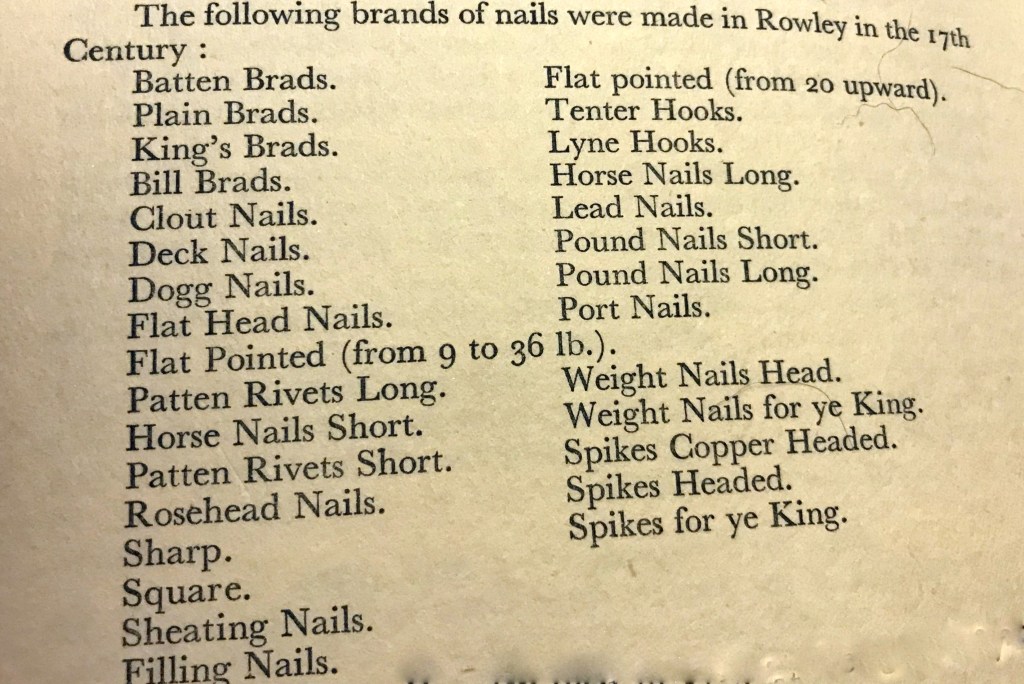
Taken from my original copy of J Wilson Jone’s book, details below.
Brief Lives
So, for all of us who have nail-making ancestors in Rowley, there is a glimpse of the conditions in which many worked. It is small wonder that so many died young. John Cobden wrote a book, published in 1854 titled “The White Slaves of England” in which he described the working conditions in such trades and in dressmaking , the Workhouse system and also in the cotton mills of Northern England which is listed below, written in somewhat dire language and not cheerful reading!
Britain may have abolished slavery in Great Britain and fought to abolish it elsewhere but much of the profits of the wealthy manufacturing classes in the Industrial Revolution came from the hard physical work and the deprived conditions in which tens of thousands of the poorest workers existed.
Further reading:
Nailmaking by Hugh Bodey, Shire Books. ISBN: 978-0-85263-60-0
The History of the Black Country by J Wilson Jones, originally published in about 1950, recently republished by Royston Slim, Janus Books.
The White Slaves of England by John Cobden – Digital download – free.
https://archive.org/details/whiteslavesofeng00cobduoft
There is an interesting article on the West Midlands Nail Trade here: https://historywm.com/file/historywm/the-west-mids-nail-trade-article-guy-sjogren-final-80502.pdf
 rowleyregislosthamlets.co.uk