My previous article was about John Levett and his connections. James Adshead Levett was the son of John Levett and Elizabeth Adshead. He was baptised at St Giles, Rowley Regis on 6 Jul 1805, followed by his sister Catherine Levett who was baptised at Halesowen Parish Church on 30 Jul 1813. James’s mother Elizabeth had died in 1822 and his father remarried in London in 1823.
I have limited myself in this piece mostly to those descendants who stayed in the immediate area of Rowley. There are many others who lived in surrounding towns and villages as well as much further afield but I have stuck for now with those who continued to be associated with the area of the Lost Hamlets. These lived consistently in Perry’s Lake and Gadd’s Green, Brickfields and Tippity Green.
Incidentally, I was very interested, in looking at various Levett Wills to see that at least some of them regarded Perry’s Lake as a separate place and not part of Rowley Regis, so that they gave their address as Perry’s Lake, near Dudley. All of the Lost Hamlets were, of course, within the parish of Rowley Regis but clearly at least these residents did not see it as simply part of the village.

Copyright Glenys Sykes. I apologise for these somewhat fuzzy images, I am exploring ways of producing better ones!
Catherine Elizabeth Levett and the Thorne family
John and Elizabeth’s only daughter Catherine or Kate Levett married John Brooke Thorne, a widower and a Mercantile Clerk of Bradford Street, Birmingham at St Giles on 4 Oct 1837 and they later lived in Aston in Birmingham. They appear to have had only one child, Ellen Levett Thorne who was born in Aston in July 1838 but died aged 3 years and 8 months in 1842. In 1841 Ellen is not in their household, she appears to be with a Sarah Thorne, who was aged 23, living in Handsworth, along with two Finney children who were possibly related to William Finney who married Hannah Gaunt in 1833, although I have not been able to confirm any connection. Why Ellen was with Sarah Thorne is unclear and I have been unable to confirm any relationship between Sarah Thorne and John Brooke Thorne but it seems a considerable coincidence that the child should be entrusted to Sarah Thorne unless they were related.
At a later stage, on a family tree on Ancestry, there is a photograph of a beautifully bound Family Bible which has embossed on the front of it that it was presented to John Levett (1840-1922) and Sarah Petford (1844-1917) on their wedding day, 18th March 1867, by ‘their aunt Sarah Thorne’. This John Levett was the son of James Adshead Levett the Elder and his only blood aunt was Catherine Levett who was married to John B Thorne. Was Catherine/Kate known as Sarah – I have not seen this suggested anywhere else although she was frequently referred to as Kate and all official documentation shows her as Catherine or Katherine or Kate. Or was this the unknown Sarah Thorne who was caring for John and Kate Thorne’s daughter in 1841? Sarah Thorne is very elusive in the censuses, does not appear to be in the Midlands over a period of forty years and this remains a mystery – unless there is a member of the Levett family who can tell me? I would love to know!
In later censuses John and Kate Thorne had Catherine’s nephew John Levett (the one who was later presented with that bible)staying with them in Birmingham in 1851, in 1861 a niece Lissie Levett aged 11 and born in Rowley, and in 1871, a niece Janet Pearson aged 10 and said to be born in Penkridge. However, I cannot work out who this child could be, as Catherine had only one brother and he did not have a daughter called Janet. However there is a birth registration in 1860 in Penkridge for an Esther Jane Pearson, and the Mother’s maiden name is shown as Thorne, so presumably Mary was the sister of John Brooke Thorne.
John Brooke Thorne died in 1873 and was buried in Key Hill Cemetery in Birmingham.
By 1881, the widowed Catherine had moved to Sutton Coldfield where in 1881 her unmarried niece Esther Pearson, aged 20 and also born in Penkridge, was living with her, together with a Mary Pearson, aged 46, who was married and a visitor, born in Stafford. Was Esther the Janet who had been staying in 1871? It appears that Esther was indeed Janet or rather Jane, because an Esther Jane Pearson was born in Penkridge in 1860 and her Mother’s Maiden name was Thorne so it appears that this was a niece of Catherine’s husband, rather than Catherine herself. Was Mary her mother? It seems likely. However, tantalising as this rabbit hole is, it is not directly connected with the Lost Hamlets area and I will resist exploring it further! For now, anyway…
Catherine Elizabeth Thorne’s death was registered in the first quarter of 1893 in the Dudley Registration District, although I have been unable to find her burial. Perhaps in her final years she came back to the family with whom she had clearly remained in close contact through the years of her widowhood. From the number of nieces staying with her in various censuses, it would be good to think that for much of her life ‘going to stay with Aunt Kate’ was a pleasing prospect. Catherine’s Death Certificate shows that she died of ‘senectus’ – old age, and that she died at 28 Tump Road, Blackheath (later Beeches Road) and her death was registered by Mrs Ann Barker, who had been present at the death. Who Ann Barker was and why Kate was there, I have no idea but her only brother and her nephew were both dead and several of his children were to die shortly afterwards so may already have been unable to take Kate in. It is possible that Kate was buried at St Paul’s churchyard, the burial records for there have not yet been transcribed for FreeREG. She was not buried at Key Hill Cemetery with her husband, according to their records.
James Adshead Levett the Elder 1805-1878
James was married to Mary Ann Bate on 21 Feb 1832 at Wolverhampton St Peter, the witnesses being H Adshead, possibly Harriet Adhead, his aunt and James Adshead who may have been his grandfather. The Adsheads appear to have been a Wolverhampton family. Perhaps James had been staying with his Adshead relations. The first child of James and Mary Ann- also James Adshead Levett (who I shall refer to as JAL the Younger from hereon) – was baptised at Dudley St Thomas on 27 May 1832, shown in the Baptism Register as James, son of James Adshead and Mary Ann Levett of Rowley. James’s occupation was given as Farmer, perhaps at Brickfield Farm which was still in the ownership of his father. Two more sons Richard in 1836 and John in 1840 followed. A daughter Elizabeth, again probably named for her Adshead great-grandmother, was born in 1849.
The Bate family – publicans and Victuallers in Cock Green
Mary Ann Bate gives her place of birth in later censuses as Rowley Regis and her ages in those censuses consistently compute to give her a birth year of about 1813. But there is no baptism at St Giles for a Mary Ann Bate in that period. There is a baptism in 1814 for a John, son of Richard and Hannah Bate of Cock Green where the father’s occupation is shown as Victualler so in the licensed trade and he was apparently her brother.
However, there was a baptism at Dudley St Thomas on 8th Aug 1813 for a Mary Ann Bate, daughter of the same couple, Richard and Hannah Bate of Rowley, said to be a labourer so this appears to be the correct Mary Ann, and this was during is the period when extensive repairs were being carried out at St Giles which may account for the Dudley baptism.
Checking out my theory that Mary Ann’s Bate family were in the Licensed trade, I looked without success in the 1851 Census for Richard Bate and then for Hannah Bate and found her, by then a widow, listed at Cock Green, next door to Brickhouse Farm, aged 64 and a Victualler. This later became known as the Cock Inn and it certainly reinforces the idea that John and Mary Ann grew up as neighbours. I was then able to find that Richard Bate of Cock Green was buried at St Giles on 26 March 1832, aged 41, said in the Burial Register to have died of Dropsy.
Hannah Bate had also been at Cock Green in 1841, also a publican then and living apparently in the same household as her son Benjamin Bate, aged 37 and his family, although he had no occupation shown. Perhaps his mother was the licensee but he also worked in the pub.
Hitchmough shows that three members of the Bate family owned the Cock Inn between 1814 and 1873, with John Bate, mentioned above, the last of these. In 1818, a daughter Sarah had been baptised at St Giles to Richard and Hannah Bate of Cock Green but this time Richard’s occupation was given as a farmer, another instance of double occupations for victuallers. Multi-generation pub-keeping seems to have been quite common in Rowley!
There are numerous entries in the St Giles Registers for the Bate family and many of them are in the Cock Green area which was adjacent to Brickhouse so James and this Mary Ann would have known each other from childhood as neighbours. Why they were married in Wolverhampton is another matter, (although there is a marriage of a Richard Bate in Wolverhampton in 1808 so perhaps the Bate family had connections there, like the Adsheads). Or it may simply have been that Mary Ann was at least six months pregnant at the time of the marriage on 21 Feb 1832, as James Adshead the Younger was baptised on 27 May 1832 at Dudley, again, not in the parish so perhaps an attempt to keep a low profile on this. Or simply that James was in busisness there or perhaps that one or other of their families did not approve of the marriage, we cannot tell.
The 1841 Census shows James Adshead Levett and his family in Perry’s Lake where his occupation is shown as ‘Publican’. Richard at that time was 5 years old and John just 8 months old. Little James would have been nine and was not shown in the household, because he was with his grandfather John Levett at Brickhouse Farm. So by that time James had already moved from Brickhouse Farm to Perry’s Lake and become a publican, presumably at The Portway Tavern although it was not named as such in the census. We can narrow the date of that move down even more. At Richard’s baptism on29 May 1836, the abode is given as Cock Green and his father’s occupation as a Farmer but by the time John was baptised on 6 Dec 1840 his father’s address was shown as Perry’s Lake, although he was still shown as a farmer. So James and Mary Ann must have moved from Cock Green, in all likelihood from Brickhouse Farm, although possibly from Mary Ann’s family residence at Cock Green, to Perry’s Lake at some point between 1836 and 1840.
According to Hitchmough’s Guide to Black Country pubs, James Adshead Levett the Elder was the Licensee at the Portway Tavern from at least 1841 until 1887 and his son James Adshead Levett the Younger from 1887-1895, followed by William Levett from 1892-1896, some overlap there. Interestingly, Hitchmough lists the owner of the pub as Thomas B Williams and Lizzie Bate and also states that it was acquired by Ansells on 15th June 1846 which seems a very early date, especially as Ansells itself was not founded until 1858, so I suspect that Ansells acquired it in 1946, not 1846. The name Bate is also of interest here as Mary Ann, the wife of James was a Bate so perhaps her family bought the pub.
But James appears to have had more interests than the Portway Tavern in Perry’s Lake, he was listed in the Poll Books and Electoral Registers as the ratepayer of Freehold houses there between at least 1841 and 1878, though there may be other Poll Books which have not yet been digitised.
In August 1847, the Worcestershire Chronicle reported that James Levett of Rowley Regis was summonsed before the Magistrates as P.C.Janson had charged him with
“permitting gaming with dice in his house, an ale house on the 7th August. On the table were two dice and a cup, a man shaking it and money on the table for which they were playing. Defendant said that there had been a raffle at his house that night and afterwards the men did play for a few pence, but without his knowledge. – Fined 5 shillings and costs. “
In the 1851 Census, James and Mary Ann were at Perry’s Lake, though there is still no mention of the Portway Tavern and James’s occupation is shown as Colliery Clerk. It was quite common for publicans to have other jobs and if, as I suspect, Mary Ann was the daughter of a publican, it is quite likely that she would have been very involved in the management of the pub. Their children, shown as Richard aged 15 and Elizabeth aged 1 were at home but John was not.
In the 1861 Census, James is shown for the first time at the Portway Tavern and as a Victualler, along with Mary Ann, and their unmarried son Richard, now 26 and a shoe maker.
In the 1871 Census, James and Mary Ann are again shown at the Portway Tavern, and he is shown as a Licensed Victualler.
Perhaps there was a little rivalry between the Bull’s Head and the Portway Tavern – Hitchmough relates an account that after Thomas Williams had taken over the licence of the Bull’s Head in 1875,
“The pub prospered much to the reported displeasure of the Levett family who were running the PORTWAY TAVERN …… One night the windows of the BULLS HEAD were mysteriously smashed. The following night, Thomas, always called Master by his wife, was seen leaving his pub with a poker up his sleeve, and setting out over Allsops Hill. The following day it was reported that the windows of the PORTWAY TAVERN had been broken during the hours of darkness! The BULLS HEAD suffered no further damage.”
James Adshead Levett the Elder died , according to the Probate Record, on 23 Jun 1878, aged 75. Mary Ann had moved to Gadd’s Green by the time of the 1881 Census, described as a Retired Licensed Victualler, where her granddaughters Ellen Levett, aged 18 and Harriet Levett aged 9 were living with her. Mary Ann died 15 Jan 1890, according to her Probate Record, aged 76, her burial record states that she died in Perry’s Lake, she was buried on 20 Jan 1890 at St Giles.
The children of James and Mary Ann
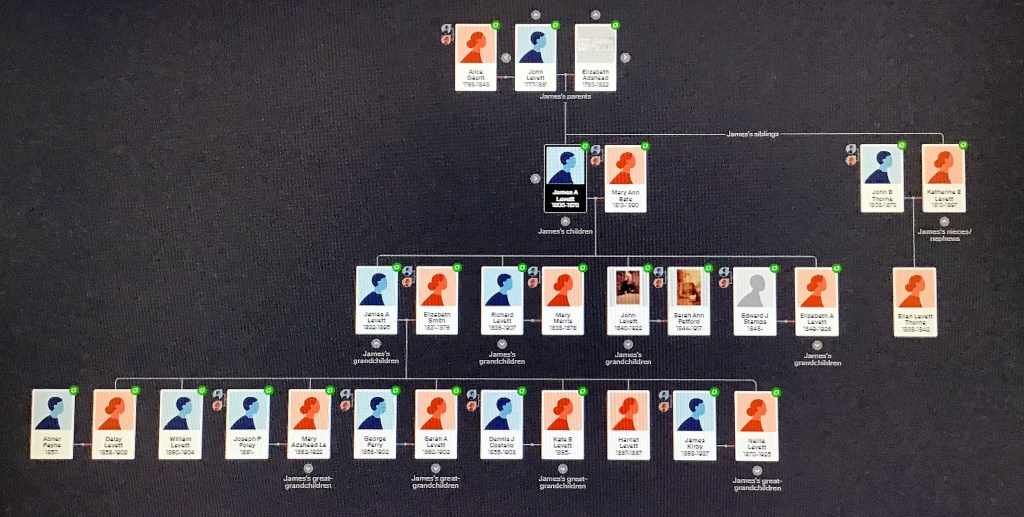
Copyright Glenys Sykes.
Of the children of James the Elder and Mary Ann, James Adshead Levett the Younger and Richard stayed in the Perry’s Lake area for the rest of their lives. I shall deal with James in more detail later as he is the one I have most information about but this is what became of the other children of James Adshead Levett the Elder and Mary Ann:
Richard (1838-1907) and his family
Richard, the Boot and Shoe maker, married Mary Merris in 1863 at Dudley St Thomas and they had five daughters – Ellen in 1863, Hannah in 1864, Elizabeth or Lizzie in 1867, Harriet in 1872 and Mary Ann in 1875. Mary Merris died in 1878 and Richard never remarried.
Of these girls, I have been unable to find any trace of Ellen after 1881, no marriage or death.
Hannah married George Ward and they stayed in Rowley Regis, living in Perry’s Lake. They had two children Amy Ward in 1887 and William Ward in 1893. Alas Hannah also died aged 41 in 1906 and she was buried in St Giles on 26 Jun 1906.
Elizabeth (or Lizzie) had gone into service and was in Manningham, Yorkshire for the 1891 Census. I think it was this Lizzie Levett who died in the Sheffield area, possibly in the North Bierlow Workhouse and was buried on 9 Jun 1899 at the City Road Cemetery, Sheffield, Yorkshire, aged 31.
Harriet married John Rudkin and I have already uploaded a whole article on the Rudkin family. Harriet’s children were all born in Rowley, the last in 1909 but she then moved to Cannock in 1911 and later to Meriden and then possibly Nuneaton as that was where she died in 1956.
Mary Ann Levett married Charles Jones in 1897 at Reddall Hill and they lived in Ross in Rowley and later Oldbury. I have been unable to trace the couple after 1921 when they were living in Church Street, Oldbury with their five children and looking for Charles or Mary Jones is a difficult exercise!
So it appears that Hannah was the only one of Richard’s daughters to stay in Rowley and she had died by 1906.
John Levett (1840-1922) and his family
John Levett, the third son, married Sarah Ann Petford at St Giles in 1867 and they moved to live in Harts Hill, Dudley where they had ten children. These were Kate Elizabeth (1867), Fred (1870), Florence Mary (1872), Kezia Beatrice (1873), Daisy (1874), Harry Brooke (1875-1875), Janet (1877), William A (1879), Major (1881) and May (1887). Sarah died in 1917 in Dudley and John died in September 1922 in Halifax, Yorkshire where he was living with his daughter Daisy. So this branch of the Levett family had moved completely out of the Lost Hamlets area.
Elizabeth Levett and her family
Elizabeth Levett married Edward J Stamps in 1871 in Handsworth, Birmingham and they had one daughter Violet Stamps (1873) and three sons Edward Levett Stamps (1875), Thomas Bernard Stamps (1876) and Ernest Cecil Stamps (1877). The family lived in Sutton Coldfield until 1911 but by 1921 the widowed Elizabeth was living with her son Edward in Carshalton, Surrey where Elizabeth died in 1925. Another branch of the Levett family which had moved completely out of the Lost Hamlets area.
James Adshead Levett the Younger (1832-1895) and his family
In those days, it was quite common for boys to be apprenticed at about the age of fourteen, which was usually a seven year commitment. And James was apprenticed to Mr Gill of Bilston, a Provision Dealer, at the age of fourteen, which would have been in about 1846. Following my research on the Old Swinford Hospital School, and their apprenticing practices, it does occur to me that James may have attended the school but I have not been able to check their records, so the apprenticeship may simply have been arranged by his family. He apparently left before his apprenticeship was completed, with Mr Gill’s concurrence and went into the employ of Mess’rs Hallam and Spikes who may have been in Birmingham. Mr Gill had apparently always found James to be ‘a faithful, honest and industrious servant’ whilst in his employ. His new employers also found him steady and faithful until in 1850 he seems to have had a momentary aberration.
A spell ‘inside’!
In October 1850 James Adshead Levett the Younger was convicted at Birmingham of stealing five shillings and sixpence from his employer and sentenced to 12 months in Birmingham Boro’ Gaol, or possibly the Moor Street lock-up. (A new Gaol had been built in 1849 so if this was where James was held it was very new. Or he may have been held in the Birmingham Lock up in Moor Street, it is not clear.) James was now 19 but his former employers, both Mr Gill and Mess’rs Hallam and Spikes evidently did not think of him as an habitual criminal as Mr Gill expressed willingness to take him back into his employ. Mess’rs Hallam and Spikes were said to regard the taking of the money as ‘an act of peculation’, rather than a determined theft.’ and bore witness to his general honesty. Peculation is the act of illegally taking or using money, especially public money, that you are responsible for managing.
How do I know all this? Because in The National Archives is a letter to the Home Secretary [i] Sir George Grey, dated 10 December 1850, from the Mayor of Dudley Thomas Fereday, urging that James’s sentence should be commuted. This letter emphasised the good standing of James’s family in the local community, that the signatories had known them for many years and that they had always ‘maintained the highest character for honesty and integrity’.

Copyright: The National Archives – Reference HO 18/294
The letter goes on that James’s mother had been ‘greatly depressed in spirits ever since his committal and her health which has been gradually declining, is now in a precarious state’.
The letter therefore asked the Home Secretary to consider remitting or commuting James’s sentence. The number and identity of signatories to this letter is impressive. The signatories were:- Thomas Fereday, Mayor of Dudley; William Crump, Incumbent of Rowley Regis; Samuel Nicklin, Churchwarden of Rowley Regis; Thomas Sidaway, Churchwarden of St Luke’s Church at Reddal Hill; William F Peart, Curate of Rowley Regis; Samuel Gill, Provision Dealer of Bilston, the former Master of J A Levett; Francis Northall of Rowley Regis; Charles Hallam, Tea Dealer, Birmingham.
Also appended to this request was a statement that “We the undersigned are desirous of certifying that the parents and family of James Adshead Levett whom we have known many years, have always borne a high character for honesty and integrity.” This statement had been signed by Isaac Budge, and Councillor Cartwright, both Magistrates for the County of Worcester and Stafford.
What an impressive list of supporters for the family had put together this letter. Did it work? It seems unlikely. There is a note on the outside of the paper that James would have immediate employment if he was released and that an answer was sent on the 4th January 1851 but a scribbled note appears to say Nil and certainly James was still in prison at the time of the census in 1851. What a terrible time this must have been for the family. I found it touching that so many people of position and standing in the community tried to intervene to get James’s sentence reduced. And, it seems, James’s mother Mary Ann survived and lived on until 1890.
James Adshead Levett the Younger obviously served his time and rebuilt his life over the next few years. He married Elizabeth Smith by Banns on 26 Nov 1857 at St Mark’s Wolverhampton (Wolverhampton keeps cropping up, doesn’t it?) at which time he was a grocer in Tettenhall Road and their daughter Daisy, the first of ten children, was born in Rowley in 1858, with their abode given in the baptismal register at St Giles as Perry’s Lake and James’s occupation shown as Grocer, the trade he had been apprenticed to originally. A son William followed in 1860, twins Sarah and Mary in in 1863, Kate in 1865, Harriet in 1867, Nellie in 1870, Alice in 1872, Fred in 1873 and Amy in 1875.
In 1861 James Adshead Levett the Younger and Elizabeth, with William, are in Perry’s Lake, in a grocer’s shop, although Daisy is with her maternal grandparents William and Sarah Smith on Freebodies Farm on Turner’s Hill.
Another Bankruptcy? But in the Birmingham Journal of 12 May 1866 there was a Notice that there had been a First Meeting in re Bankruptcy for James Adshead Levett the Younger of Deritend, which is in Birmingham, a labourer, formerly of Rowley Regis, with debts of £204 6s and assets of £202. 5s 2½d, when an assignee was appointed. How strange that Bankruptcy should have been involved for a difference of a couple of pounds.
Did he move to Birmingham for a time in between the two censuses? Did his grocery shop run into trouble? Twins Sarah and Mary were baptised at St Giles on 9 November 1862, Kate Elizabeth on 30 Apr 1865, and James’s occupation in all of these was given as grocer. So if there was a bankruptcy, it appears to have been resolved very quickly because I have not been able to find any other formal Notices which are usually involved in the process. Other bankruptcies I have seen in this research have generated numerous advertisements and meetings but this one does not appear to have had this happen. Had it not been for the reference to the full name and James being formerly of Rowley Regis I would have thought that this was a case of mistaken identity. Or perhaps family realised what was happening and helped James out of his difficulty.
In 1871, the family are still in Perry’s Lake although James is now described as a Labourer. Elizabeth Levett, nee Smith, died in 1876, aged only 45 and was buried at St Giles.
Taking over the Portway Tavern
After his father’s death in Jun 1878, James Adshead Levett the Younger applied early in September 1878 for a new Licence for the premises in Perry’s Lake, apparently successfully. I cannot think this would have happened if James was still bankrupt.
In 1881, James was listed as a Licensed Victualler in Perry’s Lake, and his daughter Daisy, by then 23, was a grocer. Other children William, aged 21, a carpenter, Kate, aged 16 a pupil teacher and Nellie, aged 10, a scholar were also living with him. Twins Sarah and Mary, aged 18, were also listed in Perry’s Lake though not apparently in the same house but their occupations were described as ‘Licensed Victualler’s daughters with a note on the census ‘see note on Portway Tavern. Sadly the note is not visible but it appears that the flexible living arrangements of the Levett family in Perry’s Lake was well established. The twins were each married soon after that census.
In 1891, James was still at the Portway Tavern with his son William, and his niece Harriet. But in August 1895 he died and was buried at St Giles on the 30th August.
What happened to James and Elizabeth’s children?
Daisy Levett was married in 1885 to Abner Payne but they do not appear to have had any children before her early death on 24 Oct 1902 at the age of 44. Daisy was buried on 31 Oct 1902 at St Giles.
William Levett stayed in the area and died on 5th June 1904, his abode at the time of his burial on 8th Jun 1904 was shown in the Burial Register entry as Gadds Green. He did not marry, so far as I have been able to discover and in his Will, his married sisters Catherine and Elizabeth were his executors. He was also 44 at the time of his death.
Mary Adshead Levett was married to Joseph Foley on 6 Sep 1881 at Halesowen and lived in Powke Lane and later Garratts Lane, before moving to West Bromwich, never returning to live in Rowley village. Though Mary and her daughter Sarah both later ran sweet shops in West Bromwich and Oldbury so they carried on the trading traditions of the Levett family. Mary and Joseph had five children of whom two died in infancy. The eldest son John James Adshead Foley died in 1902, aged only 19. 1902 , indeed the first decade of the 1900s, were terrible years for the Levett family. Mary’s remaining son Albert Edward married in 1915 but did not have had any children, so far as I can find and appears to have been divorced as his wife re-married in 1931. In the 1939 Register Alfred was living with his sister Sarah in Station Road, Oldbury, and was described as a retired Motor Engineer (incapacitated), whereas she was still described as a shopkeeper (Sweets and Tobacco). I have not been able to identify a death or burial for Arthur.
Mary Foley, nee Levett was living with her daughter Sarah in High Street, West Bromwich in the 1921 Census, both were widows and Mary died in West Bromwich in 1922, aged 59. I suspect that she and Joseph may have separated before 1901, and there is no evidence of them being together after 1891. Evidence suggests that Joseph ‘married’ his barmaid Amy Read, twenty years his junior, in 1901 (according to the number of years married shown in the 1911 Census) although I have not found any evidence of such a marriage or of a divorce. It is not impossible that a divorce did happen, although Mary Foley was still describing herself as married in the 1911 Census!
Sarah Adshead Levett, Mary’s twin, was married in 1882 at Netherton to George Perry, (whose brothers Samuel and Daniel kept the Why Not Inn in Reddall Hill, another pub-keeping family) and Sarah and George lived at Gadds Green and subsequently took over the Portway Tavern, although George seems also to have kept up his other occupation as an iron or scrap dealer. Sarah and George had five children, Ada, born 1888, Mabel born 1891, James, born 1892, Alfred born 1894 and Miriam born 1896.
Sadly Sarah Adshead Perry, nee Levett died on 28th October 1902, aged 40, only four days after her oldest sister Daisy who was 44 when she died. Their funerals were held three days apart. And only weeks later on 31 December 1902 Sarah’s husband George Perry also died, aged 47, so that their children were orphaned.
Alcoholism seems to be an occupational hazard for publicans and all three adults who died in late 1902 died of alcoholism and related causes. There is also some evidence of epilepsy in the family, as epilepsy was given as one of the causes of death for Daisy and some years earlier, during the trial of James Levett for brewing offences, it was mentioned in evidence that one of Sarah’s children had suffered a fit on the evening of the alleged offence.
Of Sarah and George Perry’s children, the two older girls of the Perry family were living with their aunt Mary in Smethwick in 1911, both working as shop assistants in a draper’s shop. Ada went to New York, USA in 1912, marrying there and dying in Pennsylvania in 1964. I have been unable to trace her sister Mabel in this country after the 1911 Census but note with interest that a Mabel Perry of the correct age travelled to New York in 1914 and I wonder whether she went to join her sister there.
The two boys went to their father’s brothers at the Why Not Inn in Reddall Hill. James Perry became a mechanic and subsequently emigrated to Canada where he married and had two children, dying in Ontario in 1965. Alfred stayed in Reddall Hill, where he married and had one son, he had taken over the management of the Why Not Inn by 1921, that common family trade but died – yet another premature Levett death, at the age of 38 in 1933.
Little Miriam, the youngest at only five when her mother died, appears to have been adopted by the Pearson family who kept the Haden Cross Inn at Haden Hill. I believe that she married George Yarranton in 1927 and had two sons, dying in the Sandwell area in 1980.
Nellie Levett, the youngest of the children of James Adshead Levett the Younger married James Kirby in 1890 and they had ten children. They continued to live in the area, in Gadds Green and in Perry’s Lake. In 1921 the family were living at 7 Tippity Green, with nine of the children and two grandchildren.
The Kirby children were William James (1891-1941), Elizabeth (b.1892), Frederick (b.1894), Mary known as Polly) b.1895, Sarah Helen (1897-1906), John (b.1898), Miriam (b.1900), Mabel (b.1902), Samuel (b.1904), Ada (b.906), Lily (b.1908), Nellie (b.1911) and Beatrice May (b.1913). In 1939, for the Register commissioned for identification and rationing purposes, many of these brothers and sisters were living at 6 Windsor Road, with the oldest William as Head of the Household, their mother Nellie having died in 1925 and father James Kirby in 1937. At the time of James Kirby’s burial the abode is given as Hailstone House, Tippity Green so this part of the family had stayed in the immediate area. Nellie gave her children so many Levett Christian names there, familiar from her siblings and her wider family! Many of the Levett girls gave their children the names Levett and Adshead as second names, which can help a lot with tracing them in the records.
Born, as most of Nellie’s children were, on the cusp of the 20th century, it is not always possible to trace their whereabouts properly, as records tend to be closed for privacy reasons for 100 years but it appears from those who I have been able to track, that many or most of this family stayed in or close to Rowley, often in the immediate area of Perrys Lake, Gadds Green and Tippity Green, true Lost Hamlets people.
The descendants of John Levett in the Lost Hamlets
So there we have the Levett family – from the arrival in Rowley of John Levett, from Stepney, London, grandson of the Nock family, in about 1800, through his children, grandchildren and great-grandchildren – they lived in the Lost Hamlets area for almost exactly a century, although their Nock ancestors had been there much longer – also spreading around the wider area and further afield. They ran pubs, shops and businesses, brewed ale, suffered bankruptcies, prosecutions and even prison and conducted bitter disputes with the Curate in that time. They married members of other families in the licensed trade numerous times. And the other familiar names of the Lost Hamlets families appear frequently on their family tree.
But by 1911 the last of this branch of the Levett name in the village had died, many of them after relatively short lives, and the family had suffered some grievous losses. At the end of that time, although there were descendants from the female line still living in the village, there were no Levetts who could trace their descent directly from the original John Levett.
Or were there?
Where did Levett’s Butchers , who I remember from Blackheath and mentioned right at the start of the first article, fit into this? I had not found any connection between this family and those Levetts. And when I double checked for Levetts in the village in the 1911 Census, I was surprised to see that there was still a John Levett with his family in Springfield in 1911 and his son Fred in the village, John keeping a shop in Springfield and Fred a butchers shop in Rowley village.
But that’s another story… and a third instalment to come about the Levetts!
[i] The National Archives Reference HO 18/294

 rowleyregislosthamlets.co.uk