I have been continuing this week to dip into the very detailed and wideranging reports by the Health Inspector to the Rowley Regis Borough Council. This piece does not relate solely to the area of the Lost Hamlets but this campaign would certainly have included them so I have included it in my blog out of general interest.
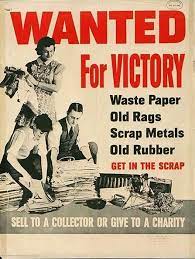
Recycling seems to be thought of these days as a fairly modern phenomenon but this extract from the RRUDC Health Inspector’s Report in 1941 shows that it has happened before!
The Ministry of Supply started the “National Salvage Scheme” in December 1939 to save paper, rags, rope and string, household bones, rubber, food waste and all kinds of metal. The Women’s Voluntary Service helped run the campaign to encourage householders to salvage as much material as possible. The point in time of this report was almost halfway through the Second World War and shows how the authorities engaged with the community in promoting recycling for the War Effort.
Copyright unknown.
This report is taken from the online report verbatim.
“1941 Report of Health Inspector to Rowley Regis Urban District Council.
WASTE RECOVERY.
This work has expanded during the year according to the demand of National needs.
The premises at Powke Lane have been fully made use of and the ample space and cover provided has been invaluable. An Electric Baling Press for tins, and a larger one for paper (both purchased the previous year) were installed and are rendering excellent service.
In August a County Salvage Drive was inaugurated in which Rowley Regis as a Borough took part, and a two-ton Bedford lorry was obtained and fitted with high sides and painted with suitable advertising matter. The slogan adopted, “ SALVAGE OR SINK,” has caught on very well.
A loud speaker and gramophone were fitted to this vehicle, and after the official send-off by the Mayor and Mayoress, the Chairman of the Health Committee, the Organiser of the W.V.S., and the Leader of the Girl Guides, a tour of the streets and a canvas of every house in the district was made within the allotted fortnight. Excellent results were obtained in material, but financially we were no better off owing to heavy expenses incurred to make the effort a success.
Apart from this, however, the imagination of the Public was stirred and it did help to keep the householders more salvageminded with the resultant continuous even output.
My opinion is that whilst County Drives have played a useful part in educating the people in this war effort, National Appeals result in a far heavier response by those firms who have had the capacity to contribute the weightier ledgers and redundant material which is asked for.
The Women’s Voluntary Service has rendered excellent service and on two occasions every house in the Borough has been canvassed, and handbills delivered. In addition to this, large bills with a gummed front surface have been distributed and stuck inside the windows of the houses. The W.V.S. has been most successful in this form of advertisement as at least one house in every 20 throughout the whole Borough exhibited at least one bill in the house or shop window.
The bills or posters were in large red block type letters with the words “ PLEASE KEEP your Salvage out of the Dustbin,” and “ Put your Scraps in Pig Food Bins and maintain your Eggs and Bacon.” The results were well worth the effort.
In addition to the above, on two separate occasions, every dustbin lid in the Borough had glued on to it a circular paper disc 6 inches in diameter with red letters with the following words “For Ashes Only. Keep your Salvage out,” and “Salvage in the Dustbin is an offence against the War Effort. Are you Guilty? ”
Needless to say, the results were remarkable.
Further to all this, an alternative weekly collection of Refuse and Salvage was inaugurated during the early months and continued throughout the year.
This system of salvage collection is far in advance of the hanging of bags in the street for householders to put the paper in once per week, a method as unsightly as it is disagreeable. A weekly collection from shops, offices and stores is also maintained.
Splendid results have also been obtained from Schools. The method is for children to collect paper and metal and take it to school. It is weighed daily and each child credited with the amount collected. Prizes to the children of each school have been awarded monthly in the form of Saving Stamps, and these have been presented by the Mayoress together with the Chief Sanitary Inspector. The Mayoress (Mrs. Card) has done wonderful work in this connection as up to 10 schools have been visited in one day every month awarding the prizes and instructing the children on salvage procedure.
Much praise is also due to the teachers, most of whom have given every possible help throughout the whole period.
Pen friends have also been made with our local school children in towns in the Yorkshire area.
Prizes of Saving Stamps have been awarded to the children totalling £22 8s. 6d.
Fortnightly visits to the tip and Salvage Disposal Depot have been arranged by the W.V.S. for groups of children from the various schools, and this has formed an interesting feature of our advertising campaign.
The estimated value of Salvage sales are as follows:—[ For those who are not familiar, these sums are shown in pounds, shillings and pence!]
January £51 15 10
February £490 16 1
March £202 1 1
April £217 15 11
May £318 7 6
June £325 0 7
July £251 10 6
August £407 5 3
September £240 0 2
October £305 18 9
November £278 16 11
December £278 19 1
Estimated total sales … £3,368 7 8
The following are the amounts of waste material recovered and returned to industry:—
Tons Cwts Qrs Lbs.
Waste Paper 387 0 2 7
Pig Food 320 6 0 0
Ferrous Metals 202 2 2 18
Non-Ferrous Metals 1 7 0 14
Baled Tins 70 5 0 0
Bones 7 8 3 4
Rags 8 3 2 0
Broken Glass 29 14 3 0
Bottles, Jars, etc. 494 gross, 3 dozen.
Deputations from other Authorities have visited the District and have copied some of our methods.
The number of Communal Pig Food Bins in the district is 825, and these are collected three times per week. The Refuse and Salvage vehicles also collect household scraps from the houses on the weekly visits.”
Copyright details unknown.
We may think we are doing something new but in reality, recycling and re-using materials used to be essential and a way of life to a far greater extent than it is now. It is our modern society which has forgotten about ‘rag and bone men’ who came round the streets with their horse and cart and we have become used to single use plastics and throwaway appliances.
Perhaps we might still have some lessons to learn!
Anyone who has researched their ancestors back much beyond 1900 knows that general health, life expectancy and particularly child mortality were very much worse than they were later. As Chitham notes in his History of Rowley Regis, cholera epidemics in 1832 and 1849 had made it clear that small parishes had problems coping with such outbreaks and health issues generally. As a result Local Boards of Health were set up and Rowley Regis had one of these, later succeeded by the Rowley Regis Urban District Council in 1871.
The cholera epidemic did not leave Rowley village untouched. Between 16th July and 8th October 1832 there were 71 burials at St Giles with cholera given as the cause of death. Of those 11 were from Rowley Village including 5 members of the Westwood family, 1 from Portway, 1 from Tippity Green, 5 from Bourne Brook and 21 from Windmill End, which was below Rowley, between Springfield and Netherton. Bourn Brook was also in that area. There were also several from Primrose Hill, again very close to Windmill End so the cholera really was rife in that area, though it appears to have been largely avoided by the folk in the hamlets living higher up the hill. The age range of those affected was from 6 months to 78 years, with many adults in middle life, leaving their families without a mother or a father.
In 1849 the published transcribed burial registers stop at the end of 1849 and between 10 Oct 1849 and the end of December that year there were 12 burials of cholera victims but there may be more after that. All of these came from the Old Hill area.
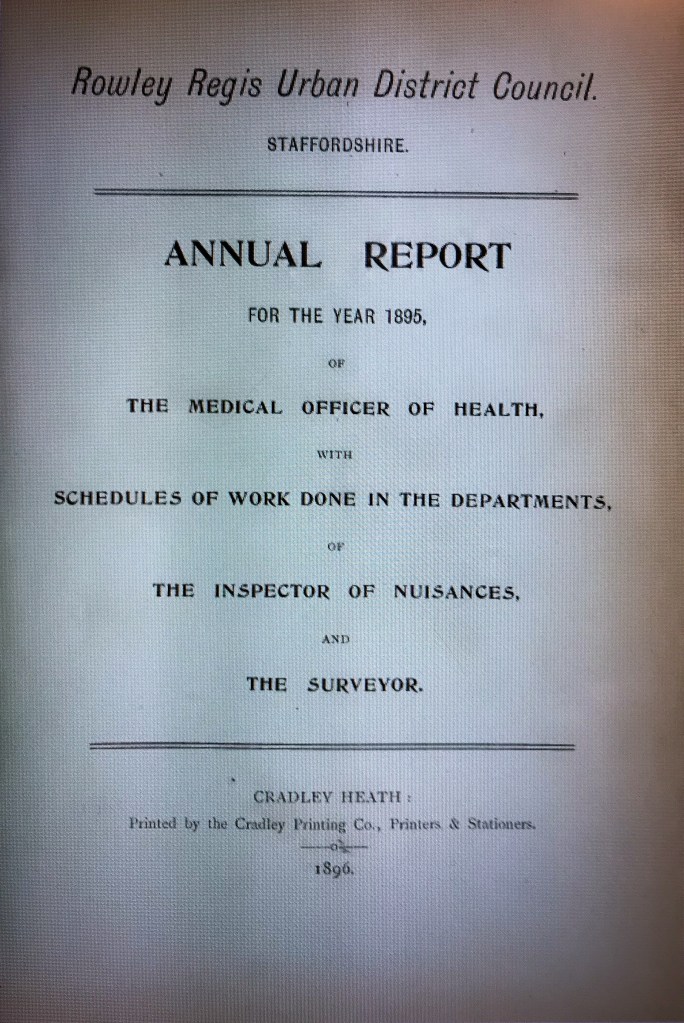
This week online I have found the Annual Report of the Medical Officer of Health to the Rowley Regis Urban District Council , many ofwhich have been digitised with the assistance of the Wellcome Foundation, very possibly from the Foundation Library and which can be read and downloaded free from the Internet Archive. And they make fascinating reading, giving an official view of many aspects of life in the Rowley Regis area. The earliest report I have been able to find so far is dated March 1894 and the last in 1965 when the Council was abolished.
All photographs here my copyright.
The Medical Officer of Health in 1895 was J G Beasley. The members of the Rowley Local Board were listed in a newspaper report in the County Express on 24 December 1887 so fairly close in date to the first report I can find and they were all local names – Mr W Bassano presided, other members present were Mess’rs Lowe, Priest, Plant, Wood, Robertson and Whitehouse. The Board apparently met monthly. Dr Beasley had clearly been in post for several years by the time of the report I found for 1895 and he knew his area well.
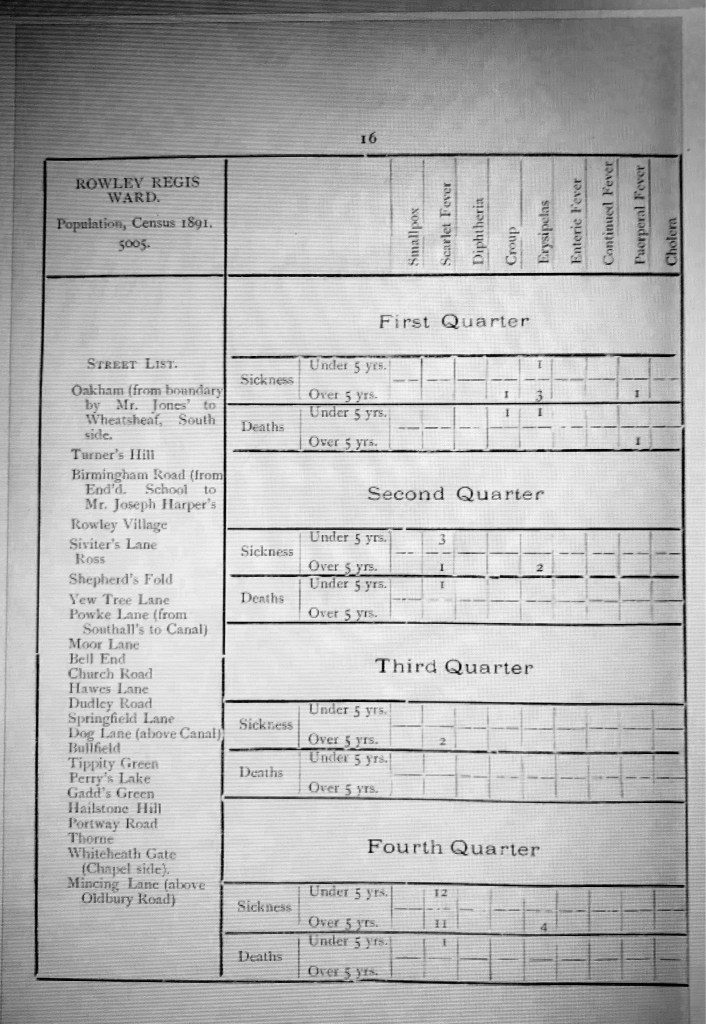
The report is extremely detailed and thorough, much of the information broken down into the Electoral Wards in Rowley Regis, which were Tividale, Rowley Regis, Blackheath, Old Hill and Cradley Heath so it is possible to look at much of the information just for Rowley Regis. Much of what follows, however, relates to the wider area of Rowley, rather than just the hamlets. Nevertheless I hope that you will find it of interest as undoubtedly the issues covered in the report relate to the residents of the Lost Hamlets to some extent. The photograph below shows the list of streets in the Rowley Ward in 1891. The population of the ward then was 5,005, it comprised 1347 acres, had 920 inhabited houses and 29 void houses.
The report also notes the number of births – 1252 in the District in 1895, there were also 622 deaths in all.
The page also shows the numbers of sicknesses of particular types – Smallpox, Scarlet Fever, Diptheria, Croup, Erysipelas, Enteric Fever, Puerperal Fever and Cholera, whether they related to people under or over five years of age, and the number of deaths resulting, all divided into quarters of the year. Fortunately in this year, there were no cases of small pox, diphtheria, enteric fever or Cholera.
There are mortality returns – 622 deaths in the year1895, 326 males and 296 female, giving a death rate of 18.7 per 1000 inhabitants. In 1894, the report says, there were 510, and the death rate then was 15.6 per 1000. The report then breaks these down by age – 243 deaths of infants under the age of one year, a rate of 7.3 per 1000 inhabitants, more than twice the rate of any other age group – 103 between one and five years, 22 between five and fifteen years, 19 between fifteen and twenty-five years, 115 between twenty-five and sixty five years and 120 aged over sixty five. None of these latter were more than 3.6 per 1000.
The infant mortality rates were a subject of much concern amongst both Council Health officers and members. The report goes on:
“Infant mortality again forces itself very prominently on our notice. Three hundred and forty six deaths under five years of age out of a total of six hundred and twenty two which had been registered. This is a very serious condition of affairs and the solution to the problem of how this waste of infant life is to be prevented does not appear to me to be forthcoming in the near future. In addition to the old conditions mentioned in my previous reports, all of which conditions still exist, a severe epidemic of Scarlet Fever has been prevalent in the District for the last eight months concurrent with which has been an epidemic of Whooping Cough and, during the last quarter and epidemic of measles. “
Smallpox
The report also notes that in the year there were three cases of smallpox, all in the Halesowen Road. In these cases, all the patients had been vaccinated against smallpox and had mild attacks from which they recovered. It is clear from the report that the medical officers made vigorous attempts to trace the origin of the infection and although all three cases were in the same street, he had been unable to find any connection between them. In the report for the previous year, I noted that there had been fourteen cases of smallpox, all treated in isolation at the Tividale Isolation Hospital.
It was noted that several were connected and from the same area of High Street and Hackett Street, Blackheath. The report notes
“All these people, in my opinion, had the disease conveyed to them by our Sub-Inspector who is brother-in-law to the first case admitted this year. I had foreseen the danger for some time and had attempted to minimise it by instructing him not to handle the patients or otherwise unnecessarily expose himself to infection, also to disinfect his own clothing at frequent intervals. This risk will always be attendant on those engaged in disinfecting clothing and infected houses.”
Poor sub-inspector. Fortunately all the patients were well vaccinated, had the disease in a very mild form and made good recoveries. Another cluster of cases in Tividale were thought to have originated with a policeman who regularly patrolled past the isolation hospital where smallpox patients were nursed.
The report noted that the Medical Officer considered that they had been very fortunate in confining the disease to the houses in which it had appeared and he attributed this success in a great measure to the prompt removal of the patients to the hospital and the thorough process of disinfection to which they subjected the houses and their contents.
There had also been one case of suspected cholera in July 1894 in Tividale and again swift and thorough measures were taken. The Medical officer says in a letter sent the same day to the Local Government Board that
“I have ordered the closets at his residence and at the works to be emptied tonight, the contents to be buried after being freely treated with carbolic powder, and the midden holes also to be freely dressed with the same powder. I have supplied disinfectants (sanitas oil emulsion) for all soiled linen to be soaked in and the first thing in the morning, shall have all soiled articles disinfected by our steam disinfector. I have removed all the occupants of the house (including two lodgers) and have left him in the care of his wife and mother.”
How thorough is that? Fortunately the man survived and recovered and laboratory tests on samples subsequently showed that the infection was not cholera. But it might have been…
Scarlet Fever – unknown for my childhood and since until quite recently – 541 cases of this had occurred in 1895, amongst 352 families with 24 deaths resulting. This was 353 more than the previous year. Fortunately most of these had been of a very mild type, hence the ‘small proportion’ of deaths. By the middle of August 1895 the outbreak had become so severe that Dr Beasley had to report it to the Local Government Board. The letter is shown in full in the report. He details his efforts to stop the spread of the disease,
“taking all the means at my disposal’ including confining patients to their homes ‘until desquamation has been completed’ (the peeling of scales of skin due to the disease), preventing children from infected houses attending any school or public assembly, disinfecting by stean disinfector all clothes, bedding etc and disinfecting all infected houses as early as possible after the convalescence or death of the patient. A free distribution of disinfectants and a strict surveillance over all notified cases.”
He also noted that one person Mary Jane Dunn – had been convicted of exposing a child in public whilst suffering from Scarlet Fever, for which they had been fined twenty shillings and costs. They were certainly very proactive in trying to combat this disease. He notes that almost all the cases were confined to Old Hill and Cradley Heath at the time (August) though it later appeared in Blackheath and Rowley Regis and was also in neighbouring areas and indeed the whole country.
Seven cases of Diptheria had also occurred among five families with one death. Again, unheard of in our modern lives, thanks to vaccinations. The Medical Officer attributed most of these cases to drainage problems and offensive drains.
Six cases of membranous croup had occurred, all isolated cases spread around the district and five of them in under fives, four deaths resulting from these.
There had been twenty one cases of Enteric (Typhoid) Fever, among seventeen families again scattered around the District though usually attributed to impure drinking water or ‘effluvia’from a night soil tip or pigstys, or contaminated wells or water supplies. He notes that the water supply to these houses had received ‘careful attention’ and other sanitary defects had been rectified.
Measles, although not a notifiable disease,had also proved a considerable problem. Eight deaths had been registered from this cause. There had been a few cases in Old Hill and Cradley Heath in the first quarter and then none until November and December when it became so prevalent that the Endowed School at Reddal Hill and the Infant Department at the Old Hill Board School had been advised by him to close a week prior to the Christmas holidays to try to slow the spread of the disease by person to person infection. A full report had been submitted to the Local Government Board again, once more included in the report, and it was stated that at Reddal Hill School, 120 children out of 610 pupils and at the Old Hill Board School, 200 out of 417 children were absent on account of some members of the various families being attacked with either measles or scarlet fever. The schools had closed immediately and would not re-open until 6th January.
This photograph shows the Preventive Measures adopted to try to contain the spread of infectious diseases.
As part of this report there is also an ‘Epitome of Sanitary Work for the Past Year’ in the report. Work was being done to provide ‘deep drainage’ throughout the District but this could not be turned into the pipes until the whole work was completed, understandably!
To improve surface drainage extra men were still employed in attending to the open ditches and water courses in the parish and 5,507 yards of ditches had been cleared out during the year. It has to be said that although parts of Oakham were included in the list of areas where ditches had been cleared out, there is no mention of any of the lost hamlets – perhaps there weren’t any ditches on the quarry side of the hill. Also 1,335 yards of kerbing and channelling had been laid on local roads in the area. It is difficult to imagine so much work being done in such a small area in one year these days.
Night soil removal was done under contract which was said to be ‘far from satisfactory’ – complaints were made of the nuisance arising from some of the tips and of the night soil being tipped in unauthorised places – the more things change the more they stay the same! Early fly tipping, obviously… In the previous April an extra assistant inspector had been appointed to look after the privies and closets in the Upper Division – which would include Rowley – and since then, complaints of delay in having them emptied has been less frequent.
There had been continuing efforts to improve the safety of water supply in the District – 261 houses had been connected to the South Staffordshire Water Company supply and two wells had been closed in 1895 and the water from fifteen tested and fourteen of those had been condemned as unfit for use. But finally a reference to Turners Hill –
Reference to the water supply to Turners Hill appears in both the 1894 and 1895 Reports.
In 1894:
“The water supply of Turners Hill and District still remains unchanged, although further very special efforts have been made to procure a proper supply from the SSWWCo for this area. It is a matter of deep regret to the Board and to myself that these efforts have been unsuccessful, notwithstanding the engagement by the Board of an eminent Water Engineer, with the hope of effecting the required supply. The Water Works Company have considered several schemes suggested by the said engineer but have not accepted any of them, nor does it seem possible to get the company to lay on their water without the payment of a very considerable sum of money, which it is feared could not be met by a rate on the locality. This particular area is rural in character but is nevertheless within that covered by the Company’s Act of Parliament. It is a great pity that the service reservoir for the parish of Rowley Regis was not constructed on this highest point of the parish so that all parts could have been supplied from it.”
And the 1895 Report has:
“In spite of all efforts on the part of the Council the water supply of Turners Hill district remains unchanged. An effort has been made to get the mains extended either from Perrys lake or Whiteheath to the lower part of Portway and Throne but without success and this part of the parish is practically without any reliable water. Two springs and a number of surface wells are the only sources from which water can be obtained.”
Inspections
In addition to all these other responsibilities Inspections had also been carried out under the Factory and Workshop Act. And 22 dairies and Milkshops had been inspected with 18 formal notices issued and 17 nuisances abated as a result. 219 Cowsheds and 131 slaughter houses, 92 canal boats and 67 pigsties had been inspected. Dwellings, houses and schools had been the subject of 281 inspections for ‘foul conditions’, resulting in 133 notices and 130 improvements, 31 buildings had been found to have structural defects , 14 to be overcrowded and 17 unfit for habitation. Of these latter notices had been issued in 15 cases and the nuisances abated. There had also been 1098 lots of infected bedding stoved or destroyed, 458 houses disinfected and 1 school and 330 houses had been limewashed. The Department had purchased a ‘Disinfector’ apparatus which was judged to be a great requisition and was performing its work ‘in a most satisfactory manner’, and public prejudice against it was said to be gradually wearing away.
Conclusions
I was struck by the diligent efforts shown in this report to prevent disease and to identify the origins, the work to improve housing, sanitation, drains etc, to make life better for local people. Taxes, it has been said, are paid with resignation, rates are paid in anger and it is certainly true that, in my experience as a local government officer, many people find it hard to identify the services which their rates pay for. But I don’t think that this can have been said then. There appears to have been quite a small team making a very strong effort to improve people’s lives and to assist those afflicted by infectious diseases and to remove the causes where these could be traced back to environmental issues.
I am also sure that it is not insignificant that the people sitting on this board were local people, they lived here, they worked or had their businesses here, they met the local inhabitants at their churches and chapels, in the shops, as their neighbours – they knew them. These were not ‘jobsworths’ doing this for the sake of looking good, of being a committee member, this committee also had a vigorous committed professional staff who, frankly, appear to have been working their socks off to improve the living conditions of local people, and many of them appear to have stayed in their posts for many years. So they knew their area intimately. I have the impression that they achieved an enormous amount given the limitations of scientific knowledge then.
I wonder, has local government been greatly improved by combining authorities into bigger and bigger councils so that your representatives will certainly not have the local knowledge and commitment that these people did?
These reports show a very detailed picture of the public health concerns of local councils at this time and by looking at later reports it is possible to see great changes and to appreciate why some courses of action were taken in slum clearance and demolishing houses in later years. I will look at a couple of later reports in a later post, some of the changes are very striking.
To read some of the reports for yourself, go to the Internet Archive at archive.org and search for “Rowley Regis” and specify ‘texts’. You can also limit it by dates so I searched from 1850 – 1970, lots of interesting results and many of these reports.



 rowleyregislosthamlets.co.uk