When I look into my family history and into life in the Lost Hamlets, I do find the history of the place interesting, especially how the landscape affected industries and work and transmigration for Rowley people, but I am also very interested in what everyday life was like for people then, how they worked, worshipped, moved around, socialised, amused themselves, how they shopped and cooked and celebrated. I want to know the minutiae of their lives – which is probably very boring to most people but which provides a rich vein for research for me!
Of these activities, shopping has changed in the most amazing ways even since since I was a child.
In the 1950s, my mother took a weekly grocery order to George Mason’s shop in High Street, Blackheath (not least because my father worked for George Masons at their Head Office in Birmingham, although I don’t think they got such a thing as a staff discount) and the order was boxed up and delivered by a boy on a bicycle later.
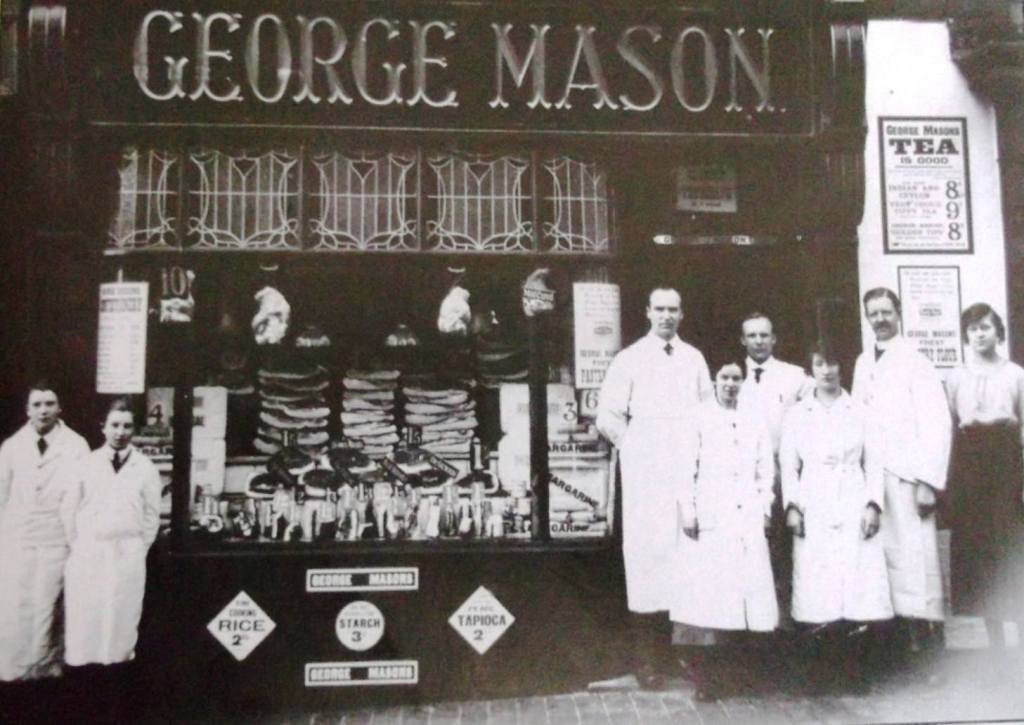
Copyright: Mike Fenton. This was a few years before my time, of course, taken in about 1925. Aren’t the staff all smartly turned out? And the store had their own brand tea, I see, from the poster on the right, 8d a quarter it appears, for those who still know what the weight and price means – old weights and old money!
Sugar was still sold in the 1950s in packets made of thick blue paper then, (this paper was saved by the thrifty and used to cover school books in the days when we had to do this! My granddaughter started secondary school this week and commented on all the books that she was being given which brought back some memories of RRGS for me, though I don’t think they are expected to wrap them these days! But even now there is a type of paper called sugar paper which is used for crafts, thick and slightly rough, just like the paper sugar was bagged in)
And biscuits – custard creams, Nice, pink wafers, rich tea, Bourbons, plain and chocolate digestives – were also sold loose from large aluminium cube shaped tins in grocerrs’ shops, Woolworths and on the market. Mixed broken biscuits were sold at a cheaper price. Mum bought meat for our Sunday roast from Levett’s butchers in Birmingham Road, bacon and other groceries from Mr Darby’s shop, also in Birmingham Road, where the shop always smelled of coffee beans roasting and smoky bacon. I can’t remember us drinking coffee much at home, Typhoo tea was the beverage of choice for the adults although I hated it then, although I seem to remember a bottle of Camp coffee on the shelf in the pantry. It was there for years, probably because it tasted so awful. But later instant coffee became available which in our house was made with hot milk and lots of sugar! Mum always made a cup for my Grandad Hopkins when he visited us on Sunday mornings.
I can’t remember where Mum bought vegetables, perhaps in the local shops or in Blackheath market although my grandad probably gave her some produce sometimes from his garden and allotment. My father brought ham, sausage and bacon from George Mason’s curing house at their Head Office in Digbeth, every Friday and he probably also brought home fruit and veg from the Bull Ring market just up the road. I can certainly remember him bringing home tangerines and pomegranates, usually just before Christmas and him teaching me to prise out the pomegranate seeds with a silver pin, though I have no idea where that method came from. I still think of my dad whenever I get a pomegranate.
Milk, of course, was delivered to the door in glass bottles and bread could also be delivered. Although sometimes, I can remember going up to Bell End to the bakery at the bottom of Newhall Road, where we could knock at a side door and buy freshly baked bread- it smelled delicious and rarely survived the five minute walk home without a corner of crust being torn off and nibbled!
But for oddments and urgent items, we had the local shops –there were several near Uplands Avenue, the little one on the corner of Uplands Avenue and Mincing Lane which had a bell above the door which pinged as you went in, another shop a hundred yards or so up Mincing Lane and two or three more in a row on Bell End just at the junction with Mincing Lane, the biggest of them also run by a Mr Darby, another member of the indefatigable trading family with grocery and other businesses all around the area.
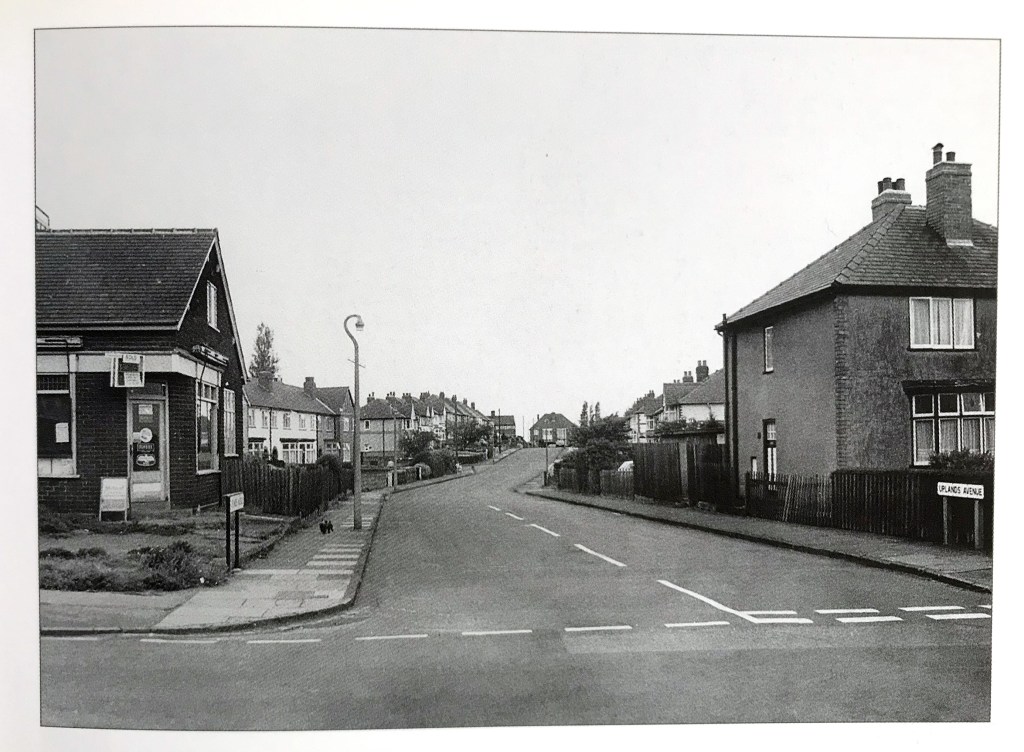
Copyright: Anthony Page. This picture from Anthony’s first book on Rowley is looking along Uplands Avenue from Mincing Lane, with the corner shop on the left here. We lived about half way along here on the right so we were pretty close to this shop, a two minute walk.
These shops were the ones my family mainly used for convenience shopping although there were more shops down on the Oldbury Road, several at the bottom of Uplands Avenue and one at the bottom of Mincing Lane, below the Pear Tree Inn. From these local shops we would get items we had run out of at home, ham – freshly sliced to order, butter – carved from the tub of Danish butter and wrapped in greaseproof paper – they were very skilled at carving exactly the amount requested. and as children, we would buy our sweets, chocolate and crisps. And in October the Fireworks would come into stock, displayed in a glass case under the counter and in those days individual fireworks could be bought as pocket money permitted- my brother loved bangers and I liked Roman Candles, Catherine wheels and sparklers! Every one saved their fireworks up at home ready for Bonfire Night and begged for pennies with a guy to buy more. And there were no age restrictions on sales in those days so even as little ones we could buy explosives…
On Saturday mornings we would walk along Bell End and down the Birmingham Road to Blackheath where my dad would take us to the market where we were allowed to choose some sweets from Teddy Gray’s stall. I expect we got other things from the market as well but the sweet stall is a vivid memory. Chocolate covered coconut ice, chewy toffee and coconut teacakes, chunks of rock, herbal tablets and herbal candy, coconut mushrooms, we each had our favourites.
Over the road from the market in Blackheath was Robinsons the cake shop where again we had favourites. I loved the pineapple tarts, chocolate tarts, I seem to remember big puffy choux buns. And they also sold bread – light airy Viennese loaves for special occasions and tiny bridge rolls, as well as sliced ham to go in those rolls, cut in the shop. Hovis was available if you wanted brown bread but wholemeal, rye, seeded and sourdough loaves were unknown in the 1950s.
These excursions to Blackheath usually ended with a visit either to my Grandad Rose in Birmingham Road, next to the Handel Hotel or to my Grandad Hopkins in Park Street, opposite the back entrance to the market. Here we might be allowed to go down the back garden and pick the raspberries which grew along the fence or to accompany Grandad to his allotment further down Park Street, just behind a mission hall.
What would our ancestors have thought of the colossal choices of goods which are now available to us at the touch of a button, delivered to our doors, though not generally by a boy on a pedal bike these days? Instead of the high-ceilinged shops with wooden counters, shelves stacked with familiar tins and packets, the wire pulley system which zinged your cash payment around the store to the cashier upstairs and back; how bewildering would they have found the tens of thousands of items from all over the world? Fresh food available regardless of season – though not necessarily the better for that – displayed in a modern supermarket? What would they have made of people waving small cards over machines or pointing little gadgets in their hands at another gadget to make their payments?
So where did the people living in the Lost Hamlets shop in and access the services they needed in centuries gone by?
There were no supermarkets or chain stores until relatively recently. Chain stores did not start until the second half of the nineteenth century for chain stores and in then only in towns. Small local shops tended to sell all sorts of useful things, besides food. And there would be specialists such as butchers or bakers, perhaps shoemakers, other specialists such as fishmongers or greengrocers were probably uncommon, at least in small villages such as Rowley in early days. Where did people buy their tobacco, their alcohol, their medicines, their tools and needles, thread, yarn, cloth and clothes? Some of these, perhaps, from village stores, beer from the off-licence door at the pub, probably or home brewed by many. Medicines perhaps from the local shop or from some local person known to be knowledgeable about such things, a herbalist in effect. This was touched on in my piece on this blog entitled “Murdered by his wife”. People had to use what was available to them, be it services or goods. There were few doctors, few midwives and dentists, no vets. Yet people with these skills would have been known to local people and sought out when needed. The 1680 Will of Ambrose Crowley of Rowley Regis, Naylor included some ‘Chyrurgery Instruments’ – surgical instruments, perhaps scalpels or similar, but whether these were for use on humans or animals is unknown. Items such as pins, needles, scissors – like nails, these tended to be made in particular areas of the country – needles in Redditch, cutlery and scissors in Sheffield – would have been costly and loss or breakage would present a difficulty until a replacement could be obtained.
Before shops developed, most such occasional needs would have been met from the visits of pedlars who travelled around the country and from weekly markets, with some items sought out at annual ‘fairs’ when traders from afar would work their way round an established and ancient round of such fairs, when not just fairground rides featured but also hiring of labourers and servants and exchanges of goods, including luxuries such as ribbons and fancy goods.
You may hear, even now, occasionally, of ‘market rights’. Towns could not simply start a market because they wanted to, the right to hold a market was a valuable commodity and was organised carefully, often negotiated or sponsored by a benefactor or Lord of the area. There were generally two ways early markets were held, either by the by virtue of a specific royal grant, where there is likely to be a charter recording it, or by prescriptive right, that is, based on immemorial custom, where there may not be any charter to be found. There are also unlikely to be charters for markets and fairs held on the land within the royal demesne.
Market rights were so highly prized by towns because they attracted both shoppers and traders and the market fees went to the owners of those rights. Grants of such rights also usually included the right for the town to hold an annual fair which would have been a much bigger affair and would have been held on a specified Saint’s Day each year. These rights were carefully calculated not to clash with other nearby markets and fairs and indeed to allow regular fair traders to move from one to another on a regular circuit and to this day these ‘fair families’ mourn when places no longer hold their fairs, as I know from my time working for my Town Council. We were approached repeatedly by the family which had historically provided the fair in the town to reinstate the annual fair, impossible now alas, because of the constraints of narrow roads, development of traditional fair sites for other purposes and the size of modern fairground rides. To this day, ‘fair people’, families who travel the country between fairs still prize their traditional circuits between towns to coincide with their annual fairs, although most of the trading aspects of the fairs have long since disappeared. And to this day, the trustees of market rights still actively protect and control the markets within their towns, such as Cirencester.
Such markets and fairs had to be within reach of their customers, preferably within a reasonable walking distance because roads were poor or non-existent and it is noticeable, certainly within the countryside area where I live now, that towns tend to be about seven to ten miles apart (so at most a five mile walk or horse ride each way for people living between them, such as farmers wanting to take goods to market) and bigger centres seem, generally, to be about twenty miles apart.
Rowley village was not big enough to support a full market, although both Blackheath and Cradley Heath grew big enough eventually to do so. So where were the market towns which served Rowley?
Dudley was the obvious candidate and nearest market town for centuries. Blackheath did not exist as a town until the middle of the nineteenth century so although it still today has a good market, it did not exist in early times. Birmingham was not then a bustling city. And no doubt Rowley folk would have walked over Turner’s Hill to Dudley for some purposes. But the official market town for Rowley, as revealed by notes in the Parish Register at the time of the Commonwealth (1649-1660) was designated by the Government of the day to be Walsall, much further away then Dudley by several miles and without an obvious connection. But Dudley was in Worcestershire and it seems that Cromwell’s new laws applied within County Districts so Walsall, in Staffordshire, was deemed the local market town, although in practice I have my doubts that many people chose to walk the additional miles to get there, unless forced to do so by the requirement to publish notice of impending marriages. Perhaps there were also shops or facilities at Halesowen or Oldbury or Stourbridge or Kidderminster to attract people. Certainly Stourbridge was apparently a busy trading centre for nails.
But on a day to day basis there were small local shops within and near to the area of the Hamlets, especially in Rowley Village, perhaps Hawes Lane and certainly in Tippity Green and Perry’s Lake. These appear to have sold groceries and perhaps some hardware or clothing items. Perhaps some vegetables, potatoes, onions, carrots, beans etc were grown in people’s gardens, pigs for bacon were commonly kept in back yards, sometimes shared between households and it seems likely that many people kept chickens for eggs but certainly there were numerous butchers’ shops and most butchers slaughtered their own animals on the premises. Those who kept a pig at home might call in a pig butcher to slaughter and joint their pig when the time came but for beef, mutton and lamb, they needed a butcher.
Was bread made locally or did everyone make their own? I know that there was later a bakery in Bell End but there may have been others. Did flour come from the local mill or was this one of the items sold in the small shops?
I recall that in the press reports about the deaths from carbon monoxide poisoning of a family in Cradley Heath in 1873, the bodies were discovered by one of the neighbours who had gone to the house because she wanted to use their oven for baking. So it appears that not every house had such facilities and that it was commonly accepted that neighbours would go into each other’s houses to use them. I have also seen many reports from other areas and sources that it was common for people to take their Christmas goose or joint of meat to the baker on Christmas Eve so that these could be cooked in the bakery ovens. So it seems likely that in earlier times, few small houses would have had ovens and much of the home cooking would have been done over the open fires in houses, limiting the range of dishes possible.
Tea and sugar were comparative luxuries and I suspect that exotic items such as coffee and chocolate were not commonly available in these remoter parts of the area until relatively recent times. Local dairy herds would have supplied milk and perhaps cheese and butter, although many families in earlier times would have used dripping, collected from roasting of meat and bacon, for spreading on bread. Nowadays, if you seek out dripping in supermarkets or butchers, you will find it as beef or goose dripping or lard, according to which animal or bird it comes from but I believe that in earlier times, any dripping would have been collected together and saves carefully for later use, all mixed together and all the tastier for it.
So the whole experience of shopping would have been much more limited than it became in later times, and, of course, because many of the families in the area were poorly paid, every penny of expenditure would have been carefully controlled. Perhaps many poorer folk would have obtained food on ‘tick’ where goods would be taken and then paid for later when the man’s wages were brought home at the end of the week. Provided he did not spend too much of his wages in the pub on the way home. Was this why the Levetts ran a shop as part of their pub business? Different customers, perhaps but from the same families. Many women probably never went to the pub and many men probably never did the shopping!
Another aspect of shops was the Truck or Tommy system. This was a system where employers paid their workers partly in ‘truck or Tommy tokens’ which could only be used in specified ‘truck shops’, usually also controlled by them or their families. This system was doubly unfair in that the employers and/or truck shop owners could set the prices of the goods, usually considerably higher than in independent shops and they also controlled the quality of the goods supplied, frequently substandard or of poor quality, adulterated or even inedible foodstuffs. Although the ability to make bulk purchases could in theory benefit the customers by offering lower prices, generally, it was the employers who made profits from the system. An Act of Parliament was passed in 1821 to outlaw this system but as late as 1860 it was reported that it still operated in the area around Tipton. I have not seen anything to suggest that any such shops operated in the area of the Lost Hamlets, possibly because there was no one dominant employer in the area as there tended to be around the major iron works.
Chains of shops began to appear in the mid 1800s, nationwide chains such as Home and Colonial and Liptons had thousands of branches by 1900 but of these chains the only one which survives today is the Co-op. Home and Colonial had, I believe, a branch in Blackheath High Street until as late as the 1950s and there were branches of the Co-op in Blackheath and, at one time, opposite Bell End. W H Smith had begun to appear in the 1840s, mainly originally at railway stations but the local stations were not big enough to merit this facility. Boots the Chemist was another High Street chain which is still on our High Streets – or some of them – and I am old enough to remember Timothy Whites which was a similar chain but again, the hamlets were not big enough to support these.
More legislation affecting shops followed in later years, in 1892, restricting the hours that young people under the age of eighteen could be required to work to seventy four hours, inclusive of meal times. Shops were also required to provide stools for staff (though whether the staff felt able to use them is another matter!) and the Shops Act, passed in 1911, was a United Kingdom piece of legislation which allowed a weekly half holiday for shop staff. This became known in Britain as “early closing day”. However, provisions of the act of 1892 did not apply to members of the same family living in a house of which the shop formed part, or to members of the employer’s family, or to anyone wholly employed as a domestic servant so, yet again, most of these protections did not apply to the sorts of shops in small villages and hamlets.
So the shops in the Lost Hamlets area were mostly much smaller outfits, often in front rooms of ordinary houses and run by local business people, often by the wives of men who went out of the house to work.
In the 1841 Census, Elizabeth Lewis, aged 40, was listed in Tippity Green as an Ironmonger. There was no adult male in the household so perhaps she was a widow, we cannot tell from this census which gives no indication of marital status or relationships. Among so many people who worked with iron, this seems a little contrary but perhaps she sold such items as buckets, pots and pans, small tools and implements, lamps or candle holders – items which could not easily be made in small forges. Joseph Bowater, aged 50 and the landlord at the Bull, was listed as a butcher in Tippity Green, and Edward Richards, aged about 50, was also listed there as a shoemaker. There are no other shop trades mentioned.
By the time of the 1851 Census, Joseph Bowater, again listed in Tippity Green and now 64, was described as a ‘vittler and butcher’ and was now employing a second butcher who was living with them. Sarah Parkes, also in Tippity Green aged 50 and the wife of a Nailer, was a dressmaker but it not clear that this meant that she had an actual shop. No other shopkeepers were listed.
In the 1861 Census, William Badley, aged 26 and a House Agent was listed living with his father and family but it is difficult to imagine that this involved shop premises as modern estate agents do. In any case, it is likely that he was employed by an estate or owner of houses in the locality, to manage them and collect rents, rather than to sell properties. James Levett, then 29 was listed in Perry’s Lake as a grocer. I have included information about the grocery business run by the Levett family in my articles about that family. Also in Perry’s Lake were two ladies born in Ridgmont, Bedfordshire who were both ‘bonnet sewers’, although again, one cannot imagine there would be sufficient trade for a shop, bonnets may well have been sold from their house.
There is an interesting article on the hat making and straw plaiting industries in Bedfordshire in this period, much of which was a cottage industry in the 1800s, much like nail making in Rowley.[i] However, it seems unlikely that there would have been the logistical set-up for straw plaiting in Rowley village so perhaps these ladies were making the end product of actual hats for local customers.
Also in the 1861 Census, Benjamin Rock was listed in Tippity Green as a Blacksmith and grocer, immediately next to the Bull Inn. Living very close to them were the Whitehouse family in their private residence which included William Whitehouse, the Registrar of Births and Deaths (his signature well known to many Rowley family historians and his father had performed the same role before him) and his brother Thomas who, aged 19 was listed as a Chemist and Druggist but with no indication of where he practised this profession. Benjamin Bate was listed in Perry’s Lake as a grocer and his house described as a Grocer’s shop; other members of the Bate family kept the Cock Inn in Cock Green and Mary Ann Batehad married into the Levett family so this shop may have been associated with the Levetts .
In the 1871 Census, James Whitehouse, aged 40 is listed as a grocer at Tippity Green but no other shops are mentioned.
In 1881, Daisy Levett is shown as a grocer in Perry’s Lake. Again, this is the only shop that I have found mentioned.
There would have been more shops just a little way away in Rowley village and probably also in Hawes Lane but I have been concentrating on the area of the Lost Hamlets. Later there were shops at Springfield and Doulton Road and on the Dudley Road.
In 1901, in the Census, my paternal great-grandfather Arthur Hopkins, lived at 3 Tippity Green ‘the fish shop’ and his occupation was shown as a ‘fishmonger’.

Copyright: The National Archives. This is the only reference I have ever found to a wet fish shop in this area and obviously didn’t last long as he was living in Coventry by the time of the next census in 1911!
My mother could remember in the early 1920s, as a small child, being taken to visit elderly ladies in Bell End. In her memoir, she said “I particularly liked Aunt Mary Ingram, mother’s first cousin. She lived in Bell End, where previously the Pits had been until they were worked out. Now it was all fields, with a row of small terraced miners’ cottages. There was a tiny pantry with a front facing window. Aunt Mary made it into a little shop with sweets and chocolate, lucky bags and pop.” [Editor’s note: There was at least one sweet manufacturer in Holly Road in Blackheath but perhaps some sweets, such as toffees, were home made.] “ I suppose she sold groceries too but they wouldn’t have interested me! Oh, yes, I can remember blue paper bags of sugar. Well, of course, as the grown-ups chatted, I was continually asking for pennies and usually got a penny or two for goodies. I loved this tiny windowed shop. Inside was a huge wooden screen or settle padded with cushions – the back was tall and right to the ground and the wooden arms kept one very cosy by the big deep open fire. Hot ashes were falling and glowing cascades as we poked the fire and ‘made it up’ with new coals. Further along the road my mother’s Aunt Liza lived with her grumpy husband Alf. We never stayed too long here. She never had a family but Uncle always retired to his precious garden and greenhouse. He can’t have been too bad because he was kind enough to show me his precious plants and vegetable garden”
Also in the 1920s mum remembered buying vegetables from a greengrocers run by “the Bird family, who traded as greengrocers in Blackheath for many years.” Dick Bird visited my dad’s cobblers shop every day for a gossip or ‘cant’, as did some other men, especially in winter. A good coal fire was a great attraction.” My mother remembered arguments about football – her father and brother were loyal West Bromwich Albion supporters and other customers favoured Aston Villa! This is another aspect of these small shops, the social life which revolved around them, much more than a simple cash transaction.
By the later 19th and most of the 20th century, with a hugely expanded population by comparison with even fifty years earlier, there were dozens of small ‘corner’ shops of varying size, serving small local communities with all sorts of goods. Many of them are remembered with affection by those of us who grew up in that time. But alas, most of them are gone now, overtaken by changes in shopping and cooking habits, long trading hours, the loss of tobacco sales and post offices, perhaps excessive regulation, business costs, the increased availability of personal transport making it easier to shop somewhere else, especially as more people work a distance from their homes and may pass supermarkets on their way home. Not to mention home delivery services, now offered by all the big supermarkets with the exception of Aldi and Lidl, I believe. Ironically, the nearest equivalent to these corner shops now is probably the small local stores introduced into small towns and neighbourhoods by the big supermarkets- the Tesco Expresses, the Sainsburys Locals, the Morrison’s Daily, the little Waitroses – going back to small convenient local shops which sell a big range of goods and are open for long hours.
These are some of the Facebook Comments over a number of years on the ‘I remember Blackheath and Rowley Regis’ page, about memories of local shops:
There was some discussion about one shop at Perry’s Lake:
Le Hughes – “I used to live in Regent Road and walk to the local shop every Sunday with my dad and the dog 😊”
Cynthia Cole – “I remember the shop – Always known as Peggy’s.”
Andy Jakdaw Dawes – “How about the one at the bottom of Turners Hill by the Portway Tavern, it was the only shop open Sunday afternoons where we could get suck from little old lady ran it, if I remember right.”
Carl Fisher – “Yes, I do, we used to go in there when we went to my nan’s
Maggie Smith – “Alison, do you mean the shop at the top of Oakham Road on the corner of Turners Hill? That was also Peggy’s – belonged to the Slim family.
Alison Prosser – Yes Maggie, Aunty Peggys maiden name was Slim.
Maggie Smith – We must have known each other then. I was good friends with her nieces Ann and Joan Davies and Peggy’s daughter. Also Peggy’s other niece whose parents had the shop in Hilton Road. I think Ann and Joan must have been on Peggy’s side. Their mother, I think, was a Slim. I remember Kathleen, she was younger than me. I spent a lot of my childhood at your Aunty Peggy’s house. I hadn’t seen her for about 50 years and popped into the shop a couple of years ago – I was really surprised that she actually remembered me. We lived in Ashleigh Road, just down from Hadley’s farm. Ann and Joan lived a few houses away. I think it was Peggys brother who was a minister at the mission we attended at the top of Portway Hill.”
Diane Williams asked “Who remembers Bob Woodhouse, he owned the tyre yard & the big house behind Peggy’s shop…..
Peter Hackett – I remember it! Used it once!
Marie Devonport said “I walked past Peggy’s old shop today. Went for a walk over to Warrens Hall park. When you walk down the side of the old people’s home, feed the ducks in the pond and then walk down past the riding stables you’re in a different world. You could be anywhere. I love it on a sunny day.”
Paul Scerri remembered“I worked with a bloke on the buses in Wolverhampton, whose mother had the shop before Peggy and George.”
Sue Lynn Babington said “There is still a little paper shop there as I get off the bus there when walking over Turners Hill and pop in for my Kit Kat.”
Joyce Connop – Yes, I can remember that nice to pop in for and ice cream when we’d been for a walk over the golf links.
Doris Crump recalled “There was a green shed across Portway Road, it was a cafe to start with then it was a sweet shop, years ago, sold the best icecream.”
Kath Harris also remembered shops in that area: “I also remember Mrs McKay and Brenda in the sweet shop, Agnes and Ted king Frank the butcher (possibly Tippity Green but not sure)!”
Tony Holland said “ I think Tippity Green started from Portway Tavern to the junction, Bulls Head facing you. I was born in Portway Road in 1959.
Kelvin Edmunds said there were two shops in Tippity Green, just past the Tavern on left was Faulkner’s two sisters who kept that last, the House on the right before the junction, he thought it was Mrs Tromans.
Keith Fenton commented that he had been told that there was a sweet shop in Tippity Green, he didn’t remember it, did anyone else?
He remembered one of the terraced houses opposite the entrance to golf range used to be a shop.
Sean Comfort agreed that was exactly where it was, opposite his grandparents who lived in the cottages over the road that backed onto the quarry. Jane Davies agreed, she had lived at number 8 Tippity Green from the 70s and her mom only moved from there about 11 years ago. That’s exactly where the shop was.
Janet Harris said “My uncle had the sweet shop in the terraced house about 65 years ago, his name was Albert Haden.”
Mike Fenton noted that in 1939 Albert Haden was living at No. 11 Tippity Green but was listed as a worker in Seamless Steel Tubes. Presumably, the sweet shop came later perhaps he worked at both with his wife Ada?
So many local connections came up!
Jill Tarr said “My auntie Renes full name was Ada Irene.”
Shirley Jordan said “There was 3 shops across Tippity Green, Mrs Haden and then Mrs. Vine took it over and there was Mrs Faulkner’s shop. Over the road a little further along was Mrs Mullets who sold grocery and sweets. Terry Greenhouse believed Mrs Mulletts husband was Reuben if his memory was correct.
Sharon Whitehouse said “Yes I remember it very well, my dad took me in there for sweets, on the way to my nans. I remember it had a red door with a large black knob in the middle of it and all the jars were in the window2.
Peter Wroe had lived in the Portway Tavern as a kid and remembered “going to the shop for sweets, especially flying saucers or rainbow drops, yummy.”
Andrea James also had more reason than most to remember the shop – she noted “Yes there were actually two, one up the steps was owned by two old sisters and it burnt down through faulty electrics. We lived 2 doors away and lost our house in the fire too.
Susan Bowater said her nan had a cafe just below the Port way Tavern on the other side of the road. She remembered going to the sweet shop for yellow kali. Joyce Connop asked whether that was Ada’s cafe? She remembered Ada well. She said “On the way to school we used to call and she would sell us cakes left from the day before for a penny and I remember when she moved to a new house in Throne Rd with her daughter .
Brian Kirkham remembered that he used to like the barley twist canes with the chocolate centre. He also recalled that Joe and Johnny slater lived next door, he thought the row of houses was the villa and the pub was the Portway Tavern.
Roger Harris said “I remember the little shop owned by two sisters on the left hand side past the Portway Tavern. It was the only shop open on Sunday afternoon, there was nothing to do on Sundays in the 60s as everywhere else was closed on the afternoon when the newsagents closed at lunchtime .
David Hilton also had family connections with the shop: He said “The sweet shop up the steps was owned by my aunt, Sarah Faulkner. Three of her sisters, Edna, Doris and Mon also worked in the shop.
As a child I lived directly opposite the shop. At quiet times the shop would be locked but regular customers knew that if they stood on the step, one of the sisters would run over the road from where I lived and serve them. It was often my job to “watch the shop”. It was not only a sweet shop but sold most things from food to a few clothes.
I thought the greengrocers was Levers and the other shop was Parkes.”
Gaynor Brockley asked whether anyone remembered the hairdressers, ‘Maureens’ right next to the Bull’s Head in Tippity Green? And she remembered a greengrocers , she thought his name was Jim Levett .
Those shops in Tippity Green certainly provoked a lot of memories, even today but alas, I have not been able to find any photographs of them or even of Tippity Green. There were also various shops on the Dudley Road , including the Post Office at Springfield and in Doulton Road and later at least one fish and chip shop on Dudley Road which was remembered with appreciation by many people on the Facebook page.
Another memory on Facebook which makes me smile is one from Tracie Evans who said in 2014 “I used to work on the cake stall at Blackheath market, every Saturday we would get the lovely pensioners saying
‘I’ll tek a pound of bosted biscuits and mek sure they ay bosted'” , wonderful, I can just hear them, pure Black Country in word and wit!

Copyright Anthony Page. This is the older of two images in Anthony’s first book of photographs of Rowley, of Bayley’s Post Office at Springfield, which would have been very familiar to residents in the Lost Hamlets, this one is dated about 1920. Not much traffic about, so the many children are quite safe gathering in the road, possibly to gawk at the photographer, although there is one motorcar parked by the Post Office, I wonder who it belonged to?!
And from the mid 1800s onwards an evergrowing range of shops was established in the ‘new town’ of Blackheath which would have drawn many local people to the shops and market there. Hopping on the 140 Bus, probably! And as roads and bus sevices improved, trips to Dudley and even the grand shops in Birmingham would have become possible.
The Tibbetts shop-keeping ladies of Rowley Regis

Copyright: Anthony Page. This picture gives us a glimpse of the interior of one of those shops in Rowley village, with members of the Tibbetts family.
So I have done my best to consider how and where our ancestors in the Lost Hamlets shopped and what they might have bought there, I hope you have enjoyed this little exploration of shopping in years gone by.
[i] https://www.selvedge.org/blogs/selvedge/the-straw-hat-industry-of-luton
 rowleyregislosthamlets.co.uk