I have noted from Census entries for the Lost Hamlets over several decades that while most residents were from the village or the hamlets themselves, some people came from other areas. If a place recurs several times when I am transcribing, I look the place up to see whether I can work out the link and I often find that these places had granite quarries, just like Rowley. Researching around this theme, I have found so much information that I am splitting the results into three posts.
To illustrate this migratory pattern, I have concentrated initially on looking at one family, the Hopewell brothers who came to Rowley from Mountsorrel in Leicestershire, fifty miles away, in about 1841. There were numerous other migrant workers but I picked this family because there were three brothers to work on. I do not appear to be related to them, at least so far!
In the 1851 Census Thomas Hopewell (aged 30) and his brother Charles (24) were living in Tippity Green, probably lodging at the Bull’s Head. They both gave their occupation as Stone Cutter and both were born in Mountsorrel, Leicestershire. Thomas had already been living in Tippity Green in the 1841 Census, but the 1851 Census is the first which actually shows the place of birth, usually County and place. The 1841 Census does not show relationships within a household and just says whether someone was born in the County or not. In Rowley’s case, this means that someone could be born as close as Dudley, parts of Whiteheath or Gorsty Hill, Oldbury or Halesowen and still tick No so this is not a good indication of how far people had moved.
Thomas Hopewell had married Mary Trowman on 18 Sep 1843 at St Giles Church. His occupation then was given as a Stocktaker, perhaps at the quarry but there is no way of knowing for sure. Mary gave her abode at the time of the marriage as Club Buildings and she was the daughter of Benjamin Trowman, a Jews Harp Maker. Thomas signed the Register so he was literate, as presumably he would need to be as a Stocktaker but Mary made her mark as most people in Rowley did at the time.
The marriage registers tell us that the father of the brothers was Septimus Hopewell and his occupation was given as a ‘Frame work slitter’ who does not appear ever to have moved from Leicestershire. That would have been a very unfamiliar occupation in Rowley, and I think he was actually a frame work knitter. The framework knitting trade was common in Leicestershire and Nottinghamshire, making stockings but, like nailmaking, work at home which was very badly paid which is perhaps why Thomas and his brothers sought other employment. I have put a link at the end of this article to an interesting website about the conditions of Framework knitters.
There was at least one other Hopewell brother in the area, George Hopewell who married Mary Ann Masfield/Masefield in Rowley in 1842. George was also living in Tippity Green at the time of the marriage and was also a stone cutter. He died aged 47 in 1862, leaving his widow with his stepson. They do not appear to have had any other children.
Charles Hopewell, the youngest brother I have found in Rowley, married Elizabeth Lowe in St Giles in 1852 but died aged only 32 in 1860 leaving his widow with five young children. Lowe is another Rowley name which will recur in this family tree. The children from Charles’s marriage appear to have stayed in the Rowley/Blackheath area although their mother had at least two more children and then remarried in 1870 to John Brooks, living almost next door to the Gadds in Ross. The Hopewell name in this part of the family appears to have been spelled as Oakwell in various records for some time, a hazard to the illiterate (and to the family history researcher)! If you say Hopewell and drop the ‘h’ you can hear how that might happen. Later some of the children used the name Hopewell and some Oakwell and some swapped between the two…
Both George and Charles Hopewell were buried at St Giles.
In 1861 Thomas and Mary were living in Hawes Lane, Rowley with five children: Annie, born 1844, Sarah, born 1847, George born 1850, Elizabeth born 1853 and Septimus born 1860, all in Rowley Regis. He was now described as a Stone Cutter.
Living next door to them were Joseph Lowe and his sons including Samuel, then aged 20 and Joseph, aged 18, both of whom feature later in the Hopewell family story. Thomas and Mary’s eldest daughter Annie married Samuel Lowe in Dudley in May 1861 and they stayed in Rowley for some years after her parents moved to Shropshire although her later children were also born in Shropshire.
Mountsorrel in Leicestershire, where the brothers came from, is described even today as ‘The village renowned for its granite quarry, the largest in Europe… and the local area is built on granite. Organised quarrying of the granite in Mountsorrel Quarry began in the late eighteenth century, and the quarrying trade had around 500 employees by 1870.’ So there was certainly expertise in granite quarrying there.
Clee Hills, Shropshire:
There were apparently numerous granite quarries around the Clee Hills in Shropshire at this time, most of which are long closed now. Interestingly, there were a few Hopewells living in the area in the 1841 and 1851 censuses but I have not been able to link them to the brothers.
This map shows the locations of Mountsorrel in Leicestershire, Bedworth in Warwickshire, Rowley Regis and Cainham in Shropshire, all places which had a notable interchange of workers and their families.

Copyright Google maps.
By 1871 Thomas, Mary and three of their children were living in Cainham (now Caynham), Shropshire, thirty three miles from Rowley.
Most people in earlier censuses in Cainham were involved in agriculture but by 1871 there were many stone cutters, most of them incomers. There is no mention of a quarry at Cainham in current information online about the village but in the 1871 Census there was a Quarry House and ‘The Stone Inn’ in Cainham, which are pretty good clues that there was a quarry operating then. Quarry House was occupied by a Quarry Man, his two lodgers were from Leicestershire – one from Mountsorrel and one from Sileby which is a nearby village, both stone cutters.
Next to the Stone Inn were the ‘New Buildings’, eight or nine houses, presumably built specially to accommodate incoming quarry workers, as six of these were occupied by stone cutters or sett makers, mostly born in the Mountsorrel area of Leicestershire, one from Bedworth in Warwickshire plus a Clerk of Works who almost certainly also worked at the quarry. Amongst these were a sprinkling of wives and children from other granite producing areas, including several who gave their place of birth as Rowley Regis.
A few doors along the street from the New Buildings Thomas and Mary had living with them their sons George aged 20, Septimus aged 11 and Benjamin aged 7. All the children were born in Rowley, plus two boarders. Joseph Bissell, a familiar Rowley family name, aged 20, listed as from Staffordshire (but in all likelihood the Joseph Bissell who was baptised at St Giles on 26 Sep 1849, the son of Joseph and Mary Ann Bissell of Hawes Lane). Another lodger in their household was a Thomas Baum, born in Leicestershire, the Baum name recurs later in the Hopewell family history, too. Thomas Hopewell, his two older sons, George aged 20 and Septimus aged 11, and their two lodgers were all described as ‘stone cutters’.
Next door was Thomas Rudkin, also born in Leicestershire and also a stone cutter, with his wife Jane and his daughter Sarah who were both born in Rowley Regis, three further children born in Cainham and his brother-in-law Thomas Parkes and mother-in-law Mary Parkes, both born in Rowley Regis. Samuel Sharpe, aged 22, a few houses away was also a stone cutter, he was born in Mountsorrel, his wife in Cainham. A real mixture in Cainham of Mountsorrel , Cainham and Rowley Regis origins.
By the time of the 1881 Census, Thomas and Mary, both now 60 , were still living in Shropshire but had moved three miles along the road to Hope Baggott. Their son Benjamin, now 16, was still at home and their son George, with his wife Hannah and children Mary, aged 8, Joseph aged 6 and Anne, aged 2 were living next door. All of the men were stone cutters.
Interestingly, although George had been with Thomas and Mary in Cainham in 1871, his wife Hannah and two older children were all born in Rowley Regis, clearly in the interim George had gone home to Rowley to get married and stayed there for long enough to have two children before they all m oved to Shropshire. His bride Hannah Bissell, daughter of Joseph Bissell, lived in Tippity Green, so still in the Tippity Green area. It took me some time to find the record of their wedding in 1872, as the bridegroom’s name was recorded as Oakwell! Was Hannah the sister of the Joseph Bissell who was lodging with the Hopewells in Cainham a year earlier? Yes, she was. What you might call close family links!
By 1891 Mary Hopewell was living in Clee Hill, Shropshire, a widow, although I have been completely unable to find a record of the death or burial of Thomas Hopewell in this period. Mary had two lodgers aged 20, Albert Varnham (her grandson by daughter Elizabeth) and James Masefield, both stone breakers. The Masfield/Masefield/Macefield name has occurred in this family before, too – Mary’s brother-in-law George Hopewell was married to Mary Ann/Maria Masfield in 1842 so it is possible that there is a family connection here too.
In 1901 Mary was still living independently in Cainham, still with two (different) lodgers, one of whom was born in Rowley Regis, sadly I cannot read his name but he was, as you might expect, a stone cutter.
Mary Hopewell, nee Trowman, died in March 1907, aged 88 and was buried at St Paul’s, Knowbury.
I have created a family tree for the Hopewells on Ancestry; if anyone has connections and would like to see it do let me know and I will give you a link. At present the tree is private.
I have not yet been able to trace all the Hopewell descendants although I know that Septimus Hopewell moved to Pistyll, near Pwllheli, where he was working as a sett maker in 1881 and lodging with Daniel Baum and his family, (in 1871 a Thomas Baum had been lodging with his parents). Septimus appears to have been with his brother Benjamin in the Bradford area by 1901, both working as sett dressers. He returned to Cainham later and was living with his sister Elizabeth and her family there in 1911. He had then returned to Rowley Regis by 1921, still single, when he was living at 1 Tippity Green, as a lodger and working as a quarryman, full circle for this Hopewell! He appears to have died in the Dudley Registration District in 1930.
There are some connections with the Bradford area where some of the family worked as sett dressers at one point but I have not done a great deal of research on that. Again, the granite dressing skills, this time used in road making, are the connecting factor.
Several of the Varnham family, children of Elizabeth Hopewell, later moved to the Alnwick area of Northumberland, where most of them were sett makers! Follow the granite…
A moving pattern
So there is a pattern in the mid-1800s of stone cutters moving from Leicestershire, in particular the Mountsorrel area, to Rowley Regis, marrying local girls and having children there and then moving on to other quarrying areas. The family patterns felt rather like ribbons intermingling on a maypole at times when I was trying to sort them out. Suddenly a familiar name would pop up again!
It was obviously very common, even for families with several children , to accommodate and living in what were probably quite small cottages, for young single men to be taken in as lodgers, though it appears that in the case of the Hopewells they were often related or in close friendship groups.
Stone cutters were clearly not simply labourers, there are other entries in the censuses for labourers, both general and agricultural but stone cutters and sett makers, wherever their origins, are listed by their skill.
This photograph (brought to my attention by Ronald Terence Woodhouse) shows workers in the Hailstone Quarry and shows the size of some of the rocks they were working with. Imagine the effort needed to manually reduce that very hard rock down to small evenly shaped setts. Hard and dangerous work. It is also used on the front over of Anthony Page’s book on Rowley in Old Photographs and he notes that it was from the Ken Rock Collection: the photograph itself refers to BlackCountryMuse.com. Whichever owns the copyright, due acknowledgment is made!
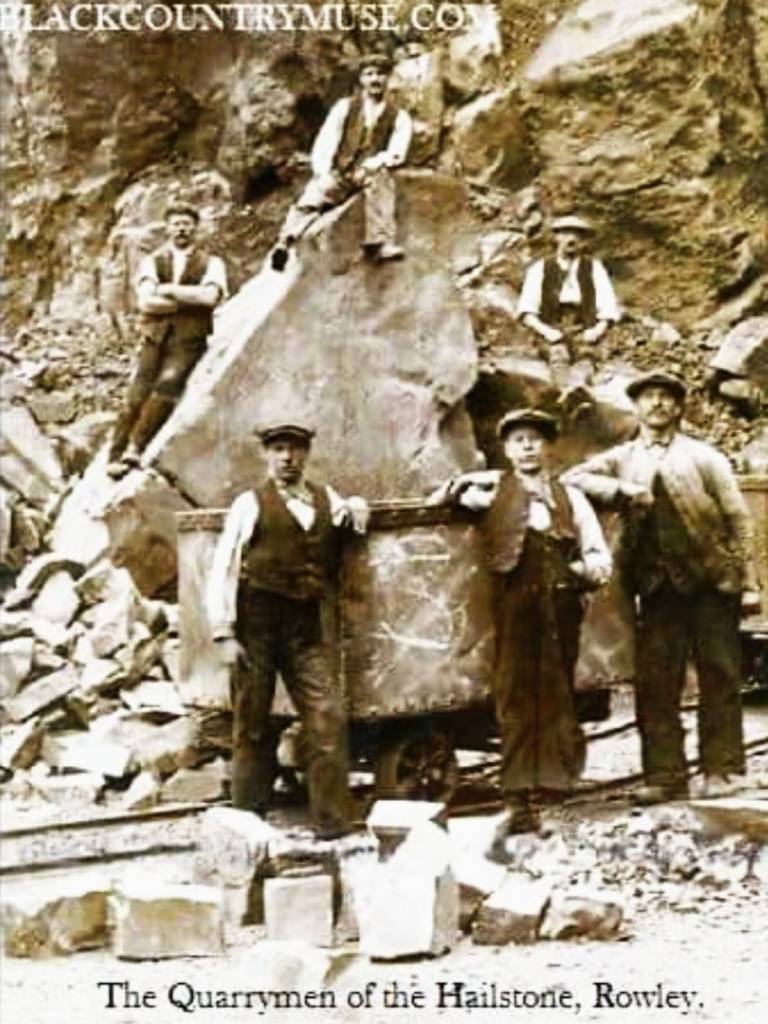
Whether these movements of workers happened because the quarries sent recruiters to particular areas which had the skills they needed is not clear or whether word was spread by the men themselves that work was available or a combination of both. Some of these skilled workers settled in their new areas and many moved on again to another granite quarrying location where their skills would have been at a premium. If you have ancestors in Rowley who you know came from Leicestershire, or who subsequently moved to Shropshire, this may well account for it!
I will do another post about the Nuneaton/Bedworth connections to Rowley.
And there was another migration wave, a little later on in the century , which I will write about in another piece – The Threlkeld Connection, to follow soon!
Other resources:


Another interesting view of local history. I look forward to chapter on Nuneaton as my grandfather and his brother who were miners left Dudley in early twentieth century to work in the mines in Nuneaton and my father was born there in 1914. My grandfather and his family returned and lived in Whiteheath while his brother stayed in Nuneaton , and married a local girl .
LikeLike
I have a book that I compiled in 2020 about Hailstone Farm and Freebodies Farm both on Turners Hill that I would like to gift to you.
My grandfather was born at Hailstone in 1879. My parents left the farm around 1967/8 when I was thirteen.
My ancestor Joseph Mason came from Mount Sorrel and Judith Siviter a local girl. Their daughter Lucy married my great grandfather William Cartwright (from Chaddesley Corbett).
LikeLike
Sarah, what a very generous thought, I would be thrilled to add it to my collection of books on Rowley. It is also a real pleasure to hear from someone who has this pattern of migration in their family. Have you done much work on your family tree?
How interesting that you have that involvement with Hope Bagot, it is a small world. I was on holiday in north Shropshire last week and drove home to Gloucestershire down the A40 and considered exploring a little as I passed the Clee Hills but I have a knee problem which makes driving quite uncomfortable at the moment so I drove on but hope to do that another time.
I know your name from the Facebook group because so many people have made reference to your family when they lived at the farm and also to some photographs which you had of the farm. In fact, among the possible future topics I have listed for articles on this blog, was Freebodies Farm but I knew I need to do quite a bit more research on it before I could put that together.
I can see an email address from your comment so will send you a message to that with my address. May I, please, use some of the information and photographs from your book in a future article? It is entirely up to you but I do want my One Place Study to tell the stories of the people who lived in those now vanished places and these farms are very much part of that. Were Hailstone and Freebodies separate places? Looking at such maps as I can find, it looks as though Hailstone was nearer to Gadds Green and Freebodies further up the road, nearer to Oakham.
Thank you again so much for getting in touch, very much appreciated.
LikeLike
Forgot to mention that I lived near Hope Bagot for 30 years and was a trustee for the Friends of Hope Bagot church. Beautiful wee church.
LikeLike