As I mention in the introduction to this One Place Study, it was the loss to quarrying of whole hamlets in which my ancestors had lived which prompted me to start this study in the hope of recording information about the hamlets and the people who lived there. Quite a few people have mentioned on the Facebook Page ‘I remember Blackheath and Rowley Regis’ their own memories of living on the edge of the quarries on Turner’s Hill.
Peter Hackett was amongst those saddened by the loss of these hamlets. He said in 2014 “You forget that Perrys Lake was almost a little community of its own. Obliterated. Fair enough you have the new houses now. You would have thought that the planners would have kept its original name….”
Marilyn Holder at the same time said “I took a drive over to see the lost community of Perry’s Lake today and found it rather sad that it has disappeared into history like so many parts of the Black Country.” Marilyn’s 4 x Great-grandad Isaac Bishop lived in one of these cottages and worked as a nail maker in his late 70s – no pension then, work or poor house! Her father-in-law was born in one of the cottages in Perry’s Lake in 1919. She thought that there were 6 terraced cottages, which according to the 1841 census housed around 75 occupants. No bathrooms and one toilet up the back yard served all the houses.
Growing up and family memories on the edge

Cottages at Perry’s Lake, just prior to demolition, early 1960s. Copyright Linda George.
Perry’s Lake was the biggest of the hamlets and in close proximity to the entrance to Rowley Quarry in an area known as “Heaven”. The Portway Tavern was once the haunt of quarry workers after a long shift. For many years the Portway Tavern was owned by the Levett family, up to 1900, who were also butchers in Rowley and Blackheath for many years. It remained open until The Portway Tavern was demolished in 1984.
Many people have commented that Perry’s Lake was known as ‘Heaven’ though this does not appear on any maps that I have seen.
Sue Cole was born in a quarry cottage up on Turners Hill. It was next to a farm. Her mum told her that she had to fetch water from the farm as they didn’t have running water, or electricity, they had Tilley lamps for lighting. And she had to sleep in the wicker washing basket, because her brother was still sleeping in the cot. She also remembers that she used to play on the top of the quarry, and had to go inside when the siren blew when they were going to blast. When she was about six weeks old they moved to one of the houses round the back of the Tavern. Her Dad worked at the Hailstone quarry.
Carol Adney was born in Number 16 in the row of cottages along the top of Turners hill in 1950 and lived there until she was 4yrs old.
Shirley Jordan recalled that her aunt Mary had lived in the first house round the corner from the Portway Tavern and then there was the road that was called round heaven. She used to play round heaven at the bottom and there were some horses down there. A lady and family called Onions lived round there as well.
David John Reynolds also remembered that Joe Onions had looked after the quarry horses. When David was a child in the 50’s Joe only had one horse to look after, a white one called Dolly. Geoff Skelton noted that the field is still there where they kept the horses, the golf course fence is where the fence was to stop people going to the edge of the quarry. Stephen Hall remembered Geoff Onions whom he had worked with at Albright and Wilson and who later kept the Portway Tavern with his wife Joan.
Eileen Hadley remembered that her great-aunt Kate Faulkner lived across Perry’s Lake, and that it used to be known as Heaven. Other residents included families called Bird and Harcourt . Jus Joan had a Great aunt whose name was Redfern, she lived in the first cottage set back from the road about half way down with a small front garden. George Webb said that his in-laws lived at the back of the Portway Tavern, aka Heaven in old cottages ,they were Harcourts and Reynolds , both worked in the quarry. He also recalled that Syd and Joe Dowell lived opposite the Tavern . Alma Webb also remembered that she visited the cottages by Portway Tavern. George’s wife Mary used to take her to see her sister who lived there. Her husband worked at the quarry and the cottage was on the edge of the quarry.
Jus Joan had a great-uncle Jesse Plant who was killed in the 1st World war who lived at no. 12 Perry’s Lake.
Tony Holland said that he lived in the Portway Tavern from 1959 to about 1962. (It’s surprising how many people lived at the Portway Tavern at various times! I shall write a separate article on the Portway Tavern and the other pubs in the hamlets at some point!) He also knew the area as ‘Heaven’. At the end of Heaven on the left hand side was a field owned by a chap called Joe, presumably Joe Onions. The children played football there and called it Joe’s stadium. Tony said he hung about with kids from Irish families that lived there. He knew that the houses did not have electricity and relied on gas lighting. The cottages were still there in 1962 and there were about half a dozen then.
Stephanie Pullinger says that her great-grandad was a quarryman. As they lived in Tipperty Green she assumes that he worked at the Hailstone quarry but has very little information and would love to find out more. He and his brother, according to family legend, were characters. Apparently one night he brought a donkey home that he found on the way home from the pub. On another occasion he brought an old gypsy woman back much to her great grandmother’s disgust! Stephanie says that every time she thinks about that donkey she imagines its hooves clattering on the cobbles in the entry between the terraced houses.
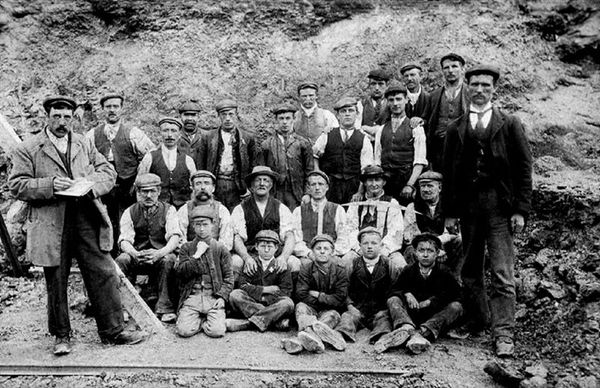
Hailstone Quarry workers c.1910. Copyright unknown but will be gladly acknowledged on receipt of more information.
Mention of the entries between houses brought back a memory of his teenage years for David Steventon when he was helping the local milkman with deliveries each weekend. Obviously on such days one would collect payment for the week’s milk from the lady of the house. So at the front end of each entryway I would start singing, “Milk ho, milk ho, milk ho, ho, ho!” And sure enough, when he reached the back door the customer would be waiting with purse open to settle the debt.
Reg Parsons was born at Number2 Turner’s Hill in the bungalow his father had built after demolishing some old cottages which had stood on the site. He recalled Slim’s sweet shop which was the nearest shop and his parents’ shop in Doulton Road. He remembered Vera Cartwright with her milk cart. Amongst the local boys he had played with were those from the Simpson, Parkes, Robinson and Hopkins families who lived nearby. During WWII the field below the bungalow was used as a fuel dump, which consisted of concrete bases with piles of Jerry cans of fuel, securely fenced! There was an anti-aircraft gun nearby, near the Wheatsheaf Inn, something my late mother had also told me about. Reg’s brother Harry was in the Grenadier Guards and his sister Edna was in the Land Army, based in Evesham.
I have recounted elsewhere that Reg went to Britannia Road school and milked the cows at a farm on the way through Rowley, walking to and from school. From what Reg told me about where the bungalow was, I believe this was later replaced by a much bigger house by a local motor dealer Sid Riley who owned the Garage in Dudley Port, Caldene Motors. His niece Maggie Smith tells that he had a swimming pool in the basement of his house, which flooded the rest of the house, when quarry blasting damaged the footings.
If I am correct, this would have been the view from Reg and later Sid’s home.
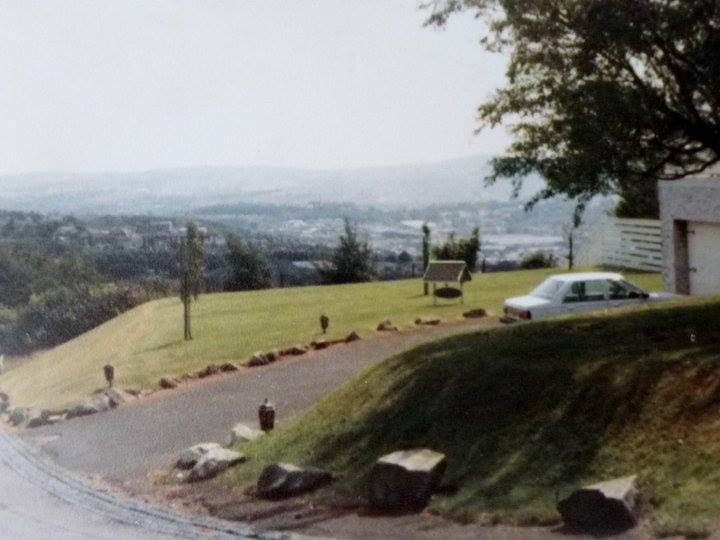
View from top of Turner’s Hill. Copyright Catherine Ann.
Joyce Connop remembered that when she used to walk across Tippity Green (73 years ago!) to Doulton school there was nothing on the right hand side, only Ada’s cafe then she would cross over the bottom of Turners Hill. There was a row of houses, one had a shop in the front room, on the other side there were the grey looking council houses then and Stiffs concrete works, Portway Tavern and a row of terraced houses lay back where the golf range is now. There were a about half a dozen houses just round the corner from Ada’s cafe at the bottom of Turners Hill which were really old, Joyce remembers her mother saying they had earth floors. There were also about half a dozen terraced houses on the corner opposite the Bulls Head.
Joyce loved Ada’s café, Ada used to serve them with penny cakes on our way to school . She was seven, and remembers that it was lonely across there and no pavement then, noting that 7 year olds don’t walk all that way on their own to school now .
Playing on the edge
There were lots of places for children to play and have fun as with so much of the derelict land in the area, known as the ‘quack’, the ‘bonk’, the marlholes which abounded in the area.
Many children played around the quarries and some could remember falling over the edge. Pam Veal said that she fell off the top on to the ledge once.
Peter Greatbatch remembered in about 1965 when he was about 13, that he fell down the Hailstone quarry from top to bottom after climbing down it after a paper jet. He walked away, through the lorry entrance, with a sprained ankle and a cut at the back of his head, neither of these injuries serious! His brother David Greatbatch was there and also his friend Raymond Knowles who said to him after the incident “I thought you had had your chips there”. Peter says he will never forget it, the luckiest day of his life. Some years later, he added, he had another incident at the other quarry at Turner’s hill in the 70’s when he hit the big rocks put by the side of the quarry at the bottom of the hill. He was trying to broadside his Ford 1600E there in the snow. If those rocks weren’t there he and his three passengers would have ended up in that quarry. He says he would not have walked away from that one.
There was a pool at the Blue Rock quarry where David Wood and JJSmith used to fish, JJSmith commenting that he fell in more than once – the sides were very steep where the perch were and David Wood agreed that the sides were so steep you were lucky if you got out. Joyce Connop recounted that her brother had fallen in there when he was 10 and another lad got a lifesaving award for getting him out. Roger Harris remembered that he and his mates used to swim there, they used to make rafts out of old wood. One of his mates had a deep gash on his leg after hitting a sharp rock when he fell off an old bit of wood, noting that these were mad days in the 60s before such places were fenced off. There was little mention of Health and Safety in those days.
Sadly, not everyone who fell in got out. There were tragic memories of two brothers who drowned there, within living memory. It was believed that the younger fell in and his older brother jumped in to help him but neither could swim and both were lost, devastating their family and no doubt worrying legion mothers who urged their children not to go near such pools.
Riding on the Edge
Many people remembered riding lessons at Hailstone Farm. Ian Davies recalled that the Cartwrights ran Hailstone Farm which was off to the left on the way up Turners Hill. They were his relatives; his Geordie grandfather lived with them at Lamb Farm, near Portway Hall, when he first moved south in the early 1900s. By the 1950s George Cartwright had moved away to a farm near Bewdley and Hailstone Farm had been taken over by their daughter Vera and her husband George Thomas. George taught him to ride. The quarries were already threatening to swallow the farm back then. The narrow track from Turners Hill had quarries close on both sides. The farmhouse and top of the land were later swallowed up by the Tarmac mega-quarry.

Hailstone and Freebodies Farms, on the edge! copyright D Morris
Driving on the edge
The road between Perry’s Lake and Oakham, going up Turner’s Hill also had memories for many people. This was later closed and quarried away. There was a sheer drop on either side within a few feet of the road. Many people could remember walking up that road on their way to visit family. Roy Martin could remember when it was still open to two way traffic when he first drove up there. But being narrow with passing places, it was still dodgy so they made it one-way it uphill. But as John Packer remembered, a few people still used it as a short cut, as late as autumn 1968. Michael Bowater recounted that he just managed to escape serious injury walking up there one night on his way back from Brickhouse. A car coming up the hill was going too fast and he just about scrambled up the bank on the left, it was a close call, he noted, it was a good job he was young ,fit and agile. John Packer hoped the car wasn’t his red Hillman Imp!
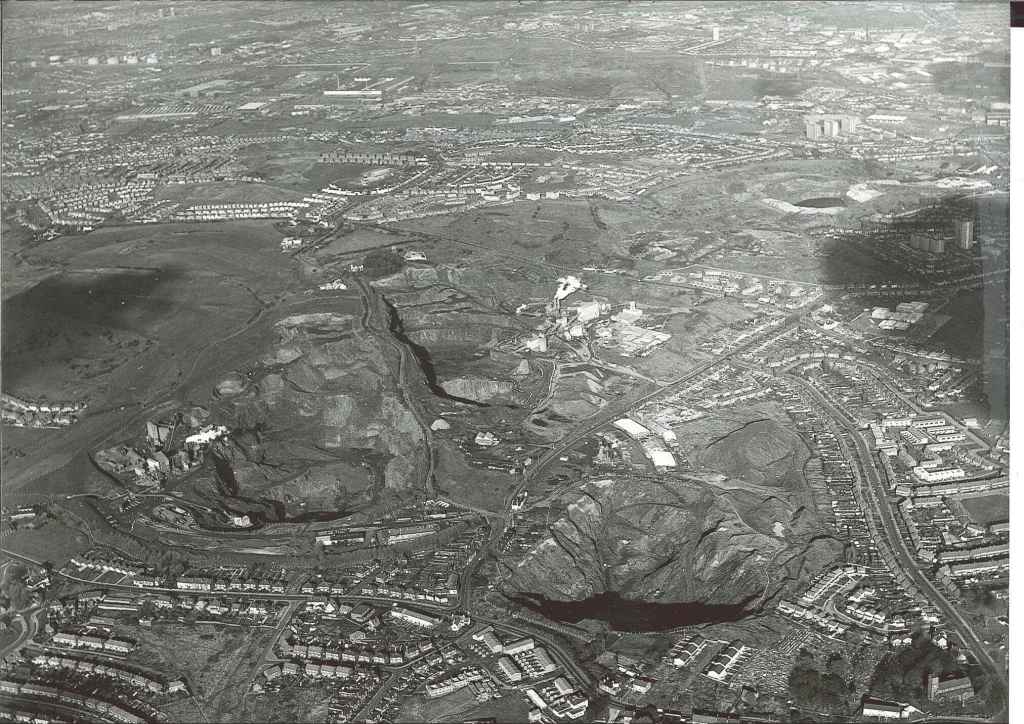
This photograph shows the three main quarries with the Turner’s Hill Road, climbing between the top two roads. Note also the steep edge of the bottom quarry immediately behind Tippity Green.
Eileen Herbert could remember driving up Turners Hill with her dad to visit her aunt Rose Kite, Eileen lived in Highmoor Road and the siren before blasting was very loud from there. They always knew what time was as they could hear Lenches ” Bull” as well. “Long time ago but I can still hear them in my head!”
Angela Kirkham also recalled going to visit her gran, auntie and cousins (Tonks and Madley were the names), they used to visit on Sundays and always went over the quarry. She recalls that she spent most of her early childhood playing round the top of the quarry and the banks, sometimes with her brothers throwing bricks at other kids and sometimes at one another ! Angela’s Kirkham grandfather, father and uncles all worked in the quarries, they lived in Dane Terrace and Angela remembered that the blasts used to shake the house. These were presumably the Kirkham brothers Brian and Clifford who commented on the Facebook page that they all worked in the quarry, bringing the rock to the crusher or as a mechanic. Roger Harris also worked with them and said that, although the work was hard and the money wasn’t good, they had some laughs. Which sounds like a lot of life in the area!
Dropping off the edge
Not only people fell into the quarries. Gardens did too and other things! The map shows clearly that the quarries came right up to the edge of gardens in the hamlets.
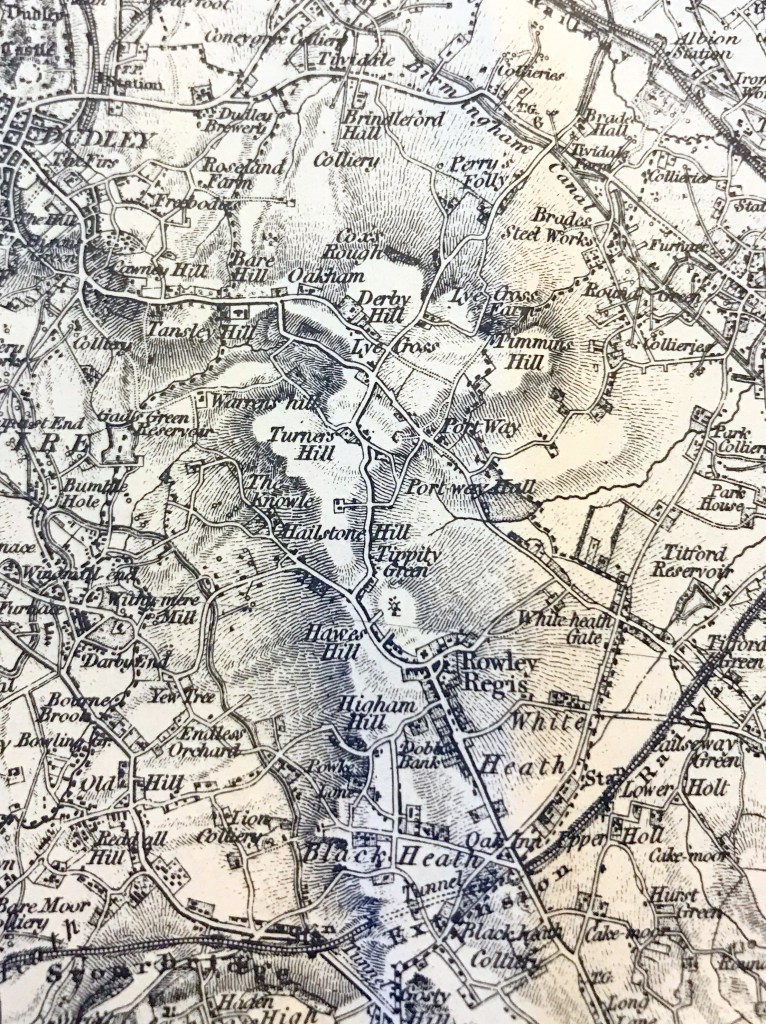
1st Edition OS Map extract, Copyright David and Charles.
Graham Evan Beese recounted that his grandparents lived at number 50 Tippity Green until the bottom half of the garden fell down the quarry, pigs chickens and shed too. There is no word on the fate of the poor livestock! Graham’s grandparents were quickly moved to Eagle Close on the Brickhouse Farm estate.
Andrea James had a similar experience and recounts “We used to live along Tippity Green and our garden backed right onto the quarry , with only a tiny wire fence that , as children we could easily climb over. Every time they blasted we would lose a little of our garden.
In those days we didn’t have an inside toilet, ours was at the top of the garden and one morning I went to go to the loo …only to find out it had disappeared.
To add insult to injury I had a further telling off from mom when I woke her up to tell her the toilet had fallen down the quarry.”
Andrea added that, unlike Graham’s grandparents, her family were not rehoused after losing their loo, they used Mrs Faulkner’s loo next door for years! They stayed there until the row of terraced cottages were destroyed by a fire that started in the sweet shop . Their roof caught fire and Andrea’s father woke them all up to get out … her mom said “Oh my God ..where’s the dog ? “
Andrea’s dad said “He’s in the car with my fishing rods”. Andrea’s dad clearly had a good grasp of his priorities. They lost everything in the fire (except the dog and the fishing rods, of course) but her mom refused to move into the horrible maisonette she was offered so they lived in the burnt out shell, with help from local people, until they were offered a better house. Tough Black Country folk, these!
And if your garden didn’t fall into the quarry, it was still a risky place to live! Paul Pearson remembered when the air brake failed (or forgot to be put on) on one of the quarry wagons, and it rolled back down the driveway, across Portway road, down the gardens and into two houses. He said that there are still steel girders out in the front of the houses now that the quarry put up after this incident.
Working on the edge
As can be seen from all these memories the quarry loomed large over the village and especially the hamlets. Many local men and boys worked there, quite a few died there or were injured or maimed. Sarah Preston recounted that her great grandfather died in an accident there before her grandmother was born, he had done an extra shift to get extra money but didn’t live to see his daughter born.
There was regular daily blasting to loosen rock. Apparently when the blasting happened the workers sheltered under metal containers to save coming up away from the area. Anyone who lived or went to school within hearing distance of the quarries can remember how the day was punctuated by the regular sound of the siren at 10am and 1pm. Certainly I can remember it from my days at Rowley Hall Primary, although I do not remember it from my days at RRGs in Hawes Lane, perhaps the school there was that much lower down and on the other side of the hill. Recollections may vary, others may remember it from there, too.
Maggie Smith also notes that her son in law’s father owned a cafe in Low Town, Oldbury, called the Polar Bear. The cafe had to be pulled down to make way she thought for the magistrates court. It was taken in one piece and used as the cafe at the Hailstone quarry.
Many members of the ‘I remember Blackheath and Rowley Regis’ Facebook page have told of their memories of the sirens and the blasts. The blasting was not always without incident. Alan Homer recalled a rock coming through the roof of Toyes chippy on Dudley Road. Someone else (sorry, I can’t find this entry now!) remembered a rock coming through the roof of a toilet, just after she had finished cleaning it. Fortunately it was unoccupied at the time!
Kelvin Taylor noted that his family lived in Limes Avenue, a mile away below Britannia Park and could hear the siren and the blast if the wind was blowing in the right direction.
Graham Lamb remembered that his mother used to go mad because they had metal window frames and the blasts used to crack the glass, nearly every week his dad had to put a new pane in somewhere.
I have tried to gather these memories into a more or less coherent form and hope that people will enjoy reading about the life of the ordinary working people who lived in the Lost Hamlets. They had full, active, hard working and hard playing lives and formed strong communities. Though their physical homes have gone, something of their lives is recorded through these memories. Please feel free to contact me if there are more memories of family here that you would like to add.


Absolutely fascinating as always Glenys.
LikeLiked by 1 person