One of the things I have learned as I have been working on this One Place Study, but which I was already somewhat conscious of from my family history researches, is how difficult it is for us, in our relatively pampered modern lives, to really understand what our ancestor’s lives were like. How they coped with the sheer hard toil of their work, whether in mine, quarry or workshop, how they coped with the loss of so many of their wives dying in childbirth, husbands dying in industrial accidents, the high numbers of early deaths from diseases now rare or curable, their children dying young from diseases and conditions which have been overcome by modern medicine. Were they were worried by the changes in their surroundings as industry despoiled what had once been fields and pastures or did they consider the jobs that this brought were a benefit which outweighed this?
Some of this we may never know. We can only wonder.
So in recent times, I have widened my reading to address my lack of knowledge about those times.
A really good blog for Family Historians
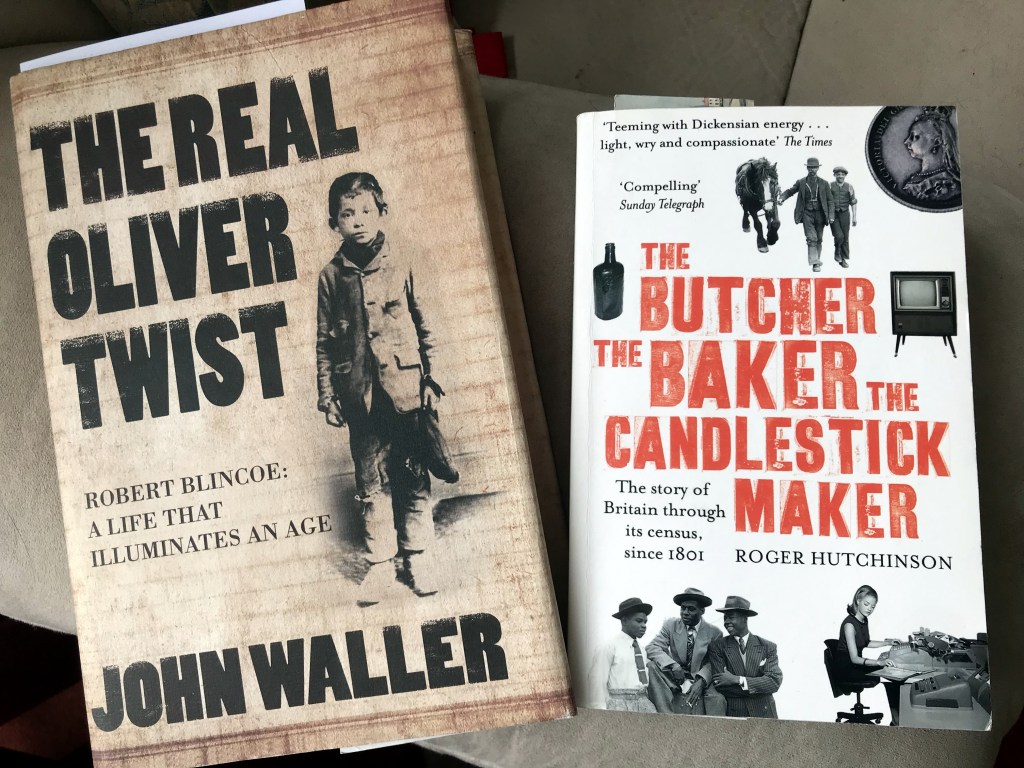
I follow an interesting blog on WordPress which I highly recommend, called English Ancestors by Janice Heppingstall. Janice writes excellent and thoughtful (and very informative) pieces on family history and sometimes recommends books which she has found interesting. A few weeks ago she recommended ‘The Butcher, the Baker and the Candlestick Maker’ by Roger Hutchinson which is about how the censuses came to be taken, including a lot of fascinating information, well worth reading. She and I seem to share certain interests, such as what she calls ‘homing in on the little people’ and, like me, some of her ancestors moved from rural areas to industrial ones, including Mill towns, in her case in the North West. Similarly, a book entitled The real Oliver Twist by John Waller and about Robert Blincoe, who was thought to have inspired the character of Oliver Twist. That has also now been added to my pile of books to be read.
Contemporary Fiction as a source of information
At a conference on West Midlands history which I attended a few weeks ago, there was an interesting note from one speaker that we can sometimes learn from the fiction writing of contemporary authors. Francis Brett Young is the obvious writer for the Black Country ( though I confess to not enjoying his writing m7ch) but the other name which was mentioned as giving detailed descriptions of the hardships of many who worked in industry was Charles Dickens.
I have been an avid reader since I was a child but must confess that Dickens has never been top of my list of favourite authors. In fact, when I thought about it, I couldn’t remember reading any of his books apart, perhaps, from Oliver Twist when I was a child. I have seen the many adaptations of his works on television, of course, but again, not for many years so that I could not remember the details of the plots of even Great Expectations. The story of A Christmas Carol is more familiar – dare I admit that that is mainly because it is so deeply imbedded into our culture around Christmas, particularly from the Muppets Christmas Carol which was a family favourite for many years.
But the speaker at the history conference commented that Dickens had used his books to bring attention to the dreadful working conditions of ordinary working people, with some success and had helped to expose the poverty and living conditions of the poor as a result of the Industrial Revolution. He particularly mentioned ‘The Olde Curiosity Shop’ which is next on my reading list.
Different ways to read books!
Now I have a fondness for computer puzzle games. Not the sort of modern flash bang video racing explosive hidden object or match three stuff but actual puzzles, jigsaws, etc. I play a couple of games most days and like to think it helps to keep my brain active. One I have played for many years is called Sherlock and was invented by an American called Everett Kaser, he has many absorbing puzzle games. Recently I noticed that he had a new game called Beckett’s Books. This game takes books which he has transcribed and divides each page into squares (you can vary the numbers of squares) and jumbles them. Your task is then to put the squares back into the right order to give you a readable page before you can move onto the next page. This is done by matching the beginnings and ends of words and phrases – it is quite challenging at times. Kaser has a list of some fifty or so books available including many classics, such as The Secret Garden, the Father Brown Mysteries, several Sherlock Holmes novels, a number of Dickens classics, some of the PGWodehouse books, plus some which clearly reflect his particular interests and some American authors I am not familiar with. As you do the puzzles, of course, you read the book. Really properly slowly read the book – and it’s really enjoyable. The first Dickens book, I tried was Great Expectations. This brought home to me that Dickens really was a cracking writer and that he was very skilled at leaving his readers with a cliff hanger. He originally wrote many of his books for serialisation through daily or weekly publications and I can now fully understand how eagerly his readers would have been waiting for the next instalment. I could hardly wait to start the next page when I finished each one! This threatened to be so time consuming that I had to resort to buying copies of the novels to finish reading.
The Olde Curiosity Shop is, sadly (or perhaps fortunately) not among the books listed at the moment (so I have a pre-loved paperback copy on the way) but another novel called ‘Hard Times’ is among those Everett Kaser has listed and online reviews said that this was a diatribe about the evils of industrialisation, the effects on the air around and the suffering of the poor workers. So I have read (yes, and puzzled) that one. It’s a clever story and has many characters, sympathetic and not, many threads, some amusing and some incredibly sad at times. It is an interesting insight into the politics and prejudices of the time. I was actually moved to tears at one point which is not something that often happens to me. The other thing that is engaging is that it is written entirely without the benefit of hindsight. It reflects in detail how people really lived, worked, travelled, amused themselves at the time without anything but fairly primitive means of communication.
One chapter details an operation to rescue a man who has fallen into a disused mine shaft on the moors above the town – it is no less than riveting, giving so many details about the rescue that I had to wonder whether Dickens had actually watched such an operation.
The Whiteheath Mine Disaster
In December 2022, I posted the piece below on Facebook about a mine disaster at Whiteheath which had resulted in the death of eleven men. Although Whiteheath is slightly outside the Lost Hamlets area, I include the piece below, people living in the hamlets would certainly have known of it at the time and some men from there may well have worked in the mine.
‘The Ramrod Hall Colliery explosion 1856 – some local history which I had never heard of before.
Transcribing burial records last week for St Giles in 1856, I was curious to notice five consecutive entries for burials of young men all on the 15 August 1856, the abode for all given as Whiteheath Gate. The following day another young man from Portway was buried, none of these had any cause of death shown which was unusual for this register.
The loss of five young men would have been a grievous loss for such a small community so I did a little research. I wondered whether they had all died in some sort of accident together.
Knowing that the Ramrod Hall Pit was at Whiteheath, I searched the website of the Northern Mine Research Society and found the following information about an explosion there:
RAMROD HALL. Oldbury, Staffordshire. 13th August, 1856.
The colliery was owned by Lord Ward and was at White Heath Gate. The explosion occurred because of bad ventilation. This was partly due to the neglect of the ‘butty’, Thomas Barker who did not discharge the 17th Rule and did not inspect the mine before the men descended. Of the sixteen men and boys who were in the mine at the time of the explosion, eleven were killed.
Those who died were:
Thomas Barker aged 23 years,
R. Cartwright aged 43 years,
John Sheldon aged 36 years,
Thomas Shaw aged 35 years,
Thomas Round aged 34 years,
John Walletts aged 28 years,
William Simpson aged 33 years,
Samuel Willetts aged 26 years,
J. Fulford aged 16 years,
John Bryan aged 13 years,
T. Hampton aged 18 years.
At the inquest it emerged that on the morning of the disaster one group of men descended one of the two shafts. (The mine was quite new and had been closed for a few days because the men were working on the approach roads on the surface.) When the mine reopened, and the first party went down, one of them had a lighted candle which was seen to burn blue, indicating the presence of gas. The candle was sensibly blown out and the miners called up to the banksman that gas was present and to bring down a lantern. By the regulations, a lamp should have been used to test for gas before the men went down. This rule was neglected.
Another skip containing seventeen or eighteen men was lowered and a man named Barker, the butty, ordered some live coals to be placed in it, saying that there was no sulphur for the lantern. The explosion took place as they were being lowered, blowing the basket and men out of the top of the shaft and causing terrible injuries to them. The accident was put down to the fact that there were two shafts at the mine and water was being drawn off one which forced the foul air up the other shaft.
Newspaper reports tell of hundreds of people rushing to the pithead after the explosion and miners from a neighbouring pit volunteering to go down to rescue injured men still trapped below ground.
Such a sad tale, such a hazardous industry and what a terrible event for the community of Whiteheath, so many widows and children left behind, without any means of support. There are frequent entries in the Burial Registers for men (and boys as young as ten) ‘killed in a pit’, even though in 1835 a mining investigative committee had been set up to figure out how to cut down on the number of accidents. Whatever they did was not enough to prevent the deaths of at least 610 miners in the Black Country between 1837 and 1842 and many more in later years.
A press report on this explosion states that the inquests were attended by two Inspectors of Mines and a solicitor (representing Lord Ward who was out of the country) to observe. The Coroner reported that he had gone down the mine the day after the explosion and again a few days later so he was obviously very thorough and such accidents were being properly examined.
Although the reports refer to Thomas Barker (who was buried the day after the other five) the Burial register and his Death Registration give his name as Baker. Thomas Barker/Baker was the ‘butty’ who gave the instruction to carry burning coals into the mine, even though he had been warned that gas was present. Presumably he was buried the following day as local feeling did not want him buried with the other men who died because of his actions. The Mines Inspectors though were clear at the inquests (there were five separate inquests because the men killed lived in different places) that the failure of the mine managers to keep a fire or furnace burning at the foot of one of the shafts to force air circulation through the mine was the reason that gas accumulated while the mine was closed for a few days. A horse kept underground apparently survived the explosion unhurt and for five days afterwards without any attention, food or water, poor animal!
Within weeks of the inquests, Mine Agents for the area met and agreed tougher new rules on ventilation in mines so perhaps this tragedy helped to prevent others.
The J Fulford listed amongst those who died was listed in the Burial Register as Joseph Fullwood, although his Death Registration gives his name as Fulford. So if you have a young man who disappears from your family tree in 1866 in this area, this may be what happened to them.
These days we sometimes tend to think H&S is too rigorous but those men could have done with rather more of it.’
That post generated some interesting comments, including some from a former HM Inspector of Factories who noted that “Nowadays, I think the verdict would not be directed at the fault of one person, ‘the butty’, rather the controlling organisation would be blamed (the employer/directors/management), ie it was a systemic failure. And I’m pretty sure the charge would be ‘corporate manslaughter by gross negligence.’ The dangers were well known, the precautions should have been in place, but weren’t.”
Hard times in Whiteheath?
Copyright unknown but will be gladly acknowledged if made known.
The connection here is that the rescue described by Dickens in Hard Times must have been very similar and vividly relates the incident almost minute by minute.
In the story, the two women who realised that a missing man had fallen down the shaft of a disused mine which had not been fenced off adequately (his hat had fallen off and was lying by the shaft) had to run long distances across the moor in opposite directions to seek help – no mobile phones, no phone boxes. It was a Sunday so people were not at work. Of the men the first woman found, one was lying in a drunken sleep – he was woken and hearing “that a man had fallen into the ‘Old Hell shaft’ he started out to a pool of dirty water, put his head in it and came back sober” – and Dickens recounts that he turned out to be the most useful of the men at the rescue operation. The other men ran off to nearby villages and others from those in turn ran on to other places to spread the word to get more help and equipment, before all heading back to the ‘Old Hell shaft’ where, again, they had to wait for more implements and help to arrive. No cars or lorries or helicopters, no mountain rescue, no first aid kits or painkillers or stretchers, no radios, no roads, the equipment needed had to be assembled and carried manually up to the shaft. Dickens notes that it was more than four hours before enough equipment arrived to start the rescue attempt. Difficulties had arisen in the construction of a means of enabling two men to descend securely before this was rigged with poles and ropes, requisites had been found wanting and messages had to go and return. Some of this would not have applied at Whiteheath, as it was close to other mines and it was a working day but some of the difficulties of the rescue must have been the same.
Eventually, in the story, a surgeon also arrived after messages were sent to the nearest town. By the time the rescue could be attempted, Dickens says perhaps two hundred people had assembled. “There now being enough people present to impede the work” the original rescuers, led by the man who had been drunk, “made a large ring around the Old Hell shaft and appointed men to keep it”. Again, one can well imagine this happening at Whiteheath where a large and anxious crowd had assembled.
When enough equipment had arrived a windlass was set up and a candle was sent down into the shaft to “try the air while three or four rough faces stood crowded close together, attentively watching it: the candle was brought up again, feebly burning “, – such a vivid picture this conjures – then a bucket was hooked on and two volunteers with lights were lowered into the pit where they found the desperately injured man.
“As the rope went out, tight and strained, and the windlass creaked, there was not a breath among the one or two hundred men and women looking on. The signal was given and the windlass stopped, with abundant rope to spare.”
Again, Dickens has some striking detail – he mentions that when the two rescuers had first been below for some time with no communication, some in the crowd began to panic that they too had suffered some accident but that
“the surgeon who held the watch declared that not yet five minutes had elapsed and sternly admonished them to keep silence’. Just then the windlass reversed and “practised eyes knew that it did not go as heavily as it would if both workmen had been coming up and that only one was returning.” Yes, those miners would have known that.
“The rope came in tight and strained; and ring after ring was coiled upon the barrel of the windlass, and all eyes were fastened on the pit. The sobered man was brought up and leaped out briskly on the grass. There was a universal cry of “Alive or dead?” and then a deep profound hush.
When he said ‘Alive’ a great shout arose and many eyes had tears in them.”
‘The surgeon who held the watch’ – the watch – presumably not many of the onlookers would have had such a thing and presumably, too in such an operation, one watch has to be used as the timekeeper for that operation.
The story goes on that the fallen man was very badly injured and a hurdle was brought, on which a thick bed of spare clothes was made by the crowd while the surgeon contrived some bandages and slings from shawls and handkerchiefs.
“As these were made they were hung upon an arm of the pitman who had last come up, with instructions how to use them: and as he stood, shown by the light he carried, leaning his powerful loose hand upon one of the poles and sometimes glancing down into the pit and sometimes glancing round upon the people, he was not the least conspicuous figure on the scene. It was dark now and torches were kindled. “
Again, such a clear picture is in my mind of this man. Eventually, he was lowered again into the pit and again, the windlass stopped.
“No man removed his hand from it now. Everyone waited with his grasp set, and his body bent down to the work, ready to reverse and wind in. At length the signal was given, and all the ring leaned forward.
For, now the rope came in, tightened and strained to its utmost as it appeared and the men turned heavily, and the windlass complained. It was scarcely endurable to look at the rope and think of its giving way. But, ring after ring was coiled upon the barrel of the windlass safely, and the connecting chains appeared, and finally the bucket appeared with the two men holding on at the sides – a sight to make the head swim- and tenderly supported between them, slung and tied within, the figure of a poor, crushed, human figure.
A low murmur of pity went round the throng and the women wept aloud, as this form, almost without form, was moved very slowly from its iron deliverance, and laid upon a bed of straw.”
Now, to me, that was the most vivid report I have ever read of such an operation, encompassing not only the details of the mechanics required but the expertise and skills of the rescuers, the feelings of those involved and those watching. I could not help imagining just those responses in the crowd which gathered after the explosion at Whiteheath.
Dickens does not allow the opportunity to pass of making mention of the huge numbers of pit casualties in those times. The victim here says (in a broad accent that I will not attempt to reproduce) that the pit into which he had fallen had cost, in the knowledge of old people still living, hundreds and hundreds of men’s lives, fathers, sons, brothers, dear ones to thousands and thousands and keeping them from want and hunger. The pit he had fallen into had had methane gases which he described as ‘crueller than battle’ which he had read about in public petitions from the men who worked in the pits, in which they prayed and prayed to the lawmakers not to let their work be murder to them but to spare them for the wives and children that they loved as much as gentlefolk loved theirs. When the pit had been in use, it had killed needlessly and even now it killed needlessly.
Powerful stuff!
Hard times was published in 1854, just two years before the Whiteheath Mine disaster, these scenes must surely have been very similar. The book was not necessarily well thought of at the time. Macaulay attacked Hard Times for its ‘sullen socialism’, but 20th-century critics such as George Bernard Shaw and F.R. Leavis praised this book in the highest terms, for what is both Dickens’ shortest completed novel and also one of his important statements on Victorian society. George Orwell later praised the novel (and Dickens himself) for “generous anger”. The works of Dickens are apparently regarded as having brought about or at least advanced many improvements to working and living conditions of the poor and voiceless which he laid before the mass of his readers.
Dickens was born in Portsmouth and left school to work in a boot-blacking factory when he was twelve because his father was in Debtor’s Prison. After three years he was able to return to school and later became a journalist, editing a weekly journal for twenty years as well as writing 15 novels, five novellas, hundreds of short stories and non-fiction articles. But it meant that he had first hand experience of working conditions and the lives of poor people. He was an indefatigable letter writer, and campaigned vigorously for children’s rights, for education, and for other social reforms.
Am I leaving you on tenterhooks with Hard Times? What happened next? One more short quote, then:
“They carried him very gently along the fields, and down the lanes and over the wide landscape; Rachael, [his beloved friend] always holding his hand in hers. Very few whispers broke the mournful silence. It was soon a funeral procession. The star had shown him where to find the God of the poor and through humility and sorrow, and forgiveness, he had gone to his Redeemer’s rest.”
Yes, I had tears in my eyes by this time, too.
As a new convert to the works of Dickens, I do recommend you to seek out the book Hard Times and read the whole thing – it is such a good read, such a reminder of how people behave to one another and the living conditions in which many ordinary people lived then. I shall be interested to see what Dickens has to say in the Old Curiosity Shop and what I can learn from that about the society in which Dickens lived and observed.
So I hope my readers will forgive this little diversion from the detailed posts about the Lost Hamlets and the people who lived in them – more posts on that in progress and to follow very soon.
 rowleyregislosthamlets.co.uk
Another very interesting read , and an incident that took place very near to where I grew up. Lord Ward was later the Earl of Dudley and a very rich man. There is an inscription on his tomb in Worcester Cathedral that mentions his ‘munificence ‘ to the Church – I wonder whether his generosity extended to the family of those who died in the explosion. I have not read ‘ The Old Curiosity Shop’ but am aware that Dickens set some scenes in Wolverhampton. He did visit the West Midlands , and his paternal grandmother came from Claverley , near Wolverhampton. Many thanks for the article .
LikeLike
There were such huge contrasts in such industrial areas, Norma, between the ordinary folk and the landowners, industrialists and nobility, the likes of Lord Ward. I did read in one report that he had a reputation for being generous to the families in these circumstances and I was interested that he sent his solicitor to the inquests – covering his back, perhaps. Perhaps questions were beginning to be asked about the number of accidents in such places. Interesting that Dickens visited the West Midlands, and that he had family links not too far away. I’m glad you found it interesting.
LikeLike