There was no shortage of places for folk to have a drink in days gone by, in Rowley and around. Hitchmough’s work on Black Country pubs is an amazing and most interesting read, packed with information and stories. (Hitchmough’s Guide to Black Country pubs – an invaluable source for local historians is at longpull.co.uk ) He lists 29 pubs in and around Rowley, 7 with a Whiteheath address in addition to the ones in the Lost Hamlets. Not all of them will have been operating at the same time and most of them have long since disappeared but in their time, there were a lot of them!
For the purposes of this study, I shall look at the main pubs in the Lost Hamlets in separate posts, as there is too much information for each of them to fit them into one piece
I am starting with the BULLS HEAD which was at 1, Dudley Road, Springfield, (Tippity Green), Rowley Regis. This is the view that most people now would recognise, from Anthony Page’s Second book of Rowley Regis images.

Copyright Anthony Page.
According to Hitchmough, who is the fount of all knowledge on such issues, the owners of the Bull’s Head were Ferdinando Dudley Lea-Smith, Thomas Benjamin Williams and Lizzie Bate of Rowley Regis, Ansells Ltd. (acquired in 1946) and later Sue Whittall and Mark Franks [1997].
It is entirely probable that there was a public house or hostelry of some sort on the site before formal licensing was introduced but the LICENSEES were as follows:
Joseph Bowater [1834] – [1854]
Mrs. Eliza Bowater [1860]
Elizabeth Bowater [1861] – [1865]
William Henry Hingley [1868] – [1870]
William James Hingley [1867] – [1874]
William Williams [1875]
Thomas Benjamin Williams [1875] – [1891]
Thomas William Williams [1892] – [1900]
Howard Woodhouse [ ] – 1909);
Simeon Dunn (1909 – [1912]
Thomas Benjamin Williams [1911]
Gertrude Fletcher (1913 – [ ]
John Hughes [1916] – 1932
Hitchmough has later licensees listed but I have stopped at about 1920 as my study is really looking at this earlier period.
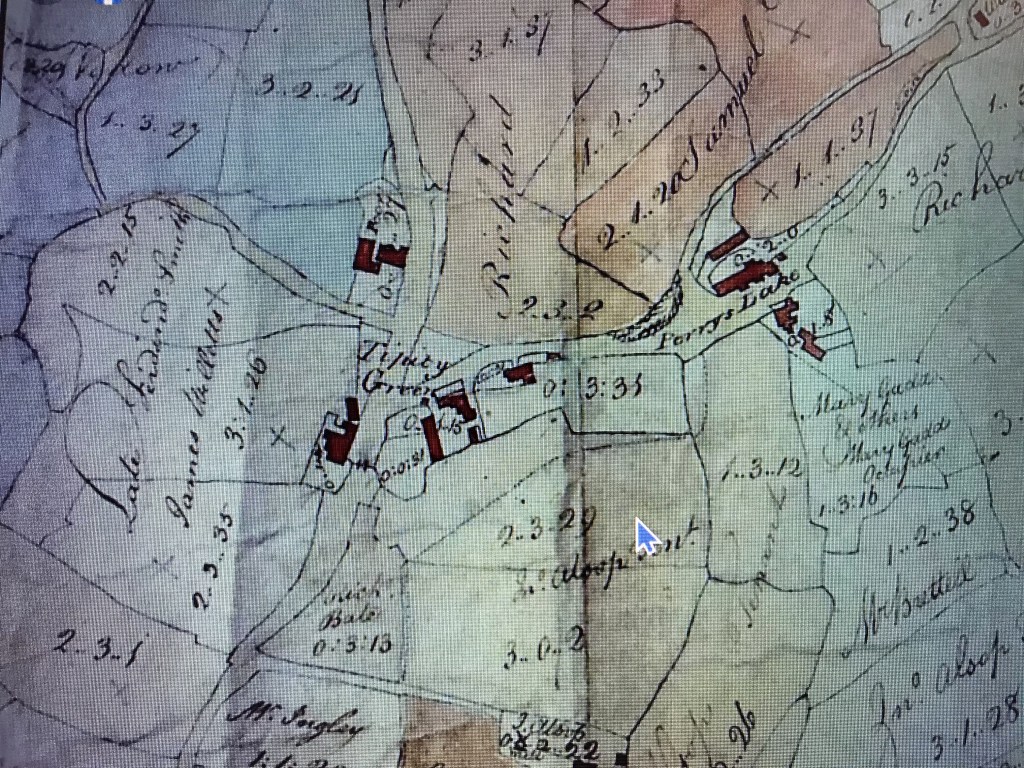
This map is dated about 1803, copyright Bob Adams. It shows a substantial building on the site of the Bull’s Head which was probably a hostelry even then. There is not much other development, the buildings above it are marked Poor and are presumably the Poorhouse which fits with later census routes. The windmill is just visible in the middle at the bottom, the tiny building with sails, in the ownership of J Alsop, according to this map. There is no development to the North side of Tippety Green but the building opposite the Bull’s Head may be the Mill Farm. I suspect that the tiny square there is the Tippity Green Toll House but that is just a guess! Perrys Lake is already quite a substantial area with several buildings shown.
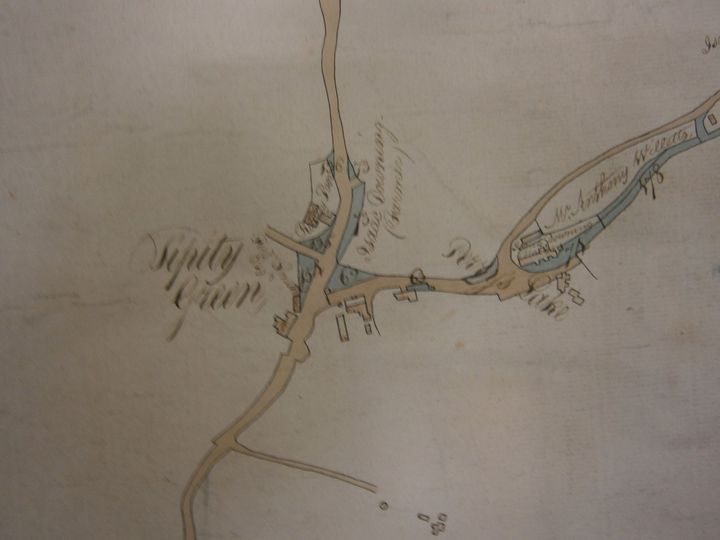
This hand-drawn map looks to date to about the same period and was shown on Facebook by Roger Slater. It too shows the same buildings but possibly also shows the ‘green’ area. Presumably the bar shown across the road to Perry’s Lake is the Toll Gate.
Joseph Bowater, the first licensee listed by Hitchmough, was also a butcher and it was quite common in those days for licensees to have other full time occupations in addition to the pub, including butchers, farmers and boilermakers in this area. In the 1841 Census, Joseph Bowater was listed as living in Tippity Green and his occupation was shown as a butcher. His age was shown as 50 and with him was Elizabeth Bowater, also 50 with no occupation shown, and also William Cooper, a Male Servant, aged 20, and Catherine Hargrove a female servant aged 25. The two men were both born in Staffordshire, the two women were not.
Also living there were three other men, all labourers. Since Joseph had already been the licensee for several years, it appears that he was combining his butchery business with the pub which was probably why the pub was called the Bull’s Head. (In similar vein, the Levett family apparently sold or let land near their butchery business in Birmingham Road, Blackheath for the erection of a pub (first licenced in 1857) and specified that the pub should be called the Shoulder of Mutton which is, as far as I know, still there and still a pub.)
So it appears that as early as 1841 Joseph Bowater was operating also as a lodging house keeper at the pub. A Joseph Johnson Bowater was baptised at St Giles on 13 Jul 1788, the illegitimate son of Ann Bowater, one wonders, as ever whether his middle name is a clue to his father’s identity. And I was very interested to note from the parish register that sixteen years later in 1804, a child Elenor was baptised, the ‘base-born’ daughter of Daniel Johnson and Elizabeth Bowater , unusual in this register for the father of an illegitimate child to be named – perhaps the Bowaters and the Johnsons were near neighbours!
There were other Bowater families in the area at the time, the first Bowater mentioned in the Parish Registers of St Giles is in 1740.
In 1851 the census gives clearer picture – Joseph Bowater, 64 still showing as living in the first entry in Tippity Green, is a Vittler (a corruption of Victualler – someone who supplies Victuals – food and drink) and Butcher who was born in Rowley and his wife Elizabeth, 66 who was born in Birmingham. Joseph is also employing a butcher Luke Lashford aged 21 who was also born in Birmingham (also referred to in my post about the Redfern family), two female general servants, born in Halesowen and Tipton respectively , a fourteen year old lad from Dudley described as an Inn Servant and a visitor William Bowater 40, born in Rowley.
Whereas Tippity Green came in time to be used as the name of the street running from Dudley Road to Perrys Lake, it seems that at this time the names of various small hamlets referred to a group of dwellings and small businesses grouped together, often round an open space or Green rather than a linear row of houses, as shown on the early maps above, hence Tippity Green, Cock Green, Brickhouse Green although quite where one stopped and the next started is not so easy to work out. One thing I have learned is not to get too hung up on precise addresses at this time.
Bowater was clearly keeping the Bulls Head Inn , licensed premises even though the Census does not mention it by name and this is borne out by that little word in the description of one of his employees – Inn servant! And when I looked at the Enumerator’s Route which Ancestry provides at the beginning of each census piece, the enumerator actually mentions the Bulls Head Inn although he doesn’t identify it on the Census sheet itself, how contrary and unhelpful for us later local historians centuries later!
Incidentally, the next entry in the census is for two people described as Almspeople so that gives us a clue that the almshouse was somewhere very close to the Bulls Head. One of those was Thomas Beet, my 4xg-grandfather, then aged 88 and blind.
There is remarkably little information about Joseph Bowater that I can find. There is one baptism in St Giles in 1829 for James, son of Joseph and Mary Bowater of Cock Green, a labourer which is roughly in the same area as the Bull but there were a lot of Bowaters around and there is no real evidence that this is the same Joseph. By 1841 our Joseph was married to an Elizabeth but no children of that marriage are listed anywhere that I can find. Joseph appears to have died in 1857 and was buried on 23 Jan 1857 at St Giles, aged 70, his abode given as Tippity Green and his cause of death shown in the Burial Register as old age.
Elizabeth or Eliza Bowater then appears to have taken over the licence as she is shown by Hitchmough as the licensee until at least 1865. In the 1861 Census, she is still in Tippity Green, aged 71 and a publican, living with one Elizabeth Bowater, 71, publican and one house servant and one boarder, a stone dresser so the butchery business appears to have ceased or at least not to have a butcher there. There was a grocery shop listed next door in that census, occupied by Benjamin Rock so perhaps he was using part of the premises which had previously been used by the butcher.
Inquests were often held in local pubs and the Bull’s Head was no exception. A report in the Stourbridge Observer on January 1 1865 told of
“An adjourned inquest was held at the BULLS HEAD, Perry’s Lake, on Wednesday last, before E. Hooper, Esq, Coroner, touching the death of Henry Parkes, a collier, 44 years of age, who met with his death through falling down a coal pit on the 21st ultimo. On that day, the deceased and several others who all worked for Mr. Mills of Gornal went to the office to receive their wages. Deceased left the office first, and walked towards the pit to pay his club money. One of the men heard a sound, and immediately missing deceased, some tackle was procured, and a miner named Edwards and another man descended and brought deceased from the bottom of the shaft. He was quite dead. The pit according to witness’s statement, was fenced all round, and was not at work. A man and a boy have both lost their lives previously, by falling down the same pit. After the first inquest, the Coroner and Jury went to view the pit.
At the adjourned inquest, on Wednesday, Mr. Baker, Government Inspector of Mines, was present, and also Mr. Homfray, solicitor, with Mr. Mills, on behalf of the proprietors of the colliery.
Some further evidence was taken of the state of the fencing round the pit, and William Morgan, the banksman of the pit, was called by Mr. Homfray. He stated that the pit was in the same state when the Jury saw it as at the time of the accident.
Mr. Mills was also sworn, and deposed to the same circumstances, and promised that new iron railing should be placed round it.
The Coroner summed up, impressing upon the Jury the fact that there was no evidence as to how the deceased got into the pit. If they were of opinion that the pit was properly fenced of course, would be accidental; but if they thought that the pit was not properly fenced, they would leave the matter in the hands of the Government Inspector.
The Jury retired for ten minutes, and then returned a verdict of Accidental Death, accompanied with the opinion that the pit was not properly fenced at the time.”
Poor Henry Parkes and his family and just before Christmas, too. After publishing this piece I was contacted via Facebook by Luke Adams who was able to give me more information. His wife was related to the Mr Mills referred to above and Luke thinks that the reporter misheard the name of the place, which he gave as Gornal but which Luke thinks was probably Gawne Hill which was the site of a mine and very close to the Bull’s Head. This makes a lot of sense to me, as I had found the Gornal reference odd. Thanks, Luke!
The Bull’s Head also acted as a community venue and several meetings of striking miners and pottery workers were held there at various times, as reported in the local press.
William Hingley took over the licence from at least 1868 so I looked for a death or burial for Elizabeth Bowater at or around that date. But there was no such burial at St Giles anywhere near that date. However, there was a death registered in the Dudley Registration District in the September qtr of 1866 for an Elizabeth Bywater of about the right age. And FreeREG shows that an Elizabeth Bywater was buried in Upper Gornal on August 1866, aged 70 which is exactly the right age for Elizabeth Bowater. Upper Gornal? The abode recorded in the Burial Register is the clue here, she had been in the Union Workhouse there, just along the road from Upper Gornal and if, as I surmise, she had had no children to look to her welfare, this might well be where she ended up if she became infirm.
I had noticed when looking at the Bowaters in censuses that they rarely employed anyone from the village, always from the surrounding area, perhaps they did not endear themselves to local people.
There is an article on the workhouses.org.uk site from the Dudley Guardian here on the Dudley Workhouse, including an article dated April 1866 so particularly timely for this Elizabeth which gives a ‘pen and ink sketch’ of the new workhouse, well worth reading and fairly positive, considering the general reputation of workhouses at that time.
https://workhouses.org.uk/Dudley/#Post-1834
The Licence for the Bull’s Head was now taken over by William Henry Hingley [1868] – [1870] and then William James Hingley [1867] – [1874]. I do wonder whether these two were actually the same man. Certainly a newspaper report in the Stourbridge Observer on 28 September 1867 has William James.
In the 1871 Census William J Hingley is recorded as being 32 and a licensed victualler, born Rowley Regis. He had married Ann Maria Barnsley in 1862 at Netherton and children Caroline M, born 1864, William H, born 1867 and Mary born 1869 were listed in the census, all born in Rowley Regis. His father Titus Hingley was also a publican, running the Heath Tavern in Cradley Heath – the licensed trade is another that often ran in families.
Did he keep a good house? I suspect it depended who you asked…
A report in the Stourbridge Observer on 28 September 1867 says:
“At the Petty Sessions, on Wednesday last, before H. G. Firmstone, E. Moore, and F. W. G. Barrs, Esqrs, William James Hingley, landlord of the BULLS HEAD, Tippitty Green, was charged by Superintendent Mills with unlawfully and knowingly permitting drunkenness in his house on the 9th instant.
Police-sergeant Powner said that he visited the defendant’s house after eleven o’clock. He found about forty men in the house, several of whom were quite drunk. Two of the men were playing at dominoes, and four others at cards. About one o’clock in the morning he heard great screaming at the defendant’s house, and some person shouting ‘Murder’. He visited the house again just before two o’clock, and there was fighting going on, the defendant taking no notice.
Defendant admitted that there were a number of persons ‘fresh’, but he did what he could to get them out. Fined 5s and costs.”
So it sounds as though he was popular with some people!
The Police were obviously keeping an eye on the Bull’s Head. A report in the Stourbridge Observer on 21 February 1874 relates:
“William James Hingley, landlord of the BULLS HEAD INN, Rowley, was charged with a similar offence [being open during prohibited hours] on the 8th inst.
Police-constable Cooper said he visited defendant’s house on the above date at 5.40pm and found a man and a woman there. The landlady was warming some ale. The man gave the name of Joseph Whitehouse of Dudley. Defendant’s wife said the two people said they were travellers, and she was getting them something to eat and drink, when the officer came in. Joseph Whitehouse also gave evidence. The case was dismissed.”
So he was let off here. Certainly convictions on licensing matters for a licensee were not a trivial matter. At the Annual Licensing Meeting of the Rowley Regis Petty Sessional division, held at Cooksey’s Hotel, Old Hill on 27 August 1870, the County Express reported that the landlord of the Boat Inn, Tividale who had two convictions recorded in the previous year, had his licence taken away altogether, two more had their licenses suspended, and five landlords, including William’s father Tobias in Cradley Heath were ‘cautioned in reference to the future conduct of their houses’. Numerous beer house keepers around the area applied for wine and spirit licences which were all refused except one. Nine men applied for a licence to keep a beerhouse and all but one of these were refused, too. So frequent offences might well lead directly to a loss of livelihood.
But an advertisement in the Dudley Herald on the 7 March 1874 seems to show the whole brewing apparatus being sold off.
“Unreserved sale ….. at the BULLS HEAD, Tippetty Green near Rowley Regis ….. the whole of the
excellent brewing plant, well seasoned hogshead and half hogshead ale casks, 350 gallon store cask,
2 and a half pockets fine Farnham and Worcester hops, malt, whiskey, stock of old and fresh ale,
crossleg and oblong tables, rail back benches and forms, quantity of chairs, 4-pull beer machine, tap
tables, malt crusher, iron boilers, vats, coolers, fowls, stock of hay etc. together with the neat and
clean household furniture…..”
Whether this sale went ahead we do not know because certainly William James Hingley was still landlord of the Bull’s Head in June of that year when the following report appeared in the Stourbridge Observer
“William James Hingley, landlord of the BULLS HEAD, Tippetty Green, Rowley, was charged by Police-sergeant Walters with selling ale during prohibited hours on the night of the 13th inst, to wit, at 20 minutes to twelve.
Defendant’s wife pleaded not guilty.
Police-constable Jackson said that he visited the defendant’s house at twenty minutes to twelve o’clock. When he heard some persons laughing and talking. Witness pushed the door, but it was fastened. He got over the wall and found several men sitting in the bar, and some women. Cole had a glass of liquors, as also had a man named Joseph Baker. A woman named Priest had a stone bottle full of ale. He went to the front door, and met the woman coming out. Witness told Mrs. Hingley of it. She said the ale was filled before eleven o’clock. Witness saw the bottle filled.
Defendant said it was club night, and there was a dispute over a bondsman, and could not help it.
Sergeant Mills said defendant had been previously convicted; although it had been some time since.
The Bench considered it a bad case, and fined defendant 20s and costs.”
Whether or not these issues led to the Hingleys giving up is not known but Thomas Benjamin Williams took over the licence at latest in 1875 which is very close to that date and the sale.
Thomas Benjamin Williams was born on 6th August 1844, at Glasbury on Wye, Radnorshire. He married Alice Susannah Darby on 8th September 1874 at Rowley Church. He died in 1908.
The Baptisms Register at St. Giles’, Rowley records the baptism on 15th August 1875 of Ella Mary, daughter of Thomas Benjamin, publican of Tippetty (sic) Green and Alice Susannah Williams,
(Thirty-five years later on 29th July 1911 Thomas Raymond (b. 9/7/1911), son of Thomas Benjamin and Jessie Williams, brewer, The Croft, Rowley Regis was also recorded, the next generation!)
So the 1881 Census for the Bull’s Head has Thomas Benjamin Williams (36), licenced victualler, born Glasbury; Alice S. Williams (39), wife, their children Ella M. Williams (5), Florence Williams (2), daughter and Lizzie Williams (7 months), daughter, all born in Rowley Regis plus Louisa Plant (14) and Hannah Horton (14), both general servants and born Rowley Regis. The Williams family employed people from the village in contrast with the Bowaters.
Sadly Florence died in December 1883 and was buried at St Giles on 10 December, aged 5 and Ella Mary Williams died in December 1888, aged 13 and was buried at St Giles on the 20th December. So in the 1891 Census there were Thomas Williams (46), licensed victualler, born Glasbury, Radnorshire, Alice S. Williams (39), wife, Lizzie Williams (10), daughter, scholar, Thomas B. Williams (8), son, scholar, all born Rowley Regis and Ellen Hill (22), a general servant, born Rowley Regis.

Anthony Page had this photograph in his Second Book of Rowley Regis photographs and he dated this to the late 19th Century. The buildings to the right of the house are the brewery. Perhaps the people standing outside are the Williams family.
An article in the Black Country Bugle in January 2003 had the following tale to tell:
‘Tippetty Green – The Tromans Family – And The Rowley Quarries’ by Peter Goddard
“The BULLS HEAD was a little more upmarket thanks largely to the efforts of Thomas Benjamin Williams and his wife ….. Thomas had left the quarries to take the tenancy of the BULLS HEAD and it was here that their children were born – Lizzie and Thomas Benjamin Jnr. The pub prospered much to the reported displeasure of the Levett family who were running the PORTWAY TAVERN …… One night the windows of the BULLS HEAD were mysteriously smashed. The following night, Thomas, always called Master by his wife, was seen leaving his pub with a poker up his sleeve, and setting out over Allsops Hill. The following day it was reported that the windows of the PORTWAY TAVERN had been broken during the hours of darkness! The BULLS HEAD suffered no further damage.
Having worked in the quarries Thomas knew the hardships the local families suffered and during very severe periods he would send a cart to Old Hill Bakery for a load of bread which he distributed free of charge to his customers.
…..The pub continued to improve its trade and Thomas eventually purchased the freehold and began to brew his own beer. The business made rapid progress and Thomas purchased other pubs in the area, including the WHEATSHEAF at Turners Hill and the GRANGE in Rowley Village. They had 14 pubs in all and to meet the demand they built a bigger brewery on land to the rear of “The Turnpike” immediately opposite the BULLS HEAD. Williams’ [This is a useful clue to the whereabouts of the Turnlike!] Fine Rowley Ales continued at the Rowley Brewery until 1st November 1927 when they began to purchase beers from the Holt Brewery of Birmingham. Thomas (Jnr) had taken over the business when his father died in 1908. Ansells Brewery bought out the Holt Brewery and being keen to expand further, made a bid for young Thomas’ business. After protracted negotiations an ‘attractive’ offer was finally made and accepted and the enterprising business of T. W. Williams and their Fine Rowley Ales finally came to an end…..”

Copyright NLS Creative Commons.
https://maps.nls.uk/index.html
This map, the OS 25” to the mile, was surveyed in 1881 and revised in 1914 and it shows the site of the brewery in Tippity Green. It ceased brewing on 1st November 1927.
So although the list of licensees shows other people at different periods between 1900 and 1911, the pub was still in the ownership of the Williams family.
So in the 1901 Census, Thomas and Alice Williams were still at The Bulls Head, Thomas now listed as a brewer rather than just a publican with their children Lizzie, now 20 and Thomas Junior, 18 and one general domestic servant Maria Parsons, aged 19. Next door on Dudley Road was still a grocer’s shop where Hannah Povey (or possibly Dovey) was noted as the shopkeeper. Living with her and her husband Charles Povey (or Dovey), who was a self-employed haulier, were her daughter Isabella, Isabella’s husband Simeon Dunn who was also listed as a brewer and their five children. Simeon Dunn was listed as the licensee from 1909, the year after Thomas Williams’s death, until 1912 when the licence went back to Thomas Junior for a couple of years. So these were obviously closely connected with the family and reinforces my feeling that the grocery shop was part of or intrinsically connected with the Bull’s Head.
The Parish Register notes on 15th September 1909 the baptism of Wilfred, son of Simeon and Isabella Dunn, brewer, of 1, Dudley Road, the usual address of the Bull’s Head and the 1911 Census has Simeon Dunn (45), brewer, Isabella Dunn (43), wife, married 23 years, James Dunn (22), son, coal haulier, (perhaps with his grandfather/step-grandfather Charles Povey/Dovey?), William Dunn (19), son, a bricklayer’s apprentice, Amy Dunn (18), daughter, Arthur Dunn (15), son, blacksmith’s striker, Lily Dunn (12), daughter, Florence Dunn (9), daughter, Hilda Dunn (6), daughter, Wilfred Dunn (1), son, all born Rowley Regis. Simeon and Isabella’s descendents are still very much around today.
Norma Postin also confirmed in a comment on this piece about the descendents of Simeon and Isabella Dunn – “I am one of them as they were my gt grandparents . My grandfather was James Dunn. Isabella was the daughter of Hannah and her first husband Samuel Wittall. Isabella later married Charles Dovey. Simeon and Isabella’s daughter Florence married John Noott in 1927 , and lived at Rowley Hall .” Thanks, Norma, the web of connections around the Hamlets is always interesting!
Luke Adams also added some more information on Facebook about Gertrude Fletcher, the landlady in 1913 and who was Luke’s wife’s great-grandmother. She was apparently pretty formidable and well known as the sole proprietor of a series of pubs and cider houses such as The Plough in Halesowen, which was quite unusual for a woman in that time. Coincidentally, she was also the granddaughter of Mr Mills, mentioned in connection with the death of Henry Parkes. And he even supplied a picture of her!
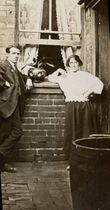
Gertrude Fletcher, Copyright Luke Adams.
The invaluable ‘I remember Blackheath and Rowley Regis’ Facebook page and community can add some interest to the picture, too. In 2021 Simon Hancox showed a picture of a Williams Fine Rowley Ales blue and white Pint tot, owned by his mother and which was thought to come from the Bull’s Head. Simon’s mother lived at Rowley Hall which he says was owned by the William’s family so their property holdings in Rowley were obviously substantial. A rare and possibly now unique piece of Rowley history, I show it here, if Simon has any objection to this, I will of course remove it.
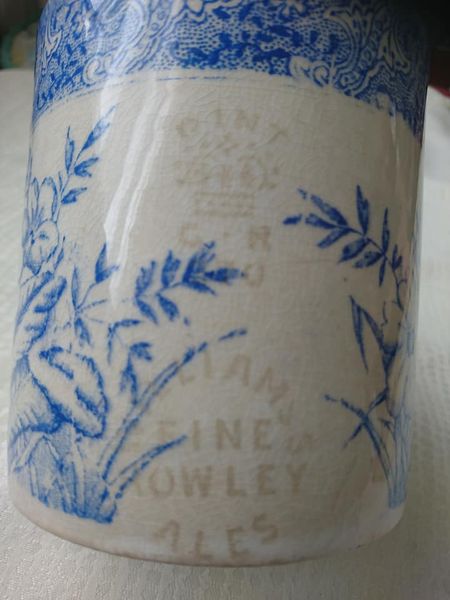
Copyright Simon Hancox.
As I said in the original piece, I had no doubt that there are many local residents who have memories of this pub, so much a part of the lcoal community over such a long period which has been confirmed on the Facebook page ‘I remember Blackheath and Rowley Regis! Many people had lived there or had friends who lived there or had held family celebrations of various sorts there, many happy memories.
I had asked whether the pub is still open or whether it has suffered the fate of so many pubs now and had closed down. Immediately this piece was published, several people reported on the Facebook page that the Bull’s Head is currently closed and looking sad and run down, there seem to be various rumours about potential future uses though no mention of it reopening as a pub to the regret of many people. Another community asset lost and the long usage of the site as a pub apparently at an end. Many thanks to everyone who added information and answered my question.


Another very interesting read ! You refer to the descendents of Simeon and Isabella Dunn – I am one of them as they were my gt grandparents . My grandfather was James Dunn. Isabella was the daughter of Hannah and her first husband Samuel Wittall. Isabella later married Charles Dovey. Simeon and Isabella’s daughter Florence married John Noott in 1927 , and lived at Rowley Hall .I agree that Hitchmough’s guide to pubs of blackheath and Rowley Regis is a great read and full of interesting local history.
LikeLiked by 1 person
Yes, I saw from a previous post somewhere that you were connected with Simeon and Isabella so it was you I had in mind when I said that family were still around! Glad you found it interesting, as ever, once I started I found more and more to write about.
LikeLike