If we were able to travel back through time to a century or two ago in the Lost Hamlets and Rowley, would those of us with ancestors there be able to pick out members of our family? Or are our genes since then so genetically jumbled that we would not be able to do so?
Recently I went to fascinating talk by Dr Turi King who is the DNA specialist who appears on DNA Family Secrets on BBC1 and who is also the DNA expert at the University of Leicester who helped to exhume and subsequently identified the skeleton of Richard III through DNA. It was a most interesting talk and Dr King also has a website with some interesting videos on it (Link at the end of this article).
During the question and answer session afterwards, there was some discussion – and recognition – that physical appearances pass through DNA. And I put in my two penn’orth that I had observed that other physical characteristics such as gait and mannerisms also passed in that way. She looked rather surprised at this. I gave a couple of instances.
In the small town where I live now I once asked a locally born friend who a particular man coming towards us was, as I often saw him about the town but did not know his name. She thought for a moment and said that she wasn’t sure of his Christian name but he was definitely a P***tt as she could tell by his walk. She was so matter of fact about this that I was interested. Some months later I was standing outside the Co-op in the town and out of the corner of my eye I noticed this same friend approaching me – I knew it was her by her figure and especially because she also had quite a distinctive walk or gait. As she drew near I turned to say hello and found that I was looking at, not my friend, but her aunt – another distinctive family appearance and/or gait!
Dr King was quite interested to hear this though she commented that she had never heard of gait being passed like this – and then remembered that gait most definitely did pass in horses – she gave an instance of a particular breed of horses which had been imported to another country but the descendants of these horses could be identified as belonging to the imported horses by their particular gait. If it can be passed in horses, it seems to me, it can certainly be passed in humans.
At the end of the evening, as we all gathered our coats, a member of the audience came to find me and told me that I was right, gait did pass in families, her brother walked in exactly the same way as her grandmother had. It appears that sometimes genealogists recognise such traits before the science can prove it!
Recently I was discussing this with my cousin and she reminded me of something that happened when we were attending her daughter’s wedding. For various reasons, mostly distance and family commitments, although we had grown up as close friends and family, we had not seen much of each other for some years but my grown-up children and I travelled to Hertfordshire for this family occasion. It was interesting to see friends and family who we had not seen for some years and yes, likenesses were definitely clear – my cousin’s husband had turned into a replica of his father who I had known throughout my childhood. During the evening reception, my cousin and I stood chatting outside while various people were strolling around taking photographs of the grounds as the sun went down. Suddenly my cousin clutched my arm and pointed to someone – “Is that your R***?” she asked? “I thought it was Uncle John. He stands exactly like Uncle John.” It was my son. My father, his grandfather – her Uncle John – had been dead for many years before he was born and there were and are very few people now alive who knew him or would recognise such a thing as the way he stood.
But I already knew that my son had inherited a strong family likeness from the Hopkins side of my family. A newly acquired photograph of my great-uncle John Thomas Hopkins, killed unmarried and without issue, at Passchendaele in 1917 had shown that he and my son, his great-great-nephew, born seventy years after his death, could have been twins. Intriguingly, from the obituary with the photograph, it appeared that they also had various other traits in common, including artistic ability. Now, thanks to my cousin, I knew that my son had also inherited his gait or stance from that side of the family, too.
So it seems possible that, on our time trip to the Lost Hamlets in earlier times, we might have a clue as to which were our family members by recognising the way they walked or stood, as well as their looks.
Looking at a group photograph of ladies from the Birmingham Road Methodist church Women’s Own some years ago I pointed out one lady to my mother, saying “There is your cousin Edith.” who I knew well. “No, that’s not Edith,” said my mother “That’s her mother, my Aunt Blanche”. Likeness passed complete between mother and daughter!
Back in my little country town in Gloucestershire, where I have lived for forty years now, I once took a visitor from New Zealand into our primary school, at his request, as his ancestors had attended that school, and he gave a talk to the children about his life in New Zealand. As we waited to start, and the children were assembled in front of us, he commented to me how many familiar faces there were amongst the children. How could they be familiar to someone born and raised on the other side of the world? He knew the faces from old photographs of family and friends which his family in New Zealand had. I could not dismiss his observation.
And a few years ago, my husband and I travelled up to Ashcroft Nurseries, near Kingswinford (I collected Hellebores then and they are Hellebore specialists). Sitting in their café I looked around at the other customers and commented to my husband how many familiar faces there were. He was startled and looked round him. Who did I know? he asked, thinking I had spotted some old friends from my childhood. No-one, I didn’t actually know anyone individually, but I recognised the shapes of faces, the bone structures, the eyes, the hairlines – they were my tribe.
Whilst researching my family tree, I have often looked at old photographs of Rowley and Blackheath folk in books or online, particularly of groups taken in schools or chapels or sports teams, and have caught glimpses of faces which were familiar. Am I alone in this?
Photographs in some of Anthony Page’s books can also show up strong likenesses. Sometimes I can put a name to a face – Tromans or Baker, before even looking at the caption, from people I know.

From Anthony Page’s book Old Photographs of Rowley.
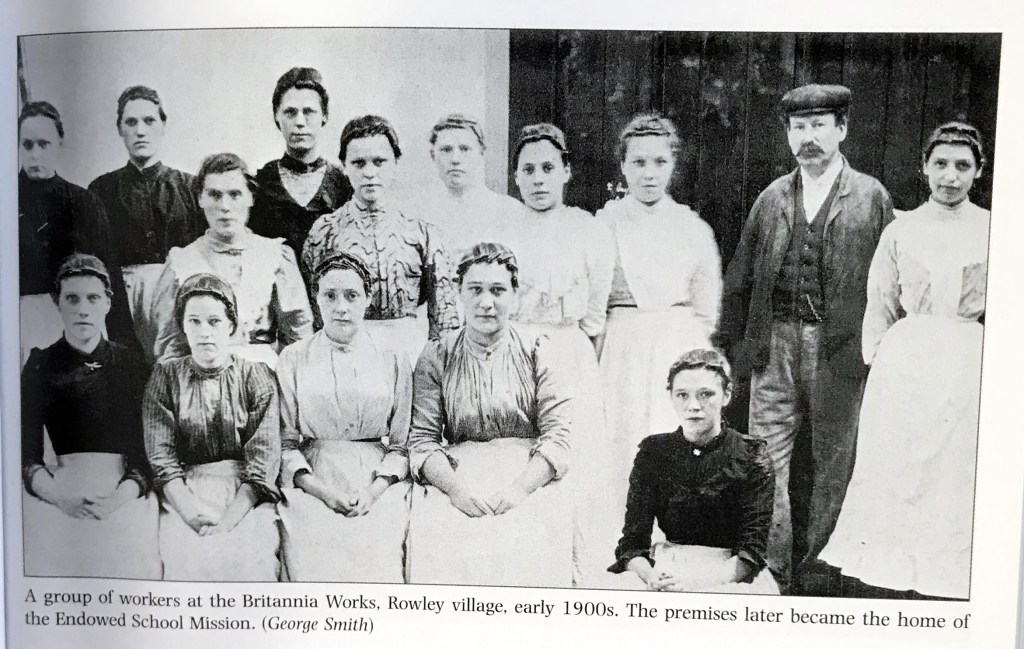
From Anthony Page’s book Old Photographs of Rowley.
These photographs are almost certainly of Rowley girls and women. In fact, because they appear to be dated ten or fifteen years apart, some of them may be the same children!
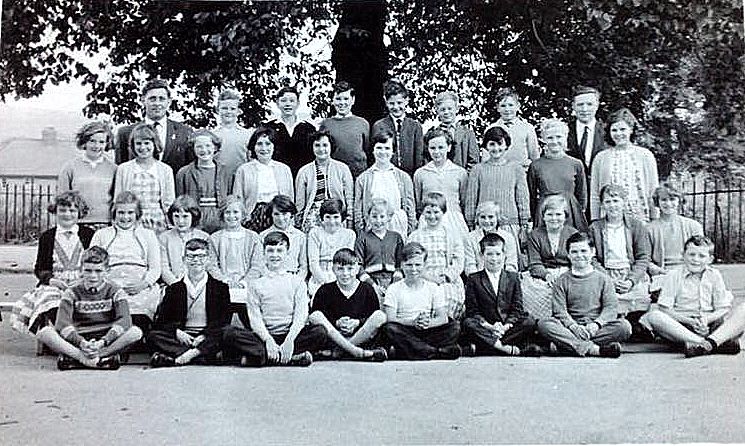
Copyright: Glenys Sykes
I posted this photograph of my class at Rowley Hall Primary School, taken in about 1961, on the Facebook group, some years ago. These were the faces around me in my childhood school years. Here are children named Harper, Spittle, Raybould, Whitehead, Sidaway, Ward, Franks,Whittall, Cole, Russell, Mullett, Tibbetts, Crump and many others if I could only remember them all more than 60 years later! I now know many of these are Rowley family names, although I hadn’t known that at the time.
And, looking at the old group photographs, I see the faces of their descendants, especially of the children in my class , appearing to me among the faces in the old photographs. It gives me a curious sense of belonging since many of my ancestors, too, have been in Rowley since parish records began and possibly since time immemorial.

Rowley quarrymen. Copyright unknown but will be gladly acknowledged if claimed. (If you can positively identify individuals in these photographs, please let me know. That information can then be added to the Lost Hamlets Study.)
Few poor people had cameras in those days and were certainly not of a class to have portraits painted so sometimes these more or less anonymous group photographs will be the only photographs which exist of our poorer ancestors. The men shown in photographs of groups of quarry workers, such as the one above, in all likelihood lived in and around the Lost Hamlets, some of them fathers and sons or brothers or cousins to each other – if we only knew their names. Do you look at them and see familiar faces? Is there a particular ‘walk’ or way of standing that you have noticed in your family?
So please tell me, Rowley and Blackheath people, do you know of family likenesses or family gaits or other characteristics which you have seen in your family? I would be interested to know.
We may never time travel but it is fun to consider what our ancestors looked like.
Useful link: https://turiking.co.uk/
 rowleyregislosthamlets.co.uk
Hi Glenys, not replying on the FB page as it’s not actually relevant to there – but I’ll tell you about my paternal grandmother Dorothy. She was the age that I am now, when I was 7 and I’d spent a lot of time being looked after by her when my mother was at work or in hospital. The one thing that I remember about her is her physical structure, and definitely her gait! I’ve traced osteoarthritis of the hip back 5 generations in that side of the family, and I definitely have her lopsided walk. And yes, she needed a hip replacement (as did her son, my father) and so do I. As for physical structure – yes, down to the rectangular shape of our bodies, the total lack of a waist… The thing is, how far back could I trace the gait? If I’ve traced the condition that caused it, I should be able to see its result in other generations. Now here’s another thing: my 1st cousin once removed Ken had both hips replaced, and he is on my father’s side – but only via my father’s father not his mother! It seems that I was going to get osteoarthritis from both paternal grandparents!
LikeLike
Oh, interesting. Even small things like the shape of ankles seems to vary across families. My mother had very neat ankles and I have inherited those, as has my daughter – even when I was a lot heavier, those ankles stayed slim. But my cousin’s ankles were a completely different shape.
It seems that before too long, our DNA will tell us which conditions we are likely to inherit, this is already possible in some diseases.
This post seems to have generated a lot of interest and memories – an incredible 325 views in less than 12 hours. It has obviously struck a chord!
LikeLike