I have known, for as long as I can remember, that some of my family were nailmakers in Rowley and Blackheath. Both of my parents could remember their parents or uncles making rivets or nails in workshops behind their houses. And both of my parents thought of themselves as Blackheath people, as they were both born and grew up there. It was only as I built our family tree, after they were both dead, that I discovered that their roots were very much in Rowley.
In a similar way, I grew up respecting the skills of artisan craftsmen. My father was apprenticed and qualified as a Cabinet Maker, although most people thought of him as a simple carpenter and he was proud of his skill. And I have long been conscious that some writers dismissed Black Country folk as uneducated drunkards. This did not tally with my knowledge of the many Methodists in my family who founded, built and worshipped at numerous chapels, in the 1800s and early 1900s, some of the chapels very substantial and who then managed them as Trustees, keeping records, priding themselves on their Sunday schools and chapel communities and – for many of them – never setting foot in a pub in their lives! These people too educated themselves and ensured that their children were brought up in the same way, sober, hard-working, honest.
And many local men worked in foundries – hot, dry, dirty and dangerous with very few health and safety regulations to protect them but nonetheless skilled work. Or in quarries, blasting and shattering the hard Rowley Rag, or in mines – again, dark, dangerous, hard work. I understand that this was true also of the various glass making industries a little further afield from Rowley, another hot dry workplace.
So, it seems to me, if those men went to the pub for a drink when they finished work, that would not be surprising. Beer was considerably safer than water to slake their thirsts. Some of them, no doubt, stayed too long and spent too much but I somehow doubt it was all of them.
Since I have been working on my One Place Study, I have realised that, other than these outside jobs, the overwhelming work in Rowley village and the immediately surrounding area was nail and rivet making, at home and with employers such as the Gadds and Lenches, a specialisation in tube making also developing in later years. I knew also that other local places had their specialisms.
Carl Chinn summed this up beautifully in the first paragraphs of his book ‘One thousand years of Brum’, when he described a gathering of the Unions in Birmingham on 7 May 1832 to demand electoral reform. He listed numerous places where people had come from and referred specifically to those who came from the Black Country:
“tens of thousands of chaps and wenches who’d strode in from the Black Country. There were manufacturers of tubes from Wednesbury, lock makers from Willenhall and saddlers from Walsall. There were hardware workers from West Bromwich, nailers from Dudley and fashioners of metal from Smethwick. And there were puddlers from Bilston, chain makers from Cradley Heath and colliers from Cannock. As these determined folk poured into Birmingham, they were met by a tide of Brummies sweeping out from each street and yard. It seemed that every trade in the town was represented, from button makers and pin workers to smiths and jewellers, and from engineers and minters to gun makers and brass workers.
It was the greatest gathering in brum’s history. No. It was more than that. It was the greatest gathering in the history of England. There they were all assembled, over 200,000 men, women and children, packed into that natural bowl flanked by Summer Hill, Newhall Hill and easy Hill. Many were ragged and barefoot, others were well clothed and shod but the differences between them mattered not. For the bond that joined them overrode all distinctions of status. The poor and the well-off, the able-bodied and the halt, the young and the old had all come together with one intent – to press for reform. United they cried out for all men to have the vote. United they shouted out for each industrial town to be given its own member of Parliament. United they called out for the ending of rule by a few and for the coming of democracy.”[i]
Stirring stuff, isn’t it? It makes me proud to come from Black Country stock. He goes on to describe the meeting and the eventual reforms which followed. The more I read of Carl Chinn’s work, the more I learn. What a gift he has.
So yes, each town and community had a particular skill which was passed from generation to generation, at least until the coming of the industrial revolution and massive expansion of factories.
And we hear a lot about nails and chains in the Black Country and about foundries and blast furnaces. However, I had not appreciated, until I looked into the Vaughan family, how many skilled blacksmiths in the area were engaged in the specialised trade of making tools with sharp edges. While most men in Rowley were nailers, there was an occasional horse nail maker (more usually a Dudley skill) and there was one jobbing smith, living in Cock Green. I wonder where he worked and whether he was also a tool maker? Most blacksmiths could make some tools and nails for use in their communities and probably catches, hinges and fasteners for doors, etc for local use. But obviously some smiths in the Black Country developed the specialised skills needed for edge tools. It was not just in Oldbury, although the Brades Works was founded there quite early. There were, of course, also edge tool makers in the Sheffield area but there was a distinct and versatile industry in the Black Country and Birmingham.
Ned Williams in his book about Netherton[ii] has a photograph of employees of Swindell & Co of Netherton, each holding a different tool produced by the Company. And on the same page there is a 1930 advertisement for another company – Samuel Lewis & Co of Withymoor, near Dudley who listed what they manufactured. Here we go –
“Manufacturers of every description of Wrought Nails, Rivets, Chains, Cables, Anchors, Bolts and Nuts. Chain harrows. Coach screws. Engineers and Plough bolts, etc. Cart Hames, Horse, Mules amd Ox shoes suitable for all markets. Anvils, Vices, Hammers, Pan Bits, Staples etc. Welded iron hinges, Builders’ and General Iron Oddwork etc. Spades, shovels, forks, etc. “ This company, founded in 1750, was one of the oldest in the area. It seems to me that the skills available to Samuel Lewis & Co, meant that they could and would create almost anything made of metal that was needed. I have often seen photographs of the massive chains and anchors produced for ships like the Titanic but these other less obvious skills were also at play in Black Country communities.
I had come across clues about edge tools elsewhere, over the past few years, when I was transcribing parish records of places where edge tools were being made. Sometimes of a specialised nature, sometimes more general. In the baptism records for the Old Hill Primitive Methodist Church, I came across an occupation for a father of the baptised child where he was said to be a ‘tree turner’. This puzzled me until a vague memory surfaced from what passes for my brain that the handle of some garden implements was called the tree – because it branches at the top! So perhaps this man was turning the handles of spades. And in the same register an entry for the same man described him as a ‘spade tree turner’. And looking at where he lived in Wrights Lane, nearby was a works where spades were made. Puzzle solved!
And I had noted that parish registers for Clent showed a number of scythe makers living there. Clent Parish Council note in their brief history of the village that from the 16th Century scythe makers and later wheelwrights, locksmiths and nailers all thrived in the area.
For anyone interested in learning more about English scythes ( https://wildscythe.co.uk/english-scythes/ ) has a whole website devoted to the subject! And a piece in Historical Metallurgy on the north Worcestershire scythe industry (https://www.hmsjournal.org/index.php/home/article/view/215 ) by Peter King of Hagley also has a great deal of information.
But one sentence in Ned William’s caption of the picture of the workers at Swindell & Co in Netherton stuck in my mind. The photograph of the workers had been shared by George Roberts Jnr. And one man in the photograph was identified as George Roberts (presumably an ancestor of the owner of the photograph) who was holding a hay knife, “one of the edge tools in which he specialised.”
And there it was. These skilled workers, blade workers, and their employers specialised in particular tools, just as the Vaughan brothers later, in Aston, divided their labours and responsibilities between factories producing particular bladed tools, with some tools, such as hoes and rakes or sheep shears, being produced in small specialised workshops and factories.
The toolmakers were innovators, they registered patents for improved ways of producing tools, developed new markets such as sets of gardening tools for ladies. They described themselves almost universally as ‘toolmakers’. So here was another artisan trade which I had not really understood. I knew that some engineers called themselves ‘toolmakers’ who worked in industry but until now, I had not fully appreciated the nuances of their profession, the makers of tools which required particular skills in their manufacture and which enabled endless other workers, all over the world, to carry out their own work. And they turned their enterprise to new areas during war time, producing both tools, such as trenching spades and pick axes but also horse shoes and weapons such as bomb heads.
And in those circles in life which I have written about recently, another of those came full circle for me this week.
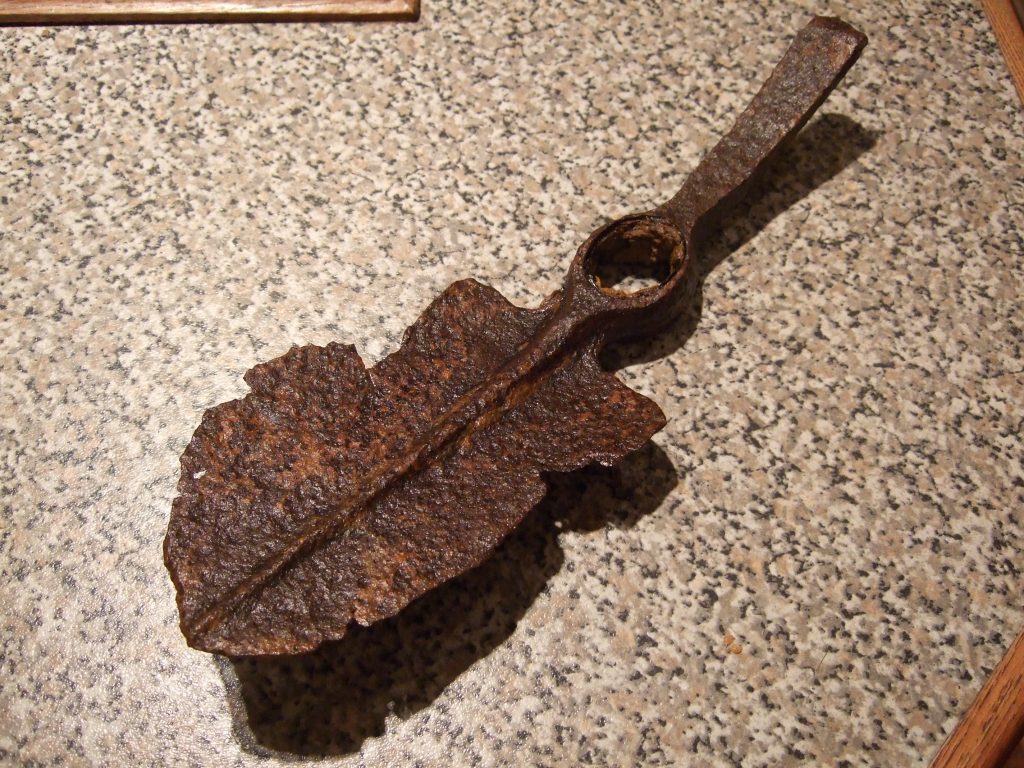
In 2007, I went to a small farm near Ypres where my great-uncle John Thomas Hopkins was killed in action in Passchendaele on the 26 October 1917, for the 90th anniversary of his death. That anniversary was marked with reverence and solemnity at the farm that day by visitors and locals alike. This week I was reading again the account I wrote on my return of this visit and was reminded that I had been given by the owner of the farm an item from the ‘iron harvest’ of wartime items recovered from the soil during recent farming work. This was a rusting trenching tool, such as my great-uncle may have used there. This is the tool or what remains of it.
Copyright: Glenys Sykes
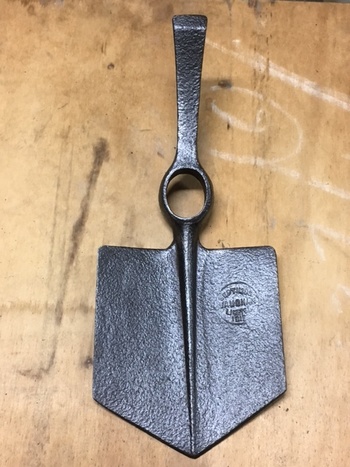
And below is a picture of a better preserved trenching tool made by Septimus Vaughan for use in that war. I have been writing about the Vaughan family and their tool making for several weeks recently. Was my trenching tool, retrieved from the Belgian battlefield decades after the war and given into the care of this Black Country girl, made by his company? It probably was, the design is the same and is that the edge of the circular stamped maker’s mark I can see on the right hand side of the damaged tool? Another history circle snapping into place over 100 years and twenty years.
Copyright unknown.
Near where I now live in rural Gloucestershire there is a company which produces some of the most advanced measuring tools in the world, originally developed for use in the Concorde engines being built at Rolls Royce in Bristol. Like the companies started by the Vaughan brothers, this company had started here in this small country town with a few workers in small premises. Before growing into an international leader in the field, employing thousands of people. But the original invention and later ones were subsequently developed so that these measuring devices are now an integral part of almost every machine tool in the world, to aid accuracy in production. So the workers there are also tool makers: some of them will be electronic engineers and various other more modern professions but in essence they are still ‘tool makers’, still enabling others to do their work better, faster, more accurately, just as the edge tool makers of the Black Country did.
I have a new respect for tool makers!
[i] One Thousand Years of Brum by Carl Chinn. Published 1999 by Birmingham Evening Mail. ISBN: 0-9534316-5-7
[ii] Netherton by Ned Williams. Published by Sutton Publishing 2006, reprinted 2009 by the History Press. ISBN: 978-0-7509-4182-2

