The Vaughan family, into whom Mary Ann Alsop married, were – at least in 1841 – jobbing-smiths living – presumably fairly humbly – in Rounds Green and my presumption has been that they were employed making edge tools at the Brades Works.
I have mentioned earlier Joseph Vaughan (1795-1851) and his wives Amelia Page and Lucy Nixon.
Joseph’s children were: William James (3rd son of Joseph) had:
Charles Vaughan (1816-1892) Joseph Edward (1845-1909)
Sampson Vaughan (1818-1837) William James (1846-1928)
William James Vaughan (1820-1869) Charles (1849-1912)
Betsy Vaughan (1825-1859) Richard Henry (1851-1928)
Emma Vaughan (1826-1908) Thomas (1853-1886)
Richard Vaughan (1827-1885) Amelia Page (1855-1939)
Mary Anne Vaughan (1828- Mary Anne (1856-1928)
Selina Vaughan (1830-1882) Emma Eugenie (1858-1932)
Joseph Vaughan (1832-1882) Lewis Ralph (1861-1931)
John Vaughan (1833-1896) Septimus (1863-1938)
Septimus Vaughan (1836-1907)
Octavius Vaughan (1837-1838)
As you can see, there is a large crossover of family names with the children of William James, who we have already looked at in great detail, so that has led to ample opportunities for confusion, in researching the family, especially as most of them moved to the Aston area, including their father Joseph. But I suspect, from his second marriage to Lucy Nixon, in 1843, that the family already had links, in the business community at least, there. Also there is a considerable overlap in dates so extra care has been required to check which generation any given piece of information relates to. And I won’t go into all the other brothers in both generations and what they named their children…
Of these brothers, Dix’s General and Commercial Directory of Birmingham dated 1858, lists a generic ‘Vaughan Brothers’ as manufacturers of hoes, rakes, forks, ladies’ fancy garden tools in sets, ship scrapers etc, at the Garden Tool Works, Dartmouth Street which was in the Duddeston/Aston area. But below that, there are entries for the various brothers which appears to show that – in various combinations – they ran factories specialising in various tools – hoes and rakes, etc.
A list in the Birmingham Daily Gazette dated 13 February 1868, shows Charles, of Victoria Road, Acocks Green, as an Edge Tool maker; Septimus, of Birchfields, also an Edge Tool maker. Was that the Birchfields at Oldbury? I suspect it was.
Did they all leave the Black Country?
But, as I worked through the sons of Joseph and the businesses that some of the brothers set up in Birmingham, which tended to result in their children, brought up mostly in Aston and Duddeston eventually settling in the greener suburbs around Sutton Coldfield, there were clues that some of the family had stayed in the Oldbury and West Bromwich area.
There was a newspaper report of an insolvency hearing in March 1846 for a ‘Sampson Vaughan, late of Dudley, Worcestershire, journeyman smith’. My first thought was that this was the Sampson, son of Joseph but he had died in Birmingham in June 1837, buried at St Martin’s, Birmingham and described in the burial entry as ‘son of Joseph and Amelia’, aged 20, although his abode was shown as Oldbury. So there was another Sampson Vaughan not far away, also in the smithing trade!
The Vaughans were certainly active in the local community in Oldbury in 1835 when Joseph Vaughan was listed as the Treasurer of the Oldbury Co-operative Society and Charles Vaughan as the Secretary, so they must have had some public spirited intentions.
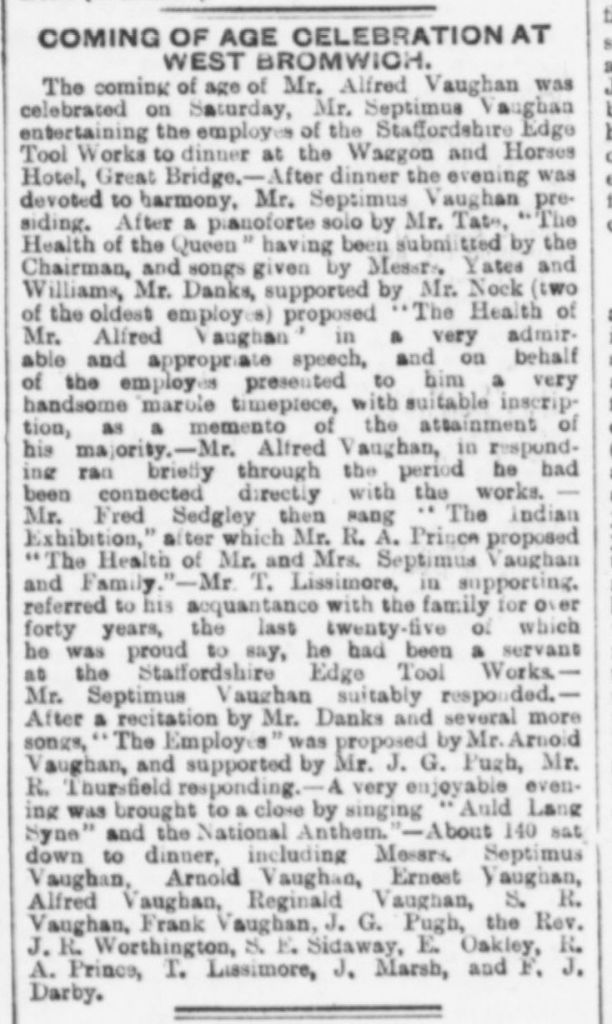
And there was a most interesting report of a party for the coming of age of Alfred Vaughan, son of Septimus, in 1896 when ‘Mr Septimus’ hosted a dinner at the Waggon and Horses at Great Bridge for employees of the Staffordshire Edge Tool Works, where 140 employees and family sat down to dinner. The article gives an account of the entertainments and the speeches and shows a family deeply embedded in their company and their employees. So clearly there was still at least one substantial Vaughan edge too-making company in the area, not all of the Vaughan interests were in Aston.
Copyright: Uncertain but gladly acknowledged if known.
Some random searches and what they revealed
Much of my research for this study is done via the usual family history sources with which most family historians are familiar, with plenty of cross checking across sources, plus newspaper articles which often reveal small items of interest. But sometimes I will just type the name I am interested in into a general search engine with a date or a profession to narrow the results and often this brings up some matter of interest.
So when I searched google for Vaughan tool makers 1800s UK, I was fascinated to see that the first result was for Vaughan Brothers (Drop Forgings) Limited at Willenhall, founded in 1874. willenhallhistory.co.uk lists H&T Vaughan amongst the most important lockmaking firms in the town by the end of the 19th century. I had not previously known of any connection with the family and Willenhall and indeed this may not have been the same branch. But they were in a similar metal based industry.
Another article revealed that the firm of Vaughan & Bushnell was founded in Chicago, USA in 1869 by an Alexander Vaughan, who patented an improved auger and who made various hand tools. More edge tool makers, more innovations, more patents! I know this because there is a Vaughan & Bushnell All Metal Hay Hook for sale on ebay!
A Philip Vaughan, I learned, who was an ironmaster in Carmarthen, Wales, invented the Ball Bearing and obtained a patent for it in 1794, to improve ‘axle trees, axle arms and boxes for light and heavy wheel carriages’ Obtaining such a patent in 1794 was a laborious and expensive process costing around £100-120 with no guarantee of success and only covered England and Wales. But this decision to protect and innovative process was repeated by several later Vaughans. There is also a note in the article I found which says that in 1800, Vaughan formalised his business interests through a co-partnership deed with four partners including John Morgan and William Morgan. Morgan is, of course, a common name in Wales but I do wonder whether this is the origin of the Vaughan Morgans I note below.
Septimus Vaughan (1836-1907)
A search for Septimus Vaughan brings up a huge number of results, including information about the company of Septimus Vaughan Limited of Henry Street, West Bromwich which, during the Great War, made trenching tools, pickaxes, Stokes’ bomb heads and horseshoes. There are any number of trenching tools made by this company for WW1 on eBay, too!
There are numerous other Septimus Vaughans popping up in America and in other places – were they all related? Very possibly!
There was a Septimus Vaughan Morgan (1832-1913), the son of a hostel keeper of Abergavenny, who was one of four brothers (including Walter, William and Octavius Vaughan Morgan) who founded the Morgan Crucible Company (more hot metal working!) – and also –lest he be thought single minded, he joined his brothers in a drug and hardware factors business in London (he had qualified as a medical doctor) and also published newspapers ‘The Chemist and Druggist’ and ‘The Ironmonger’. One of his brothers was Lord Mayor of London in 1905-06, his brother Octavius sat as a Member of Parliament for Battersea for some years. A family of many talents and high achievers. Were they related to the Vaughans of the Black Country and Birmingham? I don’t know but there is a certain cross-over of names and of interests so it seems possible and I have mentioned previously my theory that the family had links with Wales.
Black Country Vaughans
But the Black Country Vaughans were no slouches either. An article on the website The Annals of Tipton refers to the Company of Revo. A man called Frederick Reeves went into partnership with one Septimus Vaughan whose father Ernest Vaughan (son of Septimus) had founded Vono, a manufacturer of mattresses and bed fittings.
Revo produced a vast range of products, most designed in-house. Early products included lighting, radios, loudspeakers, cookers, switchgear and fans. By the 1930s the firm became a household name and their electric street lighting was widely introduced thoughout the country, and their traffic lights in the late 1920s and 1930s.
There is a huge amount of information about Revo on the website (http://www.historywebsite.co.uk/articles/Tipton/Revo.ht )and it is well worth reading.
Revo became one of the largest local employers with over 3,000 employed by the late 1950s. The Britannia Works at Dudley Port was alongside the Birmingham Canal and expanded to cover over sixty acres, extending into the boroughs of Dudley and Rowley Regis. I gather that the Company was later taken over and subsequently disappeared, as so often seems to happen.
An industrial accident
A newspaper report on the inquest into the death of an employee at the works of Septimus Vaughan Limited appeared in February 1909, after a grinder was caught in machinery. It appeared that the employees, probably unknown to the company, used to put the belt round the drum at night, while the machinery was in motion to save time in the morning. He had been wearing his overcoat, ready to go home which may have got caught. Mr Arnold Vaughan, a director of the company, told the inquest that this was the first accident of the kind in fifty five years, (which seems to be to me to be quite an impressive record, given the nature of the machinery in use) and it was thought that he had gone inside the fence around the machinery intended to protect him. The company representative also expressed willingness to carry out suggestions to prevent such accidents in future.
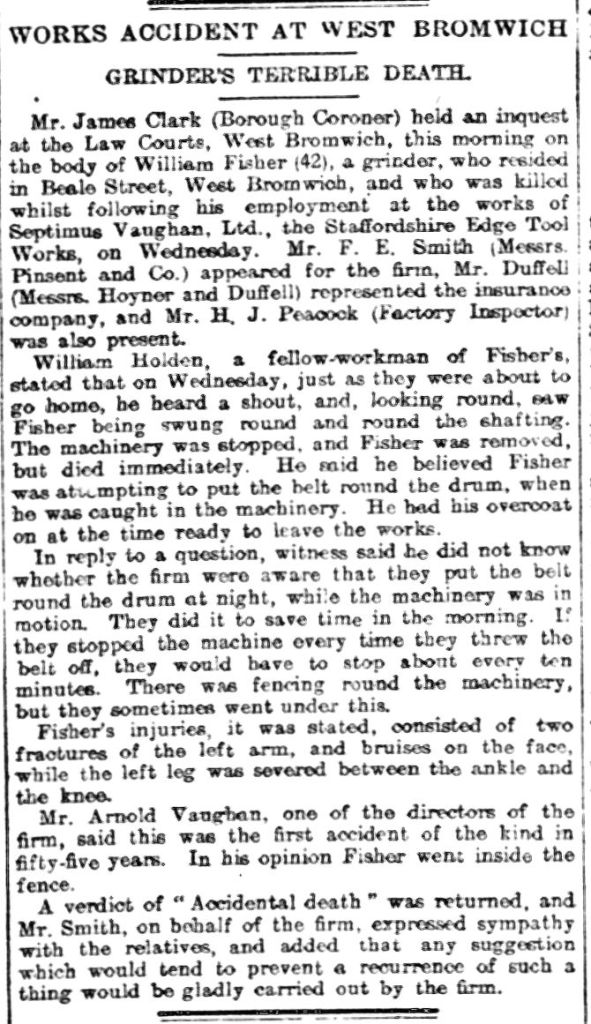
I was interested also to note that there was a further report at the end of March that year that compensation of £205 5s.9d. had been awarded to the widow and the judge directed that £20 should be paid to the widow forthwith and that the residue should be invested in the Court , to be paid out at the rate of £1 per week for the maintenance of the widow and her five young children. It is not absolutely clear whether the payment came from the company or an insurance company but it is good to know that she was not left completely destitute.
Civic duties
And, like the Vaughan Morgan family, at least some of this part of the Vaughan family also had a sense of civic responsibility. A newspaper article in the Birmingham Gazette in 1914, is about Mr Alfred Vaughan, he of the coming of age dinner mentioned earlier. He was standing as an independent Candidate for the West Bromwich Town Council and was described as a familiar and popular figure in the borough. He had received his training at Messrs Tangye’s works in Smethwick before joining his father in the management of Septimus Vaughan Limited, edge tool manufacturers which he subsequently managed and expanded. Another article in the Evening Despatch in 1917 notes that Mr Alfred Vaughan JP, had been admitted to the Freedom and Livery of the City of London in the Felt-maker’s Company. The article recounts that his father Septimus Vaughan had founded the well-known firm of Septimus Vaughan Limited, makers of plantation and railway tools at West Bromwich.
In addition to his work there, Alfred was also a director of ‘four other important manufacturing establishments in South Staffordshire and Worcestershire’, and Chairman of three sections of trade associations connected with the edge-tool and other industries. His companies had clearly been involved in manufacturing for the war effort but in this ceremony he spoke of the need for the relationship between capital and labour to be put on a better footing after the war, with joint organisations and labour must have a larger share of the results and also of the responsibilities. He was also a member of West Bromwich Town Council and other local committees. A hard-working and industrious but also able man, clearly, and deeply involved in his community.
Final note on the Vaughans
It has been interesting to observe how many and varied companies emerged from this branch of the Vaughan family over a period of 100 years or so, providing many jobs and companies quick to develop new products or innovations as new technologies emerged. From the patents for improving the manufacture of edge tools in the mid-1800s to the developments of radios, street lighting and a vast range of other goods a century later. From jobbing smiths to major industrialists, still in the same area, the Vaughan family were, it seems to me, a dynasty to be reckoned with.
All of this information (which, believe me, has only scratched the surface of the information out there) has emerged during my research into William James Vaughan who married Mary Ann Alsop. While it has proved to be a fairly lengthy side-track into this large and successful local family, I hope my readers have found it of interest, albeit with only the tenuous link to the Lost Hamlets through Mary Ann Alsop.

