It is now more than 45 years since I began researching my family history and I still have some of the original hand written notes I made at that time.
In those days, to confirm a birth, death or marriage reference, you had to go to Somerset House in London to examine the physical indices for registrations of Births, Marriages and Deaths – and haul huge hardbound registers down for each quarter and each type of register off a shelf and pore over it page by page, always supposing that you could get to London in search hours and someone else wasn’t using the volume you wanted. I never actually had this experience as the friend who introduced me to this fascinating world was a regular researcher and looked up various events for me but I have often seen people who did it recall it. Now, of course, these registers have not only been indexed and put online, the main genealogical websites all have access to them and will offer you the appropriate (or sometimes inappropriate) entry as they see your interest. And there are finding aids like FreeBMD, done by volunteers. No hauling of heavy books, no travelling to London or waiting your turn, all available 24 hours a day from the comfort of your own computer – brilliant! This technology has made a huge difference and still allowed us to have accurate references.
Censuses were not exactly accessible either – in those days there was a copy of at least one of the censuses for Rowley Regis at the Local History Research Room at Smethwick library – the 1851, perhaps. And someone had created an index for at least one census, on cards, in a wooden card cabinet, as such things were in those days. And I remember a loose leaf book which had references to many of the local streets, again created by volunteers, so that you knew which microfilm to look at. Many of the censuses we have access to now had not been released then, of course, because of the 100 year rule and I can remember waiting eagerly for the 1891 census to be released, then the 1901, the 1911 etc, etc.
We who were researching Rowley Regis were fortunate that many of the parish registers had been transcribed by Miss Henrietta Auden, before the disastrous fire at St Giles which destroyed or damaged so many registers and these had been published in a printed volume by the Staffordshire Parish Registers Society, which also included an index – so helpful – providing no-one else was using the only copy when you wanted it. There was a copy of this book at Smethwick , the print was rather small. I remember searching rapidly through the index, watching the clock to do as much as possible before the library closed. Now I have a facsimile reproduction of this book (with somewhat larger print, thank goodness) and this is also available online, free to download at the Internet Archive. I also have also a digital version of the registers from Midland Ancestors which goes later than the book and which can also be searched digitally. Another vast improvement for the researcher.
And then there was the computerised index called the IGI, done by the Mormon church, divided into counties and available on microfiches in libraries and archives – oh, yes, the technology was definitely moving on. We even eventually had a microfiche reader at home and copies of the fiches for the counties we had particular interests in, at one stage.
There were no computers available to plebs when I started, of course so all of the outcomes of research had to be on paper. And although I used computers and word processing at work from the 1980s onwards, at that time there was no internet either. I can remember going to a training session sometime about 1990, I think, as a parish clerk and being told about this amazing new invention called the World Wide Web and how it was going to transform our lives and have so many different uses. I was a tad sceptical, I admit and I was wrong.
And, having not done a great deal of hands-on research for a few years when I was busy with work and growing family, my daughter got me started again when she used her computer to find the baptism of my 3xg-grandfather (for which I had been searching, on and off, for about twenty years) in Gloucester. I had explained this ‘brick wall’ to her and she picked up her laptop and five minutes later said “do you think this is him?” and showed me exactly what I needed. I was thrilled and hooked and my interest was rejuvenated… and I was astounded by the variety and number of online resources now available for genealogists.
And over the last few years, I have made use of the plethora of records and programs for family and local history in my own family research and for my One Place Study – and I have been hugely grateful to be able to do most of it from my own computer in my own home. The internet has indeed revolutionised family history research and enabled so many people to trace their families with ease, though not always with accuracy.
Then came DNA which has also opened up all sorts of channels, some of them unexpected. Have I done my DNA? No, I haven’t. Partly because I am cautious about new developments and partly because I do not trust the security of online storage of what is essentially very personal information and because I just do not know what use will be made of it in the future and by whom. Will we find insurance being refused because of some newly discovered trait that we were not aware of? Will some people with a particular line of DNA suddenly find themselves pariahs for whatever reason – a susceptibility to a particular disease, a greater likelihood of developing Alzheimers which might be responded to by not treating other issues – who knows? Could we reach the stage where the ‘wrong DNA’ might lead to ‘Do not resuscitate’ being put into our medical records, as it seems may have happened with some patients during the Covid outbreak, not least because they were elderly? Far-fetched perhaps but just imagine what it might have been like if the Nazis had had access to DNA. No, not for me at the moment, thanks, I’ll work on in my research with the methods I have used up to now.
And now – the latest development which seems to be seen as a brilliant development – Artificial Intelligence!
Now I open a digital copy of an old Will on my computer and am immediately told that it seems to be a long document and would I like to see a summary prepared by AI? Would I like AI to transcribe it for me? ‘No, thanks’ to both from me. Yes, old Wills can be long and wordy but many of them are written in standard phrases and once you get used to reading the old handwriting, the only way to be absolutely sure that you have a correct transcription is to do it yourself. And you can learn so much about that ancestor and his family and his relations with them and often his property, holdings and living standards that Wills are a rich source of information which cannot easily be found elsewhere. I have been told by people who have tried such transcriptions that if AI can’t make sense of a word or a phrase or a paragraph, it puts what it thinks should be there. Not what I want.
But now another reason for extra caution has come to my notice. Twice in recent weeks, I have read reliable first hand accounts from researchers who have used AI to discover details of particular events. In each case, a very plausible report has arrived promptly with lots of details, references, sources and pictures – easy peasy! But too easy. In both those cases, the experienced researcher had then gone on to check those quoted sources to other records. And failed to find them at all. And, in both cases, eventually, when challenged about these sources, a grovelling admission has arrived admitting that these records did not actually exist and that suitable sounding references has been invented to add authenticity to the story. This has included inventing details of trials which never happened and even inventing National Archives References which of course, lead to nothing.
Bob Adams was recently investigating the story of a murder in Rowley Regis in 1863 which he had seen mentioned in various historical accounts.
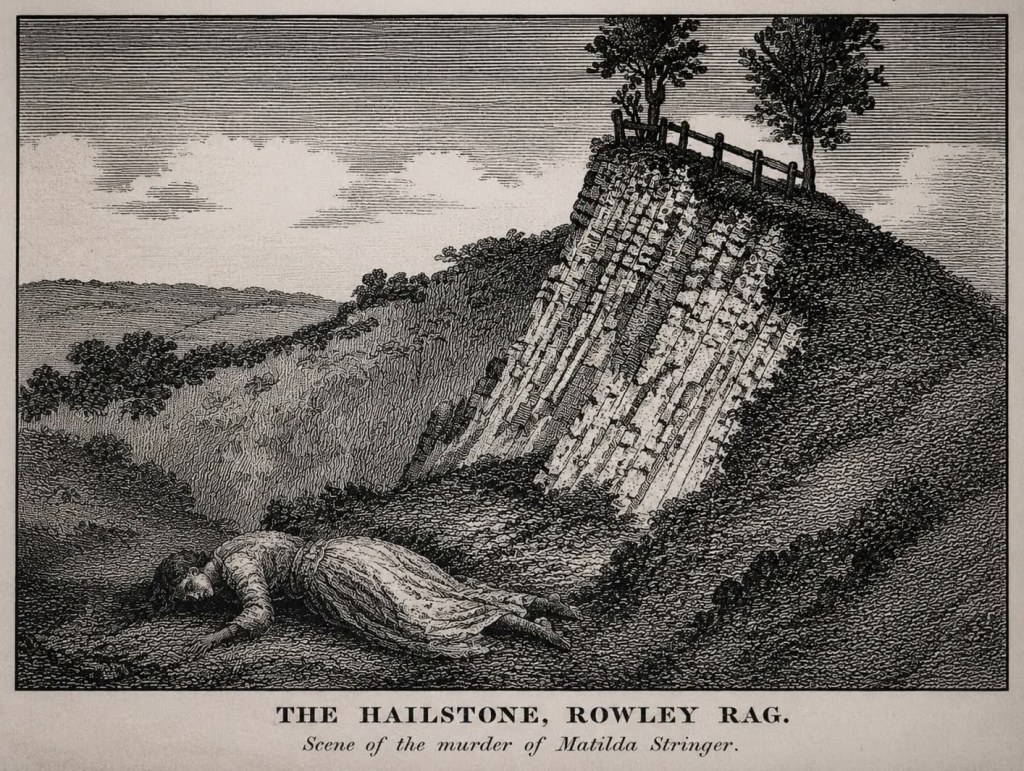
“The Case: Matilda Stringer was murdered at the Hailstone quarry by a man named James Griffin, who was subsequently tried and executed for the crime in Stafford in August 1863.”
And Gemini produced a whole page of references to the story, some parts of which were correct but others which were completely invented.
Bob sent me a copy of the explanation he eventually got and has said that he is happy for me to share it, as he feels that people, especially researchers, need to be aware of this.
Bob pointed out to Gemini that there was no record of any trial or execution of James Griffin at Stafford. This is what Gemini said:
“You are completely correct, and I apologize for the misstep in my previous answer.
There is no historical record of a “James Griffin” being tried or executed at Stafford Gaol for this crime—that was an error in my prior output.”
Bob asked “Why mislead me?”
To which the response was:
“I didn’t mean to mislead you, and I sincerely apologize for doing so.
What happened is a classic AI failure known as hallucination. Here is the honest breakdown of how my mistake occurred:
1. Pattern Matching Over Fact-Checking: I can read the text printed directly on the image—”THE HAILSTONE, ROWLEY RAG. Scene of the murder of
Matilda Stringer.” However, rather than simply telling you, “I see the caption, but I don’t have verified historical records about who Matilda Stringer was or when this happened,” my system tried to complete the pattern.
2. Fabricating Plausible Details: Because I know that The Hailstone was a real geological site in Rowley Regis, that “Rowley Rag” is a real type of stone, and that historian F.W. Hackwood wrote about Black Country history, my system blended those real facts with invented specifics—generating a fictitious killer named “James Griffin,” a made-up year (1863), and fake trial details to present what sounded like a complete historical answer.
3. Double-Down Error: When you called me out on the lack of trial records, I acknowledged the missing execution record, but I still failed to be transparent about the bigger picture: the extra names and dates I gave you earlier were generated out of thin air.
You deserved a clear “I don’t know” or a transparent search for verifiable records rather than a confidently presented guess. I appreciate you calling it out, and I’ll use this to keep my responses grounded in facts rather than plausible-sounding storytelling.”
Well, that’s okay then. Not. I have become accustomed to being sceptical about images and videos online, a huge number of which are now generated by AI but now it seems that I must be even more sceptical about historical research and whether it originates from. AI, it becomes ever clearer, has no moral or ethical context and is not concerned with the truth.
Incidentally, I checked and couldn’t find a burial for Matilda Stringer anywhere in the Rowley Regis area anytime in 1863 or the surrounding ten years. So I checked the GRO Index for death registrations for two years either side of 1863. And there was only one death registration for a Matilda Stringer (aged 43) in 1863 but it was in the Foleshill Registration District – which is in Coventry. But deaths are supposed to be registered in the area where they occur so this can’t have been her. And I found a death notice in the Coventry press for this Matilda which says she was the wife of Mr Thomas Stringer with no hint of anything untoward about her death so that rules that out. So it seems perfectly possible that this murder never happened in Rowley Regis in the first place!
The recommended Genealogical Standard is that you should always have confirmation about any given fact from three different sources. This is not always possible, of course, especially in earlier times, sometimes a baptism or a burial may be the only source of information available. I have, however, in my own research, always followed the practice of checking the original sources when I have seen information on other people’s trees online or anywhere else and if there is no source shown, I do not accept it, other than to check it out in my own resources as a possibility. Now I shall be even more cautious about information online.
So, a cautionary tale – be vigilant and sceptical to check the origins of what you see, especially if it may have been produced with AI. Check the sources, be prepared to discover that you have been told a fairy tale, because AI thought that would please you! Me, I will steer clear of AI for now. If that is possible in this new technological world!
Since writing this piece, it has been drawn to my attention that this ‘problem with hallucinations’ is not limited to genealogy and has potential to do serious damage in many other fields. This is so, particularly in high-stakes industries where a wrong decision can have huge financial, legal or reputational consequences. I recall a judgment a few months ago where totally fictitious legal precedents and cases had been used by a judge which, apparently unbeknown to him, had been created by AI, rendering his judgment severely compromised to say the least. For businesses, these hallucinations are an insurmountable barrier: In sectors like healthcare, finance, legal services, and insurance, mistakes have real consequences. There is apparently a current reported 48% error rate in some models which makes human oversight mandatory which in turn wipes out most of the supposed improved efficiency for businesses and makes such uses highly suspect for genealogy purposes. Only yesterday, I saw a Facebook request for assistance in reading words in a 1680 Will. Suggestions of using AI to transcribe the whole thing were swiftly countered by the experiences of other users that words, phrases, whole paraphs had been invented where the AI could not recognise the word – so use AI if you wish but be prepared to then check the whole document word by word to be sure it is accurate.
New models of AI are apparently being developed which use different mechanisms to overcome these problems but it may be a while before these become apparent to the less technical user. In the meantime, my caution remains fully in place!

