Wilful Trespassers
Life at Windmill Farm and the village of Rowley may not always have been as peaceful as one imagines. In August 1830 a group of Rowley Regis land owners and occupiers had placed an advertisement in Aris’s Birmingham Gazette, addressed to ‘all qualified and unqualified Gentlemen’ and requiring them to refrain from sporting or trespassing on the Lands in their respective occupations, as they would be deemed ‘wilful trespassers’ after the notice. The signatories were Joseph Downing, Joseph Cooks, Josiah Parkes Jnr, Benjamin Woodhouse, William Clift, Joseph Merries, William Bridgwater, Thomas Smart, Mark Pitt, Benjamin Hadley, William Woodhouse, Benjamin Davis, Edward Alsop, Samuel Smith and John Hodgetts. (There is a useful list of major local landowners! )
I do not know what gave rise to this advertisement, as I have noticed similar notices for other areas. After a long period of war which ended in 1815 with the Battle of Waterloo, demobilisation of the army had led to mass unemployment. At the same time the first of the Corn Laws had been passed, helping farmers but with a disastrous impact on the poor. This was followed by dire harvests due to bad weather in 1816, causing widespread hunger in what was described as a ‘Year without a summer’. This led to a steep rise in the numbers of people who left Britain for good, by the 1830s, in particular those who had been affected by the agricultural depression. So perhaps men were poaching to feed their families.
Or perhaps, now that not so many young men were away with the army, there were more ‘gentlemen’ with the time and inclination to go out hunting and who may not have been particular about trespassing on land belonging to other people. None of the landowners or occupiers listed were gentry so perhaps they had more of a need to assert their rights. And there was no police force to address bad behaviour.
The killing of Richard Hunt
But certainly it appears that of those men, Mary Ann’s father Edward Alsop at least was prepared to defend his property to the death. In December of 1841 and January of 1842, reports appeared in the local papers, of an inquest on a man called Richard Hunt which showed that on 12 December 1841, he had been killed by Edward Alsop of Rowley Regis, a farmer, when he was caught in the act of committing a robbery in an outhouse of the premises. The jury returned a verdict of ‘justifiable homicide’. (This is not a formal verdict now at least in England and Wales, self-defense is now the preferred option). The deceased, it was noted, was about sixty years of age, and “had long been known as a most profligate and notorious thief”. His accomplice Edward Steward pleaded guilty in court in early January 1842 to a charge of stealing three iron punches and a peck of potatoes, the property of Edward Alsop. He was imprisoned for four calendar months. So clearly Edward Alsop was not a man to cross!
So looking at the story of Rhoda, it begins in much the same way as for her siblings. Rhoda was born on 18 November 1821 at the Windmill Farm and was baptised at St Giles on 18 November 1821. For the next three censuses – 1841, 1851 and 1861 she continued to live at the Windmill Farm, with her family, aged 39 and single in the last one.
But life had not been easy for Rhoda over that period. As I noted earlier, Rhoda’s father Edward Alsop was not one to tolerate offence easily and it appears that Rhoda may have been of a similar mindset. I found a whole series of press reports when Rhoda sued a former swain for breach of promise.
Fortunately for us, the newspapers reported in great details on the circumstances of the case. A report in the Staffordshire Advertiser on 21 July 1855 (subsequently similar accounts appearing in newspapers across the country) explained that Thomas Sergeant had broken a promise to marry her. She stated that there had been an engagement between them for two or three years, tht she was always ready and willing to marry him and that he had married another person.
She was, the report said, a “young lady of some 31 or 32 years of age, the daughter of a farmer of considerable respectability, a gentleman whose ancestors had been tenants of Lord Ward for more than a century, of the Mill Farm, at Rowley Regis. Mr Sergeant was a builder, and a person of considerable landed property, living at North Fields, about four miles from Mr Alsop’s house; and was a person of a suitable age for Rhoda, being some 37 or 38 years old. He met Miss Alsop in the autumn of 1852, and paid great attention to her; was received in her father’s house, introduced to her friends, and acknowledged in every way as her suitor. As he lived at so small a distance from her father’s he used to pay continual visits to her and proposed for her to her father, an old gentleman of about 70 who referred her to Miss Alsop, with whom he had already settled matters. For more than two years this engagement continued, and letters passed between them, the only impediment to their union being the illness of Rhoda’s mother.
Matters went so far that a church was fixed upon for the performance of the ceremony, Mr Sergeant insisting that it should take place at North-field church, where his fathers before him had been married. He also made arrangements for the festivities that should take place on the occasion; the children at the school were to be treated; there was to be a balloon ascent, and other festivities of a rustic character. He also took from her a ring she usually wore, in order to get one of the same size; in fact every preparation was made for the marriage.”
Quotations from various letters from Thomas Sergeant, referring to his affection for her and many of a religious tone, including one which recommended that Rhoda should read Dr.Hook’s Meditations and put her trust in God.
In July 1854 Rhoda’s mother died “and then that which up to that moment had been all tender affection on the part of Mr Sergeant gradually cooled. He was less frequent in his visits and Miss Alsop was astonished to receive, on the 4th September, the following letter. It had been up to this time ‘My dear Rhoda’ or ‘My dearest Rhoda’ and terms of fond endearment; now the letter came without any heading whatever; it ran thus:
“I assure you I sympathise with you in your troubles, for I have felt the same myself. One above knows how great mine have been the last month, and then, after all anxiety, loss of time and rest, and through that finding my health giving way, to be accused of dishonour and deception and trifling with your feelings, it is certainly very hard. For I must declare, it was never my intention to act dishonourably. Your dear mother’s death caused me to weigh matters over very carefully, and I found that, after all my efforts, I was acting against the will of God. I could no longer stand against the will of Him who sees farther than us sinful creatures, with all our bright hopes of worldly happiness. In all our troubles, we may be sure all things work together for good to them that love him. I would have you to weigh all future affairs now, and I have no doubt you will come to the same conclusion, that I have to appreciate your own home rather than risk your happiness elsewhere. I thank you for all acts of kindness, and shall be happy to reward you, and see you as a friend at any time. Sincerely, T Sergeant”
Oh dear. Poor Rhoda, she was apparently distraught and even sent a cousin to speak to Mr Sergeant and to ask him why he had abandoned her but the only reason he would give was that it was the will of God. He had wept and said that he would never marry anyone else and that if he was to marry at all it should be Miss Alsop. Then he visited her at home and again, wept bitterly and again declaring that it was the will of God, leaving her in ‘a state of despair’.
Mr Alsop, Rhoda’s father, had then written a letter to Mr Sergeant which ran thus:
“In consequence of not seeing you personally for some time, I have taken the liberty of writing to you on a subject, as much as I feel dissatisfied that you have been keeping company with my daughter for about two years, and you do not say what offence any of us have given you, as you stop and slight her. She has fixed her affections on you, and from what you have told her she expected you to be quite a different person and not false. I myself always endeavoured to make you welcome at my house, not expecting that you would treat her in this way. She has not had a day or night’s comfort since, crying and lamenting continually, night and day. She is very ill from your false behaviour, and you have done that you ought not to have done.
I have plenty of living witnesses of your courtship and correspondence and promises of marriage, and so forth, and if you do assign some just reason for your false treatment of conspiracy and delusion against my dear daughter, whom I much adore, my full determination is to enter an action at law of conspiracy and delusion against you, Mr Thomas Sergeant; if you have any defence to make you had better say what you mean to do in this case as you have played the same game with others, and leave them to bear the rubs without defence.
But it will not be so in this case, for Rhoda Alsop has a very close friend that will see her righted.”
Mr Sergeant responded to the allegation that he had ‘played the same game with others’ by saying “I truly say it is the second unfortunate affair of the kind with which I have been concerned’. Hmmm, as Lady Bracknell would say, “to lose one fiancé is unfortunate, to lose two looks like carelessness.” (Oscar Wilde).
More evidence of trifling gifts given to Rhoda by Thomas, commencing with ‘damsons’ and ‘port pies’ and ending with a ‘book with gilt letters’. Evidence was also given by her father, her cousin Miss bates and Mr Alsop’s housekeeper, Mrs Farnell.
However, despite his promises about not marrying anyone else, Mr Sergeant had married Ann Ayre, a spinster aged 33, in February 1855. This had prompted the court action.
The case seemed to cause some amusement in court, and it appears that the counsel for the defendant tried to pass this off as a frivolous matter.
In his summing up, the Judge made it fairly clear that he did not approve of this case, saying that an action for breach of promise was not one upon which, as a lawyer, he looked with remarkable favour but it was part of the law of the land and they must deal with it. He also noted that such cases were rarely brought by parties above a certain rank in society; sensitive persons naturally shrank from bringing such an action; but when the action was brought they must bear with it and do justice between the parties. Well, that makes it fairly clear what the Judge thought about the standing of the Alsop family!
However, despite this, the jury took only a few minutes to find for Rhoda and awarded her £50 damages, worth about £7,000 today so not an inconsiderable sum.
Edward Alsop died five years later in 1860 and Rhoda was still at the farm in 1861 with her brother Thomas who had taken over the farm and her eldest sister Sarah. However, following the death of Thomas in 1865, things changed a lot. Sarah, described in the 1871 census as an ‘idiot’ was living with her sister-in-law Eliza in Mincing Lane. So where was Rhoda?
Rhoda had set up in business as a pawnbroker. Had she used her damages? Possibly. She was living in Lichfield Road, Aston and had two unmarried women described as her cousins, Emma Bates, aged 44, also described as a pawnbroker so perhaps they had gone into business together , and Marian O’Donellan, (also described as a cousin, although I cannot work out how she could be a cousin), a pawnbroker’s assistant.
Well ,well! Two years later the same Marian O’Donellan married Rhoda’s nephew Joseph Vaughan, son of Rhoda’s sister Mary Ann. When I was writing about Joseph and Marian in my previous piece, I had not been able to find Marian in the 1871 Census because, I now realise, her surname had been wrongly transcribed and was therefore not turning up in my searches. And comparing dates, I see that Marian’s father Michael was also a pawnbroker at this time – he is listed as such in trade directories in 1868. So perhaps Marian was getting some experience by working for another pawnbroker. Or perhaps the pawnbroking business was a tight knit community.
Although Rhoda describes Emma Bate as a cousin, (and her father did have Bate half-siblings) and the story of Rhoda’s cousin Emma Bate visiting Thomas Sergeant on behalf of Rhoda, was mentioned in the court reports, I have not been able to find out much more about Emma Bate so far. However, I suspect that it was this Emma Bate who died in 1880 and was buried at Northfield Church.
There is a newspaper report in 1877 that Rhoda Alsop was charged with “taking pledges from a person under 12 years of age” after her assistant Eliza Ann Jones had lent a lad 1s6d, on a pair of boots. The boy, aged 11 years and 2 months, was charged with stealing the boots, valued at 10s, from his employer Mr Oakley and, on the instructions of his stepmother, had pawned them and destroyed the pawn ticket. Rhoda said that the lad had claimed to be 12 and her assistant confirmed that he had told her on a previous occasion that he was over 12, so Rhoda was discharged with a caution. The stepmother who was charged with receiving stolen goods, claimed that she had not known that the boots were stolen but she was committed to the Winter Assizes for trial. The boy was very fortunate that the magistrates considered that he had been led astray by his stepmother and that his employer was willing to take him back provided that the stepmother kept away from him. As a result, the magistrates did not send him away for five years, as they would otherwise have done, but found him guilty and sentenced him to one day’s imprisonment. He was then allowed to leave with Mrs Oakley with the hope expressed by the magistrate that he would be suitably grateful for this kindness.
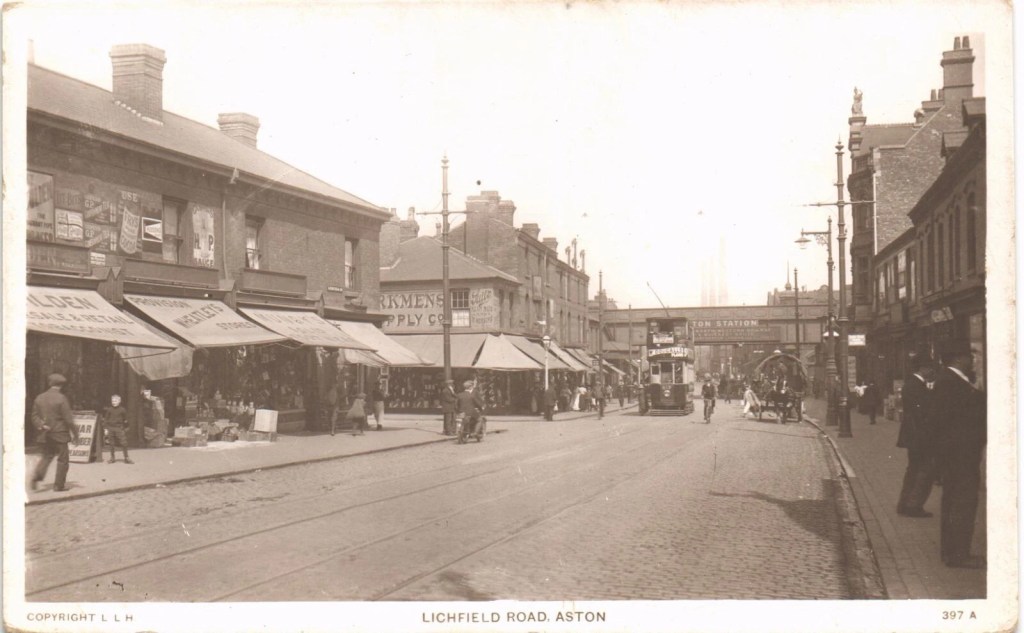
Lichfield Road, Aston. Copyright unknown. Date also unclear but possibly early 1900s.
In 1881, Rhoda was still at 36 Lichfield Road, Aston, still a pawnbroker, this time with a new assistant boarding with her, Caroline Kent. Rhoda was also shown as a pawnbroker in trade directories at this address in 1876, 1879 and 1884. But, after that, things changed considerably for her.
In the first quarter of 1886, at last, Rhoda got married! At the age of 59, Rhoda married widower David Round who was also a pawnbroker, in Netherton. He had two sons and four daughters by two previous marriages. Rhoda moved to Netherton where the wider Round family had several businesses, including the pawnbroker’s shop at 14 High Street. This was where David and Rhoda were living at the time of the census in 1891. They had one pawnbroker’s assistant (Ada Mitchell, aged 21, born in Birmingham) and a servant in the household. Both David and Rhoda were described as pawnbrokers so Rhoda had clearly not retired from the pawnbroking business on her marriage.
David Round died in December 1891, with probate being granted to his son James, leaving a modest estate of £1203 7s 1d. so poor Rhoda only had five years of marriage.
The census in 1901 shows Rhoda still living in Netherton in St Thomas Street, although she is no longer described as a pawnbroker, her age being given as 79 when she was living with one boarder, Sarah Gill who was 81.
Rhoda died on 28th January 1903 and was buried at Witton Cemetery, the resting place of her sister Mary Ann, and much of her family. Probate was granted to her executors Charles Vaughan, iron-caster – her nephew, son of her sister Mary Ann – and Henry Strange, brass caster. I do not know who Henry was or whether he was related to her. But, as ever, it appeared that the Alsop family had remained close through the years.
So Rhoda was the last of the children of Edward Alsop and Betty Hodgetts. Rhoda was clearly an independent woman who set up and ran a business for a number of years, in what must have been a challenging trade and in a busy and poor area of Birmingham.
Pawn Broking
By what is perhaps a curious coincidence, Rhoda ‘s brother Edward Alsop was living next to the Bennett/Collard family who had a draper’s business next to the Alsop boot and shoe business in Blackheath Market Place for some years and the Bennetts had pawnbrokers in their family too. There is no apparent direct connection but it is interesting that both families were involved in pawnbroking in this period.
But the pawnbroking connection does not end there. When I researched Lucy Bennett, I was interested to note that she had been born in Chipping Sodbury, Gloucestershire (which is about eight miles from where I live now!) and she had arrived in Blackheath by 1871 when she was Lucy Roberts.
At that time she was 18 and living in High Street, Blackheath with her uncle William Dudley who was – oh, look! – a Pawnbroker but also a draper and a Local Preacher – interesting combination, but I can see that his near neighbour Benjamin Shaw was also listed as a Stationer and Local Preacher in the same census. Another neighbour was a miner and ironmonger and yet another – William Darby – was a Grocer and Maltster. On the following page is a Benjamin Hadley, also a stationer and Methodist Local Preacher while Zachariah Willetts was a Carter and Greengrocer. Multiple occupations seemed to be quite common but clearly being a Local Preacher was a matter of some pride.
William Dudley had previously had a pawnbroker’s shop in Church Street, Oldbury but moved to High Street, Blackheath after his marriage to Mary Collard. Lucy, Mary’s niece, was an assistant in the drapery in 1871. Also living with them was William Roberts, Lucy’s brother, also born in Chipping Sodbury and also a Constantine Lovell, aged 23, born, the census says, either in Gloucester or Somerset –he was a first cousin to Lucy, their mothers were Collard sisters and poor Constantine apparently wasn’t even sure where he had been born. He was actually born in Clifton in Bristol, I was able to confirm with today’s searching resources available to me but later in life he gave his place of birth as various parts of Somerset and Gloucestershire.
Several of the Collards and their extended family appeared to combine pawnbroking with their outfitter’s trade.
Lucy’s brother William Roberts, by 1881, was a pawnbroker in Halesowen Road, Netherton and appears to have stayed in Netherton until his death in 1918, but he was buried in Chipping Sodbury, his birthplace. Was it possible that this business was tied in somehow with David Round who married Rhoda Alsop and who was also a pawnbroker in Netherton? Perhaps or perhaps there was sufficient pawnbroking business in the town to support more than one pawnbroker.
Constantine Lovell was also William Dudley’s nephew, also became a pawnbroker and shipping agent in Harborne. But by the time of his son Frederick’s marriage in 1908, both Constantine and Frederick were shown as tailors, so back to the drapery/outfitters/pawnbrokers connection, it seems. Perhaps unredeemed pawned items were sold on in the drapers or outfitter’s shop? But it seems that pawnbroking could be combined with various other trades.
I had never been aware of any pawnbrokers in Blackheath and they were probably no longer around by the time I was growing up there. But only a couple of weeks ago, I was very interested to see a photograph of Blackheath High Street in 1915, posted on Facebook and there, above the Loan Office, were the three balls which denoted a pawnbroker! Not Rhoda’s shop but definitely in Blackheath so that may at one time have been where William Dudley originally had his shop.
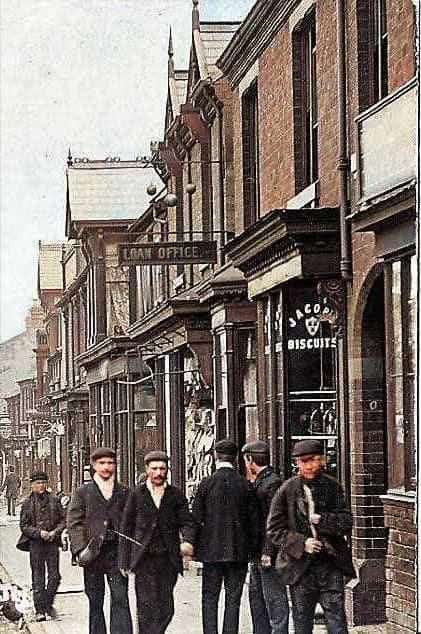
High Street, Blackheath, 1915. Copyright unknown.
Conclusion
So – at considerably greater length than I had originally expected – this concludes the family study for the Alsop family, one time millers of Tippity Green. Like so many local business families, their children took up similar or complementary occupations to their parents and siblings and married into the same sort of families, several of them becoming very prosperous indeed in the fullness of time. But few of them seem to have remained in Rowley Regis and mostly made their lives elsewhere.
The Alsop family was very different from most of the core families who made nails or worked in the quarry or in local foundries and who had lived in the hamlets for so many centuries but it has been interesting to me to explore their ventures through these posts. I hope in particular that these stories will be of interest to Dennis Allsopp and the members of the Allsopp One Name Study.

