In the course of my research, I have often come across reports of Inquests in the newspapers and in Hitchmough. In the 19th century these were usually held in the nearest pub to the incident in which the death occurred which meant that local people could observe the proceedings and give evidence when required. And many newspaper reports of more interesting inquests went into great detail. There are reports in Dicken’s novels of such inquests, too – there were very few dedicated Coroner’s Courts then and often a pub would be the only building in poorer areas where there was a suitable room for the purpose. I often read about family historians now who are trying to trace a formal Coroner’s Decision, only to learn that many if not most have been disposed of and no longer exist. So the newspaper reports can be a valuable resource and are often the only surviving record of the proceedings.
Whilst researching the children and grandchildren of William Rollason, I was interested to see that a report from a Coroner’s personal notebook (West Yorkshire, England, County Coroner Notebooks, 1852-1909) was being suggested by Ancestry as a source of information. I have never seen such a document before and it is clearly a very precious resource for family historians. This particular notebook was noted as belonging to Thomas Taylor at the beginning of the book. It contained not the formal records but the Coroner’s own handwritten detailed notes taken during the inquests, a particularly contemporary record, precise and unaffected by the sense of drama which often shaped newspaper reports.
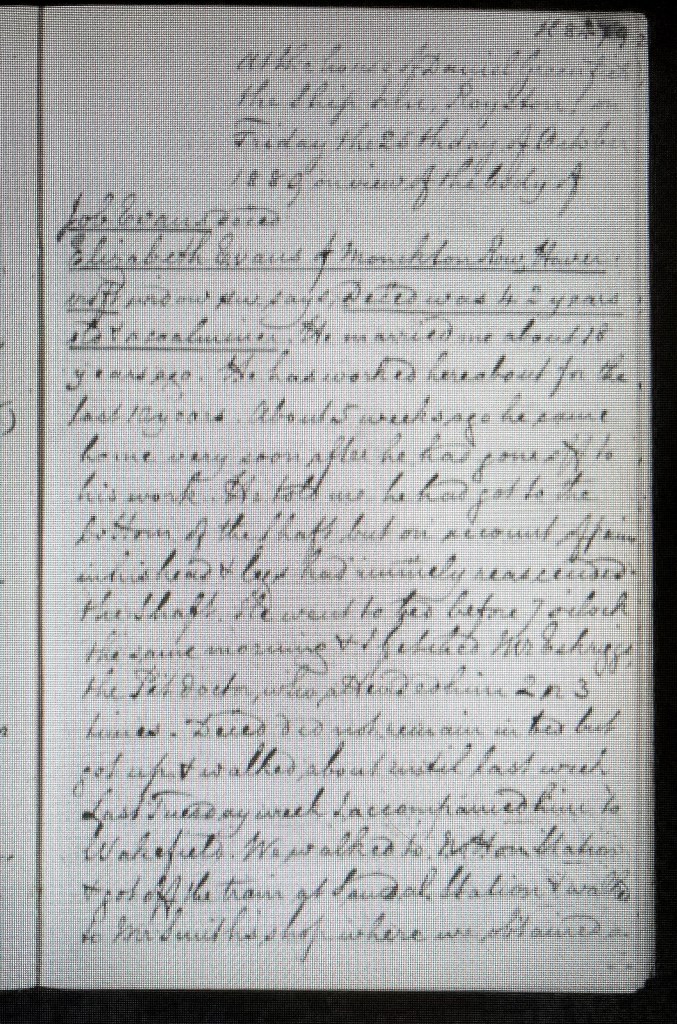
Copyright: West Yorkshire, England, County Coroner Notebooks, 1852-1909
This report related to Job Evans who had died on 25 October 1889 in Hemsworth, near Wakefield, West Yorkshire, aged 41. So how does this relate to my One Place Study?
Job was married to Sarah Williams, daughter of Rhoda Rollason and Thomas Williams, granddaughter of William and Jane Rollason, who were the subject of my latest piece on the residents of Turner’s Hill in the 1841 Census.
Job and Elizabeth were married in St James’s Church, Eve Hill, Dudley on 18 March 1867. Job was 19 and Elizabeth 18. He had been born in Tipton, one of ten children and he and his father were miners. In 1871, they were living with Elizabeth’s parents in Dudley. They remained in Dudley until about 1877 and the first three of their children were born there. They appear to have moved for a time to Skegby, near Mansfield, Nottinghamshire where Job was a miner and at least two of their children were born there in 1878 and 1879. By 1881, they were living in Havercroft-cum-Cold Hiendley in Yorkshire, a small mining village where, again Job was working as a miner. By 1889, when Job died, the couple had nine surviving children, the last three born in Yorkshire. Elizabeth’s parents Thomas and Rhoda Williams were also living in Havercroft in 1881, in the next street and they later moved to Featherstone, near Pontefract.
Copyright: Havercroft-with-Cold Hiendley Parish Council
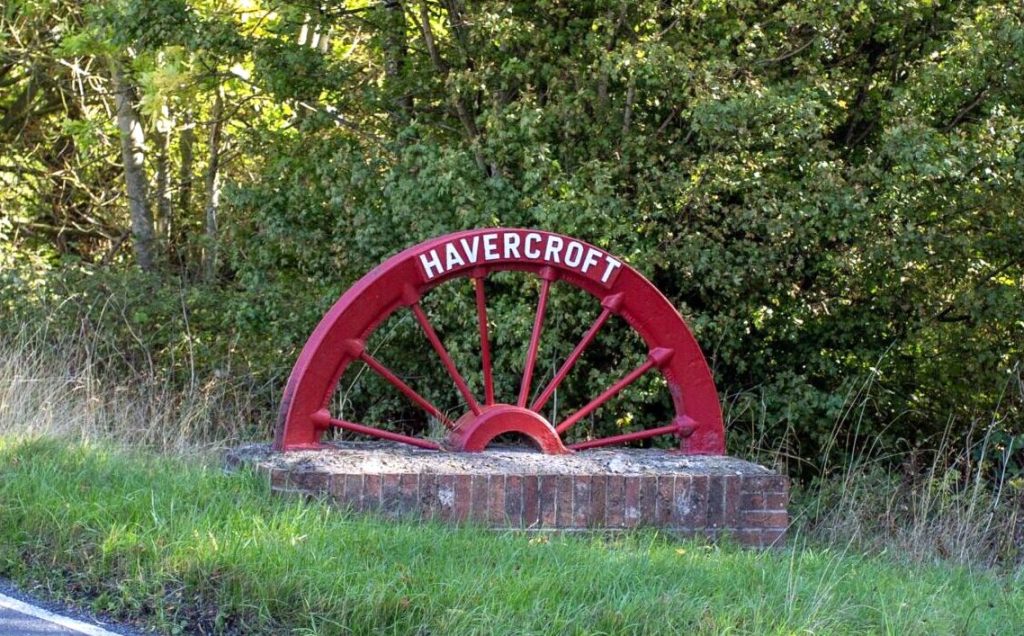
Havercroft-cum-Cold Hiendley was a small village, not far from Wakefield which was mostly a mining community. Today, Havercroft With Cold Hiendley features a landscape where reclaimed industrial land has been transformed into country parks and nature reserves and it is apparently well known for the walks and biking trails there. In the late-1800s country walks probably did not feature much in the day-to-day lives of mining families.
The Inquest
The notes in the Coroner’s report begin by detailing the date of the inquest, the venue (The Ship Inn, Royston) and the name of the deceased.
The notes give the background to Job’s death, beginning with the sworn evidence of Elizabeth Evans (nee Williams), of Monckton Row, Havercroft:
“Deceased was 42 years old and a coalminer. He married me about 18 years ago. He has worked hereabout for the last ten years. About 5 weeks ago he came home very soon after he had gone off to his work. He told me that he had got to the bottom of the shaft but on account of pain in his head & legs had immediately ascended the shaft. He went to bed before 7.00 the same morning and I fetched Mr Eskrigge, the Pit Doctor, who attended him 2 or 3 times.
Deceased did not remain in bed but got up and walked about until last week. Last Tuesday week I accompanied him to Wakefield. We walked to Notton Station and got off the train at Sandal Station & walked to Mr Smith’s shop where we obtained a bottle of medicine. Deceased had difficulty in reaching home and as soon as he arrived there he was undressed and helped to bed. We passed Mr Eskrigge’s Surgery on our way home and I called and saw him but deceased walked on. He had a glass of beer at Wakefield. He has been confined to bed from that day & has not had any beer or spirits since.
I sent my daughter Sarah, aged 13 years, to the Doctor on the following day. She told me that he was out. She went again in the afternoon & came back with a bottle of medicine & said the Doctor could not come that day. The Doctor saw the deceased on the morning of Thursday the 17th inst. And each day up to last Tuesday when he died about half past 1 o’clock.
Deceased had been very restless until I gave him a dose of Mr Eskrigge’s medicine which seemed to thrown him into a sleep. Therefore I did not give more than three doses altho’ directions were that he should have a dose every 4 hours. He required to be shaken up to be at all roused. He did not take any food. I sat up with him at nights up to Sunday last.
His brother John Evans arrived last Monday & took charge of the bottle with the medicine in it after the deceased’s death. Last Sunday I called in Mr Coleman of Pontefract & he told me that the deceased was dying. He sent some medicine, however and deceased had some of it given to him according to the directions on the bottle.”
The next evidence noted was that of John Blackburn, of Pitt Street, Barnsley, surgeon, who had performed a post-mortem, presumably because the death was unexplained, although, after some weeks of illness, it appears not unexpected by the end. He reported:
“Deceased was a stranger to me. Yesterday afternoon, accompanied by Police Constable Moore and Mr Eskrigge, I went to his house where I found his body laid on a coffin board on a bed upstairs. There was not any unusual appearance externally. Rigor mortis was fully developed. The pupil of each eye was dilated. The body was thin and spare. On removing the skull cap, I found all the membranes, (especially the arachnoid) very much congested & between the archnoid and on the surface of the brain on both sides there was a large quantity of pus. On removing the brain from the skull, a large quantity of pus was found between the lobes of the cerebellum. There was not any effusion in the ventriles. The bloody points in the substance of the brain were very much intensified. There was not any sign of violence. Both lungs were fast from very old adhesions. There was general adherence of all the organs – the lungs were much congested as would likely be caused by hypostasis. The abdominal organs were normal. The stomach was empty. In my opinion, the cause of death was congestion of the Lungs, followed by arachnitis.”
So he considered that Job had died from a lung infection, Hypostasis means the settling of blood and fluids in the lower parts of an organ or a body, due to gravity and weak circulation, which can lead to hypostatic pneumonia. This would have been brought on by his being confined to bed for a long period.
The Coroner noted the Verdict of the Jury: Died from natural causes.
So – what was this illness which afflicted the relatively young and previously healthy Job?
With the aid of the resources available to us now, and the benefits of modern science and technology, I was able to discover, by googling these symptoms, that poor Job may have had a brain abscess, or an infection of that nature, all his symptoms fit with this and, even today, this is a medical emergency requiring prompt treatment and strong antibiotics. Such abscesses can be caused by infection moving across from sinus, ear or dental infections. Key symptoms listed now include severe headache, fever or chills, stiff neck, confusion or changes in mental state, seizures and weakness or trouble moving parts of the body. It seems that without any of the modern technology which would enable a correct diagnosis and without any means of treating the infection, even had they known what the problem was, poor Job was doomed from the outset.
Another possibility was that he had an aneurism in his skull, either burst or not, either way likely to be fatal, although the post mortem examination made no mention of an aneurism being found, it could have been leaking and given rise to the infection. But the fact that he was able to travel and walk to the station only a few days before his death make this less likely, I suspect.
I can find no trace of a condition currently listed as arachnitis, which was mentioned as a cause of death by the surgeon. There is a rare condition called arachnoiditis which may be a more modern term for the same condition, as many of the symptoms also fit with Job’s illness. The arachnoid is one of the membranes that surround and protect the spinal cord and its nerves. Such inflammation may be a response to injury or infection, so may have spread from an infection in the brain.
Diagnosis of this today requires MRI scans, lumbar punctures, myelography and an electromyogram. And even today with this panoply of modern diagnostic aids, the condition is said to be challenging to diagnose and complex to treat, with a combination of pain management, physical therapy, exercise and counselling – with possible surgery to remove scarring where the condition is found only in a small area. Again, what chance in the 1880s for a humble miner in a small village with little access to proper diagnosis or meaningful treatment?
Elizabeth’s evidence – suspicious circumstances?
But I was also interested that, from the report, it appeared that Elizabeth was careful to demonstrate throughout her evidence that Job’s death was not due to any overdose or deliberate malfeasance on her part. She emphasises that she gave her husband only the prescribed doses or less of various bottles of ‘medicine’ which had been prescribed by the doctors (sometimes without even seeing his patient), sometimes less.
It is possible, even likely, that one or more of these medicines contained laudanum, which acted as a sedative and an overdose could certainly cause death. In the 18th and 19th centuries, people used Laudanum as a common cure-all for pain, coughs, insomnia, and diarrhea. It is rarely prescribed today. It contained powdered opium and high proof alcohol and was highly addictve. Common effects included drowsiness, extreme sleepiness, dizziness, and severe constipation. It also carried severe dangers – Slowed or shallow breathing (respiratory depression), overdose, and death. Any or all of these symptoms might be inferred from the descriptions of Job’s deterioration and it is possible, if the bottles of medicine prescribed did contain laudanum, may have been contributory factors in his decline.
Was Elizabeth under suspicion? Did local gossips speculate that Job’s unexplained illness over five weeks was in some way, a poisoning or deliberate harm? When a police constable and two doctors arrived at the house, after his death, I am sure this would have been noted by their neighbours. And Job’s brother John, who was by that time living about 11 miles away in Hoyland, Yorkshire with his family, had taken charge of the medicine bottle after his brother died – did he think Elizabeth was under suspicion? Were her parents supportive? They were living in the same village but are not mentioned in this account.
Poor Elizabeth, not only had she lost her husband and his income, leaving her with nine children, the youngest, Annie, only born in March of that year and the four youngest all under the age of ten but she would not have known what had caused his death or what had contributed to it. She probably did not really know for the rest of her life, indeed I suspect that most families would struggle to comprehend this illness even today, with all the resources available to us. What a sad situation for her.
Elizabeth was still only 39, she did not stay in Havercroft-cum-Cold Hiendley for very long after Job’s death, indeed the house they were living in may well have been a pit tied house so that once her husband was dead she had to move. By the time of the 1891 Census, she had moved three miles to Royston, where her eldest son Thomas was working as a general labourer – perhaps neither Elizabeth nor Thomas wanted him working in the pit. She also had two boarders who were coal miners which would have brought her some additional income.
But, in September 1896, Elizabeth married again in Warmfield, Yorkshire, to Thomas Skelton, a miner and widower a couple of years her junior. Thomas was not a Yorkshireman, he had been born in Rowley Regis and his first marriage had taken place in Tipton, his first three children were born in Netherton. In 1881 both Job and Elizabeth and Thomas and his family had been living in the same street in Havercroft so it seems likely that, as mining families and Black Country folk, they knew each other before Job died.
As we have seen previously, there seems to have been a Black Country enclave in this small village, I counted more than 25 families (including Thomas Skelton’s brother Herbert) in the ten pages around the Evans household, who were from the Black Country – Dudley, Gornal, Tipton, Kates Hill, Brierley Hill, Pensnett – all miners. There were people from other areas, too, mostly mining districts as well as local people. The local population appear to have been out-numbered by the incomers. Perhaps the Yorkshire mine owners and managers had been expanding their operations and had been recruiting around Dudley and other mining areas, it seems unlikely that all these families should have chosen to travel so far to settle in this small village unless they had been brought there by their employers. The Black Country mines were not worked out at this time, there must have been an incentive to leave their roots behind.
In 1891 Thomas was living in Leeds, Yorkshire with his wife and family but at least four of their daughters died in Leeds between 1888 and 1889, and his wife died there in 1894. At some point or perhaps at the time of their marriage, Thomas moved back to Royston with, as far as I can see, three remaining living children but another daughter died in Royston in March 1896. Without buying death certificates, I do not know why so many children died in a relatively short period – at ages ranging from 9-14, although it is possible that a disease such as consumption or TB affected both the girls and Thomas’s wife. Both families had been afflicted with tragedy and early deaths.
In 1901, the blended family – with Elizabeth, Thomas, four of her children and two of his – were living in Millgate Street, Royston.
By 1911, Elizabeth was again a widow, (Thomas died in 1908, aged 55) and was shown in the 1911 Census as a Grocer and shopkeeper in Royston, by now with her daughter Annie, Annie’s husband Joseph Mirfin, Elizabeth’s stepson Thomas Skelton (21) and three grandchildren – Frederick Hawkes (23), John W Powers (17) and Violet Powers (9). All of these men were working at the colliery, Joseph Mirfin as a hewer and the other three all as pony drivers below ground.
I can find no trace of Elizabeth in the 1921 Census but there is a death of an Elizabeth Skelton in the Barnsley Registration District (which covers Royston) in the first quarter of 1914, and, with the age of 63, this would tally with our Elizabeth.
The Coroner’s Notebook
It was interesting for me to see the detailed and professional way that the Coroner had kept his notes, they flow very naturally and in detail and his handwriting was clear. This report was page 106 of 141 so the Notebook obviously contains dozens if not hundreds of reports, an invaluable original contemporaneous source of information for family historians.
But I was struck by the vulnerable position of the widow of the man, who was taking such pains in her evidence to show that she had done nothing wrong. The post-mortem evidence and the verdict must have been a great relief to her but I do not know whether this was reported in the local newspapers, I have not found any trace of it but it may simply be that those newspapers have not yet been added to the newspaper archives or that no report was made.
Whatever happened then, there must have remained a mystery in Elizabeth’s mind about what had caused her husband’s death and whether there was any more she could have done to prevent it. Or perhaps, in a time when sudden death was not as uncommon as it is now, whether through industrial accidents and associated illnesses or through illnesses which proved fatal without antibiotics, once the natural causes verdict was pronounced, perhaps Elizabeth was able to live without guilt. I hope so.
I hope my readers will excuse this diversion from Rowley Regis to West Yorkshire and found this sad story interesting.
–

