A Coroner’s Notebook

In the course of my research, I have often come across reports of Inquests in the newspapers and in Hitchmough. In the 19th century these were usually held in the nearest pub to the incident in which the death occurred which meant that local people could observe the proceedings and give evidence when required. And many newspaper reports of more interesting inquests went into great detail. There are reports in Dicken’s novels of such inquests, too – there were very few dedicated Coroner’s Courts then and often a pub would be the only building in poorer areas where there was a suitable room for the purpose.  I often read about family historians now who are trying to trace a formal Coroner’s Decision, only to learn that many if not most have been disposed of and no longer exist. So the newspaper reports can be a valuable resource and are often the only surviving record of the proceedings.

Whilst researching the children and grandchildren of William Rollason, I was interested to see that a report from a Coroner’s personal notebook (West Yorkshire, England, County Coroner Notebooks, 1852-1909) was being suggested by Ancestry as a source of information. I have never seen such a document before and it is clearly a very precious resource for family historians. This particular notebook was noted as belonging to Thomas Taylor at the beginning of the book. It contained not the formal records but the Coroner’s own handwritten detailed notes taken during the inquests, a particularly contemporary record, precise and unaffected by the sense of drama which often shaped newspaper reports.
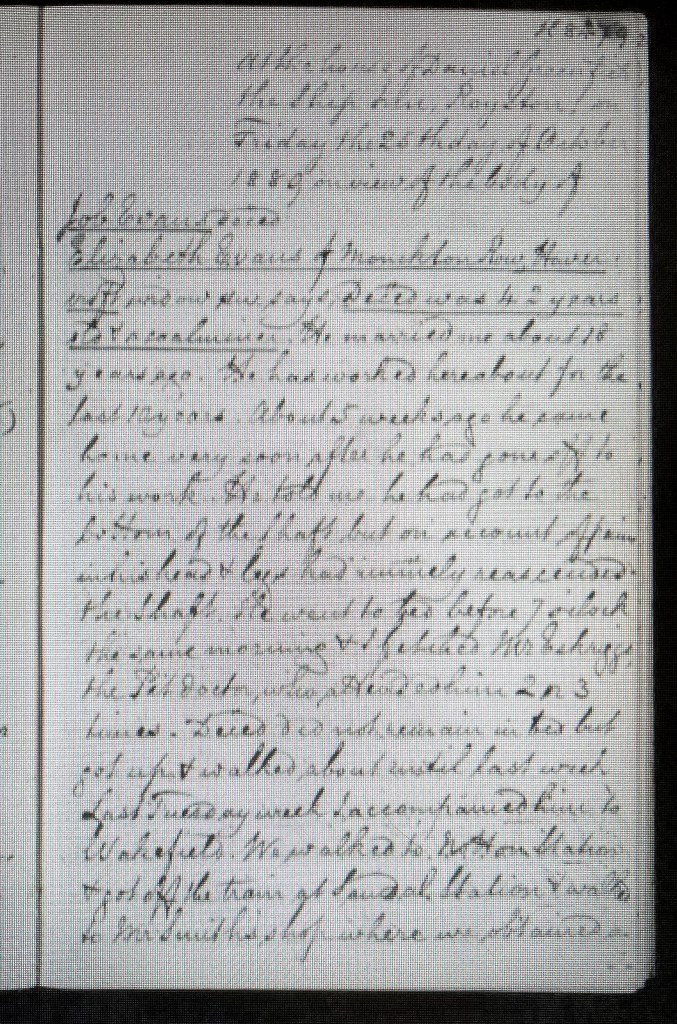
Copyright: West Yorkshire, England, County Coroner Notebooks, 1852-1909

This report related to Job Evans who had died on 25 October 1889 in Hemsworth, near Wakefield, West Yorkshire, aged 41. So how does this relate to my One Place Study?

Job was married to Sarah Williams, daughter of Rhoda Rollason and Thomas Williams, granddaughter of William and Jane Rollason, who were the subject of my latest piece on the residents of Turner’s Hill in the 1841 Census.

Job and Elizabeth were married in St James’s Church, Eve Hill, Dudley on 18 March 1867. Job was 19 and Elizabeth 18. He had been born in Tipton, one of ten children and he and his father were miners. In 1871, they were living with Elizabeth’s parents in Dudley. They remained in Dudley until about 1877 and the first three of their children were born there. They appear to have moved for a time to Skegby, near Mansfield, Nottinghamshire where Job was a miner and at least two of their children were born there in 1878 and 1879. By 1881, they were living in Havercroft-cum-Cold Hiendley in Yorkshire, a small mining village where, again Job was working as a miner. By 1889, when Job died, the couple had nine surviving children, the last three born in Yorkshire. Elizabeth’s parents Thomas and Rhoda Williams were also living in Havercroft in 1881, in the next street and they later moved to Featherstone, near Pontefract.
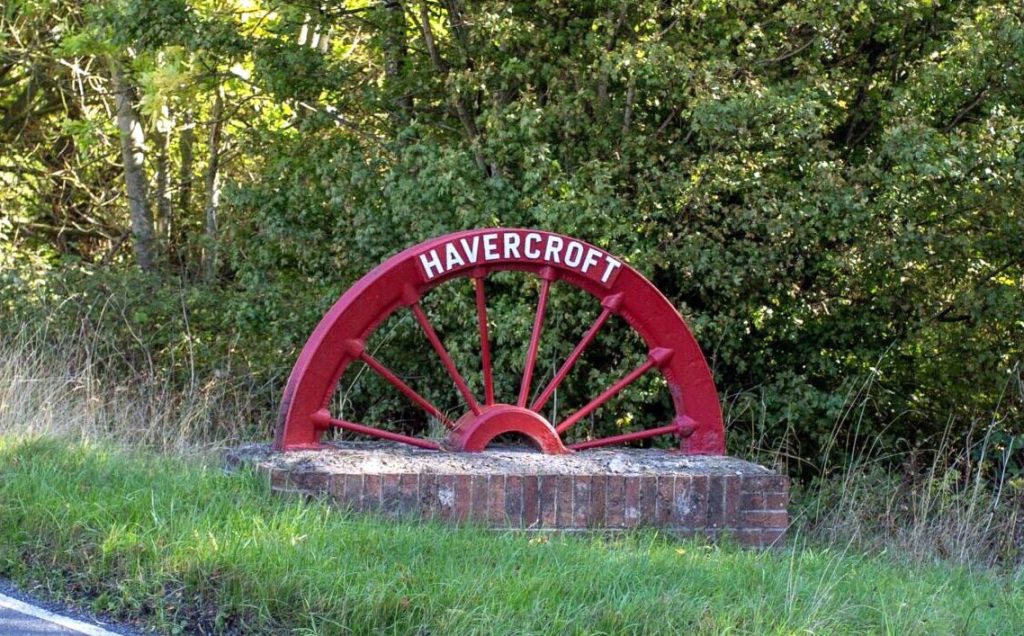
Copyright: Havercroft-with-Cold Hiendley Parish Council

Havercroft-cum-Cold Hiendley was a small village, not far from Wakefield which was mostly a mining community. Today, Havercroft With Cold Hiendley features a landscape where reclaimed industrial land has been transformed into country parks and nature reserves and it is apparently well known for the walks and biking trails there. In the late-1800s country walks probably did not feature much in the day-to-day lives of mining families.

The Inquest

The notes in the Coroner’s report begin by detailing the date of the inquest, the venue (The Ship Inn, Royston) and the name of the deceased.

The notes give the background to Job’s death, beginning with the sworn evidence of Elizabeth Evans (nee Williams), of Monckton Row, Havercroft:

“Deceased was 42 years old and a coalminer. He married me about 18 years ago. He has worked hereabout for the last ten years. About 5 weeks ago he came home very soon after he had gone off to his work. He told me that he had got to the bottom of the shaft but on account of pain in his head & legs had immediately ascended the shaft. He went to bed before 7.00 the same morning and I fetched Mr Eskrigge, the Pit Doctor, who attended him 2 or 3 times.

Deceased did not remain in bed but got up and walked about until last week. Last Tuesday week I accompanied him to Wakefield. We walked to Notton Station and got off the train at Sandal Station & walked to Mr Smith’s shop where we obtained a bottle of medicine. Deceased had difficulty in reaching home and as soon as he arrived there he was undressed and helped to bed. We passed Mr Eskrigge’s Surgery on our way home and I called and saw him but deceased walked on. He had a glass of beer at Wakefield. He has been confined to bed from that day & has not had any beer or spirits since.

I sent my daughter Sarah, aged 13 years, to the Doctor on the following day. She told me that he was out. She went again in the afternoon & came back with a bottle of medicine & said the Doctor could not come that day. The Doctor saw the deceased on the morning of Thursday the 17th inst. And each day up to last Tuesday when he died about half past 1 o’clock.

Deceased had been very restless until I gave him a dose of Mr Eskrigge’s medicine which seemed to thrown him into a sleep. Therefore I did not give more than three doses altho’ directions were that he should have a dose every 4 hours. He required to be shaken up to be at all roused. He did not take any food. I sat up with him at nights up to Sunday last.

His brother John Evans arrived last Monday & took charge of the bottle with the medicine in it after the deceased’s death. Last Sunday I called in Mr Coleman of Pontefract  & he told me that the deceased was dying. He sent some medicine, however and deceased had some of it given to him according to the directions on the bottle.”

The next evidence noted was that of John Blackburn, of Pitt Street, Barnsley, surgeon, who had performed a post-mortem, presumably because the death was unexplained, although, after some weeks of illness, it appears not unexpected by the end. He reported:

“Deceased was a stranger to me. Yesterday afternoon, accompanied by Police Constable Moore and Mr Eskrigge, I went to his house where I found his body laid on a coffin board on a bed upstairs. There was not any unusual appearance externally. Rigor mortis was fully developed. The pupil of each eye was dilated. The body was thin and spare. On removing the skull cap, I found all the membranes, (especially the arachnoid) very much congested & between the archnoid and on the surface of the brain on both sides there was a large quantity of pus. On removing the brain from the skull, a large quantity of pus was found between the lobes of the cerebellum. There was not any effusion in the ventriles. The bloody points in the substance of the brain were very much intensified. There was not any sign of violence. Both lungs were fast from very old adhesions. There was general adherence of all the organs – the lungs were much congested as would likely be caused by hypostasis. The abdominal organs were normal. The stomach was empty. In my opinion, the cause of death was congestion of the Lungs, followed by arachnitis.”

So he considered that Job had died from a lung infection, Hypostasis means the settling of blood and fluids in the lower parts of an organ or a body, due to gravity and weak circulation, which can lead to hypostatic pneumonia. This would have been brought on by his being confined to bed for a long period.

The Coroner noted the Verdict of the Jury: Died from natural causes.

So – what was this illness which afflicted the relatively young and previously healthy Job?

With the aid of the resources available to us now, and the benefits of modern science and technology, I was able to discover, by googling these symptoms, that poor Job may have had a brain abscess, or an infection of that nature, all his symptoms fit with this and, even today, this is a medical emergency requiring prompt treatment and strong antibiotics. Such abscesses can be caused by infection moving across from sinus, ear or dental infections.  Key symptoms listed now include severe headache, fever or chills, stiff neck, confusion or changes in mental state, seizures and weakness or trouble moving parts of the body. It seems that without any of the modern technology which would enable a correct diagnosis and without any means of treating the infection, even had they known what the problem was, poor Job was doomed from the outset.

Another possibility was that he had an aneurism in his skull, either burst or not, either way likely to be fatal, although the post mortem examination made no mention of an aneurism being found, it could have been leaking and given rise to the infection. But the fact that he was able to travel and walk to the station only a few days before his death make this less likely, I suspect.

I can find no trace of a condition currently listed as arachnitis, which was mentioned as a cause of death by the surgeon.  There is a rare condition called arachnoiditis which may be a more modern term for the same condition, as many of the symptoms also fit with Job’s illness. The arachnoid is one of the membranes that surround and protect the spinal cord and its nerves. Such inflammation may be a response to injury or infection, so may have spread from an infection in the brain.

Diagnosis of this today requires MRI scans, lumbar punctures, myelography and an electromyogram. And even today with this panoply of modern diagnostic aids, the condition is said to be challenging to diagnose and complex to treat, with a combination of pain management, physical therapy, exercise and counselling – with possible surgery to remove scarring where the condition is found only in a small area. Again, what chance in the 1880s for a humble miner in a small village with little access to proper diagnosis or meaningful treatment?

Elizabeth’s evidence – suspicious circumstances?

But I was also interested that, from the report, it appeared that Elizabeth was careful to demonstrate throughout her evidence that Job’s death was not due to any overdose or deliberate malfeasance on her part. She emphasises that she gave her husband only the prescribed doses or less of various bottles of ‘medicine’ which had been prescribed by the doctors (sometimes without even seeing his patient), sometimes less.

It is possible, even likely, that one or more of these medicines contained laudanum, which acted as a sedative and an overdose could certainly cause death. In the 18th and 19th centuries, people used Laudanum as a common cure-all for pain, coughs, insomnia, and diarrhea. It is rarely prescribed today. It contained powdered opium and high proof alcohol and was highly addictve. Common effects included drowsiness, extreme sleepiness, dizziness, and severe constipation. It also carried severe dangers – Slowed or shallow breathing (respiratory depression), overdose, and death. Any or all of these symptoms might be inferred from the descriptions of Job’s deterioration and it is possible, if the bottles of medicine prescribed did contain laudanum, may have been contributory factors in his decline.

Was Elizabeth under suspicion? Did local gossips speculate that Job’s unexplained illness over five weeks was in some way, a poisoning or deliberate harm? When a police constable and two doctors arrived at the house, after his death, I am sure this would have been noted by their neighbours. And  Job’s brother John, who was by that time living about 11 miles away in Hoyland, Yorkshire with his family, had taken charge of the medicine bottle after his brother died – did he think Elizabeth was under suspicion? Were her parents supportive? They were living in the same village but are not  mentioned in this account.

Poor Elizabeth, not only had she lost her husband and his income, leaving her with nine children, the youngest, Annie, only born in March of that year and the four youngest all under the age of ten but she would not have known what had caused his death or what had contributed to it. She probably did not really know for the rest of her life, indeed I suspect that most families would struggle to comprehend this illness even today, with all the resources available to us.  What a sad situation for her.

Elizabeth was still only 39, she did not stay in Havercroft-cum-Cold Hiendley for very long after Job’s death, indeed the house they were living in may well have been a pit tied house so that once her husband was dead she had to move. By the time of the 1891 Census, she had moved three miles to Royston, where her eldest son Thomas was working as a general labourer – perhaps neither Elizabeth nor Thomas wanted him working in the pit. She also had two boarders who were coal miners which would have brought her some additional income.

 But, in September 1896, Elizabeth married again in Warmfield, Yorkshire, to Thomas Skelton, a miner and widower a couple of years her junior. Thomas was not a Yorkshireman, he had been born in Rowley Regis and his first marriage had taken place in Tipton, his first three children were born in Netherton. In 1881 both Job and Elizabeth and Thomas and his family had been living in the same street in Havercroft   so it seems likely that, as mining families and Black Country folk, they knew each other before Job died.

As we have seen previously, there seems to have been a Black Country enclave in this small village, I counted more than 25 families (including Thomas Skelton’s brother Herbert) in the ten pages around the Evans household, who were from the Black Country – Dudley, Gornal, Tipton, Kates Hill, Brierley Hill, Pensnett – all miners. There were people from other areas, too, mostly mining districts as well as local people. The local population appear to have been out-numbered by the incomers. Perhaps the Yorkshire mine owners and managers had been expanding their operations and had been recruiting around Dudley and other mining areas, it seems unlikely that all these families should have chosen to travel so far to settle in this small village unless they had been brought there by their employers. The Black Country mines were not worked out at this time, there must have been an incentive to leave their roots behind.

In 1891 Thomas was living in Leeds, Yorkshire with his wife and family but at least four of their daughters died in Leeds between 1888 and 1889, and his wife died there in 1894. At some point or perhaps at the time of their marriage, Thomas moved back to Royston with, as far as I can see, three remaining living children but another daughter died in Royston in March 1896. Without buying death certificates, I do not know why so many children died in a relatively short period – at ages ranging from 9-14, although it is possible that a disease such as consumption or TB affected both the girls and Thomas’s wife. Both families had been afflicted with tragedy and early deaths.

 In 1901, the blended family – with Elizabeth, Thomas, four of her children and two of his – were living in Millgate Street, Royston.

By 1911, Elizabeth was again a widow, (Thomas died in 1908, aged 55) and was shown in the 1911 Census as a Grocer and shopkeeper in Royston, by now with her daughter Annie, Annie’s husband Joseph Mirfin, Elizabeth’s stepson Thomas Skelton (21) and three grandchildren – Frederick Hawkes (23), John W Powers (17) and Violet Powers (9). All of these men were working at the colliery, Joseph Mirfin as a hewer and the other three all as pony drivers below ground.

I can find no trace of Elizabeth in the 1921 Census but there is a death of an Elizabeth Skelton in the Barnsley Registration District (which covers Royston) in the first quarter of 1914, and, with the age of 63, this would tally with our Elizabeth.

The Coroner’s Notebook

It was interesting for me to see the detailed and professional way that the Coroner had kept his notes, they flow very naturally and in detail and his handwriting was clear. This report was page 106 of 141 so the Notebook obviously contains dozens if not hundreds of reports, an invaluable original contemporaneous source of information for family historians.

But I was struck by the vulnerable position of the widow of the man, who was taking such pains in her evidence to show that she had done nothing wrong. The post-mortem evidence and the verdict must have been a great relief to her but I do not know whether this was reported in the local newspapers, I have not found any trace of it but it may simply be that those newspapers have not yet been added to the newspaper archives or that no report was made.

Whatever happened then, there must have remained a mystery in Elizabeth’s mind about what had caused her husband’s death and whether there was any more she could have done to prevent it. Or perhaps, in a time when sudden death was not as uncommon as it is now, whether through industrial accidents and associated illnesses or through illnesses which proved fatal without antibiotics, once the natural causes verdict was pronounced, perhaps Elizabeth was able to live without guilt. I hope so.

I hope my readers will excuse this diversion from Rowley Regis to West Yorkshire and found this sad story interesting.

–
The 1841 Census – Turner’s Hill 2 – The Rollasons

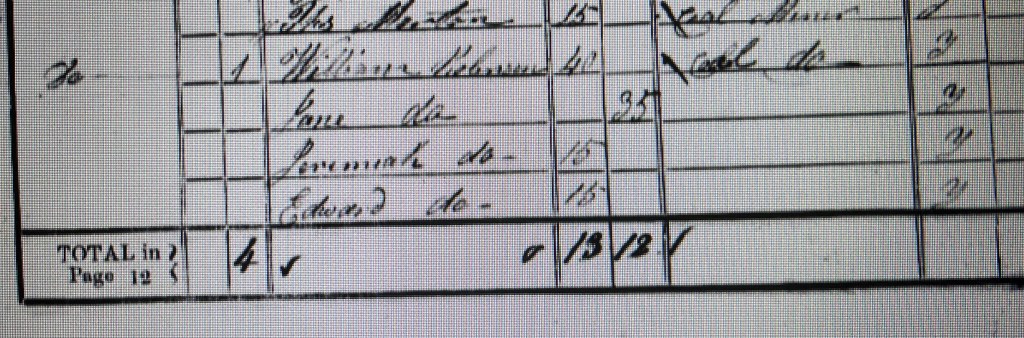
The next family listed in the 1841 Census is that of William “Robinson“, it appears or that is how it is transcribed on Ancestry – bear with me. Start with the basics – this is the family group as shown on the page, as transcribed on Ancestry and  on FindMyPast:

Christian nameSurnameAgeOccupationWhether born in CountyWhether born in Scotland, Ireland or Foreign Parts
WilliamRobinson40Coal minerYes 
JaneRobinson35 Yes 
JeremiahRobinson15 Yes 
EdwardRobinson15 Yes 
JamesRobinson13 Yes 
RodahRobinson11 Yes 
MarthaRobinson9 Yes 
RuthRobinson4 Yes 
ElizabethRobinson1 Yes 

Fairly straightforward then, local family, all born in Staffordshire. But, unusually, there were very few clues about them on Ancestry which is usually quick to offer hints to other records for names I am researching. Although the hints can be spurious, sometimes they can offer useful links. But I did notice, looking on Ancestry at the details of the census entry for William, that someone had suggested that his name was actually Rollason or Rollinson. Ah, yes, now that is definitely a local name that I recognise.

Copyright: The National Archives. HO 107/997/3.

You can see how the name is difficult to read in this small extract from the 1841 Census (the other children are on the next page) and this looks more like Rolinson than Rollason but for someone not familiar with local names, Robinson was a reasonable guess. But from comparisons with other records over several decades of his life, I have settled on using Rollason for him as the name this man was recorded as most!

Copyright Mike Fenton.

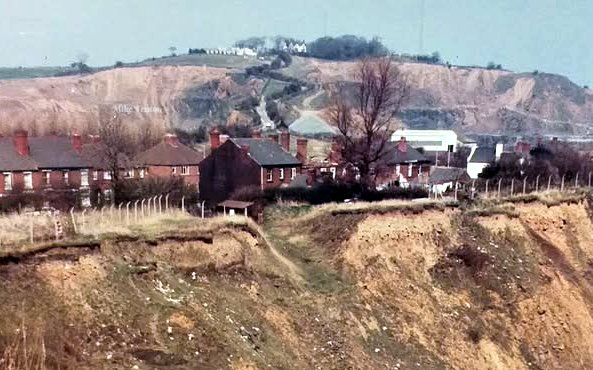
Taken in the 1970s, this view is looking over Alsop’s Quarry and the houses and farms can be seen at the top of Turner’s Hill, though it is impossible to know whether these were exactly the same houses as in 1841. But it does show how far up the hill they were from the village of Rowley and may be a clue to why the families there often used Dudley, rather than Rowley as their church.

The Robinsons/Rollasons

Out of interest, I checked the Rowley Regis Parish Registers to see how long Rollasons had been in the parish and there was a first clue to potential difficulties to come. Searching the digital copy of the Parish Registers is a good way of finding when people were in the parish, how many there were, whether there were any other place links, how the spelling varied. And the spelling certainly varied for this family, perhaps more than I have come across with any other Rowley family. There were 31 entries for names beginning with Rol in volume 2 of the digital version of the parish Registers, none in Volume 1 – the first was in 1729 when Enoch Rolason married Mary Davis at St Giles. There were 15 entries for Rolasons in this volume with this spelling, another 10 with Roliston, 2 with Rolison, 1 Roleson, 1 Rolinson, 1 Rollison, and 1 Rolloson. And that was just for the period 1685-1772. And these related to several different branches of the family, several of them described as ‘of Dudley’ and one from Oldbury. The next tranch of the Registers – from 1771-1812- has another 96 entries, more than half spelled as Rolinson but again with another six different spellings in various parts of the register.

One of these entries was for the unfortunate Alice, wife of Stephen Rolinson. The Burial entry relates that in September 1802 she “was murdered by a red-hot nailrod being thrust into her side while at work in a nail shop. It penetrated through her stomach and a considerable way into the right lobe of her liver. She died about an hour after. The Coroner’s Inquest sat on the body from 12 o’clock at midday until 6 the next morning when a verdict was returned Wilful Murder. The murderer was acquitted at the following Stafford Assizes.” Poor Alice, what a terrible death but what a long time the jury took to return their verdict – presumably both parties were known to the jurors – oh, to have been able to hear their deliberations! I cannot find any other record of the inquest or the trial so we do not know who the other party was.

The final tranch of the Parish Registers (1813-1849), Volume 4, has 60 entries for names beginning with Rol, 46 spelled Rollason, 7 with Rolinson, 2 with Rolason, 2 with Rolaston, 2 with Rollinson, and 1 with Rollaston. So it appears that expecting any sort of consistency in identifying this name is a forlorn hope. And, for once, I do not appear to have any connection with this 1841 branch of the family, although I do have people with various spellings of this name on my tree there are only a few and they are mostly in the mid-1700s so no short cuts for me there.

The Rolinsons of Dudley

William Rol*son (1801-1862)

So, back to basics. The 1841 Census gives me no information about where William Rollason or Rollinson was born. So I looked for him in the 1851 Census which would give a more detailed place of birth and also confirm relationships within the family. But William, now definitely shown in this census as Rollason, was no longer on Turner’s Hill. By 1851, he was, with his wife Jane and children James, Ruth, Elizabeth and several younger children born after 1841 – Sarah Jane (1842), Rebecca (1844), Phoebe (1846) and Ann Maria (1849), plus his daughter-in-law Sarah and her son Jeremiah (1849)– all living in Constitution Hill, Dudley which is on the Rowley side of Dudley, near Kate’s Hill.

And living next door in 1851 in Dudley was an Edward Rollason, presumably the Edward listed as William’s son in 1841, by now married and with his own wife Mary (Mary Ann, nee Ingley or Hingley) and two children, Rosanna and William. Lodging with Edward was his sister Rhoda with her husband Thomas Williams. So, with all these matching names, it is definitely the same family.  By 1861, William and his family had moved to Bath Street, Dudley and again, Edward was living with his wife and six children two doors away, plus a lodger Henry Hingley who was presumably related to Mary Ann.

So, the 1851 Census tells me that William was born in 1801 in Dudley. In fact, all of his family were shown as having been born in Dudley which makes me suspect that they were living on the Dudley side of Rowley and of Turner’s Hill and counted this as Dudley. Now I was looking, in FreeREG,  for the birth or baptism of a William ROLLASON in about 1801.

But there is no baptism for a William Rollason in this period, anywhere in Dudley or the surrounding area. There are clusters of Rollasons (with varied spellings) in Oldbury, Brierley Hill and Wednesbury, some of the fathers were William but there was no baptism between 1798 and 1805 for a William.

However, when I searched instead for ROLINSON for the same period, up came a whole list of 64 different baptisms, including just two for William, both at Dudley St Thomas, one on 15 March 1801 the son of Joseph and Phebe Rolinson and another on 4 November 1804 for William son of John and Phebe Rolinson. There was very little variation in the spelling of the surname here, the Rolinson family name was clearly familiar and well-established in the Dudley parish. Variations in spellings at this time often arose when different people – clerks, registrars, priests – wrote down what they heard or what they expected to hear.

Hmm, just to try to get some idea of how many Rolinsons there were in the area, and whether there were any particular names in use in any of the families, I looked at baptisms for Rolinsons in Dudley St Thomas, from 1790-1810. There were what appear to be twenty Rolinson couples having their children baptised at Dudley in this period of just twenty years, including Daniel and Mary; Edward with his first wife Hannah Parsons  and second wife Prudence Griffiths;  Enoch and Ann; James and Sarah; at least three, possibly four, different Johns with their wives Leah, Mary, Phebe, Sarah and Lucy; three Josephs with their wives Nancy (possibly the same wife as Ann), Mary and Phebe;  Mark and Phebe; Nehemiah and Mary; Solomon and Ann; Stephen and Phebe; Thomas and Mary; and three Williams with wives Mary, Nancy and Sarah. They really weren’t very adventurous in their naming patterns, were they? But it seems very likely – though I have not researched this any further – that most of these were related to each other, brothers and cousins. This is indicated by the names they gave their children, too which all recur across the couples. All of the names are biblical, as is so typical of much of the Black Country at this period which is probably not surprising as the readings from the bible which they heard in chapel and church were probably the only narrative that they ever heard. I digress…

But the greatest of these was love.. sorry, I mean, the couple I was most interested in were Joseph and Phebe Rolinson . Joseph Rolinson married Phebe Davis (both of Dudley) on 2 Aug 1784 at Dudley St Thomas. They were married by banns and both made their mark so neither was literate enough to sign their names. Their children that I have found baptisms for are Jeremiah (1790), Elizabeth (1792), Mary (1793), Sarah (1796), Joseph (1797), Isaac (1799), William (1901), Benjamin (1802), and Dudley (1804). (Edward and his wife Prudence also named a son Dudley the following year so it recurs. And there was also a Dudley Rolinson baptised at DST in  1754, son of William Rolinson and Catherine (nee Dudley) so it was not completely new to the Rolinson family and was in fact a family surname brought forward.)  So it looks likely that, if this was our William, and that he named one son Jeremiah, after his brother and a daughter after his sister Sarah.

The Rolinsons were not strangers to Rowley Regis. There were 49 Rolinson entries in the Parish Registers between 1772 and 1812, plus another half dozen with variations of Rolinson, rather than Rolason. But none of them appear to relate to the William on Turner’s Hill in 1841.

In fact William is one of the most challenging people I have ever tried to trace.

I shall work on the basis that I have correctly identified the baptism at Dudley of the correct William Rolason/Rollason/Rollinson. 

William Rolinson married Jane Parkes on 23 November 1823 at Kingswinford St Mary, with Kingswinford given as the abode for them both.  The witnesses to the marriage were William Parkes and Thomas Walker.

The GRO entries for their younger children, (born after the start of civil registration in 1837) mostly -that is for Sarah Jane Rolinson(1842), Phoebe Rollason (1846) and Ann Maria Rollason(1849) ) – give a Mother’s Maiden name as Parkes  which fits with the marriage I had found. Rebecca Rolinson, born in 1845, has the Mother’s Maiden name as Vanes – which may be a Transcription error, as it is difficult to see how William could have changed wives in the middle of this period, unless she is the child of a different family – and Elizabeth Rollason, born in 1841 where the Mother’s Maiden name is shown as Smith. I cannot offer any convincing explanations for these differences, especially as William was still living with Jane in 1861 and all censuses in between.

I see also from other records that Rolinson and Rolason seem to be used interchangeably, including by children of the same parents, and also by the same person over their lifetime, just to add to the difficulties.

William and Jane were still in Bath Street in the 1861 Census, still with their son Edward next door. Their children Rebecca and Ann Maria were still living with them, plus their married daughter Sarah, now Garbet.

By the end of the following year, however, they were living in Oxford Streeet, Dudley where Jane died on 2nd November 1862, aged 63 of Bronchitis and Exhaustion, and William died on the following day, 3rd November 1862, aged 62 of Paralysis and Exhaustion. Both deaths were registered by their daughter Rhoda. They were buried together on 9th November at Dudley St Thomas.

William and Jane’s children shown in the 1841 Census:

As the family appear to have moved out of the hamlets by 1847 at the latest I have not gone into great detail about the later lives of their children and have also limited myself to those children who were living on Turner’s Hill in 1841.

Jeremiah Rolinson (1825-1843)

Jeremiah died, aged 18 years and 9 months on 5 May 1843 and was buried at Dudley St Thomas on the 7 May, noted as ‘of Rowley’.

Edward Rollason (1826-1897)

Edward was born on 10 March  1825 and baptised at Dudley St Thomas on 16 December 1838, along with James, Rhoda, Martha and Ruth. The bonus for me of this family group baptism record is that the date of birth of the children was recorded in the baptismal register so that we unusually have accurate dates of birth for these children.

Edward married Mary Ann Ingley (sometimes Hingley) (1829-1895) at Sedgley on 6 September 1847 when he was ‘of full age’ (ie 21 or over) and she was still a minor, both said to be of Dudley. Mary Ann’s father William was a Vice Maker.  The couple lived in the Dudley/Kates Hill areas and had ten children. These were Rosanna (1847-1918), William (1850), Samuel (1852-), James (1855), Reuben (1858), Edward (1860), Isaac (1863), Mary Ann (1865), Elizabeth(1867) and Minnie Martha (1869).

Edward gives his place of birth mostly as Dudley but in later censuses as Oakham which might also have been Turner’s Hill.

Up to the 1881 Census, Edward and his family were living in Constitution Hill and later in Bath Street, Dudley, often near his own parents or siblings. But in 1881, while Mary Ann Rollason, giving her marital status as Married, was living in Tower Street, Dudley with four of their younger children (aged from 12-23), Edward, now aged 60, was recorded living as a Boarder in St John Street, Dudley where he is shown as a coal dealer. He was living in the household of a widow, Mary Ann Hill, aged 41, a nailer and her son John who was a coal miner. And in 1891, when Mary Ann Rollason was living with her son Isaac and his family in Flood Street, Dudley, Edward was still living in the household of Mary Ann Hill, as a lodger, but they had apparently moved to Owen Street, Kates Hill. I say apparently because when you look at it on the map, St John’s Road appears to turn into Owen Street so it may have been the same house as in 1881. By this time Edward was described as a coal haulier and he and Mary Ann Hill were living next door to another coal haulier Charles Dewell so perhaps there was also a coal business here.  These places were only less than a mile from each other but show two separate residences over more than a decade. So it does appear that Edward and Mary Ann had separated between 1871 and 1881.

Mary Ann Rollason, nee Ingley, died in early 1895 and was buried at Dudley St Thomas, on 3 February 1895, aged 66 and with her abode given as Flood Street, Dudley where she had been living with Isaac in 1891.

Edward Rollason died on 7 August 1897, at 65 St John’s Road, Dudley, of pneumonia and his death was registered by his daughter Rosanna, now married and still living in Tower Street, Dudley where her mother had lived in 1881. Rosanna had been present when her father died so presumably there was no estrangement between them, even if her parents had parted. Edward was also buried at Dudley St Thomas on 11 August 1897. Was he buried with his wife, who had been buried there two years before? I don’t know, but it would be interesting to find out!

James Rollason/ Rollinson (1828-1897)

James was born on 9 January 1828 and baptised at Dudley St Thomas on 16 December 1838, with his siblings. He was still with his parental family in the 1851 Census. But he had married, on 4 October 1847 at Tipton St Martin, to Sarah Wheale. They were both minors and neither have an abode shown in the marriage record so presumably were living in the Tipton parish. James was shown as the son of William Rollason, miner (James was also a miner) and Sarah’s father John Wheale was also a miner.

Their son Jeremiah was born in the September quarter of 1848 so is also living with William’s family in 1851. They had a further ten children thereafter, making a total of eleven. These were John (1852), James ((1854), Edward (1858), Job ((1860), Rosanna ((1862), Fanny (1865), Jane (1865), Sarah Ann (1866), Ruth (1868), Cornelius (1873) and Joseph (1876).   James also stayed in the Dudley area for the rest of his life, dying on 24 December 1897 and buried at DST on 2 January 1898. His wife Sarah had died in 1895.

Rhoda Rollason/Rollinson (1829-1909)

Rhoda was born on 19 November 1830 and baptised at Dudley St Thomas on 16 December 1838, with her siblings. She was married at St Andrews Netherton on 15 May 1848 to Thomas Williams, a miner like her father, (although his father was a chainmaker) of Dudley. Both of them give their abode as Dudley so it appears the family had already moved from Turner’s Hill by this time, perhaps her father William had moved to work in a different mine.

In 1851, Rhoda and her husband were lodging with her brother Edward in Constitution Hill, Dudley, as already noted abovewith their 10 month old daughter Elizabeth.

By 1861, Thomas and Rhoda Williams were living at 13 John Street, Dudley with their children Elizabeth (10), John (8), Ann (4) and Emily (1), plus one Boarder John Garbett (23, a coal miner. plus a lodger Frederick Hawkes (19, who was a fishmonger). All three of the children were described as ‘Sunday Scholars’ and this may be another indication that they were Methodist or at least nonconformists, who had more Sunday schools than any of the other denominations.

Rhoda’s younger sister   Sarah Jane (b.1842) had married a William Garbett in 1860 and another sister Rebecca Rollason ( b.1844)  – was to marry this Frederick Hawkes mentioned above in 1862. Rhoda’s niece another Rebecca Rollason, (b. 1872) daughter of Martha and Joseph, was later to marry a John Garbutt (b.1870) in Pontefract in 1890, he was also from Dudley so it seems likely that these Garbetts and Hawkes were all inter-related and remained connected with the Rolason/Rollinson family over a long period.

 In all Thomas and Rhoda had six children, the last two were Rhoda (b.1865) and Rosannah (1867). They were in Dudley in the 1871 Census but then moved to Havercroft in Yorkshire by 1881 where Thomas was shown as a Coal Miner and in the next two censuses they were living in Featherstone, near Pontefract. Thomas died there in 1895 and Rhoda died in Royston, Yorkshire in 1909.

Martha Rollason/Rollinson (1836-1874)

Martha was born on 13 February 1836 and baptised at Dudley St Thomas on 16 December 1838. She was with her family in the 1841 Census. married her first cousin Joseph at Sedgley on 16 February 1852 when her abode was given as Gornal. He was the son of William’s older brother Joseph and Lucy, nee Rose. Joseph was 23 and a miner, Martha was said to be 20 in the marriage details but she was actually 16!  

Martha and Joseph had Benjamin (1854), Obediah (1858), Joseph (1860) all born in Dudley and in 1861, they were living at Waterloo Street, New Dock, Dudley. But in 1871 they were living in Featherstone, a coal mining town near Pontefract, Yorkshire. Their daughter Rebecca was born in 1872 in Harrington, Durham and in 1874, Martha appears to have died giving birth or soon after to William who also died in the same quarter, she was buried at West Herrington, Durham on 7 May 1874.

In the 1881 Census, Joseph was back in Dudley, living at Chapel Street, Dudley with Moses and Rebecca and his widowed sister Caroline who was presumably helping to look after the children. But Caroline re-married in 1884. I have been unable to trace him in the 1891 Census but Rebecca was married in Featherstone in October 1890 to John Garbett and they settled there and had eleven children.  And Moses was also married in Featherstone in 1891 and remained in the North, Yorkshire and Durham area for the rest of his life, so Joseph may well have moved back to the area, too. In 1901 he was  definitely back in Featherstone living with Rebecca and her husband and family. In December 1901, there was a death registration for a Joseph Rollason in Wortley, Yorkshire. This Joseph had died, aged 73, in the County Asylum there and I think that this was this Joseph Rollason as I can find no other trace of him after that time. He had been admitted on the 12 July that year and died on 27 September so he may have been there as a hospital patient, rather than because of mental problems.

Ruth Rollason (1838-1885)

Ruth was born on 15 January 1838, and was baptised at Dudley St Thomas on 16 December that year. She was living with her family in Constitution Hill, Dudley in the 1851 Census.

On  27 Apr 1856 Ruth married at Dudley St James, aged 18. Her husband rejoiced in the name Manassah which is another Old testament name and a great deal easier to track than Rolason/Rollinson. Perhaps it was a relatively unusual name as the biblical Manassah was ‘The Evil King of Judah’, who ruled for 55 years and introduced not only child sacrifices but also sorcery and demonic worship… fortunately, our Manassah did not exhibit any such antisocial tendencies!

Manassah Plant gave his occupation as an Engineer in the Marriage Register, as did his father although at this period this is likely to have meant that they looked after stationary pumping engines,in mines and factories,  rather than the more general engineering we think of today. There is a full scale working replica of the Newcomen atmospheric steam engine at the Black Country Living Museum. Thomas Newcomen invented the first successful engine in 1712, although nothing remains of the original now, it was known to have been put to work in the Black Country in pumping water out of deep coal mines.

In 1861 Manassah and Ruth, with their eldest children Phoebe (b.1858) and James (1860 – aged 5 months), were living in Portway Road and Manassah was shown as an Engine Driver. By 1871, they had moved to Tipton, where they were living at 1 Newels Road, Dudley Port, just four doors away from the Mallin family which I have looked at during my study of the Alsop family. By this time, Phoebe was 13, James 10 and Rebecca (b.1863), Martha (b.1865), Ruth (b.1867), Sarah Jane (b.1869),  and Fanny, aged 1 month had been added to the family. Living next door to them, at 2, Newels Row, were Christopher and Phoebe Plant, Manassah’s parents and on the other side of them at No.3 was Manassah’s sister Phoebe with her husband Charles Bridgwater and their four children. So a tight little family grouping, as we have so often seen in these Black Country families. The 1881 Census finds Ruth and Manassah at 14 Railway Terrace, Tipton with three additional children Manassah (b.1873), Moses (b.1876), and Lilly (b.1878), so a total of 10 children. 

That was the last census in which Ruth appears. She died in 1885 in the West Bromwich Registration area and was buried on 2 June 1885, although the record of this does not indicate where, other than ‘West Midlands’ which is a modern reference because there was no such administrative region in those days.

In 1891, the widowed Manassah was living at 43, Moor Street, West Bromwich and was listed as a ‘Stationery Engine Driver’. With him were Fanny, Manassah Jnr, Moses and Lilian who was now 13. In December 1897 Manassah re-married at Blackheath St Paul’s to a widow, Louisa Woodhouse (nee Barnsley) who had two sons and a daughter from her first marriage. At the time of the marriage, both gave their abode as Halesowen Street, Blackheath. But in 1901, they were all living in Bradley Street, Tipton along with two children of Manassah and Louisa, John (b.1899) and Maud (b. 1900) – Louisa was more than twenty years younger than Manassah and had been 37 when they were married, he had been 58. However in the 1911 Census, Louisa was living in Brades Village with these two youngest children and, although she was described as Married, she was also Head of the household. In this census Manassah was with his widowed son Manassah at 81 Moor Street, West Bromwich and working as an Engine Driver (Stationary) at an Iron Foundry.

And in 1921 Louisa was living at 12 Henry Street, Langley and gave her occupation as a Housekeeper, still with John and Maud living with her.  Manassah, however, was living at 54 Thynne Street, West Bromwich with his daughter Sarah Jane and her husband Edward Aston and their three grown up sons. Manassah’s age was shown in this Census as 94 years and 3 months.

Manassah died in April 1922 and was buried at Heath Lane Cemetery, West Bromwich on 15 April. This  may well be where Ruth was buried, too. Although both the death registration and the burial record (and the 1921 Census) show his age as 93, in fact he was 85 – but there would have been no-one to dispute the matter and the ages of very old people (and he was old, for those times) are often exaggerated, I find. In any case, they are only as accurate as the facts known to whoever was registering the death!

Elizabeth Rollason or Rollinson (1843-1909)

Elizabeth was born in about 1840 in Rowley, almost certainly while the family were living on Turner’s Hill. She was baptised on 2 February 1840 at Dudley St Thomas. Three more sisters followed her, Rebecca in 1844, Phoebe in 1846 and Ann Maria in 1849 but I have not explored these last children in as much detail as they did not appear in the 1841 Census. Elizabeth was with the rest of the family in Constitution Hill, Dudley in the 1851 Census.

Elizabeth was married at All Saints Sedgley on 4 October 1858, when she was 18, to Edward Fisher, who was a Grate Moulder, presumably in an iron foundry. Their first son George Henry was born in early 1860 and a daughter Sarah Jane was born in late 1861. Another daughter Elizabeth followed in the third quarter of 1863 but sadly her father Edward died at about the same time, when he was only 24.

In 1867, Elizabeth married at St John, Kates Hill to William Finch, a miner who was a little younger than her at 22. The 1871 Census finds them living in one of the Courts off Fountain Street, Dudley with the three children of Elizabeth’s first marriage, all listed under the name Finch but with no children of their own.  But by 1881, William Finch had also died, aged 36 and he was buried at Dudley St James in March 1881.

So by the time of the 1881 Census, Elizabeth, now 38 and described as a pipe maker (tobacco, unemployed) was living with her daughters Elizabeth and Sarah Jane in the Minories, Dudley. However, in July 1882, Elizabeth  married for a third time, at Dudley St Thomas, to Joseph Freeman.

In 1891, Elizabeth Freeman, a widow, is living at 54a, Birmingham Street, Dudley with her daughter Elizabeth Fisher, aged 26, William Matthews, a Boarder who was 30 and a chairmaker, Jane Wakefield, aged 17, and Henry Harper aged 14, also both boarders and then George Fisher, aged 8 and Thomas Fisher aged 3. All of these were born in Dudley, and it may have been that Elizabeth was in effect running a boarding house. So where was Joseph Freeman? It seems that this was the Joseph Freeman of Birmingham Street who had died in Dudley, aged 48 in the June quarter of 1888 and was buried at Dudley St Thomas. Poor Elizabeth really didn’t seem to have much luck in choosing husbands for longevity, did she?

But who were the George and Thomas Fisher who were living with her in this census? They are shown as the sons of the Head of the Household which was Elizabeth Freeman. But the clue is in their surname – they were not Elizabeth’s sons, they were both illegitimate and I suspect that they were the sons of her daughter Elizabeth Fisher who was listed just above them in the census. Certainly in the 1901 Census, George is still living with Elizabeth Freeman and is shown as her grandson and Thomas was living with this Elizabeth Fisher, now married, and described as her son and I suspect that George(b.1882) was her son, too as Elizabeth Rollason/Fisher /Finch/Freeman would already have been 42 when this George was born and 48 when Thomas was born, having had no children since 1863 in either of her subsequent marriages. And she already had a son named George Henry Fisher (b.1860) who was Elizabeth Fisher’s older brother. I have been unable to find baptisms for either of these two boys so there is no clue from that quarter. However I have resisted the temptation to buy the birth certificates as I am satisfied that these two boys were the grandsons of Elizabeth Rollason/Fisher /Finch/Freeman.

Elizabeth died in August 1909, aged about 67 and was buried at Dudley St Thomas.

Summary

So there we have the household of William Rollason who were living on Turner’s Hill in 1841.

Although there were undoubtedly other Rollasons/Rollinsons in Rowley and Blackheath, it seems fairly clear to me, from their baptisms and burials, that this branch regarded themselves as a Dudley family and, although they all moved around, rarely staying in one place for very long, for William and Jane and three of these children, those places were mainly in the Dudley area. Martha and Rhoda’s husbands and families ended up moving north to Yorkshire for work and settling there but Edward, James and Elizabeth stayed within a few miles of Dudley and each other. There is little of the deep-rooted attachment to Rowley and the immediate area which characterises so many of the families in the Lost Hamlets. And there appear to have been several instances of marriage breakdowns with couples living separately for many years, at a time when divorce was essentially not possible for people of this class. Again, not something I have observed very much in other family studies but a practical solution for those times.

This has been a challenging family to track because of all the name changes and variations and frequent changes of abode. For once, I have not found a connection to my own family tree and I started out thinking that I would not need a tree, working from paper notes which accumulated rapidly. After a few frustrating days, I gave in and created a separate family tree for this family on Ancestry and this did help to keep them straight. So if anyone has connections to this family, there is a tree on Ancestry with all my research so far.

I did not do a general search on the Rollason name, until I had completed this piece, as I prefer to reach my own conclusions before seeing whether there is anything to confirm or refute them. But a general search produces the AI generated information that there is, apparently, no formal One Name Study for Rollason registered with the Guild of One-Name Studies, although individual genealogical research and regional name collections (such as historical Warwickshire and West Midlands records) frequently track the name. And happily, despite my rant recently about the dangers of AI, all of that fits neatly with my own findings and needs little further explanation. The AI report also notes the variations of the name and also notes that there were a number of Rollason Christenings at the Ruiton Independent chapel at Sedgley in the 18th and 19th centuries, again, all of which tallies with my researches for this piece. So there were no great surprises or additional areas for exploration there. A similar search for Rollinson reveals that this is generally taken to be a variation of the Rollason name which again bears out my own conclusions.

There is a website dedicated to the Stubbs Family but which has a page about Rollasons living in Witton, Birmingham so if any Rollasons are reading this, they may find that of interest. Glancing quickly through it, I could see that these Rollasons appear to be partly in West Bromwich and that one of them married a Mallin – some names keep popping up! https://stubbsfamilyhistory.wordpress.com/2011/01/11/rollason-linneage/

Another interesting finding was that there is a book entitled The Old Non-Parochial registers of Dudley comprising those of the Society of Friends … by a certain Arthur A Rollason. I was pleased to find this book on the Internet Archive and was able to download a copy. I searched it eagerly – there was one Rollason entry found – the author! Hey ho… There is also – according to the Sedgley Manor website – another book by him entitled Dudley Pedigrees but I have been unable to find out any more about this book, nor to trace where it can be seen. Hopefully, it will be at Dudley Archives when I am next able to visit again.

Creating a tree on Ancestry also enabled me to see trees created by other people for individuals in this family which were mostly pretty well in line with my own research. However, this did bring home to me the advantages of having FreeREG with its very full transcriptions, as it meant that I had usually accessed full details of the fathers of couples at their marriages to confirm I was looking at the correct couple. I came across more than one instance in other trees where someone had obviously not seen the full marriage record and had attached the bride or groom to the wrong parents, whereas FreeREG shows the name of the fathers where it has been recorded at the time. So those trees have gone off at a tangent, researching the wrong line for all the earlier generations, which is unfortunate. However, messages about such things are not always appreciated or accepted. Perhaps Ancestry will offer them some hints once it has absorbed the tree I have created.  Thank goodness for FreeREG!

I had not anticipated that this one family would expand to take up a whole piece but it has. I hope to be able to fit in more than one family in future pieces!

Onward in my next piece on the 1841 Census to the family of Joseph Redfern and possibly to Joseph Downing.  Although I also have a short diversion of more general interest in preparation which I hope to slot in soon.