The next household on Turner’s Hill, after the Downing family, was that of Herbert Hampton, a Coal Miner. Well, the Census gives his name as Harbut Hampton but in other records, including his baptism, his name is Herbert
This was their household:
| Christian name | Surname | Age | Occupation | Whether born in County | Whether born in Scotland, Ireland or Foreign Parts |
| Herbert | Hampton | 30 | Coal Miner | Y | |
| Eliza | 30 | N | |||
| Edward | 12 | N | |||
| John | 10 | N | |||
| Sarah | 6 | N | |||
| William | 4 | N | |||
| Thomas | 2 | N | |||
| Ann | 6m | Y |
As I started to research Herbert, I realised that there was another Herbert Hampton, about ten years older than this Herbert and also a coal miner, living in Netherton and possibly later also in Rowley, and just to add to the fun, he was married to an Elizabeth… I expect they were cousins, Herbert seems to have been a family name but I haven’t looked into that other Herbert very much.
As I often do, I looked the family up in the 1851 Census to get more detail on their ages and place of birth, the latter especially important here as most of the family were noted as not having been born in Staffordshire. By 1851, the family had moved to Newbury Lane. In that census Herbert gave his age as 43, which indicates a birth around 1808, Eliza as 42, and their children living with them then, Thomas aged 11, Ann and Eli or Elias, born after the 1841 Census. And living next door to them in 1851 was their eldest son Edward with his family, so they had not gone very far in those ten years.
Herbert Hampton (1808-1869)
Baptism records show that there were indeed two Herbert Hamptons baptised in the area between 1795 and 1810 and both were baptised at Dudley St Thomas. The first Herbert was baptised on 29 January 1797, the son of the son of James and Mary Hampton. The second was baptised on 27 September 1807 and he was the son of Edward and Lucy Hampton. These two baptisms fit the ages of the two Herberts I found in the censuses and, as the Herbert living on Turner’s Hill named his firstborn son Edward it seems likely that he was the second of these.
And when I looked at this couple I found that Lucy, Herbert’s mother was …. A Rollason! What a coincidence that the Hamptons were living just two doors away from the Rollason family on Turner’s Hill! So, were they related? At first glance, no. But, but, but… Lucy Rolason married Edward Hampton at Halesowen on 1 August 1802, both of this parish. They had at least six children that I have been able to trace – William in 1803, Joseph in 1805, Hannah in 1806, Herbert in 1807, Daniel in 1809 and Edward in 1811.
I can trace Lucy back through her father Ephraim who had about ten other children, including three sons Joshua (1758), William (1765), and Stephen (1772) , who remained Rol*sons and so might have been ancestors of the William living on Turner’s Hill in 1841 but I have not established a definite link. However, it does seem quite possible that Lucy and William were related in some way, familiar as we have become with the complexities of family relationships in the hamlets.
I found a marriage for Herbert at Tipton on 15 September 1828 when he married Eliza Davies, both of Tipton. (The other Herbert married Elizabeth Shakespear in 1819 in Oldswinford). The mother’s maiden name given for the birth registrations of Herbert and Eliza’s younger children, (born after Civil Registration began in September 1837), is Davis which confirms that this is the right couple. Incidentally in my previous piece on the Rollasons, I concluded that the William living on Turner’s Hill in 1841 was most likely to be the son of Joseph Rollinson (1759-1838) and Phebe Davies (1763-1812). So, was Eliza Davies, wife of Herbert, related to their neighbour William Rolason’s mother, who was also a Davies/Davis? Another possible connection! I have yet to explore that possibility in detail.
All of Herbert and Eliza’s children were baptised at Christchurch West Bromwich. Fortunately this priest recorded dates of birth for the baptisms there well before this became the usual practice. Their first child Edward was born on 4 April 1829 and baptised on 10 March 1833, on the same day as his brother Benjamin who was born on 2 December 1832. In between these two was John who was born on 23 October 1830 but not baptised until 19 January 1834. Then came Sarah, born on 31 October 1834 and baptised on 14 December that year, William, born on 16 September 1836 and baptised on 20 November 1836. In all of these baptisms the abode of the family was shown as Greet’s Green which is near West Bromwich. Next came Thomas, born on 30 June 1838 and baptised on 29 July 1838 when the abode was shown as Oldbury Lane, West Bromwich and then Ann, born on 21 June 1840 and baptised on 12 December 1841, when the abode changed to Turner’s Hill. Herbert’s occupation was in each case shown in the Register as a Miner. So it appears that the Hampton family had only recently moved to Turner’s Hill just a year or so before the 1841 Census, perhaps Herbert had moved to work in a different mine. Later children were to include Joseph, born on 29 October 1841 and Elias or Eli who was born in the last quarter of 1843, although I have not found a baptism for him, I have found his Birth Registration which was in the Dudley Registration District so very possibly he was born in Rowley.
So, as already noted, in 1851 the family were living in Newbury Lane – Herbert, Eliza and Thomas aged 11, Ann aged 10 and Eli or Elias aged 8. But in 1861, Herbert was living as a Boarder in Plants Green, Old Hill, a widower and a miner.
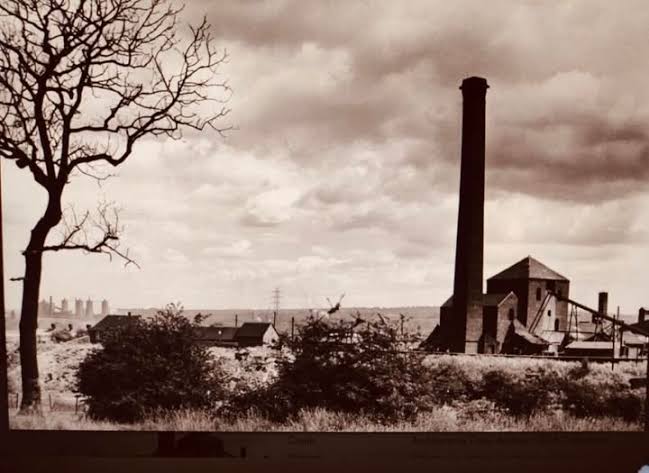
Copyright unknown: This shows the Brickworks in Newbury Lane which was very close to the mine of which more later. It gives some idea of the desolate landscape around the area.
Herbert appears to have died in the Union Workhouse in August 1869 and was buried at the Parish Church in Upper Gornal on 12 August 1869 (as were most people who died in the Workhouse).
Eliza Davis (1809-1844)
I can find very little about Eliza, who, according to the 1851 Census, was born in Oldbury in about 1809 or 1810, going by her age in the 1851 census and her age at burial. There are no baptisms in Oldbury itself, nor in West Bromwich for an Eliza Davis/ies at the relevant period, although it is possible that she might have been baptised some time after her birth or she might have been baptised at a nonconformist chapel for which records have not survived. There was a baptism of an Eliza Davis at St Giles, Rowley Regis, on 29 April 1809, the daughter of James and Elizabeth Davis; another on 22 October 1809 at Dudley St Thomas for an Eliza Davies, daughter of Edward and Sarah Davies; and a third for Eliza Davis, daughter of Jonah and Ann Davis at Tipton St Martin on 30 June 1811. It is tempting to plump for the second of these, as it is the same spelling of Davies as used at her marriage and her eldest children were named Edward and Sarah but it is not possible to be sure about this and Davis/Davies is not an uncommon name.
Noting that Herbert was a widower in the 1861 Census, however, I was able to find a burial at Christchurch, Oldbury on 10 January 1854 of Eliza Hampton, aged 44 and of Newbury Lane.
Herbert and Eliza’s children:
Edward Hampton (1829-1899)
Edward (by then 22)was living next door to his family in Newbury Lane, in the 1851 Census with his wife Harriet (36) (nee Hipkiss, previously Callaghan, previously Jones – twice widowed) and her children from previous marriages John Jones, (16) a puddler, Samuel (9), William Henry (6), Mary Ann (4) and Thomas Callaghan (3), plus their son Edward John Hampton, aged 6 months. Edward had married on December 31 1849. He was a coal miner. Harriet’s previous husband William Callaghan had also been a miner and had been killed in May 1848 in a roof fall at the Newbury Lane Pit owned by Mess’rs Whitehouse and Peacock, where it is quite possible that both Edward and his father Herbert were also working there, in a pit which had terrible associations for the family. So this was a very blended family, as we say these days.
In 1861, the family were living in Portway Road, still with his stepson John living with them, named in this return as John Walls Jones (26), Samuel (19), William Henry (17)and Thomas Callaghan (13) (but not Mary Ann although she might well have gone into service by now at 14), plus Edward John, (10), George William (8), and Stephen Herbert (6) Hampton. One suspects the house may have been quite crowded. All of the men and boys except George and Stephen were listed as miners.
By 1871, Edward and Harriet were living at 19 Portway Road, Oldbury and had only George and Stephen still at home, George at 18 was a carpenter and Stephen a labourer. Their neighbour at Number 18 was a builder, perhaps he employed the Hampton boys.
I found a newspaper report on 23 June 1869 which said that a group of men and youths had been summoned before the magistrates at Oldbury, charged with unlawfully obstructing the thoroughfare in Portway Road on 7th June, the names including Edward Hampton, George Hampton and Stephen Hampton. They were in a crowd of about 100 watching a pigeon race. The Magistrates decided that they had not been given sufficient caution and all were discharged on payment of costs of 5 shillings each. I am interested that a pigeon race could attract a crowd of 100 in Portway Road, including some lively lads evidently!
Harriet died in 1874, aged 61 and was buried in the Oldbury Public Cemetery on 17 April that year, her abode given as Portway Road, Oldbury. On 21 September 1874, Edward re-married to Mary Hadley on 17 Apr 1874 at Rowley Regis St Giles, who was also a widow, the marriage witnessed by Eli and Mary Ann (nee Redfern) Hampton, the groom’s brother and his wife. Mary Hadley’s father Edward Darby was a farmer, possibly one of the Darbys farming on Turner’s Hill.
The 1881 Census apparently finds Edward and Mary at 50 Portway Road, next door to two Hadley households who may have been related to Mary’s previous husband. The family becomes even more blended as Mary Hadley’s children are added to the pot! With Edward and Mary are Jane Hampton – who is described as the daughter of the head of the household but who was , like the Herbert Hampton, born 1866 in Oldbury, listed next and the Clara Hampton, born 1868 actually Hadley, although Harriet Hadley, born 1871 and Fanny Hadley, born 1872 were listed with their correct surname. So all of these were Edward’s stepchildren.
Edward’s own sons had all left home by this time. Edward John Hampton had married Hannah Stanley at St Giles in 1870 and his brother George had been one of the witnesses. Edward and Hannah had been living in Portway Road in 1871 but I am unable to find them in the 1881 Census.
I cannot find George Hampton at all in 1881 but he may have been the George Hampton, aged 26 , who died in West Bromwich Hospital in 1878 and was buried at Oldbury Public Cemetery on 31 December 1878.
Stephen (aged 26) was also still in Portway Road in 1881, a few houses away, lodging with a Joseph Hipkiss (aged 37) (Hipkiss was his mother’s maiden name so presumably a cousin of some sort.) As we discovered with the lost hamlets, the Portway area is proving to be a close-knit community with several core families over a long period.
The 1891 Census finds Edward and Mary Hampton living with Stephen and Stephen’s wife Elizabeth (nee Orton) in Halesowen Street, Oldbury, where Edward was working as a groom. Stephen and Elizabeth had been married at Langley on 25 December 1889.
I cannot find Edward Sen’r in the 1901 Census but there was a death of an Edward Hampton, aged 80, recorded in the West Bromwich Registration District in March 1899 and I suspect this is our man. Although the age is out by ten years, the ages given by relatives on death registrations are only as accurate as the information they have and could well be several years out.
John Hampton (1830-1846)
John, born on 23 October 1830 and baptised on 19 January 1834 at Christchurch West Bromwich, who would by 1851 have been 20, does not appear to be with his family in the 1851 Census. Nor can I find him anywhere else in the area in that or later censuses. I suspect then that the John Hampton, aged 16, who was buried at Oldbury Christchurch on 22 November 1846, is the reason for that. The age and dates fit and Newbury Lane, where the family were living, counted as part of Oldbury parish.
Sarah Hampton (1835-1844)
Similarly, Sarah, born 31 October 1834 and baptised on 14 December 1834, was not with her family in the 1851 Census. And I can find no trace of her after the 1841 Census, no marriage, no further census entries. So again, I think that the Sarah Hampton, aged 10, who was buried at Oldbury Christchurch on 28 April 1844, is our missing girl.
William Hampton (1836-1846)
It appears that William, born on 16 September 1836 and baptised on 20 November 1836, was buried, aged 10, on 22 November 1846 the same day as his brother John, above. So the family had lost three children in two years.
With three children dying so young, I was tempted into ordering the three death certificates. And it was indeed the correct Sarah who died on 23 April 1844 at Newbury Lane, infant daughter of Herbert Hampton. The cause of death was shown as “Accidentally burnt, 32 days” so the poor child had lived for several weeks after she was burned. The death was registered by the Coroner so there was clearly an Inquest but I have been unable to trace any report of that.
Were that not bad enough, the death certificates for John and William showed that they had both also been “accidentally burnt by an explosion of sulphur in a coal pit” on 17 November 1846, an explosion at the Rounds Green New Colliery, situated at Newbury Lane, near Oldbury, a pit belonging to Mr George Parker. This terrible tragedy was widely reported as nineteen men and boys were killed.
There are numerous press reports about the explosion and the inquests. A report in the Birmingham Journal on 21 November 1846 reported that twenty-eight men and boys, including the ‘doggy’ and the ‘butty’ or manager, the men in charge that day, had assembled at the top of the pit at 6am and descended into the pit. About three-quarters of an hour later, there was
“a terrific explosion, which shook the earth for a great distance around and produced the utmost consternation in the neighbourhood, was heard; the skip [used to lower and raise the men in the shaft] was shot high into the air and dashed to pieces, and a water barrel, which was ascending, was forced up the shaft, followed by clouds of sulphurous vapour and long tongues of flickering flame. The noise of the explosion was distinctly heard at Oldbury, and a scene ensued which baffles all description. Most of the miners in that pit were residents of the town, and the news of some dreadful catastrophe having occurred, drew thousands from their houses to the streets and thence to the immediate scene of the occurrence. Hurrying groups, breathless with anxiety and fear, men, women and children, hastened to the spot, to learn the dreadful reality.”
Map
It can be seen from this map how close the pits were to Oldbury, so that the explosion was heard there. It appears from the order of households in the census entries that the Hamptons lived opposite the mine so would have seen immediately what was happening.
Some of the rescuers were men from the local stone quarry. As the flames from the shaft subsided, “a courageous band descended, to ascertain the extent of the calamity, and if possible render assistance to any of the unfortunate men who might still be alive.” Sadly, before most of the casualties could be retrieved, these men had to return to the surface “reeling and insensible from the noxious vapours which had nearly stifled them in their exertions to rescue their fellow creatures.” Fortunately these rescuers were revived although some were incapacitated for some days afterwards.
The method of reviving the men was described – this involved cutting pieces of turf and then putting the heads of the affected men under the turves, with their faces to the earth, which was apparently a common method which had some success. Doctors from Oldbury and Dudley had also rushed to the spot and assisted the injured.
It took most of the day to retrieve the bodies from the pit which was still full of noxious gases and a mining engineer appointed by the Coroner to inspect the mine, was not able to go into the pit for several days after the explosion. So the work to remove the poor men was very hazardous.
The report observed
“Each body, as it was recognised by the anxious relatives, was instantly surrounded by a tearful group, giving utterance to their grief in the most agonising expressions of sorrow. Group after group followed the remains of their friends along the road, which was crowded with mourners, and presented a most melancholy spectacle.” “Oldbury seemed that day to be turned almost universal mourning”.
Eighteen men had died in the explosion, five were brought out much injured, one of whom later died, only four escaped unhurt. Two boys of ten died, one of 14, one of 15, one of 16. The other men were mostly in their twenties and thirties, most married with families. Fourteen widows were left and one hundred and two children were orphaned.
There were several separate inquests, according to where the men lived and the location of the pit so close to three County boundaries, involving men living in Staffordshire, Worcestershire and Salop (Shropshire which still included parts of Oldbury in Halesowen at this time). Verdicts of accidental death were returned in most of the inquests, although some juries added their concerns about the adequacy of ventilation in the mines, although evidence had been given by Mr Thomas Haynes, the mine surveyor employed by the owner that the mine owner had gone to considerable lengths to incorporate the latest methods of improving ventilation and spent a large sum of money in doing so. The jury in that inquest returned a verdict of Manslaughter against Mr Haynes, in the apparent belief that the management of the ventilation was inadequate. Another jury returned a verdict of Accidental Death but censured Mr Haines. Another jury considered that no one could be blamed for the accident. Mr Haines subsequently surrendered to take his trial and was granted bail in London. In the Lent Assizes at Worcester the following March, Mr Haines was acquitted after a trial lasting four and a half hours.
Thirteen of the deceased miners were buried in Oldbury churchyard on the 22 November, including the Hampton brothers and two others in chapel burial grounds. This report stated that “Such a day of grief and mourning had never been seen in the Town before.”
Several miners gave evidence that they had worked in the pit recently but had refused to continue because of the presence of sulphur and firedamp and they considered the ventilation inadequate. Some miners also considered that the wind direction and atmospheric pressure may have meant that ventilation was reduced inside the mine, and the day had been foggy with not much wind. The air in mines was said to be much affected by the atmosphere above them. Although there was also evidence that the air passages were not cleared out regularly, being left in this instance, it appeared, for four months or more, whereas in some mines they were cleared out weekly. This area in Staffordshire was said to be particularly liable to problems with sulphur in the mines.
Subsequent calls for enquiries into the causes of such accidents were sent to the government and for improvements to safety in mines, particular reference was made to the negligence in the use of Davy lamps.
There was also a relief fund raised to support the families affected but that would not have relieved the grief those families must all have suffered, knowing their loved ones had met such a terrible death. Poor lads, such a terrible death while youngsters of that age now would still be safely in school, William not even at secondary school yet. When we see proud Year Sixes ready for the adventure of moving on to secondary school, it is awful to imagine them descending into mines to work in such awful and dangerous conditions. It is perhaps fortunate for the family that Herbert was not in the mine that day. But, living in Newbury Lane, they must have been within a short distance of the mine and probably early on the scene.
A detailed account also appears here, including the report from Warington-Smyth of the Geological Survey Office and also notes from the Coroner George Hinchliffe to theHome Secretary on the explosion :
Thomas Hampton (1838-1856)
Thomas was born on 30 June 1838 and was baptised on 29 July that year. His parents were then living in Oldbury Lane. He was living with the family on Turner’s Hill in 1841 and, aged 11, in Newbury Lane in 1851. But I could not find him in the 1861 Census or any later censuses. But then I found a report of an inquest in 1856 when a Thomas Hampton, aged 18, had been killed in the mine explosion at the Ramrod Hall mine, an event I have written about previously. This Thomas was buried at Christchurch, Oldbury, on 19 August 1856, aged 18 and of Portway. One report notes that he survived the initial explosion but was badly injured and died of his injuries five days later.
Poor lad, he was one of eleven men and boys killed that day. Poor family, to have lost three young sons in pit explosions.
Such a sad story and one which continued for years afterwards. As someone who grew up in the UK in the 1950s and 60s, I can remember mine disasters even then, most of them caused by sulphur or firedamp, now known as methane, with 45 men killed in Newport, Wales in 1960 and 31 in Clydach Vale in 1965. And the films shown this week on the anniversary of the Aberfan disaster 60 years ago, mining related and in a mining community, gave a sense of what those crowds at Oldbury must have been like, horror stricken and grieving, desperately trying to help. Mining, whether for coal or minerals, it seems must always have been a dangerous profession, I suspect that it is only because all of the mines in the UK have closed, that such reports are unknown to our children and grandchildren, although as recently as May of this year, 82 people were killed in a explosion in coal mine in China.
Ann Hampton (1840–1923)
The last child named in the 1841 Census which was taken on 6 June, Ann was only six months old at the time of the census so should have a birth date in late 1840. The baptism record for her at Christchurch gives her date of birth as 21 June 1840 (which would make her 12 months old at census date) and her baptism at 12 December 1841. So these do not tally! However, Ann was shown as 10 years old when she was living with her parents and brothers Thomas and Elias at Newbury Lane in 1851.
The only Ann Hampton I can find in the 1861 Census, when it seems those of the family still alive were scattered, was living in Blackheath, aged 20 as a servant in the household of Joseph Hackett, Coalmaster and Victualler.
On 12 April 1863 Ann, aged 22, married Samuel Parkes, 23 at St John’s Kates Hill, Dudley. He was a puddler, working in an iron works. Both gave their abode as Dudley but as recently as the 1861 Census, Samuel had been living with his family in Tippity Green. By 1871 they were living in Reddall Hill with their two daughters Eliza (3) and Sarah Ann (7). They were in Halesowen Road, in 1881, this time with their sons Edward John (5) and Samuel (3). In 1891, they were at 7 Halesowen Road still with their two boys, the older of whom was also now working in the ironworks, as a labourer. Samuel was still a scholar at 12. I think that Samuel Parkes, husband of Ann, died in 1896 and was buried at St John’s Kates Hill, Dudley on 2 June that year, aged 55. Certainly Ann was listed as a widow and Head of the household in the 1901 Census when she was living at Bank Street, Old Hill with her daughter Sarah Ann and son Samuel. By 1911 they had moved to 9 Queen Street, Old Hill, where Sarah Ann, still unmarried, was a shopkeeper, Samuel also still living there, although now Sarah was the Head of the household.
This census asked people how long they had been married, how many children had been born alive and how many had died. Ann had completed this column, despite being widowed and I was surprised to see that she and Samuel had had eleven children of whom only four were still living. And there were indeed more than eleven births with the name of Parkes, and a Mother’s Maiden Name of Hampton in the Dudley Registration Area between 1863 and 1889, I have emboldened the children who survived at least until the census after their birth – Sarah Ann (1864), two Elizas, one in the first quarter of 1867 and one in the second quarter of 1868, Thomas Eli (1873), Tamar (1875), Edward John (1877), Samuel (1878), Emily (1879), Thomas Henry (1881), Flora (1882), Hannah (1885), Kate (1887), Benjamin (1889) which I make thirteen but there are so many Parkes families in the area that it is difficult to trace most of these with any certainty. Another of Herbert’s family to suffer the loss of many children.
Ann was still living with Sarah at Queen Street in the 1921 Census. She died in March 1923, aged 82 and was buried at St Luke’s, Cradley Heath on 7 March 1923.
For completeness, I will also include the last of Herbert and Eliza’s children although they were born after the 1841 Census:
Joseph Hampton was born on the 29 October 1841 and was baptised at Christchurch, West Bromwich on 12 December that year. He died and was buried at St Giles, Rowley Regis on the 10th October 1842, aged 1 and of Turner’s Hill.
Eli or Elias Hampton (1843-1924)
Eli or Elias Hampton was born in the last quarter of 1843 and in later census entries he gives his place of birth as Turner’s Hill. He is shown with his parents in Newbury Lane, in the 1851 Census, after the death of his sister Sarah and brothers John and William. I have not been able to find him in the 1861 Census when he would have been 18 but by that time his parents and his brother Thomas had also died and his remaining sister Ann was in service. He was not with his brother Edward in Portway Road whose household was already crowded.
I checked every Hampton male in the area who was born around 1843 but none of them fitted. I checked for Eli or Elias Ham* in case the name had been wrongly transcribed but again, no luck. Then I started checking all the Elias men of that age in the area, in case he was lodging or boarding somewhere and either his name had been spelled wrong or he had been included under the name of the head of that household, which has been known to happen.
And that was when I found one Elias Burger, aged 19, a puddler, born West Bromwich, unmarried and a lodger in the household of George and Sarah Burger in Bull Lane, West Bromwich and their grandson George Burger. So I looked for the birth of Elias Burger in about the right time, I looked for him in later censuses, I searched for him on Ancestry and FindMyPast. I found nothing. Other than this one entry, Elias Burger did not appear to exist in official records. At first I could not think how Elias Hampton might have any connection with this area, other perhaps than work, but when I looked at a map to see where Bull Lane was, I saw that it was in Greet’s Green, where his parents had lived for most of their married life. So perhaps they were friends of the family and took Elias in. So perhaps this is the right Elias.
It appears that Elias had not left the immediate area, though or certainly, if he had, he soon returned because on 24 July 1865 at Dudley St Thomas, Eli Hampton, aged 21, a miner, son of Herbert Hampton, married Mary Ann, 21, daughter of William Redfern, of Portway Road, perhaps the girl next door to where he had previously been living, certainly the girl along the road! The witnesses to the marriage were Thomas Redfern and Elizabeth Law. And in 1871, Eli and Mary Ann were living – guess where? – yes, on Turner’s Hill, in fact they were living almost next door to the Cole family, just as his parents had been in 1841! By 1871 Eli and Ann had their three children Sarah Ann (born 1866, West Bromwich RD)), Arthur (b.1868, Dudley RD) and Harriett Elizabeth(b. 1870). Eli was now a miner. Another daughter Eliza was baptised in August 1873 at St Giles when their abode was shown as Portway and Emma was born in 1875 when the family were living in the Village. Thomas Benjamin was born in the first quarter of 1881 and baptised in May 1882 where again, the abode was given as the village.
In January 1880, there was a report in the Dudley & District News about a fatal accident at the Hailstone Quarry and one of the witnesses was one Eli Hampton who was working nearby in the quarry and went to the aid of the injured man, along with one Henry Redfern. His evidence makes it clear that he was a regular employee there as he was able to give information about the usual working practices in the quarry. So Eli was certainly in the area in 1880 and apparently working at the Hailstone Quarry, possibly with a brother or relative of his wife. Despite all these clues placing Elias and his family in Rowley Regis around this period, I have been quite unable to find Elias or any of his family in the 1881 Census, despite varied search techniques. Neither Ancestry, FindMypast nor FamilySearch can find him in that census either so I am not alone!
However, wherever Elias was in 1881, by 1891 the family were living in Dog Lane, Rowley Regis – Eli, Mary Ann, Arthur, Emma and Thomas. In 1901, they – Eli, Mary Ann, Arthur and Thomas – were in Dudley Road, Rowley Regis, next door to the Hailstone Inn. Eli was still listed as a Coal Miner (hewer), Arthur as a Colliery Clerk and Thomas as a Colliery Boat Loader.
Several things had changed by 1911. Mary Ann Hampton, nee Redfern, died in 1906, aged 62, of sudden heart failure and was buried at St Giles on 12 January 1906, her abode given as The Knowle. Arthur (24) had married Keturah Davenport (34) at Brierley Hill on 31 August 1902 and their daughter Annie was born on 13 November 1902 and baptised at St Giles on 7 June 1903, when their abode was given as 90 Springfield. Arthur died on 22 October 1910, aged 43, of a stroke. His address was shown as 133 Dudley Road, Knowle and he was buried at St Giles on 26 October. Interestingly his death was registered by his sister in law Phoebe Cooper who was living next door at 134 Dudley Road, she was the sister of Keturah. So, the 1911 Census finds Elias living at 123 Dudley Road with his widowed daughter-in-law Keturah and granddaughter Annie. He gave his occupation as a Coal Miner (hewer) so even at 68 he was still working in the punishing occupation which had killed three of his brothers.
In 1921 Elias, at 77 and now retired (though he gives his occupation as a retied miner and road repairer, he seems to have turned his hand to various jobs in his lifetime!) was still in Dudley road with Keturah Hampton (55) and Annie 18.
Elias Hampton died in September 1924, aged 80 and was buried at St Giles on 11 September. Elias appears to have been the longest living of Herbert and Eliza’s children. He lived most of his life in the immediate area of the Lost Hamlets.
Summary
So that is the family of Herbert and Eliza Hampton, subject to several tragic losses of three young sons in pit explosions and a daughter who also died of burns. It does not surprise me that neither Herbert nor Eliza made old bones but at least three of their children survived to marry and have children, staying mostly in the Rowley area and often in the immediate area of the Lost Hamlets.

