In my last post to this blog, I mentioned in passing that a William Cole (my 2xg-great-uncle) had been a witness at the marriage of Edward/Edwin Hopkins and Elizabeth Cole and that it appeared that this William Cole was the older brother of Elizabeth.
I knew from my previous researches for my family tree that William was born presumably in 1837 or at least baptised at St Giles, on 17th September 1837, the eldest son of Edward and Frances Cole of Perry’s Lake and that he became a hairdresser which was a somewhat unusual occupation in the area at that time. He was with his parents in Perry’s Lake in 1841 but not in 1851 when he would have been 13 or 14. I searched for him, wondering whether he had died in the interim between the two censuses or whether he was staying with grandparents or other relatives. But he was not in Perrys Lake or Rowley and I could not find a death registration or a burial for him.
Searching the 1851 Census for a slightly wider area, I found him listed as a Scholar at an institution named in the Census as ‘The Old Swinford Hospital’ which was on the Hagley Road, near Stourbridge, along with 80+ other boys. How on earth did he come to be there, apparently living there?
So I googled ‘The Old Swinford Hospital’ and found that this had been – and still is – a boarding school! That was a surprise to me, as I hadn’t thought the Coles were of a class who could afford to send their son to a boarding school. And, of course, they weren’t. They were ‘poor but honest’.
Founded by Thomas Foley, an ironmaster, MP and landowner from the Great Witley Estate in Worcestershire and with close links to Old Swinford and the surrounding area, Old Swinford Hospital first opened its doors to pupils in the late summer of 1670, just four years after the Great Fire of London which had probably considerably affected the Foley’s trading empire in London and may have resulted in them retiring to their country estates for a time. Local tradition has it that Foley, son of the famous Ironmaster Richard Foley, was originally inspired to start the school after hearing a sermon by Richard Baxter, the ‘Kidderminster divine’, on the proper use of riches. In particular, it appears, the school prepared the boys for useful lives where they could ‘make a difference’ to society and to provide them with a trade or craft, a means of earning a living.
Originally known as Stourbridge Hospital (charity), and occasionally referred to as Foley’s Blue Coat School, Thomas Foley’s vision was for the education of 60 boys from ‘poor but honest’ families nominated by specific local parishes. Families who had received poor relief at any time were excluded from this. The boys were not to come from the families of ‘the undeserving poor’. From those nominated by the eligible parishes, the Feoffees would choose boys to make up the required number.
Rowley Regis was one of those parishes and William Cole must have been nominated for a scholarship by the Vicar/Curate of Rowley Regis, at that time, the Rev’d George Barrs and perhaps the Church Wardens. The boys boarded for two half year terms each year at the school in what were fairly Spartan conditions and were provided with a uniform. The diet was apparently fairly basic but this was regularly inspected by the Feoffees.
The eligible parishes and the numbers of boys to be nominated from each were set out in Foley’s Will, dated 1667, in places where the Foleys had a major interest, usually a landed or industrial link. These were:
Three from Old Swinford, four from Stourbridge Town, six from Kidderminster with three from the town and three from the foreign, four from Dudley and from Bewdley, two from each of Great Witley, Kingswinford, Kinver, Harborne, Halesowen, West Bromwich, Bromsgrove, Rowley Regis, Wednesbury, and Sedgley and one from Hagley, Little Witley, Alvechurch, Pedmore and Wombourne. In these cases the parish officers were to choose several names from which the feoffees made the final decision. The original school was for 60 boys and the remaining fourteen boys were chosen by the feoffees, though the numbers were later increased.
The 1851 census for the Hospital shows that home parish of each boy, all of them between 8 and 13 (with the exception of one 7year old!) These included Clent, West Bromwich, Harborne, , Stourbridge, Great Witley, Halesowen, Dudley, Bewdley, Kinver, Ledbury, Birmingham, Martley, Bromsgrove, Kidderminster, Wednesbury, Old Swinford, Kingswinford, Cradley, Pedmore, Wombourne, Worcester, Prestwood in Staffordshire, Hagley, Amblecote, Hallow, Holt and Banbury – so the admissions were still mainly being made in accordance with the original scheme nearly two hundred years later.
This Foundation was a huge undertaking, when you consider that Eton College had been founded in 1446 for seventy scholars and Winchester School, also for seventy in 1382, both with the huge resources of their royal and ecclesiastical founders behind them. Their intake of boys from the poorer classes was based on similar philanthropic motives, as well as on the need for choirs. In a much more local instance for me, the secondary school my children attended was founded in 1384 when Katharine, Lady Berkeley set up a school in Wotton-under-Edge, (one of the Manors owned by the Berkeley families of Berkeley Castle and treated by them as the Dowager’s residence) with one master and two students. This grew and later became a Grammar school and again, Katharine Lady Berkeley’s School still exists and is now a highly successful 11-18 mixed comprehensive school with over 1500 students.) So these educational foundations can continue to serve their local communities indefinitely, it seems.
Thomas Foley’s Will gave the Feoffees he had carefully selected and appointed the responsibility for the ‘maintenance and education and placing forth of Sixty Poore boys’ which was a considerable responsibility. In 1689 the total expenditure was £592.16.11 (That is £592 pounds, 16 shillings and 11 pence for those unfamiliar with pre-decimal currency. There were twelve pennies to the shilling and twenty shillings to the pound!). This was funded mainly from the income from the Pedmore Estate, including rectorial tithes and rents, which had been purchased by Thomas Foley for this purpose, though he also purchased other lands in various places including 15 acres in Rowley Regis.
The Dyett (food!) cost £173.16.07, much of the corn was home grown and the diet included a variety of meats. Apparel, including linen cloth for shirts and blue cloth for the traditional ‘Blue Coat’ coats and suits cost £124.7.6, plus salaries, husbandry, building and other minor expenses.
Later Foleys also funded an extension to provide a new aisle to Old Swinford Church, as all the boys would attend on Sundays which would have made it rather crowded.
How many local families must have benefitted over the centuries from this school and the opportunities offered to poor children? This requirement that the families of the boys had to be ‘poor but honest’ bears out my long held view that my Cole family were not rich but were respectable and industrious. I had wondered though how it was that the children of John Cole (1768-1843), unlike many of their cousins, appeared to be literate – perhaps John Cole or one of his sons was an earlier scholar at the school and passed on his learning to his siblings and children?
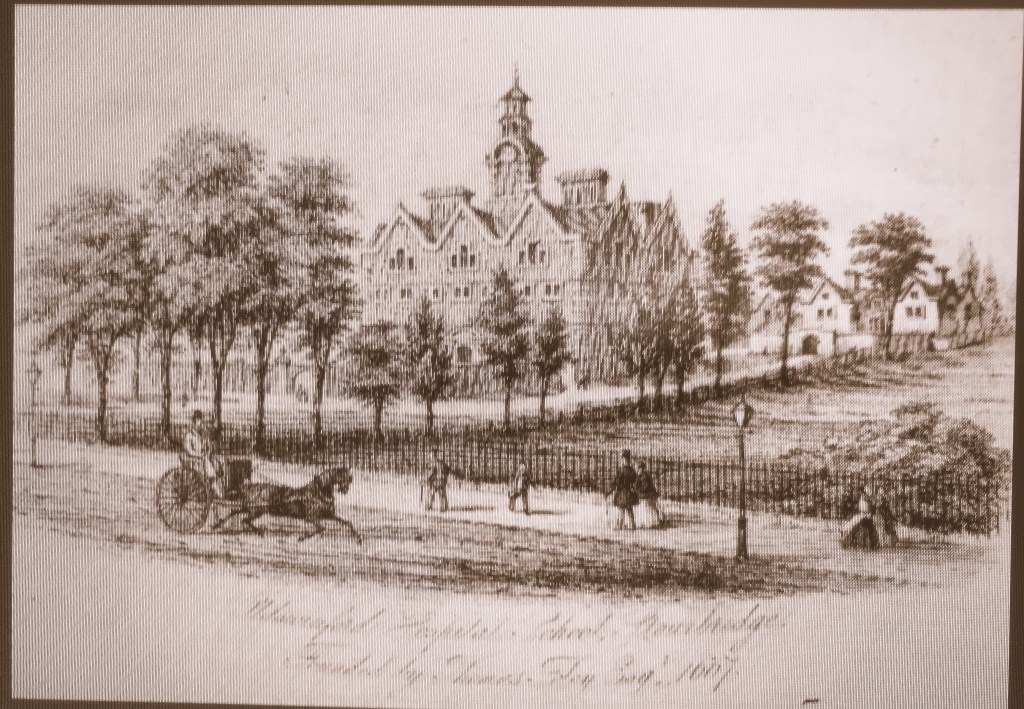
Copyright unknown but will gladly be acknowledge if informed.
Imagine the shock these grand buildings would have been to the poor boys of Rowley, leaving home for the first time – even Rowley church, until it was rebuilt, did not appear to be as grand as this. These buildings also remain in use at the school today, it appears as the school is still there, now a State Boarding School of high repute and they have an interesting website which says that descendants of Thomas Foley are still among the Trustees or Feoffees to this day.
Day to day running of the school
In 1851, the school did not have a big establishment – the Census shows that the Head of the Household was a Scottish lady of 51 who was described as the Matron, although the Head Master (also a Scot)lived nearby on Hagley Road. She was assisted by one Under-Master, a Porter, a Nurse, a Cook and a Housemaid. Not many people to look after and educate more than 70 boys. The aim was that boys entered the school at about the age of seven or eight and received a grounding in many subjects although many would have been illiterate or very nearly so on entry.
Older boys were appointed as ‘hearers’, each of whom had two or three younger boys under his care for half a year and had to hear the boys of the 1st and 2nd classes reciting thirty verses of scripture and thirty of hymns, some new and some old, per week plus rules of grammar and arithmetical tables. The ‘hearers’ apparently took pride in their pupils doing well. Lessons, in 1838, for the 3rd and 4th classes included Writing, Reading, Spelling, Arithmetic, Reading and Tables, Catechism and Bible reading. By 1876 the 3rd classes were studying Writing and Dictation, Reading, Arithmetic, Arithmetic and grammar or geography, reading and sums, Grammar, Geography , Catechism and geography and scripture, a total of 30 hours teaching a week. The 4th classes studied Writing on slates and paper; Reading and dictation; Sums; Reading, spelling and scripture; Arithmetic and geography or scripture; Catechism and geography and Scripture. In 1848, boys began to attend a drawing and modelling class at the Art School in Stourbridge and were later entered for public examinations in design. This all prepared the boys for industrial or commercial apprenticeships. Nothing if not ambitious and clearly well thought out.
Not all boys went in so early. The Headmaster’s report for 1865 mentions that some boys were already ten or more when admitted and only two were below nine. Two of those aged above ten did not know the alphabet and could not count to twenty.
All cannot have been sweetness and light at times, as in September 1854, 43 boys, nearly half the school, ran away, claiming that they were badly treated by the Master, that they were sometimes struck by the Porter with a cane and that they were not given sufficient food for breakfast and supper – perpetually hungry bolshy teenagers, it seems, perhaps not so different from boys today though I suspect most boys of that age now would be utterly astonished at the prospect of learning and reciting thirty verses of scripture and of hymns each week, in addition to the rest of the curriculum The absconding boys were mostly brought back the following day by their parents and the Feoffees looked into this and dismissed the first claim, reprimanded the Porter and increased the ration of bread with meals, at least until the following year when more boys ran away so the Feoffees decided that the amount of food did not appear to have made any difference and reduced the portions to the previous amount!
At the age of 14 the boys were apprenticed or indentured in various crafts and trades, on terms specified by the Feoffees of the school and which applied until the apprenticeship was completed. Placements were carefully selected and the Founder had set out in detail the form of indenture to be used. A Master requiring a boy had to provide a certificate signed by his local church authorities to show that he was a member of the Church of England, was a good and substantial householder, of sober life and conversation, and had sufficient employment to require and properly maintain an apprentice. He would then appear in person before the feoffees, sign the indentures, and receive a premium which was formerly of £4, afterwards raised to £10. No assignment of the indenture was allowed without the feoffees’ consent.
This was taken very seriously and the Admissions Book apparently shows the destination of every boy and the annual printed reports listed all appprenticeships agreed on. The Feoffees’ report of 1859 refers to the fact that the character of the boys stood high in the neighbourhood, and this is quite understandable. They were placed carefully, commonly within easy reach of the parent’s homes but sometimes they went further afield. For example, a boy was apprenticed to a confectioner in Aberystwyth in 1826, another to a London architect in 1848, and a third to a saddler in Manchester in I874. The kind of trades and crafts they went to varied considerably; some went into manual trades-rollers, blacksmiths, file cutters, fitters, carpenters, wheelwrights, coachbuilders; some into retail trades-grocers, drapers, bakers, confectioners; and a few were sent to professional men such as solicitors or architects, or even to surgeons, though in this last respect it was usually ‘to learn the art of a dispensing chemist’. There was a need in the area, particularly as industry and the industrial revolution expanded rapidly for literate boys with good education and Foley’s school was aimed precisely at meeting this need.
Much of this information is taken from a fascinating study entitled ‘Old Swinford Hospital School’ by Eric Hopkins who was a Principal Lecturer in History at Shenstone College, Bromsgrove. Appearing in the British Journal of Educational Studies in 1969, it can be accessed through educational links or a library interlibrary loan. It is online and worth reading. It is full of interesting detail and I have barely skimmed the surface! Other information comes from ‘The Seventeenth Century Foleys’ by Roy Peacock, published by the Black Country Society.
The opportunities this school presented to the boys of poor families in the area must have been life changing for them, by contrast with the schools available in the village. Other wealthy individuals at various times also gave or left money to improve education in Rowley, including Lady Monins who set up a group of Trustees to remedy the lack of a school but died before her scheme could be implemented. She left a sum of money in her will in 1705 to found a school but it seems likely that it was not enough to do so and her relatives lived in London and Kent so probably were not really interested in Rowley matters. In 1774 it was found that income from the moneys left by Lady Monins were being used by the Gaunt family, Richard Gaunt was the Parish Clerk and also sexton at St Giles – the Gaunts were Parish Clerks for several generations – perhaps some of them too had been scholars at the Hospital. His school was the only one in the village at that time and Richard Gaunt, according to Edward Chitham in his book on Rowley Regis, was found to be receiving £10 per annum from the Monin moneys and he educated 24 children for free, in addition to his paying pupils, his daughter Hannah also later running the school. But it seems unlikely that his teaching could have covered the curriculum and breadth of teaching at the hospital and opportunities for a real education in the village were severely limited.
The Old Swinford Hospital School continued to operate under Foley’s specifications for more than 300 years before becoming, in the last forty years, a top class residential comprehensive school.
Swinford Old Hospital Boys
At some point I hope to be able to see the original records and registers for the school and find out more detail but at present I do not know where these records are held or what access is permitted to them. But I have been able to trace quite a lot of information about the three boys there in 1851 and their stories follow.
William Cole
William Cole appears to have been trained as a barber or hairdresser and he continued this trade until the end of his working life, at least from 1861 to 1891. By 1861 William Cole was living in Corngreaves Road, Reddal Hill, lodging with a widowed plumber and glazier and with his occupation given as Barber. In November of 1861 he married Elizabeth Davies at Dudley St Thomas. Although Elizabeth’s name was spelled Davies in the Marriage Register, the children seem, in the GRO Birth Registrations, mostly to have mother’s maiden name as Davis. What is interesting about this is that the plumber and glazier that William, now 23, was lodging with in 1861 was a Richard Davis. And another lodger was a Joseph Davis who was 24 and a ‘grainer and Decorator’. I cannot help wondering whether Joseph, with that distinctive trade, had also been a scholar at the Old Swinford Hospital, there were several Davises in the school in 1851 so it is possible that he and William had become friends there. Elizabeth’s father was shown in the marriage register as Isaac Davi(e)s, so perhaps Elizabeth was related to one or other or both of the Davises in that household.
In 1871, still in Corngreaves Road, and now listed as a hairdresser, he and Elizabeth had four children – Emma Jane, born 1865, Annie Rebecca born 1867, William Edward born 1869 and Amelia born 1870. By the time of the 1881 Census three more children had arrived, Edward born 1873, Nelley born 1876 and John born 1879. It is possible that other children may have been born and died between censuses. By 1891, William was still at 4 Corngreaves Road, still a hairdresser, and with a grandson Norman Cole aged 3 living with them, in addition to his own children, possibly the illegitimate child of Amelia.
William appears to have died in the September quarter of 1900 without ever living in Rowley or Perry’s Lake again. The trade he presumably learned at the Old Swinford Hospital gave him employment for his whole life and at least one of his sons followed him into the profession.
And William was not the only Rowley child at the Old Swinford Hospital in 1851.
Uriah Gadd
Also from Perry’s Lake was Uriah Gadd, aged 12, the son of James and Phoebe Gadd. At the time of Uriah’s baptism in 1838 the family were living in Ross, (that Gadd stronghold), but in 1841 they were in Perry’s Lake. Uriah was the 5th child of the couple and the 3rd son.
By 1861 Uriah was back in Blackheath, aged 22 and a carpenter, living with his parents. He remained in Blackheath living in High Street and later Mott Street, and working as a carpenter for the rest of his life. Uriah was married in 1864 at St Andrew’s, Netherton to Honor Hickman of Netherton.
By 1871, Uriah and Honor were living in High Street, Blackheath with three children, Mary (5). Charles (3) and Edward (1). In 1881, Uriah, now giving his occupation as a Carpenter and Joiner and Honor were living at 108 High Street , Blackheath with Charles (13), Edward (11), Ann (9), all scholars and George (3) and Ellen (1). Plus Honor’s mother Mary Hickman and nephew Walter Hickman (6).
By 1901 the family had moved to 25 Mott Street and Edward, now 21 was working as a bricklayer’s labourer and Uriah had given his occupation as a Carpenter Journeyman. I was slightly surprised that Edward was not also working as a carpenter but because Uriah was a Journeyman and not a Master Carpenter, he would not have been able to take apprentices. George, Ann and a last child Rachel (7) were all scholars. By 1911 Uriah was living alone, a widower, in Mott Street, now 72 and still giving his occupation as a Carpenter & Joiner, working on his own account in the House Building Trade. Honor had died in 1907, aged 62 and Uriah died in 1921, aged 82.
William Jenks Milner
Also in the school in 1851 was William Jenks Milner , whose parish was given as Rowley Regis and who had been baptised there on 11 September 1842, the son of Richard Milner, a wheelwright and his wife Phoebe, nee Jenks (who had grown up in Clent). In 1851 Phoebe was living with her parents William and Harriet Jenks in Clatterbatch, Clent on their farm and was a widow with two other children. I was interested to see from the Census that even in leafy and green Clent, most of the inhabitants were nailmakers and a neighbour of the family was a Scythe grinder, quite a specialised trade and one for which a particular type of iron was required. Perhaps it was supplied by the Foleys.
Richard Milner had died in Wolverhampton in June 1849 so the opportunity for William to receive this education must have been a great boon for his mother. The census entry for Phoebe and her other children notes under occupation that his brother Thomas aged 5 was a ‘scholar’ and Mary at 11 ‘attended Sunday School’, which may show the level of education William would have received, had he not been awarded his scholarship. Had his father lived, it seems possible that William would have followed him into the Wheelwright’s business but in those days when a craftsman father died prematurely it also made it much more difficult for any children to learn their craft.
I have been unable to find William Jenks Milner in the 1861 Census but on Christmas day 1862 William married Louisa Perks at St Barnabas church, Birmingham, both of them aged 21 so it seems likely that he was still in the Midlands. Her father Henry Perks was a Grocer in Great Hampton Row in Birmingham. It seems likely that William had been apprenticed to a saddler in Birmingham.
In 1871 William and Louisa were living in High Street, (the Ecclesiastical District is given on the Census return as Reddal Hill so I suspect this was High Street, Old Hill but possibly Cradley Heath as he was certainly based in High Street, Cradley Heath later. Their children were Ada L, aged 7 born on 14 December 1863 in Birmingham, and baptised at St George’s, Birmingham on 25 September 1865 with their abode given as Lozells and William’s occupation as a Saddler and Harness Maker. Harriet, aged 4 was born in Aston and William J aged 1 born in Rowley Regis (Cradley was in the Rowley Parish so this new William Jenks Milner was probably born in Cradley.) which suggests that their move was fairly recent.
An advertisement in the County Express on the 31 August 1878 by William Jenks Milner, states that the Saddlery, Oil Sheeting and Tenting business ‘carried on so successfully for nearly ten years and , by the wish of my grandfather William Jenks, carried on in his name’ would, from that date, be carried on as usual in his own name, William Jenks Milner. Perhaps grandfather William had helped his grandson set up business in Cradley Heath, and had wanted the business to be in his name. I have not found anything to indicate that William Jenks the elder was ever a saddler as he appears to have been a farmer.

Copyright: County Express
By 1881 William was living at 61 High Street, Cradley Heath and gave his occupation as a ‘Sadler & Oil Sheet Manufacturer, employing 1 man and 1 boy. Along with Louisa, their children Ada Louisa, aged 17, a pawnbroker’s assistant, Harriet, aged 14, William Jenks, aged 11, Anne aged 9, Mary Jane, aged 4, all of whom were scholars , Thirza aged 1 and William Jenks aged 92, his grandfather.
William Jenks, the grandfather, must have died soon after the Census which was taken on 3rd April 1881 as his death was registered in the April-June quarter of that year. And, despite the optimistic tone of William Jenks Milner’s advertisement in 1878, everything changed for the Milner family in 1883 when the family emigrated to Queensland, Australia.
Since the business in Cradley Heath appeared to be sound, a move to the other side of the world was a big step and I wondered what had prompted this. I had noticed that, immediately below William’s advertisement in the County Express in 1878, there was an advertisement for sailings from Great Britain (Scotland) to Brisbane, seeking migrants for Queensland, especially female domestic servants and farm labourers who were offered free passage. The Local Agent was in Brierley Hill. Who knows whether, in checking his own advertisement, William had seen this, considered all those farmers and settlers who would need saddles and harnesses and probably oil sheeting and tenting, all William’s business goods, and it had sowed a seed about new opportunities in his mind which could, perhaps, only be realised after the death of his grandfather. Certainly the Milners sailed on the 31 Aug 1883 from Dundee in Scotland, within months or even weeks of his death, arriving on 28th December, a four month voyage.
Louisa Milner died in 1919 and is buried in Toowong Cemetery, Brisbane. William Jenks Milner died on 30 Jul 1932, aged 89, at Leichhart, Sydney, New South Wales and is buried in the Rookwood Cemetery there, described by his children as their ‘dearly beloved father’ on his death notice in the Sydney Morning Herald. It appears that some if not all of the Milner children remained in Australia.
To sum up…
So, three boys from Rowley Regis, two of them from Perry’s Lake, were scholars at the ‘The Old Swinford Hospital’ in 1851 who all went on in good trades and crafts in the area or further afield. There were boys from Rowley there in 1861, too – James Fletcher, aged 13, Meshach S Palmer aged 11 and James Wharton aged 11 of Coombs Wood though I have not researched these boys.
Who knew? I had never heard of ‘The Old Swinford Hospital’ until now and yet hundreds of boys selected over those centuries and the community of Rowley Regis and the surrounding area must have benefitted from the generosity and care of Thomas Foley in 1670. I agree with Thomas Foley that his school was indeed the best thing he did with his wealth and which benefitted so many ‘poor but honest’ boys in the area, fitting them for new trades, crafts, skills, professions and, it appears, usually successfully assuring them of skilled work for the remainder of their lives.





 rowleyregislosthamlets.co.uk