Daily life in the hamlets in times gone by

In our generally comfortable living conditions today, it can be quite difficult to imagine the conditions in which our ancestors lived and worked. These are some memories which relate to Rowley and Blackheath, so technically may be considered outside of the area of the Lost Hamlets but I am sure that many of them apply also to the houses and residents there. Some of my own memories of growing up in Long Lane and Uplands Avenue are also included.

What the Vicar thought…

The Reverend George Barrs, who was Curate of St Giles from 1800 to 1840. He did not seem to have a high opinion of his parishioners and he wrote in the 1830s:-

“In 1831 the number of inhabited houses in the parish was 1366, the number of families occupying them 1420 made up of nearly 7500 individuals, an equal number of each sex, within a very few, the males predominating by only 7 or 8. 82 homes were then without inhabitants and only 5 building. Since then the state of trade has considerably improved, many houses have been built or are in progress but few unoccupied.  

Of the above number of families 140 were occupied in agriculture and 909 in manufacture, trade etc. Many however who are ranked as agriculturists are frequently engaged in some branch of trade or manufacture. A very large proportion of the manufacturers are nail makers and nearly all the women and girls; that being the chief pursuit of the operatives in this and surrounding parishes. Here chains of various descriptions and the making of gun barrels especially in time of war, find work for many hands. Here also the manufacture of Jews Harps is carried on and sometimes employs a considerable number of persons.

 A great many of the manufacturers are very poor and their families frequently appear clad in rags, and as if they could obtain but a slender pittance of life’s comforts or even necessities. This however is not to be attributed to their being destitute of the means of procuring these comforts in a degree unknown to other manufacturers but in their want of frugality, domestic economy and good management. Their work is laborious but they can generally earn good wages, which, if discreetly applied would furnish them with a comfortable competence. Unhappily however many, from their very youth contract habits of idleness and prodigality and these are a certain and fruitful source of rags and wretchedness. Since the national pest the “Beer Act” came into operation in 1830 their manners have become more dissolute, their morals more corrupt, their habits more idle and unthrifty and of course neither their personal appearance nor their domestic comforts has much improved.

Such is the degraded and grovelling condition into which many of the nailers are sunk that during the late war when wages were high those who could make a miserable living by earning 2 shillings a day would not earn another 2 pence when they might by no great exertion have earned 2 shillings a day. Of all descriptions of individuals these appear most anxious to observe to the very letter that maxim of holy writ “take no thought for the morrow for the morrow shall take thought for the things of itself” The wretchedness that results from their conduct is indeed an undeniable proof of its criminality and of the enormous evil of such perversions.”

[Note: It is likely that this statistical information is taken from the 1831 Census which is not generally available and did not include as much detail as later censuses. This information relates to the whole ecclesiastical Parish, including Old Hill, Cradley Heath, Whiteheath and Tividale, not just the village of Rowley.]

It is evident that Barr was a man of strong opinions and a striking contempt for his working class parishioners. He had married into the Haden family and apparently lived at Haden Hall, rather than in the village. The resistance he met from local people in his campaign to build a new church may have contributed to his dislike for his parishioners, but surely there must have been a few decent people? Excessive drinking was undoubtedly a general problem in those times, though not limited to the Black Country and certainly the non-conformist churches were strongly against alcohol because of the problems it gave rise to in society. And I suspect that non-conformism, particularly amongst Methodists and Baptists was already strong in the area, perhaps even encouraged by the contempt of clergy such as Barrs.

A visitor’s view of Rowley Regis

Walter White, a traveller from London, visited the Black Country in 1860 and wrote about his observations in his book ‘All round the Wrekin’ . He walked through the village of Rowley Regis and along Hawes Lane and noted the numerous quarries producing ‘Rowley Rag’. He would have seen the breathtaking view over Old Hill from Hawes Lane, a view I later gazed out at from RRGS many a time. Later he went through Tippity Green, Perry’s Lake and over Turner’s Hill to Oakham, right through the Lost Hamlets, a long walk! He also noted, echoing round the village, the click-click and thump-thump of hammers, finding that nearly every cottage had a workshop with a forge in place of a washhouse. In each workshop he and his friend observed the same scene, three or four women hard at work together, sometimes with children helping.

He noted “The fire is in common; and one after another giving a pull at the bellows, each woman heats the end of two slender iron rods, withdraws the first, and by a few hammer strokes, fashions and cuts off the nail, thrusts the end into the fire and takes out the second rod and gets a nail from that in the same way. So the work goes merrily on.”

For the women working thus, it may not have been quite as merry as he found it.

Memories recorded by Wilson Jones

In his book The History of the Black Country (now available as a reprint)  J Wilson Jones recounts that he, born in Walthamstow, had moved as a boy to Rowley Regis in 1921, following the death of his mother. He was often taken by his father to visit elderly relatives on Sundays – one born in 1839, one in 1844, one in 1845 and one in 1847 so their memories went back a long way. How fortunate we are that Wilson Jones listened to and remembered their tales and recorded them for posterity.

He tells that “One old lady had been sold as a bond servant at Halesowen Cross and had received three pence per day wages; another had been employed down the mines, harnessed like a horse and drawing tubs. They had all been nailers and had walked three miles to fetch iron, laboured 109 hours weekly for a penny halfpenny an hour, raised 11 children and saved enough to be owners of three houses. Recreational hours were unknown and children did part time work from seven years of age, school was voluntary and the majority could not read. “

Black Country houses were mostly of a pattern, and I recall that my first family home in Long Lane, my grandfather’s house in Park Street and my great-aunt’s house in Darby Street all exactly fitted this pattern. Built in terraces there was a long entry from the street to the back of the house (because the front doors were never used!)  At the rear there was a scullery or kitchen, in later years sometimes using what had been a nailshop or Brewhouse joined to the house with a bluestone or blue brick yard. There were usually two rooms up and down with a cellar below.  The lavatory was also in the yard at the rear – luxury was having a separate one for each house, often two or three or more houses shared one and people have commented on Facebook, remembering this arrangement in cottages in Tippity Green, Perry’s Lake and Gadds Green.  And a garden where vegetables could be grown and perhaps room for pig and some chickens was a bonus and not always provided.  My grandad Hopkins produced wonderful pickled shallots and grew beautiful flowers, in his garden and allotment. To this day I think of him when I see drumstick primulas which I remember him wearing in his buttonhole, in a tiny silver holder, when he visited us on Sundays.

Later, when nailmaking at home ceased,  many workshops or brewhouses were linked to the house, sometimes with a glass roof and became the scullery or kitchen, often with bathrooms or toilets later added on at the back. My grandfather’s Victorian house in Park Street, Blackheath and our 1930s house in Uplands Avenue still had cast iron ranges in the 1950s with a lovely coal fire and a kettle that could be put on it. The range in Uplands Avenue even had a little oven and I can remember my dad cooking some little lamb chops in there, they tasted wonderful. And toast made in front of the fire, using a wire toasting fork and slices of bread, fresh from the bakery in Bell End, lavished with tub butter from the shop at the top of Mincing Lane, (this was Danish butter, I think, I can remember it was cut from the block in the tub in front of you, according to how much you wanted. The shop owner could judge perfectly how much to carve off, showing long years of experience.) That toast was glorious! Toast made now with mass produced bread and toasted with electric devices doesn’t taste the same at all.

My grandparents had rag rugs on the floor, no fitted carpets in those days – from memory these were made of rags clearly from old suits and any other sturdy fabric available, hooked into pieces of sacking and warmer on the feet than lino or brick floors, though the floor in the entry and in the link from the house to the scullery was made of blue bricks. The range in our house was taken out at some point in the late fifties and replaced with a fireplace with a posh gas fire with a Baxi Bermuda boiler behind it which made the whole house warmer and undoubtedly less dusty. And yes, like many people of my vintage, I can remember ice, exquisite ferny patterns, on the insides of the (unheated) bedroom windows in bad winters, hot water bottles were an essential and when it was really cold my dad used to put his army greatcoat over the bed, it was very heavy.  

When we moved from Long Lane to Uplands Avenue in about 1957 we had an indoor bathroom for the first time – at Long Lane the bath was a tin tub which hung on the wall, filled on bath nights from the copper in the outside washhouse. There were still gas brackets on the wall at Uplands Avenue, (though disused) which had provided the lighting originally, and I remember we had a gas fridge, not something you hear of today with a tiny freezer section which just accommodated a little metal ice-cube tray. Not that we got ice-cubes out of it very often, as the freezer box accumulated frost around itself so that it usually became a block of ice itself. And your fingers stuck to the metal tray if  you tried to extract the cubes. The trick was to hold it under the tap and hope the ice-cubes came out before they completely melted!  If the little gas pilot light on the fridge went out, as it did periodically, my dad had to crawl into the space under the sink with a taper to relight it through the tiny hole at the back with a distinct ‘whoomph. Funny memories!

In most houses, including my home well into the 1960s, the front room or parlour was rarely used. In Victorian times it might have had an aspidistra, hard uncomfortable horsehair stuffed furniture, and a glass display cabinet. Perhaps a harmonium or a piano – my grandad Hopkins loved playing piano and had a white one!  I can remember my great-aunt’s middle sitting room in Darby Street had a dining table with a deep red velour cloth with a fringe I loved playing with as a child, with a lace-edged white cotton table cloth over that. My aunt could remember visiting the same house in Darby Street when she was a child in the 1920s when her grandfather still made nails out in the workshop and she could remember that she was sometimes allowed to work the bellows for the forge for him. Despite being asthmatic, he walked regularly to the bottom of Powke Lane with a little cart to collect iron rod and coke for his forge from the Gas works, and to take his completed nails to be weighed.

On one occasion, Aunt Alice remembered, while ‘helping’ her grandfather, that she had got some ashes on her white pinafore and, realising that her mother would be cross with her, my great grandmother washed, dried and ironed it before she went home. In the days before washing machines, tumble driers and electric irons, this was no mean task and speaks volumes of her kindness. My aunt also remembered that her granny was a wonderful cook and she remembered freshly baked cakes and particularly custard tarts set out to cool on the window sill. Is it coincidence that my father, myself and my son all loved custard tarts? Who knows, perhaps there is such a thing as genetic memory!

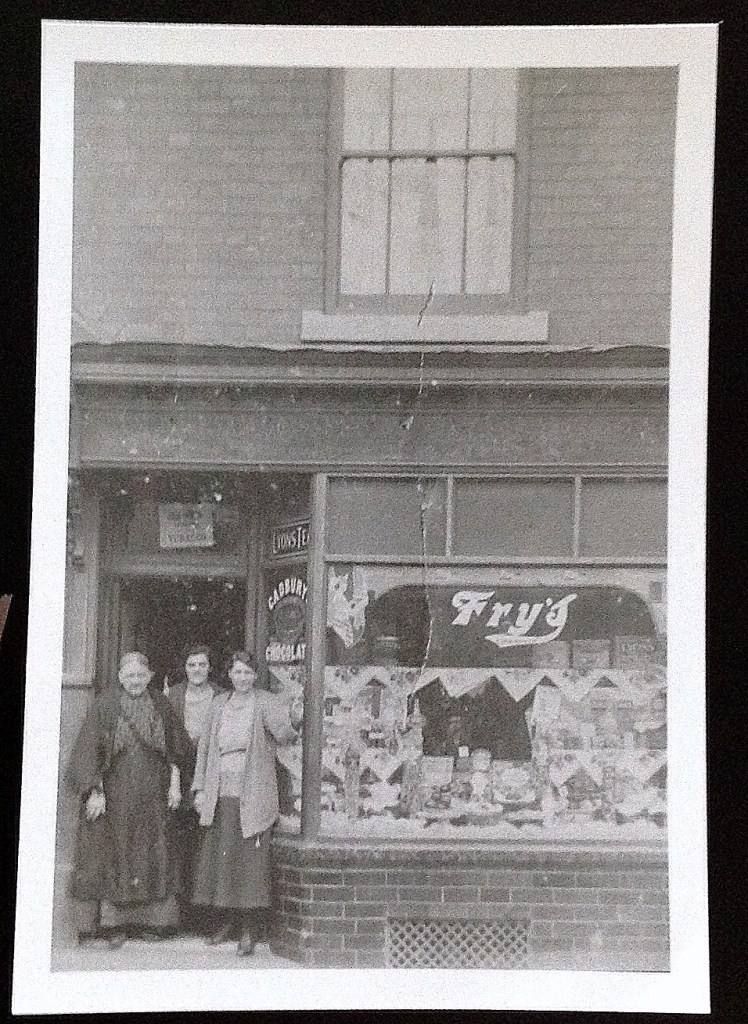
Black Country dress remained the same, probably  until the 1920s. Women nailmakers wore black lace-up boots, woollen stockings, long black skirt with a shawl , sometimes a man’s cap. Men wore checked shirts and sturdy leather belts.  The photograph here shows my great grandmother Betsy Rose and my great aunts, taken in the doorway of their shop in Birmingham Road probably in the early 1920s or thereabouts, and her dress fits this description although her daughters are more fashionable! Old photographs from the time of chapel gatherings show that many of the older ladies appeared to be still wearing their ‘Sunday best’ outfits and hats from some decades before. ‘Sunday best’ was definitely a feature of life in those days and even in the 1950s with new outfits for children for the Anniversary each year and I can remember that the men in church always wore smart suits and ties, the ladies dresses or costumes and often hats – no dressing down!

My great-granny Rose with her daughters. Copyright: Glenys Sykes

Weekly routines

Each week in earlier times apparently had routines. Monday was washday and nailmaking , Tuesday brewing and nailmaking, Wednesday and Thursday house cleaning and nailmaking, Friday ess-hole and grate cleaning, knife polishing and nailmaking, Saturday Window cleaning and nailmaking, Sunday   – preparing the Sunday dinner, church, chapel and Sunday school – no work, not even sewing! The days were long, starting at six and often not ending until 10pm. For women, all of this on top of bearing children, caring for and feeding them,  there was little time for rest. Men often worked during the day at outside jobs, in the quarry, mines or farms but also made nails when they got home.

Meals also followed a routine – Sunday, the joint, Monday cold leftover meat, Tuesday broth, Wednesday boney pie, Thursday stew, Friday faggots or tripe. What they would have thought of our supermarkets, online shopping and ready meals I do not know!

But Wilson Jones notes also that, in his words,’ Black Country people had “hearts as big as buckets”, they would laugh with the merry and weep with the sad. Neighbours would share the duties of a sick woman, share their meals, deliver each other’s babies. There was never any knocking at the door, they lifted the latch and walked in. They would draw a pint of home brewed beer for the visitor, be he a vicar or insurance agent. Brewing reached an art that no other district shared. Each home had its ‘secret’ upon how many hops or what kind of malt was to be used. The fermentation had to be produced by no synthetic yeast but from the ‘barm’ passed from one relation to another. The visitor would be handed the glass of beer after it had been inspected for clearness and he had to express his opinion that it was better than ‘so-and-so’s’  – their beer was too muddy, too sweet or too sour’.

Looking back

So – living in tiny overcrowded houses with earthen floors, no running water or sanitation, big families, polluted air, deadly diseases when no cures were available leading to high infant mortality and often early deaths, men working in dangerous jobs in mines and quarries or in the constant heat and grime of factories and the nailshop, children working in nailshops, mines, quarries and factories from the age of seven or so, few shops,  little money, little or no healthcare provision, plenty of hard work – our ancestors had tough lives, and few luxuries but often a strong faith and caring communities.  I am deeply proud to be descended from them.                                                                                                                                                                                                                                                                                                                                                                                                                                                                                                                                                                                                                                                                                                                                                                                                                                                                                                                                                                                                                                                                                                                                                                                                                                                                                                                                                                                                                                                                                                                                                                                                                                                                                                                                                                                                                                                                                                                                                                                                                                                                                                                                                                                                           

Life on the Edge

As I mention in the introduction to this One Place Study, it was the loss to quarrying of whole hamlets in which my ancestors had lived which prompted me to start this study in the hope of recording information about the hamlets and the people who lived there. Quite a few people have mentioned on the Facebook Page ‘I remember Blackheath and Rowley Regis’ their own memories of living on the edge of the quarries on Turner’s Hill.

Peter Hackett was amongst those saddened by the loss of these hamlets. He said in 2014 “You forget that Perrys Lake was almost a little community of its own. Obliterated. Fair enough you have the new houses now. You would have thought that the planners would have kept its original name….”

Marilyn Holder at the same time said “I took a drive over to see the lost community of Perry’s Lake today and found it rather sad that it has disappeared into history like so many parts of the Black Country.”  Marilyn’s  4 x Great-grandad Isaac Bishop lived in one of these cottages and worked as a nail maker in his late 70s – no pension then, work or poor house! Her father-in-law was born in one of the cottages in Perry’s Lake in 1919. She thought that there were 6 terraced cottages, which according to the 1841 census housed around 75 occupants. No bathrooms and one toilet up the back yard served all the houses.

Growing up and family memories on the edge

Cottages at Perry’s Lake, just prior to demolition, early 1960s. Copyright Linda George.

Perry’s Lake was the biggest of the hamlets and in close proximity to the entrance to Rowley Quarry in an area known as “Heaven”. The Portway Tavern was once the haunt of quarry workers after a long shift. For many years the Portway Tavern was owned by the Levett family, up to 1900, who were also butchers in Rowley and Blackheath for many years. It remained open until The Portway Tavern was demolished in 1984.

Many people have commented that Perry’s Lake was known as ‘Heaven’ though this does not appear on any maps that I have seen.

Sue Cole was born in a quarry cottage up on Turners Hill. It was next to a farm. Her mum told her that she had to fetch water from the farm as they didn’t have running water, or electricity, they had Tilley lamps for lighting. And she had to sleep in the wicker washing basket, because her brother was still sleeping in the cot. She also remembers that she used to play on the top of the quarry, and had to go inside when the siren blew when they were going to blast. When she was about six weeks old they moved to one of the houses round the back of the Tavern. Her Dad worked at the Hailstone quarry.

Carol Adney was born in Number 16 in the row of cottages along the top of Turners hill in 1950 and lived there until she was 4yrs old. 

Shirley Jordan recalled that her aunt Mary had lived in the first house round the corner from the Portway Tavern and then there was the road that was called round heaven. She used to play round heaven at the bottom and there were some horses down there. A lady and family called Onions lived round there as well.

David John Reynolds also remembered that Joe Onions had looked after the quarry horses. When David was a child in the 50’s Joe only had one horse to look after, a white one called Dolly. Geoff Skelton  noted that the field is still there where they kept the horses, the golf course fence is where the fence was to stop people  going to the edge of the quarry. Stephen Hall remembered Geoff Onions whom he had worked with at Albright and Wilson and who later kept the Portway Tavern with his wife Joan.

Eileen Hadley remembered that her great-aunt Kate Faulkner lived across Perry’s Lake, and that it used to be known as Heaven. Other residents included families called Bird and Harcourt . Jus Joan had a Great aunt whose name was Redfern, she lived in the first cottage set back from the road about half way down with a small front garden.  George Webb said that his in-laws lived at the back of the Portway Tavern, aka Heaven in old cottages ,they were Harcourts and Reynolds , both worked in the quarry. He also recalled that Syd and Joe Dowell lived opposite the Tavern . Alma Webb also remembered that she visited the cottages by Portway Tavern. George’s wife Mary used to take her to see her sister who lived there. Her husband worked at the quarry and the cottage was on the edge of the quarry.

Jus Joan had a great-uncle Jesse Plant who was killed in the 1st World war who lived at no. 12 Perry’s Lake.

Tony Holland said that he lived in the Portway Tavern from 1959 to about 1962. (It’s surprising how many people lived at the Portway Tavern at various times! I shall write a separate article on the Portway Tavern and the other pubs in the hamlets at some point!) He also knew the area as ‘Heaven’. At the end of Heaven on the left hand side was a field owned by a chap called Joe, presumably Joe Onions. The children played football there and called it Joe’s stadium. Tony said he hung about with kids from Irish families that lived there. He knew that the houses did not have electricity and relied on gas lighting. The cottages were still there in 1962 and there were about half a dozen then.

Stephanie Pullinger says that her great-grandad was a quarryman. As they lived in Tipperty Green she assumes that he worked at the Hailstone quarry but has very little information and would love to find out more. He and his brother, according to family legend, were characters. Apparently one night he brought a donkey home that he found on the way home from the pub. On another occasion he brought an old gypsy woman back much to her great grandmother’s disgust! Stephanie says that every time she thinks about that donkey she imagines its hooves clattering on the cobbles in the entry between the terraced houses.

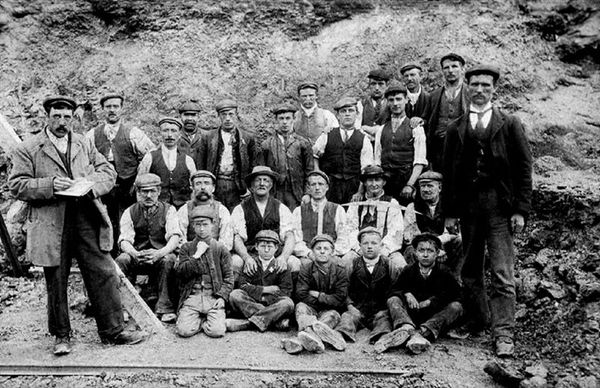
Hailstone Quarry workers c.1910. Copyright unknown but will be gladly acknowledged on receipt of more information.

Mention of the entries between houses brought back a memory of his teenage years for David Steventon when he was helping the local milkman with deliveries each weekend. Obviously on such days one would collect payment for the week’s milk from the lady of the house. So at the front end of each entryway I would start singing, “Milk ho, milk ho, milk ho, ho, ho!” And sure enough, when he reached the back door the customer would be waiting with purse open to settle the debt.

Reg Parsons was born at Number2 Turner’s Hill in the bungalow his father had built after demolishing some old cottages which had stood on the site. He recalled Slim’s sweet shop which was the nearest shop and his parents’ shop in Doulton Road. He remembered Vera Cartwright with her milk cart. Amongst the local  boys he had played with were those from the Simpson, Parkes, Robinson and Hopkins families who lived nearby. During WWII the field below the bungalow was used as a fuel dump, which consisted of concrete bases with piles of Jerry cans of fuel, securely fenced! There was an anti-aircraft gun nearby, near the Wheatsheaf Inn, something my late mother had also told me about. Reg’s brother Harry was in the Grenadier Guards and his sister Edna was in the Land Army, based in Evesham.

I have recounted elsewhere that Reg went to Britannia Road school and milked the cows at a farm on the way through Rowley, walking to and from school. From what Reg told me about where the bungalow was, I believe this was later replaced by a much bigger house by a local motor dealer Sid Riley who owned the Garage in Dudley Port, Caldene Motors. His niece Maggie Smith tells that he had a swimming pool in the basement of his house, which flooded the rest of the house, when quarry blasting damaged the footings. 

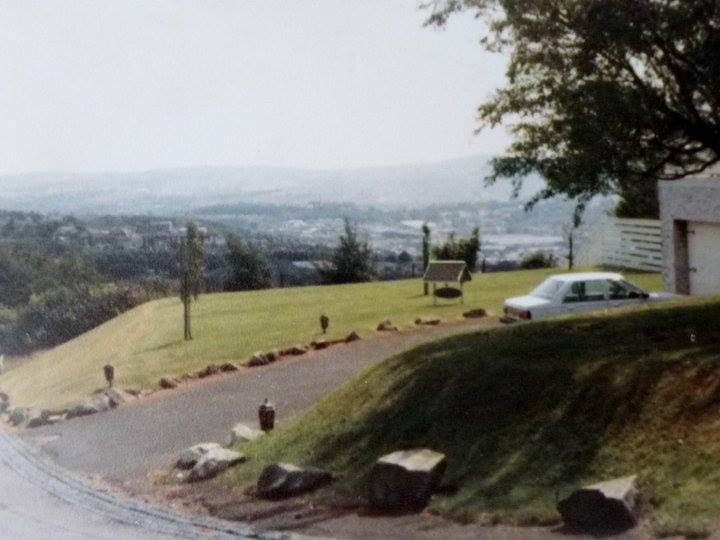
If I am correct, this would have been the view from Reg and later Sid’s home.

View from top of Turner’s Hill. Copyright Catherine Ann.

Joyce Connop remembered that when she used to walk across Tippity Green (73 years ago!) to Doulton school there was nothing on the right hand side, only Ada’s cafe then she would cross over the bottom of Turners Hill. There  was a row of houses, one had a shop in the front room, on the other side there were the grey looking council houses then and Stiffs concrete works, Portway Tavern and a row of terraced houses lay back where the golf range is now. There were a about half a dozen houses just round the corner from Ada’s cafe at the bottom of Turners Hill which were really old, Joyce remembers her mother saying they had earth floors. There were also about half a dozen terraced houses on the corner opposite the Bulls Head.

Joyce loved Ada’s café, Ada used to serve them with penny cakes on our way to school . She was seven, and remembers that it was lonely across there and no pavement then, noting that 7 year olds don’t walk all that way on their own to school now .

Playing on the edge

There were lots of places for children to play and have fun as with so much  of the derelict land in the area, known as the ‘quack’, the ‘bonk’, the marlholes which abounded in the area.

Many children played around the quarries and some could remember falling over the edge.  Pam Veal said that she fell off the top on to the ledge once. 

Peter Greatbatch remembered in about 1965 when he was about 13, that he fell down the Hailstone quarry from top to bottom after climbing down it after a paper jet. He walked away, through the lorry entrance, with a sprained ankle and a cut at the back of his head, neither of these injuries serious! His brother David Greatbatch was there and also his friend Raymond Knowles who said to him after the incident “I thought you had had your chips there”.  Peter says he will never forget it, the luckiest day of his life. Some years later, he added, he had another incident at the other quarry at Turner’s hill in the 70’s when he hit the big rocks put by the side of the quarry at the bottom of the hill. He was trying to broadside his Ford 1600E there in the snow. If those rocks weren’t there he and his three passengers would have ended up in that quarry. He says he would not have walked away from that one.

There was a pool at the Blue Rock quarry where David Wood and JJSmith used to fish, JJSmith commenting that he fell in more than once – the sides were very steep where the perch were and David Wood agreed that the sides were so steep you were lucky if you got out. Joyce Connop recounted that her brother had fallen in there when he was 10 and another lad got a lifesaving award for getting him out.  Roger Harris remembered that he and his mates used to swim there, they used to make rafts out of old wood. One of his mates had a deep gash on his leg after hitting a sharp rock when he fell off an old bit of wood, noting that these were mad days in the 60s before such places were fenced off. There was little mention of Health and Safety in those days.

Sadly, not everyone who fell in got out. There were tragic memories of two brothers who drowned there, within living memory. It was believed that the younger fell in and his older brother jumped in to help him but neither could swim and both were lost, devastating their family and no doubt worrying legion mothers who urged their children not to go near such pools.

Riding on the Edge

Many people remembered riding lessons at Hailstone Farm. Ian Davies recalled that the Cartwrights ran Hailstone Farm which was off to the left on the way up Turners Hill.  They were his relatives; his Geordie grandfather lived with them at Lamb Farm, near Portway Hall, when he first moved south in the early 1900s. By the 1950s George Cartwright had moved away to a farm near Bewdley and Hailstone Farm had been taken over by their daughter Vera and her husband George Thomas. George taught him to ride. The quarries were already threatening to swallow the farm back then. The narrow track from Turners Hill had quarries close on both sides. The farmhouse and top of the land were later swallowed up by the Tarmac mega-quarry.

Hailstone and Freebodies Farms, on the edge! copyright D Morris

Driving on the edge

The road between Perry’s Lake and Oakham, going up Turner’s Hill also had memories for many people. This was later closed and quarried away. There was a sheer drop on either side within a few feet of the road. Many people could remember walking up that road on their way to visit family. Roy Martin could remember when it was still open to two way traffic when he first drove up there. But being narrow with passing places, it was still dodgy so they made it one-way it uphill. But as John Packer remembered, a few people still used it as a short cut, as late as autumn 1968. Michael Bowater recounted that he just managed to escape serious injury walking up there one night on his way back from Brickhouse. A car coming up the hill was going too fast and he just about scrambled up the bank on the left, it was a close call, he noted, it was a good job he was young ,fit and agile. John Packer hoped the car wasn’t his red Hillman Imp!

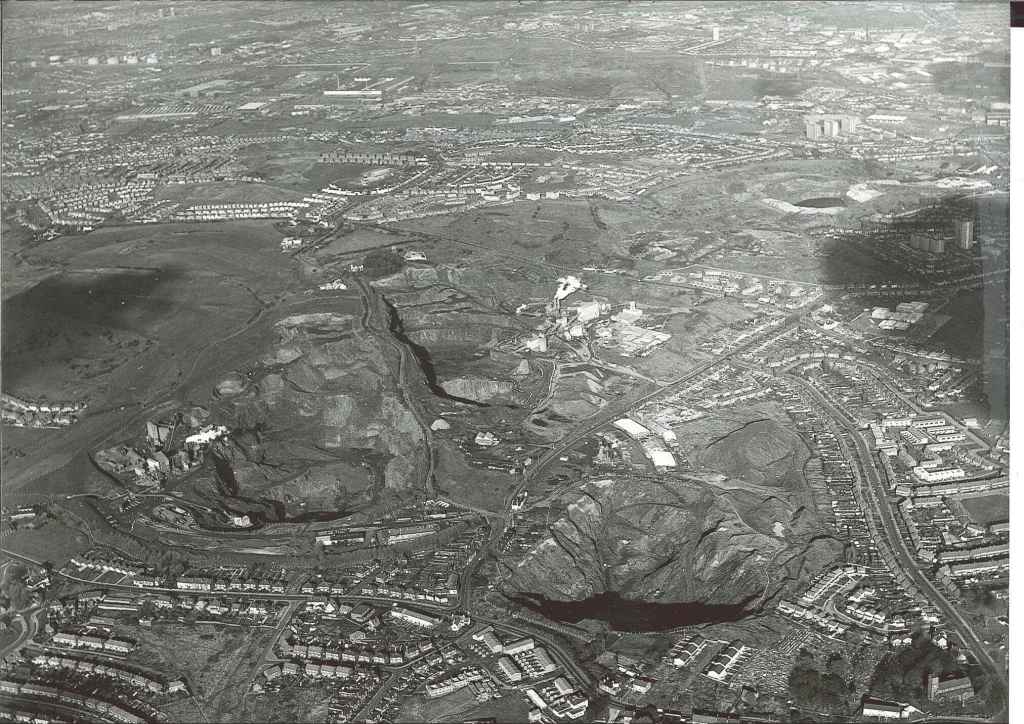
This photograph shows the three main quarries with the Turner’s Hill Road, climbing between the top two roads. Note also the steep edge of the bottom quarry immediately behind Tippity Green.

Eileen Herbert could remember driving up Turners Hill with her dad to visit her aunt Rose Kite, Eileen lived in Highmoor Road and the siren before blasting was very loud from there. They always knew what time was as they could hear Lenches ” Bull” as well. “Long time ago but I can still hear them in my head!” 

Angela Kirkham also recalled going to visit her gran, auntie and cousins (Tonks and Madley were the names), they used to visit on Sundays and always went over the quarry. She recalls that she spent most of her early childhood playing round the top of the quarry and the banks, sometimes with her brothers throwing bricks at other kids and sometimes at one another ! Angela’s Kirkham grandfather, father and uncles all worked in the quarries, they lived in Dane Terrace and Angela remembered that the blasts used to shake the house. These were presumably the Kirkham brothers Brian and Clifford who commented on the Facebook page that they all worked in the quarry, bringing the rock to the crusher or as a mechanic. Roger Harris also worked with them and said that, although the work was hard and the money wasn’t good, they had some laughs. Which sounds like a lot of life in the area!

Dropping off the edge

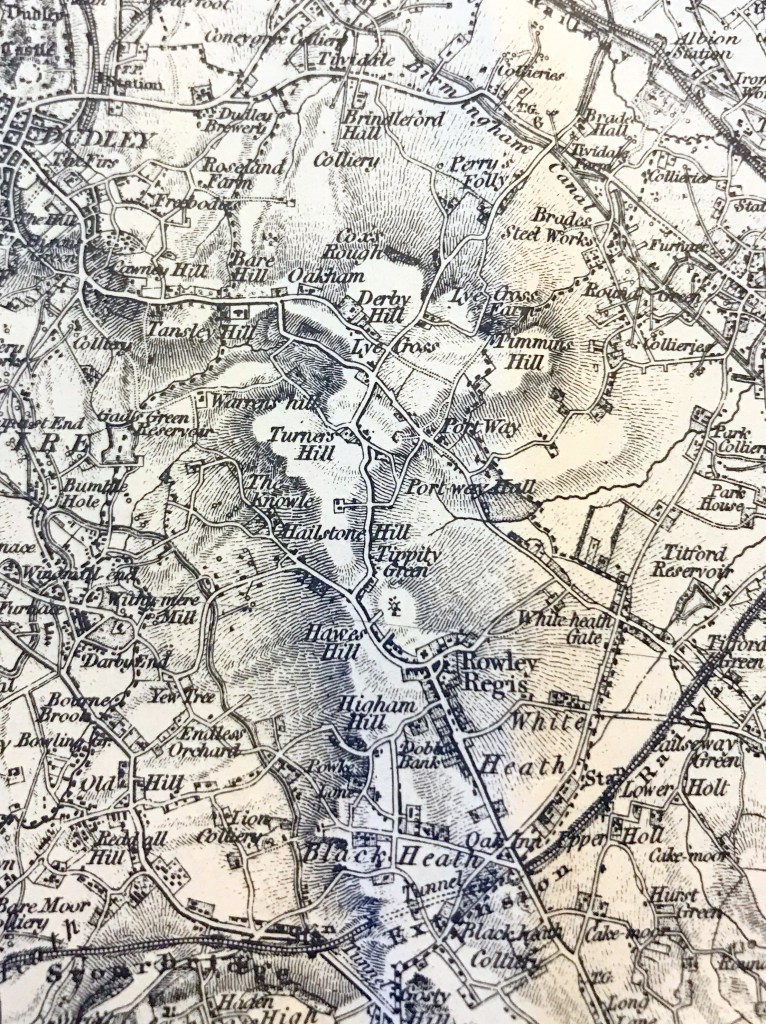
Not only people fell into the quarries. Gardens did too and other things! The map shows clearly that the quarries came right up to the edge of gardens in the hamlets.

1st Edition OS Map extract, Copyright David and Charles.

Graham Evan Beese recounted that his grandparents lived at number 50 Tippity Green until the bottom half of the garden fell down the quarry, pigs chickens and shed too. There is no word on the fate of the poor livestock! Graham’s grandparents were quickly moved to Eagle Close on the Brickhouse Farm estate.

Andrea James had a similar experience and recounts “We used to live along Tippity Green and our garden backed right onto the quarry , with only a tiny wire fence that , as children we could easily climb over. Every time they blasted we would lose a little of our garden.

In those days we didn’t have an inside toilet, ours was at the top of the garden and one morning I went to go to the loo …only to find out it had disappeared.  

To add insult to injury I had a further telling off from mom when I woke her up to tell her the toilet had fallen down the quarry.”

Andrea added that, unlike Graham’s grandparents, her family were not rehoused after losing their loo, they used Mrs Faulkner’s loo next door for years!  They stayed there until the row of terraced cottages were destroyed by a fire that started in the sweet shop . Their roof caught fire and Andrea’s father woke them all up to get out … her  mom said “Oh my God ..where’s the dog ? “

Andrea’s dad said “He’s in the car with my fishing rods”. Andrea’s dad clearly had a good grasp of his priorities. They lost everything in the fire (except the dog and the fishing rods, of course) but her mom refused to move into the horrible maisonette she was offered so they lived in the burnt out shell, with help from local people, until they were offered a better house. Tough Black Country folk, these!

And if your garden didn’t fall into the quarry, it was still a risky place to live! Paul Pearson remembered when the air brake failed (or forgot to be put on) on one of the quarry wagons, and it rolled back down the driveway, across Portway road, down the gardens and into two houses. He said that there are still steel girders out in the front of the houses now that the quarry put up after this incident.

Working on the edge

As can be seen from all these memories the quarry loomed large over the village and especially the hamlets. Many local men and boys worked there, quite a few died there or were injured or maimed.  Sarah Preston recounted that her great grandfather died in an accident there before her grandmother was born, he had done an extra shift to get extra money but didn’t live to see his daughter born.

There was regular daily blasting to loosen rock. Apparently when the blasting happened the workers sheltered under metal containers to save coming up away from the area.  Anyone who lived or went to school within hearing distance of the quarries can remember how the day was punctuated by the regular sound of the siren at 10am and 1pm. Certainly I can remember it from my days at Rowley Hall Primary, although I do not remember it from my days at RRGs in Hawes Lane, perhaps the school there was that much lower down and on the other side of the hill. Recollections may vary, others may remember it from there, too.

Maggie Smith also notes that her son in law’s father owned a cafe in Low Town, Oldbury, called the Polar Bear. The cafe had to be pulled down to make way she thought for the magistrates court. It was taken in one piece and used as the cafe at the Hailstone quarry.

Many members of the ‘I remember Blackheath and Rowley Regis’ Facebook page have told of their memories of the sirens and the blasts. The blasting was not always without incident. Alan Homer recalled a rock coming through the roof of Toyes chippy on Dudley Road. Someone else (sorry, I can’t find this entry now!) remembered a rock coming through the roof of a toilet, just after she had finished cleaning it. Fortunately it was unoccupied at the time!

Kelvin Taylor noted that his family lived in Limes Avenue, a mile away below Britannia Park  and could hear the siren and the blast if the wind was blowing in the right direction.

Graham Lamb remembered that his mother used to go mad because they had metal window frames and the blasts used to crack the glass, nearly every week his dad had to put a new pane in somewhere.

I have tried to gather these memories into a more or less coherent form and hope that people will enjoy reading about the life of the ordinary working people who lived in the Lost Hamlets. They had full, active, hard working and hard playing lives and formed strong communities. Though their physical homes have gone, something of their lives is recorded through these memories.  Please feel free to contact me if there are more memories of family here that you would like to add.

Alias Hunt & Johnson and the Commonwealth Gap

In the same way, that I had (wrongly, as it turned out) assumed that my ancestors had stayed pretty firmly in Rowley Regis, I tended also to have assumed that, by and large, they would have been law abiding, if somewhat inclined to non-conformism.

So I was intrigued to find, early on in my researches, that from about 1665, some of my ancestors were appearing in the Parish Registers with an alias which continued over several generations! Johnson, alias Hunt.  I could not imagine what could have given rise to this. And they were not alone. Other families in the village also appeared to have aliases. I tended to associate the use of aliases with murky deeds but it seemed a bit odd that so many families had apparently turned outlaw and over such a long period.

We Rowley family historians owe a great debt of gratitude to Miss Henrietta Mary Auden, as she had transcribed most of the older parish registers before many of them were destroyed or damaged in the church fire in 1913. This enabled these records to be published in book form by the Staffordshire Parish Registers Society after the fire and this book, in Smethwick Local Studies Library, was an important source of information for me when I began researching. I would go to the library with a list of ancestors who I needed to check and I was very grateful that the book was indexed, thus saving me precious research time. Nonetheless, I can remember my frustration that I often ran out of time and had to continue on my next visit.

I could not have known then how developments in technology would change this process beyond recognition. Some years ago, I was able to purchase a digital copy of the entries from the Registers from Midland Ancestors, which could also be searched digitally; later still, searching to see whether any second hand copies of this book were available to buy, I was amazed to find that I could purchase a facsimile copy of it for a few pounds, photographed from a copy deposited in a library in the USA and printed to order for me. Such luxury, I could now browse the Register to my heart’s content! And sometimes, there is no substitute for reading through a parish register in sequence over a period of years for building a picture of a family or a place.  Miss Auden commented in her introduction to the book (which I now had time to read properly) on the number of families in the village using aliases. She said “there are many curious nicknames and aliases’. So what was happening that so many people in this little village were apparently using two different names?

My first alias was used after the union of my 8xgreat-grandfather Richard Hunt and Elizabeth Johnson. I say union because I have never found a record of their marriage. It is quite possible that this is because some records at this period were lost or it may be that they simply did not get married. Their first child John Johnson alias Hunt was born in 1655. The date was my first clue.

This was just after the Civil War and was during the period of Government known as the Commonwealth, under the leadership of Oliver Cromwell. The Commonwealth Parliament passed an Act regulating the keeping of civil records of births marriages and deaths, taking this responsibility away from the church.  It was called ‘An Act touching Marriages and the Registring thereof;  and also touching Births and Deaths.’ It was quite clear. Officers were to be appointed by each parish, to be called the ‘Parish Register’ and all marriages now had to be performed by a Justice of the Peace.  The wording was clear –

‘no other Marriage whatsoever within the Commonwealth of England, after the 29th Sept, in the year One thousand six hundred and fifty three, shall be held or accounted a Marriage according to the Laws of England.’

 Photograph from ‘Birth, Marriage and Death Records’ by David Annal and Audrey Collins.

Oh my, what a huge change for ordinary people from the customs which had been practised from time immemorial. So how did this affect that little village of Rowley? A lot, it seems.

These are extracts from the Parish Registers for the time, the spelling is the original spelling in the Register!:

“12 Mar 1654      William DOBBES, minister, buried.

These names of Birthes, Burials and Marriages above mentioned were entred in another paper booke by Mr Dobbes & written out in this as it was entred by him.

Stafford. At Wolverhampton the 20th day of March 1654.

O Tempora! Memorandum that Josias ROCKE, of Rowly Regis, was this day sworne before us by virtue of the Act of Parliament of the 24th of August 1653, to execute the office of Parrish Registor for Rowly aforesaid according to his best skill and knowledge & according to the said Act so longe as hee shall continue in the said office.

Witness our handds the day and yeare above written.

John WYRLEY

Hen. STONE

Staff. At Walsall, ye 22th June 1657.

Be itt remembred that William WHITTORNE, of Rowley Regis, in ye said county was this day sworne before mee to execute ye office of parrish Register there according to ye forme of a late Act of Parliamt. Intituled An Act touching Marriages and the Registring thereof and touching birthes and burialls soe long as hee shall continue in ye said office.

Witness my hand ye day and yeare  above written.

O mores!

Hen Stone”

Several pages of births, baptisms and burials follow. The marriage record which follows is the most detailed of those recorded and shows the effort required to be married under the new system. Some of the marriages, starting in 1655, had notice published in the church on three Sundays but others went through a more elaborate procedure.

“John MARTINE, of Rowly, Co. Stafford, Joyner, & Joyce COLBURNE, d. of John COLBURNE, of Rowly, Gentleman, was published in the market towne of Walshall (being conceived to bee the next market towne to the p’ish church of Rowly afforesaid) three market dayes sevrally each after other between the howers of Eleaven & two of ye Clocke (that is to say) the 14th, 21th and 28 dayes of August 1655, without contradiction of any.  As by the Certificate of the pish Register of Walshall doth appeare. The said John MARTINE & Joice COLEBURNE above named were declared Husband and Wife Sept 29 1655.

By mee, Hen Stone.”

There are then several pages in the Parish Register of ‘marriages’ performed by these Magistrates, most of which say that they were performed at Hampsted, a few at Walsall or Kidderminster, presumably transferred from the Registers kept during the Commonwealth period.

Note that Walsall (9 miles away) and not Dudley (less than 4 miles away) was deemed to be the closest market town, presumably because Dudley was in Worcestershire, Walsall in Staffordshire. Not too much of a problem if you had a horse or carriage of some sort but in this period, most poor people did not have this, they had to walk. The minor inconvenience of the extra miles to be walked which this implied for the parties to the marriage was apparently not considered.

I was puzzled by the references to Hampsted as I wasn’t familiar with this place. The only Hamstead I could find anywhere near was on the Handsworth border, more than seven miles away from Rowley. For some years, I couldn’t work out why marriages should have taken place there.  Then, while I was reading “A Birth, a Death and a Barrellage” by Kate Creed which is about Ridgacre at Quinton, she commented in connection with some land transactions

“The Wyrleys were the earliest family recorded as being seated at Hamstead. They came from Little Wyrley and although some of them were referred to as ‘de Hamstede’, they finally adopted  the name de Wyrley. They continued to hold Hamstead for generations and became the largest landholders in Handsworth.” And I have since read that in early times the Wyrley family also held a lot of land in Rowley.

So that was why so many Rowley marriages took place in Hamstead, John Wyrley, who was one of the magistrates appointing the Register right back at the beginning, lived there and anyone wanting to be married had to go to him. Imagine the nuisance for poor folk who had to miss a day’s work and walk a fifteen mile round trip, instead of being able to be married in the parish church – one suspects quite a lot just didn’t bother. By 1658 there is no mention of where the marriages took place and by 1659 it seems that some marriages were happening in churches again, but it isn’t absolutely clear. 

Unfortunately for family historians, and probably for all the reasons mentioned above, the new secular system was not a success. It is not clear whether proper records were not kept or whether these were lost in the upheavals but many places have gaps in their registers around this time – it is known in genealogical circles as the ‘Commonwealth Gap’.

But after the Restoration of the Monarchy, in 1660, these regulations were revoked and responsibility for records reverted to the church.  The legitimacy of all marriages by Justices was confirmed by the Government so that children of these marriages were not deemed illegitimate.  However, what of the children born to couples who had not been married at all or where there was no record of the marriage, as with my Richard Hunt and Elizabeth Johnson? And apparently, some of the newly restored Clergy refused to recognise the circumstances or perhaps the marriages and any children born of that marriage were called by their mother’s name, alias their father’s name. Hence my Johnson, alias Hunts. Imagine how those fathers must have felt, not being allowed to give their name to their own children (almost like a mother who takes her husband’s name on marriage, even now!). I suspect that is why the aliases continued for so long, it was the only way to keep the paternal name in use. There were still Johnson Hunts in the parish many years later. No wonder the Puritans came to be so disliked!

So if you have an alias in your family at around this date, this is probably the reason – the Commonwealth Gap and the problems caused by a remote government imposing demanding new rules without any apparent understanding of the problems this would cause for poor people. Plus ca change, you might think, I couldn’t possibly comment…

Poisoned by his wife…

This is not strictly within the Lost Hamlets but concerns a member of the Cole family who was born there – and it’s a fascinating story so I am sharing it with you anyway!

Even after 40 years of research, I still find new facts on my family. Recently I was working on siblings of my 4XG-Grandfather Edward Cole and tracking their descendants, a task infinitely easier than it was when I first worked on Edward himself 40 years ago. With the advent of digitised records and family history programs and online resources, plus, of course, the many subscription services research has utterly transformed. 

Searching through the Cole entries in the St Giles Registers, I came across the Burial Record on 14 March 1832 for my 1st cousin 5xremoved David Cole. The entry says that he was 43 when he died in Mar 1832 and that he was a farmer living in Slack Hillock , off Gorsty Hill. I was picking out Cole burials, spotted the note on his made by the Vicar and was off down a fascinating rabbit hole, irresistible!

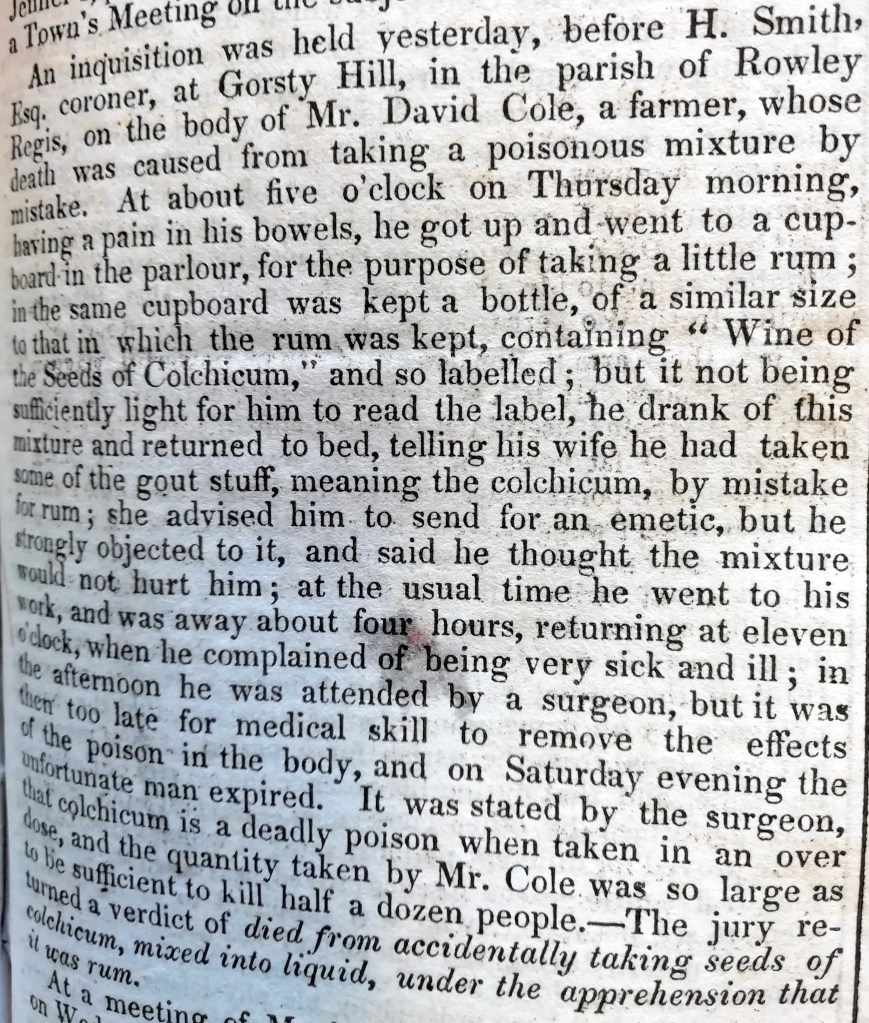
A note in the Register , added by the Vicar, says “Poisoned by drinking a composition which his wife retailed as a specific for the gout”. How about that for a damning story in a few words? I had to know more. I did some sleuthing and found a newspaper report in the Wolverhampton Chronicle dated 14 March 1832.

David Cole had woken at about five o’clock in the morning, with a pain in his bowels and had gone to get a nip of rum to settle his stomach. The ‘specific’ made by his wife, was called ‘seeds of Colchicum’ and was stored in the same cupboard as the rum in a similar bottle. The bottle containing the mixture was labelled “Wine of the Seeds of Colchicum” but it was not sufficiently light for him to read it. When he returned to bed he told his wife he had taken some of the gout mixture and she was concerned and wanted to get a physician to purge him but he strongly objected to this, saying that he did not think the mixture would hurt him. He went off to work as usual but returned four hours later at 11.00am, feeling ill and very sick and took to his bed. He died two days later. The surgeon who had attended him later on the afternoon he was taken ill could do nothing and told the inquest that he had taken ‘enough of the mixture to kill half a dozen people’. The jury returned a verdict that he “died from accidentally taking seeds of colchicum, mixed  into liquid, under the apprehension that  it was rum.”

Copyright Wolverhampton Chronicle.

 He left his wife Charlotte with thirteen children, the youngest David baptised in June 1832, after his father’s death so it seems very likely that Charlotte was heavily pregnant when her husband died.  However, the oldest were old enough to be already working, one as a butcher and others on the farm and she stayed there, listing herself as a farmer for many years after that. I wonder whether she carried on selling her remedies?

But doesn’t this little story actually tell us quite a lot about them? Yes, she was a farmer’s wife but also a herbalist of some knowledge and known as such to local people. I wonder who taught her? Perhaps a family skill? When I looked into it, seeds of Colchicum is still listed by present day herbalists as a treatment for gout but with warnings that it is toxic in large quantities and may cause death. And, to my geat surprise, when I recounted this tale to a genealogist friend who has recently had extensive heart surgery, she responded immediately that “Colchicum is still recommended by the NHS! When I saw my consultant a couple of weeks ago, he recommended colchicine for gout”. So an extract of Colchicum is still used by the NHS today. Charlotte Cole actually knew her stuff, it seems.

Copyright: Glenys Sykes

And there were few remedies for painful gout in those days, if I remember correctly. Presumably she was known to local people for her remedies, hence the Vicar’s somewhat judgmental comment that she sold the remedy. But they didn’t have pharmacies as we know them then, no picking up a remedy at the chemist or pharmacy as we might and probably most people couldn’t afford to consult doctors.

How devastating for Charlotte to have witnessed this tragedy, her husband killed by her own remedy and to have suffered the reproaches of someone like the Vicar and possibly others for something that was not her fault.

A Methodist chapel in Perry’s Lake?!

Once upon a time there was a Methodist Chapel in or between the hamlets of Gadds Green or Perry’s Lake. Who knew? There is no trace of it on any of the maps I can find but it is listed on the censuses, between Perry’s Lake and Gadds Green , in 1861 and 1871.

I first noticed when transcribing the 1871 Census for Perry’s Lake and Gadds Green that between the two hamlets there is a line which says “Primitive Methodist Chapel”. It is not mentioned in the 1881 Census but in the 1861 Census it is there, again listed between Perry’s Lake and Gadds Green both times but this time called Gadds Green Chapel. Not mentioned in the 1851 Census (although Thomas Barnsley, aged 29, living in Perry’s Lake and born in Rowley Regis, gave his occupation as “Methodist Local Preacher and labourer at Stone Quarry”.

However, in an 1844 Preaching Plan for the Dudley Circuit which is on the ‘My Primitive Methodist’ website, Perry’s Lake is among the Chapels listed as having two services each Sunday at 2.30 and 6pm.  Also listed is Rowley  – one service each Sunday at 6pm, though it is not clear where this chapel was, possibly services held in a private house or a rented room or even the open air, as neither Knowle nor Hawes Lane chapels are recorded as having been in operation by this date.

The Preaching Plan is an interesting document, showing the burgeoning vitality of the Methodist church in those days with a list of more than 36 chapels in and around Dudley with a few paid ministers who walked long distances to conduct services and in excess of 80 local preachers in the area, including several women.  And that was only the Primitive Methodists, there were several other types of Methodists, plus Baptists, Congregationalists, Quakers, Unitarians and others all apparently thriving.

The chapel was also noted as ‘Gads Green’ on a list of Chapels, drawn up in 1867, which is again on the My Primitive Methodist website. So it definitely existed between 1844 and 1871. It would be interesting to see the 1887 OS 6″ to the mile map , just to see whether it was still there then but I can’t find this map online or in print anywhere at the moment.

The earliest 6″ OS map I have at present is dated 1904 and I can’t see a chapel marked on there in Perrys Lake or Gadds Green. There is a Chapel Cottage in Gadds Green as late as the 1911 Census but a chapel isn’t mentioned then. So I wonder whether the local Methodists transferred to other chapels, the nearest being Hawes Lane or The Knowle, both less than a mile away and surely less than a mile apart! 

I found online this bit of history about the Knowle Chapel (Eric Bowater giving the information in 2019).

“The first beginning of Knowle Methodist Church met in the small kitchen of a local house,for the sum of 1s 6d.around 1860. As the membership grew it moved into a farm building in Brickhouse Farm a short distance away. Once again the membership grew and so it was decided to build a church of their own. A Church was now to be erected on the present site and was opened in December 1869 called Ebenezer. In 1890 new trouble arose with undermining which affected the chapel. The last meeting held in the chapel was held in 1907.The present church which was built in front of the old one 25th September 1907 and was a United Methodist Church.”

The Knowle site would have been quite close to the hamlets and accessible across the fields so if the earlier chapel closed people might have moved to the Knowle chapel. Reg Parsons, who grew up on Turner’s Hill, told me that he had never heard of a chapel there but that there was also a ‘tin chapel’ at Oakham, opposite the pub there so that may also have provided a spiritual home for some local people when the Perry’s Lake chapel closed.

There was an Ecclesiastical Census on 31st March 1851 (this can be downloaded free of charge from The National Archives) but many small chapels appear to have been omitted and I have been unable to find a chapel I can identify as Perry’s Lake or Gadd’s Green. The entry for St Giles shows figures for attendance which, frankly, I find rather suspect.  An extract is shown here.

Copyright: The National Archives

I find it difficult to imagine 600 people at morning service with 400 children at Sunday School, 1100 people all crammed into St Giles Church for the afternoon service with 400 children at Sunday school (again) and another 100 in the evening in a rented room – such neat round figures, 1000 and 1500 people?! The return for Dudley St Thomas gives figures of 800 and 700 attending services but that for Reddal Hill claims much more modest figures of 149 at church with  223 at Sunday school in the morning with 259 and 223 respectively at later services.

As we have just entered the season of Lent, it is perhaps timely to note that several clergy, in their returns for this census (and clearly anxious that their attendances should not be underestimated by the powers that be for the future), pointed out that the date chosen for the Census was the middle Sunday of Lent.  The note shown below was attached by one local Clergyman. It reads “The reason that attendance at the church appears smaller on the 30th Mar than the average is that the day is Mid-Lent Sunday, commonly called Mothering Sunday. A day much observed in this district by parents having their children and friends around their tables on this day and providing the best in their power for them.”

Copyright: The National Archives

What a picture that conjures in a few words. And a clergyman apparently much in tune with his congregation, however humble.  I can remember my mother telling me as a child that Mothering Sunday was the one day of the year that domestic servants were allowed to go home to visit their mothers, often taking them gifts of food from their employers or spring flowers gathered along the way.

One nearby Anglican clergyman noted bitterly on his return, the ‘scourge of those Dissenters so prevalent in this locality’ and blamed them for his poor attendance figures – showing the hostility of some clergy to their independently minded parishioners. Nonconformists were not popular at that time with the Anglican church, generally seen as rebels and ignorant troublemakers to be corrected and brought back to the Anglican church. A history of Birmingham Road Methodist church in Blackheath recounts that their meeting started in the 1840s in a rented stable in Siviters Lane in Rowley. Dissenters, as they were known, were regarded as the ‘off-scouring of life’, the very scum of the earth’ and, on one occasion when they were unable to pay the rent for the room above the stable, they were not allowed to use the room so sang and prayed in the street outside. A note in the Register for the burial of my 5xgreat-uncle at St Giles in 1794 reads “William Rose, never came to church tho’ often warned and kindly exhorted, died suddenly”. I wonder how kind those exhortations were?  To me, it seems very likely that William Rose was a Dissenter, a Methodist and that was why the Vicar was trying to lure him back.

So the hamlets of Perrys Lake and Gadds Green were fortunate to have a chapel of their own to worship in. Worship in their chosen style was an important part of life for our ancestors then and even small hamlets like Perry’s Lake had chapels – I wonder where it was? Any information would be very welcome.

Might it, just might it, have been behind the cottages in the part of Perry’s Lake which people still remember being called ‘Heaven’?

Families in the Lost Hamlets 1841-1881

There are 13 families who were living in the hamlets of Perry’s Lake, Gadd’s Green and Turner’s Hill area for all five censuses which I have so far transcribed. All are familiar Rowley names:

Cole, Cutler, Darby, Foster, Hill, Hipkiss, Levett, Parkes, Redfern, Simpson, Taylor, Whitehall/Whittall and Woodhouse.

A further 9 families had moved in between 1841 and 1851 and were in all four of the 1851-1881 Censuses:

Barnsley, Detheridge, Edwards, Hadley, Harcourt, Ingram, Jones, Knight, Ocroft, Payne and Timmings/Timmins.

Four families were in the 1841-1871 Censuses but had moved on by 1881 – Badley, Downing, Round and Siviter.

When time permits, I will check where these families had moved to.

Certainly there will have been marriages between these families and they were most likely closely interrelated over those years.

This information will be updated as more censuses are transcribed.

The ‘Lost Hamlets’ of Rowley Regis

Rowley Regis was once a small ancient village on the top of a very high hill in South Staffordshire, now apparently absorbed seamlessly into the enveloping sprawl of the West Midlands conurbation. It has had several other municipal designations due to local Government re-organisations in the last century but historically, it was in South Staffordshire – that’s what it said on my school exercise books, so I know! The other, less defined, description is that Rowley Regis was in the Black Country, that nebulous area of industry, metal working, mining, quarrying and sheer hard work and where probably most of the population lived in what we would think of now as poverty. 

Although Rowley Regis is an interesting name – yes, at one time, part of it was held by the King, possibly as a hunting area – by the 19th century the village was of no particular note, the main industries in and around the village were quarrying the very hard ‘Rowley Rag’ stone from various quarries on the hill, mining and, above all, in Rowley itself, wrought iron hand nail making which was mostly carried out in small ‘shops’ at the back of houses, and involved whole families, men, women and children from about the age of six. The metal working skills of the local people and the plentiful supplies of the raw materials required meant that, as the Industrial Revolution progressed, hand nail and chain making fell into history and the metal working and myriad engineering skills gave rise to a vast landscape of heavy and polluting industry, canals, mines and brickworks.

I am a Rowley girl. I was born there, grew up and was educated there and lived there until I was eighteen. My parents and grandparents and many of their forebears were born there too and lived out their lives there. My mother told me stories about the area when I was growing up and I started my family history research in about 1980 and have been working on it ever since.

Retired after many years working in local government and now living in the West Country, during the first Covid lockdown I volunteered to transcribe parish registers at home from photographs for FreeREG, for Rowley Regis and Blackheath, the adjacent town which developed just down the road in the mid 19th Century, after the glebe lands belonging to the church were sold. This has included many non-conformist registers, which have never been available online previously.

Very quickly I noticed that many of the family names in those registers were familiar although some of them I had not come across for many years, since I moved away. But I had been at chapel and school with those names! It was also apparent from the Registers and from the various censuses that as well as the village proper, there were a number of hamlets on the edge of the village, some large and some small, and that families tended to stay within these hamlets or nearby. They appear to have been close-knit little communities. Some of my ancestors seemed to stay very firmly in and around the hamlets of Perry’s Lake, Gadds Green, Tipperty Green and Turners Hill, for example, which were very small settlements barely a mile from the village church and within half a mile of each other.  Gradually as houses were built, new roads opened, transport improved  and development spread, addresses were formalised and house numbers began to appear in the parish registers and censuses and some of the old names for the hamlets became less significant.  

There is a very active and informative Facebook page about memories of Rowley Regis and Blackheath, the town. Recently one person asked on the Facebook page where Gadds Green was, because Poppy memorials were being placed near the homes of soldiers who had died in the First World War and one of those had come from Gadds Green. She couldn’t find any trace of it.  I had not realised until then that quarrying had completely obliterated Gadds Green, and much of Perry’s Lake and the houses on Turners Hill – they only existed now on old maps. Other local names do not even appear on maps – there has been some animated discussion on the page about where a place called ‘Finger-i-the-hole’ was and most local people will never have heard of Blackberry Town, which appears in the 1841 census.

Several of the local historians using the page were able to tell the Facebook enquirer where Gadds Green had been. But it seemed a pity to me that these lost hamlets, home to so many of my ancestors, have not only physically disappeared but are now fading from local memory. Through my various researches and transcribing church registers and censuses, I have gathered quite a lot of information about these places, who lived there, who ran the shops and pubs, where people worked and worshipped and who married who.

So I have decided to create a One Place Study about these ‘lost hamlets’. My study will initially concentrate on the hamlets of Perry’s Lake, Gadd’s Green and Turner’s Hill, clustered to the North-West of the village centre, during the period 1840-1921, principally looking initially at censuses, parish registers , maps and what these can tell us about the people who lived there. The people and their lives are my main interest. I suspect that it will expand both geographically and in time period as particular information and resources come to hand. I will be posting to this site with new posts about aspects of life in the hamlets and will add maps and photographs in due course.

And by starting a One Place Study, now registered with the Society for One Place Studies, hopefully information about the people who lived in those ‘lost hamlets’ and in due course, others of the ‘lost hamlets’ can be preserved in a study where other people can also contribute their knowledge to it and where later researchers can find the answer to ‘Where was Gadd’s Green?’.