Gosh, that has brought back a brain worm memory of Noel Harrison singing ‘windmills of your mind’ in the 1960s, that will be going round in my brain all day now…
Am I the only person who finds that their life seems to move in circles? Where somewhere that you lived or played decades ago suddenly comes back into your life?
How could I have known, when I played in the playground of Rowley Hall Primary School, hearing the bull that sounded when blasting was taking place in the quarry above us, that one day, that quarry and the communities that lived around it, would become such a fascinating subject for me?
When, as a teenager in the 1960s, I stood at the window on the top floor of the classroom block at RRGS, or at the top of the drive on Hawes Lane on my way home after a school day, looking out at lovely sunsets over the busy streets and furnaces of Old Hill, Cradley and Netherton and the whole industrial landscape, I could not have guessed how keenly, more than half a century later, I would be poring over old maps and looking at how those communities interrelated.
Family and Kinship
A few weeks ago, when I was summing up my Family Study of the Hill family, I talked about Kinship and how the little community in Gadd’s Green seemed to encapsulate so much of what sociologists now understand about how kinship binds people together.
The word kinship kept coming back into my mind, after I had finished the article, nagging at me that it was a familiar word to me. And when I really thought about it, a book title came into my head. ‘Family and Kinship in..?’ was it East London? I had had it on my bookcase for years but it had gone a while ago. How did I come across that book, as I had never been a sociologist? Then I remembered.
When I first left home at eighteen, I moved to Birmingham and lived for about three years at the Birmingham Settlement in Summer Lane, Aston. Settlements were charitable organisations which began in the 1880s and were residential houses, in which educated people, often university students, lived in poor industrialised areas and offered everything from classes and clubs to legal advice and health support to the local population. The Birmingham Settlement, which I came across through a friend who lived there, was in a modern building and had something like sixteen rooms, some for tw0, most for one, plus a warden and staff. There was one payphone, under the stairs – how did we manage? We had a small kitchen but the residents generally ate together in the dining room in the evening, big old circular tables for eigt, great for chatting with different residents – a tiny but feisty local lady called Lil was the cook – and the Settlement, mainly through the residents, provided services to the surrounding area, including meals on wheels, youth club, legal advice and other outreach services. At weekends, there was a cold supper on Saturdays and on Sundays, residents were encouraged to cook for everyone. Which was how I learned to cook for sixteen+…
It was a good place to live for me then. Quite a few of the residents were students but not all. I was a junior civil servant, in the salubrious Aston office of the Department of Health and Social Security and there was at least one barrister living at the Settlement, who was very involved with the legal advice service provided and who roped in various colleagues to assist. The social workers at the Settlement would have been very familiar with ‘Family and Kinship in East London’ where there were, of course, numerous settlement houses, the book had been published in 1957, only ten years before I arrived at the Settlement and is now acknowledged by many sociologists as being one of the most influential sociological studies of the twentieth century .
I got to know the Aston area at a time when the City of Birmingham was working through a program of demolishing the tens of thousands of back to back houses in the city and rehousing the occupants in mostly high rise blocks of flats locally, or several miles away out at Chelmsley Wood – which must have felt like the other side of the moon for residents who had grown up in these tiny houses without sanitary facilities but with strong communities, shops, pubs, factories, chapels. Some were relocated still in Aston but in very different surroundings.
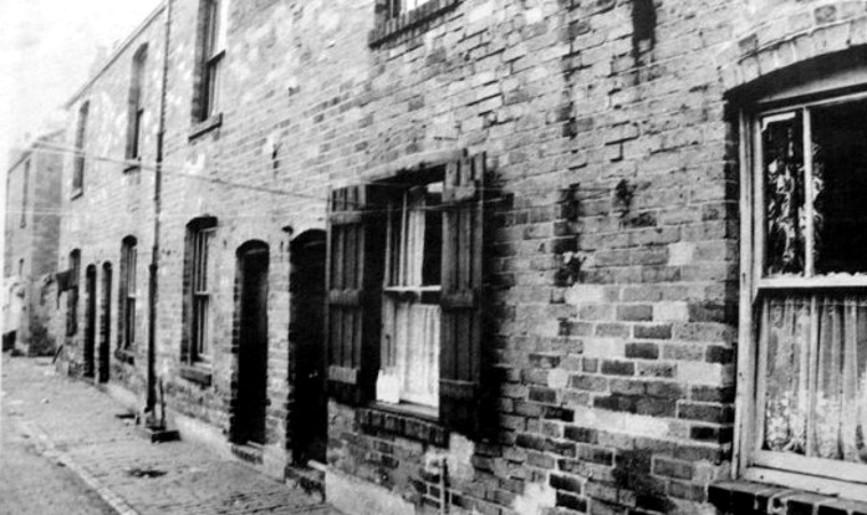
Copyright unknown: these back to backs were in Nechells, close to Aston but very typical of their type. Through the entry, behind these was a court of similar houses, built back to back with these houses.
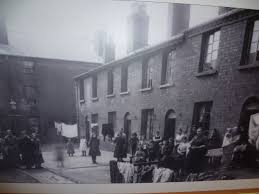
Copyright Slum Collection, Birmingham Libraries. A back courtyard in Duddeston, Birmingham, about 1905.
On one occasion I remember visiting one old lady in one of the remaining back to back cottages with her hot lunch. She was a friendly lady and told me how she dreaded being moved out of the house she had lived in for most of her life, probably into a high rise flat. She told how friends who had moved had found themselves isolated because although there would be six or eight flats on one floor in the tower blocks, you did not get to know your neighbours because people did not stand at their front doors and chat as they did in the back-to-backs. There were supermarkets but no corner shops. No pets allowed. You did not see people coming home from work along the street or the children of your neighbours playing outside. And the lifts often broke down so the less mobile really were trapped in their flats. So they were lonely.
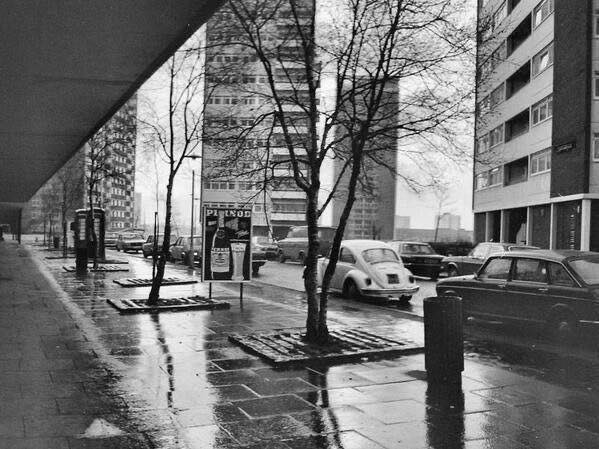
Newtown in the rain, 1970. Copyright Carrie White.
Whereas, where she was, she knew her neighbours, they had raised children together, went to the same schools and chapels, shopped in the same corner shops, drank in the same pubs. All that was wiped away with these wholesale relocations. In her little house, she could feed the birds in the yard, she had her cat for company and if she had a problem, she banged on the back of the fireplace and her neighbour behind would hear her through their fireplace and come round to help. Yes, this did make an impression on me for me to remember so vividly half a century later. I do understand the absolute necessity and drive to improve living conditions from those thousands of back-to-backs, not only in Birmingham but in other cities too but somehow something so important seemed to have been lost in the process.
I was very involved with the legal advice centre which operated at the Settlement on Monday evenings, always busy. I did a sort of triage in greeting people and finding out what they needed advice on so that they could be directed to the most appropriate legal adviser. So I learned a lot about social conditions and one of the books which I came across was ‘Family and Kinship in East London’. Eventually I moved from the salubrious Aston Office of the DHSS to the fresh pastures of the Smethwick office… lucky me! But I was by then flat sharing in leafy Edgbaston which was another most enjoyable period in my life.
And now here I was, more than fifty years after I left the Settlement, ordering a copy of ‘Family and Kinship in East London’ and reading it with fresh interest. Many of the aspects of family and kinship and community in Bethnal Green where large numbers of people were being relocated because of slum clearance to Essex, had a great deal in common with the community in both Aston and the Lost Hamlets. I think that the people of Rowley village and Blackheath, mostly living in the 1800s and early 1900s in sub-standard cottages and houses, (though no actual back-to-backs in Rowley, to the best of my knowledge), were very fortunate that so much new housing was built in the immediate area of their homes, between Rowley and Blackheath so that people had the advantages of spacious new houses with bathrooms, kitchens and gardens, but were still close to their families, chapels, shops and pubs so that their communities and lives were not fractured in the way that the lives of many people in Birmingham and Bethnal Green were.
So I had come full circle to considering how important neighbours and kinship were in these communities, just as I had seen in Aston half a century before.
Housing and Renewal
And then, in the last few weeks, I have been working on another branch of the Alsops, the family of Mary Ann Alsop and her husband William James Vaughan whose family lived at Rounds Green. But he and his brothers, sons, nephews and extended family moved to Aston and Duddeston in Birmingham where they were involved in metal working, edge tool making and later electro-plating. So suddenly, looking at censuses and trade directories, I was finding familiar addresses that I had got to know during my Settlement time and where the Vaughan/Alsop family had their numerous factories and homes.
So I ended up last week sending for the reprint old OS maps of the area so that I could see exactly where they had lived and worked and found my self finger walking the streets which had, mostly, still been there when I lived there. So many small factories were still shown on the OS maps from the early 1900s. So I had come full circle again, back to my haunts of my late teens and seeing the area in my mind’s eye in a way which I had never revisited it before. Google street view is just not the same, some areas can be picked out but most of it has changed again in those fifty years!
Looking at the areas of back-to-back housing in Birmingham on those maps, though really showed how dense the housing was and I know that it was seriously sub-standard by any measure. But it also made me aware that, poor though many of the cottages in Rowley Parish would have been, I suspect that few of them would have approached the level of universal over crowding and deprivation that existed just a few miles away in Aston where so many Black Country people moved for work.
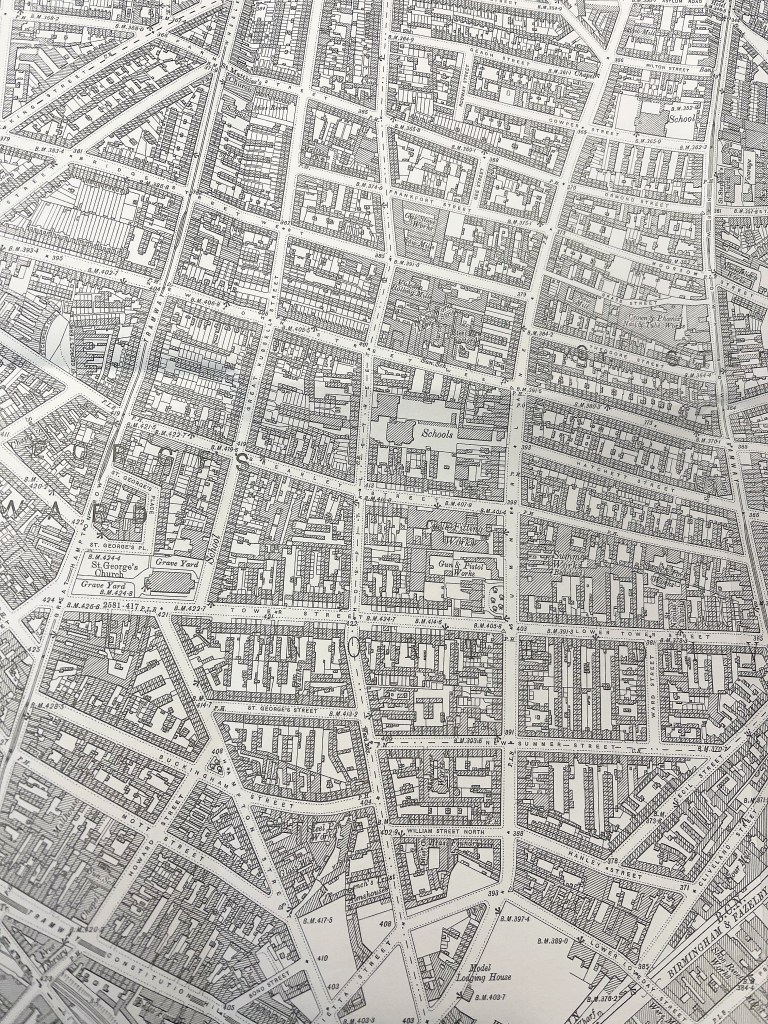
Copyright: Alan Godfrey Maps. This 1902 OS Map of Aston shows the density of housing, intermingled with industry, schools and churches. Summer Lane runs from top to bottom of the map, just to the right of the centre. The Settlement was later built next to a Gun and Pistol Works on what is shown as a garden area with trees- something of a rarity on this map – on the corner of Summer Lane and Tower Street. The building is still there but is in other uses now.
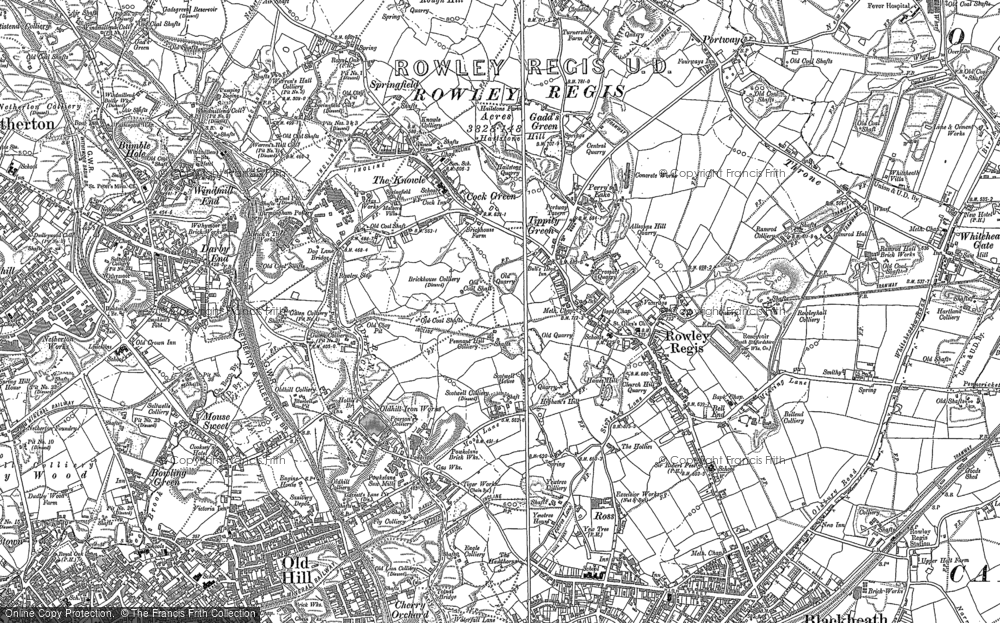
Copyright: Alan Godfrey Maps. This 1902 OS Map of Rowley Regis shows some denser patches of development in places such as Blackheath and Old Hill but large areas of open space, too. what a contrast to the Aston map.
Those old haunts are still popping up in my research – only recently, I found that one of the Vaughan sons had died in Earlswood, a beautiful leafy part of Warwickshire that I also lived in briefly and which I hadn’t really thought about much since I moved away from there in 1973. And another branch of the family, I discovered, had lived for some years in a little town just eight miles from where I live now. And the latest instalment of my blog, about the Vaughans, had me remembering the times when I lived in Birmingham and shopped in the city centre, catching the No.6 bus from Bull Street, out to Summer Lane.
This week, I obtained a book called ‘Homes for People’ by the legendary Carl Chinn which is about Council Housing and Urban Renewal in Birmingham 1849-1999 which looks most interesting. And I came across references to his books about the streets of Brum, as he calls it, their history and names – I already have his books on the Black Country and several others of his books – so a book order for one or more of these is going in. The sheer amount of local knowledge in that man’s head, combined with his gregarious nature and his passion for sharing and encouraging interest in the area, is extraordinary, not least because his interest is in the ordinary people of the area and their lives. He is probably best known now for his work on the Peaky Blinders but it is his other work which I find much more impressive.
Oooh, and I see he has a series of Podcasts online called ‘Our lives, our stories’ which I must have a look at, in my copious free time – I haven’t really got into podcasts much but these look interesting… https://www.facebook.com/ourlivespod
Every single one of us, Carl Chinn declares, has a story to tell – so this piece has been about part of my story.
But yes, circles, circles, the windmills of my mind – my life is going round in circles!

