The next family on the 1841 Census were the Redferns, Joseph Redfern, his wife Ann Maria (nee Priest) and their elder children. This is how the family were shown in that Census:
| Christian name | Surname | Age | Occupation | Whether born in County | Whether born in Scotland, Ireland or Foreign Parts |
| Joseph | Redfern | 35 | Labourer | Yes | |
| Maria | Redfern | 40 | Yes | ||
| Sarah | Redfern | 12 | Yes | ||
| Eliza | Redfern | 10 | Yes | ||
| Joseph | Redfern | 8 | Yes | ||
| William | Redfern | 6 | Yes | ||
| Ann | Redfern | 4 | Yes | ||
| Thomas | Priest | 15 | Yes |
Thomas Priest was Joseph’s stepson, the illegitimate son of Ann Maria Priest.
No need for much new research on this family, I did a family study on this family in August and September 2023 which appears in two posts.
There is little new to be added to that information since then so any interested readers may wish to refresh their memories from those posts:
The Downing Family
Next along the hill were Joseph Downing and his family, Joseph was shown as a farmer. This was their household:
| Christian name | Surname | Age | Occupation | Whether born in County | Whether born in Scotland, Ireland or Foreign Parts |
| Joseph | Downing | 55 | Farmer | Yes | |
| Nancy | 50 | Yes | |||
| Isaac | 25 | Yes | |||
| Sarah | Ward | 20 | Female Servant | No | |
| Hannah | Harris | 30 | No |
The Downing Family
There are many Downings in and around the Rowley area, also in Tividale, Sedgley, West Bromwich and Harborne and many of them were owners or tenants of land and therefore more prosperous than most of the average nailers. They intermarried with other families of similar status in the area. Many of them left Wills which, where I have been able to find them, have been the source of a lot of information.
Joseph Downing (1784-1849)
Joseph’s age in the 1841 Census indicates a birth year of about 1786, bearing in mind that in this census adult ages were rounded down to the nearest five years. I had hoped that I would be able to find Joseph in the 1851 Census which would give me a more accurate year but although I found Nancy still on Turner’s Hill with various others, she was now a widow. So now I knew that Joseph had died between 1841 and 1851, into the period of civil registration so easier to find – this should give me an age from the death registration and from the burial if I was able to find that. There were several death registrations of Joseph Downings in the Dudley Registration District between those dates but only one of them was for a Joseph of the right age. Joseph Downing, aged 65, died in the first quarter of 1849 which brings me back to a birth date of about 1784. And this Joseph Downing, aged 65, and – according to the entry in the Burial Register – of Turner’s Hill was buried at St Giles on 2 January 1849. So this is definitely the right Joseph Downing. The Burial entry indicates that he died of a diseased heart.
So now I could look for a baptism of this Joseph. I searched FreeREG for a period from 1780 to 1790 in Rowley Regis and the surrounding area within 7.5 miles. Somewhat to my surprise, there were only two such baptisms – one in 1780 in Himley – a little early if our Joseph’s age was recorded correctly and quite a long way away – and one in Rowley Regis on 11 January 1784. It seems likely that this second Joseph was our man. This Joseph was the son of Paul and Ann Downing, who had also had a daughter Mary baptised at St Giles in 1782. There were no other baptisms for this couple anywhere that I could find which makes me suspect that the Hannah Downing who died in July 1786 and was buried at St Giles may have been this Ann – Ann and Hannah are sometimes used interchangeably. Or it is possible that she was the Ann Downing who was buried at Halesowen in December 1792. The only other trace that I could find at that point of Paul Downing was a burial at St Giles in November 1823, aged 81 (giving a birth year of about 1742) and giving his abode as Turner’s Hill. So, again, that ties in neatly with this family.
Joseph’s father Paul Downing (1742-1823)
Paul is not a common name in the Downing family nor indeed in Rowley Regis at this time, as far as I can see, but I was able to find a marriage of a Paul Downing on 14 February 1782 to Ann Darby – another name associated with Rowley – by Licence (which indicates a certain level of wealth or social standing). The marriage is listed as having taken place at Rowley Regis cum Clent but I cannot see it in the Rowley Regis Register so presumably it took place at Clent. And there was a Paul Downing baptised at Harborne on 10 February 1765 who may have been connected in some way, he was the son of John and Martha Downing. The only Paul Downing that I have been able to find in the area in the 1841 Census was a blacksmith living in Hagley Road, Harborne so it does seem that the Downings in that area used Paul as a Christian name, more so than the Rowley Downings. However, I know from other sources (of which more anon) that this Joseph Downing was the nephew of Isaac Downing of Turner’s Hill.
There was a Paul Downing living on Turner’s Hill from at least about 1782 until 1823. I found a newspaper report that in 1821, John Fox, John Priest, Samuel Perry, Benjamin Perry and Ephraim Rollason of Rowley were convicted at Stafford Assizes for housebreaking at the dwelling-house of Paul Downing in April 1821 and stealing a coat, two sheets and other goods. This does make me think that Paul Downing must have been living in a house of a larger than average size for the village. It would not have taken four men to burgle the average small cottage in the village.
For this crime all four were sentenced to death at Stafford Assizes, which seems a harsh sentence to our modern thinking although I have been able to discover that these death sentneces were commuted and they were all were transported to Australia instead. This was in the period of demobilisation of the army after Waterloo, leading to mass unemployment, poor harvests owing to bad weather, the Peterloo Massacre in 1819 and the introduction of the Corn laws which had a disastrous impact on the poor. Who knows what motivated these four men to break in and steal, though it does not appear that they managed to steal very much and the death sentences seem draconian to us today. I had also noted that Ephraim Rollason appeared in court a couple of times previously charged with stealing so this may not have been a one-off. I cannot help thinking that it would not have made the Downing family very popular amongst the poorer families of the hamlets who lost four of their men.
There was also Isaac Downing on Turner’s Hill at this time, he was buried at St Giles in November 1814, of Turner’s Hill, aged 75, having died of asthma. It seems that Paul and Isaac were brothers. And the maps which appear to have been prepared in connection with the Enclosures in Rowley in the late 1790s or very early 1800s, also show Paul Downing as tenant of land on Turner’s Hill. Looking back, I see that I wrote at some length about the Downings (amongst other families) in my piece about the farms in the Lost Hamlets.
Joseph and Nancy
Joseph Downing married Nancy Whitehouse – again by Licence – at St Giles, on 29 March 1810, the witnesses to this marriage were Mary Downing and William Whitehouse, a really Rowley union, it seems! A daughter Emma was baptised at Rowley on 17 September 1810, daughter of Joseph and Nancy, followed by Matilda in 1813, Isaac in 1815, Mary Ann in 1818, Lavinia (1821-1824), Amelia in 1823 and another Lavinia – Lavinia Augusta in 1829. In all of these baptisms except the first, Joseph was described as a ‘Beast Leech’.
The ‘beast leech’
A ‘beast leech’ is an old term for a man practiced in healing cattle, which would have included horses and other livestock – a veterinary or cow doctor. The term is first recorded, according to the Oxford English Dictionary, in 1627 in a dictionary by F Holyoake and that dictionary thinks that it was a term used in English Regional dialect. Certainly there are numerous examples of this term in Yorkshire in the mid 1700s but clearly it was not limited to there.
In archaic and Old English the word leech meant a physician, healer or surgeon and the term apparently comes from the Old English word lǣce which meant healer. This use had apparently fallen mostly out of use by the 17th century. But, as we can see, the use certainly continued in connection with animals.
And it must have been that there was a need for people experienced and knowledgeable in the treatment of sick animals in most farming communities. Doubtless some horse dealers, grooms, cattle dealers developed their own expertise in dealing with ailments and problems in their own specialisms but the description of Joseph as a beast leech over a period of years suggests that he was recognised as having particular skills in this area and earning his living from his practice and, since his uncle was also a beast leech, this may have been a family occupation. There is certainly continuing evidence that the Downing family were particularly interested in cattle breeding. But by 1841 Joseph was described simply as a farmer in the census.
So this was the only Census in which Joseph Downing appeared, and he died, aged 65, on the 27th December 1848 and was buried at St Giles on 2 January 1849. There is much more to say about Joseph Downing, so much that this will be a separate post about him, soon!
Nancy Downing (nee Whitehouse) 1788-1855
Nancy Whitehouse was born in about 1788-79, which fits with both the age shown in the 1841 and from the age of 62 which she gave in the 1851 Census. There were four Nancy Whitehouses baptised between 1785 and 1790 in the immediate area of Rowley, two in Wednesbury and one in Kingswinford. But the fourth one was baptised in Rowley Regis on 11 May 1788 which is a close fit, she was the daughter of William and Hannah Whitehouse. As Nancy gives her place of birth in the census as Rowley it seems likely that this is our Nancy.
In 1851, as a widow, Nancy was still living on Turner’s Hill. With her then were her surviving children Isaac (35), Mary (30), Amelia (27), Lavinia (21), along with a Thomas Whitehouse, aged 63, a widower shown as a ‘resident’ (not shown as a relative) and two servants – Joseph Hodgets who was a manservant, aged 20 and Caroline Wasnidge, a general servant aged 35. All of these were born in Rowley Regis except Thomas who was marked born in Staffordshire and Caroline who was born in Birmingham.
As I have often noted previously, those prosperous enough to employ servants often employed people from outside the village.
In 1851, all of the children listed were unmarried. Nancy‘s occupation was listed as an annuitant, as were her three daughters while her son Isaac was shown as a ‘proprietor of lands, etc’, as was Thomas Whitehouse. No mention of farming at all. So this was definitely a well-to-do family on both sides, it seems, owning land and wealthy enough to leave annuities for their unmarried daughters.
Where were the Downing daughters in 1841?
I was curious as to where the four girls, then 20, 17, 15 and 11 were in 1841 as they were not with their parents. The answer was that they, were with Thomas Whitehouse and a Mary Whitehouse, (b.1786, possibly his wife or his sister-in-law)at his home in High Street, West Bromwich. It seems very likely that Thomas was related to them in some way.
This Thomas Whitehouse was a Currier, these were skilled craftsmen, currying was the process of stretching and finishing tanned leather, using techniques of dressing, finishing and colouring to give the leather the desired colour. The leather was then ready to pass on to the finishing trades such as saddlery, bridlery, shoemaking or glovemaking. Walsall was at that time the capital of saddlery in England, plus the making of bridles and harnesses and leather goods, due to the proximity of lime pits used for tanning leather and metal industries supplying metal fittings so Thomas Whitehouse would have had a ready market nearby.
Whilst looking at the Whitehouse family, of whom there were many in this area, I noticed a list published in the Worcester Journal in 1845, of ‘members of the Dudley and West Bromwich Bank” which also showed their occupations and where they lived. There were seven Whitehouses listed among the investors: Richard from Oakham who was a Cattle Dealer (a source for Thomas’s hides, perhaps?); a Joseph and a John, both of Dudley and both canal carriers; a William and a William Frederick of West Bromwich, both Nail Merchants; Thomas of West Bromwich, a currier plus the representatives of a Samuel Whitehouse Deceased, also of West Bromwich and also a currier; and a William of Dudley and West Bromwich who was a Canal Carrier. There were no Downings listed among the Investors, perhaps merchants had more disposable capital than farmers, or perhaps they were more inclined to invest in banks. This is quite a close cluster of Whitehouses, who seemed – at least some of the time – to be close to each other in location and to be occupied in complimentary businesses. It is quite possible they were all related.
William and Hannah Whitehouse’s family
I looked to see what other children William and Hannah Whitehouse had had baptised at Rowley Regis around the time of Nancy’s birth. The first was Joseph in January 1775 which makes me think that William Whitehouse and Hannah Willetts were the couple who were married at St Philip’s, Birmingham on 14 February 1774. Then followed Samuel in 1777, William in 1780, Thomas in 1785, and Nancy in 1788. However, of these, I have discovered, from the Will of William Whitehouse (abt 1751-1827), Nancy’s father, that his son William died in 1812, sons Samuel and Thomas both died in 1822, leaving only his eldest son Joseph and Nancy herself of his children. So whoever the Thomas Whitehouse shown in the 1841 Census was , he was not Nancy’s brother, though he was very likely related.
So the Thomas and Samuel Whitehouse who were both curriers in West Bromwich must have been brothers from another or at least more distant twig of the Whitehouse family.
But it was when I was looking at these Whitehouse men that I came across a fascinating story of which more in my next post. But what I discovered for certain was that Samuel and Nancy and Thomas Whitehouse –were definitely siblings and that Joseph Downing had married Nancy Whitehouse in 1810 and Samuel Whitehouse had married Mary Downing in 1813 – Joseph’s sister and only sibling. So the families were double in-laws and clearly very closely connected!
Nancy Downing died in 1855 and was buried at St Giles on 22 August that year, her age given as 67 and her abode as Turner’s Hill. The person making the burial entry noted that the cause of death was General Decay. Thomas Whitehouse, appears to have died in May 1852 in Rowley Regis and was buried in West Bromwich, which had previously been his business base and home for many years.
Isaac Downing (1815-1874)
Isaac was still living on Turner’s Hill in 1851, listed within his mother’s household and described as a “Proprietor of Lands, etc.” His sisters Mary, Amelia and Lavinia were also living there by that time and Thomas Whitehouse.
In 1861 Isaac was still there – although it is clear from the Census that the family were not living at Turner’s Hill Farm, as this is shown separately and occupied by a different family. The Downing abode was a private house. By this time, his mother and Thomas Whitehouse had died and Isaac, by then 42 and unmarried, was shown as the Head of the Household and described as “Principal Occupation: General Superintendence of the cultivation of Land”. Again his three sisters were also living there, all single.
By 1871, Isaac was 55 and shown as a Landowner and Farmer, employing 4 men. His sisters Mary and Lavinia were still with him, all of them unmarried.
Isaac died in 1874, aged 59 and was buried at St Giles on 20 November 1874. He was the last surviving issue of Joseph and Nancy.
Joseph and Nancy’s daughters
From another source, I learned that Mr and Mrs Samuel Whitehouse had been married six or seven years, and had no children of their own. Joseph Downing, who had married Samuel Whitehouse’s sister had four or five children. Samuel Whitehouse had reportedly taken Joseph and Nancy’s eldest daughter Emma from her birth and had adopted her as his own. He had also sent two other of Downing’s children to school, Whitehouse expressing his great satisfaction at what he had done, and saying what good children they were.
Samuel Whitehouse and his brother Thomas both died in 1822 when Emma was about 12 but I suspect that at least one of the girls, if not all, remained with his widow Mary nee Downing. Another Thomas Whitehouse, a bachelor, married a Mary Whitehouse, a widow, by Licence in West Bromwich on 27 September 1827 and I suspect that this is the Thomas and Mary Whitehouse with whom the girls were living in 1841.
Just to add to the confusion about this family, when this second Thomas died in 1852, in his will he referred to his ‘late brother Samuel’ – don’t you just love it when branches of families use all the same Christian names…? And in the same Will, the second Thomas left property to a William and Joseph Whitehouse of Rowley, some minor bequests and the residue of his estate to the Downing children, naming Isaac as his nephew. Isaac was Mary’s nephew – but not his but it appears he considered Isaac as such.
Of Joseph and Nancy’s children then, their second daughter Matilda (1813-1837) had died of fever on 24th October 1837, aged 24 and of The Heath, West Bromwich (which was where Samuel and Mary Whitehouse were living at the time of his death and presumably where she continued to live) and was buried at West Bromwich. Emma (1810-1850) had died of Typhus Fever at Great Malvern, unmarried, aged 40 in 1850 and was also buried at West Bromwich. Amelia (1824-1861) died in 1861 and was buried at St Giles on 22 July. Lavinia Augusta (1829-1873) died on 12 March 1873 of Heart disease and was buried at St Giles on 18 March; her sister Mary Ann (1818-1873) died ten days later on 22 March 1873 of Hepatitis and Fatty degeneration of the heart and was buried at St Giles on 27 March. Isaac was described in their Probate Records as ‘Brother and only Next of Kin’. Isaac died the following year on 15th November, with Angina Pectoris given as the cause of death. None of the children married.
So, this particular family ended in 1874. What a contrast with some of the other, poorer families in the area who left dozens of grandchildren and great-grandchildren. I have not yet managed to find all of the Wills for this branch of the family and suspect they may be at Stafford Record Office but will continue to try to trace them for the further information they contain.
What sort of social life did the family lead?
I wondered what sort of life Isaac lived, whether the unmarried siblings were reclusive or whether they took part in life in the village.
What was Turner’s Hill House like?
I found an advertisement in the County Advertiser in 1875 which was placed by the Trustees of the Will of this Isaac Downing. This refers principally to the site as a
“Freehold Mineral Property , comprising a desirable Residence and Premises and several closes of very rich Pasture Land adjoining, with an extensive bed of Rowley Rag stone therein, together with the very valuable MINES and MINERALS thereunder ,situate at Turner’s Hill”.
This was being sold at Dudley in One lot and there was some further description of the house itself.
“That very desirable and compact FREEHOLD ESTATE, called TURNER’S HILL, with residence, pleasure grounds, luxuriant Shrubberies, Greenhouses, Vineries, Stables, Coach-Houses, Outbuildings, Entrance Lodge and Premises occupied therewith, and several closes of very fertile Pasture Land, with the Outbuildings and Cottages adjoining, the whole lying well together and comprising an area of nearly 20 acres.”
This surprised me, I had not realised how extensive the estate was. I wonder where the Entrance Lodge was? On Turner’s Hill or somewhere off Portway? So I looked on the NLS webpage and found this image of the top of Turner’s Hill which shows Turner’s Hill Farm quite clearly. And I now think that the estate called Cloudlands on this map is Turner’s Hill House – it fits the description above very well, it has shrubberies and gardens, it has outbuildings and cottages, it has an entrance lodge!
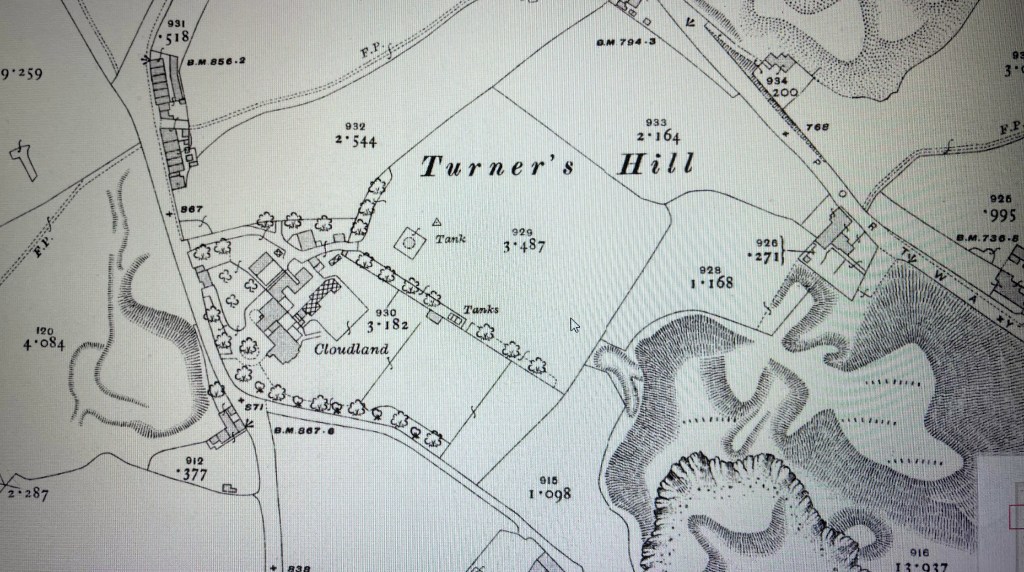
Copyright: National Library of Scotland Creative Commons Re-use.
Another paragraph notes “This property is situated in the very centre of the South Staffordshire Coalfield, and the Earl of Dudley’s new sinkings at Lye Cross are only a few yards from it’s boundary, proving beyond doubt the existence of Thick Coal of the very best quality under the entire Estate.”
The earlier Isaac Downing probably lived here, too and the previous news snippet shows that he had an estate worth £1,000 a year, so presumably this was that estate. The 1800 Enclosure Map shows Isaac Downing and Paul Downing as tenants in this area. And was this the house that attracted the attention of four burglars? In another context, in 1822, I noted Joseph Downing was described as a “opulent farmer”. So it appears that the family were quite wealthy.
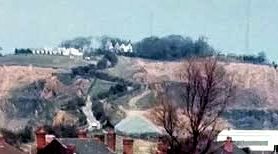
Copyright: Mike Fenton.
Comparing this photograph with the map and the position of the road up between the quarries, I think that the large white house in the middle of the picture is probably Turner’s Hill House, much nearer to the edge of the quarry when this picture was taken than when the map was surveyed in the 1890s.
So the family lived in some luxury and they owned most of the surrounding cottages. I was surprised that there is very little evidence of live-in servants, in the census entries there is usually only one or at most two servants, I would have expected coachmen, grooms or gardeners, with the buildings and gardens listed.
From the description in the advertisement, I now think that all of this little group of cottages was associated with Turner’s Hill House and the farm – and quite possibly most of the people living in the houses worked for the Downings in one way or another. Perhaps Mary Cooper the washerwoman or Hannah Cooper or Phoebe Brinton living a few yards down the lane, actually worked for the Downings? I had wondered why a washerwoman would live so far from the village so that she or her customers would have to carry laundry a long way. But if she worked in a laundry at Turner’s Hill House, that would make more sense. So, in effect, this seems to have been another self-contained enclave in a similar way to Gadd’s Green, but associated – at least in the mid to late 1800s with the Turner’s Hill House estate, and the Downing family. This makes sense in many ways since the hamlet was so physically removed from neighbouring hamlets by a steep hill.
Isaac’s social standing
There is not much to be found about the Downing daughters and their lives. But their brother was easier to track. I noticed that in 1851, Isaac was one of several gentlemen appointed as assignees to hold finds in a bankruptcy case of a local Bank which implies a certain respectability and good standing in the financial community. In 1855, Isaac was shown as one of the Churchwardens which implies at least some association with St Giles’s, the Parish Church. In 1856 Isaac was listed as holding a General Game Certificate and certainly his father Joseph and his uncle Samuel went shooting regularly. In 1867, Isaac Downing, of Turner’s Hill was elected as a member of the Royal Agricultural Society which indicates a continuing interest in farming then.
In the 1851 and the 1871 censuses the family had visitors staying who were named Crump and it seems that these were the children of the then Vicar William Crump so clearly the family had some social contacts within the village.
The Cattle Connection
You may remember, when I listed Whitehouses in business, earlier in this piece, I mentioned a Richard Whitehouse from Oakham who was a Cattle Dealer. This must have been very close to the Downing estate and it is more than possible that Richard was related to Nancy, Joseph Downing’s wife.
The Sale of the Shorthorn Cattle Herd
I wonder whether this was a particular Downing interest, as in 1872, shortly before Isaac Downing died, there were numerous reports including one in the Gloucester Journal that he and another man Mr John Harwood of Winterfold, Kidderminster, sold their
“entire herds of shorthorn cattle, consisting of about 65 Head of Bulls, Cows and Heifers, of the Oxford, Waterloo, Wild Eyes, Kirklevington, Lally, Blanche and Surmise Tribes. More than half the Stock are directly descended from animals bred at Kirklevington, and the others largely inherit this highly fashionable blood. The sale includes the magnificent Bull Third Duke of Claro (23729), whose Sire and Dam were both by the celebrated Seventh Duke of York (17754(), and the superb Bull Eighth Duke of Geneva (28390). The young stock are by these excellent Sires, and the Cows and Heifers are served by them. Catalogues, with pedigrees may be had on application to Mr Strafford of Euston Square, London or of Mr Minett, at Winterfold.” Clearly this was no small local sale and generated considerable interest and the animals sold for what were described as “extraordinary prices” .
Another report in that Journal a little later describes the sale itself. The sale was held
“in one of the large parks connected with the residence of Mr John Harward at Winterfold, situated about three miles from Kidderminster. There was a large attendance of Shorthorn Breeders from all parts of the country. Among those present were the Lord Fitzhardinge, the Earl of Bective, Colonel Kingscote, MO, the agents of Lord Skelmoersdale, Mr Brogden MP, Colonel Morris (New York), the agent of the Duke of Devonshire, the agent of Sir W Throckmorton, etc.
Luncheon was served, prior to the sale, to which about 500 sat down. Five hundred! That must have been quite a sight to see! This picture shows Winterfold House in 1850 so it was a very grand establishment.
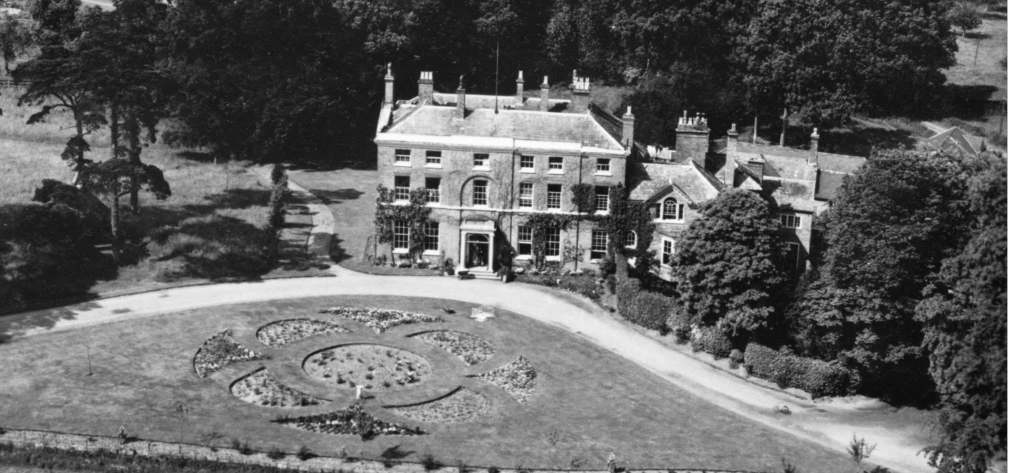
Copyright: Historic England.
At the sale, one animal, named as the Fifth Maid of Oxford, was sold to Mr G Moore of Whitehall, Cumberland for 900 guineas. Lot 26 was sold to a Mr Bowley of Cirencester for £210 guineas and was said to be one of the purest and best bred animals of that tribe in the Kingdom. In the eight-bull department – Lord Fitzhardinge (Of the Berkeley Castle estate near where I live now) had started the bidding for the Duke of Geneva, at £900 guineas but it was eventually purchased by Mr Leney of Kent, for the sum of £1,650 guineas, said to be a “remarkable fine animal, fully developed in every particular, healthy in appearance and well fed.”
The sums raised by the sale were: Cows £15,458; heifers £12,343; and the bulls £3,114. The average price per head was £253/16s. the highest on record.
So if Isaac was closely involved with the breeding of this herd, he was clearly a serious breeder. John Harward was also named as one of the executors of Isaac’s Will so they were at least good friends although I have found no evidence that they were related.
John Harward was a solicitor and apparently a temperance campaigner and preacher. He only outlived Isaac by a few years but I noted that there was another very large sale of Harward’s cattle in 1880 and almost continuous reports of sales of individual beasts after Isaac’s death so clearly Harward had not sold his entire herd at the sale detailed above, perhaps only ones jointly owned with Isaac Downing. I have also learned from the National Archives catalogue that a cache of legal documents relating to the “Downing/Whitehouse/Crump family” was deposited at Stafford Record Office by Harward and Evers, Solicitors of Stourbridge, John’s company, so I am considering whether a visit to Stafford Archives might be worthwhile at some point.
Summary
Generally building the pictures of the lives of this family was slow because they were not very well documented anywhere, as other families often are on Ancestry or Find My Past. Perhaps this is because there were no descendants, so there was less reason for family historians now to document them so fully.
But it appears that Isaac, at least, was not completely reclusive and played a part in society and was, clearly, extremely wealthy in comparison with most residents of the village. It seems rather sad that this wealth and privilege did not prevent all the children of Joseph and Nancy remaining single and dying at relatively early ages and without leaving children to continue their legacy.
One more post to come on the residents of Turner’s Hill in 1841 and another on a particular episode the Downing/Whitehouse families!

